NBER WORKING PAPERS SERIES
CHANGES
IN THE STRUCTURE OF WAGES
IN THE PUBLIC AND PRIVATE SECTORS
Lawrence F. Katz
Alan
B. KruegerWorking Paper No. 3667
NATIONAL BUREAU OF ECONOMIC RESEARCH
1050 Massachusetts AvenueCambridge, MA 02138 March 1991
We thank Kevin M. Murphy for providing us with data from the
March Current Population Surveys and for helpful discussions. We
are grateful to Ana Maria Lusardi and Kainan Tang for expert
research assistance, and to Phillip Schneider and Andrew Klugh
for providing us with data from the Central Personnel Data File
of the U.S. Office of Personnel Management. We have benefitted
from the coments of Claudia Goldin, Ron Johnson, and seminar
participants at Harvard, Princeton, UCLA, UCSD, MIT, and the
University of Chicago. Financial support from National Science
Foundation Grant SES9010759, the Princeton Industrial Relations
Section, and an NBER Olin Fellowship in Economics is gratefully
acknowledged. This paper is part of NBER's research program in
Labor Studies. Any opinions expressed are those of the authors
and not those of the National Bureau of Economic Research.NBER Working Paper #3667
March 1991
CHANGES IN THE
STRUCTUREOF WAGES IN THE
PUBLiC AND PRIVATE SECTORSABSTRACT
The wage structure in the U.S. public sector responded
sluggishly to substantial changes in private sector wages during
the 1970s and 1980s. Despite a large expansion in the
college/high school wage differential during the 1980s in the
private sector, the public sector college wage premium remained
fairly stable. Although wage differentials by skill, in the
publicsector
were fairly unresponsive to changes in the private
sector, overall pay levels for state and local government workers
were quite sensitive to local labor market conditions. But
federal government regional pay levels appear unaffected by local
economic conditions. Several possible explanations are
considered to account for the rigidity of the government internal
wage structure, including employer size, unionization, and
nonprofit status. None of these factors adequately explains the
pay rigidity we observe in the government.Lawience F. Katz
Alan B. Krueger
Department of Economics
Industrial Relations
Littauer Center Section
Harvard University
Firestone Library
Cambridge, MA 02138
Princeton University
I. Introduction
Recent research has documented sharp changes in the structure of wages
and substantial increases in wage dispersion in the United States over the
last twenty years.1 The college wage premium, after narrowing in the 1970s,
increased markedly in the l9BOs. Wage differentials by experience expanded
from the early 1970s to the late l980s, and residual wage inequality
(earnings dispersion within detailed education-experience groups) increased
for both men and women in the l970s and l980s. Typically, however, this
literature has not determined whether these wide-ranging changes have been
confined to the private sector or whether they are shared by public and
private employees alike, We document in this paper that overall wage
structure changes in the l970s and 1980s have been driven by events in the
private sector. These private sector changes provide a natural benchmark for
examining how public sector wages respond to movements in labor market
conditions.
We examine three questions concerning public sector pay flexibility in
the federal government and in state and local governments. The first is the
extent to which public sector wage policies respond to market changes in
skill differentials. The second is the extent to which government pay levels
respond to differences in local labor market conditions. In particular, we
explore how wages in different branches of government are affected by changes
in private sector skill premia and by local private sector wage levels and
unemployment rates. Finally, we examine the implications of government pay
polices for the ability of government agencies to meet their personnel
1Srudies examining recent changes in the U.S. wage structure include Blackburn, Bloom, and Freeman (1990), Bluestone (1990), Bound and Johnson (1989), Davis and Haltiwanger (1991), Juhn, Murphy, and Pierce (1989), Karoly (1990), Katz and Murphy (1990), Katz and Revenga (1989), and Murphy and Welch
requirements.
Answers to these questions are necessary to understand and evaluate the public sector personnel management systems, which directly affect the nearly one-fifth of employees in the United States who are employed by some branch
of government.2 Furthermore, government pay practices can have a substantial
impact on the operation of private sector labor markets in which the government is a major employer, such as the markets for health service
workers, scientists, teachers, and engineers, Smith (1977) has argued that
there are many reasons to suspect that ordinary market forces will not lead the government to optimally alter its personnel and compensation practices.
Many observers have already voiced concern that the government (especially
the federal government) will be increasingly unable to recruit highly skilled
employees -- such as scientists, engineers, and judges --
unless
its wagestructure responds to changes in the private sector wages (e.g. Campbell and Dix, 1990; National Commission on the Public Service, 1989).
In section II, we analyze a variety of micro-data sets from the Current Population Survey (CPS) and other sources to examine whether the government wage structure has, in fact, been rigid in the face of changes in the private
sector wage structure. We compare and contrast changes in wages by
education, experience, and gender in the public and private sectors during
the l970s and l980s. Despite the large expansion in private sector wage
differentials by skill level in the 1980s, we find that skill differentials
remained fairly stable in the public sector in the l9SOs. In particular, the
pay of workers at the upper part of the federal pay scale has fallen
2See Ehrenberg and Schwarz (1986) for a discussion of U.S. public sector labor market institutions and a critical survey of research on public sector labor markets.
3
substantially relative to "comparable" private sector workers, and the wages of less-educated employees of state and local governments have increased
greatly relative less-educated private sector workers. The sharp increase
during the 1980s in the college/high school wage differential of the l980s is almost entirely a private sector phenomenon.
In section III, we examine variation in pay across states in the private
and public sectors. Ceographic variation in pay at a moment in time is quite
similar for workers employed in the private sector and for those employed by
state and local governments. Changes in local labor market conditions (as
proxied by state unemployment rates) seem to have a similar effect on private
and on state and local government wage levels. We find that state and local
governments alter overall wage levels in response to economic conditions that
are likely to affect government budgets and the tax base. Their response is
similar to how private sector employers, operating in industries with
localized product markets, respond to changes in local economies. In
contrast to the responsiveness of their overall wage levels, state and local governments sluggishly adjust relative wages by skill category to shifts in
the private sector wage structure. Regional pay variation appears quite
different in the federal government. Here pay does not closely mimic local
wage structures and does not seem to respond to changes in local labor market
conditions. We present some evideoce that this rigidity owes to a single
national wage schedule for most federal government employees. In section IV, we explore several possible explanations for the
stability of public sector skill differentials in the l980s. We first
examine the roles played by employer size, nonprofit status, and
4
for wage structure rigidity in the government. Educational wage
differentials expanded sharply in the 1980s in large, private-sector firas
and in private sector industries dosinated by nonprofit firms. Furtheraore,
we find that public sector skill differentials increased auch less than those in the private sector even in the ten states with the lowest public sector
unionization rates. Finally, we briefly discuss other institutional
explanations for the relative rigidity of government pay structure. In section V, we empirically examine how increases in wage compression in the public sector relative to the private sector in the l980s has affected
public sector personnel outcomes. We analyze how wage rigidity in the
federal government has affected its ability to recruit and retain employees
of different skill levels. Job queues have indeed expanded for blue-collar
jobs and contracted for white-collar jobs in the federal government in the
l9g05. Furthermore, the federal government also seems to be having
difficulty in retaining college graduates whose skills are valued highly in the private sector.
II. Changes in Public and Private Wsge Structures Over Time
We use several individual-level data sets to compare wage structure changes in the U.S. public and private sectors over the last twenty years. Before turning to this micro analysis, we first examine longer-term trends in
the relative pay of public sector workers using aggregate data from the National Income and Product Accounts (NIPA) for the entire postwar period.
Figure 1 presents NIPA data on the ratio of total compensation, and of
0 ri
4-, (t, >..a
a) 4-, (U>
C-a
U
'-4.0
a
I I I I I I — 1 ——48
50
55
60
65
70
75
80
85
89
Year
Figure
1:
Public/Private
Pay
Patios,
1948—89,
NIPA
Data
5TT3
oWages,
Federal
Civilian
•
Total
Cornp,
Fed
Civilian
+Wages,
State
6
Local
cTotal
Camp,
State
&Local
1.45
-
1.4
-
1.35
-
1.3
-
1.25
-
1.2
-
1.15
-
1.1
—1.05
-
.95
-
.9
-
workers for 1948 to l989. Average pay has remained much higher in the
federal government than in the private sector or in state and local
governments, and trends in relative public sector pay by branch of government
were fairly similar over much of the period. From the mid l950s to the early
l970s, public sector pay rose relative to the private sector. The period
corresponds to a growth spurt in employment demand in the public sector as public sector employment steadily expanded from 13.1 percent of civilian employment (measured in full-time equivalents) in 1955 to 17.9 percent in
1975. Relative public sector pay declined in the late l970s as public sector
employment growth stagnated and the share of employment in the public sector
started a steady decline that lasted through the 1980s. Despite declining
relative employment, the relative pay of employees in state and local
governments increased in the l98Ds. The picture is less clear for the pay of
federal civilian employees relative to private sector workers. If one
examines wages and salaries alone, federal relative pay sharply declined in
the l980s. If, instead, one includes nonwage compensation, federal relative
total compensation increased because nonwage compensation (particularly
pension contributions) rose sharply relative to the private sector. As we
show below, the aggregate trends in the 1980s hide substantial differences in movements in relative public sector pay by education and skill group.
3The figure plots public/private sector ratios of pay per full-time
equivalent employee. Total compensation includes wages and salaries,
employer contributions to social insurance, and employer contributions to
private pension and welfare funds. The Federal Civilian sector includes
civilian employees of the Federal government and of government enterprises. The data used in Figure 1 are fros the U.S. Departsenr of Cossnerce, Bureau of Economic Analysis, National Income and Froducts Accounts.
6
A. gasic Relative Wage Changes. 1967-87
Our comparative analysis of wage structure changes begins with an
examination of movements in the college/high school wage differential by
sector. Many occupations in the government have few close private sector
analogues, if any. Thus movements in education differentials by sector
provide the most meaningful measure of movements in skill differentials in
the public and private sectors.
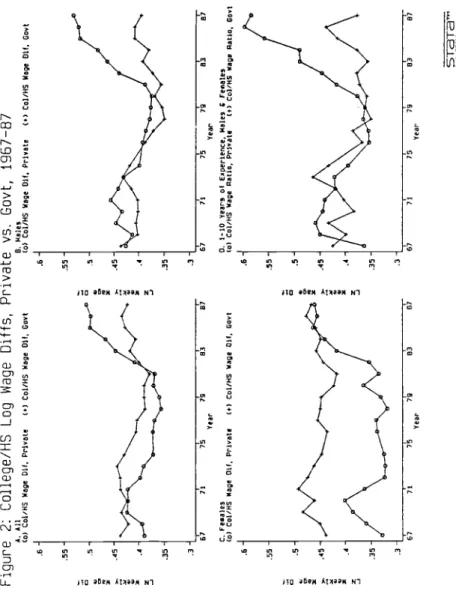
Panel A of Figure 2 presents a plot of the log weekly earnings
differential between college and high school educated workers in the
government and private sectors from 1967 to 1987. The earnings differentials
have been adjusted for changes in the age and gender composition of the
government and private sector labor forces. The plot is based on data from
the March CI'S Annual Demographic Files from 1968 to 1988. Relative earnings
of college graduates declined in both the public and private sectors in the
1970s. In contrast, a sharp increase in the average earnings of college
educated workers relative to high school educated workers occurred in the
'We define high school graduates as individuals with exactly 12 years of
schooling and college graduates as those with 16 or more years of schooling.
To generate Figure 1, we sorted the individual-level data on high school and
college graduates from the March CI'S Surveys into 64 cells based on sex, two
education categories (12 and 16 or more years of schooling), eight potential experience brackets (five-year intervals), and two sectors (private and government). The mean log weekly wages for full-time workers in each of these cells was computed. College/high school log wage differentials for each of our 32 sex-experience-sector categories are then given by the difference in these cell means for the college and high school workers in the category. The numbers plotted in Figure 1 are fixed-weighted averages of the college/high school log wage differentials for the relevant categories in each graph. The fixed-weights are the average share of the sex-experience group in total employment in all sectors over the entire 1967-87 period. The
March CI'S samples provide information on the earnings and weeks worked in the
calendar year preceding the March survey. The sample selection rules used in
the creation of the March CI'S extract are described in detail in Juhn, Murphy, and Pierce (1989) and Katz and Murphy (1990).
Figure
2:
Coilege/HS
Log
wage
Diffs,
Private
vs.
Govt,
1967—87
A. 0)) 8. Holes to) Cot/OS Wage Dl), PrIvate (0) Cot/HG 008e DII. Govt lot Cot/HG Wage CII, PrIvate to) Col/HS Wage DII. Govt .6 .55 .6 .55 5 45 .4 .3 .6 .550
0. .45 .4 .35 .3 67 1•t 7•g 83 87 Year c. Females to) Cot/OS Wage Ott, Prlvatl (0) Cot/OS Wage CU, Govt .3 67 71 75 79 83 81 Year 0. 1—50 Years 01 EapertenCe, 4481ev 8 Feeales Cal Cal/OS Waga RatIo, Private tat Cal/OS Wage ROUO, Govt .6 .55 .5 .45 .4 .35 67 71 757
03 07 Yea, .3 67 71 75 79 83 075TaTa"
private sector in the 1980s, with the college/high school wage differential
for males and females combined rising from by 15 log points from 0.36 in 1979
to 0.51 in 1987. But the gap in earnings between college educated and high
school educated workers in the government sector increased by only 3 log
points from 0.39 in 1979 to 0.42 in 1987. This rather moderate increase
reflected a combination of a constant differential in the federal government
and an increase of about 4 log points in the state and local government
sector. Panels B and C of the figure illustrate that from 1979 to 1987 the
college wage premium expanded by much less in the public sector than in the
private sector for both men and women. Finally, Panel 0 shows that this
divergence in relative wage patterns in the private and public sectors in the
l980s was most extreme for young workers.
The divergence in educational differentials between the public and
private sectors in the l980s could have occurred because of a relative
decline in public sector pay for highly educated workers, a relative increase
in the public sector earnings of high school graduates, or a combination of
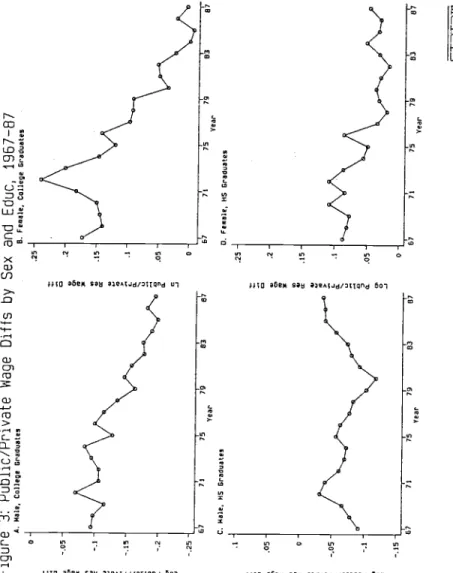
the two. Figure 3 plots trends in public/private wage differentials by level
of education. More precisely, the figure presents the difference between the
actual average public sector wage and the predicted average wage of public
sector workers if they were employed in the private sector (based on a
private sector wage regression) for each group of public sector workers. We
estimated a log weekly wage regression for private sector workers in each
year by gender and education group (high school and college) using the March
CPS samples for calendar years 1967-87. The regressions were of the form:
.25 0 Year
STaTa,'
Figure
3:
Public/Private
Wage
Diffs
by
Sex
and
Educ,
1967—87
A. Male, College Graduale B. Feaale, College Gradoates .25 —.05 -.1 -.2 -.25 &77
7
7
8') &1 Year C. Male, tIE Or000atea .16'
7'l7
7
&3 87 Year 0. Feacle, HO Eradoatea .2 .15 .1 .05 Year8
where W is the weekly wage rate, X is a vector of explanatory variables
including a quartic in experience (and dummies for individual years of
schooling beyond 16 years for college graduates), is the vector of
private sector coefficients for group j in year t. The public/private wage
differential for group j in year t is given by the average value for public
sector workers in group j of lnJ
-X1fi.
During the period of increase in the overall public/private sector pay
ratio from the late 1960s to the early 1970s, Figure 3 indicates that
public/private differentials increased moderately for all groups.
Furthermore, all groups shared in the decline of public sector relative pay
of the late l970s. Previous work has documented the decline in the public
sector wage premium from the aid-l970s to the early 1980s (Freeman, 1987;
Moulton, 1990), but it has not adequately examined how different educational
groups shared in this decline. In the 1980s, the public/private wage
differential continued to drop for college graduates, while the relative
position of male high school graduates in the public sector improved
substantially. The decline of relative public sector wages for college
graduates generated a large negative differential for males and eliminated
the historically large positive differential for females. At the federal
level, the wage premium for male college graduates also withers away,
underscoring recent concerns that the federal government is increasingly
unable to attract skilled professionals,
8. Detailed Analysis of Changes in Relative Wages. 1973-88
years of the Full Year Outgoing Rotation Group (ORG) files of the CE'S and the
May CPS 1973-1975 to estimate a series of wage regressions.5 These data sets
indicate in which branch of government a worker is currently employed, and contain usual weekly earnings and usual weekly hours on the current job.6
We divided the sample into eight subsamples by sex, experience (0-19
and 20+ years), and education (12 and 16 or more years of schooling) for both
the private and public sectors. Wage equations of the form
lnW —a. +b X. +e.
lit it it tjt ijt
were
estimated for each of the subsamples, where W is the hourly wage rate, Xis a vector of personal characteristics (education, two race dummies, an
5Each May CE'S from 1973 to 1978 contains about one-third as many
observations as the Full Year Outgoing Rotation Group Files, available since 1979. We pooled the May 1973 and 1975 CPS's together to provide a larger sample of data. The May 1974 tape that we were able to access lacked
information on level of government and wss not used.
6Wages each year were converted to 1988 dollars using the personal
consumption expenditures implicit price deflator (PCE). Workers who failed
to report usual weekly earnings (those with allocated wages) were dropped from the sample. One limitation of the CE'S is that edited usual weekly
earnings variable is topcoded at $999 in current dollars. The unedited usual weekly earnings variable, however, is top coded at $1,999, but this field is only available for the ORG sample after 1985. The following crude procedure was used to overcome the censuring problem. First, we calculated the mean log hourly wage rate of those in 1988 who had top-coded edited usual weekly earnings using the 1988 unedited weekly earnings variable. This figure was
then assigned to each individual in the 1988 CE'S whose edited weekly wage was
top coded. If few people are censored by the $1,999 earnings limit on the unedited field, this procedure will lead the expected value of the error in the regressions to be approximately zero. We used a similar procedure to deal with top coding in the 1979 and 1983 ORG samples. We converted the top coded amount in 1979 (1983) into 1988 dollars and used the distribution of the unedited weekly earnings variable from 1988 to calculate the mean log hourly wage rate in 1988 dollars of those ropcoded in 1979 (1983) and
assigned this figure to earh individual topcoded in 1979 (1983) .
Since
lessthan 0.2 percent of workers are topcoded prior to the late l97Os, we ignored
10
experience spline, SMSA, and part-time status), i is a subscript for
individuals, j indicates the individual's sector of eaployment (public or
private), and t
is
the year.7 The results are also given separately forfederal government workers and for state and local government workers.
The predicted wage rate each year for the four sectors (private,
public, federal, state and local) was calculated by the
gender-experience-education groups for a hypothetical worker with constant characteristics
--white,
full-time, selected experience levels, and residence in a metropolitanarea. That is, we formed the predicted wage
K [ln W, X° ] —
+
bX°.
where X° is the characteristics of the hypothetical worker. This approach
standardizes the wages comparisons for differences in these characteristics
between sectors at a point in time, and for compositional changes within
sectors over time.
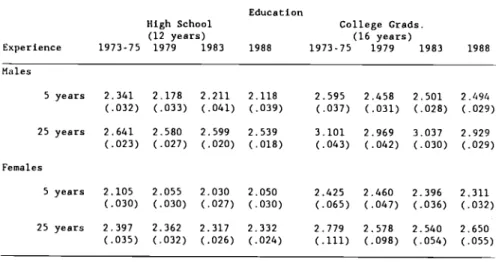
Table 1 reports these "regression-adjusted" means for men and women at
two levels of experience in the 1970s and 1980s. Because changes in the wage
structure are likely to occur more rapidly and most sharply for newly hired
workers on the "active labor market" (e.g., Freeman, 1977), our discussion
focuses primarily on the group of workers with little experience. As Smith
(1977), Krueger (1988a), and others have noted, federal workers earn more
than private sector workers, while state and local government workers (who
7The experience variable is defined as age minus education minus six.
Furthermore, we specified the experience effect as a apline function with two terms for each of our subsamples, with a break point in the spline function occurring at 10 years for the 0-20 year experience group and 30 years for the
Table 1: Estimated Mean Log Real Hourly Wage Rates
by Education, Experience, Gender and Sector
Class of Worker: Private Sector
Education
High School College Grads.
(12 years) (16 years) Experience 1973-75 1979 1983 1988 1973-75 1979 1983 1988 Males 5 years 2.197 2.182 2.017 1.967 2.505 2.472 2.414 (.006) (.006) (.005) (.005) (.011) (.010) (.008) 2.443 (.008) 25 years 2.565 2.573 2.518 2.467 2.975 2.940 2.919 (.008) (.008) (.007) (.007) (.021) (.020) (.016) 2.908 (.013) Females 5 years 1.915 1.905 1.839 1.800 2.178 2.212 2.233 (.006) (.005) (.005) (.005) (.020) (.013) (.009) 2.290 (.008) 25 years 2.067 2.080 2.053 2.053 2.288 2.270 2.265 (.009) (.008) (.006) (.006) (.041) (.032) (.024) 2.378 (.019)
Class of Worker: All Government
Education
High School College Grads.
(12 years) (16 years) Experience 1973-75 1979 1983 1988 1973-75 1979 1983 1988 Males 5 years 2.212 2.081 2.027 2.029 2.463 2.349 2.306 (.021) (.019) (.018) (.018) (.016) (.016) (.014) 2.310 (.015) 25 years 2.563 2.523 2.490 2.490 2.902 2.828 2.810 (.017) (.017) (.014) (.013) (.027) (.024) (.020) 2.795 (.017) Females 5 years 1.988 1.958 1.935 1.943 2.323 2.242 2.221 (.017) (.015) (.014) (.016) (.014) (.014) (.012) 2.258 (.011) 25 years 2.135 2.113 2.093 2.157 2.518 2.411 2.422 (.018) (.016) (.013) (.012) (.025) (.025) (.019) 2.468 (.016)
Table 1: continued
Class of Worker: Federal Government
Experience High School (12 years) 1973-75 1979 1983 Education 1988 College Grads. (16 years) 1973-75 1979 1983 1988 Males 5 years 2.341 2.178 2.211 (.032) (.033) (.041) 2.118 (.039) 2.595 2.458 2.501 (.037) (.031) (.028) 2.494 (.029) 25 years 2.641 2.580 2.599 (.023) (.027) (.020) 2.539 (.018) 3.101 2.969 3.037 (.043) (.042) (.030) 2.929 (.029) Females 5 years 2.105 2.055 2.030 (.030) (.030) (.027) 2.050 (.030) 2.425 2.460 2.396 (.065) (.047) (.036) 2.311 (.032) 25 years 2.397 2.362 2.317 (.035) (.032) (.026) 2.332 (.024) 2.779 2.578 2.560 (.111) (.098) (.054) 2.650 (.055)
Class of Worker: State and Local Government
Experience High School (12 years) 1973-75 1979 1983 Education 1988 College Grads. (16 years) 1973-75 1979 1983 1988 Males 5 years 2.170 2.054 1.999 (.025) (.022) (.019) 2.006 (.021) 2.398 2.289 2.233 (.018) (.018) (.016) 2.245 (.017) 25 years 2.497 2.495 2.429 (.023) (.021) (.017) 2.455 (.017) 2.739 2.699 2.646 (.032) (.030) (.025) 2.714 (.022) Females 5 years 1.928 1.921 1.904 (.021) (.016) (.016) 1.897 (.018) 2.307 2.215 2.193 (.014) (.014) (.012) 2.248 (.012) 25 years 2.029 2.029 2.031 (.020) (.016) (.013) 2.102 (.013) 2.485 2.391 2.403 (.026) (.026) (.020) 2.449 (.017)
Table 1: continued
Note: Each eatimate is from a separate cross-section regression for an education-experience-gender-sector group of log real hourly earnings on a linear spline of years of experience with a break every ten years, 2 race dummy variables, and dummy variables for metropolitan area and part-time status. The education classes
used are exactly 12 and 16 or more years of schooling; the experience classes are
0-19 and 20 or more years of potential experience. The regressions for college graduates include dummy variables for individual years of schooling. The
estimates for each group are the predicted values of the log hourly earnings
regression for that group evaluated at the indicated schooling and experience
levels and for a full-time, white employee living in a metropolitan area.
Sources: The data used are from the May 1973 and 1975 CPSs and the Full-Year 1979,
1983, and 1988 CPSs (Outgoing Rotation Groups). The samples used include wage and
salary workers who do not have imputed (allocated) earnings. Earnings are deflated
by the personal consumption expenditures implicit price deflator for GNP and are
in 1988 dollars.
I
11
dominate
the all government
category) earn less than observationallyequivalent private sector workers. The federal pay differential is
especially large for women.
The table also reinforces the findings of Figures 1 and 3 by
indicating that government workers' earnings (even for workers with a fixed set of characteristics) decreased substantially relative to private sector
workers between the mid and late 1970s. For example, from 1973 to 1979 real
government wages fell by 12% for high school educated men with five years of
experience, but fell by only 1.5% for similar private sector men. Inflation
eroded government workers' pay far more than it eroded private sector
workers' pay in the 1970s. In fact, time series analysis using NIPA data
indicates a general tendency for public/private sector pay ratios to decline during periods of rapid price deflation (Freeman, 1987).
In contrast to the l970s, the figures for the 1980s show a huge decrease in the real wage rate of less-educated workers in the private sector, while less-educated workers in the government experienced a much smaller decline in
real wages. For young, male high school graduates the real average wage rate
fell by more than 20% in the private sector in the decade between 1979 and 1988, while the real wage of similar government workers fell by only 5% over the same time period.
Evidence on changes in nonwage compensation suggests that the relative
gain in total compensation made by less-educated government workers in the
1980s was even greater than indicated by the wage changes in Table 1. Data from the NIPA indicate that from 1979 to 1988 the nonwage share of total
compensation increased from 15.5 to 21.8 percent in the federal government
12
share actually fell slightly from 15.4 ro 15.1 percent over the same period
in rhe privare sector. The relative decline in nonwage benefits in the
private secror is likely to have been most important for less-educated
workers. For example, tabulations from the May 1979 and May 1988 CPS Pension
Supplements indicate that the share of workers with 12 years of schooling
covered by employer health insurance declined from 46 to 42 percent in the
private sector end increased from 56 to 61 percent in the public sector from
1979 to 1988.8 No similar relative private sector decline in health
insurance coverage for college-educated workers is apparent: the fraction of
employed college graduates covered by health insurance increased from 75 to
78 percent in the private sector and from 80 to 84 percent in the public
sector over this period. Thus the consideration of nonwage benefits is
likely to have expanded public sector compensation gains for less-educated
workers in the 1980s and may not have greatly affected public/private sector
relative compensation changes for more-educated workers.
The wage patterns shovn in Table 1 imply that the college/high school
log wage differential for males with 5 years of experience increased from
0.29 in 1979 to 0.48 in 1988 in the private sector. In the public sector
over the same period, the wage differential remained fairly stable increasing
by only 0.01, from 0.27 to 0.28. Similarly, experience differentials for
high-school workers increased by much more in the 1980s in the private sector
than in the government.
Women who were college graduates in the private sector experienced
substantial gains in earnings in the 1980s, while earnings remained
relatively constant for college educated women in the public sector. As a
8These tabulations were provided to the authors by Jonathan Gruber.
13
result of the latter trend, young college educated women, who earned 15% more b
in
rhe government than in the private sector in the early 1970s, now earnslightly less in the government than in the private sector.
In general, the trends detailed in this section suggest that the government sector has been fairly unresponsive to the major swings in the
wage structure that occurred in the private sector in the 1980s. As a
consequence, the government wage structure has become even more compressed
relative to the private sector. The adjustment has been most sluggish for
recent labor market entrants with advanced degrees.
Another important trend worth noting is that in the early 1970s more than 65% of college educated female workers were employed by some branch of
government, but by 1987 only 42% of all college educated women (and less than
30% of those with 1 to 5 years of potential experience) were employed by the
government. Although the government remains an important source of
employment for well-educated women, it clearly has decreased in importance. Furthermore, female college and high school graduates gained approximately 8-14 percent on males with similar levels of education and experience in the
private sector in the l980s; the analogous groups gained just 4 to 8 percent
in the public sector. Thus, despite the comparable worth movement in the
public sector in the 1980s, private sector employment and earnings growth for
women have been largely responsible for the substantial narrowing of the gender gap in earnings since the late l970s.
C. Wame Differentials in the Federal Government. 1976-88
14
difficult to draw precise conclusions about changes in educational wage
I
differentials in the federal government, we use a large extract of micro-data
from the Central Personnel Data File (CPDF) of the U.S. Office of Personnel
Management (DPM) to analyze changes in the college wage premium in the
federal government from 1976 to 1988. This extract contains over 1.4 million
observations and includes information on workers' annual salary, tenure, age, occupation, and other characteristics for a 10 percent random sample of full-rime, permanent General Schedule-equivalent and blue-collar workers in the federal government for even-numbered years from 1976 to 1988.
We used the CPDF to estimate cross-section regressions by gender and
year for samples of workers with exactly 12 and exactly 16 years of
schooling. The dependent variable is the log annualized salary, and the
independent variables are a quartic in potential experience (age -
years
ofschooling -
6),
three race dummies, seven interaction terms between a collegegraduate dummy variable and dummy variables for experience brackets (0-5,
6-10, 11-15, 16-20, 21-25, 26-30, and 31+ years), and an interaction term
between the black dummy and the college graduate dummy. The estimated
college/high school wage differentials by gender and experience from these
regressions for 1976, 1980, 1984, and 1988 are presented in Table 2.
Table 2 indicates that the college wage premium expanded only moderately
in the federal government in the l98Ds. In contrast to the greater than 20
log point increase in the college/high school differential for young workers
in the private sector, the college wage premium increased by only about S log
points for those with less than 5 years of experience in the federal
government. Increases for more experienced workers were also much more
moderate than those for the private sector.
Table 2: College/High School Log Wage Differentials for Full-Time Workers
in the U.S. Federal Covernmenr 1976-1988
Experience Group 1976 1980 1984 1988 Males 0-5 years 0.291 (0.008) 0.280 (0.010) 0.287 (0.010) 0.327 (0.009) 6-10 years 0.322 (0.005) 0.336 (0.006) 0.299 (0.006) 0.328 (0.007) 16-20 years 0.383 (0.006) 0.368 (0.006) 0.377 (0.005) 0.347 (0.005) 26-30 years 0.368 (0.006) 0.334 (0.007) 0.362 (0.006) 0.373 (0.006) Females 0-5 years 0.343 (0.006) 0.341 (0.007) 0.370 (0.008) 0.399 (0.008) 6-10 years 0.395 (0.008) 0.388 (0.007) 0.397 (0.009) 0.405 (0.007) 16-20 years 0.317 (0.014) 0.358 (0.012) 0.365 (0.009) 0.371 (0.007) 26-30 years 0.295 (0.013) 0.242 (0.013) 0.243 (0.012) 0.283 (0.011)
Note: The reported estimates are from cross-section regressions of log annualized
salary on a quartic in experience (age -
years
of schooling -6),
3 race dummies,7 interaction terms between a college graduate dummy variable and dummy variables for experience brackets (0-5, 6-10, 11-15, 16-20, 21-25, 26-30, and 31+ years), and an interaction term between the black dummy and the college graduate dummy.
Separate regressions were run for each of the indicated years by gender for samples containing Federal workers with exactly 12 or exactly 16 years of
schooling. Each reported estimate is the coefficient on the interaction term
between college graduate status and the indicated experience bracket dummy
variable. The numbers in parentheses are standard errors. Sample sizes for males
(females) are 62,091 (40,511) in 1976; 59,718 (44.171) in 1980; 65.189 (47,829) in 1984; and 64,936 (52,875) in 1988.
Source: The data are from the U.S. Office of Personnel Management's Central
Personnel Data File (CPDF) and cover full-time, permanent CS-and-equivalent and blue collar federal employment.
15
D. Changes in Public/Private Sector Wage Differentials by Percentile
Civen the compression in government pay relative to the private sector
nored above, there has been a great deal of concern that the government is
unable to recruit qualified workers at the high-end of the skill
distribution. This concern is especially strong in the federal government,
as demonstrated by the formation of the National Commission on the Public
Service to study this issue. Consequently, we next contrast trends in pay at
the upper and lower ends of the earnings distribution in the government and
the private sector.
Figure 4 plots the federal/private log hourly wage differential by
percentile for full-time college and high school graduates by sex for 1979
and 198g. These plots compare the log hourly earnings of federal and private
sector employees who hold the same relative position within their respective
earnings distributions. The plots use wage residuals to control for
differences in the wage distributions arising from differences in the age, location, and race coapcsitions of the workforces in each sector.
Specifically, we estimate regressions of log hourly earnings on a quartic in
years of potential experience, eight region dummy variables, two race dummy
variables, and a metropolitan area dummy variable. Separate regressions are
estimated for full-time, private-sector workers in four education-sex groups
in 1979 and in l98g. Wage residuals for each individual in the federal and
9The two education groups examined are college graduates and high school graduates. The earnings regressions for college graduates include two dummy variables for 17 and for 18 or more years of schooling. Since we are interested in looking at the entire wage distribution and since a substantial fraction of workers in some groups in 1988 have edited usual weekly earnings
that are top coded at $999 (e.g., over 20 percent of male college graduates 4
are
top coded in 1988) , we use the unedited usual weekly earnings variable—2 -.25 —3 lb 2b 3o ib sb 60 7b so gb ido Percent lie C. Males, 12 Years of Scnoolln 0 1 1979 (5)
l8B
lb 20 30 40 50 607
eo gb,d
Percentile 0. Females, 12 Yea,! of 00080lin 1 1979 181 198-C-
III
liii,,
10 20 30 40 50 60 70 00 90 100 PercentileFigure
4:
Federal
Govt/Private
(Residual)
Wage
Diffs
by
Percentile
A. Males, 16 or more Years of Schooling B. Females, 16 or more Years of Schooling 1 1 1979 (5) 1988 1 I 1979 1,1 1909 .35 .3 .25 .2 .15 .05 0 -.05 -.15 .4 .35 .25 .15 .05 .35 .3 .25 .2 .15 .1 .05 0ib
20 30 40 50 6bib
80 gb 100 Percentile5TaTa''
16
private sectors are given by the difference between actual and predicted log
hourly earnings. Predicted earnings for an individual are calculated using
the individuals observed characteristics and the estimated coefficients from
the private sector earnines function for that individuals education-sex
group.
Figure 4 illustrates pay compression in the federal government relative
to the private sector. It is clear that the earnings advantage of federal
workers is much greater at the bottom part than at the top part of the
earnings distribution in each group. Panel A shows that for msles with
college degrees the substantial earnings premium of federal workers in the
bottom fifteen percent of the distribution remained steady from 1979 to 1988,
but the relative earnings of federal workers declined at an increasing rate
as one moves up the earnings distribution. From 1979 to 1988, the earnings
of college-educated males in the top quintile of the federal government
earnings distribution fell by approximately 10 percent relative to private
sector workers in comparable positions in the earnings distribution. In
fact, the log (residual) wage differential between the 90th percentile and
10th percentile workers increased by 0.07 in the private sector and declined
by 0.03 in the federal government for male college graduates from 1979 to
1988. Panel B shows a similar pattern for college-educated females.
Figure 5 uses the same approach as Figure 4 to display wage
differentials by percentile between state and local government and private
for 1988 in our analysis of wage changes by percentile. The wages of individuals with usual weekly earnings top coded at $999 in 1979 and at $1999
in 1988 are adjusted by multiplying the wages of such workers by 1.40.
Since changes at the very top end of the (residual) earnings distribution appear to be quite sensitive to the treatment of top coded wages, we truncate
the plots presented in Figures 4 and 5 at the 95th percentile.
—
—
.—
-.
e
—-—
-
———
———
-—
—-
---—-———-
p .3 .25 .2 10 28 3b 40 50 60 7b eb gb ado Percentile 0. resale,, 12 Years at ScYeYlin I 1979 (41 198 20 abo
so so 7b ob ab ado Percentile .25 .2 Is .1 .05 0 -.05 —.1Figure
5:
State
C
Local/Private
(Residual)
Wage
Outs
by
Percentile
A. Hales, (8 or mere Veers 5! SchoolIng 8. resale,, 16 or sore Years of Schoa11e 1 a 1979 C.) 1986 I 1 1979 +1 1909 .3 S -.15 .3 .25 'Is .1 .05 -.05 —'I -'IS to 20 30 ib so so ob eb 9o ida Percentile C. Hales, 12 Years al Scoosling I I 1979 Ia) 1008 3 .15'I
.05 —.05 —'I —.15 ab 20 3b 40 sb sb 7b Wo ab ido PercentilesTaTa"
17
sector wotkers for 1979 and 1988.10 Panel A of Figure 5 shows some small
gains at the bottom end of the distribution and small losses at the top end
for male college graduates in state and local governments relative to the
private sector. Panel 8 of Figure 5 indicates a significant decline in wages
relative to the private sector for female college graduates in the top half
of the earnings distribution in the state and local sector.
In contrast, panels C and D of Figures 4 and 5 show a quite different
pattern for high school graduates. For high school educated workers the
premium for working in the federal government increased throughout most of
the earnings distribution for both male end females in the l980s, but
decreased at the upper end for males. The earnings of high school graduates
in state end local government increased relative to private sector workers
throughout the distribution.
Taken together, Figures 4 end S tell strikingly different stories for
low-paid end high-paid workers in the government relative to the private
sector. Over the lest decade, less-educated workers fared extremely well in
the government relative to the private sector, while highly-educated federal
workers lost ground. Upper-tail federal workers now earn substantielly less
then upper-teil private sector workers. In the state end locel government
sector, pay compression reflects improvements in wages for less educated
workers relerive to the privete sector, rather then sharp declines in the
wages of highly educated workers. These patterns suggest thet it should have
become more difficult to recruit end retein highly-skilled workers in the
10Appendix Teble Al further illustretes changes in eernings dispersion in the privete end public sectors by presenting summary measures of log hourly earnings inequality for college end high school greduetes by sex and
18
federal government, while there should be long queues of less-educated
workers seeking government employment.
III. Variation in Pay Across Soace in the Private and Public Sectors
A. Pay Variation Across States in the Public and Privste Sectors
In this section, we examine variation across states in pay levels in the
public and private sectors and analyze the responses of public and private
sector pay to changes in local labor market conditions. Private sector wages
vary considerably across states and cities in the United States. Because,
with few exceptions, the federal government pays the same wage to
white-collar workers who are in the same grade of an occupation nationwide, the
federal/private pay relationship is likely to vary greatly by location and
federal wages are unlikely to be very responsive to changes in local
economies.11 State and local government wages are typically set within
localized labor markets with some attempt to maintain local pay
comparability. Furthermore, state and local governments face hard budget
constraints and therefore are likely to respond to local economic shocks that
affect their tax revenues in a manner similar to private sector employers
responses to changes in market conditions and ability-to-pay. The wage
premia earned by state and local government workers may also vary across
regions because of regional differences in the relative political strength of
public sector unions.
We use data from the Full Year ORG files of the 1979 and 1988 CPSa to
analyze these issues. In each year, we estimate separate 1og hourly earnings
We note, however, that special area wage rates and the potential to use discretion in sorting workers among job classifications (grades) may
19
regressions for private, state and local, and federal workers. Each
regression includes a set of standard control variables and a full set of state duismy variables as independent variablesj2
The extent to which public sector pay varied across states with private
sector pay in 1988 is illustrated in panels A and B of Figure 6. The panels
plot the state dummy variable coefficients for state and local government and
federal workers respectively against the coefficients for private sector
workers.13 Panel A shows a tight correspondence across states between state
and local government pay levels and private sector pay levels. The standard
deviation of the state dummy variable coefficients is larger for state and
local workers than for private sector workers in 1988 (0.13 versus 0.l0).
Furthermore, the employment-weighted regression of the state and local
government coefficients on those of public sector workers yields a regression
coefficient of 1.26 with a standard error of 0.07 and an R2 of 0.87) This
implies that the state and local government pay premium relative to the
12Each regression includes a quartic in experience; yeats of schooling;
two race dummies; marital, metropolitan area and part-time status dummies; a female dummy and the interaction of the female dummy with the marital status dummy and the quartic in experience, and a set of one-digit occupation dummies. The private sector regressions also include a set of two-digit industry dummy variables. The sample sizes were 70,946 in 1979 and 112,256 in 1988 for the private sector, 3554 in 1979 and 5184 in 1988 fur the federal
government, and 13,790 in 1979 and 20,418 in 1988 for state and local governments.
13The coefficients are normalized so that California is the origin (the base group) in all the plots. Alaska is the outlier with the highest wages
in all plots of levels of state-level wage differentials.
14All reported standard deviations of regression coefficients have been adjusted for sampling error following the procedure described in Krueger and
Summers (1988) . The results are quite similar if we compute weighted
standard deviations using state employment as the weights. 15The weights ate 1987 state employment levels.
Figure
6:
Public
vs.
Private
Sector
Wage
Variation
Across
States
A. State and Local oi. PrIvate, State Log Wage DItto, 2908 0. Federal no. Private, State Log Wage DItto, 1988 .250
.25 .2 .2o
.150
.2 .1(to
.05 .050
0op
00
00
-oso0
-.15o°cP°
°
-2 .0
0
-.2 -.25 -.25 -.3Ok
-
-.4 0 0 -.4 4 35 3 25 2 29I
050 05 1 15 2 25 3 35 4 4 35 3 252
15 I050
05 I 152
25 35 4 Prinate Sector Ditto. 2988 PrIvate Sector DItto, 1908 C. Changeo In Stat, Log Wage Dliii, 001, no. PrIvate, 1979—aO 0. CSev9eO In State Log Wage Ditto, PeA no. PrIvate, 2978—88 .25 .25 .15,;
°d
0
800
.5
0oo0
o0
::
gg%OO
'o0
Oooo
00
4 35 3 252
15 1 05 0 05 I 15 2 25 3 35 4 4 35 3 25 2 IS I 05 0 05 I 5 2 25 3 35 4 Change In Wage DIII. Private. 1979—60 Change In wage Ott I, PrIvate. 1979—605TaTa'
20
private sector is larger on average in states where private sector wages are
particularly high. Thus state and local government pay levels appear to be
even more responsive to local economic factors than private sector wages. One explanation for the greater regional pay variation for state and local government workers than for private sector workers is that tax revenues for state and local governments depend on local economic conditions while
many private employers operate in national product markets. When we use an
analogous approach to compare private sector workers in industries operating in localized product markets to other private sector workers, we find support
for this type of explanation.16 In 1988 the standard deviations of state
dummy variable coefficients are 0.11 and 0.08 for private sector workers in localized and national industries respectively.
Panel B of Figure 6 shows the story is quite different in the federal
government. If one ignores Alaska, there is little positive relationship
between federal pay and private pay across states. Furthermore, the standard
deviation of the state dummy variable coefficients for federal government workers in 1988 is 0.06 which is substantially below the overall private sector level and even below the variation found for private sector industries
with national product marketsj7 Because federal pay does not vary
16We assign private sector workers in construction, local transportation services, real estate, and other (nonfinancial) services to the sample of localized industries, and assign all other private sector workers to the sample of national industries.
17We have also examined regional pay variation in the federal government
in 1988 using our micro data from the CPDF. This much larger sample (178,000
observations) yields precisely estimated state differentials that tell a
story that is similar to the CPS results. The standard deviation of state
dummy variable coefficients is equal to 0.05 in 1988 for estimates using the
CPDF data. Furthermore, we find little difference in the average Ceneral
Schedule (CS) grades of workers with comparable education levels in the states with the highest and lowest private sector wages in the 1984-1988
21
substantially actoss regions, the federal/private pay differential is
strongly negatively related to the level of private sector pay. In fact, an
employment-weighted regression of the state dummy variable coefficients of
federal workers on those of all private sector workers yields a coefficient
of O.4lg with a standard error of 0.08 and an R2 of 0.32.
Panels C and 0 of Figure 6 show bow public sector pay levels responded
to changes in private sector pay levels across states from 1979 to 198g.
Wage levels moved in tandem across states for private sector and state and
local government employees, while changes in federal pay levels across areas are essentially orthogonal to changes in private sector wage levels.
g Wage Curves for the Public and Private Sectors
We next analyze the extent to which pay in the private and public
sectors respond to local labor marker conditions by examining the
relationship between pay levels and state unemployment rates. The stare
dummy variable coefficients (from the regressions described above in section
Ill-A) for each sector are plotted against state unemployment rates for 1979
and 1988 in Figures 7 and g• Upward sloping wage curves (in the terminology
of Blanchflower and Oswald (1990)) are apparent for all three sectors in
1979, while downward sloping wage curves are apparent for the private sector
and state and local government workers in 198g.
To eliminate the impact of permanent state effects end focus on how pay
changes across sectors in response to changes in labor market conditions, we
plot the changes in the stare wage coefficients by sector against the changes
period. It does nor appear that the CS schedule is manipulated to adjust
10 F-10
0)
F-
N-o0C
00
o
0 ° 0
— gi 0 cr5 0 -0Th 0 -' 000 0-000
In
0 0_) 0>
o0
0 (__) ci.) WcuE: __________
Dl
C-ID
r
6L51 010 a6epi ijoo §01 0 00
_CO I 3_)cc)>
Li
03ccL
0cm
10 o0 0 03oo
000..
0o 0 0 0 0Im
__________
0Tt
0(f)
rio
a
Figure
8:
State
Hrly
V1ageDiffs.
vs.
Unernp
Rates,
1988
(o)
Actual
Values
(+)
Predicted
Values
from
Emp.
Wtd.
Regression
A. Privet. Sector 8. State and Local Government 3 3. .25 .25 .2 .2 .15 .15 .05 0 .03_____I
0:
Unemployment Rote. toad Une.ptoyeient Rote, 1086 C. F caere] Covernen .25 .2 o .15:1
0 Unemployment Rate, 1008Public
vs.
Private
Sector
Wage
Curves,
U.S.,
1988
5TaTa
22
in state unemployment rates in Figure 9. The figure indicates strong
negative responses of private sector and state and local government wages to
changes in state unemployment rates, but virtually no response of federal
wages to changes in state labor markets. The employment-weighted regressions
of changes of wage differentials on changes in state unemployment from 1979
to 1988 yield:18
Private sector: dw — - .038 -
.019*
du, R2—0.32;(.007) (.004)
State and Local: dw — - .036 -
.021*
du, R2—0.39;(.007) (.004)
Federal: dw — - .006 -
.003*
du, R2-0.Ol.(.008) (.004)
where dw is the change in the estimated log wage differential and du is the
change in the unemployment rate measured in percentage points.
We conclude that private sector and state and local government pay
levels seem to respond similarly to changes in local economic conditions,
while federal pay levels seem almost completely unresponsive. One plausible
interpretation of the difference between flexibility to local conditions of
state and local government pay sod federal pay is that state and local
government fiscal conditions depend directly on local economic factors, while
the federal government pay levels are mainly affected by aggregate economic
conditions. While government pay levels may be sensitive to economic
conditions which affect tax revenues and budget size, our findings in section
II suggest that economic factors affecting relative skill prices do nor have
18Unweighted regressions yield quite similar estimates of these first-differeoced wage curves.
a
r
Figure
9:
Changes
in
State
Wage
Diffs.
vs.
Changes
in
Unerup
Rates
(0)
Actual
Values
(+)
Predicted
Values
from
Ernp.
Wtd.
Regression
9. Private Sector 8. State and Local Sonernmant .2 .2 .15 .15 — 0 0 — 0ii
___
Change In Unemployeent Rate. 1979—1988 Cheng. In Unemployment Rate. 1979—1998 C. Feneral Government .15 0 0 0 0°
ST;l00000
Change In Unenplnyoent Rate. 1979—1888Public
vs.
Private
Wage
Curves
in
Changes,
1.979—88
STaTa-,
23
much affect on the relative wage structure in the public sector.
IV. Explanations for Ware Structure Rigidity in the Public Sector
In this section, we examine several potential explanations for the
apparent stability of the internal wage structure in the public sector during
the l9gO5. We first examine whether stable educational wage differentials
were also apparent in large private sector firms and in private nonprofit
organizations. We then explore the roles of public sector unionization and
civil service systems.
A. Is Relative Pay Rigidity Also Apparent in Large Private Sector Firms?
One possible explanation for the rigid pay differentials within the
government is that this type of inflexibility is a characteristic common to
all large organizations with highly bureaucratized personnel systems. The
same political forces that make pay somewhat unresponsive to individual performance and market conditions in the public sector may restrict the
responsiveness of pay in large private sector firms. Ideally, we would like
to examine this hypothesis by examining whether skill differentials have
expanded in the l9SOs within large private sector firms that operate on a
national basis. This type of analysis would require data from the personnel
records of individual large private sector firms at different points of rime comparable to the CPOF data file.
Since we do not have access to data for individual private sector firms,
we are limited to ustng CPS data with information of firm size from the May
19?9 and May 1988 Pension Supplements to examine differences in changes in
skill differentials in the large firm sector (as a whole) and in the small
24
firm sector. We categorize workers as being in the large firm sector if they
I
work for a multi-establishment firm (firms with employees at more than one
location) that employs over one thousand workers. All other workers (those
in multi-establishment firms with less than 1000 workers and those in single establishment firms) are placed in the small firm sector.
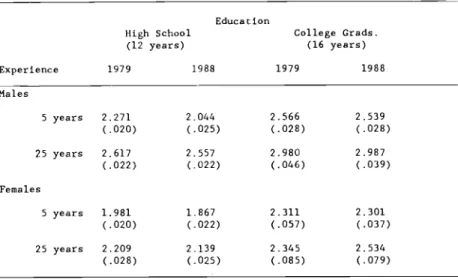
Table 3 contrasts the "regression-adjusted" mean log hourly wages of college and high school graduates by gender and experience at large and small
firms in 1979 and 1988. The table highlights the well-know employer-size
wage differential, with large firms paying substantially higher wages (from
approximately 8 to 25 percent higher) for workers with similar education and
experience. Furthermore, education differentials have moved similarly in
small and large firms in the privare sector in the l980s. The college/high
school log wage differential for males with 5 years of experience expanded by
0.21 in large firms and 0.20 in small firms from 1979 to 1988. In fact, the
real wages of young, high-school graduates fell by more in the l980s in the large firm sector than in the small firm sector of the private economy.
The results from Table 3 indicate that the structure of relative pay by education, experience, and sex changed dramatically in the large firm sector
of the private economy. While the CPS data do not allow us to determine the
extent to which these changes have taken place within individual
organizations as opposed to changes in relative wages between organizations
with different labor force characteristics, evidence on the sharp increase in
the relative pay of executives of large private sector firms (Mishel and Frankel, 1990, p. 124) suggests that much of this has likely occurred within
individual firms. Croshen's (1990) recent analysis of data from an annual
Table 3: Estimated Mean Log Real Hourly Wage Rates for Private Sector
Workers by Education, Experience, Gender, and Firm Size
A. Workers in Large Firms (Multi-Establishment Firms with at least 1000
Employees)
Education
High School College Grads.
(12 years) (16 years) Experience 1979 1988 1979 1988 Males 5 years 2.271 2.044 2.566 2.539 (.020) (.025) (.028) (.028) 25 years 2.617 2.557 2.980 2.987 (.022) (.022) (.046) (.039) Females 5 years 1.981 1.867 2.311 2.301 (.020) (.022) (.057) (.037) 25 years 2.209 2.139 2.345 2.534 (.028) (.025) (.085) (.079)
8. Workers in Small Firms (Multi-Establishment Firms with less than
Employees or Single Establishment Firms)
1000
Education
High School College Grads.
(12 years) (16 yeats) Experience 1979 1988 1979 1988 Males 5 years 2.153 1.967 2.390 2.405 (.014) (.017) (.027) (.028) 25 years 2.486 2.409 2.789 2.845 (.023) (.026) (.048) (.053) Females 5 yearm 1.858 1.766 2.114 2.205 (.013) (.018) (.031) (.028) 25 years 2.014 2.003 2.144 2.410 (.018) (.021) (.079) (.058)
Table 3: continued
Note: Each estimate is from a separate cross-section regression for an educarion-experience-genderfirm size group of log real hourly earnings on a
linear spline of years of experience with a break every ten years, 2 race
dummy variables, and dummy variables for metropolitan area and part-time status. The education classes used are exactly 12 and 16 or more years of schooling; the experience classes are 0-19 and 20 or more years of potential experience. The regressions for college graduates include dummy variables for individual years of schooling. The estimates for each group are the predicted values of the log hourly earnings regression for that group evaluated at the indicated schooling and experience levels and for a full-time, white employee
living in a metropolitan area.
Sources: The data used are from the May 1979 and 1988 CPS Pension Supplement Surveys. The 1979 data include earnings for both the May 1979 and June 1979 Outgoing Rotation Groups. Earnings are deflated by the personal consumption
25
Cleveland provides further evidence of this phenomenon. Croshen finds that
occupational wage differentials within large private sector employers in
Cleveland, Cincinnati, and Pittsburgh did indeed expand substantially in the
1980s. This evidence indicates that the internal wage structures of large
private sector firms did change in the l980s and that government relative pay
rigidity is not something shared by all large bureaucratic organizations.
Finally the insensitivity of pay in the federal government to changes in
local labor market conditions documented in section III does not appear to be
a characteristic shared by large private sector employers in the United
States. Rebick (1990) finds for the 1979 to 1988 period that wages in small
firms (10 to 99 employees) , medium firms (100 to 999 employees) , and large
firms (1000 or more employees) in the private sector responded substantially
and similarly to changes in state unemployment rates.
B. Is Pay Rigidity A Characteristic of All Nonprofit Organizations?
A second potential explanation for the insensitivity of the government
internal wage structure to market changes in skill differentials is that such
behavior is characteristic of all "not-for-profit" organizations. This
hypothesis can be evaluated by examining whether wage differentials by skill
category behave similarly in the government and in private sector nonprofit
otganizations
19
We examine changes in wage differentials by education in the private
"for-profit", private nonprofit, and government sectors using data from the
19Furthermore, the "labor donations" model of Preston (1989) suggests that the supply of workers willing to accept a reduced wage to work for organizations that produce positive social externalities may be similar in
26
1979
and 1988 CPS outgoing rotation groups. Since the CPS does not identifythe whether workers are employed by nonprofit firms, a private sector worker is classified in the nonprofit sector if he or she works in a three-digit industry that has at least two-thirds of total employment in nonprofit firms. Following Preston (1989), we classified three-digit industries into the for-profit and nonfor-profit sectors on the basis of information reported in the 1977 census of service industries and tabulated by Rudney and Weitzman (1983). Private sector workers in all other industries are classified as part of the for-profit sector.
Table 4 presents estimates of the college/high school log wage premium
for males and females by sector in 1979 and 1988. The table shows that the
college wage premium increased substantially in the 1980s in both the private
for-profit and private nonptofit sectors. In contrast, the college/high
school
wage differential barely changed in the 1980s in the government
sector. Thus, relative pay rigidity in the 1980s is not apparent in the
private nonprofit sector and seems to be confined to public sector labor
markets.
C. The Role of Unionization
Freeman (1990) and others have argued that declining unionization may
have played an important role in rising skill differentials and wage
inequality in the United States in the 1980s. Since unions have largely
represented workers without college degrees in the private sector,
deunionization and losses of union wage premia are likely to reduce the wages
of less-educated workers relative to more-educated workers in the private
Table 4: College/High School Log Wage Differentials by Sector, 19791988a Group 1979 Males 1988 Change 1979-88 1979 Females 1988 Change 1979-88 Private Sector All 0.288 (0.006) 0.420 (0.006) 0.132 0.269 (0.007) 0.406 (0.006) 0.137 For-Profit sectorb 0.311 (0.024) 0.433 (0.030) 0.122 0.257 (0.022) 0.398 (0.023) 0.141 Nonprofit Sectorb 0.232 (0.036) 0.328 (0.037) 0.096 0.281 (0.014) 0.405 (0.014) 0.124 Government All 0.278 (0.011) 0.286 (0.011) 0.008 0.316 (0.009) 0.330 (0.010) 0.014
State and Local 0.270 0.277 0.007 0.354 0.366 0.012
Government (0.013) (0.013) (0.010) (0.011)
Federal 0.301 0.303 0.002 0.298 0.278 -0.020
Government (0.018) (0.019) (0.026) (0.025)
aEach estimate is from a separate cross-section regression for a
gender-sector group of log hourly earnings on dummy variables for individual years of schooling, a quartic in potential experience, two race dummy variables, a
dummy variable for metropolitan area status, and a dummy variable for
part-time status. The samples include workers with exactly 12 and with 16 or more years of schooling. Each reported estimate is the coefficient of the dummy variable for exactly 16 years of schooling with those with exactly 12 years of schooling as the base group. The numbers in parentheses are standard
errors.
bThe nonprofit sector includes private sector workers in the following
industries: hospitals; health services; elementary and secondary schools;
colleges and universities; libraries; educational services; museums, art galleries, and zoos; religious organizations; welfare services and welfare facilities; nonprofit membership organizations. Private sector workers in all other industries are classified as part of the for-profit sector. This
classification scheme is based on Appendix A of Preston (1989).
Source: The data are from the Full-Year 1979 and 1988 CPSs (Outgoing
27
unions compress wsges among organized workers in rhe privare secror. These
facrors suggesr rhar rhe high and relatively srable level of unionization in
the public sector since the mid-1970s may help explain much smaller increases in wage differentials by education in the public sector than in the private sector.
Our approach to assessing the role played by unionization in moderating
movements in skill differentials in the public sector relative to the private
sector is to compare changes in skill differentials in states with high and
low public sector unionization rates. Table 5 compares changes in the
college/high school log wage differential in the public and private sectors
from 1979 to 1988 for the ten states with the lowest and the ten states with
the highest public sector unionization rates in the early l98Os. We ranked
states according to their public sector union coverage rate in 1983 using tabulations from the CPS outgoing rotation groups reported by Curme, Hirsch,
and Macpherson (1990, Table 5, pp. 20-26). The public sector union coverage
rates in the high unionization states in 1983 ranged from 61.7 percent in
Maine to 73.5 percent in New York, while they ranged from 17.2 percent in
Georgia to 30.1 percent in Oklahoma in the low unionization states.
Table 5 indicates that the college wage premium increased substantially
more in the private sector than in the public sector in both groups of
states. Even in states with low public sector unionization rates, changes in
education differentials in the public sector were negative for men and quite
moderate for women in the 1980s. On the other hand, the table does indicate
that the college/high school wage differential is a bit lower in the public
sector in high unionization stares. Although unions may play a role in
Table 5: College/High School Log Wage Differentials for States
with High and Low Public Sector Union Coverage Ra