Worcester Polytechnic Institute
Digital WPI
Interactive Qualifying Projects (All Years)
Interactive Qualifying Projects
May 2016
ASSISTments: Experiments on Learning Styles and
Strategies in Web Based Homework Assignments
Steven P. Ireland
Worcester Polytechnic Institute
Theofilos Gatsos
Worcester Polytechnic InstituteFollow this and additional works at:
https://digitalcommons.wpi.edu/iqp-all
This Unrestricted is brought to you for free and open access by the Interactive Qualifying Projects at Digital WPI. It has been accepted for inclusion in Interactive Qualifying Projects (All Years) by an authorized administrator of Digital WPI. For more information, please [email protected].
Repository Citation
Ireland, S. P., & Gatsos, T. (2016).ASSISTments: Experiments on Learning Styles and Strategies in Web Based Homework Assignments. Retrieved fromhttps://digitalcommons.wpi.edu/iqp-all/190
Worcester Polytechnic Institute
ASSISTments Interactive Qualifying Project
Prepared By
Theofilos Gatsos
Steven Ireland
Prepared For
Professor Neil Heffernan
Cristina Heffernan
Date
2 May 2016
Abstract
ASSISTments is an online tool for teachers around the world to assign schoolwork and
assist in student learning in multiple fields. We built content for six Common Core skills
new to ASSISTments: absolute value equation solving, logarithmic equation solving,
matrix multiplication, matrix addition, complex numbers, and exponential equations. We
were able to run 4 different experiments with these skills: adjusting the number of hints
provided, varying the number of problems students are required to complete, presenting
struggling students with prerequisite content, and examining the difference between
theoretical and contextual examples. Our goal in running these experiments is to
determine strategies which improve students' understanding of the material and
transference of the skill.
Table of Contents
Abstract Table of Contents Introduction Building our Experiments Experiments Generalized vs Contextual Learning Introduction to this Experiment Purpose Content Selection Variable Number of Hints Introduction to this experiment Fixed variables 1.Content of the hints 2.Ordering effects Content selection: Two hints Five hints Experiment 1: Variable assignment length Fixed Variables Ordering Effects Content Selection Initial Notice Absolute Value Congratulations Message Transfer Item / PostTest Data Analysis Considerations Results Experiment 2: Prerequisite questions Content Selection Complex numbers Figure 2: Complex Number Equation Solving (control skill builder) Figure 3: Prerequisite Skills for Complex Numbers (Templates) Figure 4: Intermediate Messages Figure 5: Post Test PRA84HB Data Analysis Data Analysis for Students with Weaker Background Expanding Previous StudiesAdaptive vs NonAdaptiveMultiplication,Division Adaptive vs NonAdaptive Study Coin Quiz Figure 2: Design Diagram of the coin quiz study Appendix
Introduction
General Terminology
For the purposes of this experiment we will be using the ASSISTments
educational software. It is a way for teachers to provide their students with problem sets
on the taught topics. We would like to define the following terms that will be used
throughout this paper:
● Variabilized Template (Template): It is a specific way to write a problem where
variables are used instead of actual numbers or words. Writing problems in this
format allows the software to create multiple versions of the problem.
● Instantiated Problem: It is one specific problem that has been created by
Assistments from one variabilized template. One template will be usually able to
produce multiple instantiated problems.
● Problem Set: It is a combination of selected problems that will appear to the
student in a specific way. There are many options for building problems sets
including ifthenelse statements, random choose commands, complete all
problems, Skill builders and others.
● Skill builder: This type of problem set (or section in a problem set) asks for
students to succeed in a selected number of questions in a row. We make a list
of multiple (50 or more problems are usually created) problems ( instantiated
problems coming from the same or similar templates), and the skill builder option
will display questions to the student until they solve a number X in row. When
they manage to solve the required number of questions in a row, the skill builder
is completed.
● Experiment: Assistments gives us the chance to make complex problem sets
which allow for results to be extracted regarding the student learning process. A
simple example is to randomly give students questions from two different groups
of problems, and then compare which question group was more successful.
Building our Experiments
During our time with ASSISTments, we built out six problem sets of new content in order to conduct experiments on students’ learning strategies. All of our content filled gaps in current material required for ASSISTments’ full coverage of the Common Core standard. The skills webuilt out were as follows: absolute value equation solving, logarithmic equation solving, matrix multiplication, matrix addition, complex numbers, and exponential equations. For each skill, we created multiple variablized templates to capture the entirety of the skill and add variety. We could then generate as many problems as necessary to conduct each experiment. When creating the experimental problem sets, we used these generated problems in different ways to test differing learning strategies. In absolute value and logarithmic equation solving, we wanted to discover how many problems in a row would demonstrate proficiency in a skill. For matrix multiplication and complex numbers, we wanted to see if presenting struggling students with prerequisite skills would improve their ability to complete the content. For exponential equation solving we wanted to see if splitting up large hints helped or hindered student learning. Finally, for matrix addition we wanted to test whether contextual examples helped students understand content better than classical mathematicallystyled examples.
Experiments
We conducted multiple experiments during our IQP Term, and were able to collect data on and analyze two in particular: The effectiveness of presenting prerequisite content to struggling students, and exploring the implications of presenting students with variable amounts of problems. We created four unique studies overall, but two of them have not yet collected enough data for us to analyze. The bulk of this paper will analyze two out the four experiments that we created which gathered data. Experimental designs of the two experiments that did not collect data are given below.Generalized vs Contextual Learning
Introduction to this Experiment
Purpose
The goal of this experiment is to test the ordering effect of presenting a student with generalized or contextual examples in skill builders. Students will either be presented with real world matrix addition questions or more typical textbook problems. Generalized problems use standard matrix notation and terminology, whereas contextual examples populate matrices with data and give it meaning labels. For example, a matrix of cab fares per day and time or basketball scores per team and game. After completing the first set of problems, the student will be entered into a skill builder of the remaining skill; if the student completed the theoreticalproblems they will receive the real world problems, and if they completed the real world problems they will receive the theoretical problems. This is an attempt to see which teaching strategy offers the most transferable skill. We hypothesize that, when this experiment gathers data, presenting the more difficult real world examples will transfer better than the theoretical examples.
Content Selection
Matrix addition was chosen as a skill to test this hypothesis because of it’s unary nature. Once students understand that adding or subtracting two matrices is just adding or subtracting their corresponding positions, they are likely to not make many mistakes. Because of this, we will examine how the skill’s presentation effects its transfer by comparing it with a different presentation of the same skill. Five skill builders were selected to accomplish this task, some with contextual matrices, and some with generalized matrices. Below are the templates we created for this skill: Template 1 (theory) PRA7UJW Template 2 (theory) PRA8CEWTemplate 3 (theory) PRA8CE6
Template 4 (realworld) PRA8VZK
Template 5 (realworld) PRA8XSX Template 6 (realworld) PRA85CZ
Variable Number of Hints
This experiment dealt with the number of hints given in the skill builder questions.
Complicated problems were selected, that could either be dealt with in two long hints, or
in five more analytical ones. The hypothesis was that fewer hints will be less
discouraging for the students that look at the number of hints, in order to judge the
complexity of the problem, thus leading to lower dropout rates.
Introduction to this experiment
This study is an attempt to evaluate how the number of hints influences the student's results on a particular problem set. The problem set selected in order to carry out this study is a skill builder on exponential equations. In order to help the students navigate through the problems, hints are added, explaining the solving procedure behind the skill builder. The number of hints that appear in each problem, however, can be affecting the student's performance by itself. Inclusion of multiple hints gives the teacher the possibility to explain the solving process in a more analytical way, thus providing a better understanding to the student. However there can be a case made for the higher number of hints to be having a negative effect on performance; as it can be a factor that is discouraging the students from trying to complete the problem set overall. In this study we will create two versions of the exponential equations problem set mentioned above: the first will include two hints, and the second will include five hints. The selection of this specific skill builder was made based on the flexibility that it gives regarding the number of hints that could be written, as the solution involves manipulation of the exponents and solving of the linear equation that will arise afterwards, offering enough content for the use of five but can also be funneled into two distinct hints. Students that have been assigned this problem set will be randomly given one version or the other. The results for both versions will be gathered and compared in order to formulate results on the effect of the number of hints.Fixed variables
This experiment is dealing with the effect that the number of hints of a problem might have on the effectiveness of assisting the student. It is important in such research to indicate the following factors which must be kept fixed in order for the results to be affected only by the number of hints.1.Content of the hints
Explaining the same problem in two or five hints could cause the tutoring of the five hints to be more indepth. This was eliminated from our experiment. In both cases we are using the exact same instructions and equations. The order is also unchanged. The only factor that is allowed to change is grouping of these instructions, creating 2hint and 5hint content.2.Ordering effects
In this experiment the students are required to solve three problems in a row in order to successfully pass the problem set. All the problems that will be given are generated from templates written with variables. This means that Assistments randomly generates the problems by inputting random numbers. This way a multitude of problems is produced. This means thateach student is randomly assigned some of the 50 problems that we asked assistments to generate. This allows for some inconsistency regarding the difficulty of work. Some problems might come up to have numbers that are easier to manipulate and the problems could come in “easier” to “harder” order, which would be helpful for some students. However, the significance of these effects are minimized by the randomization process, where there are more than enough available problems. We are confident that all students will share similar difficulty from the problem set and they will need to attain a specific mastery of the skill in order to succeed.
Content selection:
Template 1 Template 2Template 3 In order to solve this problem students have to go through two different stages. Stage 1 is to change the base of the left hand side to a base of 3 (using the fact that 27 is a power of 3). Once they get through that step, students are required to apply the property of equality which states that the exponent of each side is equal to one another, since they have the same base. Stage 2 requires solving of the remaining linear equation. The way the tutoring was broken down in the two cases (five against two hints) is shown below.
Two hints
Temlpate 1
Template 2
Template 3
Five hints
Template 1
Template 2
Template 3
This paper goes on to include further analysis of past studies that are similar to the ones
that are analyzing (variable assignment length, prerequisite questions), in order to make
use of newer results that were not available when the summaries were written.
Experiment 1: Variable assignment length
When students rely on ASSISTments to reinforce a skill, we use a structure called a skill builder. Skill builders provide the student with as many problems in a row as they need to get a certain number correct in a row, giving them practice and ample chances to achieve mastery of the skill. The goal of this experiment is to determine whether the amount of questions needed to escape a skill builder affects how well a student learns the material. This study is important because of the difference between highknowledge students and lowknowledge students; highknowledge students may become frustrated by too many questions after quickly mastering the content, where low knowledge students may be able to guess their way through two questions in a row, thus not demonstrating mastery. Our hypothesis is that the dropout rate will increase when the number of problems to demonstrate mastery increases. The most common number in ASSISTments and the default option is three, but we will look into the differences between offering two, three, four, or five questions to demonstrate mastery (escape the skill builder). We will use an absolute value equation skill builder to test this because it has many variations to eliminate guessing, and stands well on its own(doesn’t have many prerequisite skills). Students will be randomly put into skill builders requiring 2,3,4, or 5 questions needed to complete, containing the same problems. Data can then be compared between each type of skill builder to determine its effect on the students.
Fixed Variables
In order to ensure our results are not a confounded effect, we control many variables between the skill builders. The questions for each skill builder set are selected randomly from an identical pool, generated via templates to ensure their difficulty is the same. The presentation of the questions are identical between the skill builders, and the student does not know which pool they are in. All instructions read “This equation has two solutions [problem] Submit only the larger/smaller one” to prevent any effect of the text.
Ordering Effects
Because we are only interested in the effect of the number of questions to escape the skill builder, we control other possibly confounding variables that we cannot fix through randomness. The skill builders present questions in a random order, minimizing the impact of any ordering effects that would arise with a linear presentation. The problems themselves are also generated randomly via templates to ensure their difficulty is consistent.Content Selection
Initial Notice
Because the students will have to answer a varying amount of problems in a row to complete the assignment, we show the following message to students before beginning the problem set:Absolute Value
Absolute Value equations were selected for this experiment because of two reasons. The many templates that create the problems in the skill builders provide enough variety thatstudents will not get bored and complete the transfer item, and also similar and focused enough that only the target skill is being exercised. There are nearly identical hints for every problem detailing its solution, eliminating any chance that a student would get completely stuck. The absolute value equation sets fulfill these requirements. The templates are in a table below. Template 1 PRA7KZJ Template 2 PRA7PEU Template 3 PRA7QSY
Template 4 PRA7RV3 To solve these problems, students must understand when to split an absolute value equation and when to simplify it; order of operations is a key element in this skill. In this example, the equation is split immediately, and the student will then solve both sides of the equation to determine which side yields a larger value for x.
Congratulations Message
Transfer Item / PostTest
The transfer question chosen as the posttest was chosen because it brings the students one step past what the skill builders exposed them to. By adding an additional constant to anabsolute value equation, we are able to test how well the content helped them learn the skill by asking them to apply it in a slightly different scenario.
Data Analysis
Considerations
There are a few considerations we had to make when analyzing the data. Firstly, there was a dropout effect of the fiveinarow treatment as seen in the following table: Conditions Students who started the problem set Students who finished the problem set Percent of students completed 2 correct 44 38 86 3 correct 60 55 92 4 correct 46 45 98 5 correct 46 34 74 N 196Degrees Of Freedom 3 ChiSquared 13.4777 PValue 0.0037 When analyzing the data, we had to be careful not to compare the 5 group on equal terms with the others because of the differential dropout. The dropout could have led to lowskill or timelimited students dropping the course, and skewing the results. Additionally, on the posttest data collected for this experiment, the wrong answer and the correct answer were swapped. This meant anyone answering correctly had their score labeled incorrect, and everyone answering incorrectly answered correctly. I attempted to account for this by switching everyone’s posttest scores (newscore = (1 score)) and then performing our analysis. This may have had strange interactions with people who left the test without eventually inputting the “wrong answer”, as they would not have been marked as correct.
Results
To work around these considerations, we decided to analyze the data by comparing each group to each other in order to determine whether the treatment significantly helped the students’ learning. We performed a twotailed TTest on each treatment option to determine whether there was any effect. The data we used were the posttest scores of each completed student, taking into account partial credit. Group Posttest Average 2 .550 3 .470 4 .630 5 .763 TTest Results 2 3 4 5 2 0 .3531 .3622 .0113 3 .3531 0 .0462 .00014 .3622 .0462 0 .0827 5 .0113 .0001 .0827 0 As seen above, between the three and four groups we did establish significance. When not taking into account partial credit, the results look as such: Group Posttest Average 2 .400 3 .321 4 .478 5 .552 TTest Results 2 3 4 5 2 0 .437 .4714 .1819 3 .437 0 .1112 .028 4 .4714 .1112 0 .5032 5 .1819 .028 .5032 0 When viewing it as a binary distribution, we can observe no significant difference between any of the two groups. In a much larger study done by Kim Kelley with over 1700 students participating, we can observe similar results without the worry of the problem having an incorrect answer, and with access to a much larger pool of data. Conditions Students who started the problem set Students who finished the problem set Percent of students completed 2 correct 421 356 85 3 correct 473 337 71
4 correct 415 293 71 5 correct 417 289 69 N 1726 Degrees Of Freedom 3 A difference in dropout rate was detected for this study, with a ChiSquared of 33.4116. Group Posttest Average 2 .427 3 .479 4 .481 5 .491 TTest Results 2 3 4 5 2 0 .0829 .0886 .0442 3 .0829 0 .9531 .7036 4 .886 .9531 0 .7583 5 .0442 .7036 .7583 0 Similar to our data, the study shows that as students complete more problems their understanding of the material also increases. Specifically, 5 questions compared to 2 questions improved student posttest score by an average of .064 with a significance of p=0.0442. We can also observe from this that 3 and 4 questions in a row yielded extremely similar results, with neither of them being significantly different from 5 in a row. 2 Questions in a row yielded the lowest average score, which is likely the result of lowerskill students being able to guess through two questions in a row without having a complete understanding of the skill. The errors in our study which could have corrupted our results have since been fixed, and we believe that when more data is available the results should reflect the results shown in Kim’s study.
Experiment 2: Prerequisite questions
The goal of this experiment is to test the effectiveness of using problem sets that include problems with prerequisite material. This means that when the student seems to struggle with the questions that he is given he will be presented with some easier questions, designed for reteaching him the necessary prerequisite material. After this inclusion, the student returns to working on the initial problems. This is an attempt to help the student succeed in the problem set and enhance his understanding of the material. In this experiment we are trying to test this assumption. We have created two problem sets. One is dealing with content on solving equations with complex numbers, and one dealing with matrix multiplication. Both problems sets are built with the same structure. This structure is analyzed below. Figure 1: Experiment flow diagram
Hypotheses
1) Prerequisite questions will be helpful for the students to complete the skill builder.
This would be the case for any relatively complex skill builder as the one
selected, since the prerequisites are helpful to clarify the concepts that are
required. This would be clearly seen in the post test scores, where the students
understanding is tested more directly.
2) Prerequisite questions will prove to be more beneficial for students with weaker
background. For many students it might be easy to solve the overall skill builder
without need for prerequisites (where these might end up confusing or annoying
students who are well prepared). For the students who seem to be struggling
though, we expect prerequisite questions to make a great difference in their
performance.
Problem Set Structure
The problem set requires the students to complete all of the following sections in linear order: 1. Choose Condition Section 2. Post Test section Choose Condition Section: This section will randomly choose if the student will be sent to the control or the treatment group. Students in the control group will face a normal skill builder problem set, composed of at least 50 questions on the topics mentioned above (complex equation solving or matrix multiplication). After completing the skill builder problem set (they need to get three correct questions in a row) they will move on to the post test section. Students in the treatment group will be presented with a short skill builder problem set. It is composed of 5 problems, meaning that the student will have to solve the skill builder with a small number of tries (he will be allowed a mistake in the first two questions). This is where an ifthenelse statement has been incorporated in the problem set structure. The IF condition is the completion of the short skill builder. If the student manages to solve it he goes to the THEN statement, which sends him to the post test. If he does not complete the skill builder, he is led to the ELSE statement. This is a section that requires him to complete all the following: 1. *A linear order skill builder on prerequisite material 2. The ‘normal’ skill builder (identical to the control skill builder). *This linear order skill builder is composed of problems that examine the prerequisite skills. They come in alternating order depending on which skill they focus on (for example skill 1, skill 2, skill 1, skill 2, skill 1, and so forth). Students are required to get 2 correct answers in a row in order to show understanding of both skills. Once these steps are completed the student will be sent to the post test. Post Test This section is designed to test the level of mastery that the student demonstrates after going through the problem set. It is composed of two problems that must be solved in linear order. These problems present the student with questions that will challenge him (on the topic that the problem set is designed for). Results from this section are important for the analysis part of this experiment.Content Selection
Complex numbers
For the purposes of the experiment we used problems that require skill in at least
two different sectors. We chose to use a skill builder problem set on complex number
equation solving. For this case, the students will have to make use of two different skills:
1. Linear equation solving,
2. grouping of the real and imaginary parts.
In this way we were able to set up questions that allow the student to practice on the
specific prerequisite skills. The types of problems that were used are shown below.
Figure 2: Complex Number Equation Solving (control skill builder)
Templates ~
PRA7SBH
~
PRA8Y4N
~
PRA8Y4Q
Selected questions from this set were found in the normal skill builder, the short skill builder, and the control skill builder.
Figure 3: Prerequisite Skills for Complex Numbers (Templates)
Grouping~
PRA8TF3
The picture on the right displays an
instantiated problem for exercising
grouping of real and imaginary parts.
Students are asked to complete an
addition of complex, for which they need
to perform the grouping of the two parts.
Linear Equation~
PRA8ZE8
In this case the students are asked to
solve a simple linear equation. Mastery of
this skill, combined with mastery of the
grouping, will give them the ability to
complete the control skill builder,
These questions concentrate on the two basic skills that are required for the rest of the skill builder.
Figure 4: Intermediate Messages
PRA8WAJ PRA8WAK
PRA86C7
These messages are used to help students move around the problem set, informing
them of what they are about to do next, as they switch from normal skill builder to
prerequisite skill builder as well as the opposite, and also let them know when they have
reached the post test section.
Figure 5: Post Test
Table of Post Test Questions used PRA8US2PRA84HB
These two were the problems shown on the post test section. They were the
same for all students.
Data Analysis
The first step in the analysis of the results is to compare the results between control and treatment conditions. The following tables address the completion rate, the post test scores, and the average number of problems attempted in both conditions. Table 1: Completion rate for the two conditions
Condition
s
Students who started the
problem set
Students who finished the
problem set
Percent of students
completed
control
54
37
69
treatment 61
41
67
This statistic gives 1 to the students who completed the skill builder, and 0 to those who did not. Table 2: Post Test Scores for the two conditions (counting dropouts as 0)
Students who completed the
problem set
Percent of students completing the
problem set
PostTestSco
re
Average
control 37
69
0.87037
treatme
nt
41
67
0.86885The students answered two post test questions. They get 0 for answering 0 correct questions, 1 for answering one correct question, 2 for answering two correct questions. Students who did not reach the post test due to dropping out earlier received a 0 in this statistic. Table 3: Post Test Scores for the two conditions (discarding dropouts)
Students who completed the
problem set
Percent of students completing the
problem set
PostTestSco
re
Average
control 37
69
1.2368
treatme
nt
41
67
1.1777The students answered two post test questions. They get 0 for answering 0 correct questions, 1 for answering one correct question, 2 for answering two correct questions. Students who did not reach the post test due to dropping out, were not included in this statistic.
Table 4: Average Number of problems attempted for both conditions
Average Number of Problems
Attempted
Average Number of Hard Problems
Attempted
control 5.00
5.00
treatme
nt
6.88
5.61
This statistic compares the number of problems that students in each condition faced. In this statistic students that did not make any attempts to answer any problems were not included. This can be done since students that made no attempts could not have been influenced by condition (as the first problem is similar for both conditions), and were evenly split out between the two conditions. Hard problems are all skill builder problems, except from the prerequisite problems. The TTest for all problems has a value of 0.0029 The TTest for hard problems has a value of 0.1839 A deeper look in the treatment condition gives the following. Table 5: Dropout point during the skill builder (treatment only)Dropout point Short Skill Builder Prerequisite Skill Builder Normal Skill Builder Number of students 1 1 4 This statistic does not include the students that did not make any attempts on any of the questions.
Data Analysis for Students with Weaker Background
We also tried to examine the hypothesis that prerequisite skill builders would prove beneficial for students with weaker background. The following data come from students with weaker background only. In order to select which students belong in this category, we looked at their Assistments record (percentage of correct answers on previous questions). We found the median for the entire sample, and selected all students that were below the median. Table 6: Completion rate for the two conditions
Condition
s
Students who started the
problem set
Students who finished the
problem set
Percent of students
completed
control
24
12
50
treatment 33
19
58
The TTest for the Completion Rate shows a value of 0.5801 Table 7: Post Test Scores for the two conditions (counting dropouts as 0)
Students who completed the
problem set
Percent of students completing the
problem set
PostTestSco
re
Average
control 24
12
0.41667
treatme
nt
33
19
0.57576The TTest for the Post test scores shows a value of 0.4106
Conclusions A few points can be made about the results: ● The first four tables reveal that there is no significant difference between the control and the treatment overall. A small increase in the number of problems attempted by treatment students is noticed, but the pvalue of the TTest is not significant. This could however be analyzed further when more data points are collected. ● Table 5 gives a useful inquiry about the point where most students might drop out. It seems that the transition back to a hard skill builder after an easy one is a good cause for dropping out. It seems that either the students are reluctant to continue after having been asked to complete two different skill builders, or they cannot really put into use what they learned in the prerequisite problem sets. However, only six students are included in this table, which means that results can really be formed only with addition of new students. ● The second section is the analysis of the students who have done worse in past Assistments studies.Their results seem to be more diverse with regards to control against treatment conditions. In particular, treatment students now seem to have an advantage, with higher completion rate and better post test results. This is in contrast with the overall student population, where this difference was not observed. This would agree with our hypothesis that prerequisite questions are more beneficial for students with weaker background, who need this in depth review before they master the new skill. The TTests however, are still not providing high enough significance levels, which could be attributed to the few data points collected. ● Our first hypothesis does not seem supported well by the data, while there hints towards supporting our second hypothesis. More data should be analyzed in the future, so that the accuracy of the TTest is also increased.
Expanding Previous Studies
Adaptive vs NonAdaptiveMultiplication,Division
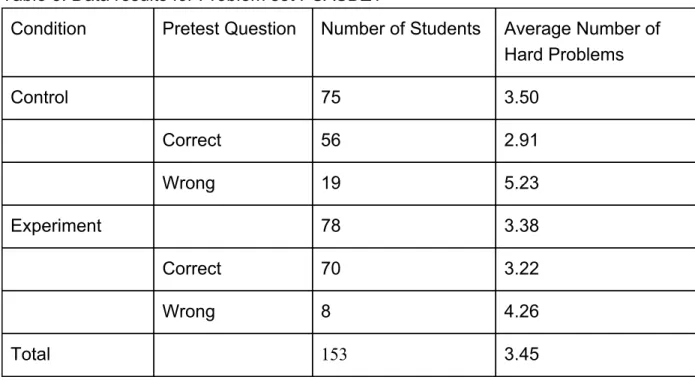
A study that is similar to the prerequisites study was made some years earlier with only a few students participating. This study is based on the idea of using one pretest question that will decide if the students in the treatment will get prerequisite questions or not. We will provide a renewed analysis for this study with the new students that participated. This study uses two problem sets: PSASDZY and PSAR9Y9 on multiplication and division skills. Figure 1: Design diagram of the experiment
Table 8: Data results for Problem set PSASDZY
Condition
Pretest Question Number of Students Average Number of
Hard Problems
Control
75
3.50
Correct
56
2.91
Wrong
19
5.23
Experiment
78
3.38
Correct
70
3.22
Wrong
8
4.26
Total
153
3.45
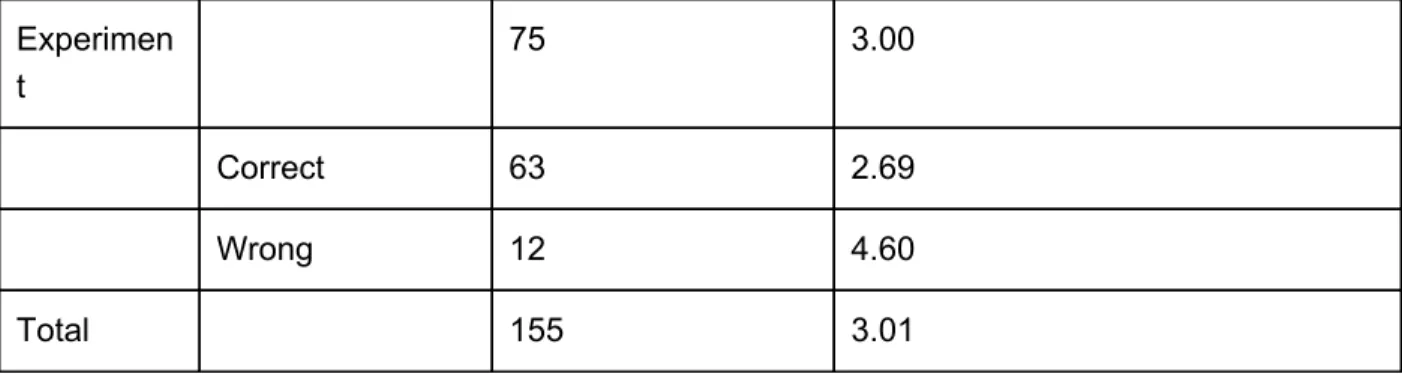
Table 9: Data results for Problem set
PSAR9Y9Case Pretest Question Number of Students Average Number of Hard Problems
Control 80 3.01
Correct 72 2.81
Experimen t 75 3.00 Correct 63 2.69 Wrong 12 4.60 Total 155 3.01 Conclusion: This study seems to suggest that control and experiment are not heavily differentiated in terms of overall performance. Slightly more effort seems to be required for the control students, which is close to the initial hypothesis. We can also see that looking at students who got the question wrong, there is an greater advantage for the experimental condition group. In that case the prerequisite questions seem to be helpful. With more data we draw better conclusions in the future. It should be noted that the part of the analysis that separates between multiplication and division is still not available due to the small amount of students that reached that category.
Adaptive vs NonAdaptive Study Coin Quiz
A study that is similar to the prerequisites study was made some years earlier with only a few students participating. This study is based on the idea of using one pretest question that will decide if the students in the treatment will get prerequisite questions or not. We will provide a renewed analysis for this study with the new students that participated. This study uses the problem set PSASA4B, with questions on handling and understanding coin values.
Table 10: Data results for problem set PSASA4B Group [DE] First questio n Second question Droup outs Experimental: 37 14 13 5 Total: 9 1 23 Text quiz: 12 9 3 0 Visual quiz: 11 7 3 1 Control: 34 12 11 2 Total: 12 1 22 14 10 8 *In the above table blue color means that the students answered the question correctly, and red color means that they answered incorrectly. Comments: This experiment seems to add to our previous results, showing no significant difference between control and treatment. Comparing the students who got the first question wrong in both conditions however, again shows a small imbalance with the number of dropouts being 10 for those in the control and 6 six for those in treatment. Again with 71 students in total, the results are inconclusive and therefore this problem set requires more time to collect data.
Appendix
4/28/2016 Assistment Printing Content https://www.assistments.org/build/print/sequence/677479?mode=debug&op_scaf=false&op_hint=false&op_answer_op=false&op_answer=false&op_n… 1/18 Problem Set "All templates" id:[PSAZZ9F] Select All 1) Problem #PRA85CZ "PRA85CZ TEMPLATE Add or Subtract Matrices Calendar 3" A couple is trying to get %v{times[morning]} on %v{weekdays[day]}, how much would it cost for one of them to take the cab and one of them to take the subway? Cab Fare
Monday Tuesday Wednesday Thursday Friday
Morning $%v{dollars1[0]}.00 $%v{dollars1[1]}.00 $%v{dollars1[2]}.00 $%v{dollars1[3]}.00 $%v{dollars1[4]}.00 Afternoon $%v{dollars1[5]}.00 $%v{dollars1[6]}.00 $%v{dollars1[7]}.00 $%v{dollars1[8]}.00 $%v{dollars1[9]}.00
Subway Fare
Monday Tuesday Wednesday Thursday Friday
Morning $%v{dollars1[10]}.00 $%v{dollars1[11]}.00 $%v{dollars1[12]}.00 $%v{dollars1[13]}.00 $%v{dollars1[14]}.00 Afternoon $%v{dollars1[15]}.00 $%v{dollars1[16]}.00 $%v{dollars1[17]}.00 $%v{dollars1[18]}.00 $%v{dollars1[19]}.00 Algebraic Expression: %v{dollars1[5*morning+day]+dollars1[10+5*morning+day]} Hints: Add the values across the corresponding cells. So you have: %v{weekdays[day]} %v{mornoon[morning]} Cab fare + %v{weekdays[day]} %v{mornoon[morning]} Subway fare %v{weekdays[day]} %v{mornoon[morning]} Cab fare + %v{weekdays[day]} %v{mornoon[morning]} Subway fare = TotalCost
%v{dollars1[5*morning+day]} + %v{dollars1[10+5*morning+day]} = TotalCost
%v{dollars1[5*morning+day]+dollars1[10+5*morning+day]} = TotalCost
Type in %v{dollars1[5*morning+day]+dollars1[10+5*morning+day]} 2) Problem #PRA8XSX "PRA8XSX TEMPLATE Add or Subtract Matrices Calendar 2" How many more points did Team A score in Game %v{game+1}'s %v{fourths[quarter]} quarter than Team B in Game %v{gametwo+1}'s %v{fourths[quarter]} quarter? Game 1 Team A Team B
First Quarter %v{score[0]} pts %v{score[1]} pts Second Quarter %v{score[2]} pts %v{score[3]} pts Third Quarter %v{score[4]} pts %v{score[5]} pts Fourth Quarter %v{score[6]} pts %v{score[7]} pts
4/28/2016 Assistment Printing Content https://www.assistments.org/build/print/sequence/677479?mode=debug&op_scaf=false&op_hint=false&op_answer_op=false&op_answer=false&op_n… 2/18 Game 2 Team A Team B
First Quarter %v{score[8]} pts %v{score[9]} pts Second Quarter %v{score[10]} pts %v{score[11]} pts
Third Quarter %v{score[12]} pts %v{score[13]} pts Fourth Quarter %v{score[14]} pts %v{score[15]} pts Algebraic Expression: %v{score[game*8+quarter*2]score[gametwo*8+quarter*2+1]} Hints: Subtract the values across the corresponding cells. So you have: Team A's Game %v{game+1} %v{fourths[quarter]} quarter score Team B's Game %v{gametwo+1} %v{fourths[quarter]} quarter score Team A's Game %v{game+1} %v{fourths[quarter]} quarter score Team B's Game %v{gametwo+1} %v{fourths[quarter]} quarter score = Point Difference %v{score[game*8+quarter*2]} %v{score[gametwo*8+quarter*2+1]} = Point Difference %v{score[game*8+quarter*2]score[gametwo*8+quarter*2+1]} = Point Difference Type in %v{score[game*8+quarter*2]score[gametwo*8+quarter*2+1]} 3) Problem #PRA8VZK "PRA8VZK TEMPLATE Add or Subtract Matrices Calendar 1" In total, how much did Sam and Nick spend on %v{meals[meal]} on %v{weekdays[day]}? Sam
Monday Tuesday Wednesday Thursday Friday
Breakfast $%v{dollars1[0]}.00 $%v{dollars1[1]}.00 $%v{dollars1[2]}.00 $%v{dollars1[3]}.00 $%v{dollars1[4]}.00 Lunch $%v{dollars1[5]}.00 $%v{dollars1[6]}.00 $%v{dollars1[7]}.00 $%v{dollars1[8]}.00 $%v{dollars1[9]}.00 Dinner $%v{dollars1[10]}.00 $%v{dollars1[11]}.00 $%v{dollars1[12]}.00 $%v{dollars1[13]}.00 $%v{dollars1[14]}.00
Nick
Monday Tuesday Wednesday Thursday Friday
Breakfast $%v{dollars2[0]}.00 $%v{dollars2[1]}.00 $%v{dollars2[2]}.00 $%v{dollars2[3]}.00 $%v{dollars2[4]}.00 Lunch $%v{dollars2[5]}.00 $%v{dollars2[6]}.00 $%v{dollars2[7]}.00 $%v{dollars2[8]}.00 $%v{dollars2[9]}.00 Dinner $%v{dollars2[10]}.00 $%v{dollars2[11]}.00 $%v{dollars2[12]}.00 $%v{dollars2[13]}.00 $%v{dollars2[14]}.00 Algebraic Expression: %v{dollars1[meal*5+day]+dollars2[meal*5+day]} Hints: Add the values across the corresponding cells. So you have: Sam's %v{weekdays[day]} %v{meals[meal]} + Nick's %v{weekdays[day]} %v{meals[meal]} = Total Cost
4/28/2016 Assistment Printing Content
https://www.assistments.org/build/print/sequence/677479?mode=debug&op_scaf=false&op_hint=false&op_answer_op=false&op_answer=false&op_n… 3/18
Sam's %v{weekdays[day]} %v{meals[meal]} + Nick's %v{weekdays[day]} %v{meals[meal]} = TotalCost
$%v{dollars1[meal*5+day]}.00 + $%v{dollars2[meal*5+day]}.00 = TotalCost
$%v{dollars1[meal*5+day]+dollars2[meal*5+day]} = Total Cost Type in $%v{dollars1[meal*5+day]+dollars2[meal*5+day]} 4) Problem #PRA8EHN "PRA8EHN TEMPLATE Matrix Rows vs Columns 6" How many columns does the following matrix have?
%v{rows[0]} %v{rows[1]} %v{rows[2]} %v{rows[3]} %v{rows[4]} %v{rows[5]} %v{rows[6]} %v{rows[7]} %v{rows[8]} %v{rows[9]} %v{rows[10]} %v{rows[11]} Algebraic Expression: %v{ans} %v{wans} You confused columns with rows.
a
rc One Column 1 2 3 One Row 1 2 3 Hints: Columns are vertical pillars, so because there are three vertical columns, the answer is 3.%v{rows[0]} %v{rows[1]} %v{rows[2]}
4/28/2016 Assistment Printing Content
https://www.assistments.org/build/print/sequence/677479?mode=debug&op_scaf=false&op_hint=false&op_answer_op=false&op_answer=false&op_n… 4/18
%v{rows[6]} %v{rows[7]} %v{rows[8]}
%v{rows[9]} %v{rows[10]} %v{rows[11]}
Type in 3. 5) Problem #PRA8EHM "PRA8EHM TEMPLATE Matrix Rows vs Columns 5" How many columns does the following matrix have? %v{rows[0]} %v{rows[1]} %v{rows[2]} %v{rows[3]} %v{rows[4]} %v{rows[5]} Algebraic Expression: %v{ans} %v{wans} You confused columns with rows.
a
rc One Column 1 2 3 One Row 1 2 3 Hints: Columns are vertical pillars, so because there are two vertical columns, the answer is 2. %v{rows[0]} %v{rows[1]} %v{rows[2]} %v{rows[3]} %v{rows[4]} %v{rows[5]} Type in 2. 6) Problem #PRA8EHK "PRA8EHK TEMPLATE Matrix Rows vs Columns 4" How many columns does the following matrix have?4/28/2016 Assistment Printing Content
https://www.assistments.org/build/print/sequence/677479?mode=debug&op_scaf=false&op_hint=false&op_answer_op=false&op_answer=false&op_n… 5/18
%v{rows[0]} %v{rows[1]} %v{rows[2]} %v{rows[3]} %v{rows[4]} %v{rows[5]} %v{rows[6]} %v{rows[7]} Algebraic Expression: %v{ans} %v{wans} You confused columns with rows.
a
rc One Column 1 2 3 One Row 1 2 3 Hints: Columns are vertical pillars, so because there are four vertical columns, the answer is 4.%v{rows[0]} %v{rows[1]} %v{rows[2]} %v{rows[3]}
%v{rows[4]} %v{rows[5]} %v{rows[6]} %v{rows[7]}
Type in 4.
7) Problem #PRA8EHJ "PRA8EHJ TEMPLATE Matrix Rows vs Columns 3"
How many rows does the following matrix have?
%v{rows[0]} %v{rows[1]} %v{rows[2]} %v{rows[3]} %v{rows[4]} %v{rows[5]} %v{rows[6]} %v{rows[7]} %v{rows[8]} %v{rows[9]} %v{rows[10]} %v{rows[11]} Algebraic Expression: %v{ans} %v{wans} You confused rows with columns.
a
rc One Row4/28/2016 Assistment Printing Content https://www.assistments.org/build/print/sequence/677479?mode=debug&op_scaf=false&op_hint=false&op_answer_op=false&op_answer=false&op_n… 6/18 1 2 3 One Column 1 2 3 Hints: Rows are horizontal bars, so because there are four horizontal rows, the answer is 4.
%v{rows[0]} %v{rows[1]} %v{rows[2]}
%v{rows[3]} %v{rows[4]} %v{rows[5]} %v{rows[6]} %v{rows[7]} %v{rows[8]}
%v{rows[9]} %v{rows[10]} %v{rows[11]} Type in 4. 8) Problem #PRA8EHH "PRA8EHH TEMPLATE Matrix Rows vs Columns 2" How many rows does the following matrix have? %v{rows[0]} %v{rows[1]} %v{rows[2]} %v{rows[3]} %v{rows[4]} %v{rows[5]} Algebraic Expression: %v{ans} %v{wans} You confused rows with columns.
a
rc One Row 1 2 3 One Column 1 2 34/28/2016 Assistment Printing Content https://www.assistments.org/build/print/sequence/677479?mode=debug&op_scaf=false&op_hint=false&op_answer_op=false&op_answer=false&op_n… 7/18 Hints: Rows are horizontal bars, so because there are three horizontal rows, the answer is 3. %v{rows[0]} %v{rows[1]} %v{rows[2]} %v{rows[3]} %v{rows[4]} %v{rows[5]} Type in 3. 9) Problem #PRA8CE6 "PRA8CE6 TEMPLATE Add or Subtract Matrices 3"
Submit C%v{arow}%v{acol} from the %v{operation[choice]} of the following matrices. %v{mat1[0]} %v{mat1[1]} %v{mat1[2]} %v{mat1[3]} %v{mat1[4]} %v{mat1[5]} %v{mat1[6]} %v{mat1[7]} %v{sign[choice]} %v{mat2[0]} %v{mat2[1]} %v{mat2[2]} %v{mat2[3]} %v{mat2[4]} %v{mat2[5]} %v{mat2[6]} %v{mat2[7]} = C11 C12 C21 C22 C31 C32 C41 C42 Algebraic Expression: %v{mat3[(arow1)*2 + (acol1)]} Hints: %v{operationtwo[choice]} across the corresponding cells. So you have: Arc %v{sign[choice]} Brc = Crc
A%v{arow}%v{acol} %v{sign[choice]} B%v{arow}%v{acol} = C%v{arow}%v{acol}
%v{mat1[(arow1)*2 + (acol1)]} %v{sign[choice]} %v{mat2[(arow1)*2 + (acol1)]} = C%v{arow}%v{acol} %v{mat3[(arow1)*2 + (acol1)]} = C%v{arow}%v{acol} Type in %v{mat3[(arow1)*2 + (acol1)]}. 10) Problem #PRA8CEW "PRA8CEW TEMPLATE Add or Subtract Matrices 2"
Submit C%v{arow}%v{acol} from the %v{operation[choice]} of the following matrices.
%v{mat1[0]} %v{mat1[1]} %v{mat1[2]} %v{mat1[3]} %v{mat1[4]} %v{mat1[5]}
%v{sign[choice]}
%v{mat2[0]} %v{mat2[1]} %v{mat2[2]} %v{mat2[3]} %v{mat2[4]} %v{mat2[5]}
=
C11 C12 C13 C21 C22 C23
4/28/2016 Assistment Printing Content https://www.assistments.org/build/print/sequence/677479?mode=debug&op_scaf=false&op_hint=false&op_answer_op=false&op_answer=false&op_n… 8/18 Algebraic Expression: %v{mat3[(arow1)*3 + (acol1)]} Hints: %v{operationtwo[choice]} across the corresponding cells. So you have: Arc %v{sign[choice]} Brc = Crc
A%v{arow}%v{acol} %v{sign[choice]} B%v{arow}%v{acol} = C%v{arow}%v{acol}
%v{mat1[(arow1)*3 + (acol1)]} %v{sign[choice]} %v{mat2[(arow1)*3 + (acol1)]} = C%v{arow}%v{acol} %v{mat3[(arow1)*3 + (acol1)]} = C%v{arow}%v{acol} Type in %v{mat3[(arow1)*3 + (acol1)]}. 11) Problem #PRA8CEK "PRA8CEK TEMPLATE Intro to Matrices 3" What is the value at a%v{arow}%v{acol}? a = %v{rows[0]} %v{rows[1]} %v{rows[2]} %v{rows[3]} %v{rows[4]} %v{rows[5]} %v{rows[6]} %v{rows[7]} Algebraic Expression: %v{ans} %v{wrong_ans} You confused rows with columns.
a
rc One Row 1 2 3 One Column 1 2 3 Hints:4/28/2016 Assistment Printing Content https://www.assistments.org/build/print/sequence/677479?mode=debug&op_scaf=false&op_hint=false&op_answer_op=false&op_answer=false&op_n… 9/18 %v{rows[0]} %v{rows[1]} %v{rows[2]} %v{rows[3]} %v{rows[4]} %v{rows[5]} %v{rows[6]} %v{rows[7]}
Go right %v{acol} (a%v{arow}%v{acol}) columns %v{rows[0]} %v{rows[1]} %v{rows[2]} %v{rows[3]} %v{rows[4]} %v{rows[5]} %v{rows[6]} %v{rows[7]} Type in %v{ans} 12) Problem #PRA8B8R "PRA8B8R TEMPLATE Multiply Matrices 6"
Submit C%v{arow}%v{acol} from the following matrix multiplication.
%v{mat1[0]} %v{mat1[1]} %v{mat1[2]} %v{mat1[3]} %v{mat1[4]} %v{mat1[5]}
x %v{mat2[0]} %v{mat2[1]} %v{mat2[2]} %v{mat2[3]} %v{mat2[4]} %v{mat2[5]} = C11 C12 C21 C22 Algebraic Expression: %v{mat3[(arow1)*2+(acol1)]} Hints: Multiply row %v{arow} by column %v{acol}.
%v{mat1[0]}%v{mat1[1]}%v{mat1[2]}
%v{mat1[3]} %v{mat1[4]} %v{mat1[5]} x %v{mat2[0]}%v{mat2[1]} %v{mat2[2]}%v{mat2[3]} %v{mat2[4]}%v{mat2[5]}
A22 = %v{mat1[0]} * %v{mat2[1]} + %v{mat1[1]} * %v{mat2[3]} + %v{mat1[2]} * %v{mat2[5]}
A22 = %v{mat1[0] * mat2[1]} + %v{mat1[1] * mat2[3]} + %v{mat1[2] * mat2[5]}
A22 = %v{mat3[(arow1)*2+(acol1)]}. Type in %v{mat3[(arow1)*2+(acol1)]}.
13) Problem #PRA74QN "PRA74QN TEMPLATE Multiply Matrices 5"
4/28/2016 Assistment Printing Content
https://www.assistments.org/build/print/sequence/677479?mode=debug&op_scaf=false&op_hint=false&op_answer_op=false&op_answer=false&op_… 10/18
%v{mat1[0]} %v{mat1[1]} %v{mat1[2]} %v{mat1[3]} %v{mat1[4]} %v{mat1[5]}
x %v{mat2[0]} %v{mat2[1]} %v{mat2[2]} %v{mat2[3]} %v{mat2[4]} %v{mat2[5]} = C11 C12 C21 C22 Algebraic Expression: %v{mat3[(arow1)*2+(acol1)]} Hints: Multiply row %v{arow} by column %v{acol}.
%v{mat1[0]}%v{mat1[1]}%v{mat1[2]}
%v{mat1[3]} %v{mat1[4]} %v{mat1[5]} x %v{mat2[0]}%v{mat2[1]} %v{mat2[2]}%v{mat2[3]} %v{mat2[4]}%v{mat2[5]}
A22 = %v{mat1[0]} * %v{mat2[0]} + %v{mat1[1]} * %v{mat2[2]} + %v{mat1[2]} * %v{mat2[4]}
A22 = %v{mat1[0] * mat2[0]} + %v{mat1[1] * mat2[2]} + %v{mat1[2] * mat2[4]}
A22 = %v{mat3[(arow1)*2+(acol1)]}. Type in %v{mat3[(arow1)*2+(acol1)]}.
14) Problem #PRA74PS "PRA74PS TEMPLATE Multiply Matrices 4"
Submit C%v{arow}%v{acol} from the following matrix multiplication. %v{mat1[0]} %v{mat1[1]} %v{mat1[2]}
%v{mat1[3]} %v{mat1[4]} %v{mat1[5]} %v{mat1[6]} %v{mat1[7]} %v{mat1[8]}
x
%v{mat2[0]} %v{mat2[1]} %v{mat2[2]} %v{mat2[3]} %v{mat2[4]} %v{mat2[5]} %v{mat2[6]} %v{mat2[7]} %v{mat2[8]}
= C11 C12 C13 C21 C22 C23 C31 C32 C33 Algebraic Expression: %v{mat3[(arow1)*3+(acol1)]} Hints: Multiply row %v{arow} by column %v{acol}. %v{mat1[0]} %v{mat1[1]} %v{mat1[2]} %v{mat1[3]}%v{mat1[4]}%v{mat1[5]}
%v{mat1[6]} %v{mat1[7]} %v{mat1[8]} x
%v{mat2[0]}%v{mat2[1]} %v{mat2[2]}
%v{mat2[3]}%v{mat2[4]} %v{mat2[5]}
%v{mat2[6]}%v{mat2[7]} %v{mat2[8]}
A22 = %v{mat1[3]} * %v{mat2[0]} + %v{mat1[4]} * %v{mat2[3]} + %v{mat1[5]} * %v{mat2[6]}
A22 = %v{mat1[3] * mat2[0]} + %v{mat1[4] * mat2[3]} + %v{mat1[5] * mat2[6]}
A22 = %v{mat3[3]}. Type in %v{mat3[3]}.
4/28/2016 Assistment Printing Content
https://www.assistments.org/build/print/sequence/677479?mode=debug&op_scaf=false&op_hint=false&op_answer_op=false&op_answer=false&op_… 11/18
15) Problem #PRA74PP "PRA74PP TEMPLATE Multiply Matrices 3"
Submit C%v{arow}%v{acol} from the following matrix multiplication. %v{mat1[0]} %v{mat1[1]} %v{mat1[2]}
%v{mat1[3]} %v{mat1[4]} %v{mat1[5]} %v{mat1[6]} %v{mat1[7]} %v{mat1[8]}
x
%v{mat2[0]} %v{mat2[1]} %v{mat2[2]} %v{mat2[3]} %v{mat2[4]} %v{mat2[5]} %v{mat2[6]} %v{mat2[7]} %v{mat2[8]}
= C11 C12 C13 C21 C22 C23 C31 C32 C33 Algebraic Expression: %v{mat3[(arow1)*3+(acol1)]} Hints: Multiply row %v{arow} by column %v{acol}. %v{mat1[0]} %v{mat1[1]} %v{mat1[2]} %v{mat1[3]} %v{mat1[4]} %v{mat1[5]} %v{mat1[6]}%v{mat1[7]}%v{mat1[8]}
x
%v{mat2[0]}%v{mat2[1]}%v{mat2[2]}
%v{mat2[3]}%v{mat2[4]}%v{mat2[5]} %v{mat2[6]}%v{mat2[7]}%v{mat2[8]}
A22 = %v{mat1[6]} * %v{mat2[1]} + %v{mat1[7]} * %v{mat2[4]} + %v{mat1[8]} * %v{mat2[7]}
A22 = %v{mat1[6] * mat2[1]} + %v{mat1[7] * mat2[4]} + %v{mat1[8] * mat2[7]}
A22 = %v{mat3[7]}. Type in %v{mat3[7]}.
16) Problem #PRA74PN "PRA74PN TEMPLATE Multiply Matrices 2"
Submit C%v{arow}%v{acol} from the following matrix multiplication. %v{mat1[0]} %v{mat1[1]} %v{mat1[2]}
%v{mat1[3]} %v{mat1[4]} %v{mat1[5]} %v{mat1[6]} %v{mat1[7]} %v{mat1[8]}
x
%v{mat2[0]} %v{mat2[1]} %v{mat2[2]} %v{mat2[3]} %v{mat2[4]} %v{mat2[5]} %v{mat2[6]} %v{mat2[7]} %v{mat2[8]}
= C11 C12 C13 C21 C22 C23 C31 C32 C33 Algebraic Expression: %v{mat3[(arow1)*3+(acol1)]} Hints: Multiply row %v{arow} by column %v{acol}. %v{mat1[0]}%v{mat1[1]}%v{mat1[2]}
%v{mat1[3]} %v{mat1[4]} %v{mat1[5]} %v{mat1[6]} %v{mat1[7]} %v{mat1[8]}
x
%v{mat2[0]} %v{mat2[1]}%v{mat2[2]}
%v{mat2[3]} %v{mat2[4]}%v{mat2[5]}
%v{mat2[6]} %v{mat2[7]}%v{mat2[8]}
A22 = %v{mat1[0]} * %v{mat2[2]} + %v{mat1[1]} * %v{mat2[5]} + %v{mat1[2]} * %v{mat2[8]}
A22 = %v{mat1[0] * mat2[2]} + %v{mat1[1] * mat2[5]} + %v{mat1[2] * mat2[8]}
A22 = %v{mat3[2]}. Type in %v{mat3[2]}.
4/28/2016 Assistment Printing Content
https://www.assistments.org/build/print/sequence/677479?mode=debug&op_scaf=false&op_hint=false&op_answer_op=false&op_answer=false&op_… 12/18
17) Problem #PRA7Z7T "PRA7Z7T TEMPLATE Multiply Matrices"
Submit the number missing from the %v{operation[choice]}. %v{mat1[0]} %v{mat1[1]} %v{mat1[2]}
%v{mat1[3]} %v{mat1[4]} %v{mat1[5]} %v{mat1[6]} %v{mat1[7]} %v{mat1[8]}
%v{sign[choice]}
%v{mat2[0]} %v{mat2[1]} %v{mat2[2]} %v{mat2[3]} %v{mat2[4]} %v{mat2[5]} %v{mat2[6]} %v{mat2[7]} %v{mat2[8]}
=
%v{mat3[0]} %v{mat3[1]} %v{mat3[2]} %v{mat3[3]} ? %v{mat3[5]} %v{mat3[6]} %v{mat3[7]} %v{mat3[8]} Algebraic Expression: %v{mat3[4]} Hints: %v{operationtwo[choice]} according to Arc %v{sign[choice]} Brc = Crc A22 %v{sign[choice]} B22 = C22 %v{mat1[4]} %v{sign[choice]} %v{mat2[4]} = C22 %v{mat3[4]} = C22 Type in %v{mat3[4]}. 18) Problem #PRA7UJW "PRA7UJW TEMPLATE Add or Subtract Matrices 1"
Submit C%v{arow}%v{acol} from the %v{operation[choice]} of the following matrices.
%v{mat1[0]} %v{mat1[1]} %v{mat1[2]} %v{mat1[3]} %v{mat1[4]} %v{mat1[5]} %v{mat1[6]} %v{mat1[7]} %v{mat1[8]}
%v{sign[choice]}
%v{mat2[0]} %v{mat2[1]} %v{mat2[2]} %v{mat2[3]} %v{mat2[4]} %v{mat2[5]} %v{mat2[6]} %v{mat2[7]} %v{mat2[8]}
= C11 C12 C13 C21 C22 C23 C31 C32 C33 Algebraic Expression: %v{mat3[(arow1)*3 + (acol1)]} Hints: %v{operationtwo[choice]} across the corresponding cells. So you have: Arc %v{sign[choice]} Brc = Crc
A%v{arow}%v{acol} %v{sign[choice]} B%v{arow}%v{acol} = C%v{arow}%v{acol}
%v{mat1[(arow1)*3 + (acol1)]} %v{sign[choice]} %v{mat2[(arow1)*3 + (acol1)]} = C%v{arow}%v{acol} %v{mat3[(arow1)*3 + (acol1)]} = C%v{arow}%v{acol} Type in %v{mat3[(arow1)*3 + (acol1)]}.
4/28/2016 Assistment Printing Content
https://www.assistments.org/build/print/sequence/677479?mode=debug&op_scaf=false&op_hint=false&op_answer_op=false&op_answer=false&op_… 13/18
19) Problem #PRA7UJV "PRA7UJV TEMPLATE Matrix Rows vs Columns"
How many rows does the following matrix have?
%v{rows[0]} %v{rows[1]} %v{rows[2]} %v{rows[3]} %v{rows[4]} %v{rows[5]} %v{rows[6]} %v{rows[7]} Algebraic Expression: %v{ans} %v{wans} You confused rows with columns.
a
rc One Row 1 2 3 One Column 1 2 3 Hints: Rows are horizontal bars, so because there are two horizontal rows, the answer is 2.%v{rows[0]} %v{rows[1]} %v{rows[2]} %v{rows[3]}
%v{rows[4]} %v{rows[5]} %v{rows[6]} %v{rows[7]}
Type in 2. 20) Problem #PRA7RV3 "PRA7RV3 TEMPLATE Absolute Value Equations 7" This equation has two solutions. | %v{c}x + %v{a} | = %v{b} Submit only the %v{size[choice]} one. Algebraic Expression: %v{ans[choice]} %v{ans[wchoice]} You input the smaller value, solve for the larger one. Hints: | %v{c}x + %v{a} | = %v{b}
%v{c}x + %v{a} = %v{b} or %v{c}x + %v{a} = %v{b}
4/28/2016 Assistment Printing Content https://www.assistments.org/build/print/sequence/677479?mode=debug&op_scaf=false&op_hint=false&op_answer_op=false&op_answer=false&op_… 14/18 %v{c}x %v{c} %v{(1)*b a} %v{c} %v{c}x %v{c} %v{(1)*b a} %v{c} %v{c}| x + %v{a} | %v{c} %v{b} %v{c} Continue Solving for x.
%v{c}x + %v{a} %v{a} = %v{b} %v{a} %v{c}x + %v{a} %v{a}= %v{(1*b)} %v{a}
%v{c}x = %v{(1)*b a} %v{c}x = %v{(1)*b a} = = x = %v{((1)*b a) / c} x = %v{((1)*b a) / c} %v{ans[choice]} is %v{size[choice]}. Type in %v{ans[choice]}. 21) Problem #PRA7QSY "PRA7QSY TEMPLATE Absolute Value Equations 5" This equation has two solutions. %v{c}| x + %v{a} | = %v{b} Submit only the %v{size[choice]} one. Algebraic Expression: %v{ans[choice]} %v{ans[wchoice]} You solved for the larger value of X, try solving for the other side of the absolute value. Hints: Isolate the absolute value on one side of the equal sign. %v{c}| x + %v{a} | = %v{b} = | x + %v{a} | = %v{b / c}
x + %v{a} = %v{b / c} or x + %v{a} = %v{(1*b) / c}
Continue Solving for x.
x + %v{a} %v{a} = %v{b / c} %v{a} x + %v{a} %v{a}= %v{(1*b) / c} %v{a}
x = %v{((1)*b / c) a} x = %v{((1)*b / c) a} %v{ans[choice]} is %v{size[choice]}. Type in %v{ans[choice]}. 22) Problem #PRA7QB9 "PRA7QB9 TEMPLATE Absolute Value Equations 3" This equation has two solutions. %v{c}| x + %v{a} | = %v{b} Submit only the larger one. Algebraic Expression: %v{ans} %v{wans}
4/28/