THE EFFECT OF PREDICTOR VARIABLES ON
SELECTED WEBSITE NAVIGATION AIDS
Cappel, James J.
Central Michigan University
Huang, Zhenyu
Central Michigan University
ABSTRACT
Website usability advocates have stressed the importance providing a site search function and a site map, directory or index to users to enhance website usability. A number of prior studies have investigated company website practices and offered important recommendations to improve website usability. However, little attention has been devoted to identifying factors that may help to explain differences in company web design usability practices. This exploratory study involves a content analysis of INC. 5000 company websites to examine the effect of site type and company type on selected website usability practices. The findings raise issues for company website management and future research.
INTRODUCTION
Website usability may be viewed as the quality of a user’s experience in interacting with a website [Usability.gov, 2008]. Usability is influenced by many factors such as the content, presentation and navigation of a website. Various authorities have drawn attention to importance of website usability, and they have offered various guidelines to promote usability [e.g., Nielsen (2000); Nielsen and Loranger (2006); Krug (2006); Flanders (2002); Johnson (2003); Gold (2006); Van Duyne, Landay and Hong (2007); U.S. HHS/GSA (2006)]. A website that follows good usability practices promotes customer goodwill, an image of professionalism, and greater confidence in the company. In contrast, a site that lacks usability risks creating customer irritation, confusion, frustration, and even anger that may result in lost sales to competitors’ websites. Thus, usability can impact a company’s reputation as well as its “bottom line.”
A number of research studies have evaluated company website usability practices using content analysis [e.g., Liu & Arnett, 2002; Huang & Cappel, 2012; Palmer 2002; Singh, Zhao & Hu, 2003; Cappel & Huang, 2007; Zhao & Zhao, 2004]. These studies have identified various improvements many websites can make in the name of usability. For example, in a study of Fortune 500 and INC. 500 company websites, Huang and Cappel [2012] found that less than half had a site search function and a site map, directory or index. This may present potential problems for users. For example, some users who are search-dependent expect to see a search function to help them locate website information. In addition, many users look for a site map, directory or index “as a last resort” to help them locate information [Huang & Cappel, 2012].
Based on a review of the literature, the authors could not locate any previous studies that have identified factors that help to explain the variability in website design practices with regard to usability measures. That is the focus of this investigation. This study will consider the effects of
two independent variables, site type and company type, on two dependent variables, the presence of a site search capability, and a site map, directory or index at company websites. The research questions underlying this investigation are: (1) Does website type (e-commerce sites versus non-e-commerce sites) have a significant effect on the presence of these selected usability features at company websites? (2) Does company type (technology companies versus non-technology companies) have a significant effect on the presence of these selected usability features at company websites?
For purposes of this study, “e-commerce websites” were defined as those companies who offer online sales at their website as indicated by cues such as a shopping cart icon on the home page. “Technology companies” are those firms in the sample who are in the technology business, i.e., companies who are classified in the INC. 5000 company list in the computer hardware, IT services, software, or telecommunications industries.
METHODOLOGY
A content analysis of INC. 5000 company websites was conducted by three coders during the first few months of 2013. The URLs for the company websites were obtained wherever possible from the INC. company list available at that publication’s website. For any firms that did not have a URL on this list, the researchers used Google to locate the organization’s website. The measures considered in this study were evaluated based on a review of the company’s home page.
A
pre-test of 500 selected randomly sites was conducted to assess inter-coder reliability.
This test showed reliability coefficients of .967 for the search function and .976 for the site map, directory or index. These values are acceptable according to the content analysis guidelines published by Neuendorf [2002] that inter-coder reliability coefficients should be at least .90.Since at least 10%
of the overall sample was included in the pre-tests with an acceptable level of inter-rater
reliability, the remainder of the data collection was conducted by the coders individually
reviewing an equal number of websites.
The results of this study are based on 4916 websites on the INC. company list. The remainder of the websites could not be included in this analysis because: (1) their websites were under construction or maintenance; (2) their website could not be opened or was infected with a virus; or (3) the company apparently did not have a website based on no URL entry in the INC. 5000 list and no site being found as a result of the Google search.
To assess the potential effect of the independent variables, company type and site type, on the dependent variables, the presence of a site search capability and the presence of a site map, directory or index, t-tests were applied. The results of these significance tests are reported below.
RESULTS
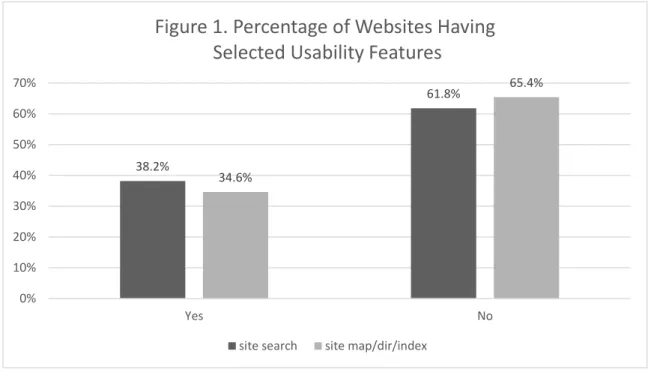
As indicated in Figure 1, most websites reviewed in this study did not present a site search or site map, index or directory. Specifically, only 38% of the sites contained a site search capability, and about 35% presented a site map, directory or index. This indicates that website practices are quite variable with respect to these two usability practices.
Additional analysis was undertaken between these two usability measures and the independent variables of website type and company type. This analysis revealed that e-commerce websites were significantly more likely to present a site search feature than non e-commerce websites (t = -9.783, sign. = .000). In addition, the websites of technology companies were significantly more likely to contain a site search capability than those of non-technology companies (t = 4.870, sign. = .000).
A similar pattern of results emerged for the second dependent variable, the presence of a site map, directory, or index. E-commerce websites were significantly more likely to present a site map, directory or index than non e-commerce websites (t = -4.369, sign. = .000). Additionally, the websites of technology companies were significantly more likely to contain a site map, directory or index than those of non-technology companies (t = 4.042, sign. = .000).
DISCUSSION AND CONCLUSIONS
The overall results of this study that only 38% of the websites presented a site search and 35% had a site map, directory, or index suggests that there is important variation with respect to these important usability practices. While usability advocates point out the importance of these website features, many websites currently do not include them. These results are largely consistent with the previous study by Huang and Cappel [2012] that found that less than half of company websites had site search function (45%) or a site map, directory or index (46%). The even lower incidence of these usability features in the current study seems to be attributable to sample differences between the two studies. While the current study focuses exclusively on INC. 5000 companies, the Huang and Cappel [2012] study considered both Fortune 500 and INC. 500 company websites. That study also found that Fortune 500 company websites presented a site search and a site map, directory or index capabilities significantly more than INC. 500 company websites.
A second important finding of the current study is that website type and company type had a significant effect on whether company websites presented the usability features of a search function and a site map, directory, or index. As noted, e-commerce sites were significantly more likely to contain these usability features than non e-commerce sites which is a result that appears to be consistent with intuition. Since e-commerce firms depend on their websites for their revenue and survival more than non e-commerce companies, it would be expected that they would undertake more effort to build features into their websites to help users find information and products. In addition, the study showed that technology companies’ websites were significantly more likely to
38.2% 61.8% 34.6% 65.4% 0% 10% 20% 30% 40% 50% 60% 70% Yes No
Figure 1. Percentage of Websites Having
Selected Usability Features
contain the usability features than non-technology companies’ websites. This result might also be expected in that technology companies (who are “in the business”) would be more attune with leading Web design practices than other types of companies.
A few limitations of this study should be acknowledged. First, this is a cross-sectional study where the data were collected at “one point in time”, i.e., within several weeks. Since websites change on an ongoing basis, follow-up studies may not find identical results to those reported here. Second, the data in this study is based on the websites of INC. 5000 companies, which are small to medium sized, high growth businesses. As such, their websites may not be representative of organizations’ websites in general. Thus, follow-up studies using other samples such as Fortune 500 company websites or another set of companies are encouraged. Finally, this study utilized two selected dependent variables based on their potential to impact usability practices. As noted earlier, since there are many other factors that also affect usability, future studies using other independent and dependent variables are encouraged.
To organizations and their web designers, the results of this study underscore that there seems to be a significant gap between some of the web design guidelines published by usability advocates and actual website practices. Thus, companies should reexamine their website design practices to determine whether they can be improved from a usability perspective. To researchers, this exploratory study may trigger ideas about additional variables that may be investigated to help explain the variability in company website design practices.
REFERENCES
Cappel, J. & Huang, Z. (2007). “A Usability Analysis of Company Websites.” Journal of Computer Information Systems, 48(1), 117-123.
Flanders, V. (2002). Son of Web Pages that Suck: Learn Good Design by Looking at Bad Design. San Francisco, CA: Sybex.
Gold, M. (2006). Ten Mistakes Web Sites Still Make and How to Fix Them. Palo Alto, CA: Stanford Videos.
Huang, Z. & Cappel, J. (2012).“A Comparative Study of Website Usability Practices of Fortune 500 versus INC. 500 Companies.” Journal Information Systems Management, 29(2), 112-122.
Johnson, J. (2003). Web Bloopers: 60 Common Web Mistakes and How to Avoid Them. San Francisco, CA: Morgan Kaufmann Publishers.
Krug, S. (2006). Don’t Make Me Think: A Common Sense Approach to Web Usability. Second
Edition. Berkeley, CA: New Riders Publishing.
Liu, C. & Arnett, K. (2002). “Raising a Red Flag on Global WWW Privacy Policies.” Journal of Computer Information Systems, 43(1), 117-127.
Nielsen, J. (2000). Designing Web Usability. Berkeley, CA: New Riders Publishing.
Nielsen, J. & Loranger, H. (2006). Prioritizing Web Usability. Berkeley, CA: New Riders Publishing.
Palmer, J. (2002). “Web Site Usability, Design, and Performance Metrics.” Information Systems Research, 13(2), 151-167.
Singh, N., Zhao, H. & Hu, X. (2003). “Cultural Adaption on the Web: A Study of American Companies’ Domestic and Chinese Websites.” Journal of Global Information Management, 11(3), 63-80.
Usability.gov. (2008). What is Usability? Retrieved from www.usability.gov/basics/whatusa.html. U.S. HHS/GSA. (2006). U.S. Department of Health and Human Services and U.S. General Services
Administration. Research-Based Web Design & Usability Guidelines. Retrieved from usability.gov/pdfs/guidelines.html.
Van Duyne, D., Landay, J. & Hong, J. (2007). The Design of Sites. Second Edition. Upper Saddle River, NJ: Prentice-Hall.
Zhao, J. & Zhao, S. (2004). “Internet Technologies Used by INC. 500 Corporate Web Sites.” Issues in Information Systems, 4, 366-372.