Gamifying Wikis for Learning Engagement
LITERATURE SYNTHESISReitumetse Chaka
University Of Cape Town
ABSTRACT
Sakai, an educational institution system, delivers a number of features for content management. This study investigates methods to improve student engagement with the learning functions of the system, in particular, improving ubiquitous use together with addition of a gaming layer on top of the traditional tools. Encouragement of students to engage with such tools in a quick and easy way involves content delivery on both web and mobile platforms. Inspiration to use gamification spurs from the success of video games on enjoyable use and achievement systems that motivate engagement of players. However, the study also explores how undesirable use of game elements may be mitigated and current academic research precursors and parallels to this relatively new field. The result of this research will form a basis in the design of a “gamified” wiki.
1.INTRODUCTION
Student engagement with course material results in increased pass rates; this research aims to uncover ways in improving external motivation for students to use learning management system tools. The wiki tool serves as the main case study, from which we explore the delivery of its content to mobile devices and methods in available literature to improve agency within use of the system. This requirement has therefore driven research focus on gamification. With the success of Gamification towards the engagement of audiences in applied fields [1] [2] [3], the first sections will investigate its application in the
pursuit of resulting in an improved interface for the Sakai wiki tool delivered on mobile and web. However, implementation of such systems inherits considerations of social user interaction, security mechanisms and artificial intelligence which will be discussed in subsequent sections.
2. GAMIFICATION
Arising from a growing trend of mass used software development methods inspired by video games, gamification has been defined as “the use of game design elements in non-game contexts” [4]. This term primarily came about because of the intent to motivate particular user behaviour through the use of game elements [1]. The trend relates to integration with human computer interaction heuristics dating back to the 1980s [5] which experiments on how addition of elements inherited from game designs can enhance interest of an audience.
The augmented reality game “I love bees” is an example of use of information pieces used to unlock next sections of a game. These pieces can be a concept that a student could learn in a particular field and also can be designed as a community task. Using computer games and games in general for educational purposes offers a variety of knowledge presentations and creates opportunities to apply the knowledge within a virtual world thus supporting and facilitating learning processes [6]. In the “UniGame” approach [6]; the educators are able to choose a topic thus modifying gameplay to suit their own purposes.
In the game industry and game studies communities, “gamification” has been a contested term because of discontentment with current implementation which oversimplifies the traditional game concepts [4]. This has spurred varying interpretation of the principle from fun and playful design to the term serious gaming [7]. However, the prevalent traits for current application are explored in detail.
2.1 Psychology
The aim of applying gamification is to appeal to the mind and interests of the student. If the main inspiration for engaging with such academic tools was just for marks then it serves no different from traditional teaching and learning methods. Thomas researched about the psychological aspects taken from games that can encourage learning and found that “In order for a computer game to be challenging, it must provide a goal whose attainment is uncertain” [8]. He shows how this principle increases a sense of agency and interest for participants to engage in activities. Hence set goals and curiosity were found to be emotionally appealing for participants to get though challenges [5].
Research on how cognitive principles can be used for enhanced training due to effects of engagement in serious games is also considered [7]. This research points to the importance of knowledge structures. It arrives at a conclusion that when a knowledge structure is large and well connected, new information is more readily acquired. This is often the case through voluntary learning and emotional attachment to a domain, a principle realised in computer games.
2.2 Achievement Systems
Game achievements usually reward a player with points. They have appeared to become a clear means to make an application more engaging; providing goals, instruction and leading to reputation [9]. Case studies include the use of achievements to improve medication compliance in the elderly through memory aid
[2] and to help with encouragement of interaction with student orientation information [1]. In the prior case, pilot studies on the test subjects showed an improved pill intake rate closest to the recommended times during and after use of the application. Whilst in the latter case, students were more engaged in learning from both the application information and the environment due to completing given tasks.
Not all implementations of gamification have been successful; we consider research on applying a game achievement system to enhance user experience in a photo sharing service. The results of the study show that some users were not convinced of the added value and expressed that this may motivate undesirable use; however, this showed potential of use and also triggered friendly competition [10].
2.3 Avatars, Badges and Experience Levels
These simply exist as status symbols and form part of the reward system. The players attain status, affirmation and group identification [9], often appealing to the psychosocial needs of the players. Ways of representing these include metaphors of character avatar growth, badges and numeric experience levels. Badges in particular have been a way of motivating users in social networks such as Foursquare, StackOverflow and Wikipedia for promoting location sharing, encouraging productive participation and awarding valued work respectively. These authors [9] therefore argue that depending on the context of use, badges can provide several functionalities, some as personal achievements and some more socially inclined.
3.WIKI DESIGN
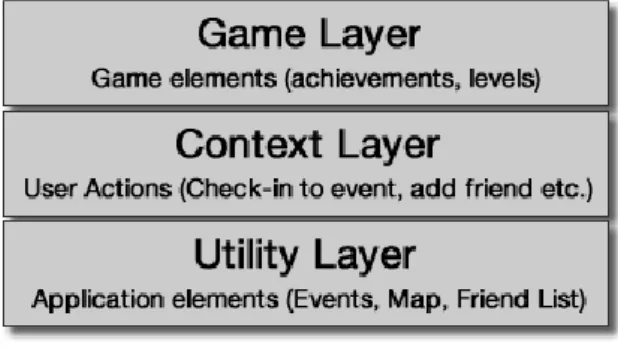
Wikis require voluntary participation, and as mentioned [7], can increase learning ability. The integration of a traditional wiki tool and gamification concepts can be visualised in
comparison to that of the student orientation passport application [1].
Figure 1. Layered design framework for student orientatioin passport system
The design framework has layers respective to functionality. In comparison with the Wiki system; the utility layer forms the underlying functionality of the system including creation of new wikis, tools and user listings. Whilst the context layer refers to user activity on the wiki such as edits and content contribution. It is the context layer that gets recorded such that the information provided translates to the game layer. The game layer includes usage rules, instructions, achievements and experience levels. Whilst these form the basic layers of the system design, several other factors ought to be investigated in implementation, some of which are expanded below.
3.1Automated Conflict and Coordination
In collaborative knowledge building such as Wikipedia there is need for coordination and conflict resolutions. Using this as a platform, research meant to address these issues [11] has not only quantified the likelihood of an event of conflict or vandalism, but also predicts conflict and coordination costs of maintaining such wikis. Machine learning was used for this example to act on simple computable content then tested on untrained articles. Results of these experiments were comparable to the human expert review. In the case of conflict other automated systems can select the best data from inference and select them for higher precedence. In the programming code domain an example a Sakai tool that acts as such an
expert system is the automatic marking tool [12] which has been evidenced to be effective.
3.2Peer Content Review
Of further more importance to the gaming domain, a peer review framework can collaboratively mitigate vandalism, cheating, spam or content inaccuracy. Websites such as digg.com and del.icio.us already assign content rating with respect to user input [11]. A study on how to use author reputation [13] in Wikipedia shows that this notion has good predictive value; changes made by low reputation authors have a significantly large probability of having poor quality as judged by human observers. In this framework, authors loose reputation if their work is rolled back or undone by peers within a short time. However the difference in this implementation from traditional ranking such as Ebay.com is that instead of using user ranking, the system is solely based on user activity. Applying this in the gamification context; users with higher reputation can be assigned a badge and also earn the right to preference in cases of conflict. Major edits the wiki could be highlighted to a number of peers for review, on acceptance the author and reviewers earn points for participation. This results in users earning roles as pseudo-moderators.
4.MOBILE USER INTERFACES
Through advancements in mobile technology, a high rate of traditional web information services being offered on mobile has been realised. In particular, mobile phones with a variety of sensors such as accelerometers, cameras and GPS are already widely deployed and becoming more ubiquitous each year. The case study of Micro-Blog [14] aims to employ these features as means of input of the environment together with text input for location based news and alerts. It also tests how social collaboration can help some communities and device specific requirements such as battery life efficiency. In relation to the wiki, an example is these services being
used to collaboratively build a map of a campus using pictures, words and geo-tagging.
Content output and interactivity on a mobile device requires some consideration of some design heuristics and the limitations of the display and input. The design “wheels around the world” [15] enables a user to consume a multitude of personalized internet and web content by using rotating icons and screen portions. This helps with navigation through a long menu of items such as the wiki tools and the allowance of the content that can be delivered with in widgets or a textual paged view.
5.SECURITY MECHANISMS
User authorisation and integrity are the two predominant security constraints to be researched. On Sakai, confidentiality is handled through data exchange encryption using HTTPS. Integrity however relies on the expected use of the system, which is, exploring different techniques available for mitigating cheating on the wiki which have been briefly discussed in section 3.1 and 3.2.
Authorisation lies in the use of mechanisms to ensure access grant for a user provided they meet the entry requirements. In a distributed environment such as an external Sakai tool, single sign-on is critical for usability. Systems like Sakai require login via username and password, however this is not desirable for use through a third party tool, we study research on using “session passwords” which are temporary passwords sent on behalf of the users password for access to the system [16]. This case study uses “MyProxy”, an X.509 credential management system from which after the user is logged in, serves a representative certificate credential to act as the representative session key.
6. CONCLUSION
This study has compared the different ideas preceding and parallel to the idea of gamification; more so, implementations
showing how this related work can influence further development for the wiki application and contribution to institutionalisation of this new term. The study has uncovered psychological and social perceptions of participants together with tools that can be implemented within the wiki to make it more engaging. Details of design of related systems show in comparison how to implement the wiki through functionality layers and how these can be used for automated and content based user interaction. For technical development of the wiki, the study explored principles in mobile user interface and ubiquitous computing together with issues and mitigation of security concerns.
7. REFERENCES
[1] Z. Fitz-walter, D. Tjondronegoro, and P. Wyeth, “Orientation Passport : Using gamification to engage university students,” pp. 122-125, 2011. [2] R. D. Oliveira, M. Cherubini, and N.
Oliver, “MoviPill : Improving Medication Compliance for Elders Using a Mobile Persuasive Social Game,” pp. 251-260, 2010.
[3] M.-chieh Chiu et al., “Playful Bottle : a Mobile Social Persuasion System to Motivate Healthy Water Intake,” 2009. [4] S. Deterding and D. Dixon, “From
Game Design Elements to
Gamefulness : Defining ‘ Gamification ’,” pp. 9-15, 2011.
[5] T. W. Malone, “Lessons from Computer Games,” pp. 63-68, 1982. [6] M. Pivec and O. Dziabenko,
“Game-Based Learning in Universities and Lifelong Learning : ‘ UniGame : Social Skills and Knowledge Training ’ Game Concept 1,” vol. 10, no. 1, pp. 14-26, 2004.
[7] F. L. Greitzer, O. A. Kuchar, and K. Huston, “Cognitive science implications for enhancing training effectiveness in a serious gaming context,” Journal on
Educational Resources in Computing,
vol. 7, no. 3, p. 2-es, Nov. 2007. [8] T. W. Malone, “What Makes Things
Fun to Learn? Heuristics for Designing Instructional Computer Games,” vol. 162, 1980.
[9] J. Antin and E. F. Churchill, “Badges in Social Media : A Social Psychological Perspective,” pp. 1-4, 2011.
[10] M. Montola, T. Nummenmaa, A. Lucero, M. Boberg, and H. Korhonen, “Applying Game Achievement Systems to Enhance User Experience in a Photo Sharing Service,” 2009, vol. 4, no. 46, pp. 94-97.
[11] A. Kittur et al., “He Says, She Says: Conflict and Coordination in Wikipedia +,” 2007, pp. 453-462.
[12] H. Suleman and C. Town, “Automatic Marking with Sakai,” 2008, pp. 229-236.
[13] B. T. Adler and L. D. Alfaro, “A Content-Driven Reputation System for the Wikipedia ∗,” 2007, pp. 261-270. [14] S. Gaonkar, J. Li, R. R. Choudhury, and
A. Schmidt, “Micro-Blog : Sharing and Querying Content Through,” 2008, pp. 174-186.
[15] A. Christine, H. S. G., and M. Andre, “Wheels Around the World : Windows Live Mobile Interface Design,” 2008, pp. 2113-2128.
[16] T. Fleury, J. Basney, and V. Welch, “Single sign-on for java web start applications using myproxy,” in
Proceedings of the 3rd ACM workshop
on Secure web services - SWS ’06,