Report No. 390
P
Global experience
The International Association of Oil & Gas Producers has access to a wealth of technical knowledge and experience with its members operating around the world in many different terrains. We collate and distil this valuable knowledge for the industry to use as guidelines for good practice by individual members.
Consistent high quality database and guidelines
Our overall aim is to ensure a consistent approach to training, management and best practice throughout the world.
The oil and gas exploration and production industry recognises the need to develop consistent databases and records in certain fields. The OGP’s members are encouraged to use the guidelines as a starting point for their operations or to supplement their own policies and regulations which may apply locally.
Internationally recognised source of industry information
Many of our guidelines have been recognised and used by international authorities and safety and environmental bodies. Requests come from governments and non-government organisations around the world as well as from non-member companies.
Disclaimer
Whilst every effort has been made to ensure the accuracy of the information contained in this publication, neither the OGP nor any of its members past present or future warrants its accuracy or will, regardless of its or their negligence, assume liability for any foreseeable or unforeseeable use made thereof, which liability is hereby excluded. Consequently, such use is at the recipient’s own risk on the basis that any use by the recipient constitutes agreement to the terms of this disclaimer. The recipient is obliged to inform any subsequent recipient of such terms.
Copyright notice
The contents of these pages are © The International Association of Oil and Gas Producers. Permission is given to reproduce this report in whole or in part provided (i) that the copyright of OGP and (ii) the source are acknowledged. All other rights are reserved.” Any other use requires the prior written permission of the OGP.
Report No: 390
The following table gives information concerning this edition of the Aircraft management guidelines:
Issue Comments Date
5 Addition appendix 13, Appendix 14 published as report number
390-A14, updates to sections 4.2.5, 8.1.8, 12.4 and 12.5.3 August 2013 4 Replacement of section 3, addition of section 4.6, withdrawl of
Appendix 2
August 2011
3 Updates to sections 4.3, 4.3, 4.5, 5.3, 5.6, 6.7, 8.1, 9.9, 11.9 &
Appendices 1, 3, 4, 5A, 5B & 11. November 2010
2 Updates to Sections 4.3, 4.4, 8.1, 8.2 & Appendix 5 July 2008
Table of Contents
1 Introduction
5
1.1 Purpose ...7
1.2 Document structure ...7
1.3 OGP guidelines ...7
1.4 Setting an aviation policy ...7
2
Aviation operation review requirements
9
2.1 Contracted air operators ...112.2 One-time acceptances ...11
2.3 Principles of review ...11
3
Safety & quality management
13
3.1 Regulatory requirements ...153.2 OGP requirements ...16
3.3 Safety management system elements ...17
3.4 Hazard/risk management process ... 19
3.5 Incident & accident reporting requirements ... 20
3.6 Quality assurance ... 20
3.7 Environmental management ... 20
4
Aircraft operations general
21
4.1 Contractual ...234.2 Operating categories & usage ... 24
4.3 Pilots ...26
4.4 Maintenance personnel ...27
4.5 Maintenance requirements ...28
4.6 Drugs & alcohol policy ...30
5
Helicopter operations
31
5.1 Helicopter standards ... 335.2 Helicopter performance classes ...34
5.3 Fuel planning ...34
5.4 Use of offshore alternatives...35
5.5 Composition of flight crew ...36
5.6 Flight & duty time ...36
5.7 Offshore helicopter life-jackets & aircraft homing devices ...38
5.8 Rotors Running Refuelling (RRRF)/helicopter rapid refuelling ...38
5.9 Crane-helicopter operational procedures ...38
5.10 Radio silence - perforating operations ...38
5.11 Specialist roles ...39
6
Fixed-wing operations – public transport & aerial work
41
6.1 Fixed-wing aircraft standards ...436.2 Airfields - minimum requirements ...44
6.3 Fuel planning ...44
6.4 Composition of flight crew ...45
6.5 Flying hour limits - recommended maximum ...45
6.6 Aircrew life-jackets & aircraft homing devices ...45
6.7 Sideways facing seats ...45
6.8 Specialist roles ...46
7
Fuel system design & management
47
7.1 Design, operation & inspection references ...497.3 Variances...49
7.4 Fuel quality control ...49
7.5 Rapid refuelling (refuelling with engines running) ...51
7.6 Portable offshore fuel transport tanks ...52
8
Training & experience
53
8.1 Flight crew training ...558.2 Support & technical personnel requirements ...60
8.3 Training records & programmes ...60
9
Passengers & freight
61
9.1 General ...63 9.2 Cargo ...63 9.3 Manifests ...64 9.4 Passenger weights...64 9.5 Passenger briefings ...65 9.6 Video briefing ... 66 9.7 Multi-language operations ... 669.8 Passenger marshalling areas ... 67
9.9 Passenger training... 67
9.10 Passenger dress requirements ... 67
9.11 Passenger & cargo management on helidecks ...68
9.12 Passenger seating ...68
9.13 Survival equipment ...68
10
Aircraft equipment standards
71
10.1 Introduction & equipment fit tables ...7310.2 Minimum aircraft equipment - general ...73
10.3 Helicopter equipment...75
10.4 Fixed-wing equipment ... 77
11 Airbases
79
11.1 Definition ... 8111.2 Airbase design reference ... 81
11.3 Airbase design reviews ... 81
11.4 Variances... 81
11.5 Weather monitoring systems ... 81
11.6 Airbase rescue equipment ...82
11.7 Airbase fire protection & equipment ...82
11.8 Non-directional beacons (NDB) ...83
11.9 Helicopters & helidecks ...83
11.10 Airports & airstrips...85
12
Emergency response planning
87
12.1 Introduction ...8912.2 Aircraft in the emergency response role...89
12.3 Scenario-based drills ...89
12.4 Helicopters used for medical evacuations ... 90
12.5 Search & Rescue (SAR) services & equipment ... 90
12.6 Survival equipment ... 91
12.7 Emergency flights ...95
12.8 Overdue aircraft ...95
13 Appendices
97
A1
Risk assessment & risk reduction opportunity ranking
99
A2 [WITHDRAWN]
105
A3
Duties & responsibilities of the Air Operations Supervisor
107
A4
Training courses - air operations supervisor
109
A4.1 Introduction ...111
A4.2 Advisory familiarisation & training ...111
A4.3 Flight safety & aircraft accident investigation courses ...111
A4.4 UK airworthiness course ...112
A4.5 Safety management system ...112
A4.6 Crew resource management ...112
A4.7 Familiarisation/refresher/conversion flying training ...112
A4.8 Role experience ...112
A4.9 Basic fire course ...112
A4.10 Helicopter fire course ...112
A4.11 HLO training course ...112
A4.12 Fuel quality course ...113
A4.13 Seismic course ...113
A4.14 Quality assurance course ...113
A4.15 Weather observer course ...113
A4.16 Dangerous goods course...113
A5
Training courses - air operations supervisor
115
A5A Experience & Qualification Levels ...117A5B INITIO & low experience pilot training & progression for multi-crew offshore helicopter pilots ...120
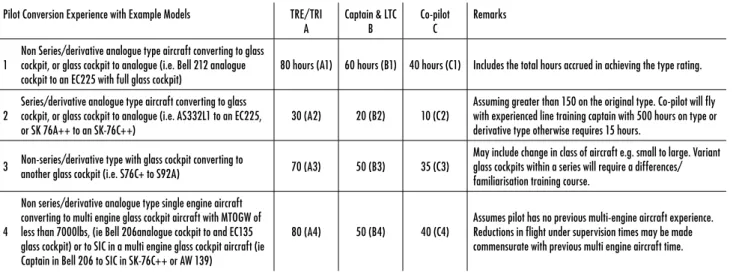
A5C Pilot Aircraft Conversion Syllabus and Minimum Hours ...121
A5D Engineering, load master, helideck personnel, aerial observer and dispatcher qualifications & experience .126
A6
Aviation weather guidelines
129
A6.1 General ...131A6.2 Operating environment & weather ...131
A6.3 Flight rules & weather ...131
A6.4 Offshore helicopter weather limits & reporting ...133
A6.5 Offshore helicopter adverse weather operational limitations ...135
A7
Recommended aircraft equipment fit
139
A8
Heliportable land seismic operations (issued as OGP Report Nº 420) 145
A9
Winching (hoisting) operations
147
A9.1 Personnel transfer by winch ... 149A9.2 Helicopter performance ... 149
A9.3 Operational procedures ... 149
A9.4 Personnel (pilots & winch operator) guidelines ... 150
A9.5 Required equipment standards... 150
A10 Airborne geophysical survey
153
A10.1 Risk analysis ...155A10.2 Aircraft equipment standards ...155
A10.3 Personal equipment standards ...155
A10.4 Minimum crew ...155
A10.6 Pilot flight & duty times ... 156
A10.7 Minimum survey height ... 156
A10.8 Minimum survey speed ... 157
A10.9 SAR coverage ... 157
A10.10 Minimum fuel reserves ... 157
A10.11 Fuel quality & procedures ... 157
A10.12 Helicopter procedures ...158
A11
Aerial pipeline inspection
159
A11.1 General ...161A11.2 General guidelines ...161
A11.3 Single-engine aircraft ...161
A11.4 Aircraft configuration ...162
A11.5 Aircraft maintenance for long-term operations ...162
A11.6 General pilot and/or observer requirements ... 165
A11.7 Pipeline patrol specific pilot role experience ... 165
A11.8 Pilot flight & duty time ...167
A11.9 Collision avoidance ...167
A11.10 Passengers – crew members ...167
A11.11 Exemptions/Low Altitude Waivers ...168
A11.12 Inadvertent entry into Instrument Meteorological Conditions ...168
A11.13 Flight following ...168
A11.14 Flights over urban areas ...172
A11.15 Landings and low altitude inspections en-route (helicopters only) ...172
A12 Helicopters as a secondary Search & Rescue task
173
A12.1 Introduction ... 175A12.2 Management ... 175
A12.3 Operating standards ... 175
A12.4 Aircraft & equipment fit ...176
A12.5 SAR equipment ...177
A12.6 Aircrew ...177
A12.7 SAR crew ...178
A13 Cold weather aircraft operations
183
A13.1 Introduction ...183A13.2 Aircraft certification standards & equipment fit ...185
A13.3 Flight operations - general ...186
A13.4 Helicopter-specific operations ...189
A13.5 Airplane-specific operations ...190
A13.6 Maintenance procedures ...191
A13.7 De-ice/anti-ice ... 193
A13.8 Survival equipment ...194
A13.9 Facilities ... 195
A13.10 Personnel ...197
A13.11 References...198
A13.12 Annexes ...199
Section 1 Contents
1 Introduction
7
1.1 Purpose ...7
1.2 Document structure ...7
1.3 OGP guidelines ...7
1 Introduction
1.1 Purpose
The purpose of these guidelines is to provide a ready reference for the management of aviation. It deals with operations from the conceptual phase onwards. In doing so it addresses the factors to be taken into account when contemplating aircraft operations, the tendering and contractual process, the setting up of support facilities and the expectations required of our contractors.
Most governments have some form of National (Civil) Aviation Authority, the function of which is to lay down standards and requirements for both the aircraft and the manner in which they are operated. However, Aviation Authorities vary in their effectiveness as well as their requirements and standards, although a good aircraft operator may apply guidelines that are more exacting than legislated requirements. Indeed, even the best Aviation Authority can only lay down minimum requirements; the ultimate responsibility for safety in the air lies with the aircraft operator.
These guidelines and the readily available support from Aviation Advisers should assist those responsible for managing aviation, particularly if they are not aviation specialists, to plan, develop and control, safely and efficiently, air transport operations that are best suited to their needs.
1.2
Document structure
These guidelines are divided into two parts:
• Part 1 contains the current guidelines for aircraft operations.
• Part 2 contains additional guidance and explanatory material describing how the defined guidelines and policies can best be applied.
Part 2 of the document is still under development.
It is emphasised that nothing in this document is intended to contravene national or international regulations.
1.3
OGP guidelines
OGP has developed the set of safety guidelines contained in this manual based on a number of core guidelines and recognised industry best practices. The guidelines are largely based on existing international legislation and safety codes but, where appropriate are further developed as described in this manual. The regulatory basis for these guidelines is summarised in Part 2.
Where these guidelines cannot be achieved fully for practical reasons, an aviation adviser should, wherever practicable, seek mitigating measures with a view to achieving an equivalent level of safety. For specific operations, these guidelines may need to be augmented with specified additional guidelines to reflect the local circumstances and operating conditions.
1.4
Setting an aviation policy
Companies should consider the establishment of an aviation policy to provide guidelines for the safe, economic and efficient use of aircraft in support of company operations. Such a policy would apply equally to company and contractors’ personnel.
As an example, the aviation policy could require that:
• Preference is given to the use of those international airlines and regional carriers with low accident rates. Where any doubt exists, advice should be sought from an aviation adviser.
• Exposure to high-risk operations should be minimised.
• For all aviation activities, other than scheduled airline travel, only aircraft operators and aircraft types approved for use by an aviation adviser should be used.
• Contracted aircraft are to be operated only by aircrew, and maintained by engineers, meeting specified minimum qualifications, and experience and currency requirements.
• Aircraft operators are to meet company insurance requirements.
• Specific operational restrictions may be applied, taking account of the contractor and local environment; amongst these will be the requirement to operate to public transport standards and to meet published aircraft performance criteria.
• The decision to use aircraft should be weighed against the alternatives of using other forms of travel, taking full account of operational, economic and, above all, safety implications.
Section 2 Contents
2
Aviation operation review requirements
11
2.1 Contracted air operations ...11 2.2 One-time acceptances ...11 2.3 Principles of review ...11
2 Aviation operation review requirements
2.1
Contracted air operators
Any aircraft operator invited to tender should be reviewed and accepted in accordance with the relevant procedures of the OGP member company. Subsequently, all such operators should be reviewed on a regular basis, at a frequency determined by risk, exposure, usage and performance of the air operation on the previous review, and should not be used without a current acceptance.
• All ongoing/long-term operations (those exceeding one year in length) should be subject to initial and thereafter annuals reviews.
• Start-up operations or those with a high level of activity may require more frequent oversight.
2.2
One-time acceptances
Operators used for ad-hoc charter flights are also subject to an on-site review. Should this not be practical, an exceptional “one-time acceptance” based solely on documentation provided by the operator may be given subject to certain criteria being met and accepted by the OGP member company. It must be recognised that such a one-time acceptance provides less assurance about the safety of the operation and the contractor’s suitability for the proposed task. Aircraft operators receiving a “one-time acceptance” should not be used subsequently until they are subjected to a full review as explained above.
2.3
Principles of review
The purpose of an OGP Member Company review of an aircraft operator is to determine the suitability as an aircraft operator in terms of safety and capability and, where appropriate, to make recommendations for improvements. The OGP member company interfaces such as owned/ maintained assets (airfields, passenger services, flight following, helidecks, refuelling equipment, scheduling arrangements, etc.), should also be reviewed.
Reviews must be carried out in accordance with defined terms of reference. The standards applied will be those established by the OGP member company, except where the requirements of the National Aviation Regulations of the air operator concerned are more restrictive or otherwise exceed the standards specified by the OGP member company. A review report will be delivered to the customer, typically by the end user within the OGP member company, within an agreed period after the review debrief.
Section 3 Contents
3
Safety & quality management
15
3.1 Regulatory requirements ...15
3.2 OGP requiremnts ...16
3.3 Safety management system elements ...17
3.4 Hazard/risk management process ... 19
3.5 Incident & accident reporting requirements ... 20
3.6 Quality assurance ... 20
3 Safety management
3.1
Regulatory requirements
Safety Management Systems (SMS) are increasingly being expressed as a regulatory requirement. The International Civil Aviation Organization (ICAO) is driving the shift in regulatory position: “From 01 January 2009 each applicant for the grant of an air operator’s certificate shall establish a safety management system appropriate to the size and complexity of the operation, for the proactive management of safety, that integrates the management of operations and technical systems with financial and human resource management, and that reflects quality assurance principles”.
The following regulatory guidance applies:
• ICAO Safety Management Manual (Doc 9859-AN/474) Second Edition 2009;
• ICAO Annex 6, (Operation of Aircraft) requires that States, as part of their State Safety programme, shall require an operator to implement a safety management system;
• ICAO Annex 11, (Air Traffic Services) requires member States to have certificated international airports establish a SMS;
• ICAO Annex 14, Volume I (Aerodrome Design and Operations) requires member States to have certificated international airports establish a SMS;
• EASA/JAA – Ops.001 Group are in process of determining how SMS can be implemented, and therefore embedded within the regulations;
• FAA – Advisory Circular, AC 120-92A, Safety Management Systems for Aviation Service Providers;
• FAA – Advisory Circular, AC 150/5200-37, Introduction to Safety Management Systems (SMS) for Airport Operators;
• FAA – Advisory Circular, AC 120-59A, Air Carrier Internal Evaluation Programs;
• Transport Canada – Civil Aviation Directive 31 (Safety Management Systems);
• CASA – Safety Management Systems Information Pack;
• UK CAA, Civil Aviation Publication CAP 726 (Guidance for Developing and Auditing a Formal Safety Management System)
3.2
OGP requirements
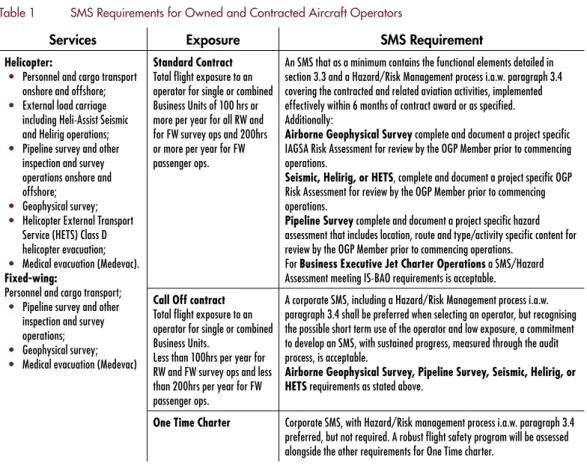
OGP Members and their contracted aircraft operators shall comply with applicable national safety management system regulations, as these relate to air operator and associated air operations infrastructure.
However, as a minimum or where national regulations have not yet been mandated for safety management systems, OGP Members should require of owned or contracted aircraft operators, the SMS requirements detailed in table 1 below.
Table 1 SMS Requirements for Owned and Contracted Aircraft Operators
Services Exposure SMS Requirement
Helicopter:
• Personnel and cargo transport onshore and offshore; • External load carriage
including Heli-Assist Seismic and Helirig operations; • Pipeline survey and other
inspection and survey operations onshore and offshore;
• Geophysical survey; • Helicopter External Transport
Service (HETS) Class D helicopter evacuation; • Medical evacuation (Medevac).
Fixed-wing:
Personnel and cargo transport; • Pipeline survey and other
inspection and survey operations; • Geophysical survey; • Medical evacuation (Medevac)
Standard Contract
Total flight exposure to an operator for single or combined Business Units of 100 hrs or more per year for all RW and for FW survey ops and 200hrs or more per year for FW passenger ops.
An SMS that as a minimum contains the functional elements detailed in section 3.3 and a Hazard/Risk Management process i.a.w. paragraph 3.4 covering the contracted and related aviation activities, implemented effectively within 6 months of contract award or as specified. Additionally:
Airborne Geophysical Survey complete and document a project specific IAGSA Risk Assessment for review by the OGP Member prior to commencing operations.
Seismic, Helirig, or HETS, complete and document a project specific OGP Risk Assessment for review by the OGP Member prior to commencing operations.
Pipeline Survey complete and document a project specific hazard assessment that includes location, route and type/activity specific content for review by the OGP Member prior to commencing operations.
For Business Executive Jet Charter Operations a SMS/Hazard Assessment meeting IS-BAO requirements is acceptable.
Call Off contract
Total flight exposure to an operator for single or combined Business Units.
Less than 100hrs per year for RW and FW survey ops and less than 200hrs per year for FW passenger ops.
A corporate SMS, including a Hazard/Risk Management process i.a.w. paragraph 3.4 shall be preferred when selecting an operator, but recognising the possible short term use of the operator and low exposure, a commitment to develop an SMS, with sustained progress, measured through the audit process, is acceptable.
Airborne Geophysical Survey, Pipeline Survey, Seismic, Helirig, or HETS requirements as stated above.
One Time Charter Corporate SMS, with Hazard/Risk management process i.a.w. paragraph 3.4 preferred, but not required. A robust flight safety program will be assessed alongside the other requirements for One Time charter.
3.3
Safety management system elements
The range of SMS guidance documentation detailed at 3.1 describes an SMS in a number of different ways and lists many elements for an effective SMS.
Those different requirements have been reviewed and for the purpose of this document, condensed into 10 elements. Individual OGP Members may describe the elements in different terms in their own company documentation, but those should include the content detailed below.
Subject to the requirements defined at Table 1 (SMS requirements for Owned and Contracted aircraft operators), OGP Members should require the following SMS elements and relationships to be effectively implemented within their own and contracted aircraft operators.
It is recognised that the size and complexity of the aircraft operator will be reflected in the structure and complexity of the elements of the SMS.
Required SMS Elements & Relationships
1) Leadership Commitment – Active SMS involvement and support from an informed company leadership.
2) Policy, accountabilities & KPIs – A defined HSE policy, based on a “Just” culture, defined responsibilities for safety management and Key Performance Indicators (KPIs).
3) Documented Procedures - Documented, detailed procedures covering all SMS activities and processes and more broadly documented procedures for safety critical tasks related to aircraft operations, including flight operations, aircraft maintenance and ground operations.
4) Personnel & Competence – Appointment of key safety personnel, with defined competence requirements. Sufficient resources to manage and operate an effective SMS.
5) Safety Communications – A range and hierarchy of safety communication processes to enable an effective, two way flow of safety information throughout the company.
6) Safety Reporting & Investigation – Safety reporting procedures covering regulatory required reports and lower level incidents and occurrences and an investigation process to generate and follow to closure, internal recommendations.
7) Management of Change – A defined procedure to manage the risks associated with significant change related to aircraft operations, including key personnel.
8) Hazard/Risk Management – See section 3.4 for more detail.
9) Quality Assurance (QA)– An internal process focused on providing confidence that the risk controls specified through regulation, company operating procedures and the risk management process are effective within all flight operations, maintenance and ground operations activities. See Section 3.6 for more details.
10) Senior Management Review – A management review process, based on a defined meeting schedule, that gives senior managers visibility of the SMS activity, in particular safety reporting, hazard management and QA issues.
Relevant elements should also be co-ordinated to ensure actions complement one another and support the effectiveness of the whole SMS.
Required SMS elements & relationships
Leadership Commitment
Policy, accountability & KPIs
Documented
procedures Safety reporting& investigation
Regular Senior Management
Review
Management of change
Hazard & Risk Management
ID, assessment & mitigation
Quality assurance Personel &
competence CommunicationsSafety
3.4
Hazard/risk management processs
The hazard management process, previously and sometimes referred to as a Safety Case, is not generally well defined within the reference guidance or well understood by a number of operators, but forms an essential element in managing risk to as low as reasonably practicable (ALARP). Further guidance is therefore provided in this section.
Regardless of the size of the operator, its SMS is required to include a Hazard/Risk Management Process. Although the systems and procedures used will vary by operator and need to be aligned to complement the other elements of the SMS, the Hazard/Risk Management Process should contain the elements and links shown below. Like the SMS, the size and complexity of the elements is likely to reflect the size and complexity of the operator.
Define the scope
of the activity Managementof change
Process new hazards
Control exists
New control required
Validate existing controls or develop new controls Validate existing controls or
develop new controls
Control developed
Identify & record hazards
Reference controls to company procedures & assign responsible individual
Conduct risk analysis Identify controls to manage hazards Record in remedial action plan QA system/process – Update checklists Safety reporting & investigation Management Review Process
More detail and explanation of the use of a Risk Assessment Matrix (RAM) for the risk analysis stage and bow tie analysis for the identification of controls stage, is found at Appendix 1.
The Hazard/Risk Management process must identify and address both generic, mission specific and location specific hazards. The hazards should be recorded in a hazard register in a format that:
• shows the risk assessment score assigned to each hazard;
• links the hazards to specific controls and (bowtie) recovery measures;
• provides a document reference for the control and recovery measure;
• assigns a responsible individual to each control.
The hazard register can be within the SMS Manual, in an appendix, in a separate document or in a software tool, as suits the operator.
An operator may have one generic hazard register covering its whole operation or a number of location or mission specific hazard registers. In either case, controls identified for location specific hazards are to be assigned local responsibility.
The Hazard/Risk Management process should be demonstrably linked to the operators Safety Reporting and Investigation process, its Management of Change process, and to the QA function. This ensures that the hazard/risk management process is triggered by reported incidents and occurrences, by relevant changes within the company, and that the controls developed by the process are verified by QA audit and by the investigation process. Those parts of the process indicated, should also be subject to periodic management review.
3.5
Incident and accident reporting requirements
Notwithstanding the air operator’s regulatory, local and/or national legislative Mandatory Occurrence Reporting obligations, OGP Members should, by contract, require that owned and contracted aircraft operators provide notification and relevant available details to the OGP Member (within 24 hours) in the event of the following occurrences:
• Aircraft Accident
• Serious or Significant Incident
• Near Miss
• Air Safety Reports (having imminent Airworthiness or Safety of Flight implications)
Aircraft accidents and serious incidents will normally be notified, investigated and reported in accordance with the international standards and recommended practices contained in ICAO Annex 13, which provides the necessary framework for the Investigation. OGP Members may observe and participate if allowed by the Governing State of Occurrence and specialist assistance may be provided by the OGP Members Aviation Advisor to local in-house investigations, following notification.
OGP’s Health & safety incident reporting system users’ guide should also be consulted to determine if injuries sustained in the course of OGP Members aviation related activities are reportable to the OGP.
3.5.1. Accident definition
For the purposes of consistency across different national regulatory authorities and to enable accurate statistics to be compiled, the following definition of accident, taken from ICAO, will be assumed for all OGP reporting purposes:
Accident – An occurrence associated with the operation of an aircraft which, in the case of a manned aircraft, takes place between the time any person boards the aircraft with the intention of flight until such time as all such persons have disembarked, or in the case of an unmanned aircraft, takes place between the time the aircraft is ready to move with the purpose of flight until such time as it comes to rest at the end of the flight and the primary propulsion system is shut down, in which:
a) a person is fatally or seriously injured as a result of:
–being in the aircraft, or
–direct contact with any part of the aircraft, including parts which have become detached from the aircraft, or
–direct exposure to jet blast or rotor downwash, except when the injuries are from natural causes, self-inflicted or inflicted by other persons, or when the injuries are to stowaways hiding outside the areas normally available to the passengers and crew; or
b) the aircraft sustains damage or structural failure which:
–adversely affects the structural strength, performance or flight characteristics of the aircraft, and
–would normally require major repair or replacement of the affected component,
except for engine failure or damage, when the damage is limited to a single engine, (including its cowlings or accessories), to propellers, wing tips, antennas, probes, vanes, tyres, brakes, wheels, fairings, panels, landing gear doors, windscreens, the aircraft skin (such as small dents or puncture holes), or for minor damages to main rotor blades, tail rotor blades, landing gear, and those resulting from hail or bird strike (including holes in the radome); or
c) the aircraft is missing or is completely inaccessible.
Because the ICAO definition is aimed primarily at fixed-wing flights terminating on land, the following is added for clarity over the particular area of ditching or water landing. Where the aircraft intentionally or unintentionally ditches or lands on water as the result of a mechanical/
system failure or aircrew error, and the aircraft cannot regain flight or is not subsequently recovered without sustaining the damage detailed in b) above, it will be considered an accident for the purposes of the OGP aviation safety statistics.
For example, a ditching that resulted in a subsequent, but not necessarily immediate, rollover and/or sinking and major repair due to water damage, would be considered an accident for OGP statistics. A ditching where the aircraft remains upright on its floats and is recovered with only minimal damage, including the damage due to water ingress, would not be considered an accident, unless paragraph a) applied.
3.6.
Quality assurance
OGP Members should require aircraft operators to develop, document and implement a quality assurance system (or process) modelled to provide confidence that the risk controls specified through regulation, company operating procedures and the risk management process are effective within all flight operations, ground operations and maintenance activities.
This should include:
• An internal evaluation/audit programme encompassing all safety and quality critical activities within flight operations, ground operations and maintenance.
• Auditing of processes, procedures, documentation, training and records.
• Audit activities should be scheduled and conducted at planned intervals to establish conformity with regulatory and management system requirements. Results of previous audits, including implementation and effectiveness of corrective action, should be included within the scope of the programme.
• The programme should be managed at the local operational level and be subject to periodic review by the air operator’s management. QA departmental procedures, duties, responsibilities, and reporting relationships should be described in the Operations Manual, Maintenance Management Manual (MMM), Management System Manual or a separate QA manual as appropriate.
3.7
Environmental management
Environmental management controls should at all times be in compliance with local and or national regulatory requirements.
Controlled companies and their contracted aircraft operators shall demonstrate to an acceptable level how the hazard of aircraft noise is effectively managed within their operations.
Section 4 Contents
4
Aircraft operations general
23
4.1 Contractual ...23
4.1.1 Contract management - Aviation Advisor support ...23 4.1.2 The role of the Air Operations Supervisor (AOS) focal point ...23 4.1.3 Aircraft insurance and indemnity ...23 4.1.4 Use of third-party (turnkey) contracts ...24
4.2 Operating categories and usage ... 24
4.2.1 Use of scheduled airlines and airline safety ...24 4.2.2 Use of non-scheduled Aircraft ...24 4.2.3 Use of private or non-accepted aircraft ...25 4.2.4 Use of public sector aircraft ...25 4.2.5 The use of unapproved aircraft for emergency and med-rescue flights ...25
4.3 Pilots ...26
4.3.1 Qualifications and experience levels ... 26 4.3.2 Alternatives to OGP recommended experience levels ... 26 4.3.3 Use of freelance pilots ... 27 4.3.4 Pilots flying more than one aircraft type ... 27 4.3.5 Medicals ... 27 4.3.6 Payroll/salary... 27
4.4 Maintenance personnel ...28
4.4.1 Qualifications ... 28 4.4.2 Experience levels ... 28 4.4.3 Avoidance of fatigue in maintenance personnel ... 28
4.5 Maintenance requirements ...29
4.5.1 Quality assurance and quality control ... 29 4.5.2 Requirement for duplicate inspections/Required Inspection Items (RII) ... 29 4.5.3 Aircraft Minimum Equipment List (MEL) ... 30
4 Aircraft operations general
4.1 Contractual
4.1.1 Contract management – Aviation Advisor support
In the early stages of planning a new venture where air transport is being considered, the involvement of an Aviation Advisor has proved invaluable in determining the optimal solution for aviation transport requirements. In such cases, Aviation Advisor representation on the scouting team provides the necessary expertise to evaluate influencing factors such as terrain, distances, climate, SAR facilities, and make timely recommendations including advice on design criteria for remote airfields or for helipads or helidecks. In remote and developing areas, a considerable lead time (typically a minimum of six months) may be required to ensure availability of suitable aircraft operated by an approved contractor.
For longer-term contracts and contract renewal, advice should also be sought from the Aviation Advisor on the detailed contract terms to ensure that individual OGP Member’s standards are included in the contract.
Where the air support requirements on a contract are particularly complex or extensive in their scope, consideration should be given to appointing a professionally qualified aviation supervisor for the specific operation.
All OGP Member’s using aircraft should have a nominated Air Operations Supervisor (AOS) focal point, responsible for overseeing aviation activities in accordance with the advice laid down in this manual. Advice is available at all times from the nominated Aviation Advisor, and this advice is supplemented by the Guidance to Air Operations Supervisors booklet issued by the OGP.
4.1.2 The role of the Air Operations Supervisor (AOS) focal point
Those responsible for the supervision of air transport within OGP Member’s business units typically range from Heads of Aircraft Services, who may be qualified pilots or professional aircraft maintenance engineers to others, with no previous knowledge of aviation. Other variations include EP ventures, where the Operations Manager, Logistics Manager, or a member of their staff, looks after air transport support, often in conjunction with other responsibilities.
The scope of work varies enormously: from simply chartering aircraft to meet specific tasks, with passenger handling undertaken by the aircraft operator or an agent; to operating an owned fleet of aircraft, with company owned facilities including airfields, helipads, helidecks, passenger scheduling and handling. The running of facilities will require the setting up of in-house procedures, establishing competencies training personnel, provisioning equipment and putting in place a safety management system.
Air Operations Supervisor (AOS) will be used as the generic term for the purpose of this publication be they an ‘Aviation Co-ordinator, ‘focal point’, or other localised or OGP Member specific term (Terms of Reference at Appendix 3).
The training needs of an AOS should be tailored to the experience level and qualifications of the person selected to be an AOS taking into consideration the scope of the work required to be undertaken. Examples of courses available are at Appendix 4.
4.1.3 Aircraft insurance & indemnity
Level of Insurance
The OGP Member should determine the level of insurance required in line with its company risk management guidelines.
Evidence of insurance
OGP Members should require that:
a) Each aircraft operator provide documentary evidence of the required insurance coverage. b) Such insurance not be cancelled or changed materially during the course of the contract
without at least thirty days written notice to the OGP Member.
Subrogation, cross liability & additional insured
a) To the extent necessary to reflect indemnities given by an aircraft operator under the contract, insurers should waive rights of action/subrogation against the OGP Member and the OGP Member should be named as an additional insured under the policy.
b) Liability insurance should contain a severability clause (Cross Liabilities).
Additional cost
The OGP Member’s Risk Management and or Insurance specialists/advisors should be consulted if there will be a cost associated with the requirement to name the OGP Member as additional insured or to obtain a waiver of subrogation.
4.1.4 Use of third-party (turnkey) contracts
The following points are stressed should an OGP Member choose to use turnkey contractors: a) OGP Member’s personnel on company business who in the course of their work are expected
to use aircraft owned by other companies or chartered by third parties/other companies should exercise caution and should consult with the OGP Member’s Aviation Advisory staff before using the aircraft.
b) Third-party aircraft should meet standards of safety/technical quality comparable to those of the OGP Member; they should provide an adequate level of liability coverage (see previous comments above) and the crew/staff should meet OGP Member equivalent competence standards.
c) While emergency situations may not allow sufficient notice for advance evaluation, employees should liaise with their OGP Member’s Aviation Advisor, either directly or through locally designated contacts, whenever possible.
d) Included are aircraft operating to OGP Member contracted facilities and provided through third-parties as a “turn-key” contract operation for other services such as seismic, barge, geophysical survey, cargo, mobile offshore drilling units (MODUs), etc.
e) Reviews of the aviation contractor by the Aviation Advisor should still be required, whether or not a turn-key contract is in place.
f) Supervision of the aviation services should be maintained and the aviation contractor’s performance continuously monitored.
g) The Aviation Advisor’s review of the contractor would also specifically cover the local OGP Member’s business unit’s ability to monitor and maintain standards.
4.2
Operating categories & usage
4.2.1 Use of scheduled airlines & airline safety
OGP Members should endeavour to provide information that allows its business travellers to select and use those airlines representing the lowest risk for the route to be flown.
The OGP has developed an Airline safety assessment mechanism (OGP Report № 418) which can be used by OGP Members to compare the relative risks of travelling on scheduled airlines and decide whether the risks associated with airline travel are compatible with the business need. The Mechanism takes into account a significant number of factors that contribute to the relative risk of an airline.
4.2.2 Use of non-scheduled Aircraft
When travel by non-scheduled aeroplane or helicopter is deemed appropriate, this may be on dedicated contract aircraft, by spot charter or on aircraft of joint venture partners. In these cases, advice should be sought from the Aviation Advisor regarding the status, with respect to the OGP Member’s policies and requirements, of the aircraft operator and aircraft type, and the qualifications of the pilots to be used.
Paragraph 2.2 of this manual provides further details in respect of ‘One Time Acceptance’ and subsequent review requirements.
4.2.3 Use of private or non-accepted aircraft
During the course of conducting company business, personnel are sometimes offered ‘lifts’ in private aircraft or in aircraft operated by non-reviewed or non-accepted companies, often at very short notice. Providing time permits, the Aviation Advisor may be able to offer advice in respect of non-reviewed companies. OGP Members should consider using a ‘One Time Acceptance process’ (paragraph 2.2) as a guide to the operator’s ability and to assist management in the risk assessment of such flights.
4.2.4 Use of public sector aircraft
In the course of conducting its activities the OGP Member may be offered the use of public sector aircraft, for example those operated by law enforcement or other government agencies. The aircraft offered may be military types or civil aircraft that may not otherwise conform with civil airworthiness requirements. It is also possible that these aircraft are operated outside of the civil aviation regulations. There may be situations or locations where the use of a public sector aircraft by an OGP Member is warranted in which case advice from the Aviation Advisor should be sought to determine how to assess whether use of these aircraft can accepted or should be declined.
4.2.5 The use of unapproved aircraft for emergency & med-rescue flights
Whenever OGP Members have ongoing operations within any given area, they should pre-plan, prequalify and proactively contract for aircraft services necessary to provide emergency evacuations, especially medical evacuations, where the time required to get patients to competent and comprehensive medical care can make the difference between life and death. Helicopters on long-term contract to provide medical evacuation services should at least comply with the requirements for transport helicopters used in the same environment. See Section 12.4Helicopters used for medical evacuations for more details. The option of auditing all the possible med-rescue aircraft operators around the world (e.g. SOS, AXA or similar companies) that are available to respond to an air ambulance flight is likely to be beyond the resources available to most OGP Members. However, where there is a dedicated aircraft operator that is approved and suitably equipped, then that operator should be used for the task, such as in the case where an injured person is evacuated from an offshore platform, for which the OGP Member has a contracted support helicopter.
A good source for standards for Air Ambulance operations are summarised in the Transport Canada, Guide to air ambulance operations (TP10839E) available on website:
http://www.tc.gc.ca/CivilAviation/commerce/manuals/tp10839/menu.htm.
At the time of requiring a Med-rescue flight, the OGP Member may not be able to pick and choose whose aircraft will be called to respond and therefore is forced to accept the service as provided. The only alternate would be to use local medical facilities, or wait for commercial airline flights; neither of these options may be practicable or acceptable for real medical emergencies in remote locations where the medical support is less than the desirable standard.
Therefore the following process should apply:
a) Controls should be in place to ensure that the OGP Member management and medical advisors only call for Med-rescue flights when the level of illness/injury warrants the evacuation of the patient. These controls should form one part of the Emergency Response Plans for the operation or site.
b) Wherever possible, contracts should be in place with Med-rescue service companies such as those with known international reputations.
c) The use of aircraft, as supplied, is accepted on the basis that the exposure and risk of using unaudited/unapproved aircraft is outweighed by the risk of further suffering or loss of life to the patient who is the focus of the medical emergency.
4.3 Pilots
4.3.1 Qualifications & experience levels
The tables at Appendix 5A detail the recommended flying experience and qualifications of pilots before they can fly OGP Member or Contractor(s) personnel. Where these requirements cannot be met a mechanism to obtain a dispensation providing mitigating factors should be set in place. Where this is requested, full details of an individual’s experience and qualifications under the headings shown in the tables should be submitted to the Aviation Advisor for assessment and consideration prior to agreeing or otherwise such a dispensation.
Some operators have a basic pilot training scheme involving carefully structured modules from selection through to basic, ab-initio training, conversion training, supervised line training, and captaincy. For the graduates of such a scheme, dispensation may be given for acceptance as captains or co-pilots on OGP Member flights, in accordance with paragraph 4.3.2 below for multi-crew aircraft.
Some civil aviation authorities allow “captaincy under supervision”, or “P1 U/S” as it is sometimes called, to count towards captaincy time, usually counting as half captaincy time. Before such an arrangement can be agreed during the progression of a co-pilot towards captaincy on an OGP Member contract, guidance should be sought from the Aviation Advisor to ensure the validity of that flying. See paragraph 8.1.6.
In some countries air taxi and helicopter pilots may not be entitled to an Air Transport Pilot’s Licence (ATPL) or equivalent. If this is the case then a Commercial Pilot’s Licence (CPL), or equivalent in the country of operation, is considered acceptable.
4.3.2 Alternatives to OGP recommended experience levels
As an alternative to the pilot experience levels detailed at Appendix 5A, it is possible to replace the requirement for defined pilot experience levels with an approved operator’s competency based Training Management System.
In order for this to be achieved the following conditions must be met:
a) Establishment of a formal modular competency based progression scheme for pilots from basic (ab-initio/new-hire/conversion) to command and for aircraft type conversion, which will:
i) Be based on the guidelines at Appendix 5B and 5C as applicable.
ii) Include an ATPL Theory examination and elements for role specific training (i.e. offshore, vertical reference, etc) at the Stage 2 level of Appendix B for Commercial Pilot License (CPL) training.
b) An “In depth” audit of the operator’s training system and effectiveness of the implementation of the competency based training program should be conducted by the Aviation Advisor to include as a minimum the following:
i) Content of the training syllabus, to include comprehensive ground and flight training, particularly for entry at the CPL stage (see paragraph e. below), based on the best practices from both the JAA and FAA training schemes.
ii) Formal progression scheme for pilots from basic (ab-initio) to command. Observation of Crew Resource Management (CRM) and simulator programs including Line Oriented Flight Training (LOFT).
iii) Examination of training records with emphasis on a structured command course, competencies to be achieved and the associated checking process.
iv) Base and Line training staff with defined competencies who themselves are regularly checked.
c) An ongoing Aviation Advisor audit plan to ensure continued compliance with the above. d) Additionally, when a new aircraft type is introduced on contract, it may be necessary to
reduce total time on type. This must be considered only after approval of the contractor’s type conversion scheme based on the requirements of Appendix 5C, and will be reviewed on a case-by-case basis as noted above and in paragraph 8.1.2.3.
e) The entry level for the competency based Training Management System will normally be at the ab-initio level (Appendix 5B, Stage 1), but can also be with a CPL (Appendix 5B, Stage 4) providing the following conditions are met:
i) Aptitude testing is completed in accordance with Appendix 5B, Stage 1. ii) The candidate holds an ATPL theory qualification
iii) Full training records are held for the CPL training including records of stage and final check flights and total hours are validated by the training provider.
iv) The training provider has been assessed and approved by the Helicopter Operator’s QA or Training organisation and the following factors taken into account:
• Instructor experience and oversight.
• Instructor competency check process.
• The content of the CPL training (ground and flight), which should include an element of role specific training dependant on the type of flying to be performed (i.e. Offshore, vertical reference).
4.3.3 Use of freelance pilots
Freelance pilots may be used provided they have received proper company Induction/Conversion/ line training before initial engagement, are included as part of the company’s recurrent training programme, and have OPC/LPC (or equivalent) conversion training in accordance with national regulations. If time between engagements exceeds time between required OPCs, a training programme applicable to all company pilots, being away from flying for whatever reason, should apply to the freelancer.
Their competence and suitability should be formally endorsed by the senior management of the company and must meet all OGP Member flying qualifications and experience level requirements. They are also to be identified to and accepted by the OGP Member Company prior to use.
4.3.4 Pilots flying more than one aircraft type
Aircraft operator policy regarding how many types of aircraft their pilots may fly varies significantly from company to company. The advisability of pilots flying more than one type will vary with the types involved, the experience level and ability of the individual pilot. Nevertheless, because flying several types on a day-to-day basis inevitably increases the danger of incorrect responses in the case of emergency, and the likelihood of handling errors or errors of omission, a limit must be placed on the practice.
It is expected that aircraft operators have a written policy on the subject, which applies across their operations. While pilots are quite correctly endorsed on a number of aircraft types, it is recommended that only in exceptional circumstances would more than 2 types be flown on a day-to-day basis, with a preference to see a single type flown, or scheduling in blocks of days on a particular type. If more than one type is flown, recency flying and type training must be closely monitored both by individual pilots and by a nominated member of the flying, training or operations staff.
4.3.5 Medicals
All pilots should hold a valid medical certificate; appropriate to their age and licence (e.g. CPL, ATPL) requirements. The frequency of medical examinations is determined by the local National Aviation Authority and/or company policy, however the maximum interval between medical examinations should not exceed 12 months.
4.3.6 Payroll/salary
Aircrew personnel should not receive remuneration solely on a basis of hours or miles flown. The method of remuneration preferred by the OGP is fixed salary.
4.4
Maintenance personnel
4.4.1 Qualifications
Personnel carrying out aircraft maintenance should hold appropriate Licences and Endorsements (see Appendix 5D1-3). These should permit them to carry out aircraft maintenance or act in a supervisory or management capacity of an approved Maintenance organization as required by the governing regulatory authority of the jurisdiction in which operations are being conducted.
In addition, a system of local approvals should exist whereby the operator or maintenance organisation systematically approves the individual to exercise the privileges granted by the licence &/or endorsements held on the range of equipment operated or maintained by that organisation. Such approvals may be granted following formal type training and/or local on-the-job training/ evaluation as appropriate.
4.4.2 Experience levels
Except in the case of incumbent supervisory/management personnel already employed in an organization introducing a new aircraft type, where additional manufacturer or other qualified support may be required during the introductory and early operational phases, the experience level requirements at Appendix 5D1-3 should be applied.
4.4.2.1 Unlicenced and recently licensed maintenance personnel
Where organisations employ a mix of licenced and unlicenced or recently licenced personnel, the proportion of personnel having Certificate of Release to Service (CRS) privileges to others should be sufficiently high to ensure adequate supervision of work is provided at all times.
4.4.2.2 Trainee aircraft maintenance engineer/technician/mechanic
Where trainees are sponsored or employed directly, the requirements for unlicensed and recently licenced maintenance personnel equally applies. In addition, there will be a documented training plan that includes:
a) Formal training – must hold basic educational qualifications for entry into regulator approved maintenance training course(s) in respect of the licence categories desired. Training must be provided by an approved training organisation.
b) On-the-job training – must be relevant and provide adequately supervised experience.
4.4.3 Avoidance of fatigue in maintenance personnel
Other than any specific labor laws that may be applicable locally, maintenance personnel are not regulated by duty hour limitations. The following should be applied to all engineering staff as a minimum standard:
4.4.3.1 Total work period
Total work periods should not exceed 12 hours in any 24-hour period. Where, exceptionally, it is essential that the working period is extended; the Head of Maintenance should approve it on a case-by-case basis.
4.4.3.2 Night Shifts
Where shifts are regularly rostered with a heavy maintenance workload to be completed through the night, the length of the duty period may be reduced from the 12 hour maximum.
Ideally, if night maintenance is necessary, the bulk of work should be completed by the shifts on duty up to midnight with the residue completed by a swing shift covering the period from approximately 2300 to 0700 hrs.
4.4.3.3 Rest
Each full working shift should be followed by a minimum 8-hour rest period. When working a 24-hour split shift on line operations, at least 6 hours rest should be provided excluding travel. The entitlement for days off should be a minimum of 7 per month of which at least 4 should be in a minimum of 2-day periods. When the location or climate is arduous then this should be increased to minimize fatigue.
4.4.3.4 Remote camps
On locations such as seismic camps, where it is not feasible to provide other than the bare accommodation necessities, a regular “time on site, time off site” routine should be set up to ensure that maintenance personnel working under these conditions do not stay in the field for prolonged periods. The minimum recommended ratio of time on site to time off site is considered to be 2:1 with a maximum period on site not to exceed 2 months.
4.5
Maintenance requirements
4.5.1 Quality assurance & quality control
Quality Assurance requirements are given at paragraph 3.4. Quality Control procedures are normally a regulatory requirement, and should adopt a form similar to those expressed in EASA Ops 1/EASA 145. However, where there is an absence of regulatory control in this respect, the requirements expressed in paragraphs 4.5.2 and 4.5.3 should be satisfied by all operators/maintenance organisations on contract to the OGP Member.
4.5.2 Requirement for duplicate inspections/Required Inspection Items (RII)
After any disturbance or dis-assembly of a control system or vital point in an aircraft, most but not all Regulators call for independent inspections to be made and certified by two appropriately qualified persons, before the next flight. The inspections are to include correct assembly, locking, and free and correct movement of control systems over the full range. Such requirements extend to electrically activated “fly-by-wire” systems and their connections as well as to mechanical linkages. This procedure is known as duplicate inspection/required inspection item and, although not all authorities have a similar requirement, it is recommended that companies require such inspections. Therefore, whenever a contract is drawn up this requirement should be included.
Independent Duplicate/Required Inspection Item (RII) inspections are to be carried out by appropriately qualified technicians, the required qualifications normally being determined by the Regulator, e.g. FAA Inspection Authorisation (IA). In the event that the qualification of these persons is not regulated, then they would normally be a licensed engineer, technician or equivalent, holding a type approval for maintaining the engines and airframe of the aircraft concerned. In all cases, the operator or maintenance organisation is to ensure that sufficient persons appropriately qualified are available at all main operating &/or maintenance bases. When away from the normal
maintenance facilities, and only minor adjustment of a control is required, a pilot may, if approved by appropriate aviation authorities, exceptionally act as the second signatory. The licensed engineer/ technician should instruct the pilot on which controls have been disturbed and the limits of the area to be checked, but should include freedom and sense of movement, as well as simple assembly and locking. The full procedure, which should be defined in the organisation’s Maintenance Exposition or Procedures Manual, is then to be adopted on return to base.
The written statement heading the certification should include a description of the disturbance to the control and a range that is to be checked, ie from point to point.
Note 1: It should be noted that duplicate inspections are not a requirement under EASA-145 or EASA-OPS. However due to UK CAA requirements, maintenance carried out on UK registered aircraft by other national maintenance bases includes the requirement for duplicate inspections and it is the operator’s responsibility to ensure compliance.
Note 2: FAA requirements for RII differentiate between aircraft types certificated for 9 seats or less, subject to an Approved Aircraft Inspection Programme (AAIP) and those of 10 seats or more, subject to Continuing Analysis and Surveillance. The AAIP does not require RII/duplicate inspection. Further information can be found in 14CFR Part 135.411/419/429/431. Nevertheless, it is recommended that OGP Member standards require that the maintenance of aircraft subject to AAIP when on contract to the OGP Member include RIIs. Furthermore, those operators providing services that are not contracted should be encouraged to adopt a RII policy in respect of their aircraft that are subject to the less restrictive AAIP.
Note 3: The requirement for an operator to complete duplicate inspections after disturbing a control may be mandated in the contract where it is not required by the local regulator.
4.5.3 Aircraft Minimum Equipment List (MEL)
Flight crews and maintenance personnel must always have available for reference an aircraft Minimum Equipment List (MEL) or Minimum Departure Standard (MDS) for the appropriate aircraft type and the local airworthiness authority should approve these. Where a MEL is not available, full equipment serviceability will be required. See Section 5.1 Helicopter standards.
4.6
Drugs & alcohol policy
Contractors and Sub-Contractors should have formally documented policies on the use/abuse of alcohol, medical drugs and narcotics. Guidance is to be provided on what the company considers to be acceptable by way of alcohol consumption. Additionally, guidance should be given to staff on which commonly available medical drugs, prescribed or otherwise, may impair an individual’s ability to perform in the cockpit or workplace. In all cases the air operator shall comply with any National legislation/guidelines.
Section 5 Contents
5
Helicopter operations
33
5.1 Helicopter standards ... 33
5.1.1 Minimum operational & role-specific equipment ... 33 5.1.2 Piston-engine helicopters ... 33 5.1.3 Multi-engine helicopters with single-engine performance ... 33 5.1.4 Multi-engine helicopters without single-engine climb performance, or single-engine helicopters,
or single pilot ... 33 5.1.5 Helicopters operating in a hostile sea environment ... 33
5.2 Helicopter performance classes ...34 5.3 Fuel planning ...34
5.3.1 IFR flight plan ... 34 5.3.2 VFR flight plan ... 34
5.4 Use of offshore alternates ...35 5.5 Composition of flight crew ...36
5.5.1 Two pilot operations ...36 5.5.2 Single pilot operations ...36
5.6 Flight and duty time ...36
5.6.1 Limits ...36 5.6.2 Fatigue-related work ...37 5.6.3 Maximum flight times ...37 5.6.4 Maximum duty and minimum rest times ...37 5.6.5 Rest for rotating crews ...37 5.6.6 Night standby duty ...37
5.7 Offshore helicopter life-jackets and aircraft homing devices ...38 5.8 Rotors Running Refuelling (RRRF)/helicopter rapid refuelling ...38 5.9 Crane-helicopter operational procedures ...38 5.10 Radio silence - perforating operations ...38
5.10.1 Nature of hazard...38 5.10.2 Radio silence...38
5.11 Specialist roles ...39
5.11.1 Land seismic operations ...39 5.11.2 Winch operations ...39 5.11.3 Airborne geophysical survey requirements ...39 5.11.4 Aerial pipeline inspection ...39
5 Helicopter operations
5.1
Helicopter standards
5.1.1 Minimum operational & role-specific equipment
In addition to the minimum equipment recommendations of Appendix 7 and role-specific equipment specified in other sections of this guide, the requirements in the following paragraphs should also be considered.
5.1.2 Piston-engine helicopters
Piston-engine helicopters should not be used.
5.1.3 Multi-engine helicopters with single-engine performance
Multi-engine helicopters capable of sustaining a 1% net climb gradient at or above the lowest safe altitude with one engine inoperative (OEI) and flown with two pilots should be used when any of the following conditions exist:
a) The environment is hostile (see Appendix 6.2.3). b) Any portion of the flight is performed at night.
c) Any portion of the flight will be in instrument (non-visual) conditions.
5.1.4 Multi-engine helicopters without single-engine climb performance, or single-engine helicopters, or single pilot
Multi-engine helicopters without single-engine climb performance in cruise, or single-engine helicopters, or single pilot should ONLY be used when the following conditions are met:
a) When permitted by local regulatory authorities.
b) The environment is determined to be non-hostile (see Appendix 6.2.4).
c) Operations are Day VFR only, and for single-engine helicopters, the aircraft is landed 30 minutes prior to official sunset.
d) Acceptable Search & Rescue Services are available (see Section 12 and Appendix 12). e) Continuous Flight Following is maintained.
5.1.5 Helicopters operating in a hostile sea environment
If the sea temperature will be less than 10°C during the flight a risk assessment should be completed to determine if exposure suits should be worn by occupants (see Appendix 6).