Drug Treatment and Testing Orders:
Final evaluation report
Paul J. Turnbull, Tim McSweeney, Russell Webster,
Mark Edmunds and Mike Hough
Criminal Policy Research Unit, South Bank University
Home Office Research, Development and Statistics Directorate October 2000
The Home Office Research Studies are reports on research undertaken by or on behalf of the Home Office. They cover the range of subjects for which the Home Secretary has responsibility. Titles in the series are listed at the back of this report (copies are available from the address on the back cover). Other publications produced by the Research, Development and Statistics Directorate include Research Findings, the Research Bulletin, Statistical Bulletins and Statistical Papers.
The Research, Development and Statistics Directorate
RDS is part of the Home Office. The Home Office’s purpose is to build a safe, just and tolerant society in which the rights and responsibilities of individuals, families and communities are properly balanced and the protection and security of the public are maintained.
RDS is also a part of the Government Statistical Service (GSS). One of the GSS aims is to inform Parliament and the citizen about the state of the nation and provide a window on the work and performance of government, allowing the impact of government policies and actions to be assessed.
Therefore -
Research Development and Statistics Directorate exists to improve policy making, decision taking and practice in support of the Home Office purpose and aims, to provide the public and Parliament with information necessary for informed debate and to publish information for future use.
“The views expressed in this report are those of the authors, not necessarily those of the Home Office (nor do they reflect Government policy).”
First published 2000
Application for reproduction should be made to the Communications and Development Unit, Room 201, Home Office, 50 Queen Anne’s Gate, London SW1H 9AT.
© Crown copyright 2000 ISBN 1 84082 556 1 ISSN 0072 6435
Drug Treatment and Testing Orders (DTTOs) were introduced as a new community sentence under the Crime and Disorder Act, 1998. The orders were established in response to growing evidence of the link between problem drug use and persistent acquisitive offending. Orders are targeted at serious drug misusing offenders aged 16 and over, with the dual aim of treating their drug use in order to reduce the amount of crime committed to fund a drug habit. The order requires the offenders to undergo regular urine tests and, unique to community sentences, court reviews to monitor progress.
This report presents findings from an 18-month evaluation conducted by South Bank University, on behalf of the Home Office, in three pilot areas - Gloucestershire, Liverpool and Croydon. Results include an evaluation of the type of offenders sentenced to a DTTO, how well they met the treatment, testing and review elements of the order, and how successful the pilot projects were in reducing their drug use and related offending.
The evaluation also makes recommendations about the most effective ways for multi-agency teams to deliver DTTOs.
CHRIS LEWIS
Head of Offenders and Corrections Unit
We are grateful to staff and probationers in the DTTO pilot sites for their help with this evaluation. Being the object of research can be a trying experience, and we appreciate the patience and tolerance shown to us. We would like to thank all those who participated in focus groups in the comparison sites with special thanks to Imogen Brown and Caterina Fagg (STEP), Marie Orrell and Bernie Heath (PASCO), Nadia Clarke and Clare Thompson (Hastings), and Mike Ruffles and Jane Anderson (Fast Track).
We would like to thank Sarah Partridge of the Home Office Research, Development and Statistics Directorate, and Keir Hopley, Matthew Bird and Robert Stanbury of the Home Office Probation Unit.
Several people within the Criminal Policy Research Unit have contributed to this project including Ian Hearnden, Carol Hedderman and Jim Parsons. Special thanks to our field workers Luke Tierney and Paul Russell.
Paul J. Turnbull Tim McSweeney Russell Webster Mark Edmunds Mike Hough
Page Foreword i Acknowledgements ii Summary v Throughputs v Testing vi Enforcement vi Reviews vii
Impact on offenders vii
Implications viii
1. Introduction 1
Drug Treatment and Testing Orders 1
Previous experience of coerced treatment 3
The experience in the United States 3
The UK experience 6
Our approach to evaluating DTTOs 7
The structure of this report 8
2. The pilot and comparison schemes 9
The Croydon Pilot Programme 9
The Gloucestershire Pilot Programme 13
The Liverpool Pilot Programme 15
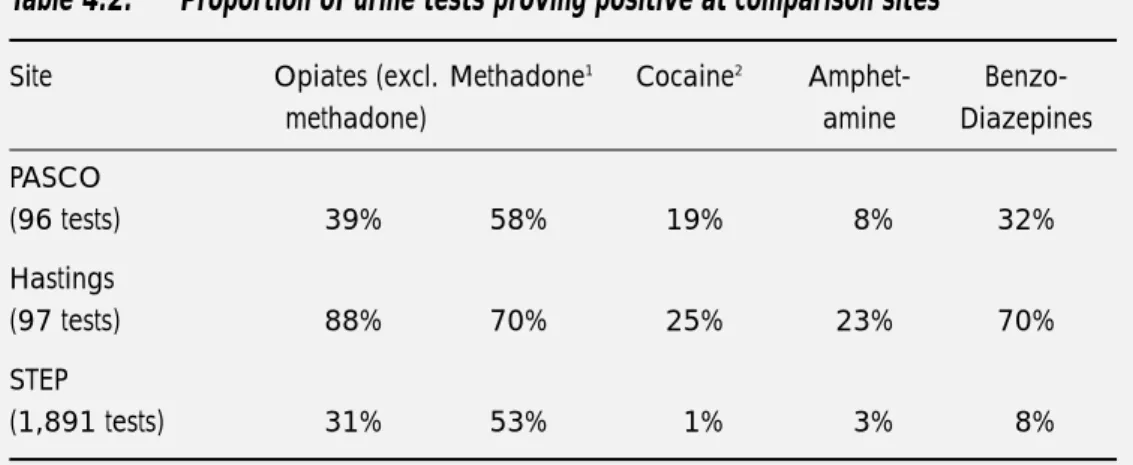
The comparison sites 17
3. Choosing Offenders For DTTOS 21
The pool of potential candidates for DTTOs 21
Referral, assessment and selection 23
Criteria for acceptance 29
Details of orders made 31
Profile of those given DTTOs 32
4. Testing, Reviews And Enforcement 35 Testing 35 Enforcement 41 Court Reviews 47 Stock-taking 51 5. Inter-agency working 53 Comparison sites 55 Stocktaking 56
6. The views of DTTO offenders 59
Initial experience 59
Views of offenders at completion or revocation of order 62
Completers and those near to completion 63
Revocations 63
7. Changes in drug use and offending 65
At Intake 65
Changes in the middle term 71
Changes in drug spend 73
Exit interviews 74
Stock-taking 76
8. Summary and implications 79
Throughputs 79 Testing 79 Enforcement 80 Reviews 80 Impact on offenders 81 Implications 82
Monitoring and evaluation 87
Concluding thoughts 87
Appendix A: Details of research methodology 89
Appendix B: Urine test data 91
This report presents the findings of our evaluation of Drug Treatment and Testing Orders (DTTOs). We have examined the three pilot sites (in Croydon, Gloucestershire and Liverpool) as well as four additional projects which use Probation 1A(6)1 orders in ways which closely resemble DTTOs. Our results cover the full period of the DTTO pilot projects, which ran from October 1998 to March 2000.
Throughputs
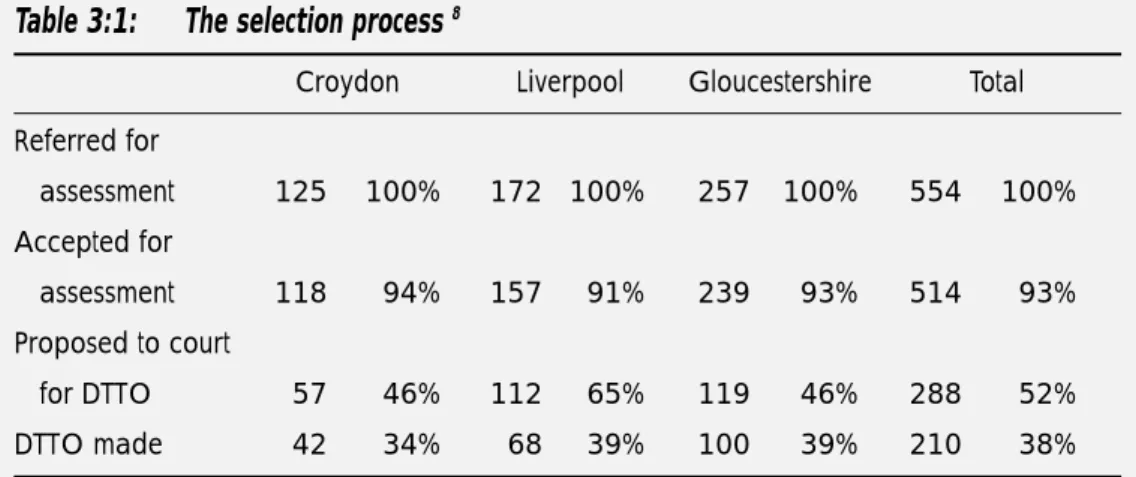
All three sites got off to a slow start, though the pace of referrals picked up half way into the pilot period. The comparison sites seemed to have experienced similar difficulties in getting their schemes up-and-running. In planning national roll-out a slow start should be expected. In total 210 offenders were given DTTOs. The pilots had differing referral and assessment strategies. Attrition rates between referral for assessment and acceptance for assessment were influenced by a number of factors such as an individual offender not consenting to an order, not accepting or attending an assessment interview, or being judged as unsuitable for an assessment by the DTTO team. Offenders must consent to a DTTO; these data therefore include some who decided to withdraw from the proposal and assessment process. The table below shows the number of drug-using offenders at each stage of the selection process.
The selection process
Croydon Liverpool Gloucestershire Total
Referred for assessment 125 100% 172 100% 257 100% 554 100% Accepted for assessment 118 94% 157 91% 239 93% 514 93% Proposed to court for DTTO 57 46% 112 65% 119 46% 288 52% DTTO made 42 34% 68 39% 100 39% 210 38%
1. A 1A(6) probation order, is an order with an additional requirement for treatment of drug or alcohol dependency. For more information see Criminal Justice Act, 1991.
Testing
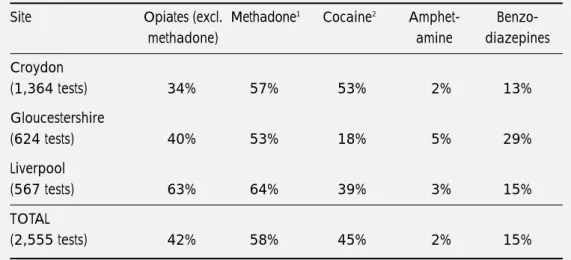
We have records of 2,555 urine tests carried out by the end of March 2000 covering 173 offenders – an average of 14.7 each. Just over half (53%) were conducted at the Croydon site. As can be seen from the table below many tests were positive for opiates and cocaine. However as drug-using offenders continued on a DTTO, the rate of testing positive for opiates decreased. The impact on cocaine use was less clear.
Proportion of urine tests proving positive, by end of March 2000
Site Opiates (excl. Methadone1 Cocaine2 Amphet-
Benzo-methadone) amine diazepines
Croydon (1,364 tests) 34% 57% 53% 2% 13% Gloucestershire (624 tests) 40% 53% 18% 5% 29% Liverpool (567 tests) 63% 64% 39% 3% 15% TOTAL (2,555 tests) 42% 58% 45% 2% 15%
1. Includes licit and illicit use.
2. Urine tests do not distinguish between crack cocaine and cocaine powder. Therefore, the term ‘cocaine’ is used in the report to cover both types of drug.
What the tests do not show, of course, is changes in level of drug use. Even though they were still using illicit drugs, most of those we interviewed reported steep reductions.
Enforcement
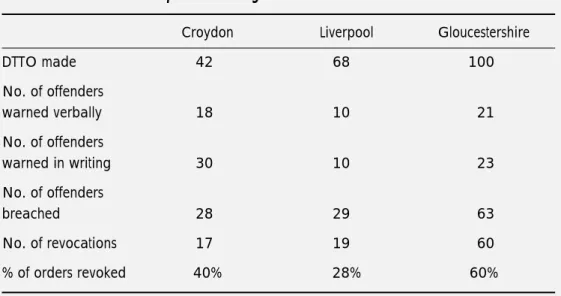
The three sites had widely differing approaches to warnings, breaches and revocations. In all three sites offenders quite often failed to meet the conditions of the order. The main form of non-compliance was failure to attend, but as noted above, many continued to use illicit drugs, especially near the start of their order. The table below summarises warnings, breaches and revocations for the three pilot sites up until March 2000. Further warning, breaches and revocations are likely to occur as offenders continue with their DTTOs.
Enforcement processes – figures until 31 March 2000
Croydon Liverpool Gloucestershire
DTTO made 42 68 100 No. of offenders warned verbally 18 10 21 No. of offenders warned in writing 30 10 23 No. of offenders breached in 28 29 63 No. of revocations 17 19 60 % of orders revoked 40% 28% 60%
Reviews
We hold information on 413 separate review hearings for 154 offenders. Practice varied across the sites. There were practical problems in arranging reviews, mainly to do with case listing in two of the three sites. In Liverpool more than four out of five reviews were heard by the judge or magistrates who originally passed sentence; in Croydon the figure was a third, and in Gloucestershire a fifth. Especially for reviews which were heard by the original sentencer, the process seemed a useful one, welcomed by staff and offenders alike as making a positive contribution to the treatment process.
Impact on offenders
We carried out 132 interviews with offenders within six weeks of receiving the order; we re-interviewed 48 of these after they had been on their order for six months; and we carried out 50 ‘exit interviews’ with those who had completed their DTTO successfully (or were within a few weeks of doing so) or had it revoked. Results from our self-report interviews on drug use are broadly consistent with the urine test results; the majority (75%) who tested positive admitted at interview that they had used the drug in question.
On the basis of self-report data, there were substantial reductions in drug use and offending at the start of the order. The average weekly spend on drugs fell from £400 in the four
weeks before arrest to £25 in the first four to six weeks of the order (94% reduction in drug spend). Polydrug use had become much less common; typically people stopped using crack or amphetamine, but continued to use opiates, albeit at a much reduced level. There were commensurate reductions in acquisitive crime. The average number of acquisitive crimes committed by 119 offenders in the month before arrest was 137. The corresponding figure for 35 offenders during the month before first interview was thirty-four. As ever, one should be circumspect about self-report data, though the picture to emerge is consistent with the urine testing results and other surveys of this kind.
The six-month interviews showed that these reductions were largely sustained over time. This implies that if DTTOs succeed in retaining offenders within the programme, they seem likely to contain drug use and offending. We cannot say conclusively that this is the case, however, given the small number of offenders reaching this stage to date.
The exit interviews were completed on two groups – those who reached (or had nearly reached) the end of their order successfully, and those who had failed. The 31 successes said they were crime-free and 27 said they were drug-free – except for their use of cannabis. At present very few orders have matured to this stage. Therefore, all we can say is that an eighth of those on orders seem to have emerged drug-free. This proportion will obviously grow over time, but we cannot yet say by how much.
Even the failures had reduced their drug use, and some claimed to have benefited from their experience on the order. Although we cannot be certain, we strongly suspect that we managed to contact the ”partial failures” and that there will be a disproportionate number of serious relapses amongst the remainder whom we were unable to contact.
Implications
Here we have tried to identify problems which are most likely to affect the national roll-out of DTTOs, and suggested possible solutions.
Inter-agency working
The lack of effective inter-agency working in every pilot site is perhaps the single most important factor to address. The pilot sites all encountered quite serious ”teething problems”; and some of these remain unresolved. In order to aid a successful roll-out the Home Office and probation areas will have to invest heavily in the selection and training of staff, achieving clarity of roles, team building activities and planning better assessment procedures and treatment programmes.
Referral procedures
One reason why DTTOs got off to a slow start was that probation officers writing PSRs (Pre-Sentence Reports) and other agencies, such as the police, failed to refer appropriate candidates. It is important both to stimulate the flow of referrals and to minimise the proportion of inappropriate referrals. Probation areas need to put systems in place to ensure that PSR writers are aware of DTTOs and some broad criteria for acceptance on the programme.
Assessment
This is a two-stage process. First DTTO teams decide whether to accept a referral for assessment, and secondly they mount a formal assessment. There is scope for establishing tighter selection criteria and injecting more rigour into the initial screening process, as just over 40 per cent of those assessed were not put forward for a DTTO. It would be useful if teams drew up a clear set of criteria and filtered out inappropriate cases using published guidelines.
The assessment process needs to be more discriminating in winnowing out both those who are certain to fail and those who need very little help to address their drug problems. Given their cost, DTTOs obviously need to be targeted on those offenders on whom treatment programmes will have the greatest impact. There is certainly a need for a specific diagnostic tool.
Matching the individual to treatment
The pilots exemplify widely differing approaches in the intensity, nature and flexibility of the interventions delivered. It would be helpful to set some expectations nationally in terms of the level of restriction of liberty, the need for chaotic drug users to have a structured programme and the lessons of the Effectiveness Review which suggests that treatment needs to be matched to the individual (Department of Health, 1996).
Clarity of intervention objectives
Whilst there is a growing evidence base about the effectiveness of drug treatment, there is still much professional disagreement about the best approaches. Teams need to articulate their working philosophy, and to achieve a consensus within the team around this. It would be useful for DTTO teams to formalise in writing a clear plan of their proposed intervention. Given the level of breach and revocation soon after an order is made it is important that early interventions focus on engaging with drug-using offenders and retaining them in treatment.
‘Expectations of drug use on DTTOs’
The pilot sites had widely differing expectations of offenders; the Gloucestershire pilot initially expected very rapid progress to drug-free status, the other two teams had the less demanding expectation that progress towards abstinence will be gradual and accompanied by relapses. Our reading of the research evidence is that it takes at least three months to engage successfully with this client group; and our own view is that requiring DTTO offenders to be completely drug-free in a matter of weeks is pushing them too far too fast.
‘Consistency and effectiveness of urine testing’
The frequency of urine testing varies markedly between pilot areas. Very frequent testing may not be a good use of money, and can be counter-productive in those who are reducing the amount of drugs they use. We think that testing needs to be integrated fully with treatment programmes, with testing regimes tailored to the objectives set for individual offenders. However, we suggest the following minimum standard; twice per week for the first three months of the orders with discretion to reduce this to a minimum of once per week after that period.
Continuity of sentencers at court reviews
The review process seems to be of value. Offenders respond both to the praise and to the criticism of a sentencer who shows interest in their progress. Our sense is that the benefits are likely to be greatest when the same sentencer(s) is involved throughout the sentencing and review process. The difficulty is the practical one of getting this to happen. The Merseyside system of regular court sessions dedicated to the review of DTTO appears to be both effective and efficient.
Streamlining breach procedures
If there is to be greater consistency across areas, there is a need to produce clearer indications of guidelines for when breach is appropriate. We do not think that the revised (2000) National Standards for probation orders could be applied unamended to DTTOs. On the one hand the greater intensiveness of the DTTO means that the opportunities for failure are very much higher than for a conventional probation order. On the other, the nature of dependent drug use is such that relapses are very likely to occur even under the toughest regimes of control. Although an expectation of consistent reporting should be set, teams should be encouraged to concentrate mainly on the reduction and cessation of offending behaviour. Wherever the minimum acceptable attendance rate is set, it needs to be proportionate to the level of contact required by the programme. More work needs doing in clarifying the procedure for Crown Court breaches and improving the speed of the police response in executing warrants. It would make sense for probation areas to negotiate arrangements for executing warrants with their local police force, as was done in Croydon.
Monitoring
We think it important that, from the start, schemes should design monitoring arrangements into their programmes. Monitoring needs to cover the referral and assessment process, offenders’ contact hours per week with the programme and the enforcement process. It is particularly important to monitor whether enforcement proceedings are removing offenders from the programme when they are still near the start of their order.
This report presents the findings of our evaluation of Drug Treatment and Testing Orders (DTTOs), which were introduced under the Crime and Disorder Act of 1998. This introductory chapter falls into three parts. First it sets out the background to the development of DTTOs. It then considers previous experience, both in Britain and in America, of using the criminal law to coerce problem drug users into treatment. It ends with a section detailing the research methods used in evaluating DTTOs.
Drug Treatment and Testing Orders
DTTOs were introduced by the Criminal Justice Act 1998. They were designed as a response to the growing evidence of links between problem drug use and crime. For example, extrapolating from British Crime Survey figures and Home Office Addicts Index notifications, we have estimated that there are between 85,000 and 215,000 problem drug users who could benefit from treatment – or about three per cent of those who use drugs every year (Edmunds et al. 1998). It is increasingly clear that this relatively small group of problem users imposes heavy costs on both victims of crime and public services. Many are heavily involved in acquisitive crime, imposing losses on crime victims in excess of £1.5 billion, per year (Turnbull and Webster, 1998; Hough, 1996; Edmunds et al. 1999). There are additional costs associated with this group including those incurred by the criminal justice, social security and health systems.
As recognition of the links between drugs and crime has grown, so the probation service has been under increasing pressure to develop its work with criminally involved problem drug users. To date most work with this group has been undertaken in partnership with specialist drug services. Though several studies have shown the positive impact of existing arrangements for courts to impose treatment as a condition of a 1A(6) probation order2, HM Inspectorate of Probation’s thematic inspection of drugs found that relatively little use had been made of these arrangements (HMIP, 1997). The main reasons found for this were:
● little or no guidance from the Home Office and probation service to sentencers on the use of this disposal
2. Orders were usually under Section 1A(6) of the 1991 Criminal Justice Act, which is being superceded by the DTTO; though other powers, e.g. under Section 1A(2), with an additional probation order requirement to ‘participate in activities’ will remain in force.
● probation officers and treatment providers were reluctant to involve themselves in legally coerced treatment
● sentencers were unaware of the type and availability of treatment ● no arrangements were made to meet the cost of treatment.
DTTOs were intended to overcome these problems. The new order was designed to provide the courts with powers to make an order requiring the offender to undergo treatment as part of or in association with an existing community sentence. Two things distinguish it from previous probation orders carrying conditions of treatment:
● the requirement that courts regularly review offenders’ progress ● the requirement that offenders must undergo regular drug testing.
DTTOs can be made for periods between six months and three years, on offenders aged 16 or over. Before it makes an order, the court must be satisfied that the offender “is dependent on or has a propensity to misuse drugs”, and that the offender would benefit from treatment. The assessment of whether an offender is appropriate for a DTTO is presented in the form of a Pre-Sentence Report (PSR) to the court. The offender has to consent to a DTTO being proposed and made.
The Home Office has issued guidance on which drug-using offenders the order should target. The main selection criteria are dependence on drugs, seriousness of the offence, offenders’ motivation to treatment and volume of offending. The guidance specifies that:
● the main aim of DTTOs is to reduce further offending
● those committing high levels of acquisitive crime to support their habit will form the core of the DTTO target group.
The Criminal Justice Act 1998 enabled DTTOs to be piloted. Three pilot sites were established in Croydon, Liverpool and Gloucestershire, with start dates planned for October 1998. The Criminal Policy Research Unit was contracted to carry out the evaluation of the pilot sites, the results of which would enable the Home Office to decide whether or not to extend the order across the country. As is discussed later in the report, the Home Secretary made a decision in favour of doing so in June 2000 on the basis of findings in our interim report (see Turnbull, 1999, for a summary).
The evaluation was designed not simply to support the decision whether or not to “roll-out” nationally, but to provide – in the event of a positive decision – research-based advice about
the best way of doing so. Thus it seemed sensible to capture the experience not only of the pilot sites but also of some comparison schemes which were running similar schemes using 1A(6) probation orders. We collected information from four such schemes:
● the West Yorkshire drug court and STEP Programme ● the Plymouth Fast Track scheme
● the PASCO scheme in Cheshire
● Hastings Multi-agency Drug Treatment and Testing Programme.
Previous experience of coerced treatment
The DTTO has several innovative features, but is by no means a complete break with the past. As noted above, courts in England and Wales have had powers to order treatment as a condition of a probation order for several years, even if these powers were more limited than for DTTOs, and had been used sparingly. The United States has much more experience of trying to tackle drug-related crime through legally coerced treatment, and has a larger body of relevant evaluative research.
The experience in the United States
The US drug court movement has had a considerable impact on the development of approaches to court-based intervention with drug-using offenders in the UK. However, there are important differences in the types of intervention offered, the procedures and judicial systems. The US drug court initiatives developed out of local courts’ recognition that, on the one hand, problem drug use created significant criminal and social problems and that, on the other, increasingly tough and inflexible penal responses to drug dependency were failing to tackle the cause of these problems effectively. The drug court movement created local partnerships involving the judiciary, other criminal justice agencies and the drug treatment sector in order to achieve the goal of protecting the public by addressing problematic drug use among offenders. A striking feature of these partnerships is their almost evangelical enthusiasm and proselytising zeal. It is this commitment which leads people to talk of the drug court movement, as opposed to a drug court strategy or policy. Evaluations have identified the strength of these partnerships as key to the successful development and implementation of drug courts. There have been additional spin-offs, in that relationships forged within drug courts have led to increased co-operation between the court, other
criminal justice agencies and the community; this has fostered a ‘problem solving’ approach to a wider range of criminal justice problems (see Belenko, 1999, for a review).
The “bottom-up” origins of drug courts have something in common with the comparison sites which we included in our evaluation, but contrast markedly with the “top-down” nature of the DTTO initiative. As we shall discuss below, this difference may go some way to explaining the difficulties which our pilot schemes encountered in establishing inter-agency working relations. There are now over 300 drug court programmes in the US; many are still evolving, but most share some operational features. A survey of drug courts conducted in 1997 by the US General Accounting Office found that all had procedures to identify and recruit eligible offenders, placed offenders in a treatment programme, monitored treatment and had ongoing monitoring of treatment progress and judicial review. Most courts dealt only with offenders charged with drug possession; a minority (24%) dealt with property offences, and even fewer dealt with such offences as forgery (5%) and prostitution (4%). Only 26 per cent of those appearing before the courts had prior experiences of drug treatment, although most had previously been imprisoned (Belenko, 1999).
Those dealt with in drug courts are typically required to participate in treatment for a year or more, have at least three contacts per week with the treatment provider, and submit to one or more urine tests per week (at least in the early stages of treatment). Few courts agree to methadone maintenance as a treatment option. Treatment providers and case managers provide monitoring reports to the judge, who has a central role in overseeing treatment and sanctioning offenders who fail to comply. An important principle of drug courts is that non-compliance should only result in the suspension of the treatment programme as a last resort. The 1997 survey found types of sanctions used included imprisonment (used by 60% of courts, usually for very short periods, followed by the resumption of treatment), more frequent hearings (90%), more frequent drug testing (80%) and more intensive treatment (80%). The drug court movement attaches as much value in rewarding success as in punishing non-compliance. Rewards are often symbolic – giving offenders a round of applause when they have made good progress, for example – but they can also be substantive. The successful completion of the treatment plan usually leads to the waiving of penalties that were conditionally imposed on the offender but suspended for the duration of the programme. Both the targeting of treatment at offenders charged specifically with drug offences and the restrictions on the range of treatment options contrasts sharply with the approach taken with the DTTO pilots and with their predecessor, the 1A(6) probation orders. The involvement of sentencers in regularly reviewing progress is a feature common to drug courts and DTTOs,
but one which is absent from 1A(6) probation orders (or any other British sentencing option). However, the role of US sentencers in drug courts approximates far more to that of “case manager”. This, coupled with a sentencing ideology that emphasises reward as well as punishment, distinguishes drug courts from the DTTO pilot sites.
Evaluations of US drug courts
Many evaluations of drug courts have been undertaken in recent years. Most are based on relatively weak research design. Most have relied on urine-test data for the period covering the treatment programme; few have collected reliable outcome measures relating to re-offending. Even fewer have run for periods of time stretching beyond engagement with the programme, comparing treatment groups with comparison samples.
Nevertheless, the weight of evidence supports the crime prevention potential of drug courts. Belenko (1999) reviewed 30 evaluations of 24 drug courts. He concluded that drug courts have been more successful than other forms of community supervision in closely supervising drug-using offenders in the community, reducing drug use and recidivism while offenders are on the programme. He concluded more tentatively that drug courts can also achieve longer-term reductions in offending after offenders have left programmes.
One of the key predictors of positive treatment outcome are retention rates. Belenko found that retention rates for drug courts are greater than retention rates for criminal justice offenders and treatment clients in general. The 1997 survey of drug courts estimated a minimum, average, programme completion rate of 48 per cent for those who enter a drug court. Strategies therefore to improve the positive impact of drug courts should focus on increasing the length of time offenders participate in treatment.
Evidence of changes in drug use amongst drug court offenders is based on urine test results while in the treatment programme. Thirteen of the 24 drug courts covered by Belenko’s review provided results of urinalysis tests; on average, 10 per cent of tests were positive. Few evaluations have examined post-programme drug use but these have found drug use is lower than for comparison groups.
Most evaluations show that criminal behaviour was substantially reduced during participation in drug court programmes. When comparison groups are utilised, again, criminal behaviour was shown to be much lower for clients while they participate in the programme. All evaluations that compare post-programme recidivism for drug court participants find lower rates of recidivism. However many of these evaluations only take into account those who have completed programmes and exclude programme drop-outs from the analysis.
Predictably, perhaps, many US evaluators conclude that there is a need for more robust evaluations of treatment-orientated courts. They argue that information is needed on the long-term impact on both drug use and re-offending; and that too little is known about the relative effectiveness of different elements – and styles – of treatment. Belenko also argues that better mechanisms for matching criminal justice clients to treatment need to be developed.
The UK experience
The UK experience of coercive approaches to treatment for drug using offenders has been much more limited to date. On the whole the criminal justice system has been used as a means of identifying those with treatment needs and encouraging drug-using offenders into treatment. Such approaches have had some success.
Most police forces now have arrest referral schemes which aim to identify problem drug users when they are arrested, provide an assessment and then refer them to treatment and helping agencies. Most schemes are not explicitly coercive: offenders do not have to decide between punishment and engaging in treatment. However it would be perverse to ignore the pressures on arrestees to demonstrate compliance and to show the intention of “turning over a new leaf” in advance of a court appearance.
The aim of schemes is to produce a reduction in drug use and therefore drug-related crime. Edmunds and colleagues showed that this type of intervention can have an impact on drug use and offending (Edmunds et al. 1999). They found steep reductions in drug use and acquisitive crime amongst those passing through the schemes; six to nine months after contact self-reported expenditure of drugs had reduced from £400 per week to £25. There were similar dramatic reductions in the amount of acquisitive crime also reported. Many (44%) reported that they had not committed any offences, and a further 17 per cent reported a reduced level of offending. Further interviews that were conducted with 50 arrestees 18 to 24 months after contact with the schemes showed that these changes had persisted. It should be noted that as with evaluations of US drug courts, this evaluation had a relatively weak research design; in particular it was not practical to assemble a comparison group.
Edmunds et al. also examined outcomes for a group of offenders in Derby given 1A(6) probation orders. The orders performed well in retaining people in treatment; of 35 probationers referred, 30 were still in or had completed their treatment six to nine months later. Those on the orders also made considerable changes in their drug-using and offending behaviour. Weekly spend on drugs fell from £300 before contact to £25 after contact.
A recently completed study of the work of the Inner London Probation Service considered the impact of probation supervision on drug use and crime six months into the probation order (Hearnden et al., 2000). Of 278 drug using offenders interviewed, most (85%) financed their drug use through crime before arrest, spending an average of £362 per week on drugs. Most (203) reported daily use of heroin. At least six months into a probation order the number reporting heroin use dropped to 138 and weekly spend on drugs fell to £40. Only a third now reported financing their drug use through crime. Excluding offences of drug possession, the median number of crimes committed dropped from 30 to five in the last month. Those subject to conditions of treatment (under 1A(6) orders) showed larger reductions in weekly spend (from £513 to £49) than offenders on orders without extra requirements (£297 to £36).
Our approach to evaluating DTTOs
The research presented here includes both an outcome and process evaluation. The outcome evaluation aims to give an indication of the success of the pilot projects in reducing offenders’ drug use and related offending whilst on the order. The process evaluation provides “natural histories” of the pilot sites – how they were set up, how they functioned and how they evolved over time. The process evaluation also provides some pointers as to the sorts of organisational arrangements which work smoothly, and those which run into difficulty.
The overriding aim of the evaluation is to inform the national roll-out of DTTOs. This report attempts to throw light on a number of questions:
● What sort of structures for providing DTTOs are most likely to work?
● What use is best made of testing, enforcement procedures and court reviews? ● What implementation problems can be expected and how can these best be
overcome?
We have assembled various datasets:
● a range of monitoring data produced by the pilot sites themselves on the offenders they come into contact with and the work they do with them
● individual interviews and focus groups with those involved in the delivery of DTTOs
● interviews with offenders given a DTTO
● activity data from (for the first 12 months in most cases) focus group interviews with the four comparison sites.
These data enabled us to describe the pilot schemes’ first 18 months in operation and the progress of offenders given DTTOs. We aimed to interview drug-using offenders on three occasions (4 weeks after the beginning of the order, six months later and on completion or revocation). At the time of writing many drug-using offenders were still on the order (some for less than six months (58)) and therefore had not yet had interim or exit interviews. Nearly half of the orders were revoked, many before interim interview (78). Some we were unable to interview at all because they failed to attend the schemes or stopped attending very early on in their order. The majority of outcome information we provide relates to the period of time when drug-using offenders were participating in DTTOs. We have not gathered information on offenders’ progress after completion or revocation of their order. In the future we hope to do a reconviction study. Further details of data collection are at Appendix A.
The structure of this report
Chapter 2 provides a description of the three pilot sites and how they developed over the 18 months of the pilot period; we also offer shorter accounts of the four comparison schemes. Chapter 3 sets out details of the processes by which offenders were recruited to the three pilot schemes (including referral, assessment procedures and acceptance criteria). Chapter 4 describes the projects in operation, giving a fuller account of testing, court reviews and enforcement procedures. Chapter 5 considers the experience of the three pilots, and of the comparison site programmes, in establishing viable partnerships. In Chapters 6 and 7 we present results from our interviews with offenders. Chapter 6 considers their views and experiences of DTTOs and in Chapter 7 we describe changes in drug use and offending. At the end of Chapters 3, 4, 5 and 7 we have included “stock-taking” sections, in which we identify the key issues which need to be addressed for national roll-out, and offer our own views on the best ways of resolving them. The final chapter draws out our overall conclusions and offers learning points.
In this chapter we provide descriptions of the pilot schemes and the comparison site programmes. Staffing, the main elements of the intervention and major changes throughout the pilot period are the three key issues covered. These descriptions are based on data from three main sources: material supplied by programme staff; information gathered at team focus groups; and information gathered from team leaders and other partners interviewed on an individual basis.
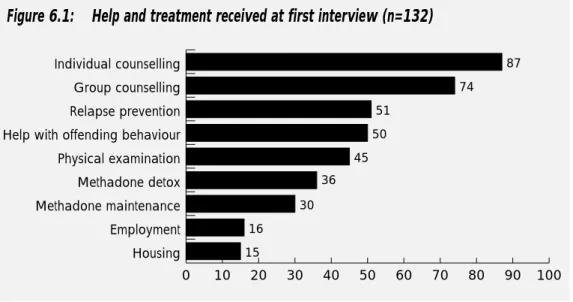
A large minority of drug-using offenders placed on DTTOs (74 out of 210) attended residential rehabilitation centres as part of their order. For these drug-using offenders, the work of the pilot teams focused primarily on preparing them for residential rehabilitation and organising funding. They had little further contact unless drug-using offenders were discharged early from the rehabilitation centres. Some of those who fared well relocated and had their supervision transferred to other probation services. Table 2.1 shows the main types of treatment received by offenders. The length of time over which individual offenders received these services varied.
Table 2.1:
Types of treatment received by offenders
Croydon Gloucestershire Liverpool TOTAL
Residential rehab 5 49 20 74
Community detox 14 7 14 35
Reduction script 1 45 27 73
Maintenance script 28 0 14 42
The Croydon Pilot Programme
The DTTO team consists of a consultant psychiatrist (0.5 day per week), senior probation officer (1 day per week, increasing to 2.5), psychologist (1 day per week), two registered nurses (full-time), one probation officer (full-time), two probation officers (2.5 days per week) and a specialist group worker (full-time).
In contrast to Liverpool, but in common with Gloucestershire, the Croydon pilot was set up for DTTOs to be made alongside probation orders. The thinking here was to provide a legal basis for offering support over and above that which was narrowly defined as “drug treatment”. The probation officers in the DTTO team hold both orders. It is a legal question whether a probation order has to be in place to allow DTTO teams to offer help on accommodation, for example, or employment. Our study cannot address this. However, there are implications about the enforcement of National Standards which are examined later in the report.
Main elements of the intervention
A team member attended court with the drug-using offender when a DTTO was proposed at the sentencing hearing and returned immediately with her/him to the office once an order was made. If time permitted, an initial one-to-one session was held and appointments were set up with the consultant (for prescribing if appropriate), with the psychologist for profiling (mainly as a baseline for evaluation), for urine testing and for further individual work. Although the probation officer (PO) held both court orders (DTTO and probation), the team operated a system whereby each drug-using offender had a nominated key worker who could be a probation officer or nurse.
Initial one-to-one sessions were aimed at increasing offenders’ motivation and resolving practical issues (such as accommodation and benefit problems). Some drug-using offenders on DTTOs went straight to a detoxification (n=14) or residential rehabilitation service (n=5). Detoxification could usually be organised very swiftly within a few days (the same day in some instances). Others had swift access to methadone or other prescription drugs. Many were seen under the supervision of the consultant psychiatrist who provides clinical input for the DTTO team.
Overall an individual package of care was negotiated with the offender. However the guiding philosophy of the programme was consistent with the Prochaska/DiClemente model of change (Prochaska and DiClemente, 1986). This identifies various stages of preparedness to engage in treatment, as outlined in Figure 2.1.
Figure 2.1: Preparedness to engage in treatment
Once the stabilisation took place, the programme remained intensive, with mandatory attendance at five half-day groupwork sessions plus one-to-one appointments and three-weekly urine tests (on a Monday, Wednesday and Friday). The groupwork programme, co-led by Community Drug Project (CDP) and a nurse or PO, included:
● relapse prevention (co-led by CDP + Nurse or PO) ● reasoning and rehabilitation (co-led by CDP + Nurse or PO) ● process support group (co-led by CDP + Nurse or PO).
This was a 12-week programme and all groups were run according to clearly agreed protocols. Offenders who went to a detoxification service subsequently joined the groupwork programme. Offenders who went to residential rehabilitation were individually assessed as to whether they needed the programme on discharge into the community.
After the initial 12-week programme, offenders were required to attend a ‘Schema’3 group which focuses on entitlement beliefs and impulse control. This addressed three key issues:
1. substance misuse 2. offending behaviour
3. maintaining attendance at/compliance with DTTO.
Maintenance Relapse Action Contemplation Relapse Contemplation Action Maintenance Exit Pre-contemplation Pre-contemplation Exit Termination
3. Schema Therapy is a psychotherapeutic model that integrates elements of cognitive and behaviour therapy, psychoanalysis and interpersonal therapy. It is designed to break lifelong psychological patterns and has been used extensively in the treatment of criminal offenders and relapse prevention for substance abuse.
The Schema group ran for one session per week for 12 weeks.
Following the groupwork programme, keyworkers sought to place offenders with education, training and employment (ETE) advice/placement services or constructive use of leisure organisations. However, the team felt a need to develop this area of work further since current options were limited.
The team identified the programme’s main weakness as the lack of a “holding group” for new drug-using offenders. Their experience was that it was disruptive to run a rolling programme, which offenders joined and left as they progressed through their order. The team aimed to move to an arrangement where at any one time there was a core groupwork programme run for a closed group, with newcomers waiting in a holding group. This would enable some motivational enhancement and stabilisation to be done with new drug-using offenders, whilst avoiding constant disruption to the main group, by new members at different stages of motivation joining the programme. Resources did not allow the establishment of the holding group but this was a clear aim and at the time of writing additional resources were being sought for this. The components of a holding group would be:
● lifestyle modification
● managing emotions (including anger) ● offending behaviour work
● monitoring drug use.
These would be delivered in a series of stand-alone interventions which would mean that new drug-using offenders could attend immediately.
Major changes throughout the pilot period
There was relatively little change to the intervention at the Croydon pilot site over the course of the evaluation. The DTTO programme was designed specifically for work with drug-using offenders and the offending behaviour component of the intervention had been in-built from the start. Towards the end of the pilot period, the team began to refer drug-using offenders on to other groupwork provision once they had completed the core programme. The intention was that this would include women’s groups, domestic violence groups and the full range of probation groups available under the ‘Pathfinder’4programmes.
4. Pathfinders are programmes, identified by previous research, often in other jurisdictions, which use techniques and/or approaches shown to have a strong possibility of reducing re-offending. They are being piloted in a number of probation areas with a view to spreading best practice throughout the Probation Service of England and Wales.
Links with ETE providers grew over the course of the evaluation and the team referred individuals at appropriate points in the order. There was an expectation that drug-using offenders would complete the core groupwork programme first. Arrangements are being made to contract with Prospects (an ETE provider) to provide groupwork sessions as part of the pathfinder programme, and then return offenders to individual action plans at times which match individual need.
The Gloucestershire Pilot Programme
The Gloucestershire DTTO team consisted of a senior probation officer (full-time), three probation officers (full-time), two drugs workers (full-time), two community psychiatric nurses (CPNs – 4 days per week although both these posts were vacant for a considerable amount of time), a GP (3 sessions per week) and an administrator (full-time).
In addition to the pilot DTTO, the team also operated the Drug Arrest Referral Scheme and provided clinical support to a probation and bail hostel. Additional funds were secured for this work.
Main elements of the intervention
This pilot site was beset with difficulties including severe staff shortages. At one stage referrals were suspended for a four week period due to these staff shortages. Here we have described the main elements of the intervention, as set out in the original programme. We have been unable to secure firm information from the team about the extent to which they were able to fulfil their original aims5. However it is clear both from our contact with the scheme and from interviews with drug-using offenders that implementation fell far short of plans.
The Gloucestershire team asked the court to make both a DTTO and a probation order. A probation officer in the team held both orders. Initially each case was given a key-worker who could be from any discipline and who was responsible for co-ordinating all aspects of work. Subsequently roles were amended to ensure probation officers were given the case management role for all DTTOs.
In describing the intervention it is important to remember that it was based on a pre-existing programme, the Drug Stabilisation Treatment Project. This programme was designed as a 5. For example, the team were unable to give us any clear idea of the amount of time per week that drug-using
drug-free programme. Positive drug tests were not tolerated after an initial period which was originally two weeks and was extended to between six to eight weeks by the end of the pilot period. A health and medical assessment took place in the first week following sentence and those requiring a prescription could normally receive one within a week to 10 days. Access to in-patient detoxification took a minimum of six weeks.
The intention was that individuals would be seen on a one-to-one basis for the first few weeks until they provided a clean urine sample. On average drug-using offenders were tested twice per week. Tests were done most days. Once drug-using offenders provided clean urine samples, they joined the induction group.
The induction group was to run for five mornings and one afternoon per week for 4 weeks. The group was designed as a rolling programme. There was no set programme but the work included motivational work, lifestyle modification and offending behaviour. In addition there were the following components:
● acupuncture (for first two weeks)
● employment, training and education advice ● sport or other constructive use of leisure time.
Offenders’ progress on the induction group was assessed by four main criteria: ● attendance
● participation in group ● clean urine tests
● no disruptive behaviour.
The intention was that if offenders did well, they would move on to a ‘core group’. If progress in the induction group was variable, they might redo all or part of the induction group or engage in work on a one-to-one basis. The core group was in the process of being developed by the team when it was halted for lack of staff time. Thus it was only offered to a small proportion of the drug-using offenders who were made subject to DTTOs during the pilot period. The group relied on using exercises and approaches from different sources. Although the exercises were drawn from reputable sources (eg Maguire and Priestly (1995), Ross and Fabiano (1985)), there was no clear protocol for how they were being assembled into ‘modules’. The aim was to develop a number of modules which would form part of a rolling programme. Areas which workers envisaged including were:
● reasoning and rehabilitation ● relapse prevention ● assertiveness training ● problem solving ● offending-related work ● self-awareness.
Offenders were required to attend the core group three mornings a week; two sessions consisted of the work identified above, the other session alternated between ETE and sport/constructive use of leisure. Offenders were also required to attend two sessions of the induction group, one of which was sport/constructive use of leisure. This group was designed by probation officers and was therefore mainly run by them.
Major changes throughout the pilot period
As suggested above, major changes were forced upon the Gloucestershire team by staff shortages, particularly of nursing staff. This meant that the overall programme as originally envisaged was never fully implemented, assessed or developed.
However, some changes were made, particularly that of giving drug-using offenders a longer period to become drug-free. Whilst the time allowed for this was extended by four to six weeks, drug-using offenders were still expected to provide consistently clean urine tests much earlier by the end of the pilot than in the other two sites. Over the course of the pilot the team made increasing use of Subutex, Lofexidine and Naltrexone in supporting drug-using offenders to detoxify. The other two teams continued to use mainly methadone. Drug-using offenders attending residential rehabilitation (49 out of 100) had very limited contact with the DTTO team. They did not participate in the programmes, and visited the project only for the preparation of review reports. DTTO staff monitored the progress of these drug-using offenders and sometimes visited them.
The Liverpool Pilot Programme
The Liverpool DTTO team consisted of five staff including a senior probation officer (2 days per week), two probation officers (full-time), two CPNs and a probation service officer (PSO) (full-time). The PSO post was created near the end of the pilot in October 1999. In addition, there were partnerships with a number of local drug and employment, training and education agencies with which drug-using offenders on DTTOs were placed.
Main elements of the intervention
The Merseyside team requested courts to make free-standing DTTOs, and attempted to have other pre-existing community sentences revoked. Unlike the other two pilot sites, the Merseyside programme was not centred on a groupwork programme, but tailored individual treatment programmes from a range of options, many of them offered by partner agencies.
Drug-using offenders were expected to report to a probation officer the day after sentence. They were also assessed by the CPN in the first week and by the PSO who assessed their suitability for a group and whether they needed to see partner organisations on what the team termed ‘lifestyle’ issues (for example employment, accommodation and benefits). They were also urine tested and could see the programme doctor.
It appeared that there were sometimes delays of over one to two weeks in seeing the doctor. However, some of those given a DTTO were already participating in a bail support scheme run by Mersey Drug Council in partnership with the probation service. For this group prescription of methadone could continue for up to four weeks after sentence, ensuring continuity of prescription.
The central feature of the Merseyside approach was the development of individual programmes for each drug-using offender. However, it proved difficult to get team members to describe who had responsibility for offence-based work or drug treatment work or even which partner organisation was used for what sort of drug-using offender at which part of their order or stage of treatment. There was also no clear expectation on frequency or intensity of contact, although the SPO stated that drug-using offenders were ‘expected to attend something most days’.
A weekly group was introduced at the end of the pilot period (see below) and in addition, a range of other interventions was offered on the basis of need including relapse prevention, acupuncture, reflexology, and other unspecified interventions provided by outside agencies.
Major changes throughout the pilot period
Towards the end of the pilot period, the team was moving towards a system where they concentrated on providing a direct in-house service in the first two months of the order to engage drug-using offenders in treatment and build motivation. This service was mainly provided by the additional PSO who ran a group for half a day once a week. There was no clear philosophy for this group, which offered a range of different interventions ‘according to what the clients are interested in’.
The comparison sites
At the time of the evaluation, a growing number of probation areas had anticipated the DTTO legislation (some by intention, others by convergence of thinking), and had developed programmes similar to the DTTO pilots. We examined four such sites.
PASCO – Cheshire
PASCO (Partnership Action on Substance Misuse and Crime and Offending) in Chester and Warrington had been running for a similar period of time as the pilot DTTO schemes although it had a longer time in development – 18 months. There were seven core members of staff employed across the two sites: two probation officers (funded part-time), two drugs workers (full-time) and additional input from a doctor, a senior probation officer and an assistant chief probation officer. Funding was provided from a number of sources including health, probation, the police and social services.
Drug-using offenders were given 1A(6) probation orders to attend PASCO. Once an order had been made offenders met with the PASCO team as soon as possible. This first session was used to highlight that participating in PASCO was part of a court order. First of all, drug-using offenders were stabilised (generally with methadone but other substitute drugs were also available). This was one of the key objectives in the initial phase. Drug-using offenders usually attended two or three times a week, but treatment was based on individual clinical need rather than a prescribed timetable. Case reviews were conducted weekly and once drug-using offenders were stable most were expected to attend a Day Programme managed by Arch Initiatives. In South Cheshire, where there is no day care provision, PASCO offenders were expected to attend local generic drug services.
The Arch Day Programme ran for 16 weeks. In the first eight weeks sessions involved individual counselling, groupwork, self-esteem workshops, help with accommodation, and ETE work. PASCO offenders were expected to attend 2.5 days per week. After this initial phase a further eight-week programme was provided for half a day a week, focusing on relapse prevention. If appropriate, drug-using offenders were then referred to ‘Next Steps’, an employment and training service. At this stage all PASCO offenders still had regular contact with a keyworker. A mentoring scheme was also offered to PASCO offenders by SOVA6. This extra support mechanism was seen as being particularly useful at crisis points.
6. SOVA is a national organisation that seeks to increase the involvement of local communities as volunteers working in crime reduction and offender rehabilitation.
The approach adopted by the scheme remained largely the same during the period of evaluation. The team felt that increasing the level of contact with offenders on the orders would bring benefits. A high level of contact with offenders, it was felt, would help reduce the number of positive urine tests, speed up progress and provide further discipline and structure to offenders’ lives. In particular group-work and key-work sessions as well as ETE were seen as important elements of an increased level of service.
The Plymouth and Torbay Fast Track scheme
The Plymouth and Torbay Fast Track scheme had been running since September 1995. Once drug-using offenders had been given a 1A(6) probation order the aim was to stabilise them. Services were provided by Plymouth Community Services NHS Trust and Torbay Drug Services, both of which work to a definition of stabilisation which has been agreed by all partners. These criteria include key outcomes on offending and drug-using behaviour. Both services operated within a harm reduction model and Fast Track offenders were not expected to be drug-free. However, all were expected to make significant lifestyle changes within four months of the probation order being made. It was anticipated that by this point Fast Track offenders would be mostly abstaining from street drugs and not offending. An individual care plan was drawn up tailored to the needs and circumstances of offenders. These plans were reviewed every three months. Most were prescribed methadone within a week of a 1A(6) order being made. Methadone was used as a vehicle for change – if offenders did not change methadone was discontinued. The average dose was between 60 to 80 mgs a day. The period of time, during which offenders received methadone was variable, depending on how well they were doing. No rapid detoxification was provided unless a drug-using offender had a short drug-using history.
Other interventions were provided to Fast Track offenders including counselling, health screening, Hepatitis B vaccination and psychotherapy. Offenders attended the drug service at least weekly for the first 12 weeks and had regular meetings with probation officers. The exact level of attendance was determined jointly by the courts, probation service and treatment providers. Typically drug-using offenders were expected to have had 18 to 20 contacts with the Fast Track team during the first three months.
Once stabilised drug-using offenders had access to existing probation programmes focusing on housing, employment, offending behaviour and education. During the evaluation period no major changes in the intervention delivered were reported.
The West Yorkshire drug court and STEP programme
Of the three comparison schemes, the West Yorkshire drug court and STEP programme was probably closest to a DTTO, and was designed to anticipate the new order. As with the two other schemes, offenders were required to participate in the programme as a condition of a 1A(6) probation order. In terms of the day-to-day delivery of the intervention, the STEP team consisted of a probation officer (full-time), two criminal justice workers (full-time) and a consultant GP (sessional). The management of the scheme was also multi-agency, being divided between a probation officer, a GP and a drug service manager. Orders were normally made for 12 months and the treatment programme initially comprised three main phases:
● detoxification (4 months) ● stabilisation (6 months)
● aftercare (3 months).
Offenders were expected to progress through these stages, but as the scheme developed it became apparent that a more flexible approach was appropriate allowing offenders to move between phases as and when their treatment required adjusting. During their time on the STEP programme offenders attended various sessions throughout the week including twice weekly urine testing, a clinic appointment, a key worker appointment and probation appointments. Detoxification was initially planned to take place over a 12-week period in which STEP offenders were prescribed drugs on a reduction basis. However, it became evident that there was a need to allow for a longer period for detoxification. Individual and cognitive-behavioural group work was undertaken at services throughout the Wakefield and Pontefract area, as was help with education and employment. These were seen as core components, though staff stressed that there were no ‘typical’ treatment pathways. A range of therapeutic approaches were incorporated in the treatment package. Failure to keep appointments, failing drug tests and offending whilst on the programme all resulted in offenders being sent back to the drugs court.
An unusual feature of the programme – and one which gives it a claim to be a drug court – was the use of a small group of specially trained magistrates to make the 1A(6) orders and to review cases when they are returned to court. Drug courts operated on specific days each week at both the Wakefield and Pontefract court. All other court personnel were also offered training.
The Hastings Multi-Agency Drug Treatment and Testing Programme
This programme was initiated in 1998 following a report by Sussex police highlighting that, within Sussex, Hastings had one of the highest levels of recorded crime, drug use, and specifically linked domestic burglary and problematic drug use. This scheme was initially set up to operate in both Worthing and Hastings. However by the time fieldwork was under way the Worthing branch no longer operated, having failed for a number of reasons, most notably a lack of referrals. A team of five comprising a probation officer, a criminal justice worker, a groupworker, a nurse and a consultant GP delivered the programme. All staff were funded on a part-time or sessional basis.
A six-month condition of treatment was imposed by the court as part of a probation order. The stated aim of the scheme was to stabilise drug misuse and its associated lifestyle and thereby reduce any drug-related offending behaviour.
Although treatment plans were designed to meet individuals’ needs rather than adhere to any prescribed timetable, for most offenders on the order the initial aim was to stabilise their drug use with methadone. At this stage the team aimed to build a relationship with the drug-using offender, requiring a minimum attendance of two days per week for one-to-one sessions and other interventions such as acupuncture and massage. Drug workers then assessed offenders’ suitability to join groupwork sessions which were part of the day care programme run by Addaction in Hastings. Groupwork focused on relapse prevention, offence-related behaviour and the promotion of self-awareness. drug-using offenders also had access to a limited range of training courses. Housing problems were particularly severe for drug-using offenders in Hastings, and thus support and assistance on housing was seen as an important part of the scheme’s work.
Offenders given this order were required to submit to urine testing at least once a month; however because of limited resources testing was only conducted for the first six months of the scheme’s operation. Financial restrictions have also led to the restriction of orders to six months’ duration. However, by placing these limits on the length of orders it was felt that offenders were encouraged to make changes and progress more quickly.
Drug workers advised probation officers (who retained responsibility for enforcement) about kept or failed appointments. Three-way meetings between the client, the probation officer and the drugs worker took place on a regular basis throughout the order.
In this chapter we present information on the referral, assessment and selection processes for DTTOs. Figures cover the period from the start of the pilots until the end of March 2000.
The pool of potential candidates for DTTOs
Pre-Sentence Reports on drug-using offenders provide a useful source of information about the range of possible candidates for DTTOs. They can provide some background information on the types of drug-using offenders the services had contact with, the proposals for sentence offered to the court and the sentence actually passed by the court. We received PSR data from Croydon, Liverpool and Gloucestershire for 19977.
South East London
Details were provided on 163 offenders sentenced for whom offending was identified as related to drug use, or whose drug use needed to be addressed in a supervision plan. The majority were male (90%) with an average age of 29 (range from 14 to 59 years) and white (81%). Half of the offenders had no previous custodial experience and many (42%) were identified as having a high risk of re-offending.
For just over half (86), their drug use was identified as being both related to offending and needing to be addressed in a supervision plan. These drug-using offenders were described as ‘hard core’. This group was using a range of drugs but most usually heroin. The most common offences committed were theft and handling stolen goods (31%), drug offences (21%) and burglary (16%). Three-fifths of PSRs recommended either a straight probation order (47) or a probation order with additional requirements (5). A further 29 per cent of proposals made recommendations for either a community service order (8) or a combination order (17). The remaining PSRs proposed either a fine/discharge (2) or some ‘other’ form of disposal (7). The sentences passed by the courts for this ‘hard core’ group tended not to reflect those proposed by the probation service. The courts were more likely to sentence offenders to imprisonment and attach conditions to a probation order. The majority of sentences passed were community based, straight probation orders (23) or with additional requirements (12) and combination orders (12). A custodial sentence was 7. The data described here cover the wider probation areas of which the Croydon and Liverpool pilot sites are part (South East London and Merseyside) and differentiate between drug-using offenders per se and those whose drug use needs to be addressed as a priority.
imposed against one in four drug-using offenders (21). The remaining offenders were sentenced to either a community service order (5), a fine/discharge (3) or some ‘other’ form of disposal (10).
Merseyside
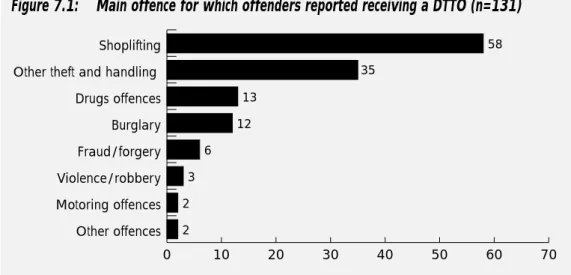
Many more offenders with drug problems were identified in the Merseyside probation area than in South East London – as might be expected in view of the size of the service. In total 656 PSRs identified offending as drug-related. This group of offenders had a mean age of 29 and the majority (94%) were white. While the majority were male (78%) this proportion was lower than in South East London. Most (59%) had previously been to prison. The most common current offence was theft and handling stolen goods (39% – including 114 shoplifting offences). Other common offences included drugs offences (24%) and burglary (10%).
Of the 656 offenders, 426 (65%) were assessed as their offence being drug-inspired or induced and a priority problem. Demographically the latter resembled the larger group of drug-using offenders although slightly more had previous experience of imprisonment (65%). For half (211) the current offence was theft or handling stolen goods, though shoplifting made up half of these (103). Other offences included burglary (14%) and robbery or violent offences (10%). Over half of the recommendations made by the probation service were for probation orders, either a straight probation order (25%) or with additional requirements (31%). Other proposals included community service orders (35), combination orders (45), a fine discharge (11) or some ‘other’ form of penalty (24). Custody was deemed likely for six offenders and in the remaining cases (66) no recommendations were made. Just under two-thirds were remanded on bail during this time, and 32 per cent were remanded in custody. When sentenced just under half (45%) received a custodial sentence, a fifth (21%) were given a probation order and 19 per cent were given a probation order with additional requirements. Of those given additional requirements, 60 were given 1A(2) orders (a requirement to participate in specified activities) and only seven were given 1A(6) orders (a requirement to receive drug or alcohol treatment).
These data show that there is potentially a large pool of offenders in Merseyside who may be susceptible to drug treatment. Many of these offenders were imprisoned. Very few received a probation order with a condition of treatment.
Gloucestershire
Gloucestershire assessed the offending behaviour of 189 offenders sentenced during 1997 as being either drug inspired, induced or defined. The vast majority were male (87%) and just under half (48%) were aged 25 or less. We have no data on the ethnic origin of these