Virtual Machine Consolidation in Cloud Data
Centers using ACO Metaheuristic
Md Hasanul Ferdaus1, Manzur Murshed2, Rodrigo N. Calheiros3, Rajkumar
Buyya3
1 Faculty of Information Technology, Monash University, Churchill Vic 3842,
Australia.
2
School of Information Technology, Faculty of Science, Federation University Australia, Churchill Vic 3842, Australia.
3
Department of Computing and Information Systems, The University of Melbourne, Australia.
Abstract. In this paper, we propose the AVVMC VM consolidation scheme that focuses on balanced resource utilization of servers across different computing resources (CPU, memory, and network I/O) with the goal of minimizing power consumption and resource wastage. Since the VM consolidation problem is strictly NP-hard and computationally infeasible for large data centers, we propose adaptation and integration of the Ant Colony Optimization (ACO) metaheuristic with balanced usage of computing resources based on vector algebra. Our simulation results show that AVVMC outperforms existing methods and achieves improve-ment in both energy consumption and resource wastage reduction.
1
Introduction
Cloud computing, a very recent paradigm shift in IT industry, is growing rapidly with the goal of providing virtually infinite amount of computing, storage, and communication resources where customers are provisioned these resources ac-cording to their demands as a pay-per-use business model [1]. To meet the rapid growth of customer demands for computing power, cloud providers such as Ama-zon and Google are deploying large number of planet-scale power-hungry data centers across the world, even comprising more than 1 million servers [2]. Reports show that energy is one of the critical TCO (Total Cost of Ownership) variables in managing a data center, and servers and data equipment account for 55% of energy used by data centers [3]. Large data centers also have enormous effects on the environment: higher energy consumption consequently drive in more carbon emission. Furthermore, inefficient use is one of the key factors for the extremely high energy consumption: in traditional data centers, on average servers oper-ate only at 10-15% of their full capacity most of the time, leading to expenses on over-provisioning of resources [4]. Since cloud promises virtually unlimited resources through elastic provisioning and absolute reliability and availability, over-provisioning of resources in cloud data centers is a common phenomenon.
Virtualization technologies allow data centers to address such resource and energy inefficiency by placing multiple Virtual Machines (VM) in a single physi-cal server through live VM migration techniques. Reduction of energy consump-tion is achieved by switching idle physical servers to lower power states (e.g., suspended) while still preserving application performance requirements.
In this paper, we propose AVVMC, a VM consolidation algorithm that fo-cuses on balanced resource utilization of servers for different resource types. We present adaptation techniques of the popular Ant Colony Optimization (ACO) [5] metaheuristic with vector algebra-based multi-dimensional server resource utilization capturing method [6]. Through simulation-based evaluation, we show that AVVMC outperforms four other existing VM consolidation methods in dif-ferent performance metrics.
2
Related Works
VM consolidation techniques have been very attractive to reduce energy costs and increase resource utilization in virtualized data centers. Consequently, a good amount of research works have been done in this area and depending on the modeling techniques used, different problem solving techniques are proposed. Most of the works that apply greedy heuristics primarily model VM consolida-tion as variants of the bin packing problem and propose extensions of simple greedy algorithms such as First Fit Decreasing (FFD) [7], Best Fit [6], Best Fit Decreasing [8], and so on [9, 10]. However, as VM consolidation is a NP-hard problem, greedy approaches are not guaranteed to generate near optimal solu-tions. Moreover, most of the approaches use mean estimators that fail to capture the multi-dimensional aspect of server resource utilization [6].
Using constraint programming (CP) model, Van et al. [11] proposed VM provisioning and placement techniques to achieve high VM packing efficiency in cloud data centers. Entropy [12] is a server consolidation manager proposed for clusters with the goal of minimizing the number of active servers and VM migra-tion overhead. However, by the use of CP the proposed frameworks effectively restrict the domain of the total number of servers and VMs in data center, and thus limit the search space.
Recently, ACO metaheuristics have successfully been used to address 1-dimensional bin packing problem and VM consolidation. Levine et al. [13] first proposed an ACO-based solution for bin packing problem combined with a lo-cal search algorithm. Later, Brugger et al. [14] used a later version of the ACO metaheuristic that demonstrated superior performance over genetic algorithm for large problem instances. Feller et al. [15] used another version of ACO to address VM consolidation and has shown better results than FFD. However, the evaluation is shown by varying only the number of cores demanded by VMs while keeping other resource demands unchanged and as a result the evaluation is simplified to one-dimensional resource. Another recent work [16] proposed a multi-objective ACO algorithm to reduce resource wastage and power con-sumption in cloud data centers. This work considers two types of resources (i.e.
CPU and memory) and demonstrates performance improvement over genetic and other ACO-based algorithms.
3
Virtual Machine Consolidation
Most of the popular cloud providers offer different categories of VMs with spec-ification for each type of resource. These VM instances differ in their individual resource capacity: some instances are larger than others, whereas some instances have relatively higher capacity of one type of resource compared to other re-sources. Moreover, cloud VM instances host various types of applications and active VMs exhibit dynamic resource demands in run-time that can be captured and used to perform workload prediction and estimation [17]. Because of the above properties of VM instances and dynamic workloads, complementary re-source demands across difference rere-source dimensions are common in cloud data centers [6]. Furthermore, as clouds offer an on-demand pay-as-you-go business model, customers can demand for creation and termination of any number of VMs according to their requirements. As a result, VMs are created and termi-nated in the cloud data centers dynamically, which causes resource fragmentation in the servers, and thus leads to degradation in server resource utilization. VM consolidation is a tool to address the above issues in virtualized data centers that tries to pack the active VMs in the minimum number of physical servers considering multi-dimensional resource demands with the goal of energy saving and maximization of server resource utilization.
3.1 Modeling VM Consolidation as Multi-dimensional Vector Packing Problem
Multi-dimensional Vector Packing Problem (mDVPP) is a NP-hard combinato-rial optimization problem where a number of items have to be packed into the minimum number of bins provided that bins capacities are not violated [18]. We model the physical machines (PMs) as bins and the VMs as items to pack into the bins. LetP denotes the set ofnPMs andV denotes the set ofmVMs in the data center. The set ofdtypes of resources available in the PMs is represented by R. Each PMPi (Pi∈P) has a d-dimensional Resource Capacity Vector (RCV) Ci=hCi1, . . . , C k i, . . . , C d ii, whereC k
i denotes the total capacity of resourceRk of PMPi. Similarly, each VM Vj (Vj ∈V) is represented by its d-dimensional
Resource Demand Vector (RDV)Dj=hD1j, . . . , Dkj, . . . , Ddji, whereDkj denotes the demand of resource Rk of VM Vj. The Resource Utilization Vector (RUV) Ui=hUi1, . . . , Uik, . . . , Uidiof PMPiis computed as the sum of the RDVs of the hosted VMs:
Uik=XDjk for∀xi,j= 1 (1)
wherexis thePlacement Matrix that models the VM-to-PM placements and is defined as follows:
xi,j=
(
1 ifVj is placed inPi
We also introduce thePM Allocation Vector y, where each elementyi equals 1 if PMPi is hosting at least 1 VM, or 0 otherwise:
yi=
(
1 if Pm
j=1xi,j ≥1
0 otherwise (3)
The goal of the AVVMC VM consolidation algorithm is to place the VMs in the available PMs in such a way that: 1) resource utilization of active PMs is maximized across all dimensions and 2) power consumption of active PMs is minimized. Since available models for server power consumption primarily focus on CPU utilization [19], any placement decision that results in lesser number of active PMs compared to others have higher resource utilization across all dimen-sions and lesser energy consumption. So, we formulate the objective functionf as a single minimization function ony:
minf(y) = n
X
i=0
yi (4)
Finally, the PM resource capacity constraint (i.e. for each resource type, demands Dk of hosted VMs not to exceed host PM’s resource capacity Ck) is expressed as follows:
m
X
j=1
Djkxi,j ≤Cik,∀i∈ {1, . . . , n},∀k∈ {1, . . . , d} (5)
And the following ensures that each VM is assigned to at most one PM: n
X
i=1
xi,j≤1,∀j∈ {1, . . . , m} (6)
3.2 Modeling Multi-dimensional Resource Utilization based on Vector Algebra
When placing VMs in a PM, capturing the measure of overall resource utiliza-tion for multiple resource types is one of the most important factors for any server consolidation algorithm: saturation of only one resource type can lead to no further improvement in utilization while leaving other types of resource un-derutilized. In order to capture both balanced and overall resource utilization, we augment and integrate the vector algebra-based complementary resource uti-lization capturing technique [6] in our ACO-based solution. Our model considers CPU, memory, and network I/O as relevant server resources in the context of VM consolidation. We consider storage resource is provided on-demand through SAN/NAS-based storage backbone (e.g., Amazon EBS). PM’s normalized re-source capacity is expressed as a unit cube (Resource Cube), with the three dimensions representing three types of resources. RCV and RUV represent the
total capacity and current resource utilization of PM, respectively. To capture the degree of imbalance in current resource utilization of a PM, theResource Imbal-ance Vector (RIV) is used which is computed as vector difference between RUV’s projection on RCV and RUV itself. GivenRU V =Cˆi+Mˆj+Iˆkof a PM after placing a VM (C,M, andIare current utilization of CPU, memory, and network I/O), RIV = (C−H) ˆi+ (M−H) ˆj+ (I−H) ˆk, where H = (C+M +I)/3. When selecting VMs for placement in a PM, the VM that shortens the magni-tude of RIV most is the VM that mostly balances the resource utilization of the PM across different dimensions. The magnitude of RIV is given by the following: magRIV =p(C−H)2+ (M−H)2+ (I−H)2 (7)
We use magRIV to define the heuristic information for the proposed AVVMC algorithm along with the overall resource utilization of PM (Eq. 13).
3.3 Modeling Resource Utilization and Wastage
The overall resource utilization of PM p is modeled as the summation of the normalized resource utilization Ur
p of each individual resource r ∈ R (Eq. 1): U tilizationp = Pr∈RUpr, where R = {CP U, M EM, IO}. Similarly, resource wastage is modeled as the summation of the remaining resources (normalized) of each individual resource:
W astagep=
X
r∈R
(1−Upr) (8)
3.4 Modeling Power Consumption
Power consumption of servers is dominated by their CPU and can be expressed as a linear expression of CPU utilization [19]. So, we model the energy drawn by a PMpas a linear function of its CPU utilizationUCP U
p ∈[0,1]:
E(p) = (
Eidle+ (Ef ull−Eidle)×UpCP U ifUpCP U>0
0 otherwise (9)
where Ef ull and Eidle are the average energy drawn when a PM is fully uti-lized (i.e. 100% CPU busy) and idle, respectively. Due to the non-proportional power usage (i.e. high idle power) of physical servers, we consider turning off or suspending idle servers after the VM placement. Therefore, the estimate of the total energy consumed by a VM placement decisionxis computed as follows:
E(x) = n
X
p=1
4
Proposed Solution
4.1 Adaptation of ACO Metaheuristic for VM Consolidation
ACO metaheuristics are computational methods that take inspiration from the foraging behavior of some ant species [5]. In ACO, a number of artificial ants build solutions to the considered optimization problem by choosing feasible so-lution components and exchanging information on the quality of these soso-lutions via pheromone. In the proposed AVVMC algorithm, we adapt Ant Colony Sys-tem(ACS) [20], a later version of ACO and consider each VM-to-PM assignment as a solution component. Pheromone levels are associated to all VM-to-PM as-signments representing the desirability of assigning a VM to a PM (Eq. 11 and Eq. 18) and heuristic values are computed dynamically for each VM-to-PM as-signment representing the favorability of assigning a VM to a PM in terms of both overall and balanced resource utilization of the PM (Eq. 13).
4.2 AVVMC Algorithm
The AVVMC algorithm pseudocode is shown in Algorithm 1. Pheromone levels are implemented using an×mmatrixτ. Each ant starts with an empty solution, a set of PMs, and a randomly shuffled set of VMs [line 6-12]. Inside the while loop, an ant is chosen at random and is allowed to choose a VM to assign next to its current PM among all the feasible VMs (Eq. 16) using a probabilistic decision rule (Eq. 15) [line 11-22]. If the current PM is fully utilized or there are no feasible VMs left to assign to the PM, a new empty PM is taken to fill in [line 14-16].
When all the ants have finished building their solutions, all the solutions in the current cycle are compared to the so far found global-best-solution (GBS) against their achieved objective function values f (Eq. 4). The solution with minimum value of f is chosen as the current GBS [line 23-28]. The pheromone reinforcement amount is computed based on (Eq. 19) and the pheromone levels of each VM-PM pair is updated to simulate the pheromone evaporation and depo-sition according to (Eq. 18) [line 29-34]. The algorithm reinforces the pheromone values only on the VM-PM pairs that belong to the GBS. Afterwards, the whole process of searching new solutions repeats. The algorithm terminates when no further improvement in the solution quality is observed for the lastnCycleT erm cycles [line 35]. Different parts of the algorithm are formally defined below.
Definition of Pheromone and Initial Pheromone Amount At the begin-ning of any ACO algorithm, ants start with a fixed amount of initial pheromone for each VM-PM solution component. Following the approach used in the original ACS algorithm [20], we use the measure of quality of the solution produced by a reference baseline algorithm (FFD heuristic based onL1 norm mean estimator)
to compute the initial amount of pheromone:
Algorithm 1The AVVMC Algorithm.
1:Input: Set of PMsP and their RCVCi, set of VMsV and their RDVDj, set of antsantSet.
Set of parameters{nAnts, nCycleT erm, β, ω, δ, q0}
2:Output: Global-best-solutionGBS
3:Initialize parameters, set pheromone value for each VM-PM pair (τv,p) to τ0, GBS := ∅, nCycle:= 0
4:repeat
5: for allant∈antSetdo
6: ant.solution:=∅;ant.pmList:=P
7: ant.p:= 1;ant.vmList:=V
8: Shuffleant.vmList
9: end for
10: antList:=antSet;nCycle:=nCycle+ 1
11: whileantList6=∅do
12: pick anantat random fromantList
13: ifant.vmList6=∅then 14: ifF Vant(ant.p) =∅then
15: ant.p:=ant.p+ 1
16: end if
17: Choose a VMvfromF Vant(ant.p) accord. to Eq. 15
18: ant.solution.xp,v:= 1;ant.vmList.remove(v)
19: else
20: ant.solution.f:=p;antList.remove(ant)
21: end if
22: end while
23: for allant∈antSetdo
24: ifant.solution.f < GBS.fthen 25: GBS:=ant.solution 26: nCycle:= 0 27: end if 28: end for 29: Compute∆τ 30: for allp∈Pdo 31: for allv∈V do 32: τv,p:= (1−δ)×τv,p+δ×∆τv,p 33: end for 34: end for
35: untilnCycle=nCycleT erm
whereP EF F DL1N orm is thePacking Efficiency of the solution produced by the FFD heuristic. The PE of any solution sol produced by an algorithm is given by:
P Esol=
nV M
nActiveP M (12)
Definition of Heuristic Information During the solution building process, the heuristic value ηv,p represents a measure of benefit of selecting a solution component v −p. As the goal of AVVMC is to reduce the number of active PMs by packing VMs in a balanced way, we define the heuristic value favoring both balanced resource utilization in all dimensions and higher overall resource utilization:
ηv,p=ω× |log10magRIVp(v)|+ (1−ω)×U tilizationp(v) (13)
where magRIVp(v) is the magnitude of RIV of PM pafter assigning VMv to it (Eq. 7). Logarithm ofmagRIVp(v) is taken to give higher heuristic values to the v-p pairs that result in smaller magnitudes of RIV. U tilizationp(v) is the
overall resource utilization of PMpif VMvis assigned to it: U tilizationp(v) =
X
r∈R
(Upr+Dvr) (14)
Andωis a parameter that trades off the relative importance of balanced versus overall resource utilization as per our definition.
It can be shown that magRIV is in the interval [0.0,0.82]. Since loga-rithm of zero is undefined, we used the range [0.001,0.82] in the evaluation and thus|log10magRIV|results in the range [0.086,3.0] which is compatible to
U tilizationp in terms of metric that results in the interval [0.0,3.0].
Pseudo-random Proportional Rule When constructing a solution, an ant k selects a VM s to be assigned to PM p with the following pseudo-random proportional rule [20]: s= ( argmaxv∈F Vk(p){τv,p×[ηv,p] β} ifq≤q 0 S otherwise (15)
where q is a random number uniformly distributed in [0,1], q0 is a parameter
in interval [0,1], τv,p is the current pheromone value associated with the v-p VM-PM pair (Eq. 18), and β is a non-negative parameter that determines the relative importance of pheromone amount versus heuristic value in the decision rule.F Vk(p) defines the list of feasible VMs for ant kto assign to PMp:
F Vk(p) = ( v| n X p=1 xp,v= 0 ^ Upr+D r v≤C r p for∀r∈R ) (16)
Whenq≤q0, then thev-p pair resulting highestτv,p×[ηv,p]β value is cho-sen as the solution component (exploitation), otherwise a VMv is chosen with probabilityPk(v, p) using the following random-proportional rule (exploration):
Pk(v, p) = τv,p×[ηv,p]β P u∈F Vk(p)τv,p×[ηv,p]β ifv∈F Vk(p) 0 otherwise (17)
Global Pheromone Update In order to favor the solution components of the GBS for subsequent iterations and to simulate pheromone evaporation, the global update rule is applied on the pheromone values of eachv−ppair according to the following equation:
τv,p:= (1−δ)×τv,p+δ×∆τv,p (18) where δis the global pheromone decay parameter (0< δ <1) and∆τv,p is the pheromone reinforcement applied to eachv−ppairs and is computed as follows:
∆τv,p=
(
P EGBS ifv−p∈GBS
5
Performance Evaluation
Because of the lack of access to large scale testbeds or real cloud infrastructures and ease of reproducibility, we resorted to simulation-based evaluation to com-pare the performance of the proposed AVVMC to the following existing works in literature: 1) an adapted version of Max-Min Ant System (MMAS) meta-heuristic for VM consolidation (MMVMC) [15], 2) a greedy algorithm (Vector-Greedy) [6] for solving consolidation that uses vector algebra for mean estima-tion of multi-dimensional resources, 3) a modified version of the FFD algorithm (FFD-Volume) [7] that uses volume-based mean estimator, and 4) another mod-ified FFD algorithm (FFD-L1Norm) based onL1 norm mean estimator.
The simulated data center consists of a cluster of homogeneous PMs and VM resource demand for each resource type is expressed in percentage of to-tal resource capacity of PM. We used reference-based VM resource demands: Ref = z% means each randomly generated VM resource demand Dr falls in the interval [0,2z] forr∈ {CP U, M EM, IO}. Considering the fact that clouds deploy high-end servers and try to host as many VMs as possible in each active server to increase resource utilization, we conducted our simulation for the sce-narios where expected average PE would be more than 4, otherwise there would not be much scope for consolidation and benefit of using specialized algorithms. Therefore, we used reference values of Ref = 10%, 15%, 20%, and 25% with their corresponding expected averageP Eof 10, 6.7, 5, and 4. The simulation is conducted through 10 independent simulation runs and each run was repeated for 100 times and finally, the results are generated after taking their average.
The optimal values of the parameters used in AVVMC are measured through rigorous parameter sensitivity analysis in the preliminary phases of the experi-ment and are set as follows:nAnts= 5, nCycleT erm = 5, β = 2, δ = 0.5, q0 =
0.8, andω= 0.5. Parameters for the other algorithms are taken as reported in the respective papers.
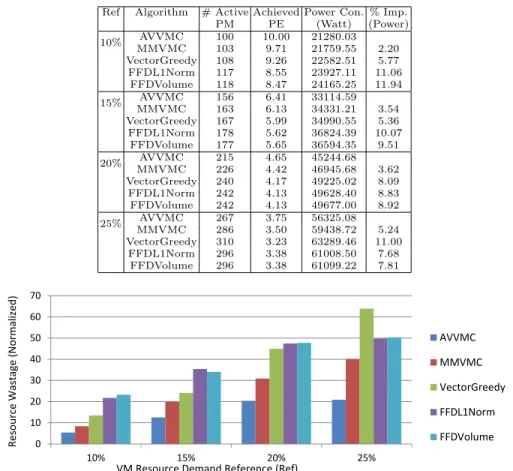
Table 1 summarizes performance of various algorithms for 1000 VMs in terms of 1) the number of active PMs, 2) achieved VM packing efficiency, and 3) power consumption according to the overall power consumption model (Eq. 10). For the purpose of simulation, we setEidleandEf ullto 162 watts and 215 watts, re-spectively as used by Gao et al. [16]. Table 1 shows that for all the four reference values, AVVMC outperforms other algorithms in all the above performance met-rics. It also shows that AVVMC achievesPE near the expected average values. One interesting observation from column 6 of Table 1 is that AVVMC achieves comparatively better performance over MMVMC and VectorGreedy for larger reference values (i.e. larger VM sizes), whereas it achieves comparatively better performance over FFD-based algorithms for smaller reference values (i.e. smaller VM sizes). The reason is that metaheuristic-based solutions have higher flexibil-ity to refine the solutions for smaller reference values (i.e. when higher number of VMs can be packed in a single PM) compared to larger reference values. On the other hand, FFD-based greedy solutions achieve higher overall resource uti-lization and need lesser number of active PMs for larger reference values (i.e. when VMs are larger).
Table 1.Simulation results across various performance metrics.
Ref Algorithm # Active Achieved Power Con. % Imp.
PM PE (Watt) (Power) 10% AVVMC 100 10.00 21280.03 MMVMC 103 9.71 21759.55 2.20 VectorGreedy 108 9.26 22582.51 5.77 FFDL1Norm 117 8.55 23927.11 11.06 FFDVolume 118 8.47 24165.25 11.94 15% AVVMC 156 6.41 33114.59 MMVMC 163 6.13 34331.21 3.54 VectorGreedy 167 5.99 34990.55 5.36 FFDL1Norm 178 5.62 36824.39 10.07 FFDVolume 177 5.65 36594.35 9.51 20% AVVMC 215 4.65 45244.68 MMVMC 226 4.42 46945.68 3.62 VectorGreedy 240 4.17 49225.02 8.09 FFDL1Norm 242 4.13 49628.40 8.83 FFDVolume 242 4.13 49677.00 8.92 25% AVVMC 267 3.75 56325.08 MMVMC 286 3.50 59438.72 5.24 VectorGreedy 310 3.23 63289.46 11.00 FFDL1Norm 296 3.38 61008.50 7.68 FFDVolume 296 3.38 61099.22 7.81 0 10 20 30 40 50 60 70 10% 15% 20% 25% AVVMC MMVMC VectorGreedy FFDL1Norm FFDVolume R esou rc e Wastage (N or maliz ed )
VM Resource Demand Reference (Ref)
Fig. 1. Bar chart representation of total resource (normalized) wastage of AVVMC and other algorithms.
Fig. 1 shows a bar chart representation of the total resource (normalized in percentage) wastage of active PMs that host 1000 VMs according to (Eq. 8) for the VM placement solutions produced by the different consolidation algorithms. The figure shows that AVVMC significantly reduces the resource wastage com-pared to other algorithms. This is because AVVMC tries to improve the overall resource utilization with preference to consolidate VMs with complementary re-source demands in each server and thus reduces rere-source wastage across different resource dimensions.
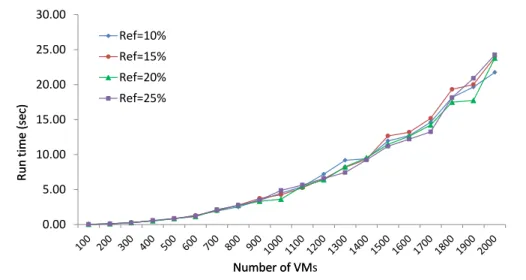
In order to assess AVVMC for time complexity, simulation is conducted for larger number of VMs and the solution computation time is plotted (Fig. 2). The algorithm is written in Java language and ran on a Dell Workstation having Intel Core i5-2400 3.10 GHz CPU (4 cores), and 4 GB of RAM. It is observed that computation time increases non-linearly with the number of VMs with small gradient and for 2000 VMs, AVVMC takes around 25 seconds on average.
0.00 5.00 10.00 15.00 20.00 25.00 30.00 Ref=10% Ref=15% Ref=20% Ref=25% R u n tim e (sec ) Number of VM R u n tim e (sec ) Number of VMs
Fig. 2.Solution computation time of AVVMC for large problem instances.
6
Conclusions and Future Work
In this paper, we presented several aspects of server resource utilization and consolidation, and proposed an ACO metaheuristic-based server consolidation mechanism to address both power consumption and resource wastage minimiza-tion in large virtualized data centers. We presented performance evaluaminimiza-tion by comparing the proposed technique with some of the recent techniques proposed in the literature. We also showed evaluation of time complexity of solution com-putation and argued about the feasibility and effectiveness of the algorithm for cloud data centers.
As future work, we plan to incorporate mechanisms for efficient network resource utilization in cloud infrastructures during VM placement and consol-idation decisions. We also expect to consider current VM assignments and re-configuration (including VM live migrations) overheads during VM placement decision making phase. In this way, an overall VM placement framework will be designed and implemented that will be aware of both energy consumption and compute-network resource utilization.
References
1. Buyya, R., Yeo, C.S., Venugopal, S., Broberg, J., Brandic, I.: Cloud computing and emerging IT platforms: Vision, hype, and reality for delivering computing as the 5th utility. Future Generation Computer Systems25(6) (2009) 599–616 2. Miller, R.: Ballmer: Microsoft has 1 million servers.
http://www.datacenterknowledge.com/archives/2013/07/15/ballmer-microsoft-has-1-million-servers/ (July 2013)
3. Perspectives, I.: Using a Total Cost of Ownership (TCO) model for your data center. http://www.datacenterknowledge.com/archives/2013/10/01/using-a-total-cost-of-ownership-tco-model-for-your-data-center/ (October 2013)
4. Barroso, L., Holzle, U.: The case for energy-proportional computing. Computer 40(12) (2007) 33–37
5. Dorigo, M., Birattari, M., Stutzle, T.: Ant colony optimization. Computational Intelligence Magazine, IEEE1(4) (nov. 2006) 28–39
6. Mishra, M., Sahoo, A.: On theory of VM placement: Anomalies in existing method-ologies and their mitigation using a novel vector based approach. In: Cloud Com-puting (CLOUD), 2011 IEEE International Conference on, IEEE (2011) 275–282 7. Wood, T., Shenoy, P., Venkataramani, A., Yousif, M.: Sandpiper: Black-box and
gray-box resource management for virtual machines. Computer Networks53(17) (2009) 2923–2938
8. Beloglazov, A., Buyya, R.: Adaptive threshold-based approach for energy-efficient consolidation of virtual machines in cloud data centers. In: Proceedings of the 8th International Workshop on Middleware for Grids, Clouds and e-Science, ACM (2010)
9. Li, X., Qian, Z., Chi, R., Zhang, B., Lu, S.: Balancing resource utilization for continuous virtual machine requests in clouds. In: Innovative Mobile and Internet Services in Ubiquitous Computing (IMIS), 2012 Sixth International Conference on, IEEE (2012) 266–273
10. Li, X., Qian, Z., Lu, S., Wu, J.: Energy efficient virtual machine placement algo-rithm with balanced and improved resource utilization in a data center. Mathe-matical and Computer Modelling58(5) (2013) 1222–1235
11. Van, H.N., Tran, F., Menaud, J.M.: Performance and power management for cloud infrastructures. In: Cloud Computing (CLOUD), 2010 IEEE 3rd International Conference on. (july 2010) 329–336
12. Hermenier, F., Lorca, X., Menaud, J.M., Muller, G., Lawall, J.: Entropy: a consoli-dation manager for clusters. In: Proceedings of the 2009 ACM SIGPLAN/SIGOPS international conference on Virtual execution environments. VEE ’09, New York, NY, USA, ACM (2009) 41–50
13. Levine, J., Ducatelle, F.: Ant colony optimization and local search for bin packing and cutting stock problems. Journal of the Operational Research Society 55(7) (2004) 705–716
14. Brugger, B., Doerner, K., Hartl, R., Reimann, M.: Antpacking-an ant colony optimization approach for the one-dimensional bin packing problem. Evolutionary Computation in Combinatorial Optimization (2004) 41–50
15. Feller, E., Rilling, L., Morin, C.: Energy-aware ant colony based workload place-ment in clouds. In: Proceedings of the 2011 IEEE/ACM 12th International Con-ference on Grid Computing, IEEE Computer Society (2011) 26–33
16. Gao, Y., Guan, H., Qi, Z., Hou, Y., Liu, L.: A multi-objective ant colony system algorithm for virtual machine placement in cloud computing. Journal of Computer and System Sciences (2013)
17. Wood, T., Cherkasova, L., Ozonat, K., Shenoy, P.: Predicting application resource requirements in virtual environments. HP Laboratories, Technical Report HPL-2008-122 (2008)
18. Caprara, A., Toth, P.: Lower bounds and algorithms for the 2-dimensional vector packing problem. Discrete Applied Mathematics111(3) (2001) 231–262
19. Fan, X., Weber, W.D., Barroso, L.A.: Power provisioning for a warehouse-sized computer. ACM SIGARCH Computer Architecture News35(2) (2007) 13–23 20. Dorigo, M., Gambardella, L.: Ant colony system: a cooperative learning approach
to the traveling salesman problem. IEEE Transactions on Evolutionary Computa-tion1(1) (apr 1997) 53–66