Construct Equivalence as an Approach to Replacing Validated
Cognitive Ability Selection Tests
Daniel B. Turban
University of HoustonPatricia A. Sanders
Shell Oil CompanyDavid J. Francis and
H. G.
Osburn
University of Houston
In this study we demonstrate an approach to replacing validated selection tests to which job appli- cants may have prior access. This approach, labeled construct equivalence, allows for replacing valid tests currently in use with new, experimental tests that have been shown to measure the same con- structs. We demonstrated the construct equivalence approach by collecting data from over 2,000 applicants for four different positions in a large petrochemical company. We investigated the equiva- lence of the experimental and the current tests by using correlational analyses, structural modeling, and analyses of hiring decisions. Results indicated that the experimental and current tests measure the same constructs and that replacing the current tests with the experimental tests would treat ethnic and sex subgroups consistently. Construct equivalence was shown to be a viable approach to test substitution.
Maintaining the security of selection tests is a practical prob- lem for both publishers and test users (Guion, 1987). Although most test publishers sell tests only to qualified users, publishers have virtually no control over the purchaser's actual use (or mis- use) of test materials (Holmen &Docter, 1972). Test security may be further jeopardized by the widespread use of certain tests within industries. For example, many petrochemical com- panies with employment offices in the same cities use, or have used, a common set of cognitive ability tests for personnel selec- tion (Callender & Osburn, 1981; Schmidt, Hunter, & Caplan, 1981). In addition, many organizations have used the same set of tests for personnel selection for an extended period of time. Consequently, many organizations are faced with the problem that some applicants may have prior information concerning these selection tests and some may even have access to the cor- rect answers to test items. This is a concern not only because of the unfair advantage for applicants with prior access but also because the validity of the tests may be substantially reduced.
Unfortunately, when it becomes necessary to replace current, validated cognitive ability tests with new, experimental tests, the options are often limited. One possible solution is to con- duct criterion-related validity studies of new, secure tests. How- ever, concurrent validity studies with incumbents are often not feasible owing to severe restriction of range resulting from high m i n i m u m scores on the current cognitive test batteries. Predic-
Portions of this article were presented at the 95th Annual Convention of the American Psychological Association, August 28-September I, 1987, New York. We gratefully acknowledge the helpful comments of Allan Jones, Edward Kahn, Angela McDermott, and Carol Timmreck on earlier drafts of the manuscript.
Correspondence concerning this article should be addressed to Dan- iel B. Turban, Psychology Department, University of Houston, Hous- ton, Texas 77004.
62
tive validity studies, which can minimize restriction of range, typically are not practical owing to low hiring rates and the neg- ative consequences of hiring low-scoring applicants.
Of course, if secure, parallel alternate forms were available, these could be substituted for the current forms without com- promising the validity of selection procedures. Unfortunately, in many situations, secure, parallel forms do not exist. In that case, another possible solution is for the organization to develop alternative measures of the current, validated tests. However, many organizations lack the resources necessary to develop their own tests and must therefore rely on published tests. Se- lecting items from an item bank and administering different, but equivalent, tests to applicants is another solution that poses similar difficulties, because few organizations maintain item banks or have the resources necessary to analyze item-level data.
An approach that many organizations should find feasible is to replace the current, validated tests with secure, experimental tests that measure the same constructs or combination of con- structs. This approach, labeled construct equivalence, is based on the idea that (a) it is the ability, or trait, measured by the current test that is related to job performance, in other words, the test's predictive validity comes from its relation to some un- derlying construct (ability or trait) and the role of that construct in job performance; and that (b) new tests can be found that measure the same constructs as the current tests, even though these tests were not constructed as strictly parallel alternate forms of the current tests. The construct equivalence approach is derived from construct validity theory (Cronbach & Meehl, 1955) and involves administering concurrently both current and experimental tests to applicants to determine whether the new, experimental tests measure the same constructs as the cur- rent, validated tests. If both the current and new tests measure the same construct, or combination of constructs, then the ex- perimental test can replace the previously validated test in the
selection battery. W h e t h e r a c o n s t r u c t is c o n c e p t u a l i z e d as a s i n g u l a r c o n s t r u c t or a c o m b i n a t i o n o f c o n s t r u c t s does n o t affect t h e c o n s t r u c t e q u i v a l e n c e a p p r o a c h to test s u b s t i t u t i o n , b e c a u s e if two tests m e a s u r e the s a m e c o n s t r u c t , o r c o m b i n a - t i o n o f c o n s t r u c t s , t h e n t h e new test c a n replace t h e c u r r e n t test in the selection battery. T h e r e f o r e , for s i m p l i c i t y i n p r e s e n t a - tion, the t e r m c o n s t r u c t is u s e d to refer t o s i n g u l a r c o n s t r u c t s a n d a c o m b i n a t i o n o f c o n s t r u c t s .
A c o n s t r u c t is c o n c e p t u a l i z e d as a " p o s t u l a t e d a t t r i b u t e as- s u m e d to b e reflected in test p e r f o r m a n c e " ( C r o n b a c h & Meehl, 1955, p. 283). In the p r e s e n t study, we a s s u m e t h a t v a r i a n c e i n c u r r e n t test scores is c a u s e d b y i n d i v i d u a l differences in t h e c o n s t r u c t m e a s u r e d b y the test a n d t h a t a n o t h e r test m a y also m e a s u r e t h a t s a m e c o n s t r u c t . I f it is a s s u m e d t h a t the c o n s t r u c t reflected in the test score i n f l u e n c e s j o b p e r f o r m a n c e , t h e n an- o t h e r m e a s u r e o f t h a t c o n s t r u c t would also p r e s u m a b l y p r e d i c t j o b p e r f o r m a n c e . T h e r e f o r e , evidence for the validity o f t h e new tests in p r e d i c t i n g j o b p e r f o r m a n c e is o b t a i n e d b y d e m o n s t r a t - ing t h a t a new test m e a s u r e s t h e s a m e c o n s t r u c t as the c u r r e n t test.
I n the p r e s e n t study, we deal w i t h t h e p r a c t i c a l p r o b l e m o f r e p l a c i n g c u r r e n t , v a l i d a t e d tests b y d e m o n s t r a t i n g a n ap- p r o a c h to investigating w h e t h e r new, e x p e r i m e n t a l tests m e a - sure the s a m e c o n s t r u c t s as t h e c u r r e n t tests a n d c a n t h e r e f o r e replace the c u r r e n t tests in a selection battery.
M e t h o d
Sample
The sample consisted of 2,430 applicants for clerical, secretarial, ex- ploration and production (E&P) operating, and refinery and chemical plant (R&C) process operating positions in a large petrochemical com- pany. Data were collected at five different sites: three in the Southeast, and one each in the Southwest and Midwest. Data for the clerical and secretarial positions were collected from two sites, data for the R&C positions were collected from two other sites, and data for the E&P posi- tions were collected from the fifth site. We collected these data during an actual hiring process, and the sex and ethnicity of applicants were representative of previous applicants for these positions.
Procedure
Applicants were tested as part of an ongoing hiring process and there- fore had reason to believe that all test results would be used for selection purposes. The current tests were administered first, followed by the ex- perimental tests. The testing sessions lasted approximately 2-4 hr, de- pending on the job group.
Constructs
The three constructs measured by the previously validated, current tests and the experimental tests were general mental ability, mechanical reasoning, and spatial visualization. For secretarial and clerical posi- tions, the construct was general mental ability; for E&P positions, the constructs were general mental ability and mechanical reasoning; and for R&C operating positions, the constructs were general mental ability, mechanical reasoning, and spatial visualization.
General mental ability is the ability to manipulate abstract verbal, numerical, and figural symbols. This construct is currently measured by a 12-min test, referred to as GMA, containing 18 block-counting problems, 18 vocabulary items, and 18 arithmetic problems in a spiral
Table 1
Descriptive Statistics and Intercorrelations of Current and
Experimental Tests for Total Sample
Test N GMA MR SV EGMA EMR ESV
M
SD
GMA 2,430 - - 28.40 8.18 MR 1,509 .553 - - 40.33 10.44 SV !,244 .520 .675 - - 27.25 11.05 EGMA 2,429 .788 .656 .640 - - 36.37 15.54 EMR !,507 .541 .868 .676 .658 - - 45.71 12.55 ESV !,242 .528 .707 .901 .656 .719 - - 32.48 12.43
Note. GMA = general mental ability; MR = mechanical reasoning;
SV = spatial visualization. EGMA, EMR, and ESV = experimental GMA, MR, and SV, respectively.omnibus pattern. The experimental test, designated EGMA, is a 40- min test containing 25 verbal comprehension items, 25 verbal reasoning items, 15 figural reasoning items, and 15 quantitative reasoning items also in a spiral omnibus pattern.
Mechanical reasoning is the ability to perceive and understand the relation of physical forces and mechanical dements in practical situa- tions. The current test for this construct, identified as MR, contains 68 multiple-choice items that realistically illustrate situations involving mechanical devices or principles. The experimental test, EMR, con- tains 70 items that are very similar to items included in the MR. Both tests have the same 30-min time limit.
Spatial visualization is the ability to visualize a three-dimensional object from a picture of the pattern of its surfaces and to imagine how the object would appear if rotated in various ways. The current test for this construct, referred to as SV, and the experimental test, ESV, each contain 60 of the same type of items and have the same 25-min time limit.
As far as we can determine, none of the experimental tests were spe- cifically designed to be parallel, alternate forms of the current tests and have not been validated for the job groups investigated. The experimen- tal and the current tests of spatial visualization and mechanical reason- ing are very similar to each other and were published by the same com- pany, however, different companies published the experimental and the current general mental ability tests. Table 1 presents descriptive statis- tics and intercorrelations of the current and experimental tests for the total sample.
A n a l y s e s a n d R e s u l t s
Correlations
O n e way t o investigate w h e t h e r t h e c u r r e n t a n d e x p e r i m e n t a l tests m e a s u r e t h e s a m e c o n s t r u c t is t o c o r r e c t b o t h tests for u n - reliability t o e s t i m a t e the c o r r e l a t i o n b e t w e e n t r u e scores o n the tests. A c o r r e c t e d c o r r e l a t i o n o f 1.00 suggests t h a t t h e tests are e q u i v a l e n t m e a s u r e s o f the c o n s t r u c t . Table 2 p r e s e n t s u n c o r - r e c t e d a n d c o r r e c t e d c o r r e l a t i o n s o f t h e p a i r e d c u r r e n t a n d ex- p e r i m e n t a l tests b y j o b , sex, a n d e t h n i c g r o u p . T h e c o r r e l a t i o n s were c o r r e c t e d for u n r e l i a b i l i t y i n b o t h tests ( T h o r n d i k e , 1982). T h e total s a m p l e c o r r e c t e d c o r r e l a t i o n s b e t w e e n t h e c u r r e n t a n d e x p e r i m e n t a l tests o f t h e general m e n t a l ability, m e c h a n i c a l reasoning, a n d spatial v i s u a l i z a t i o n c o n s t r u c t s were .877, 1.00, a n d .953, respectively. T h e c o r r e c t e d c o r r e l a t i o n s a n a l y z e d b y j o b , sex, a n d e t h n i c s u b g r o u p s i n d i c a t e s i m i l a r results. Overall, these results suggest t h a t M R a n d E M R m e a s u r e o n e c o n s t r u c t ;
Table 2
Correlations of Paired Current and Experimental Tests for Job, Sex, and Ethnic Subgroups
GMA with EGMA MR with EMR SV with ESV
Group n r r c n r r e n r r ¢ Job Clerical 415 .749 .834 Secretarial 504 .747 .831 E&P operations 265 .792 .881 265 .841 .972 R&C operations 1,241 .814 .906 1,241 .870 1.000 1,24 ! .901 .953 Sex Female 1,119 .759 .845 282 .754 .872 279 .868 .919 Male 1,306 .808 .899 1,224 .857 .991 962 .904 .957 Ethnic White 1,204 .757 .842 841 .839 .970 646 .903 .956 Black 1,090 .746 .830 643 .774 .895 574 .852 .902 Total minority 1,221 .743 .827 665 .781 .903 595 .851 .901 Total sample 2,425 .788 .877 1,506 .868 1.00 1,241 .901 .953
Note.
E&P = exploration and production; R&C = refinery and chemical. GMA = general mental ability; MR = mechanical reasoning; SV = spatial visualization. EGMA, EMR, and ESV = experimental GMA, MR, and SV, respectively, rCs are correlations corrected for unreliability in both measures. Reliability coefficients used for the corrections were: GMA = .85, EGMA = .95; MR = .86, EMR = .87; SV = .95, and ESV = .94.SV and ESV measure one construct; and G M A and E G M A measure very similar but possibly n o t identical constructs.
Structural Analysis
The corrected correlations provide initial evidence concern- ing the equivalence o f the current and the experimental tests, however, this m e t h o d has limitations. Internal consistency reli- ability estimates were obtained from published reports. Al- though the largest applicable reliability estimates were used in the corrections, these estimates may over- or underestimate reli- ability in a given sample. T h e accuracy o f reliability estimates is a concern because underestimated reliability coefficients arti- ficially inflate the corrected correlations. Furthermore, as typi- cally applied, this m e t h o d focuses only on relation between tests and therefore loses information about relations a m o n g all tests and constructs. Although one could disattenuate all corre- lations and subsequently e x a m i n e t h e m for perfect within-con- struct correlations and low to m o d e r a t e cross-construct corre- lations, there is no easy m e t h o d for testing that such a pattern holds on the disattenuated correlations. To overcome these limi- tations and to investigate the psychometric properties o f all tests simultaneously, we used structural modeling analyses. Struc- tural modeling is a particularly powerful technique to investi- gate whether tests measure the same constructs because (a) the reliability estimates are based on the sample under investiga- tion and the particular model specified; (b) the user can specify the relation between constructs and tests; (c) the relations among all tests and constructs can be investigated simulta- neously, therefore using m o r e i n f o r m a t i o n than the correla- tional analyses; (d) the degree o f equivalence o f tests can vary across constructs; and (e) the equivalence o f tests can be e x a m - ined simultaneously in multiple groups. These strengths allow investigation into m a n y different models o f the equivalence o f paired current and experimental tests.'
We conducted the structural analyses with LISREL VI (J~res- kog & S/Srbom, 1986). LISREL VI is a general statistical p r o g r a m that can be used for confirmatory factor analysis and allows for comparison o f different models o f the relations between the tests and constructs by allowing a user to (a) fix parameters to an assigned value, (b) constrain parameters to be equal to an u n k n o w n value o f one or m o r e other parameters, and (c) allow free parameters that are not constrained to be equal to any other p a r a m e t e r or value (J/Sreskog & S/Srbom, 1986). LISREL Vl provides users with the ability to c o m p a r e statistically the goodness o f fit o f different models o f relations a m o n g constructs and tests with the obtained data. Only data from the refinery and chemical plant process operations applicants were analyzed with LISREL VI for two m a j o r reasons: (a) It is the largest j o b group, and (b) it is the only j o b group that was administered all three experimental tests. 2
' To use structural modeling to investigate the equivalence of tests, the models must be overidentified. Identification is a complex issue be- yond the scope of this article and is generally a function of the number of tests, the number of constructs, and whether the constructs axe corre- lated. Interested readers are referred to Kenny (1979).
2 The data used in the structural analyses were the uncorrected co- variances and are presented in the Appendix. The analyses in this sec- tion, based on combined ethnic groups (i.e., the total R&C sample), assume that models are comparable across ethnic groups. The approach demonstrated in the next section tests that assumption. In practice, re- searchers should consider the subgroup analyses before the total group analyses. However, in many situations, sufficiently large samples will not be available in all subgroups to make the subgroup approach feasi- ble. For that reason, we demonstrated both approaches in the present study. Furthermore, when the sample consists of subgroups that are known to have mean differences on the tests (e.g., Blacks and Whites), structural analyses on the total sample should be conducted on a pooled within-groups covariance matrix so as to remove the effects of mean differences on estimated covariances. Although analyses of the pooled
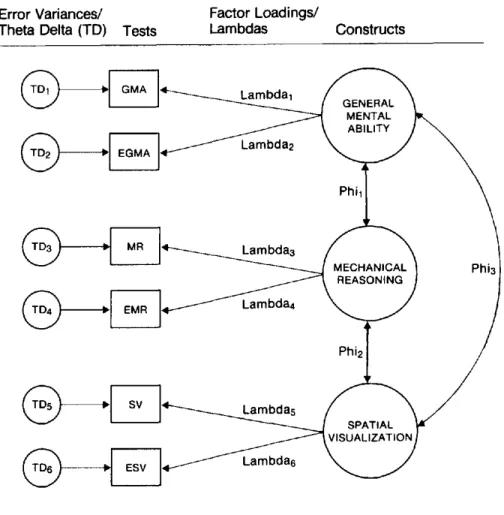
Psychometric theory distinguishes three levels o f test equiva- lence (see Figure 1). Congeneric tests may have unequal true score variances and unequal error variances; however, the rela- tion between congeneric measures "is attributable to a single underlying latent variable" that "accounts for all o f the system- atic variability of the observed measures" (Linn & Werts, 1979, p. 55). Thus, in this context, congenericism implies a three-fac- tor model in which the relation between each pair o f current and experimental tests is caused by only one construct. At the very least, the data must fit the congeneric model for construct equivalence to be demonstrated. Tau-equivalent and parallel tests are considered special cases o f congeneric tests that place additional constraints on error variances and true score vari- ances (JSreskog, 1979a). Tau-equivalent tests have equal true score variances, but unequal error variances, whereas parallel tests have equal true score variances and equal error variances. Thus, as indicated in Figure 1, the tau-equivalent model con- strained the factor loadings to be equal for each pair o f tests, and the parallel tests model constrained both the factor loadings and the error variances to be equal for each pair of current and experimental tests. Finally, the null model is used only for com- parative purposes and states that there is no relation among the tests, in other words, the variance in each test is error variance. We investigated three psychometric models because these models have different implications for test substitution. Ob- served scores on congeneric tests reflect the same construct, al- though not necessarily to the same degree, and not necessarily as reliably. Tan-equivalent tests measure a construct to the same degree, yet are not equally reliable. Therefore, true scores on tau-equivalent tests differ by a constant and may be measured more accurately by one of the tau-equivalent tests than by the other (Allen & Yen, 1979). Finally, parallel tests measure the same construct to the same degree and are equally reliable. Therefore, parallel tests have equal observed score means and equal correlations with other variables. Only when tests are par- allel, will the validity o f the new tests equal the validity o f the current tests. If the tests are congeneric or tau-equivalent, the new tests may be more or less valid for predicting j o b perfor- mance than the current tests, in part because reliabilities may differ. In addition, scores on parallel tests are interchangeable. However, observed scores on congeneric or tau-equivalent tests are not interchangeable and would therefore necessitate rescal- ing the raw scores before making selection decisions.
Because the three substantive models are hierarchically nested from most restrictive (parallel) to least restrictive (conge- neric), more than one of these models may fit the data. Specifi- cally, if a restrictive model fits the data, then all less restrictive models must also fit. Consequently, researchers should not nec- essarily stop the analyses when the results indicate that a specific model fits the data. Rather, all three substantive models should
within-groups covariance matrix slightly improved the fit of the models to the data in the current study, conclusions concerning the fit of the models were the same as when the unpooled covariance matrix was ana- lyzed. Therefore, for ease of presentation, we presented the results on the total sample from analyses of unpooled covariance matrixes, with results from the total R&C sample presented first, followed by the sub- group analyses.
be assessed to determine the effect o f each set o f restrictions. Because the restrictions are nested, specified in advance, and represent theoretically defensible positions, determining which model fits the data is considered a confirmatory, rather than an exploratory, analysis (Loehlin, 1987).
Table 3 presents results from structural analyses o f both co- variances and correlations. Strictly speaking, tests cannot be de- termined to be parallel or tau-equivalent by analyzing corre- lations, because parallelism and tau-equivalence are statements about tests in their original metric, not in a standardized met- ric. However, the tests in this study would not be expected to be strictly parallel because o f their different lengths, although they may be tau-equivalent. More importantly, if the tests are conge- neric and have equal reliabilities, then the tests will be parallel when standardized (Kenny, 1979). Furthermore, because in this study we addressed the practical problem o f test substitution and were not concerned with whether the true score was in the units o f measurement of the tests (Kenny, 1979), we analyzed all models with both covariances and correlations.
The results indicate that the congeneric tests model is most suitable for these data. Although the chi-square is statistically significant (p _< .008), this is not surprising given the large sam- ple size and, as J6reskog (1979b) notes, "a model may well be accepted even though x 2 is large" (p. 201). The large size o f the goodness-of-fit and normed fit indices, and the small size o f the root mean square residual, indicate that the congeneric tests model provides a very good fit to the data. When the covariance matrix is analyzed, the parallel and tau-equivalent models do not fit the data; however, when the correlations are analyzed, these models provide an excellent fit to the data.
The pattern of corrected correlations presented in Table 2 suggests that perhaps the current and experimental tests o f the general mental ability construct were congeneric, whereas the tests o f the mechanical reasoning and spatial visualization con- structs were either tau-equivalent or parallel. Therefore, we in- vestigated these additional models (see Table 3). Although the congeneric model for all constructs necessarily fits the data best, the results suggest that for practical purposes the paired tests of the general mental ability construct are congeneric (i.e., one factor accounts for all the systematic variance in both tests), and the paired tests of the mechanical reasoning and spatial vi- sualization constructs can be considered parallel (i.e., equal true scores and reliabilities). The correlational and structural modeling analyses provide strong evidence to indicate that, al- though the strength o f the relation varies across constructs, each pair of experimental and current tests measures the same con- struct.
Ethnic and Sex Differences
Although considerable evidence indicates that the use o f cog- nitive tests to predict j o b performance criteria is not unfair to minorities (Hunter, Schmidt, & Hunter, 1979; Schmidt, Pearl- man, & Hunter, 1980), LISrtEL was used to determine whether the relation o f the experimental and the current tests with the constructs is consistent across sex and ethnic subgroups. If the relation o f the current and the experimental tests with the con- structs are relatively consistent across groups, it indicates that the tests affect the groups similarly, at least within the context
E r r o r V a r i a n c e s / T h e t a Delta (TD) F a c t o r L o a d i n g s / Tests L a m b d a s C o n s t r u c t s Lambdal Lambda2 GENERAL MENTAL ABILITY Phi. Lambda3 Lambda4 MECHANICAL REASONING Lambdas Lambda6 Phi2 SPATIAL IISUALIZATIOb
Null Model'. Lambdal = Lambda2 = Lambdas = Lambda4 = Lambda5 = Lambdaa = Phil = Phi2 = Phi3 = 0.
Congeneric Model." Relationship as indicated by figure. Lambdas and theta deltas not constrained to be equal.
Tau-Equivalent Model: Lambdal = Lambda2; Lambda3 = Lambda4; Lambda5 = Lambdas.
Parallel Model: Lambdal = Lambda2; Lambda3 = Lambda4;
Lambda5 = Lambda6; TD1 = TD2; TD3 = TD4; TDs = TD6.
Figure 1. Structural models of the relation of the current and experimental tests with the latent constructs.
of these models. Therefore, we analyzed the R&C data with LIS- REL by investigating the fit of the data to a model that constrains certain parameters to be equal in both groups. However, differ- ent parameters can be constrained to be equal across groups, therefore we investigated different models.
The null model is used for comparative purposes only and constrains the variance o f each test to be equal across groups, although there are no covariances among the tests in either group. The hypothesis of equal covariance matrixes constrains the variances and covariances to be equal in both groups. If this hypothesis is rejected, then it remains possible that the correla- tion matrixes (i.e., the standardized covariance matrixes) are equal in both groups. If neither covariance nor correlation ma-
trixes are equal across groups, then the important question is, how are the groups unequal? The least restricted possibility that allows for measurement comparability across groups is the hy- pothesis o f invariant factor patterns, in other words, the conge- neric model holds in both groups, with the paired current and experimental tests measuring the same construct irrespective o f group membership. If this hypothesis is tenable, then it may be appropriate to test more restricted hypotheses. The more restricted hypotheses test (a) whether the factor loadings are in- variant across subgroups; (b) whether the factor loadings and error variances are invariant across subgroups; and (c) whether the factor loadings, error variances, and factor correlations are invariant across subgroups. If any of the less restricted hypothe-
Table 3
Confirmatory Factor Analysis of Relation Between Current and Experimental Tests
Adjusted Root Goodness- goodness- meanof-fit of-fit square Normed
Model
x 2
df
p
index index residual fit indexNull 7,087.56 Parallel tests 1,356.33 Tau-equivalent tests 777.37 Congeneric tests 17.48 GMA congeneric and SV and MR tau-equivalent 189.87 GMA congeneric and SV and MR parallel 275.96 Covariancematrix 15 .0001 .299 -1.454 a 83.746 - - 12 .0001 .774 .472 36.126 .809 9 .0001 .834 .709 37.212 .890 6 .008 .995 .993 .867 .998 8 .0001 .950 .919 10.192 .973 10 .0001 .930 .866 !1.412 .961 Null 7,087.56 Parallel tests 129.29 Tau-equivalent tests 73.15 Congeneric tests 17.48 GMA congeneric and SV and MR tau-equivalent 24.56 GMA congeneric and SV and MR parallel 35.75 Correlation matrix 15 .0001 .299 -1.454 a .579 - - 12 .0001 .967 .924 .035 .982 9 .0001 .981 .966 .049 .990 6 .008 .995 .993 .008 .998 8 .002 .993 .989 .014 .997 10 .0001 .991 .983 .011 .995
Note. GMA = general mental ability; MR = mechanical reasoning; SV = spatial visualization. EGMA,
EMR, and ESV = experimental GMA, MR, and SV, respectively. N = 1,241 for all analyses.a Although the adjusted goodness-of-fit index is usually between zero and one, it is theoretically possible for it to become negative (JiSreskng & S6rbom, 1986). This indicates, as expected, that the null model does not fit the data.
ses are rejected, then the more restricted hypotheses will either be rejected or will be of questionable scientific use; for example, testing for equality of factor loadings is only meaningful when the tests measure the same factors in both groups. Nevertheless, we present the results from all analyses for interested readers (see Table 4).
These results indicate that the relation of the current and the experimental tests with the constructs are relatively consistent across ethnic and sex subgroups. For both the ethnic and sex subgroup analyses, the model with the best fit to the data states that the congeneric model fits in both groups. Although the chi- square is significant (at the p < .05 level) for the sex subgroups, the magnitude of the normed fit index indicates that this model fits the data extremely well. In addition, the factor loadings in- variant model also fits the data extremely well for both the sex and ethnic subgroups. These results indicate that the current and the experimental tests measure the constructs similarly for ethnic and sex subgroups.
Operational Effects
The results indicate that the new and the current tests mea- sure the same constructs and that the relationships of the cur- rent and the experimental tests with the constructs are similar across sex and ethnic subgroups. If the current and the new tests
were strictly parallel, it would be unnecessary to investigate the operational effects of the substitution. However, because the re- sults are equivocal about whether the tests are strictly parallel, we conducted the operational analyses to provide additional in- formation about the construct equivalence of the tests. To con- duct the operational analyses, we created battery scores, follow- ing the organization's normal procedures, by standardizing each test in the battery and summing the standardized scores. The clerical battery consisted of the G M A (EGMA) test and two other tests, the secretarial battery consisted of the G M A (EGMA) test and one other test, the E&P battery consisted of the G M A (EGMA) and the MR (EMR) tests, and the R&C bat- tery consisted of the G M A (EGMA), MR (EMR), and SV (ESV) tests. The uncorrected correlations between the new and the old test battery scores for the clerical, secretarial, E&P, and R&C job groups were .96, .93, .88, and .94, respectively.
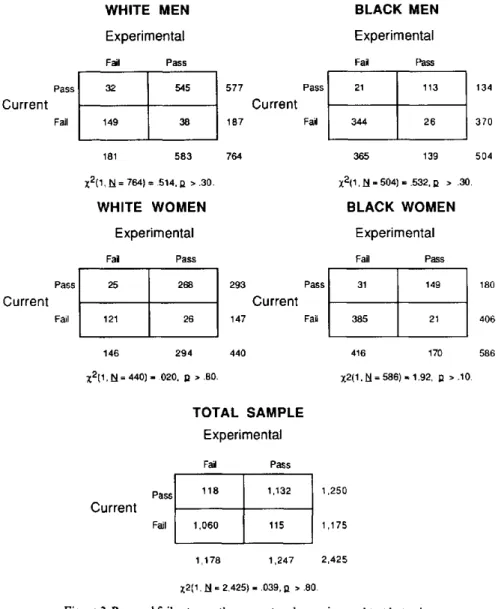
Further evidence concerning the operational effects of the substitution is provided by directly comparing decisions made under the two sets of tests. Figure 2 presents fourfold tables of pass and fail rates on the current and the experimental test bat- teries, analyzed by sex and ethnic subgroups. Although we ex- pected that some individuals would pass one test battery and fail the other, we expected these mismatches to differ only as a result of chance sampling (McNemar, 1969). The nonsignifi- cant chi-squares indicated there were no differences in the mis-
Table 4
Testing Hypotheses of the Equality of the Relations of the Current and Experimental Tests with the Constructs for Sex and Ethnic Subgroups
Ethnic" Sex b
Normed Normed
fit fit
Hypothesis x ~ p index x 2 p index
Equal null model
(df = 36) 5,752.11 .001 - - 6,912.98 .001 Equal covariance matrixes (df = 21) 75.54 .001 .987 67.42 .001 .990 Equal correlation matrixes (df= 21) 82.80 .001 .986 74.21 .001 .989 Factor patterns invariant (df = 12) 16.07 .188 .997 22.61 .031 .997 Factor loadings invariant (df= 15) 32.01 .006 .994 44.26 .001 .994 Factor loadings and
error variances invariant (df= 21) 66.26 .001 .988 60.79 .001 .991 Factor loadings, error variances, and factor covariances invariant (df= 27) 88.76 .001 .985 85.77 .001 .988 Note. All analyses were performed with covariances except for the equality of correlation matrixes hypothesis.
"Equality of the relationships of the current and experimental tests with the constructs for Black (n = 574) and White (n = 646) subgroups, bEquality of the relationships of the current and experimental tests with the constructs for female (n = 279) and male (n -- 962) subgroups.
matches, that is, the number of applicants who passed the cur- rent but failed the experimental battery was equivalent to the number who passed the experimental but failed the current bat- tery. These analyses also indicated that an equivalent propor- tion of applicants passed the current and the experimental test batteries within ethnic and sex subgroups.
The only test in the clerical and secretarial batteries with an experimental form was the measure of the general mental abil- ity construct. Although previous analyses suggested that EGMA and G M A may measure the same construct slightly differently, the operational analyses (not shown in Figure 2) in- dicated that the number of mismatches did not differ signifi- cantly for clerical or secretarial applicants as a function of the test used. This indicates that the slight difference in measuring the construct does not affect resulting decisions.
For the total sample, less than 5% passed the current battery but failed the experimental battery, and over two-thirds of these applicants were within 3 scale points of the experimental bat- tery cutoff score. Because similar results would be expected with a retest of the current battery, this provides further evi- dence that the experimental tests are equivalent measures of the constructs measured by the current tests and can therefore replace the current tests in the selection battery.
D i s c u s s i o n
In this study we demonstrated an approach to determine whether experimental tests can replace current, validated cog- nitive ability tests in selecting job applicants. This approach, labeled construct equivalence, states that if another test mea- sures the same construct as the validated, current test, then this new test can replace the current test in the selection battery. We demonstrated the construct equivalence approach by adminis- tering current and experimental tests to job applicants. By us- ing correlational, structural modeling, and operational effects analyses, we investigated the equivalence of the experimental and the current tests.
We used three types of analyses to investigate the equivalence of the tests because each analysis provides somewhat different information. Furthermore, the extent to which the three types of analyses lead to the same conclusions provides information about whether to replace the current test with the experimental tests. In the present study, because all three analyses led to the same conclusion, we decided that the experimental tests could replace the current tests in the selection battery.
The correlational analyses were based on the assumption that if the experimental and the current tests measure the same con-
Current
Current
Pass Fail Pass Fail WHITE MENExperimental
Fail Pass 32 545 149 38 181 5 8 3 ; ( 2 ( 1 , ~ = 764) = .514,~ • .30. WHITE WOMEN Experimental Fail Pass 25 268 121 26 146 294 ;(2(1, N = 440) = .020, D • .80. PassCurrent
Fail 577 PassCurrent
187 Fail 764 293 PassCurrent
147 Fail 440 TOTALSAMPLE
Experimental
Fail Pass 118 1,132 1,060 115 1,250 1,175 1,178 1,247 2,425 Z2(1, N = 2,425) = .039, 12 > .80. BLACK MENExperimental
Fail Pass 21 113 344 26 365 139 ;(2(1, N = 504) = .532, D > .30.BLACK
WOMEN Experimental Fail Pass 31 149 385 21Figure
2. Pass and fail rates on the current and experimental test batteries across job groups: total sample and by sex and ethnic subgroups.416 170 ;(2(1,E1=586)= 1.92, 12 • . 1 0 . 134 370 504 180 406 586
struct, then the true correlation between these tests would be 1.00, although any estimated true correlation may be different from 1.00 because o f sampling error. Correlations of the paired experimental and current tests corrected for unreliability in both measures provided preliminary evidence that the experi- mental tests measure the same constructs as the current tests, although the strength o f the relation varies across constructs.
Whereas the correlational analyses provided information about the relation between the paired tests, structural modeling (LISREL VI) investigated the relation of latent constructs with the tests. Although we analyzed both covariances and corre- lations, we deemed analyses of correlations most appropriate because standardized test scores are used for selection deci- sions, and this study deals with the practical issues of test substi- tution. The congeneric tests model fits the data best, although the model with congeneric tests of the general mental ability construct and parallel tests o f the mechanical reasoning and spatial visualization constructs also provided an excellent fit to
the data; the root mean square residual o f .011 indicates that very little data were unexplained by this model. Because the experimental test of the general mental ability construct had a higher reliability estimate than the current test, it is expected to have greater validity in predicting j o b performance.
If the current and the experimental tests were strictly parallel, it would be unnecessary to investigate whether decisions made about applicants are consistent within subgroups. Operational analyses become increasingly important when insufficient sub- jects are available to allow subgroup analyses. In the present study, subgroup analyses using structural modeling indicated that the relations o f the current and the experimental tests with the constructs were similar across sex and ethnic subgroups but that these measures, although essentially equivalent, may not be strictly parallel. Operational analyses indicated that the per- centage o f applicants passing the current and the experimental tests did not differ within sex and ethnic subgroups. Taken in sum, these results indicate that the experimental and the cur- rent tests treat ethnic and sex subgroups similarly.
Because the correlational and structural analyses indicated that the paired experimental and current tests measure essen- tially the same constructs, we expected that decisions made about applicants would be the same regardless of the test bat- tery used. However, we conducted these analyses to provide fur- ther information about the effects of substituting the experi- mental tests. Results indicated that an equivalent proportion of applicants passed the current and the experimental test batter- ies; this provides further support for the substitutability of the experimental tests.
It is instructive to consider the outcome of the operational analyses, presented in Figure 2, when the current tests have been compromised. To the extent that a large number of appli- cants had prior access to the current tests, more applicants would be expected to pass the current battery and fail the exper- imental battery than would pass the experimental and fail the current battery. Thus, it is clear that construct equivalence stud- ies should not be conducted at locations where many applicants have prior access to the current tests. Instead, data should be collected at locations where it is believed that the tests are secure and then, if results support construct equivalence, the experi- mental tests can be transported to other locations. Obviously, if many applicants have prior access to the test, results indicating a lack of construct equivalence may be obtained because the experimental and the current tests actually do not measure the same constructs; or because the current tests no longer measure the relevant constructs in the applicant pool in which many ap- plicants have prior access to the current tests. We conducted the current study at locations believed to be secure; the results supported that belief.
The construct equivalence approach is not a panacea for breaches in test security. As noted previously, if many appli- cants have prior access to the current tests, it may not be feasible to conduct a study investigating the construct equivalence of tests. A construct equivalence study needs to be conducted be- fore the tests are badly compromised or at locations where the tests are relatively secure; otherwise, results are uninterpret- able. Furthermore, a construct equivalence study is not feasible if one cannot find new tests that, although not necessarily paral- lel, are relatively similar to the current tests. At the least, the new tests need to have item content similar to the current tests before one can empirically investigate the equivalence of the current and the experimental tests. Of course, it is not enough to state that two tests purport to measure the same construct; data are needed to determine whether the tests actually measure the same construct. In addition, a construct equivalence study can only be done after the current tests have been validated. Finally, i~" the job has substantially changed since the current tests were validated, one should not replace current tests (that may no longer be valid) with new tests of the same construct.
In summary, the construct equivalence approach suggests that once a criterion-related validation study indicates which constructs are related to job success, if the job remains essen- tially the same, alternate tests of the same construct may be sub-
stituted for current tests without the necessity of conducting new criterion-related validity studies. In this study we demon- strated that construct equivalence is a viable approach for in- vestigating whether experimental tests can replace current tests in the selection battery. Advantages of the construct equivalence approach are as follows: (a) Data are collected from applicants during regular testing sessions; (b) the data required are only test scores, not item information; and (c) the statistical packages to analyze the data are readily available (e.g., sPss-x, LISREL) in many organizations. Therefore, when alternate solutions are not feasible, organizations may wish to consider a construct equivalence approach to test substitution.
References
Allen, M. J., & Yen, W. M. (1979). Introduction to measurement theory. Monterey, CA: Brooks/Cole.
Ca/lender, J. C., & Osburn, H. G. (1981). Testing the constancy of valid- ity with computer-generated sampling distributions of the multiplica- tive model variance estimate: Results for petroleum industry valida- tion research. Journal of Applied Psychology, 66, 274-281.
Cronbach, L. J., & Meehl, P. E. (1955). Construct validity in psychologi- cal tests. Psychological Bulletin, 52, 281-302.
Guion, R. M. (1987). Changing views for personnel selection research. Personnel Psychology, 40, 199-213.
Holmen, M. G., &Docter, R. (1972). Educational and psychological testing: A study of the industry and its practices. New York: Russell Sage.
Hunter, J. E., Schmidt, E L., & Hunter, R. (1979). Differential validity of employment tests by race: A comprehensive review and analysis. Psychological Bulletin, 86, 721-735.
J/Sreskog, K. G. (1979a). Analyzing psychological data by structural analysis of covariance matrices. In K. G. J6reskog & D. S6rbom (Eds.), Advances in factor analysis and structural equation models (pp. 45-100). Cambridge, MA: Abt Books.
J~Sreskog, K. G. (1979b). Simultaneous factor analysis in several popula- tions. In K. G. J6reskog & D. S6rbom (Eds.), Advances in factor anal- ysis and structural equation models (pp. i 89-206). Cambridge, MA: Abt Books.
J~reskog, K. G., & SiSrbom, D. (1986). LISREL Vl." Analysis of linear structural relationships by maximum likelihood, instrumental vari- ables, and least squares methods (4th ed.). Mooresville, IN: Scientific Software.
Kenny, D. A. (1979). Correlation and causality. New York: Wiley. Linn, P. C., & Werts, C. E. (1979). Covariance structures and their anal-
ysis. In R. Traub (Ed.), New directions for testing and measurement: Methodological developments (pp. 53-73). San Francisco: Jossey- Bass.
Loehlin, J. C. (1987). Latent variable models: An introduction to factor, path, and structural analysis. Hillsdale, N J: Erlbaum.
McNemar, Q. (1969). Psychological statistics (4th ed.). New York: Wi- ley.
Schmidt, E L., Hunter, J. E., & Caplan, J. R. ( 1981 ). Validity generaliza- tion results for two job groups in the petroleum industry. Journal of Applied Psychology, 66, 261-273.
Schmidt, F. L., Pearlman, K. & Hunter, J. E. (1980). The validity and fairness of employment and educational tests for Hispanic Ameri- cans: A review and analysis. Personnel Psychology,, 33, 705-724. Thorndike, R. L. (1982). Applied psychometrics. Boston: Houghton
Appendix
Covariances Used in the Structural Analyses
Table A 1Covariance Matrix for Total R&C Job Group
Test G M A MR SV E G M A EMR ESV
Table A2
Covariance Matrix for Blacks
Test G M A M R SV E G M A E M R ESV G M A 71.4543 - - MR 50.9329 112.195 - - SV 48.4748 78.9707 122.057 - - E G M A 108.54 110.04 111.529 249.06 - - EMR 59.3943 116.74 94.6553 130.884 160.548 - - ESV 55.5005 93.1335 123.861 128.754 113.365 154.724 Note. G M A = general mental ability; MR = mechanical reasoning; SV = spatial visualization. EGMA, EMR, and ESV = experimental GMA, MR, and SV, respectively. N = 1,241 for the total sample R&C job group. G M A 60.675 - - M R 29.4184 70.1573 - - SV 30.6018 43.6013 87.6463 - - E G M A 76.261 55.1205 64.7521 165.639 - - EMR 35.5879 69.2847 54.6886 69.5802 112.753 ESV 35.1716 50.7212 84.927 74.6926 65.6026 m 113.382 Note. G M A = general mental ability; M R = mechanical reasoning; SV = spatial visualization. EGMA, EMR, and ESV = experimental GMA, MR, and SV, respectively. N = 574 for the Black subgroup.
Table A3
Covariance Matrix for Whites
Test G M A M R SV E G M A E M R ESV G M A 56.9735 - - M R 31.8603 91.1369 - - SV 34.2873 63.4671 115.849 - - E G M A 88.7335 82.8507 92.7099 226.556 EMR 36.5387 91.5946 76.3304 98.5813 125.561 - - ESV 38.1412 76.1537 115.463 106.522 92.8923 141.001 Note. G M A = general mental ability; M R = mechanical reasoning; SV = spatial visualization. EGMA, EMR, and ESV = experimental GMA, MR, and SV, respectively. N = 646 for the White subgroup.
Table A4
Covariance Matrix for Women
Test G M A M R SV E G M A E M R ESV G M A 63.0543 - - M R 33.0618 66.1629 - - SV 38.1823 44.1707 86.4267 - - E G M A 87.5596 73.0126 83.1033 201.89 EMR 47.1732 66.5403 67.0332 104.141 ESV 47.44 56.92 90.2128 104.049 m 117.909 86.9316 124.844 Note. G M A = general mental ability; M R = mechanical reasoning; SV = spatial visualization. EGMA, EMR, and ESV = experimental GMA, MR, and SV, respectively. N = 279 for the female subgroup.
Table A5
Covariance Matrix for Men
Test G M A MR SV E G M A EMR ESV
G M A 73.0231 - - M R 51.3069 100.498 - - SV 49.2085 77.23 126.865 - - E G M A 112.562 109.669 114.57 257.975 - - E M R 57.1531 101.126 88.428 125.275 136.617 - - ESV 55.0684 89.0832 126.805 129.519 103.522 155.019 Note. G M A = general mental ability, M R = mechanical reasoning, SV = spatial visualization. EGMA, EMR, and ESV = experimental GMA, MR, and SV, respectively. N = 962 for the male subgroup.
R e c e i v e d O c t o b e r 27, 1987 R e v i s i o n r e c e i v e d M a y 11, 1988 A c c e p t e d A p r i l 20, 1988 •