Learning Visual Behavior for Gesture Analysis
Andrew D. Wilson
Aaron F. Bobick
Perceptual Computing Group
MIT Media Laboratory
Cambridge, MA 02139
drew, [email protected]
Abstract
A state-based method for learning visual behavior from image sequences is presented. The technique is novel for its incorporation of multiple representations into the Hidden Markov Model framework. Indepen-dent representations of the instantaneous visual input at each state of the Markov model are estimated con-currently with the learning of the temporal character-istics. Measures of the degree to which each represen-tation describes the input are combined to determine an input’s overall membership to a state. We exploit two constraints allowing application of the technique to view-based gesture recognition: gestures are modal in the space of possible human motion, and gestures are viewpoint-dependent. The recovery of the visual behavior of a number of simple gestures with a small number of low resolution image sequences is shown.
1
From human motion to gesture
For all the degrees of freedom available to the hu-man body, we seem to habitually use a only small class of motions that they permit. Even athletes, which as a group use their bodies in ways that most people do not, aspire to repeat motions flawlessly, spending hours upon hours practicing the same motion. In the space of motions allowed by the body’s degrees of free-dom, there is a subspace that most of us use. For ex-ample, if the body is modeled by a series of joints and angles between them, there would be many combina-tions of joint angles that we would never see.
Gesture is one interesting subspace of human mo-tion. For the purposes of this paper, we define gesture to be motions of the body that are intended to com-municate to another agent. Therefore, the gesturer and the recipient of the gesture must share a knowl-edge of gesture to communicate effectively. By way of simplification, this means the gesturer’s movement must be one of a predefined set. We do not mean that a given gesture has a fixed geometry; a “wave” might be a single gesture in which the hand can be at any height between the chest and the top of the head. Rather, for now we are assuming that there is a set of gestures and each gesture defines a range of motions that are to be interpreted as being examples of that gesture. Thus gestures aremodalin the space of possible human motion.
Due to the variability of human movement, the be-havior of the gesture must be described without
re-gards to precise geometry or precise temporal infor-mation. We takevisual behaviorto mean the sequence of visual events that makes a complete action or ges-ture. We assume that two gestures that have the same visual behavior are in fact the same gesture, thus ig-noring the delicate problem of relating the form and meaning of natural gesture [6].
1.1
View-based approach
The machine understanding of human movement and gesture brings new possibilities to computer-human interaction. Such interest has inspired research into the recovery of the the complete 3-dimensional pose of the body or hand using a 3-dimensional phys-ical model (e.g. [12, 13]). The presumption behind such work is that a complete kinematic model of the body will be required for useful inferences.
We claim that gestures are embedded within com-munication. As such, the gesturer typically orients the movements towards the recipient of the gesture. Vi-sual gestures are thereforeviewpoint-dependent. And the task of gesture understanding is particularly suited to a view-based, multiple model approach in which only a small subspace of human motions is repre-sented.
In related work, Darrell and Pentland [3] use dy-namic time warping and normalized correlation to match the interpolated responses of several learned image templates. Murase and Nayar [8] parameterize multiple eigenspaces over pose and illumination angle for object recognition. Polana and Nelson [10] match low level templates of spatiotemporal motion to recog-nize periodic human motions in image sequences. Cui and Weng [2] use learned decision boundaries to rec-ognize sequences of vector-quantized images of hands. Starner and Pentland [15] extract the position and dominant orientation of both hands for the recogni-tion of simple American Sign Language.
2
Representation of gesture
2.1
Multiple models for gesture
We claim that gestures are modal in the space of human motion. But how should a system model hu-man motion to capture the constraints present in the gestures? There may be no single set of features that makes explicit the relationships that hold for a given gesture. In the case of hand gestures, for example,
the spatial configuration of the hand may be impor-tant (as in a point gesture, when the observer must notice a particular pose of the hand), or alternatively, the gross motion of the hand may be important (as in a friendly wave across the quad). Quek [11] has ob-served that it is rare for both the pose and the position of the hand to simultaneously change in a meaningful way during a gesture.
Rather than use one model that is only partially effective, the approach here is to allow for multiple models. Bymodel we mean a systematic way to de-scribe a set of existing sensor data and a method to measure how well it describes new sensor data. Dif-ferent models may interpret the same sensor data in different ways or they may take data from different sensors, in which casesensor fusion is the goal. The use of multiple models in a visual classification task is discussed in [9].
One goal is to develop an approach that can ex-ploit multiple models simultaneously, where the type of models might be quite distinct. Model types useful for characterizing images in an image sequence might include eigenvector decomposition of sets of images [16], orientation histograms [4], peak temporal fre-quencies [10], tracked position of objects in the frame, and optic flow field summaries.
2.2
State-based descriptions
In previous work [1] we defined gesture to be a se-quence of states in a configuration space. States were defined on some input space (say the joint angles re-turned by a DataGlove) and were designed to capture the constraints present in a series of training examples. Membership in a state was governed by probabilistic functions that attempted to capture the natural vari-ability of motion in terms of the variances of these functions.
The temporal aspect of a gesture was incorporated by requiring that the states be defined along a pro-totype derived from training examples. Once defined, these states would be used to determine if a particular trajectory through the input space was an example of the learned gesture: the trajectory had to sequentially pass through each state attaining sufficient member-ships in sequence. The actual time course was not important as long as the sequence was appropriate.
In the work presented here, we continue to consider a gesture as a sequence of states. At each point in time, the observed visual input reflects the current state and perhaps the transition to the next state. This state-based description is easily extended to ac-commodate multiple models for the representation of different gestures or even different phases of the same gesture. The basic idea is that the different models need to approximate the (small) subspace associated with a particular state. Membership in a state is de-termined by how well the state models can represent the current observation.
2.3
Learning visual behavior
In this paper we develop a technique for learning visual behaviors that 1) incorporates the notion of multiple models; 2) makes explicit the idea that a given phase of a gesture is constrained to be within
some small subspace of possible human motions; and 3) represents time in a more probabilistic manner than defined by a prototype approach. In the remaining sections we first derive a state model and member-ship function based uponresidual, or how well a given model can represent the current sensor input. We then embed this residual-based technique within a Hidden Markov Model framework; the HMM’s represent the temporal aspect of the gestures in a probabilistic man-ner and provide an implicit form of dynamic time warping for the recognition of gesture. Finally, we demonstrate the technique on several examples of ges-ture and discuss possible recognition and coding ap-plications.
3
Modeling gestures
3.1
Model instances and memberships
Suppose we have a set of observations O =O1, O2, . . . , OT and a collection of states numbered
j = 1. . . N. Assume that for each observation Ot we are given a degree of beliefγt(j) that Ot belongs to a statej; we require thatNj=1γt(j) = 1. We can interpretγt(j) as themembership ofOt to statej. In this section we use the combination of multiple mod-els to describe the set of observations belonging to a single state; in the next section we consider modeling the time course of states.
A number ofmodel types A, B, etc. are selecteda priori to describe the observations. One instance of each model type is associated with a state. Let us denote the set of model instances at statej as Mj=
{Aj, Bj, . . .}. Each model instance is defined by the set of parameters that limit the model type to match some set of observations. For example, eigenvector decomposition of images may be a model type. An instance of the model type would comprise a particular mean image and set of eigenvectors (eigenimages) that are computed from a set of examples.
The parameters ofMj are computed from the set of example observations with the highest membership
γt(j). This may be accomplished by weighting each of the examples in the computation of the parame-ters, or simply by selecting some fixed number of the top observations, ranked by γt(j). In the examples presented, the latter approach is taken.
For each model instancem∈ Mj and an observa-tionxwe can compute a distance dm(x) which mea-sures the degree to which the model instance m is unable to match x. In this sense, dm(x) is a recon-struction errororresidual. If we think of the parame-ters ofMj as limiting the model to a subspace of the samples, then we may also call dm(x) a distance to model subspace. The distances to each model instance may be combined to give
dj(x) =dAj(x), dBj(x), . . ..
This quantity is similar to the “distance from feature space” derived in [7].
Next we consider the observation probability dis-tribution bj(x) which describes the probability of measuring a particular residual for an observation
when that observation is really generated by state
j. The probabilitybj(x) may be estimated from the observations, each weighted by γt(j). We estimate
bj as a normal1 joint distribution on dj: bj(x) =
N[dj(x), µµj,Σj], with µµj= T t=1 γt(j) T t=1γt(j) dj(Ot), and Σj= T t=1 γt(j) T t=1γt(j) (dj(Ot)−µµj)(dj(Ot)−µµj)T.
The probabilitybj(x) may then be used to compute a newγt(j). In the next section, Hidden Markov Mod-els are presented as a technique for computingγt(j) that treats the observations as a sequence rather than a set.
Having updatedγt(j), the estimation of the model instancesMj described above is iterated. In this way the memberships γt(j) and the model instances are tuned to define the states in a way that best represents the observations. Summarizing, we list the following requirements of model instances:
• Model instance parameters are computed using the observations and their membership to the state,γt(j).
• Each model instance delineates some subspace of the space of observations.
• The distances dj(x) must be lowest for observa-tions with a high degree of membershipγt(j).
3.2
HMM’s with multiple independent
model subspaces
Following a trend in speech recognition, vision re-searchers have applied the Hidden Markov Model tech-nique to gesture recognition. Yamato et al. [17] com-pute a simple region-based statistic from each frame of image sequences of tennis swings. Sequences of the vector-quantized features are then identified by a trained HMM. Schlenzig et al. [14] use a rotation invariant representation of binary images and a neural net to quantize the image to a hand pose token before using an HMM. Starner and Pentland [15] apply con-tinuous HMM’s with the orientation and position of both hands wearing colored gloves.
HMM’s are attractive because they put dynamic time warping on a probabilistic foundation and pro-duce a Markov model of discrete states that codes the temporal structure of the observations [5]. Training an HMM involves inferring a first-order Markov model
1Since there are no negative distances, the gamma distribution
may be more appropriate.
(a) 3 4 1 2 dB d A (b) 3 4 1 2 dA1 dB1 dA2 dA3 dA4 dB2 dB3 dB4
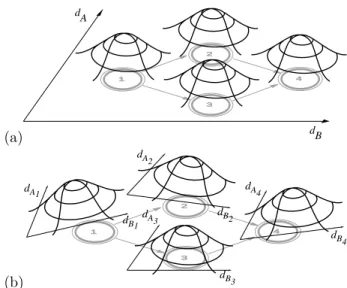
Figure 1: Each state of the Markov model (gray) is asso-ciated with a unimodal observation pdf. (a) In the conven-tional HMM framework all observation distributions reside
in the same space of measurements from modelAandB.
(b) In the multiple independent model subspace HMM, each state is associated with an independent space of mea-surements from modelAjandBj.
from a set of possibly continuous observation vectors. Each state is associated with the observation proba-bility distributionbj(x). The probability of making a transition from a stateito a statejin one time step is denoted asAij. The relationship between the discrete states andbj(x) is depicted in Figure 1(a).
Treating O as a sequence, we may now interpret
γt(j) from Section 3.1 as the probability of being in state j at time t given the observation sequence O and the HMM. Computed by the standard “forward-backward” procedure, γt(j) is used by the Baum-Welch algorithm to iteratively adjust bj(x) and Aij until the probability of the HMM generating the ob-servations is maximized.
Training the HMM with multiple independent model subspaces proceeds by interleaving iterations of the Baum-Welch algorithm (giving an updated γt(j) to reflect the updated transition matrixA) with rees-timating the parameters of the model instances. In this way the representation encoded at each state is trained concurrently with the transition model. The relationship between each discrete state of the Markov model and the multiple independent model subspaces is depicted in Figure 1(b).
An advantage to this approach is that the repre-sentation at each state is designed to match the par-ticular temporal model, while the temporal model is designed for the particular choice of representations as well. Additionally, by having multiple independent models, we do not rely on any one particular model instance to fit all observations for all states.
3.3
HMM topology
Before training the HMM, initial transition prob-abilitiesAij must be provided. The topology of the resulting Markov model is constrained by initially
set-a
b1 b2
c
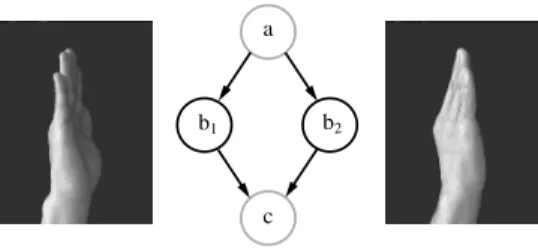
Figure 2: Astate-based description of gesture must en-code the relevant perceptual states. These images of an upright open hand share the same conceptual description, but have very different perceptual descriptions due to a slight change in viewing angle.
ting someAij to zero. To ease training, the topology is commonly constrained to be simple (e.g. causal).
The topology of the Markov model has the capa-bility of encoding the temporal structure of the ges-ture. We choose not to restrict the topology of the Markov model initially and instead recover the topol-ogy through training (though thenumberof states is assumed). The reasons for doing so are twofold. First, by not providing a strict initial model we may recover interesting temporal structures that would otherwise escape notice, such as symmetry in time. In such cases the structure of the recovered transition matrix con-tributes to our understanding of the gesture.
Second, by providing a strict initial model we make implicit assumptions about the distribution of the sen-sor outputs (e.g., unimodal along the gesture in the case of a strictly linear Markov model). These assump-tions may be unwarranted: while a simple gesture may seem to us a simple sequence ofconceptual states, the sensors may see the movement as a complicated tan-gle ofperceptual states. This may occur, for example, when the sensors used do not embody the same invari-ances as our own visual system. Figure 2 illustrates a single conceptual state (the upright hand) generating grossly different observations. If a singlebj(x) cannot encode both observations equally well, then additional Markov states are required to span the single concep-tual state. The addition of these states require the flexibility of the Markov model to deviate from strictly causal topologies.
3.4
Algorithm
To recover the temporal structure of the gesture and to train the representations at each state to suit the temporal model, we initialize the iterative algo-rithm sketched above with a uniform transition ma-trix and a random membership for each observation (Figure 3).
In the conventional HMM framework, the Baum-Welch algorithm is guaranteed to converge [5]. By interleaving the estimation of model parameters with the Baum-Welch algorithm, the proof of convergence may be invalidated. However, convergence has not been a problem with the examples tried thus far.
Initialization:
setAij =N1 for alli,j
initializeγt(j) randomly,Nj=1γt(j) = 1 Algorithm:
repeat until parameters ofMj do not change: for each statej (parallelizable):
estimate parameters to modelsm∈ Mj computedj(x) for allx∈O
estimatebj(x) =N[dj(x), µµj,Σj] end
updateA,γt(j) by Baum-Welch algorithm end
Figure 3: Training algorithm
4
Examples
4.1
Single model
For our first example, we use the eigenvector de-composition of the image as the single model type. In this case, the parameters associated with a model instance are simply a number of the top eigenimages that account for most of the variance of the training images (as indicated by the eigenvalues) and the mean training image. The training images for a model in-stance at statej are selected by ranking all samples by γt(j) and selecting some number of the top sam-ples. Given a model instanceEj and a sample image x,dj(x) =dEj(x)is simply the reconstruction resid-ual of the image using the precomputed eigenvectors at statej.
The input consists of 32 image sequences of a wav-ing hand, each about 25 frames (60 by 80 pixels, grayscale) in length. The top 50 γt(j)-ranked sam-ple images were used, and the number of eigenvectors was chosen to account for 70% of the variance of the selected sample images. Given the limited data, the Markov model was allowed 4 states.
The recovered Markov model, the mean image at each state, and a plot ofγt(j) and dEj for one train-ing sequence are shown in Figure 4. The recovered Markov model permits the symmetry shown by the plot ofγt(j) over an observation sequence. Some other observation sequences differ in the extent of the wave motion; in these cases the state representing the hand at its lowest or highest position in the frame is not used.
The plot of γt(j) reveals the time warping of the observation sequence to the Markov model. For ex-ample, the hand must decelerate to stop at the top of the wave, and then accelerate to continue. This is shown by the longer duration of membership to the first (top) state shown in the figure.
4.2
Position and configuration
The second example describes the position and con-figuration of a waving, pointing hand. In each frame of the training sequences, a 50 by 50 pixel image of the hand was tracked and clipped from a larger image with a cluttered background. Foreground segmentation was accomplished using the known background. The
con-0.87 0.13 0.16 0.68 0.16 0.75 0.25 0.11 0.07 0.82 0 5 10 15 20 25 0 0.5 1 Time t 0 5 10 15 20 25 0 0.5 1 0 5 10 15 20 25 0 0.5 1 0 5 10 15 20 25 0 0.5 1
Figure 4: The recovered Markov model for all training sequences at left shows the symmetry of the gesture. The
γt(j)-weighted mean image for each state is shown in the middle. On the right is a plot ofγt(j) (solid line) anddEj
(dotted line) for each state for one training sequence.dEj
was scaled to fit. The exact shape of the plots varies in response to the variance and length of the sequence.
figurationCof the hand is modeled by the eigenvector decomposition of the 50 by 50 images. The positionP of the hand is modeled by the location of the tracked hand within the larger image; at each state,P is esti-mated as theγt(j)-weighted mean location.
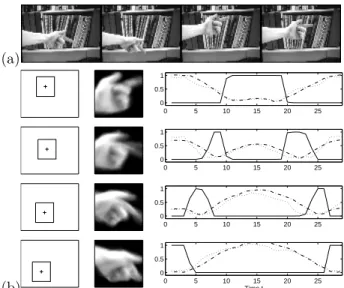
The recovered Markov model is similar to that of the waving hand in the previous example. The mean images anddj =dCj, dPj for each state are shown in Figure 5.
The variance of each feature indicates the impor-tance of the feature in describing the gesture. In this example both the position and configuration of the hand was relevant in describing the gesture. Had the location of the hand varied greatly in the training set, the high variance of the position representation would have indicated that position was not important in de-scribing the gesture.
4.3
Two camera views
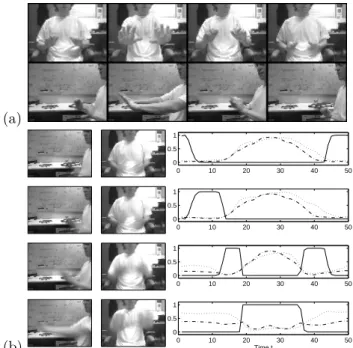
The final example shows how models for two cam-era views may be combined. Two views may be useful in describing the simultaneous movement of multiple objects (e.g. two hands, or a face and hands), or in de-scribing gestures that exhibit movement in depth. Fif-teen examples of a “pushing” gesture (see Figure 6(a)) were taken from both a side and front view. Eigen-vector decomposition was used to model each view; dj =dEfront
j , dEjside. The mean image for each view and plots ofdj are shown in Figure 6(b).
Note that in both views foreground segmentation is unnecessary since the camera is stationary. The mean image corresponds to the static parts of the image; the eigenvector decomposition subtracts the mean image at each state.
5
Conclusion and future work
The examples in Section 4 demonstrate that with a practical number of low resolution image sequences
(a) (b) 0 5 10 15 20 25 0 0.5 1 Time t 0 5 10 15 20 25 0 0.5 1 0 5 10 15 20 25 0 0.5 1 0 5 10 15 20 25 0 0.5 1
Figure 5: (a) Four representative frames (ordered left to right) are shown from one training sequence. (b) The
γt(j)-weighted mean location of the tracked hand in the larger image is shown on the left. The mean image for each state is shown in the middle. On the right is a plot of
γt(j) (solid line), dCj (dotted line), and dPj (dash-dotted
line) for each state for one training sequence. (dCjanddPj
were scaled to fit.)
and weak initial conditions, the algorithm is able to recover the visual behavior of the gesture, including interesting temporal structure. Future implementa-tions may be useful in novel wireless computer-human interfaces, real time “object-based” coding from video, and studying the relevant features of human gesture.
5.1
Real time coding
In HMM applications, recognition may be per-formed by the “forward-backward” algorithm, which returns the probability of an observation sequence given a particular HMM. The algorithm requires com-puting the observation probability at each state, at each time step. When there is a large number of states to consider or the cost of computing bj(x) is high, the forward-backward algorithm may not scale to a reasonable number of states, especially in a real time recognition or coding application.
In our framework the cost of computing the proba-bility of a new observation is quite high, sincedmmust be computed for all model instancesm ∈ Mj. If we were to use the eigenvector decomposition of the im-age as our model with 4 HMM’s with 25 states each, keeping the top 10 eigenvectors at each state, then 1,000 image correlations would be required at every time step.
The development of a robust coding method of low complexity is an important step in a real time imple-mentation of the framework. One possibility is to use abeam search in whichbj(x) is computed for a small subset of the available states, chosen to maximize the probability of being in the states given the past obser-vations. This strategy is suboptimal in the sense that it will miss paths through the model that are locally of
(a) (b) 0 10 20 30 40 50 0 0.5 1 Time t 0 10 20 30 40 50 0 0.5 1 0 10 20 30 40 50 0 0.5 1 0 10 20 30 40 50 0 0.5 1
Figure 6: (a) Four representative frames (ordered left to right) are shown from each view of one training “push” gesture. (b) The mean images for both the side view and front view at each state are shown on the left. Plots of
γt(j), dEfront
j (dotted line) and dEjside (dash-dotted line)
are from one training sequence.
low probability but globally of high probability. It re-mains to be seen whether this limitation has practical merit.
5.2
Model type selection
Because the observation distribution is a joint dis-tribution on the distances to multiple independent model subspaces, the set of model types at each state does not have to be the same across all states. One topic of future work involves the automatic selection of model types at each state. For example, one state may be characterized by motion sufficiently, while in another both motion and shape are required to char-acterize the observations.
Automatic selection of models is desirable for a number of reasons. First, a particular model type may be unable to characterize the training examples at a state, in which case erroneous model instances should be removed from the set of models at the state. Sec-ondly, if the appropriate set of features is not known beforehand, a good approach is to use all available models and let the system select the useful ones, pos-sibly subject to a cost constraint. Lastly, the selection of different subsets of model types at each state allows the characterization of behaviors in which the set of relevant features changes over time. Automatic selec-tion of models may provide insight into the degree to which this happens in the case of human gesture.
Acknowledgments
Special thanks to Tom Minka, Kris Popat, and Baback Moghaddam for valuable discussions on
mul-tiple models and eigenspace representations.
References
[1] A. F. Bobick and A. D. Wilson. A state-based tech-nique for the summarization and recognition of ges-ture. Proc. Int. Conf. Comp. Vis., 1995.
[2] Y. Cui and J. Weng. Learning-based hand sign
recog-nition. InProc. of the Intl. Workshop on Automatic
Face- and Gesture-Recognition, Zurich, 1995. [3] T.J. Darrell and A.P. Pentland. Space-time gestures.
Proc. Comp. Vis. and Pattern Rec., pages 335–340, 1993.
[4] W. T. Freeman and M. Roth. Orientation
his-tograms for hand gesture recognition. In Proc. of
the Intl. Workshop on Automatic Face- and Gesture-Recognition, Zurich, 1995.
[5] X.D. Huang, Y. Ariki, and M. A. Jack. Hidden
Markov Models for Speech Recognition. Edinburgh University Press, 1990.
[6] D. McNeill. Hand and Mind: What Gestures
Re-veal About Thought. Univ. of Chicago Press, Chicago, 1992.
[7] B. Moghaddam and A. Pentland. Probabalistic vi-sual learning for object detection. InProc. Int. Conf. Comp. Vis., Cambridge, MA, 1995.
[8] H. Murase and S. Nayar. Visual learning and recogni-tion of 3-D objects from appearance.Int. J. of Comp. Vis., 14:5–24, 1995.
[9] R. W. Picard and T. P. Minka. Vision texture for
annotation. Journal of Multimedia Systems, 3:3–14,
1995.
[10] R. Polana and R. Nelson. Low level recognition of
human motion. InProc. of the Workshop on Motion
of Non-Rigid and Articulated Objects, pages 77–82, Austin, Texas, Nov. 1994.
[11] F. Quek. Hand gesture interface for human-machine interaction. InProc. of Virtual Reality Systems, vol-ume Fall, 1993.
[12] J. M. Rehg and T. Kanade. Visual tracking of high DOF articulated structures: an application to human
hand tracking. Proc. European Conf. Comp. Vis.,
2:35–46, 1994.
[13] K. Rohr. Towards model-based recognition of human
movements in image sequences. Comp. Vis., Graph.,
and Img. Proc., 59(1):94–115, 1994.
[14] J. Schlenzig, E. Hunter, and R. Jain. Vision based hand gesture interpretation using recursive
estima-tion. InProc. of the Twenty-Eighth Asilomar Conf.
on Signals, Systems and Comp., October 1994. [15] T. E. Starner and A. Pentland. Visual recognition of
american sign language using hidden markov models. In Proc. of the Intl. Workshop on Automatic Face-and Gesture-Recognition, Zurich, 1995.
[16] M. Turk and A. Pentland. Eigenfaces for recognition.
Journal of Cognitive Neuroscience, 3(1):71–86, 1991. [17] J. Yamato, J. Ohya, and K. Ishii. Recognizing human
action in time-sequential images using hidden markov
model. Proc. Comp. Vis. and Pattern Rec., pages