UCLA
UCLA Electronic Theses and Dissertations
TitleMulti-relational Representation Learning and Knowledge Acquisition Permalink https://escholarship.org/uc/item/373677v6 Author Chen, Muhao Publication Date 2019 Peer reviewed|Thesis/dissertation
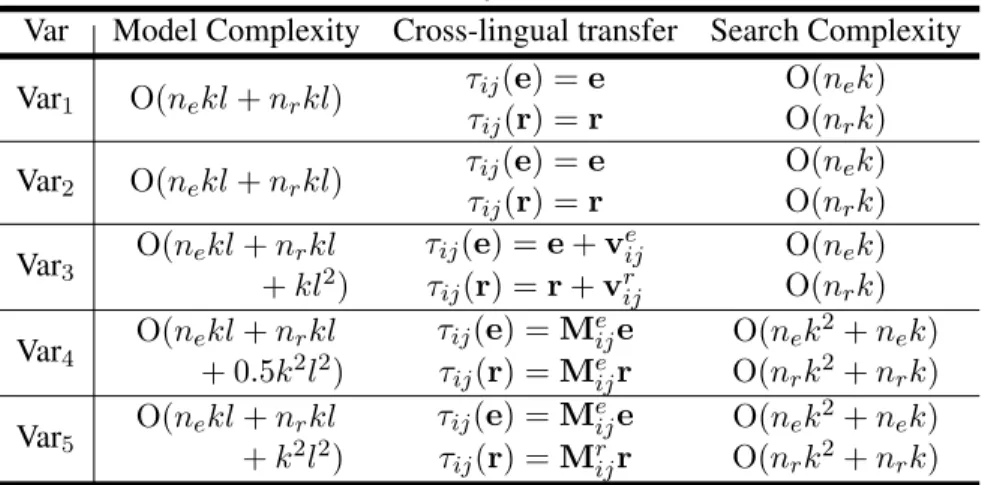
U
NIVERSITY OFC
ALIFORNIA Los AngelesMulti-relational Representation Learning and Knowledge Acquisition
A dissertation submitted in partial satisfaction of the requirements for the degree Doctor of Philosophy in Computer Science
by
Muhao Chen
c
Copyright by Muhao Chen
A
BSTRACT OF THED
ISSERTATIONMulti-relational Representation Learning and Knowledge Acquisition by
Muhao Chen
Doctor of Philosophy in Computer Science University of California, Los Angeles, 2019
Professor Carlo Zaniolo, Chair
Multi-relational representation learning methods encode entities or concepts of a knowledge graph in a continuous and low-dimensional vector space, where the relational inferences of entities (con-cepts) are modeled as some simple vector algebras. Despite such knowledge representations being crucial to a wide range of knowledge-driven applications, state-of-the-art methods are limited to learning embeddings for simple relation facts in a single knowledge graph. In this dissertation, we pursue the goal of comprehensively capturing the multifaceted relational knowledge in various types of knowledge bases, and towards that we contribute on three fronts: (i) we introduce the first multi-relational representation learning framework that learns to transfer embeddings across multiple knowledge bases; (ii) we propose techniques for preserving relational facts with complex properties in the embedding space, including those enforce relational properties, form hierarchies, or endowed uncertainty; (iii) we investigate large-scale relational learning based on other modali-ties of data, with the aim of acquiring knowledge to enrich the knowledge bases.
Each of these three research problems presents a series of key challenges which we address. Thus, for transferred embeddings, we develop joint learning of relational structure encoders that confront the heterogeneity of contents in knowledge graphs, together with diverse types of align-ment models that learn to transfer on the basis of simple, hierarchical or fuzzy alignalign-ment infor-mation. In addition, we extend the joint learning framework with semi-supervised co-training of entity descriptions, and proactive score propagation for fuzzy alignment, so as to conquer the sce-narios where alignment information is limitedly provided. To capture complex relation facts, we
focus first on the relational properties that cause non-linearity in embedding structures, for which we leverage a non-linear component-specific mappings of embeddings to eliminate the conflicts, and strengthens the learning process with hierarchical regularization. For uncertain relation facts, we preserve the uncertainty by utilizing Probablistic Soft Logic to guide the non-linear regressor that is jointly trained with the structure encoder. We further study the support of relational learn-ing based on sequence data. Our model proposes generic neural sequence pair models to support large-scale relation detection, in which we incorporate different sequence encoders for heteroge-neous data such as structured articles, amino acid sequences, and lexicographic knowledge.
The methods proposed in this dissertation extend the application of multi-relational embed-dings, and improve a wide spectrum of applications in different domains. These include knowl-edge alignment, monolingual and cross-lingual knowlknowl-edge graph completion, semantic search, entity typing, paraphrase identification, uncertain relation prediction, protein-protein interaction prediction, protein binding affinity estimation, single-cell RNA-sequence imputation, and Web-scale sub-article matching.
The dissertation of Muhao Chen is approved.
Junghoo Cho
Yizhou Sun
Yingnian Wu
Carlo Zaniolo, Committee Chair
University of California, Los Angeles 2019
Table of Contents
1 Introduction. . . 1 1.1 Motivation . . . 1 1.2 Challenges . . . 3 1.3 Thesis Contributions . . . 5 1.4 Thesis Overview . . . 7 2 Background . . . 112.1 Multi-relational Representation Learning . . . 11
2.2 Knowledge Bases and Knowledge Graphs . . . 13
2.2.1 Monolingual and Multilingual Knowledge . . . 13
2.2.2 Ontology and Instance-level Knowledge Graphs . . . 13
2.2.3 Comprehensive Properties of Relation Facts . . . 14
2.2.4 Sequence Data As Side Information . . . 16
2.3 Neural Sequence Models . . . 17
2.3.1 The Convolution Layer with Pooling . . . 17
2.3.2 GRU and Residual GRU . . . 17
2.3.3 Self-attentive Encoder . . . 19
3 Transfer Embeddings of Multilingual Knowledge Graphs . . . 21
3.1 Introduction . . . 21
3.2 Related Work . . . 24
3.3 The Vanilla Multilingual Knowledge Graph Embeddings . . . 25
3.3.1 Multilingual Knowledge Graphs . . . 25
3.3.2 Knowledge Model . . . 26
3.3.3 Alignment Model . . . 26
3.3.4 Variants ofMTransE . . . 28
3.4 Cross-lingual Entity Matching . . . 30
3.4.1 Examples of Knowledge Alignment . . . 33
3.5 Semi-supervised Co-training . . . 35
3.5.1 Iterative Co-training . . . 37
3.6 Semi-supervised and Zero-shot Entity Alignment . . . 38
3.6.1 Cross-lingual Entity Alignment . . . 39
3.6.2 Zero-shot Alignment . . . 41
3.6.3 Cross-lingual KG Completion . . . 42
3.7 Conclusion . . . 43
4 Transfer Embeddings with Complex Alignment Information . . . 44
4.1 Introduction . . . 44
4.1.1 Ontology-level Concepts and Instance-level Entities . . . 44
4.1.2 Single-cell RNA-sequence Data As Fuzzy Alignment . . . 47
4.2 Joint Embedding of Ontological Concepts and Instance-view Entities . . . 48
4.2.1 Formalization of Two-view Knowledge Bases . . . 48
4.2.3 Knowledge Model . . . 52
4.2.4 Joint Training on Two Views . . . 55
4.2.5 Variants ofJOIEand Complexity . . . 55
4.3 Entity Typing and Triple Completion . . . 56
4.3.1 Datasets . . . 56 4.3.2 Triple Completion . . . 57 4.3.3 Entity Typing . . . 59 4.3.4 Case Study . . . 61 4.4 Ablation Study . . . 64 4.4.1 Dimensionality . . . 65
4.4.2 Sufficiency of Type Information . . . 66
4.4.3 Effects of Negative Sampling . . . 67
4.5 Transfer Gene Knowledge Based on Fuzzy Alignment . . . 68
4.6 Cell Clustering . . . 70
4.6.1 Dataset . . . 70
4.6.2 Evaluation . . . 71
4.7 Conclusion . . . 72
5 Learning to Capture Relational Properties . . . 74
5.1 Introduction . . . 74
5.2 Embedding Ontology Graphs With Complex Relational Properties . . . 76
5.2.1 Preliminary . . . 76
5.2.2 Modeling . . . 76
5.2.3 Learning Process . . . 81
5.3.1 Relation Prediction . . . 82
5.3.2 Relation Verification . . . 85
5.3.3 Case Study . . . 87
5.4 Conclusion . . . 88
6 Embedding Uncertain Knowledge Graphs . . . 89
6.1 Introduction . . . 89
6.2 Related Work . . . 91
6.3 Problem Definition . . . 92
6.4 Modeling . . . 92
6.4.1 Modeling Plausibility for Relation Facts . . . 93
6.4.2 Inferring Confidence Scores for Unseen Relation Facts . . . 94
6.4.3 Embedding Uncertain Knowledge Graphs . . . 97
6.4.4 Model variants . . . 98
6.4.5 Confidence score prediction . . . 100
6.5 Experiments . . . 100
6.5.1 Datasets . . . 100
6.5.2 Model Configurations . . . 103
6.5.3 Confidence Prediction . . . 104
6.5.4 Relation Fact Ranking . . . 105
6.5.5 Relation Fact Classification . . . 107
6.6 Conclusion and Future Work . . . 108
7 Large-scale Sub-article Relation Learning . . . 109
7.2 Related Work . . . 112 7.3 Modeling . . . 113 7.3.1 Preliminaries . . . 113 7.3.2 Document Encoders . . . 114 7.3.3 Explicit Features . . . 115 7.3.4 Training . . . 116 7.4 Experiments . . . 117 7.4.1 Evaluation . . . 119
7.4.2 Mining Sub-articles from the Entire English Wikipedia . . . 123
7.5 Conclusion and Future Work . . . 124
8 Multifaceted Protein-Protein Interaction Learning . . . 125
8.1 Introduction . . . 125
8.2 Related Work . . . 127
8.3 Methods . . . 129
8.3.1 Preliminary . . . 129
8.3.2 RCNN-based Protein Sequence Encoder . . . 130
8.3.3 Learning Architecture and Learning Objectives . . . 132
8.4 Experiments . . . 133
8.4.1 Datasets . . . 134
8.4.2 Binary PPI Prediction . . . 135
8.4.3 Interaction Type Prediction . . . 139
8.4.4 Binding Affinity Estimation . . . 141
8.4.5 Amino Acid Embeddings . . . 142
8.4.7 Run-time Analysis . . . 144
8.5 Conclusion . . . 144
9 Learning Multi-granular Associations of Lexemes and Sentences . . . 146
9.1 Introduction . . . 146
9.2 Related Work . . . 148
9.3 Modeling Bilingual Dictionaries . . . 150
9.3.1 Encoders for Bilingual Dictionaries . . . 151
9.3.2 Basic Learning Objective . . . 151
9.3.3 Bilingual Multi-task Learning . . . 152
9.3.4 Joint Learning Objective . . . 153
9.4 Experiments . . . 153
9.4.1 Cross-lingual Reverse Dictionary Retrieval . . . 155
9.4.2 Bilingual Paraphrase Identification . . . 157
9.5 Conclusion . . . 159
10 Conclusion and Future Work . . . 160
10.1 Summary . . . 160
List of Figures
2.1 An example of two-view KB. Regular meta-relations and those conforming the hierarchical property are denoted as black and orange dashed lines respectively in the ontology view. . . 14
3.1 A simple example which shows triples, an ILL, and entity descriptions in a mul-tilingual KG (DBpedia). The French description for astronome means an as-tronomer is a scientist specialized in the study of astronomy, which contains much fewer content details than the English description forastronomer. . . 23 3.2 Precision-recall curves for cross-lingual entity matching on WK3l-15k. . . 31 3.3 Visualization of the result of Var4for the same six English entities in their original
space (left) and in French space after being transformed (right). English entities are rendered in blue, and the corresponding French entities are in light ruby. . . 35
4.1 The scRNA-seq fuzzy alignment between genes and cells. . . 46 4.2 JOIElearns two aspects of a knowledge base. The alignment model learns
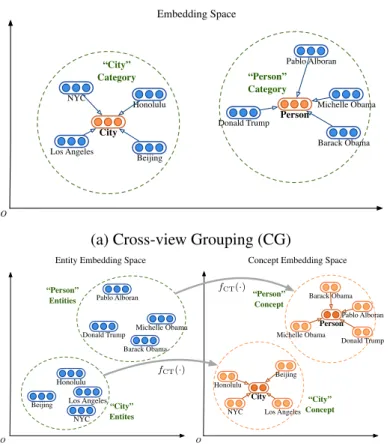
embed-dings from type links (dash arrows in green “category” box). The default knowl-edge model learns embeddings from triples (grey box) in each view; Besides, hierarchy-aware knowledge models the meta-relation facts that form hierarchies in the ontology (orange “Hierarchy” trapezoid). . . 49 4.3 Intuition of the alignment model: Cross-view Grouping (a); Cross-view
4.4 Examples of ontology population by finding the closest relations in the instance view for the query "Office Holder-Country". Top 10 predicted relations are plotted with their ranks. . . 63 4.5 Performance of entity typing task on both datasets with different entity and concept
embedding dimensionalities . . . 67 4.6 The effect of training the model using different proportions of type links on (a)
YAGO26K-906 and (b) DB111K-174 . . . 68 4.7 Visualizing the effects on embeddings of negative sampling on type links . . . 69 4.8 ARI of cell clustering under different drop-out rates of the Zeisel dataset. . . 71
5.1 Depiction of the conflicts of the relation-specific projection for learning transitive relations (Case 1, left), and symmetric relations (Case 2, right). . . 77 5.2 Precision-recall curves for relation prediction on YG15k and YG60k. . . 83 5.3 Choices ofα1 values and corresponding accuracy of relation prediction on YG15k. 86
6.1 Precision-Recall curves for relation fact classification task. . . 107
7.1 The main-articleBundeswehr(armed forces of Germany) and its sub-articles. . . . 110 7.2 Learning architecture of the model. . . 117 7.3 Relative importance (RI) of features analyzed by Garson’s algorithm. RI of each
feature is aggregated from all folds of cross-validation. . . 121 7.4 Sensitivity of CNN+F on the proportion of dataset for evaluation. . . 121
8.1 The overall learning architecture of our framework. . . 131 8.2 The structure of our residual RCNN encoder is shown on the right, and the RCNN
unit is shown on the left. Each RCNN unit contains a convolution-pooling layer followed a bidirectional residual GRU. . . 131
8.3 Mutation effects on structure and binding affinity. The blue entity is Subtilisin BPN’ precursor (Chain E), and the red entity is Chymotrypsin inhibitor (Chain I). The mutation is highlighted in yellow. The wild type (1TM1) and mutant (1TO1) complexes are retrieved from PDB. . . 142 8.4 Performance evaluation on dimensionality of hidden states, and the number of
oc-currences of the RCNN units. . . 144
9.1 An example illustrating the two cross-lingual tasks. Thecross-lingual reverse dic-tionary retrieval finds cross-lingual target words based on descriptions. In terms of cross-lingual paraphrases, the French sentence (which means any male being considered in relation to his father and mother, or only one of them) describes the same meaning as the English sentence, but has much more content details. . . 148 9.2 Joint learning architecture ofBilDRL. . . 150
List of Tables
2.1 The number of triples of each relation type in Yago3 Ontology. . . 15
3.1 Summary of model variants. . . 29
3.2 Statistics of the WK3l datasets. . . 30
3.3 Number of entity inter-lingual links (ILLs). . . 30
3.4 Cross-lingual entity matching results. . . 31
3.5 Examples of cross-lingual entity matching. . . 33
3.6 Examples of cross-lingual relation matching. . . 33
3.7 Examples of cross-lingual triple completion. . . 34
3.8 Statistics of the Wk3l60k dataset. . . 40
3.9 Results of cross-lingual entity alignment. . . 40
3.10 Results of zero-shot alignment. . . 41
3.11 Results of KG completion. . . 41
4.1 Statistics of datasets. . . 57
4.2 Results of triple completion. Note that H@1 and H@10 denoteHit@1andHit@10 respectively. For each group of model variants with the same knowledge encoding techniques, the best results are bold-faced. The overall best results on each dataset are under-scored. . . 59
4.4 Examples of ontology population fromJOIE-TransE-CT. Top 5 Populated Triples with smallest L2-norm distances are provided with reasonable answers bold-faced. 64 4.5 Results of long-tail entities typing. . . 64 4.6 Examples of long-tail entity typing. Top 3 predictions are provided with the correct
type bold-faced. . . 65 4.7 Effects of negative sampling in type links . . . 66 4.8 ARI of cell clustering by KG-Transfer verses the best of all baselines under
different drop-out rate. . . 72
5.1 Model complexity: number of parameters for optimization, and the computational complexity for predicting a relation. ncandnr are numbers of concepts and
rela-tions, andk is the dimensionality of embeddings. . . 80 5.2 Statistics of the data sets. pct. prop. and pct. hier. are the percentages of triples
defined with relational properties and hierachies. . . 80 5.3 Accuracy of Relation Prediction (%). prop. means with properties, hier. means
hierarchical relations. . . 83 5.4 Accuracy of relation verification (%). prop. means with properties, hier. means
hierarchical relations. . . 85 5.5 Examples of top-ranked new relation facts. The italic ones are conceptually close.
The rest are correct. . . 86
6.1 Statistics of the extracted datasets used in this chapter. Avg(s) and Std(s) thereof are the average and standard deviation of confidence scores. . . 101 6.2 Examples of logical rules . . . 101 6.3 Mean square error (MSE) and mean absolute error (MAE) of relation fact
confi-dence prediction. . . 101 6.4 Examples of confidence prediction usingUKGE2. . . 102
6.5 Mean Spearman’s Rho between predicted rankings and true rankings for relative
ranking task. . . 102
6.6 Mean normalized DCG for global ranking task. Herelinearstands for linear gain, andexp.stands for exponential gain. . . 102
6.7 Examples of relation fact ranking (global) results usingUKGE3 . . . 103
6.8 F-1 scores and accuracies (%) of relation fact classification . . . 103
7.1 Statistics of the dataset. . . 120
7.2 Cross-validation results on WAP196k. We report precision, recall and F1-scores on three groups of models: (1) statistical classification algorithms based on ex-plicit features, including logistic regression, Naive Bayes Classifier (NBC), Linear SVM, Adaboost (SAMME.R algorithm), Decision Tree (DT), Random Forest (RF) and k-nearest-neighbor classifier (kNN); (2) three types of document pair encoders without explicit features; (3) the proposed model in this chapter that combines explicit features with convolutional document pair encoders (CNN+F), GRU en-coders (GRU+F) or attentive encoders (AGRU+F). . . 120
7.3 Ablation on feature categories for CNN+F. . . 121
7.4 Examples of recognized main and sub-article matches. The italicize sub-article titles are without overlapping tokens with the main article titles. . . 123
8.1 Evaluation of binary PPI prediction on the Yeast dataset based on 5-fold cross-validation. We report the mean and standard deviation for the test sets. . . 136
8.2 Statistical assessment (t-test; two-tailed) on the accuracy of binary PPI prediction. The statistically significant differences are highlighted in red. . . 136
8.3 Evaluation of binary PPI prediction on variants of multi-species (C. elegan, Drosophila, and E. coli) dataset. . . 138
8.4 Accuracy (%) and fold changes over zero rule for PPI interaction type prediction
on two STRING datasets based on 10-fold cross-validation. . . 139
8.5 Results for binding affinity prediction on the SKEMPI dataset. Each measurement is an average of the test sets over 10-fold cross-validation. . . 139
8.6 Comparison of amino acid representations based on binary prediction. . . 143
8.7 Run-Time of training embeddings and different prediction tasks. . . 143
9.1 Statistics of the bilingual dictionary dataset Wikt3l. . . 154
9.2 Examples of bilingual paraphrases from WBP3l. . . 155
9.3 Cross-lingual reverse dictionary retrieval results by BilDRLvariants. We report P@1,P@10, andMRRon four groups of models: (i) basic dictionary models that adopt four different encoding techniques (BOW, CNN, GRU and ATT); (ii) mod-els with the two best encoding techniques that enforce the monolingual retrieval approach by Hill et al. (Hill et al., 2016) (GRU-mono and ATT-mono); (iii) mod-els adopting bilingual multi-task learning (GRU-MTL and ATT-MTL); (iv) joint learning that employs the best dictionary model of ATT-MTL (ATT-joint). . . 156
9.4 Accuracy and F1-scores of bilingual paraphrase identification. For BilDRL, the results by three model variants are reported: BilDRL-GRU-MTL and BilDRL -ATT-MTL are models with bilingual multi-task learning, and BilDRL-ATT-joint is the best ATT-based dictionary model variant deployed with both multi-task and joint learning. . . 158
A
CKNOWLEDGMENTSI would like to express my sincere gratitude to my advisor, Prof. Carlo Zaniolo, who has guided me throughout the entire Ph.D. study, and inspired me to be an enthusiastic scholar. He has given me enough freedom to explore problems according to my own interests. He has demonstrated all the skills to be a remarkable scholar and a passionate educator.
I would like to thank my committee, Prof. Junghoo Cho, Prof. Yingnian Wu, and Prof. Yizhou Sun, for their advice and suggestions over the years. I am thankful to Prof. Kai-Wei Chang, Prof. Wei Wang, and Prof. Mario Gerla, for closely collaborating with me on many exciting research projects.
I would like to thank all my friends and fellow students at UCLA ScAi Lab, UCLA NLP Group and UCLA NRL Group for their friendship and collaboration. I am sure I am forgetting some who helped me along the way, but this list includes Wasi Uddin Ahmed, Xuelu Chen, Hsuan Chiu, Manoj Reddy Dareddy, Ariyam Das, Ling Ding, Pengyuan Du, Changjun Fan, Shi Gao, Jiaqi Gu, Junheng Hao, Kuan-Hao Huang, Jyun-Yu Jiang, Chelsea Ju, Youfu Li, Ruirui Li, Mingda Li, Giuseppe M. Mazzeo, Tao Meng, Md Rizwan Parvez, Weijia Shi, Alexander Shkapsky, Ankith Uppunda, Jin Wang, Zheng Wang, Zijun Xue, Mohan Yang, Seunghyun Yoo, Jieyu Zhao, Qi Zhao, Guangyu Zhou, and Pei Zhou.
I am grateful to my parents for their unconditional love. Their sacrifice and support have led to all my accomplishments. I also appreciate Jessie Du for accompanying me through most of the time during my Ph.D. study, for which I will always remember. Lastly, I would like to thank Galneryus and Gyze for their great songs that have been encouraging me all the time.
V
ITA2014 Bachelor of Science in Computer Science, Fudan University, Shanghai, China.
2015 Research Intern, Teradata Labs, Los Angeles, CA.
2015-2016 Teaching Assistant, Department of Computer Science, UCLA.
2016-2017 Teaching Associate, Department of Computer Science, UCLA.
2016 SDE Intern, Google, Mountain View, CA.
2017-2018 Teaching Fellow, Department of Computer Science, UCLA.
2017 RSDE Intern, Google, Mountain View, CA.
2018 Research Intern, Microsoft Research, Redmond, WA.
P
UBLICATIONSParts of the work in this dissertation have appeared in the following publications:
• Muhao Chen, Chelsea J. T. Ju, G. Zhou, T. Zhang, Kai-Wei Chang, Carlo Zaniolo, Wei Wang. Multifaceted Protein-Protein Interaction Prediction Based on Siamese Residual RCNN. Bioinfor-matics, Oxford Academic. 2019. Special issues featuring ISMB/ECCB 2019
• Muhao Chen, Yingtao Tian, Haochen Chen, Kai-Wei Chang, Steven Skiena, Carlo Zaniolo. Learn-ing to Represent BilLearn-ingual Dictionaries. Arxiv Preprint. 2019
• Junheng hao, Muhao Chen, Wenchao Yu, Yizhou Sun, Wei Wang. Universal Representation Learn-ing of Knowledge Bases by Jointly EmbeddLearn-ing Instances and Ontological Concepts.KDD. 2019 • Muhao Chen, Chris Quirk. Embedding Edge-attributed Relational Hierarchies.SIGIR. 2019 • Xuelu Chen, Muhao Chen, Weijia Shi, Yizhou Sun, Carlo Zaniolo. Embedding Uncertain
Knowl-edge Graphs.AAAI. 2019
• Muhao Chen, Changping Meng, Gang Huang, Carlo Zaniolo. Neural Article Pair Modeling for Wikipedia Sub-article Matching.ECML-PKDD. 2018
• Muhao Chen, Yingtao Tian, Kai-Wei Chang, et al. Co-training Embeddings of Knowledge Graphs and Entity Descriptions for Cross-lingual Entity Alignment.IJCAI. 2018
• Muhao Chen, Yingtao Tian, Xuelu Chen, Z. Xue, Carlo Zaniolo. On2Vec: Embedding-based Relation Prediction for Ontology Population. SDM. 2018
• Muhao Chen, Yingtao Tian, Mohan Yang, Carlo Zaniolo. Multilingual Knowledge Graph Embed-dings for Cross-lingual Knowledge Alignment.IJCAI. 2017
• Muhao Chen, Carlo Zaniolo. Learning Multi-faceted Knowledge Graph Embeddings for Natural Language Processing. IJCAI. 2017
• Muhao Chen, Tao Zhou, Pei Zhou, Carlo Zaniolo. Multi-graph Affinity Embeddings for Multilin-gual Knowledge Graphs. AKBC. 2017
CHAPTER 1
Introduction
Knowledge bases form large collections of multi-relational data, which model the relations of enti-ties and concepts as large graph structures (i.e. knowledge graphs). The knowledge graph provides a shared understanding of human knowledge that supports commonsense reasoning (Bollacker et al., 2008; Cilibrasi and Vitanyi, 2007; Lehmann et al., 2015; Mahdisoltani et al., 2015; Speer et al., 2017), and also supports domain-specific research work with valuable expert knowledge (Moal and Fernández-Recio, 2012; Szklarczyk et al., 2016; Yu et al., 2016).
1.1
Motivation
This dissertation focuses on representation learning methods for multi-relational data. Multi-relational representation learning models (a.k.a. knowledge graph embeddings) typically encode entities or concepts of a knowledge graph in a continuous and low-dimensional vector space, where the relational inferences of entities (concepts) are modeled as some simple vector algebras. Hence, these models provide efficient and versatile methods to incorporate the symbolic knowledge of multi-relational data into machine learning. Models of this kind have effectively supported a few tasks like knowledge graph completion (Bordes et al., 2013), relation extraction from text (Wang et al., 2014b), and logic rule mining (Yang et al., 2015d). The embedding representations obtained from these models have been indispensable to support a long list of knowledge-driven applications in different domains, including dialogue agents (He et al., 2017a), question answering (Das et al., 2018; Huang et al., 2019), item recommendation (He et al., 2017b), visual object detection (Fang
et al., 2017), story understanding (Chen et al., 2019a), drug discovery (Scott et al., 2016) and drug side effect detection (Zitnik et al., 2018).
Despite multi-relational representation learning having been widely utilized, previous methods merely focus on embedding the data in one knowledge graph. In contrast, learning transferable
embeddings across multiple knowledge graphs represents an unresolved problem. In fact, in many application scenarios, different knowledge graphs can be naturally connected to each other. For example, while multilingual knowledge bases separately manage knowledge graphs in different languages (Lehmann et al., 2015; Mahdisoltani et al., 2015), all those language-specific knowl-edge graphs are expected to describe consistent relation facts for a shared set of entities in the same domain. In a commonsense ontology where semantic relations seek to provide more abstract concepts (Speer et al., 2017), where each concept can be instantiated into more specific entities in a larger instance-level knowledge graph (Lehmann et al., 2015). Biological data may also be inter-changeable across different domains, for instance, interaction data of proteins (Szklarczyk et al., 2016), gene ontologies (Ashburner et al., 2000), and single-cell descriptions (Bard et al., 2005).
Learning embeddings that transfer between different knowledge graphs undoubtedly provides a more generic way to represent knowledge. One immediate benefit from such transferable em-beddings is to match and synchronize the entity contents of different language-specific knowledge graphs. This directly extends the use of knowledge graph embeddings to address knowledge align-ment tasks (Vuli´c and Moens, 2015), and is particularly useful to various cross-lingual NLP tasks, as well as other tasks such as entity typing and data cleaning. Moreover, the supported knowledge transfer can lead to an effective way to populate the missing knowledge in one domain based on the knowledge from others. Therefore, knowledge bases of low-resource languages can be easily populated using the embeddings trained on well-populated high-resource ones, without abundant alignment information. For biology research, cell identification and clustering tasks may also bor-row knowledge from protein knowledge graphs and gene ontologies, based on partially complete single-cell RNA sequencing transcripts (Elyanow et al., 2019; Lin et al., 2017a).
Besides transferable representation learning, there are other critical problems that are related to multi-relational data. One is that knowledge graphs often enforce complex properties on relation
facts. These properties include relational properties such as transitivity and symmetry, as well as hierarchical relations that may be simultaneously endowed transitivity and multi-mapping. Some knowledge graphs also endow uncertainty to relation facts (Mitchell et al., 2018; Speer et al., 2017; Wu et al., 2012). Failure of preserving these important properties in capturing the relations will no doubt cause an imprecise representation of multi-relational knowledge, and further impairs the performance of downstream tasks that are based on the embedding techniques. However, few efforts have investigated the embedding representations needed for relations with these complex properties.
Aside from these issues, knowledge graphs are often far from complete due to the high cost of acquiring high quality relational knowledge (Culotta and Sorensen, 2004; Fundel et al., 2007; Mousavi et al., 2014b). Hence, another important mission is to investigate how to best support re-lational learning based on data modalities other than graphs, and leverage the acquired knowledge to populate knowledge graphs themselves. As many real-world objects can be represented with sequence information, we investigate relational learning with sequence data.
In this dissertation, we aim at investigating new multi-relational representation learning meth-ods, which produce transferable embeddings across multiple knowledge graphs in different do-mains, and capture complex properties of the relation facts. For knowledge acquisition, we study the relational learning approaches based on sequence data.
1.2
Challenges
We address several key challenges in this dissertation. First, we propose the study of learning trans-ferable embeddings for different knowledge graphs. Models should characterize the heterogenous structures of different knowledge graphs in the embedding space, while capturing the precise cor-respondences of entities and relations across graphs. In addition, this learning process is often subject to insufficient supervision, since the alignment information to learn the correspondence is provided to only a limited extent. Second, capturing complex properties of relation facts is non-trivial. Dedicated learning techniques need to be carefully designed to preserve specific relational properties, as well as exploit and propagate uncertainty of relation facts in the embedding space.
Lastly, as knowledge graph themselves are often far from complete, it is vital to populate the graphs by acquiring knowledge from other modalities (both same or different) of data. The challenges we tackle in this dissertation are summarized below:
• Learning transferred embeddings. To realize universal and transferable embedding represen-tations for different knowledge graphs, a model should address the following major difficulties of representation learning in two aspects.
(i)Heterogeneity in knowledge graph contents.Different knowledge graphs often lead to hetero-geneity in relation facts, as well as that in vocabularies of entities and relations. In fact, different language-specific versions of knowledge graphs in a knowledge base are typically extracted from independently maintained corpora (Lehmann et al., 2015; Mahdisoltani et al., 2015), which no doubt leads to all the aforementioned heterogeneity. If we consider transferring across different domains of knowledge, such as genes and cells (Elyanow et al., 2019) or instances and onto-logical concepts (Lehmann et al., 2015), then, the relation facts and objects to align between different graphs can even be disjoint with each other.
(ii) Diverse types of alignment information. Diverse types of alignment information are often provided across different knowledge graphs under different application scenarios as well. These include one-to-one alignment between different language-specific knowledge graphs, many-to-one alignment between instance-level entities and ontological concepts (Lehmann et al., 2015), and fuzzy alignment, such as single-cell RNA sequencing transcripts to associate between genes and cells. Each such type of alignment information requires a dedicated method to represent the knowledge transfer.
• Transfer with limited alignment information. The information on seed alignment to connect between different knowledge graphs is often very limited. For example, the cross-lingual align-ment between language-specific version of a Wikipedia-based knowledge base typically cover less than 20% of entities in each language (Chen et al., 2018e). The alignment information be-tween gene knowledge graphs and cells can be even sparser due to the high cost of verifying single-cell gene expressions in wet lab experiments (Elyanow et al., 2019; Lin et al., 2017a).
Hence, the transfer learning based on limited supervision non-trivially demands carefully de-signed semi-supervised learning techniques.
• Learning to capture complex properties of relation facts. Given one knowledge graph, pre-vious works typically focus on capturing simple deterministic relation facts, and do not learn to preserve the complex properties that are often endowed to relation facts. Towards more precise relational learning, we discuss the challenges in learning two types of properties.
(i)Relational properties. Many knowledge graphs, typically domain-specific ontology graphs, often add relational properties to the knowledge, such as transitivity and symmetry. Some of such relation facts often form hierarchies. A typical example is provided byIs-A, which is both transitive and hierarchical, and is the most frequently appearing semantic relation in ontologies. More examples are discussed in Section 2.2.3.1. Such relational facts lead to non-linearity of the embedding structure that cause conflict in a regular Euclidean embedding space.
(ii) Uncertainty. Probablistic knowledge graphs (Wu et al., 2012), commonsense knowledge graphs (Mitchell et al., 2018; Speer et al., 2017) and protein-protein interaction knowledge graphs (Szklarczyk et al., 2016) endow relation facts with uncertainty. As existing multi-relational representation learning methods merely captures deterministic knowledge, the vector algebras employed in these methods do not preserve uncertainty.
• Relational learning based on sequence data. The challenges here lie in several aspects. One is that, to represent objects based on sequence data in different application domains, we may have diverse requirements of feature selection from different forms of sequence data, including structured articles, short sentences, and nucleotide sequences. Another issue is how to support large-scale relation detection based on sequence pairs. In some cases, the relation may also appear as a multi-granular association between sequences and lexical units of a sequence.
1.3
Thesis Contributions
• In this dissertation, we propose the first method to learn transferred embeddings across dif-ferent knowledge graphs. Our learning framework examines multiple techniques to capture
cross-lingual knowledge transfer under the simplest one-to-one alignment setting, and iden-tifies the most suitable technique. Our framework is further extended to support knowledge transfer under many-to-one and fuzzy alignment settings. This is accomplished by respectively incorporating hierarchical-grouping based alignment techniques and Semi-non-negative Matrix Tri-facterization based techniques.
• To address the challenging semi-supervised transfer learning of knowledge graph embeddings, this dissertation proposes an iterative co-training model, which leverages the side information of entity descriptions to bridge across different knowledge graphs. For fuzzy alignment settings, our method addresses this problem with proactive score propagation.
• This dissertation proposes two models to capture the two aspects of complex relation properties. The first proposed model leverages a non-linear, component-specific mapping of entity (con-cept) embeddings to eliminate the conflicts of the embedding structures caused by relational properties, and strengthens the learning of hierarchical relations with hierarchical regulariza-tion. To preserve information about uncertainty, the second model jointly learns a non-linear regressor with a multi-relational structure encoder. We also incorporate Probablistic Soft Logic rules into the learning process, to estimate effectively the uncertainty of unseen relation facts through guided confidence score propagation.
• To support relational learning based on sequence data, our work proposes generic neural se-quence pair models to support large-scale relation detection between articles, and multi-faceted interaction prediction between proteins. We also propose a joint learning framework that learns the multi-granular association of lexical and sentential semantics in different languages.
• The methods introduced in this dissertation benefit a wide spectrum of applications in different domains. This long list includes knowledge alignment, monolingual and cross-lingual knowl-edge graph completion, semantic search of entities, entity typing, paraphrase identification, un-certain relation prediction, protein-protein interaction prediction, protein binding affinity esti-mation, single-cell RNA-sequence imputation, and sub-article matching.
1.4
Thesis Overview
The dissertation can be broadly categorized into five logical segments. Part I: Background
• Chapter 2:
The first part of this dissertation surveys background. We start by introducing different cate-gories of multi-relational data. Then we provide an overview of previously proposed knowledge graph embedding approaches. Our work seeks to extend new approaches to support transfer-able embeddings in (Part II), and to capture complex relation properties in (Part III). Lastly, we define different types neural sequence encoders, which are the basis of our work on sequence-based relational learning in (Part IV), and also constitute the key component of the co-training framework in Chapter 3.
Part II: Transfer Multi-relational Embeddings
• Chapter 3:
This chapter introduces the first method to learn transferred embeddings of multi-relational data. The proposed model MTransE learns to transfer across different language-specific versions of knowledge graphs. MTransE uses a combination of two component models, namely the knowledge model and the alignment model. The knowledge model is responsible for encoding entities and relations in a language-specific version of knowledge graph. We explore the method that organizes each language-specific version in a separated embedding space. On top of that, the alignment model learns cross-lingual transitions for both entities and relations across different embedding spaces. We explore the following three representation techniques for cross-lingual alignment: distance-based axis calibration, translation vectors, and linear transformations. To improve the transfer learning under limited supervision, we extend MTransE to a novel co-training-based approach KDCoE . KDCoE iteratively trains MTransE and a bilingual entity description embedding model. Starting with a very small portion of entity alignment, both model
components alternately propose a set of most confident new ILLs to strengthen the supervision of cross-lingual learning, which leads to gradually improved accuracy on cross-lingual inferences. • Chapter 4:
We extend the techniques in the previous chapter to deal with more complex knowledge transfer. JOIE extendsMTransEto learn the association between instance-level entities and concepts in a hierarchical ontology, for which two types of hierarchical grouping based alignment mod-els are incorporated to capture the many-to-one associations between entities and concepts.
KG-Transfer modifies MTransE’s alignment model as a Semi-non-negative Matrix Tri-factorization technique, so as to capture and propagate the fuzzy alignment information between genes and cells in single-cell RNA sequencing data.
Part III: Learning to Capture Complex Properties of Multi-relational Data
• Chapter 5:
We study how to preserve relational properties of an ontology with a multi-relational embedding model. The proposedOn2Vecmodel integrates two model components that effectively char-acterize comprehensive relation facts in ontology graphs. The first is the Component-specific Model that encodes concepts and relations into low-dimensional embedding spaces without a loss of relational properties. The second is the Hierarchy Model that performs focused learning of hierarchical relation facts.
• Chapter 6:
The proposed uncertain KG embedding modelUKGEseeks to preserve both structural and un-certainty information of relation facts in the embedding space. Unlike previous models that characterize relation facts with binary classification techniques, UKGE learns embeddings ac-cording to the confidence scores of uncertain relation facts. To further enhance the precision of
UKGE, we also introduce Probabilistic Soft Logic to infer confidence scores for unseen relation facts during training.
Part IV: Knowledge Acquisition With Neural Sequence Pair Models
• Chapter 7:
We provide an approach to large-scale detection of the main and sub-article relations for Wikipedia articles. The proposed model adopts a hierarchical learning structure that combines multiple variants of neural document pair encoders with a comprehensive set of explicit features. A large crowdsourced dataset is created to support the evaluation and feature extraction for the task. Based on this large dataset, the proposed model achieves promising results of cross-validation and significantly outperforms previous approaches. Large-scale serving on the entire English Wikipedia also proves the practicability and scalability of the proposed model by effectively extracting a vast collection of newly paired main- and sub-articles.
• Chapter 8:
This chapter presents an end-to-end framework,PIPR, for protein-protein interaction (PPI) pre-dictions using only the protein sequences. PIPRincorporates a deep residual recurrent convo-lutional neural network in the Siamese architecture, which leverages both robust local features and contextualized information, which are significant for capturing the mutual influence of pro-teins sequences. PIPR eliminates the data pre-processing efforts that are required by other systems, and generalizes well to different application scenarios. Experimental evaluations show thatPIPR outperforms various state-of-the-art systems on the binary PPI prediction problem. Moreover, it shows a promising performance on more challenging problems of interaction type prediction and binding affinity estimation, where existing approaches fall short.
• Chapter 9:
This chapter presents a neural embedding model that captures the multi-granular associations of words and sentences based on bilingual lexicographic definitions. To enhance the learning process on limited resources, our model adopts several critical learning strategies, including multi-task learning on different bridges of languages, and joint learning of the dictionary model with a bilingual word embedding model.
Part V: Conclusion
• Chapter 10:
The final part of the dissertation concludes the contributions of this dissertation and discusses directions for future research that can be built on top of this work.
CHAPTER 2
Background
In this chapter, we present the background on multi-relational representation learning approaches. We then describe the complex multi-relational data of different categories, each of which presents specific representation learning problems that are addressed in our work. Finally, we summarize a series of neural sequence encoding techniques, which serve as the basis of sequence data based knowledge acquisition.
2.1
Multi-relational Representation Learning
Multi-relational representation learning, a.k.a. knowledge graph embeddings, aim at distribut-ing entities of multi-relational data in low-dimensional embedddistribut-ing spaces, in which the semantic similarity of entities are captured as vector distances. The relational inferences of entities are captured in forms of simple vector algebra. Models for knowledge graph embeddings can be cat-egorized into three families, i.e. translation-based models, similarity-based models, and neural models(Wang et al., 2017a).
To characterize a triple(h, r, t), translation-based models follow a common assumption hr+
r ≈ tr, where hr and tr are either the original vectors of h and t, or the transformed vectors
under a certain transformation w.r.t. relationr. The forerunner TransE (Bordes et al., 2013) sets hr and tr as the original h and t, and achieves promising results in handling 1-to-1 relations.
Later works improve TransE on multi-mapping relations by introducing relation-specific transfor-mations on entities to obtain differenthr andtr, including projections on relation-specific
hyper-planes in TransH (Wang et al., 2014b), linear transformations to heterogeneous relation spaces in TransR (Lin et al., 2015), dynamic matrices in TransD (Ji et al., 2015), and other forms (Jia et al., 2016; Nguyen et al., 2016). All these variants of TransE specialize entity embeddings for different relations, therefore improving knowledge graph completion on multi-mapping relations at the cost of increased model complexity. Meanwhile translation-based models cooperate well with other models. For example, variants of TransE are combined with word embeddings to help relation extraction from text (Weston et al., 2013; Zhong et al., 2015).
As for the similarity-based models, DistMult (Yang et al., 2015b) associates related entities using Hadamard product of embeddings, and HolE (Nickel et al., 2016) substitutes Hadamard product with circular correlation to improve the encoding of asymmetric relations, and achieves the state-of-the-art performance in knowledge graph completion. ComplEx (Trouillon et al., 2016) migrates DistMult in a complex space and offers comparable performance.
In addition to those, neural models include RESCAL (Nickel et al., 2011), SLM (Socher et al., 2013), ConvE (Dettmers et al., 2018) and R-GCN (Schlichtkrull et al., 2018). These approaches also achieve comparable performances on triple completion tasks at the cost of high model com-plexity.
A recent survey has summarized the score functions of these models (Wang et al., 2017a). The training process minimizes the total loss, which is defined as the sum of the scores over all triples in the graph. To prevent the training process from overfitting, negative sampling (Bordes et al., 2013) is used in training. This is realized by randomly corrupting the subject or object of a golden triple (h, r, t) to a corrupted triple (h0, r, t0). Thereby the score function of a triple is described by the following hinge loss,
max(fr(h,t) +γ−fr(h0,t0),0)
whereγ is a positive margin. Usually, negative sampling follows either uniform distribution or Bernoulli distribution to corrupt eitherhort, which are so called uniform and Bernoulli negative sampling respectively (Wang et al., 2014b).
It is noteworthy that the literature has paid attention only to encode simple triples within a single knowledge graph. Existing knowledge bases however, constitute far more complicated knowledge than simple relation facts, including different language specific versions, complex properties of relation facts, and knowledge of other modalities. In the next section, we describe different cate-gories of complicated knowledge for which we seek to extend the representation learning methods towards.
2.2
Knowledge Bases and Knowledge Graphs
This section provides a introduction and categorization of the multi-relational data (or knowledge graphs).
2.2.1 Monolingual and Multilingual Knowledge
We have already come across much of monolingual knowledge in the literature. In current knowl-edge bases, such as Wikipedia (Wikipedia, 2016), WordNet (Bond and Foster, 2013), and Concept-Net (Speer and Havasi, 2013), vast amounts of multilingual knowledge are being created across the multiple language-specific versions of the knowledge base. Such multilingual knowledge, in-cluding inter-lingual links (ILLs), and triple-wise alignment (TWA), is very useful in aligning and synchronizing different language-specific versions of a knowledge base that evolve independently, as needed to further improve applications built on multilingual knowledge bases. However, such cross-lingual knowledge is far from complete, while extending it is challenging due to the fact that it is almost not possible for existing corpus to directly provide such knowledge of expertise. Ex-isting approaches involve either extensive human involvement or require training comprehensive models on information that is external to knowledge graphs.
2.2.2 Ontology and Instance-level Knowledge Graphs
From a different perspective, knowledge bases can also be classified intoinstance-level knowledge graphsandontology-level knowledge graphs(Ni et al., 2016). Some large knowledge bases, such as DBpedia (Lehmann et al., 2015), YAGO (Mahdisoltani et al., 2015) and ConceptNet (Speer et al., 2017), simultaneously manage both categories of knowledge graphs as two views. These
two views of knowledge graphs are described as follows: (i) theinstance-level knowledge graphs that containrelationsbetween specificentitiesin triples (for example, “Barack Obama”, “ isPoliti-cianOf”, “United States”) and (ii) the ontology-level knowledge graphsthat constitute semantic meta-relations of abstract concepts (such as “polication”, “is leader of”, “city”). In addition, these knowledge bases also provide cross-view links that connect ontological concepts and in-stances, denoting whether an instance is an instantiation from a specific concept. Figure 2.1 shows a snapshot of such a knowledge base.
Barack Obama Person Politician City at_location Honolulu Singer Pablo Alborán State Donald Trump at_location Place was_born_in Columbia University New York City is_located_in graduated_from is_a is_a
Ontology-viewKnowledgeGraph
Instance-viewKnowledgeGraph
University Michelle Obama has_spouse Nobel Peace Prize has_award Richard Hofstadter graduated_from at_location Artist is_a is_a is_a is_a has_album Institution is_a leader TypeLinks Concept Entity Relation Meta-Relation was_born_in lives_in related_to has_award has_spouse
Figure 2.1: An example of two-view KB. Regular meta-relations and those conforming the hierar-chical property are denoted as black and orange dashed lines respectively in the ontology view.
2.2.3 Comprehensive Properties of Relation Facts
Aside from general knowledge graphs that model relation facts as simple triples, a handful of com-monsense (Mitchell et al., 2018; Speer et al., 2017) and biological ontologies (Moal and Fernández-Recio, 2012; Szklarczyk et al., 2016), feature comprehensive properties in their relation facts. This subsection describes such properties from two perspectives, i.e. relational properties and uncer-tainty.
Table 2.1: The number of triples of each relation type in Yago3 Ontology. Relation Number Trans. Sym. Hier.
happenedIn 2810 hasChild 41938 X hasAcademicAdvisor 4 X livesIn 1600 isCitizenOf 1197 isLocatedIn 1549685 X X wasBornIn 11672 isMarriedTo 8593 X isLeaderOf 1071 X isPoliticianOf 4833 hasNeighbor 450 X hasCapital 5280 isConnectedTo 26966 X X dealsWith 821 X influences 170 hasCurrency 4 X diedIn 7195 hasGender 34811 X Total num/portion 1699100 92.8% 2.2% 95.8% 2.2.3.1 Relational Properties
In some knowledge graphs, especially ontology graphs, the majority of relation facts can be en-forced with specific relational properties (e.g., transitivity, symmetry), or form hierarchies (e.g. taxonomy relations and spatial topological relations (Chen et al., 2016a)). For example, Freebase contains more than 20% of transitive or symmetric relations (Bollacker et al., 2008); Concept-Net (Speer and Havasi, 2013) contains 70% of transitive or symmetric relations, and at least 26% of hierarchical relations; Yago3 Ontology (Mahdisoltani et al., 2015) even contains only 17 types of relations (whose statistics we have listed in Table 2.1), while more than 92% of the relations are transitive or symmetric relations, and more than 95% of the relations are hierarchical. Moreover, we can further divide hierarchical relations into refinement and coercion relations (Camossi et al., 2006), such that the former divides each coarser concept or entity into more refined ones, and the later does the opposite.
2.2.3.2 Uncertain Knowledge Graphs
In contrast to the aforementioned deterministic knowledge graphs, uncertain knowledge graphs provide a confidence score along with every relation fact. The development of relation extraction and crowdsourcing in recent years enabled the construction of large-scale uncertain knowledge bases. ConceptNet (Speer et al., 2017) is a multilingual uncertain knowledge graph for common-sense knowledge that is collected via crowdsourcing. The confidence scores in ConceptNet mainly come from the co-occurrence frequency of the labels in crowdsourced task results. Probase (Wu et al., 2012) consists of an universal probabilistic taxonomy that is built by relation extraction. Ev-ery relation fact in Probase is associated with a joint probabilityPisA(x, y). NELL (Mitchell et al.,
2018) collects relation facts from reading web pages, and learns their confidence scores from semi-supervised learning with Expectation-maximum (EM) algorithm. On the other side, in biological knowledge graphs, the confidence score often serves as a quantification of certain biochemical in-teractions, or express the belief of the interactions based on the experimental verification. Such cases include binding affinity estimation of proteins that are endowed to the proteprotein in-teractions in SKEMPI (Moal and Fernández-Recio, 2012), as well as the evidential confidence of typed protein-protein interactions in STRING (Szklarczyk et al., 2016).
2.2.4 Sequence Data As Side Information
Besides the multi-relational structures, some knowledge bases also provide side information of entities (concepts) as sequence data. Such sequence data serve as alternative views to represent entities or concepts in the embedding space, which is captured with the neural sequence models introduced in the next sections. Such data includes natural language descriptions of entities in multilingual knowledge bases (Bollacker et al., 2008; Lehmann et al., 2015), which are leveraged to support co-training of cross-lingual knowledge transfer in Section 3. Other forms include def-initions of words in lexicographic knowledge bases (online dictionaries) (Meyer and Gurevych, 2012), and amino acid sequences of proteins in protein knowledge bases (Szklarczyk et al., 2016), for which we utilize directly to experiment sequence-based relational learning.
2.3
Neural Sequence Models
This subsection introduces a variety of neural sequence encoding techniques, which are the basis of our work on knowledge acquisition from sequence data.
2.3.1 The Convolution Layer with Pooling
We use X = [v1,v2, ...,vl] to denote an input vector sequence that corresponds to the input
se-quence or the outputs of a previous neural layer. A convolution layer applies a weight-sharing kernel Mc ∈ Rh×k to generate a k-dimension latent vector h
(1)
t from a window vt:t+h−1 of the input vector sequenceX:
h(1)t = Conv(vt:t+h−1) =Mcvt:t+h−1+bc
for whichhis the kernel size, andbcis a bias vector. The convolution layer applies the kernel as a
sliding window to produce a sequence of latent vectorsH(1) = [h(1) 1 ,h
(1) 2 , ...,h
(1)
l−h+1], where each latent vector combines the local features from each h-gram of the input sequence. The n -max-pooling mechanism is applied to every consecutive n-length subsequence (i.e., non-overlapped n-strides) of the convolution outputs, which takes the maximum value along each dimensionj by h(2)i,j = max(h(1)i:n+i−1,j). The purpose of this mechanism is to discretize the convolution results, and preserve the most significant features within each n-stride (Chen et al., 2018b; Hashemifar et al., 2018; Kim, 2014). By definition, this mechanism divides the size of processed features by n.
2.3.2 GRU and Residual GRU
The Gated Recurrent Unit model (GRU) represents an alternative to the Long-short-term Memory network (LSTM) (Cho et al., 2014), which consecutively characterizes the sequential information without using separated memory cells (Dhingra et al., 2016). Each unit consists of two types of gates to track the state of the sequence, i.e. the reset gate rt and the update gate zt. Given the
embeddingvtof an incoming item, GRU updates the hidden stateh
(3)
t of the sequence as a linear
combination of the previous state h(3)t−1 and the candidate state h˜(3)t of a new item vt, which is
calculated as below. h(3)t = GRU(vt) = zth˜ (3) t + (1−zt)h (3) t−1 zt=σ Mzvt+Nzh (3) t−1+bz ˜ h(3)t = tanhMsvt+rt(Nsh (3) t−1) +bs rt =σ Mrvt+Nrh (3) t−1 +br .
The symboldenotes the element-wise multiplication. The update gateztbalances the
informa-tion of the previous sequence and the new item, where capitalized M∗ and N∗ denote different weight matrices,b∗ denote bias vectors, and σ is the sigmoid function. The candidate state h˜(3)t is calculated similarly to those in a traditional recurrent unit, and the reset gate rt controls how
much information of the past sequence contributes to h˜(3)t . Note that GRU generally performs comparably to LSTM in sequence encoding tasks, but is less complex and requires much fewer computational resources for training.
A bidirectional GRU layer characterizes the sequential information in two directions. It con-tains the forward encoding process−−−→GRUthat reads the input vector sequenceX = [v1,v2, ...,vl]
fromv1tovl, and a backward encoding process←−−−GRUthat reads in the opposite direction. The
en-coding results of both processes are concatenated for each input itemvt, i.e.h
(4)
t = BiGRU(vt) =
[−−−→GRU(vt),←−−−GRU(vt)].
The residual mechanism passes on an identity mapping of the GRU inputs to its output side through a residual shortcut (He et al., 2016). By adding the forwarded input values to the outputs, the corresponding neural layer is only required to capture the difference between the input and output values. This mechanism aims at improving the learning process of non-linear neural layers by increasing the sensitivity of the optimization gradients (He et al., 2016; Kim et al., 2016), as
well as preventing the model from the vanishing gradient problem. It has been widely deployed in deep learning architectures for various tasks of image recognition (He et al., 2016), document classification (Conneau et al., 2017b) and speech recognition (Zhang et al., 2017). In our deep RCNN in Chapter 8, the bidirectional GRU is incorporated with the residual mechanism, and will pass on the following outputs to its subsequent neural network layer:
h(5)t = ResGRU(vt) = [−−−→GRU(vt) +vt,←−−−GRU(vt) +vt]
In our development, we have found that the residual mechanism is able to drastically simplify the training process, and largely decreases the epochs of parameter updates for the model to converge. 2.3.3 Self-attentive Encoder
The self-attention mechanism (Conneau et al., 2017a) seeks to capture the overall meaning of the input sequence unevenly from each encoded item. One layer of self-attention is calculated as below, ut= tanh Mah (3) t +ba at= exp u>t uX P wm∈Xexp (u > muX) h(6)t =|X|atut
where ut thereof is the intermediary latent representation of the GRU output h(3)t , and uX =
tanh(Mah
(3)
X +ba)is the intermediary latent representation of the last GRU outputh
(3)
X that can be
seen as a high-level representation of the entire input sequence. By measuring the similarity of each ut with uX, the normalized attention weight at forh
(3)
t is produced through a softmax function,
which highlights an input that contributes more significantly to the overall meaning. Note that a scalar|X|(the length of the input sequence) is multiplied along withattoutto obtain the weighted
of the sequence is calculated as the average of the last attention layerE(2)(X) = |X1|P|X|
t=1ath
(6)
t .
2.3.4 Linear Bag-of-words
The much simpler Linear Bag-of-words (BOW) encoder (Hill et al., 2016; Xie et al., 2016) is real-ized by the sum of projected word embeddings of the input sentence, i.e.E(3)(S) =P|S|
CHAPTER 3
Transfer Embeddings of Multilingual Knowledge Graphs
In this chapter, we propose the first method that learns transferred embeddings across multiple knowledge graphs. This work is presented in the stage of learning to represent multilingual knowl-edge graphs (Chen et al., 2017b,d), although it is easily extended to other domains.
3.1
Introduction
Multilingual knowledge bases such as Wikipedia (Wikipedia, 2016), WordNet (Bond and Foster, 2013), and ConceptNet (Speer and Havasi, 2013) are becoming essential sources of knowledge for people and AI-related applications. These knowledge bases are modeled as knowledge graphs that store two aspects of knowledge: the monolingual knowledge that includes entities and relations recorded in the form of triples, and the cross-lingual knowledge that matches the monolingual knowledge among various human languages.
The coverage issue of monolingual knowledge has been widely addressed by recently proposed embedding-based techniques, which provide simple methods to encode entities in low-dimensional embedding spaces and capture relations as means of translations among entity vectors. Meanwhile, the problem of applying these techniques on cross-lingual knowledge remains largely unexplored. Such knowledge, includinginter-lingual links(ILLs) that match the same entities, andtriple-wise alignment (TWA) that represents the same relations, is very helpful in synchronizing different language-specific versions of a knowledge base that evolve independently, as needed to further improve applications built on knowledge bases, such as Q&A systems, semantic Web, and Web
search. In spite of its importance, this cross-lingual knowledge remains largely intact. In fact, in the most successful knowledge base Wikipedia, we find that ILLs cover less than 20% entity alignment.
Leveraging knowledge graph embeddings to cross-lingual knowledge no doubt provides a generic way to help extract and apply such knowledge. However, it is a non-trivial task to find a tractable technique to capture the cross-lingual transfers. Such transfers are more difficult to capture than relational translations for several reasons: (i) a cross-lingual transfer has a far larger domain than any monolingual relational translation; (ii) it applies on both entities and relations, which have incoherent vocabularies among different languages; (iii) the known alignment for train-ing such transfers usually accounts for a small percentage of a knowledge base. Moreover, the characterization of monolingual knowledge graph structures has to be well-preserved to ensure the correct representation of the knowledge to be aligned.
To address the above issues, we first propose a multilingual knowledge graph embedding model
MTransE, that learns the multilingual knowledge graph structure using a combination of two component models, namely knowledge model and alignment model. The knowledge model en-codes entities and relations in a language-specific version of knowledge graph. We explore the method that organizes each language-specific version in a separated embedding space, in which
MTransE adopts TransE as the knowledge model. On top of that, the alignment model learns cross-lingual transfers for both entities and relations across different embedding spaces, where the following three representations of cross-lingual alignment are considered: distance-based axis cal-ibration, translation vectors, and linear transformations. Thus, we obtain five variants ofMTransE
based on different loss functions, and identify the best variant by comparing them on cross-lingual alignment tasks using two partially aligned trilingual graphs constructed from Wikipedia triples.
While the MTransE solely relies on the structured knowledge for cross-lingual learning, it would be promising to enhance the corresponding learning process with the literal descriptions of entities that are stored in many KGs (Ji et al., 2017; Lehmann et al., 2015; Mahdisoltani et al., 2015). These descriptions comprise an alternative view of entities that potentially bridges two languages, since the descriptions of an entity in different languages often share a lot of semantic
EN triple:
(
Ulugh Beg
, occupation,
astronomer
)
FR triple:
(
Ulugh Beg
, activité ,
astronome
)
An astronomer is a scientist in the field of astronomywho concentrates their studies on a specific question or field outside of the scope of Earth...
Un astronome est un scientifique spécialisé dans l'étude de l'astronomie...
Inter-lingual Link (ILL):
(
astronomer
@EN,
astronome
@FR)
Figure 3.1: A simple example which shows triples, an ILL, and entity descriptions in a multilin-gual KG (DBpedia). The French description for astronome means an astronomer is a scientist specialized in the study of astronomy, which contains much fewer content details than the English description forastronomer.
information. However, it is non-trivial to characterize and utilize such information for cross-lingual learning, as this requires the model to learn to match descriptions across different languages with inadequate labels, while conquering the inconsistency of literals in content details, grammars, and word orders (as shown in Fig. 3.1). Moreover, aggregating semantic relatedness of descriptions from words of different languages is another challenge.
To address these issues, we propose a novel co-training-based approach KDCoE to enhance the semi-supervised learning of multilingual KG embeddings. KDCoEiteratively trains two com-ponent embedding models on multilingual KG structures and entity descriptions respectively. A KG embedding model jointly trains a translational knowledge model with a linear-transformation-based alignment model to encode the KG structure. A description embedding model employs an attentive gated recurrent unit encoder (AGRU) and multilingual word embeddings to characterize multilingual entity descriptions, and is trained to collocate the embeddings of cross-lingual coun-terparts. The co-training is processed on a large Wikipedia-based trilingual KG, for which a very small portion of ILLs is used for training. During each iteration of co-training, both models al-ternately propose a set of most confident new ILLs to strengthen the supervision of cross-lingual learning, which leads to gradually improved accuracy on cross-lingual inferences. Experimen-tal results on entity alignment confirms the effectiveness ofKDCoEthat significantly outperforms previous models, while those results on zero-shot alignment and cross-lingual KG completion also show wider usability of our approach.
3.2
Related Work
While, at the best of our knowledge, there is no previous work on learning multilingual knowledge graph embeddings, we will describe next three lines of work which are closely related to this topic. Multilingual Word Embeddings. Several approaches learn multilingual word embeddings on parallel text corpora. Some of those can be extended to multilingual knowledge graphs, such as LM (Mikolov et al., 2013a) and CCA (Faruqui and Dyer, 2014) which induce offline transfers among pre-trained monolingual embeddings in forms of linear transformations and canonical cor-relation analysis respectively. These approaches do not adjust the inconsistent vector spaces via calibration or jointly training with the alignment model, thus fail to perform well on knowledge graphs as the parallelism exists only in small portions. A better approach OT (Xing et al., 2015) jointly learns regularized embeddings and orthogonal transformations, which is however found to be overcomplicated due to the inconsistency of monolingual vector spaces and the large diversity of relations among entities.
Knowledge Bases Alignment.Some projects produce cross-lingual alignment in knowledge bases at the cost of extensive human involvement and designing hand-crafted features dedicated to spe-cific applications. Wikidata (Vrandeˇci´c, 2012) and DBpedia (Lehmann et al., 2015) rely on crowd-sourcing to create ILLs and relation alignment. YAGO (Mahdisoltani et al., 2015) mines associa-tion rules on known matches, which combines many confident scores and requires extensively fine tuning. Many other works require sources that are external to the graphs, from well-established schemata or ontologies (Nguyen et al., 2011; Rinser et al., 2013; Suchanek et al., 2011) to en-tity descriptions (Yang et al., 2015d), which being unavailable to many knowledge bases such as YAGO, WordNet, and ConceptNet (Speer and Havasi, 2013). Such approaches also involve com-plicated model dependencies that are not tractable and reusable. By contrast, embedding-based methods are simple and general, require little human involvement, and generate task-independent features that can contribute to other NLP tasks.
Co-training. Co-training combines multiple models to learn on different views of the data in the training process, in which all participating models take turn in suggesting more labels on
unla-beled data to enhance the supervision. This technique is widely used in semi-supervised learning tasks, such as sentiment classification on bilingual corpora with incomplete labels (Wan, 2009), collaborative filtering in recommender systems with multiple user views (Zhang et al., 2014), and semantic role labeling based on the semantic and syntactic views of documents (Thi et al., 2016). Our work conducts co-training on two views of the multilingual KG, i.e. structures and literal descriptions, which to the best of our knowledge, is the first work that incorporates co-training into embedding learning, as well as knowledge alignment tasks.
3.3
The Vanilla Multilingual Knowledge Graph Embeddings
We hereby begin our modeling with the formalization of multilingual knowledge graphs. 3.3.1 Multilingual Knowledge Graphs
In a knowledge base KB, we use L to denote the set of languages, and L2 to denote the 2-combination ofL (i.e., the set of unordered language pairs). For a languageL ∈ L, GLdenotes
the language-specific knowledge graph ofL, andEL andRL respectively denote the
correspond-ing vocabularies of entity expression and relation expression. T = (h, r, t)denotes a triple in GL
such thath, t ∈ EL andr ∈ RL. Boldfacedh, r,trespectively represent the embedding vectors
of head h, relationr, and tailt. For a language pair(L1, L2) ∈ L2, δ(L1, L2) denotes the align-ment set which contains the pairs of triples that have already been aligned between L1 and L2. The alignment set commonly exists in a small portion in a multilingual knowledge base (Lehmann et al., 2015; Mahdisoltani et al., 2015; Vrandeˇci´c, 2012), and is one part of knowledge we want to extend. Besides, for KBs with entity-level alignmentI(L1, L2)denotes a set of ILLs that align entities betweenL1 andL2, such thate1 ∈ EL1 ande2 ∈ EL2 for each ILL(e1, e2) ∈ I(L1, L2).
We assume the entity pairs have a 1-to-1 mapping and it is specified inI(L1, L2). This assumption is congruent to the design of mainstream KGs (Lehmann et al., 2015). Besides the above structured knowledge, we useDL to denote the literal descriptions of entities in languageL. A description
de ∈ DL describes an entitye∈ ELwith a sequence of words from the word vocabularyWL, i.e.