Charalambos Spathis Department of Economics
Division of Business Administration
ments (FFS) involve the mani pulation of financial accounts by overstating assets, sales and profit, or understating liabi lities, expenses, or losses. The aim of this study is to propose a framework combining Accoun ting Information Systems (AIS) and Intelligent Systems (IS) for Continuous Auditing (CA) with the aim of detecting FFS. AIS are a unified structure with an entity, such as a business firm, that employs physical re sources and other components to transform economic data into accounting information. An IS consists of computer software designed to perceive, reason and comprehend. As both an expert and artificial
extends the computer's ability to process mass data in order to make decisions as a human would. In this study, we propose an intelligent approach that can test all or certain types of transactions or controls and ensure propriety of data. Acting like a detective control or analytical procedure, the system notes down control violations or unusual activities for further follow-up. Ana lytical tests then follow - na mely evaluations of financial information made by studying plausible relationships among financial and non-financial data - to assess whether the account balances appear reasonable.
Introduction
One of the most promising fields of application for com puters and their related technology is the financial field (Si mon, 1991; Nelke, 2000). Over the last four decades, com puter systems have grown exponentially. Their use and so phistication has permeated all business operations. How ever, the development of online control systems, and the auditing of these systems, has progressed very slowly. Real time sampling systems and embedded monitoring modules have lagged even more. The current audit approach primar ily confirms information previously processed and distrib uted. Nowadays, the speed of business calls for the control analysis to be performed as part of the production cycle, and not at a later date. A move to more continuous and real time controls and their analysis would be of major benefit to numerous companies. The current backward looking audit model may need to be completely revised. There has been considerable progress in the use of computer systems to au dit data. In addition, there have been major improvements in the use of technology for the management of the audit process. Examples of automation use in audit work process ing include automated work papers, spreadsheets, and word processors. Data retrieval software, analysis, statistical sam pling and other audit packages have all played an important role. However, some difficulties still lay in the path of online and continuous auditing processes (The Institute of Internal Auditors).
The aim of this study is to propose a framework combin ing Accounting Information Systems (AIS) and Intelligent Systems (IS) for Continuous Auditing (CA) with a focus on the detection of fraudulent financial statements (FFS). The detection of FFS is based on previous empirical findings specific for Greece (Spathis 2002; Spathis et al., 2002) re lated to the analysis of audit reports (Spathis 2003; Spathis et al., 2003). AIS are a unified structure with an entity, such as a business firm, that employs physical resources and oth er components to transform economic data into account ing information (Wilkinson et al., 2000). An IS consists of
computer software designed to perceive, reason and com- prehend. As both an expert and artificial intelligence sys tem, the IS extends the computer’s ability to process mass data in order to make decisions as a human would. CA is defined as: “a methodology that enables independent audi tors to provide written assurance on a subject matter, for which an entity’s management is responsible, using a series of auditors’ reports issued virtually simultaneously with, or a short period of time after, the occurrence of events under lying the subject matter” (AICPA, 1999).
Following the works of Groomer and Murthy (1989), Va- sarhelyi and Halper (1991), and Vasarhelyi (1998; 2002) on CA, this study proposes an intelligent approach that can test all or certain types of transactions or controls to en sure propriety of data. Acting like a detective control or ana lytical procedure, the system notes down control violations or unusual activities for further follow-up. Analytical tests then follow - namely evaluations of financial information made by studying plausible relationships among financial and non-financial data - to assess whether the account bal ances appear reasonable.
The remainder of this paper is organised as follows: The next section reviews previous research on FFS, continuous auditing and intelligent systems. A framework for detecting FFS is proposed and the final section provides the conclud ing remarks.
Fraudulent financial statements
Fraudulent financial statements (FFS) are increasingly fre quent over the last few years. FFS primarily involve the ma nipulation of data by overstating assets, sales and profit, or understating liabilities, expenses, or losses. When a finan cial statement contains falsifications, so that its elements no longer represent the true picture, we speak of fraud. Man agement fraud can be defined as deliberate fraud commit ted by management that injures investors and creditors through misleading financial statements. The type of fraud addressed in this paper is financial statement fraud: the in
tentional misstatements or omissions of amounts or disclo sures in financial statements (AICPA 1977).
Spathis et al., (2002) used the UTADIS multicriteria de cision aid classification method to address the identification of firms issuing FFS. Ten financial ratios were selected for examination as potential predictors of FFS. These variables appeared to be important in prior research and constitute ratios derived from published financial statements. The vari ables selected by the above techniques as possible indicators of FFS are: the ratio of total debt to total assets, the invento ries to sales ratio, the net profit to sales ratio and the sales to total assets ratio. The conducted analysis suggests that there is strong potential in detecting FFS through the examination of publicly available financial statements. The study’s results, along with the comparison with well-established statistical classification procedures, support future use of multicriteria analysis as a fraud-risk assessment tool.
Spathis et al., (2003) developed a model that identifies factors associated with qualified audit reports and predicts whether firms will receive qualified or clean reports. Uni variate tests were employed to select the appropriate ex planatory variables and a multicretiria decision aid classi fication method (UTADIS) was used. Ten variables (eight financial ratios, one dummy variable and the z-score) were selected to analyze the qualified audit reports. These vari ables appeared to be important in prior research and con stituted ratios derived from published financial statements. The variables selected by the above techniques as potential ly useful indicators were: the receivables/sales ratio, the net profit/total assets ratio, the sales/total assets ratio and the working capital/total assets ratio. The UTADIS method was found quite effective in predicting qualified/clean reports, providing an estimated classification accuracy of approxi mately 80%. This result suggests that there is potential in identifying pre-engagement factors associated with quali fied audit reports through the analysis of publicly available financial statements. The conclusions are thus encouraging in that we believe we have developed a reliable model for as sessing the likelihood of identifying qualified audit reports issued by businesses in Greece. Use of the proposed meth
odological framework could be of assistance to profession als who are interested in the financial prosperity of the firms they monitor. This study complements the earlier one on FFS detection, thus contributing to an integrated analysis of the accounting practice in Greece concerning the analysis of audit reports and the detection of FFS.
FFS are related to creative accounting in Greece. In a re cent study by Baralexis (2004), it is stated that creative ac counting is frequently practiced in Greece, with large com panies overstating their profit, while small companies un derstate theirs.
Continuous auditing
Continuous auditing has been the subject of intensive dis cussions for at least twenty years (Kearns, 1980). Factors that long ago suggested that continuous auditing was an idea that required application include (Kearns, 1980): (a) In creased dependency on sophisticated information systems; (b) Greater volumes of data processed by these information systems; (c) Heightened management responsibility for ad equate internal control, and (d) Development of audit tools that make continuous auditing viable.
These reasons are even more prevalent today than twenty years ago. Since continuous auditing has been suggested as a professional service for some time now, possible audit tech niques have been discussed for use in a continuous auditing environment. Groomer and Murthy (1989) and Vasharhelyi and Halper (1991) have suggested possible techniques for auditing information in a more efficient and timely manner than the techniques used in an annual audit. With the con tinuing heightening trend of IT dependency, recommended techniques have focused on Computer Assisted Audit Tech niques (CAATs) that allow the possibility of efficiently au diting certain types of data through the increasingly well- used network of database environments of many organiza tions. Some of these CAATs essentially involve embedding the analytical procedures within the network database of an organization.
Vasarhelyi and Halper (1991) described the Continuous Process Auditing System (CPAS) developed at AT&T Bell Labs for the internal audit organization, designed to deal with the problems of auditing large paperless real-time sys tems. They discussed the importance of the continuous au diting system and compared it to the traditional audit ap proach. The CPAS monitors key operational analytics, com pares these with standards, and leads the auditor’s attention to any problems that may exist. Ultimately, this technology utilizes system probes that monitor the system and inter vene when necessary. Yu et al. (1998) placed CPAS in an electronic commerce framework, and evaluated possible impacts of electronic commerce on the overall auditing pro cess. They developed security methods for electronic trans actions and provided two new auditing process models (pe riodical auditing process and continuous auditing process).
In response to these numerous trends, both the Canadian Institute of Chartered Accountants (CICA’s) Inter-Institute Vision Task Force and the Special Committee on Assurance Services (also known as the «Elliott Committee») have sug gested that auditors move from annual audits to a more time ly audit that would ultimately become continuous (CICA, 1996) (AICPA, 1997a). A number of traditional profession al services already provide timelier reporting than the tradi tional annual audit. The reviews of quarterly financial results for SEC registrants are a traditional attestation service that is timelier than the annual audited financial statements. Some SEC registrants have reviews that take place each month. Many non-public companies have their financial statement data reviewed or compiled on a monthly basis.
Apart from the traditional compilations and reviews, new services that have recently been developed by the pro fession, such as WebTrust and SysTrust, provide timelier re porting of results than the traditional audit. Both of these services focus on IT, with WebTrust providing assurance for a 90-day period for Internet websites and SysTrust provid ing assurance for information systems at a particular point in time. Although they render timelier reporting of results than traditional audits, these services focus only on contin uous auditing.
Differences between auditing and continuous auditing When comparing the ASOBAC (“A Statement of Basic Au diting Concepts”) definition of auditing to the AICPA/CI- CA definition of CA, two differences are observed. The first difference deals with the subject matter, while the second deals with the time of attestation. Beyond these two obvi ous differences, the method of investigation differs in a less evident manner. Continuous auditing specifically focuses on the primary use of network database technology for at testing the subject matter. The following sections provide an analysis of each individual difference.
(a) Subject matter: The AICPA / CICA definition of contin uous auditing differs from the definition of auditing by providing an opinion not just on economic actions and events summarized in financial statement form, but on many other types of subject matter as well. While tradi tional annual audits are associated only with financial information, continuous auditing is concerned with the attestation of some financial statement information, as well as relevant non-financial information. This is in ac cordance with the profession’s shift towards the provi sion of assurance services that attest many broader types of information.
(b) Time frame of attestation: The use of the word ‘continu ous’ in the term “continuous attestation” represents the importance of timeliness in attesting relevant informa tion. From the three qualitative characteristics of infor mation (relevance, reliability and timeliness), relevance, along with reliability, are considered primary character istics (FASB, 1980). In order for information to be rel evant and influential in making decisions, it must be timely and have predictive and/or feedback value (FASB, 1980). Focusing on the timeliness aspect, if information is not provided in a timely manner, then it has reduced or no value for use in making decisions. Timeliness is essential for information to have value to decision-mak ers. The definition of auditing makes no specific men tion as to the timeliness of investigating and reporting financial information. Traditional annual audits are nec essarily concluded after year-end, with varying amounts
of procedures performed in the interim before the end of the fiscal year. As for reporting, annual financial state ment audit reports are usually issued from one to three months after year-end.
(c) Manner of investigation: The proliferation of Information Technology (IT) is what allows continuous attestation to be discussed as a possible service rendered by the ac counting profession. In fact, the word “online” has been used as a means of describing the notion of continuous auditing and reporting (Vasarhelyi, 1998).
Both Groomer and Murthy (1989) and Vasarhelyi and Halper (1991) suggest a number of techniques that may be feasibly used in a continuous attestation environment. One method, Embedded Audit Modules (EAMs), concerns pro grams within a database application that perform audit pro cedures concurrently with the processing of the application (Groomer and Murthy, 1989). EAMs can capture informa tion of audit significance on a continuous basis regardless of the security and data integrity features of the Accounting Information System (AIS). Interfacing with the AIS, EAMs can test all or certain types of transactions or controls to en sure propriety of data. Acting like a detective control or ana lytical procedure, control violations or unusual activity can be noted for further follow-up or automatic system shut down. EAMs are suited for use in auditing the activities of a routine transaction process (Groomer and Murthy, 1989) and are best implemented during the development of a net work database system. If not integrated during the devel opment and implementation of a system, the difficulty and expense of installing EAMs into a system could be enor mous. A second method suggested by Groomer and Murthy (1989), as well as Vasarhelyi and Halper (1991), is the use of queries, such as through Data Description Language (DDL) or Data Control Language (DCL). This method makes use of the security and integrity features of the database system software itself.
The three main differences between auditing and COA (subject matter, frequency of assurance and manner of in vestigation) are a reflection of the business trends and needs of decision makers over the last two decades. Financial
statement users no longer rely primarily on annually audit ed financial statements as their main source of information when making decisions (Rimerman, 1990; Elliot, 1992). The accounting profession already provides attestation of quar terly information for stock exchange registrants, and infor mation used to make decisions in a timelier manner than with audited financial statements. Many decision-makers, however, use un-audited information, whether financial or non-financial, provided on a timely basis and not at the end of year, audited financial statements or quarterly state ments.
CA builds on the power of a firm’s underlying enterprise resource planning (ERP) and other systems to produce audit results simultaneously with, or a short period of time after, the occurrence of relevant events. Spathis (2004) provides a detailed examination of the benefits to a firm’s accounting process from the automation and integration capabilities of its ERP system. In comparison with the traditional finan cial statements audit, CA aims to be timelier, more compre hensive, more accurate and more supportive of the man agement process. While attaining that goal is still a work in progress, and the implementation of CA remains in its early phases, topical interest has clearly reached critical mass. Continuous auditing and fraud
Regulators and users of financial information have often criticized the current traditional audit model for failing to detect fraud or other illegal acts and to identify appropriate risks. The recent financial crisis seems to support the stake holders’ criticism e.g., (a) alleged fraud in WorldCom, (b) alleged illegal acts in Tyco and (c) unknown risks incurred by Enron in structuring special-purpose entities (AICPA 1997). This crisis has led financial statement users and regu lators to question the integrity of both auditors and corpo rate managers.
Vasarhelyi et al. (2002) queried whether continuous au diting would have uncovered the Enron issues before they escalated to a crisis. They noted that a continuous audit would (a) focus on all processes, including those that are not a component of the financial report; (b) be more akin to
a supervisory review than the traditional “after-the-fact” re view; and (c) rely on analysis that crosses corporate business processes and address risks. Moreover, continuous auditing methodology expands traditional audit methodology by fo cusing on anomalies such as extraordinary transactions.
Rezaee et al. (2002) primarily focused on external audi tors building continuous auditing capabilities through the use of audit data warehouses and data marts. Searcy et al. (2002) surveyed partners in the Big 4 firms to obtain their views on continuous auditing. The partners surveyed ex pressed their views on obstacles, the viability, the current state of continuous auditing and the potential impact that continuous auditing may have. The authors noted that con tinuous auditing may be required for external auditors of public companies and that without the commitment of au dit clients to implement the technologies and make key fi nancial information available, continuous auditing was not feasible. The partners’ responses to the survey were: (a) capital markets will be expecting new reporting and audit models in the future; (b) discussions with clients on provid ing assurance on real-time reports has received little atten tion; and (c) most partners believed that continuous audit ing of continuous reporting would increase users’ expecta tions about auditors’ ability/responsibility to (i) report go ing-concern problems in a more timely manner, (ii) detect fraud, and (iii) provide more assurance on the degree of reli ability of financial information.
Intelligent systems
An Intelligent System (IS) consists of computer software designed to perceive, reason and comprehend. As both an expert and artificial intelligence system, the IS extends the computer’s ability to process mass data in order to make decisions as a human would. However, new tools have also been discovered, such as Computational Intelligence (Lang ley and Simon, 1995). This tool has very often proven to be a valuable asset in the general field of decision-making and expert system modeling, which suggests that its implemen
tation in relation to continuous online auditing could be highly successful. The idea is to extract the knowledge from the experts in a correct manner and then to create a sys tem that will apply the knowledge to a set of continuously changing data.
Knowledge extraction
New technologies and methods have made the extraction of essential knowledge from the experts an easier and more efficient exercise. There are two main ways of collecting the information required to initialize any process involved in teaching a computer about the various aspects of deci sion-making. The first is to try and extract the knowledge directly from the experts. The second is to try and extract the knowledge from the experts’ work.
As regards the first method, one can find many prescrip tive models of audit approaches in evolving computerized systems (Davis and Weber, 1983; Wand and Weber, 1989; Wu and Hahn, 1989). Receiving the knowledge directly from the group of experts that have been assigned to deal with a certain problem is almost impossible. The reason be ing, that most of them are ignorant in terms of advanced computer knowledge, to the extent that they consider the personal computer as a vicious enemy, whose only purpose is to rob them of their position. As a result, they are very re luctant to share their knowledge when asked and, in some cases, they even refuse to discuss alternatives to their way of dealing with the problem in hand. Rules in the form of “if then, else” are programmed into the computer.
The whole process can be accelerated if questionnaires are sent to the experts by e-mail, asking them to judge a certain case and explain how they reached that specific de cision. The answers can then be collected and screened in order to extract the rules. Other methods include the use of brainstorming techniques, group-sessions and interviews between the programmers and the experts. The selection of any of these techniques depends on the existing circum stances at the time of the system’s development. Further more, the development team has to keep in mind that the developed system has to fulfill the control objectives of ac
curacy, completeness, security, timeliness and recoverabil ity of information, so as to be reliable (Chan, 1992; Gill and Gosserat, 1993).
The second way of creating the necessary database is to try and extract the knowledge from the experts’ work. This methodology is preferable, since it avoids the constraints of the first method. Moreover, it also has some crucial advan tages. The first is that, from the initial stage of the process, the data is translated into a form that the computer software recognizes, which means that an interactive learning pro cess can be established. In other words, when new cases are presented, it is easy to incorporate them into the knowledge database. Another advantage is that the rules are automati cally created in the form of decision trees; these can be very easily understood by the experts, who can then provide the implementation team with important feedback.
Available tools
There are various tools available for automatic knowledge extraction. The most common ones are based on informa tion entropy, fuzzy sets, expert systems, neural networks or a combination of these methods (Spathis et al., 2001). (a) Information entropy: In the past decade, various types of
information entropy software for the purpose of knowl edge extraction have been introduced. This category of software has the advantage that its theory is based on mathematical models and statistics. It can manipulate both numerical and qualitative data with the same ease and, as an output, it presents a decision tree in a very comprehensible form. The basic advantage of the al gorithm that it incorporates for data mining, is that it has the same capability of handling numerical as well as linguistic values, without requiring any transformation processes. Its main purpose is to construct a decision tree and/or extract a set of rules that will correctly clas sify new cases, according to the classes stated in the ini tial training database.
(b) Fuzzy logic: Many problems of a complex nature, how ever, cannot be handled through the use of information entropy. Thus, non-conventional methodologies have
been created to deal with such problems. Fuzzy logic is the first non-conventional technique used in industry for solving problems; it was presented by Zadeh in the mid 1980’s (Zadeh, 1985; Zimmerman, 1996). As is well known, fuzzy logic is based on the assumption that the surrounding environment consists of data that belongs to different data sets with different degrees of member ship. The complexity of this theory is the major cause for it not having been applied earlier in the field of indus try. However, applications have shown that it is a strong tool in the hands of the expert, not only for the purpose of representing knowledge and experience, but also for creating conclusion extraction mechanisms that use the available encrypted knowledge and the current value of the attributes of the process under control to extract the required control actions.
(c) Neural networks: Another theory that is gaining more support is the theory of Neural Networks (Freeman, 1991; Kosko, 1992; Lin, 1994). The concept behind ar tificial neural networks is to imitate the structure and workings of the human brain by means of mathematical models. The foundations of most neural networks focus on three basic qualities of the human brain: knowledge is distributed over many neurons within the brain; neu rons can communicate with one another; and the brain is adaptable. Neural networks (NNs) process data in a parallel processing mode. A neural network (NN) is a network of many interconnected processing elements that can process multiple operations simultaneously. This multiple processing capability enables NNs to ex ecute operations much faster than traditional methods, which process data serially, one operation at a time. NNs solve problems by recognizing patterns in data that may be too subtle or complex for humans or other types of computer methods to discern. An NN creates a math ematical model from a database of historical examples of input and output values. The NN system automatically adjusts its analysis until it learns the most probable re lationships between the inputs and outputs (Wilkinson etal., 2000).
An NN is suited for simple to complex and structured to unstructured problems. Thus an NN can solve a much broader range of problems than an ES, including problems that are almost completely random in nature. Specific ac counting applications suitable for development by using NN software are: (a) Detecting management fraud; (b) Detect ing weaknesses in internal control structure; (c) Interpreting audit evidence; (d) Interpreting audit quality; (e) Detecting employee fraud; (f) Interpreting staff evaluations; (g) Pre dicting bankruptcy; (h) Predicting occurrence of risks.
The development and implementation of an accounting NN application is often much easier and faster than that of an accounting ES application. In addition, some NN soft ware packages select the network structure automatically, making the developmental process much faster compared to other NN packages that do not offer this feature. The NN development process consists of creating a database of examples, constructing a mathematical model of the rela tionships detected in the data values, evaluating the perfor mance of the derived network, and implementing the model for its intended purpose.
A neural network differs significantly from an Expert System (ES). An ES is developed based on knowledge ex tracted from an expert, whereas an NN derives its knowl edge from examples of historical data. Moreover, an ES has a strong user interface and an explanation facility to estab lish the reasoning for its decisions; an NN does not provide these options. An NN is trained through the processing of examples of historical data. The network constructs a model by recognizing patterns or correlations in these data obser vations.
Expert systems
An expert system is a computerized software model that simulates the thinking process of one or more human ex perts in solving a complex problem or in making a decision. It utilizes a type of knowledge engineering to incorporate into a computer program the specialized knowledge and symbolic reasoning process of the human experts. As op posed to procedural programming languages, which solve
numeric problems, expert systems emulate the way experts manipulate symbolic or non-numeric information. Thus they are electronic consultants able to advise, analyze, train, diagnose, explain, and justify their conclusions to a non-ex pert user (Wilkinson et al., 2000).
Numerous types of firms are rapidly adopting account ing and business expert systems. All of the Big 4 public ac counting firms, not-for-profit firms, manufacturing firms, and numerous other types of firms are either using or de veloping accounting expert systems. High-payoff areas of expert systems by branch of accounting are: (a) Classify ing financial transactions correctly; (b) Analyzing unusual transactions; (c) Analyzing the adequacy of the allowance for doubtful accounts; (d) Evaluating creditworthiness; (e) Issuing audit reports and forming audit opinions; (f) Assist ing in making a going-concern judgment.
Within these, the majority of accounting expert systems are being used or developed in the audit and tax areas. A recent on-line search of accounting expert systems articles revealed that about 60 percent pertained to auditing and tax applications. A sample of real-world expert systems in the audit and tax areas include: (a) Auditor: To aid in evaluat ing the adequacy of the allowance for bad debts; (b) EDP- XPERT: To aid audit specialists in evaluating the reliability of controls in computer systems; (c) GC-X: To aid in making going-concern judgments; (d) Taxpayer Service: To aid IRS agents in answering taxpayer questions on complex tax is sues.
Developing an expert system requires the services of experts, knowledge engineers, and users. As a rule, expert systems go through three major stages of development: (a) knowledge acquisition, (b) computer modelling and debug ging, and (c) validation. The knowledge engineers first de termine from the users the purposes and applications of the proposed expert system. Then they extract the relevant knowledge from the experts. Based on this knowledge, the knowledge engineers determine the rules of thumb the ex pert uses to make decisions in the problem area being pro grammed. Most accounting expert systems are developed using an expert system shell, that is, a commercial software
development package. An expert system must be proven reliable before non-experts use it to make real-world de cisions. Validation —measured by the validity rate— is the process of determining and improving the reliability of an expert system. The validity rate is the percentage of cor rect answers that an expert system gives and corresponds to those of one or more human experts. The expert system’s validity rate should be equal to or higher than the validity rate of its human counterparts.
A framework for detecting FFS
In the paragraphs above, there is a description of the tools available for the extraction of knowledge and hence of the control rules for carrying out the auditing process. If an ex pert system is realized either by means of information en tropy, fuzzy logic, neural networks or a combination of these techniques, then we can proceed with the next phase of the proposed framework.
At this point it is imperative that a final evaluation of the expert system takes place. The main concern should focus on the following: (a) whether the system provides all the necessary data for the auditing, such as the timing, recogni tion, storage, retrieval, and review of financial transactions documentation, (b) whether it is accurate on its assess ments, (c) whether it provides security and recoverability of information. If these demands are met, then the process of making the necessary alterations to the system in order to make continuous auditing should take place for the pur poses of FFS detection.
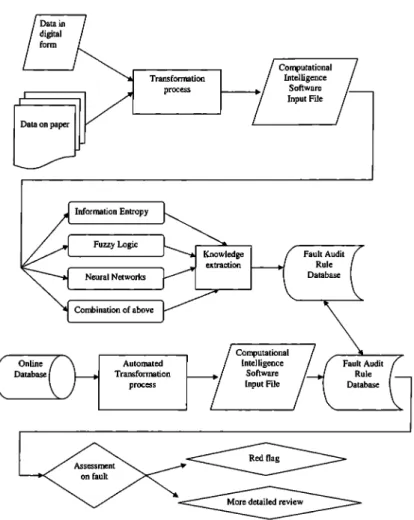
At this phase, there are a small number of important steps that should be followed in order to reach the final outcome (Figure 1). The first is to establish a connection between the actual databases from which the expert system will take the data while being online. This means that, as each new case is presented, its data will be automatically accessed by the system and translated into the form that the expert system recognizes (when necessary). Most of the work at this level has been dealt with in the first phase, concerning knowledge
extraction. The auditor has to extract the knowledge from the expert and find the rules that apply for errors. In order to do this, the initial database should be transformed into a proper input database for the computational intelligence software that is going to be used. The software could be an implementation of information entropy, fuzzy sets, neural networks or a combination of these techniques. After the options have been set in the software, the supervised train ing can begin. That means that a group of experts will pro vide the appropriate training examples that are representa tive of that specific error category. This will be done for all of the error categories. The aim in this phase is to construct a fixed and complete error audit knowledge database that will be used in phase two as the dynamic auditor. Therefore, it is important that effective, reliable, quick and secure meth ods for translating the initial data into the proper form are found at the first phase.
In the second phase, these methods will provide the back bone for the automation of accessing real-time data. After the realization of automated accessing of the data, the expert system will give real-time assessment on the nature of the problem and any alteration or deletion of the initial data will take place. The goal is to link the extracted error audit knowl edge database with the actual AIS database. The computa tional software will provide an assessment on each new case as to whether it incorporates errors or not, and if the prob ability is high or higher than the number given by the deci sion maker, then it will proceed to correct the error itself. If this is not feasible, it will mark the case for a more detailed review by the auditor. This technology will examine 100% of financial transactions, not just a sample in real time, compar ing each one against a predetermined set of business rules.
At the end of each period (month, quarter or year), the ratios of the financial statements are calculated which, ac cording to the FFS model, indicate likelihood of fraud. These ratios are compared with the respective values of the ratios included in the fault audit rule database. The expert system then classifies these financial statements as fraudu lent financial statements (FFS) or non-FFS. Those classified as FFS are then further examined by the auditor..
Both of the software tools discussed, offer the neces sary facilitations in order to make this a reality, which is the main reason why they were chosen from a variety of other programs. Such software as mentioned earlier has a freely distributed source code in C++, and so it is easy for a pro grammer to incorporate the extracted rule-base into a new application. DataEngine has an Application Development Library (ADL), which performs the integration of the ex tracted fault audit database and requires little programming effort. This ADL is available as C++ class library for various different platforms and compilers. Furthermore, under MS Windows, it is available in the form of Dynamic Link Li brary (DLL), which has a special interface for Visual Basic, Borland Pascal/Delphi and C++. Another task that has to be completed, after a small number of new cases have been added, is that the system should also take them into account when making an assessment on other new cases. This pro cess should also be automated, when an actual implementa tion of a continuous auditing expert system is developed.
The auditors with suitable software will run auditing fi nancial statements posted on Internet web sites, scanning and analysing the differences between existing trends in the company’s reports. The above-mentioned software also iden tifies “red flags” that substantially differ from defined norms. The software implementation of the proposed methodology can be easily achieved without significant cost, by using any programming environment or commercially available linear programming packages. Furthermore, apart from data col lection, Internet technology can also be used for the imple mentation of the proposed methodology at a low cost. The methodology can be implemented at the central level (on a server) and auditors can employ the proposed methodology via the Internet by inputting data through a spreadsheet in terface and obtaining online estimations on the probability that a firm issues FFS. Such an implementation approach would be of interest to audit firms, where expert decision analysts will be responsible for model development at the central level and auditors will use the developed FFS detec tion models via the Internet.
Concluding remarks
The present study provides a framework for pursuing con tinuous auditing with the aim of detecting FFS. Through a brief survey of the software tools available, I have found two that both satisfy all the modern theories of machine learning and provide the necessary tools for taking the next step. After obtaining the above-mentioned software tools, one should try at an initial stage to find efficient ways of ex tracting the rule database. I believe that the first stage of the framework is the most important one, since everything is based on whether the generated expert system behaves well or is efficient at detecting the faults. If not, then there is no point in transforming it into a real-time system.
The use of the proposed methodological framework could be of assistance to auditors (both internal and exter nal), taxation and other state authorities, institutional in vestors, the stock exchange, economic analysts, and to the banking system. For the auditing profession, which is taking measures to fulfill its responsibility regarding the detection of FFS, the results of this study could also prove beneficial. Assisted by this model, auditors can provide effective expert witness testimony and computer litigation support regard ing FFS at a low cost to the auditing company.
References
American Institute of Certified Public Accountants (AICPA) (1997a), Report of the Special Committee on Assurance Servic es, http://www.aicpa.org/assurance/scas/newsvs/reliab/index. htm.
Canadian Institute of Chartered Accountants (CICA) (1996), Re port of the Inter-Institute Vision Task Force, http://www.cica.ca. Baralexis, S. (2004), "Creative Accounting in Small Advancing
Countries. The Greek Case” Managerial Auditing Journal, Vol. 19 No, 3, pp. 440-461.
Canadian Institute of Chartered Accountants (1999), Research Report: Continuous Auditing. Toronto, ON: CICA.
Chan, S. (1992), “Establishing Reliability in an EDI Environment” The EDP Auditor Journal, Vol. II, pp. 47-51.
Davis, G.B. and Weber, R. (1983), Auditing Advanced EDP Sys tems: A Survey ofPractice and Development of a Theory, Limp- erg Institute, The Netherlands.
Elliot, R.K. (1992), “The Third Wave Breaks on the Shores of Ac counting” Accounting Horizons (June), pp. 61-85.
Financial Accounting Standards Board, (1980), FASB Statement of Concepts No. 2 - Qualitative Characteristics of Accounting Information.
Gill, G.S. and Cosserat, G.W. (1993), Modern Auditing in Austra lia, 3rd ed., John Wiley & Sons, Brisbane.
Groomer, S.M. and Murthy, U.S. (1989), “Continuous Auditing of Database Applications: An Embedded Audit Module Ap proach”, Journal of Information Systems (Spring), pp. 53-69. Kearns, J. (1980), “Are we Ready for Continuous Process Audit
ing?” CA Magazine, (Sept).
Langley P. and H. Simon, (1995), "Applications of Machine Learn ing and Rule Induction” Communications of the ACM, Vol. 38 No. 11, pp.55-64.
Lin, C. T. (1994), Neural Fuzzy Control Systems with Structure and Parameter Learning Management Intelligent Techniques (MIT) Gmbh, http://www.mitgmbh.de
Nelke, M. (2000), “Business Intelligence in Financial Engineering - A combined Approach to Customer Segmentation and Da tabase Marketing” in Proc. of CoIL-2000, European Sympo sium on Computational Intelligence and Learning, 22-23 June, Chios, Greece, pp. 171-177.
Rezaee, Z., Ford, W.F. and Elam, R. (2000), “The Role of Internal Auditors in a Real-time Accounting System” Internal Auditor, April, pp. 62-67.
Rezaee, Z., Elam, R. and Sharbatoghlie, A. (2001), “Continuous Auditing: The Audit of the Future, Managerial Auditing Jour nal, Vol. 16 No. 3, pp.150-158.
Rezaee, Z., A. Sharbatoghlie, R. Elam, and McMickle, P. L. (2002), “Continuous Auditing: Building Automated Auditing Capabil ity” Auditing: A Journal of Practice & Theory, March, pp. 147- 163.
Rimerman, T. W. (1990), “The Changing Significance of Financial Statements”, Journal of Accountancy, June, pp. 79-83.
Searcy, D., J. Woodroof, and Behn, B. (2002), “Continuous Audit: The Motivations, Benefits, Problems, and Challenges Identi fied by Partners of a Big 4 Accounting Firm” Proceedings of the 36th Hawaii International Conference on System Sciences, January 6-9.
Simon, H. (1991), “Artificial Intelligence: Where Has It Been and Where is it Going?” IEEE Trans. Knowledge & Data Eng., Vol. 3 No. 2, pp. 128-136.
Spathis, C., K. Kosmidou and Hatas, D. (2001), “Accounting In formation Systems and Intelligent Systems: A Framework for Continuous Online Auditing” Congress Proceedings Book of the 24th European Accounting Association, Athens, Greece, April 18-20.
Spathis, C. (2002), “Detecting False Financial Statements using Published Data: Some Evidence from Greece” Managerial Au diting Journal, Vol. 17 No. 4, pp. 179-191.
Spathis, C., M. Doumpos and Zopounidis, C. (2002), “Detecting Falsified Financial Statements: A Comparative Study Using Multicriteria and Multivariate Statistical Techniques, The Eu ropean Accounting Review, Vol. 11 No. 3, pp. 509-535.
Spathis, C. (2003), “Audit Qualification, Firm Litigation, and Fi nancial Information: An Empirical Analysis in Greece”, Inter national Journal of Auditing Vol. 7 No. 1, pp. 71-85.
Spathis, C., M. Doumpos and Zopounidis, C. (2003), “Using Cli ent Performance Measures to Identify Pre-engagement Fac tors Associated with Qualified Audit Reports in Greece" The International Journal of Accounting Vol. 38 No. 3, pp. 267- 284.
Spathis, C. (2004), “Enterprise Systems Implementation and Ac counting Benefits” 1st International Conference on Enterprise Systems and Accounting September 3-4, Thessaloniki.
The Institute of Internal Auditors, http://www.theiia.org
Vasarhelyi, M.A. and Halper, F.B. (1991), “The Continuous Audit of Online Systems”, Auditing: A Journal of Practice and Theory, (Spring), Vol. 10 No.l, pp. 110-125.
Vasarhelyi, M.A. (1998), "Toward an Intelligent Audit: Online Re porting, Online Audit, and Other Assurance Services" Advanc es in Accounting Information Systems, Vol. 6, pp. 207-221. Vasarhelyhi, M. A. (2002), Researching Accounting as an Informa
tion Systems Discipline. Monograph for the American Account ing Association Information Systems Section. Chapter 12: Con cepts in Continuous Assurance, In Arnold, V. and S. G. Sutton, Editors. The Institute of Internal Auditors Research Founda tion, Altamonte Springs, FL.
Wand, Y. and Weber, R. (1989), “A Model of Control and Audit Procedure Change in Evolving Data Processing Systems” The Accounting Review, Vol. LXIV No. 1, pp. 87-107.
Wilkinson, W. J., M. J. Cerullo, V. Raval and B. Wong O. W. (2000), Accounting Information Systems, Fourth Edition, Wiley. Wu, F.H. and Hahn, R.L. (1989), "A Control Complexity and Con
trol-point Orientation to the Review of an Entity’s Internal Control Structure in the Computer Environment" Journal of Information Systems, Vol. 3 No. 2, pp. 117-31.
Yu, C., Yu, C., and Chou, C. (1998), “The Impacts of Electronic Commerce on Auditing Practices: An Auditing Process Model for Evidence Collection and Validation,” Printed Papers of the Seventh Annual Research Workshop on: Artificial Intelligence and Emerging Technologies in Accounting, Auditing and Tax, New Orleans, USA.
Zadeh L. A., (1985) Fuzzy Sets, Information & Control, Vol. 8. Zimmerman, H. J. (1996), Fuzzy Set Theory and its Applications,