Working Paper n° 07-03
Shifting Logics of
Legitimation in the
Diffusion of Complex
Innovations
Shifting Logics of
Legitimation in the
Diffusion of Complex
Innovations
Stéphane Guérard
1, Ann Langley
21
Institute of Health Economics
and Management (IEMS), HEC
Lausanne, University of Lausanne
2
HEC Montréal
The authors are grateful to HealNET, to the Social Sciences and Humanities
Research Council of Canada for their financial support for this research.
This text is not to be cited without the permission of the authors.
Working Paper n° 07-03
Shifting Logics of Legitimation in the Diffusion of Complex Innovations
1Stéphane Guérard, University of Lausanne
HEC Lausanne
Institute of Health Economics and Management Extranef CH-1015 Lausanne, Switzerland [email protected] Tel: +41 21 692 33 18 Fax: +41 21 692 36 55 Ann Langley, HEC Montréal 3000, chemin de la Côte-Ste-Catherine Montréal, H3T 2A7, Canada
Tel: 514 340-7748 Fax: 514 340-5635
June 2007
Shifting Logics of Legitimation in the Diffusion of Complex Innovations
ABSTRACT
Legitimation and competition are two major forces moulding organizational field and the diffusion of innovations. While discursive legitimation provides "rational justifications" for innovations, competition may incite organizations to acquire effective innovations pre-emptively. This paper draws on a case study of the legitimation and diffusion of a sophisticated medical technology to suggest that, in highly regulated environments, these two forces may interact, and that opposing legitimation strategies may be associated with competition. We argue that while convergent discursive legitimation strategies tend to speed up the diffusion process, divergent discursive legitimation strategies may have the opposite effect. The case suggests that the dominant logics of legitimation may shift, oscillating between convergence and divergence as an innovation diffuses. We also show how the resulting delays in diffusion may be pre-empted by a phenomenon we call institutional delinquency, that is when the moral and cognitive-cultural legitimacies of the technology among professionals and managers becomes sufficient to counteract regulatory forces.
Legitimation and competition are two major forces shaping organizational fields (Alexander & D'Aunno, 2003; Carroll & Hannan, 1989; Scott et al., 2000) and the diffusion of innovations (Geroski, 2000). While discursive legitimation provides "rational" justifications for innovations (Greenwood et al., 2002; Strang & Meyer, 1993; Tolbert & Zucker, 1996), competition may incite organizations to acquire effective innovations pre-emptively. Although the interplay between legitimation and competition has been scrutinized by some institutional theorists (Alexander & D'Aunno, 2003; Scott et al., 2000), little work has examined how these two forces may be related in a highly regulated environment with limited resources where the diffusion of innovation may be considered as a cost instead of as a source of profit.
This paper draws on a case study of the legitimation and diffusion of a sophisticated medical technology (the Positron Emission Tomography scanner or PET scanner) in the Quebec health care context to suggest that, in highly institutionalized environments, these two forces may interact, and that opposing discursive legitimation strategies may be associated with competition. We argue that while convergent discursive legitimation strategies tend to speed up the diffusion process, divergent discursive legitimation strategies may have the opposite effect. Thus, our results suggest that contrary to economic wisdom, under certain conditions, competition may actually impede the diffusion of innovations. We also show how the resulting delays in diffusion may be pre-empted by a phenomenon we call institutional
delinquency, that is when the moral and cognitive-cultural legitimacies of the technology
among professionals and managers becomes sufficient to counteract regulatory forces.
The case suggests that the dominant logics of discursive legitimation may shift, oscillating between convergence and divergence as an innovation diffuses. The study also responds to calls for greater attention to the collision of different forms of legitimacy (Suchman, 1995)
and emphasizes the usefulness of documenting the multiple rhetorical strategies involved in legitimizing new technology (Greenwood et al., 2002; Munir & Phillips, 2005; Suddaby & Greenwood, 2005; van den Hoed & Vergragt, 2004).
We begin by reviewing the literature on the role of competition and discursive legitimation in the diffusion of technology, paying particular attention to the health care sector. We then describe the research context and method. The following sections present the case history chronologically, tracing the shifting logics of legitimation observed within the organizational field studied. We then derive a series of propositions and conclude with implications for future research.
THEORETICAL BACKGROUND
Competition and the diffusion of innovation
Competition is believed to be a powerful force moulding the diffusion of innovations (Christensen et al., 2000; Nelson et al., 1967; Rapoport, 1978; Schumpeter, 1944). Schumpeter (1944) was the first to propose that competition is the fundamental motor of innovation understood as invention, and that it increases with market concentration. This hypothesis has been under relentless scrutiny since then, but studies have shown inconclusive results (Cohen & Levin, 1989). However, his idea that competition stimulates innovation has been taken up by scholars and applied to the health care industry in relation not to invention, but to the diffusion of existing innovations. In this respect, most of the studies in this sector support the hypothesis that an environment conducive to competition increases the speed of diffusion of innovation.
However, competition takes on a particular form in this sector. Because of third-party payer mechanisms and universal coverage, hospitals do not compete on price to attract patients but
on quality and status which are defined as having highly specialized equipment and personnel, and as offering a wide range of services. Consequently, the better equipped a hospital is, the easier it is to retain and attract good quality physicians, and ultimately to admit more patients (Lee, 1971). This nonprice competitive mechanism, which tends to increase the diffusion of innovation, has been empirically corroborated by various studies for diagnostic devices (Chou et al., 2004; Hillman et al., 1987; Rapoport, 1978; Vogt et al., 1995), and for services such as 24-hour emergency care and cardiac catheterization (Luft et al., 1986). Also, the supply of specialized services has been found to be more intensive and duplicative in competitive settings to attract physicians and patients (Dranove & Satterthwaite, 2000; Dranove et al., 1992; Robinson et al., 1987), a phenomenon known as the "medical arms race." In general, scholars agree that services increasing patient admissions are more likely to diffuse widely (Luft et al., 1986).
Intraspeciality rivalry as a special form of competition also increases the speed of diffusion. For example, the rapid diffusion of laparascopic cholecystectomy has been attributed to competition among surgeons (Denis et al., 2002; Escarce et al., 1995; Gelijns & Fendrick, 1993). Interspeciality rivalry has also been identified as a force increasing the diffusion of innovations for the treatment of angina pectoris and gallstones (Gelijns & Rosenberg, 1994).
While competition increases the speed of diffusion, most studies have not traced the processes of diffusion in depth (Renshaw et al., 1990), other than indicating that diffusion flows from higher status teaching hospitals to less prestigious ones (Lee, 1971; Rapoport, 1978; Vogt et al., 1995).
Legitimation and the diffusion of innovation
complying to rules, norms and culturally shared beliefs, to manipulating their environment by the means of discursive strategies (Oliver, 1991; Suchman, 1995). By providing general abstract models and rationalized causality (Strang & Soule, 1998), "theorization" is a discursive strategy that enhances legitimacy as it contributes to the objectificationi and taken-for-grantedness of an innovation (Tolbert & Zucker, 1996). While local theorization involves
ad hoc peer-to-peer interactions to "make sense of the world" (Strang & Meyer, 1993: 493), global theorization is believed to accelerate and widen the diffusion of innovation by
abstractly homogenizing a potential population of adopters, by specifying the properties and outcomes of an innovation, and by identifying theorists behaving according to the theoretical model as conduits of diffusion (Strang & Meyer, 1993). The more abstract the theorization, the greater its influence on diffusion. Thus, theorization can be conceptualized as a discursive strategy providing rationales, meanings and interpretations that legitimate and make sense of adopting innovations.
To be effective, theorization has to perform two tasks that are 1) specifying an organizational problem, and 2) justifying a solution (Greenwood et al., 2002; Tolbert & Zucker, 1996). Failing to provide both of these discursive elements would endanger attempts to institutionalize social practices (Greenwood et al., 2002). In addition, the theorization itself has to be perceived as natural, morally appropriate or aligned with interests of strategic actors for an innovation to become legitimate and ultimately be diffused (Tolbert & Zucker, 1996). When applied to the diffusion of technology, theorization has been found to be involved in defining the position of new actors in the institutional field, as well as creating new objects and new concepts (Munir & Phillips, 2005). Yet, while theorization is associated with the legitimation of novelty, to be effective, it also needs to be embedded in or artfully connected to shared cultural understandings (Munir & Phillips, 2005; Strang & Soule, 1998), prevailing
discourses (Vaara et al., 2006), or institutional logics (Scott, 2004).
Institutional logics condense rules, norms and belief systems into practices and symbolism thereby constituting organizing principles guiding behaviours of actors in a given field (Friedland & Alford, 1991). Specifically, in his analysis of the transformations of health care in the San Francisco Bay, Scott et al. (2004; 2000) identify three competing institutional logics in the health care field that are carried by institutional actors. The institutional logic of 1) quality of care, a professional logic, is incarnated by physicians who promote technological change in order to provide best quality services to patients. Professional associations are the guardians of this logic. The institutional logic of 2) equity of access appeared with the development of universal coverage systems in OECD countries (WHO, 2000). These systems were created after the Second World War (WHO, 2000) and sustained by bureaucrats to ensure that everyone had access to care. However, universal coverage sparked increasing costs that stimulated a need for enhanced control. Taking the private sector has an archetype of success, market mechanisms based on the 'managed care' concept were introduced in the US, thereby creating a third institutional logic related to 3) efficiency. These three logics offer competing forces that sculpt the dynamic of the health care institutional field. While the health care industries in different countries have mixed these logics very differently (Tuohy, 1999), the competing logics of quality, equity and efficiency are inherent in all of them and very much in evidence in the Canadian context (Denis et al., 2003) as we shall see in this study.
Of course, theorization alone is not sufficient for an innovation to diffuse. Tangible examples of successful adoption must support theorization (Tolbert & Zucker, 1996) which renders action an indispensable ingredient besides theorization for an innovation to gain legitimacy (Barley & Tolbert, 1997; Suchman, 1995). Somehow, the early stages of diffusion must be based on the capacity for an innovation to solve problems or obtain positive returns (DiMaggio & Powell, 1983; Meyer & Rowan, 1977).
Overall, while studies on the effect of competition on the diffusion of innovation in health care have taken place in the market settings such as United States, Japan or Taiwan, few studies have looked at the role of competition in a highly regulated environment. In addition, institutional accounts have mainly focused on the legitimation of new organizational forms, but neglected the legitimation process of technical innovation at the institutional level. This study bridges up the concepts of competition and legitimation in the context of the diffusion of a complex innovation in a highly regulated field, examining more particularly how various institutional logics are mobilized within a competitive process.
RESEARCH CONTEXT AND METHODOLOGY
Research context
The study described in this paper is part of a larger investigation of the impact of the institutional environment on the processes of legitimation and diffusion of technology in the health care sector, involving the comparison of two different national health care systems (Quebec and Switzerland). Since the research is concerned with the understanding of
processes evolving over time, a longitudinal case study approach is appropriate (Patton, 2002;
Yin 2003). In the current paper, we focus more particularly on how and why logics of legitimation evolved for an important technological innovation in one of the two jurisdictions.
Specifically, the diffusion of Positron Emission Tomography (PET scanner) in the Quebec health care system was the focus of this study. The PET scanner is a very complex and expensive diagnostic imaging technology that was initially rather controversial. Although clinical applications are now fairly universally accepted, the cost-effectiveness of this technology is still debated (Adams et al., 2006). Indeed, the high acquisition cost of approximately $1.8 millions US for the camera and the impressive operational budget of $1.3 million US per year are a major counterweight to the benefits at least in some jurisdictions (Adams et al., 2006). The complexity of the PET scanner derives in large part from the necessity of having a cyclotron nearby to produce the radiopharmaceuticals injected into the patient during the diagnostic procedure. Many of these radiopharmaceuticals have very short half-lives, and must be produced on site. A cyclotron costs around $3.6 millions US and requires highly qualified personnel as well as a major improvement to hospital infrastructure to comply with nuclear regulations.
Mainly used in nuclear medicine to diagnose cancer, the PET scanner has a long history in neurology where it provided revolutionary imagery of brain functioning. By the eighties, severe cardiac conditions were being diagnosed with this technology. The discovery of the most important radiopharmaceutical (Rohren & Coleman, 2004), fluorodesoxyglucose (FDG), was a significant breakthrough enabling the PET scanner to diagnose cancer. Since there are many applications in cardiology, neurology, and oncology, inter-speciality competition to acquire the technology can occur.
The Quebec health care system provides universal coverage to the whole population for a wide range of medical services. The system possesses most of the characteristics of a highly structured organizational field according to the dimensions proposed by Scott (2004). The system is 1) centrally administered and funded by the Ministry of Health which delegates
operations to Regional Health Authorities and health care institutions. Because the governance structure is centrally imposed, 2) unity of governance is fairly high. Moreover, the principal mode of governance is 3) mainly public (one mode of governance dominates), there are a 4) limited number of structural models for hospitals (structural isomorphism), and 5)
formal organizational linkages are numerous. These five dimensions tend to produce a high
degree of structural isomorphism (DiMaggio & Powell, 1983; Scott, 2004).
Because the State administers the health care system and is the single authorized insurer for basic health care coverage, the adoption of new technology is not accounted for as a source of profit by the regulator, but as a cost. This leads authorities to be reluctant to invest or to allow reimbursement of costly procedures among organizations in the field. To ensure that an innovation is worthy to be reimbursed and diffused, the government may rely on the recommendations of the Health Technology Assessment Agency (HTAA).
While the health care system is centrally managed and publicly funded, different forms of nonprice based competition are embedded within it. Most critically, physicians are generally paid on a fee-for-service basis and therefore may compete with each other in a market for patients. Moreover, hospitals' survival depends on attracting qualified medical specialists and these specialists thus have an important influence on organizational strategy. Competition for prestige, resources, and investment among institutions can therefore be intense. Since resources are largely controlled by government, this competition often plays itself out in the public sphere. Legitimation and competition thus become inextricably intertwined. This case seems a suitable site for examining the interaction of these processes.
Data collection and analysis
involved in the diffusion of the PET scanner at the local, regional, national, and international levels. Internal and public documents were used for triangulation purposes (Patton, 2002). The interview guide covered respondents' perceptions of the institutional environment, of the innovation itself, and of the role of different participants in adoption both within their own local context as well as more broadly. Particular attention was paid to arguments for and against the technology and legitimation strategies. The research protocol followed closely that used by Denis et al. (2002). Data collection was conducted in two waves. In the first wave, 22 interviews were conducted, coded and analysed. The interview guide (Eisenhardt 1989; Miles and Huberman 1994) was modified according to the partial results and 24 more interviews were performed to saturate the data set (Strauss & Corbin, 1998).
Descriptive case studies were written to break down the complexity of the data into manageable chunks (Eisenhardt, 1989; Langley, 1999). An extensive case narrative was written covering the three regions that initially adopted the first six PET scanners in the Quebec health care system. Data were organized using a visual mapping strategy (Langley, 1999) to draw out the key patterns. The data were then coded with the N'Vivo program resulting in a grounded set of legitimation categories. Visual mapping and matrix displays were used to explore, analyse, and display results (Miles & Huberman, 1994). The following section presents the case history divided into four eras, each reflecting a shift in the logics of legitimation. For the two competitive eras, we will present the theorizations of the technology generated by competing groups under three headings: the definition of the innovation itself, why it should be adopted, and (critical for this study) who should adopt.
CASE HISTORY
legitimation process for the diffusion of the PET scanner in this organizational field. The "research era" portrays the development of the PET scanner as a research tool in neurology, cardiology, and oncology. The "clinical era" is characterized by the first clinical use of this technology in this jurisdiction, and by the publication of the Health Technology Assessment Agency (HTAA) report that provides evidence-based legitimacy to the PET scanner. The "confrontational era" features the dispute over the implementation of the recommendations of the HTAA report. Finally, the public announcement of a dissemination plan of the PET scanner in the organizational field is the central event of the "regulation era." Three natural geographic regions that are fairly physically remote from one another are designated by the letters A, B and C, where A is the most populated region, C the second most demographically important, and B a relatively less populated area that nevertheless included a university with a faculty of medicine.
1. The Research era (1974 - 1997)
The first PET scanner was acquired by a major university in region A in 1974 for research applications in neurology. In 1995, the second PET scanner was bought in the relatively less populated region B. While the acquisition of the first PET scanner in neurology was clearly the result of independent research funds, the acquisition of the second PET scanner happened as the result of the entrepreneurship of a nuclear doctor who relentlessly fought to convince various governmental departments to invest in the project of creating a research center which would include a PET scanner and a cyclotron for research applications in oncology. For twenty years, this entrepreneur built up organizational assets such as developing an internationally known group of researchers in radiation technology, offering a unique PhD in radiation in Canada, and patenting a PET scanner prototype, all of which contributed to consecrate B1 as a major centre in nuclear medicine. These assets provided the teaching
hospital B1 with an organizational legitimacy based on its competence that was a major ingredient in convincing authorities to finance its project.
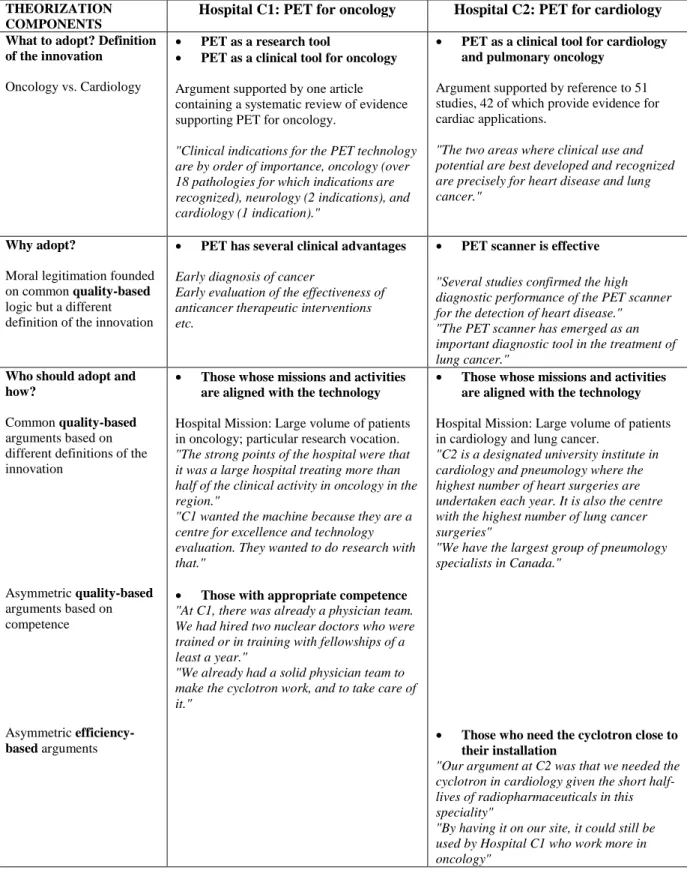
While the acquisition of the PET scanner by B1 encountered no competition either locally or provincially, the competition in region C between C2, a specialized hospital in cardiology and in lung cancer, and C1, the most important teaching hospital in the area, seriously impeded any attempt at adoption. As early as 1988, both hospitals were striving to convince the Provincial Ministry of Health to acquire a PET scanner for clinical as well as for research purposes, but in vain. Later on, with the emergence of evidence for the potential of the technology for lung cancer, both hospitals submitted a report to the Regional Health Board. These reports draw on competing theorizations that are summarized in Table 1.
Specifically, because of its dual mission in cardiology and in lung cancer, C2 declared itself to be the best centre to receive a PET scanner. C2 contended that its supra-regional mission combined with being the hospital performing the highest number of cardiac surgical operations justified obtaining a PET scanner. Since the evidence on the potential in the case of lung cancer was indisputable, C2 also highlighted the fact they were performing the highest number of surgeries in pulmonary cancer. On the other hand, C1 was arguing that oncology was the main application of PET scanner. Given that more than half of the clinical activities in oncology in the region C were performed at C1, it argued that it should be the first centre to adopt a PET scanner. Also since the cyclotron was an essential ingredient to produce radiopharmaceuticals, its location also became an issue. Because the half-life of the radiopharmaceutical used in cardiology is approximately 2 minutes, C2 was arguing that the cyclotron should be close to their building. Emphasizing its mission in research and in evaluating new technology, C1 argued that the cyclotron should be in their organization. These self-interested arguments and destructive battles oriented around pragmatic legitimation
(Suchman, 1995) did not contribute to helping accelerate the diffusion of the technology.
Table 1: Competing Quality-Based Theorizations during the Research Era
THEORIZATION COMPONENTS
Hospital C1: PET for oncology Hospital C2: PET for cardiology
What to adopt? Definition of the innovation
Oncology vs. Cardiology
• PET as a research tool
• PET as a clinical tool for oncology
Argument supported by one article containing a systematic review of evidence supporting PET for oncology.
"Clinical indications for the PET technology are by order of importance, oncology (over 18 pathologies for which indications are recognized), neurology (2 indications), and cardiology (1 indication)."
• PET as a clinical tool for cardiology and pulmonary oncology
Argument supported by reference to 51 studies, 42 of which provide evidence for cardiac applications.
"The two areas where clinical use and potential are best developed and recognized are precisely for heart disease and lung cancer."
Why adopt?
Moral legitimation founded on common quality-based logic but a different definition of the innovation
• PET has several clinical advantages
Early diagnosis of cancer
Early evaluation of the effectiveness of anticancer therapeutic interventions etc.
• PET scanner is effective
"Several studies confirmed the high diagnostic performance of the PET scanner for the detection of heart disease." "The PET scanner has emerged as an important diagnostic tool in the treatment of lung cancer."
Who should adopt and how?
Common quality-based arguments based on different definitions of the innovation Asymmetric quality-based arguments based on competence Asymmetric efficiency-based arguments
• Those whose missions and activities are aligned with the technology
Hospital Mission: Large volume of patients in oncology; particular research vocation.
"The strong points of the hospital were that it was a large hospital treating more than half of the clinical activity in oncology in the region."
"C1 wanted the machine because they are a centre for excellence and technology evaluation. They wanted to do research with that."
• Those with appropriate competence
"At C1, there was already a physician team. We had hired two nuclear doctors who were trained or in training with fellowships of a least a year."
"We already had a solid physician team to make the cyclotron work, and to take care of it."
• Those whose missions and activities are aligned with the technology
Hospital Mission: Large volume of patients in cardiology and lung cancer.
"C2 is a designated university institute in cardiology and pneumology where the highest number of heart surgeries are undertaken each year. It is also the centre with the highest number of lung cancer surgeries"
"We have the largest group of pneumology specialists in Canada."
• Those who need the cyclotron close to their installation
"Our argument at C2 was that we needed the cyclotron in cardiology given the short half-lives of radiopharmaceuticals in this speciality"
"By having it on our site, it could still be used by Hospital C1 who work more in oncology"
Analysis. Competition pushed the hospitals to develop different theorizations aimed at shaping
the perception of authorities regarding what was the purpose of the technology, as well as why and how it should be diffused. They mainly drew on clinical scientific evidence to support their arguments. Accordingly, each hospital deployed a quality-based theorization to convince the authorities. Our analysis illuminates three dimensions of theorization: 1) the definition of the technology (what), 2) benefits of the technology (why), and 3) justifying a solution (who and how). First, given the uncertainty surrounding what the technology could actually achieve, both camps were using different scientific evidence to define the technology in a way that supported their positions. For example, whereas C1 argued that there were potentially many more applications in oncology using one paper developing a systematic literature review; C2 displayed a large array of studies in cardiology involving the PET scanner to prove its significance in this domain while also emphasizing its maturity for lung cancer applications. The second dimension concerns why this technology should be diffused. Interestingly, both actors emphasized similar arguments but aligned with different definitions of the technology. The third element is related to the how to diffuse or how to implement the technology locally. Again, the actors proposed to align diffusion of the technology with their interpretation of the evidence and its fit with hospital's mission. Indeed, each hospital asserted that their specialty was precisely related to the state of the evidence to provide legitimacy to their institutional position in the field as being a potential receiver.
In addition, C1 used competence-based arguments to further enhance its organizational legitimacy, while C2 invoked pragmatic issues of efficiency related to the location of the cyclotron. Nevertheless as shown in Table 1, the dominant institutional logic invoked in this debate was clearly based on quality of care (Scott, 2004). The arguments about the evidence, and the clear perception that the two hospitals saw that evidence differently and were at the
same time undermining the theoretical claims of their adversaries did not contribute to accelerating diffusion at this point.
2. The clinical era (1998-2000)
Due to the underutilisation of the PET scanner in research, hospital B1 began to use the machine for clinical applications. After having hardly fought to obtain an operational budget from the Ministry of Health, B1 used the PET scanner in the clinical setting by 1998. This aroused consternation among nuclear doctors around the province, and especially from those practising in teaching hospitals who felt that it was irrational that the only clinically operational scanner should be in a remote region. This prompted those hospitals to pressure for a PET scanner for themselves. In addition, the decision of the Centers for Medicare and Medicaid Services (CMS) to authorize the reimbursement of the PET scanner for lung cancer as well as the wide and fast diffusion of this technology in USA contributed to build up pressure on the Ministry of Health to more widely diffuse the technology.
"The FDA [Federal Drug Administration] had an impact on demand because, once the FDA had recognized the technology, and especially the CMS… which is the payer, when they began to pay in the States, then of course there were huge pressures here because we always compare ourselves with the United States in a North-American environment."
Meanwhile, the competition between the pulmonary-cardiac hospital C2 and the teaching hospital C1 continued, and was even exacerbated with the surfacing of a rumour suggesting that only one PET scanner camera would be installed in region C. The competition was even more acute with the entry of a new hospital into this technological arms race. Tension increased to the point that in 2000, the Regional Health Board in Region C decided to create a committee to sort out the tense situation. Using the same arguments as the previous report of 1997, each hospital developed a second report which was submitted to the Health Regional
Board in July 2001. In parallel with these formal discussions hospitals were actively lobbying regional and provincial authorities.
All together, these quarrels, the first clinical use of the technology in Quebec, the authorization to reimburse the PET scanner procedure by the CMS, and the emerging evidence in the scientific literature praising the clinical benefits of the PET scanner stimulated the president of a Medical Association (MA) and another patient’s association to ask the Health Technology Assessment Agency (HTAA) to produce a report on the cost-effectiveness of this technology. The request was addressed to the HTAA in September 2000.
If the legitimation of the PET scanner as a clinical tool in this organizational field was strongly enhanced with the first clinical use and with the authorization for reimbursement by the CMS, the publication of the report of the HTAA in October 2001 confirmed the evidence-based legitimacy of the PET scanner in this organizational field as an indispensable diagnostic tool for specific conditions. The HTAA report concludes:
"In its capacity to inform on both the anatomic location of tissues and on their dynamic functions, the PET scanner makes an important contribution to medical imaging."
The clinical conclusions of this report were unequivocal. The need for more PET scanners was undeniable, and at least 15,000 exams were said to be required annually. Although the report is very prudent regarding the main application of the technology, all the experts agreed with this report that the PET scanner was to be used essentially in oncology. The following quotations from interviews support our contention that from then on the technology was perceived as legitimate from a clinical point of view. Indeed, all the citations point to an evidence-based legitimacy that would eventually lead to the technology being taken for granted as an essential medical tool based on a quality of care institutional logic.
"It's like asking whether you need an operating room in a hospital. (…) It's an indispensable and necessary tool."
- Nuclear doctor
"It's inevitable, it's a question of the quality of medicine. Some will even say that it is bad medical practice not to use it in diagnosis."
- President of the Medical Association
"After the HTAA report, the first and most visible impact is that we rapidly received many demands from the hospitals that were all referring to this report."
-Biomedical engineer
Later on, the Committee of the Regional Health Board of region C agreed that three machines were required in the area. This recommendation to the Provincial Ministry of Health initially relieved C1 and C2 from their fierce competition, at least regarding this issue. These recommendations came jointly with the presentation of the HTAA report in 2001 which precipitated an intensive debate over the way the PET scanner should be disseminated at the provincial institutional field level.
Analysis. During this era, the definition of the PET scanner mutated from a research tool to an
evidence-based legitimated clinical diagnostic device. The first clinical use and the reimbursement of the procedure by the CMS contributed, at least partially, to the legitimacy of the procedure in this organizational field. Indeed, while the former launched a signal the technology was mature enough to be used in a clinical setting in Quebec, the latter demonstrated that the technique was recognized as effective in another organizational field. Maybe even more important is the conclusion of the HTAA report which recognizes without any doubt the clinical usefulness of the procedure thereby legitimating the PET scanner. As compared with previous attempts and diverging theorizations, this report more clearly specifies a reason to diffuse the technology related to the needs of the population in terms of 15,000 exams per year. Considering the consensual acknowledgement that the PET scanner is
an essential clinical tool, we argue that the clinical era is characterised by convergent
quality-based legitimation where all actors agree on the value of the technology for clinical
applications. The next era describes the confrontation regarding the implementation of the PET scanner and the institutional delinquency that resulted from government inaction.
3. The Confrontational Era (October
2001-2004)
Although the clinical conclusions of the HTAA report provided evidence-based legitimacy to the PET scanner based on the logic of quality of care, the recommendation suggesting that the PET scanner technology should be consolidated into existing centers raised several concerns among nuclear doctors. This recommendation was perceived by the Medical Association (MA) as a signal that the PET scanner technology was going to be diffused to only two teaching hospitals. This was perceived by the MA as a way of favouring research at the expense of clinical applications. To counter these recommendations, the MA created a special
committee rallying nuclear doctors in remote hospitals, and began to directly negotiate with
the Government in power.
By primarily defining the PET scanner as a clinical device and not a research tool, the aim of this special committee was to counteract the recommendations favouring teaching hospitals, and to democratize access to this high-end medical technology by proposing that 12 major centres in oncology should obtain a PET scanner. By February 2003, after the teaching hospital A2 adopted a PET scanner without the consent of authorities, but also after intense negotiations, the Ministry of Health agreed to invest $23 millions US to buy 12 PET scanners and to diffuse them all over the province. However, this informal agreement between the government and the special committee aborted with the change of the government following the election of April 2003. This marks a radical shift in the dissemination plan for the technology. With the priority of the newly elected government on creating Integrated Health
University Networks, the new Minister of Health planned to diffuse the relatively new and more effective architectureii (Henderson & Clark, 1990) of the technology: the PET-CT.
In fact, by 2001, the architecture of the PET scanner technology had evolved to include a CT scanner, thereby creating a PET-CT. Because the CT scanner provides quasi instantaneous anatomical images, the combination of both technologies increased the precision of the diagnosis considering that the PET scanner provides unrivalled functional images. With the emergence of this alternative, two types of architecture were available on the market: PET-CT and PET only.
Experts estimated that the clinical added-value of PET-CT over PET only existed for approximately 15% of cases, mainly in the otorhinolaryngology speciality. In addition, the PET-CT allowed a hospital to perform 12 cases per day instead of 8 with a PET scanner only. This is due to the fact that the addition of the CT scanner reduced the timeiii required to scan a patient. Besides allowing more patients to be diagnosed per day per machine, acquiring a PET-CT would allow teaching hospitals to participate in international research protocols. Indeed, the PET-CT was becoming a standard in research for OECD countries.
The parallel development of this new architecture with the publication of the HTAA report turned the institutional dynamic into a confrontation between two clans: the Pro-PET-only against the Pro-PET-CT coalitions. Because the cost of a PET-CT was twice the price of PET only ($3.7 millions US), promoting the diffusion of the former was equivalent to encouraging narrower diffusion considering that a limited amount of the $23 millions US was still available, and that to perform research at least two more $4 millions cyclotron were required. Hence, the advent of the PET-CT was not good news for the pro-PET-only coalition.
only few centres that is to teaching hospitals, moving without the support of the medical association would have been politically risky. A new round of negotiations had to be opened. Disagreeing with the policy of the new government, the MA invested in different lobbying actions to convince the government of the necessity of diffusing the PET scanner to as many places as possible for people to have access to this technology. As one interviewee reports:
"We made our presentation by sending a letter. We try to contact people in the Ministry. We sent a letter signed by three department heads and the president of the medical council. We showed them the facts, we gave the arguments that I listed just now to sensitize people. The Association also sent a letter to say that we did not agree that it would only be in the teaching hospitals. As an association, we wanted a wider deployment of the PET scanner to 12 centres. "
With the arrival of PET-CT, private manufacturers had an incentive to influence the diffusion given that the profit margin on this technology was higher than for the PET only. Of course, part of the margin came from the higher selling price, but also from the yearly recurring maintenance costs which correspond to 10% of the selling price - twice as high as for a PET only. This prompted private manufacturers to ally with teaching hospitals to promote the diffusion of the PET-CT to a smaller number of sites.
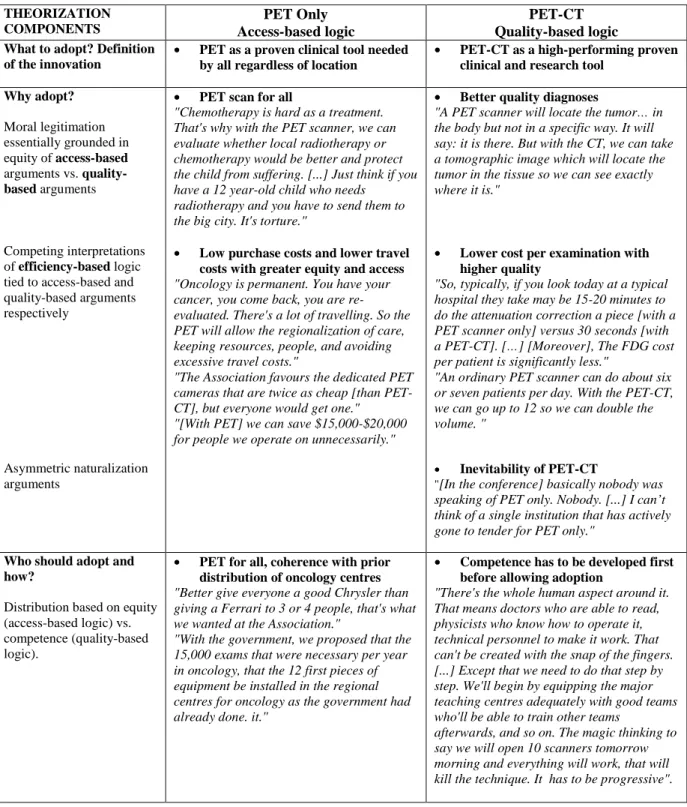
Transformed into a legitimation battlefield with two confronting factions, this institutional field witnessed several theorization strategies deployed by the two camps. The Pro-PET-only coalition used an access-based theorization strategy, composed of moral and pragmatic arguments, to deplore the insufficient number of PET scanners in the Quebec health care system (problem), and to justify a wider diffusion of the technology to the previously-designated regional centres in oncology (solution). The rationale was to give the population access to the technology independently of their location, a real challenge in a huge territory like Quebec. To support this view, it was argued that it did was unethical for children to go through useless chemotherapy as well as asking them to travel long distances to get a PET
scan. Other arguments involved reference to the common good and solidarity given that adopting 12 machines would economize on useless surgeries thereby allowing better resource allocation.
Table 2: Competing Theorizations during the Confrontational Era
THEORIZATION COMPONENTS PET Only Access-based logic PET-CT Quality-based logic
What to adopt? Definition of the innovation
• PET as a proven clinical tool needed by all regardless of location
• PET-CT as a high-performing proven clinical and research tool
Why adopt? Moral legitimation essentially grounded in equity of access-based arguments vs. quality-based arguments Competing interpretations of efficiency-based logic tied to access-based and quality-based arguments respectively
Asymmetric naturalization arguments
• PET scan for all
"Chemotherapy is hard as a treatment. That's why with the PET scanner, we can evaluate whether local radiotherapy or chemotherapy would be better and protect the child from suffering. [...] Just think if you have a 12 year-old child who needs
radiotherapy and you have to send them to the big city. It's torture."
• Low purchase costs and lower travel costs with greater equity and access
"Oncology is permanent. You have your cancer, you come back, you are re-evaluated. There's a lot of travelling. So the PET will allow the regionalization of care, keeping resources, people, and avoiding excessive travel costs."
"The Association favours the dedicated PET cameras that are twice as cheap [than PET-CT], but everyone would get one." "[With PET] we can save $15,000-$20,000 for people we operate on unnecessarily."
• Better quality diagnoses
"A PET scanner will locate the tumor… in the body but not in a specific way. It will say: it is there. But with the CT, we can take a tomographic image which will locate the tumor in the tissue so we can see exactly where it is."
• Lower cost per examination with higher quality
"So, typically, if you look today at a typical hospital they take may be 15-20 minutes to do the attenuation correction a piece [with a PET scanner only] versus 30 seconds [with a PET-CT]. […] [Moreover], The FDG cost per patient is significantly less."
"An ordinary PET scanner can do about six or seven patients per day. With the PET-CT, we can go up to 12 so we can double the volume. "
• Inevitability of PET-CT
"[In the conference] basically nobody was speaking of PET only. Nobody. [...] I can’t think of a single institution that has actively gone to tender for PET only."
Who should adopt and how?
Distribution based on equity (access-based logic) vs. competence (quality-based logic).
• PET for all, coherence with prior distribution of oncology centres
"Better give everyone a good Chrysler than giving a Ferrari to 3 or 4 people, that's what we wanted at the Association."
"With the government, we proposed that the 15,000 exams that were necessary per year in oncology, that the 12 first pieces of equipment be installed in the regional centres for oncology as the government had already done. it."
• Competence has to be developed first before allowing adoption
"There's the whole human aspect around it. That means doctors who are able to read, physicists who know how to operate it, technical personnel to make it work. That can't be created with the snap of the fingers. [...] Except that we need to do that step by step. We'll begin by equipping the major teaching centres adequately with good teams who'll be able to train other teams
afterwards, and so on. The magic thinking to say we will open 10 scanners tomorrow morning and everything will work, that will kill the technique. It has to be progressive".
In constrast, the Pro-PET-CT coalition invoked moral arguments related to the technical superiority of the PET-CT – a quality-based logic. Whereas the access-based theorization stressed the importance of widely diffusing the technology, the quality-based theorization defined efficiency in techno-economic terms related to a single machine and not to the impact of the diffusion of many machines across the organizational field. Arguments related to the inevitability of the PET-CT were also put forward. In consonance with its quality orientation, the Pro-PET-CT coalition proposed that the technology had to be diffused along competence-lines. This group argued that nuclear doctors must be well trained to perform good quality diagnoses, and that this technology had to be further developed thereby deeming the PET scanner technology as a research as well as a clinical tool.
Hence, this coalition defended the idea that the best technical machine had to be purchased to ensure quality. Overall, while the epidemiological perspective promoting a wide diffusion is at the heart of the legitimation strategy of the Pro-PET-only coalition, the Pro-PET-CT clan is clearly in favour of narrower diffusion of more highly-performing machines as shown in Table 2.
These two divergent legitimation strategies are the expression of a competition between two factions having divergent interests in the diffusion of the PET scanner. For the MA, wider diffusion would satisfy more members and would reinforce the profession of nuclear doctors, while rendering the services accessible to a larger portion of the population. For doctors in teaching hospitals, adopting a PET-CT would allow them to participate in international protocols as well as to have more effective and efficient machines, and in the end increase their prestige through the acquisition of the latest technology.
architecture of the innovation should be diffused and to what extent, the government decided to withhold any decision. While attempts at negotiation failed, the same hospital B1, which had been the first to use the PET scanner in a clinical setting, acquired a second PET scanner, but, officially, for research purpose. This adoption was the consequence of a private-public partnership, and was attributed to the highly positive reputation B1 developed regarding this technology. This second adoption brought consternation all over the province. By this time, private companies had begun distributing FDG, and possessing a cyclotron was no longer an issue to be able to deliver PET scanner diagnosis.
Analysis. This period shows how competing institutional logics may be mobilized to defend
different modes of diffusion of a technology even when its basic utility has been fully legitimized as it was in the HTAA report. Each theorization relies on different moral imperatives presenting plausible but incompatible arguments. While the access-based theorization strategy focuses on the idea that failing to widely diffuse the technology is unethical because suffering and useless operations can be avoided, the quality-based theorization underlines the superiority of the more recent technology, its technico-economic advantages and the need for the technology to be calibrated and operated by highly skilled and competent professionals who master its complexities. Efficiency-based arguments are also mobilized by both camps, but they tend to be subordinated to the dominant access and quality-based logics.
The acceptance of one or other theorization could have a huge impact. As compared with the access-based theorization which contended that this technology should be available in 12 centres in oncology all over the province, the quality-based theorization was more oriented towards the performance of the machine itself. As a consequence, while the pro-PET-only clan was arguing that with 12 machines, 96 patients per day (12 patients times 8 patients/day)
could have a PET scan in the province, the PET-CT clan was arguing that it was better to have 4 machines serving 48 patients per day (4 centres times 12 patients /day) in the province, but with good quality diagnosis performed by competent staff. The significant underlying consequences of adopting one or the other strategies clearly illustrate that effectiveness is socially defined (Suchman, 1995) and inevitably implies ethical choices.
3a. Institutional Delinquency in region A (2003-2004)
The competition between these two factions in this institutional field placed the government in an uncomfortable position since opting for one or other solution was politically very difficult. This tended to reaffirm the status quo despite repeated applications from hospitals to obtain a PET scanner, and disillusionment and cynicism from many nuclear doctors:
"The deployment of PET scanners, I've been hearing about that for four years, and another announcement arrives every 15th of the month. It's the classic running gag. I've stopped believing in that."
Eventually, unanswered applications to the government for a PET scanner prompted teaching hospital A2 to acquire a machine without the required consent of the Ministry of Healthiv. To bypass the regulations, A2 convinced its private foundation to buy and rent the PET scanner to the hospital for a symbolic sum. By January 2003, the PET scanner was functional. To justify this manoeuvre, A2 suggested to the authorities to consider the machine as a research tool although everyone knew that it was more than this. Because A2 was in a position to publicly justify the need for a PET scanner in oncology to the population, it seemed unlikely that the government would denounce it. Given that access to health care services is a public service in Quebec, people cannot normally pay privately for health care services that are insured by universal coverage. Despite this rule, A2 had to find a way to finance the running costs of its PET scanner. The solution was to offer the PET scanner at nights and on
week-ends on a private basis to companies. This provoked a swift reaction from the Minister of Health who asked A2 to stop selling public services to the private sector. In exchange, the government would provide them with an operational budget. Hospital A2 immediately complied. In February 2003, a few days after this institutionally delinquent adoption, the Ministry of Health asked Regional Board of Region A to create a committee to evaluate the needs in terms of PET scanners in that region.
This delinquent behaviour was taken up by other institutions who launched the process for adopting a PET-CT even though they had not yet received the formal consent from the government. The committee formed by the Regional Health Board produced a document which was submitted to the Ministry of Health in April 2004, and concluded that seven cameras were necessary to cover the needs of the population in oncology for region A.
Analysis. The evidence-based legitimacy of the PET scanner acquired through the HTAA
report was one main factor behind the behaviour of institutional delinquency documented above. It was because the technology had become so widely accepted as being an integral part of medical practice that hospitals could, in the first place, adopt the technology without the consent of the government. Also, the legitimacy of the technology as an essential clinical tool minimized the risk incurred by institutional delinquents in acting this way since the government had its hands tied in responding to their actions. Any government attempt at retaliation against the hospital could easily be denounced in the media as preventing access to treatment for cancer patients – not a wise move.
Moreover, the inertia of the government regarding the conflicting demands from nuclear doctors to obtain PET scanners stimulated the institutional delinquent behaviours. In effect, the PET-CT clan essentially won out here through their greater access to the resources needed
to undertake delinquent strategies. A2’s institutional entrepreneurship had an important impact on subsequent dynamics. Indeed, A2 brought another teaching hospital in its wake and forced the Ministry of Health to create a regional committee to address this issue. Since the Ministry of Health did not announce a dissemination plan for the technology, and because no sanctions were applied to the first delinquents, other hospitals adopted the same strategy. Indeed, it now became necessary to acquire the technology as quickly as possible if one did not want to miss the boat. Institutional delinquency is a deviant behaviour according to the law but one which can be perceived as legitimate by professionals and the population in a given setting. Thus, institutional delinquency can be seen as a special type of institutional entrepreneurship (DiMaggio, 1988) that is rendered possible when normative and cognitive-cultural forces are stronger than regulative ones.
4. THE REGULATION ERA (2005-2006)
When hospitals began buying PET scanners without the specific authorization from the Ministry of Health, the government was in an untenable position since it could lose its credibility. Chaotic diffusion was probably the main risk the government was facing at this point and with this, the potential waste of important resources.
"The danger was that we would have rather anarchical development. It would be those who had the money or those who screamed the most or those who made the most pressure that would get the machine."
Considering the tendency for other OECD countries to buy PET-CT rather than PET alone, and since the government was reorganizing health care services on teaching network lines, there were several pressures to go for PET-CT. However, the Ministry of Health needed to get the support of the PET-only coalition which was still promoting wider diffusion. The pro-PET-only clan was now ready to accept narrower diffusion as long as the Government would
provide guarantee the diffusion of the technology into more peripheral centres.
Finally, a dissemination plan was developed in which remote hospitals would get a PET scanner within a certain timeframe. By the end of 2004, the government made a first announcement of the purchase or enhancement of existing equipment from PET scanner only to PET-CT for four teaching hospitals. Moreover, the government would provide each of these teaching hospitals with an operating budget that was an essential component to make this equipment functional. By June 2005, the government announced the dissemination of the PET scanner technology in three phases. Phase 1 was already in progress with the equipment in these four teaching hospitals. Phase 2 would provide PET scanners to major centres in oncology, and Phase 3 would allow smaller hospitals to have a PET scanner only. However, in the end, private companies discontinued supplying the less sophisticated technology, forcing the choice for PET-CT.
Analysis. The absence of a credible technology dissemination plan from the government led to
uncertainty in the institutional field which made many hospitals believe that if they quickly acquired a machine then the government would be forced to provide them with an operating budget. Aware of this delicate situation, the government publicly announced the plan to put a stop to a potentially chaotic dissemination process that could have escalated further out of control. This, combined with the fact that the suppliers had themselves converged on a dominant design (Abernathy & Utterback, 1988; Anderson & Tushman, 1990) produced convergence and eliminated the hostility between factions, at least for the time being.
DISCUSSION
Our results suggest that competition feeds legitimation processes, and that both are involved in the dynamics of diffusion of a complex technology in a highly regulated environment.
Competition between hospitals to acquire this expensive technology is characterized by institutional battles where discursive legitimation strategies draw on divergent institutional logics and constitute the weaponry of opponents. This war-like diffusion process tends to show oscillation between divergence and convergence, corresponding to alternating periods of peace and conflict. While divergent competition-based legitimation strategies tend to slow down the diffusion process, convergent evidence-based legitimation strategies may have the opposite effect. As such, this study documents the colliding of different legitimation processes (Suchman, 1995).
The research era is characterized by divergent theorizations based on different conceptions of the nature of the technology, but drawing on a common quality-based institutional logic. Fighting using scientifically grounded arguments, evidence from cardiology was employed by one camp while the other mobilized evidence in the area of oncology. Each side of this institutional battle drew on science to provide moral legitimacy (Suchman, 1995). These theorizations were supported on one side by arguments about competence and on the other by effiency-based arguments. The confrontational era also exhibits the colliding of theorizations, this time based on different institutional logics (Scott, 2004) of quality and access. While the pro-PET-CT group contended that diffusion should follow the flow of competence from teaching hospitals to smaller hospitals, defenders of the pro-PET-only faction argued along equity of access lines stating that everyone should have access to the technology in order to offer a better quality of treatment to all.
Given these observations, the received wisdom in health economics (Chou et al., 2004; Dranove & Satterthwaite, 2000; Dranove et al., 1992; Lee, 1971; Luft et al., 1986; Rapoport, 1978; Vogt et al., 1995) asserting that nonprice competition (which is often equated to competition on quality) has the effect of increasing the diffusion of innovation might be
overstated and does not sufficiently consider the context in which this occurs. In a regulated environment where innovation is considered to be a cost and not a source of profit, competition may prompt institutional battles which slow the diffusion of technology, at least in the short run. Revealing divergent legitimation processes, the research and the confrontational eras are associated with the postponement of the adoption or the diffusion of the PET scanner because in both cases the regulator was stuck between two irreconcilable avenues, and because choosing one or the other option would have been politically difficult. On the other hand, divergent logics of legitimation create pressure that prompts actors to do something about the quarrel - whether asking for a report, lobbying, or acting delinquently by adopting the technology without the consent of the authorities. But as long as the conflict persists, diffusion is unlikely. This leads to the following proposition:
Proposition 1: Divergent logics of legitimation tend to slow the diffusion of technology in highly regulated environment with limited resources.
The concept of competition has long been debated in the literature (Hannan & Carroll, 1992). Organizational ecologists have defined competition as the struggle for limited resources without defining these limits or specifying how actors strive for these resources. In this case study, a fixed amount of $23 millions US was dedicated to the deployment of the PET scanner. This explicit limit stimulated passionate debates over the strategy for implementing this technology. Consequently, actors were fiercely involved in advocating the legitimacy of their organization to be recipients of the PET scanner technology by defining the purpose of the diagnostic tool (i.e. cardiology vs. oncology), by trying to influence the type of architecture, or by negotiating the scope of the diffusion (i.e. PET only vs. PET-CT). Competition for scarce resource in this environment is a strong incentive to elicit discursive legitimation strategies, suggesting the following proposition:
Proposition 2: Competition between organizations tends to increase legitimation activity in highly regulated environment with limited resources.
While the research and confrontational eras are characterized by divergence in theorizations, the clinical era involves convergence on a quality-based theorization surrounding the PET scanner based on scientific evidence. The HTAA report confirmed the appropriateness of the technology for applications in oncology in this organizational field thereby providing it with evidence-based legitimacy. The stamp of this agency essentially conferred taken-for-granted status (or cultural-cognitive legitimacy) on this technology, at least in this organizational field. This is corroborated by the fact that doctors deemed the technology as an essential procedure. This provided strong arguments for hospitals to fight to obtain a PET scanner. Convergence is also the main trait of the regulative era as the dissemination plan comes during another peaceful period. This plan specifies which hospitals will receive an operational budget. Any adoption from hospitals that are not in the plan would not be considered for further financing. Thus this agreement was required to protect the Ministry of health from being politically trapped in a situation where unapproved and chaotic adoptions continued, but would be seen as legitimate by the public. Because eras of convergence show a consensus over either the definition of an innovation or the way it should be implemented, this case study suggests the following proposition:
Proposition 3: Convergent logics of legitimation tend to speed up the diffusion of innovation in highly regulated environment with limited resources.
This paper identifies different kinds of theorization involved in the legitimation of the diffusion of complex technologies. Some theorizations lean on scientific evidence to support their stance. Because science provides procedural legitimacy (Suchman, 1995), a special type of moral legitimacy, and because science is in our modern society a cognitive-cultural institution, evidence-based theorization that is further sanctioned by a reputed scientific
body embedded in a regulatory structure (such as the HTAA in our case) can be an extremely powerful force for legitimation. This type of theorization clearly draws on an institutional logic associated with quality (Scott, 2004). In contrast, access-based theorizations rely on the institutional logic of access (Scott, 2004), a logic that has had currency in the institutional environment since the introduction of universal coverage in health care systems and that remains powerful within the Canadian context. Arguments surrounding this type of theorization are infused with moral and pragmatic elements (Suchman, 1995) to support the wider diffusion of the less expensive form of the technology thereby democratizing access to it. Theorizations that focus on competence are again based on the professional discourse of quality, this time associated with buying the best available technology although it may be more expensive. Efficiency-based institutional logics were also drawn on in the theorizations we observed but more in a supporting role than as a central component. This is rather ironic given the high cost of this technology and the obvious impact of economic concerns in the dynamics of diffusion.
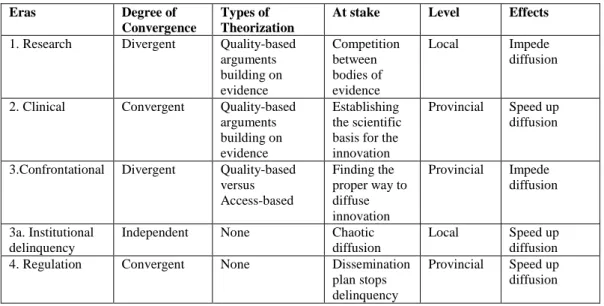
Interestingly, it appeared that a legitimation strategy was a gestalt that involved a highly internally coherent discourse. There are no contradictory arguments within a type of theorization as shown in Tables 1 and 2. Contradictions are revealed at the interface of competing logics. Table 3 provides a summary of the characteristics of each of the four eras regarding the degree of convergence in discursive legitimation, the types of theorizations involved, what is at stake, the level of action, and the effects of the degree of convergence.