An
introduction
to
the
Patstat
database
with
example
queries
Gaétan de Rassenfosse a, Hélène Dernis b, Geert Boedt c
a The University of Melbourne, MIAESR and IPRIA, Level 5, 111 Barry St., Carlton VIC 3010,
Australia. Email: [email protected]. Corresponding author.
b The Organisation for Economic Co‐operation and Development, 2 rue André Pascal, 75775 Paris Cedex 16, France. c European Patent Office, 12 Rennweg, 1030 Vienna, Austria. This version: April 1, 2014 Abstract
This paper provides an introduction to the Patstat patent database. It offers guided examples of ten popular queries that are relevant for research purposes and that cover the most important data tables. It is targeted at academic researchers and practitioners willing to learn the basics of the database.
1. Introduction
Empirical research on the economics and management of innovation is benefiting from greater availability of structured data. The most prominent database is certainly the European Patent Office (EPO) Worldwide Patent Statistical Database, henceforth ‘Patstat’. Patstat offers bibliographic patent data for more than 100 patent offices, sometimes as early as the nineteenth century. It is a valuable tool for the community of researchers because it contains raw data that is collected in a transparent manner. This rich database promises to greatly improve the quality of empirical research in the field. It is, however, difficult to navigate in the wealth of data it offers and many prospective users are deterred by its apparent complexity.
This document seeks to demystify Patstat and offers guided examples on a broad range of queries.1 It is assumed that the reader has a general knowledge of Structured Query Language (SQL).2 We have used the April 2013 edition of the database and rely on the MySQL language. Users of another dialect of SQL may have to slightly adapt the queries. Our guiding philosophy in creating the queries was to cover the most important tables and to exploit useful SQL commands. We devote particular attention to outlying some potential uses of the queries for research purposes as well as explaining pitfalls of the data. The reader shall refer to the 2009 OECD Patent Statistics Manual for further guidelines for building and interpreting patent data.
1 This document focuses on the offline Patstat database, available in a series of DVDs from the EPO. A specific introduction exists for the online version of Patstat (“Sample Queries and Tips – Patstat online”, available on the EPO website). The online version offers visualisation tools and linked resources, but is less flexible than the offline version.
2 In particular, we assume knowledge of joins, groups, views and embedded queries. Many introductory courses to SQL are freely available online, including one on the EPO website.
In a desire to make this introduction accessible to the greatest number, we have produced a test database in MS Access format. This database contains the relevant data used in this paper as well as all the queries. It allows readers to familiarise themselves with the Patstat database without having to install it on their computers. The test database and the queries are available at http://www.runmycode.org or upon request from the authors.
2. Patstat cookbook
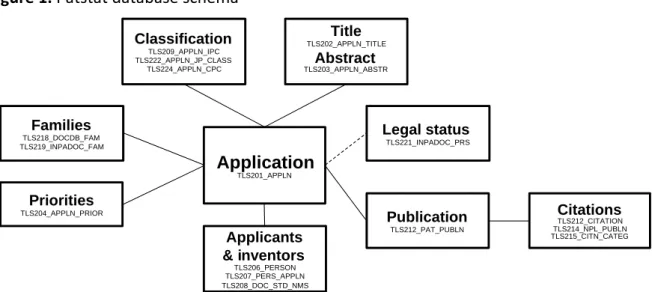
The Patstat database consists in a set of tables that follow a relational database schema where tables can be connected to each other using a relevant entry key.3 The table on patent applications, labeled tls201_appln, contains more than 74 million records and is the central element of Patstat, as indicated in Figure 1. The other tables contain information on each of the patent applications, e.g., inventors and owners, technology fields, titles and abstracts, publication instances, and citations. Figure 1. Patstat database schema Source: European Patent Office, Patstat database, April 2013. Not all the tables are reported.
To limit the volume of data retrieval, we run our queries on a sample of patent applications describing inventions related to wind turbine technologies and filed in the year 2005 anywhere in the world. Patent applications related to wind turbines technologies are predominantly found in the IPC subclass F03D (Dubarić et al. 2012).4 This subclass includes all the IPC codes that start with F03D such as ‘F03D 1/00’ (wind motors with rotation axis substantially in wind direction) and ‘F03D 5/02’ (wind‐engaging parts being attached to endless chains or the like).
3
The identifier of patent applications (appln_id) is frequently used to link tables with each other. A full description of tables and fields is provided in the Data Catalog, which is available on the Patstat DVDs and can also be downloaded from the EPO website.
4
IPC stands for International Patent Classification. IPC codes are used by patent examiners to identify the areas of technology to which patents pertain. Note that not all patents have IPC codes. Wind energy patents can also be identified using the CPC code Y02E10/70 available in table tls224_appln_cpc. CPC stands for Cooperative Patent Classification and is a joint classification system between the US Patent and Trademark Office (USPTO) and the EPO. Application TLS201_APPLN Classification TLS209_APPLN_IPC TLS222_APPLN_JP_CLASS TLS224_APPLN_CPC Title TLS202_APPLN_TITLE Abstract TLS203_APPLN_ABSTR Applicants & i nventors TLS206_PERSON TLS207_PERS_APPLN TLS208_DOC_STD_NMS Citations TLS212_CITATION TLS214_NPL_PUBLN TLS215_CITN_CATEG Priorities TLS204_APPLN_PRIOR Publication TLS212_PAT_PUBLN Families TLS218_DOCDB_FAM TLS219_INPADOC_FAM Legal status TLS221_INPADOC_PRS
2.1Identification of patents by technology fields
We use the term ‘application’ to refer to entries in table tls201_appln. This table lists all the applications available in the Patstat database and assigns them a unique and stable
appln_id, which is built from a combination of the patent authority (the patent office where
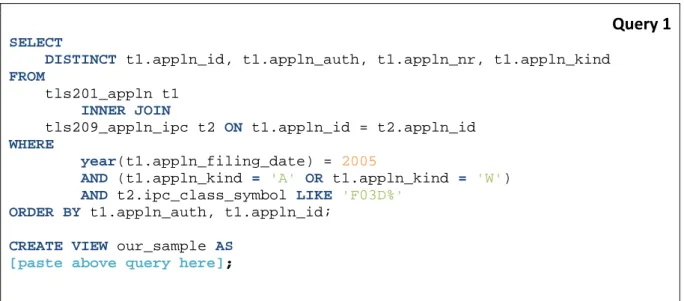
the application was submitted), the patent application number, and the application kind code (indicating for example whether the application is a patent application, a PCT application or a design application). The application number is distinct from the application identifier. The application number is the number issued by the patent authority where the application was filed, whereas the application identifier is specific to the Patstat database. The latter is called a ‘primary key’ in SQL jargon. In Query 1, the appln_id is used to link table
tls201_appln with table tls209_appln_ipc, which contains the IPC codes assigned to each
application.
Query 1 SELECT
DISTINCT t1.appln_id, t1.appln_auth, t1.appln_nr, t1.appln_kind
FROM
tls201_appln t1 INNER JOIN
tls209_appln_ipc t2 ON t1.appln_id = t2.appln_id
WHERE
year(t1.appln_filing_date) = 2005
AND (t1.appln_kind = 'A' OR t1.appln_kind = 'W') AND t2.ipc_class_symbol LIKE 'F03D%'
ORDER BY t1.appln_auth, t1.appln_id;
CREATE VIEW our_sample AS
[paste above query here];
Note: See main text for comment regarding compatibility of the query with MS SQL.
The first statement extracts: the unique application identifier (appln_id); the two‐ letter code of the patent application authority (appln_auth); the patent application number
(appln_nr) and the kind of application (appln_kind). We select patent applications by
choosing applications with an appln_kind code of either ‘A’ (direct filing) or ‘W’ (PCT application, see section 2.2). The SELECT DISTINCT clause is used to avoid duplicates in the result table in case a given patent application has more than one IPC code starting with F03D. The query returns 2125 distinct patent applications and sorts them by appln_auth and
appln_id. The first five results are presented in Table 1 for illustrative purposes. Note that
the use of ORDER BY generally slows down queries and can usually be avoided.
Table 1. First five rows of Query 1.
appln_id appln_auth appln_nr appln_kind
55286477 AP 200603687 A 55286499 AP 200603713 A 532990 AR P050100289 A 533082 AR P050100386 A 533175 AR P050100493 A
The two‐letter code shown in appln_auth column in Table 1 corresponds to the receiving office: ‘AP’ refers to the African Regional Intellectual Property Organization (ARIPO) and ‘AR’ to Argentina’s National Institute of Industrial Property. The codes follow the WIPO ST.3 format.5 Exceptionally, some codes in Patstat might not have a correspondence (for instance if an applicant cites a patent document with a non‐standard country code).
The second statement creates a temporary table (a ‘view’ in SQL jargon) that is referred to as our_sample and contains the set of patents related to wind turbine technologies defined in the first statement. Views are particularly useful to break down queries into smaller, simpler pieces. Views cannot have indexes, so that they are better suited for small populations. Users of MS SQL should remove the ORDER BY keyword from the first query.
2.2Identifying PCT applications
The Patent Cooperation Treaty (PCT) is an international patent law treaty that provides a unified procedure for filing patent applications to protect inventions in each of its contracting states. A patent application filed under the PCT is called an international application, or PCT application. PCT applications are often associated with inventions of high market potential (van Zeebroeck and van Pottelsberghe 2011) and are being used increasingly by patent applicants (Frietsch et al. 2013).6 Researchers sometimes use them to study the international dimension of patenting activity (see e.g. Allred and Park 2007). A PCT application does not automatically lead to global patent protection. Instead, patent applicants eventually need to ‘apply’ for patents in each of the jurisdictions where they wish to pursue patent protection by starting the national search and/or examination process. These ‘national’ patents are formally referred to as national‐phase entry of PCT applications.
In Patstat, PCT applications at international phase can be identified in different ways. They are associated with an appln_kind code ‘W’ in table tls201_appln, and they are associated with a publishing patent authority (publn_auth) set to ‘WO’ in table
tls211_pat_publn. The two‐letter code ‘WO’ stands for the World Intellectual Property
Office (WIPO). National‐phase entry of PCT applications can be identified with the field
internat_appln_id in table tls201_appln, which corresponds to the appln_id of the PCT
application (the field internat_appln_id is set to 0 for applications not originating from a PCT filing).
The query below lists all PCT applications that entered the national phase either at the State Intellectual Property Office of the People's Republic of China (SIPO) or at the Japanese Patent Office (JPO) and for which the Danish Patent and Trademark Office (DKPTO) was the receiving office (that is, application authority) of the initial PCT application.
5
See the WIPO’s “Recommended standard on two‐letter codes for the representation of states, other entities and intergovernmental organizations” (Standard ST.3) for the exhaustive list of codes, available on the WIPO website.
6
Note that the link between patent value and PCT status is a priori ambiguous. As Guellec and van Pottelsberghe (2001) and Reitzig (2004) point out, patents applicants may be uncertain about the economic success of the patent’s underlying invention and use the PCT route to ‘buy’ additional decision time. Alternatively, the economic success of the patent’s underlying invention may be well established at the date of filing and PCT is used to seek global protection as fast as possible.
Query 2 SELECT t1.appln_id AS PCT_appln_id, t1.appln_auth AS PCT_appln_auth, t1.appln_nr AS PCT_appln_nr, t1.appln_kind, t2.appln_id AS appln_id_sf, t2.appln_auth AS appln_auth_sf FROM our_sample t1 INNER JOIN
tls201_appln t2 ON t1.appln_id = t2.internat_appln_id
WHERE
t1.appln_auth = 'DK'
AND t2.appln_auth IN ('CN', 'JP')
ORDER BY t1.appln_id;
The statement relies on patents in our_sample. It literally selects all the applications submitted at the SIPO or the JPO that have their internat_appln_id equal to the appln_id of PCT patent applications in our_sample submitted at the DKPTO. The first five results (out of a total of 15 national phase entries) are presented in Table 2.
Table 2. First five rows of Query 2.
PCT_appln_id PCT_appln_auth PCT_appln_nr appln_kind appln_id_sf appln_auth_sf 15563101 DK 2005000031 W 8300709 CN 15563116 DK 2005000046 W 8300768 CN 15563118 DK 2005000048 W 8300756 CN 15563246 DK 2005000181 W 8306357 CN 15563258 DK 2005000193 W 39635652 JP
2.3Obtaining information on priority status
A priority patent application is the first patent application filed to protect an invention. Under the 1883 Paris convention, a priority patent can be filed in other jurisdictions, with the aim of extending the protection to other countries. The subsequent patents are called ‘second filings’.
Depending of the research goal, the priority status of patent documents is an important piece of information. First, the count of patent applications described in Query 1 may lead to multiple counts of inventions since it mixes both priority and second filings. Counting unique inventions involves counting only priority filings.7 de Rassenfosse et al. (2013) explain the details of such a ‘worldwide count of priority filings’. The issue of double counting becomes less acute if patents are counted at a single office of reference such as at the EPO.8 Second, it may be desirable to know the priority status of the patent document in 7 Note that an alternative approach for counting unique inventions involves counting families of patents. More information on patent families is provided in the next section. 8
One can often observe priority filings and subsequent second filings at the same patent office. This phenomenon is driven by divisional (or similar) applications. If a priority application was filed at the EPO and a divisional was also filed at the EPO, this divisional would claim priority from the original document and is therefore technically equivalent to a second filing. Such cases can be identified with table tls216_appln_contn.
order to avoid potential selection bias, especially when patents are counted at a single office of reference. de Rassenfosse et al. (2014) explain that the single‐office count may produce biased econometric estimates of patent production functions.9 They propose a test based on the priority status of the patent application to detect the presence of selection bias. The query below returns the priority status of the patent documents in our set. Query 3 SELECT DISTINCT t1.appln_id, (CASE
WHEN t2.appln_id IS NULL THEN 1
ELSE 0
END) AS is_a_pf
FROM
our_sample t1 LEFT OUTER JOIN
tls204_appln_prior t2 ON t1.appln_id = t2.appln_id
ORDER BY t1.appln_id;
This statement selects all the appln_id from our_sample dataset and matches them
to appln_id provided in table tls204_appln_prior, which lists priority patents claimed in
second filings. By definition, all patent applications that do not claim a priority are priority filings. Therefore, the column labelled is_a_pf takes the value 1 if no match is found. Note that, contrary to previous queries, tables are linked together using the LEFT OUTER JOIN statement. This joint returns all rows from the left table (t1) and adds information from the right hand side table (t2) when a match exists. Note also that second filings may claim more than on priority filing in table tls204_appln, hence the use of the DISTINCT clause. Query 3 reports 957 priority applications out of 2125 patent applications originally identified in
our_sample. The first five records are presented in the table below for illustrative purposes. Table 3. First five rows of Query 3. appln_id is_a_pf 65303 0 133780 0 149552 1 151084 0 151176 0
2.4Computing the patent family size
A patent family refers to a group of patent applications that are all related to each other by way of one or several common priority filings. Following Putnam (1996), researchers use information on patent families as a proxy for patent value. The validity of this approach was established by Harhoff et al. (2003) who show that family size is correlated with estimates of the value of patent rights from a survey of patent‐holders. The family size is an
9 Patent production functions are used in econometric studies to study the determinants of the number of patents produced by an economic unit such as a firm or a country.
internationally‐comparable measure of value and is thus well‐suited for studies relying on patent applications filed in different jurisdictions.
The next query counts the patent family size associated with the applications in
our_sample. We adopt the ‘extended’ family definition (INPADOC) which captures all
applications that are directly or indirectly linked via priority filings. An alternative approach involves using the DOCDB family, available in table tls218_docdb_fam. Various definitions (and hence ways to measure) patent families exist and a good overview is provided in the 2009 OECD Patent Statistics Manual as well as in Martínez (2011).
Query 4 SELECT
t1.appln_id, COUNT(t3.appln_id) AS family_size
FROM
our_sample t1 INNER JOIN
tls219_inpadoc_fam t2 ON t2.appln_id = t1.appln_id INNER JOIN
tls219_inpadoc_fam t3 ON t3.inpadoc_family_id = t2.inpadoc_family_id
GROUP BY t1.appln_id
ORDER BY t1.appln_id;
Notice that Query 4 calls table tls219_inpadoc_fam twice, under the aliases t2 and
t3: t2 links each appln_id from our_sample to its patent family identifier inpadoc_family_id,
and is in turn linked to t3 to retrieve and count all family members (t3.appln_id) that belong to the same inpadoc_family_id. The first five rows are presented below.
Table 4. First five rows of Query 4. appln_id family_size 65303 9 133780 4 149552 14 151084 13 151176 9 Researchers are sometimes interested in the number of jurisdictions that the family covers. For example, the OECD produces an indicator on triadic patent families, which captures patents granted by the US Patent and Trademark Office (USPTO) and filed at the EPO and the Japan Patent Office (JPO) to protect the same set of inventions (Dernis and Khan 2004). de Rassenfosse and van Pottelsberghe (2009) show that triadic patents are a good indicator of countries’ research productivity (compared with priority filings, which are affected by variations in the propensity to patent across countries). Information on how to identify triadic patents in Patstat is provided in Appendix A. Another family‐based indicator is obtained by simply counting the number of jurisdictions identified in a family – we call it here the ‘geographic’ family size (see also Squicciarini et al. 2013). Query 4 can be easily adapted to measure the geographic family size, as illustrated in Query 5.
Query 5 SELECT
t1.appln_id,
COUNT(DISTINCT t4.publn_auth) AS geog_family_size FROM our_sample t1
INNER JOIN
tls219_inpadoc_fam t2 ON t2.appln_id = t1.appln_id INNER JOIN
tls219_inpadoc_fam t3 ON t3.inpadoc_family_id = t2.inpadoc_family_id INNER JOIN
tls211_pat_publn t4 ON t4.appln_id = t3.appln_id
WHERE t4.publn_auth != 'WO' GROUP BY t1.appln_id
ORDER BY t1.appln_id;
Compared with Query 4, Query 5 uses information from an additional table,
tls211_pat_publn, to recover information on the patent offices of destination (publication
authorities) of all INPADOC family members, and excludes the PCT publication authority (WO) as it has an international coverage.10 The first five results are presented in Table 5. A comparison with the results presented in Table 4 suggests that large differences may exist between the two measures of family size. For example, while the family associated with
appln_id number 65303 has nine members, it covers only four jurisdictions: Germany,
members of the European Patent Convention (through the EPO), the United States and China. There are various reasons why the family size may differ from the geographic family size such as procedural reasons (unity of invention requirement or maximum number of independent claims) and patent strategy reasons (e.g., creation of patent thickets).
Table 5. First five rows of Query 5. appln_id geog_family_size 65303 4 133780 4 149552 12 151084 11 151176 8 Note that Query 5 reports the number of distinct patent offices and not the number of distinct countries per se. This distinction matters when patents are filed at regional offices such as the ARIPO or the EPO, which cover many jurisdictions. Patents granted by a regional office must be validated in each of the member states where patent protection is sought. As a result, while a patent application at the EPO virtually covers a market of approximately 500 million people, its actual coverage could be much smaller depending on the countries in which the patent was validated. One way of dealing with the issue involves adding information on the number of jurisdictions in which regional applications were validated, after the patent has been granted at the regional office considered. This can be done with Patstat but we will not discuss it as it far exceeds to scope of this paper.11 Note also that
10 Indeed, not excluding the PCT application at international phase inflates the family count by one unit. For example, if the JPO is the receiving office of a PCT application that then enters national phase at the JPO only, not excluding the PCT application at international phase will lead to a family size of 2 instead of 1.
11 Briefly, the approach for EPO patents would be to use the INPADOC legal status database in addition to Patstat and identify the relevant legal status codes that indicate a validation or renewal fee payment in a designated state. The INPADOC database is available as an add‐in table to Patstat, as explained in Appendix A.
patents listed in our_sample may belong to the same family, and further consolidation may be envisaged to control for double counting.
2.5 Counting patents by country (simple counts vs. fractional counts)
Patent data provides information on inventors and applicants and it is thus a rich source of information about the structure of technology production. Briefly, the inventor country of residence reflects the country of origin of inventions while the applicant country of residence reflects the ownership of inventions. The 2009 OECD Patent Statistics Manual proposes a comprehensive discussion on the choice of the reference country for building patent counts. Two distinct counting approaches can be applied, in response to specific analytical requirements: simple count method versus fractional count method. Since a large number of patent applications are due to team work, it is likely that more than one inventor has contributed to the protected invention, located in one or several countries. Similarly, several applicants may co‐own a unique patent. The fractional count procedure is used to better reflect the contribution of each country and avoid multiple counts of a same patent in different countries.
The list of inventors (applicants) can be identified using two additional tables:
tls207_pers_appln lists the correspondence between patent application and inventors
(applicants), and tls206_person provides details on names and addresses. The person_id identifier enables to establish the link between these two tables. Note that not all patent documents listed in tls201_appln have an entry in tls207_pers_appln.
The script below performs a fractional count of inventors’ country of residence for patent applications in our_sample. Inventors have a field invt_seq_nr greater than 0 in table
tls207_pers_appln, while applicants have a field applt_seq_nr greater than 0.
Query 6 SELECT
person_ctry_code, SUM(tot_in_ctry/tot_in_patent) AS fractional_count
FROM
(SELECT
t.appln_id,
ifnull(t1.person_ctry_code, '') AS person_ctry_code, ifnull(t1.tot_in_ctry, 1) AS tot_in_ctry,
ifnull(t2.tot_in_patent, 1) AS tot_in_patent FROM
our_sample t
LEFT OUTER JOIN
--> Accounts for missing inventor references in tls207_pers_appln table
(SELECT
a.appln_id,
b.person_ctry_code,
COUNT(b.person_id) AS tot_in_ctry FROM
tls207_pers_appln a
INNER JOIN tls206_person b ON a.person_id = b.person_id WHERE
a.invt_seq_nr > 0
GROUP BY a.appln_id, person_ctry_code
--> Compiles country-level count of inventors per patent
) t1 ON t.appln_id = t1.appln_id LEFT OUTER JOIN
(SELECT
appln_id, MAX(invt_seq_nr) AS tot_in_patent FROM
tls207_pers_appln
GROUP BY appln_id HAVING MAX(invt_seq_nr) > 0 --> Compiles total count of inventors per patent
) t2 ON t.appln_id = t2.appln_id ) our_sample_with_country
GROUP BY person_ctry_code
ORDER BY SUM(tot_in_ctry/tot_in_patent) DESC;
Note: See main text for comment regarding compatibility of the query with MS SQL.
The above script is more advanced than previous scripts as it is composed of embedded queries providing intermediary counts for facilitating fractional counts by country. (It is possible to break it into smaller statements using VIEWS) The aggregated counts by country are performed on a selection of fields (named our_sample_with_country) extracted using our_sample table and two sub‐queries. Sub‐query t1 reports the counts of inventors by country and by patent and sub‐query t2 reports the total number of inventors by patent. Output from t1 and t2 is then linked to patents in our_sample using a LEFT OUTER JOIN statement to account for missing records in tls207_pers_appln table. MySQL function ‘ifnull()’ replaces the missing records by an empty record, and sets the count to 1 where missing (either because the appln_id was not found in table tls207_pers_appln or because no person_id was identified for invt_seq_nr greater than 0). Users of MS SQL should use the ‘isnull()’ function instead. They should also specify that the final count needs to be a float by using [CONVERT(float, COUNT(b.person_id)) AS tot_in_ctry] in query t1. Previews of results for the field selection (our_sample_with_country) and the final count are presented in Table 6 and Table 7 respectively.
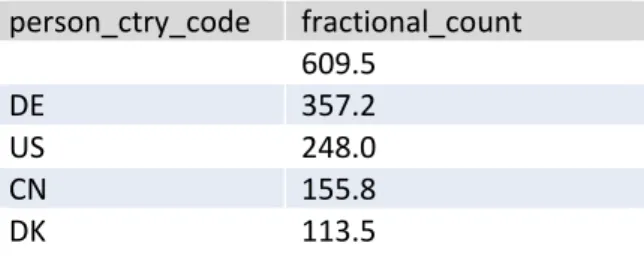
Table 6 shows that all the inventors of appln_id 263066 are German. By contrast, one‐fourth of inventors of appln_id 273390 is Swiss and three‐fourth is German. Grouping all the shares by person_ctry_code leads to the results presented in Table 7. Among the 2125 patent application in our_sample, 609.5 have not been allocated to a country, and 357.2 patents were due to German inventors. A methodology for recovering missing country codes is presented in de Rassenfosse et al. (2013).
Table 6. Five randomly‐selected rows of field selection of Query 6 (join from t1 and t2).
appln_id person_ctry_code tot_in_ctry tot_in_patent
263066 DE 2 2 273390 CH 1 4 273390 DE 3 4 273768 JP 1 1 273769 JP 1 1 Table 7. First five rows of Query 6 (fractional count by applicant country). person_ctry_code fractional_count 609.5 DE 357.2 US 248.0 CN 155.8 DK 113.5
It is straightforward to adapt Query 6 to applicants’ country of residence (using the
applt_seq_nr field instead of invt_seq_nr in tls207_pers_appln). It is important to stress that
applicant and inventor information provided in Patstat and linked via the tls207_pers_appln table corresponds to the information available in the last publication associated with an application. For example, if an EP‐B1 publication has different applicant names than the original EP‐A1 publication, then only the person information for the B1 publication will be available.12 To recover the current information, it is possible to link Patstat data with data provided by national patent offices, as explained in Section 2.9.
2.6Identifying patents resulting from international collaborations
The information on applicants and inventors has been used to study among other questions international R&D collaboration (Guellec and van Pottelsberghe 2001; Picci 2010; Danguy 2014), R&D offshoring (Thomson 2013), or network of inventors (Balconi et al. 2004; Ejermo and Karlsson 2006). To the best of our knowledge, only a limited number of studies assess the validity of these indicators. One such study is Bergek and Bruzelius (2010), which casts some doubt on the use of inventor data to measure R&D collaboration.
An example of query identifying patents resulting from international collaboration is presented below. The rationale being that patent applications for which the field
nb_locations is greater than 1 involve inventors that reside in different countries and are
thus the outcome of an international collaboration (i.e., co‐invented patents).
12 Persons are also linkable to publications since the October 2013 release of Patstat. Kind code ‘A1’ refers to a European patent application published with European search report, and ‘B1’ to a European patent granted.
Query 7 SELECT
t1.appln_id, COUNT(DISTINCT t3.person_ctry_code) AS nb_locations
FROM
our_sample t1 INNER JOIN
tls207_pers_appln t2 ON t1.appln_id = t2.appln_id INNER JOIN
tls206_person t3 ON t2.person_id = t3.person_id
WHERE
t3.person_ctry_code IS NOT NULL
AND t2.invt_seq_nr > 0 GROUP BY t1.appln_id
ORDER BY COUNT(DISTINCT t3.person_ctry_code) DESC, t1.appln_id ASC;
Query 7 counts the number of distinct inventor countries listed in each patent application in our_sample. It reports a positive international collaboration conditional on the availability of records in tls207_pers_appln table or in the person_ctry_code field in table tls206_person. The first five results are presented in Table 8.
Table 8. First five rows of Query 7. appln_id nb_locations 48145305 3 273390 2 4975233 2 4979189 2 5804835 2
2.7Counting citations received
Following early works by Carpenter et al. (1981) and Trajtenberg (1990) citation data is used as an indicator of quality – broadly defined as the technological merit and the economic potential of an invention. Note that other indicators of patent quality exist, see in particular the recent work by Squicciarini et al. (2013). Citation data is also frequently used to track knowledge flows (Jaffe et al. 1993) and to measure the speed of knowledge obsolescence (Clark 1976; Jaffe and Trajtenberg 1996). While patent citation data may offer very rich insights, it must be used with caution. One must pay close attention to the effects of the institutional environment on the relevance of citation data as an economic indicator. In particular, patent citations practices differ across patent offices (Michel and Bettels 2001), and examiner‐added citations may add extra noise to the data (see Alcácer and Gittelman 2006 for USPTO evidence). In addition, many publications from different patenting authorities but covering the same invention can be cited, leading to a fragmentation of citation records as explained in Webb et al. (2005).
The next query counts the number of citations received in a three‐year time window from patent applications published by the German Patent and Trade Mark Office by patent applications published by the EPO. Citations received by a patent are often referred to as ‘forward’ citations, in opposition to ‘backward’ citations, which indicate citations made by a
patent. The latter is sometimes also called ‘references’ (by analogy to the reference list of a scientific paper).
Query 8 SELECT
t1.appln_id, COUNT(distinct t3.pat_publn_id) AS cites_3y
FROM
our_sample t1 INNER JOIN (SELECT
appln_id, MIN(publn_date) AS earliest_date
FROM
tls211_pat_publn
GROUP BY appln_id) t2 ON t1.appln_id = t2.appln_id INNER JOIN
tls211_pat_publn t2b ON t2b.appln_id = t2.appln_id INNER JOIN
tls212_citation t3 ON t2b.pat_publn_id = t3.cited_pat_publn_id INNER JOIN
tls211_pat_publn t4 ON t3.pat_publn_id = t4.pat_publn_id
WHERE
t2b.publn_auth = 'DE'
AND t4.publn_auth = 'EP'
AND YEAR(t2.earliest_date)!= 9999 AND YEAR(t4.publn_date)!= 9999
AND t4.publn_date <= DATE_ADD(t2.earliest_date, INTERVAL 3 YEAR)
GROUP BY t1.appln_id
ORDER BY COUNT(distinct t3.pat_publn_id) DESC, t1.appln_id ASC; Note: See main text for comment regarding compatibility of the query with MS SQL.
Note that the citation records are based on the published patent documents, hence
the use publn_auth from table tls211_pat_publn instead of appln_auth from table
tls201_appln. The field publn_auth captures the publication authority of the patent
document. The publication authority is often also the receiving office (appln_auth) except in the case of PCT applications where the publication authority is WIPO and the receiving office is the patent office where the patent application was actually lodged. Thus, an alternative to criterion [t2.publn_auth = 'DE'] is [t1.appln_auth = 'DE' AND t1.appln_kind = 'A']. The use of a time window is important when working with patents of different age cohorts in order to avoid data truncation. It is easily implemented with the function ‘DATE_ADD()’. Users of MS SQL should use [DATEDIFF(YEAR, t2.earliest_date, t4.publn_date) <= 3] instead. In order to better estimate the citation lag, the date of reference is set to the earliest date of publication of the cited patent. Note that the count is fairly naïve for reasons explained above as well as because it does not take into account the type of EPO citations. See Webb et al. (2005:8) for an overview of citation types at the EPO. The first five results are presented in Table 9.
Table 9. First five rows of Query 8. appln_id cites_3y 14995919 5 14997816 2 14971868 1 14974947 1 14975309 1
2.8Obtaining grant information
A published patent application provides legal rights and some economic benefits to its owner (see e.g. Guellec et al. 2012), but most of the value of a patent is achieved when the patent is granted and the owner can enforce its exclusive right. The grant status is therefore an important economic variable. Query 9 shows how to recover information on whether patent applications in our_sample filed at the UK Intellectual Property Office (UKIPO) have been granted.
Query 9 SELECT
t1.appln_id, MAX(t2.publn_first_grant) AS granted
FROM
our_sample t1 INNER JOIN
tls211_pat_publn t2 ON t1.appln_id = t2.appln_id
WHERE t1.appln_auth = 'GB'
AND t1.appln_kind = 'A' GROUP BY t1.appln_id
ORDER BY t1.appln_id;
The query uses information from table tls211_pat_publn. Each application is associated with one or more published documents, and each published document is tagged with an office‐specific publication kind code to indicate the kind of publication. The Patstat team has identified the publication kind codes associated with granted documents and the earliest document of an application corresponding to a grant is given a value of 1 in the field
publn_first_grant. All other documents are given a value of 0. A simple way of finding
whether a patent application was granted is thus to select the maximum value of the field
publn_first_grant for each appln_id. If the maximum value is 1, the patent was granted. The
status of a patent application associated with a value of 0 is unclear: other legal statuses include, but are not limited to: pending; withdrawn; and refused. Detailed information on legal status can be recovered from table tls221_inpadoc_prs for some patent offices (see Appendix A for details). For other offices, it is necessary to link Patstat data with data provided by national patent offices, as explained in the next section. Note that PCT applications are never granted per se; only applications that entered the national phase can be granted.
Table 10. First five rows of Query 9. appln_id granted 21465239 1 21466952 0 21467768 0 21470294 0 21471154 0
2.9Linking Patstat with data provided by national patent offices
It is sometimes desirable to enrich Patstat data with data directly provided by national patent offices, for example to get accurate information on the legal statuses of patent applications or to collect information on reassignments. This can be done by using information from the field publn_nr in table tls211_pat_publn. The reconstruction of the publication number is specific to each patent office and Query 10 focuses on the rather simple example of the UKIPO. Query 10 SELECT DISTINCT t1.appln_id, t2.publn_nr AS publn_nr_patstat,
CONCAT('GB',RIGHT(t2.publn_nr,7)) AS publn_nr_ukipo
FROM
our_sample t1 INNER JOIN
tls211_pat_publn t2 ON t1.appln_id = t2.appln_id
WHERE t1.appln_auth = 'GB'
AND t1.appln_kind = 'A'
AND t2.publn_kind != 'D0' ORDER BY t1.appln_id;
Note: See main text for comment regarding compatibility of the query with MS SQL.
The online patent document and information service of the UKIPO (Ipsum) requires the publication number to be in the following format: ‘GBnnnnnnn’, i.e. the characters ‘GB’ followed by 7 digits. Query 10 thus appends the characters ‘GB’ in front of the last 7 digits of the field publn_nr in order to recompose a publication number that is compatible with the UKIPO online service. Users of MS SQL need to replace the last element of the SELECT DISTINCT clause with [('GB'+RIGHT(t2.publn_nr,7)) AS publn_nr_ukipo] Note the exclusion of documents with publn_kind code ‘D0’ which, for the UKIPO, correspond to patent applications filed. The field publn_nr_ukipo can now be used to search for additional information on the UKIPO website. More generally, one must reverse‐engineer the Patstat format to the format use with the national patent office.
Table 11. First five rows of Query 10.
appln_id publn_nr_patstat publn_nr_ukipo 21465239 2410379 GB2410379 21467768 2423650 GB2423650 21470294 2441770 GB2441770 21471154 2424926 GB2424926 21471862 2425334 GB2425334 3. Concluding remarks
This paper has provided a broad overview of the Patstat database by discussing typical queries that rely on the main tables. A good way to proceed from here is to slightly alter the queries and observe how result‐sets returned are affected. We hope that users will be able to devise indicators tailored to their research needs and therefore contribute to further improving the quality of empirical research in the fields of economics and management of innovation. In order to avoid duplication of work, however, we encourage researchers to share their contributions with the broad community. Appendix A briefly describes add‐ons provided by institutions or individual contributors to enrich Patstat data.
A large community of users has emerged over time and is keen to share its experience and answers questions of beginners on the Patstat forum on the EPO website. An additional helpful resource is the annual Patent Statistics for Decision Makers conference (and the preceding user workshop) where the Patstat community gathers and exchanges recent developments. Acknowledgements The authors are grateful to Monica Coffano, Jérôme Danguy, Paul Jensen, Catalina Martínez, Clinton McCarthur, Nico Rasters and Gianluca Tarasconi for helpful comments. The paper has also benefited from comments by participants at a staff development workshop at IP Australia (Canberra). References Alcácer, J., and M. Gittelman. 2006. “Patent citations as a measure of knowledge flows: The influence of examiner citations”. Review of Economics and Statistics, 88(4), 774–779. Allred, B., and W. Park. 2007. “Patent rights and innovative activity: evidence from national
and firm‐level data”. Journal of International Business Studies, 38(6), 878–900.
Balconi, M., S. Breschi, and F. Lissoni. 2004. “Networks of inventors and the role of academia: an exploration of Italian patent data”. Research Policy, 33(1), 127–145. Bergek, A., and M. Bruzelius. 2010. “Are patents with multiple inventors from different
countries a good indicator of international R&D collaboration? The case of ABB”.
Research Policy, 39(10), 1321–1334.
Carpenter, M., F. Narin, and P. Woolf. 1981. “Citation rates to technologically important patents”. World Patent Information, 3(4), 160–163.
Clark, C. 1976. “Obsolescence of the patent literature”. Journal of Documentation, 32(1), 32–52.
Danguy, J. 2014. “Globalization of innovation production: A patent‐based industry analysis”. Université libre de Bruxelles, iCite Working Paper 2014‐009.
de Rassenfosse, G., H. Dernis, D. Guellec, L. Picci, and B. van Pottelsberghe de la Potterie. 2013. “The worldwide count of priority patents: A new indicator of inventive activity”.
Research Policy, 42(3), 720–737.
de Rassenfosse, G., A. Schoen, and A. Wastyn. 2014. “Selection bias in innovation studies: A simple test”. Technological Forecasting and Social Change, 81(1), 287–299.
de Rassenfosse, G., and B. van Pottelsberghe de la Potterie. 2009. “A policy insight into the R&D–patent relationship”. Research Policy, 38(5), 779–792.
Den Besten, M., F. Lissoni, A. Maurino, M. Pezzoni, and G. Tarasconi, 2012. “APE‐INV Data Dissemination and Users’ Feedback Project”. Mimeo dated 06/06/2012, available at: http://www.esf‐ape‐inv.eu/.
Dubarić, E., D. Giannoccaro, R. Bengtsson, and T. Ackermann. 2011. “Patent data as indicators of wind power technology development”. World Patent Information, 33(2), 144–149.
Dernis, H., D. Guellec, and B. van Pottelsberghe de la Potterie. 2001. “Using patent counts for cross‐country comparisons of technology output”. OECD STI Review, 27, 129–146. Dernis, H., and M. Khan. 2004. “Triadic Patent Families Methodology”, OECD Science,
Technology and Industry Working Papers, No. 2004/02, OECD Publishing.
Ejermo, O., and C. Karlsson. 2006. “Interregional inventor networks as studied by patent coinventorships”. Research Policy, 35(3), 412–430.
Frietsch, R., P. Neuhäusler, and O. Rothengatter. 2013. “Which road to take? Filing routes to the European Patent Office”. World Patent Information, 35(1), 8–19.
Guellec, D., C. Martínez, and P. Zuniga. 2012. “Pre‐emptive patenting: securing market exclusion and freedom of operation”. Economics of Innovation and New Technology, 21(1), 1‐29.
Guellec, D., and B. van Pottelsberghe de la Potterie. 2000. “Applications, grants and the value of patent”. Economic Letters, 69(1), 109–114.
Guellec, D., and B. van Pottelsberghe de la Potterie. 2001. “The internationalisation of technology analysed with patent data”. Research Policy, 30(8), 1253–1266.
Harhoff, D., F. Scherer, and K. Vopel. 2003. “Citations, family size, opposition and the value of patent rights”. Research Policy, 32(8), 1343–1363.
Jaffe, A., and M. Trajtenberg. 1996. “Flows of knowledge from universities and federal laboratories: Modeling the flow of patent citations over time and across institutional and geographic boundaries”. In A. Pakes and K. Sokoloff (Eds.), Proceedings of the
National Academy of Sciences of the United States of America, 93, 12671–12677.
Jaffe, A., M. Trajtenberg, and R. Henderson. 1993. “Geographic localization of knowledge spillovers as evidenced by patent citations”. Quarterly Journal of Economics, 108(3), 577–598.
Maraut, S., H. Dernis, C. Webb, V. Spiezia, and D. Guellec. 2008. “The OECD REGPAT Database: A Presentation”. OECD STI Working Papers, 2008/02.
Martínez, C. 2011. “Patent families: when do different definitions really matter?”.
Scientometrics, 86(1), 39–63.
Michel, J., and B. Bettels. 2001. “Patent citation analysis. A closer look at the basic input data from patent search reports”. Scientometrics, 51(1), 185–201.
Organisation for Economic Co‐operation and Development (OECD). 2009. OECD Patent
Picci, L. 2010. “The internationalization of inventive activity: A gravity model using patent data”. Research Policy, 39(8), 1070–1081.
Putnam, J. 1996. “The value of international patent rights”. PhD thesis, Yale University. Reitzig, M. 2004. “Improving patent valuations for management purposes—validating new
indicators by analyzing application rationales”. Research Policy, 33(6–7), 939–957. Squicciarini, M., H. Dernis, and C. Criscuolo. 2013. “Measuring patent quality: Indicators of
technological and economic value”. OECD STI Working Papers, 2013/03.
Thomson, R. 2013. “National scientific capacity and R&D offshoring”. Research Policy, 42(2), 517–528.
Trajtenberg, M. 1990. “A penny for your quotes: patent citations and the value of innovations”. RAND Journal of Economics, 21(1), 172–187.
van Zeebroeck, N., and B. van Pottelsberghe de la Potterie. 2011. “Filing strategies and patent value”. Economics of Innovation and New Technology, 20 (6), 539–562.
Webb, C., H. Dernis, D. Harhoff, and K. Hoisl. 2005. “Analysing European and international patent citations: A set of EPO patent database building blocks”. OECD STI Working
Papers, 2005/9.
Appendix A. Resources for Patstat
EPO Worldwide Legal Status database – Also known as tls221_inpadoc_prs table, it contains
information on legal events that occurred during the life of a patent, either before or after grant. Typical events are: payment of (national) renewal fees, lapse of the patent, change of ownership, withdrawal of the application, entrance into the national phase, etc. The records in this table originate from the patent gazettes and registers of various national patent authorities, including the EPO and WIPO. Currently over 50 offices provide the EPO with legal status data.
European Patent Register database – Released twice a year, the database contains
bibliographic, legal and procedural information on published European patent applications and on published PCT applications for which the EPO is a designated office (so called Euro‐ PCT applications). The database is extracted from the European Patent Register, which stores all publicly available information the EPO has on European patent applications as they pass through the application and examination procedure. It includes information on: applicants, inventors, opponents and representatives, procedural events during application and examination proceedings, opposition and appeal proceedings, limitation and revocation proceedings.
OECD REGPAT database – It covers records on patent applications at the EPO (derived from
Patstat) and PCT patents at international phase (derived from the EPO Bibliographic Database weekly downloads), for which addresses of inventors and applicants have been regionalised (i.e. assigned to a region code). The dataset covers regional information for most OECD and EU28 member countries, plus the BRICS countries. It can be linked to Patstat data using the appln_id field. All OECD databases are freely available on the OECD website. See Maraut et al. (2008) for technical details.
OECD Triadic Patent Families (TPF) database – It relies on a specific definition of patent
family, covering patent applications filed at the EPO, the JPO and granted by the USPTO and that share a same set of priorities (Dernis and Khan 2004). The data is compiled using different patent linkages provided in Patstat and is a consolidated subset of the
tls219_inpadoc_fam table. The appln_id field can be used to connect the data to Patstat.
OECD Citations database – It proposes a consolidated patent citation records of Patstat data
for patents filed at the EPO or through the PCT. It mainly draws on the infrastructure proposed in Webb et al. (2005) and takes into account citations of patent and non‐patent literature (NPL). In addition to the list of cited patents and NPL, it proposes a list of EPO or WIPO equivalents to patents cited, in order to facilitate further consolidation of the data.
OECD Patent Quality Indicators database – It proposes a number of indicators that are
aimed at capturing the quality of patents and the possible impact that patent quality might have on subsequent technological developments, as described in Squicciarini et al. (2013). The current version of the dataset only relies on patent applications filed at the EPO but coverage will likely be expanded in the future to include patents filed to other offices. Indicators can be replicated using the program lines available in Squicciarini et al. (2013).
OECD HAN database – The OECD Harmonised Applicant Names (HAN) database proposes a
EEE‐PPAT table – In collaboration with the ECOOM department at KU Leuven, the EPO and
Sogeti (a software consultancy), EUROSTAT has devoted considerable efforts to harmonize applicant names and allocate applicants to sectors (private business enterprises, universities and higher education institutions, governmental agencies, individuals). Sector allocation is relevant for analysing the constituents and dynamics of technological performance on the level of innovation systems. Read more at http://www.ecoom.be/en/EEE‐PPAT
EP‐INV database on academic inventors – It is the result of a project sponsored by the
European Science Foundation and chaired by Francesco Lissoni. The database contains cleaned and standardised inventors’ names and addresses, as well as information on the affiliations of academic scientists. See Den Besten et al. (2012) for more information.
WIPO’s IPC ‐ Technology concordance table – The WIPO technology concordance table links
the International Patent Classification (IPC) symbols with thirty‐five fields of technology. The concordance table is updated on a regular basis to reflect revisions to the IPC. Further information is provided on the WIPO website.
Worldwide count of priority filings – de Rassenfosse et al. (2013) have proposed an
algorithm that exploits patent‐family linkages (direct equivalents and other second filings) to recover missing information on inventor and applicant country of residence. Their algorithm can be used for the recovery of other information such as missing IPC codes.