Cognitive style predicts entry into physical sciences and humanities:
Questionnaire and performance tests of empathy and systemizing
Jac Billington
⁎
, Simon Baron-Cohen, Sally Wheelwright
Autism Research Centre, Department of Psychiatry, Cambridge University, Douglas House, 18B Trumpington Rd, Cambridge CB2 8AH, UK Received 4 June 2006; received in revised form 6 February 2007; accepted 15 February 2007
Abstract
It is often questioned as to why fewer women enter science. This study assesses whether a cognitive style characterized by systemizing being at a higher level than empathizing (SNE) is better than sex in predicating entry into the physical sciences compared to humanities. 415 students in both types of discipline (203 males, 212 females) were given questionnaire and performance measures of systemizing and empathy. 59.1% of the science students were male and 70.1% of the humanities students were female. There were significant sex differences on the Empathy Quotient (EQ) (females on average scoring higher) and on the Systemizing Quotient (SQ) (males on average scoring higher), confirming earlier studies. Scientists also scored higher on the SQ, and scored lower on the EQ, compared to those in the humanities. Thus, independent of sex, SQ was a significant predictor of entry into the physical sciences. Results from questionnaire data and performance data indicate an SNE profile for physical science students as a group, and an ENS profile for humanities students as a group, regardless of sex. We interpret this as evidence that whilst on average males show stronger systemizing and females show stronger empathizing, individuals with a strong systemizing drive are more likely to enter the physical sciences, irrespective of their sex.
© 2007 Elsevier Inc. All rights reserved.
Keywords:Sex differences; Cognitive style; Science
Disparities have been noted in the performance of males and females in mathematics and science from an early age (Geary, Saults, Liu, & Hoard, 2000; Linn & Peterson, 1986). Men also out-number women in careers that involve a scientific style of thinking (such as engineering), whilst women out-number men in fields that primarily involve social skills (such as counselling) (Lawrence, 2006). Although there has been an increase in the number of women entering scientific careers this disparity still exists, and women occupy only 10% of the top positions in these areas (EMBO). Unsurprisingly the issue is a contentious one, with any suggestion of males or females being‘better’at one particular academic subject or career choice often being met with rejection. However, if we ignore these differences, and fail to seek explanations for their existence, we cannot begin to redress the balance in the proportions of males and females entering particular academic domains and subsequent career paths.
A recent theoretical account of cognitive sex differences (Baron-Cohen, 2002a, 2003) proposes two core psychological dimensions, or cognitive styles, that differ between the sexes: empathizing (E) and systemizing (S). Empathizing facilitates
⁎Corresponding author.
E-mail address:[email protected](J. Billington).
1041-6080/$ - see front matter © 2007 Elsevier Inc. All rights reserved. doi:10.1016/j.lindif.2007.02.004
interacting in the social world. It is defined as both the drive and ability to identify another's mental states and to respond to these with one of a range of appropriate emotions. Empathizing has both a cognitive and an affective component ( Baron-Cohen & Wheelwright, 2004; Davis, 1980). The cognitive component involves understanding another's thoughts and feelings and is also referred to as usinga theory of mind(Baron-Cohen, 1995; Wellman, 1990). The affective component of empathizing involves an emotional response that arises as a result of the comprehension of another individuals emotional state (Eisenberg, 2002).
Systemizing is defined a drive and ability to analyse the rules underlying a system, in order to predict its behaviour. Systems are found in many different domains: technical (e.g. machines and tools); natural (e.g. a weather system); abstract (e.g. mathematics); social (e.g. a political system); spatial (e.g. map reading); and organisable (e.g. a taxonomy). Although systems exist in a variety of domains, they all share the same tripartite structure: they can all be analysed in terms of an INPUT–OPERATION–OUTPUT principle. Input is defined as the initial state of the system; output is the subsequent state of a system, whilst operations are defined as actions that transform input to output. The ability to systemize is associated with a preference for local detail and an ability to ignore Gestalt perceptual distractors in a visual field (Billington, Baron-Cohen, & Bor, submitted for publication), also known as a ‘field independent’ cognitive style (Witkin, Dyk, Faterson, Goodenough, & Karp, 1962).
In order to test the E–S model, we devised two self-report questionnaires: the Systemizing Quotient (SQ) and the Empathy Quotient (EQ) (Baron-Cohen, Richler, Bisarya, Gurunathan, & Wheelwright, 2003; Baron-Cohen & Wheelwright, 2004). The SQ, originally a 40-item, forced choice format, self-report questionnaire assesses an individual's drive to systemize across a range of domains. The SQ asks questions such as“I like music shops because they are clearly organised”and“When I learn a language I become intrigued by the grammatical rules”. It was recently revised as a 75-item questionnaire (SQ-R), with improved psychometric properties and sex-neutral items (Wheelwright et al., 2006). Similarly, the EQ provides a quantitative measure of an individual's empathizing drive. It is a 40-item self-report questionnaire aimed at assessing different aspects of empathy. For example, whilst items such as“I am good at predicting what someone will do”are aimed at measuring cognitive empathy, items such as“I usually stay emotionally detached while watching a film”are included to measure affective the component of empathy. The EQ correlates well with the Interpersonal Reactivity Index (IRI) (Davis, 1983), providing evidence of concurrent validity. Its factor structure (cognitive vs. affective empathy) has also been confirmed (Lawrence, Shaw, Baker, Baron-Cohen, & David, 2004). The self-report nature of both of these questionnaires means that they measure an individual's drive and preference for empathizing and systemizing, though it remains unclear if they also provide a measure of ability.
The E–S theory proposes that females on average have a stronger drive to empathize, whilst males on average have a stronger drive to systemize (Baron-Cohen, 2002). This claim only applies on average; thus, there will always be individuals who are atypical for their sex. Whilst this statistical point should go without saying, given the sensitivity of the topic, it is worth making this assumption explicit. In support of the claim, males demonstrate superior performance in systemizing using tests of mathematics (Benbow, 1988), folk physics (Lawson, Baron-Cohen, & Wheelwright, 2004), map reading (Atur, Ortix, & Sutherland, 1998; Contreras, Colom, Shih, Alava, & Santacreu, 2001; Moffat, Hampson, & Hatzipantelis, 1998), and mental rotation (Kimura, 1999; Linn & Petersen, 1985; Voyer, Voyer, & Bryden, 1995). Also, sex differences have been found in questionnaire studies of systemizing, with males scoring significantly higher than females on the SQ and the SQ-R (Baron-Cohen et al., 2003; Wheelwright et al., 2006). In contrast, females demonstrate superiority on questionnaire (Baron-Cohen & Wheelwright, 2004; Davis, 1994) and laboratory (Baron-Cohen, Joliffe, Mortimore, & Robertson, 1997; Baron-Cohen, Wheelwright, Hill, Raste, & Plumb, 2001; Lawson et al., 2004) measures of empathy, responding with the appropriate emotion to a distressed other (Hoffman, 1977) and picking up subtle social nuances (Baron-Cohen, O'Riordan, Stone, Jones, & Plaisted, 1999; Hall, 1978). The disparity between one's empathizing and systemizing shows strong sex differences (Goldenfeld, Baron-Cohen, & Wheelwright, 2005) and may lead males and females into different fields of study and/ or occupations choices (Baron-Cohen, 2003).
E–S theory also argues that, irrespective of their sex, if an individual's systemizing is at a higher level than their empathizing (SNE), it is this profile that leads them into disciplines that require an analytical style to deal with rule-based phenomena. Some evidence has been found for a difference in brain function and cognitive style in those gifted in physical and mathematical subjects. For example, mathematically talented individuals have a more piecemeal, analytic style and experience less interference from distracters when attending to visual stimuli, a style associated with field independence (Singh & O'Boyle, 2004). Unfortunately, this study only assessed performance in a male sample. Field-independence, measured using tasks such as the Embedded Figures Task (EFT) (Witkin, Oltman, Raskin, & Karp, 1971), predicts entry into mathematical courses and is associated with achievement in mathematical disciplines (Vaidya
& Chansky, 1980; Van Blerkon, 1988). A recent study directly tested E–S theory among students (Wheelwright et al., 2006) and found that, independent of sex, physical science degree students scored significantly lower on the EQ and significantly higher on the SQ-R, compared to humanities students. This suggests that the academic subject one ends up studying may be better predicted by one's cognitive style (i.e. empathizing relative to systemizing) than by one's sex. Although the study ofWheelwright et al. (2006)provides evidence for an association between cognitive style and the likelihood of entering a particular academic discipline or career, these findings did not include any performance measures as validation. The study reported below tests if students in the physical sciences and humanities display a difference in cognitive style, using both questionnaire and performance measures of empathizing and systemizing.
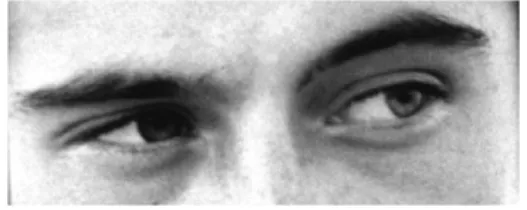
The‘Reading the Mind in the Eyes’Test (Eyes Test) (Baron-Cohen et al., 2001; Baron-Cohen et al., 1997) was devised as an adult test of empathy. Unlike the EQ, this task is a measure ofabilityto empathize. The test involves selecting one of four mental state terms that best describes the mental state of the actor whose eyes are displayed. As the subject is not required to identify with the feelings of the actor, this test only taps the cognitive component of empathy. The Embedded Figures Task is a measure of visual search ability in a perceptually complex background and high performance on this task is associated with a field-independent cognitive style (Witkin et al., 1971). Whilst the EFT does not require full systemizing, it does test attention to detail and analytic skills, which are prerequisites of systemizing. Both tests assess traits that are sexually dimorphic (Baron-Cohen & Hammer, 1997; Baron-Cohen et al., 2001) and are linked to particular academic or career choices (Witkin, Moore, Goodenough, & Cox, 1977; Witkin, Moore, Oltman et al., 1977; Van Blerkon, 1988).
Aims:
1. To retest the sex ratio in physical sciences and humanities.
2. To test if males show the profile of SNE, and if females show the profile of ENS, using both performance and questionnaire assessment.
3. To test if physical science students show the profile of SNE, and if humanities students show the profile of ENS, using both performance and questionnaire assessment.
4. To test if cognitive style (SNE or ENS) is a better predictor than sex in explaining enrolment into physical science vs. humanities.
1. Methods
1.1. Participants
415 students who could be unambiguously categorised into either physical science or humanities students were selected from an online data base set (male = 203, female = 212), seeTable 1. The average age was 21.0 years (S.D. = 2.51). 87.7% of the sample were right handed, 10.6% left-handed and 1.7% were ambidextrous. Recruitment was carried out via email post and advertisement throughout the university, with participants being offered an incentive of a prize draw if they completed all the tasks. Participants were excluded if they had any history of psychiatric illness.
Physical sciencedegree subjects consisted of mathematics, physics, physical natural sciences, chemistry, computer science, geology, communications, engineering, manufacturing engineering, chemical engineering, mineral science,
Table 1
Percentage of participants studying each degree category, by sex
Sex Degree N % of totalN
Female Physical 108 26.0% Humanities 104 25.1% Total 212 51.1% Male Physical 160 38.6% Humanities 43 10.4% Total 203 48.9% Total Physical 268 64.6% Humanities 147 35.4% Total 415 100.0%
material science, astrophysics, astronomy, and geophysics.Humanitiesdegree subjects consisted of classics, languages, drama, education, law, architecture, Anglo-Saxon, Norse and Celtic Studies, philosophy, oriental studies, English, linguistics, theology, history, history and philosophy of science, history of art and music.
1.2. Procedure and tasks
Both questionnaires and both performance tasks were carried out online via a secure university website (www. cambridgepsychology.com). All participants registering on the site were required to provide basic information that included sex, date of birth, handedness, diagnoses of medical conditions, educational level and degree type. They were invited to fill out two questionnaires and two performance tasks. These could be completed in any order and participants could return to the site if they wished to complete the tasks across multiple sessions. Participants could only complete each of the questionnaires/tasks once.
1.3. Questionnaires
The SQ-R is a modified version of the original SQ (Baron-Cohen et al., 2003). The final version of the SQ-R has 75 items (Wheelwright et al., 2006). The minimum possible score on the SQ-R is 0 and the maximum possible score is 150. The EQ is a 40-item questionnaire designed to assess cognitive and affective empathy (Baron-Cohen & Wheelwright, 2004). Scores on the EQ can range from 0 to 80. On both the EQ and SQ-R, participants are asked to respond‘definitely agree’,‘slightly agree’,‘slightly disagree’or‘definitely disagree’to each item, and approximately half the items are reverse scored to avoid response bias.
A‘brain type’was calculated for each participant using a method reported in (Wheelwright et al., 2006) in order to give an indication of their relative SQ-R and EQ scores. The five brain types comprised: Type S, Type E, Type B (Balanced), Extreme Type E, and Extreme Type S. In calculating the brain types, SQ-R and EQ scores were standardised using the following formulae: S = (SQ-R−bSQ-RN) / 150 and E = (EQ−bEQN) / 80.bSQ-RNandbEQN represent established population means of 55.6 and 44.3, respectively (Wheelwright et al., 2006). The original EQ and SQ-R axes were then rotated by 45° to produce a new variable;D. TheDscore gives an indication of the difference between each individual's EQ and SQ-R score. Those in the lowest and highest 2.5% of the population were classed as Extreme Type E and Extreme Types S, respectively. Those who scored between the 2.5th and 35th percentiles were Type E, and those scoring between the 65th and 97.5th percentile were defined as Type S. The remaining individuals, between the 35th and 65th percentile, defined as Type B.
1.4. Tasks
A forced choice version of the Embedded Figures Task (FC-EFT) was created so that responses could be recorded using online testing. The items on the FC-EFT were piloted in conjunction with items from the original EFT task
(Witkin, Moore, Goodenough et al., 1977) and scores between both tasks correlated highly. The FC-EFT involves selecting one of two possible answers. Participants were told they were going to see a series of 12 pairs of diagrams (seeFig. 1). Their task was to find the small black and white shape in one of the two larger, more complex, diagrams. They were told to press one of two keys to indicate whether the target shape was in the left or right picture. They were informed that if they had not made a decision within 50 s, the task would automatically move on to display the next pair of pictures.
The Eyes Test (Baron-Cohen et al., 2001) is a four-choice task assessing cognitive empathy (seeFig. 2). Participants were told that they had to choose one of four words that best describes what the person in the picture is thinking or feeling. They were told to press 1 if it was the top left word, 9 if it was the top right word,Qif it was the bottom left word and I if it was the bottom right word. They were also told if they had not made a decision in 20 s, the task would automatically move on to display the next photograph.
1.5. Scoring
For the two performance tasks (FC-EFT and Eyes Test) participants were awarded one point for each correct item plus an additional bonus point if they were in the fastest 25% of correct responders for that item. A‘total’ score was computed for each task by summing the individual items. Thus, scores for the FC-EFT range from 0 to 24 and for the Eyes Test from 0 to 72. As they reflect reaction time and error rate, only these scores were considered when exploring results. This is the first study to look at both the Eyes Test and the FC-EFT in the same sample. Thus, no established population means were available in order to create amalgamated brain type scores. A One-Sample Kolmogorov–Smirnov Test was carried out on both questionnaire and performance scores prior to analysis. Distributions were found not to be significantly different from normal (pN0.01). Thus, parametric tests were used.
2. Results
There was a sex difference between the two classes of academic disciplines, 59.1% of physical science students being males and 70.1% of humanities students being female. This association was strongly sig-nificant (χ2= 35.22, p= 0.001). Percentages of participants categorised by degree subject and sex are shown in
Table 1.
Questionnaire results showed that there was also a significant relationship between sex and cognitive style indicated by brain type (χ2= 67.69,p= 0.001). EQ and SQ-R and performance scores categorised by sex and degree subject are shown inTable 2. 66% of males were categorised as either Type S or Extreme Type S compared to 28.8% of females. 36.8% of females were categorised as Type E or Extreme Type E, compared to 10.3% of males. These results can be seen inFig. 3. Performance tests partially reflected this finding with females scoring significantly higher than males on the Eyes Test (t=−2.85,df= 413,p= 0.005). There was no significant sex difference on the FC-EFT. Thus, overall both questionnaire and performance measures suggest there is evidence for an ENS profile in females and an SNE profile in males.
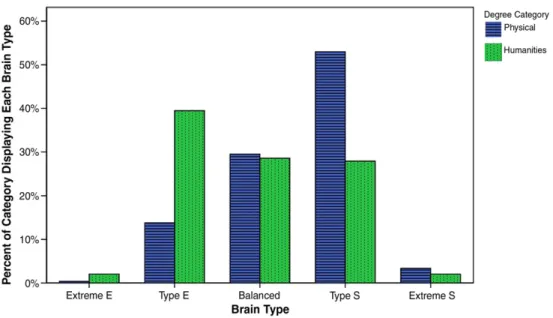
Of the physical science students, 56.3% showed either an Extreme Type S or Type S profile compared to 29.9% of humanities students. Whilst 41.5% of humanities students obtained an Extreme Type E or a Type E profile, only 14.2% of physical scientists obtained this profile, seeFig. 4. Furthermore, physical scientists performed better than humanities students on the FC-EFT (t= 3.42, df= 361, p= 0.001) and worse than the humanities students on the Eyes task (t=−3.96,df= 413,p= 0.001). Thus, results from questionnaire data and performance data indicate an SNE profile for physical science students as a group and an ENS profile for humanities students as a group, regardless of sex.
In order to assess whether cognitive profile was a stronger predictor than sex for entry into a physical science vs. a humanities subject, a logistic regression was performed, with degree category as the dependent variable and brain type, FC-EFT score, Eyes Test score and sex as the independent variables. Logistic regression allows one to make forecasts about category membership based on several predictor variables. The full model was significant (χ2= 87.4,
p= 0.001) and accounted for between 19% and 26.1% of the variance in degree subject studied. Overall, 71.3% of the predictions from this model were accurate. Wald's statistics showed that all of the included independent variables
Fig. 3. Percentage of males and females displaying each brain type. Table 2
SQ-R, EQ, FC-EFT and Eyes Test scores by degree category and sex
Mean S.D. Female Physical SQ-R 61.23 20.60 EQ 43.48 12.56 FC-EFT 15.05 3.05 Eyes Test 32.86 6.65 Humanities SQ-R 51.54 19.18 EQ 46.82 12.07 FC-EFT 14.07 2.40 Eyes Test 35.69 6.95 Male Physical SQ-R 65.46 18.17 EQ 35.59 10.39 FC-EFT 15.03 3.14 Eyes Test 31.83 7.23 Humanities SQ-R 58.65 21.17 EQ 40.56 10.33 FC-EFT 14.14 2.63 Eyes Test 33.79 8.00
reliably predicted degree subject studied; however, brain type was the strongest predictor (W= 23.29, df= 3,
pb0.001), followed by FC-EFT performance (W= 16.55,df= 1,pb0.001), Eyes Test performance (W= 16.27,df= 1,
pb0.001), and sex (W= 11.40, df= 1, pb0.001). In summary, these results show that brain type, followed by performance measures on tests of empathy and field independence are the greatest predictors of degree subject entry, whilst sex is the least critical factor.
3. Conclusions
This study tested the relationship between sex, cognitive style, cognitive performance, and academic degree subject. As predicted, questionnaire scores for both the EQ and the SQ showed significant sex differences. On average, males obtained higher systemizing scores, both relative to their own empathizing scores and relative to female systemizing scores. Females displayed the opposite cognitive profile. Despite these sex differences results indicated that, regardless of sex, stronger systemizing and weaker empathizing was associated with students in the physical sciences compared to students reading humanities. Extremely high systemizing scores were only seen in male physical scientists and extremely low systemizing scores were only seen in female humanities students, whilst the converse was true for empathizing scores. Thus, of the predictor variables used in this study, it seems a greater preference for systemizing, a field independent style and (to a lesser extent) a lower empathy score (both in preference and ability) predict whether an individual is studying a physical science or a humanities subject. Logistic regression showed that, whilst males were more likely to enter physical sciences, and females were more likely to enter humanities subjects, sex was the least significant predictor, indicating that an individual's biological sex is not a strong determinant of academic career choice. These findings have important implications for higher education and the work place. Principally, they suggest that the sex ratio of certain occupations or degree subjects reflect differences in empathizing and systemizing. This study replicates our previous study (Wheelwright et al., 2006), showing enhanced systemizing in science and mathematics students, this time revealed through performance as well as questionnaire measures. Thus, individuals with low systemizing scores (predominantly females) may be less likely to pursue scientific academic disciplines, presumably a result of difficulties in dealing with domains in which systemizing is required.
This study also provides insight into the way individuals with a Type S or Type E may learn in a classroom environment and can help educators tailor teaching methods to suit individual styles. For example, if on average, boys and girls show a difference in systemizing (boys being more likely to be Type S), it may be useful to adapt teaching methods accordingly. Support for this has been found by (Gredlein & Bjorklund, 2005) who looked at the ability of 3-year-old children to retrieve an out-of-reach toy using six tools. Boys outperformed girls in using the tools to retrieve the toy on the initial baseline task. However, once girls had been given hints on how to use the tools, they performed
just as well as boys. Thus, girls may only require additional scaffolding to increase interest in systems and perform at the same level as boys.
In conclusion, in examining the relationship between sex, cognitive style and academic discipline, this study finds that a person's relative drive to systemize or empathize, coupled with their degree of field-independence as a cognitive style, plays a large part in determining entry into the physical sciences or humanities, regardless of sex. Our analysis shows the importance of looking at individuals in terms of their ‘brain type’, defined in terms of the discrepancy between empathizing and systemizing, rather than by their sex.
Acknowledgments
The authors were supported by the MRC (UK) and the Nancy Lurie Marks Family Foundation, during the period of this work. We are grateful to Anu Parekh, Claire Hoxley, Alex Pollitt and Vicky Kaziewicz for help with data collection, and to Nigel Goldenfeld, Johnny Lawson and Akio Wakabayashi for valuable discussions.
References
Atur, R. S., Ortix, M. L., & Sutherland, R. J. (1998). A characterization of performance by men and women in a virtual Morris Water Task: A large and reliable sex difference.Behavioural Brain Research,93, 185−190.
Baron-Cohen, S. (1995).Mindblindness: An essay on autism and theory of mind.Boston: MIT Press/Bradford Books. Baron-Cohen, S. (2002). The extreme male brain theory of autism.Trends in Cognitive Sciences,6, 248−254. Baron-Cohen, S. (2003).The essential difference: Men, women and the extreme male brain.London: Penguin.
Baron-Cohen, S., & Hammer, J. (1997). Is autism an extreme form of the male brain?Advances in Infancy Research,11, 193−217.
Baron-Cohen, S., Joliffe, T., Mortimore, C., & Robertson, M. (1997). Another advanced test of theory of mind: Evidence from very high functioning adults with autism or Asperger syndrome.Journal of Child Psychology and Psychiatry,38, 813−822.
Baron-Cohen, S., O'Riordan, M., Stone, V., Jones, R., & Plaisted, K. (1999). Recognition of faux pas by normally developing children and children with Asperger syndrome or high-functioning autism.Journal of Autism and Developmental Disorders,29, 407−418.
Baron-Cohen, S., Richler, J., Bisarya, D., Gurunathan, N., & Wheelwright, S. (2003). The systemizing quotient: An investigation of adults with Asperger syndrome or high-functioning autism, and normal sex differences.Philosophical Transactions of the Royal Society of London. Series B Biological Sciences,358, 361−374.
Baron-Cohen, S., & Wheelwright, S. (2004). The empathy quotient: An investigation of adults with Asperger syndrome or high functioning autism, and normal sex differences.Journal of Autism and Developmental Disorders,34, 163−175.
Baron-Cohen, S., Wheelwright, S., Hill, J., Raste, Y., & Plumb, I. (2001). The“Reading the Mind in the Eyes”test revised version: A study with normal adults, and adults with Asperger syndrome or high-functioning autism. Journal of Child Psychology and Psychiatry and Allied Disciplines,42, 241−251.
Benbow, C. P. (1988). Sex-differences in mathematical reasoning ability in intellectually talented preadolescents–Their nature, effects, and possible causes.Behavioral and Brain Sciences,11, 169−183.
Billington, J., Baron-Cohen, S., & Bor, D. (submitted for publication) Systemizing influences attention during the Navon task: An fMRI study. Contreras, M. J., Colom, R., Shih, P. C., Alava, M. J., & Santacreu, J. (2001). Dynamic spatial performance: Sex and educational differences.
Personality and Individual Differences,30, 117−126.
Davis, M. H. (1980). A multidimensional approach to individual differences in empathy.JSAS Catalogue of Selected Documents in Psychology,10, 85. Davis, M. H. (1983). Measuring individual differences in empathy: Evidence for a multidimensional approach.Journal of Personality and Social
Psychology,44, 113−126.
Davis, M. H. (1994).Empathy: A social psychological approach.Colorado: Westview Press.
Eisenberg, N. (2002). Empathy-related emotional responses, altruism, and their socialization. In R. J. Davidson & A. Harrington (Eds.),Visions of compassion: Western scientists and Tibetan Buddhists examine human nature( pp. 131−164). London: Oxford University Press.
Geary, D. C., Saults, S. J., Liu, F., & Hoard, M. K. (2000). Sex differences in spatial cognition, computational fluency and arithmetical reasoning. Journal of Experimental Child Psychology,77, 337−353.
Goldenfeld, N., Baron-Cohen, S., & Wheelwright, S. (2005). Empathizing and systemizing in males, females and autism.International Journal of Clinical Neuropsychiatry, 2, 338−345.
Gredlein, J. M., & Bjorklund, D. F. (2005). Sex differences in young children's use of tools in a problem-solving task–The role of object-oriented play.Human Nature–An Interdisciplinary Biosocial Perspective,16, 211−232.
Hall, J. A. (1978). Gender effects in decoding nonverbal cues.Psychological Bulletin,85, 845−857.
Hoffman, M. L. (1977). Sex-differences in empathy and related behaviors.Psychological Bulletin,84, 712−722. Kimura, D. (1999).Sex and cognition.Cambridge, MA: MIT Press.
Lawrence, P. A. (2006). Men, women, and ghosts in science.PLoS Biology,4, 13−15.
Lawrence, E. J., Shaw, P., Baker, D., Baron-Cohen, S., & David, A. S. (2004). Measuring empathy: Reliability and validity of the Empathy Quotient. Psychological Medicine,34, 911−919.
Lawson, J., Baron-Cohen, S., & Wheelwright, S. (2004). Empathising and systemising in adults with and without Asperger syndrome.Journal of Autism and Developmental Disorders,34, 301−310.
Linn, M. C., & Petersen, A. C. (1985). Emergence and characterisation of sex differences in spatial ability: A meta-analysis.Child Development,56, 1479−1498.
Linn, M. C., & Peterson, A. C. (1986). A meta-analysis of gender differences in spatial ability: Implications for mathematics and science achievement. In J. S. Hyde & M. C. Linn (Eds.),The psychology of gender: Advances through meta-analysis.Baltimore: The Johns Hopkins University Press.
Moffat, E., Hampson, E., & Hatzipantelis, M. (1998). Navigation in a‘virtual’maze: Sex difference and correlation with psychometric measure of spatial ability in humans.Evolution and Human Behavior,19, 73−87.
Singh, H., & O'Boyle, M. W. (2004). Interhemispheric interaction during global–local processing in mathematically gifted adolescents, average-ability youth, and college students.Neuropsychology,18, 371−377.
Vaidya, S., & Chansky, N. (1980). Cognitive-development and cognitive-style as factors in mathematics achievement.Journal of Educational Psychology,72, 326−330.
Van Blerkon, M. (1988). Field dependence, sex role self-perceptions, and mathematics achievement in collage students: A closer examination. Contemporary Educational Psychology,13, 339−347.
Voyer, D., Voyer, S., & Bryden, M. (1995). Magnitude of sex differences in spatial abilities: A meta-analysis and consideration of critical variables. Psychological Bulletin,117, 250−270.
Wellman, H. (1990).Children's theories of mind.Bradford: MIT Press.
Wheelwright, S., Baron-Cohen, S., Goldenfeld, N., Delaney, J., Fine, D., Smith, R., et al. (2006). Predicting Autism Spectrum Quotient (AQ) from the Systemizing Quotient-Revised (SQ-R) and Empathy Quotient (EQ).Brain Research,1079, 47−56.
Witkin, H. A., Dyk, R., Faterson, H. F., Goodenough, D. G., & Karp, S. A. (1962).Personality through perception.New York: Harper & Row. Witkin, H. A., Moore, C. A., Goodenough, D. R., & Cox, P. W. (1977). Field-dependent and field-independent cognitive styles and their educational
implications.Review of Educational Research,47, 1−64.
Witkin, H. A., Moore, C. A., Oltman, P. K., Goodenough, D. R., Friedman, F., Owen, D. R., et al. (1977). Role of dependent and field-independent cognitive styles in academic evolution–Longitudinal-study.Journal of Educational Psychology,69, 197−211.
Witkin, H. A., Oltman, P., Raskin, E., & Karp, S. (1971).A manual for the Embedded Figures Task.Palo Alto, CA: Consulting Psychologists Press, Inc.