For More Information
Visit RAND at www.rand.org Explore RAND Project AIR FORCE View document details
Support RAND
Purchase this document Browse Reports & Bookstore Make a charitable contribution
Limited Electronic Distribution Rights
This document and trademark(s) contained herein are protected by law as indicated in a notice appearing later in this work. This electronic representation of RAND intellectual property is provided for non-commercial use only. Unauthorized posting of RAND electronic documents to a non-RAND website is prohibited. RAND electronic documents are protected under copyright law. Permission is required from RAND to reproduce, or reuse in another form, any of our research documents for commercial use. For information on reprint and linking permissions, please see
RAND Permissions.
Skip all front matter: Jump to Page 1
6
The RAND Corporation is a nonprofit institution that helps improve policy and decisionmaking through research and analysis.
This electronic document was made available from www.rand.org as a public service of the RAND Corporation.
CHILDREN AND FAMILIES EDUCATION AND THE ARTS ENERGY AND ENVIRONMENT
HEALTH AND HEALTH CARE INFRASTRUCTURE AND
TRANSPORTATION INTERNATIONAL AFFAIRS LAW AND BUSINESS NATIONAL SECURITY POPULATION AND AGING PUBLIC SAFETY SCIENCE AND TECHNOLOGY TERRORISM AND HOMELAND SECURITY
This product is part of the RAND Corporation monograph series. RAND monographs present major research findings that address the challenges facing the public and private sectors. All RAND mono-graphs undergo rigorous peer review to ensure high standards for research quality and objectivity.
Mark A. Lorell Michael Kennedy Robert S. Leonard Ken Munson Shmuel Abramzon David L. An Robert A. Guffey
Do Joint
Fighter
Programs
Save
Money?
C O R P O R A T I O NMark A. Lorell, Michael Kennedy, Robert S. Leonard, Ken Munson, Shmuel Abramzon, David L. An, Robert A. Guffey
Do Joint
Fighter
Programs
Save
Money?
PROJECT AIR FORCEPrepared for the United States Air Force
The RAND Corporation is a nonprofit institution that helps improve policy and decisionmaking through research and analysis. RAND’s publications do not necessarily reflect the opinions of its research clients and sponsors.
Support RAND—make a tax-deductible charitable contribution at www.rand.org/giving/contribute.html
R® is a registered trademark
Cover image courtesy of iStockphoto.
© Copyright 2013 RAND Corporation
This document and trademark(s) contained herein are protected by law. This representation of RAND intellectual property is provided for noncommercial use only. Unauthorized posting of RAND documents to a non-RAND website is prohibited. RAND documents are protected under copyright law. Permission is given to duplicate this document for personal use only, as long as it is unaltered and complete. Permission is required from RAND to reproduce, or reuse in another form, any of our research documents for commercial use. For information on reprint and linking permissions, please see the RAND permissions page (www.rand.org/pubs/permissions.html).
RAND OFFICES
SANTA MONICA, CA • WASHINGTON, DC
PITTSBURGH, PA • NEW ORLEANS, LA • JACKSON, MS • BOSTON, MA DOHA, QA • CAMBRIDGE, UK • BRUSSELS, BE
www.rand.org
Library of Congress Cataloging-in-Publication Data is available for this publication. ISBN: 978-0-8330-7456-0
The research described in this report was sponsored by the United States Air Force under Contract FA7014-06-C-0001. Further information may be obtained from the Strategic Planning Division, Directorate of Plans,
iii
Preface
In the past 50 years, the U.S. Department of Defense (DoD) has pur-sued numerous joint aircraft programs, the largest and most recent of which is the F-35 Joint Strike Fighter (JSF). Joint aircraft programs, in which two or more services participate in the development, pro-curement, and sustainment of a single aircraft design, are thought to save significant Life Cycle Cost (LCC) by eliminating duplicate efforts and realizing economies of scale.
But the need to accommodate different service requirements in a single design or common design family leads to greater program complexity, increased technical risk, and common functionality or increased weight beyond that needed for some variants, potentially leading to higher overall cost, despite the efficiencies. The fundamental question we seek to answer is how much savings accrue, on average, from joint aircraft programs and are they sufficient to offset the addi-tional costs arising from greater complexity? In short, do joint fighter and other aircraft programs cost less overall throughout their entire life cycles than an equivalent set of specialized, single-service systems?
To help Air Force leaders (and acquisition decisionmakers in gen-eral) select an appropriate acquisition strategy for future combat air-craft, Gen Donald Hoffman, as former commander of Air Force Mate-riel Command (AFMC), asked RAND Project AIR FORCE to analyze the costs and savings of joint tactical aviation acquisition programs. The study team examined whether historical joint aircraft programs, and JSF in particular, have saved LCC compared with comparable single-service programs. Also examined were the implications of joint fighter
iv Do Joint Fighter Programs Save Money?
programs for the health of the industrial base and for operational and strategic risk. Greater detail on the methodologies and approaches used in the analysis reported in this document has been published in a sepa-rate document.1
Our analysis shows that historical joint aircraft programs have not saved overall LCC versus single-service aircraft programs and that JSF is currently not on the path to saving LCC versus comparable notional single-service fighter programs. The objective of this research was to inform the formulation of acquisition strategies and program structures for future fighter and other aircraft major defense acquisi-tion programs. These findings do not, therefore, directly address policy questions regarding the current or future status of JSF. However, they can provide insight into how and why JSF has arrived at its current status with respect to cost and cost growth, and they could contribute to broader analysis seeking to develop policy options for the way ahead for the JSF program.
The research reported here was sponsored by Gen Donald Hoffman, former Commander of Air Force Materiel Command, and conducted within the Resource Management Program of RAND Proj-ect AIR FORCE as part of the “Cost/Benefit Analysis of Joint Tactical Aviation Acquisition Programs” project.
This document should be of interest to the senior defense acquisi-tion and cost analysis policy communities.
RAND Project AIR FORCE
RAND Project AIR FORCE (PAF), a division of the RAND Corpo-ration, is the U.S. Air Force’s federally funded research and develop-ment center for studies and analyses. PAF provides the Air Force with independent analyses of policy alternatives affecting the development, employment, combat readiness, and support of current and future air, 1 See Mark A. Lorell, Michael Kennedy, Robert S. Leonard, Ken Munson, Shmuel Abramzon, David L. An, and Robert A. Guffey, Do Joint Fighter Programs Save Money? Technical Appendixes on Methodology, Santa Monica, Calif.: RAND Corporation, MG-1225/1-AF, 2013.
Preface v
space, and cyber forces. Research is conducted in four programs: Force Modernization and Employment; Manpower, Personnel, and Train-ing; Resource Management; and Strategy and Doctrine.
Additional information about PAF is available on our website: http://www.rand.org/paf/
vii
Contents
Preface . . . iii Figures . . . ix Tables . . . xi Summary . . . .xiii Acknowledgments . . . .xxi Abbreviations . . . xxiii CHAPTER ONE Introduction . . . 1Focus on Joint Aircraft Acquisition . . . .1
Project Objectives and Approach . . . .3
Organization of This Report . . . .5
CHAPTER TWO Historical Joint Fighter and Other Joint Aircraft Programs: Analysis of Savings and Costs . . . .7
Methodology . . . .7
Major Cost Findings . . . .10
Factors Contributing to Cost Growth . . . .17
CHAPTER THREE Joint Strike Fighter Program: Analysis of Savings and Costs . . . .21
Methodology . . . 22
Major Cost Findings . . . .25
viii Do Joint Fighter Programs Save Money?
CHAPTER FOUR
Additional Implications of Joint Aircraft Programs . . . .33
Implications for the Industrial Base . . . .33
Implications for Operational and Strategic Risk . . . .35 CHAPTER FIVE
Conclusions . . . .39 Bibliography . . . .41
ix
Figures
S.1. Estimated Nine Years Past Milestone B, Life Cycle Cost for Joint Strike Fighter Would Be Higher Than Those for Three Notional Single-Service Programs . . . .xvii
2.1. Historical Joint Aircraft Programs Have Incurred an Acquisition Cost-Growth Premium Compared with Single-Service Aircraft Programs . . . .11
2.2. Theoretical Maximum Savings from a Representative Two-Service Joint Aircraft Acquisition Program Are Offset by the Average Joint Acquisition Cost-Growth Premium . . . .13
2.3. Maximum Operations and Support Savings from Ideal Joint Fighter Programs Are Unlikely to Offset the Joint
Aircraft Acquisition Cost-Growth Premium . . . .16
2.4. Differing Operational Environments and Service
Requirements Led to Many Variants, Less Commonality, and Greater Program Complexity, and Thus Reduced Joint Cost Savings . . . .19
3.1. Estimated at Milestone B, Research, Development, Test, Evaluation, and Procurement for Joint Strike Fighter Would Cost Less Than for Three Notional Single-Service Programs . . . 26
3.2. Estimated Nine Years Past Milestone B, the Joint Strike Fighter Acquisition Program Would Cost More Than
Three Notional Single-Service Acquisition Programs . . . 27
3.3. Estimated at Milestone B, Life Cycle Cost for the Joint Strike Fighter Would Be Less Than Those of Three
x Do Joint Fighter Programs Save Money?
3.4. Estimated Nine Years Past Milestone B, Life Cycle Cost for the Joint Strike Fighter Would Be Higher Than Those of Three Notional Single-Service Programs . . . .29
3.5. Joint Strike Fighter Structural Commonality Has Declined Since Milestone B . . . .31
4.1. Recent Consolidation of Fighter Primes Coincides with
xi
Tables
2.1. Actual and Proposed Pre–Joint Strike Fighter Joint Tactical Fighter Programs Reviewed . . . .8
3.1. Methodological Approach for Comparing Actual Joint Strike Fighter Costs with Those of Three Notional Single-Service Fighters. . . 23
xiii
Summary
The U.S. Department of Defense (DoD) has launched or attempted to launch numerous joint fighter and other joint aircraft programs in the past 50 years.1 The largest and most recent is the F-35 Joint Strike Fighter (JSF), which was designed for use by the U.S. Air Force, U.S. Navy, U.S. Marine Corps, and international partners and is currently in low-rate initial production. The main purpose of a joint program, versus a set of single-service programs, is to save overall Life Cycle Cost (LCC) by eliminating duplicate research, development, test, and evalu-ation (RDT&E) efforts and achieving economies of scale in procure-ment and operations and support (O&S). Yet, the need to integrate multiple service requirements in a single design increases the complex-ity of joint programs and potentially leads to higher-than-average cost growth that could reduce or even negate potential savings.
There have been no comprehensive assessments of costs and sav-ings in historical joint aircraft programs based on actual joint aircraft program outcomes and historical cost data. To help inform future acquisition strategies for fighter aircraft, the commander of Air Force Materiel Command (AFMC) asked RAND Project AIR FORCE (PAF) to analyze the costs and benefits of historical joint aircraft pro-grams, from the early 1960s through today’s JSF. The project addressed five major questions:
1 Our definition of a fully joint aircraft program is an aircraft program in which two or more services are significantly involved in all stages of the acquisition and operational phases— that is, in the design, development, procurement, and operations and support (O&S) of the aircraft.
xiv Do Joint Fighter Programs Save Money?
• Have historical joint aircraft programs saved LCC compared with comparable single-service aircraft programs?
• Is JSF on track to save LCC compared with notional equivalent single-service fighter programs?
• What factors contributed to cost outcomes in historical joint air-craft programs, as well as JSF?
• What are the implications of a joint aircraft approach for the industrial base?
• What are the implications of a joint aircraft approach for opera-tional and strategic risk?2
The project performed quantitative and qualitative reviews of joint fighter and other joint aircraft programs, drawing from a broad range of published sources, as well as the RAND Selected Acquisi-tion Report (SAR) database (SARs document cost and schedule esti-mates at different stages; the RAND SAR database includes more than 300 major defense acquisition programs) and databases of his-torical O&S costs for Air Force aircraft. The data-cutoff point for this analysis was November 2011. Greater detail on the methodologies and approaches used in the analysis reported in this document has been published in a separate document.3
Because of the impossibility of making direct cost comparisons, in which multiple similar single-service programs were developed in parallel with an equivalent joint program, PAF sought to answer the question of which approach costs less by comparing the cost growth of joint and single-service programs. If cost growth tends to differ and be higher for joint programs, this would suggest that the difficulties 2 One of the operational benefits of a joint approach is greater interoperability among the participating services. We addressed this in our assessment of economies of scale in O&S costs, which include the benefits of a common spare parts pool, a key part of interoperability. We did not assess other potential benefits of interoperability, such as the ability of one service to do maintenance on another’s aircraft if necessary.
3 See Mark A. Lorell, Michael Kennedy, Robert S. Leonard, Ken Munson, Shmuel Abramzon, David L. An, and Robert A. Guffey, Do Joint Fighter Programs Save Money? Technical Appendixes on Methodology, Santa Monica, Calif.: RAND Corporation, MG-1225/1-AF, 2013.
Summary xv
of joint, common programs are typically underestimated. The degree of underestimation, if any, can be used to estimate whether total costs become higher or lower.
The ultimate question we seek to answer with our full method-ology is whether or not, in the end, the actual, realized cost benefits of joint aircraft programs offset and exceed any increased costs due to greater complexity, resulting in a force of aircraft with lower LCC than those of an equivalent force of specialized, single-service aircraft.
PAF sought to answer this question by assessing historical joint aircraft program outcomes and cost data from the early 1960s through today’s JSF. Among the major findings was that historical joint air-craft programs have experienced so much higher rates of acquisition cost growth than single-service programs have that they have not saved overall LCC, despite any efficiencies from common efforts. Researchers also found that, nine years past Milestone B (MS B), the JSF program is not on the path to achieving the expected cost savings versus three separate notional, single-service fighter programs.
A summary of our major findings is as follows.
Historical joint aircraft programs have experienced higher rates of acquisition cost growth than single-service aircraft programs and have not saved overall LCC. We compared RDT&E and procurement cost-growth estimates for recent historical single-service and recent histori-cal joint aircraft programs at the same points in their program histories following the beginning of full-scale development (MS B), adjusting for changes in procurement quantity. Cost growth was measured in dollars of constant purchasing power, so inflation effects were properly accounted for. We found that joint programs experience substantially higher cost growth in acquisition than single-service programs do.4 Although joint aircraft programs may, in theory, save costs by sharing RDT&E resources and by achieving economies of scale in procure-ment and O&S, the maximum percentage theoretical savings in joint 4 In general, the word acquisition loosely refers to the entire process of acquiring major defense systems. In our discussion of historical program costs and JSF costs, we use acquisi-tion in the narrower technical sense as used by DoD cost analysts to refer to the combined RDT&E and procurement portions of a program. Procurement refers to the production phase of the program.
xvi Do Joint Fighter Programs Save Money?
acquisition and O&S compared with equivalent single-service pro-grams are too small to offset the historically observed additional aver-age cost growth that joint aircraft programs experience in the acquisi-tion phase.
JSF is not on the path to deliver promised LCC savings. In order to determine whether or not JSF is on track to deliver the originally promised LCC savings, we developed LCC estimates for three notional single-service fighter programs at MS B and nine years after MS B to compare with actual JSF LCC estimates at the same points in the JSF program.5 We developed our estimates of LCC for three notional fight-ers based on conservative assumptions that favored JSF. We also recal-culated our estimates of notional single-service fighter LCC using a different methodology to verify the robustness of our original produc-tion cost estimates. Although the JSF program was structured to over-come some of the problems encountered by past joint fighter programs, it faced the challenge of accommodating three substantially different sets of service requirements (along with international partner require-ments) and ambitious technical and performance objectives (such as supersonic low observable short takeoff and vertical landing [STOVL] capability) into a single core aircraft design, with an 80-percent com-monality goal among service variants. Our analysis of SAR data shows that, nine years past MS B, estimated JSF LCC are higher than if the services had pursued three separate fighter programs.
As shown in Figure S.1, at the beginning of development (using MS B program baseline data), JSF LCC theoretically would be 16 per-cent less than our estimate of the cost of three notional single-service fighter programs. However, the situation changes after nearly a decade. Nine years past MS B, SAR estimates of JSF LCC are higher than our LCC estimates for notional single-service fighters. As indicated by the stacked bars on the right of the figure, if we apply F-22 cost-growth per-centages at MS C (9.7 years past MS B) to the notional single-service fighters’ MS B estimate, then JSF LCC are 65 percent higher. JSF LCC are 37 percent higher if we calculate the notional single-service pro-5 Nine years after MS B was the most recent point in time with full SAR cost data available for JSF at the time the analysis was undertaken.
Summary xvii
grams using the F-22 estimated O&S cost-growth percentage at initial operational capability (IOC), 14 years after MS B, when O&S costs were expected to be greater than in earlier estimates. Under none of the plausible conditions we analyzed did JSF have a lower LCC estimate than the notional single-service programs.
The difficulty of reconciling diverse service requirements in a common design is a major factor in joint cost outcomes. From the Tactical Fighter, Experimental (TFX)/F-111 program in the 1960s through the JSF pro-gram today, the attempt to accommodate multiple operating environ-ments, service-specific missions, and differing performance and tech-nology requirements in common joint fighter designs has increased programmatic and technical complexity and risk, thus prolonging RDT&E and driving up joint acquisition costs. At the same time, service-specific requirements and demands tend to produce less com-monality and lead to more variants, thus reducing the main source of joint cost savings anticipated in procurement and O&S. Historically, Figure S.1
Estimated Nine Years Past Milestone B, Life Cycle Cost for Joint Strike Fighter Would Be Higher Than Those for Three Notional Single-Service Programs (Assuming F-22 Cost-Growth Percentages)
RAND MG1225-S.1 600 400 300 200 100 0 800 900 500 700 Cost (billions of 2002 $) JSF (MS B, 2001) Three single service (MS B) JSF (2010) Three single service (with F-22 cost-growth rate)
Total LCC at MS B Total LCC nine years after MS B
O&S (F-22 cost-growth rate at 14 years)
O&S (F-22 cost-growth rate at 9.7 years)
O&S Procurement RDT&E
xviii Do Joint Fighter Programs Save Money?
joint fighter programs have typically evolved toward distinct service variants with significantly reduced commonality. For example, the congressionally mandated joint Air Combat Fighter program in the early 1970s evolved from an original goal of 100 percent commonal-ity into two distinct platforms with zero commonalcommonal-ity: the Air Force F-16A/B and the Navy F/A-18A/B. In other cases, necessary design compromises left the services unsatisfied and sometimes resulted in one or more partners withdrawing from the program, as in the case of the Air Force/Navy F-111 program and numerous others. These fac-tors work against the potential for joint cost savings, which depend on maximum commonality, and are a major contributor to the joint acquisition cost-growth premium identified in our cost analysis.
Joint aircraft programs are associated with a shrinking combat air-craft industrial base. Looking beyond cost considerations, the pur-suit of joint aircraft programs in recent decades has coincided with a reduction in the number of major fighter aircraft prime contractors from eight in 1985 to only three today. Currently, Lockheed Martin is the only prime contractor actively leading a fifth-generation manned fighter/attack aircraft development and production program (JSF) for the foreseeable future. Such a situation reduces the potential for future competition, may discourage innovation, and makes costs more diffi-cult to control. Whether the next fighter development program is joint or single service, acquisition decisionmakers will face the challenge of a smaller industrial base and must understand the impact of acquisition strategy on the long-term health of the industry.
Joint aircraft programs could potentially increase operational and strategic risk to warfighters. Having a variety of fighter platform types across service inventories provides a hedge against design flaws and maintenance and safety issues that could potentially cause fleet-wide stand-downs. Having a variety of fighter platform types also increases the options available to meet unanticipated enemy capabilities. For example, during the Korean War, the U.S. Air Force was able to rap-idly upgrade one of its four jet fighters, the F-86 Sabre, to meet the surprise introduction of the Russian Mikoyan-Gurevich (MiG)-15, a Soviet-designed fighter that was more capable than any other U.S. fighter in the Air Force or Navy inventory. Had the Air Force and
Summary xix
Navy relied exclusively on a single joint fighter other than the F-86, it might not have been able to respond quickly to the unanticipated new threat posed by the MiG-15. The more the U.S. military employs joint fighters, the fewer options will be available to meet unforeseen threats and crises in the future, as well as unanticipated safety and reliability issues that can ground entire fleets of specific aircraft types.
Informed by these findings, we recommend that, unless the participating services have identical, stable requirements, DoD avoid future joint fighter and other complex joint aircraft programs.
xxi
Acknowledgments
We are grateful for the broad expertise, advice, constructive criticism, and assistance provided by numerous Air Force officers, as well as colleagues at RAND, without whom this study could not have been completed. Gen Donald Hoffman, as former commander of Air Force Materiel Command (AFMC), initiated this research and provided cru-cial guidance throughout. The authors would also like to acknowledge Lt Gen (Ret) George K. Muellner, former Principal Deputy, Office of the Assistant Secretary of the Air Force for Acquisition, and former Director and Program Executive Officer, Joint Advanced Strike Tech-nology Program, for his invaluable insights into the early genesis of the Joint Strike Fighter (JSF) program. William Suit, Headquarters AFMC History Office, searched through vast amounts of primary source materials and provided extensive archival documentation that proved critical for our evaluation of historical joint fighter programs. Extensive information on the F-111 program derived from her care-ful study of the documentary record was graciously shared with us by Molly J. Waters, Operations Research Analyst, Headquarters AFMC. Former Lt Col Michael McGee, Operational Requirements Lead, JSF, Directorate of Operational Requirements, Headquarters U.S. Air Force, in the early phases of the JSF program, contributed useful infor-mation on the early parts of the process of reconciling requirements.
Jacques Gansler and Paul Kaminski, both former Under Secretar-ies of Defense for Acquisition and Technology, read earlier drafts of this document and provided valuable feedback. We greatly appreciate their assistance.
xxii Do Joint Fighter Programs Save Money?
Many RAND colleagues contributed crucial analysis, insights, critiques, and advice in the course of this research. In this regard, we are especially grateful for the contributions of Fred Timson, James S. Chow, Obaid Younossi, John C. Graser, Donald Stevens, Daniel M. Romano, Natalie W. Crawford, Paul DeLuca, and many others. Eric Peltz, Associate Director of the RAND National Security Research Division and Director of the RAND Supply Chain Policy Center, pro-vided a comprehensive critique of an earlier version of this document that led to significant improvements. We are particularly grateful to James S. Chow and Obaid Younossi for their formal technical reviews of the final draft of this document.
The constant support, substantive input, and critical guidance provided by Andrew R. Hoehn, RAND Senior Vice President for Research and Analysis and former Director of Project AIR FORCE; Lara Schmidt, Associate Director, RAND Project AIR FORCE; and Laura H. Baldwin, Director, Resource Management Program, RAND Project AIR FORCE, are greatly appreciated. We also owe a special debt of gratitude to our project monitor, Dr. Ross Jackson, Deputy Division Chief, Studies and Analyses Division, Headquarters AFMC, for his considerable assistance and encouragement.
xxiii
Abbreviations
ACF Air Combat Fighter (F-16) AFMC Air Force Materiel Command AFTOC Air Force Total Ownership Cost A/F-X Advanced Attack Fighter Aircraft
ASTOVL advanced short takeoff and vertical landing ATA Advanced Tactical Aircraft
ATE Advanced Technology Engine (F100) ATF Advanced Tactical Fighter (F-22)
A-X Attack, Experimental (joint Navy–Air Force, predecessor to A/F-X, early 1990s; also the name of an Air Force program from 1966 to 1972, which then became the A-10 program)
CAIG Cost Analysis Improvement Group CAPE Cost Assessment and Program Evaluation CAS close air support
CGF cost-growth factor
CTOL conventional takeoff and landing CV aircraft carrier capable
xxiv Do Joint Fighter Programs Save Money?
DoD U.S. Department of Defense
EMD engineering and manufacturing development F-X fighter, experimental; applied to many programs
over the years, including the F-15 program in the late 1960s
FY fiscal year
IOC initial operational capability JAST Joint Advanced Strike Technology JEP Joint Engine Program (F100)
JIAWG Joint Integrated Avionics Working Group JPATS Joint Primary Aircraft Training System JPO joint program office
JSF Joint Strike Fighter
JSTARS Joint Surveillance Target Attack Radar System LCC Life Cycle Cost
LIMS-EV Logistics Installations and Mission Support– Enterprise View
LO low observable
LTV Ling Tempco Vought Corporation MiG Mikoyan-Gurevich
MS milestone
NACF Navy Air Combat Fighter (YF-17/F-18) NATF Navy Advanced Tactical Fighter O&S operations and support
Abbreviations xxv
PAF RAND Project AIR FORCE R&D research and development
RDT&E research, development, test, and evaluation SAR Selected Acquisition Report
SSF Supersonic Short Takeoff and Vertical Landing Fighter
STOVL short takeoff and vertical landing T1 first production article
TFX Tactical Fighter, Experimental (F-111) VFX Navy Fighter, Experimental (F-14)
1
CHAPTER ONE
Introduction
Focus on Joint Aircraft Acquisition
The U.S. Department of Defense (DoD) has launched joint tactical fighter programs to meet the needs of multiple services many times since the 1960s. The largest and most recent program is the Lockheed Martin F-35 Joint Strike Fighter (JSF), which was developed for use by the U.S. Air Force, U.S. Navy, U.S. Marine Corps, and interna-tional partners and is currently in low-rate initial production. The pri-mary objective of joint, versus single-service, programs is to save money by eliminating duplicate research, development, test, and evaluation (RDT&E) efforts and by realizing economies of scale in procurement and operations and support (O&S). Yet, the need to integrate multiple service requirements in a single common design increases the complex-ity and technical challenges of joint programs and potentially leads to higher-than-average cost growth that could reduce or even negate potential savings compared with an equivalent number of specialized single-service aircraft programs.1
1 Our focus is primarily on joint fighter aircraft programs and secondarily on joint acquisi-tion of other types of military aircraft. We do not consider joint acquisiacquisi-tion of other types of systems, for which the outcome of the analysis could be quite different. We define joint fighter acquisition program as an acquisition program in which more than one service is involved from the inception in the design, development, procurement, and sustainment of the aircraft. Thus, a program in which one service unilaterally develops a fighter that is then procured jointly is viewed as a joint procurement program but not a fully joint acquisition program. For one excellent methodological discussion, including case studies on determin-ing whether programs could benefit from a joint acquisition approach, see Thomas Held, Bruce Newsome, and Matthew W. Lewis, Commonality in Military Equipment: A Framework
2 Do Joint Fighter Programs Save Money?
Although there have been many analyses of the potential savings from joint aircraft programs, there have been no comprehensive analy-ses of actual outcomes based on cost data from historical joint aircraft programs. Several questions require detailed analysis: Have joint air-craft programs experienced greater or lesser cost growth than single-service programs? Has a joint approach yielded sufficient RDT&E, procurement, and O&S savings to offset any additional cost growth arising from the complexities of a joint approach, thus resulting in net life-cycle savings compared with single-service programs? Looking beyond cost issues, to what extent have the participating services com-promised on requirements in order to achieve system commonality in joint aircraft programs? How do joint programs affect the fighter and military aircraft industrial base in the long term? Do fewer fighter air-craft designs and fewer fighter platform types across the service inven-tories affect operational and strategic risk for warfighters?
In theory, joint programs have the potential to save costs com-pared with comparable single-service programs by reducing total RDT&E expenditures and achieving economies of scale in produc-tion and O&S. But the need to accommodate different service require-ments in a single design or common design family leads to greater pro-gram complexity, increased technical risk, and common functionality or increased weight in excess to that needed for some variants, poten-tially leading to higher overall cost and unwelcome design and perfor-mance penalties, despite these efficiencies. The fundamental question we seek to answer is whether, on average, the savings that should accrue from joint aircraft programs are sufficient to offset the additional costs arising from greater complexity and nonoptimal designs. In short, do joint fighter and other joint aircraft programs cost less overall through-out their entire life cycles than an equivalent set of specialized single-service systems?2
to Improve Acquisition Decisions, Santa Monica, Calif.: RAND Corporation, MG-719-A, 2008.
2 We do not attempt to place a quantitative cost value on the effects of procuring nonopti-mized joint designs but note that it could have significant effects on overall force capability.
Introduction 3
Answering these questions will help Air Force leaders (and acqui-sition decisionmakers in general) to select an appropriate acquiacqui-sition strategy for future combat aircraft programs and to ensure that future joint aircraft programs are carried out in the most efficient and benefi-cial manner possible.
Project Objectives and Approach
In July 2011, Gen Donald Hoffman, commander of Air Force Materiel Command (AFMC),3 asked RAND Project AIR FORCE (PAF) to conduct a detailed assessment of cost savings from joint tactical fighter programs, beginning with the Tactical Fighter, Experimental (TFX)/ F-111 program in the early 1960s and ending with JSF, in order to inform acquisition strategy discussions for future combat aircraft. The analysis examined the following major questions:
• Have historical joint aircraft programs saved Life Cycle Cost (LCC) compared with comparable single-service aircraft pro-grams?
• Is JSF on track to providing the promised LCC savings?
• What factors contributed to cost outcomes in historical joint air-craft programs, as well as JSF?
• What are the implications of a joint aircraft approach for the industrial base?
• What are the implications of a joint aircraft approach for opera-tional and strategic risk?
We used the best data available to analyze historical aircraft pro-grams and JSF. A major source was the RAND Selected Acquisition Report (SAR) database, which documents cost and schedule estimates and procurement quantities at different stages of more than 300 major
3 All positions, ranks, and offices as they appear in this document are current as of the completion of the research in December 2011.
4 Do Joint Fighter Programs Save Money?
defense acquisition programs dating back to the late 1960s (the data-cutoff point for this analysis was November 2011).
However, data about historical joint fighter aircraft programs are incomplete because all joint fighter programs other than JSF that were initiated in the past 50 years did not reach the joint procurement stage.4 Where data are lacking, we made conservative estimates (described further in Chapters Two and Three) that were generally favorable to joint programs.
Looking beyond cost considerations, we also briefly analyzed the effects of joint fighter programs on the combat aircraft industrial base, as well as operational and strategic risks associated with multiservice dependency on a single basic fighter platform design.
We adopted a two-pronged approach using quantitative and qual-itative analysis to assess the potential operational and strategic risks posed by heavy dependence on a single basic platform design.5 For the quantitative analysis, we used historical data on fleet-wide stand-downs of various Air Force fighter aircraft types, and then projected the dif-ferent future probabilities of a fleet-wide stand-down of all fighters, depending on the number of different types of basic platform designs and fighter types across the inventories of the three services. For the qualitative analysis, we surveyed post–World War II U.S. air combat experience to understand how the number of different fighter types across the service inventories affected operational and strategic risk.
4 Thus, JSF is not only the largest, most ambitious, and complex joint fighter program in history; it is the only fully joint fighter program (by our definition) in the past 50 years to have progressed beyond the joint development stage into the joint procurement phase. 5 One of the operational benefits of a joint approach is greater interoperability among the participating services. We addressed this in our assessment of economies of scale in O&S cost, which include the benefits of a common spare parts pool, a key part of interoperability. The other potential benefits of interoperability, such as the ability of one service to do main-tenance on another’s aircraft in an emergency situation, do not affect the cost of operating the aircraft.
Introduction 5
Greater detail on the methodologies and approaches used in the analysis reported in this document has been published in a separate document.6
Organization of This Report
This report documents the major findings of the PAF analysis. Chapters Two and Three present our analysis of historical and JSF program costs, respectively. In each chapter, we describe the analytical approach; pre-sent findings for LCC, including RDT&E, procurement, and O&S; and discuss the factors that contribute to these cost outcomes. Chapter Four summarizes our conclusions regarding the implications of joint aircraft programs for the industrial base and for operational and stra-tegic risk. Chapter Five summarizes our conclusions and recommenda-tions for the Air Force.
6 See Mark A. Lorell, Michael Kennedy, Robert S. Leonard, Ken Munson, Shmuel Abramzon, David L. An, and Robert A. Guffey, Do Joint Fighter Programs Save Money? Technical Appendixes on Methodology, Santa Monica, Calif.: RAND Corporation, MG-1225/1-AF, 2013.
7
CHAPTER TWO
Historical Joint Fighter and Other Joint Aircraft
Programs: Analysis of Savings and Costs
Methodology
The first part of the analysis assessed cost outcomes related to actual historical joint fighter programs and other joint aircraft programs, compared with those of single-service programs. Although it is typical for major acquisition programs to experience some cost growth in the RDT&E and procurement phases, we assessed (1) whether joint air-craft programs have historically experienced higher-than-average cost growth during RDT&E and procurement and, if so, (2) whether joint programs could save enough money in RDT&E, procurement, and O&S to offset such additional cost growth, thus resulting in lower LCC compared with an equivalent number of specialized single-service aircraft.
We began by identifying and examining 11 major joint fighter programs (Table 2.1) that were proposed from 1962 through 1996 (i.e., prior to JSF). All were intended to be major acquisition programs, and most were initiated by DoD or Congress.1 Of these, seven programs never progressed beyond the proposal stage to actual development and 1 F-117N/AF-117X and the Joint Advanced Strike Technology (JAST) program are excep-tions. F-117N and AF-117X were largely company initiatives promoted by Lockheed. When JAST was first launched, it was explicitly described by DoD as a joint technology demonstra-tion and maturademonstra-tion program, not a joint acquisidemonstra-tion program. However, it rapidly evolved into a de facto acquisition program and was explicitly recognized as such when it was reorga-nized and renamed as the JSF program in 1996.
It is important to note that Table 2.1 shows original program intent, not actual outcomes of these programs.
8 D o J o in t F ig h te r P ro g ra m s S av e M o n ey ? Table 2.1
Actual and Proposed Pre–Joint Strike Fighter Joint Tactical Fighter Programs Reviewed
Program Lead Service Dates
Design and Technology
Development EMD Procurement Single Service Joint Single Service Joint Single Service Joint
TFX/F-111a Air Force 1962–1968 X X X
F-4a, b Navy 1962–1979 X X X
A-7a, b Navy 1965–1984 X X X
F-X, VFX, ATE, JEPc Air Force 1966–1971 X X X
F-15Nc, d Air Force 1971, 1973 X Partial X
ACF, NACF (YF-16, YF-17)c, d Air Force 1974–1975 X X X
ATF, NATF, JIAWGc, d Air Force 1986–1991 X X X
ATAb, c Navy 1986–1991 X X X
A-X, A/F-Xc Navy 1991–1993 X X X
F-117N, AF-117Xc, d Air Force 1993–1994 X X X
JASTa JPO 1993–1996 X X X
a Progressed beyond design proposal and technology risk-reduction stages. b U.S. Navy baseline design and RDT&E.
c Proposal only.
d U.S. Air Force baseline design and RDT&E.
NOTE: The table reflects original program intent. EMD = engineering and manufacturing development. F-X = fighter—experimental; evolved into the F-15 program. VFX = Navy Fighter, Experimental (F-14). ATE = Advanced Technology Engine (F100). JEP = Joint Engine Program (F100). ACF = Air Combat Fighter (F-16). NACF = Navy Air Combat Fighter (YF-17/F-18). ATF = Advanced Tactical Fighter (F-22). NATF = Navy Advanced Tactical Fighter. JIAWG = Joint Integrated Avionics Working Group. ATA = Advanced Tactical Aircraft. A-X = Attack, Experimental (joint Navy–Air Force, predecessor to A/F-X, early 1990s). A/F-X = Advanced Attack Fighter Aircraft. JPO = joint program office.
Historical Joint Fighter and Other Joint Aircraft Programs 9
procurement, though they did include many detailed proposals and estimates of costs, some of which we were able to examine. Two pro-grams, the F-4 and the A-7, resulted in joint production and deploy-ment, but we do not consider them to be true joint programs because they were developed as single-service programs by the Navy. The TFX/ F-111 emerged from a joint Air Force/Navy requirement and design effort and progressed four years into RDT&E as a joint development program, at which time the Navy withdrew because of dissatisfaction with weight and cost growth and the performance of the Navy F-111B prototype. Subsequently, the Navy launched its own single-service pro-gram, which led to the F-14 fighter. Although begun as a technology demonstration and maturation program, JAST is included as a joint aircraft program because it evolved into a de facto joint acquisition pro-gram and was the immediate predecessor to the JSF propro-gram.
Although there are significant qualitative and proposal data avail-able on joint fighter programs prior to JSF that are worthy of study and analysis and that provide extensive insight into the challenges and issues posed by joint fighter programs, there is a lack of cost data derived from actual program outcomes. Full and comparable cost data from 1960s joint fighter programs, such as TFX/F-111, F-4, and A-7, are incomplete (because none of these programs ended up being fully joint), not fully available in SARs, and of uncertain quality.2
In order to make cost-growth comparisons using actual program cost estimates and cost data with extensive budgetary time series, we broadened the analysis to include military aircraft other than fighters, for which there are substantial SAR data. We included all recent unclas-sified aircraft major defense acquisition programs from the mid-1980s on with a significant time series of data (nine years or more beyond Milestone B [MS B]) and that included a major development effort. We analyzed four joint programs (JSF, the Joint Primary Aircraft Train-2 SAR reporting did not yet exist in the early 1960s and became more reliable and com-prehensive only in the 1980s. As noted earlier, prior to JSF, not one of the fully joint fighter proposals (by our definition) progressed into the production phase, and only the TFX/F-111 experienced a period of actual joint development. In the case of the TFX/F-111, some data are available from the joint RDT&E phase, during which the Navy was still participating, but not in the current SAR format.
10 Do Joint Fighter Programs Save Money?
ing System [JPATS] T-6A, the Joint Surveillance Target Attack Radar System [JSTARS] E-8, and the V-22 Osprey) and four single-service programs (C-17, F/A-18E/F, F-22, and T-45 Training System). All cost comparisons were adjusted for changes in quantity, and the analysis was done in dollars of constant purchasing power to remove the effects of inflation.3
Major Cost Findings
First, we analyzed the RDT&E and procurement (together called the acquisition phase)4 cost estimates for each program from five years after MS B to a point nine years past MS B.5 Figure 2.1 shows that, at every year during this period, joint aircraft programs on average experi-3 We recognize that the data set for this part of the analysis is relatively small. Our conclu-sions are based on the best data available for all major defense acquisition aircraft programs (excluding “black” or highly classified programs, such as the B-2), both joint and single ser-vice, from the mid-1980s to the present, that have significant acquisition actual data time series in the SARs, and that included substantial RDT&E. Although the data vary from pro-gram to propro-gram, the pattern is clear: The single-service propro-grams, with a cost-growth range at nine years beyond MS B of –2 percent to 48 percent, are either lower or close to the low end of the joint program range of 40 percent to 97 percent cost growth. In addition, there are no outlying cases that drive the average cost growth shown here.
4 In general, the word acquisition loosely refers to the entire process of acquiring major defense systems. In our discussion of joint historical program costs and JSF costs, we use acquisition in the narrower technical sense, as used by DoD cost analysts to refer to the com-bined RDT&E and procurement portions of a program. Procurement refers to the produc-tion phase of the program.
U.S. Department of Defense, Operation of the Defense Acquisition System, Instruc-tion 5000.02, December 8, 2008, structures major acquisition programs into five main phases. The second milestone event, called the MS B review, assesses the program’s readiness for entry into the EMD phase. During this phase, the item is fully developed into a system that, after successful completion of the MS C review, enters the production phase.
5 This data range from these program years was chosen for the following reasons. Five years after MS B was chosen as the beginning point because, at fewer than five years past MS B, substantial cost growth is not yet recognized in some programs. Nine years after MS B was chosen as the end point because this was the furthest point beyond MS B that we had reason-ably complete sets of cost data for all eight aircraft programs at the time of the data-cutoff point for this research, which was November 2011.
Historical Joint Fighter and Other Joint Aircraft Programs 11
enced considerably more average acquisition program cost growth than single-service aircraft programs (to which we will refer as a joint cost-growth premium) did. At the point furthest beyond MS B for which we had full data (nine years past MS B), acquisition cost estimates had grown by an average of 24 percent for the single-service programs and 65 percent for joint programs.
This comparison indicates that, on average, historical joint air-craft programs incurred an additional 41 percent of cost growth in the acquisition phase at a point nine years after MS B. However, Figure 2.1 also shows that the percentage size of the average joint aircraft cost-growth premium varied over this period from a low of about 30 per-cent to a high of about 44 perper-cent. At no point did the average cost growth for joint aircraft acquisition programs exceed that for single-Figure 2.1
Historical Joint Aircraft Programs Have Incurred an Acquisition Cost-Growth Premium Compared with Single-Service Aircraft Programs
SOURCE: Authors’ analysis of SAR cost data. NOTE: CGF = cost-growth factor.
RAND MG1225-2.1 50 30 10 70 60 40 20 0 80 A verage acquisition pr ogram cost gr owth (%) 5 6 7 8 9 Years past MS B Joint aircraft CGF Single-service aircraft CGF 41% Joint programs (JSF, JPATS T-6A, JSTARS E-8, V-22) Single-service programs (C-17, F/A-18E/F, F-22, T-45 TS)
12 Do Joint Fighter Programs Save Money?
service programs by less than 30 percent. (The reasons for cost growth are discussed in the next chapter.)6
Next, we assessed whether the theoretical maximum savings that could accrue from joint RDT&E and procurement were sufficient to offset the joint acquisition cost-growth premium described above, thus yielding a net acquisition savings over single-service programs. We used algebraic equations to determine the maximum potential savings that a notional “ideal” joint program could, in theory, achieve in RDT&E and procurement. For example, in a joint program in which two ser-vices acquire equal numbers of 100-percent common fighters and pay an equal share of all costs, each service will save 50 percent in RDT&E and 13 percent in procurement compared with two single-service pro-grams (assuming a typical fighter production cost improvement curve with an 87-percent slope). In a representative modern fighter aircraft program, in which production or procurement spending is four times that of RDT&E, the overall joint acquisition savings would be on the order of 20 percent, as shown by the first two bars on the left in Figure 2.2. For the purpose of comparison, we consider this to be rep-resentative of the theoretical maximum cost savings for a reprep-resentative joint fighter aircraft acquisition program.7
However, even if a notional historical two-service joint aircraft program realized the theoretical maximum 20-percent savings in acquisition costs, it would still end up costing more than two compa-rable separate single-service programs after cost growth because of the 41-percent average joint cost-growth premium discussed above. The two bars on the right in Figure 2.2 compare the total acquisition costs of a notional two-partner joint program with two comparable separate 6 For a more detailed discussion of this comparison and its methodology, see Lorell, Kennedy, et al., 2013, Appendixes B and C.
7
The 20-percent figure is based on the relation (0.50 × 0.20) + (0.13 × 0.80) = 0.204, or 20.4 percent. Here, 0.50 is the research and development (R&D) saving, 0.13 is the produc-tion saving, and 0.20 and 0.80 are the R&D and procurement shares of a typical single-service program, respectively. The theoretical maximum savings will vary depending on the relative percentage size of each of the two components (RDT&E and procurement) com-pared with the overall total acquisition costs and the relative number of aircraft procured of each variant.
Historical Joint Fighter and Other Joint Aircraft Programs 13
single-service programs after nine years of cost growth. After applying the average cost growth for historical joint and single-service aircraft programs to the baseline RDT&E and procurement estimates, we find that the joint acquisition program now costs 6 percent more than the single-service programs.8
However, as noted in our discussion of the joint cost-growth pre-mium shown in Figure 2.1, the size of the joint cost-growth prepre-mium 8 The 41-percent average joint cost-growth premium applies to the overall acquisition program cost comparisons and is a weighted average of a separate average joint RDT&E cost-growth premium of 43 percent (68 percent average joint RDT&E cost growth versus 25 percent average single-service RDT&E cost growth) and a 41-percent joint procurement cost-growth premium (64 percent average joint procurement cost growth versus 23 percent average single-service procurement cost growth), which were applied separately in the calcu-lations for this figure.
Figure 2.2
Theoretical Maximum Savings from a Representative Two-Service Joint Aircraft Acquisition Program Are Offset by the Average Joint Acquisition Cost-Growth Premium
NOTE: Cost growth applied to the single-service program is the average at nine years past MS B. Uncertainty reflects the range of joint program cost-growth premiums in years 5 through 9 past MS B.
RAND MG1225-2.2 120 80 60 40 20 0 140 100
Notional cost ($ billions)
Two-variant
joint Two singleservice Two-variantjoint Two singleservice Procurement
RDT&E
Time frame
MS B After nine years cost growth
14 Do Joint Fighter Programs Save Money?
varies over time. To reflect the range of joint cost-growth premiums in the years from five through nine years past MS B, we include an uncer-tainty band on the notional two-service joint fighter acquisition cost estimate bar shown in Figure 2.2. This uncertainty band overlaps both acquisition cost estimates for a two-service joint fighter program and two single-service fighter programs at a point nine years past MS B. This suggests that, after nine years of cost growth, the total acquisition cost of an “ideal” two-service joint program could be expected to be essentially the same as the total acquisition cost of two separate single-service fighter acquisition programs. In other words, a two-single-service joint fighter program would not save acquisition costs versus two compa-rable single-service fighter programs.
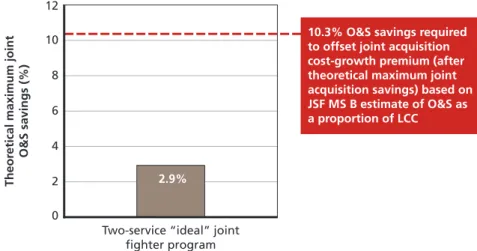
We next assessed whether joint aircraft programs could save enough O&S costs to offset the effects of the joint aircraft acquisition cost-growth premium.9 The O&S savings required depends on the pro-portion of LCC estimated to be spent on RDT&E, procurement, and O&S in the program baseline estimate at MS B. If O&S makes up a very large share of expected total program LCC, then less O&S cost savings are required to offset the average joint aircraft acquisition cost-growth premium. The smaller the O&S share, the greater the O&S savings required. For the purpose of this analysis, we assume a repre-sentative fighter aircraft program that allocates 54 percent of LCC to acquisition and 46 percent to O&S.10 Using this assumption, we cal-culate that 10.3 percent savings in joint O&S costs would be needed to offset the joint acquisition cost-growth premium, assuming that the theoretical maximum representative joint fighter savings in RDT&E and procurement are realized, the average joint acquisition program cost-growth premium at nine years after MS B is applied, and there is no O&S cost growth.
9 Unfortunately, our SAR database did not include sufficient data on O&S cost estimates to compare O&S cost growth on the joint versus single-service aircraft programs we exam-ined. Therefore, we assumed zero cost growth nine years after MS B for both joint and single-service aircraft programs. For our cost comparison of JSF with three notional single-single-service fighters discussed later in this document, we did have sufficient O&S cost data to assess O&S cost growth.
Historical Joint Fighter and Other Joint Aircraft Programs 15
How much O&S savings are joint fighter programs likely to actu-ally achieve under ideal circumstances? This question is difficult to answer directly because none of the fully joint historical fighter pro-grams identified in Table 2.1 has been jointly fielded and operated.11 Moreover, SAR data are not available to conduct the same kind of cost-growth comparisons for joint versus single-service aircraft program O&S cost growth that we carried out for the RDT&E and procure-ment phases.12
Instead, we developed a methodology using actual O&S data from current Air Force fighters to assess the O&S savings that would accrue to an “ideal” joint fighter program, in which the participat-ing services procured identical types of common fighters and used a common support infrastructure and approach in those O&S areas affected by economies of scale. To do this, we analyzed Air Force Total Ownership Costs (AFTOCs) and Logistics Installations and Mission Support–Enterprise View (LIMS-EV) databases using regression analy-sis to determine how actual O&S costs of Air Force fighters vary with different fleet sizes. This approach allowed us to simulate ideal cases in which two or three services operate equal numbers of identical fighters and to observe how economies of scale would affect O&S costs.13 This approach favors joint programs because the aircraft type mix, force 11 This statement, of course, excludes the F-4 and A-7. As noted earlier, these are not true joint programs by our definition because they were developed unilaterally by a single service and then only procured jointly. In addition, appropriate O&S data on the Navy and Air Force versions of the F-4 and A-7 are not available. Furthermore, it appears that spares pool-ing, common depots, and other forms of joint O&S were not attempted on these programs. 12 SARs have not included consistent O&S cost estimates and categories from early phases of programs until relatively recently.
13 We examined data for A-10s, F-15s, F-16s, and F-22s from 1996 through 2010. Each Air Force fighter type analyzed includes numerous different variants and blocks. However, our analysis kept the same relative mix of numbers of existing variants of each fighter type when we tested for the effect of changing the size of the force structure on O&S costs for that type of fighter. Thus, we compared the effect on O&S costs of changing the number of common fighter types while keeping the existing percentage mix of the variants constant. Because all the aircraft are Air Force fighters, which are operated and supported by an identical Air Force O&S infrastructure, this approach simulates the O&S cost savings that could be achieved in an ideal joint program made up of common aircraft types across the services using an identi-cal O&S infrastructure.
16 Do Joint Fighter Programs Save Money?
structure, and O&S infrastructure are assumed to be 100 percent iden-tical across the services (this would not likely be the case in a real joint fighter program).
Figure 2.3 shows the maximum O&S savings for an ideal notional two-service joint fighter program, based on this analysis of O&S data. We distinguish between overall O&S cost savings and savings in categories in which one could expect to see economies of scale (e.g., depot-level reparables and aircraft overhaul, but not fuel).14 We define an ideal notional two-service joint fighter program as one in which each service procures an equal number of the same types of aircraft, and all O&S activities that are affected by economies of scale are
con-14 We segregated out O&S categories using standard AFTOC and Office of the Secretary of Defense (OSD) Cost Analysis Improvement Group (CAIG; now Cost Assessment and Program Evaluation, or CAPE) O&S cost categories. Our assessment indicated that about two-thirds of fighter O&S costs could theoretically be affected by economies of scale.
Figure 2.3
Maximum Operations and Support Savings from Ideal Joint Fighter Programs Are Unlikely to Offset the Joint Aircraft Acquisition Cost-Growth Premium
NOTE: Ideal here refers to having an equal number and mix of aircraft per service and 100 percent commonality in O&S activities and infrastructure.
RAND MG1225-2.3 8 6 4 2 0 12 10 Theor
etical maximum joint O&S savings (%)
Two-service “ideal” joint fighter program
10.3% O&S savings required to offset joint acquisition cost-growth premium (after theoretical maximum joint acquisition savings) based on JSF MS B estimate of O&S as a proportion of LCC
Historical Joint Fighter and Other Joint Aircraft Programs 17
ducted 100-percent jointly and in common. Joint O&S cost savings for an ideal two-service joint fighter program would be 4.6 percent in categories affected by economies of scale and 2.9 percent overall. These savings fall short of the 10.3-percent O&S savings required to offset the historical average joint aircraft acquisition cost-growth premium at nine years past MS B, as discussed above. Of course, more than 10.3-percent savings in joint O&S costs would be necessary for a joint program under these assumptions to cost less than two comparable single-service programs.15
Using this analysis, we conclude that, although joint aircraft pro-grams do, in theory, save costs by sharing RDT&E resources, increas-ing production runs, and utilizincreas-ing economies of scale in O&S, these savings are too small to offset the substantial additional average cost growth historically observed in the acquisition phase. Historical joint aircraft programs have not yielded overall LCC savings compared with single-service programs.
Factors Contributing to Cost Growth
An important factor contributing to this joint aircraft acquisition pro-gram cost-growth premium is the tension between the need to attain maximum design and system commonality, which is the basis of poten-tial joint cost savings, and service-specific requirements, which tend to reduce commonality. Historically, the services have entered joint air-craft programs with unique requirements that arise from differences in operating environments, missions, doctrine, and operational concepts. Launch and recovery of fighters on an aircraft carrier involve funda-15 As noted in the discussion of Figures 2.1 and 2.2, the average joint aircraft acquisition cost-growth premium varies between five and nine years after MS B. Using an uncertainty band reflecting this variation in the joint acquisition cost-growth premium, the percentage savings in joint O&S costs necessary to offset the joint cost-growth premium to reach LCC parity with two single-service fighter programs varies between 15.4 percent and –5.1 percent. This uncertainty band suggests that, nine years after MS B, LCC of a two-service joint pro-gram can be expected to be essentially equivalent with the total of two separate single-service programs. For a more complete explanation of the methodology and data used in this analy-sis, see Lorell, Kennedy, et al., 2013, Appendixes B and C.
18 Do Joint Fighter Programs Save Money?
mentally different design challenges from those of takeoff and landing on a land base.16 Short takeoff and vertical landing (STOVL) capabil-ity imposes even greater demands than conventional land- and carrier-based aircraft, particularly regarding air vehicle weight, engine thrust requirements, and the complexity of the propulsion system. Attempts to reconcile different requirements in a common-core airframe increase technical complexity and risk, which can lead to RDT&E and pro-curement cost growth. At the same time, efforts to optimize variants for each service decrease commonality, thus reducing the potential for procurement and O&S cost savings. The increased complexity and decreased commonality can lead to greater cost growth than for single-service programs, especially when initial baseline cost estimates have assumed optimistic projections of theoretical maximum savings from commonality, as has often been the case historically.17
Figure 2.4 illustrates the tensions between commonality and ser-vice optimization in four historical joint fighter programs from the 1960s and 1970s, each of which began with the goal of 100-percent commonality but diverged into unique service variants. For example, the TFX program began as a joint program for a multirole fighter with 16 Our assessment of the data available on the 11 proposed and actual historical joint fighter programs listed in Table 2.1 indicates that nearly all historical Air Force design proposals that were later modified for maximum commonality with a common carrier–based Navy fighter included a roughly 2,000- to 3,000-pound empty-weight penalty to accommodate the more robust airframe structure, landing gear, and other design factors necessary for catapult launch and carrier deck recovery on an aircraft carrier. Other requirements for carrier fighters, such as low landing approach speed, high controllability at slow approach speeds, excellent forward visibility at high angles of attack, “wind over deck” factors, carrier deck “spotting” factors, and deck elevator load limitations, can have significant effects on air vehicle design, weight, maneuverability, and other performance factors.
17 We examined the original internal cost savings calculations made by the OSD Systems Analysis office for the TFX program, and they appear to assume an “ideal” program with 100-percent commonality between Air Force and Navy variants and no additional costs for the greater developmental complexities involved. (However, it was never assumed that the Air Force and Navy would buy equal numbers of TFX aircraft.) Although the data are less complete and not in the same format as modern SARs, the development phase of the F-111 program later appears to have experienced more than 100-percent cost growth during RDT&E compared with an average of about 30 to 40 percent cost growth for major military defense programs during the 1950s and 1960s.
Historical Joint Fighter and Other Joint Aircraft Programs 19
100-percent commonality for all participating services; however, it quickly evolved into the F-111A variant for the Air Force and the F-111B variant for the Navy. In an attempt to keep the aircraft as common as possible, each service had to accept design penalties to accommodate the other service’s requirements. These penalties became so significant from the Navy perspective that the Navy eventually withdrew from the program before the completion of development and launched its own single-service program for the F-14. The original TFX close air sup-port (CAS) mission requirement dropped out of the design very early Figure 2.4
Differing Operational Environments and Service Requirements Led to Many Variants, Less Commonality, and Greater Program Complexity, and Thus Reduced Joint Cost Savings
RAND MG1225-2.4 F-111A YF-16 YF-17 A-7D F-4C A-X AV-8A A-7 YF-17N YF-16N A-7A F-4B A-10 RF-4C F-4D F-4E F-16A/B CAS TFX VFX F-14A F-4J A-7E F/A-18A/B Goal: 100% commonality Goal: 100% commonality Goal: 100% commonality Goal: 100% commonality F-4 Navy developed A-7 Navy developed ACF Air Force developed F-111B Canceled 1968 70% commonality 20% commonality Significant differences 30–40% commonality 70–80% commonality 0% commonality Joint Air Force Navy Marine Corps
20 Do Joint Fighter Programs Save Money?
in the program because of insurmountable design and cost issues, and it eventually evolved into the A-7A developed unilaterally by the Navy and later procured jointly by the Air Force as the A-7D variant. The Air Force A-7D and later Navy A-7E variant evolved to meet unique service requirements and had only about 30 to 40 percent production-floor commonality. The F-4 and ACF programs had similar experi-ences, with the latter resulting in two aircraft with no commonality: the F-16A/B for the Air Force and F/A-18A/B for the Navy.18
These examples illustrate the persistent tension between the need to maximize system commonality to achieve the greatest cost savings possible and the difficulty of reconciling differing service requirements, which has historically worked against the realization of theoretical joint cost savings. In the next chapter, we examine how JSF, as the latest joint fighter program, has dealt with this tension and analyze the program’s potential for joint cost savings.
18 The F-4A/B and the A-7A were originally developed entirely by and for the Navy. After development, the Secretary of Defense mandated Air Force procurement of both of these fighter/attack aircraft but permitted modification of the aircraft to meet unique Air Force requirements. The ACF program included a competition between the YF-16 and YF-17 prototypes. Congress mandated that the Navy would buy a navalized version of whichever fighter won the competition (the YF-16N or YF-17N). The YF-16 won the competition and was developed and procured by the Air Force as the F-16A/B. The Navy, however, argued that neither prototype met its requirements and instead developed the YF-17N into the F/A-18A/B, a fighter that had zero commonality with the Air Force F-16.