A study of factors affecting the efficiency of milking operations
Authors
E.J. O’Callaghan
1, P.M. Murphy
2, and D.E. Gleeson
11
Teagasc, Dairy Production Research Centre
2
Teagasc, Dairy Products Research Centre
Moorepark, Fermoy, Co Cork.
End of Project Report ARMIS 5063
Teagasc acknowledges with gratitude the support of structural Funds in
the financing of this research project.
Teagasc,
19 Sandymount Avenue,
Ballsbridge,
Contents
Section and Title
Page
1. Summary
3
2. The effect of altering teat end vacuum levels on milking characteristics 4
2.1 Introduction2.2 Materials and methods 2.3 Results
2.4 Discussion
3. The effect of specific pre-milking preparation practices on milking
characteristics 9
3.1 Introduction
3.2 Materials and methods 3.3 Results and discussion
1. Summary
• With a mid-level milking system the milking time was reduced significantly when the teat end vacuum was increased
• Vacuum losses were lower and milking time was shorter with simultaneous pulsation than with alternate pulsation
• Milk yield was not affected by the magnitude of teat end vacuum.
• Both the mean flowrate and peak flowrate increased when the teat end vacuum was increased.
• New milking plants and conversions should have 16 mm bore long milk tubes (LMT) and 16 mm bore entries in the milk pipeline
• The omission of udder washing as a pre-milking preparation procedure did not influence milking characteristics.
• TBC and E. coli were significantly reduced with full pre-milking preparation compared to no pre-milking preparation when milk was produced from cows on pasture
• Counts for individual bacterial species were well below maximum numbers permitted in EU Council Directive (Anon. 1992) when no pre-milking preparation was carried out.
2.
The effect of altering teat end vacuum levels on milking
characteristics
2.1 Introduction
The milking time of individual cows has a major affect on output in milking sheds. The rate of milk extraction depends on the average vacuum applied to the teat-end during the milking phase of pulsation (b-phase). This vacuum level depends on the degree of vacuum drop due to the components between the vacuum pump and the teat-end. Most modern milking machines have large-bore milk pipelines in which the vacuum losses are low. The main vacuum losses occur from frictional losses and hydrostatic effects in the connecting system from the teat to the milk pipeline during milk flow. Under practical milking conditions these losses are difficult to measure, as the flow through individual teats is not known. O’ Callaghan (2001) developed a flow simulator to record vacuum losses in commercial milking plants. With this simulator, insertion of artificial teats into the liners simulated the flow conditions from the teat and rate of water flow was controlled. Flow simulation tests (O’Callaghan, 1997, 2003; O’Callaghan and Gleeson, 1999, 2001 ) on a range of milking systems have shown that the applied vacuum during milk flow can vary by up to 30% depending on the configuration of the milking system.. There is limited data on the effect of applying different levels of milking vacuum on milking characteristics and particularly milking time.
2.2 Materials and Methods
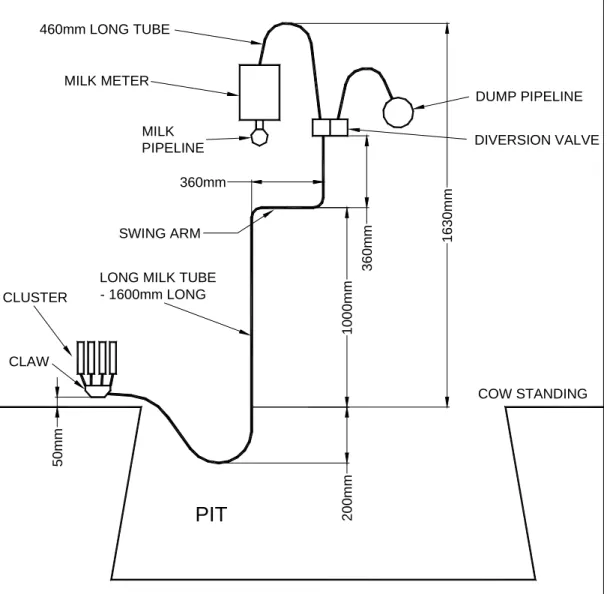
Four configurations of a milking unit shown in Figure 1 were calibrated with a portable flow simulator (O’Callaghan and Gleeson, 2001) at a water flowrate of 4 l /min to give vacuum levels during the b-phase of pulsation of 35, 38, 40 and 42 kPa at the apex of an artificial teat during simulated milking. Simultaneous (4x1) and alternate (2x2) pulsation patterns and two bores of long milk tubes (LMT) were used to establish these differences in teat end vacuum (Table 1). The vacuum traces recorded with the flow simulator for the four treatments are shown in Figures 2 to 5 at a flow of 4 l/min.
Friesian cows (N=56) were milked in a 14 unit side-by-side parlour in a Latin Square design experiment to establish the effect of altering the teat-end vacuum levels on milking characteristics.The system vacuum level for the mid-level milking plant was set at 49 kPa. A pulsation rate of 60 Hz was used for the four treatments and the “a”, “b”, “c” and “d” values of the pulsation chamber waveform were 12.0%, 56.2%, 11.3% and 20.5% respectively. One cluster type fitted with wide bore tapered liners, a 150 ml claw and a cluster weight of 3.16 kgs was used for the four treatments. Milk yields and milk flow profiles were recorded automatically with Dairymaster Weigh-all electronic milk meters. Clusters were removed automatically at a milk flow-rate of 0.2 kg/min. Milking time was computed as the time interval from cluster application to when the milk flow reached 0.2 kgs/min. Pre-milking preparation consisted of washing teats with warm running water and drying with individual paper towels.
360m m 360mm 100 0m m 200m m 50m m 1630m m
PIT
DUMP PIPELINE MILK METER MILK PIPELINE CLUSTER CLAW SWING ARM DIVERSION VALVE COW STANDING LONG MILK TUBE- 1600mm LONG 460mm LONG TUBE
Figure 1. X-section of milking unit for milking tests
Table 1. Details of milking treatments
Treatment Pulsation Pattern Bore of LMT (mm) Vacuum at 4 l/min (kPa) T1 4x1 16.0 42 T2 4x1 13.5 40 T3 2x2 16.0 38 T4 2x2 13.5 35
Figure 2. Vacuum traces of pulsation chamber vacuum, claw vacuum and
teat end vacuum with a 16mm bore LMT and simultaneous
(4x1) pulsation.
Figure 3. Vacuum traces of pulsation chamber vacuum, claw vacuum and
teat end vacuum with a 13.5 mm bore LMT and simultaneous
(4x1) pulsation.
0 10 20 30 40 50 60 0 400 800 1200 Time (ms) Vacuum (kPa) Pulsation vacuum Claw vacuum Teat end vacuum Teat vacuum =40kPa13.5mm LMT and 4x1 b-phase 0 10 20 30 40 50 60 0 400 800 1200 Time (ms) V a c uum (k P a ) Pulsation vacuum Claw vacuum Teat end vacuum Teat vacuum=42kPa
16mm LMT and 4x1 b-phase
Figure 4. Vacuum traces of pulsation chamber vacuum, claw vacuum and
teat end vacuum with a 16 mm bore LMT and alternate (2x2)
pulsation.
Figure 5. Vacuum traces of pulsation chamber vacuum, claw vacuum and
teat end vacuum with a 13.5 mm bore LMT and alternate (2x2)
pulsation.
2.3 Results
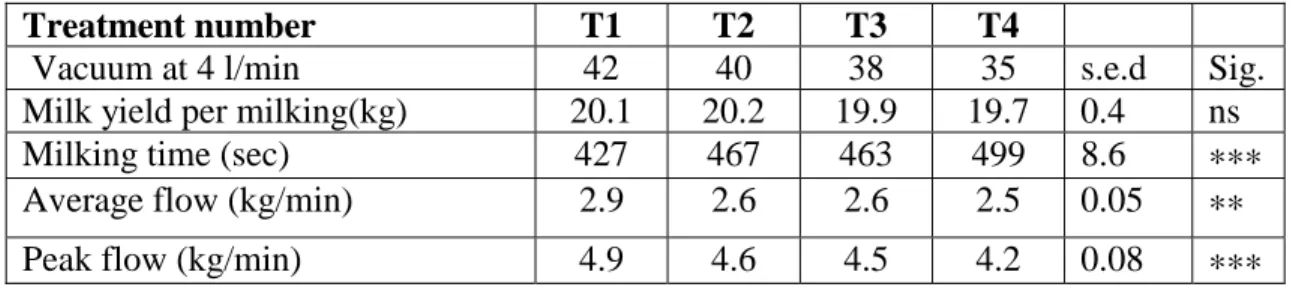
The milking characteristics obtained with the four configurations of milking units are presented in Table 2. Altering the vacuum level at the teat-end or reducing vacuum loss in a milking system had no significant effect on milk yield. When the LMT bore was
0 10 20 30 40 50 60 0 400 800 1200 Time (ms) V a c uum ( k P a ) Pulsation chamber Claw vacuum Teat end vacuum Teat vacuum = 38kPa
16mm LMT and 2x2 b-phase 0 10 20 30 40 50 60 0 400 800 1200 Time (ms) V a c uum ( k P a ) Pulsation vacuum Claw vacuum teat end vacuum Teat vacuum=35kPa
13.5mm LMT and 2x2 b-phase
increased from 13.5 mm to 16 mm milking vacuum was increased by 2kPa with 4x1 pulsation during simulation tests. In the milking trial this increase in milking vacuum reduced the milking time by 40 seconds per cow, and increased both the average and peak milk flowrate (P<0.0001). With alternate pulsation the teat end vacuum increased from 35 kPa to 38 kPa when the LMT was increased from 13.5 mm bore to 16 mm, this reduced the milking time by 36 seconds per cow. The milking characteristics were similar when simultaneous pulsation and a 13.5 mm LMT were compared to alternate pulsation and 16 mm LMT.
Table 2. Milking characteristics recorded with four milking units calibrated with a flow simulator at 4l/min.
Treatment number T1 T2 T3 T4
Vacuum at 4 l/min 42 40 38 35 s.e.d Sig.
Milk yield per milking(kg) 20.1 20.2 19.9 19.7 0.4 ns
Milking time (sec) 427 467 463 499 8.6 ∗∗∗
Average flow (kg/min) 2.9 2.6 2.6 2.5 0.05 ∗∗
Peak flow (kg/min) 4.9 4.6 4.5 4.2 0.08 ∗∗∗
2.4 Discussion
The present ISO standard (ISO 6690, 1996) for milking machines specify that flow capacity of milking units should be proportional to the amplitude of vacuum fluctuation. This standard is presently been revised and international experts involved in the revision agree that vacuum level at the teat-end during the b-phase of pulsation is a more important measurement than the level of vacuum fluctuation. While the amplitude of vacuum fluctuation at the teat-end recorded during flow simulation for wide-bore tapered liners is high with simultaneous pulsation the vacuum loss during the b-phase or milking phase is low and fast milking was achieved in the present trial with simultaneous pulsation and 16mm bore LMT. Worstorff and Hollweck (1995) showed that the presence of large vacuum losses reduced milk yield and increased milking time. In the present trial increasing the vacuum loss did not affect milk yield.
There is a practical benefit in increasing the bore of the LMT with either simultaneous or alternate pulsation with wide bore tapered liners in terms of less time required for the milking process. Most milking plants in Ireland have a milk tube bore in the range 13.5-14 mm. The results indicate that new milking plants and conversions should have 16mm bore LMT and 16mm bore entries in the milk pipeline. During the flow simulation tests the vacuum variations were similar in the claw and at the apex of the artificial teat. Thus measurements of vacuum taken in the claw during actual milking represent teat end conditions.
3. The effect of specific pre-milking preparation practices on milking
characteristics
3.1 Introduction
The need for ensuring good animal hygiene practice in the production of good quality milk is governed by E.U Commission Directive (Anon. 1989). Galton et al (1984) showed that cleaning of teats before milking significantly reduced bacterial contamination of milk and that drying of teats was essential to achieve low sediment in milk. Mein and Thompson (2000) concluded that the time spent on manual cleaning of teats and foremilk stripping is sufficient stimulation to cause milk ejection. Timing of the attachment of the milking unit relative the start of preparation has been shown to influence milk yield. Rasmussen et al, 1992 showed that milk yield decreased and the amount of residual milk increased in Holstein cows by increasing this interval from 1.3 to 3.0 min. Rasmussen et al, 1990 showed that specific timing of the attachment after start of preparation throughout the lactation increased milk yield by 5.5% compared with a milking routine with a variable interval. Due to time constraints and shortage of farm labor there is now a trend away from pre-milking and teat cleaning which may impact negatively on milk quality. There is minimal data on the effect of udder preparation practices on milking characteristics. The objective of the present study was to quantify the effects of the design and configuration of commercial milking units on milking characteristics particularly milking time, and to measure the effect of specific udder preparation practices on milking efficiency and milk quality. The project will provide a strategy for reducing labor in milking sheds by reducing the time of milking while producing quality milk.
3.2 Materials and Methods
Experiment 1 consisted of a 4x4 Latin Square in which 4 groups of Friesian dairy cows comprising of 14 animals in each group were at pasture by day and maintained indoor at night on sawdust/lime bedding. The milking plant had a high-level milk pipeline and the clusters consisted of wide-bore tapered liners, 150ml claws and the cluster weight was 3.16 kgs. Animals were subjected to 4 treatments for cleaning of teats comprising of wash and dry with paper towel (full preparation), no preparation, wash only and dry wipe only. Milk pipelines were subjected to a detergent and hot water wash between treatments. All animals were pre-milked and received a teat spray containing 4250-ppm chlorhexidine gluconate at the end of milking. Following 2 days on each treatment and on morning of milking, 2.5 litre quantities of milk were collected aseptically by connecting the sample bottle to a tap on the outlet of a variable speed milk pump under the milk receiver. The connecting tube from the sampling tap to the sterile sample bottle was washed during circulation cleaning of the milking system. Milk contained in sterile containers was transported to the laboratory for immediate analysis. A similar procedure was followed in Experiment 2 except the animals were outdoors fulltime and received just two treatments i.e wash and dry wipe with paper towel and no treatment.
Measurements of milk yield, the time from cluster application to when a yield of 0.2 kg occurred (milking time), the peak and average milk flow rate, and milk letdown time
(time from cluster application to when a milk of 1 kg was recorded) were made at A.M milkings.
3.3 Results and Discussion
The milking characteristics for Experiment 1 are presented in Table 3 for the four treatments. Milk quality data for Exp.1is presented in Table 4. Milk quality data for Experiment 2 is presented in Table 5. The AM milk yields were similar with the four pre-milking practices. Also the milking time, the peak or average milk flow rate, and milk letdown time were not affected by the pre-milking procedures. The high maximum or peak milk flowrate reflected the high teat end vacuum obtained with wide bore tapered liners when combined with simultaneous pulsation. Bacterial counts were reduced with full teat preparation compared with other treatments when cows housed at night. This result is in agreement with studies by Galton (1984). Milk from cows on full teat preparation showed a consistent reduction in sediment compared with other treatments but this was not significantly different. In the case where milk was produced from cows on pasture fulltime TBC and E. coli were significantly reduced in the full preparation compared with no preparation treatment. A noticeable feature of the results is the narrow range of bacterial counts measured and also the low numbers encountered even in the no preparation treatment where counts for individual species are well below maximum numbers permitted in EU Council Directive (Anon. 1992). The results suggest that when cows are indoors attention to housing and milking parlor hygiene will reduce the need for cleaning teats prior to milking. However the differences observed in bacterial counts between full and no preparation also indicate that in situations where hygiene conditions are poor and soiling of teats is likely to occur, then significant contamination of milk with undesirable microorganisms is to be expected and a cleaning regime should be implemented.
Table 3. Effect of pre-milking preparation on milking characteristics.
Treatment Full Wash Dry wipe None Sig.
Milk Yield /milking (kgs) 20.1 20.8 20.2 20.4 ns
Time to 0.2 kg 438 441 438 433 ns
Max. flow (kg/min) 5.0 5.1 4.8 5.0 ns
Average flow (kgs/min) 2.8 2.8 2.8 2.9 ns
Time to 1 kg 32.4 33.4 33.1 33.8 ns
Table 4. The effect of pre-milking preparation treatments on total bacterial counts, coliform count, E.coli count and sediment in raw milk produced by cows on pasture by day and indoors at night
Treatment TBC (cfu/ml) Coliforms (cfu/ml) E.Coli (cfu/ml) Sediment (mg/l)
Full 3765 14 2 1.9
Wash 5756 18 3 4.1
Dry wipe 8153 46 4 3.8
Table 5. The effect of pre-milking preparation treatments on total bacterial counts, coliform count, E.coli count and sediment in raw milk produced under outdoor conditions
Treatment TBC (cfu/ml) Coliforms (cfu/ml) E.Coli (cfu/ml) Sediment (mg/l) Full 4523 4 1 3 None 10878 88 11 3 Significance ∗ - ∗ - 4 References
Anon. 1989. On general conditions of hygiene in milk production holdings. Commission Directive (89/362/EEC). Official Journal of European Communities. No L 156.
Anon. 1992. Laying down the health rules for the production and placing on the market of raw milk, heat treated milk and milk based products. Commission Directive (92/46/EEC). Official Journal of European Communities. No L 268/1.
Galton,D.M., Peterson, L.G.,Merrill, W.G., Bandler, D.K and Shuster, D.E. 1984. Effects of pre-milking udder preparation on bacterial population, sediment and iodine residue in milk. Journal of Dairy Science, 67:2580
ISO 6690. 1996. Milking machine installations- mechanical tests. International standards organization, Geneva, Switzerland.
Mein, G.A and Thompson, P.D. 2000. Milking the 30.000-pound herd. J Dairy Science. 76:3294-3300.
O’Callaghan, E.J. 1997. Comparison of testing systems for evaluating milking units. International Conference on machine milking and mastitis. 23rd May, 1997. Teagasc. ISBN 1 901138, 151: 31-55.
O’Callaghan, E.J. and Gleeson, D.E. 1999. Measurement of vacuum stability in milking units during simulated milking. In: National Mastitis Council, 38th annual Meeting, Arlington, Virginia, 14th-17th February, Arlington, Virginia, USA, pp.206-208. O’Callaghan, E.J. and Gleeson, D.E. 2001. A portable measuring system for dynamic evaluation of milking systems. End-project-report No 4739.
O’Callaghan, E.J. 2001. Measurement of vacuum stability in milking units during simulated milking. Irish Journal of Agricultural and Food Research. 41: 171-179.
O’Callaghan, E.J. 2003. Effect of bore of milk tubes and claw volume on vacuum variations during simulated milking. Irish Journal of Agricultural and Food Research. 42: 179-193.
Rasmussen,M.D., Frimer, E.S., Horvath, Z and Jensen, N.E. 1990. Comparison of a standardised and variable milking routine. J. Dairy Science. 73: 3472-3480.
Rasmussen, M.D., Frimer,E.S., Galton, D.M and Petersson, L.G. 1992. The infleunce of pre-milking teat preparation and attachement delay on milk yield and milking performance. J Dairy Science. 75, 2131-2141.
Worstorff, H and Hollweck, W. 1995. Vacuum losses and milk yield. Milchpraxis, 33, Jg (4).