1
Cloud Computing Security in the Tactical
Environment – the Difference a Year Makes
“This document does not contain technical data as defined by the International Traffic
in Arms Regulations, 22 CFR 120.10(a), or technology as defined by the Department of
Commerce Export Administration Regulations, and is therefore authorized for
publication.”
Copyright © Raytheon Company. All rights reserved.
Panel Coordinator / Moderator:
Noel Ellis (Eli) Johnson
260-429-5457
2 2
Panel Topic & Members…
Panel Topic: Cloud Computing Security in the Tactical Environment, the Difference a
Year Makes
Panel Coordinator / Moderator, Noel Ellis (Eli) Johnson – Raytheon
Sr. Principal Systems Engineer, CISSP-ISSEP, CSSLP, Tactical Communications Solutions,
multiple program supports as a Cybersecurity Subject Matter Expert,
Dr. Jeff Boleng, Carnegie Mellon University, Software Solutions Division, Software
Engineering Institute,
Principal Research Scientist
Professor; Elisa Bertino , Purdue University,
Professor CS, Research Director of CERIAS, Director of Cyber Center,
Mr. Randall Brooks, Raytheon, Raytheon Engineering Fellow,
Member of the Technical Staff
Mr. David A. Smith, Raytheon Certified Architect, Chair Cloud TIG
C4I Business Area Technical Lead
UNCLASSIFIED UNCLASSIFIED
3 3
Panel Format…
Panel Topic: Cloud Computing Security in the Tactical Environment
Each panel member will have 3-5 minutes to provide an initial position statement,
Discussion based on initial position statements & moderator questions,
Half hour will be reserved for questions from the audience,
Each panel member will be provided 5 minutes final remarks,
Noel Ellis (Eli) Johnson – Raytheon
Provide the context of challenges and opportunities of Cloud Computing Security in the
Tactical Environment
Opening position statements.
Dr. Jeff Boleng, Carnegie Mellon University, Software Solutions Division, Software
Engineering Institute,
Professor; Elisa Bertino , Purdue University,
Mr. Randall Brooks, Raytheon, Raytheon Engineering Fellow,
Mr. David A. Smith, Raytheon Certified Architect, Chair Cloud TIG
UNCLASSIFIED UNCLASSIFIED
4 4
What is Cloud Computing ?
NIST SP 800-145, Mell and Grance, 2011
Cloud computing is a model for enabling
ubiquitous, convenient,
on-demand network
access
to a
shared pool of configurable computing resources
(e.g., networks, servers,
storage, applications, and services) that can be
rapidly provisioned and released
with
minimal management effort or service provider interaction
. This cloud model is composed
of five essential characteristics
,
three service models, and four deployment models.
Essential Characteristics,
Rapid Elasticity
Resource Pooling
Measured Service
Broad network access
On-demand self-service
Service Models
Software as a Service (SaaS)
Platform as a Service (PaaS)
Infrastructure as a Service (IaaS)
Deployment Models
Public Cloud,
Hybrid Cloud,
Private Cloud,
Community Cloud,
5 5
Cloud Computing Security in the Tactical Environments,
Not all Tactical Environments are the Same !
•
Types of Cloud Computing Services
• Software as a Service (SaaS) • Platform as a Service (PaaS) • Infrastructure as a Service (IaaS),
•
Core Advantages
• Flexibility,
• Highly automated, • Shared Resources, • Increased storage, • Pay for what your use, • Back up and restoration,
• Easy installation and maintenance,
• Core Disadvantages
• Cost,
• Limited flexibility,
• Data security and privacy, • Knowledge and integration,
• Dependence on outside agencies, • Network connectivity and bandwidth, • Long term stability of service provider,
• Service unavailability due to a variety of reasons,
UNCLASSIFIED
6 6
USG & DoD Transitioning to the Cloud…
The Transition has begun: Is it secure? Will it meet the goals?
UNCLASSIFIED UNCLASSIFIED
UNCLASSIFIED
FedRAMP – Federal Risk and Authorization Management Program – Cloud computing for USG
DoD Cloud Computing Security Requirements Guide (SRG) Version 1, Release 1, 1/13/2015
National Institute of Standards and Technology (NIST)
Cloud Computing Strategy working paper, April 2011
USG Cloud Computing Technology Roadmap Volume 1 Release 1.0 (Draft) November 2011
NIST Federal Information Processing Standards (FIPS) and Special Publication (SP) Relevant to Cloud Computing
FIPS 199; Minimum Security Requirements for Federal Information and Information Systems
NIST SP 500-291; NIST Cloud Computing Standards Roadmap, Version 2.0, July 2013
NIST SP 500-292; NIST Cloud Computing Reference Architecture, September 2011,
NIST SP 800-37; Guide for Applying the Risk Management Framework to Federal Information Systems; A Security Life Cycle
Approach;
NIST SP 800-53 Rev.4; Security and Privacy Controls for Federal Information systems and Organizations;
NIST SP 800-53A Rev.3; Assessing Security and Privacy Controls in Federal Information Systems and Organizations: Build
Effective Assessment Plans; June 2010;
NIST SP 800-92; Guide to Computer Security Log Management; September 2006
NIST SP 800-125; Guide to Security for Full Virtualization Technologies; January 2011
NIST SP 800-137; Information Security Continuous Monitoring for Federal Information Systems and Organizations;
September 2011;
NIST SP 800-144; Guidelines on Security and Privacy Issues in Public Cloud Computing, December 2011
NIST SP 800-145; The NIST Definition of Cloud Computing; September 2011
7 7
The Solution must address…
UNCLASSIFIED
UNCLASSIFIED
Timely Keep Bad Guys
& Malware Out
Cloud Computing,
COTS & GOTS Device(s)
8
Cloud Security at the Edge
Jeff Boleng, PhD
Principal Research Scientist
Dr. Jeff Boleng, Carnegie Mellon University,
Software Solutions Division, Software Engineering
Institute,
9 9
Copyright 2015 Carnegie Mellon University and IEEE
This material is based upon work funded and supported by the Department of Defense under Contract No. FA8721-05-C-0003 with Carnegie Mellon University for the operation of the Software Engineering Institute, a federally funded research and development center.
NO WARRANTY. THIS CARNEGIE MELLON UNIVERSITY AND SOFTWARE ENGINEERING INSTITUTE MATERIAL IS FURNISHED ON AN “AS-IS” BASIS. CARNEGIE MELLON
UNIVERSITY MAKES NO WARRANTIES OF ANY KIND, EITHER EXPRESSED OR IMPLIED, AS TO ANY MATTER INCLUDING, BUT NOT LIMITED TO, WARRANTY OF FITNESS FOR PURPOSE OR MERCHANTABILITY, EXCLUSIVITY, OR RESULTS
OBTAINED FROM USE OF THE MATERIAL. CARNEGIE MELLON UNIVERSITY DOES NOT MAKE ANY WARRANTY OF ANY KIND WITH RESPECT TO FREEDOM FROM PATENT, TRADEMARK, OR COPYRIGHT INFRINGEMENT.
This material has been approved for public release and unlimited distribution. This material may be reproduced in its entirety, without modification, and freely distributed in written or electronic form without requesting formal permission.
Permission is required for any other use. Requests for permission should be directed to the Software Engineering Institute at [email protected].
10 10
•
Dr. Jeff Boleng, PhD, Principal Research Scientist, Software
Solutions Division, Software Engineering Institute, Carnegie
Mellow University
•
Since 2012, Advanced Mobile Systems Team
•
Co-PI of Tactical Computing and Communications and Tactical
Analytics research at SEI
•
Research areas: Context Computing, Mobile Ad Hoc
Networks, Scientific Computing, Parallel and Distributed
Systems
•
BS in CS from US Air Force Academy 1991, MS and PhD from
Colorado School of Mines (1997 and 2002) in Mathematical
and Computer Sciences
•
25 years experience as AF Cyber Operation Officer, deployable
networks, command post integration, 21
stMission Support
Squadron Commander
•
8 years on faculty at USAFA as Associate Professor, 4 years as
Deputy Computer Science Department Head
11 11
Securing the cloud
•
Tail of two layers
– Infrastructure
– Services
•
Securing each is different
•
Infrastructure
– Largely virtualized
– Depends on security of every VM
•
Services
– “Secured” by numerous external administrators
12 12
Securing the Services*
•
Simplify!
•
Simple, well defined, and enforced interfaces
•
“Do one thing and do it well” --
Doug McIlroy
•
Favor composability over monolithic design
•
Assume components are compromised
– Use fail-safe/fail-secure design
– Never implicitly trust the results of another service
– Always ask “What will my service do when it fails?”
*Note: these ideas aren’t new or mine. Thanks to Ken Thompson, Dennis Ritchie,
Brian Kernighan, Rob Pike, Doug McIlroy, Eric Raymond and others…
13 13
Piping diagram of a Westinghouse Air Brake System - 1909
14 14
Elisha Otis’s elevator patent drawing, 15 January 1861
15 15
Microservice architectures
•
Modular operating system containers
– Docker and LXC
– OSv
– Unikernels and MirageOS
– CoreOS
– Intel Clear Containers
•
Small, lightweight, typically single process,
multi-threaded VMs built with only the OS and library
components necessary to support the code
16 16
Microservice architectures
•
Our experience on an embedded robotics sensor system
– OSv with nanoMsg and protocol buffers on Xen
– ≈12Mb VM on disk, ≈60Mb VM when running
– Redis benchmark ≈30% faster in OSv container
– No other OS service running (i.e. only 1 or 2 ports open at all)
•
Pros
– ↑ cohesion ↓ coupling
– Forces rigorous commitment to interfaces and standardization
– Small size on disk and in RAM
– Faster startup and migration
– Reduced attack surface and complexity
– High availability (redundancy, load balancing, fail over) techniques from data center
experience directly applicable
•
Cons
– Timing, network latency, etc. (all the distributed computing challenges)
– Startup and shutdown orchestration
17 17
Simplicity is the ultimate sophistication
-Leonardo da Vinci
18
Sensor-Cloud:
Opportunities and Research Directions
Elisa Bertino
Purdue University
Cyber
Center
Professor; Elisa Bertino , Purdue University,
Professor CS, Research Director of CERIAS, Director of Cyber
Center,
19 19
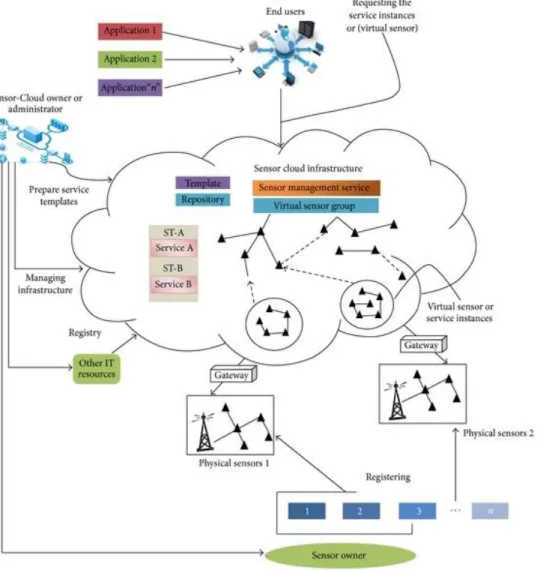
Definitions and Conceptual Architecture
Military Target Tracking Natural Disaster Relief
What is a Sensor-Cloud?
An Infrastructure supporting pervasive computation based on:
• sensors as an interface between physical and cyber
worlds
• the cloud as the cyber backbone
• the Internet and wireless technologies as the
communication medium
IoT and NoT
These recent trends will further accelerate the deployment of sensor networks and sensor-based applications
Drones and UAV
The use of these devices will multiply the opportunities for collecting data from (possibly mobile) sensors on-the-ground and for managing these sensors
20 20
Research Directions
Diagram from: A. Alamri et al. A Survey on Sensor-Cloud: Architectures, Applications, and Approaches, 2013.
• Network access management
• Encryption techniques for small devices • Sensor software and firmware security • Secure sensor localization techniques • Provenance techniques for sensors • Tools supporting the deployment and
monitoring of sensors, and the design of sensor-based data collection applications • Data fusion techniques to assess and enhance
sensor data trustworthiness
• Fault-tolerant and reliable continuous data acquisition
• Efficient sensor streamed data processing techniques
• Event processing and management
21
Introduction & Opening Statement of Panel Member
Mr. Randall Brooks, Raytheon, Raytheon Engineering Fellow,
22 22
Position Statement
•
Cloud Security is difficult to achieve in a tactical
environment. It is faced with connectivity issues, a
lack of elasticity and limited Infrastructure as a
Service (IaaS) and Platform as a Service (PaaS)
providers.
Outer Router On Prem Server Farm Firewall Proxy (Deep Packet Inspection) IaaS Server Farm SaaS Provider PaaS Server FarmHost Operating System
Clo ud App lic ati on (hos ted VM) Cl oud Appli ca ti on (hos ted VM ) Clo ud App lic ati on (hos ted VM) Clo ud App lic ati on (hos ted VM)
App A App A App B App C
Mobile User
Isolated Services
23 23
Cloud Computing
•
Essential
Characteristics:
– Rapid Elasticity
– Resource Pooling
– Measured Service
– Broad network access
– On-demand
self-service
PaaS
Host Operating System
Clo ud App lic ati on (hos ted VM) Cl oud Appli ca ti on (hos ted VM ) Clo ud App lic ati on (hos ted VM) Clo ud App lic ati on (hos ted VM)
App A App A App B App C
•
NIST SP 800-145, Mell and Grance, 2011
– Cloud computing is a model for enabling ubiquitous, convenient, on-demand
network access to a shared pool of configurable computing resources (e.g.,
networks, servers, storage, applications, and services) that can be rapidly
provisioned and released with minimal management effort or service provider
interaction. This cloud model is composed of five essential characteristics, three
service models, and four deployment models.
24 24
Cloud Computing Models
•
Service Models
– Software as a Service
(SaaS)
– Platform as a Service
(PaaS)
– Infrastructure as a
Service (IaaS)
•
Deployment Models
– Public Cloud
– Hybrid Cloud
– Private Cloud
– Community Cloud
IaaS Server Farm SaaS Provider PaaS Server FarmHost Operating System
Clo ud App lic ati on (hos ted VM) Cl oud Appli ca ti on (hos ted VM ) Clo ud App lic ati on (hos ted VM) Clo ud App lic ati on (hos ted VM)
App A App A App B App C
IaaS Server Farm SaaS Provider PaaS Server Farm
Host Operating System
Clo ud App lic ati on (hos ted VM) Cl oud Appli ca ti on (hos ted VM ) Clo ud App lic ati on (hos ted VM) Clo ud App lic ati on (hos ted VM)
25 25
The Notorious Nine: Cloud Computing Top Threats
• Data Breaches
• Data Loss
• Account Hijacking
• Insecure APIs
• Denial of Service
• Malicious Insiders
• Abuse of Cloud Services
• Insufficient Due Diligence
• Shared Technology Issue
26 26
Mr. David A. Smith, Raytheon Certified Architect, Chair Cloud
TIG
C4I Business Area Technical Lead
27 27
The Power of Cloud Applications
Instances are added, deleted,
and restarted by the application
itself based on need.
Security is built in, or not, to the
application.
(Mobile) User
Interface
Service
Interfaces
Service
Processing
Data
Cloud Application Designs are Scalable and Resilient – when connected
Cloud Native Applications are
built differently.
Stateless services are composed
of many separate, identical
28 28
The Solution must address…
UNCLASSIFIED
UNCLASSIFIED
Timely Keep Bad Guys
& Malware Out
Cloud Computing,
COTS & GOTS Device(s)
29 29
Mr. David A. Smith, Raytheon Certified Architect, Chair Cloud TIG
C4I Business Area Technical Lead
Mr. Randall Brooks, Raytheon, Raytheon Engineering Fellow,
Member of the Technical Staff
Professor; Elisa Bertino , Purdue University,
Professor CS, Research Director of CERIAS, Director of Cyber
Center,
Dr. Jeff Boleng, Carnegie Mellon University, Software
Solutions Division, Software Engineering Institute,
Principal Research Scientist
Panel Coordinator / Moderator, Noel Ellis (Eli) Johnson –
Raytheon
Sr. Principal Systems Engineer,
30 30
31 31
Biography
Noel Ellis (Eli) Johnson, CISSP-ISSEP, CSSLP
Information Systems Security Engineer
Business Unit: SAS
Location: Fort Wayne
Email:
[email protected]
Office Phone: 260.429.5457
Mr. Johnson is a Senior Principal Engineer at Raytheon with over 26 years’ experience in designing security and information assurance (IA) solutions for the Defense and Commercial Telecommunications markets.
Mr. Johnson recently was the Principal Investigator for secure mobility and supports the development and capture of a wide variety of crypto modern solutions for Type 1 applications as an IA subject matter expert.
Mr. Johnson holds the following International Information Systems Security Certification Consortium (ISC)2 certification credentials:
Certified Information Systems Security Professional (CISSP)
Information Systems Security Engineering Professional (ISSEP)
Certified Secure Software Lifecycle Professional (CSSLP)
Mr. Johnson supports the International Information Systems Security Certification Consortium (ISC)2 Information Systems Security Engineering Professional (ISSEP) credential as a volunteer domain expert to perform Job Task Analyses and writes domain related items for the internationally recognized credential examination.
Mr. Johnson has published articles relating to Cryptographic Solutions for Mobile Devices and Secure Mobility in 2011 and 2012, presented at MILCOM 2012, panel chair for MILCOM 2014 & MILCOM 2015 relating to Cloud Computing Security.