RIPHAH INTERNATIONAL UNIVERSITY
ISLAMABAD
SELF ASSESSMENT REPORT
MS (Project Management)
Riphah School of Leadership (RSL)
30 June 2015
Prepared by: Riphah School of Leadership
Table of Contents
1.0 Executive Summary ... 4
1.1 Objectives ... 4
1.2 Execution ... 4
2.0 Introduction ... 6
2.1 University Mission Statement ... 6
2.2 Faculty of Management Sciences (FMS) ... 6
2.3 Program Selected ... 7
2.4 Program Evaluation ... 7
3.0 Criterion 1: Program Mission, Objectives and Outcomes ... 7
3.1 Standard 1-1 ... 7
3.1.1 Program Mission Statement ... 7
3.1.2 Program Objectives ... 7
3.1.3 Alignment of Program Objectives with Program & University Mission Statements ... 8
3.1.4 Main Elements of Strategic Plan... 8
3.1.5 Program Contents... 8
3.1.6 Curriculum Design ... 9
3.2 Standard 1-2 ... 10
3.2.1 Program Outcomes... 10
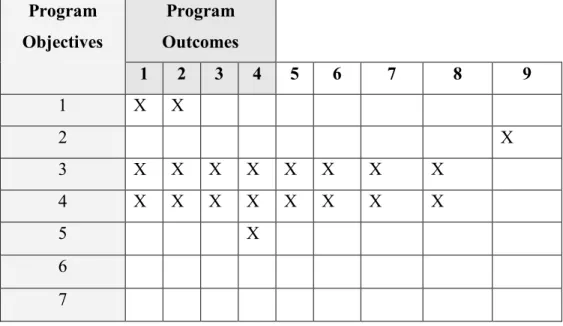
3.2.2 Program Objectives and Outcomes Matching ... 11
3.3 Standard 1-3 ... 11
3.3.1 Course Evaluation ... 12
3.3.2 Teachers Evaluation ... 13
3.4 MS Program Strong and Weak Points ... 14
3.5 Significant Future Development Plans ... 15
3.6 Standard 1-4 ... 15
3.6.1 Graduates/Undergraduates enrolled in last three years ... 15
3.6.2 Student Faculty Ratio:... 15
3.6.3 Average GPA per semester: ... 15
3.6.4 Average Completion time ... 15
3.6.5 Employer Satisfaction ... 16
3.6.6 Students Course Evaluation Rate ... 16
3.6.7 Students Faculty Evaluation ... 16
3.6.8 Research ... 16
3.6.9 Community Service ... 16
3.6.10 Students/Teachers Satisfaction ... 16
4.0 Criterion 2: Curriculum Design and Organization... 16
4.1 Title of Degree Program ... 16
4.2 Definition of credit hour: ... 17
4.3 Degree plan ... 17
4.4 Curriculum Breakdown ... 17
4.5 Courses Information/ outline ... 18
4.5.1 Essentials of Project Management ... 18
4.5.2 Objective ... 18
4.5.3 Core Texts: ... 18
Riphah_MS PM_June 2015 3
4.5.5 Advance Research Method ... 19
4.5.6 Strategic Marketing ... 20
4.5.7 Project Planning & Control ... 20
4.5.8 Project Management Procurement & Contract ... 22
4.6 Standard 2-1 ... 23
4.6.1 Course Groups and Program Objectives ... 23
4.7 Standard 2-2 ... 24 4.8 Standard 2-3 ... 24 4.9 Standard 2-4 ... 25 4.10 Standard 2-5 ... 25 4.11 Standard 2-6 ... 25 4.12 Standard 2-7 ... 26
5.0 Criterion 3: Laboratories and Computing Facilities ... 26
5.1 Standard 3-1 ... 27
5.2 Standard 3-2 ... 27
5.3 Standard 3-3 ... 28
6.0 Criterion 4: Student Support and Advising ... 28
6.1 Standard 4-1 ... 28
6.2 Standard 4-2 ... 29
6.3 Standard 4-3 ... 29
7.0 Criterion 5: Process Control... 30
7.1 Standard 5-1 ... 30 7.2 Standard 5-2 ... 31 7.3 Standard 5-3 ... 31 7.4 Standard 5-4 ... 32 7.5 Standard 5-5 ... 33 8.0 Criterion 6: Faculty ... 34 8.1 Standard 6-1 ... 34 8.2 Standard 6-2 ... 35 8.3 Standard 6-3 ... 36
9.0 Criterion 7: Institutional Facilities ... 36
9.1 Standard 7-1 ... 36
9.2 Standard 7-2 ... 37
9.3 Standard 7-3 ... 37
10.0 Criterion 8: Institutional Support ... 38
10.1 Standard 8-1 ... 38 10.2 Standard 8-2 ... 38 10.3 Standard 8-3 ... 39 11.0 Conclusion ... 39 11.1 Strong Areas... 41 11.2 Weaknesses ... 41
1.0 Executive Summary
This report is being prepared almost at the end of the assessment cycle for 5 selected faculties of Riphah International University, as per requirements of Higher Education Commission (HEC). Quality Enhancement Cell (QEC) was formed in Riphah International University in Oct 2009. Program Team Members of all five faculties, notified by University, worked with Dir QEC to pursue the application of Self-Assessment Manual in their respective departments. From each faculty one program was selected.
In Faculty of Management Sciences (FMS), MS (Project Management)
was selected for self-assessment, evaluation and improvements. A strong commitment of Respected Vice Chancellor to support QEC made the difference and resultantly, a cycle of assessment is about to complete. 1.1 Objectives
Following are the two main objectives of the self-assessment report:- a To implement Self-Assessment Manual in selected program with a
view to improve quality in higher education.
b To identify the areas requiring improvements in order to achieve objectives through desired outcomes.
1.2 Execution
A soft copy of self-assessment manual was given to all faculty members. Quality Awareness Lecture and Workshop on preparation of Self-Assessment Report (SAR) were arranged (22 Oct, 2014) for the Deans/In-charge Programs and Program Team (PT) Members of the selected program. Hard copies of HEC issued 10 proformas, 8 criterion and 31 standards were provided to PT members to evaluate their respected program against defined standards. The PT members with an intimate support and follow up of QEC, completed the SAR and forwarded to QEC in given time frame.
Riphah_MS PM_June 2015 5 After reviewing SAR, QEC arranged visit of Assessment Team to the
selected program on 13, April 2015. Dir QEC accompanied the AT Team and participated in discussions with In-charge Program / Program Team members and available faculty members. Date for exit presentation was fixed as 5 May 2015, as per availability of Respected VC. Dean, In-charge Program, PT and AT members were invited.
The AT during visits, indicated salient points of the SAR, account of its discussions with the faculty members, improvements required in the infrastructure, syllabi and training of the faculty and support staff.
The implementation plan (Annex-K) basing on the discussions in exit meeting have been made by In-charge Programs.
The implementation plan indicates the resources required to improve the infrastructure, environment in the classes and E-Learning. The tasks have been completed on fast track by the combined efforts of Head of Department, QEC and Registrar’s Office.
At the completion of Self-Assessment cycle, QEC is going to submit the hard and soft copy of SAR to HEC on 25 June 2015.
Director Quality Enhancement Cell
Self Assessment Report
2.0 Introduction
Riphah International University is a private university, chartered by the Federal Government of Pakistan in 2002. The university was established with a view to produce professionals with Islamic moral and ethical values. The Riphah International University is committed to promote and impart quality education with character building of the new generation in the light of Islamic principles and values. Riphah International University is committed to a value based integrated educational philosophy. It is running 10 faculties in 3 different campuses.
2.1 University Mission Statement
Establishment of state of the art educational institutions with a focus on inculcation of Islamic ethical values
2.2 Faculty of Management Sciences (FMS)
Faculty of Management Sciences is running following programs:
a. Bachelor of Business Administration (BBA) b. Master of Business Administration (MBA) c. Master of Science (Management Science) (MS) d. Master in Project Management (MPM)
e. MS in Project Management (MSPM) f. Diploma in Project Management (DPM) g. PhD in Management Science
h. Diploma in Business Administration (PGD) i. Certificate in Business Administration (Cert BA)
Riphah_MS PM_June 2015 7
2.3 Program Selected
Riphah International University has selected the MS Project Management as fifth model program for Self Assessment Report (SAR) for the year 2015-16 under the directives of HEC.
The selected program is in the process of getting accredited by National Business Education Accreditation Council (NBEAC). The program has got inbuilt mechanism for the revision of syllabi, has competent faculty and adequate infrastructure. New and modern tools have been introduced in the program to conduct research and quality teaching.
2.4 Program Evaluation
The program is being evaluated based on 8 criterion and 31 standards as given in the Self Assessment Manual provided by Higher Education Commission (HEC).
3.0 Criterion 1: Program Mission, Objectives and Outcomes
3.1 Standard 1-1
The program must have documented measurable objectives that support institution mission statements.
3.1.1 Program Mission Statement
The mission of faculty of management sciences is to exhibit excellence in teaching and research for our undergraduate and graduate students with emphasis on Islamic ethical values, integrity, social responsibility and entrepreneurial spirit along with continuous learning.
3.1.2 Program Objectives
The MS program aims to accomplish following objectives:
1. To promote research environment that will expose students to get in-depth knowledge in research design and methodologies.
2. To prepare students to work within ethical values and betterment of the society at large.
3. Develop detailed knowledge of contemporary and pervasive issues in strategic project management from both academic and professional perspectives
4. Develop a significant range of principal and specialist skills, techniques and practices in the domains of strategy and project management.
5. Employability through development of strategic awareness and transferable skills, particularly in leadership, teamwork, communication, negotiation, conflict resolution and presentation.
6. To enable the students to pursue career in related field
7. To prepare the students to pursue higher education (PhD) in university of repute.
3.1.3 Alignment of Program Objectives with Program & University Mission Statements
MS PM program objectives are defined in the light of program and university mission statements that require the output to be inclusive of ethical values and industrial skills. This is done by imparting business, research related skills and sense of ethics in students through defined set of courses and training.
3.1.4 Main Elements of Strategic Plan
Strategic plan for MS PM defines the overall layout of the areas/elements that are included in the program to educate students to post graduate level. Provides an environment in which students primarily interested in a career of research, teaching and professional field of business and management. These elements prepare students through theory and practical work. These elements are Program Curriculum Design, Program Contents, Program Delivery Methodology and Program Output Evaluation.
3.1.5 Program Contents
MS PM program is comprised of 36 credit hours. 24 credit hours are for core subjects, whereas, 6 credit hours are for specialization related subjects, while, 6 credit hours are for final project and research thesis.
Riphah_MS PM_June 2015 9
3.1.6 Curriculum Design
Regular meetings of Board of Studies (BOS) and Board of Faculty (BOF) are conducted to review the curriculum. Prior to this, a regular meeting is called and faculty members provide their feedback regarding course content and teaching methodology. These recommendations and observation are discussed in Board of Studies (BOS) meeting.
Once a proposal is discussed in BOS, its recommendations are forwarded to BOF. The BOF reviews the proposals and forwards the recommendations to Academic Council for the final approval. After the approval of a proposal by Academic Council the Dean is responsible for its implementation.
To ensure quality, a regular feedback from stakeholders is ensured. They include industry, students, faculty, alumni etc.
3.1.6.1 Program Delivery Methodology
To improve the delivery of the courses the department requires weekly, and semester wise course planners from the entire visiting and permanent faculty. Furthermore, senior faculty members occasionally sit in classes (picked on random basis) and take observations. These observations are discussed in person with respective faculty and in faculty meeting to learn from each other’s experience.
Similarly Quality Enhancement Cell (QEC) conducts student feedback surveys. QEC discuss the results of these surveys with Dean and Incharge Programs of RSL. Necessary improvements in content and delivery of courses are inculcated in the design and delivery section of curriculum.
Program delivery methodology includes interactive lectures, Workshop, Seminar, Real-time case studies, Interactive video, Research projects and group work.
Lectures
Program delivery methodology includes lectures to explain the theme of the course. Power point slides and relevant videos are used to explain the required content.
Case studies are assigned to students to expose them to real business problems. These assigned cases are discussed in the class rooms and pros and cons of alternative choices are critically evaluated jointly by the teacher and students.
Tutorials:
These tutorials are in addition to regular lectures and are specifically helpful to understand and solve the case studies and assignments.
Hands on exercises are done in labs on software such as primavera, project management tools E-views, SPSS etc. Industrial visits and internships are assigned to nurture students for their future professional life.
Program Output Evaluation
Students are given projects, assignments, and presentations in each course which ensure that intellectual skills are transferred to students who are then evaluated on the basis of their decision making, comprehension, and research skills in these projects, assignments and presentations.
End term research project (6 credit hours from industry)
Real life projects and assignment.
Case Studies
Applied concepts taught in labs (Financial Modeling, MIS, and Quantitative Modeling)
Professional softwares such as primavera, project management tools EVIEWS, SPSS etc. are used, taught, and practiced.
Seminars and workshops are conducted.
3.2 Standard 1-2
The program must have documented outcomes for graduating students. It must be demonstrated that the outcome support the program objectives and that graduating students are capable of performing these outcomes.
3.2.1 Program Outcomes
Riphah_MS PM_June 2015 11
1. Graduates will be able to summarize major themes and a current research problem in their area of specialization.
2. Graduates will be able to communicate the major tenets of their field and their work orally and in writing for students, peers and the lay public.
3. Students will be able to execute tasks in positive and constructive manner. 4. Effectively Communicate with all stakeholders in a global project
environment
5. Apply current project management methods, skills, and tools
6. Assess and Improve an organization's project management practices 7. Evaluate projects in both an operational and strategic context
8. Guide projects toward effective organizational Change
9. Incorporate Ethics and Values into project leadership and decision making
3.2.2 Program Objectives and Outcomes Matching
Program Objectives Program Outcomes 1 2 3 4 5 6 7 8 9 1 X X 2 X 3 X X X X X X X X 4 X X X X X X X X 5 X 6 7
Table 1: Outcomes versus Objectives
3.3 Standard 1-3
The results of Program’s assessment and the extent to which they are used to improve the program must be documented.
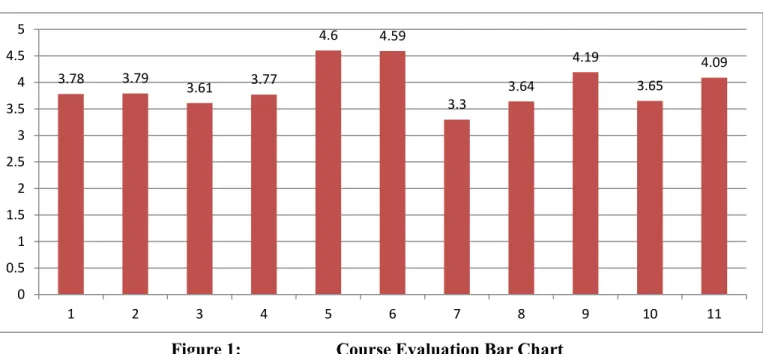
3.78 3.79 3.61 3.77 4.6 4.59 3.3 3.64 4.19 3.65 4.09 0 0.5 1 1.5 2 2.5 3 3.5 4 4.5 5 1 2 3 4 5 6 7 8 9 10 11
The program is being evaluated based on 8 criterion and 31 standards as given in the Self-Assessment Manual provided by Higher Education Commission (HEC). QEC staff carries out course and teacher evaluation survey in order to ensure unbiased feedback from students. The gathered data is analyzed by QEC and results are provided to department officials for further actions.
Dean of the Faculty of Management Sciences reviews the output and decides to put up the results in Board of Studies and Board of Faculty meetings for further discussion and actions. Initially the results are brought up in Board of Studies, who may decide to move results to higher level for discussion and decisions if required. This meeting is held during summer time every year.
The result of the program assessment is shown below in graphical charts for courses evaluation and teachers’ evaluations.
3.3.1 Course Evaluation
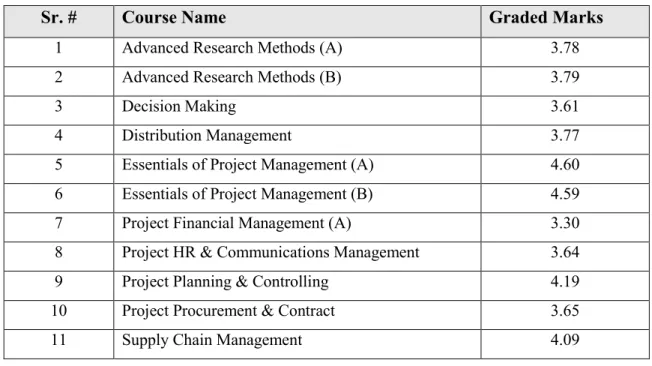
Courses evaluation is shown in the following graphical chart:
Figure 1: Course Evaluation Bar Chart
Students have graded the courses against the course structure, teaching methodology, learning objectives and outcomes and practical implementation of theory. The total
Riphah_MS PM_June 2015 13 4.4 4.21 3.42 4.14 4.11 4.1 3.87 3.05 3.76 4.49 4.53 4.2 4.3 4.34 4.3 3.95 4.06 4.04 3.7 3.82 4.56 3.77 4.72 4.61 3.51 4.69 4.72 3.61 3.86 4.12 0 0.5 1 1.5 2 2.5 3 3.5 4 4.5 5 1 2 3 4 5 6 7 8 9 10 11 12 13 14 15 16 17 18 19 20 21 22 23 24 25 26 27 28 29 30
graded marks are 5. Following is the list of courses that are being evaluated by the students along with their course code and graded scores.
Sr. # Course Name Graded Marks
1 Advanced Research Methods (A) 3.78
2 Advanced Research Methods (B) 3.79
3 Decision Making 3.61
4 Distribution Management 3.77
5 Essentials of Project Management (A) 4.60
6 Essentials of Project Management (B) 4.59
7 Project Financial Management (A) 3.30
8 Project HR & Communications Management 3.64
9 Project Planning & Controlling 4.19
10 Project Procurement & Contract 3.65
11 Supply Chain Management 4.09
3.3.2 Teachers Evaluation
Teacher’s evaluation is shown in the following graphical chart:
Figure 2: Teachers Evaluation Graph
Students have graded the teachers against their lecture preparation, punctuality, general behavior, subject knowledge and teaching methodology. The total graded marks are 5.
Following is the list of teachers that are being evaluated by the students along with the serial number and graded scores.
Sr. No Teacher Name Course Name Marks
1 Dr Muhammad Farhan Operation Research 4.40 2 Dr. Amir Gulzar Marketing for Engineers 4.21 3 Zeshan Ghafoor Awan Managerial Decision Making 3.42 4 Dr. Nazim Ali Zaman Islamic Leadership & Management 4.14 5 Ikramullah Khan Trade & Business in Islam 4.11 6 Khurram Khan Trade & Business in Islam 4.10 7 Mr. Amir Khalil Ur Rehman Financial Reporting in IFI 3.87 8 Zeshan Ghafoor Awan Decision Making 3.05 9 Dr S M M Raza Naqvi Directed Research in HRD 3.76 10 Dr. Arshad Hassan Financial Risk Management (A) 4.49 11 Dr. Sajid Bashir Current Issues in HRM 4.53 12 Dr. Zulfiqar Ali Shah Financial Theory (A) 4.2 13 Khurram Shahzad Advanced Research Methods (A) 4.30 14 Mr Aqeel Shahzad Strategic Marketing 4.34 15 Mr Humayun Akhtar Distribution Management 4.30 16 Amir Khalil Ur Rehman Financial Reporting in IFI 3.95 17 Zeshan Ghafoor Awan Strategic Finance (A) 4.06 18 Zeshan Ghafoor Awan Strategic Finance (B) 4.04 19 Afkar Majeed Project Financial Management (A) 3.70 20 Prof. Amanullah Khan Project Financial Management (A) 3.82 21 Dr. Nadeem Khan Supply Chain Management 4.56 22 Kamran Azam Project HR & Communications Management 3.77 23 Mr Humayun Akhtar Distribution Management 4.72 24 Mr Humayun Akhtar 2 Project Planning & Controlling 4.61 25 Mr Usman Khalid Project Procurement & Contract 3.51 26 Mr. Waseem Irshad Essentials of Project Management (A) 4.69 27 Mr. Waseem Irshad 2 Essentials of Project Management (B) 4.72 28 Muhammad Abbas Advanced Research Methods (A) 3.61 29 Muhammad Abbas 2 Advanced Research Methods (B) 3.86 30 Zeshan Ghafoor Awan Decision Making 4.12
3.4 MS Program Strong and Weak Points
MS program is designed to educate students to meet the challenges of the modern world and present market needs. During the execution of the program several observations were made that can be categorized as strong and weak points of the program. These points are listed below:
MS Program Strong Points:
a. Highly qualified and experienced faculty
b. The curriculum has rich and logically arranged courses to prepare the students to be competent in research and professionally.
Riphah_MS PM_June 2015 15
d. Attractive scholarship e. Ideal location
f. Weekend classes
MS program Weak Points:
a. Lack of library resources b. Below par class rooms facilities
3.5 Significant Future Development Plans
Significant future development plan for the program includes rectification of weaknesses and improvement in overall performance of the program. As per agreed views, lack of learning resources will be rectified by the induction of more learning material including books, CDs and related research articles in the library. While, classroom facilities will be improved over a period of time during the next financial year. On the basis of self assessment, faculty management has decided to look into the improvement areas for course syllabi in the light of observations listed in section 3.1.5, that would help achieve program objectives more efficiently.
3.6 Standard 1-4
The department must assess its overall performance periodically using quantifiable measures.
3.6.1 Graduates/Undergraduates enrolled in last three years
Year Enrolled Graduate
2012 42
2013 80 N/A
2014 117 N/A
3.6.2 Student Faculty Ratio:
FMS has 15-1 ratio.
3.6.3 Average GPA per semester:
The average GPA is 3.00 3.6.4 Average Completion time
The MS program has average completion time of 2.5 years. The attrition rate in the program is around 28%.
3.6.5 Employer Satisfaction
The employer survey was conducted by Faculty with the help of QEC which resulted in 85% satisfaction level. See Annexure B for details.
3.6.6 Students Course Evaluation Rate
Student’s course evaluation rate for all courses is 29.43 3.6.7 Students Faculty Evaluation
QEC staff conducted the teachers’ evaluation to ensure unbiased feedback. The results showed that 19 out of 30 teachers (63%) scored more than 80% marks as graded by students while, rest of the faculty scored plus 70%.
3.6.8 Research
The program faculty published 33 research papers in different journals. List attached in Annexure E.
3.6.9 Community Service
The Faculty of Management Sciences launched a campaign to provide books to needy students in a nearby school. Faculty members and students were assigned different tasks regarding this campaign. Students were responsible to advertise and market the campaign in all campuses while faculty member were responsible to gather books and donations.
3.6.10 Students/Teachers Satisfaction
As per HEC defined standard, a ratio of 4:1 for the academic and administrative non-technical staff is maintained by the faculty of computing.
Students and teachers satisfaction is judged in different ways. For students this is done by faculty as well as QEC staff by conducting in-class discussions to know students views and through feedback provided by them on HEC Performa number 1 & 10. While, teachers satisfaction is judged using the HEC defined Performa number 5 and their views during in-person discussion with QEC staff.
4.0 Criterion 2: Curriculum Design and Organization
4.1 Title of Degree Program
Riphah_MS PM_June 2015 17
4.2 Definition of credit hour:
1.5 credit hours are 1.5 hour of theory lecture or 2 hours of laboratory (research) work in a week.
4.3 Degree plan
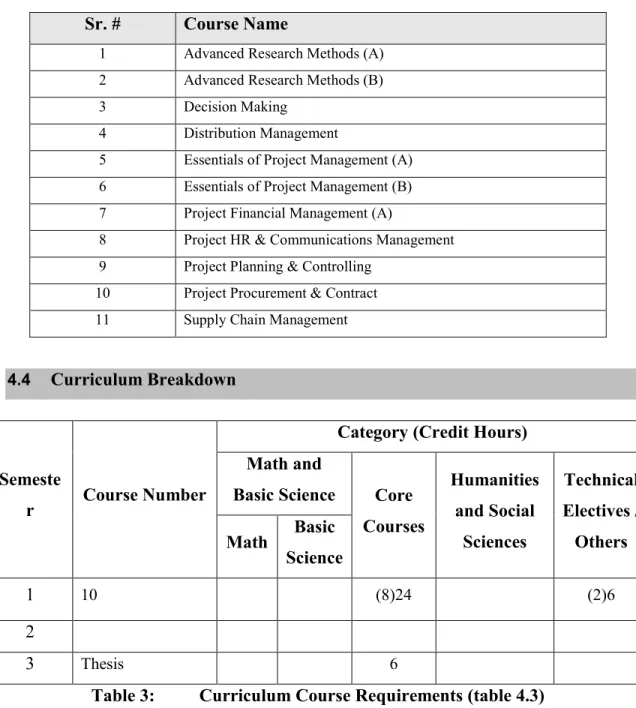
Following is the list of core courses taught in the selected program. Section 4.5 shows the details about these courses.
Sr. # Course Name
1 Advanced Research Methods (A) 2 Advanced Research Methods (B) 3 Decision Making
4 Distribution Management
5 Essentials of Project Management (A) 6 Essentials of Project Management (B) 7 Project Financial Management (A)
8 Project HR & Communications Management 9 Project Planning & Controlling
10 Project Procurement & Contract 11 Supply Chain Management
4.4 Curriculum Breakdown
Semeste
r Course Number
Category (Credit Hours) Math and
Basic Science Core
Courses Humanities and Social Sciences Technical Electives / Others Math Basic Science 1 10 (8)24 (2)6 2 3 Thesis 6
4.5 Courses Information/ outline
4.5.1 Essentials of Project Management
4.5.2 Objective
The main objective of this module is to develop participants understanding of the different software concepts, terminologies and methods used in project management. This course is designed in accordance with the flow of Project Management Body of Knowledge (PMBOK) which will help students to learn things and prepare them to appear in PMP exam. Specific objective includes;
To understand five process groups of project management.
To understand ten knowledge areas.
To monitor projects with the help of different graphical and tabular reports using MS Project.
To perform Earned Value Management (EVM) in practical.
This is a 3 credit hour course, comprising 3 hours of teaching per week.
4.5.3 Core Texts:
Project Management: Strategic Design and implementation
David I. Cleland & Lewis R. Ireland McGraw Hill, 4th edition, 2002 ISBN: 0-07-139310-2
Additional reading:
Project Management: The Managerial Process
Clifford F. Gray & Erik W. Larson MGraw Hill, 3rd edition, 2006 ISBN: 0-07-060093-7
4.5.4 Strategic Management
4.5.4.1 Objectives
1. Develop a framework of analysis to enable them to identify central issues and problem in complex, comprehensive case; to suggest alternative course of action; and present well supported recommendations for future action 2. Develop conceptual skills so that students are able to integrate previously
Riphah_MS PM_June 2015 19
3. Understand the relevance of the strategic management theories and practices, underscored by Western academicians and practitioners, in local settings.
4. Understand the Islamic perspective of formulating, implementing, and managing strategic decisions.
5. Develop skills to analyze and evaluate, both qualitatively and quantitatively, the performance of people responsible for strategic decisions.
6. Bridge the gap between theory and practice and developing an understanding of when and how to apply the concepts and techniques learned in earlier courses in marketing, accounting; finance, management, production and information systems
7. Develop a better understanding of the present and future environment in which corporations must function.
8. Develop analytical and decision making skills for dealing with complex conceptual problems in an ethical manner
4.5.4.2 Books
Certo & Peter; Strategic Management: Concepts & Applications, Random House Business Division.
Johnson Schol, Exploring Corporate Strategy, Prentice Hall Fried. R.David, Strategic Management, Prentice Hall
4.5.5 Advance Research Method
4.5.5.1 Objectives
To understand the different approaches to research and the management research process
To understand the various research designs, techniques of variable measurements, data collection and computer based data analysis
To develop skills in preparing research proposals, designing questionnaires, analyzing data, interpreting results and preparing reports
More specifically the course is designed to meet the following objectives: To understand why one should know about research
To develop a critical appreciation of the scientific research process and also to plan a research project
To learn how to evaluate the research proposal and the final report
To help students to appreciate the validity and usefulness of published researches concerning the functioning of organizations
4.5.5.2 Books
Cooper, D.R. & Schindler P.S, (1998), Business Research Methods, Sixth Edition, McGraw-Hill International Editions.
Uma Sekaran. (2003), Research Methods for Business – A skill building approach, Fourth Edition, John Wiley & Sons, Inc.
Zikmund, W.G. (2003), Business Research Methods, 7ed, South-Western.
4.5.6 Strategic Marketing
4.5.6.1 Objectives
1. Understand fundamental marketing strategy concepts and theories;
2. Be able to identify and use appropriate methods and tools for formulating, implementing, monitoring and evaluating marketing strategy in diverse organizational and marketing situations;
3. Be able to develop, write and present a formal strategic marketing plan including financial implications; and
4. Understand principles and behaviors underlying effective performance in project based teams.
4.5.6.2 Books
Marketing Strategy and Competitive Advantage By Hooley, Piercy & Nicoulaud, 4th Edition
Marketing Strategy Folder
4.5.7 Project Planning & Control
4.5.7.1 Objective
Aims and Objectives:
This course consists of the following objectives:
1. Understanding the Philosophy, Concept and Theory of Project Management. 2. Appreciating the importance of Project Planning Processes in corporate
working environments & focusing various project planning and control mechanisms.
Riphah_MS PM_June 2015 21
3. Learning the various tools and techniques for successful planning and control of various project types for effective projects, programs and portfolio
management.
4. To teach the students through coursework, assignments, term projects, class discussions, case studies and practical examples regarding Project Planning & Control Techniques and related issues in national, international and
multinational organizations & environments, with special emphasis on the latest trends.
Recommended Text Book:
“Project Management, Planning and Control, Sixth Edition: Managing Engineering, Construction and Manufacturing Projects to PMI, APM and BSI Standards by Albert Lester
4.5.7.2 Supply Chain Management
4.5.7.3 Objectives
1. Describe the basic concepts of supply chain management and its essential role in an organization
2. Identify the key elements and processes of a supply chain and how they interact
3. Identify principles and strategies for establishing efficient, effective, and sustainable supply chains
4. Explain the critical roles of technology in supply chain planning, visibility, and execution
5. Define the requirements and challenges of moving products across global supply chains
6. Discuss how to assess the performance of supply chains using standard metrics and frameworks.
4.5.7.4 Books Text Book:
Lambert, Douglas M., and Martha C. Cooper. "Issues in supply chain management."Handfield, R. B., & Nichols, E. L. (1999). Introduction to supply chain management (Vol. 183). Upper Saddle River, NJ: prentice Hall.
Reference Book(s):
Christopher, M. (1992). Logistics and supply chain management: strategies for reducing costs and improving services (Vol. 1). Financial Times.
Simchi-Levi, D. (2005). Designing and managing the supply chain. Mcgraw-Hill College. Berry, W. L., Whybark, D. C., & Jacobs, F. R. (2005). Manufacturing planning and control for supply chain management (pp. 638-642). New York: McGraw-Hill/Irwin.
4.5.8 Project Management Procurement &Contract
4.5.8.1 Objective
Explore the project procurement processes, from the initial procurement decision,
Through the solicitation process, to contract award, administration, and closure.
Examine the interaction of these processes and how they overlap with the other areas of project management.
Learn effective strategies to successfully manage key partners and vendors, and acquire the tools and techniques to manage each contract life cycle.
4.5.8.2 Textbook:
Details to be provided Additional texts: Articles:
Articles will be assigned to the class for group presentation according to a schedule Case Studies will be provided for additional learning.
4.5.8.3 Managerial Decision Making
4.5.8.4 Objective
Understand the major decision making theories as they apply to various business and management settings, and be able to apply these theories to the analysis of problems, situations and develop effective problem solving strategies.
Identify and describe the mental models that underlie our thinking processes;
Effectively utilize the advocacy and inquiry method to understand our way of reasoning;
Effectively prepare for team work or problem solving in interaction through situational awareness, self assessment, and the assessment of the other party(ies);
Understand and effectively deal with stress situations, including the choice of appropriate stress management techniques;
Recognize crisis situations and effectively approach them by using appropriate strategies and techniques;
Riphah_MS PM_June 2015 23
Identify problem situations and assess uncertainty;
Recognize the various processes that lead us to be "less than rational" in our decision making;
Recognize and overcome the limitations and inconsistencies in our decision making;
Effectively deal with ambiguity and develop strategies to deal with different levels of ambiguity in problem solving;
Understand the role of intuition in the decision making process;
Develop creative problem solving strategies both individually in team settings, and apply them
4.5.8.5 Books
1.Judgment in Managerial Decision Making by Bazarman and Moore 2. Psychology of judgment and decision making by Scott Plous
3. Rethinking the Fifth Discipline by Robert Louis Flood
4.6 Standard 2-1
The curriculum must be consistent and supports the program’s documented objectives.
MSPM program is designed inline with PMBOK 9 Core areas, and provide all the expertise required by any project manager in alignment with Project Management Body of Knowledge.
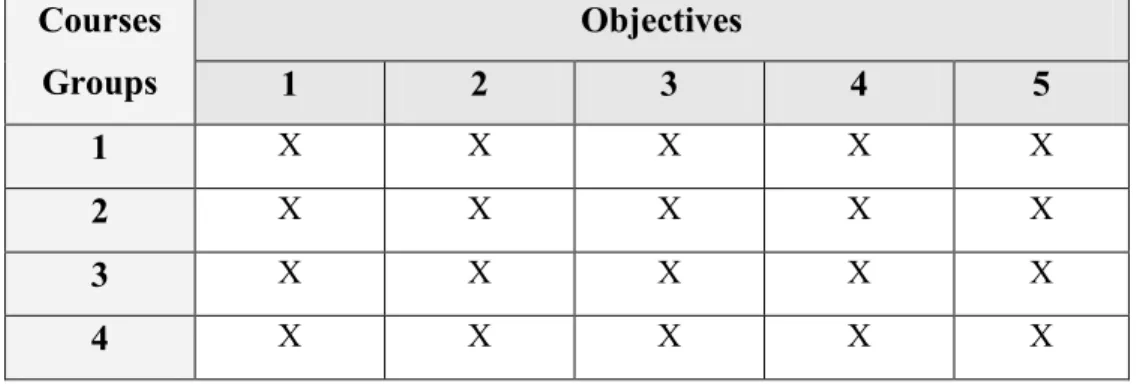
4.6.1 Course Groups and Program Objectives
Table 4: Courses versus Program Objectives (table 4.4) Courses Groups Objectives 1 2 3 4 5 1 X X X X X 2 X X X X X 3 X X X X X 4 X X X X X
4.7 Standard 2-2
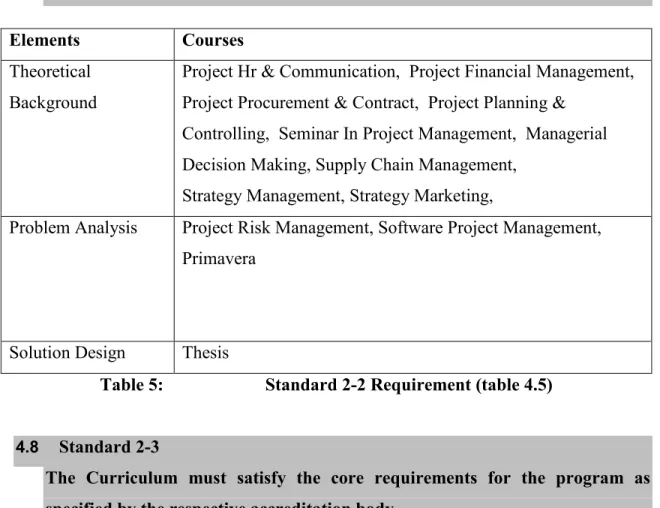
Theoretical backgrounds, problem analysis and solution design must be stressed within the program’s core material.
Table 5: Standard 2-2 Requirement (table 4.5)
4.8 Standard 2-3
The Curriculum must satisfy the core requirements for the program as specified by the respective accreditation body.
MS program is under accreditation by the National Business Education Accreditation Council (NBEAC).
Minimum Requirements for each program (Program Semester Credit Hours)
Table 6: Program Credit Hours (appendix A table)
Elements Courses
Theoretical Background
Project Hr & Communication, Project Financial Management, Project Procurement & Contract, Project Planning &
Controlling, Seminar In Project Management, Managerial Decision Making, Supply Chain Management,
Strategy Management, Strategy Marketing,
Problem Analysis Project Risk Management, Software Project Management, Primavera
Solution Design Thesis
Program Core
Course
Electives
Riphah_MS PM_June 2015 25
4.9 Standard 2-4
The curriculum must satisfy the major requirements for the program as specified by the respective accreditation body.
Same as Standard 2-3.
4.10 Standard 2-5
The curriculum must satisfy general education, arts and professional and other discipline requirements for the program as specified by the respective accreditation body.
Same as standard 2-3 and Standard 2-1 (table 4.4) as defined above. 4.11 Standard 2-6
Information technology component of the curriculum must be integrated throughout the program
MS PM program contain 10 courses, these courses educate the students with the concept of the research and its application in the field of business management and their area of specialization. The knowledge provided during these courses is theoretical based on latest research throughout the program whenever students do practical work (data analysis) in laboratory for any course that required the knowledge of information technology (software application) concepts to execute the work.
The software majorly taught to the students are following
1. Software Project Management, 2. Primavera
3. SPSS 4. E-views
4.12 Standard 2-7
Oral and written communication skills of the student must be developed and applied in the program.
Students go through report writing, research writing and presentation during the course work which develops the oral and written communication skills of the students.
5.0 Criterion 3: Laboratories and Computing Facilities
RIPHAH has established multiple laboratories for students to practice their learning outcomes. Following is the list of available laboratories available to MBA students: 1. Computer Lab I
2. Computer Lab II
The details about these laboratories are provided as under:
Laboratory Title Computer Lab I Computer Lab II
Location & Area Block A All-Mezan
Objectives Provide students with IT
facility to practice software applications
Provide students with IT facility to practice software applications
Adequacy for
Instruction
All required instructions are displayed in the lab at appropriate places for use by faculty, students and support staff.
All required instructions are displayed in the lab at appropriate places for use by faculty, students and support staff.
Courses Taught Advance Research
Method
Advance Research Method
Software Available MS Office, Java, SQL Server, MS Visio, SPSS, Eviews, Software
MS Office, Visual Studio, SQL Server, SPSS, Eviews,Software
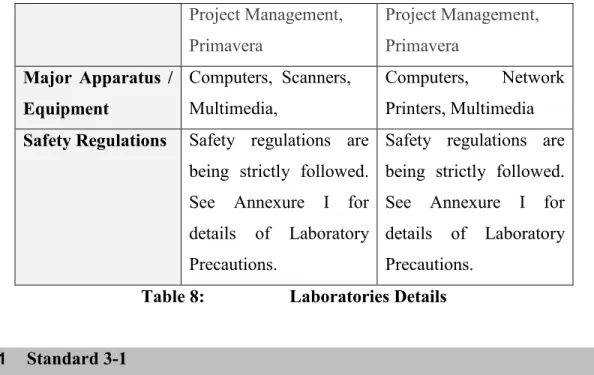
Riphah_MS PM_June 2015 27 Project Management, Primavera Project Management, Primavera Major Apparatus / Equipment Computers, Scanners, Multimedia, Computers, Network Printers, Multimedia
Safety Regulations Safety regulations are being strictly followed. See Annexure I for details of Laboratory Precautions.
Safety regulations are being strictly followed. See Annexure I for details of Laboratory Precautions.
Table 8: Laboratories Details
5.1 Standard 3-1
Laboratory manuals/documentation/instructions for experiments must be available and easily accessible to faculty and students.
Laboratory In-charge is the custodian of all the manuals and instructions concerning his laboratory. Its copies are also available with the Program Coordinator to be used by the faculty and students. These manuals and instructions are issued to desired entity through a defined process and proper record is maintained. The laboratory in-charge keeps the manuals and instructions in laboratory for immediate access to students and faculty members during the laboratory work.
Laboratory equipment and facilities in Faculty of Computing (RIPHAH) are equally good and comparable to any high reputed university of the country.
5.2 Standard 3-2
There must be support personal for instruction and maintaining the laboratories.
Each laboratory is authorized two staff members, Laboratory In-Charge and Laboratory Attendant. Laboratory in-charge is responsible for overall maintenance of laboratory and also maintains the manuals and instructions while laboratory
Attendant is responsible to maintain the laboratory equipment and general duties within the lab.
5.3 Standard 3-3
The University computing infrastructure and facilities must be adequate to support program’s objectives.
The computer laboratories have the latest computers & equipments. The program objectives are that students shall be equipped with IT skills at the end of the program and facilities (equipment and software) provided in the computer laboratories are adequate enough to achieve defined goals. Computing facilities in RIPHAH are extremely good and can be compared with any high reputed university of the country.
RIPHAH is running a comprehensive Campus Management System. It facilitates the faculty members in maintaining the attendance record, examination schedules, time tables and student’s data.
6.0 Criterion 4: Student Support and Advising
Since the launch of RIPHAH in year 2002, all its programs have started and finished on schedule. The culture in RIPHAH is that teachers and students have facility of frequent interaction, even after classes, for any professional and academic advice. This aspect is even highlighted and indicated by the students in the feedback on HEC Performa number 10, taken by the Quality Enhancement Cell (QEC) in the university.
6.1 Standard 4-1
Courses must be offered with sufficient frequency and number for students to complete the program in a timely manner.
The required and elective courses are offered in a logical sequence that grooms the students to obtain the program’s defined objectives and outcomes.
Riphah_MS PM_June 2015 29
6.2 Standard 4-2
Courses in the major area of study must be structured to ensure effective interaction between students, faculty and teaching assistants.
All courses in the program are taught by the single faculty member. Courses are structured in the board of studies before commencement of each semester. Faculty members interact frequently among themselves and with students. Students are encouraged to participate in providing feedback and their views about course contents during and after the classes.
6.3 Standard 4-3
Guidance on how to complete the program must be available to all students and access to qualified advising must be available to make course decisions and career choices.
Students are informed about the program requirements at the start of the session during orientation week by in-charge program and QEC staff. In-Charge Program acts as advisor to guide students to choose appropriate courses and also provide guidance on different issues. He also maintains a list of guidance points provided to students during the semester and program, which is being evaluated at the end of the program to take necessary improvement.
In-charge student’s affair provides professional counseling to students when needed. Students can get in touch directly with him/her for any advice.
In charge Industrial Liaison arranges industrial tours for students to improve their subject vision and technical know-how. He/She also invites professionals from different business entities to conduct interactive sessions with students for advice on professional matters/future career planning.
Program coordinator maintains a list of professional societies and technical bodies, that is provided to students on demand and students can get membership of such organizations on individual basis.
7.0 Criterion 5: Process Control
7.1 Standard 5-1
The process by which students are admitted to the program must be based on quantitative and qualitative criteria and clearly documented. This process must be periodically evaluated to ensure that it is meeting its objectives.
The program has a well defined admission criterion, which include evaluation of student’s marks at different levels and admission test results. The admission is done twice a year, in fall and spring semester.
Students who have completed the 16 years of education (relevant degree) are eligible to appear in the admission test of the program. Admission is granted strictly on the basis of academic record, admission test and interview.
Students from accredited universities are eligible to transfer their credits to RIPHAH. Students have to submit complete course curriculum and internal evaluation certificate of each subject from his/her previous institution duly signed by head of department/principal. Student’s applications in this regard are dealt on case to case basis. Such applications are discussed in Board of Studies to evaluate them and make decision. Dean of the faculty is the final authority to make decision regarding credit transfers.
This admission criterion is evaluated every 2 years by the board of faculties and academic council in the light of instructions issued by HEC. Minor internal adjustments regarding admission test result weightages or test contents are made.
Riphah_MS PM_June 2015 31
7.2 Standard 5-2
The process by which students are registered in the program and monitoring of students’ progress to ensure timely completion of the program must be documented. This process must be periodically evaluated to ensure that it is meeting its objectives.
The student’s name, after completion of the admission process, is forwarded to the Registrar office for registration in the specific program and the registration number is issued.
Students are evaluated through assignments, sessionals, mid-term tests and final examinations at the end of each semester. The laboratory work is done on regular basis as per schedule and contributes significantly towards the student’s evaluation for relevant course. Only qualified students in each semester are allowed to join the next semester.
7.3 Standard 5-3
The process of recruiting and retaining highly qualified faculty members must be in place and clearly documented. Also processes and procedures for faculty evaluation, promotion must be consistent with institution mission statement. These processes must be periodically evaluated to ensure that it is meeting with its objectives.
Vacant and newly created positions are advertised in the national newspapers, applications are received by the Registrar office, scrutinized by the respective Deans, and call letters are issued to the short-listed candidates on the basis of experience, qualification, publications and other qualities/activities as determined by the University in the light of HEC guidelines.
The candidates are interviewed by the University Selection Board. Selection of candidates is approved by the BOG. Induction of new candidates depends upon the number of approved vacancies. HEC also helps RIPHAH in enrolling the foreign faculty.
Faculty members are retained by giving them good remuneration, favorable teaching environment, research facilities and management support.
On yearly basis faculty performance is evaluated basing on HEC Performa number 10 by the students, Deans recommendations and with the counter signature of vice chancellor and pro chancellor. The annual increment is based on the recommendations of the Dean and the vice chancellor.
7.4 Standard 5-4
The process and procedures used to ensure that teaching and delivery of course material to the students emphasizes active learning and that course learning outcomes are met. The process must be periodically evaluated to ensure that it is meeting its objectives.
Students are the recipient of the delivery of course material, through their teachers. The program is actively evaluated by Dean, In Charge program and QEC. The feedback of the taught is best instrument to measure that the course learning outcomes are met. The students give feedback on Performa number 1 regarding course contents and how it was delivered. Through Performa number 10, students evaluate and comment on teacher’s efforts, put in to deliver the course contents, his general conduct in the class, the environment, he, maintains and extra efforts, he makes to satisfy students, thirst for knowledge.
Faculty feedback is also taken on HEC Performa number 2 (Faculty Course Review Report) and Performa number 5 (Faculty Survey) which is a very useful activity to evaluate the course contents, learning and teaching environments and overall teachers satisfaction level. Course evaluation by teachers also indicates what percentage of desired outcome has been achieved by the course contents and what needs to be improved or changed.
This exercise is done once a year. The feedback is discussed with Dean and In charge program, who focus on making improvements in the weak areas, identified
Riphah_MS PM_June 2015 33
by the students. Teacher’s evaluation performs are fed to the computer and bar charts are made. Each teacher is graded out of 5 marks. The comparative bar charts indicate level of performance of teachers, as visualized by the students. QEC formally submits these bar charts to Dean and Vice Chancellor for their information and taking of necessary corrective actions.
7.5 Standard 5-5
The process that ensures that graduates have completed the requirements of the program must be based on standards, effective and clearly documented procedures. This process must be periodically evaluated to ensure that it is meeting its objectives.
The program is run on semester basis and at the end of each semester examinations are held to evaluate the student’s progress in that semester. Qualified students are allowed to join next semester and this cycle continues till the end of 2nd semester which is the final semester. At the end of 2nd semester all students are required to submit their respective research thesis. Student’s final results are announced on the basis of research thesis results and examination results.
Requirements of this standard are met through 3 Performa issued by HEC. The feedback is documented and its evaluation indicates degree of satisfaction of the graduates. Three forms (Performa 3, Survey of Graduating Students, Performs 7, Alumni Survey and Performa 8, Employer Survey) are extremely good instruments to measure the program outcomes.
The feedback is taken on yearly basis. The suggestions given by the graduating students and graduates working in the industry are given due weightage. For example a few graduates through Alumni survey indicated that business communication and proposal writing aspect in program may be increased. The proposal is being evaluated by Board of Faculty of the Management Science program and recommendations are being made to Academic Council to grant approval for change in syllabi.
The feedback of employers has been achieved. Generally, they are satisfied; however, they have recommended that graduates be given more practice in business communication and proposal writing skills. This is also being processed to make changes in syllabi.
8.0 Criterion 6: Faculty
8.1 Standard 6-1
There must be enough full time faculties who are committed to the program to provide adequate coverage of the program areas/courses with continuity and stability. The interests and qualifications of all faculty members must be sufficient to teach all courses, plan, modify and update courses and curricula. All faculty members must have a level of competence that would normally be obtained through graduate work in the discipline. The majority of the faculty must hold a Ph.D. in the discipline.
Program Area of
Specialization
Courses in the area and average number of sections per year Number of faculty members in each area Number of faculty with Ph.D Degree
Finance Strategic Finance
Project Financial Management
7 3
Management Strategic Management
Project Hr & Communication Project Planning & Controlling Managerial Decision Making
Leadership Organization
Behavior
Project Risk Management
7 5
Supply Chain Supply Chain Management Distribution Management
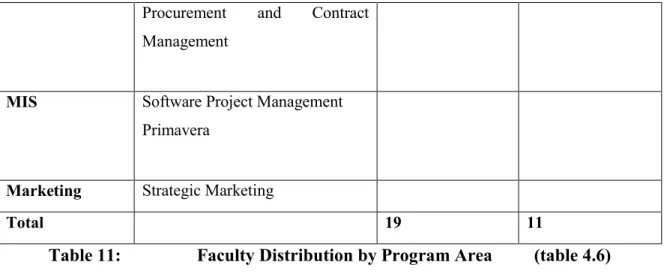
Riphah_MS PM_June 2015 35 Procurement and Contract
Management
MIS Software Project Management
Primavera
Marketing Strategic Marketing
Total 19 11
Table 11: Faculty Distribution by Program Area (table 4.6)
8.2 Standard 6-2
All faculty members must remain current in the discipline and sufficient time must be provided for scholarly activities and professional development. Also, effective programs for faculty development must be in place. Effective Programs for Faculty Development
Faculty concurrency in the discipline is determined based on the criterion set by the University in the light of HEC guidelines. All faculty members submit their professional resumes on HEC Performa number 9 (Faculty Resume) once a year. This information is compared with the existing criterion set by university for the concurrency of the post.
All full time faculty members are allocated teaching hours as per HEC defined limit which enables the faculty to have enough spare time to perform scholarly activities and improve their knowledge and skills.
Faculty members are provided with adequate resources for research and academic activities. Every faculty members has been provided with computer system and access to internet. Faculty members have also access to library materials for academic and research activities. Professional training is also provided to faculty if required to enhance their capabilities.
University has defined the development programs for faculty members under the arrangement of RARE (Riphah Academy of Research and Education). RARE holds frequent interactive sessions of junior and senior faculty to discuss teaching methodology with a view to train the young faculty members. This practice is done on yearly basis during the summer vacations. After every 2 year the development program is analyzed in Deans Council for its effectiveness and necessary improvements.
The university encourages the faculty to participate in research activities by providing them sufficient financial support within or outside university.
8.3 Standard 6-3
All faculty members should be motivated and have job satisfaction to excel in their profession.
Faculty members are motivated through public appreciation and documented appreciation (annual performance evaluation report) by the In-Charge Program and Dean on regular basis.
The faculty survey of the program using HEC Performa number 5 indicates the mix reactions of the faculty, which indicates that teaching load be distributed evenly and more relaxed environment be generated. Cumulative results of faculty surveys are attached in Annexure G.
9.0 Criterion 7: Institutional Facilities
9.1 Standard 7-1
The institution must have the infrastructure to support new trends in learning such as e-learning.
Riphah_MS PM_June 2015 37
The university has provided e-learning facilities to faculty members and students. Each faculty member has a computer system with access to internet and e-learning library section.
Students have been provided a number of computer systems in the library to access learning section. Every student has been provided with user ID to access the e-learning resources from within the university library. The university library is linked with foreign universities libraries through internet.
The support staff to look after the e-learning resources is sufficient in number, trained and responsive. The university has provided enough funding to support the e-learning.
9.2 Standard 7-2
The library must possess an up-to-date technical collection relevant to the program and must be adequately staffed with professional personnel.
The university library has enough technical books in hard copies to support the program learning. The internet access to the external universities libraries provides opportunities to the students and faculty to obtain knowledge from their technical resources.
The library is staffed with more than 8 professionals to help students and faculty members to get access to required book or learning material efficiently.
9.3 Standard 7-3
Class-rooms must be adequately equipped and offices must be adequate to enable faculty to carry out their responsibilities.
Enough class rooms are available to run the program as per desired schedule. In few class rooms, there is a need of up-gradation of multimedia and other resources. The work orders have been initiated and procurement process is in progress.
10.0 Criterion 8: Institutional Support
10.1 Standard 8-1
There must be sufficient support and financial resources to attract and retain high quality faculty and provide the means for them to maintain competence as teachers and scholars.
University allocates enough financial resources each year to hire competent faculty as required.
As already listed in standard 5-3, Faculty members are retained by giving them good remuneration, favorable teaching environment, research facilities and management support.
As listed in standard 6-2, Faculty members are provided with adequate resources for research and academic activities to maintain their competence. Every faculty members has been provided with computer system and access to internet. Faculty members have also access to library materials for academic and research activities. Professional training is also provided to faculty if required to enhance their capabilities.
10.2 Standard 8-2
There must be an adequate number of high quality graduate students, research assistants and Ph.D. students.
The university follows the guidelines of HEC for admission in this program. The number of graduate students during the last three years is 239 with no research assistants and Ph.D student in the faculty.
Faculty to graduate student’s ratio for the last three years remained in the range of 35:1 to 40:1.
Riphah_MS PM_June 2015 39
10.3 Standard 8-3
Financial resources must be provided to acquire and maintain Library holdings, laboratories and computing facilities.
Library at RIPHAH holds more than 50000 books for all programs. Sufficient number of computers are available to be used by the students. Library is organized to accommodate 50 students (male, female) in research cubicles as well as in the common places. Separate common rooms for male and female students are available with internet facility.
Laboratories at Riphah holds adequate equipment to be used by the students to carry out desired experiments and laboratory work. Each year a handful of budget is allocated for laboratories to maintain and upgrade the equipment and other facilities.
Computing facilities at Riphah provide excellent platform to students to enhance their learning capabilities. There are 2 computer laboratories in Faculty of computing, which are accessible to all students for their use.
11.0 Conclusion
The self assessment report of the Faculty of Management Sciences (MS Project Management), Riphah International University, I-14 Campus Islamabad is an important document, which gives strengths and weaknesses of the program. The management is striving hard to improve infrastructure for establishment of conducive environment for studies. The faculty is focused on imparting quality education, introduction of new and innovative techniques and conduct of quality research to produce competent engineers. The report has been prepared after evaluating the program in the light of 8 criterion and 31 standards given in HEC’s Self Assessment Manual. The program mission objectives and outcomes are assessed and strategic plans are presented to achieve the goal, which are again measurable through definite standards. Teachers’ evaluation revealed satisfactory standards, the score of twelve teachers of the program ranged from 3.05 to 4.72.
Students’ course evaluation score ranged between 3.30 and 4.60 with a mean of 3.95 points in 0-5 scale. Alumni surveys revealed variable results with regards to knowledge, interpersonal skills, management and leadership skill. Weaknesses are identified which are related to space, laboratories and equipment. Improvements in curriculum design and infrastructure are suggested which are based upon set, well defined and approved criteria. Examinations are held on schedules, academic schemes are prepared well in advance, transparent admission, registration and recruiting policy, excellent student teacher ratio are some of the strong areas of this program. The number of courses along with titles and credit hours for each semester, course contents for degree program, are thoroughly planned. Their efficacy was measured through different standards and it was found to be satisfactory.
The facilities and shortcomings in the laboratory have been discussed. It was concluded that laboratory facilities and class rooms need further improvement. The need of refreshal courses for the fresh faculty on method of teaching cannot be over emphasized.
Proper steps are taken to guide the students for program requirements, communication, meetings, tutorial system, tours, students-teacher interaction etc. Some improvements have been suggested. As regards the process control covering admission, registration, recruiting policy, courses and delivery of material, academic requirements, performance and grading, university, as well as Higher Education Commission have set forth proper rules, which are properly followed. At present there are nineteen faculty members who are highly qualified in their fields. However, faculty members need motivation for advanced knowledge, research and external training.
Institutional facilities were measured through Criterion 3; infrastructure, library, class room and faculty offices and in each case, short comings and limitation are highlighted. Institutional facilities need to be strengthened. Accordingly,
Riphah_MS PM_June 2015 41
institutional support will greatly promote and strengthen academic, research, management and leadership capabilities.
In conclusion, the strong and weak areas of the program are as under:- 11.1 Strong Areas
Highly qualified and experienced faculty
The curriculum has rich and logically arranged courses to prepare the students to be competent in research and professionally.
Research oriented environment Attractive scholarship
Ideal location Weekend classes 11.2 Weaknesses
Lack of library resources Below par class rooms facilities
Annexure – A: Alumni Survey Know ledge Excellent 21% Very Good 31% Good 22% Fair 14% Poor 12%
Excellent Very Good Good Fair Poor
Interpersonal Skills Excellent 22% Good 25% Fair 16% Poor 11% Very Good 26%
Excellent Very Good Good Fair Poor
Management Skills Excellent 18% Very Good 27% Good 30% Fair 18% Poor 7% Excellent Very Good Good Fair Poor
Com m unication Skills
Excellent 20% Very Good 25% Good 24% Fair 18% Poor 13%
Riphah_MS PM_June 2015 43
Annexure – B: Employer Survey
Annexure – C: Students Course Evaluation
Annexure – D: Students Teachers Evaluation