European Masters Program in
Language and Communication Technologies
(LCT)
Chapter 1
Study Program
The Master in Language and Communication Technologies is designed to meet the demands of industry and research in a rapidly growing area. It offers education and training opportunities for the next generations of leaders in research and innovation. It provides students with profound knowledge and insight into the various disciplines that contribute to the methods of language and communication technologies and it strengthens their ability to work according to scientific methods. Moreover, the students also acquire practice-oriented knowledge by choosing appropri-ate combinations of modules in language technology, computational and theoretical linguistics, and computer science.
Studying in multi-national groups at two universities in Europe, with English as instruction language, accompanied by language classes in another European language, contributes to the students’ preparation for the increasing globalization of science, commerce and industry. The course also prepares students for follow-up Ph.D. studies provided by the participating partners and others.
The course consists of Compulsory Modules and Advanced Modules in Language Technologies and Computer Science, complemented by a Project, and a Master thesis, for a total of 120 ECTS credits.
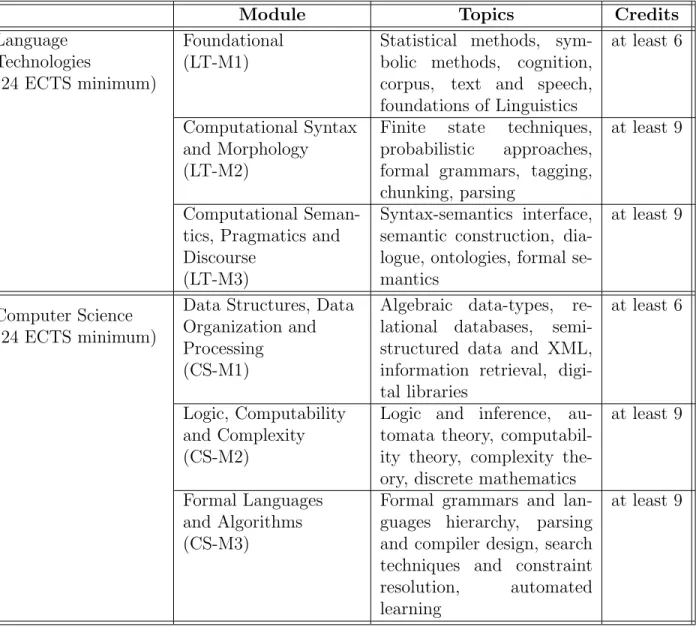
The Compulsory Modules and their range of possible syllabi are as specified in Table 1.1 below.
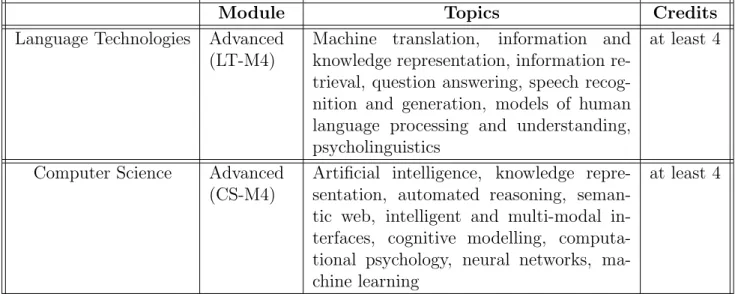
The Advanced Modules consist of 34 ECTS credits, of these at least 4 credits should be in LT and 4 in CS. These modules are based on the specific strengths in research and teaching of the partner institutions and thus vary from partner to partner. The main topics are listed in Table 1.2 below. From the 34 ECTS credits of this category of modules, 15 may be devoted to a project. The research masters thesis consists of 30 ECTS credit points.
Students within the double degree program have to study at two institutions of the consor-tium. As such, they are jointly monitored by two lecturers (tutors), one from each institution. Each student has to develop a study plan with her/his tutors. This plan must be submitted for approval to the Joint Committee of the Consortium. The students have to complete successfully all the written and/or oral exams of the modules selected in the aforementioned study plan. The students have to submit and defend their masters thesis at either or both of their selected institutions. The masters thesis can be jointly supervised. It is defended in front of a jury with members from the two selected universities.
A detailed description of the study organisation, the modules, and the courses offered by the 1
Module Topics Credits Language Technologies (24 ECTS minimum) Foundational (LT-M1)
Statistical methods, sym-bolic methods, cognition, corpus, text and speech, foundations of Linguistics
at least 6
Computational Syntax and Morphology (LT-M2)
Finite state techniques, probabilistic approaches, formal grammars, tagging, chunking, parsing
at least 9
Computational Seman-tics, Pragmatics and Discourse
(LT-M3)
Syntax-semantics interface, semantic construction, dia-logue, ontologies, formal se-mantics
at least 9
Computer Science (24 ECTS minimum)
Data Structures, Data Organization and Processing
(CS-M1)
Algebraic data-types, re-lational databases, semi-structured data and XML, information retrieval, digi-tal libraries
at least 6
Logic, Computability and Complexity (CS-M2)
Logic and inference, au-tomata theory, computabil-ity theory, complexcomputabil-ity the-ory, discrete mathematics
at least 9
Formal Languages and Algorithms (CS-M3)
Formal grammars and lan-guages hierarchy, parsing and compiler design, search techniques and constraint
resolution, automated
learning
at least 9
European Masters Program in LCT - Modules Handbook Page 3
Module Topics Credits
Language Technologies Advanced (LT-M4)
Machine translation, information and knowledge representation, information re-trieval, question answering, speech recog-nition and generation, models of human language processing and understanding, psycholinguistics
at least 4
Computer Science Advanced
(CS-M4)
Artificial intelligence, knowledge repre-sentation, automated reasoning, seman-tic web, intelligent and multi-modal in-terfaces, cognitive modelling, computa-tional psychology, neural networks, ma-chine learning
at least 4
Table 1.2: Advanced Modules
participating universities is available in the rest of this handbook.
http://www.coli.uni-saarland.de/msc/lct/ ERASMUS MUNDUS PROGRAMME
Part I
Language Technology Modules
Chapter 2
University of Amsterdam (UvA)
The indicated modules are classified as A, B, C. A means that the module is suitable as a first course in the area (though it may still require basic computational and mathematical skills), B means that it is a second course in the area and C that it is advanced.
2.1
Description of the Foundations of Language
Technol-ogy Module
The Foundations of Language Technology module at the University of Amsterdam is covered with courses on:
Language and Speech Processing (6 points, with 2 associated projects of 4 points each) which deals with all basic techniques, including statistical and symbolic methods
2.1.1
Text and Speech
Language and Speech Processing: How to deal with uncertainty and lack of knowledge when building models of human cognitive capacities such as language processing. This includes: -Statistical models for language processing -Language models for speech processing -Models for ambiguity resolution in POS tagging and syntactic parsing -Technological applications. When computational models of language processing are not constructed in a purely linguistic context, but aim at being relevant for psychological theory or for practical applications, they ought to be able to perform tasks like disambiguation and prediction. [6 ECTS, level A]
2.2
Description of the Computational Syntax and
Mor-phology Module
The Computational Syntax and Morphology module at the University of Amsterdam is covered with courses on:
Language and Speech Processing, Computational Syntax, Probabilistic Grammars and Data Oriented Parsing.
2.2.1
Finite State Techniques (FST)
Covered by the course Language and Speech Processing.
2.2.2
Probabilistic Approaches
Probabilistic Grammars and Data Oriented Parsing: The course consists of two parts. Part I introduces the use of statistics and probabilities in Natural Language Processing. It focuses on mathematical models and the principles behind them; computational aspects are de-emphasized and left for Part II. The topics to be treated are: syntactic representations, the ambiguity problem, Probability Theory and Statistics, N-gram Models applied to Part-of-Speech tagging, Hidden Markov Models and their relation to Finite State Transducers, Probabilistic Context-Free Grammars and syntactic analysis, limitations of these models.
Part II builds on Part I. It introduces more complex models and discusses their computa-tional properties. The topics are: parsing and ambiguity, the Maximum Likelihood Principle, Probabilistic Context-Free Grammars and Inside-Outside algorithms, problems with PCFG’s, Data-Oriented Parsing, Bilexical Dependency Parsing. [6 ECTS, level B]
2.2.3
Formal Grammars
Computational Syntax: Knowledge of the main formalisms used in computational descriptions of natural languages, in particular Lexical Functional Grammar, Head driven Phrase Structure Grammar and Optimality Theory. We will start with Wasow and Sag’s soft introduction to HPSG, will read some research papers on recent developments, including optimality theoretic approaches. [10 ECTS, level A]
2.2.4
Parsing
Covered at undergraduate level
2.3
Description of the Computational Semantics,
Prag-matics and Discourse Module
The Computational Semantics, Pragmatics and Discourse module at the University of Amsterdam is covered with courses on:
Computational Semantics, Dialogue systems, Meaning, Reference, and Modality, Structures for Semantics. The courses cover semantics and pragmatics, syntax-semantic interface and semantic construction.
European Masters Program in LCT - Modules Handbook Page 9
2.3.1
Syntax-Semantics Interface
Computational Semantics: The course introduces logical methods in natural language se-mantics and their implementation. [10 ECTS, level A]
2.3.2
Semantic Construction
2.3.3
Dialogue
Dialogue systems: Dialogue and man machine dialogue in particular comes with a number of special problems over and above those that one meets in discourse processing. The course will aim to look at a number of problems that are central in current research, such as agreed knowledge, conflict and negotiation, speech act recognition and characterisation of control. [6 ECTS, level B]
2.3.4
Formal Semantics
Meaning, Reference and Modality: In this course classical intensional semantics and dy-namic semantics are approached from a philosophical-logical perspective. The philosophical backgrounds of the two paradigms are studied as well as their logical formulation. We will study classical texts on intensonality from Frege, Lewis, Stalnaker and Kripke, and zoom in on long-standing issues such as sense and reference; naming, identity and necessity; beliefs de dicto, de re, and de se; speaker’s reference and semantic reference; context and context change; modality and discourse. [6 ECTS, level A]
Structures for Semantics: Formalization plays an important role in semantics. In this course we will study mathematical techniques that are used in semantics to model natural language phenomena. We will discuss type theory, event structures, and partial semantics. In all cases we will motivate the techniques from a semantic point of view and discuss applications of the tools. [10 ECTS, level B]
2.4
Description of the LT Advanced Modules and
Appli-cations
The LT Advanced Modules and Applications at the University of Amsterdam are covered with courses on:
Automated Learning and Adaptive Knowledge Systems, Internet Information, Language Technol-ogy Project, Speech TechnolTechnol-ogy Project, Speech Signal Processing, Language Learning, Multimedia Information Retrieval.
2.4.1
Information and Knowledge Representation
Automated Learning and Adaptive Knowledge Systems: This course expands the course
http://www.coli.uni-saarland.de/msc/lct/ ERASMUS MUNDUS PROGRAMME
Leren in the Bachelors programme with additional topics from Machine Learning: genetic algo-rithms, inductive logic programming/relational learning, knowledge-intensive learning clustering, boosting. Applications of Machine Learning for Data Mining and Adaptive Interactive systems will be discussed. Special attention will be given to Machine Learning in the context of text (text mining) and adaptive interactive systems. [6 ECTS, level B]
2.4.2
Information Retrieval (IR)
Internet Information: Ever wondered how internet search engines work? Or why you never find what you’re looking for? It turns out that many of the fundamental ideas underlying internet search engines go back to algorithms developed in the 1950s. In Information Retrieval we study techniques to locate information in large collections of information, that may contain both structured data (e.g., name, address, telephone number) and unstructured data (e.g., text, images, sounds). These techniques are being evaluated on annual basis as part of a number of international retrieval events. This year, the Internet Information course consists of the following components:
(i) A textbook part, in which we study basis techniques and methods from information retrieval, and in which we put these to work in the setting of web retrieval. (ii) A part in which we discuss recent research in a small number of subareas of web retrieval, including XML retrieval and open domain question answering systems. (iii) A number of practical assignments resulting in the implementation of web retrieval systems and/or extensions. [10 ECTS, level A]
2.4.3
Question Answering (QA)
Covered in undergraduate program and often in language technology project.
2.4.4
Speech Recognition and Generation
Spoken Language Generation: While in NLP and Speech the serious difficulties are normally taken to be in the interpretation direction (parsing and speech recognition). Here the question is can one do it all and can one get rid of the limiting factors under which it is possible. Generating text and speech seems comparatively simple. The research questions all center around the notion of quality, which is also the decisive factor in the commercialisation of these techniques. The course gives an overview of the standard approaches in text to speech and text generation and introduces the main research issues. [6 ECTS, level A]
2.4.5
Psycholinguistics
Logic and Cognition - from time to tense. We study the relation between the human conceptualization of time and the representation of time in natural language. The course begins with an overview of philosophical thinking about time, and then continues with an examination of current psychological theories. [10 ECTS, level A]
European Masters Program in LCT - Modules Handbook Page 11
2.5
Additions
2.5.1
Language Technology Project:
Changing topics. [6 ECTS, level B]
2.5.2
Speech Technology Project:
Changing topics. [6 ECTS, level B]
2.5.3
Speech Technology:
In this module the student will acquire insight in the structure, processing and performance of speech technological systems. With this insight one should be able to read and understand most of the literature in this field. One should also be able to extend this information into building one’s own applications or into performing one’s own research.
At least the following topics will be covered: speech and text corpora; speech segmentation and transcription at various levels; storage and access of (annotated) corpora; speech coding, speech synthesis, speech recognition, and dialogue structures; system evaluation; speech technological applications; overview of interesting research programs and products. [10 ECTS, level A]
2.5.4
Speech Signal Processing:
Speech coding and compression – Fourier analysis – band filter analysis – convolution and auto-correlation – relation with automatic speech recognition. [10 ECTS, level A]
2.5.5
Language Learning:
We will focus on questions concerning mathematical models of the learning capacity of human beings. The central problem is how people exchange information in a dialogue. This leads to the study of syntactical and semantical learning algorithms. There are various approaches in this area. Historically, the influence of Gold’s paradigm, identification in the limit has been very strong. Yet this approach is of limited value, because it leads to negative results and gives us very little clue as to the implementation of language learning algorithms that work in practice. We will present another approach based on categorial grammars, PAC-learning and Kolmogorov complexity. In this context we will introduce the concept of shallowness and will show that under very reasonable circumstances context-free grammars can be learned from text alone. We will explore the possibilities to extend this theory to a general theory of learnable structures. [6 ECTS, level A]
For more info seehttp://www.studeren.uva.nl/ma-ai/. Contact person (international students): Ms. Joke Hendriks E-mail: [email protected] (international bureau)
http://www.coli.uni-saarland.de/msc/lct/ ERASMUS MUNDUS PROGRAMME
Contact person (study advisor): Ms. Lucia Creveld E-mail: [email protected]
Chapter 3
Free University of Bozen-Bolzano(FUB)
3.1
Description of the Foundations of Language
Technol-ogy Module
The Foundations of Language Technology module at FUB is covered with courses on:
3.1.1
Text and Speech
Automatic Speech Recognition Introduction to spoken language interfaces; Human speech production and perception systems; Speech signal representation; [2 ECTS]
3.1.2
Foundations of Linguistics
Introduction to Linguistics Morphology; Phonetics; Phonology; Syntax; Semantics [4 ECTS]
3.2
Description of the Computational Syntax and
Mor-phology Module
The Computational Syntax and Morphology module at FUB is covered with courses on:
3.2.1
Finite State Techniques (FST)
See FUB course description in the Computer Science Modules Part.
3.2.2
Formal Grammars
Computational Linguistics Introduction to Formal Grammars: CFG, Feature Structures, CG, TAG. [2 ECTS]
3.2.3
Parsing
Text Processing Data and knowledge driven methodologies for text processing; Morpho-syntactic analysis; Content extraction; Part of speech tagging; Shallow parsing; Terminology recognition; Named entities recognition; Word sense disambiguation [4 ECTS]
3.3
Description of the Computational Semantics,
Prag-matics and Discourse Module
The Computational Semantics, Pragmatics and Discourse module at FUB is covered with courses on:
3.3.1
Syntax-Semantics Interface
Computational Linguistics Syntax-Semantics Interface: lambda calculus, introduction to DRT. [2 ECTS]
3.3.2
Dialogue
Intelligent Interfaces Multimodal interfaces; Tangible interfaces; Conversational interfaces; Team project [4 ECTS]
3.4
Description of the LT Advanced Modules and
Appli-cations
The LT Advanced Modules and Applications at FUB are covered with courses on:
3.4.1
Machine Translation (MT)
Cross-Language Information Technologies Statistical framework of machine translation; [1 ECTS]
3.4.2
Information and Knowledge Representation
See FUB course description in the Computer Science Modules Part.
3.4.3
Information Retrieval (IR)
See FUB course description in the Computer Science Modules Part.
3.4.4
Speech Recognition and Generation
Automatic Speech Recognition Pattern classification; Acoustic modeling; Language mod-eling; Word hypotheses generation [2 ECTS]
European Masters Program in LCT - Modules Handbook Page 15
3.4.5
Models of Human Language Processing and Understanding
Cross-Language Information Technologies Models and algorithms for various application areas; Document translation; Speech translation; Cross-language information access; Experimen-tal work with available software. [3 ECTS]
For more info seehttp://www.inf.unibz.it/mcs/lct/
Contact person: Raffaella Bernardi E-mail: [email protected]
http://www.coli.uni-saarland.de/msc/lct/ ERASMUS MUNDUS PROGRAMME
Chapter 4
Copenhagen Business School (CBS)
4.1
Description of the Foundations of Language
Technol-ogy Module
The Foundations of Language Technology module at Copenhagen Business School is covered with courses on:
symbolic methods, corpus, foundations of Linguistics.
4.1.1
Symbolic Methods
Course in Logic, (Comprises the basic concepts of prepositional and predicate logic, model theory and elementary lambda calculus.) [5 ECTS]
4.1.2
Corpus Linguistics
[2 ECTS] of our course in Computer-Assisted Terminology deal with Corpus Linguistics. (The course comprises the use of corpora for terminological and lexicographic tasks.)
4.1.3
Foundations of Linguistics
[2 ECTS] of our course in Linguistic Theories and Formalisms: Syntax fall under this heading. (The course comprises basic concepts and issue in one or more formal syntactic theories.) [2 ECTS] of our course in Linguistic Theories and Formalisms: Semantics fall un-der this heading. (The course comprises basic concepts and issue in one or more formal semantic theories.)
[1 ECTS] of our course in Computer-Assisted Terminology fall under this heading. (The course comprises theoretical issues in terminology and lexicography.)
4.2
Description of the Computational Syntax and
Mor-phology Module
The Computational Syntax and Morphology module at the Copenhagen Business School
is covered with courses on:
finite state techniques (FST), formal grammars, parsing.
4.2.1
Finite State Techniques (FST)
[1 ECTS] of our general course inComputer Science deal with FST.
4.2.2
Formal Grammars
[4 ECTS] of our course in Linguistic Theories and Formalisms: Syntax deal with Formal Grammars. (The course comprises basic concepts and issue in formal syntax.)
4.2.3
Parsing
Course in Parsing Strategies. (The course comprises top-down and bottom-up parsing, left-corner parsing and chart-parsing, and key issues and methods in robust parsing.) [5 ECTS] [2 ECTS] of our course in Linguistic Theories and Formalisms: Syntax deal with Parsing. (The course comprises methods and techniques for computational implementation of syntactic analysis of Danish sentences.)
[1 ECTS] of our course in Natural-Language Processing deals with Parsing. (The course comprises problems and methods in natural-language processing.)
4.3
Description of the Computational Semantics,
Prag-matics and Discourse Module
The Computational Semantics, Pragmatics and Discourse module at the Copenhagen Business School is covered with courses on:
dialogue, ontologies, formal semantics.
4.3.1
Dialogue
[1 ECTS] of our course in Natural-Language Processing deals with Dialogue. (The course comprises problems and methods in natural-language processing, as they are manifested in e.g. dialogue systems, natural-language interfaces or text summarisation.)
European Masters Program in LCT - Modules Handbook Page 19
4.3.2
Formal Semantics
[8 ECTS] of our course inLinguistic Theories and Formalisms: Semantics fall under this heading. (The course comprises basic concepts and issue in one or more formal semantic theories. In addition to this, methods and techniques are presented for computational implementation of semantic analysis of Danish sentences in accordance with the studied theories.)
4.4
Description of the LT Advanced Modules and
Appli-cations
The LT Advanced Modules and Applications at the Copenhagen Business School are covered with courses on:
machine translation, information and knowledge representation, question answering, speech recognition and generation
4.4.1
Machine Translation (MT)
Course in Machine Translation. (The course comprises techniques and methods for the de-velopment of translation systems.) [5 ECTS]
4.4.2
Information and Knowledge Representation
[5 ECTS] of our course in Database Theory and Programming deal with Knowledge Representation. (The course comprises database theories, the architecture of database systems, and data organisation)
[5 ECTS] of our course in Computer-Assisted Terminology deal with Knowledge Rep-resentation. (The course comprises knowledge structuring and knowledge representation in terminology work.)
4.4.3
Question Answering (QA)
[2 ECTS] of our course inDatabase Theory and Programming deal with QA. (The course comprises facilities of database systems.)
[2 ECTS] of our course in Natural-Language Processing deal with QA. (The course comprises problems and methods in natural-language processing, as they are manifested in e.g. dialogue systems, natural-language interfaces or text summarisation.)
4.4.4
Speech Recognition and Generation
Elective Module inSpeech. (The course comprises a general introduction to speech technology). [5 ECTS]
http://www.coli.uni-saarland.de/msc/lct/ ERASMUS MUNDUS PROGRAMME
4.4.5
Additions
Sections of our courses not covered by the preceding headings:
[4 ECTS] of our course in Computer Science. (General introduction to computer ar-chitecture, systems software, networks and application software).
[3 ECTS] of our course inDatabase Theory and Programming. (General database theory). [2 ECTS] of our course in Linguistic Theories and Formalisms: Syntax. (Specific linguistic issues).
[2 ECTS] of our course in Computer-Assisted Terminoloy. (Theory and methods in general terminology).
[1 ECTS] of our course in Natural-Language Processing. (Interaction with knowledge bases when using real-world knowledge in parsing).
Other courses etc.:
An Elective Module of [5 ECTS].
Project, 15 ECTS. (Assignment typically given by a company or other external partner). Thesis, 30 ECTS.
For more info seehttp://www.id.cbs.dk
Contact persons: Sabine Kirchmeier-Andersen, Stig W. Jørgensen
Chapter 5
University of Malta (UoM)
Under language technology UoM is primarily offering 15 advanced credits + 15 credit project + 30 credit dissertation. In addition there are 9 introductory level credits.
5.1
Description of the Foundations of Language
Technol-ogy Module
The Foundations of Language Technology module at UoM is covered by courses on:
5.1.1
Text and Speech
Fundamentals for Digital Signal Processing This unit teaches the basics and fundamentals underlying DSP as required for speech technologies. Sampling and quantising; Fourier transform; convolution; signal processing operations. Assignments will be carried out on audio, image and weather signals. [5 ECTS]
5.1.2
Foundations of Linguistics
Introduction to Computational Linguistics Introductory course including linguistic and computational fundamentals, linguistic categories, tagging, computational morphology, compu-tational syntax, grammar formalisms. [2 ECTS]
5.2
Description of the Computational Semantics,
Prag-matics and Discourse Module
5.2.1
Syntax-Semantics Interface
Interfacing NL Syntax and Semantics A practical exploration of the interface between syntactic phenomena, (e.g. verbs, simple and complex noun phrases, relative clauses), and their semantic representation using DCGs. Development of a simple NLDB query system. [2 ECTS]
5.3
Description of the LT Advanced Modules and
Appli-cations
The LT Advanced Modules and Applications at UoM are covered with courses on:
5.3.1
Machine Translation (MT)
Machine Translation History, FAMT/HAMT/MAHT, Direct/Transfer/Interlingual Models, Example based MT, Translation Memory, Statistical MT, evaluation of MT systems. [2 ECTS]
5.3.2
Speech Recognition and Generation
Speech Technology with Digital Signal Processing Speech technology concepts, speech analysis, speech synthesis, TTS speech corpora, speech recognition, noise, variability, computu-tational tools, HMMs and neural networks. [5 ECTS]
5.3.3
Models of Human Language Processing and Understanding
Natural Language Algorithms This unit presents and examines algorithms used at different levels of NL analysis, notably: words (finite state tools and techniques, stemming), sentences (left corner, earley etc), texts (tokenisation, tagging). [2 ECTS]
5.3.4
Additions
Information Extraction The IE problem, overall architecture of IE systems, text represen-tations and tokenisation, named entity recognition, coreference determination, representation of results, text mining. [2 ECTS]
Computational Morphology Morphology concepts, morphological analysis and synthesis, finite state techniques, xerox tools, concatenatative and non-concatenative morphology, compu-tational lexicon. [2 ECTS]
Natural Language Generation NLG compared to NLU, components of NLG systems, NLG and planning, generation of referring expressions, path planning and description, adaptive generation. [2 ECTS]
5.3.5
Project
The project involves the design, implementation, description and presentation of a computational artifact in one of the areas covered in this part of the course. The description of the work to be carried out is fully determined in advance by the lecturer(s) concerned. [15 ECTS]
European Masters Program in LCT - Modules Handbook Page 23
5.3.6
Dissertation - 30 ECTS credits
The disseration involves three main components: identification of a subject area and delimitaion of a topic within that area; a literature survey and seminar; the development of an artifact, and the dissertation.
Contact person: Michael Rosner E-mail: [email protected]
http://www.coli.uni-saarland.de/msc/lct/ ERASMUS MUNDUS PROGRAMME
Chapter 6
University Henri Poincar´
e (Nancy 1)
6.1
Description of the Foundations of Language
Technol-ogy Module
The Foundations of Language Technology module atNancy 1 is covered with the courses:
• Logic and Statistical Tools for Language Modeling [3 ECTS of a total of 6 ECTS]. Obligatory
• Tools and Algorithms for NLP [3 ECTS of a total of 6 ECTS]. Obligatory
• Corpus Linguistics [3 ECTS of a total of 3 ECTS]. Optional
• Phonetics [3 ECTS of a total of 3 ECTS]. Optional
6.1.1
Statistical Methods
Logic and Statistical Tools for Language Modeling. Hidden Markov models, n-grams, perplexity, multi-grams.
6.1.2
Symbolic Methods
Tools and Algorithms for NLP. Finite state techniques. Feature Structures and Unification. Typed Lambda Calculus. Compositionality.
6.1.3
Cognition
Logic and Statistical Tools for Language Modeling. Reasoning Models. Inference.
6.1.4
Corpus Linguistics.
Corpus Linguistics. Techniques and resources for corpus construction. Annotation tools and schemes. Applications.
6.1.5
Text and Speech
Phonetics. Phonetics, phonology, prosody.
6.2
Description of the Computational Syntax and
Mor-phology Module
TheComputational Syntax and Morphologymodule atNancy 1 is covered with the courses:
• Logic and Statistical Tools for Language Modeling [3 ECTS of a total of 6 ECTS]. Obligatory
• Tools and Algorithms of NLP [3 ECTS of a total of 6 ECTS]. Obligatory
• Introduction to NLP – Morphology and Syntax [3 ECTS of a total of 3 ECTS]. Oblig-atory
• Grammatical Formalisms [3 ECTS of a total of 3 ECTS]. Optional
6.2.1
Finite State Techniques (FST)
Introduction to NLP – Morphology and Syntax. Finite state automata. Tagging.
6.2.2
Probabilistic Approaches
Tools and Algorithms for NLP. Tabulation methods. Polarities and saturation of struc-tures. Syntactic analysis as constraint resolution.
Logic and Statistical Tools for Language Modeling. Hidden Markov models, n-grams, perplexity, multi-grams.
6.2.3
Formal Grammars
Grammatical Formalisms. Head-driven Phrase Structure Grammars. Lexical Functional Grammars. Categorial Grammars. Tree Adjoining Grammars. Metagrammars.
6.2.4
Parsing
Grammatical Formalisms. Parsing Algorithms
6.3
Description of the Computational Semantics,
Prag-matics and Discourse Module
TheComputational Semantics, Pragmatics and Discourse module atNancy 1 is covered with the courses:
European Masters Program in LCT - Modules Handbook Page 27 • NLP Applications [3 ECTS of a total of 6 ECTS]. Obligatory
• Introduction to NLP – Semantics and Pragmatics [3 ECTS of a total of 3 ECTS]. Obligatory
• Computational Semantics [3 ECTS of a total of 3 ECTS]. Optional
• Discourse and Dialogue Representation [3 ECTS of a total of 3 ECTS]. Optional
6.3.1
Syntax-Semantics Interface
Introduction to NLP – Semantics and Pragmatics. Semantic Representation. Computational Semantics. Syntax-semantics interface.
6.3.2
Semantic Construction
Introduction to NLP – Semantics and Pragmatics. Lexical Semantics. Computational Semantics. Montague Semantics. Compositionality.
6.3.3
Dialogue
NLP Applications. Dialogue systems.
Discourse and Dialogue Representation. Discourse and dialogue models. Anaphora and presupposition resolution. Treatment of the discourse and dialogue history. DRT.
6.4
Description of the LT Advanced Modules and
Appli-cations
The LT Advanced Modules and Applications atNancy 1 are covered with the courses:
• NLP Applications [3 ECTS of a total of 6 ECTS]. Obligatory
• Generation [3 ECTS of a total of 3 ECTS]. Optional
• Mining of Textual Domains [3 ECTS of a total of 3 ECTS]. Optional
• Normalization and Linguistic Resources [3 ECTS of a total of 3 ECTS]. Optional
• Lexicology [3 ECTS of a total of 3 ECTS]. Optional
6.4.1
Information and Knowledge Representation
NLP Applications. Architectures and techniques for inference in NLP.
http://www.coli.uni-saarland.de/msc/lct/ ERASMUS MUNDUS PROGRAMME
6.4.2
Information Retrieval (IR)
Mining of Textual Domains. Symbolic Classification. Numeric Classification. Rule extrac-tion.
Normalization and Linguistic Resources. Introduction to existing lexical, syntactic and semantic resources. The problem of information exchange and information structuring. Marking languages. Normalization.
6.4.3
Question Answering (QA)
NLP Applications. Question answering.
6.4.4
Text and Speech Recognition and Generation
Generation. Basic architecture. Content planing. Micro-planning. Surface Realization.
6.4.5
Models of Human Language Processing and Understanding
NLP Applications. Speech Recognition. Language Understanding. Dialogue Systems.
6.4.6
Additions
Lexicology. Macro- and Micro-structure for dictionaries. Human and electronic dictionaries. Uses of dictionaries in NLP applications.
6.5
Summary
Course ECTS Obligatory? LT M1 LT M2 LT M3 LT M4
Logics and Statistical Tools for Language Modeling 6 Yes 3 3
NLP Applications 6 Yes 3 3
Tools and Algorithms for NLP 6 Yes 3 3
Introduction to NLP - Morphology and Syntax 3 Yes 3
Introduction to NLP - Semantics and Pragmatics 3 Yes 3
Grammatical Formalisms 3 No 3
Computational Semantics 3 No 3
Discourse and Dialogue Representation 3 No 3
Corpus Linguistics 3 No 3
Generation 3 No 3
Phonetics 3 No 3
Mining of Textual Domains 3 No 3
Normalization and Linguistic Resources 3 No 3
Lexicology 3 No 3
Total 12 12 12 15
6.6
Further Information
For more info see http://tal.loria.fr. Contact person: Patrick Blackburn. E-mail:
Chapter 7
University Nancy 2
7.1
Description of the Foundations of Language
Technol-ogy Module
The Foundations of Language Technology module atNancy 2 is covered with the courses:
• Foundations in Linguistics [6 ECTS of a total of 6 ECTS]. Obligatory
• Logic and Statistic Tools for Language Modeling [3 ECTS of a total of 6 ECTS]. Obligatory
• Tools and Algorithms for NLP [3 ECTS of a total of 6 ECTS]. Obligatory
• Corpus Linguistics [3 ECTS of a total of 3 ECTS]. Optional
• Phonetics [3 ECTS of a total of 3 ECTS]. Optional
7.1.1
Statistical Methods
Logic and Statistic Tools for Language Modeling. Hidden Markov models, n-grams, perplexity, multi-grams.
7.1.2
Symbolic Methods
Tools and Algorithms for NLP. Finite state techniques. Feature Structures and Unification. Typed Lambda Calculus. Compositionality.
7.1.3
Cognition
Logic and Statistic Tools for Language Modeling. Reasoning Models. Inference.
7.1.4
Corpus Linguistics.
Corpus Linguistics. Techniques and resources for corpus construction. Annotation tools and schemes. Applications.
7.1.5
Text and Speech
Phonetics. Phonetics, phonology, prosody.
7.1.6
Foundations of Linguistics
Foundations in Linguistics. Basic concepts in Linguistics.
7.2
Description of the Computational Syntax and
Mor-phology Module
TheComputational Syntax and Morphologymodule atNancy 2 is covered with the courses:
• Logic and Statistic Tools for Language Modeling [3 ECTS of a total of 6 ECTS]. Obligatory
• Tools and Algorithms for NLP [3 ECTS of a total of 6 ECTS]. Obligatory
• Introduction to NLP – Morphology and Syntax [3 ECTS of a total of 3 ECTS]. Oblig-atory
• Grammatical Formalisms [3 ECTS of a total of 3 ECTS]. Optional
7.2.1
Finite State Techniques (FST)
Introduction to NLP – Morphology and Syntax. Finite state automata. Tagging.
7.2.2
Probabilistic Approaches
Tools and Algorithms for NLP. Tabulation methods. Polarities and saturation of struc-tures. Syntactic analysis as constraint resolution.
Logic and Statistic Tools for Language Modeling. Hidden Markov models, n-grams, perplexity, multi-grams.
7.2.3
Formal Grammars
Grammatical Formalisms. Head-driven Phrase Structure Grammars. Lexical Functional Grammars. Categorial Grammars. Tree Adjoining Grammars. Metagrammars.
7.2.4
Parsing
European Masters Program in LCT - Modules Handbook Page 31
7.3
Description of the Computational Semantics,
Prag-matics and Discourse Module
TheComputational Semantics, Pragmatics and Discoursemodule at Nancy 2 is covered with the courses:
• NLP Applications [3 ECTS of a total of 6 ECTS]. Obligatory
• Introduction to NLP – Semantics and Pragmatics [3 ECTS of a total of 3 ECTS]. Obligatory
• Computational Semantics [3 ECTS of a total of 3 ECTS]. Optional
• Discourse and Dialogue Representation [3 ECTS of a total of 3 ECTS]. Optional
7.3.1
Syntax-Semantics Interface
Introduction to NLP – Semantics and Pragmatics. Semantic Representation. Computational Semantics. Syntax-semantics interface.
7.3.2
Semantic Construction
Introduction to NLP – Semantics and Pragmatics. Lexical Semantics. Computational Semantics. Montague Semantics. Compositionality.
7.3.3
Dialogue
NLP Applications. Dialogue systems.
Discourse and Dialogue Representation. Discourse and dialogue models. Anaphora and presupposition resolution. Treatment of the discourse and dialogue history. DRT.
7.4
Description of the LT Advanced Modules and
Appli-cations
The LT Advanced Modules and Applications atNancy 2 are covered with the courses:
• Linguistic Databases [3 ECTS of a total of 6 ECTS]. Obligatory.
• NLP Applications [3 ECTS of a total of 6 ECTS]. Obligatory
• Generation [3 ECTS of a total of 3 ECTS]. Optional
• Mining of Textual Domains [3 ECTS of a total of 3 ECTS]. Optional
http://www.coli.uni-saarland.de/msc/lct/ ERASMUS MUNDUS PROGRAMME
• Normalization and Linguistic Resources [3 ECTS of a total of 3 ECTS]. Optional
• Lexicology [3 ECTS of a total of 3 ECTS]. Optional
7.4.1
Information and Knowledge Representation
NLP Applications. Architectures and techniques for inference in NLP.
7.4.2
Information Retrieval (IR)
Mining of Textual Domains. Symbolic Classification. Numeric Classification. Rule extrac-tion.
Normalization and Linguistic Resources. Introduction to existing lexical, syntactic and semantic resources. The problem of information exchange and information structuring. Marking languages. Normalization.
7.4.3
Question Answering (QA)
NLP Applications. Question answering.
7.4.4
Text and Speech Recognition and Generation
Generation. Basic architecture. Content planning. Micro-planning. Surface Realization.
7.4.5
Models of Human Language Processing and Understanding
NLP Applications. Speech Recognition. Language Understanding. Dialogue Systems.
7.4.6
Additions
Lexicology. Macro- and Micro-structure for dictionaries. Human and electronic dictionaries. Uses of dictionaries in NLP applications.
European Masters Program in LCT - Modules Handbook Page 33
7.5
Summary
Course ECTS Obligatory? LT M1 LT M2 LT M3 LT M4
Foundations in Linguistics 6 Yes 6
Linguistic Databases1 6 Yes 3
Logics and Statistics Tools for Language Modeling 6 Yes 3 3
NLP Applications 6 Yes 3 3
Tools and Algorithms for NLP 6 Yes 3 3
Introduction to NLP - Morphology and Syntax 3 Yes 3
Introduction to NLP - Semantics and Pragmatics 3 Yes 3
Grammatical Formalisms 3 No 3
Computational Semantics 3 No 3
Discourse and Dialogue Representation 3 No 3
Corpus Linguistics 3 No 3
Generation 3 No 3
Phonetics 3 No 3
Mining of Textual Domains 3 No 3
Normalization and Linguistic Resources 3 No 3
Lexicology 3 No 3
Total 18 12 12 15
Required 6 9 9 6
7.6
Further Information
For more info see http://tal.loria.fr. Contact person: Guy Perrier. E-mail: perrier@ loria.fr
1Other 3 ECTS in CS M3.
http://www.coli.uni-saarland.de/msc/lct/ ERASMUS MUNDUS PROGRAMME
Chapter 8
Charles University in Prague
8.1
Description of the Foundations of Language
Technol-ogy Module
The Foundations of Language Technology module at the Charles University in is covered with courses on:
8.1.1
Statistical Methods
Statistical Methods in Natural Language Processing I Introduction to formal linguistics and the fundamentals of statistical natural language processing, including basics of Infromation Theory, Language MOdeling and Markov Models. [6 ECTS]
Statistical Methods in Natural Language Processing II Continuation of Statistical Methods in Natural Language Processing I. Introduces the notion of linguistic experiment and its evaluation. The role of corpora in statistical NLP. Standard NLP tasks (tagging, parsing) are explained and methods presented. Short introduction to Statistical Machine Translation. [6 ECTS]
8.1.2
Symbolic Methods
Syntax without transformations The course deals with language description tools and op-tions of implementation offered by the theory of Head-Driven Phrase Structure Grammar, a non-transformational linguistic theory, describing linguistic phenomena declaratively, without transformations. Possibilities of the formalism will be illustrated by example solutions to some phenomena (valency, agreement, word order) and their comparison with solutions available in other theories. Interested students will be encouraged to implement and test a toy grammar in a grammar-writing environment. [3 ECTS]
Introductory Seminar of Mathematical Linguistics I What is mathematical linguis-tics; The foundations of the mathematical theory of languages: theory of formal languages
and automata; Immediate-constituent phrase-structure grammars; Introduction to transforma-tional grammars; Introduction to automata theory; Dependency grammars, Categorial gram-mars; Structural complexity of natural languages from the Chomsky hierarchy perspective; Au-tomatic morphological analysis and disambiguation of natural languages [3 ECTS]
Introductory Seminar of Mathematical Linguistics II The seminar follows up with the Introductory seminar of mathematical linguistics I. It deals with the following topics: morpho-logical and syntactic analysis of natural languages; Functional generative description of language (FGD); main features of the formal description of sentence structure; introduction to unification-based formalisms and grammars; prominent grammatical theories of the description of natural language in the West; introduction to corpus linguistics. [3 ECTS]
8.1.3
Cognition
Linguistic Aspects of Artifical Intelligence Natural language as a means of human com-munication is a natural candidate as an input to man-machine comcom-munication systems, a basis for knowledge representation and also as an important evidence of an “intelligent” behaviour of dialogue systems. Different aspects of language modules will be discussed, as well as the most recent approaches, systems and trends in man-machine communication domain. [3 ECTS]
8.1.4
Corpus Linguistics
Corpus Linguistics I An introduction to the modern branch of computational linguistics which concerns itself with corpora of natural languages. In theory, the following topics are stud-ied: the concept of a corpus; language corpus as a source of knowledge of language; modern computer technologies; corpus typology from various perspectives; representativeness of a text corpus (statistical methods of corpus processing, the text reception and production perspec-tive); administrative markup of texts included in the corpus; structural markup and linguistic annotation of texts (tagging, lemmatization). [3 ECTS]
Corpus Linguistics II The seminar focuses on practical issues in corpus linguistics and fol-lows up with the Corpus Linguistics I seminar. The following topics are discussed via essays and seminar papers: corpus design and build-up (methods of language material acquisition, conver-sion of language data to the unified SGML and XML format; annotation of texts included in the corpus; linguistic (morphological, syntactic, semantic) tagging of corpus texts, lemmatization; linguistic exploitation of corpus material; practical exploitation of the corpus, techniques for language data retrieval in the corpus. [3 ECTS]
Language Resources The goal of the seminar is to provide students with the survey of the field of Language Resources. Selected types of linguistic annotations will be described, with emphasis on annotating textual data (morphological categories, constituency and dependency syntactic trees, anaphora, discourse structure, word-sense disambiguation, parallel-text alignment etc.) and lexical data (wordnets, translation dictionaries, valency lexicons etc.). Leading projects for English, Czech, and some other languages will be used for illustration. [3 ECTS]
European Masters Program in LCT - Modules Handbook Page 37
8.1.5
Text and Speech
Basics of speech processing This seminar deals with speech recognition tasks and feature extraction of voice and utterance characteristics. Of particular interest will be topics related to Hidden Markov Models as applied to speech (FFT, n-dimensional clustering, Gaussian mix-tures, parameter value extraction from data, phonetic representation, prosodic analysis etc.). Preparation and training of own speech recognition models. [3 ECTS]
Text-to-Speech synthesis Speech and its automatic synthesis; writing systems, text analy-sis and processing; prosody modelling; selected TTS-related language-specific phenomena; ap-proaches and algorithms used in TTS. No prerequisite knowledge assumed. [3 ECTS]
Automatic speech recognition Introduction to statistical methods of speech recognition (automatic transcription of speech) and understanding from the founder of the statistical meth-ods in the field. Topics include elementary information theory, hidden Markov Models, efficient hypothesis search methods, statistical decision trees, the estimation-maximization (EM) algo-rithm, maximum entropy estimation, finite state transducers, context-free grammars, parsing, and the Baum, CYK, and Viterbi algorithms. [6 ECTS]
Digital signal processing, speech analysis and synthesis Introduction to the digital signal processing with the focus on speech processing, speech acoustics, speech analysis methods in time and frequency domains, speech coding, synthesis of the speech signal in time and frequency domains. [3 ECTS]
8.1.6
Foundations of Linguistics
Introduction to General Linguistics Introduction of the basic linguistic notions with regard to the history and methodology of linguistics. Structural linguistics, its sources and development. Phonology, morphology, lexicon, and syntax. Natural language as a kind of a semiotic system. [3 ECTS]
Seminar in General Linguistics Reading and analysis of selected classical structuralist works: F. de Saussure, S. Karcevskij, J. Kuryowicz, V. Mathesius, Vl. Skalicka, B. Trnka and others. [2 ECTS]
8.2
Description of the Computational Syntax and
Mor-phology Module
The Computational Syntax and Morphology module at the Charles University is covered with courses on:
http://www.coli.uni-saarland.de/msc/lct/ ERASMUS MUNDUS PROGRAMME
8.2.1
Finite State Techniques (FST)
Computational Processing of Natural Languages Basic methods and algorithms used for text processing and preprocessing from the point of view of natural language processing in general and Czech processing in particular; besides Czech, the second language of interest is English. The focus is on lower levels of processing but an introduction is given to the complex methods. Fundaments of the Perl language (for text processing). [3 ECTS]
8.2.2
Probabilistic Approaches
Statistical Methods in Natural Language Processing I Introduction to formal linguistics and the fundamentals of statistical natural language processing, including basics of Infromation Theory, Language MOdeling and Markov Models. [6 ECTS]
Statistical Methods in Natural Language Processing II Continuation of Statistical Methods in Natural Language Processing I. Introduces the notion of linguistic experiment and its evaluation. The role of corpora in statistical NLP. Standard NLP tasks (tagging, parsing) are explained and methods presented. Short introduction to Statistical Machine Translation. [6 ECTS]
8.2.3
Formal Grammars
Formal Description of Natural Language Explicit description of language: background, methods, advantages. Transformational generative grammar: its development from its begin-nings (N. Chomsky) through the discussions between interpretative and generative semantics (McCawley, Ross, Lakoff) to the theory of government and binding and the minimalist ap-proach. Case Theory (C. Fillmore) and the FrameNet project. Lexical Functional Grammar: grammar and lexicon. Functional Generative Grammar: dependency trees, valency, topic-focus articulation, discourse structure). Speech Act theory (J. Searle), Gricean conversational maxims, Relevance theory Meaning, presupposition and allegation. [3 ECTS]
Introductory Seminar of Mathematical Linguistics I What is mathematical linguis-tics; The foundations of the mathematical theory of languages: theory of formal languages and automata; Immediate-constituent phrase-structure grammars; Introduction to transforma-tional grammars; Introduction to automata theory; Dependency grammars, Categorial gram-mars; Structural complexity of natural languages from the Chomsky hierarchy perspective; Au-tomatic morphological analysis and disambiguation of natural languages [3 ECTS]
Introductory Seminar of Mathematical Linguistics II The seminar follows up with the Introductory seminar of mathematical linguistics I. It deals with the following topics: morpho-logical and syntactic analysis of natural languages; Functional generative description of language (FGD); main features of the formal description of sentence structure; introduction to unification-based formalisms and grammars; prominent grammatical theories of the description of natural language in the West; introduction to corpus linguistics. [3 ECTS]
European Masters Program in LCT - Modules Handbook Page 39
Syntax without transformations The course deals with language description tools and op-tions of implementation offered by the theory of Head-Driven Phrase Structure Grammar, a non-transformational linguistic theory, describing linguistic phenomena declaratively, without transformations. Possibilities of the formalism will be illustrated by example solutions to some phenomena (valency, agreement, word order) and their comparison with solutions available in other theories. Interested students will be encouraged to implement and test a toy grammar in a grammar-writing environment. [3 ECTS]
8.2.4
Tagging
Computational Processing of Natural Languages Basic methods and algorithms used for text processing and preprocessing from the point of view of natural language processing in general and Czech processing in particular; besides Czech, the second language of interest is English. The focus is on lower levels of processing but an introduction is given to the complex methods. Fundaments of the Perl language (for text processing). [3 ECTS]
8.2.5
Parsing
Statistical Methods in Natural Language Processing II Continuation of Statistical Methods in Natural Language Processing I. Introduces the notion of linguistic experiment and its evaluation. The role of corpora in statistical NLP. Standard NLP tasks (tagging, parsing) are explained and methods presented. Short introduction to Statistical Machine Translation. [6 ECTS]
Syntactic parsing of Czech The main goal of this workshop is to provide the students with basic theoretical and practical knowledge of methods used for syntactic parsing of languages with a high degree of word-order freedom. The students have a chance to create a simple grammar covering certain interesting syntactic phenomena of Czech in one of the formalisms or languages available (PATR, Q-systems, Prolog, Lisp etc.) [3 ECTS]
8.3
Description of the Computational Semantics,
Prag-matics and Discourse Module
The Computational Semantics, Pragmatics and Discourse module at the Charles Uni-versity is covered with courses on:
8.3.1
Syntax-Semantics Interface
From linguistics to logic Formal semantics; history and current directions, fields of study, representative theories (overview). Introduction to alternative set theory. Introduction to Fuzy Logic. Logical inferences and their relation to natural language. Transparent Intensional Logic (TIL), its relation to natural language, constructions in TIL. Tripartite structures and their relation to Functional Generative Description of natural language. Hybrid modal logic. Dynamic representation theory (DRT). [3 ECTS]
http://www.coli.uni-saarland.de/msc/lct/ ERASMUS MUNDUS PROGRAMME
8.3.2
Semantic Construction
Introduction to theoretical semantics The lecture focuses on theories of formal recon-struction of the semantics of natural language, especially those based on logic. The point of departure is the analysis of the principles and limitations of reconstructing semantics by means of the apparatus of classical (extensional) logic. This then leads to the presentation of the re-construction by means of intensional logic, and then also by means of further, newer theories, such as the theory of structured meanings, situation semantics, Tich’s theory of constructions, discourse representation theory and dynamic logic. [3 ECTS]
8.3.3
Dialogue
Linguistic Aspects of Artifical Intelligence Natural language as a means of human com-munication is a natural candidate as an input to man-machine comcom-munication systems, a basis for knowledge representation and also as an important evidence of an “intelligent” behaviour of dialogue systems. Different aspects of language modules will be discussed, as well as the most recent approaches, systems and trends in man-machine communication domain. [3 ECTS]
8.3.4
Formal Semantics
Computational Semantics First-order predicate logic and its extensions used for capturing natural language semantics (starting with English, presented methods to be applied to Czech). Topics: predicate logic, proofs, Prolog, lambda calculus, context-free grammars, Discourse Rep-resentation Theory, creation of “AI” in Prolog. [3 ECTS]
8.4
Description of the LT Advanced Modules and
Appli-cations
The LT Advanced Modules and Applications at the Charles University are covered with courses on:
8.4.1
Machine Translation (MT)
Tools for human aided machine translation The seminar provides an opportunity to get acquainted with basic tools and methods supporting the automatic translation between natural languages. A special attention is devoted to systems exploiting the concept of the translation memory (Trados, SDLX, IBM Translation Manager) and to MT systems developed at the Charles University (RUSLAN, eslko). [3 ECTS]
Statistical Methods in Natural Language Processing II Continuation of Statistical Methods in Natural Language Processing I. Introduces the notion of linguistic experiment and its evaluation. The role of corpora in statistical NLP. Standard NLP tasks (tagging, parsing) are explained and methods presented. Short introduction to Statistical Machine Translation. [6 ECTS]
European Masters Program in LCT - Modules Handbook Page 41
8.4.2
Information and Knowledge Representation
Linguistic Aspects of Artifical Intelligence Natural language as a means of human com-munication is a natural candidate as an input to man-machine comcom-munication systems, a basis for knowledge representation and also as an important evidence of an “intelligent” behaviour of dialogue systems. Different aspects of language modules will be discussed, as well as the most recent approaches, systems and trends in man-machine communication domain. [3 ECTS]
8.4.3
Information Retrieval (IR)
Information Retrieval Seminar I The seminar concerns methods of information retrieval in full texts with special emphasise on procedures of natural language processing. In this course, the subject is studied from the theoretical point of view. In the spring term, students are expected to take the seminar Information Retrieval Seminar II. [3 ECTS]
Information Retrieval Seminar II The seminar concerns methods of information retrieval in full texts with special emphasis on procedures of natural language processing. In this course, students experimentally implement and test some of the new methods. [3 ECTS]
8.4.4
Speech Recognition and Generation
Basics of speech processing This seminar deals with speech recognition tasks and feature extraction of voice and utterance characteristics. Of particular interest will be topics related to Hidden Markov Models as applied to speech (FFT, n-dimensional clustering, Gaussian mix-tures, parameter value extraction from data, phonetic representation, prosodic analysis etc.). Preparation and training of own speech recognition models. [3 ECTS]
Text-to-Speech synthesis Speech and its automatic synthesis; writing systems, text analy-sis and processing; prosody modelling; selected TTS-related language-specific phenomena; ap-proaches and algorithms used in TTS. No prerequisite knowledge assumed. [3 ECTS]
Automatic speech recognition Introduction to statistical methods of speech recognition (automatic transcription of speech) and understanding from the founder of the statistical meth-ods in the field. Topics include elementary information theory, hidden Markov Models, efficient hypothesis search methods, statistical decision trees, the estimation-maximization (EM) algo-rithm, maximum entropy estimation, finite state transducers, context-free grammars, parsing, and the Baum, CYK, and Viterbi algorithms. [6 ECTS]
Digital signal processing, speech analysis and synthesis Introduction to the digital signal processing with the focus on speech processing, speech acoustics, speech analysis methods in time and frequency domains, speech coding, synthesis of the speech signal in time and frequency domains. [3 ECTS]
http://www.coli.uni-saarland.de/msc/lct/ ERASMUS MUNDUS PROGRAMME
8.4.5
Additions
Nonlinear systems and natural languages The main aim of this seminar is to allign to-gether the newest progressive stochastic methods and natural language procesing, from the point of view of chaotic dynamical systems and dimensionality in general. The seminar includes a prac-tical part as well. [3 ECTS]
Introduction to Machine Learning (in Computational Linguistics) This one-semester introductory course provides theoretical background of and key algorithms from the field of machine learning (ML) explained independently on a broad spectrum of multidisciplinary appli-cations the ML takes place in. The seminars are application-dependent and they accompany the lecture sessions. The aim of the seminars is an acquisiton of practical experience from application of ML approaches on problems from natural language processing. [6 ECTS]
Selected Linguistics Problems I Seminar for students of informatics who are interested in natural language processing. The seminary is mainly focused on the syntax of Czech based on Functional Generative Description. [3 ECTS]
Selected Linguistics Problems II Continuation of the seminar Selected Linguistic Problems I. Accent is laid on other aspects of syntax of natural languages with free word order and on the possibility of their formal description. [3 ECTS]
For more info see
http://www.mff.cuni.cz/toUTF8.en/vnitro/is/sis/predmety/garant.php?dat=UFAL
Contact person: Vladislav Kubon
Chapter 9
Saarland University (UdS)
9.1
Description of the Foundations of Language
Technol-ogy Module
The Foundations of Language Technology module at UdS is covered with courses on:
9.1.1
Symbolic Methods
Syntactic Theory. Characteristic properties of different grammar models, Phrase Structure Grammars, Lexical Functional Grammar (LFG), Head-Driven Phrase Structure Grammar (HPSG), Categorial Grammar. [6 ECTS]
Semantic Theory. This course teaches the prevalent formalisms and methods in natural-language semantics and their applications in natural natural-language understanding systems. The stu-dents acquire the background knowledge necessary for an understanding of the current literature, and are acquainted with phenomena and methods in the semantics of words, sentences and texts, together with their formal modelling, as well as with the modelling of the syntax semantics inter-face and the interinter-face to logic-based inference systems. Topics of this course include: (a)Sentence semantics: Montague-style type-theoretical representations; semantics construction; scope ambi-guities; underspecification. (b) Discourse semantics: Anaphora; discourse representation theory (DRT). (c) Lexical semantics: Events; thematic roles; frames; lexical resources. [6 ECTS]
9.1.2
Cognition
Computational Psycholinguistics. Computational psycholinguistics is concerned with the development of computational models of how people process natural language. Models are guided by the desire to explain the cognitive architectures and mechanisms that underlie language com-prehension, as revealed by evidence from on-line psycholinguistic experiments. This course will begin with an introduction to the aims and central issues in psycholinguistic research, summaris-ing the key empirical observations about human language understandsummaris-ing before considersummaris-ing a range of models which have been proposed. In examining a wide range of computational models
– symbolic, probabilistic, connectionist, and also ’hybrid’ computational mechanisms – we con-sider both how well models explain human behaviour, as well as what they contribute to central theoretical debates concerning the nature of language acquisition and linguistic performance. [6 ECTS]
9.1.3
Text and Speech
Language Technology I. Information Management: Classification, IR, Summarisation, IE, Named-entity recognition, Language checking, Question Answering. [6 ECTS]
Language Technology II. The goal is to teach concepts and common technologies in the application areas of multilingual information management, machine translation and natural lan-guage interaction. Students learn exemplary approaches to building and evaluating such appli-cations and acquire practical experience through designing, implementing and evaluating small systems. Topics covered in the course include concepts in machine translation, multilingual re-sources, multilingual language technology, computational dialogue modeling and dialogue man-agement, issues in spoken and multimodal dialogue system development and natural language-based computer-assisted learning, user modeling, usability testing and evaluation. [6 ECTS]
Speech Science. This course gives an overview of and provides accompanying practical ex-ercises in the three main areas of Speech Science: speech production, the acoustic structure of speech and speech-sound perception. The topics covered include the anatomy and physiology of speech-sound production; articulation and the symbolic representation of speech; theories of speech-production control; the source-filter model of speech production and the acoustic prop-erties of sound classes; the ear and hearing physiology, theories of speech-sound and speech perception. [6 ECTS]
Speech Technology. Systems driven by speech technology consist of various components. On of the furthest developed is speech recognition which at its heart is a pattern recognition problem. In this course, we will cover the basic principles of pattern recognition and machine learning and see how they are applied to speech recognition. Specific topics are: classifiers, supervised Learning, unsupervised learning, Hidden Markov Models, Gaussian Mixture Models and Acoustic Modeling, classification and Regression Trees, adaptation, search. [6 ECTS]
9.1.4
Foundations of Linguistics
Foundations of Language Science and Technology. Map of Language Science and Tech-nology, why is language/speech difficult and interesting, ambiguity, commication. inference, linguistic phenomena, levels, concepts, phonetics, prosody, morpholoy, syntax ... pragmatics, automata, morphology, CFGs, parsing, corpora and data-intensive linguistics, human parsing: memory limitation and attachment, differences between human and machine processing, logic, ontologies, wordnet, HMMs: grapheme-phoneme-convert, machine learning, spoken dialog sys-tems. [6 ECTS]
European Masters Program in LCT - Modules Handbook Page 45
Phonological Theory. This course provides an overview of and applicational practice in the main phonological theories of the 20th century. Apart from offering knowledge of these theories, one of the main goals is to place present-day approaches into a wider theoretical perspective and avoid a blinkered acceptance of any one school of thought. Topics covered will include Structuralist schools and theories of the Phoneme; feature specification and generative rules in linear generative phonology; the cyclical stress rule; the shift to non-linear phonology and the autosegmental-metrical approach with feature geometry and hierarchical segmental and prosodic representations; phonology and variation - from linear generative rules to Optimality Theory. [6 ECTS]
9.2
Description of the Computational Syntax and
Mor-phology Module
The Computational Syntax and Morphology module at UdS is covered with courses on:
9.2.1
Probabilistic Approaches
Data-Oriented Parsing and Generation. Data-Oriented Parsing (DOP) models embody the assumption that humans produce and interpret natural language utterances by invoking representations of their concrete past language experience, rather than the rules of a consistent and non-redundance competence grammar. DOP models therefore maintain large corpora of sentences with syntactic structures. They analyze new input-sentences by combining partial structures from the corpus, and employ the occurrence frequencies of these structures to estimate which of the resulting analysis are the most probable one. During this seminar we will have a closer look to the computational and linguistic aspects of DOP. Recently, first Data-Oriented methods for natural language generation have been proposed, which we will discuss at the end of the seminar. [9 ECTS]
9.2.2
Formal Grammars
Covered by the course Syntactic Theory.
9.2.3
Parsing
Computational Linguistics. The goal of the course is to introduce the students to various standard algorithms in computational linguistics. The focus is on the structure of the algorithms, i.e. their data structures and mechanisms. The course discusses standard algorithms used for various types of linguistic processing in computational linguistics. The algorithms discussed in the course range from shallow methods such as pattern matching algorithms for strings and trees, and finite state methods; to machine learning and statistical techniques such as Hidden Markov Models and decision trees; to various algorithms used in deep linguistic processing. Examples of the latter are memorization techniques, unification, graph algorithms, and inferencing with
http://www.coli.uni-saarland.de/msc/lct/ ERASMUS MUNDUS PROGRAMME
ontologies. The algorithms are illustrated with practical applications from computational lin-guistics. The students will gain hands-on experience with the algorithms either through using existing implementations or by having to implement provided exercises. [9 ECTS]
9.3
Description of the Computational Semantics,
Prag-matics and Discourse Module
TheComputational Semantics, Pragmatics and Discoursemodule at UdS is covered with courses on:
9.3.1
Syntax-Semantics Interface
Morphosyntax-Semantics Interface in Lexicalist Theories. In recent years, there has been an increasing interest in the interface between (morpho-)syntax and word meaning. One of the main reasons for that is that generalizations over word classes have been proven to help lin-guistic theories - especially the ones developed in the generative tradition - overcome the natural limitations of syntax. In lexicalist theories like Lexical-Functional Grammar (LFG) and Head-Driven Phrase Structure Grammar (HPSG), where the structure of the lexical knowledge plays a central role in the theory, the interest in the interaction between (morpho-)syntax and word meaning has led to the development of linking models like the Lexical Mapping Theory (LMT), the “Optimal Linking” Theory of Butt, Dalrymple and Frank (1997) and the Hierarchical Lexi-con models. But although these linking models have as a common starting point the recognition of the importance of word classes for the interface between semantics and syntax, they vary both ontologically and in the range of linguistic phenomena they attempt to explain. The aim of this course is to present and explore approaches on formal, empirical and computational issues related to the Morphosyntax-Semantics Interface in lexicalist theories (mainly LFG and HPSG). It also intends to address inter-framework discussions, since it focuses on both LFG and HPSG. [9 ECTS]
9.3.2
Semantic Construction
Covered by the course Semantic Theory.
9.3.3
Dialogue
Modeling Grounding Subdialogues in an ISU-Based System. The goal is to gain theo-retical knowledge and practical experience in developing dialog systems in the Information-State Updat