Groups of diverse problem solvers can outperform
groups of high-ability problem solvers
Lu Hong†‡§and Scott E. Page¶
†Michigan Business School and¶Complex Systems, University of Michigan, Ann Arbor, MI 48109-1234; and‡Department of Finance, Loyola University, Chicago, IL 60611
Edited by William J. Baumol, New York University, New York, NY, and approved September 17, 2004 (received for review May 25, 2004) We introduce a general framework for modeling functionally
diverse problem-solving agents. In this framework, problem-solving agents possess representations of problems and algorithms that they use to locate solutions. We use this framework to establish a result relevant to group composition. We find that when selecting a problem-solving team from a diverse population of intelligent agents, a team of randomly selected agents outperforms a team comprised of the best-performing agents. This result relies on the intuition that, as the initial pool of problem solvers becomes large, the best-performing agents necessarily become similar in the space of problem solvers. Their relatively greater ability is more than offset by their lack of problem-solving diversity.
A
diverse society creates problems and opportunities. In the past, much of the public interest in diversity has focused on issues of fairness and representation. More recently, however, there has been a rising interest in the benefits of diversity. In the legal cases surrounding the University of Michigan’s admissions policies and in efforts to curtail affirmative action in California, Texas, and elsewhere, there have been claims that diverse perspectives improve collective understanding and collective problem solving. Coincident with this political and legal wran-gling has been an effort on the part of scholars to identify how to exploit this diversity both in solving hard computational problems (1, 2) and in human organizations (3).In the common understanding, diversity in a group of people refers to differences in their demographic characteristics, cul-tural identities and ethnicity, and training and expertise. Advo-cates of diversity in problem-solving groups claim a linkage among these sorts of diversity (which we will refer to as identity diversity) and what we might call functional diversity, differences in how people represent problems and how they go about solving them. Given that linkage, they conclude that, because of their greater functional diversity, identity-diverse groups can outper-form homogeneous groups (4–6).
Building on earlier ideas from the psychology and artificial intelligence literatures (7), we describe a mathematical frame-work for modeling problem solvers that captures the functional diversity that cognitive psychologists and organizational theo-rists claim is correlated with identity diversity. In our framework, agents possess internal representations of problems, which we call perspectives, and algorithms that they use to locate solutions, which we call heuristics. Together, a perspective-heuristic pair creates a mapping from the space of possible solutions to itself. A diverse group is one whose agents’ mappings are diverse. Our perspective-heuristic framework is not minimal, because we show in an earlier paper (8) that two problem solvers with distinct perspectives and heuristics can act identically in the space of solutions. However, the advantage of the full framework is that it generalizes models in the computer science literature that focus on diverse heuristics (1, 2), and models in the orga-nizational behavior and psychology literature, which often em-phasize diverse perspectives (3, 4, 6).
The conclusion that identity-diverse groups can outperform homogeneous groups due to their greater functional diversity rests upon a well accepted claim that if agents across groups have
equal ability, functionally diverse groups outperform homoge-neous groups. It has also been shown that functionally diverse groups tend to outperform the best individual agents, provided that agents in the group are nearly as good (1). These results still leave open an important question: Can a functionally diverse group whose members have less ability outperform a group of people with high ability who may themselves be diverse? The main result of our paper addresses exactly this question.
Consider the following scenario: An organization wants to hire people to solve a hard problem. To make a more informed decision, the organization administers a test to 1,000 applicants that is designed to reflect their individual abilities in solving such a problem. Suppose the applicants receive scores ranging from 60% to 90%, so that they are all individually capable. Should the organization hire (i) the person with the highest score, (ii) 20 people with the next 20 highest scores, or (iii) 20 people randomly selected from the applicant pool? Ignoring possible problems of communication within a group, the existing litera-ture would suggest thatiiis better thani, because more people will search a larger space, but says little about ii vs. iii. The intuition that agents with the highest scores are smarter suggests that the organization should hire ii, the individually best-performing agents. The intuition that the randomly selected agents will be functionally diverse suggests that the organization should hireiii, the randomly selected ones. In this paper, we provide conditions under whichiiiis better thanii.
Thus, the focus of our analysis is on the tension between the individual abilities in a group and its functional diversity. Under the set of conditions we identify, as the initial pool of problem solvers becomes large, the functional diversity of the group of individually best-performing agents necessarily becomes very small. Ultimately, the gain in individual abilities is more than offset by the functional diversity of a group of randomly selected people. It is in this sense that we might say diversity trumps ability. This tension is established regardless of the precise nature of group cooperation. Complementary to our study, a computer science literature (2) has been addressing the ques-tions of how to make the diverse group as effective as possible, and how and when the algorithms should share hints, informa-tion, and solutions, taking as a given that a diverse group does better than an individual. Organizational theorists have also focused on exploiting diversity. Their challenge has been how to encourage people with diverse identities and backgrounds to work together productively (3).
This paper focuses exclusively on functional diversity: differ-ences in how people encode problems and attempt to solve them. The claim that perspectives and heuristics may be influenced by race, geography, gender, or age has much to recommend it, as does the claim that perspectives and tools are shaped by expe-riences, training, and preferences. However, even when applying our result to those cases when identity diversity has been shown
This paper was submitted directly (Track II) to the PNAS office.
§To whom correspondence should be addressed. E-mail: [email protected]. © 2004 by The National Academy of Sciences of the USA
to correlate with functional diversity, we need to be acutely aware that identity-diverse groups often have more conflict, more problems with communication, and less mutual respect and trust among members (3, 9–11).
The next section presents the basic model of diverse problem-solving agents.A Computational Experimentreports simulation results establishing that a diverse group can often outperform a group of the best.A Mathematical Theoremexplores the logic behind the simulation results and provides conditions under which diversity trumps ability. Some implications of our results are discussed inConcluding Remarks.
A Model of Diverse Problem Solvers
Our model consists of a population of problem solvers of limited ability who attempt to maximize a functionVthat maps a set of solutionsXinto real numbers. For example, the set of solutions could be the set of possible gasoline engine designs, with the value function generating the efficiency of various designs. Problem solvers have internal languages in which they encode solutions. This internal language can be interpreted at the neurological level, our brains perceive and store information, or metaphorically, we interpret problems based on our experience and training. The representation of solutions in the problem solver’s internal language is called a perspective. Formally, a perspective is a mappingM from the set of solutions into the agent’s internal language. A problem solver’s heuristic is a mapping, denoted byA, from solutions in her internal language to subsets of solutions. It captures how she searches for solutions. Given a particular solution, the subset generated by the mapping
Ais the set of other solutions the agent considers.
In this way, the problem-solving ability of an agent is captured by her perspective and heuristic pair (M, A). Two agents can differ in either dimension or along both dimensions. Thus agents can have diverse perspectives (as psychologists assume), diverse heuristics (as computer scientists assume), or both. A solution is a local optimum for an individual agent if and only if when that agent encodes the problem and applies her heuristic, none of the other solutions she considers has a higher value. The set of local optima for an agent together with the size of their basins of attraction determines the agent’s expected performance on the problem, or what we might call the agent’s ability. It follows that a group of agents can get stuck only at a solution that lies in the intersection of the individual agents’ local optima. This obser-vation is independent of the procedure by which agents work together as a team. However, different procedures for interact-ing among the agents will generally result in different basins of attraction for those solutions that are local optima for all of the agents. Thus, how the team works together will matter for team performance (2).
A Computational Experiment
In a series of computational experiments we conducted based on this framework, we find that a collection of diverse agents can be highly effective collectively, locating good and often optimal solutions, confirming the widely accepted belief. More interest-ingly, we find that a random collection of agents drawn from a large set of limited-ability agents typically outperforms a col-lection of the very best agents from that same set. This result is because, with a large population of agents, the first group, although its members have more ability, is less diverse. To put it succinctly, diversity trumps ability.
Here, we report one such set of computational experiments where the second result is established and highlighted. We describe in detail how the general framework is applied, how individual and collective performances are measured, and how diversity is defined. We consider a random value function mapping the firstnintegers, {1, 2, . . . ,n}, into real numbers. The value of each of the n points is independently drawn
according to the uniform distribution on the interval [0, 100]. Agents try to find maximal values for this random function. In this set of experiments, we consider only agents who have identical perspectives but allow their heuristics to vary.储 All agents encoden solutions asn points on a circle from 1 ton
clockwise. The heuristic that an agent uses allows her to check
kpositions that lie withinlpoints to the right of the status quo point on the circle. Here, 1ⱕl⬍nand 1ⱕk⬍l. For example, considern⫽200,k⫽3, andl⫽12. A problem solver with the heuristic (1, 4, 11) starting at point 194 would first evaluate point 195 (194⫹1) and compare it with 194. If point 194 had a higher value, she would then evaluate point 198 (194⫹4). If point 198 had a higher value, she would then check point 9 (198⫹11–200). If that point had a higher value, she then would evaluate point 10 (9⫹1). She would keep evaluating until none of her three checks located a higher value. Therefore, a heuristic, denoted by
⫽(1,2, . . . ,k), where eachi僆{1, 2, . . . ,l} specifies the position to check, naturally defines a stopping point for a search started at any initial point. Denote by(i) the stopping point ofapplied to initial pointi. We measure the performance of an agent with a heuristic by the expected value of the stopping points, assuming that each point is equally likely to be the initial point,
E关V;兴⫽1
n
冘
i⫽1 n
V关共i兲兴.
Givenkandl, the set of heuristics is well defined. Because the order in which rules are applied matters, the total number of unique heuristics equalsl⫻(l⫺1)⫻䡠 䡠 䡠⫻(l⫺k⫹1). They can be ranked according to their expected values.
In our experiments, we considered environments in which a collection of agents attempt to find better solutions to the problem either sequentially or simultaneously. Our findings do not seem to depend on which structure was assumed. In the results we report here, agents approach the problem sequen-tially. The first agent searches until she attains a local optimum. The second agent begins her search at that point. After all agents have attempted to locate higher-valued solutions, the first agent searches again. The search stops only when no agent can locate an improvement, i.e., until the solution lies in the intersection of all agents’ local optima. The collective performance of agents is then defined as the expected value of the stopping points, similar to the definition of performance of an individual agent.
The diversity of two heuristicsaandbof the same sizek, ⌬(a,b), is defined by ⌬共a,b兲⫽k⫺兺i⫽1 k ␦共 i a, i b兲 k ,
where␦(ia,ib)⫽1 ifia⫽iband 0 else. For example, fora⫽ (5, 6, 9) andb⫽(9, 5, 6),⌬(a,b)⫽1, because for anyi僆 {1, 2, 3},ia ⫽ib.
In the result we report, we setl⫽ 12 or 20,k⫽3, and the number of points on the circlen⫽2,000. We experimented with
l varying between 6 and 20,kvarying between 2 and 7, andn
varying between 200 and 10,000. Within these parameter ranges, we found qualitatively similar phenomena. For a given class of agents defined bykandl, we ranked all of the possible agents by their expected values and created two groups, one consisting of, say, the 10 best agents, the agents with the highest expected
储In another set of computational experiments where a different problem was being solved, we consider agents with the same heuristics but whose perspectives vary. Similar results were found {Hong, L. & Page, S. E. (2002) Working paper,Diversity and Optimality[Loyola University (Chicago) and Univ. of Michigan (Ann Arbor)]}.
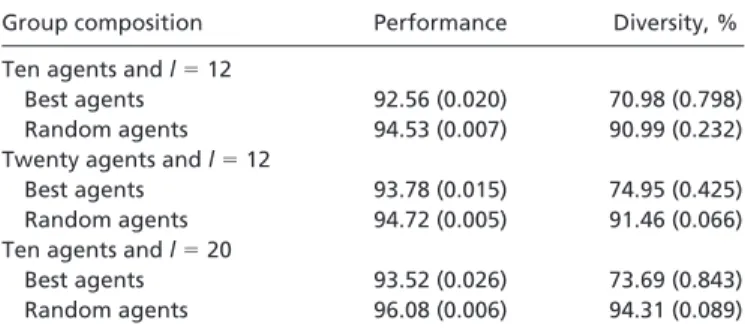
values, and one consisting of 10 agents randomly chosen from the given class. Forl⫽12, the results from a representative single run were as follows: The best agent scored 87.3; the worst agent scored 84.3; the average score of the 10 best agents was 87.1, and the average score of the 10 randomly selected agents was 85.6. The collective performance of the 10 best agents had a value of 93.2; their average diversity (averaged over all possible pairs) was 0.72. The collective performance of the 10 randomly selected agents was 94.7; their average diversity was 0.92.** We present (Table 1) the results averaged over 50 trials. The data show that, on average, the collective performance of the randomly selected agents significantly outperforms the group of the best agents. Moreover, the diversity measures show a striking difference in the constituency of the two groups. The best group does not have nearly as much diversity as the random group. When we enlarged the group size from 10 to 20, the random group still did better, but with a less pronounced advantage. The group of the best agents became more diverse. This occurred because the set of heuristics was finite and fixed. Table 1 reports data with groups of 20, again averaged over 50 trials.
Next, we increase the set of possible heuristics (or agents) by settingl⫽20. Agents can now look up to 20 spots ahead on the circle, and the total number of agents equals 6,840. Intuitively, we can make the following predictions. First, the diversity of the random group should be greater as a result of the increase in the number of heuristics. Second, this increased diversity should improve the collective performance of the random group. And third, the increase in the number of agents implies that the collective performance of the best group should also improve. The results of this set of experiments are presented in Table 1. From the data, we see, in fact, that all three predictions occur. Once again, diversity is the key to collective performance. A Mathematical Theorem
In this section, we develop a mathematical theorem that explains the logic behind our new result: that a random collection of intelligent agents outperforms the collection consisting of only the best agents. Following is a brief summary of the theorem. In the mathematical model, agents want to maximize a value function that is assumed to have a unique maximum. Consider a population of agents, denoted by⌽, that satisfy the following assumptions: (i) Agents are intelligent: given any starting point, an agent finds a weakly better solution, and the set of local optima can be enumerated. (ii) The problem is difficult: no agent can always find the optimal solution. (iii) Agents are diverse: for any potential solution that is not the optimum, there exists at least one agent who can find an improvement. (iv) The best agent is unique. Consider drawing agents independently from ⌽ according to some distribution. The theorem states that with
probability one, there exist sample sizesN1andN,N1⬍N, such that the collective performance ofN1drawn agents exceeds the collective performance of theN1individually best agents in the group ofNdrawn agents.
To formulate the theorem precisely, we begin with a set of solutionsXand a given value functionV:X3[0, 1], which has a unique maximum atx*, andV(x*)⫽1. The problem solvers try to locate the solutionx*, but they have limited abilities. Each problem solver uses a search rule to search for the maximum but does not always end up there. Suppressing the distinction between perspectives and heuristics, we characterize each prob-lem solver by a mapping:X3Xand a probability distribution
onX. A problem solver randomly selects according to distri-butionan initial point where the search starts. For eachx,(x) denotes the local optimum if the agent starts the search atx, that is,(x) is the stopping point of the search ruleapplied tox. In this interpretation, the search is deterministic: an initial point uniquely determines a stopping point. The image of the mapping,
(X), is the set of local optima for problem solver. Mathe-matically, the mappingof a problem solver has to satisfy the following assumption:
Assumption 0.
(i) @x僆 X, V((x))ⱖ V(x) (ii) ((x))⫽(x)
In general, the set of solutionsXcan be finite, denumerable, or a continuum. However, to avoid measuring theoretical com-plications, we present a simpler version of our result whereXis assumed to be finite. This finite version makes the insight more straightforward, although it comes at the cost of trivializing some intricate assumptions and arguments. For example, the group of the best-performing agents is proven below to be comprised of identical agents. This is an artifact of the finite version. In the general version††under reasonable conditions, the group of the best-performing agents can be shown to be similar, not neces-sarily the same. But this makes the proof more complicated.
For each problem solver (,), we measure her performance by the expected value of her search, which we denote asE(V;,
), i.e.,
E共V;,兲⫽
冘
x僆XV共共x兲兲共x兲.
For the purpose of our analysis, we assume that all agents have the same, and thathas full support. This assumption does not diminish the power of our result, because all the problem-solving ability of an agent is supposedly captured by the mapping. We now define the set of problem solvers⌽we consider. First, the problem is difficult for all agents under our consideration. Assumption 1 (Difficulty).@僆⌽, there exists x 僆X, such that
(x)⫽ x*.
This assumption simply necessitates the group setting. Given thathas full support, it implies that no single agent under our consideration can always find the optimum. Second, we formu-late the idea of a diverse group.
Assumption 2 (Diversity).@x僆X{x*},?僆⌽such that(x)⫽x. This assumption is a simple way to capture the essence of diverse problem-solving approaches. When one agent gets stuck, there is always another agent that can find an improvement due to a different approach. Our last assumption states that there is a unique best performer in the set of agents we consider.
**Mathematically, the expected diversity of two randomly selected agents equals 11兾12⫽ 0.9183333.
††Hong, L. & Page, S. E. (2002) Working paper,Diversity and Optimality[Loyola Univ. (Chicago) and Univ. of Michigan (Ann Arbor)].
Table 1. Result of computational experiments
Group composition Performance Diversity, %
Ten agents andl⫽12
Best agents 92.56 (0.020) 70.98 (0.798)
Random agents 94.53 (0.007) 90.99 (0.232)
Twenty agents andl⫽12
Best agents 93.78 (0.015) 74.95 (0.425)
Random agents 94.72 (0.005) 91.46 (0.066)
Ten agents andl⫽20
Best agents 93.52 (0.026) 73.69 (0.843)
Random agents 96.08 (0.006) 94.31 (0.089)
Numbers in parentheses are standard deviations.
Assumption 3 (Uniqueness).argmax{E(V;,):僆⌽}is unique. Letbe the uniform distribution. If the value functionVis one to one, then the uniqueness assumption is satisfied. Therefore, in the space of all value functions we consider, the uniqueness assumption is generically satisfied.
We do not make specific assumptions about how a group of problem solvers work together, other than requiring that search by a group can get stuck only at a point that is a local optimum for all agents in the group. An example of how this can be achieved is that agents approach the problem sequentially: wherever an agent gets stuck, the next person starts the search at that point.
Let⌽be a set of problem solvers that satisfyAssumptions 1–3above. Letbe a probability distribution over⌽with full support. From⌽, we draw a group ofNagents; each agent is drawn independently from⌽according to. TheseNagents are ordered by their individual performances, E(V; , ). Choose the bestN1agents. We compare the joint performance of this group of N1 agents with that of another group ofN1 agents that is formed by drawing each from⌽independently according to.
Theorem 1.Let⌽be a set of problem solvers that satisfy Assump-tions 1–3 above.Letbe a probability distribution over⌽with full support. Then, with probability one, a sample path will have the following property: there exist positive integers N and N1,N⬎N1,
such that the joint performance of the N1 independently drawn
problem solvers exceeds the joint performance of the N1individually
best problem solvers among the group of N agents independently drawn from⌽according to.
Here, there are in fact two independent random events: one is to independently draw a group of problem solvers, and the other is to independently draw a group of problem solvers and then select a subgroup according to their individual ability. The sample path we speak of in the theorem is the joint sample path of these two independent events.
The proof relies on two ideas. First we show (Lemma 1below) that the independently drawn collection of agents will, with probability one, find the optimal solution as the group becomes large. This lemma is intuitive, given that agents drawn indepen-dently thus are very unlikely to have common local optima. As the number of agents in the group grows, the probability of their having common local optima converges to zero. The second idea relies on the uniqueness assumption to show that, with proba-bility one, as the number of agents becomes large, the best problem solvers all become similar and therefore do not do better than the single best problem solver, who by assumption cannot always find the optimal solution.
Consider the first random event of forming a group of problem solvers: each problem solver is independently drawn from ⌽ according to. Fix a sample path of this random event,1. Let
1共
1兲, . . . , n1共1兲 denote the firstn1problem solvers. The joint performance of thesen1problem solvers is the expected value of V(y˜), where y˜ is a common local optimum of alln1 agents. The distribution of y˜ is induced by the probability distribution of the initial draw,, and a precise model of how agents work together. The proof of the lemma that follows does not depend on what the specific model is. Without being explicit, we assume thaty˜follows distribution1
n1:X3[0, 1], i.e.,
᭙x僆X, Pr共y˜⫽x兲⫽11
共x兲. Lemma 1.Pr{1: limn13⬁兺x僆XV(x)1
n1(x)⫽1} ⫽1.
Proof: Fix any 0 ⬍ ⬍ 1. Define An1 ⫽ {1: 1 ⫺ 兺x僆X V(x)1
n1(x) ⬎ }. Obviously,A
n1債 {1:
1(
1), . . . , n1(1) have common local maxima other thanx*}. Thus,
Pr共An1兲ⱕPr兵1:
1共
1兲, . . . , n1共1兲
have common local maxima other thanx*其. Letm⫽min {():僆⌽}. Becausehas full support,m⬎
0. By Assumption 2 (diversity), for any x僆 X{x*}, we have
({僆 ⌽:(x)⫽ x}) ⱕ1⫺ m. By independence, Pr兵1:1共1兲, . . . , n1共1兲
have common local maxima other thanx*其
ⱕ兺x僆X兵x*其Pr兵1: x
is a common local maximum of1共
1兲, . . . , n1共1兲其 ⱕ兺x僆X兵x*其共1⫺m兲n1 ⱕ共兩X兩⫺1兲共1⫺m兲n1. Therefore,
冘
n1⫽1 ⬁ Pr共An1兲ⱕ 兩X兩⫺1 m ⬍⬁.By the Borel–Cantelli Lemma, we have Pr
再
1:1⫺冘
x僆X V共x兲 1 n1共x兲⬎ infinitely often冎
⫽0, which implies Pr再
1: lim n13⬁ x冘
僆X V共x兲 1 n1共x兲⫽1冎
⫽1.We now proveTheorem 1.
Proof ofTheorem 1:Consider the second random event, where a group ofnagents are drawn independently from⌽according to, and then a subgroup of the best is formed. ByAssumption 3(uniqueness), there is a unique problem solver in⌽with the highest individual performance. Call that agent*. By the law of large numbers, Pr
再
2: lim n3⬁ #兵i僆兵1, . . . , n其 : i共 2兲⫽*其 n ⫽共*兲冎
⫽1.The fraction in the above expression is the frequency of* in the draw. Let⍀be the set of sample paths⫽(1,2) that have both of the asymptotic properties above; i.e., define
⍀⫽
冦
⫽共1,2兲: limn13⬁兺x僆XV共x兲1 n1 共x兲⫽1 and limn3⬁ #兵i僆兵1, . . . , n其:i共 2兲⫽*其 n ⫽共*兲冧
. ByLemma 1, Pr共⍀兲⫽1.Fix any僆⍀. Let1⫽1⫺E(V;*,), which is positive by
Assumption 1(difficulty). From the first limit above, we know there exists an integern1⬎ 0, such that for anyn1ⱖ n1,
冘
x僆X V共x兲 1 n1共x兲⬎1⫺ 1⫽E共V;*,兲.From the second limit above, there exists an integern ⬎0, such that for anynⱖ n,
#兵i僆兵1, . . . ,n其:i共 2兲⫽*其
n ⬎
共*兲
2 .
LetN1⫽n1andN ⫽max{2n1/(*), n}. Then
冘
x僆X
V共x兲N11共x兲⬎E共V;*,兲.
The left-hand side of the above inequality is the joint perfor-mance of the group ofN1agents independently drawn according to. We now prove that the right-hand side term is the joint performance of the group ofN1best agents from the group of
Nagents. By construction,Nⱖn. Therefore, #兵i僆兵1, . . . ,N其:i共 2兲⫽*其 N ⬎ 共*兲 2 . That is, #兵i僆兵1, . . . ,N其:i共 2兲⫽*其⬎ 共*兲N 2 ⱖn1⫽N1, becauseN ⱖ 2n1兾(*). This means there are more thanN1 numbers of agents among the group of N agents that are the highest performing agent*. Thus, the bestN1agents among the
Nagents are all*. Therefore, their joint performance is exactly the same as the performance of*, which isE(V;*,). To summarize, for each僆⍀, there existN1andN,N⬎N1, such that the joint performance of the group ofN1agents indepen-dently drawn according tois better than the joint performance of theN1best agents from the group ofNagents independently drawn according to. Because the set⍀has probability 1, the theorem is proven.
Concluding Remarks
The main result of this paper provides conditions under which, in the limit, a random group of intelligent problem solvers will outperform a group of the best problem solvers. Our result provides insights into the trade-off between diversity and ability. An ideal group would contain high-ability problem solvers who are diverse. But, as we see in the proof of the result, as the pool of problem solvers grows larger, the very best problem solvers must become similar. In the limit, the highest-ability problem solvers cannot be diverse. The result also relies on the size of the random group becoming large. If not, the individual members of the random group may still have substantial overlap in their local optima and not perform well. At the same time, the group size
cannot be so large as to prevent the group of the best problem solvers from becoming similar. This effect can also be seen by comparing Table 1. As the group size becomes larger, the group of the best problem solvers becomes more diverse and, not surprisingly, the group performs relatively better.
A further implication of our result is that, in a problem-solving context, a person’s value depends on her ability to improve the collective decision (8). A person’s expected contribution is contextual, depending on the perspectives and heuristics of others who work on the problem. The diversity of an agent’s problem-solving approach, as embedded in her perspective-heuristic pair, relative to the other problem solvers is an impor-tant predictor of her value and may be more relevant than her ability to solve the problem on her own. Thus, even if we were to accept the claim that IQ tests, Scholastic Aptitude Test scores, and college grades predict individual problem-solving ability, they may not be as important in determining a person’s potential contribution as a problem solver as would be measures of how differently that person thinks.
Our result has implications for organizational forms and management styles, especially for problem-solving firms and organizations. In an environment where competition depends on continuous innovation and introduction of new products, firms with organizational forms that take advantage of the power of functional diversity should perform well. The research we cited earlier by computer scientists and organizational theorists who explore how to best exploit functional diversity becomes even more relevant. Most importantly, though, our result suggests that diversity in perspective and heuristic space should be encour-aged. We should do more than just exploit our existing diversity. We may want to encourage even greater functional diversity, given its advantages.
The current model ignores several important features, in-cluding communication and learning. Our perspective-heuristic framework could be used to provide microfounda-tions for communication costs. Problem solvers with nearly identical perspectives but diverse heuristics should communi-cate with one another easily. But problem solvers with diverse perspectives may have trouble understanding solutions iden-tified by other agents. Firms then may want to hire people with similar perspectives yet maintain a diversity of heuristics. In this way, the firm can exploit diversity while minimizing communication costs. Finally, our model also does not allow problem solvers to learn. Learning could be modeled as the acquisition of new perspectives and heuristics. Clearly, in a learning model, problem solvers would have incentives to acquire diverse perspectives and heuristics.
We thank Ken Arrow, Bob Axelrod, Jenna Bednar, Jonathon Bendor, Steven Durlauf, John Ledyard, Chuck Manski, Dierdre McClosky, Jeff Polzer, Stan Reiter, and three anonymous referees for comments on earlier versions of this paper.
1. Huberman, B. (1990)Physica D42,38–47.
2. Clearwater, S., Huberman, B. & Hogg, T. (1991)Science254,1181–1183. 3. Polzer, J. T., Milton, L. P. & Swann, W. B., Jr. (2002)Admin. Sci. Q.47,296–327. 4. Nisbett, R. & Ross, L. (1980)Human Inference: Strategies and Shortcomings of
Social Judgment(Prentice–Hall, Englewood Cliffs, NJ).
5. Robbins, S. (1994)Organizational Behavior(Prentice–Hall, Saddle River, NJ). 6. Thomas, D. A. & Ely, R. J. (1996)Harvard Bus. Rev.September–October 1996,
no. 96510.
7. Newell, A. & Simon, H. (1972) Human Problem Solving (Prentice–Hall, Englewood Cliffs, NJ).
8. Hong, L. & Page, S. E. (2001)J. Econ. Theor.97,123–163. 9. MacLeod, B. (1996)Can. J. Econ.29,788–810.
10. Ruderman, M., Hughes-James, M. & Jackson, S., eds. (1996)Selected Research on Work Team Diversity(Am. Psychol. Assoc., Washington, DC).
11. Watson, W., Kumar, K. & Michaelsen, L. (1993) Acad. Manage. J. 36,
590 – 602.