University of Central Florida University of Central Florida
STARS
STARS
Electronic Theses and Dissertations, 2004-2019
2019
Improvement of Data-Intensive Applications Running on Cloud
Improvement of Data-Intensive Applications Running on Cloud
Computing Clusters
Computing Clusters
Ibrahim Adel Ibrahim University of Central Florida
Part of the Computer Engineering Commons
Find similar works at: https://stars.library.ucf.edu/etd
University of Central Florida Libraries http://library.ucf.edu
This Doctoral Dissertation (Open Access) is brought to you for free and open access by STARS. It has been accepted for inclusion in Electronic Theses and Dissertations, 2004-2019 by an authorized administrator of STARS. For more information, please contact [email protected].
STARS Citation STARS Citation
Ibrahim, Ibrahim Adel, "Improvement of Data-Intensive Applications Running on Cloud Computing Clusters" (2019). Electronic Theses and Dissertations, 2004-2019. 6711.
IMPROVEMENT OF DATA INTENSIVE APPLICATIONS RUNNING ON CLOUD COMPUTING CLUSTERS
by
IBRAHIM ADEL IBRAHIM
B.S. AlMustansiriyah University, Baghdad, 2002 M.Sc. University Of Technology, Baghdad, 2006
A dissertation submitted in partial fulfilment of the requirements for the degree of Doctor of Philosophy
in the Department of Electrical and Computer Engineering in the College of Engineering and Computer Science
at the University of Central Florida Orlando, Florida
Fall Term 2019
c
ABSTRACT
MapReduce, designed by Google, is widely used as the most popular distributed programming model in cloud environments. Hadoop, an open-source implementation of MapReduce, is a data management framework on large cluster of commodity machines to handle data-intensive applica-tions. Many famous enterprises including Facebook, Twitter, and Adobe have been using Hadoop for their data-intensive processing needs. Task stragglers in MapReduce jobs dramatically im-pede job execution on massive datasets in cloud computing systems. This impedance is due to the uneven distribution of input data and computation load among cluster nodes, heterogeneous data nodes, data skew in reduce phase, resource contention situations, and network configurations. All these reasons may cause delay failure and the violation of job completion time. One of the key issues that can significantly affect the performance of cloud computing is the computation load balancing among cluster nodes. Replica placement in Hadoop distributed file system plays a significant role in data availability and the balanced utilization of clusters. In the current replica placement policy (RPP) of Hadoop distributed file system (HDFS), the replicas of data blocks cannot be evenly distributed across cluster’s nodes. The current HDFS must rely on a load bal-ancing utility for balbal-ancing the distribution of replicas, which results in extra overhead for time and resources. This dissertation addresses data load balancing problem and presents an innova-tive replica placement policy for HDFS. It can perfectly balance the data load among cluster’s nodes. The heterogeneity of cluster nodes exacerbates the issue of computational load balancing; therefore, another replica placement algorithm has been proposed in this dissertation for hetero-geneous cluster environments. The timing of identifying the straggler map task is very important for straggler mitigation in data-intensive cloud computing. To mitigate the straggler map task, Present progress and Feedback based Speculative Execution (PFSE) algorithm has been proposed in this dissertation. PFSE is a new straggler identification scheme to identify the straggler map tasks based on the feedback information received from completed tasks beside the progress of the
current running task. Straggler reduce task aggravates the violation of MapReduce job comple-tion time. Straggler reduce task is typically the result of bad data particomple-tioning during the reduce phase. The Hash partitioner employed by Hadoop may cause intermediate data skew, which re-sults in straggler reduce task. In this dissertation a new partitioning scheme, named Balanced Data Clusters Partitioner (BDCP), is proposed to mitigate straggler reduce tasks. BDCP is based on sampling of input data and feedback information about the current processing task. BDCP can assist in straggler mitigation during the reduce phase and minimize the job completion time in MapReduce jobs. The results of extensive experiments corroborate that the algorithms and policies proposed in this dissertation can improve the performance of data-intensive applications running on cloud platforms.
ACKNOWLEDGMENTS
I owe a debt of gratitude to my major advisor Prof. Mostafa Bassiouni for his efforts, support, and encouragement throughout my doctoral study. He was always keeping me motivated during my research. It’s been a great honor for me to conduct my doctoral research under his supervision. To him, I am and will always be deeply grateful.
I am very thankful to Dr. Qun Zhou, Dr. Mingjie Lin, Dr Rickard Ewetz, and Dr. Ivan Garibay for serving on my dissertation committee.
Thank you for my brothers, Salam, Wisam, and Musaab, and my sisters Athraa, and Zahraa. They have provided me with their love, and encouragement.
I would love to thank my soul mate, my friend, and my wife, Sarah Aljumaily, who has never quit on believing on me and supported me in my life and in the journey of PhD research. Thank you Sarah for supporting and encouraging me.
I would like to thank my first teacher, the great women, my mother. She has been waiting for this moment and she has been keeping me in her prayer every day.
One final word of gratitude goes to the great man who has always waited for this moment, a person whom I always dreamt of writing these words to, a person who saw his dream in me, and he is suffering now from Lung Cancer but he promised me that he will be stronger than the cancer and he is going to be presented in my graduation; my father. I am sorry I could not make it earlier, but i am sure you are stronger than the cancer and you will be presented in my graduation. Thank you is not enough!
TABLE OF CONTENTS
LIST OF FIGURES . . . x
LIST OF TABLES . . . xii
CHAPTER 1: INTRODUCTION . . . 1
1.1 Mapreduce . . . 1
1.2 Hadoop . . . 2
1.3 Hadoop Distributed File System HDFS . . . 3
1.4 Straggler task . . . 4
1.5 Dissertation organization . . . 5
CHAPTER 2: LITERATURE REVIEW . . . 7
2.1 Replicas distribution policy in Hadoop distributed file system . . . 7
2.2 MapReduce tasks and speculative execution . . . 9
2.3 Straggler reduce tasks . . . 14
CHAPTER 3: REPLICA PLACEMENT POLICY FOR HDFS . . . 18
3.1 Introduction . . . 18
3.2 Background . . . 19
3.3 Balanced replicas placement policy . . . 20
3.4 Evaluation . . . 25
CHAPTER 4: BALANCED REPLICA PLACEMENT POLICY FOR HETEROGENEOUS CLUSTERS . . . 31
4.1 Introduction . . . 31
4.3 Speed-based Replica Assignment Policy SRAP . . . 33
4.3.1 Main assignment table MAT . . . 34
4.3.2 Block index allocation in MAT . . . 35
4.4 Evaluation . . . 40
CHAPTER 5: STRAGGLER IDENTIFICATION AND SPECULATIVE EXECUTION . . 43
5.1 Introduction . . . 43
5.2 Background . . . 45
5.3 Progress and Feedback based Speculative Execution (PFSE) algorithm . . . 45
5.4 Evaluation . . . 51
CHAPTER 6: STRAGGLER REDUCE TASKS OF MAPREDUCE JOBS . . . 54
6.1 Introduction . . . 54
6.2 Background . . . 57
6.3 Balanced Data Clusters Partitioner BDCP . . . 60
6.3.1 Sampling . . . 62
6.3.2 Reservoir sampling . . . 63
6.3.3 Partitioning policy . . . 66
6.4 Evaluation . . . 74
6.4.1 Homogeneous cluster experiments . . . 75
6.4.1.1 Word count benchmark testing . . . 75
6.4.1.2 Sort benchmark test . . . 77
6.4.2 Heterogeneous cluster experiments . . . 79
6.4.2.1 Word count benchmark . . . 81
6.4.2.2 Sort benchmark test . . . 83
APPENDIX : PERMISSION TO REUSE PUBLISHED MATERIAL . . . 90
LIST OF FIGURES
3.1 Block replication in HDFS . . . 20
3.2 Replicas placement of HDFS RPP . . . 21
3.3 Racks tables . . . 23
3.4 Main Assignment Table (MAT) . . . 24
3.5 Probability distribution of Z in scenario one. . . 28
3.6 Replica distribution generated by HDFS RPP in scenario Two . . . 29
3.7 Replica distribution generated by IDPM in scenario two . . . 30
4.1 Example of racks assignment tables . . . 40
4.2 Main Assignment Table MAT using SRAP . . . 40
4.3 Replicas distribution generated by SRAP . . . 42
6.1 Map Reduce process . . . 56
6.2 Variation in reducers data load . . . 58
6.3 MapReduce job with BDCP partitioning policy . . . 61
6.4 Reservoir sampling . . . 65
6.5 Main assignment table . . . 70
6.6 MapReduce phases for default Hadoop and BDCP . . . 74
6.7 Word count job on a file of size 6 GB, and 0.1 to 1.1 skew degree in homo-geneous cluster . . . 76
6.8 Word count job on files of sizes, 2, 4, and 6 GB. skew degree is 0.1. in homogeneous cluster . . . 77
6.9 Word count job on files of sizes, 2, 4, and 6 GB. skew degree is 1.1. in homogeneous cluster . . . 78
6.10 Sort job on a file of size 6 GB, and 0.1 to 1.1 skew degree in homogeneous
cluster . . . 79
6.11 Sort job on files of sizes, 2, 4, and 6 GB. Skew degree is 0.1.in homogeneous
cluster . . . 80
6.12 Sort job on files of sizes, 2, 4, and 6 GB. Skew degree is 1.1.in homogeneous
cluster . . . 80
6.13 Word count job on a file of size 6 GB, and 0.1 to 1.1 skew degree in
hetero-geneous cluster . . . 82
6.14 Word count job on files of sizes, 2, 4, and 6 GB. Skew degree is 0.1.in
het-erogeneous cluster . . . 82
6.15 Word count job on files of sizes, 2, 4, and 6 GB. Skew degree is 1.1.in
het-erogeneous cluster . . . 83
6.16 Sort job on a file of size 6 GB, and 0.1 to 1.1 skew degree in heterogeneous
cluster . . . 84
6.17 Sort job on files of sizes, 2, 4, and 6 GB. Skew degree is 0.1. in heterogeneous
cluster . . . 85
6.18 Sort job on files of sizes, 2, 4, and 6 GB. Skew degree is 1.1. in heterogeneous
cluster . . . 85
6.19 MapReduce phases of Word Count job on a file of size 2 GB, and skew degree
LIST OF TABLES
3.1 SIMULATION SETTINGS OF IDPM EVALUATION . . . 29
4.1 SIMULATION SETTINGS OF SRAP EVALUATION . . . 42
CHAPTER 1: INTRODUCTION
The advances in Information Technology and the storage demands of cloud computing have been growing rapidly in the last few years. Storage systems are under intense pressure due to the ex-plosive growth of data amount generated through many distributed applications, such as search engines, social networking sites, grid computing applications, data mining applications, etc. An efficient file system is required to store internet generated large data and effective handling of huge files. Cloud computing is an emerging technology that attracts data service providers offer-ing tremendous opportunities for online distribution of services. It offers computoffer-ing as a utility, sharing resources of expandable data centers [2]. End users can benefit from the convenience of accessing data and services globally, centrally managed backups, and high computational .
1.1 Mapreduce
The rapid growth of information and data in the age of data explosion in industry and research poses tremendous opportunities, as well as tremendous computational challenges. To manage the immense volumes of data, users have needed new systems to scale out computations to multiple nodes. Modern cloud datacenters are composed of thousands of servers to support the increasing demand on cloud computing. Due to the large scale of the data-intensive jobs, the only feasible way to solve them while fulfilling Quality of Service (QoS) requests is to partition them into small tasks which can be processed in parallel across many computing nodes [4]. MapReduce, designed by Google, has been widely used as the most popular distributed programming model for parallel processing of massive datasets (usually greater than 1 TB) in cloud environments. It divides a large computation into small tasks and assigns them to multiple computational cluster of nodes running in parallel. MapReduce is unique in reliability, and scalability to large clusters of inexpensive com-modity computers. It automatically partitions a job into multiple tasks and transparently handles
parallel tasks execution and complexity of fault tolerance from the programmer in a distributed manner [69].
MapReduce consists of two main phases: map, and reduce. Tasks are distributed to cluster of processing nodes during Map and Reduce phases. During Map phase, chunks of the huge data sets are processed concurrently on individual computers in the cluster. The Map function is applied to an individual input record to compute a set of intermediate key/value pairs. For each key, Reduce works on the list of all values with this key [35]. Reduce phase has 3 steps: shuffle, sort, and reduce. Shuffle starts when the data is collected by the reducer from each mapper. Shuffle may start when mappers have generated enough amount of data. On the other hand, sort and reduce can start once all the mappers have finished map phase and the resulted intermediate data have been shuffled to the reducers. Reduce phase combines the intermediate data from Map phase and derives the final output.
1.2 Hadoop
Hadoop, an open source implementation of MapReduce, is a data management framework on large cluster of commodity machines to handle large-scale data intensive applications. Hadoop is a solution that provides reliability, scalability, and manageability of big data [64]. Hadoop divides a large computation into small tasks and assigns them to multiple computational cluster nodes running in parallel. It manages the parallel processes on a large file, where the file is divided into many chunks distributed on clusters of inexpensive commodity computers, automatically handles failures, and hides the complexity of fault tolerance from the programmer. It scales easily to large clusters of inexpensive commodity computers [68]. To build such a cloud system, an increasing number of companies and academic institutions have started to rely on the Hadoop Distributed File System HDFS. The next generation of Hadoop, namely Hadoop YARN, is accommodated to various programming frameworks and capable of handling many kinds of workload such as
interactive analysis, and stream processing.
1.3 Hadoop Distributed File System HDFS
In order to meet the ever-growing data storage demands from users, The storage system for cloud computing consolidates large numbers of distributed commodity computers into a single storage pool to provide online services for data storage with immense capacity and high quality of ser-vice in an unreliable and dynamic network environment at low cost [75]. To build such a cloud storage system, an increasing number of companies and academic institutions have started to rely on the Hadoop Distributed File System (HDFS) [57]. Many cloud vendors have given attractive storage service offerings that provide a giant cloud-based storage space for users, such as Amazon, Dropbox, Google Drive, and Microsoft’s OneDrive [23, 25, 28]
HDFS has been widely used and become a common storage appliance for cloud computing. It is the storage part of Hadoop framework, it is a distributed, scalable, and portable file system designed to run on low-cost hardware. Although it has many similarities with other existing dis-tributed file systems, the differences from other disdis-tributed file systems are significant. HDFS is especially designed to be highly fault-tolerant, and to provide high throughput access to application data and is suitable for applications that have large data sets.
The idea of blocks is exist in many file systems. Block is the smallest unit which is loaded into memory in one operation. However HDFS is dealing with very large files, a block in HDFS is the smallest replication unit. All blocks in a file except the last block are the same size, the default block size is 64MB. In HDFS each data file is stored as a sequence of blocks. A file is split into blocks during the write operation and distributed across cluster nodes. Also depending on the client application, a block is, usually, the data unit on which an application copy operates on. Blocks of a file are replicated for reading performance and fault tolerance. More replicas could enhance the availability of files on cloud systems and provide users a better chance to retrieve their data when
serious disasters occur [73]. HDFS uses an uniform triplicating policy (i.e. three replicas for each data block) to improve data locality and ensure data availability and fault tolerance in the event of hardware failure [57]. The placement policy of replicas is critical to HDFS performance and reliability. This policy could also achieve load balancing by distributing work across the replicas. For the common case, the triplication policy in HDFS works well in term of high reliability and high performance. The consequence of the current replica placement policy is that the hadoop cluster gets unbalanced in terms of both storage load and the data processing load. However, the more data a node contains, the higher probability the node could be selected to serve the data. An unbalanced cluster puts a greater strain on the highly utilized DataNodes, and results in straggler tasks in MapReduce jobs [68].
1.4 Straggler task
In MapReduce, after a job is submitted, the input file is divided into multiple map tasks, and then both map and reduce tasks are assigned to multiple data nodes. Slow task or task with more data becomes straggler. The straggler task degrades the performance of MapReduce applications be-cause it delays the final results. In cloud computing platform, stragglers are very common problem especially in the case of data-intensive computing jobs because of two major reasons. First, cloud data centers use commonly commodity hardware instead of expensive, powerful, and highly reli-able hardware. As a result, the probability of part failure is high for large clusters. Part failure may just degrade the node performance Instead of causing complete node failure, which would generate stragglers. For example, a node, with a faulty hard drive may experience frequent read errors that are correctable, can still work but with very slow disk read speed.
Second, virtualization technology, such as the Amazon Elastic Compute Cloud (EC2) [5], is widely used by service providers of utility computing to provide an abstraction of the underly-ing hardware. Even though virtualization technology isolates the CPU and memory usage, both
disk and network bandwidth are still shared among virtual machines residing on the same phys-ical host, which can cause notable heterogeneity in virtual machine performance as the resource contention, the growth of virtualization have further aggravated the heterogeneity, as a result, all virtual machines on overloaded physical host become stragglers. Thus, dealing with the problem of stragglers becomes critical and significant because stragglers can seriously impact the completion time of parallel processing jobs.
Hadoop employs a mechanism called speculative execution to deal with the straggler issue, it runs a speculative copy of a straggler’s task on another normal node, the default speculative algorithm in Hadoop aggressively starts many backup tasks. Although speculative execution can dramatically reduce the job completion time because, in most cases, the speculative copy completes much earlier than the original task running on the straggler, but some of the straggler finish before the backup tasks, in this case the backup becomes ineffective and results in insufficient resource consuming. So the Identification of the straggler is the most crucial part of speculative execution, because accuracy in identifying the straggler can significantly improve job completion time and sufficiently increase the resource utilization by avoiding running backup task that will be discarded if it’s original task was incorrectly identified as straggler, where the results of the earlier completed task is taken and the other task is ignored. So stragglers must be detected correctly and early enough to get better efficiency of the speculative execution mechanism.
1.5 Dissertation organization
The dissertation is organized as follows. Chapter 2 describes the existing research related to our work. Chapter 3 presents a balancing policy for data placement in cloud storage systems. An in-novative replica placement policy for HDFS in heterogeneous cluster environments is presented in Chapter 4. Furthermore, Chapter 5 presents a new straggler identification scheme to make Hadoop more efficient in cloud environments. Subsequently, in Chapter 6 a new partitioning scheme, called
balanced data clusters partitioner (BDCP), is proposed to handle straggler reduce tasks in MapRe-duce jobs. Finally, Chapter 7 discusses the conclusion of the dissertation.
CHAPTER 2: LITERATURE REVIEW
In this chapter, some literature that related to this research work are reviewed
2.1 Replicas distribution policy in Hadoop distributed file system
The drawback of the existing block placement policy of hadoop is that it does not distribute replicas of blocks fairly and evenly across cluster’s nodes [8]. Large amount of research work has been conducted on the HDFS RPP due to its importance regarding improving the performance of HDFS. Shabeera et al. proposed a RPP for Hadoop that depends on the available bandwidth between the HDFS client and cluster nodes in [56], the bandwidth can be measured and compared periodically, and the node that has the maximum bandwidth is selected to place the replica on it in order to reduce the time of data transfer. Khan et al. [38] presents an algorithm that finds the optimal number of codeword symbols needed for recovery for any XOR-based erasure code and produces recovery schedules that use a minimum amount of data. It improves I/O performance in practice for the large block sizes used in cloud file systems, such as HDFS.
Zhang et al. present Aurora [78], a dynamic block placement mechanism, which imple-ments several local search algorithms in HDFS. They propose several constant-factor local search approximation algorithms, and present a dynamic replica distribution mechanism that implements the algorithms in HDFS. The results of Experiments show Aurora can solve the dynamic block replication problem and remarkably reduce the uneven load distribution, also it meets all the rank level reliability requirements of HDFS. Long et al.[52] proposed Multi-objective Optimized Repli-cation Management (MORM). It is an improved artificial immune algorithm used for optimizing file unavailability, service time, load variance, energy consumption and access latency by manag-ing the replication factor and replica placement in VMs. Lin et al. [48] proposed a strategy where the NameNode chooses DataNodes according to the load status. In this strategy a new node named
BalanceNode is proposed. It is used to match heavy-loaded and light-loaded DataNodes, so that the light-loaded DataNodes can share the load with heavy-loaded ones. In our previous work [20] we address the load balancing issue from the perspective of balancing replicas assignment across all cluster nodes of Hadoop, and propose a new placement policy that split the nodes in to three dif-ferent sections and run an algorithm to distribute the replicas on the three sections across all cluster nodes. Zhou et al. [79] proposed BigRoots algorithm to identify the root causes of the stragglers. BigRoots incorporates both framework and system features for root-cause analysis of stragglers in the big data system. The results of extensive experiments corroborate that BigRoots is effec-tive for identifying the root causes of stragglers and providing useful indicators for performance optimization.
Nonava et al. [53] proposed a policy based on the processing power of the hardware gen-eration. They proposed placing more data blocks onto newer hardware generation nodes. In this policy, they calculate a quota based on the hardware generation of the Data Nodes during placing blocks. Blocks will be placed on the nodes which have the highest quota. Lee et al. [42] proposed a dynamic block placement algorithm. this algorithm places blocks on the DataNodes based on their processing capacity. in this Algorithm, NameNode creates a RatioTable, it is used to determine the ratio of data blocks that decided to be placed on each DataNode. However [42, 53] depends only on the processing capacity of the DataNodes for placing data blocks. it does not consider the storage capacity of the DataNodes. The storage capacity gets unbalanced when the higher pro-cessing capacity DataNodes get greater number of data blocks. therefore, DataNodes with high processing capacity will be over utilized while the DataNodes with low processing capacity re-main under utilized in terms of storage. Both algorthims result in an imbalanced storage load on the DataNodes.
Dai et al. in [18] address the load balancing issue from the perspective of task assignment of Hadoop. It propose an improved task assignment scheme that strives to balance the map task processing load of MapReduce jobs across all cluster nodes. Cheng et al. simulat[17] proposed
Elastic Replication Management System ERMS for HDFS. ERMS provides an active/standby stor-age model for HDFS to where the replication policy is elastic and adapt to data popularity in order to get better performance and disk utilization. ERMS has a real-time event processing engine to in-crease the replication factor only for the files with higher popularity. To distinguish real-time data types, ERMS utilizes a complex event processing engine. It dynamically increases extra replicas for hot data, while it cleans up these extra replicas when the data cool down. Moreover, it uses era-sure codes for cold data. The experiments results indicate that ERMS reduces storage overhead and improves the performance and reliability of HDFS.and . The experiments results show that ERMS effectively improves the reliability and performance of HDFS and reduces the storage overhead. Eltabakh et al. in [22], propose CoHadoop, a lightweight extension of Hadoop, it addresses the performance problem of Hadoop that it cannot collocate related data on the same set of nodes. in CoHadoop the HDFS has been extended to allow applications to define and exploit customized placement strategies to improve the performance of the system. The results of experiments on CO-Hadoop show that only when applications need to process data from multiple files, CoCO-Hadoop can remarkably outperform Hadoop. Finally, the recent research work in [24, 45, 50, 54, 77] helped with the formation of our research idea.
2.2 MapReduce tasks and speculative execution
Due to its importance to data-intensive computing, the subject of straggler identification and tol-erance has received considerable amount of research attention. The mechanism of speculative execution is used in MapReduce to address the straggler problem, which performs backup execu-tion of the remaining running tasks when the parallel processing is close to compleexecu-tion. Numerous speculation based techniques have been developed for straggler mitigation providing enhancement within different operational scenarios. SkewTune [41] re-partitions the data of stragglers to move it to idle slotes resulted after completing the processing of short tasks. However, moving
re-partitioned data to idle nodes may lead to nodes communication overload, which could negatively impact the computing performance.
One commonly used straggler identification scheme is the classical Standard Deviation (SD) method. It constantly monitors the performance of all processing nodes, and marks any node as straggler if its performance is significantly lower than the sample mean of the task comple-tion times of all running nodes. Despite its wide adopcomple-tion, the SD method has certain inherent limitations, which makes it not an ideal solution to the problem of straggler identification.
Dolly [6], provides a speculative execution at job level which clones small jobs with strag-gler tasks. Dolly launches multiple clones of every task, the output of the clone that completes first is used and the other clones are killed. But the approaches that use the duplication of the entire job increases the resource usage and I/O contention on intermediate data, in addition to that, it does not have the coordination between Hadoop and the cloud infrastructure. Dolly employs a technique called “delay assignment” to avoid contention for intermediate data. however Dolly specifically tackles stragglers in small jobs.
Xie et al. [70] propose skew data partitioning according to cluster node capabilities; slow nodes receive less work than faster nodes. This static profiling does not consider a third party loads that may begin or end in the middle of a MapReduce job, making the actual node’s ability to complete work different from the profile-based prediction. Furthermore, if the nodes that predicted to receive more load fail, the application stalls for longer than when slower nodes fail. Wang et al. [67] presented an algorithm named Partial Speculative Execution (PSE), it is improved strategy to enhance the efficiency of Speculative Execution. However PSE is not designed for heterogeneous cluster’s nodes while it works good in Homogeneous cluster environments. Li et al [46] presented (SECDT), it is a new speculative execution algorithm for Hadoop. SECDT was designed and implemented by calculating the completion time of a task based on C4. 5 decision tree. Tang et al. [61] proposed Speculative Execution Performance Balancing (SEPB) with a dynamic slot allocation to improve the performance of job execution.
Wu et al. [29] proposed ERUL algorithm, it calculates the prediction of system load and the remaining time of a task. ERUL improves the accuracy of the prediction by the real-time system load feedback. However this algorithm does not take into account cluster efficiency. Maxi-mum Cost Performance (MCP) [12], a new speculative execution strategy, employs exponentially weighted moving average (EWMA) to predict the remaining time of a task. uses both progress rate and process bandwidth within a phase to identify stragglers. MCP selects the node for speculative execution using a sophisticated cost-benefit model which considers the workload on each node and the data locality. The experimental results indicate that MCP significantly improves the job performance, it can outperform Hadoop 0.21 with respect to both job completion time and cluster throughput.
There is great research interest in improving Hadoop from different perspectives. A rich set of research focused on the performance and efficiency of Hadoop cluster. After conducting a comprehensive performance study of Hadoop, Jiang et al. [34] summarized the factors that can significantly improve the Hadoop performance. Verma et al. [65] proposed cluster resource allocation approach for Hadoop. They focused on improving the cluster efficiency by minimizing resource allocations to jobs while maintaining the service level objectives. They estimated the execution time of a job based on its resource allocation and input dataset, and determined its minimum resource allocation.
There are a few recent studies focus on the improvement of speculative execution. Mantri is presented in [7], it focuses on starting speculative execution as soon as a straggler is detected during the job’s execution by monitoring the performance of processing nodes in MapReduce clusters and removing stragglers based on their causes. It kills the straggler task if the speculative task is faster than the straggler. Mantri employs three major techniques: network-aware task placement, restarting tasks running on stragglers, and protecting the output of valuable tasks. Mantri estimates a task’s remaining time based on the progress bandwidth. The major drawback of Mantri is there is no guarantee that the speculative copy of the straggler task will complete earlier, and it may need
to kill and restart the speculative task on multiple cluster nodes.
Wrangler [72] starts speculative tasks according to the prediction of which task would benefit from speculative execution, the prediction based on a statistical learning model that gets its facts from historical workloads. For workloads with low repetitiveness, the learning time may not be short. However, the accuracy of the prediction is affected by the performance interference in the cloud. SARS (Self-Adaptive Reduce Scheduling), a mechanism based on job context, includes the job completion time, can decide the start time points of each reduce tasks dynamically [62]. However, It focuses only on the reduce tasks. Jung et al. [36] proposed Dynamic Scheduling for Speculative Execution (DSSE) algorithm which enhances performance of the speculative execution in heterogeneous environments. DSSE prevents wasted speculative execution because it based on calculating the processing capability of each node. DSSE decreased rate of wasted speculative execution to 0%. However DSSE does not apply the speculative execution at early stages of the job execution.
Chen et al.[14] proposed Self-Adaptive MapReduce scheduling algorithm (SAMR), it uses the historical information stored on each node to create adaptable phase weights. SAMR MapRe-duce scheduling technique uses the historical information to find the slow nodes and launches backup tasks. According to historical information at each map stage, the time weight is adjusted and the tasks are reduced. However, SAMR does not consider the fact that different types of jobs can run on each node, therefore, different jobs have different phase weights. So SAMR cannot gen-erate high accuracy phase weights In multi-job environment. Enhanced Self Adaptive MapReduce scheduling algorithm (ESAMR), an improved version of SAMR, was proposed by Sun et al. [59] . It groups historical information by using uses the K-mean clustering and creates a middle point of each group which contains phase weights that can be used for estimation. ESAMR calculates parameters from running tasks and compares the parameters between the running tasks and the clusters.
spec-ulative algorithm in a multi-job cloud platform. SLM uses feedback information collected from some recently completed tasks of the same job to calculate the phase weights. However, SLM gets better accuracy of estimation with the progress of time because it needs to determine a specific number of finished tasks to use it for learning process, which affects the accuracy of the estimation process. Moreover, the estimation process is distorted by the assumption that tasks are processed at the same rate. All these approaches lack the ability to identify the performance bottleneck of the straggler tasks, they cannot guarantee that the speculative copies of tasks will perform better. Liu et al. [51] proposed LWR-SE, it is an optimized speculative execution strategy based on local data prediction in heterogeneous Hadoop environment. LWR-SE selects an appropriate node to run the backup task based on the predicted remaining time of each running tasks. LWR-SE calculates the predicted remaining time by using the collected task execution information in real time and the locally weighted regression.
Load imbalance among cluster nodes is also a major reason for the occurrence of stragglers in parallel processing. The load balance issue of Hadoop has been addresses from two different perspectives: task assignment and replica placement mechanism. The Earliest Completion Time scheme has been presented in [18] ,it is an improved task assignment scheme for Hadoop. we presented two improved replica placement policies for Hadoop, the Partition Replica Placement Policy and the Slot Replica Placement Policy, in [19, 20] respectively. Guo et al. [26] proposed, FlexSlot, a new strategy on tackling the data skew issue in Hadoop applications. Rather than miti-gating skew among tasks, they try to balance the processing time of tasks. instead of balancing the distribution of data across DataNodes, tasks with expensive data records are accelerated by having more resources. FlexSlot is an effective yet simple extension to the Hadoop’s slot management that provides the flexibility to alternate the number of slots in a slave node and the slot memory size online. However, despite this strategy does not need to balance the data distribution across cluster’s nodes, it increases the overhead by monitoring the memory and slot size required for each task.
DynMR [60] significantly increases both performance and efficiency of Hadoop, by op-portunistically schedule all tasks. It enables interleaved MapReduce execution that overlaps the map tasks with reduces tasks. Liu et al [49] proposed a new strategy called Speculation-NC, it is introduced and implemented in Hadoop-2.6. this algorthim can relatively save time and resource for WordCount sample.
2.3 Straggler reduce tasks
Many algorithms and models about reduce tasks scheduling have been proposed in recent years. Hassan et al. proposed a MRFA-Join algorithm [27], it is a new frequency adaptive algorithm based on MapReduce programming model and a randomized key redistribution approach for join processing of large-scale data sets. Data skew and load balancing problem is one of the main reasons of straggler reducers. In order to achieve balanced load, many researchers have focused on designing a new parallel programming model based on MapReduce [37, 44, 66]. LIBRA has been proposed in [13]. It is a lightweight strategy to resolve the data skew problem, it applies a sampling technique to produce an accurate estimation of the distribution of the intermediate data. It samples a part of the intermediate data during the map phase. LIBRA supports large cluster and it works for heterogeneous environments, but the partitioning does not consider the current processing load of the reducers.
Yujie et al. in [71], use a sampling MapReduce job to gather the distribution of keys’ frequencies, make estimation of the overall distribution, then partition scheme is generated in ad-vance. Two partition schemes have been proposed based on sampling results: cluster combination and cluster partition combination. The idea of cluster combination is that the biggest data cluster is assigned to the reducer with the smallest load in order to achieve the load balancing of all reducers. The cluster partition combination is used when the skew in intermediate data is very high. In this case the large cluster is divided into equal pieces, and then, every piece is assigned to a reducer.
This method breaks the rule that each partition should be processed by a single reducer. An ad-ditional reduce phase is configured to merge the results generated from multiple reducers which increase the job completion time.
Tang et al. In [63], have proposed splitting and combination algorithm for skew intermedi-ate data blocks (SCID). The sampling is used to predict the distribution of the keys in intermediintermedi-ate data. In SCID, the data clusters are sorted, and for each map task the output filled into buckets. A data cluster will be split once it exceeds the residual volume of the current bucket. After filling this bucket, the remainder cluster will be started the next iteration. The main idea is that each reduce task gets its share of intermediate data from particular bucket of map task. SCID focuses on how to split and combine the output data from map tasks to the proper buckets rather than decide when the sampling should start. in addition to that, this method split a big partition to be processed by more than one reducer.
Chen et al. [10] proposed a partitioner to distribute the intermediate data in a balanced par-titioning with the traditional trie, resulting in its corresponding imbalance ratio approaching one. However, their algorithm requires big amount of memory and incurs a heavy processing overhead, but they eliminated the need for big amount of memory and processing overhead required by intro-ducing the condensed trie, which is a 3-level trie a. Then, they introduced a collapsed-condensed trie for capturing the data statistics authentically [9]. Despite their new algorithm requires less memory and processing overhead but it still requires non small amount of memory and processing overhead, and this amount depends on the sampling rate.
In our previous work [30], we proposed Progress and Feedback based Speculative Execu-tion Algorithm (PFSE). It is a new Straggler identificaExecu-tion scheme to identify the straggler tasks in MapReduce jobs based on the feedback information received from completed tasks, and the progress of the currently processing task. (PFSE) focuses on map phase and sort part of reduce phase only. Zaharia et al. [74] suggested Longest Approximate Time to End (LATE), a dynamic scheduling technique, was designed for heterogeneous clusters. It is modified version of
specula-tive execution. LATE allows Hadoop to speculaspecula-tively execute the task that expected to be delayed. Instead of considering the progress made by a task, LATE computes the estimated remaining time to complete the task. LATE depends on HDFS for replica placement, this restriction minimizes the number of tasks that involved in the speculative execution. LATE is designed to enhance Hadoop performance in both homogeneous and heterogeneous environments. The experimental results indicate that LATE can improve the job completion time of Hadoop by a factor of two.
Ibrahim et al [33] developed an algorithm named LEEN for locality-aware and fairness-aware key partitioning in MapReduce to minimize the network bandwidth during the shuffle phase of MapReduce caused by partitioning skew. In LEEN all intermediate keys are partitioned and dis-tributed according to their frequencies and the fairness of the expected data distribution after the shuffle phase. Chen et al [11] proposed data Locality Rather prior to data Skew (LRS) algorithm to improve the performance of MapReduce jobs. LRS is an extension of the LEEN algorithm. How-ever LRS obtains the actual intermediate data on each map node by using Data Amount Monitor while LEEN assumes the amount of output data on each map node are equal. LRS produces data files and a metadata file. The number of data files is the number of keys. The metadata file contains a frequency table. When all map tasks are done, all metadata files will be aggregated.
Chen et al. [15] have comprehensively investigated data locality for reduce-side as well as data skew by developing Cluster Locality Partition (CLP) algorithm. It consists of three parts: Preprocess part, Data-Cluster part and Locality-Partition part. CLP uses random sampling to gather useful data information in Preprocess part, makes sure balancing load of each reducer in Data-Cluster part, and Locality-Partition part is used to partition data to right reducer. The three parts work together to improve the cluster performance. The experimental results illustrated that the CLP was better than the default partition algorithm of Hadoop in the aspects of execution time and load balancing.
However, CLP has ignored the fact that for different types of MapReduce jobs, data locality and data skew could can vary in affecting MapReduce execution time under varying in network
bandwidth. Chen et al [11] designed an extension of the CLP algorithm, it is a data Skew Rather prior to data Locality on the reduce side (SRL) algorithm, SRL algorithm is designed to increase data locality and decrease data skew on reduce side. They proposed a bandwidth-aware partitioner (BAPM), it uses the naive Bayes classifier by considering bandwidth and job type as classification attributes for proper selection SRL algorithm or LRS algorithm under various bandwidths. In our previous work [32] we address the load balancing issue from the perspective of balancing replicas assignment across all cluster nodes of hadoop, and propose a replica placement policy that run an algorithm to distribute the replicas across all cluster nodes based on their data load. In another work [31] we proposed an algorithm to address issue of load balance among heterogeneous cluster nodes. Consequently, the balancing in computational load on mappers minimizes the map phase time as well as make the reduce phase time starts earlier. Even though the distribution of intermediate data can not be predicted at the beginning of MapReduce job, balanced computational load during map phase may help in mitigating intermediate data skew if exists.
CHAPTER 3: REPLICA PLACEMENT POLICY FOR HDFS
1Hadoop has been widely adopted as a general-purpose platform for data-intensive computing, therefore, HDFS RPP has become popular research area to improve the data partitioning and place-ments. In HDFS each data file is partitioned and stored as a sequence of data blocks. Every data block is replicated to three replicas and stored on three different DataNodes to improve the pro-cessing performance data reliability. The placement of data replicas is one of the key issues that affect the performance of HDFS. Load imbalance is the major source of overhead in MapReduce jobs. Tasks with more data become stragglers and delay the overall job completion because of the uneven distribution of input data. In the current HDFS replica placement policy, the replicas of data blocks cannot be evenly distribute across cluster nodes, so the current HDFS has to rely on load balancing utility to balance replica distributions which results in extra time and resources consum-ing. These challenges drive the need for intelligent methods to solve the data placement problem to achieve high performance without the need for load balancing utility. In this chapter, Intelligent Data Placement Mechanism (IDPM), has been proposed to address the above challenges.
3.1 Introduction
Hadoop Distributed File System (HDFS) is a distributed storage system to stores large volumes of data reliably and provide access to the data by the applications at high bandwidth. HDFS provides high reliability and availability by storing the file as a sequence of blocks, each block is replicated, typically three copies. These replicas are distributed across multiple DataNodes. HDFS introduces a simple but highly effective policy to allocate the replicas of each data block. The default Hadoop distributed file system replica placement policy, HDFS RPP, (as of Hadoop 2.9.2) 1Related publication: I. A. Ibrahim, W. Dai, and M. Bassiouni. Intelligent data placement mechanism for repli-casdistribution in cloud storage systems. In2016 IEEE International Conference on Smart Cloud(SmartCloud), pages 134–139. IEEE, 2016.
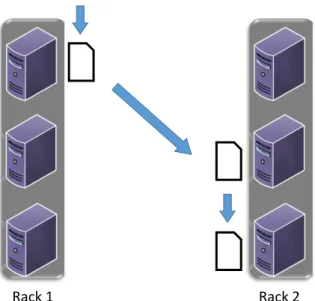
places one replica on one node in the local rack; another replica on a node in a remote rack; and the third on a different node in the same remote rack as shown in Fig. 3.1. This policy can reduce the inter-rack write traffic when distributing data to DataNodes because the three replicas of every data block are stored on only two racks. High fault tolerance and data availability are maintained in this policy because replicas are placed on three different DataNodes. However, The drawback of the policy is that it cannot evenly distribute replicas to cluster nodes. Data placement problem, therefore, needs to be considered to obtain an optimal placement solution to balance the data load on cluster nodes and minimize the data retrieval time [2].
3.2 Background
Even though HDFS RPP improves data reliability and processing performance, it has been clari-fied in our extensive experiments [32] that it cannot generate balanced replica distributions. For
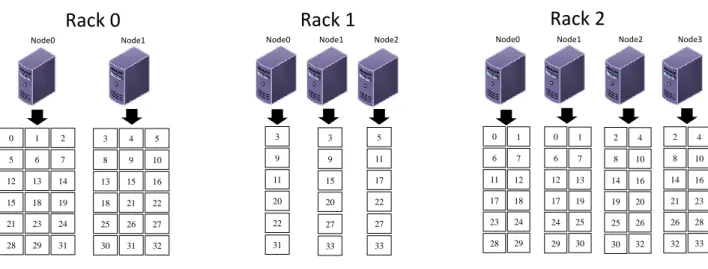
example: a cluster of three racks,rack0has two DataNodes,Rack1has three DataNodes, andRack2
has four data nodes; Let’s assume a file is stored on Hadoop cluster nodes, the file is partitioned into 34 Blocks, every block is replicated to 3 replicas. The current replicas placement policy of HDFS generates unbalanced replicas distribution of this file as shown in Fig. 3.2. Every node gets a different number of replicas. This may result in unbalanced access load. Because the higher the data blocks stored in a DataNode the more client requests for accessing data blocks in DataNode. In a Hadoop cluster, DataNodes may not be able to handle such excessive client requests, which results in stragglar map tasks. To overcome this performance issue, HDFS provides a balancing utility to address the issue of unbalanced HDFS cluster which can seriously degrade the perfor-mance of Hadoop applications. This utility is used to analyze replica placement and re-balancing replicas distribution across the DataNodes at the cost of extra system resources and running time.
Rack 1 Rack 2
Figure 3.1: Block replication in HDFS
3.3 Balanced replicas placement policy
The unbalanced replica assignment of HDFS RPP is generated because the policy places two repli-cas on two different nodes belong to one rack, and the third replica on a node located in another rack. This issue increases with the increasing of the number of files distributed in the cluster. To overcome this problem, the new policy proposed in this chapter places the replicas on DataNodes with the lowest load in the cluster, at the same time, it maintains the same distribution rules of ex-isting HDFS RPP. It is implemented by keeping pointer for each rack in the cluster to keep tracking the load on this rack. This policy makes it possible to generate an even replica distribution because the placement of replicas by using this policy is driven by the load on the DataNode instead of selecting a random racks. Since the intelligent balancing scheme is the key of the new policy, it is named the Intelligent Data Placement Mechanism Policy (IDPM).
Node0 Node1 Node2
Rack 1
Rack 2
Node0 Node1
Rack 0
Node0 Node1 Node2 Node30 1 7 9 15 16 17 18 20 22 31 33 1 3 4 8 16 21 0 1 9 10 11 12 2 6 9 11 13 3 4 6 12 14 23 2 4 5 7 10 15 2 5 8 10 14 18 3 6 8 11 14 17 0 5 7 12 13 17 19 27 28 30 13 19 23 24 29 33 25 26 27 30 32 24 20 22 23 25 26 27 15 16 18 20 24 28 29 31 21 22 25 26 28 32 32 30 31 19 21 29 33
Figure 3.2: Replicas placement of HDFS RPP
In IDPM, the replica placement process consists of two phases: rack selection phase, and node selection phase. Before the placement of a replica, rack is selected then a node inside this rack is selected to place the replica on it, the rack and node selection is the core of this policy. In rack selection phase, IDPM selects two racks with the lowest load depending on a pointer
calledRack_Pointer, it is continuously updated in every time a replica placement is achieved. The
Rack_Pointer of a specific rack is the number of free nodes in this rack for the current iteration. the distribution process consists of many iterations as will be disscussed later in this chapter. Node selection phase starts after rack selection, in this phase a free node from the selected rack in the
current iteration is selected. In every iteration, one replica is assigned to every node. The number of iterations needed to complete the whole replicas placement can be calculated as following: Let’s
assumeRis a collection ofLracks, each of which hasri(i=0,1,2, . . . ,L−1)available nodes on
it. Let N be the total number of all available nodes. n is the total numbers ofdata blocks to be
distributed, and D is the duplication factor which is assumed to be three replicas for each data
block. If pis the total number of replicas to be distributed to the DataNodes in main distribution
table, and I is the number of Iterations to complete the distributions, then p,N, and I can be
calculated according to Eq.3.1, Eq.3.2, and Eq.3.3 respectively.
p=n×D (3.1) N= L−1
∑
i=0 ri (3.2) I=lp N m (3.3)After calculating out N and I, IDPM builds the main assignment table MAT. It is two
dimensional array with N columns andI rows. Every column represents a DataNode, and every
row represent a distribution iteration. all the numbers of data blocks is stored in MAT. MAT consists of small tables attached together to form the main table. Each small table represents a rack, with number of columns equal to the number of nodes in that rack. The rows corresponding to the number of iterations for that rack. In each iteration of the distribution, the replicas are assigned to the whole current row before it jumps to the next iteration with the new row. The
be calculated according to Eq.3.4 C=d+ R−1
∑
i=0 ri (3.4)Every replica assigned to selectedrackR, and selectednoded is stored in columnC in the
main assignment table. Assume there are three racks, rack0 has five available nodes, rack1 has
three nodes, andrack2has seven nodes. As shown in Fig. 3.3 the total number of columns in the
main table isN = 15. The main table consists of three sections. IDPM first assigns all five nodes
onrack0 to section 1, all three nodes onrack1 to section 2, and then the seven nodes ofrack2 to
section 3. The main assignment table can be formed from merging these three sections. So the
main distribution table has 15 columns andIrows, whereIcan be found according to formula 3.3.
Figure 3.3: Racks tables
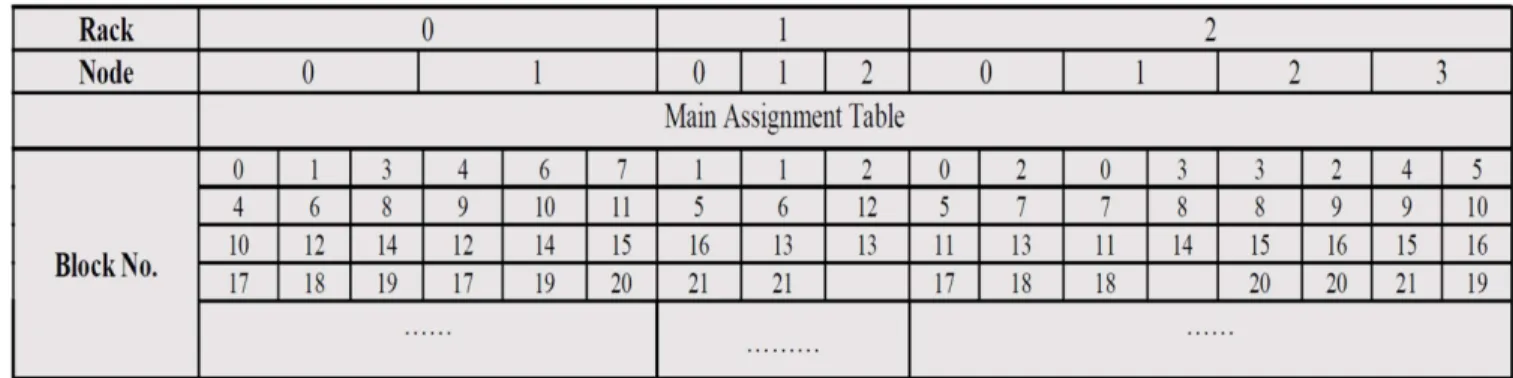
IDPM uses a tabular scheme to distribute replicas. the number of replica that supposed to be placed on a rack is stored in the table section corresponding to this rack. Each column in replica placement table is used to store the replicas assigned to one node. As shown in Fig. 3.4, replica’s numbers are assigned into the main assignment table in block number order. Each colored section is used for the replicas of one rack, the three sections forming the main assignment table. At the
Howeverrack2is selected at the beginning because it is the rack that has more free nodes. Each of
these two replicas are placed on different free node,node0andnode1, the third replica is assigned
to another rack has higher free nodes,rack0, on free node,node0. When all the columns of the first
row have been assigned replicas, the distributions start on the second row and so on.
Figure 3.4: Main Assignment Table (MAT)
As shown in Fig 3.4, the replicas are assigned into the replica assignment table in block
number order from replica 0 through replican−1, line by line. Before assigning the third replica
of current block, IDPM tags the rack in which the first two replicas of current block are residing as
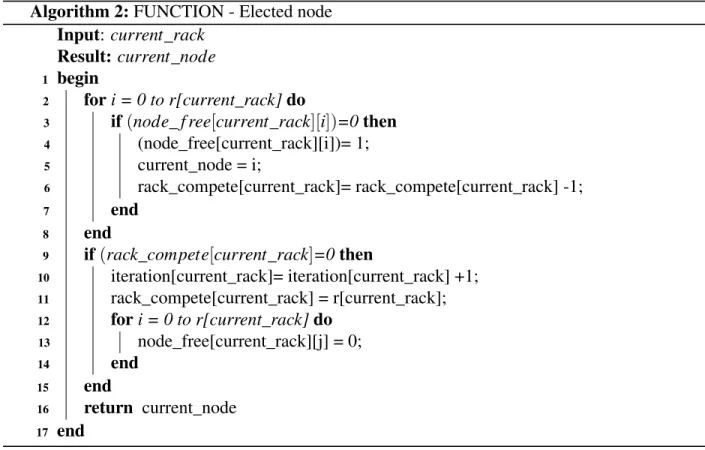
avoid_rackto discard it during the process of finding the elected rack for the third replica. After each rack election, IDPM assigns the replica to the elected node of this rack. The pseudo-code of elected rack algorithm, and elected node algorithm are shown in Alg. 1, 2 respectively. This
process continues until all the p replicas have been assigned. Finally, IDPM produces an even
distribution of replicas of file across all cluster nodes regardless the number of nodes in each rack in this cluster because the distribution of replicas is achieved depending on the total number of available nodes for this file. The pseudo-code of the replica distribution algorithm for all nodes is shown in Alg.3.
Algorithm 1:FUNCTION - Elected rack
Input:Rack_compete[0,1, ..R−1]
Result:current_rack
1 begin 2 ifrack_avoide=0then 3 rack_avoide=0; 4 end 5 fori = 0 to L-1do 6 if(i = rack_avoide)then
7 skip the current rack for the second third replica;
8 end
9 if(iteration[i] < iteration[current_rack])then
10 current_rack = i; // use the rack with the lowest iteration.
11 end
12 if(Rack_compete[i]>Rack_compete[current_rack])& (iteration[i] = =
iteration[current_rack])then
13 current_rack= i; // election of the rack with more free nodes.
14 end 15 end
16 return (current_rack) 17 end
3.4 Evaluation
In replica distribution generated by the HDFS RPP the number of replicas on one single node is a Discreet Random Variable (DRV). To test the distribution of a DRV, large scale simulation is con-ducted to examine the replica distribution generated by HDFS RPP, where theoretical simulation is more appropriate than actual implementation because much more distribution samples can be ob-tained by simulation. Two scenarios are considered, in each scenario a simulation was conducted as shown in Table 3.1. Scenario one is similar to the situations Hadoop applications encounter in practice. There are many cases in which an application has a dedicated cluster where the applica-tion can use all the nodes of racks belong to this cluster which is the case of scenario one. Assume Z is the number of replicas assigned to a single node resulted from replica distributions generated by HDFS RPP.
Algorithm 2:FUNCTION - Elected node
Input:current_rack
Result:current_node
1 begin
2 fori = 0 to r[current_rack]do
3 if(node_ f ree[current_rack][i])=0then
4 (node_free[current_rack][i])= 1;
5 current_node = i;
6 rack_compete[current_rack]= rack_compete[current_rack] -1;
7 end 8 end
9 if(rack_compete[current_rack]=0then
10 iteration[current_rack]= iteration[current_rack] +1; 11 rack_compete[current_rack] = r[current_rack]; 12 fori = 0 to r[current_rack]do 13 node_free[current_rack][j] = 0; 14 end 15 end 16 return current_node 17 end
Fig. 3.5 shows the probability distribution of Discreet Random Variable Z in Scenarios one, based on 15,000 simulation runs. HDFS RPP generates uneven replica distributions in scenario one as confirmed in simulation results. The number of replicas assigned to one node Z spreads over a wide range from 8 to 70 in scenario one. HDFS RPP randomly selects nodes directly instead of selecting a rack of this node first, therefore, the replica distribution is not significantly affected by the node distribution across racks. However, if the rack is randomly selected, the replica distribution would be more uneven when the node distribution is heterogeneous, because the nodes of rack with less nodes would have more replica assignment load than the nodes of rack with more nodes. HDFS RPP produces more load on the rack that has fewer nodes because the selected rack for the first replica would be selected for the second replica too. On the other hand, our simulation confirms that the proposed IDPM can generate perfectly even replica distributions in scenario one because Each node has 30 replicas.
Algorithm 3:Replicas Distribution algorithm
Input: A collection ofLracks each rack hasri(i=0,1,2, , ...L−1)available nodes on it.
ndata blocks to be distributed, which are numbered 1 throughn.
Result:T[0,1, ..I−1][0,1, ..,N−1]
1 begin
2 calculate N and I according to Eq. 3.2 and Eq. 3.3 respectively.
3 fori = 0 to L-1do
4 Rack_compete [i] = r[i]; //initializing rack competition register.
5 forj = 0 to r[i]do
6 Node_f ree[i][j] =0; // indicator to check if the node is assigned a block or
not.
7 end 8 end
9 rack_avoid=−1 // used to avoid the same rack for the third replica. 10 forBlock = 0 to n-1do
11 current_rack= Elected_rack(Rack_compete); 12 current_node= Elected_node(current_rack); 13 Count=0;
14 fori=0 to current_rackdo
15 Count=Count +r[i]; // to count the number of columns located before the
current rack.
16 end
17 Column =Count + current_node; // calculated from Eq. 3.4
18 T [iteration[current_rack]][column]= Block;
19 current_node= Elected_node (current_rack); 20 Column=Count+current_node;
21 T [ iteration[currentrack]][column] =Block;
22 rack_avoid= current_rack; //avoid current rack for 3rd replica.
23 current_rack= Elected_rack (Rack_compete) 24 current_node= Elected_node (current_rack) 25 fori=1 to current_rackdo
26 Count=Count +r[i]; // to count the number of columns located before the
current rack.
27 end
28 T [ iteration[currentrack]][column]= Block;
29 end
30 return T [0,1,..I-1][0,1,..,N-1] 31 end
Figure 3.5: Probability distribution of Z in scenario one.
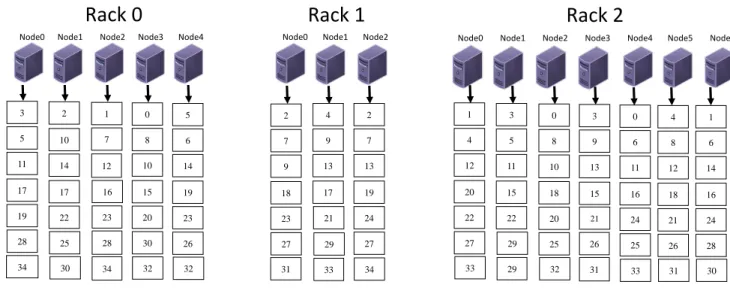
Because of the large scale of this scenario, a figure showing the replica distributions gen-erated cannot be shown in this dissertation. Therefore, scenario two, reduced scale, is included to present the replica distributions generated by both HDFS RPP and IDPM as shown in Table 3.1. Fig. 3.6 shows one replica distribution generated by HDFS RPP in scenario two. The replica dis-tribution is uneven with number of replicas on one single node ranging from 2 to 11. The replica distribution generated by IDPM in scenario two, as shown in Fig.3.7, is perfectly even, does not need to run balancing utility, and meets all HDFS replica placement requirements.
3 5 11 17 19 28 2 10 14 17 22 25 30 1 7 0 8 10 15 20 30 5 6 14 19 23 26 32 32 2 7 9 18 23 27 31 4 9 13 17 2 7 13 19 24 27 34 34 12 1 4 12 20 22 27 33 3 5 11 15 22 0 8 10 18 20 25 32 3 9 13 15 0 6 11 16 24 25 21 4 8 12 18 21 26 31 33 1 6 14 16 24 28 30 16 23 28 21 26 31 29 29 29 33 34
Node0 Node1 Node2 Node3 Node4 Node5 Node6 Node0 Node1 Node2
Node0 Node1 Node2 Node3 Node4
Rack 0
Rack 1
Rack 2
Figure 3.6: Replica distribution generated by HDFS RPP in scenario Two
Table 3.1: SIMULATION SETTINGS OF IDPM EVALUATION
Simulation Settings Scenario One Scenario Two
Total Number of Blocks 6,000 35
Duplication Factor 3 3
Total Number of Replicas 18,000 105
Total Number of Nodes 600 15
Average Number of Replicas on One Node 40 7
Minimum Number of Replicas on One Node 8 2
Maximum Number of Replicas on One Node 70 11
Total Number of racks 40 3
Number of available nodes onracki 15
5(i=0) 3(i=1) 7(i=2)
3 5 11 17 19 28 2 10 14 17 22 25 30 1 7 0 8 10 15 20 30 5 6 14 19 23 26 32 32 2 7 9 18 23 27 31 4 9 13 17 2 7 13 19 24 27 34 34 12 1 4 12 20 22 27 33 3 5 11 15 22 0 8 10 18 20 25 32 3 9 13 15 0 6 11 16 24 25 21 4 8 12 18 21 26 31 33 1 6 14 16 24 28 30 16 23 28 21 26 31 29 29 29 33 34
Node0 Node1 Node2 Node3 Node4 Node5 Node6 Node0 Node1 Node2
Node0 Node1 Node2 Node3 Node4
Rack 0
Rack 1
Rack 2
CHAPTER 4: BALANCED REPLICA PLACEMENT POLICY FOR
HETEROGENEOUS CLUSTERS
1Replica placement in HDFS plays a significant role in data availability and balancing the com-putational load on DataNodes. In the current Hadoop Distributed File System replica placement policy HDFS RPP the replicas of data blocks cannot be evenly distributed across the cluster of data nodes, specially when variety of hardware generations coexist in the cluster. As mentioned earlier in the previous chapter the current HDFS must rely on load balancing utility for balancing replica distribution, which results in extra overhead for time and resources. However, in heterogeneous clusters the even distribution of replicas does mean it is a fair distribution. It does not produce balanced computational loads on data nodes because of the variation in the processing capabilities and resources of data nodes. This chapter addresses the load balancing problem and presents an innovative replica placement policy for HDFS. It can perfectly balance the distribution of replicas of file among the data nodes in heterogeneous cluster environments. Experimental results of the proposed solution confirm that, the proposed replica placement scheme gives better DataNodes utilization than the default replica placement policy of Hadoop in heterogeneous cluster environ-ment.
4.1 Introduction
In recent years, Hadoop framework is popularly known for providing cost-effective solutions to process large-scale data intensive applications in a distributed manner on cluster of processing nodes. Cluster nodes of Hadoop may vary in their processing capabilities and availability of re-sources. One of the key issues that can significantly affect the performance of cluster nodes in 1Related publication: I. A. Ibrahim and M. Bassiouni. Improvement of data throughput in data-intensive cloud com-puting applications. In2019 IEEE Fifth International Conference on Big Data ComputingService and Applica-tions (BigDataService), pages 49–54. IEEE, 2019.
data intensive cloud computing is computational load balancing among cluster nodes. HDFS is the storage part of Hadoop framework. It is a file system designed for storing very large files reliably and stream data with high bandwidth, running on clusters on commodity hardware [68]. Cloud computing applications that perform massive computing tasks (big data processing) offload data and tasks to data centers or powerful servers in the cloud. In a typical Hadoop cluster, terabytes of data are processed using parallel computations. The processing of jobs in a Hadoop cluster is affected by the storage mechanism of data in HDFS, and the processing capabilities of cluster nodes [40].
4.2 Background
In our previous work [32], the need for running the balancing utility used by RPP for HDFS has been eliminated. An improved RPP for HDFS called Intelligent Data Placement Mechanism IDPM has been proposed for replica distribution in Cloud Storage Systems , IDPM distributes replicas evenly to cluster nodes and meet HDFS distribution requirements. However, IDPM works only for homogeneous cluster environments, while in heterogeneous cluster environments, where the racks are from different Hardware generations, the even distribution of replicas does not mean it is a fair distribution because it cannot guarantee the load balancing among cluster nodes. For example, in
Fig 3.2. If the processing nodes ofRack1are slower than the processing nodes ofrack2, the even
distribution of replicas produced by IDPM fails in balancing the processing load because it does not take into consideration the variations in processing capabilities of cluster nodes.
In HDFS, each data file is partitioned, replicated, and stored as a sequence of data blocks. In MapReduce jobs, DataNodes perform map tasks on the file’s blocks in parallel. The current HDFS Replica Placement Policy (RPP) is not designed for heterogeneous clusters ,therefore, the replicas are not distributed over all nodes that selected to store the file based on their available resources. As a result, the highly utilized DataNodes experiences overload in client access, this
degrades the performance of MapReduce in heterogeneous environment. Similarly, the IDPM pro-duces an even distribution of the file’s blocks but in heterogeneous clusters environment this even distribution may lead to unbalanced processing load, thereby reducing the overall performance of Hadoop. Load balancing among heterogeneous cluster nodes would be a great enhancement for the performance of data-intensive cloud applications. It can improve job completion time, opti-mize the usage of resource, maxiopti-mize the throughput, miniopti-mize the retrieval time, and miniopti-mize the overload on cluster nodes.
4.3 Speed-based Replica Assignment Policy SRAP
The current HDFS RPP generates unbalanced replicas assignment across all cluster nodes as shown earlier in Fig.3.2. Consequently, HDFS RPP runs a balancing utility for analyzing and re-balancing the replica placement among cluster nodes. In homogeneous cluster nodes, the data load balancing is achieved by equalizing the number of data blocks assigned to each node, while in heterogeneous cluster, the computational load balancing among cluster nodes cannot be achieved by merely bal-ancing the number of data blocks assigned to each node. The number of blocks assigned to each node must be equivalent to the node processing capacity and available resources. The new policy proposed in this chapter generates balanced data distribution where the placement of data blocks is driven by the load on the nodes.
The proposed policy fairly distributes the data blocks to cluster nodes depending on their processing speed. The node that has higher processing speed is assigned more data blocks than another node with lower processing speed in order to get better node utilization. Consequently, in-crease the efficiency of data processing by cluster nodes to meet the requirements of data-intensive cloud computing. For example, during MapReduce jobs, if map tasks are applied on the blocks of many files that stored on the same cluster nodes simultaneously, the balancing of load among cluster nodes is achieved when the blocks have been distributed using the new policy because
nodes with high processing capacity have more data blocks than slower nodes. It minimizes the chance of overloaded nodes, eventually minimizes the job completion time. Since the key to the proposed replica placement policy is assigning replicas to nodes based on their processing capa-bility, the new policy is Named Speed-based Replica Assignment Policy (SRAP). To deal with heterogeneous cluster environments, since the racks are usually belonging to different hardware generations, we assume the nodes on same rack are similar in their processing capability while nodes on different racks may differ in their processing capability. SRAP assigns a processing rank to the nodes. Rank of a node is the integer number of blocks it can process during a unit of time. The unit of time is the time needed by the slowest node in the cluster to process one data block.
Rank1 is the rank of the slowest node. However, SRAP works for homogeneous cluster
environ-ments too. It is a special case of heterogeneous cluster environenviron-ments where the rank of all nodes
isRank1.
4.3.1 Main assignment table MAT
Let’s assume a cluster consists of L racks, each of which hasri nodes, where (i=0,1, . . . ,L−1).
N is the total number of available nodes in the cluster. The nodes of each rack have a processing
speedSi where (i=0,1, . . . ,L−1). Assume a file to be distributed, the file is partitioned into n
blocks, the duplication factor,D, is assumed to be three replicas for each data block in this policy.
The total number of replicas to be distributed to the cluster nodes is p, as calculated in Eq.4.1. The
processing rank of nodes inracki=Ki, where (i=0,1, . . . ,L−1). Kiis the greatest integer number
less than or equal to the result of dividing the speed of nodes ofrackito the minimum speed in the
cluster. It can be calculated by using Eq. 4.2.
Ki=
Si
min
(0≤k≤L−1)
Sk (4.2)
SRAP builds a rack assignment table for every rack, it is two dimensional array with mi
columns andI rows, every node has column(s) in the rack assignment table equals its processing
rank Ki. In the proposed algorithm, a node in Racki hasKi columns allocated for it in the rack
assignment table. The number of columns in the assignment table of Rackiismi. It is calculated
in Eq.4.3
mi=ri×Ki f or i= (0,1, ..,L−1) (4.3)
The racks assignment tables are merged together to form the Main Assignment Table MAT. The number of columns in MAT is M. it is calculated in Eq.4.4
M=
L−1
∑
i=0
mi (4.4)
SRAP build the MAT for every file in HDFS that need to be distributed across cluster nodes. So
HDFS can use MAT of the file for the file’s blocks distribution. The number of rows in MAT isI,
it is calculated in the previous chapter using Eq. 4.5.
I=lp
N
m
(4.5)
4.3.2 Block index allocation in MAT
SRAP builds the main assignment table MAT and distributes the blocks’ numbers inside this table. Every field in MAT is corresponding an actual location in the cluster. So, HDFS can use MAT to distribute the actual blocks by placing each replica to the corresponding location referred by MAT.