B
USINESS
C
ONSEQUENCES
OF THE
EU
E
MISSIONS
T
RADING
S
CHEME
C
HAIRMAN
: Y
NGVE
S
TADE
S
ENIOR
E
XECUTIVE
V
ICE
P
RESIDENT
,
S
TORA
E
NSO
R
APPORTEURS
: C
HRISTIAN
E
GENHOFER
S
ENIOR
R
ESEARCH
F
ELLOW
,
CEPS
N
ORIKO
F
UJIWARA
R
ESEARCH
F
ELLOW
,
CEPS
K
YRIAKOS
G
IALOGLOU
R
ESEARCH
F
ELLOW
,
CEPS
CEPS
T
ASK
F
ORCE
R
EPORT
N
O
.
53
F
EBRUARY
2005
This report is based on discussions in the CEPS Task Force on The Business Consequences of the EU ETS, which ran from December 2003 until December 2004. Participants in this CEPS Task Force included senior executives from a broad range of industry – including energy production and supply companies, energy-intensive industries and service companies – and representatives from business associations and non-governmental environmental organisations. A full list of members and invited guests and speakers appears in Appendix 3.
The members of the Task Force engaged in extensive debates in the course of several meetings and submitted comments on earlier drafts of this report. Its contents contain the general tone and direction of the discussion, but its recommendations do not necessarily reflect a full common position agreed among all members of the Task Force, nor do they necessarily represent the views of the institutions to which the members belong.
ISBN 92-9079-539-5
© Copyright 2005, Centre for European Policy Studies.
All rights reserved. No part of this publication may be reproduced, stored in a retrieval system or transmitted in any form or by any means – electronic, mechanical, photocopying, recording or otherwise – without the prior permission of the Centre for European Policy Studies.
Centre for European Policy Studies Place du Congrès 1, B-1000 Brussels Tel: (32.2) 229.39.11 Fax: (32.2) 219.41.51
E-mail: [email protected] Website: http://www.ceps.be
Contents
Preface
Executive Summary ... 1
Introduction ... 7
1. The Business Consequences of the EU ETS... 8
1.1 Coping with uncertainties...8
1.2 The new business environment after the EU ETS...9
1.3 A first reality check: Assessing the EU ETS at early implementation stage...10
2. Analysis: Expected Effects of the EU ETS... 13
2.1 Environmental outcome...14
2.2 Long-term benefits, short-term costs and the competitiveness of European industry...14
2.2.1 Macroeconomic effects ... 14
2.2.2 Sector-specific impacts ... 15
2.3 Power sector investment...16
2.4 Effects on power price...17
2.5 Power market structure...20
3. Making the Most of the EU ETS... 21
3.1 Improving stability and predictability of the EU ETS...22
3.2 Competitiveness effects...23
3.3 Power sector impacts...25
3.4 The importance of a more comprehensive global agreement on climate change...26
References ... 27
Appendices 1. Criteria for National Allocation Plans in Annex III of the EU ETS Directive... 29
2. Glossary of Terms and Abbreviations... 30
3. List of Task Force Members and Invited Guests and Speakers ... 33
List of Figures 1. Impact on power prices in the Nordic region ... 20
2. Power market effects: Free allocation ... 21
List of Boxes 1. The efficiency of auctioning allocation: Theoretical considerations ... 12
2. Range of tentative CO2 prices to induce a change in power generation technologies... 16
Preface by the Chairman
missions trading and the EU Emissions Trading Scheme (ETS) in particular have the potential to be an efficient instrument in combating climate change both at EU and international level. An essential precondition, however, is careful design and effective implementation, especially in the transition period during which not all of Europe’s competitors are subject to a similar carbon constraint. Implementation should be guided by the aim to achieve the environmental objectives of the EU ETS without jeopardising the competitiveness of EU industry. Climate change is a global issue that ultimately requires global solutions. Therefore it is crucial for the EU to continue its efforts to reach a global agreement.
To review design and implementation issues, CEPS launched a multi-stakeholder Task Force consisting of representatives from industry including energy supply and energy-intensive companies, industry associations as well as environmental NGOs and independent experts. During 2003 and 2004, Task Force members met on several occasions with invited speakers and guests as well as officials from various Directorates-General from the European Commission, the European Parliament and member states to discuss the potential impact of the EU ETS on the business environment and the need to address such impacts. In essence, the analysis focused on the scheme’s impact on the macro-economy of the EU, specific sectors, power sector investment, power prices and the structure of the power market. This included both the direct and the indirect (resulting from higher power prices) effects.
I hope that this CEPS Task Force report will facilitate a constructive response resolving a critical competitive issue for European industry and that the recommendations given in the report will serve as a valuable input to make EU ETS work from the very start.
Finally, I would like to express my great appreciation to all Task Force members and last but not least to CEPS for its constructive efforts in this important work.
Yngve Stade Senior Executive Vice President, StoraEnso Chairman of the CEPS Task Force
| 1
B
USINESS
C
ONSEQUENCES
OF THE
EU
E
MISSIONS
T
RADING
S
CHEME
R
EPORT OF A
CEPS
T
ASK
F
ORCE
E
XECUTIVES
UMMARYhis CEPS report examines the effects of the EU Emissions Trading Scheme (ETS) on the business environment. While the main focus is the 2008-12 period with possible incremental improvements, the report also takes a strategic perspective by looking beyond 2012. The analysis begins with the question of whether the EU ETS can be expected to achieve the declared objectives to create the necessary incentives for the power and energy-intensive sector for behavioural changes in the short and medium term1 and to encourage investment in low-carbon generation technologies in the long term. It then asks whether and how both design and implementation might be adapted to improve the EU ETS. The analysis covers the major controversial issues currently associated with the EU ETS, including environmental effectiveness, competitiveness of European industry, power sector investment, power price effects with an emphasis on the secondary effects of the EU ETS and impacts on power market functioning. The main report comprises three sections preceded by an introduction. The first section introduces the issues related to the business consequences. The second analyses the main impacts in greater depth and section 3 assesses a number of promising proposals designed to make the most of the EU ETS. A glossary of technical terms and abbreviations used in the study appears in the appendix. This Executive Summary is divided into key messages, recommendations and a full summary.
I. Key
Messages
1. In light of a significant degree of uncertainty regarding the structure of a future global agreement on climate change, it is crucial for the EU to find the right balance between policies striving towards a low-carbon economy and maintaining competitiveness of European industry. The objective of EU ETS is to provide incentives (i.e. price signals) to reduce emissions at least-cost while moving the economy onto a lower carbon trajectory. 2. The success of the EU ETS as part of the EU climate change policy crucially depends on
three preconditions. The first is environmental effectiveness; the secondisefficiency of the allowance market, including the application of critically coherent allocation methodologies across the EU that are consistent with the internal market but also with the burden-sharing agreement. The third is to create an increasingly predictable long-term perspective of the future carbon constraint (i.e. vision) to facilitate the necessary investment in both the short and long term.
3. For the EU to achieve this vision as well as to meet both its commitment to carbon reductions and competitiveness, it is indispensable to accompany implementation of the EU ETS immediately with credible strategies for the sectors not covered by the scheme, especially transport, tertiary, households and agriculture. The EU as a whole is still missing a comprehensive strategy for full transition to a low-carbon economy.
1 In this paper, short-term in general refers to phase I of the EU ETS (2005-07), medium-term encompasses the Kyoto binding phase (to 2012) and long-term is intended to cover the phase beyond the Kyoto Protocol’s first commitment period and the whole investment life cycle.
2|EXECUTIVE SUMMARY
4. Many of the potential negative effects are not caused by the EU ETS but are a fundamental result of the creation of a carbon constraint (from the 1998 Burden-Sharing Agreement), which would also have happened had another instrument been chosen. Ultimately, an EU climate policy that is not supported by a truly global agreement and one that subjects companies worldwide to the same or similar constraints will fail to meet both environmental and economic objectives. However, the agreed equity principle of common but differentiated responsibilities, as included in the United Nations Framework Convention on Climate Change (UNFCCC), requires ambitious actions from industrialised countries first.
II. Recommendations
1. The European Commission must immediately implement systematic monitoring of the EU ETS. Immediate priorities should be to identify and test indicators that allow effective monitoring of the scheme’s impact on i) the allowance market, ii) power prices, iii) power market structures and iv) competitiveness.
2. The EU must immediately start developing a credible and comprehensive strategy for transition to a low-carbon economy, among other reasons, in order to increase longer-term predictability as much as possible in light of an international agreement that does not yet cover all major emitters in the industrialised world and/or falls short of full engagement of developing countries. Such a strategy must assess all EU policies and their coherence with the long-term UNFCCC objectives and the requirements of the Kyoto Protocol.
3. Internationally, the EU’s priority must be to build on the Kyoto Protocol and additional elements to achieve a more comprehensive global agreement to combat climate change. Such a post-2012 strengthening of emissions reduction targets for industrialised countries and expansion of legally binding commitments to new and quickly industrialising countries must i) ensure a similar carbon constraint on a growing number of polluting industries worldwide, ii) create incentives to invest in lower carbon technologies and iii) include provisions for the creation or linking of effective and transparent national or regional emissions trading schemes to ensure a global carbon price at least for the industrial sector. 4. The absolute priority for the EU and its member states in the run-up to the next round of
allocation plans must be to significantly improve the coherence of National Allocation Plans (NAPs) across the EU. These plans must also be consistent with the internal market’s economic objectives – notably including the treatment of new entrants and plant closures, which could potentially distort competition but also environmental objectives stemming from the Burden-Sharing Agreement or the Kyoto Protocol.
5. The EU and its member states should launch a process to identify the optimal rules for an allocation methodology. This should consider all different allocation methodologies, and in particular aim to: i) maximise incentives for innovation and investment and allow for development, ii) minimise competitiveness effects in the absence of an agreement that covers all major emitters and iii) avoid distortions in the internal market that may cause windfall profits. This process should be based on the results of effective monitoring (see recommendation 1 above).
6. The priority for the 2006 EU ETS review must be to improve stability and predictability in order to facilitate behavioural changes in the short and medium term and to maximise incentives for long-term investment until a global agreement with long-term targets comes to the surface. The EU and its member states must endeavour to identify solutions that will enable longer-term allocation, thereby increasing business confidence.
BUSINESS CONSEQUENCES OF THE EUEMISSIONS TRADING SCHEME |3
III. Full Summary
The EU ETS has become the EU’s principal instrument to reduce emissions of greenhouse gas (GHG) in the covered sectors (energy-intensive and power) and, more notably, to meet the EU’s Kyoto Protocol target by 2008-12, both for reasons of least-cost abatement and environmental certainty. In order to reach these objectives, the EU ETS faces a number of challenges in areas such as implementation, competitiveness of European industry, power sector investment, power prices and power sector profitability and impacts on power market structure. These challenges are much more difficult to meet in light of an international agreement that does not yet cover all major emitters in the industrialised world and/or does not have the full engagement of developing countries.
Implementation (efficiency and effectiveness)
1. The overall objective of climate change policy is to reduce greenhouse gas emissions. In order to reach climate change objectives, there needs to be balance between efforts of different sectors such as industrial, transport, tertiary, domestic and agriculture to avoid excessive costs, especially for those industries that are subject to international competition. Most member states still lack a comprehensive carbon abatement strategy.
2. There might be a temptation to allow lenient targets in industry as a result of major international competitors not being subject to a similar carbon constraint. Without a real carbon constraint, however, it is difficult to imagine an efficient and liquid allowance market. Moreover, forfeiting low-cost abatement opportunities in the covered sectors would most likely lead to an increase in overall compliance costs under the Kyoto Protocol as, for example, has been the case within the European Climate Change Programme.
3. The NAPs also dictate how the total amount of allowances is to be distributed to the individual installations. In general, for phase I of the scheme, this has been based on historical emissions of the installations (grandfathering). This may be the most justifiable approach in the preliminary stages of the scheme on the grounds that it protects investment predating the carbon constraint. However, if grandfathering is allowed to continue into the future simply by changing the reference date (i.e. updating) in the next round of allocation plans, there will be little incentive to cut emissions here and now.
4. Divergent allocation rules for new entry across the EU reduce the efficiency of the EU ETS. In addition, there is some merit to the idea of allocating more generously to energy-intensive companies as a form of compensation for their higher power costs and to new entrants in order to foster competition in power markets to the detriment of incumbent generators (see items 10-15 below), as long as this does not constitute state aid.
Competitiveness
5. The EU ETS will have an impact on the competitiveness of energy-intensive industries such as cement, pulp and paper, glass, steel/metal, aluminium, chemicals and refining. This impact will occur regardless of whether or not the sectors are covered by the EU ETS. For those industries outside the scope of the ETS, the impact will come from higher power prices (see also items 10 & 11 below). For those industries falling within the scheme’s scope, the impact will not only come from higher power prices but also increased costs from process emissions unless member states have given special treatment regarding process emissions. Consequently, some energy-intensive industries may suffer a competitive disadvantage owing to the fact that competitors of the EU industry may not be subject to the same constraints. For some industries, the competitive disadvantage is related to the geographical proximity of competitors (e.g. refining or cement production in the Mediterranean countries). For others it is related to the fact that cost increases cannot be
4|EXECUTIVE SUMMARY
passed on due to prices being set on the international commodities markets (e.g. parts of the energy intensive-industries, most notably aluminium).
6. The ultimate cause for the potential competitiveness problems is the fact that not all competitors of EU industry are subject to an equivalent carbon constraint. In the transition period therefore – until the Kyoto Protocol and the post-2012 framework includes more countries with legally binding emissions cuts – the EU and its member states have an extra responsibility to enable firms to cope with this difficult period. In the long-run, however, EU climate policy, which does not form part of a comprehensive agreement, is likely to be untenable, because it would be ineffective globally.
Power sector investment
7. It is generally assumed that a large carbon cutback will have to be achieved in the electricity generation sector. Hence, the priority must be to achieve behavioural change in the short and medium term (e.g. energy efficiency, fuel switching and portfolio management), with structural change towards less carbon-intensive power production in the long run. This idea is reflected in many of the NAPs which have tended to impose a higher carbon constraint on the power sector than on energy-intensive companies. However, it is also recognised that the ability of the power sector to deliver less carbon-intensive power production is affected by national political factors and will take considerable time due to the very long investment cycles.
8. Long-term investment signals and hence structural change will depend on stability and profitability of the power sector. It is highly likely that in this initial stage the EU ETS will add to investment uncertainty in power generation and as a result, new investment may be deferred. Uncertainty relates mainly to unpredictability about further development of the international regime based on the UNFCCC and the Kyoto Protocol and concerns about stringency and consistency of allocation across member states as well as future reductions of total allocations.
9. It is reasonable to expect that in the short to medium term, the introduction of the EU ETS will induce mostly behavioural changes in existing power generation and only minor changes in the choice of technologies for new generation. In the long term, the EU ETS should encourage investment in lower-carbon generation technologies, but this is dependent on the factors outlined above.
Power prices
10. The short-term wholesale power price in most EU countries is set on the basis of short-run marginal costs. Prices are set by the marginal production costs, including the value of emissions on the allowance market, and normally one would expect no difference between CO2 and other short-run cost factors such as fuels.
a) There is still controversy about the levels of anticipated price increases which depend on a number of parameters including impacts from i) NAPs (e.g. total number of allowances, banking provisions, rules for new entry and closure), ii) the Linking Directive, iii) the level of competition within EU power markets (see items 13 & 14 below), iv) the fuel of the marginal generating plant (e.g. high- versus low-carbon fuels) and v) government restrictions regarding new power plant construction, which may deter new entry. Some simulations have indicated 20-30% increases in base load wholesale prices based upon an allowance price of €10 per tonne of CO2. On average this translates into an end-user price increase of approximately 10-15%. Other simulations indicate lower figures. There are major variations between countries and for different types of end users.
BUSINESS CONSEQUENCES OF THE EUEMISSIONS TRADING SCHEME |5
b) However, it is certain that the EU ETS will allow low-carbon generators such as renewable, hydro or nuclear to have substantially increased profits as a result of higher power prices, without additional costs. In the short term it is likely that all generators, not just low-carbon generators, will earn increased profits due to free allocation.
c) Although it is generally assumed that the allowance price in the initial period will be relative low (e.g. €3-8 per tonne of CO2), this is not certain to be the case. In fact, it is possible that allowance prices will be highly volatile with no long-term trend and be determined largely endogenous of the EU ETS. Allowance prices may potentially be driven by fuel price differentials between coal and gas and the weather rather than by the overall stringency of NAPs. In the case of low coal prices, fuel switching to gas will be reduced and thereby the demand for allowances will go up as will the allowance price. On the other hand, lower coal prices will facilitate more use of CHP (combined heat and power) generation as well as lower electricity prices.
11. In the long term, power prices are likely to increase to provide the necessary incentives for new entry needed to replace existing aging power plants and to accommodate growing demand. The total cost of new capacity and replacement is likely to cap the cost of carbon. Possible options to address power prices
12. This CEPS report has identified five potential principal options2 to address the issues regarding power prices and competition. Each one has different advantages and disadvantages regarding compliance costs, political feasibility, power market impacts, government intervention, data issues or transaction costs. These options need to be further studied and assessed as to their suitability to address the identified problems, but they must not discourage improvements in the efficiency of both power and carbon markets.
13. The options available to energy-intensive companies in order to cope with potential negative effects from increases in the power price are limited. Negotiating lower power prices is, in most cases, at best a partial solution. For some companies increased use of own production (i.e. self-generation) may in certain circumstances be a possible long-term option but this has opportunity costs. In addition, it needs careful investment planning. Furthermore, even to the extent that this could help address the issue, it is no substitute for a market or political solution.
Power market structure
14. The EU power market is best described as being in a transitional phase and consisting of different national and regional markets characterised by different degrees of competitiveness. Generally, these markets suffer from a high degree of market power concentration. The fear is that free allocation based on historical grandfathering might increase market power even further and that the resulting windfall effect will strengthen the market position of the incumbents to such a degree as to undermine competition and simultaneously inhibit new entry.
2 The options that have been discussed are: 1) auctioning of power-related allowances and recycling to mitigate adverse competitiveness effects, 2) allocation of allowances to industrial sector, 3) electricity benchmarks and ex-post verification of allocation, 4) keeping initial carbon constraints limited and 5) separation of the allowance market from the power market.
6|EXECUTIVE SUMMARY
15. Additionally, the increased profitability in the generation sector may create a commercial freedom for companies that are present in both generation and supply markets, but this freedom is not extended to companies seeking to compete as independent suppliers. This may create some barriers to entry in the retail supply market.
| 7
B
USINESS
C
ONSEQUENCES
OF THE
EU
E
MISSIONS
T
RADING
S
CHEME
R
EPORT OF A
CEPS
T
ASK
F
ORCE
C
HAIRMAN:
Y
NGVES
TADER
APPORTEURS:
C
HRISTIANE
GENHOFER,
N
ORIKOF
UJIWARA&
K
YRIAKOSG
IALOGLOUIntroduction
The EU emissions trading (EU ETS) scheme has served as the cornerstone of the European Union’s strategy to meet its Kyoto Protocol targets. At the same time the EU ETS can be seen as an attempt to lead by example in showing that reductions in emissions of greenhouse gases (GHGs) can be achieved in a cost-effective way. It is hoped that a successful EU ETS could help to convince the EU’s international partners to undertake policies to reduce GHGs in both a domestic and international context. The EU ETS even offers the possibility that other non-EU countries might join under certain conditions.
After final adoption of the EU ETS in September 20033 and reaching agreement in April 2004 on the Linking Directive, which links credits of the Clean Development Mechanism (CDM) and Joint Implementation (JI) to the EU ETS (see Egenhofer & Fujiwara, 2004),4 attention has quickly shifted to implementation. The EU institutions are completing the legislative and regulatory framework while member states are mainly concentrating on allocation of allowances, which has been at the centre of attention ever since the Directive was adopted. With implementation progressing – at the same time – the consequences of the EU ETS for business, policy-makers and the societies at large are beginning to sink in.
For some countries – those without CO2 taxes – the start of the EU ETS marks the end of an era when carbon could be emitted without consequences and free of charge. From now on, policy-makers, industry (producers and consumers) and the public will be facing an increasing carbon constraint, which in the medium to the long term will affect all major policies as well as our life styles.
For business and industry, there are two effects: i) operational implications and ii) changes in relative prices and how they affect investment decisions. Operational consequences relate to the fact that the EU ETS creates a price for carbon. This makes carbon management both a legal necessity, as it requires monitoring, reporting and verification of emissions and the registration of allowances in the registry, and a management priority. Investors will want to know about performance, liability and risks. Managers will try to exploit opportunities through better management and participation in the trading market. They can best do this if the rules are largely the same across the entire EU internal market.
Perhaps the most fundamental impact is the fact that the EU ETS creates scarcity. This scarcity is distributed among the covered sector via the allocation process. The way allocation is undertaken has major distributional effects between sectors, firms and even installations. In
3 Directive 2003/97/EC of the European Parliament and of the Council of 13 October 2003 establishing a scheme for greenhouse gas emissions allowance trading within the Community and amending Council Directive 96/61/EC, Official Journal of the European Union, 25 October 2003.
4 Directive 2004/101/EC of 27 October 2004 amending Directive 2003/87/EC, Official Journal of the European Union of 13 November 2004, L338, pp. 18-23.
8|EGENHOFER,FUJIWARA &GIALOGLOU
addition to this direct effect of allocation, there is an additional indirect impact in that power prices as a result of the carbon mark-up (i.e. carbon price) will increase. Thus, end-use customers who are covered by the EU ETS are affected in two ways: through the capping of their own emissions and by higher power prices (as result of the carbon mark-up). End-use consumers who are not covered are still affected by the indirect effects of power price increases. This report concentrates on cost/price and distributional effects, including the opportunities offered by the EU ETS. It will largely leave aside operational implications for businesses. Following this brief introduction, the main report is structured in 3 main sections. Section 1 attempts to identify the critical areas of the EU ETS for business operations. Section 2 presents an analysis of expected effects and their consequences, and the final section assesses a number of promising proposals to make the most of the EU ETS.
The main findings of the report are contained in the Executive Summary, including Key Messages and Recommendations.
The report has three Appendices, including the criteria to guide national allocation, i.e. Annex III of the Directive (Appendix 1), a glossary of technical terms and abbreviations (Appendix 2) and a list of members of the Task Force and invited guests and speakers (Appendix 3).
1.
The Business Consequences of the EU ETS
This chapter briefly recalls the main elements of the EU ETS and their likely impact on business operations. On this basis, we analyse whether the EU ETS in its current state of implementation will be able to fulfil expectations. Prior to this, we briefly analyse the degree of uncertainty related to climate change and its policy and outline the potential impact of this uncertainty on the EU ETS.
1.1 Coping
with
uncertainties
In an ideal world, there would be certainty about the environmental target over the long term, which would allow, for example, long-term allocation – as in the case of the US SO2 trading scheme. Unfortunately, this is not the case. Design and implementation of the EU ETS are embedded in a situation of uncertainty as a result of an international agreement that does not yet cover all major emitters in the industrialised world and/or falls short of full engagement of developing countries. This inevitably creates uncertainty concerning the longer-term targets, thereby reducing predictability. While achieving a more comprehensive global agreement has always been at the top of the EU agenda, the EU critically depends on its international partners to achieve this. But even if such an agreement could be achieved, this would not reduce all
uncertainty. Climate change is a long-term issue with no technological solutions readily available. New findings in climate science or technological breakthroughs are highly likely to cause major changes to climate change policy, which inevitably creates political and regulatory uncertainty. The challenge, therefore, is to set the short-term carbon constraint (i.e. the cap) in view of long-term expectations of what the international carbon constraint may be. This will always involve a considerable degree of discretion.
To date, member states have tended to minimise the carbon constraint for EU industry by allocation that takes into account the fact that major competitors are not subject to the same or any carbon constraint at all. Eventually this might mean that more reductions will have to be undertaken by other sectors, which is likely to increase overall compliance costs to meet the Kyoto Protocol targets because of foregone low-cost abatement opportunities in the covered sectors.
BUSINESS CONSEQUENCES OF THE EUEMISSIONS TRADING SCHEME |9
One element of adding some degree of predictability is consistency between current and envisaged (short- and medium-term) policies and long-term objectives – such as global stabilisation of concentration or reduction targets of 60% in 2050, as has been suggested by EU policy-makers. Consistency for example could be improved if the EU and member states undertake a more rigorous analysis of how to streamline short-term policies (i.e. those to meet the Kyoto Protocol targets) with long-term targets. The results of early indicative analyses on the relationship between the two point to major inconsistencies, notably in transport, services and the domestic sectors.
Uncertainties not only relate to the long-term character of climate change. They can also concern regulatory uncertainty, such as the emerging regulatory regimes for renewable support systems including the possible green certificate trading scheme or policies regarding security of energy supply.
In addition, there is uncertainty related to design and implementation, which will be discussed in the following sections.
1.2 The new business environment after the EU ETS
The EU has chosen emissions trading as the instrument of choice for its industrial sector on the basis of a number of perceived advantages.5 Economically speaking, emissions trading promises to meet the environmental goal in the most cost-effective way by ensuring that the market price of carbon is equal to the lowest marginal abatement cost amongst all controlled sources. A second advantage is that the resulting carbon price should create long-term predictability for business, a crucial factor in efficient investment decisions. In addition, emissions trading offers flexibility. It provides for a mechanism by which emitters – factory operators, oil refineries, etc. – can identify the most cost-effective way to reduce their emissions and thus factor carbon-reduction strategies into day-to-day business decisions. Thus, emissions trading goes beyond existing environmental policy – mainly seen as an inescapable overhead – by establishing a long-term and predictable price signal upon which firms base investment decisions while still retaining significant flexibility to achieve the environmental objective.
At the same time emissions trading aims to provide environmental certainty by capping the overall emissions level from the covered sources.6 Combined with a robust compliance system (including for example credible penalties and an effective enforcement mechanism), emissions trading ensures that targets are met. It also lends itself well to dealing with the implementation of the Kyoto Protocol targets, as they are also expressed in absolute terms.
These theoretical economic and environmental advantages of the least-cost abatement – long-term predictability, flexibility, management focus and environmental certainty – depend, however, to a considerable degree on the market architecture, relating both to the legislative (i.e. the EU ETS directives) and implementation phases (i.e. implementation by member states under European Commission supervision) (see Egenhofer & Fujiwara, 2003). It is the allocation of allowances on the one hand and the functioning of the market (i.e. rules and compliance with them and interaction with others, such as power markets) on the other that are critical for the efficiency of the EU ETS.
5 See the previous CEPS Task Force report, Greenhouse Gas Emissions Trading in Europe: Conditions
for Environmental Credibility and Economic Efficiency (Egenhofer & Legge, 2002).
6 This ‘environmental certainty’ extends only to the covered sources. There is a risk of ‘leakage’ unless caps or similar measures are applied world-wide.
10|EGENHOFER,FUJIWARA &GIALOGLOU
Allowances are intangible assets that behave like property rights and are sensitive to rule changes that might affect the value or even property rights themselves. A precondition for the market to function is the allocation of property rights to market participants. Later on, consistent and fraud-proof monitoring and verification procedures must be put in place. Once the property rights (for the allowances) are allocated, the market is expected to achieve the environmental objective. Frequent changes in specifications of property rights or other rule changes will undermine the EU ETS.
A key criterion against which the EU ETS is assessed, however, is the extent to which it allows market participants to manage risk over the long run.7 Ideally, market participants need to be able to assess future opportunities or liabilities of transactions. A successful market allows predictability for investment and thereby provides the certainty to make efficient investment decisions, e.g. whether to invest in new equipment to reduce emissions or to buy extra allowances. Hence, there is the need for predictable rules and ideally a long-term target.
Long-term predictability (e.g. a reliable forward curve) is also brought about by liquidity, transparency and market confidence. Liquidity is related to the scarcity expressed through allocation as well as the number of market participants, including buyers and sellers, but also market-makers such as brokers, speculators and arbitrageurs. Transparency provides independent information to allow market participants to make informed decisions on whether to buy or sell.8 Market confidence is helped by stability and political and regulatory certainty.9 This includes for example clarity about the interactions between the emissions market and other markets, such as those for renewable energy certificates and the rules of the international climate regime.
Risk management can also be helped by standardised operations, i.e. clear market rules to speed up transition to lower transaction costs. In the context of EU ETS, this is somewhat less important. Generally, there are no special rules governing trade, except the treatment of financial transactions. Trading rules are a common part of the general economic and legal framework of market economies, including for example guarantee of private property, contract law, and competition law or consumer protection. Other rules, such as clearing and settlement or inter-operability, might be organised as self-regulation by market participants.
No less important, finally, are equity (i.e. distributional) and general economic impacts. A sense of a ‘fair burden-sharing’ between market participants, member states and within societies at large is crucial in order to provide the political stability required by the EU ETS. If this sense does not exist, for example, because of a perception of unfair burden-sharing within or between sectors, wealth transfer or violation of the ‘polluter-pays principle’, there is a risk of political backlash, which ultimately could jeopardise the EU ETS. Another precondition of stability is that the environmental objective will be achieved.
1.3 A first reality check: Assessing the EU ETS at the early
implementation stage
The EU ETS was the result of rigorous consultation on the part of the Commission with stakeholders both before and during the European Climate Change Programme (European
7 Ideally through a reliable forward curve, i.e. a mechanism that allows the trade of future allowances at a predetermined price.
8 This is different from transparency requirements for compliance to allow governments to ensure that the trading regime achieves the environmental objective.
9 The US SO2 trading scheme, which has a 30-year regulatory regime, is perhaps an extreme example of the kind of predictability that market participants prefer.
BUSINESS CONSEQUENCES OF THE EUEMISSIONS TRADING SCHEME |11
Commission, 2001), followed by intensive discussions within and between the Council of Ministers and the European Parliament. As a result, the EU ETS was adopted unanimously by the Council of Ministers and by a large majority in the European Parliament. In general, business was favourably disposed to the scheme, as were NGOs.
The EU ETS is based on the cap-and-trade model, which is the preferred option in the emissions trading literature as it keeps transaction costs down by allocating unambiguous property rights. It has a credible compliance system to ensure that the environmental objective will be reached. From the beginning, the European Commission aimed to keep the EU ETS as simple as possible to ensure low transaction costs for both governments and industry. The EU ETS – at least initially – covers only CO2 emissions from large industrial and energy installations from a limited number of sectors.10 Nevertheless, the EU ETS will cover about 46% of total EU CO
2 projected emissions in 2010, equivalent to 38% of the EU's total greenhouse gases in 2010. Allowances in the EU ETS are in principle allocated free of charge, i.e. grandfathered. This means that firms through their installations receive their allowances based on historical emissions. However, most of the literature on emissions trading suggests that allowances should be auctioned and the proceeds recycled to achieve fiscal neutrality. Potential advantages to auctioning are that this methodology in principle provides stronger market signals to reduce emissions (see Box 1), but also facilitates liquidity and depth in the market and therefore would provide a more reliable forward curve. Its main advantage in the context of the EU’s internal market is its high degree of transparency and non-discrimination within the internal market. On the other hand, there are disadvantages and risks associated with auctioning. The main disadvantage is that industry considers auctioning to be equivalent to a tax, albeit one whose rate would be fixed by the market. Industry’s argument was strengthened by the fact that there was no international agreement, which has had the effect of sheltering some of Europe’s competitors from a comparable carbon constraint. The main risk relates to the possible redistribution of auctioning receipts, which like any allocation methodology introduces a political element to auctioning.11
A sub-set of grandfathering is benchmarking, in which allowances are granted on the basis of a plant’s technology or techniques and how they compare to other plants. While benchmarking approaches would reduce the risk of distortions in the internal market and potentially produce ‘fairer’ allocation, it is uncertain at this stage whether industry can provide sufficient data to allow governments across the EU to benchmark against best practices.
Given these complexities and political pressures, governments may resort to ‘updating’. The updating approach bases allocations on a plant’s existing activities but takes account of future needs, i.e. the expansion of a firm. This is in contrast to grandfathering, where firms receive allowances irrespective of possible future activities. The principal advantage of this method is that it at least partially answers companies’ concerns that the trading scheme places a cap on their ability to expand and that those companies that reduce production will benefit
10 These sectors include electricity and heat generation, cement production and pulp and paper production, which alone represent a total of some 40% of total EU CO2 emissions. Additional sectors include other industries(e.g. refining, coke ovens), iron and steel, glass, ceramics and paper and board. The chemicals sector is not covered, partly because it is responsible for less than 1% of total EU CO2 emissions and partly because the high number of installations (approximately 34,000 plants) would complicate a scheme that aims at simplicity.
11 It should be mentioned that the experience in the EU is not much different from other cases. Although auctioning is more efficient, for the reasons explained in the text, the majority of emissions trading schemes – at least initially – opt for grandfathering (see e.g. Joskow & Schmalensee, 1998, Tietenberg, 2001 and NERA, 2002).
12|EGENHOFER,FUJIWARA &GIALOGLOU
disproportionately. The main disadvantage of the updating method is that it diminishes incentives for emissions reductions because it allocates allowances roughly in proportion to a firm’s output. The incentive to reduce carbon by cutting output is reduced, if not negated, because the free allocation of allowances to an expanding plant would amount to an output subsidy. Total emissions are higher than without the output subsidy, which means that overall compliance costs are higher than they would be otherwise.
In principle, this could be dealt with if a single methodology could be an agreed across the EU. In reality, however, updating appears to be worked out in negotiations between governments and sectors. This reduces transparency and increases the risk of discrimination between sectors and between sectors in different countries. If combined with lenient targets, it would also reduce liquidity.
Box 1. The efficiency of auctioning allocation: Theoretical considerations
Economic theory favours auctioning as the most efficient method of allocation for a number of reasons. Most importantly, a trading scheme based on auctioning has, economically speaking, three effects. The first is the technology effect, by providing an incentive to substitute carbon-intensive technologies with carbon-saving ones (e.g. wind instead of coal to produce electricity). The second is the output effect, which relates to the fact that due to the price effects, demand for energy, for instance, will go down. The third is the revenue-recycling effect, which states that the proceeds from auctioning should be used to lower other taxes. All three effects will only occur if allowances are auctioned. If allowances are grandfathered, only the technology effect and the output effect will occur (Sterner & Azar, 2002).
Auctioning would also benefit installations that emit fewer GHG emissions as a result of using low-carbon or low-carbon-free fuels or early action to reduce their emissions as they would have to buy fewer allowances – although
t
he actual benefit will depend on the carbon price. At the same time, auctioning leads to a price for allowances and therefore carbon, thereby facilitating the functioning of the trading market, at least initially. Auctioning has the further advantage of providing both equal access to allowances and transparency in the granting of allowances. This advantage makes auctioning especially suitable for the EU internal market. Due to its high degree of transparency, auctioning would minimise the risk of distortions to competition in the internal market, by avoiding delicate negotiations on how many allowances are allocated to each firm, or how to treat new entrants.Source: Egenhofer & Legge (2002, p. 36).
But there were other compromises to be made on the way to adoption of the EU ETS. A feature of the EU ETS is that it leaves the allocation process in the hands of member states. Although this appears to be in line with general EU practice of EU decision-making and national implementation, the high degree of decentralisation was partly also the price to pay to get support from EU member states. Another element was that most of the industries felt more comfortable with allocation undertaken at member state rather than at EU level.
This leaves the EU with an interesting tension between allowing member state preferences to prevail in areas such as energy policy, the use of the Kyoto Protocol’s flexible mechanisms and the need to ensure the integrity of the scheme and avoid distortions to competition. That tension can be found in Annex III of the Directive (reproduced in Appendix 1 of this report), which sets general criteria that should guide national allocation. During the negotiations of the EU ETS, there were attempts for example by the European Parliament to make Annex III more detailed, but they failed due to member states’ reluctance to cede ‘too much’ influence – as it was seen – to the European Commission on allocation, which in the end will be the key determinant of the carbon constraint for every company and by extension the economic burden for the covered sector. The EU could not even agree on a common methodology upon which member states
BUSINESS CONSEQUENCES OF THE EUEMISSIONS TRADING SCHEME |13
should base national allocation, except that the main method of allocation should be free of charge. The European Commission has published a ‘Guidance Document’12 on Annex III in the form of a Commission Communication, which is non-binding. It was hoped that this ‘guidance’ would ensure the necessary consistency between the different allocation processes.
To date, discretion in the hands of member states is constrained by EC competition law, notably Arts. 87-88 on state aid of the Treaty. The European Commission as the EU's competition authority (Directorate General for Competition) has the right and duty to supervise aid given by member states to a particular company or sector. Thus, it will be the European Commission's Directorate General for Competition that will have to approve National Allocation Plans. Given that examination is an ex-ante process, it is not clear at this stage what would be judged as ‘over-allocation’ by the European Commission.
Allocation in general creates uncertainty with regard to the property rights of allowances themselves (i.e. allowances) and the value of the allowances, at least until allocation is completed. The fact that there will be another round of allocation for the period of 2008-12 and again afterwards adds to this uncertainty. Uncertainty means a less reliable price signal in the form of the forward curve, meaning negative effects on risk management.
Decentralisation, another key feature of the Directive, could lead not only to diverse approaches on allocation, it could also increase the risk of distortions to competition in the internal market due to different interpretations and definitions of crucial notions, such as banking, the treatment of new entrants and closure, the definition of installations and the ‘legal definition’ of allowances.
Finally, the considerable extent of member states’ discretion raises equity (or distributional) issues. Although the Directive has built in safeguards to align allocation with member states’ progress to meet the Kyoto Protocol’s burden-sharing target (e.g. trend line towards target, substantiation in case of deviation, EC state aid provisions), there is nevertheless a risk supported by initial evidence that the same sectors in different member states or different sectors within member states will be treated differently. It will be up to the European Commission to decide whether to take action in these cases. Should these inequalities persist, there is a risk that political support will erode.
2.
Analysis: Expected Effects of the EU ETS
The previous section identified the critical issues associated with the EU ETS, including background conditions; this section presents and analyses a number of its potential effects. These include environmental, economic (macro and micro), equity or distributional consequences in addition to implications for investment, innovation and competition in power markets. It must be underlined that the analysis is based on expected results derived from modelling, given that the EU ETS has not yet started. The actual effects notably in quantitative terms will depend to a large extent on which of the applied assumptions on allowances, gas, coal and power prices will materialise.
12 European Commission (2003), Communication from the Commission on guidance to assist Member
States in the implementation of the criteria listed in Annex III to Directive 2003/87/EC establishing a scheme for greenhouse gas emission allowance trading within the Community and amending Council Directive 96/61/EC, and on the circumstances under which force majeure is demonstrated, Brussels, 7 January, 2004 COM (2003)830final.
14|EGENHOFER,FUJIWARA &GIALOGLOU
2.1 Environmental
outcome
One of the objectives of the EU ETS was environmental certainty, which is a critical element for predictability. Without predictability, markets cannot function properly. The market prefers credible targets and compliance. This will increase liquidity while it reassures governments and society that the trading process will lead to credible reductions in GHG emissions. All stakeholders share an interest in safeguards against the devaluation of the commodity, such as rules on the use of allowances from untrustworthy sources. The recently adopted Linking Directive has taken a cautious approach by both ruling out the use of allowances from sources that might have negative environmental or social impacts and limiting the overall use of CDM and JI credits in order not to undermine domestic efforts or destabilise the nascent EU allowance market. At the same time, the Linking Directive is expected to spur projects and investment in host countries eligible for CDM and JI. The creation of the Italian carbon fund and expressions of interest on the part of Spanish power companies are just the latest examples of increasing interest in the project mechanisms.13
The main issue regarding the environmental outcome relates to the balance of efforts between sectors and in fact the different social groups. Allocation of the EU ETS must be part of a proper national plan to address climate change. There might be a temptation to allow lenient targets in industry if major international competitors are not subject to a similar carbon constraint. Even if meeting the Kyoto Protocol targets was not jeopardised, this would increase overall compliance costs,14 affect equity and might actually undermine political support for the EU ETS. Policy-makers and the public might find such an environmental outcome unacceptable.
2.2 Long-term benefits, short-term costs and the competitiveness of
European industry
One of the central justifications for emissions trading in the context of both the Kyoto Protocol and the European Union has been lower compliance costs. Although the results of simulations differ highly in absolute numbers, they agree that gains from trading are substantial. Even if full trading is only allowed for industrial countries, the gains are still substantial. In its Third Assessment Report, the Intergovernmental Panel for Climate Change (IPCC) reports that the majority of studies show that full emissions trading would halve the compliance costs. The same holds true for the EU-wide CO2 emissions trading regime, which could reduce costs by about one-third, although without including indirect effects. This doesn’t say anything however about the competitive effects as a result of the absence of a global climate change agreement or differentiated responsibilities within the UNFCCC or the Kyoto Protocol.
2.2.1 Macroeconomic effects
According to the theoretical and empirical literature, environmental policy is but one of many factors that firms take into account when making investment decisions. Empirical knowledge of country-specific relocation effects is very limited, especially in Europe. The existing empirical evidence of the interaction between environmental policy and the effects on competitiveness remains largely inconclusive (Scholz & Stähler, 1999, Ederington et al., 2003). The idea that environmental policy undermines competitiveness is often based on a static view of
13 The issue has been discussed in a previous CEPS Task Force Report on the Linking Directive. See Egenhofer & Fujiwara (2004).
14 Foregone lower-cost potentials in one sector would need to be substituted by higher-cost measures in another.
BUSINESS CONSEQUENCES OF THE EUEMISSIONS TRADING SCHEME |15
competitiveness in which technology is considered exogenous (i.e. decoupled from environmental regulation). The best example of the positive impact of a high level of environmental standards is the Japanese car industry’s success in the US market. It was the Japanese industry that could best benefit from the tough environmental rules in California. Environmental policy – including its dynamic effects, such as inducing technological change, first-mover advantages in new markets or green consumerism – can indeed induce innovations in products and processes and then enhance competitiveness. This is usually referred to as the ‘Porter hypothesis’.15
A review of numerous studies of climate change policy suggests that under current circumstances the overall costs at the macroeconomic level of meeting the Kyoto Protocol targets are modest even in the absence of US participation. The transition in principle could be managed provided there is careful implementation and flexibility. Results of the reviewed studies generally depend on the degree of functioning and the price of permits in the international allowance market, including the use of Joint Implementation and the Clean Development Mechanism and the inclusion of non-CO2 gases.16
2.2.2 Sector-specific impacts
On the microeconomic level, the situation is more mixed. The current state of the Kyoto Protocol and EU implementation creates winners and losers. It is mainly parts of the energy industry and specifically most of the carbon-intensive sector that are likely to suffer from a competitive disadvantage, because of non-participation of countries where competitors are located. A few recent studies (e.g. Carbon Trust, 2004; OECD, 2002; Quirion, 2003) tend to confirm that EU climate policy could lead to market share losses and, as a result, to carbon leakage, especially if the indirect effects owing to the inclusion of carbon in the power price are realised. However, the evidence is far from being conclusive.
Potential losses in market share, however, depend on the extent to which EU producers can pass on the extra cost to consumers and suppliers. A second element is how quickly non-EU producers can increase their production in the short-term. Therefore it is most likely that negative effects on competitiveness do not fully come into play in the immediate short-term. This is even truer as long as investors assume that over a reasonable period other countries will gradually become subject to carbon constraints. The one notable exception to the general finding is aluminium, where studies agree it is directly affected in its net value as a result of the fact that the sector cannot pass on price increases, as product prices are set by international commodity markets. The same is likely to be true for other sectors or product markets.
In the transition period, therefore – i.e. until a more comprehensive agreement can be found – it is reasonable to argue that competitiveness will be a critical factor that should be closely monitored. For those sectors or sub-sectors where problems exist, the EU and its member states have an extra responsibility to enable firms to cope with this difficult transition period. In the long-run, however, an EU climate policy that is not embedded in a comprehensive agreement is likely to be untenable. Without such an agreement, the risk of re-location and potentially employment losses might increase substantially.
15 Named for the American economist Michael E. Porter, who proposed that stringent environmental regulation (on the condition that it is efficient) can lead to a win-win situation, in which social welfare as well as the private net benefits of firms operating under such regulation can be increased.
16 See, for example, Hyman et al. (2002). As for the EU, the permit price of EU-wide trading – a proxy for costs – was €33/tCO2 when CO2 had alone the -8% target. With the ‘6-gas strategy’ approach, the permit price was €20/tCO2. The target for CO2 became -5% (see Capros et al., 2000).
16|EGENHOFER,FUJIWARA &GIALOGLOU
2.3 Power sector investment
It is generally assumed that a large carbon cutback will have to be achieved in the electricity generation sector. Hence, it is important to move towards less carbon-intensive power production in the long-term. Such changes, however, take a very long time – the investment cycle in the power sector will take up to 40 years – and need to be supported by long-term prices.
In the absence of greater certainty at the international level, it would be illusory to expect that the EU ETS or any other climate change policy could radically alter the power plant park even in a medium-term perspective.Renewables will to a large extent depend on technological breakthroughs and support measures rather than on the development of the carbon price. Current expectations for EU allowance prices are in the range of €3-8 per tonne of CO2 in the short-term with long-term projections hardly going beyond €20 per tonne of CO2. The International Energy Agency (IEA, 2003) expects that the introduction of the EU ETS will induce only minor changes in the choice of technologies. If there will be fuel switching, the most likely effect of the EU ETS will be a switching to gas, nuclear or industrial CHP. At around €20 per tonne of CO2, a number of different options remain possible, including gas, lignite and nuclear. According to IEA projections it takes a carbon price of €18.5 per tonne of CO2 in order to change the merit order from coal to existing CCGTs (combined cycle gas turbines). In the case of a high fuel cost scenario, it takes a price of €34 per tonne of CO2.
While there seems to be a generally accepted view that initial allowance prices (e.g. €3-8/tonne) might be low, this does not necessarily need to be the case. This analysis is based on – more or less realistic – assumptions on a number of issues directly related to the EU ETS, such as the total number of allowances, banking provisions, expectations about future National Allocation Plans (NAPs) and the potential effects of the Linking Directive. It is possible however that the allowance price may be more influenced by the dynamics of coal/gas substitution and by differences in gas and coal prices, which determine the actual substitution of coal by gas (i.e. fuel switching). In case of low coal prices, coal substitution will be reduced, thereby increasing the demand for allowances along with allowance prices. It is very possible that allowance prices will remain highly volatile with no long-term trend as a result of their dependency on the actual coal to gas substitution.
Box. 2. Range of tentative CO2 prices to induce a change in power generation technologies
• Wind: €30-116/t of CO2
• Biomass: €140-245/t of CO2, although industrial biomass becomes competitive at 30 €/t of CO2.
• Other renewables’ viability will depend on technological breakthroughs, i.e. viability depends de facto on technology and not price.
• Nuclear: €26/t of CO2
• Coal is the most difficult since clean coal technologies would reduce carbon emissions dramatically. Possibly clean coal could become competitive at a price of €30-40/t of CO2.
Source: IEA (2003).
It is more likely than not that there is too much uncertainty in this initial stage around the EU ETS for it to harness new investment. First, there is uncertainty regarding the international regime. Secondly, there are major uncertainties associated with both the stringency of allocation within member states and short-term allocation. Finally, there is uncertainty on how international emissions trading could develop, e.g. the use of Russian surplus allowances or the project mechanisms. The uncertainty related to JI/CDM is a case in point, despite the Linking Directive. While it is reasonable to assume that JI/CDM have little price effects in the
short-BUSINESS CONSEQUENCES OF THE EUEMISSIONS TRADING SCHEME |17
term, this may change in future quite dramatically. On the other hand, there is evidence that power companies increasingly implement policies on carbon liabilities and ponder their options in an uncertain environment (e.g. Innovest, 2003).
2.4 Effects on power price
The intention of the EU ETS was to change relative prices to reflect the carbon value. In that sense, the scheme itself and emissions trading in general are a price instrument similar to taxation. The difference is that in contrast to taxation where the receipts go into government budgets, with grandfathered allocation – as is more or less the case with the EU ETS – receipts remain with industry. This does not, however, mean that all industries receive the same ‘scarcity rents’. In the short term, there are different distributional effects among the covered sectors. Generally speaking, those industries (e.g. electricity) that can pass on the additional (carbon) costs will be less affected and in effect will even have a net gain since potential losses of revenues, through for example lower sales, may be compensated or even over-compensated by receiving allowances free of charge and earning ‘windfall profits’ as described below. Those industries that are not able to pass on the additional (carbon) cost because prices are set by international commodity markets will not benefit from this compensation mechanism to the same degree. In addition, they will suffer from the windfall effect.
As with any other policy instrument, the EU ETS will produce winners and losers, which can be identified in product (i.e. the covered sector) and allowance markets. Potential winners in the product markets are low-carbon energy generators, which can pass on at least the carbon mark up to the degree of competitors’ cost increases. They would in most cases have economic rents or ‘windfall profits’, as is analysed below. Conversely, losers would be those energy-intensive industries that depend on world market prices and therefore cannot always pass through additional costs and hence would suffer from declining market shares or lower profitability. Somewhere in the middle are high-carbon generators that can pass on their costs but only as long as the marginal producer is a high-carbon coal generator. On the allowance market, winners will be those firms that operate in countries that are on track to meet the Kyoto Protocol requirements. They are more likely to receive a higher proportion of allowances of which most are free, and can therefore sell the allowances on the market. Consequently, losers are those firms that operate in ‘off-track’ countries. They are likely to receive fewer allowances and will therefore need to buy additional ones.
Box 3. Environmental policy and ‘scarcity rents’
Environmental policies enhance welfare by reducing pollution. However, different environmental policies – such as tradable permits, direct regulation, subsidies for non-polluting activities or technology adoptions – can create different privately retained ‘scarcity rents’. If these are created, welfare gains stemming from the environmental measure are reduced with the net welfare change depending on the relative size of the two factors, i.e. welfare gains through the policy versus privately held rents. This can be addressed either by policies avoiding them or by capturing these rents later on. An illustration of the former would be allocation by auctioning and an illustration of the latter would be ‘taxing away scarcity rents’ via for example a ‘windfall tax’ and redistributing the receipts. ‘Scarcity rents’ can explain why certain companies or stakeholders opt for one set of instruments over another.
Source: Fullerton & Metcalf (2001).
A particular point of contention has become the redistributive effects of the EU ETS as a result of short-term power price increases. Generally, economic models predict price increases in the power markets, and some of them are very significant.
18|EGENHOFER,FUJIWARA &GIALOGLOU
Short-run price effects
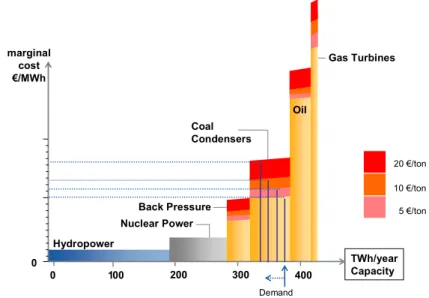
Increasingly the wholesale power market in most EU countries operates on the basis of marginal costs based on opportunity costs.17 Prices are set by the marginal production costs including the value of emissions in the allowance market (see Figure 1). One would expect no difference between CO2 and other cost factors such as fuel, investment and labour costs. Depending on whether the marginal producer will be a (high-carbon) coal power generator, the power price could increase significantly. There is a worry that in oligopolistic power markets, markets can be manipulated to ‘allow’ a coal power generator to be a marginal producer as often as possible. A number of simulations based on a carbon price of €10 per tonne of CO2 have indicated an approximate 20% increase in wholesale market prices plus increases in base load wholesale prices, which together translate into about 10-15% average end-use price increases for industrial customers.18 This does not yet include the feedback of higher gas border prices as a result of an increased demand for natural gas. McKinsey assumes that CO2 regulation increases demand growth from 2.7% to 3.8% p.a., translating into an increase in the gas border price of 15% by 2014 (Lekander, 2003; Grobbel, 2004). In addition to price effects, there is also an issue of increasing dependence on Russia and Gazprom.19
Other simulations arrive at lower figures (e.g. Carbon Trust, 2004; ILEX Energy Consulting, 2004). The exact magnitude of the price effect will directly depend on the EU carbon price, which again depends crucially on the National Allocation Plans (NAPs), the effects of the Linking Directive and the actual substitution of coal by gas and the actual pass-through of the cost increases. The IEA (2004), for example, expects power price increases for industrial customers in the magnitude of 3-5% of the wholesale price at €10/tCO2.
Long-term price effects
In the long run, power prices will increasingly be driven by the need to replace existing power plants that have reached the end of their life cycle and to attract new investment to cover growing demand for electricity. The total cost of new capacity and replacement is likely to cap the cost of carbon and determine the long-term electricity power price.20 According to the European Commission (2000) Green Paper on security of supply, about 300 GWe of existing capacity will have to be replaced over the next 20 years to replace power stations that have reached the end of their lives. In a ‘business as usual’ scenario, this means that up to 600 GWe of the installed capacity in 2020 has yet to be built. In practical terms, this would mean the construction of 23 CCGT plants per year until 2020. While in environmental terms, this will constitute a considerable opportunity to increase the efficiency of the plant park, this will inevitably affect power prices.
17 Unless there is overcapacity or strategic behaviour for example to capture market share. Nevertheless, it cannot be ruled out that there might be exceptions of pricing at full opportunity costs. Some generators could decide to price power on average costs of allowances, i.e. to add only the costs related to those allowances that are purchased. Such a strategy could make sense in that generators could run their depreciated plants for a longer period of time and still make a profit. There is also a possibility that ‘updating’ as an allocation method would place a lower cost on allowances than the market price.
18 See IEA (2003), McKinsey (2003), Mannaerts & Mulder (2003), and ICF Consulting (2003 and 2004). 19 The assumption is that wholesale prices will be transferred to the end user in liberalised markets, although with some time lag – normally within one to three years.
BUSINESS CONSEQUENCES OF THE EUEMISSIONS TRADING SCHEME |19
Consumer impact
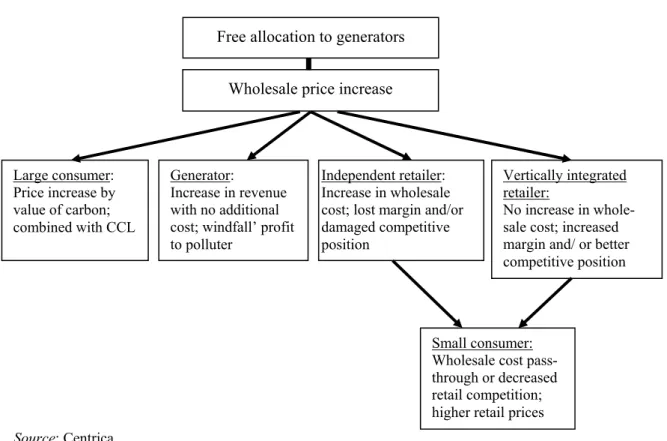
Seen from the viewpoint of energy-intensive industries, the basic issue is that the industry is affected by both direct (i.e. the need to cover its emissions by allowances) and indirect effects, resulting from power price increases. While the direct effects are ‘softened’ by free allocation, it is the indirect effects through significant power price increases that have become a concern for many, if not most of the EU’s energy-intensive industries. In addition, it is very likely that low-carbon power generators (e.g. hydro, nuclear) will have substantial economic rents or windfall profits21 as a result of higher power prices without additional costs. Depending on the competitive pressures that firms are exposed to in certain product markets and whether or not cost increases can be passed on to consumers because of prices being set in international commodities markets (e.g. parts of the energy-intensive industries, notably aluminium), price increases in the range of 15-30% could have a major impact on competitiveness for all energy-intensive companies competing in world markets, and especially for aluminium.
This in turn risks not only relocation with associated losses of employment but also carbon-leakage.22 In some cases, however, competitiveness effects are restrained by the limits on the extent to which non-EU producers can increase their production in the short-term. There is some evidence for some sectors (OECD, 2002; Gielen & Moriguchi, 2003; Quirion, 2003) that non-EU producers cannot easily replace non-EU products due to capacity constraints or efficiency gains within the EU. There are a number of additional elements that might influence the impact on competitiveness of power price increases. These include the degree of global capital mobility and perceptions on future carbon policies in countries that do not yet face a carbon constraint. An important factor is the extent to which energy users have been able to hedge their risks by long-