Measuring the Customer Experience in Online Environments:
A Structural Modeling Approach
Thomas P. Novak
[email protected]Donna L. Hoffman
[email protected]Owen Graduate School of Management,
Vanderbilt University
Yiu-Fai Yung
[email protected]SAS Institute Inc.
October 7, 1999
Paper accepted for publication in Marketing Science,
special issue on “Marketing Science and the Internet”
Measuring the Customer Experience in Online Environments:
A Structural Modeling Approach
ABSTRACT
Intuition and previous research suggest that creating a compelling online environment for Web consumers will have numerous positive consequences for commercial Web providers. Online executives note that creating a compelling online experience for cyber customers is critical to creating competitive advantage on the Internet. Yet, very little is known about the factors that make using the Web a
compelling experience for its users, and of the key consumer behavior outcomes of this compelling experience.
In a quantitative modeling framework, we develop a structural model that embodies the components of what makes for a compelling online experience. We use data collected from a large-sample Web-based consumer survey to measure these constructs, and fit a series of structural equation models that test related prior theory.
Our formulation provides marketing scientists with operational definitions of key model
constructs and establishes reliability and validity in a comprehensive measurement framework. Further, our model constructs relate in significant ways to key consumer behavior variables, including online shopping and Web use applications such as the extent to which consumers search for product information and participate in chat rooms. As such, our model may be useful both theoretically and in practice as marketers strive to decipher the secrets of commercial success in interactive online environment
1. INTRODUCTION
In the late 1990s, analyst estimates of business-to-consumer electronic commerce were repeatedly revealed after the fact to be too conservative. Forrester Research, for example, revised its initial $4.8 billion consumer e-commerce forecast for 1998 to $7.8 billion by the year’s end (Forrester Research, 1998), while the Boston Consulting Group (Boston Consulting Group,1998) boldly upped Forrester’s
estimate to $13 billion. By the year 2000, Forrester expects electronic commerce in the consumer sector to reach $33 billion (Forrester Research, 1998).
The United States Federal Government expects the digital economy created by the Internet to accelerate world economic growth well into the new millenium (Henry, Cooke, Buckley, Dumagan, Gill, Pastore, and LaPorte, 1999). By the year 2003, Internet commerce conducted globally is expected to reach $3.2 trillion, representing five percent of global transactions (Forrester Research 1998). Exuberant
statistics aside, online executives and Internet marketing academics alike agree that the need to develop a comprehensive understanding of consumer behavior in commercial online environments is urgent.
To date, there has been a lack of genuine knowledge about what contributes to effective
interactions with online customers, although intuition and previous research (Dholakia and Bagozzi 1999; Hoffman and Novak 1996a) suggest that creating a compelling online environment for Web consumers will have numerous positive consequences for commercial Web providers. Indeed, Jeff Bezos, founder and CEO of Amazon.com, one of the Internet’s leading online retailers, notes that creating a compelling online experience for cyber customers is the key to competitive advantage on the Internet (Weber 1999). Bezos (1999) further argues that delivering a compelling customer experience is even more important online than offline. This is because it contributes to strong word-of-mouth online - the most important driver of customer traffic to commercial Web sites (Cognitiative 1999) - and offers an opportunity to add differential value as the Web increasingly offers consumers full information about product alternatives (Haubl and Trifts 1999; Lynch and Ariely 1999).
Though marketers are beginning to gain an understanding of the marketing strategies that will attract visitors to Web sites (Hoffman, Novak, and Chatterjee 1995; Morr 1997; Schwartz 1996; Tchong 1998), very little is known about the factors that make using the Web a compelling customer experience, and of the key consumer behavior outcomes of this compelling experience. Consequently, our aim in this paper is to develop and test a general model of the online customer experience. We see this model development as an important early step on the path toward a comprehensive understanding of consumer behavior in new media environments such as the Internet.
Hoffman and Novak (1996) recently proposed that creating a commercially compelling Web site depends on facilitating a state of flow (Csikszentmihalyi 1977) for its consumers, and suggest that an important objective for online marketers is to provide for these “flow opportunities” (Hoffman and Novak 1996, page 66). Previous researchers (e.g. Csikszentmihalyi 1990; Ghani, Supnick and Rooney 1991; Trevino and Webster 1992; Webster, Trevino and Ryan 1993) have noted that flow is a useful construct for describing more general human-computer interactions. Hoffman and Novak extended the idea to encompass consumer navigation behavior in online environments such as the World Wide Web, and defined flow as “the state occurring during network navigation which is: (1) characterized by a seamless sequence of responses facilitated by machine interactivity, (2) intrinsically enjoyable, (3) accompanied by a loss of self-consciousness, and (4) self-reinforcing.” To experience flow while engaged in an online pursuit, consumers must perceive a balance between their skills and the challenges of the interaction, and both their skills and challenges must be above a critical threshold.
Hoffman and Novak (1996a) provided, but did not empirically test, a conceptual model of flow that detailed its antecedents and consequences. The construct is important to online marketers because it underlies what makes for a compelling online experience (Dholaki and Bagozzi 1999; Hoffman and Novak 1996a). As such, it has implications for commercial Web site design, online advertising, market segmentation, and Internet marketing strategies. Theoretically, conceptualizing and modeling consumers’ perceptions of flow on the Web can expand scholars’ knowledge of interactive consumer behavior in this emerging discipline.
In this paper, we use a quantitative modeling framework to develop a structural model that embodies the components of what makes for a compelling online experience. We use data collected from a large-sample Web-based consumer survey to measure these constructs and fit a series of structural equation models that test related prior theory from Hoffman and Novak’s conceptual model. We begin by describing the flow construct and previous models of flow that have been proposed. In the second section, we use prior marketing and consumer behavior theory to specify a range of testable hypotheses, involving the relationship of model constructs to consumer behavior and Web usage. Section three briefly describes our online data collection and sample splitting procedures. The results of our empirical analysis are contained in sections four through six. We use a two-stage structural modeling approach to test the conceptual model. We begin by purifying the measurement model prior to fitting our base model. A series of model modifications applied to our calibration sample produces a revised conceptual model, which we cross-validate using a new sample. Section seven uses the constructs derived from our
structural models to predict marketing outcomes corresponding to general and specific categories of Web usage, including online shopping and Web applications such as the extent to which consumers search for product information. We conclude in section eight with a discussion of the theoretical and managerial implications of the most comprehensive effort to date to bring quantitative modeling to bear upon the measurement of consumer experience in computer-mediated environments.
1.1. The Flow Construct
In section two, we present our formal structural model of the compelling online customer experience. Our structural model centers about the construct of flow. The flow construct was pioneered by Csikszentmihalyi, who has written extensively on this topic during the past 20 years (e.g.
Csikzentmihalyi 1977, 1990, 1997; Csikszentmihalhyi & Csikzentmihalyi 1988; Csikzentmihalyi and LeFevre 1989). While flow has been studied in a broad range of contexts, including sports, work, shopping, games, hobbies, and computer use, we focus on flow during consumer navigation of the Web.
As described by Hoffman and Novak (1996) and defined formally in our structural model that follows in section two, flow on the Web is a cognitive state experienced during online navigation that is determined by: 1) high levels of skill and control; 2) high levels of challenge and arousal; 3) focused attention; and is 4) enhanced by interactivity and telepresence (e.g. Steuer 1992). This cognitive state has been characterized as an “optimal experience” (Csikszentmihalyi 1997) that is “intrinsically enjoyable” (Privette and Bundrick 1987). Flow comprises the “complete involvement of the actor with his activity” (Mannell, Zuzanek, and Larson 1988), and is “experienced by people who are deeply involved in some event, object or activity...they are completely and totally immersed in it...Indeed, time may seem to stand still and nothing else seems to matter while engaged in the consumption event." (Lutz and Guiry 1994).
Consumers who achieve flow on the Web and perceive the online experience to be compelling are so acutely involved in the act of online navigation that thoughts and perceptions not relevant to navigation are screened out, and the consumer focuses entirely on the interaction. Concentration on the navigation experience is so intense that there is little attention left to consider anything else and consequently, other events occurring in the consumer’s surrounding physical environment lose significance. Self-consciousness disappears, the consumer’s sense of time becomes distorted, and the state of mind arising as a result of achieving flow on the Web is extremely gratifying.
It is important to note that in this paper, we are concerned with flow experienced while using the Web in general, as opposed to flow experienced on a specific Web site. Thus, the goal that may lead to flow is not specific, as in, for example, shopping online for a sweater, but rather relates more generally to the process of network navigation occurring across multiple Web sites within a particular Web session. Subsequent research will be able to use this general model to address the characteristics of customer experience on specific Web sites.
1.2. Previous Models of Flow
Our conceptual model of flow owes a debt to various models that have been proposed earlier in the literature. A good starting point is the comprehensive listing of eight components of flow provided by
Csikszentmihalyi (1997): 1) a clear goal, 2) feedback, 3) challenges match skills, 4) concentration and focus, 5) control, 6) loss of self consciousness, 7) transformation of time and 8) the activity becomes autotelic (that is, perceived as worth doing for its own sake). While structural relations among the constructs are not specified, the constructs are grouped according to whether they specify antecedent conditions of flow (1,2 and 3), its characteristics (4 and 5), or the consequences of the experience (6, 7 and 8).
Our model builds upon previous simpler structural models that have examined a limited subset of these components of flow in the context of work-related human-computer interaction (e.g., Trevino & Webster 1992; Webster, Trevino & Ryan 1993; Ghani, Supnick & Rooney 1991; Ghani & Deshpande 1994). Ghani, Supnick and Rooney (1991) fit a causal model in their study of computer-mediated interaction and found control and challenges predicted flow, which was operationalized as four items for enjoyment and four for concentration. Control and flow predicted exploratory use, which in turn predicted extent of use.
Ghani and Deshpande (1994), in a later study exploring flow occurring among individuals using computers in the workplace, included skill as well as challenge. The resulting causal model is simple, but quite interesting, in that skill leads to control which leads to flow. Skill also directly affects flow, as does perceived challenge. This model provides empirical support for definitions that specify that flow occurs when challenges and skill are both high, since skill and challenges independently contribute to flow.
Trevino and Webster (1992) fit an alternative causal model in their study of workers’ perceptions of flow during email and voice mail interactions. They used a different operational definition of flow that consisted of four items measuring control, attention focus, curiosity and intrinsic interest. Skill was measured, but not challenges. They also identified ease of use as a mediating variable between skill and flow.
Another influence on our research are the “flow channel segmentation models,” which are based upon Csikszentmihalyi's (1997) definition of flow in terms of the congruence of skills and challenges. Flow channel segmentation models provide a simpler alternative to structural modeling (e.g., Ellis, Voelkl
& Morris 1994; LeFevre 1988; Nakamura 1988; and Wells 1988). These segmentation models attempt to account for all possible combinations (channels) of high/low skills and challenges, thus defining flow solely on the basis of the constructs of skill and challenge. This narrow focus has provided an in-depth understanding of the role of these two constructs.
Early research identified three channels or segments: 1) anxiety (high challenge/low skill); 2) flow (high challenge/high skill or low challenge/low skill); and 3) boredom (low challenge/high skill).
However, greater empirical support has been found for a reformulated four-channel model where anxiety and boredom are defined as before, but flow is now defined as only high skills and high challenges and apathy is introduced as low skills and low challenges. Numerous researchers (e.g. Ellis, Voelkl & Morris 1994; LeFevre 1988; Nakamura 1988; and Wells 1988) have found clear patterns of differences among the four "flow segments."
An eight channel model (Massimini & Carli 1988; Ellis, Voelkl & Morris 1994) extends the four channel model by allowing for intermediate (moderate) levels of skill and challenge. Two intermediate segments – control and arousal - are identified, where control corresponds to high skill and moderate challenge, and arousal corresponds to high challenge and moderate skill. The eight channel model provides theoretical justification for considering control and skill to be multiple indicators, in our structural model, of one higher-order construct, and for considering arousal and challenge to be multiple indicators of a second higher-order construct.
2. RESEARCH
HYPOTHESES
2.1. Hoffman and Novak’s model of flow
A general conceptual model of flow in interactive computer-mediated environments (CME) is described in detail in Hoffman and Novak (1996a). Their proposed model served to reconcile
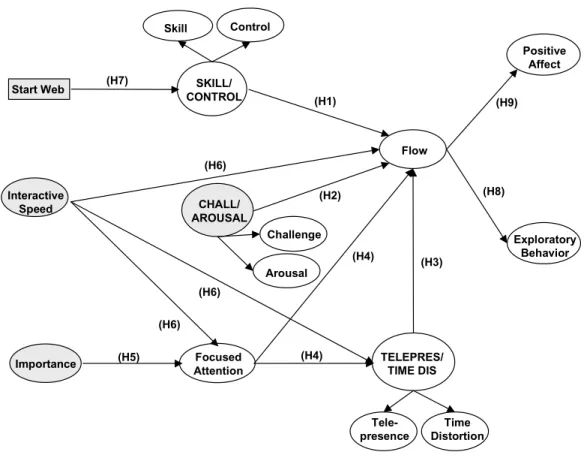
inconsistencies in previous definitions and models and laid the groundwork for formal empirical testing. In Figure 1, we summarize without loss of generality the key features of Hoffman and Novak’s
conceptual model of the customer experience in online environments.
Figure 1 - Hoffman and Novak’s (1996a) Conceptual Model
Hoffman and Novak’s conceptual model of online customer experience owes an important debt to previous models of flow conceptualized in the context of human-computer interaction, but is unique in several important ways. First, it has been specifically formulated to represent the general customer
experience in interactive online environments, with special attention to the commercial Web environment. Second, it provides more rigorous operational definitions of key model constructs than existed previously, and establishes reliability and validity in a comprehensive measurement framework. Finally, unlike prior models of flow, this new model specifies an explicit structure for direct and indirect influences on flow,
Skill Control Flow Challenge Arousal Exploratory Behavior Time Distortion Focused Attention Interactive Speed Importance SKILL/ CONTROL TELEPRES/ TIME DIS CHALL/ AROUSAL Tele-presence Start Web (H1) (H5) (H4) (H3) (H4) (H2) (H6) (H8) (H6) (H7) (H6) Positive Affect (H9)
and provides a mechanism for determining whether and how model constructs relate to external
marketing variables such as product information search and online shopping behaviors that are relevant to the commercial online environment. These advances have been achieved by carefully conceptualizing existing constructs in terms of Web use and introducing new constructs uniquely related to the consumer’s Web usage experience.
2.2. Construct
definition
The model we test in this paper has 13 constructs that are operationalized with nine-point rating scales (scale values from strongly disagree to strongly agree) or semantic differential scales. In addition, three Web usage variables specify when the respondent started using the Web (StartWeb), how much time per day the respondent spends using the Web (Timeuse), and how much time the respondent expects to use the Web in the future (Expectuse). Timeuse and Expectuse were not included in the base model, but are used later when we examine the relationship between the model constructs and consumer behavior variables.
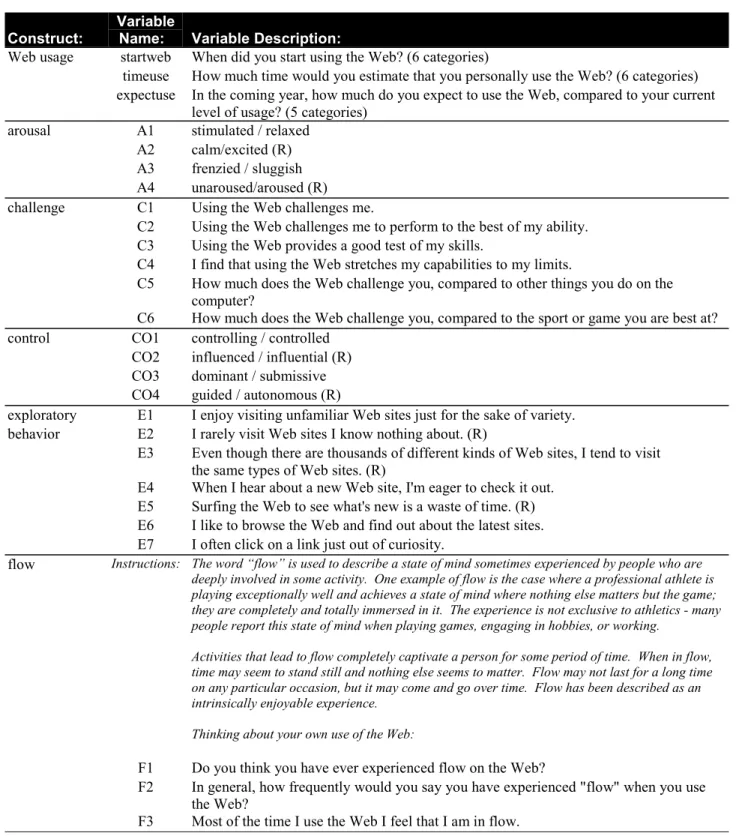
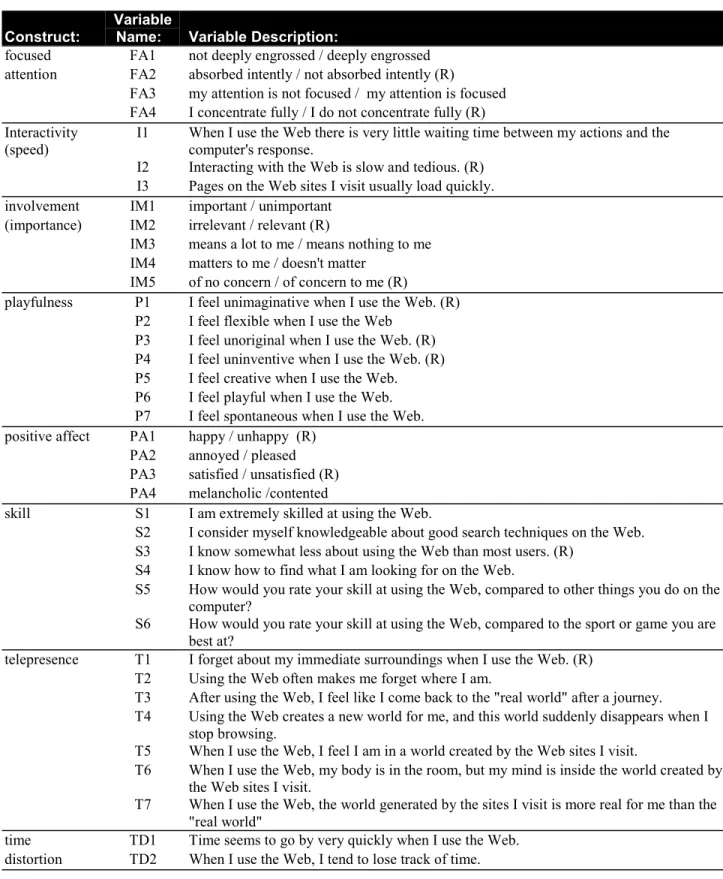
Our survey instrument was developed on the basis of extensive pilot testing and, where appropriate, incorporates existing scales. A working paper available from the authors summarizes a series of four small-scale pretests, and two large-scale pilot tests used to develop our final survey instrument. Table 1 lists the 65 items corresponding to the 13 model constructs and three background variables used in our final survey. Eight sets of items - playfulness, focused attention, importance, arousal, control, positive affect, time distortion, and exploratory behavior - were identical to the items used in one or both of the two large-scale pilots.
The seven item playfulness scale is from Webster and Martocchio (1992) (alpha = .782 and .828 in two pilot studies). The four item focused attention scale is from Ghani and Deshpande (1994) (alpha = .638 and .830 in the two pilots). We included McQuarrie and Munson’s (1991) five item importance subscale for the involvement construct (alpha = .876 and .923 in the two pilots). Three constructs in the final survey - arousal, control, and positive affect - consist of the four item scales used by Havlena and
Holbrook (1986), as derived from Mehrabian and Russell’s (1974) longer six item original versions of these three scales. Coefficient alphas for arousal, control, and positive affect in the second pilot study were, respectively, .650, .685, and .861. The two-item scale for time distortion had a coefficient alpha of .703 in the second large-scale pilot. The seven item exploratory behavior scale is modified from
Baumgartner and Steenkamp (1996)’s 20 item exploratory buying behavior tendencies scale. Items E1 through E7 were obtained by rewording items 8, 9, 1, 4, 11, 12 and 20, to make them applicable to exploratory behavior on the Web. Coefficient alpha for this scale was .788 in the second large-scale pilot.
Four-item scales for skill and challenge were developed over the series of pretests and pilots, beginning with a set of 15 items for each construct. In the large-scale pilots the four skill items had a coefficient alpha of .864 and .858, and the four challenge items had a coefficient alpha of .876 and .799. In the final survey, we included two additional items for skill and control (items S5, S6, C5, and C6 in Table 1).
The seven-item telepresence scale was modified from items developed by Kim and Biocca 1997. As these items differed from the items used in the large-scale pilots, we do not report coefficient alphas from the pilot studies. Telepresence, described as “the compelling sense of being present in a mediated virtual environment” (Kim and Biocca, 1997; Steuer, 1992) is treated as a separate construct from time distortion, the perception of time passing rapidly when engaged in an activity.
The three-item speed of interaction scale is based upon Steuer’s (1992) three-part conceptualization of interactivity. Our previous pilots attempted to measure three aspects of interaction, including 1) the
speed of the interaction; 2) the mapping of the interaction (i.e., how natural and intuitive the interaction is perceived to be by the user; and 3) the range of the interaction (i.e., the number of possibilities for action at a given time). However, in the second large-scale pilot, we were only able to achieve acceptable alphas for speed of interaction (alpha = .688, two item scale) and use only that aspect here. For this study, we added a third item to measure speed of interactivity.
Table 1 - Variables Used in the Flow Survey
Construct: VariableName: Variable Description:
Web usage startweb When did you start using the Web? (6 categories)
timeuse How much time would you estimate that you personally use the Web? (6 categories) expectuse In the coming year, how much do you expect to use the Web, compared to your current
level of usage? (5 categories) arousal A1 stimulated / relaxed
A2 calm/excited (R) A3 frenzied / sluggish A4 unaroused/aroused (R) challenge C1 Using the Web challenges me.
C2 Using the Web challenges me to perform to the best of my ability. C3 Using the Web provides a good test of my skills.
C4 I find that using the Web stretches my capabilities to my limits.
C5 How much does the Web challenge you, compared to other things you do on the computer?
C6 How much does the Web challenge you, compared to the sport or game you are best at? control CO1 controlling / controlled
CO2 influenced / influential (R) CO3 dominant / submissive CO4 guided / autonomous (R)
exploratory E1 I enjoy visiting unfamiliar Web sites just for the sake of variety. behavior E2 I rarely visit Web sites I know nothing about. (R)
E3 Even though there are thousands of different kinds of Web sites, I tend to visit the same types of Web sites. (R)
E4 When I hear about a new Web site, I'm eager to check it out. E5 Surfing the Web to see what's new is a waste of time. (R) E6 I like to browse the Web and find out about the latest sites. E7 I often click on a link just out of curiosity.
flow Instructions: The word “flow” is used to describe a state of mind sometimes experienced by people who are deeply involved in some activity. One example of flow is the case where a professional athlete is playing exceptionally well and achieves a state of mind where nothing else matters but the game; they are completely and totally immersed in it. The experience is not exclusive to athletics - many people report this state of mind when playing games, engaging in hobbies, or working.
Activities that lead to flow completely captivate a person for some period of time. When in flow, time may seem to stand still and nothing else seems to matter. Flow may not last for a long time on any particular occasion, but it may come and go over time. Flow has been described as an intrinsically enjoyable experience.
Thinking about your own use of the Web:
F1 Do you think you have ever experienced flow on the Web?
F2 In general, how frequently would you say you have experienced "flow" when you use the Web?
F3 Most of the time I use the Web I feel that I am in flow. (R) indicates the item was reverse-scaled.
Table 1 (continued) - Variables Used in the Flow Survey
Construct:
Variable
Name: Variable Description:
focused FA1 not deeply engrossed / deeply engrossed attention FA2 absorbed intently / not absorbed intently (R)
FA3 my attention is not focused / my attention is focused FA4 I concentrate fully / I do not concentrate fully (R) Interactivity
(speed) I1 When I use the Web there is very little waiting time between my actions and thecomputer's response. I2 Interacting with the Web is slow and tedious. (R)
I3 Pages on the Web sites I visit usually load quickly. involvement IM1 important / unimportant
(importance) IM2 irrelevant / relevant (R)
IM3 means a lot to me / means nothing to me IM4 matters to me / doesn't matter
IM5 of no concern / of concern to me (R)
playfulness P1 I feel unimaginative when I use the Web. (R) P2 I feel flexible when I use the Web
P3 I feel unoriginal when I use the Web. (R) P4 I feel uninventive when I use the Web. (R) P5 I feel creative when I use the Web. P6 I feel playful when I use the Web. P7 I feel spontaneous when I use the Web. positive affect PA1 happy / unhappy (R)
PA2 annoyed / pleased PA3 satisfied / unsatisfied (R) PA4 melancholic /contented
skill S1 I am extremely skilled at using the Web.
S2 I consider myself knowledgeable about good search techniques on the Web. S3 I know somewhat less about using the Web than most users. (R)
S4 I know how to find what I am looking for on the Web.
S5 How would you rate your skill at using the Web, compared to other things you do on the computer?
S6 How would you rate your skill at using the Web, compared to the sport or game you are best at?
telepresence T1 I forget about my immediate surroundings when I use the Web. (R) T2 Using the Web often makes me forget where I am.
T3 After using the Web, I feel like I come back to the "real world" after a journey. T4 Using the Web creates a new world for me, and this world suddenly disappears when I
stop browsing.
T5 When I use the Web, I feel I am in a world created by the Web sites I visit.
T6 When I use the Web, my body is in the room, but my mind is inside the world created by the Web sites I visit.
T7 When I use the Web, the world generated by the sites I visit is more real for me than the "real world"
time TD1 Time seems to go by very quickly when I use the Web. distortion TD2 When I use the Web, I tend to lose track of time. (R) indicates the item was reverse-scaled.
Finally, we directly measured flow in the present study with a three-item scale following a narrative description of flow. Chen, Wigand and Nilan (1999) have successfully used a similar approach in eliciting examples of experiences of flow among Web consumers. To minimize bias, these items appeared at the end of the survey. In August 1998, we conducted a small sample qualitative survey completed by 147 respondents, in which we provided them with the narrative description of flow shown in Table 1, and asked them if they had ever experienced flow on a specific Web site, and if so to describe that experience. Forty seven percent of the respondents said they experienced flow at specific Web sites, and provided descriptions of their interactions with these Web sites. No respondent expressed confusion about the definition of flow, and a reading of the verbatims of those respondents who did report
experiencing flow on the Web was highly consistent with reports of flow in other literature.
Below we discuss our research hypotheses. Hypotheses are not stated in a causal manner, because the direction of causality cannot be determined from our data. All hypotheses will be tested according to the paths in a structural model we fit to the data. In a structural equation model, the ‘causal’ relationships between variables are represented by directed paths. Significant paths between variables are assumed to provide support for the hypotheses.
2.3. Relationship Among Model Constructs
2.3.1. Direct influences on flow:
H1: Greater skill at using the Web and greater perceived control during the Web interaction correspond to greater flow while using the Web.
H2. Greater challenge and arousal correspond to greater flow.
H3: Greater telepresence and time distortion correspond to greater flow.
Skill refers to the Web consumer’s capacity for action during the online navigation process and control taps the consumer’s ability for action (Azjen 1988). Control comes from both the Web user’s perception of her ability to successfully navigate through the Web environment and her perception of how
the Web responds to her inputs. Challenges specify the consumer’s opportunities for action on the Web and arousal serves as a theoretical correlate of challenge.
Hypotheses 1 and 2 taken together form the heart of most definitions of flow that have appeared previously in the literature. Only when consumers perceive that the Web contains challenges congruent with their own skills can flow potentially occur (Csikszentmihalyi and Csikszentmihalyi 1988).
Otherwise, consumers may become bored or anxious (Ellis, Voelkl, and Morris 1994). The idea that flow requires high levels of skill and challenge is also consistent with optimal stimulation level theory (e.g. Holbrook and Gardner 1993; Raju 1980; Steenkamp and Baumgartner 1992).
Telepresence, or the mediated perception of the environment, is the perception that the virtual environment with which one is interacting is more real or dominant than the actual physical environment. Hoffman and Novak (1996a) introduced this antecedent of flow and we include it here. The sense of a distortion in time perception (Csikszentmihalyi 1977) in which the consumer is unaware of time passing so that time appears to pass more quickly, is a correlate.
The eight-channel flow model (Massimini & Carli 1988; Ellis, Voelkl & Morris 1994)
theoretically motivates two of the three higher-order factors in our structural model. The eight-channel model considers the pairs of constructs 1) skill and control and 2) challenge and arousal to be multiple indicators of closely related underlying latent constructs. The three higher-order factors used in the model greatly simplifies the formulation and interpretation of the structural model.
H4: Greater focused attention corresponds to greater flow, telepresence and time distortion. Focused attention refers to a “centering of attention on a limited stimulus field”
(Csikszentmihalyi 1977, p. 40). Webster, Trevino and Ryan (1993) have noted that the computer
functions as the limited stimulus field and respondents report being “mesmerized” during their computer-mediated interactions. Note that we hypothesize that focused attention has both a direct effect on flow, as well as an indirect effect through its direct influence on telepresence and time distortion.
2.3.2. Indirect influences on flow:
H5: Greater importance corresponds to greater focused attention. Webster, Trevino and Ryan (1993) found a positive association between intrinsic interest and focused attention. Enduring
involvement (Zaichkowsky 1986), operationalized here as importance, is formed by the presence of situational and/or intrinsic self-relevance and affects the attention effort (Celsi and Olson 1988). This hypothesis follows directly from Hoffman and Novak (1996a).
H6: Greater speed of interaction corresponds to greater focused attention, telepresence and time distortion, and flow. As noted above, we consider only the speed of interaction and hypothesize its links to a number of constructs. Thus, our operationalization of interactivity is somewhat limited.
H7: The longer the respondent has been using the Web, the greater the skill and control. A consumer’s skill at using the Web and her perceived control over her online actions are, in part, a function of her online experience. Thus, the absolute length of time an individual has been online (StartWeb) is expected to exert a positive influence on these two constructs, which in turn are hypothesized to positively influence her ability to achieve flow in the commercial environment.
2.3.3. Consequences of flow:
H8: Greater flow corresponds to greater exploratory behavior. H9: Greater flow corresponds to greater positive affect.
Previous research has identified numerous positive consequences of flow, including increased exploratory behavior (Webster, Trevino and Ryan 1993; Ghani and Deshpande 1994; Ghani, Supnick and Rooney 1991) and positive subjective experiences (Webster, Trevino and Ryan 1993, Csikszentmihalyi 1977). We hypothesize a positive relation for these two flow outcomes.
2.4.
Relationships of Model Constructs to Consumer Behavior and Web Usage
The hypotheses below relate to how the model constructs specifying the online customer experience relate to important consumer behavior and Web marketing variables.H10: Flow, and closely related constructs such as telepresence, time distortion, and exploratory behavior, will be greater for respondents who use the Web for “Experiential” uses, such as online chat, and entertainment, than for “Task-Oriented” uses such as work, searching for specific reference information, or online job listings. This is motivated by the theory that such experiential uses lead individuals to see the Web as a more playful environment (Ghani and Deshpande 1994; Hoffman and Novak 1996a)
H11: Consumers who more recently started using the Web are more likely to use it for experiential activities; those who have been using the Web for a long time are more likely to use it for task-oriented activities (see Hammond, McWilliam and Diaz 1997). Along the same lines, Hoffman and Novak (1996a) argued that a consumer’s early Web experiences were more likely to be characterized by an experiential, time-passing quality, but that over time, Web navigation would evolve and become more goal-directed.
H12: Flow, and closely related constructs such as telepresence, time distortion, and exploratory behavior, have a negative relationship with the length of time the respondent has used the Web.
Hammond, McWilliam and Diaz (1997) found in a small-scale longitudinal study that after four months, ratings of four scales related to fun and exploration of the Web declined for novice, intermediate and experienced users, with the greatest declines occurring for novice users. We would also expect a decline in flow, because we anticipate that a respondent’s skill at using the Web (H7) will increase more rapidly than their evaluation of the challenge of the Web (which may even decline over time).
These hypotheses have important implications for Internet marketing applications involving Web site design. For example, a critical challenge facing the Internet manager is how to design a single Web site that can provide a compelling online experience to both novices and experienced online consumers
3. ONLINE DATA COLLECTION
Our final instrument was administered as a Web fillout form that was posted from April 10 to May 15, 1998, in conjunction with the 9th WWW User Survey1 fielded by the Graphic, Visualization, and
Usability Center (GVU) at the Georgia Institute of Technology. Respondents who registered to participate in the 9th WWW User Survey were given a unique identifying code, and were presented with an online
menu of ten different surveys regarding Web usage behavior, including our flow survey, which they could potentially fill out.
As the GVU WWW User Survey employs non-probabilistic sampling and self-selection (GVU 1997), it is not representative of the general population of Web users. Comparison with population projectable surveys of Web Usage (e.g. Hoffman, Kalsbeek and Novak 1996) shows that the GVU User Survey sample contains more long-term, sophisticated Web users than the general population. Participants were solicited using both online and traditional media. These included announcements placed on
Internet-related newsgroups, banner ads placed on specific pages on high exposure sites (e.g. Yahoo, Netscape, etc.), banner ads randomly rotated through high exposure sites (e.g. Webcrawler, etc.), announcements made to the www-surveying mailing list maintained by GVU, and announcements made in the popular press.
After the five weeks of the survey period, a total of 12,570 respondents filled out at least one of the ten surveys that comprised the 9th WWW User Survey. Of these 12, 570 respondents, 2,061
respondents completed our flow survey. We eliminated 99 respondents who had missing data on any of the items in the survey. The missing data rate was so low because respondents were automatically
prompted by the Web server to complete omitted items. This amounted to showing a respondent all items she did not complete and offering the opportunity to complete these items. This data collection strategy produced an initial analysis sample of 1962 respondents with no missing data.
In addition to the flow survey items shown in Table 1, we also used items from a second survey, the “Web and Internet Usage Survey,” fielded in the 9th GVU WWW User Survey. This survey was
completed by a total of 9147 respondents. Then, we selected those 1654 respondents who completed both our flow survey and the usage survey. These 1654 respondents comprised our final analysis sample.
Following Cudeck and Browne (1983), we used a cross-validation procedure to assess model fit. To minimize capitalizing on chance when applying model modification procedures to the calibration sample, the sample of 1654 respondents was randomly split in uneven fashion, as recommended by Wickens (1989). The majority of respondents were randomly assigned into a calibration sample of 1154 respondents, and the remainder into a validation sample of 500 respondents.
4. PURIFYING THE MEASUREMENT MODEL
We adopted a two-step approach to model construction and testing (Anderson and Gerbing 1988). First, we “purified” the measurement model by eliminating measured variables and latent factors that were not well fit by an initial confirmatory factor analysis (CFA) model. Second, we fit a theoretical base model, and a series of revised models, to the measured variables retained in the first step.
Following Anderson and Gerbing (1988), the first assessment should be whether any structural model exists that has an acceptable goodness-of-fit. Thus, we began by fitting a Confirmatory Factor Analysis (CFA) model that included covariances between all pairs of latent factors. The base model for the CFA, model CFA1, included the latent factors and measured variables for arousal, challenge, control, exploratory behavior, flow, focused attention, importance, play, positive affect, skill, speed, telepresence, and time distortion, all from Table 1.
Maximum likelihood estimation was used to fit the CFA model using the calibration sample of 1154 respondents. Overall goodness of fit for this initial model was reasonable, with root mean squared error of approximation (RMSEA) equal to .051. Browne and Cudeck (1993) suggest that RMSEA values about orbelow .05 indicate a close fit of the model of model in relation to degrees of freedom, and values
below .08 indicate a reasonable fit. However, Bentler’s (1990) comparative fit index (CFI) was .854, below the minimum value of .9 suggested (Bentler 1990) as indicative of good model fit, and below the median CFI of .95 in 14 marketing studies as summarized by Baumgartner and Homberg (1995). Thus, we proceeded to improve the fit of the model via a series of model modification tests.
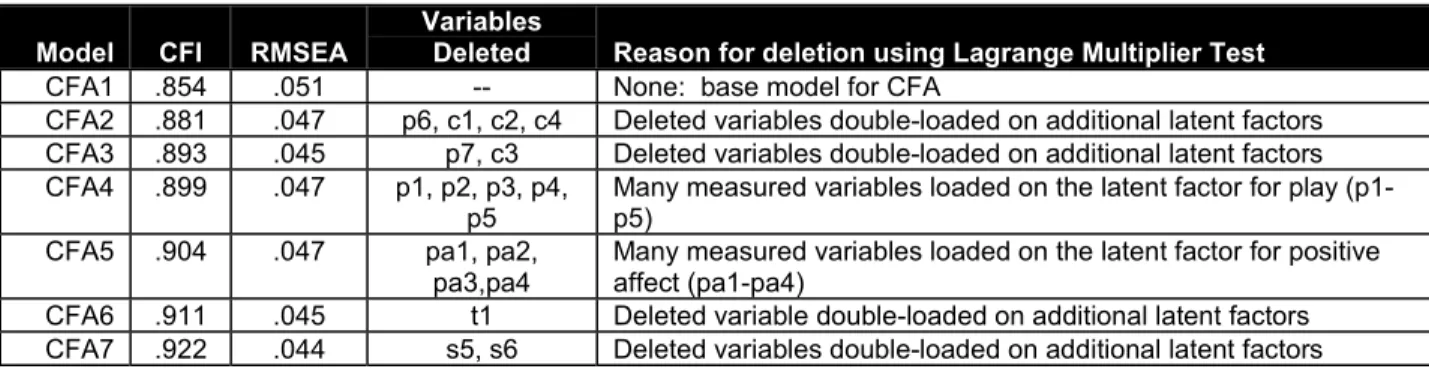
Lagrange Multiplier (LM) tests were used to identify measured variables that loaded on multiple latent factors, and latent factors on which numerous extraneous measured variables loaded. Such measured variables and latent factors were deleted from the model, as summarized in Table 2. All measurement models were fit to the calibration sample data. The final measurement model, CFA7, eliminated latent factors for play (p1-p7) and positive affect (pa1-pa4), and also eliminated measured variables t1, s1-s4, and c5-c6. Fit of this final model in the calibration sample was excellent, with CFI = .922 and RMSEA = .044 ± +/- .02.
Table 2 - Model Modification Process for Purifying the Measurement Model
Model CFI RMSEA VariablesDeleted Reason for deletion using Lagrange Multiplier Test CFA1 .854 .051 -- None: base model for CFA
CFA2 .881 .047 p6, c1, c2, c4 Deleted variables double-loaded on additional latent factors CFA3 .893 .045 p7, c3 Deleted variables double-loaded on additional latent factors CFA4 .899 .047 p1, p2, p3, p4,
p5
Many measured variables loaded on the latent factor for play (p1-p5)
CFA5 .904 .047 pa1, pa2, pa3,pa4
Many measured variables loaded on the latent factor for positive affect (pa1-pa4)
CFA6 .911 .045 t1 Deleted variable double-loaded on additional latent factors CFA7 .922 .044 s5, s6 Deleted variables double-loaded on additional latent factors
5. STRUCTURAL MODELS
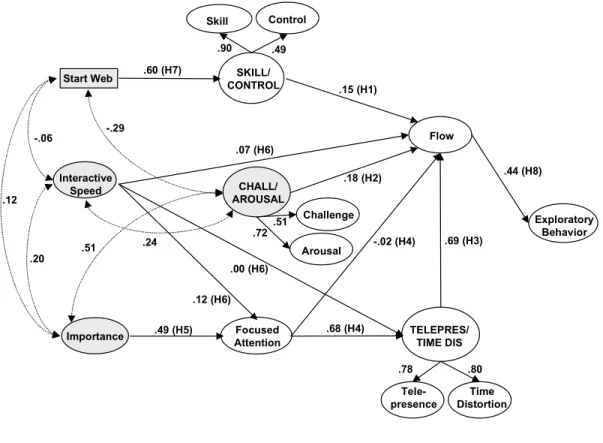
Based on the model purification process, our empirical modeling was based on only the latent factors and forty-five measured variables that were used in model CFA7. The base model shown in Figure 2 was fit first. The standardized parameter estimates are shown in Figure 2. The base model is based upon prior theory as it corresponds to Hoffman and Novak’s (1996a) conceptual model shown in Figure 1, with one modification. Because positive affect was eliminated in the process of purifying the
measurement model, it was not included in the base model.
Figure 2 – The Base Model
The base model provides an excellent initial fit2 (CFI = .892, RMSEA = .050). In many ways, one could argue that the base model provides an acceptable fit. However, we still fit a series of model modifications to identify ways in which the fit could be improved, and any problems with the base model.
2 During the model modification process, the variance estimate of the latent factor for skill produced by EQS was constrained at the lower bound of zero. Thus, we constrained the variance of skill to the variance of the higher-order
Skill Control Flow Challenge Arousal Exploratory Behavior Time Distortion Focused Attention Interactive Speed Importance SKILL/ CONTROL TELEPRES/ TIME DIS CHALL/ AROUSAL Tele-presence Start Web .15 (H1) .49 .90 -.29 .24 .49 (H5) .68 (H4) .69 (H3) -.02 (H4) .18 (H2) .07 (H6) .44 (H8) .12 .20 -.06 .80 .78 .00 (H6) .60 (H7) .72 .51 .51 .12 (H6)
The standardized path coefficients in Figure 2, with the exception of the paths from
interactivity/speed to telepresence, and focused attention are all significant at p<.05. All significant coefficients were in the hypothesized direction. Estimated correlations among the four independent variables in the Base model, StartWeb, speed, importance, and challenge/arousal, were all significant (p<.05), with the exception of the correlation between StartWeb and speed (t = -1.91).
5.2. Refining the Theoretical Model
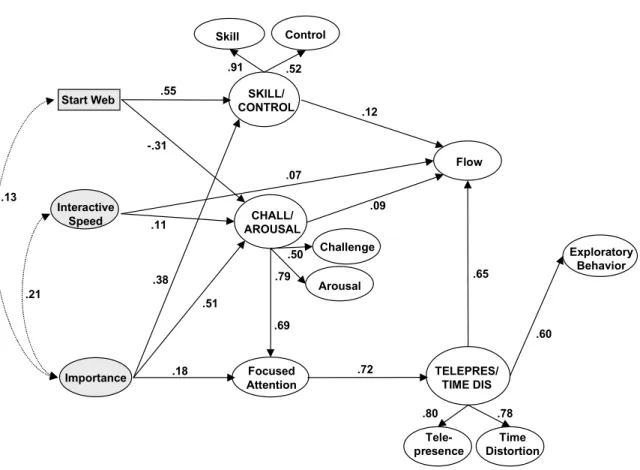
Wald tests of free parameters (Bentler and Dijkstra 1985; Bentler, 1995) suggested which paths in the theoretical base model with small t-statistics should be dropped from the model. In addition, Lagrange Multiplier (LM) tests suggested numerous parameters that could be added to the model (Bentler and Dijkstra 1985; Bentler 1995). We performed a series of revisions to our base model, using the Wald and LM tests, summarized below in Table 3. All models were fit to the calibration sample data3. As can be
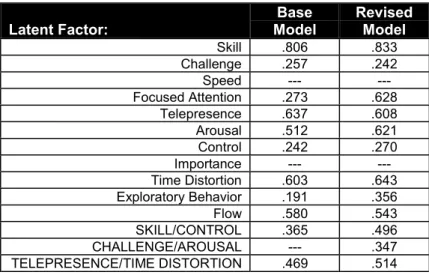
seen, successive model changes leading from the Base Model shown in Figure 2 to the Revised Model shown in Figure 3 were relatively minor, with three paths dropped, one covariance term dropped, and three paths added. The most significant change is that the Revised Model replaces the path from flow to exploratory behavior with a path from telepresence/time distortion to exploratory behavior. Overall fit of the Revised Model is good, with RMSEA=.042 (90% confidence interval of [.044, .047] ) and CFI=.911. The R2 statistics for structural equations shown in Table 4 provide further evidence for the superiority of
the Revised over Base Model.
3 As in the base model, in the revised model shown in the second row of in Table 3, the variance estimate for latent factor for skill was constrained to the variance of arousal (the latent factor with the smallest estimated variance). Constraints were not required in subsequent models.
Table 3 - Model Modification Process for Purifying the Theoretical Model
*Model CFI RMSEA Model Modifications Base Model .892 .051 (none - base model)
Step 1 .900 .048 Drop: focus Æ flow
Drop: speed Æ telepresence/time distortion Add: challenge/arousal Æ focus
Step 2 .906 .046 Drop: speed Æ focus
Add : importance Æ skill/control Step 3 .906 .046 Drop: covariance of startweb and speed
Convert challenge/arousal from an independent to dependent variable (change covariances with startweb, speed, and importance to paths) Step 4 .911 .045 Add: telepresence/time distortion Æ explore Revised Model .911 .045 Drop: flow Æ explore
Table 4 - R-Square Statistics for Structural Equations
Latent Factor: Base Model Revised Model Skill .806 .833 Challenge .257 .242 Speed --- ---Focused Attention .273 .628 Telepresence .637 .608 Arousal .512 .621 Control .242 .270 Importance --- ---Time Distortion .603 .643 Exploratory Behavior .191 .356 Flow .580 .543 SKILL/CONTROL .365 .496 CHALLENGE/AROUSAL --- .347 TELEPRESENCE/TIME DISTORTION .469 .514
Composite reliabilities estimated from the Revised Model in the calibration sample, with the exception of control (.533) and arousal (.574), were greater than .750.4 Although the reliabilities for the control and arousal constructs are below .6, previous research has found these two constructs to exhibit adequate reliability, and we include them in our structural models. However, future improvement in measuring these constructs is desirable.
Figure 3 – Revised Theoretical Model
5.3 Implications for Hypotheses
Looking at the results for the Base and Revised Models, for the most part, our hypotheses were supported. The direct paths to flow from skill (H1), challenge (H2), and telepresence (H3) are positive and significant. However, there was no support for the hypothesis that greater focused attention
corresponds directly to greater flow (H4), although focused attention was found to correspond to greater telepresence and time distortion (H4), thereby influencing flow indirectly through these variables. Interactive speed exerts a direct positive influence on flow (H6), but greater speed did not correspond to greater focused attention or telepresence and time distortion (H6). Greater importance was positively
Skill Control Flow Challenge Arousal Exploratory Behavior Time Distortion Focused Attention Interactive Speed Importance SKILL/ CONTROL TELEPRES/ TIME DIS CHALL/ AROUSAL Tele-presence Start Web .12 .52 .91 .18 .72 .65 .09 .07 .13 .21 .78 .80 .69 .55 .79 .50 .38 .11 -.31 .51 .60
associated with greater focused attention (H5), and the longer the respondent had been using the Web, the greater her skill and control in the Web environment (H7).
Although we did not hypothesize paths between challenge and StartWeb, speed, and importance, we included covariance terms for each of these pairs in the base model. In the revised model, challenge negatively relates to StartWeb, and positively relates to speed and importance. Two significant
relationships were not anticipated. Challenge was positively related to focused attention, and importance was positively related to skill. Estimated correlations among the remaining independent variables are similar to those in the initial theoretical model.
The results for H8, the relationship of flow to exploratory behavior, are more complex. The Base Model supports H8, but the Revised Model does not. However, the model shown in Step 3 of Table 3 represents an alternative revised model which is discussed in detail in a working paper available from the authors. While the Step 3 model provides an acceptable fit and supports the hypothesized relationship between flow and exploratory behavior, the working paper describes how model modification indices as well as overall measures suggest the Revised Model provides a superior fit to the data. Nonetheless, given that this intermediate model provides a reasonable fit, future research will need to determine whether exploratory behavior is best modeled as an outcome of flow (H8 supported) or as a parallel and independent outcome of telepresence (H8 not supported).
Finally, as positive affect was dropped from the model in the measurement purification process, H9 was obviously not testable.
6. CROSS-VALIDATION OF STRUCTURAL MODELS
We used two approaches to cross-validating the Base and Revised Models. For each model, a less restrictive cross-validation was performed first by fitting the revised measurement and latent variable model shown in Figure 3 to the validation sample, but with the parameters re-estimated. Second, a usual cross-validation (as described in Cudeck and Browne, 1983) was performed by applying the final
structural model with the estimated parameter values from our calibration sample to the validation sample.
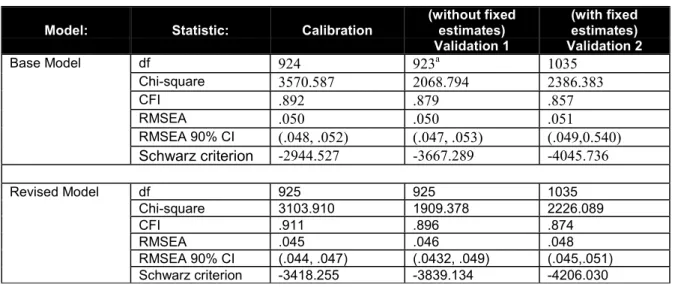
We first re-estimated the parameters of the measurement and latent variable model for the Revised Model in the validation sample (“Validation 1” column in Table 5). Validation sample RMSEA was acceptable (.046), and CFI dropped only slightly below .9 (.896). For the Base model, CFI dropped from .892 to .879, while RMSEA remained unchanged at .050.
In our second approach to cross-validation (“Validation 2” column in Table 5), we applied calibration sample parameter estimates to the validation sample. This produced an anticipated drop in overall goodness-of-fit beyond that found in the first approach. RMSEA was still reasonable in the Revised Model (.048), but CFI dropped to .874. The Base Model CFI dropped to .857 with this more stringent validation, but RMSEA remained about the same at .051.
The Schwarz criterion is lower for the Revised Model than the Base Model, in the calibration sample and in both approaches to cross-validation, further supporting the superiority of the Revised Model.
Table 5 – Cross-Validation Results
Model: Statistic: Calibration
(without fixed estimates) Validation 1 (with fixed estimates) Validation 2 df 924 923a 1035 Chi-square 3570.587 2068.794 2386.383 CFI .892 .879 .857 RMSEA .050 .050 .051 RMSEA 90% CI (.048, .052) (.047, .053) (.049,0.540) Base Model Schwarz criterion -2944.527 -3667.289 -4045.736 df 925 925 1035 Chi-square 3103.910 1909.378 2226.089 CFI .911 .896 .874 RMSEA .045 .046 .048 RMSEA 90% CI (.044, .047) (.0432, .049) (.045,.051) Revised Model Schwarz criterion -3418.255 -3839.134 -4206.030
aIn the Base Model, there are more degrees-of-freedom in the Calibration sample than in the Validation sample without fixed estimates, since a constraint was set for convergence in the Calibration sample. This constraint is sample specific and was released with estimating the model in the Validation sample.
We performed a series of follow up t-tests, testing the equivalence of calibration and validation sample parameter estimates in the Revised Model. A simple t-ratio defined by t = (
a
c -a
v) /σ
d, whered
σ
is the standard error for the difference of parameter estimates, was used to test whethera
c anda
vwere significantly different from each other.5Altogether, we performed 110 tests of the equivalence of the unstandardized parameter estimates between the calibration and validation samples and found 20.9% of all parameters were significantly different with | t | > 1.96. Although the observed rate of 20.9% rejections seem to be much higher than the corresponding nominal rate of 5%, the estimates obtained within each sample were correlated. Hence, the 110 tests were not independent and the 5% nominal rate, which assumes 110 independent tests, could only serve as a rough benchmark. It is thus more useful to treat these test results as indications of potential model refinement or modification in the future modeling. Of particular interest are the test of differences in path coefficients among latent factors in the Revised Model , and the measured variable StartWeb. Estimates of only two such path coefficients differed (in magnitude but not direction) across calibration and validation samples, suggesting that the Revised Model cross-validates well.
7. RELATIONSHIP OF MODEL CONSTRUCTS WITH CONSUMER
BEHAVIOR VARIABLES
In this section, we relate estimated scores on model constructs to a series of outcome variables dealing with consumer behavior on the Web. We have two sets of measured variables that we consider as outcomes of constructs in the flow model: (1) Web Applications consisting of 21 rating scales dealing with extent of Web use, and specific applications the Web is used for (n=1654 in the combined calibration and validation samples); and 2) Web Shopping consisting of 13 binary variables specifying features that are “most important” when shopping, or considering shopping, on the Web (n=481
respondents in the combined calibration and validation samples who completed an additional survey on Internet shopping). Additionally, we 3) examined how the model constructs change over time, by exploring the relationships among the constructs and when the respondent starting using the Web.
Estimated scores for 5 first-order latent factors (speed, importance, focused attention, flow, and exploratory behavior) and 3 higher-order factors (skill/control, challenge/arousal, and telepresence/time distortion) from the Revised Model were computed in the calibration sample. The estimated covariance matrix for the latent factors and all measured variables was obtained from the model estimates and structural equations. Least-squares regression coefficients of the latent factor scores on the observed variables were obtained using this estimated covariance matrix, and linear combinations of the variables using these regression coefficients were used as the estimated latent factor scores. The same regression coefficients were then used to obtain estimated scores in the validation sample, and the two samples were combined for further analysis.
7.1. Web Applications
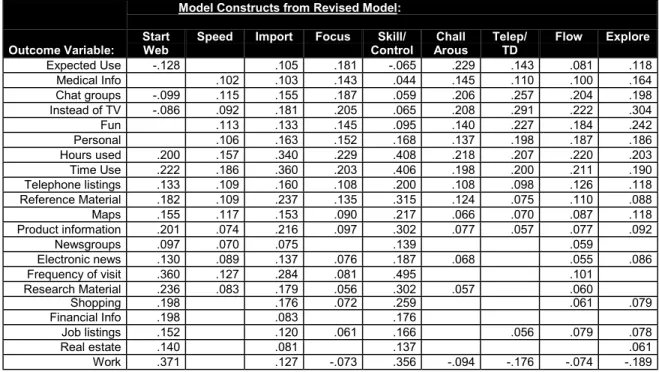
Table 6 reports significant (p<.05) correlations of StartWeb and scores on the latent factors from the Revised Model with 21 Web Applications. The significant correlations in the first column of Table 6 support H11, as consumers who have used the Web for the longer periods of time are more likely to use the Web for task-oriented activities.
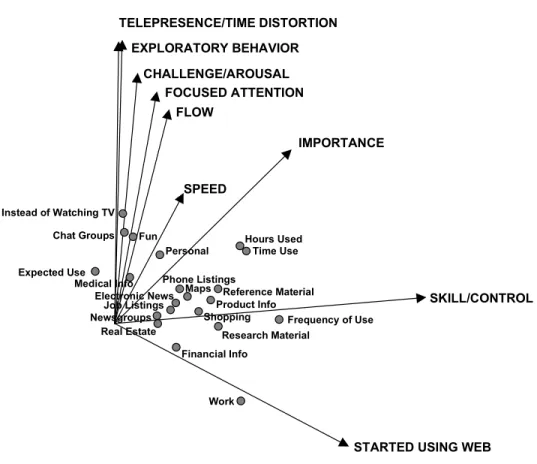
To interpret the pattern of correlations, we performed a canonical correlation of the 21 Web Application variables with StartWeb and scores on the eight model constructs shown in Table 6. Four canonical correlations were significant (p<.0001), with squared canonical correlations of .355, .278, .061, and .045. As there is a substantial drop in magnitude from the second to third squared canonical
correlation, we display only the two-dimensional plot here. However, inspection of correlations with the third canonical variable reveals that challenge/arousal is the model construct correlating most with the third canonical variable (.610), and Expected Use is the usage variable correlating most (.180); thus, the
third canonical variable serves to separate challenge/arousal from the other model constructs, and the observed correlation in Table 6 is consistent with this interpretation.
Table 6 - Significant (p<.05) Correlations Between Scores on Model Constructs and Outcome Variables for Web Applications
Model Constructs from Revised Model:
Outcome Variable: StartWeb Speed Import Focus ControlSkill/ ArousChall Telep/TD Flow Explore
Expected Use -.128 .105 .181 -.065 .229 .143 .081 .118 Medical Info .102 .103 .143 .044 .145 .110 .100 .164 Chat groups -.099 .115 .155 .187 .059 .206 .257 .204 .198 Instead of TV -.086 .092 .181 .205 .065 .208 .291 .222 .304 Fun .113 .133 .145 .095 .140 .227 .184 .242 Personal .106 .163 .152 .168 .137 .198 .187 .186 Hours used .200 .157 .340 .229 .408 .218 .207 .220 .203 Time Use .222 .186 .360 .203 .406 .198 .200 .211 .190 Telephone listings .133 .109 .160 .108 .200 .108 .098 .126 .118 Reference Material .182 .109 .237 .135 .315 .124 .075 .110 .088 Maps .155 .117 .153 .090 .217 .066 .070 .087 .118 Product information .201 .074 .216 .097 .302 .077 .057 .077 .092 Newsgroups .097 .070 .075 .139 .059 Electronic news .130 .089 .137 .076 .187 .068 .055 .086 Frequency of visit .360 .127 .284 .081 .495 .101 Research Material .236 .083 .179 .056 .302 .057 .060 Shopping .198 .176 .072 .259 .061 .079 Financial Info .198 .083 .176 Job listings .152 .120 .061 .166 .056 .079 .078 Real estate .140 .081 .137 .061 Work .371 .127 -.073 .356 -.094 -.176 -.074 -.189
Figure 4 presents a plot of the correlations of StartWeb and the eight model constructs (columns of Table 6) with their first two canonical variables, shown as vectors. Also shown are correlations of the 21 Web Application variables (rows of Table 6) with the same two canonical variables. These 21 variables are represented as points to simplify the visual display, but are, of course, also vectors from the origin. Since we have chosen the set of canonical variables for the model constructs as the basis for the plot, so as to best represent these variables, the correlations of the model constructs with the canonical variables are larger than those of the 21 Web Application variables.
Figure 4 – The Relationship Between Model Constructs and Web Applications
The vertical direction of Figure 4 shows a number of important results. First, the model constructs of telepresence/time distortion, exploratory behavior, focused attention, and flow, as well as challenge/arousal, are correlated with recreational uses of the Web, such as instead of watching TV, chat groups, fun, and personal use. Thus, H10 is supported. The horizontal direction relates the skill/control construct to more task-oriented activities, such as reference material, research, shopping, and product information. Additionally, StartWeb is positively correlated with skill/control and work use, supporting H11.
STARTED USING WEB SKILL/CONTROL IMPORTANCE EXPLORATORY BEHAVIOR TELEPRESENCE/TIME DISTORTION CHALLENGE/AROUSAL FLOW FOCUSED ATTENTION SPEED Expected Use Time Use Hours Used Work Fun Frequency of Use Personal Newsgroups Electronic News Product Info Instead of Watching TV Reference Material Research Material Financial Info Medical Info Chat Groups Phone Listings Maps Shopping Job Listings Real Estate
7.2. Online Shopping
Table 7 presents results from our set of Web shopping items, for the subsample of 481 respondents who completed an additional survey on Internet shopping. The items shown in Table 7 represent a checklist of features that respondents find important when they shop on the Internet. Table entries are the proportion of consumers checking each feature, for those with low (below the median) and high (above the median) scores on the eight model constructs from the Revised Model in Figure 3.
Table 7 – Model Constructs and Web Shopping
Model Constructs from Revised Model: Web Shopping Item:
Speed Import Focus Skill/
Control Chall/ Arous Telepres/ Time Dist. Flow Explore
low high low high low high low high low high low high low high low high
Easy to Contact .41 .53 .41 .53 .44 .50 .46 .48 .38 .56 .41 .53 .45 .48 .42 .52 Easy Ordering .68 .76 .65 .79 .65 .79 .69 .74 .66 .79 .64 .80 .66 .78 .63 .81 Easy Payment .49 .53 .45 .57 .49 .53 .50 .52 .48 .54 .48 .55 .50 .52 .46 .57 Easy Returns .42 .46 .43 .44 .42 .45 .46 .42 .38 .50 .41 .46 .43 .44 .38 .49 Easy to Cancel .41 .42 .40 .42 .41 .41 .44 .39 .37 .46 .36 .47 .38 .44 .33 .50 Quick Delivery .65 .59 .58 .65 .60 .64 .61 .63 .60 .64 .57 .67 .57 .66 .58 .65 Customer Support .49 .51 .45 .56 .45 .55 .55 .46 .44 .58 .45 .56 .45 .55 .46 .55 Cutting Edge .13 .16 .14 .15 .12 .17 .12 .17 .11 .18 .11 .19 .09 .20 .12 .17 Variety .70 .79 .70 .79 .72 .76 .71 .77 .71 .77 .70 .78 .70 .78 .69 .80 Quality Information .70 .74 .67 .77 .72 .72 .67 .76 .69 .75 .71 .73 .72 .72 .67 .77 Reliability .70 .68 .69 .69 .71 .68 .67 .71 .68 .70 .69 .69 .68 .70 .67 .71 Security .76 .75 .76 .75 .73 .78 .75 .77 .74 .78 .76 .75 .77 .74 .72 .79 Low Prices .67 .64 .67 .64 .66 .66 .62 .69 .66 .65 .64 .67 .65 .66 .63 .68
Note: Shaded pairs significant at p <.05
Consumers scoring above the median on the constructs related to a compelling online experience are, in general, more likely to rate as important shopping features that characterize what we call a
“smooth” online shopping experience. This includes easy ordering, easy to contact, easy to cancel, easy payment, easy returns, and quick delivery. Above all, customer support emerges as a key criterion of a
compelling online shopping experience. We also note that variety is important to these consumers, as is quality information. Notice, however, that reliability, security and low prices are not important factors that distinguish the compelling online experience.
Last, we investigate changes in customer experience over time. Here, we dichotomized scores on the 8 latent factors to create binary variables indicating whether the respondent was above or below the medianon each factor. Table 8 reports the proportion scoring above the median on each dichotomized factor by levels of the “Startweb” variable. The results support H12. Note that while the degree to which the online experience is compelling appears to decrease with years of experience online, even after three to four years of online experience, nearly half the respondents perceive the online environment to be compelling. For those in the highest experience group (4+ years), more than a third do. Notice the
dramatic effect for skill/control. Virtually no novice Web users (less than six months online) possess skill or a sense of control in the online environment. In contrast, after four or more years of online experience, 82 percent of Web users do.
Table 8 – Changes in Model Constructs Over Time
When started using the Web: Construct from Revised
Model: <6 months (n=84) 6-12 months (n=125) 1-2 years (n=241) 2-3 years (n=374) 3-4 years (n=605) 4+ years (n=225) Speed .55 .58 .54 .44 .53 .42 Importance .35 .42 .46 .47 .56 .55 Focused Attention .67 .54 .56 .50 .46 .46 Skill/Control .02 .10 .21 .41 .70 .82 Challenge/Arousal .80 .64 .59 .52 .44 .35 Telepresence/Time Distortion .70 .61 .59 .51 .45 .38 Flow .57 .55 .50 .52 .48 .45 Exploratory behavior .63 .60 .57 .49 .49 .36
8. DISCUSSION
Viewed from the perspective of classical marketing problems (e.g. choice and decision making, sales promotion, retail strategy, models of consumer demand, and so on), the reader may be tempted to
ask what relevance our model results have for marketing scientists concerned with examining these problems in the context of the Internet. To take this a step further, if the Internet represents just another distribution channel, retailing model or vehicle for advertising, is there much to be gained by studying the components of customer experience in that medium?
Yet, it has been argued that the Internet has unique characteristics that differentiate it from traditional marketing media in important ways (Hoffman and Novak 1996a; 1996b). The contributions of this research are perhaps best understood in the context of these differences. For example, a many-to-many, interactive communication model underlies the Web medium (Hoffman and Novak 1996a). This means that consumers can interact not only with firms and other consumers, but also with the tools themselves, that is, computers and related devices, that mediate the commercial environment. In a radical departure from traditional media, consumers can also provide content, often outside the firm’s control, to the medium. These differences imply the need to understand consumer behavior in an environment in which the rules of consumer engagement may very likely be different. Indeed, the Internet is best thought of not as a simulation of the “real world,” in which case parallels are easily drawn from existing
marketing paradigms (Novak 1999), but as an alternative real, yet computer-mediated environment, in which the online customer experience becomes paramount.
In this way, our model of customer experience in computer-mediated environments begins to address the elements managers must consider in their online marketing programs. For example, our model results suggest that the Web site design must provide for enough challenge to arouse the consumer, but not so much that she becomes frustrated navigating through the site and logs off. Unexpectedly, greater challenge corresponded to greater focused attention online. This means that engaging consumers online will arise in part from providing them with excitement. Conversely, if the site does not provide enough challenges for action, potential customers will quickly become bored and log off. Additionally, because the Web mixes experiential and goal-directed behaviors, the model constructs can be used as a first step in evaluating Web sites in terms of the extent they deliver these two types of experience.
Not surprisingly, we found that the more important consumers considered the Web to be in general, the more likely they were to focus their attention on the interaction and the more likely they were to be skilled at using the Web. The latter is consistent with Mitchell and Dacin’s (1996) observation that enduring involvement is related to expertise.
Contrary to our hypothesis, higher levels of interactive speed were not associated with greater focused attention or telepresence and time distortion. In part, this is likely due to the fact that our measure of interactivity is unidimensional and so does not fully capture interactivity. On the other hand, Dellaert and Kahn (1999) found that Web waiting time only negatively affects consumer evaluation of Web site content when slow speeds are not well managed, for example, by failing to provide information on waiting times. Thus, this recent research lends support to our result that interactive speed seems to affect challenge, but not attention.
A compelling online customer experience is positively correlated with fun, recreational and experiential uses of the Web, expected use of the Web in the future, and the amount of time consumers spend online, but negatively associated with using the Web for work-related activities. Currently, the online customer experience in the purchase context is characterized by shopping experiences that emphasize ease of use. Task-oriented activities such as work, and online search for product information and purchase relate most strongly to skill and control. These results suggest that online shopping and task-oriented activities involving product search do not yet offer the requisite levels of challenge and arousal, nor do they induce the sense of telepresence and time distortion, necessary to create a truly compelling online customer experience. These findings thus demonstrate the utility of our model for leading the development of commercial Web sites in profitable directions.
The framework we tested and refined in this paper is also useful as an important first step toward subsequent predictive modeling with critical marketing variables. For example, evidence is emerging that online environments offering full information improve the decision making process for consumers and offer greater benefits to online retailers than environments with less information (Haubl and Trifts 1999; Lynch and Ariely 1999). Though providing full information to consumers may increase the possibility of
price competition, providing a compelling online experience may significantly mitigate price sensitivity in such environments.
Toward these aims, future research should build upon the structural model of customer
experience shown in Figure 3. Dholaki and Bagozzi’s (1999) mind-set formation and influence model is an important step in that regard. Better measurement of telepresence and interactivity is also necessary. Research effort may also be fruitfully directed at the behavioral influences on online customer experience. For example, the role of situational involvement is unexplored in this research, as are distinctions between task-oriented and experiential navigation behavior, and the role of consumer demographic variables.
Investigating the relationship between online customer experience and online marketing outcome variables may also be productive. For example, the model results presented here suggest that the
"interactivity metrics" of duration time and browsing depth recently proposed to measured marketing effectiveness on advertising sponsored Web sites (Hoffman and Novak 1999; Novak and Hoffman 1997) will be highly positively correlated with a compelling online customer experience. Ultimately, knowledge of the relationship among the model constructs and marketing outcome variables can lead to more
effective interactions with online customers.
The present research may be effectively extended beyond a retrospective general evaluation of customer experience on the Web to its modeling in specific online situations. For example, apart from speed of interaction, the present research has not considered the specific elements of commercial Web site design that facilitate a compelling consumer experience, nor how this experience is likely to vary across the wide range of commercial sites found on the Web today.
The importance to the global economy of commerce conducted over the Internet is no longer in doubt (Henry, et.al. 1999). Determining how to create commercial online environments that engage consumers so that important marketing objectives such as extended visit durations, repeat visits, and online purchase objectives may be achieved are critical marketing tasks. We believe that modeling the relations among the components of the online customer experience represents an important first step on this path.