A guide to implementing
the ecosystem approach
through the Marine Strategy
Framework Directive
About PISCES
PISCES (Partnerships Involving
Stakeholders in the Celtic Sea
Ecosystem) has brought together
stakeholders from the Celtic Sea
to develop this practical guide on
implementing the ecosystem approach
in the context of the European Union
(EU) Marine Strategy Framework
Directive (MSFD). Co-funded by LIFE+,
the project ran from 2009 to 2012.
It was led by WWF-UK in partnership
with WWF-Spain and The Environment
Council, with country technical support
from the Coastal and Marine Research
Centre in Ireland and SeaWeb in France.
The Celtic Sea
The Celtic Sea, in the north-east Atlantic Ocean (see
Figure 1), has a long maritime heritage and supports
many economically significant industries and activities.
It is an extraordinarily productive sea, hosting varied
habitats and a wealth of biodiversity (including many
commercially important species). However, the growing
demand for finite marine space and resources is causing
increasing conflict between stakeholders, and threatening
the health of marine environment on which so many
depend. PISCES stakeholders have an alternative vision
for the Celtic Sea: one in which marine industries flourish,
communities prosper and the environment is healthy.
The ecosystem approach and
the Marine Strategy Framework Directive
The ecosystem approach is a way of making decisions
in order to manage our activities sustainably. The MSFD
requires EU countries to develop marine strategies based
on the ecosystem approach. Implemented in the right
way, the ecosystem approach could help to ensure we
have viable marine industries, prosperous coastal
communities and a healthy marine environment for
generations to come. PISCES stakeholders want to
ensure this happens in the Celtic Sea, and play a vital
role in the process.
How the guide was developed
This guide is the result of a unique partnership involving
stakeholders from the Celtic Sea. With a focus on sea
users, a committed multinational, cross-sectoral group
of volunteers was directly involved in determining the
objectives, scope and content. It reflects their views,
needs, aspirations and vision for the area.
We held five stakeholder workshops across the region
(in England, Wales, Ireland, France and Spain) with 46
participants (see Section 10). We collected additional
information through literature research, interviews,
questionnaires and other sources. This guide also
benefited from the contributions of an advisory group of
international experts (working in the fields of marine policy,
management, the ecosystem approach and stakeholder
engagement – see Section 10) and from comments from
a range of other individuals across Europe (representing
government, sea-users, non-governmental organisations
(NGOs), universities and others).
An innovative approach
PISCES has been the first opportunity for people who
use, work, live by or enjoy the Celtic Sea to translate
policy into practical recommendations. The approach
has helped to increase knowledge, build trust between
sectors and create a powerful voice for Celtic Sea
stakeholders.
Further information:
PISCES declaration
We, the PISCES stakeholders, declare that we have
fully participated in the development of this guide
to implementation of the ecosystem approach in
the Celtic Sea.
The guide reflects our views on what we believe
are the key priorities for action. Our focus is the EU
Marine Strategy Framework Directive, which in
our view has the potential to help deliver real
environmental improvements while bringing
prosperity to our communities.
The PISCES process has been carried out in a spirit
of knowledge sharing and mutual respect between
different sea-users with a determination to produce a
comprehensive guide. We believe our unique
partnership can play a beneficial role in the future
management of the Celtic Sea.
As committed stakeholders and developers of the
PISCES guide, we expect to participate in every
step of the implementation of the Marine Strategy
Framework Directive.
The PISCES Celtic Sea project area boundaries are based on the International Council for the Exploration of the Seas (ICES) areas and include the Celtic Seas and Western Channel.
The PISCES Celtic Sea project area broadly coincides with the southern component of the Marine Strategy Framework Directive Celtic Seas sub-region (i.e. not including water off western Scotland, western Ireland or the Irish Sea).
Note that in practice the boundaries are considered as ‘fuzzy’ because PISCES is primarily concerned with exploring broad principles and issues associated with a transnational, high-use sea area, rather than issues associated with specific boundaries.
North Sea
The Celtic Sea
Atlantic
Ocean
Bay of
Biscay
Contents
About this guide
Key messages
Implementing the ecosystem approach
The Marine Strategy Framework Directive and the
ecosystem approach
Implementing the ecosystem approach through
the Marine Strategy Framework Directive in the
Celtic Sea project area
Step-by-step implementation
Step 1 – Initial assessment, definition of Good
Environmental Status and determination of
targets and indicators
Step 2 – Development and implementation of
monitoring programmes
Step 3 – Development of programmes of measures
Step 4 – Implementation of programmes of measures
Step 5 – Evaluation and adaptation
Stakeholder participation
Stakeholder actions
Recommendations for stakeholders and government
PISCES contributors
References
06
07
08
12
16
20
22
24
27
31
33
34
40
46
47
47
1
2
3
4
5
6
7
8
9
10
11
Section
Page
This document is printed using vegetable based inks by a supplier that is ISO 9001 and ISO 14001 accred-ited. It is printed onto a Forest Stewardship Council (FSC) paper. The paper is manufactured to ISO 14001 international standards, minimising negative impacts on the environment.
Graphic Design: POLAR 10, Cardiff.
Front Cover main image: © creacart / istock Small images from left to right: Baby orca © Chris Russick / istock Lobster pots © John F Scott / istock Oil tanker © HeliRy / istock
Fisherman © Andreas G. Karelias / istock Rhossili Bay - Gower Peninsula © rocsprod / istock
PISCES is an EC LIFE+ project delivered with the contribution of the LIFE financial instrument of the European Community. Project number: LIFE07/ENV/UK/000943.
© WWF-UK
The PISCES guide was developed collaboratively
with a multi-sector, multinational group of
stakeholders from the Celtic Sea project area to
explore what is needed to implement the ecosystem
approach in the context of the MSFD. It uses the
example of the Celtic Sea to explain in practical and
non-technical terms what it means, why it is relevant
and what we can all do to help.
Note: For the purpose of this guide, the term
‘stakeholder’ refers primarily to sea-users, including
marine industry operators, infrastructure developers
and recreational user groups.
Who is the guide for?
This guide is aimed primarily at stakeholders operating in and around the Celtic Sea, and government decision-makers responsible for implementing the MSFD in it.
The guide is also relevant to:
• Implementation of other marine policies, including marine spatial planning, the EU Common Fisheries Policy and EU Habitats Directive, which are essential to meeting MSFD targets and themselves require and/or would benefit from the use of the ecosystem approach and effective stakeholder participation. • Other stakeholders, including those undertaking coastal and terrestrial activities and industries, environmental NGOs and scientists/academics.
• Other locations. The issues and challenges surrounding the ecosystem approach, implementation of the MSFD and the vital role of stakeholders in the Celtic Sea are likely to be relevant to other areas.
• All types of stakeholder participation. The PISCES process and recommendations are relevant to any process or initiative involving stakeholders in decision-making.
Why should you read this guide?
• We must all act in order for the ecosystem approach to become a reality – this guide will help to show you how. It aims to de-mystify terminology and makes practical recommendations for
stakeholders and governments. Many recommendations will also interest researchers, the public and others.
• Uniquely, it presents the voice of a cross-sectoral group of Celtic Sea stakeholders. It sets out their views, needs and aspirations for the development and implementation of marine policy. • It explores what is needed to implement the ecosystem approach
in the context of the MSFD, following statutory commitments and good practice. Recommendations are relevant to other marine policy areas and contexts.
About this guide
“You need to read this guide – whether you use,
work, live by or enjoy the sea – or are in any way
responsible for managing our activities in it.”
(Statutory agency)“Although focused on the Celtic Sea, this guide
is eminently transferable across other sea areas
around Europe, especially because it has been
driven by stakeholders”
(Fisheries sector)
“We are looking forward to the results of the
PISCES project, particularly the stakeholder
engagement methods, in order to explore the
possibilities to replicate them in Spain”
(Spanish government representative)• The ecosystem approach should be used to help manage our marine activities in a more sustainable way.
We are part of the ecosystem: we affect it and depend on the goods and services it provides. The ecosystem approach aims to ensure that these services are maintained so that our industries, jobs and economies, as well as the natural world, continue to thrive. It matters to us all.
• The MSFD should be implemented using the ecosystem approach This is a legal requirement of the MSFD, which acts as a strong driver for implementation of the ecosystem approach especially: integrated management of human activities at a regional scale, maintenance of ecosystem goods and services and stakeholder participation. European countries must identify how these aspects of the ecosystem approach are achieved.
• A range of new governance mechanisms are required to fully implement the ecosystem approach in the marine environment, particularly marine spatial planning, which is urgently required across our seas as a process for achieving integrated management of all marine activities. In the meantime, many reinforcing actions can be taken to help align implementation of the MSFD as closely as possible with the ecosystem approach, particularly improving stakeholder participation.
• Collaborative, effective stakeholder participation is essential and should begin as early as possible during MSFD implementation. Formal consultation at the end of each step is not enough. Involving stakeholders early on can save governments money and is more likely to result in measures that are effective, equitable, affordable and supported. This will benefit everybody.
• Stakeholders can play an important role in MSFD
implementation, for example, by providing and collecting data; identifying and evaluating measures; supporting monitoring and compliance; and evaluating marine strategies. Achieving this sort of input will require greater collaboration and communication between stakeholders and between stakeholders and government, at national and transboundary levels.
• Governments should engage proactively with stakeholders early in the MSFD implementation process. Developing clear and transparent stakeholder engagement strategies should be a priority in the future, recognising the longer-term benefits of a fully inclusive approach that balances stakeholder participation requirements across a range of closely related policy areas.
• Stakeholders need to be assertive and organised to maximise participation opportunities. Stakeholders should seek opportunities to guide and influence decision-making themselves. They should engage proactively with other sectors, make contact with government, and advocate and participate in multi-sector forums and discussions where possible.
• Multi-sector, regional stakeholder forums should be established as a mechanism for engagement in policy implementation and sharing knowledge and experience across sectors and borders. Forums can enable stakeholders to explore interactions and conflicts, understand different perspectives and gain knowledge and information about other sectors’ activities. Such forums need to be impartially-led, representative, adequately funded and formally recognised through statutory measures.
• Stakeholders should continue to seek new ways to implement voluntary measures to improve the sustainability of their own activities, and encourage others to do so. Implementing voluntary measures may help to reduce the regulatory burden and help meet policy targets. It also increasingly makes commercial sense as sustainability becomes more important to shareholders and consumers. Collaborating and partnering with others can help to identify win-win outcomes.
Key messages
“When we work with other stakeholders we
find a lot of common ground and have many of
the same issues. By working together, we have
a more powerful voice to influence
decision-makers at national and EU level to take notice
of us.”
Implementing the ecosystem approach
© T
oby Roxbur
Why should the ecosystem
approach matter to you?
Many people, from policy-makers to businesses to
the general public, are unclear what the ecosystem
approach is or why it is relevant to them (see Box 1).
While the term ‘ecosystem’ may suggest it concerns
ecology and conservation, it is in fact as much about
ensuring the future economic prosperity and viability
of human communities. In short it matters to all of us,
and to our future generations.
Box 1: Examples of stakeholder perceptions
regarding the ecosystem approach:
“Given all of the other legislation that we are
already complying with, it’s just not clear what the
ecosystem approach means in my sector – we need
simple, clear, practical guidelines.”
(Ports sector)
“It means all things to all people, and there
is therefore the potential threat of individual
interpretations of the ecosystem approach being
used as a stick to beat us with.”
(Fisheries sector)
“Ecosystem approach is just another way of
packaging ‘sustainability’ which we’re doing already
through numerous existing tools and processes.”
(Marine management professional)
“We are already following the ecosystem approach,
for example, by considering ecosystem services and
values in marine plan development.”
(National government marine planner)
“The ecosystem approach has become all the more
relevant given proposals for reform of the Common
Fisheries Policy.”
(Fisheries sector)
Box 2: Definitions of the ecosystem approach:
The Convention on Biological Diversity
(CBD) defines the ecosystem approach as
“a strategy for the integrated management of
land, water and living resources that promotes
conservation and sustainable use in an
equitable way”
1.
In the marine environment, ICES defines it as
“the comprehensive integrated management
of human activities based on best available
scientific knowledge about the ecosystem and
its dynamics, in order to identify and take action on
influences which are critical to the health
of the marine ecosystems, thereby achieving
sustainable use of ecosystem goods and
services and maintenance of ecosystem integrity”
2.
What is the ecosystem approach?
The ecosystem approach is a way of making decisions in order to manage our activities sustainably. It recognises that humans are part of the ecosystem and that our activities both affect the ecosystem and depend on it (see Box 2).
The ecosystem approach requires:
• An integrated approach that considers all ecosystem components (e.g. human activities, habitats and species, and physical processes).
• Consideration of ecosystem functions and resulting ecosystem services (see Box 3).
• Strong participation of stakeholders
Previous work on the ecosystem approach has tended to focus on the first two elements; this guide focuses on stakeholder participation.
Implementing the ecosystem approach
Traditional management approaches have tended to be sectoral; considering individual ecosystem components in isolation. This has often led to poor decisions, conflict over space and resources, environmental degradation and economic losses. In contrast, the ecosystem approach considers our activities as part of a single system where all sectors are integrated, allowing the wider consequences of decisions to be determined and managed.
Despite its importance, there is little practical guidance to help people translate the principles of the ecosystem approach into practical actions. This guides aims to help address this.
Implementing the ecosystem approach
In the past, important ecosystem services have been undervalued: they may be hard to measure, or fall outside conventional economic markets. However, there is growing recognition that we need to factor the multiple services natural systems provide into our decision-making – to get the most economic and social benefit and avoid the costly consequences of damaging them.
The ecosystem approach calls for strong stakeholder participation – involving all those who have an interest in, or could be affected by, decision-making. This is crucial, not least because the ecosystem approach is about managing human activities. People are much more likely to act upon a decision and change their behaviour if they understand and accept the basis on which it was made. This is far more likely with full and active participation.
Box 3: Concept and definition of
ecosystem services
Ecosystem services are the means by which ecosystems provide benefits to people. In 2005, the Millennium Ecosystem Assessment3 undertook the largest ever scientific appraisal of the condition and trends in the world’s ecosystems and the services they provide. In the UK, a National Ecosystem Assessment4 was completed in 2011
providing a comprehensive appraisal of the ecosystem services in UK waters.
In marine environments (such as the Celtic Sea), ecosystem
services can be separated into four main types: ‘provisioning services’ (e.g. harvesting of fish, shellfish and algae); ‘regulating services’ (e.g. regulation of climate, wastes and water quality); ‘cultural services’ (e.g. recreational, cultural and spiritual benefits); and ‘supporting services’ (e.g. nutrient cycling, marine habitats that support fisheries).
Ecosystem services are the foundation for our economic
prosperity and well-being – yet human activities are degrading ecosystems at such a rate that their ability to continue to provide these services is in jeopardy. Globally, the degradation of our planet’s ecosystems could be costing us €50 billion each year5.
How can the ecosystem approach
be implemented?
The ecosystem approach can apply in all decision-making
processes that affect the natural world – from those concerned with how we manage our seas, through to the day-to-day decisions of businesses, sea-users and consumers.
Box 4: PISCES stakeholder interpretation of
ecosystem approach principles
The 11 PISCES principles are shown below. Symbols corresponding to principle numbers 1 to 11 are used to highlight linkages between the contents of this guide and each of the principles.
The final agreed PISCES principles are:
Stakeholder role: stakeholders should adopt an active
and committed role to achieve the common goal of the ecosystem approach; stakeholders should be involved in all aspects of management leading to a shared understanding of objectives.
Balance: there should be a suitable balance between
conservation and the sustainable use of resources in the interests of the health of the whole ecosystem.
Evidence: an evidence-based system should be used to
integrate social, environmental and economic interests.
Adaptive: management should use an iterative and
flexible approach.
Timescales: management should be set for the
long-term with short- and medium-term objectives and milestones and should enable involvement of future stakeholders.
Economic sensitivity: involvement in implementing
the ecosystem approach should not create an economic disadvantage but should promote responsible and sustainable behaviour.
Subsidiarity: management should be undertaken by the
smallest, lowest, or least-centralised competent authority.
Connecting international through to local:
local and sectoral strategies, plans and policies should be harmonised and priorities established to reflect national and international goals and objectives for conservation and sustainable use.
Review and monitoring: an effective and targeted
performance monitoring and review regime should be used to inform management.
Adjacent impacts: consideration should be given to
how events or actions in the Celtic Sea can influence or be influenced by events or actions on the land, in the air or in different parts of the ocean.
Involve and inform: management should involve and
1 2 3 4 5 6 7 8 9 10 11
Implementing the ecosystem approach
Examples at a smaller scale include:
• Project, scheme, activity and site-level planning: at this scale, the ecosystem approach provides a framework for considering and managing ecosystem impacts and functions, including links between environmental and socio-economic aspects. This could apply to environmental impact assessment, master planning and protected area management.
• Single sector policies, such as fishery management, to help evaluate the activity alongside other potential uses of marine
space/resources in the context of an overarching, integrated framework.
• Design of economic instruments for correcting market distortions that negatively effect biodiversity. For example, it can help set prices, incentives and penalties that incorporate the
costs to ecosystem services (e.g. habitat loss and pollution).
The ecosystem approach can be seen in action in
a wide variety of contexts and a range of scales.
Examples at a large scale include:
• Ecosystem-based management. A fully integrated management framework based on ecological boundaries (see case study 1). • Marine spatial planning uses the ecosystem approach to make
integrated, forward-looking and consistent decisions on human uses of the sea. Many countries are developing marine spatial plans to combat crowded and conflicting sea use.
• River basin management plans, developed under the EU Water Framework Directive, use a ‘catchment approach’ to tackle multiple interconnected water bodies (rivers, lakes, groundwater and coastal waters).
Case study 1:
Port Orford ecosystem-based
management plan, Oregon, USA
In the late 1990s, local fishermen in Port Orford,
Oregon felt disenfranchised from the federal fishery
management system (analogous to EU directives)
and formed a non-profit organisation, Port Orford
Ocean Resource Team (POORT), to produce an
ecosystem-based management plan.
They identified a Community Stewardship Area
That incorporated the traditional fishing grounds
of the Port Orford fishing fleet, and consulted with
local scientists to develop a science and access
plan based on ecosystem-based management
principles and goals. This plan considered
the entire local ocean environment and the
surrounding watersheds that drain into the
near-shore ecosystem.
POORT’s structure includes a fishermen’s board,
a community advisory board and government.
POORT has gained widespread recognition and
support from policymakers, management agencies
and NGOs as a model for how community-based
ocean management can and should work.
Further information: www.oceanresourceteam.org
Who should be involved in implementing
the ecosystem approach?
“We all have a role to play in implementing the
ecosystem approach.”
(Regional government)
Governments have a duty to implement fully integrated
management (in accordance with ecosystem approach principles), in order to guide decision-making on use of sea-space/resources. They must also identify and implement appropriate measures to meet targets (e.g. regulations, strategies, plans, economic instruments, public infrastructure and education) and provide funding and support. Governments must also engage with stakeholders in policy implementation.
Stakeholders can take steps to ensure their activities comply with government policy and targets. They are often ideally placed to understand the issues and potential solutions, and can implement measures on a voluntary basis, and encourage others to do so. The banking and insurance industries can also exert an influence on others, for example, by issuing specific sustainability conditions for loans and insurance policies. Civil society can play an important role too, for example through lobbying, advocacy, research and innovation.
The general public can make a difference, for example, by making more sustainable day-to-day decisions regarding their consumption, resource use and leisure activities. They may also be able to positively influence others (including industry and government) through advocacy, petitioning, reporting of non-compliance and legal action.
The Marine Strategy Framework Directive and
the ecosystem approach
© T
oby Roxbur
The Marine Strategy Framework Directive and
the ecosystem approach
The Marine Strategy Framework Directive (MSFD)
8is the environmental pillar of the EU’s Integrated
Maritime Policy. Its overall aim is to promote
sustainable use of the seas and conserve marine
ecosystems. The main objective of the MSFD is to
put in place measures to reach or maintain Good
Environmental Status (GES) in Europe’s seas by 2020,
using the ecosystem approach.
The MSFD lists 11 descriptors to guide evaluation of
GES (Box 5). GES is not necessarily a pristine state;
it allows for the sustainable use of marine resources.
Box 5: Marine Strategy Framework Directive
descriptors
• Descriptor 1:Biological diversity
species and habitats maintained • Descriptor 2:Non-indigenous species
levels are minimised
• Descriptor 3:Population of commercial fish/shellfish
within safe biological limits - healthy stocks • Descriptor 4:Elements of marine food webs
all elements at normal abundance and diversity • Descriptor 5:Eutrophication
excessive nutrient input from human activities is minimised
• Descriptor 6:Sea floor integrity
species, habitats and structures and functions are not adversely affected
• Descriptor 7:Alteration of hydrographical conditions
changes in physical conditions of waters does not affect marine ecosystems
• Descriptor 8: Contaminants
levels do not give rise to pollution effects
• Descriptor 9:Contaminants in fish and seafood for human consumption
levels do not exceed standards • Descriptor 10:Marine litter
quantities do not cause harm to the environment • Descriptor 11:Introduction of energy, including
underwater noise
levels do not affect the environment
Further detail on descriptors should be included in reports produced by EU countries on the determination of Good Environmental Status (see Step 1)
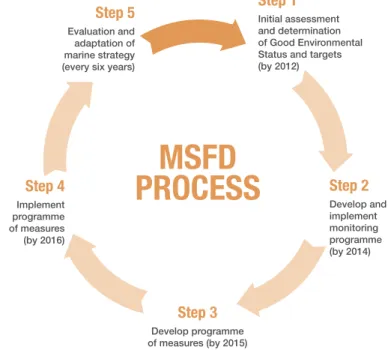
The MSFD requires EU countries to develop marine
strategies following a specific timeline (Figure 2).
The process follows a logical sequence of target-setting,
identification of measures, monitoring and ongoing
evaluation and adaptation.
Step 5
Evaluation and adaptation of marine strategy (every six years)
Step 3
Develop programme of measures (by 2015)Step 2
Develop and implement monitoring programme (by 2014)Step 1
Initial assessment and determination of Good Environmental Status and targets (by 2012)Step 4
Implement programme of measures (by 2016)MSFD
PROCESS
Figure 2: Process and timeline for implementation of the Marine Strategy Framework Directive
The Marine Strategy Framework Directive and
the ecosystem approach
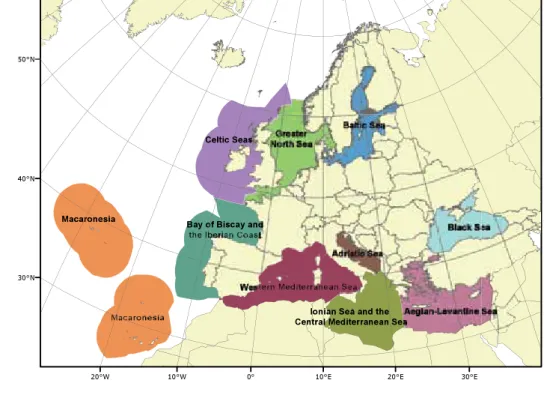
In order to achieve GES in
a coherent and strategic
manner, the MSFD establishes
four marine regions, which
are themselves divided into
sub-regions (see Figure 3).
Each EU country is required
to produce a marine strategy
for the waters under its
jurisdiction, in cooperation
with other countries that
share the same sub-region.
The Regional Seas
Conventions will support
this coordination.
Note: This map was a draft at the time of publication and may be revised. For the north-east Atlantic region, outer boundaries are indicated for the sub-regions listed in the MSFD, without addressing the remaining parts of the overall marine region (e.g. waters in the Iceland Sea, Norwegian Sea and Barents Sea). Existing policies, agreements and
legislation address many of the human activities in the marine environment that will influence the achievement of GES (see Box 6). The MSFD requires these to integrate environmental concerns. Other policies also include requirements for implementing the ecosystem approach.
Implementing the ecosystem approach
through the MSFD
The MSFD’s focus is on meeting environmental objectives: it is not a mechanism for integrated management of human activities. Additional governance tools, such as marine spatial planning, are needed to make the ecosystem approach a reality in coastal and marine environments. The economic, social and environmental benefits of marine spatial planning are well documented9.
However, marine plans are not yet in place across Europe: creating the enabling conditions for integrated marine spatial planning is a top priority.
Implementation of the MSFD will require a coordinated, coherent approach within each sub-region. This will be challenging since each country is developing its own strategy. Marine spatial planning is likely to help, as it provides a means for neighbouring countries to understand and work with adjacent demands on marine space and resources.
Stakeholder participation in
implementing the MSFD
“The ecosystem approach is nothing without
stakeholders.”
(Renewables sector)
Early and effective stakeholder participation is a legal requirement of the MSFD, and a key principle of the ecosystem approach. In the context of the MSFD, consultation must be undertaken at the end of each step during the development of marine strategies, and is one of several ways in which stakeholders can participate in decision-making (see Box 7).
Figure 3: Map showing the MSFD sub-regions.
1 10 1 2 3 6 8 10 8 7 11
The Marine Strategy Framework Directive and
the ecosystem approach
Box 6: Other relevant environmental policies,
agreements and legislative measures
• Marine spatial planning is being advocated by the EC, and implemented to varying degrees by individual
countries across Europe. It has no statutory basis at the European level, though the EC is considering this. • European fisheries are managed through the EU’s
Common Fisheries Policy (CFP), which is administered centrally by the EC. The CFP is undergoing a reform that is likely to result in requirements for fishery-based multi-annual plans with an emphasis on the ecosystem approach.
• Shipping-related issues are addressed through a number of international conventions administered by the International Maritime Organisation. MARPOL 73/78 (the International Convention for the Prevention of Pollution from Ships) is the main convention covering pollution of the marine environment by ships.
• The Water Framework Directive (WFD) overlaps with the MSFD in coastal waters. The MSFD states that coastal waters should be considered under the MSFD unless already addressed by the WFD or other EC legislation (likely to be the case for impacts of noise and litter, commercial fisheries and certain aspects of biodiversity). • The EU Habitats and Birds Directives require EU countries
to introduce measures (including protected areas) to maintain or restore vulnerable habitats and species. These Directives were developed before the ecosystem approach became a driver in European legislation, and make no allowance for human activities within sites.
• Other important policies include the EU Bathing Waters Directive, EU Shellfish Waters Directive, EU Urban Waste Water Treatment Directive and EU Nitrates Directive.
Box 7: Types of stakeholder participation
10• Consultation: to provide feedback to government
decision-makers on analysis, alternatives and/or decisions. • Involvement: to work directly with government throughout
the process to ensure that stakeholder concerns and aspirations are understood and considered in decision-making processes.
• Collaboration: to partner with government in each aspect of the decision including the development of alternatives and the identification of the preferred solution.
• Empowerment: to have decision-making placed in the hands of stakeholders.
“Stakeholders have a right to participate.”
(Statutory agency)However, the Directive clearly requires more than just consultation at the end of the process. In reality, ‘involvement’ and ‘collaboration’ are likely to be important elements in the future, particularly as the value of stakeholder knowledge is increasingly being recognised. There is also growing interest in the role of ‘empowerment’ under which responsibility for identifying and implementing measures is delegated to stakeholders (e.g. through voluntary agreements and co-management arrangements).
Effective participation requires input from a representative range of stakeholders, and over-representation of any particular sector is not in line with the MSFD. ‘Equality of arms’ also needs to be consid-ered: this is a cornerstone of EU law which means that, for example, either all stakeholders or none should be accompanied by legal counsel where required.
A range of factors influence the potential for this to happen in reality, including resource constraints, attitudes and competing demands for participation, among others. The design and strict timeframes of the MSFD also impose constraints. For example, decisions resulting from cost-benefit analysis of the programmes of measures will need to be made towards the end of the process, leaving relatively few opportunities for stakeholder input.
Stakeholder participation will also be required in the development of plans under other authorities (e.g. marine plans, marine protected area and fishery management plans). Participation across all these closely related policy areas will need to be organised in a strategic and coherent way. Stakeholder ‘fatigue’ is a real and growing risk.
Implementing the ecosystem approach through the
MSFD in the Celtic Sea project area
Implementing the ecosystem approach through the
MSFD in the Celtic Sea project area
The Celtic Sea project area
The Celtic Sea project area includes waters off the coasts of south-west England, south-west Wales, southern Ireland, and Brittany in north-west France (see Figure 4). The boundaries are based on the International Council for the Exploration of the Seas (ICES) areas and broadly coincide with the southern portion of the MSFD Celtic Seas sub-region (it does not include waters off western Scotland, western Ireland and the Irish Sea). The Celtic Seas sub-region does not include Brittany, though at the time of publication the boundaries were still being finalised.
Figure 4: Map showing the geographic scope of the PISCES Celtic Sea project area, in relation to OSPAR regions and national waters (Exclusive Economic Zones).
Implementing the ecosystem approach through the
MSFD in the Celtic Sea project area
Implementation of the MSFD
Implementation of the MSFD in the project area will be part of the wider Celtic Seas sub-region and will be shared by the UK, France and Ireland, each of which will need to produce marine strategies for the waters under their jurisdiction in coordination with each other. For the purposes of PISCES, the relevant government agencies (competent authorities) for the project area are:
• Department for the Environment, Food & Rural Affairs (Defra) and the Welsh Government (UK)
• Department of the Environment, Community and Local Government (Ireland)
• Ministry of Ecology, Sustainable Development and Energy (France) A number of other countries have commercial interests in the project area, including international fishing fleets (Spain, Denmark, Germany, Netherlands and others). These and other important stakeholders will need to be involved in the development of marine strategies by the UK, Ireland and France.
The OSPAR Convention (OSPAR), the regional sea convention guiding international cooperation on the protection of the marine environment of the north-east Atlantic, is the legal instrument through which the MSFD will be coordinated in the project area. Work under OSPAR is managed by the OSPAR Commission, made up of representatives of the governments of 15 contracting parties and the EC.
Key issues in the Celtic Sea
project area
The project area is under increasing demand for finite marine resources and space (see Figure 5), and there is a growing necessity to balance the needs of different sectors and conservation. Emerging activities, such as offshore wind farm development, alongside increased demands for marine sand and gravel, and growing marine transport, tourism and leisure activity, mariculture (cultivation of marine organisms) and fishing are the main forces driving these demands. There is also potential for oil and gas extraction to expand significantly.
The growing demand for marine resources and space is placing increasing pressure on the ecosystem. The impact of this is not yet fully understood. In 2010, OSPAR produced a comprehensive overview of the environmental status across the north-east Atlantic, including the project area11. It recommended three priorities in the
region: coordinated marine spatial planning, reduction of marine litter, and sustainable fishing.
“The main concern is that the way planning
varies across jurisdictions and between actors
may result in variant approaches across
borders. At an EU scale this is a challenge.”
(Aggregates sector)Note: This map is for illustrative purposes only and does not represent a comprehensive depiction of all marine activities in the Celtic Sea. It was produced as part of the PISCES project as a means to collate information on geographical features of relevance (e.g. administrative borders and marine activities) to help inform discussion on implications for the ecosystem approach.
8
1 2 3 8 6 6 5 11 10 8“Cultural and linguistic barriers are a
fundamental barrier to implementing the
ecosystem approach.”
(Ports sector)
Challenges for implementation of the
ecosystem approach
There are a number of challenges for the
implementation of the ecosystem approach through
the MSFD in the project area, many of which are
applicable elsewhere:
• The project area includes multiple jurisdictions with a complex range of political, administrative and management boundaries (see Figure 4).
• Marine governance arrangements are ambiguous, with considerable legal uncertainties and uncertainty regarding
institutional responsibilities leading to policies and regulations having unclear boundaries12.
• Fisheries are currently managed separately on a sectoral-basis under the CFP (and are often excluded from national marine spatial planning regimes), creating challenges for policy coordination with national marine strategy measures.
• Regionally coordinated marine spatial planning is not in place, although it is becoming established through various national and EC-led initiatives. The UK is developing a series of fully integrated marine plans13. In France, marine spatial planning is moving
forward on a more sectoral basis, including the delineation of marine energy zones and spatial protection measures for biodiversity (marine parks).
• Stakeholders are widely distributed, covering multiple countries, languages and cultures. Despite clear cultural links, the Celtic Sea does not have as strong an identity as other areas such as the Baltic or North seas.
• The only transnational stakeholder forum for the whole Celtic Sea project area is the PISCES group, which is not statutory and has no formal management role.
• The commercial fishing sector is disparate with many individual operators, making organised participation challenging. • Some sectors can be more challenging to communicate with
than others. For example, anglers often act independently, while tourism and marine leisure can have multiple associations (e.g. marine federations, yachting associations and marina operators). These sectors are subject to minimal central regulation, making it harder to fully understand levels of involvement and interaction. • The delivery of the MSFD depends on appropriate funding for
the necessary scientific research, observation and monitoring to deliver each element.
Implementing the ecosystem approach through the
MSFD in the Celtic Sea project area
7 2 8 3 1 7 4 1 11 8 6 10 9 11
Step-by-step implementation
The following section takes a step-by-step look
at implementation of the MSFD in the Celtic Sea.
At each step, compliance with the principles of the
ecosystem approach is considered, particularly
ensuring effective participation of stakeholders.
Five steps are identified:
Step 1.
Carry out initial assessment of marine waters, determine GES, and define environmental targets and indicators.
Step 2.
Develop and implement monitoring and evaluation programme.
Step 3.
Develop programme of measures.
Step 4.
Implement programme of measures.
Step 5.
Evaluation and adaptation.
For each step, the following are provided in
this section:
• MSFD requirements relevant to the ecosystem approach. • Implementation in the Celtic Sea: progress to date and key considerations for future implementation.
• How stakeholders could be affected.
• How stakeholders can participate and influence. • PISCES recommendations to other stakeholders and policy-makers.
In addition, PISCES has identified two cross-cutting
themes:
• Stakeholder participation (Section 7). • Stakeholder actions (Section 8).
In all the following sections, recommendations are made to stakeholders and governments. Stakeholders range from major industry groups with links to government, to those who operate at a smaller scale with little sectoral coherence. All stakeholders should be involved in implementing the MSFD, with greater cross-sectoral collaboration and government support.
Step-by-step implementation
Footsteps on beach / © DavidAntoniHands / istockMSFD requirements
By 2012, EU countries were required to report on (i)
the results of the initial assessment of their marine
waters including an economic and social analysis of
the uses and the costs of degradation; (ii) definition of
GES; and (iii) targets and indicators. A review of
the outputs of this step is required by July 2018
(see Step 5).
There are certain circumstances where it is accepted
that GES may not be achieved or a longer timeframe
for achievement may be permitted: for example,
if measures need international action, the costs
of measures is disproportionate, or for reasons of
overriding public interest.
Implementation in the Celtic Sea
project area
Public consultations on the outputs of this step have been completed in the UK and France. At the time of publication, work on this step is ongoing in Ireland.
In the UK the Marine Monitoring and Assessment Strategy community produced a comprehensive report on the status of UK seas (Charting Progress 214) that fed directly into the initial
assessment process. In France and Ireland information has been provided from a range of sources.
National information needs to be analysed, interpreted and
disseminated at the sub-regional (and regional) level in order to meet the requirements of the MSFD and provide the large-scale picture required to implement the ecosystem approach. It is assumed this would be coordinated by OSPAR.
Public consultations at the end of this step were mandatory under the Directive (to provide an opportunity for stakeholders to review and comment on national proposals). Prior to consultation, other participation did take place (see Section 4 for more information on types of stakeholder participation); however, because reporting on this aspect varies widely, it is difficult to determine which stakeholders participated, how and when. The general picture suggests limited participation, but with variation between countries (see Box 8). A key issue appears to be a lack of resources within national governments for a more collaborative approach.
Box 8: Stakeholder participation during
Step 1 in Celtic Sea countries (in addition to
formal consultation).
• In the UK, stakeholders have been engaged through a range of national workshops and meetings over the past two years, mainly focused on specific aspects of the
proposals (e.g. targets, GES descriptors) rather than evidence collection. Some of these have been via an informal MSFD-specific stakeholder group which met
occasionally. Workshops and meetings have generally been managed by Defra and held in London, which has tended to result in reduced participation from the devolved countries (e.g. Wales).
• In France, a wide range of stakeholders have participated in a series of national and regional meetings to share ideas (held under the auspices of the Maritime Council for the North Atlantic/Western Channel Coastal Zone). An MSFD-specific national stakeholder group with a formal and representative structure was set up. There appears to have been a relatively strong focus on participation to help develop the evidence base.
• In Ireland, there has been limited engagement with stakeholders to date, but workshops are planned for September 2012. No MSFD-specific stakeholder group exists yet.
International stakeholder participation appears to have been limited. For example, international fisheries stakeholders operating in the Celtic Sea have not been directly involved. However, governments are working to ensure consistency across European seas for fisheries targets and indicators.
In general, the impacts of proposals have also been evaluated at the
Step 1 – Initial assessment, definition of good environmental
status and determination of targets and indicators
1 1 9 6 7 5 3 11 8 8
Puffin with saltwater fish © Pauline S Mills / istock
Seal © Orsolya Haaber g / Wild W onders of Eur ope
Step 1 – Initial assessment, definition of good environmental
status and determination of targets and indicators
“Like so much legislation, if we get the proper
involvement of stakeholders at the right time,
we replace fear with success. If we fail to
create a stakeholder process that’s inclusive,
effective and provides a real opportunity for
input, we do so at our peril.”
(Statutory agency)
How stakeholders could be affected
by this step
Targets are significant for stakeholders since they will influence what the Celtic Sea might look like in the future, and set the context against which measures will be identified. The economic and social analysis is also a key source of information on which the justification for measures will be made, and is therefore highly relevant to stakeholders. At present the outputs of this step are summarised at the national level. The extent to which this national information is analysed, interpreted and disseminated at the sub-regional (and regional) scales will affect some stakeholders, particularly those with a transboundary interest (e.g. fisheries, shipping and major offshore infrastructure planning).
How stakeholders can influence
this step
This step has largely been completed in the project area. Although the default targets have been agreed, there is potential for stakeholders to influence national government decision-making on any arguments put forward for not achieving GES or for longer timeframes (which will largely take place in Step 3, as measures are determined). Stakeholders will also have the opportunity to help set targets when the outputs of this step are reviewed in 2018.
PISCES recommendations
Stakeholders should…
Press for greater participation in subsequent steps to ensure their views are represented.
Press for involvement early rather than later in the process.
Insist information (e.g. on environmental and socio-economic data, targets and indicators) is presented in a way that relates to
the whole MSFD Celtic Seas sub-region, recognising that many activities and their effects are transboundary.
Work with relevant organisations on sub-regional analyses and reports.
Governments should…
Improve the participation of stakeholders in subsequent steps. Ensure involvement at an early stage.
Ensure that analyses and reports (e.g. on environmental and socio-economic data, targets and indicators) are consistent and
integrated at a Celtic Seas sub-region scale, while retaining a wider consistency and harmonisation.
Support initiatives that develop sub-regional analyses and reports.
1 1 1 8 11 8 7 10 7 6 11 8 Striped Macker
Step 2 – Development and implementation of
monitoring programmes
MSFD requirements
By 2014, EU countries are required to develop and
implement monitoring programmes for the “ongoing
assessment of the environmental status of their
marine waters”. Monitoring programmes must
consider transboundary impacts and features, and
be compatible with others already in place, including
those under other EU legislation (e.g. Natura 2000).
Countries must cooperate to ensure programmes are
consistent across borders.
Implementation in the Celtic Sea
project area
Monitoring programmes are being developed by the UK, Ireland and France for their waters. Initial work suggests that this will involve extending or modifying existing programmes. The primary focus of MSFD monitoring programmes is environmental. However, there is growing interest in a more integrated approach to monitoring that includes other parameters (e.g. related to the performance and impacts of measures).
Monitoring needs coordination at the sub-regional scale, particularly for transboundary issues (e.g. marine pollution and noise, habitat loss and fisheries sustainability). OSPAR is developing a framework by 2013 to coordinate monitoring programmes within sub-regions.
“There is a need for monitoring to be
coordinated. When operating in the Celtic
Sea we come across a wide range of different
users from different countries, so it is very
important that we can operate together in a
fair way”
(Fisheries sector)
How stakeholders could be affected
by this step
Monitoring provides stakeholders (and governments) with an indication of progress towards objectives and targets, and provides a basis for subsequent evaluation and adaptation of measures (Step 5).
The scope of monitoring affects stakeholders. Monitoring of parameters other than those related to environmental status would potentially require a higher degree of participation from stakeholders.
Marine monitoring is expensive and labour intensive, and requires specific expertise. Stakeholders could support monitoring, for example through involvement in research or leasing vessels for survey work. There is growing interest in the role of stakeholders in monitoring, but also recognition of the need for a robust and scientifically sound evidence base. Stakeholder participation in monitoring fosters greater trust and greater support for subsequent changes in measures.
2 9 10 10 11
1 3 4 9 11
How stakeholders can participate in
and influence this step
Case study 2:
Monitoring of marine mammals in
the oil and gas sector
The Broadhaven Bay gas project is one of the most
significant engineering projects ever undertaken in
Ireland. As part of the planning for the development,
Enterprise Energy Ireland Ltd (now part of Shell)
commissioned a marine mammal monitoring
programme in the Broadhaven Bay area.
The area is important for marine mammals and
other species, and is a Special Area of Conservation
(SAC) under the EU Habitats Directive. The
monitoring programme, led by the Coastal and
Marine Research Centre since 2008, has built up
a valuable dataset on abundance, population and
behaviour of marine mammals in the area.
The monitoring programme and mitigation measures
(which include having marine mammal observers on
board construction vessels and a code of conduct
within the SAC) have helped the developer to meet
the terms of the required development consents.
The data has also contributed to the understanding
of these key marine species and helped the state
authorities cost-effectively meet their commitments
under national and international law (e.g. for
determining the distribution of protected species
in the SAC).
Further information: http://cmrc.ucc.ie
(see publications / reports)
Stakeholders can add value by participating in this
step in a range of ways, for example:
• Providing views and ideas on monitoring programme design, e.g. parameters, methodology, data collection, data analysis and quality assurance.
• Providing/helping to validate monitoring data, including from commercial activities e.g. fisheries catch/effort data, baseline research and EIAs (see case study 2).
• Identifying where data collection can usefully be carried out on platforms other than research vessels (e.g. oil/gas platforms, wind farms, buoys, fishing vessels and other commercial traffic) and collaborating on joint data collection.
• Conducting aspects of monitoring themselves (see case study 3). • Formally reviewing and commenting on proposed monitoring
programmes, and on monitoring data and its interpretation on an ongoing basis.
Step 2 – Development and implementation of
monitoring programmes
1 9
Wind T
urbine © Joe Gough / istock
PISCES recommendations
Stakeholders should…
Participate in the design, development and implementation of monitoring programmes.
Find mutually beneficial opportunities to participate in government monitoring programmes: add value by being
involved rather than consulted.
Assist in monitoring the effectiveness of measures and impacts of activities.
Seek and support coordinated monitoring for the Celtic Seas sub-region to link countries and ensure a
coherent and joined-up approach.
Governments should…
Involve stakeholders throughout the process, to build support, save public resources and meet targets.
Identify opportunities for direct stakeholder assistance in monitoring, e.g. training vessel owners to monitor
environmental conditions.
Monitor the effectiveness of measures and impacts of activities, as well as the environmental condition of the seas.
Instigate initiatives and projects to support sub-regional cooperation on monitoring, involving stakeholders.
Case study 3:
Fishing for litter
Fishing for Litter (FFL) aims to reduce marine litter
by involving one of the key stakeholders, the fishing
industry. Fishing boats are given free bags to
collect any marine debris they catch during fishing
operations and are provided with free disposal
facilities in port. As well as removing litter from the
water, the scheme helps raise awareness of the
problem of marine litter and the need for better
waste management. Litter is weighed and, where
possible, composition recorded, providing data that
may be useful in subsequent policy development
and management.
One of the original FFL schemes was set up in
the Netherlands in 2000 by KIMO International (an
association of local government authorities) and has
been replicated since in the UK and beyond. Fishing
for Litter South West (UK) launched in 2009 and
now operates in six ports in Cornwall and Devon,
with around 110 vessels taking part. More ports
are expected to join shortly. In the first year of the
current scheme (2011–2014), around 16 tonnes of
litter was landed.
Similar projects are running in Ireland and Scotland,
and there is considerable potential to expand this
initiative in the Celtic Sea and elsewhere. KIMO
International is working with local stakeholders to
explore options for FFL in Ireland, France and Spain.
In 2010, OSPAR recommended all member states
promote and develop FFL initiatives.
Further information: www.fishingforlitter.org
Step 2 – Development and implementation of
monitoring programmes
1 1 1 8 11 11 9 7 8Step 3 – Development of programmes of measures
MSFD requirements
By 2015, each EU country must develop a programme
of measures to reach or maintain GES by 2020.
By 2013, countries must report on designated spatial
protection measures (e.g. marine protected areas);
additional spatial protection measures should be
included in the programmes of measures.
Programmes of measures could include input/output
controls, spatial/temporal distribution controls,
management coordination measures, economic
incentives, communication, stakeholder involvement
and raising public awareness
16.
Countries must identify existing measures (e.g. EU
Water Framework, Birds & Habitats, Urban Waste
Water Treatment and Bathing Water Directives) and,
if these are not enough to meet targets, identify and
analyse additional measures. Cost-effectiveness
analysis, cost-benefit analysis, impact assessment
and disproportionate cost analysis will help determine
a final shortlist of measures. The Commission will
then assess whether the programme of measures will
meet the requirements of the MSFD and will provide
guidance on any modifications it considers necessary.
EU countries must consider sustainable development
and socio-economic factors. No detail is given
as to how this might be achieved, except through
the possible establishment of ”administrative
frameworks” to help them “pursue their objectives
in an integrated manner”. Marine strategies will
also require Strategic Environmental Assessment
(SEA) under the EU Strategic Environmental
Assessment Directive.
Implementation in the Celtic Sea
project area
A wide range of measures will need to be identified by UK, Ireland and France. Those responsible for implementing measures will need to be identified. Targets across a range of descriptors, including biodiversity, litter and noise, give an indication of the areas where measures are most likely to be required by stakeholders. Governments will need to implement measures, including marine protected area networks and upgrading public infrastructure (e.g. sewage and water treatment facilities and coast defences). Legislation, regulations, incentives and education programmes will also be required. The reformed CFP will be particularly significant for fisheries and habitat protection, and marine spatial planning is also likely to become an important process.
Integrating the various policy options and the timing of their implementation pose significant challenges. Progress on marine spatial planning is slow in the Celtic Sea, limiting the extent to which meaningful transboundary cooperation can take place. It is also unlikely that multiannual plans for fisheries (to be developed under the CFP) will be sufficiently developed by 2015 to inform the programmes of measures.
EU countries will need to consider sustainable development and socio-economic implications. They need a process that provides a transparent and objective means for justifying decisions on, for example, whether the environmental benefits of measures (e.g. relocating or adapting marine activities) justify their economic and social costs, and the case for any derogations (e.g. due to disproportionate costs or overriding public interest).
In developing programmes of measures, transboundary coordination will be vital, and challenging. OSPAR is expected to play a vital role in supporting coordination, as is the EU Marine Strategy Coordination Group (which brings together civil servants from EU countries working on MSFD implementation) and the informal trilateral meetings between the UK, Ireland and France, initiated in 2012 by Ireland.
Issues that are likely to require transboundary cooperation in the Celtic Sea include: measures that cannot be addressed through national legislation alone (e.g. related to noise, litter and fishing impacts), effective marine spatial planning, fishery management plans, and assessment of cumulative impacts of measures and development proposals (e.g. supporting infrastructure for offshore wind farms, underwater cables etc).
The changing demands on marine space and resources from different industries and uses are driven by the demands and requirements of wider society. In order to determine appropriate measures in the context of sustainable development, a wider view needs to be taken to identify how resource demands can be met in the most sustainable way (e.g. what would be the impact of sourcing materials from elsewhere if not from the sea).
1 1 8 9 5 3 3 10 11 7 2 2 9 10 6 6 4 11
Step 3 – Development of programmes of measures
How stakeholders could be affected
by this step
Some stakeholders could be subject to regulation through additional measures (see Box 9). The extent to which voluntary measures may be considered as a means of meeting targets will strongly influence how stakeholders are affected; discussions continue on this. To ensure that all activities are more sustainable in the longer term, there is also likely to be greater emphasis on effective mitigation and remediation of impacts in general (because of new indicators introduced by the MSFD, and because some activities not currently subject to such stringent processes may be in future).
Box 9: Examples of possible measures
• Fisheries – technical measures to reduce fishing impact, spatial management, effort and capacity management, rights-based mechanisms, and eco-labelling.
• Litter – improved waste disposal facilities in ports, improved screening for litter by water companies, legislation on micro-plastics, public litter campaigns, litter collection, fishing for litter, beach cleans.
• Coastal water quality – upgrading of combined sewerage outfalls, upgrades in advanced methods of waste treatment (e.g. UV treatment).
• Protecting especially important biological and ecological areas.
• Reducing marine noise – restriction on noise sources when threatened or endangered species are in the areas.
Major sources of noise are from oil and gas, shipping and marine construction (e.g. piling, blasting, seismic arrays, sonar etc.).
• Restoration and after-care provisions for oil and gas, and offshore wind developments.
• Shipping – use of non-toxic coatings, ballast water management measures.
• Voluntary codes of practice (e.g. dealing with the operation of leisure craft in wildlife areas).
Source: PISCES stakeholders/Defra17
Case study 4:
Stakeholder involvement in
implementation of the Water
Framework Directive in
Northern Ireland
The Water Framework Directive (WFD)
18established
a legal framework to protect and restore clean
water across Europe and ensure its sustainable
use. Involving all interested parties is critical to
achieving this objective. Under the Directive, River
Basin Management Plans have been developed for
catchments (December 2009); including estuaries
and coastal waters out to 1nm. As part of the plan
preparation, government authorities are required
to work with relevant stakeholders to establish the
specific water quality issues for their locality.
In Northern Ireland, a WFD Stakeholder Forum
was established in 2005 which covered a diverse
range of interests; additional engagement of
stakeholders at the local level culminated in the:
development of 26 local river management plans
(covering smaller areas within the three statutory
River Basin Management Plans); formation of nine
catchment stakeholder groups (each River Basin
District contained three sub-catchment areas);
and appointment of catchment officers to facilitate
stakeholder involvement, act as a link between
communities and authorities, and provide the public
with updates on progress.
This locally-focused approach provided communities
with the opportunity to actively participate in the
development and implementation of plans for their
water resources; and make their contribution to
the overall protection of Northern Ireland waters.
The approach used in Northern Ireland illustrates
the value of active participation at the local level
and using locally specific actions (e.g. training on
monitoring and removal of invasive species) as a
means of supporting the implementation of national
Step 3 – Development of programmes of measures
“I think it’s really important that legislators
recognise the essential role that stakeholders
need to play in developing programmes of
measures at any scale. Without knowing how
the measures could affect their activities then
stakeholders will be unable to effectively engage
with any process to develop the MSFD.”
(Marine recreation sector)
Participation in the process will require resources (and generate costs), but will create opportunity for stakeholders to influence what measures are selected, and potentially minimise adverse impacts on them. Early participation may also help businesses plan future investments more effectively. Stakeholders may be able to access funding to help implement measures (see Step 4).
Participation will generate benefits for society as a whole, by enhancing the effectiveness, efficiency and equity of programmes of measures, as well as their perceived relevance. Participation by stakeholders will increase knowledge of the condition of ecosystems, their impact on it and the steps needed to ensure sustainable use in the future. It will also foster greater subsequent support and compliance, meaning GES is more likely to be achieved.
Case study 5:
The Green Blue
The Green Blue is a stakeholder-led environmental
awareness programme set up by the British Marine
Federation and the Royal Yachting Association,
the major industry associations representing the
UK marine recreational boating sector. It aims to
promote the sustainable use of coastal and inland
waters by boating and water sports participants, as
well as the sustainable operation and development
of the recreational boating industry.
The programme consists of practical projects,
free advice and academic research focused on
six themes:
- Oil and fuel, including fuel efficiency and
dealing with spills
- Cleaning and maintenance of boats
- Anti-fouling and marine paints, including
reducing impacts of non-native species
- Waste management on shore and on the water
- Resource efficiency on board, at clubs and
in marinas
- Effects on wildlife, including avoiding disturbance.
The project has led to tangible changes in behaviour
in the leisure boating sector in the UK. According to
a recent survey, some 60% of boaters are aware of
the initiative, and 20% have reduced their waste as a
result of the information and support it provides.
Further information: www.thegreenblue.org.uk
Aquacultur e © thegr eekphotoholic / istock © T oby Roxbur gh / 2020VISION / WWF Canon
Step 3 – Development of programmes of measures
PISCES recommendations
Stakeholders should…
Actively participate in identifying and developing measures to ensure