
SCIENCE AND TECHNOLOGY 35(6): 1295–1311 Nov. 2020. DOI10.1007/s11390-020-0541-z
Reachability of Patterned Conditional Pushdown Systems
Xin Li1, Patrick Gardy1, Yu-Xin Deng1,∗, and Hiroyuki Seki2
1Shanghai Key Laboratory of Trustworthy Computing, East China Normal University, Shanghai 200062, China 2Graduate School of Informatics, Nagoya University, Nagoya 464-8601, Japan
E-mail: [email protected]; [email protected]; [email protected]; [email protected] Received April 11, 2020; revised October 9, 2020.
Abstract Conditional pushdown systems (CPDSs) extend pushdown systems by associating each transition rule with a regular language over the stack alphabet. The goal is to model program verification problems that need to examine the run-time call stack of programs. Examples include security property checking of programs with stack inspection, compatibility checking of HTML5 parser specifications, etc. Esparzaet al. proved that the reachability problem of CPDSs is EXPTIME-complete, which prevents the existence of an algorithm tractable for all instances in general. Driven by the practical applications of CPDSs, we study the reachability of patterned CPDS (pCPDS) that is a practically important subclass of
CPDS, in which each transition rule carries a regular expression obeying certain patterns. First, we present new satura-tion algorithms for solving state and configurasatura-tion reachability of pCPDSs. The algorithms exhibit the exponential-time
complexity in the size of atomic patterns in the worst case. Next, we show that the reachability ofpCPDSs carrying
sim-ple patterns is solvable in fixed-parameter polynomial time and space. This answers the question on whether there exist tractable reachability analysis algorithms of CPDSs tailored for those practical instances that admit efficient solutions such as stack inspection without exception handling. We have evaluated the proposed approach, and our experiments show that the pattern-driven algorithm steadily scales onpCPDSs with simple patterns.
Keywords conditional pushdown system, pattern, reachability, saturation algorithm
1 Introduction
Pushdown systems (PDSs) are widely used as ab-stract models for sequential programs with recursion. A PDS is formed by a finite set of states, a finite yet un-bounded stack, and transition rules. The stack can be used to store the calling contexts of programs, whereby method calls and returns are correctly matched when encoding the programs as PDSs in program analysis and verification. Thanks to efficient saturation-based algorithms for computing the post-images and pre-images of (possibly infinite) regular sets of system states[1], quite a few pushdown model checking tools
have been developed, notably Moped[1], jMoped[2],
SLAM[3], Weighted PDS[4], PuMoC[5], PDSolver[6], etc., and these tools have been successfully applied to
analyze, test and verify Boolean, Java, C/C++, and Erlang programs.
1.1 Motivation
PDSs have been extended in various ways to model concurrent programs[7,8], real-time system
behaviors[9,10], etc. A line of research extends PDSs
with the power of manipulating the stack, driven by practical analysis and verification problems that need to investigate or modify the runtime call stack of pro-grams. To check global security properties of programs with stack inspection, Esparzaet al. introduced PDSs with checkpoints[11] as well as model checking
algo-rithms. The model was later reformulated as con-ditional PDSs (CPDSs) in order to precisely model Regular Paper
Special Section on Software Systems 2020
This work was supported by the National Natural Science Foundation of China under Grant Nos. 61802126, 61672229, 61832015 and 62072176, the Ministry of Science and Technology of the People’s Republic of China under Grant No. 2018YFC0830400, and Shanghai Pujiang Program under Grant No. 17PJ1402200.
∗Corresponding Author
object-oriented features and perform context-sensitive points-to analysis for Java[12]. CPDSs extend PDSs by
associating each transition rule with a regular language over the stack alphabet (often represented by a regu-lar expression), such that a transition rule can be used in pushdown computation if the current stack word is accepted by the specified regular language. In recent years a few more interesting applications of CPDSs have been studied[13,14]. Unfortunately, the reachabil-ity problem of CPDSs is computationally intractable in general. In [11], Esparza et al. proved that the reachability problem of PDSs with checkpoints, even for those having three states and no negative rules○1
, is EXPTIME-complete. It follows that the reachabil-ity problem of CPDSs is also EXPTIME-complete, and thus one could only hope that application instances of CPDSs in practice are not pathological.
Nevertheless, we observe that there are practical in-stances of CPDSs that admit tractable solutions. A notable example is security property verification of pro-grams with stack inspection that has been extensively studied. By inserting Java API checkP ermission(p) in the program, runtime access control will be triggered during the program execution when the API is invoked, and the current call stack is inspected on whether the methods in the stack hold the expected permissionp. In [15], Nitta et al. studied a subclass of programs with stack inspection where exception handling is ex-cluded when access control fails. They showed that the class can be solved efficiently and sometime lin-ear in the size of a program, given that the regu-lar language involved in the analysis is represented by deterministic finite automata (DFA). Another exam-ple is context-sensitive points-to analysis for Java that has been actively studied over decades. Notably, such control-flow analysis (CFA) problems are characterized by mutual-dependency between data-flow and control-flow. There are several polynomial-time formalizations of the analysis problem, e.g., Bravenboer and Smarag-dakis presented a declarativek-CFA[16]○2
Java points-to analysis algorithm in Datalog that can only express polynomial-time algorithms[17]. Also, extensive
empir-ical studies show that most existing points-to analysis algorithms scale when k ! 2[18]. As aforementioned, a context-sensitive points-to analysis algorithm is pre-sented for Java which is yielded as reachability analysis of CPDSs[12]. Therefore, there is a gap between the
intractability results on CPDSs and tractable instances of the model.
1.2 Related Work
In addition to aforementioned earlier studies, there has been a great deal of recent work on extending PDSs with the power of manipulating the stack. Mi-namide and Mori formalized the HTML5 parser spec-ification in an imperative programming language with commands for manipulating the entire stack, and re-duced the compatibility checking of parser specifica-tions to the reachability analysis of CPDSs[13]. They
detected several compatibility issues in the implementa-tions of web browsers with the complex HTML5 parser specifications. Vy and Li[19] presented an on-the-fly model checking algorithm for weighted CPDSs, by in-terleaving saturation algorithms with regular condition checking in a demand-driven manner. By experiment-ing with the application of HTML5 compatibility check-ing, they showed that the on-the-fly algorithm drasti-cally outperforms the offline algorithm[19]. The prob-lem of pushdown flow analysis with abstract garbage collection is discussed in the framework of CPDSs, yet the problem is not directly solved by using CPDSs due to the dynamic nature of garbage collection[14].
Ab-dulla et al. introduced discrete timed PDSs that com-bine PDSs and timed automata where stack symbols are extended with the notion of ages and can be incre-mented by transitions[9]. As a generalization of these
extensions, Uezato and Minamide[20] introduced PDSs
with transductions (TrPDSs) that associate each transi-tion rule with a transductransi-tion whereby the entire stack content can be modified. Since the model is Turing-complete in general, they considered finite TrPDSs for which the closure of transductions appearing in the transitions of a TrPDS is finite and the reachability problem is decidable[20]. Later, Song et al. proposed
new saturation algorithms for efficient reachability ana-lysis of TrPDSs[21]. The aforementioned algorithms can
be directly or indirectly applied to solve the reachabil-ity problems of CPDSs, and generally fall into two cate-gories. The algorithms in [11,12,19] take a detour to the reachability analysis of PDSs and suffer from the poten-tial exponenpoten-tial blowup of the resulting PDSs. In con-trast, the algorithms in [13,21] directly extend the sat-uration procedure of PDSs by augmentingP-automata with regular lookahead or transductions.
1
○In the setting of CPDSs, negative rules are transitions that are applied when the current stack does not satisfy the regular
condition. 2
1.3 Key Ideas
By examining the existing applications of CPDSs, we observe that they carry regular expressions that obey certain patterns. A pattern can be seen as a Boolean combination of atomic patterns formed by set union, intersection, and negation operators, where an atomic pattern is a regular expression in the form ofA∗ orA∗γ
1. . .γkΓ∗, whereΓis the stack alphabet,A⊆Γ, γi ∈Γ for each 1 !i ! k, and ∗ is Kleene star. For example, the access control policy for stack inspection upon calling checkPermission(p) can be expressed by the following regular expression:
Mp∗(m1+· · ·+mn)Γ∗+Mp∗,
whereMpdenotes the set of methods possessing the re-quired permission p, and eachmi (1!i!n) denotes a privileged method. It says that stack inspection suc-ceeds if all methods in the stack possess the required permission p until a privileged method is found, and aborts the execution otherwise. If exception handling is further considered, then the negated format of the regular expression above is also considered. It indicates how the thread of control in the program changes when the access control policy is violated.
Let us consider another example. To check the compatibility of HTML5 parser specifications with their implementations in web browsers, a specification lan-guage is modelled as CPDSs and the specifications are expressed by regular expressions such as the following:
A∗LiRpΓ∗ & !PΓ∗,
where A = {Div,Optgroup,Option,Ruby} ⊆ Γ and
Li, Rp, P∈ Γ are all HTML elements and modelled as stack symbols in the analysis. We refer interested readers to [13] for more details.
Therefore, we propose an approach to reachability analysis driven by these patterns. To avoid an immedi-ate exponential blowup by taking a detour to the reach-ability analysis of PDSs, we take an approach that di-rectly extends the saturation rules ofP-automata. In-stead of inspecting the exact stack contents for apply-ing CPDS transition rules, we keep trackapply-ing the set of atomic patterns (denoted by [[ω]]) that are satisfied by the current stack word ω ∈ Γ∗. Recall that a pat-tern carried by each transition rule can be seen as a Boolean combination of atomic patterns. Then check-ing whether a stack wordω belongs to some patternR amounts to determining whetherR can be satisfied by
setting each atomic pattern inRto be true if it is from [[ω]] and false otherwise.
For this purpose, we introduce a new notion called signatures of the stack contents which play a central role in our approach, as given formally in Definition 4 (Sub-section 4.2). Generally, the signature of a stack word ω∈Γ∗ contains the set of atomic patterns thatω sat-isfies (i.e., [[ω]]), as well as extra information needed for tracking and generating these atomic patterns. Then we introduceSig-P-automata (denoted byB) as an up-date version of ordinaryP-automata (Subsection 4.3), where each state q is augmented and paired with the signature of any language accepted by B that is read forward from stateq. Then the classic saturation rules for ordinary P-automata can be adapted to the con-text ofSig-P-automata (Subsection4.4). We determine whether a CPDS transition rule carrying some pattern R can be used for saturating a Sig-P-automaton, by simply checking whetherR can be satisfied by the set of atomic patterns carried by the state.
1.4 Contributions
Comparing these approaches and observations above, we introduce a practically important subclass of CPDS called Patterned CPDS (pCPDS), driven by practical instances of CPDS, and make a comprehen-sive study on the reachability problem ofpCPDS. Each transition rule in pCPDSs carries a regular expression in certain shape called patterns, and these patterns are further categorized as simple if they are formed by basic or atomic patterns and union operators, and complete, otherwise. Despite of syntactic constraints, pCPDS is expressive to model the existing applications of CPDSs discovered in practice.
Then we propose new algorithms to solve the state and configuration reachability problems of pCPDSs. To avoid the immediate exponential blowup caused by translating the reachability problem of CPDSs to that of PDS, the new algorithms directly extend the satura-tion rules for ordinary PDS to the setting of pCPDSs (Section 4). Although the algorithms still exhibit an exponential time and space complexity in the size of atomic patterns in the worst case, we show that the reachability problem ofpCPDSs that carry simple pat-terns is solvable in fixed-parameter polynomial time and space. The result is in accordance with the exist-ing tractable solutions tailored for the aforementioned applications of CPDSs. When the set of target config-urations is finitely patterned as always found in
prac-tice, our pattern-driven approach permits further opti-mizations (Section5). We have implemented and eval-uated the proposed reachability checking algorithms. Our preliminary experiments show that the pattern-driven approach scales much better than the on-the-fly reachability checking algorithm for pCPDSs with sim-ple patterns[19].
2 Preliminaries
Definition 1 (CPDS[11,12]). A conditional
push-down system (CPDS) Pc is a 4-tuple (P,Γ,C,∆c),
where P is a finite set of control states, Γ is a finite
stack alphabet,Cis a finite set of regular languages over
Γ, and∆c⊆P×Γ×C×P×Γ∗is a finite set of transition
rules. We write %p,γ&#→ %L q,ω& if (p,γ, L, q,ω)∈ ∆c.
A configuration is a pair %q,ω& ∈ P ×Γ∗ of control
state and stack content. A binary relation⇒c on
con-figurations is defined by letting %p,γω"& ⇒c %q,ωω"&
for all ω" ∈ Γ∗ if %p,γ& #→ %L q,ω& and ω" ∈ L.
Let ⇒∗
c be the reflexive and transitive closure of ⇒c.
Given a set of configurations S ⊆ P ×Γ∗, we define
P re∗(S) = {s" ∈ P ×Γ∗ | ∃s ∈ S : s" ⇒∗
c s} and P ost∗(S) ={s"∈P×Γ∗ |∃s∈S :s⇒∗
c s"} to be the
(possibly infinite) set of predecessors and successors of
S, respectively. We denote bypre∗(S)andpost∗(S)the
set of predecessors and successors ofS computed by the
underlying unconditioned PDS, respectively.
If L = Γ∗ for a transition rule (p,γ, L, q,ω) ∈∆ c, then this rule can be used under any condition when deriving the computation relation ⇒∗
c and it becomes an ordinary transition rule in PDSs. Thus PDSs are special instances of CPDSs where each transition rule carries the regular expressionΓ∗. Following the tradi-tion of PDSs, we assume a normalized form of CPDSs where |ω| !2 for each rule %p,γ&#→ %L q,ω&. The fun-damental reachability problem of CPDSs asks given a CPDS, whether a given configuration%p",ω"& is reach-able from another given configuration%p,ω&, i.e., does
%p,ω& ⇒∗
c %p",ω"&hold?
Theorem 1[11]. The reachability problem of CPDSs is EXPTIME-complete given that the regular language associated with each transition rule in CPDSs is represented by a deterministic finite automaton.
By Theorem 1, there do not exist computation-ally tractable algorithms in general for tackling the reachability problems of CPDSs. In [11], Esparza et al. presented an algorithm that translates a CPDS PC to a corresponding PDS whereby the reachability
problem of CPDSs is reduced to that of PDSs. Let
C ={L1, . . . , Ln}. For every Li (i ∈[1..n]), let Ai be
the DFA that recognizesLR
i — the reverse of Li. Let
Πi∈[1..n]Ai = (States,Γ,δ, s0, F) be the cartesian
pro-duct automatonA1×. . .×An. Note that,Πi∈[1..n]Aiis also a DFA since eachAiis a DFA. Below we recall the translation of CPDSs to PDSs, of which the key insight is to synchronize the two machineries ofΠi∈[1..n]Aiand
the underlying pushdown system ofPC. For any
transi-tion rule in∆c on the left-hand side and for each state r∈ States, one would obtain the new transition rules of the resulting PDSs on the right-hand side:
%p,γ&#→ %L q,ε& %p,(γ,r)&#→ %q,ε& %p,γ&#→ %L q,γ"& =⇒ %p,(γ,r)&#→ %q,(γ",r)& %p,γ&#→ %L q,γ"γ""& %p,(γ,r)&#→ %q,(γ",t)(γ"",r)&
where δ(r,γ"") = t. Then efficient algorithms of the
pushdown model checking can be applied to solving the reachability problems of CPDSs. The size of the result-ing pushdown system is |∆c|×|States| since the pro-duct automatonΠi∈[1..n]Ai is deterministic. One may
optimize the translation above by constructing a min-imized DFA for each regular expression Li. Then the product automaton will be built upon a smaller set of distinguished DFA denoted byM(|M|!n) in which L(A)*=L(A") for anyA, A" ∈M. LetN = max
A∈M|A|.
Then|States|=O(N|M|) can be exponentially large in the number of distinguished regular conditions. There-fore, the size of the resulting PDS could explode right after the first step.
At the heart of efficient pushdown model check-ers are saturation-based algorithms over P-automata. Consider a PDSP = (P,Γ,∆). Let Γε =Γ∪{ε}. A
P-automatonA forP is a non-deterministic finite au-tomaton (NFA) (Q,Γε,→, P, F) that finitely represents
a possibly infinite set of configurations, whereQis the set of states,→⊆Q×Γε×Qis the set of transitions,
andP andF are the sets of initial and final states, re-spectively. A configuration%p,ω&is accepted byAifω is accepted by A from the initial state p. A set C of configurations is accepted by A iff L(A) = C. A set C of configurations is regular if it is accepted by some P-automaton. Given a P-automaton A representing some regular set of configurations, by iteratively ap-plying saturation rules and enlargingA, the saturation methods build upon termination eitherpost∗(A) — the sets of reachable configurations fromAinP, orpre∗(A) — the set of configurations that can reachAinP. We consider regular sets of source configurations and target configurations inP represented in twoP-automataAS
andAT, respectively. To solve the reachability problem between source and target configurations, one way is to saturateAS intopost∗(AS), crossAT withpost∗(AS), and solve the emptiness problem of the resulting au-tomaton. As aforementioned, the resulting PDS trans-lated from CPDS would explode even though the satu-ration procedure for PDSs above is efficient.
3 Patterned Conditional Pushdown Systems 3.1 Problems to Be Addressed
Definition 2 (Pattern). An atomic pattern
de-noted byβ is a regular expression in the form ofA∗ or
A∗γ1. . .γkΓ∗ whereA⊆Γ andγ1, . . . ,γk ∈Γ (k >0).
The set of atomic patterns is denoted by P. Further,
let P1(⊆P)be the set of atomic patterns in the form
of A∗, and let P2(⊆P) be the set of atomic patterns
in the form ofA∗γ1. . .γkΓ∗. A pattern R is a regular
expression formed by atomic patterns. We define two
kinds of simple and complete patterns as follows:
(Simple)SpatP,R::=β|β+R
(Complete)CpatP,R::=β|!R|R+R|R&R.
The operator “!” denotes negation (or
complementa-tion), “&” denotes intersection, and “ + ” denotes
union. Obviously, SpatP ⊆ CpatP. Alternatively, we
write Patfor the set of complete patterns assuming P
is given without ambiguity. We writeL(R)for the
reg-ular language thatR represents.
Parameterized by P, a simple pattern can be seen as a disjunction of patterns inP. Similarly, a complete pattern can be seen as Boolean combination of patterns in P, if we regard operators !, & and + as logic nega-tion, conjunction and disjuncnega-tion, respectively. In the
sequel, we omit parameterPwhen it is clear from the context.
Definition 3 (Patterned CPDS). Assuming a set
of atomic patterns P, a patterned CPDS (pCPDS)
(parameterized by P) Pc%P& is a CPDS (P,Γ,C,∆c)
where C = {R1, . . . , Rm} (⊆ CpatP) is a finite set of
patterns. A patterned configuration (p, R)is a regular
set {%p,ω&| ω ∈R} of configurations for a control
lo-cation p∈ P and a pattern R ∈ CpatP. We trivially
extend the definition of simple and complete patterns to
simple and complete pCPDS depending on the type of
patterns involved inC. LetK be the maximalk
appear-ing in atomic patterns of shapeA∗γ
1. . .γkΓ∗ inC. For the rest of the paper, we assume given a com-plete CPDSPC = (P,Γ,C,∆c), a regular set of source configurationsS⊆P×Γ∗, and a regular set of target configurationsT ⊆P×Γ∗. The following problems of CPDSs are to be addressed.
•State reachability is a given control locationp∈P forward (resp. backward) reachable from S, i.e., does there exist ω ∈ Γ∗ such that %p,ω& ∈P ost∗(S) (resp.
%p, ω& ∈P re∗(S))?
• Configuration reachability is T reachable from S, i.e., does T ∩P ost∗(S) *= ∅, or equivalently, does S∩P re∗(T)*=∅ hold?
Also, we observe that in practice the source and target configurationsS and T above are often a finite union of patterned configurations. As discussed later (Subsection4.4), if we assume that either S or T sat-isfies this assumption, then we are able to simplify the last step in our new reachability algorithm.
Example 1. Fig.1 shows the running example to be
used for illustrating our approach. Consider thepCPDS Pc with three control states{pA, pB, pC}and the stack alphabetΓ={γ1,γ2,γ3}. The set ∆c of transitions is shown in Fig.1(a). In a transition, the first line
repre-(b) (a)
R R
R
P
sents the stack operation and the second line following |= represents the regular condition. The source and the targetP-automata are given in Fig.1(b) where the initial states are marked with an incoming arrow. 3.2 Application: Points-to Analysis for Java
Most practical applications of pCPDSs fall un-der the cloud of either simple pCPDSs or complete pCPDSs. For instance, the compatibility checking of HTML5 parser specifications is an instance of complete CPDSs[13]. The security property checking of programs
with stack inspection and without exception handling is an instance of simplepCPDSs withk= 1[15]. Below
we illustrate the encoding of Java points-to analysis as the reachability analysis of simplepCPDSs.
Due to object-oriented features like polymorphism and late binding, the call graphs of programming lan-guages like Java would not be decided at compile time in general. For example, to resolve the method invoca-tionx.f() in Java, Java virtual machine (JVM) relies on the runtime type of the object thatxrefers to.
There-fore, points-to analysis and precise call graph construc-tion algorithms are mutually-dependent on each other. An approach is presented in [12] to yield a context-sensitive Java points-to analysis by modelling it as a model checking problem of weighted CPDSs. Since the possibly infinite set of heap objects is abstracted to be finite in terms of their allocation sites, the problem can be equivalently modelled as model checking problems of CPDSs. An example is given below that is bor-rowed and simplified from Fig.2 in [12]. We show that a context-sensitive points-to analysis (or equivalently call graph construction) algorithm can be yielded as the reachability analysis of simplepCPDSs.
Fig.2shows a code snippet that defines two classesA
andBsuch thatBinherits fromA. In the main method, two dynamic objects ofAandBare created and passed to a method foofor performing some operations. One may be concerned with issues such as whether variables c and d are aliased, or whether downcasts at line 23 and 26 are safe. The questions boil down to whetherc anddrefer to an integer object and a string object, re-spectively. To answer the questions, we model points-to
1) Part of Transitions for A!set()
2) Part of Transitions for foo()
3) Part of Transitions for main()
Fig.2. (a) Java code snippet for illustrating the application of simplepCPDSs to context-sensitive points-to analysis, with (b) its encoding as conditional pushdown transition rules given, whereR1 =l22Γ∗and R2 =l25Γ∗, and the regular condition carried by transition rules is omitted if it isΓ∗; each transition rule is numbered byr
i-jwhereiis the line number of the encoded program and j numbers all resulting transitions for thei-th line;Λdenotes the dynamic heap environment; oi denotes the abstract heap object allocated at thei-th line;retfuncrepresents the distinguished return variable of methodf unc.
analysis as model checking problems of simplepCPDSs. As given in Fig.2(b), the ruler4-1 mimics creating
ob-ject o4 on the heap, and the ruler4-2 models that o4
flows to the reference variable this.f in A.set(). The rule r13 models the moment when the program
exe-cution exits the scope of A.set() and the method is popped out. The encoding of main() is similar ex-cept that extra transition rule r22-2 is introduced to
model the thread of program control changes at line 22. Considering the call graph is constructed on-the-fly, the encoding off oo() relies on the runtime type of xto decide the method invocation at line 18.
Further, let pta(x,cxt) denote the set of objects pointed-to byx under the calling contextscxt. Here, a calling context of x in some method m is defined as
m ln . . . l1, wherel1, . . . ,lnis the sequence of call sites (in terms of line number) for method invocations lead-ing to the current method m. It can be solved as the following reachability problem of CPDSs:
pta(x,cxt) def
= {o|∃ω∈Γ∗.%Λ, main& ⇒∗c %o, ω& ⇒∗c %x, cxt&}. That is, pta(x,cxt) gives the set of objects that are backward reachable from{%x, cxt&}. Now we are ready to query the points-to sets of xin f oo() wherebyr18-1
andr18-2 are encoded. Becausepta(x,foo l22) ={o4},
A.set() is called under this calling context and we asso-ciate the regular condition R1 = l22Γ∗ with the rule r18-1. Similarly, we associate the regular condition
R2=l25Γ∗with ruler18-2. Note that, the analysis will
confuse the two variables cand dif regular conditions are removed from the transition system.
In general, suppose that x points to an object of typeAunder a calling contextcxt, and consider Shiv-ers’k-CFA context-sensitivities. A transition rule en-coding this method invocation will carry a union of regular expressions in the form of lk. . . l1Γ∗, where
li (1 !i!k) denotes the last k call sites before call-ing A.f() for a given k. It says that the stack has to comply with the calling contexts of the receiver object on which the method is invoked. This is an instance of simplepCPDSs for a given parameterk.
4 Saturation Algorithms forpCPDSs 4.1 Overall Approach
P-automata AS andAT are for recognizing source and target configurationsS and T, respectively. Both forward and backward saturation can be used to solve
the reachability problem ofpCPDS. We use the forward saturation procedure to describe our approach. The backward saturation algorithm works similarly. The reachability problems of pCPDSs are solved by our method in three major steps as follows.
Step 1. An algorithm is presented. It takes as in-put the P-automatonAS (Afor short if no confusion would occur) and builds up aSig-P-automatonBwith L(B) =S (see Algorithm1in Subsection 4.3).
Step 2. Saturation rules are adapted to Sig-P -automata and iteratively applied to saturate B com-puted in the first step. Upon convergence, it outputs a Sig-P-automaton Bpost∗ with L(B
post∗) = P ost∗(S) (see Subsection4.4).
Step3. We can solve the reachability problems.
• State Reachability. A control state p is forward
reachable from S iff there exists an initial state p in Bpost∗.
•Configuration Reachability. T is reachable fromS
iffBpost∗∩A
T *=∅and unreachable otherwise.
In particular, if the target configuration T =
!
i∈[1..n](pi, Ri) is a finite union of patterned
configura-tions, the last step for checking configuration reachabil-ity above can be further simplified: T is reachable from S iffthere exist some (p, R)∈T and an initial state p inBpost∗ carrying a setJ of atomic patterns such that Rcan be satisfied byJ.
4.2 Generating Signatures of Stack Words In this subsection we describe how to compute natures of the stack words. Below we first define sig-natures for dealing with atomic patterns in the shape of A∗ and A∗γ1. . .γkΓ∗ (Definition 4). To generate
atomic patterns of shapeA∗γ
1. . .γkΓ∗, we need to keep track of the middle word letters γ1. . .γk as the stack
grows. This forces us to augment aP-automata state with not only atomic patterns satisfied by the stack but also the longest prefix of the stack within the lengthK. Definition 4 (Signature). Given a stack word
ω∈Γ∗, we writeω
!K for the longest prefix ofω within
the lengthK. The signature (J, v)⊆P×Γ!K of ω is
a pair with J = [[ω]] and v =ω!K. We write Sig for
the set of signatures.
The cornerstone of our analysis is to generate the signature of a stack wordω ∈Γ∗. We propose an in-ductive approach by the following function:
SigOf :: Γ∗/→ Sig
SigOf(ω) =
"
(P1,ε), ifω=ε,
The first case is the base case for ω = ε. We can conclude that [[ε]] =P1 sinceε belongs to any atomic
pattern in the form ofA∗ (∈P
1), and ε!K =ε. Note that,εis not accepted by another type of atomic pat-terns in the form ofA∗γ1. . .γkΓ∗ (k >0) (∈P2). The
second case is the inductive case forω =γω" that de-pends on anU pdate function for generating the signa-ture of ω taking as inputs γ and the signature of ω". The function computes the new signature of the stack afterγ is pushed onto the top.
Recall that the signature of ω is a pair (J, v) with J = [[ω]] andv =ω!K. It is easy to update the prefix v, and the core task is to update atomic patterns [[ω]] based on [[ω"]] andγ. The atomic patterns satisfied by ω from P would be either 1) inherited from [[ω"]], or 2) newly-added after reading the symbol γ. The two cases are handled through the following functions, re-spectively. Inh :: 2P×Γ/→ 2P Inh(J,γ) =J" s.t. ifv(A∪{γ})∗∈J, then (A∪{γ})∗∈J", if (A∪{γ})∗γ 1. . .γkΓ∗∈J, then (A∪{γ})∗γ 1. . .γkΓ∗∈J". Gen :: Γ!K×Γ/→ 2P Gen(v,γ) =J" s.t. if∃0!j!K and∃A⊆ΓwithA∗γv!jΓ∗∈P, thenA∗vγv!jΓ∗∈J". Then we are ready to describe the update function as follows, and illustrate different cases handled by the function in Fig.3.
U pdate :: Sig×Γ/→ Sig
U pdate((J, v),γ) ='
Inh(J,γ)∪Gen(v,γ), v"(
s.t. v"= (γv)!K.
Recall thatP-automata finitely represent the (reg-ular set of) pushdown configurations, i.e., a set of pairs of control states and stack words. In Fig.3, we use a snapshot of some part ofP-automata to show how the update function works, where q and q" are automata states, andq" moves to q after reading the stack sym-bol γ2. We would like to remark that, as shown in
the figure, the function Inh always either preserves in the new signature ofqan atomic pattern carried by q" or just abandons it. That is, it would never introduce new atomic patterns into the signature carried byq. In contrast, the function Gen checks if any new atomic patterns can be added to the signature ofq after read-ing a new stack symbol. The correctness of our method for generating signatures is given in Lemma 1.
Lemma 1. For any ω" ∈ Γ∗, SigOf(ω") = ([[ω"]],ω!" K).
Proof. By definition, if ω" =ε, then SigOf(ω") =
(P1,ε) where P1 = [[ε]] and ε!K =ε. Otherwise, let ω" = γω for γ ∈ Γ and ω ∈ Γ∗. We have the induc-tive hypothesis that SigOf(ω) = ([[ω]],ω!K). Then it amounts to proving that U pdate(([[ω]],ω!K),γ) = ([[γω]],(γω)!K).
Let (J", v") = U pdate(([[ω]],ω!K),γ). Then v"
def
= (γω!K)!K by definition.
First, we show thatv" = (γω)!K. By case analysis of the length ofω:
• |ω| < K: we have that ω!K =ω and (γω)!K = (γω!K)!K=γω;
• |ω|"K: letω=γ1. . .γK. . .γn for somen"K. Then we have that ω!K = γ1. . .γK, and (γω)!K = (γω!K)!K=γγ1. . .γK−1.
Then we show that J"= [[γω]].
Considering a pattern β ∈ J", we show that β ∈
[[γω]], i.e.,J"⊆[[γω]]. By definition of the update func-tion, Add b y Gen Removed Removed Preserved by Inh Preserved by Inh
Fig.3. Illustrating different cases handled by the update function, whereK= 2 andPconsists of the following basic patterns: {γ1}∗,
• either β is generated through the Gen function and has the shape ofA∗γω
!jΓ∗ for 0 ! j !K; triv-ially,ωsatisfiesω!jΓ∗and thusγωsatisfiesA∗γω!jΓ∗, i.e.,β ∈[[γω]];
• orβ was generated byInhas follows:
1) ifβ= (A∪{γ})∗for someA⊆ΓwithA∗∈[[ω]], then w satisfies A∗ and γω satisfies ({γ}∪A)∗, i.e., β∈[[γω]];
2) if β = (A ∪{γ})∗γ
1. . .γkΓ∗ for some A ⊆ Γ and γi ∈Γ(1 !i!k) with A∗γ1. . .γkΓ∗ ∈ [[ω]], then
ω satisfies A∗γ1. . .γkΓ∗ and thus γω satisfies β, i.e.,
β∈[[γω]].
Considering a pattern β ∈ [[γω]], we show that β ∈J", i.e., [[γω]]⊆ J". By case analysis of the shape ofβ, we have the followings.
• Ifβ =A∗ for someA ⊆Γ, then trivially, γ ∈A and alsoA∗ ∈[[ω]]. Then by definition of theInh func-tion,A∗∈J".
• Ifβ =A∗γ
1. . .γkΓ∗ withA⊆Γandγi ∈Γ (1! i!K), thenγω=vγ1. . .γkv" for somev, v" ∈Γ∗ and
the letters inv belong toA. 1) Ifv =ε, thenβ =A∗γγ
2. . .γkΓ∗, and any such kind of basic patterns would be generated by theGen function, and thusβ∈J".
2) Otherwise, v *=ε implies thatγ1. . .γk is a
sub-sequence of ω. Trivially, β ∈ [[ω]]. Then by the Inh
function,β∈J". #
4.3 Augmenting P-Automata with Signatures We introduceSig-P-automata where each state car-ries the signature of stack words accepted by the au-tomaton reading forward from the state.
Definition 5 (Sig-P-Automaton). A Sig-P
-automaton B for a pCPDS PC = (P,Γ,C,∆c) is an
NFA (QB,Σ,→B, IB, FB) where QB ⊆ Q×Sig with
P ⊆Q for some finite set Q,Σ=Γ∪{ε} is the input
alphabet, →B⊆QB×Σ×QB is the finite set of
tran-sitions, IB ⊆(P×Sig)∩QB is the finite set of initial
states, andFB⊆QBis the finite set of final states. The
following property holds on each state q= (s,(J, v))in
B:
(J, v)is the signature of ω for any ωinL(B, q). (1)
We introduce the transition relation−→ω ∗forSig-P -automata. It is the smallest set of relations satisfying 1)q−→ε ∗q; 2)q−→γ ∗q" if (q,γ, q")∈→
B; 3)q γω −→∗q" if q−→γ ∗q"" andq""−→ω ∗q".
Let Abe a P-automaton that recognizes the regu-lar set S of source configurations. Algorithm 1 takes
Algorithm 1. Building aSig-P-AutomatonB Accepting a Regular Set of Configurations
Input: aP-automatonA= (QA,Γ,→A, P, FA) accepting a regular set of configurations S⊆P×Γ∗, whereAhas no transitions intoP and noε-transitions
Output: aSig-P-automatonB= (QB,Γ,→B, IB, FB) acceptingS, whereBhas no transitions intoP and noε-transitions 1 FB:={(qf,(PA∗,ε))|q f∈FA} 2 →B:=∅ // Prepare a mapl:QA→2QB 3 l:=λx.∅ 4 forq∈QA\FAdo 5 l(q) :=∅ 6 forq∈FAdo 7 l(q) :=FB
// Build the transitions ofB 8 workset:=FA;done:=∅ 9 whileworkset&=∅do
10 Take + remove a stateqfromworkset
11 forp
γ →Aqdo
12 forq"∈l(q) withq"= (q, I)do 13 if(p,γ, q")&∈donethen 14 done:=done∪{(p,γ, q")} 15 I":=U pdate(I,γ) 16 p":= (p, I") 17 →B:=→B∪(p",γ, q") 18 ifp"&∈l(p)then 19 l(p) :=l(p)∪{p"} 20 workset:=workset∪{p} 21 if p∈FAthen 22 FB:=FB∪{p"} // From the transitions, build states ofB
23 QB:=! (p" ,γ,q" )∈→B{p ", q"} 24 IB:=QB∩(P×Sig) 25 return (QB,Γ,→B, IB, FB)
as inputA, and outputs aSig-P-automatonBthat rec-ognizesS. The main idea is to construct B such that there exists a simulation relation between A and B. To this end, we prepare a mapping l from the states in A to the power set of states in B (lines 3–7) which induces a backward simulation relation from A to B. Initially, l relates the final statesFA of Ato the final
statesFB ofB(lines 6 and 7). Notably,FB is a pair of
qf and the signatureSigOf(ε). Starting with the final statesFAas the workset, the algorithm takes a stateq
from the workset and traversesAbackwards following the reverse of each transition (p,γ, q) inA(lines 10 and 11), and constructs a corresponding transition (p",γ, q") in B with p" = (p, I") andI" =U pdate(I,γ), for each stateq" = (q, I) inl(q) (lines 13–17). The state pwill be added to the workset ifl relates pto some newly-generated nodep" inB, andp"will be set as final states in B ifp is final states in A (lines 18–22). The while loop proceeds until no more states can be processed in the workset. The algorithm maintains indonea set of
triplets, which have already been processed for making new transitions inB, so as to ensure the termination of the algorithm (lines 13 and 14).
Next we show in Lemma 2 the correctness of Al-gorithm 1. There are three things to check. First, B has no transitions into initial states P and no ε -transitions. This is trivially satisfied by algorithm con-struction. Second, B satisfies property (1) and is a
Sig-P-automaton. This is a consequence of the algo-rithm construction and Lemma 1.
Lemma 2. In Algorithm1,Bis aSig-P-automaton.
Proof. We show that condition (1) holds at every
step of the construction. We do this through an in-duction. The initial step, where there are no edges in B, is trivially satisfied. Now in the induction step, we add an edge (p", U pdate(γ, I)) −→γ ∗ (p, I). Let Ladd ⊆ L(B, p") be the set of words that were not ac-cepted before the edge was added but acac-cepted after. We only need to show that for any word ω ∈ Ladd, ([[ω]], v) = U pdate(γ, I) for some v ∈ Γ!K. This is
ensured by Lemma 1. #
The third and final thing to check is thatB recog-nizes the same language asA. To show this, we recall some established facts of simulation relations on finite automata. LetBi= (Qi,Γε,i,→i,Initi, Fi) be NFA for i∈{0,1}. A simulation relation betweenB0andB1is a
relation≺⊆Q0×Q1such thatq0≺q1if 1)q0∈F0
im-plies thatq1∈F1, and 2) for anyq0 γ
→0p0, there exists
q1 γ
→1p1such thatp0≺p1. It is well-established that,
given a simulation relation≺onB0andB1,q0≺q1
im-plies thatL(B0, q0)⊆L(B1, q1). We sayB0is simulated
byB1if there exists a simulation relation≺⊆Q0×Q1,
such that, for any q0 ∈ Init0, there exists q1 ∈ Init1
with q0 ≺ q1. It follows that L(B0) ⊆ L(B1) if B0
is simulated by B1. Furthermore, we say B0 and B1
are simulation-equivalent, denoted byB0∼B1, ifB0 is
simulated byB1, andB1 is simulated byB0. We have L(B0) =L(B1) if B0∼B1.
Given an NFA B = (Q,Γ,→,Init, F), we define a new automaton←B= (Q,Γ,←, F,Init), by reversing→, i.e., ←= {(q,γ, p) | (p,γ, q) ∈→}, and by exchanging the initial and finial states ofB. Letω−1be the reverse
of wordω∈Γ∗. Thenω∈L(B) iffω−1∈L(←B).
Lemma 3. Algorithm 1 has the following proper-ties.
1) For q∈QA, and q" ∈QB, we write q ≺AB q" if
q" ∈l(q). Then ≺AB is a simulation relation and
← Ais
simulated by←B.
2) For q∈QA, and q" ∈QB, we write q" ≺BA q if
q" ∈l(q). Then ≺
BA is a simulation relation and
← B is
simulated by←A.
Proof. We show that←Ais simulated by←B. It
imme-diately follows the algorithm construction at lines 12–21 that, for any p →γA q, and any q" ∈ l(q), there exists
p" →γBq" such thatp"∈l(p) andp"= (p, I) for someI.
Line 28 in Algorithm 1 relates initial states of ←A and ←
B. We have that≺AB is a simulation relation between
←
Aand←B. One can similarly conclude with 2) that←B is simulated by←Aby the algorithm construction. # Corollary 1. Considering Algorithm 1, B accepts
the same language asA.
Theorem 2. The time and space required by the
U pdate((J, v),γ)function is inO(K×|P|). Algorithm1
takes O(|→A|×|Sig|×K×|P|) time and space and
produces an automaton of sizeO(|→A|×|Sig|).
Proof. TheU pdate function only requires
member-ship checks (membermember-ship inJ forInhand inPforInh considering prefixes in v) in linear time, and a small update of the prefix is also linear. Thus we get a lin-ear complexity in K and P. Consider Algorithm 1, by choosing appropriate data structures, all the needed membership test, removal operations, etc., can take constant time. Further, we know that each triplet (p,γ, q")∈doneis processed only once in the algorithm. Thus line 14 is executed inO(|→A|×|Sig|). In total,
this gives us an algorithm inO(|→A|×|Sig|×K×|P|)
time and space. Note that the resulting automaton is
of size linear in→Aand Sig. #
4.4 Saturation Rules for Sig-P-Automata
4.4.1 Evaluating Signatures
Below we give an evaluation function that takes as input a pattern R ∈ Pat and a signature (J, v) ∈Sig, and determines whether R can be satisfied byJ. The correctness is witnessed by Lemma 4.
Evaluate :: Pat×Sig/→{true, false} Evaluate(R,(J, v))
=
true, ifR is satisfied by setting the basic patterns inJ to true and the ones not inJ to false, false, otherwise.
Lemma 4. For any pattern R ∈ Pat
and any stack word ω ∈ Γ∗, ω satisfies R iff
Evaluate(R, SigOf(ω)) =true.
Proof. Suppose ω ∈ L(R). By induction on the
• caseR =β, i.e., R is a basic pattern: then since ω ∈L(R),R∈[[ω]] andEvaluate(R, I) = true for any I of shape ([[ω]], v);
• caseR =!R": then ω *∈L(!R") and by induction hypothesisEvaluate(R", I) = false for anyI of shape ([[ω]], v), thusEvaluate(R, I) = true;
• case R = R1&R2: by definition of
Evaluate, Evaluate(R1&R2, I) = Evaluate(R1, I)
∧ Evaluate(R2, I), further, ω ∈ L(R) ⇐⇒ ω ∈ L(R1) and ω ∈ L(R2); by induction hypothesis,
Evaluate(R1, I) = true and Evaluate(R2, I) = true,
and thenEvaluate(R, I) = true;
• caseR=R1+R2: similar to the conjunction.
Suppose that Evaluate(R, I) = true where I = ([[ω]], v) for somev. By induction on the structure ofR, • case R = β, i.e., R is a basic pattern: by defi-nition of [[ω]], it must hold that ω satisies R and thus ω∈L(R);
• case R =!R": then Evaluate(R", I) = false and ω*∈L(R"), thusω∈L(R);
• case R = R1&R2: we have eval(R1, I) = true
andEvaluate(R2, I) = true, and by induction
hypoth-esis, ω ∈ L(R1) and ω ∈ L(R2), which implies that
ω∈L(R);
• caseR=R1+R2: similar to the conjunction. #
Lemma 4 says that checking whether the current stack satisfies a regular condition R can be reduced to evaluating the signature of the stack and the con-dition. Since each state ofSig-P-automata carries the signature of the stack contents reading forward from the state, we can directly adapt saturation rules of ordinary P-automata to the context ofSig-P-automata.
4.4.2 Forward Saturation Rules
Given a Sig-P-automaton B recognizing a regular set C of configurations, aSig-P-automatonBpost∗ rec-ognizingP ost∗(C) can be computed by iteratively ap-plying the following saturation rules upon termination:
1) if %p, γ& #→ %R p", ε& ∈ ∆
c, (p, I1) γ −→∗ (q, I
2)
in Bpost∗, andEvaluate(R, I
2) = true, add transition
((p", I 2),ε,(q, I2)) intoBpost∗; 2) if %p,γ& #→ %R p",γ"& ∈ ∆c, (p, I1) γ −→∗ (q, I 2)
in Bpost∗, and Evaluate(R, I2) = true, add tran-sitions ((p", I),γ",(q, I2)) into Bpost∗, where I = U pdate(I2,γ");
3) if %p,γ& #→ %R p",γ"γ""& ∈ ∆c, (p, I1) γ −→∗ (q, I
2)
in Bpost∗, and Evaluate(R, I2) = true, add transi-tions ((p", I"),γ",(qp"
,γ", I)) and ((qp"
,γ", I),γ"",(q, I
2))
into Bpost∗, where I = U pdate(I2,γ"") and I" = U pdate(I,γ").
Intuitively, suppose there is a transition rule%p, γ&#→R %p", ω& ∈ ∆c and (p, I1)
γ
−→∗ (q, I
2) is already in Bpost∗. Since Evaluate(R, I
2) = true, there exists
ω" ∈ L(Bpost∗,(q, I
2)) with ω" ∈ R by the property
ofSig-P-automata. Then we know%p, γω"&is accepted byBpost∗, i.e.,%p, γω"& ∈P ost∗(C). Since the rule can be applied to %p, γω"& here, %p, ωω"& is the immedi-ate successor of%p, γω"&, i.e.,%p, ωω"& ∈P ost∗(C). By adding the transition (p", I)−→ω ∗(q, I
2) intoBpost∗, the automaton accepts%p, ωω"&, whereIis obtained by re-peatedly applying the functionU pdatetoω letter-wise (once or twice as given in the rules above).
4.4.3 Backward Saturation Rules
Similarly, considering a Sig-P-automaton B that recognizes a regular setC of configurations, the back-ward saturation rules for computing aSig-P-automaton Bpre∗ that recognizes P re∗(C) are given as follows: if %p,γ& #→ %R p",ω& ∈ ∆
c, (p", I1) −→ω ∗ (q, I2) in Bpre∗, and Evaluate(R, I2) = true, we add transitions ((p, I),γ,(q, I2)) into Bpre∗, where I = U pdate(γ, I
2).
Intuitively, suppose there is a transition rule%p, γ&#→R %p", ω& ∈ ∆
c and (p", I1) −→ω ∗ (q, I2) is already in Bpre∗. Since Evaluate(R, I
2) = true, there exists
ω" ∈ L(B
pre∗,(q, I2)) with ω" ∈ R by the property of
Sig-P-automata. Then we know%p", ωω"& is accepted byBpre∗, i.e., %p", ωω"& ∈P re∗(C). Since the rule can be applied to %p", ωω"& here, %p, γω"& is the immedi-ate predecessor of %p", ωω"&, i.e., %p, γω"& ∈P re∗(C). By adding the transition (p, I)−→γ ∗ (q, I
2) intoBpre∗, the automaton accepts%p, γω"&, whereIis obtained by applyingU pdate(I2,γ).
4.4.4 Correctness Analysis
The proposed saturation rules for pCPDS directly extend the classic ones of PDSs. The correctness of the saturation process also naturally follows. We state the correctness theorems below by taking forward satura-tion as an example.
Theorem 3. Considering a Sig-P-automaton B
that recognizes a regular setCof configurations, we can
construct aSig-P-automatonBpost∗ by applying the
for-ward saturation rules with L(Bpost∗) =P ost∗(C)upon
termination.
Proof. First, we show that Bpost∗ is a Sig-P
-automaton during the saturation process. This holds trivially when Bpost∗ = B initially, and the property preserves each time when a new transition is added into the automaton. The proof for rules 1 and 2 is trivial
for no new internal states are introduced. Considering rule 3, let (q, I2)−→ω ∗qf for some final stateqf hold in Bpost∗. I2 is the signature of ω. By Lemma 1, I is the signature ofγ""ω. The property is proved.
Next, for any%p, ω& ∈P ost∗(C),%p", ω"& ⇒∗ c %p, ω& for some%p", ω"& ∈L(B) =C. It is not hard to prove that p −→ω ∗ q
f for some final state qf in Bpost∗. We omit the proof that is a straightforward extension of the proof of Lemma 3.3 in [1]. Therefore%p, ω&is accepted byBpost∗. Conversely, for any %p, ω& ∈ L(B
post∗), we can show that %p", ω"& ⇒∗
c %p, ω& for some %p", ω"& such that p" ω"
−→∗ q
f for some final state qf holds in B. We omit the proof that is a straightforward ex-tension of the proof of Lemma 3.4 in [1]. That is,
%p, ω& ∈P ost∗(C). #
Finally, we show correctness of our overall analysis in Theorem 4.
Theorem 4. LetBpost∗ be aSig-P-automaton with L(Bpost∗) =P ost∗(S). Then T is reachable from S iff Bpost∗ ∩A
T *=∅ and unreachable otherwise. If T is a
finite union of patterned configurations, thenTis
reach-able from S iff there exists (p, R) in T and an initial
state(p, I)inBpost∗ such that Evaluate(R, I) =true.
Proof. Suppose there exists (p,ω)∈T∩L(Bpost∗).
Since L(Bpost∗) =P ost∗(S), we get (p,ω)∈P ost∗(S) andT is reachable fromS. Conversely, suppose thatT is reachable fromS. Then there is a computation from a configuration inS to a configuration inT. Therefore by definition,T∩P ost∗(S)*=∅andAT ∩Bpost∗ *=∅.
ConsiderTis finitely patterned. If there exist (p, R) in T and an initial state (p, I) in Bpost∗ such that Evaluate(R, I) = true, then let (p, I)−→ω ∗ qf hold for
some final stateqf in Bpost∗ andω satisfiesRfollowed by%p, ω& ∈ (p, R) ⊆T. Thus T is reachable from S. The reverse direction is similarly proved. #
Example 2. Consider example 1 and the Sig-P
-automaton B shown in Fig.4. The resulted automa-ton by applying the forward saturation process is given in Fig.5. After the addition of states and transitions, there is a statepC augmented with the atomic pattern γ1Γ∗. The target configurationT = (pC,γ1Γ∗) is found reachable from the source configurations.
5 Complexity Analysis and Optimizations The forward and backward saturation procedures can be efficiently implemented by straightforwardly extending the classic algorithms of ordinary PDSs, with replacing the underlyingP-automata withSig-P -automata and extra checking on regular conditions (see Figs.3.3 and 3.4 in [1]). To be self-contained, we give a forward saturation algorithm in Algorithm2 and con-clude the complexity results in Theorem 5.
Theorem 5. Following[1],a forward saturation
al-gorithm can be implemented in O(|P|×|∆c|×(n1+
n2)×n3×n4+|P|×| →B |) time and space, where
n1 = |QB\P|, n2 =|P|×|Γ|×|Sig|, n3 = K×|P|,
n4is the time taken by the evaluation function that can
be bounded by the size L of patterns, and |Sig| can be
bounded byO(2|P|×|Γ|K).
In the theorem, the simplified bound of signatures is obtained based on an implicit fact by the algo-rithm construction that, for any set of signatures I carried by states of a Sig-P-automaton, v = v" for
pA pA pA q q q q q q q
Fig.4. Constructing aSig-P-automatonB that recognizes source configurationsSin example 1, where Pconsists of the following atomic patterns: Γ∗,{γ3}∗,γ1Γ∗,γ2Γ∗.
q q
q pA
pB qpB%pB qpA%pB pC pC
Fig.5. Sig-P-automatonBpost∗ withL(Bpost∗) =P ost∗(S) for example 1.
any (J, v),(J, v") ∈ I. Thus we conclude |Sig| = O(|2|P|×|Γ|K).
Algorithm 2.Computing aSig-P-AutomatonBpost∗with L(Bpost∗) =P ost∗(S)
Input: aSig-P-automatonB= (QB,Γ,→B,InitB, FB) that recognizesS, whereBhas no transitions into the initial states and noε-transitions
Output: aSig-P-automatonBpost∗ =
(QBpost∗,Γε,→Bpost∗,InitBpost∗, FBpost∗) that recognizesP ost∗(S)
1 ws:=→B∩(InitB×Γ×QB);→B
post∗:=→B\ws whilews&=∅do
2 Take and remove a transitiontfromwswith t= ((p, I1),γ,(q0, I2))
if t&∈→Bpost∗ then
3 →B
post∗:=→Bpost∗ ∪{t} if γ&=εthen
for)p,γ*$→ )R p",ε* ∈∆cdo
if Evaluate(R, I2) = truethen
4 ws:=ws∪{((p", I2),ε,(q0, I2))}
for)p,γ*$→ )R p",γ"* ∈∆cdo
if Evaluate(R, I2) = truethen
5 I=U pdate(γ", I2)
6 ws:=ws∪{((p", I),γ",(q0, I2))}
for)p,γ*$→ )R p",γ"γ""* ∈∆cdo
if Evaluate(R, I2) = truethen
7 I=U pdate(γ"", I2) 8 I"=U pdate(γ", I) 9 ws:=ws∪{((p", I"),γ",(qp" ,γ", I))} 10 →B post∗ := →Bpost∗ ∪{((qp",γ", I),γ"",(q0, I2))} for((p"", I),ε,(q p" ,γ", I))do 11 ws:= ws∪{((p"", I),γ"",(q 0, I2))} else for((q0, I2),γ",(p"0, I3))∈→Bpost∗ do 12 ws:=ws∪{((p, I1),γ",(p" 0, I3))} 13 QB post∗ := ! (q,γ,q" )∈→B post∗{q, q "};
InitBpost∗ :=QBpost∗ ∩(P×2Sig) 14 return(QB
post∗,Γε,→Bpost∗,InitBpost∗, FBpost∗)
Recall that theSig-P-automatonBcreated in Algo-rithm1is of sizeO(|→A|×|Sig|) and is created in time
O(|→A|×|Sig|×|P|×K). This gives us an overall
algo-rithm inO(|P|×|∆c|×(n1+n2)×K×|P|×L+|P|×|→A |×|Sig|+|→A|×|Sig|×|P|×K) time and space,
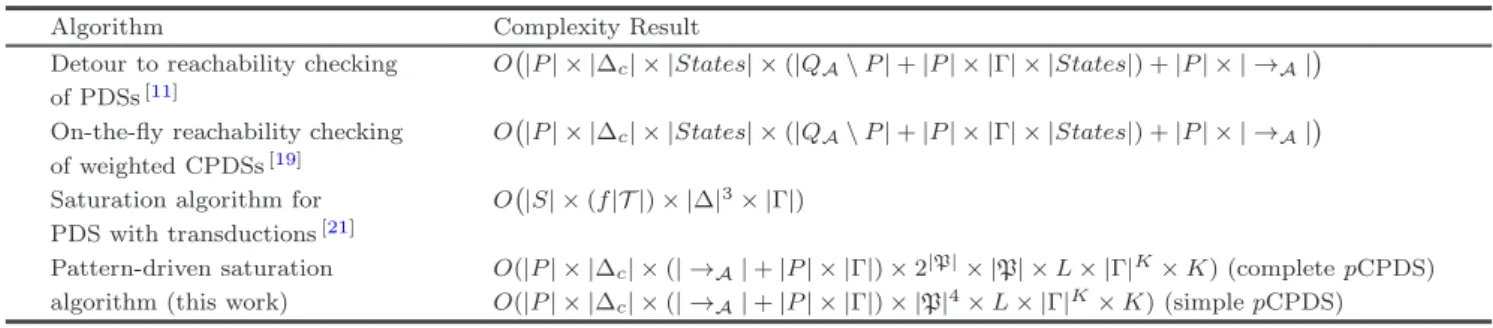
sim-plified asO(|P|×|∆c|×(| →A|+|P|×|Γ|)×2|P|× |P|×L×|Γ|K×K), as given in Table1.
We move to the complexity analysis of simple pCPDSs. If a pattern R is simple then it is sim-ply a disjunction of atomic patterns. Considering a simple pattern R, the satisfiability checking by Evaluation(R,(J, v)) is reduced to checking whether any basic pattern in J also appears in R. This obser-vation enables us to further optimize our analysis algo-rithm: it will suffice for each state inSig-P-automaton to only carry a single atomic pattern that it admits. The modification on our algorithms is minimal: for any transition ((p,(J, v)),γ,(q,(J", v"))) to be added into theSig-P-automaton in both Algorithm1and Al-gorithm 2, it will be divided as a set of transitions
! β∈J,β"
∈J"(p,(β, v)),γ,(q,(β", v")). The correctness of the algorithms is preserved, trivially. The time and space complexity becomesO(|P|2×(| →
A |×|Sig|× |P|×K)) for Algorithm1 andO(|P|2×(|P|×|∆
c|× (n1+n2)×n3×L+|P|×| →B |)) for Algorithm2,
where|Sig|=O(|P|×|Γ|K). The overall analysis takes O(|P|×|∆c|×(|→A|+|P|×|Γ|)×|P|4×L×|Γ|K×K)
time and space, as given in Table1. The algorithm is now fixed-parameter polynomial in parameterK.
Finally, we summarize the complexity results of our algorithms in Table 1, taking into account time and space consumed in steps 1 and 2 of the approach that are dominating. As given in Table1, our algorithm ex-hibits an exponential complexity in the size of atomic patterns for complete pCPDSs. Here L is the upper
Table 1. Complexity Results of Forward Saturation Algorithms forpCPDSs, Considering Time and Space Consumed in Steps 1 and 2
Algorithm Complexity Result
Detour to reachability checking O"
|P|×|∆c|×|States|×(|QA\P|+|P|×|Γ|×|States|) +|P|×|→A| # of PDSs[11]
On-the-fly reachability checking O"
|P|×|∆c|×|States|×(|QA\P|+|P|×|Γ|×|States|) +|P|×|→A| # of weighted CPDSs[19]
Saturation algorithm for O"
|S|×(f|T |)×|∆|3×|Γ|) PDS with transductions[21]
Pattern-driven saturation O(|P|×|∆c|×(|→A|+|P|×|Γ|)×2|P|×|P|×L×|Γ|K×K) (completepCPDS) algorithm (this work) O(|P|×|∆c|×(|→A|+|P|×|Γ|)×|P|4×L×|Γ|K×K) (simplepCPDS)
bound size of patterns (viewed as boolean formula of atomic patterns). For simple pCPDSs, our algorithms can be solved in fixed-parameter polynomial time and space. It coincides with those tractable instances of pCPDSs found in practice that have tailored efficient algorithms. For instance, one of the polynomial time algorithms for JDK stack inspection in [15] transforms a given CPDS A to an equivalent PDS A" in such a way thatq is reachable in A if and only if %q, prm& is reachable inA"whereprmis the set of permissions that q possesses. This corresponds to a special case of the subclass that the method in this paper works in poly-nomial time whenK= 1 andPis a constant. We also compare our analysis with other general algorithms for the reachability checking of CPDSs. The first row in Table 1 shows the complexity results for the original algorithm of CPDSs that takes a detour to reachabil-ity checking of PDSs[22] and its improved version, an
on-the-fly reachability checking algorithm of weighted PDSs[19]. The number of states in the product
automa-ton|States|can grow exponentially large. The general algorithms of CPDSs in [11] and [19] would still exhibit an exponential time for simple pCPDSs. The second row shows the results for forward saturation algorithm designed for reachability analysis of PDSs with trans-ductions, where|S|is the number of states in the finite automaton extended with transductions that recognizes the source configurations,T is a finite set of transduc-tions overΓ∗, andf is some computable function. The algorithm is also fixed-parameter tractable depending on the parameterized transductions
A possible optimization occurs when T is a finite union of patterned configurations. This is often the case we found in practical cases, when the intersection and emptiness checking in step 3 of our approach can be avoided, and is able to be replaced by a simple in-spection against T and initial states of the saturated automaton (as stated in Theorem 4) in linear time.
Last but not least, this optimized checking also enables us to terminate the saturation process early as soon as the target configurations are found reachable by a lightweight inspection of the initial states.
6 Experiments
In this section, we report preliminary experimental results to evaluate the proposed approach. We have implemented a reachability checking tool for pCPDS in Java, based on the algorithms in Section 4 and Section 5. Our implementation extends the model checker jMoped○3
developed for reachability analysis of weighted PDS. The major goal of our experiments is to conduct empirical study on the efficiency and scalability of the proposed pattern-driven reachability analysis al-gorithm ofpCPDS with simple patterns, which as we have shown is solvable in fixed-parameter polynomial time and space and is capable of modelling practical instances of CPDSs. All experiments were performed on a Mac OS X v.10.9.2 with 1.7 GHz Intel Core i7 processor, and 8 GB RAM.
Instead of restricting to particular applications, we conduct the evaluation from a general perspective with an examplepCPDS that consists of non-trivial mutual-recursive pushdown transition rules (corresponding to mutual-recursive function calls in the programs) and carry various kinds of simple patterns enumerated from the given alphabetΓ={γ1, . . . ,γn}. That is, the set of
atomic patternsPcontains two sets of atomic patterns
! A⊆ΓA∗ and ! A⊆Γ,γ1...γk∈Γ∗A ∗γ 1. . .γkΓ∗ for some givenk >0. The simple patterns attached to transition rules are randomly-enumerated combinations of atomic patterns from P formed by the union operator. The underlying pushdown system of our example is given in Fig.6(a). We also give the P-automaton accept-ing post∗(S) in Fig.6(b) computed by the transition rules in Fig.6(a). Each internal state in the automa-3
Fig.6. Underlying PDS of (a) the examplepCPDS, with (b) theP-automaton acceptingpost∗(S), whereS={)p0,γ1*}is the set of source configurations,pi (i∈[0..n]) is control locations,q0 is the final state, andqi is indexed by (pi,γi) for eachi ∈[1..n] by the construction of algorithm. In (a), each transition (p,γ/γ"γ"", p") says that, replaceγby γ"γ""on top of the stack when changing the state fromptop". Here the state reachability for control locations is of interest.
ton has incoming edges with reading any stack symbol γi(i∈[1..n]) in the alphabet. Since the computation of pCPDS synchronizes the two computing machineries of pushdown systems and condition automata, the under-lying PDS designed in this way is capable of traversing the state space of the product automaton over condition automata when necessary.
In Table2, we report results on the performance of our algorithm for computing the Sig-P-automaton ac-ceptingP ost∗(S) that is the dominating step of the en-tire approach. Here|C|denotes the set of distinguished regular conditions. We have compared our analysis with the original reachability analysis algorithm[11]and
the on-the-fly algorithm[19]. For the former, the
orig-inal algorithm does not scale since the resulted PDS transformed from the target pCPDS explodes easily. For the latter, our approach scales much better as shown in Table 2. Given the fixed-parameter K = 2, #States and #Trans list the number of states and transitions in the saturated P-automaton accepting P ost∗(S), respectively. As we increase the size of the
alphabet, the on-the-fly algorithm rapidly deteriorates in performance since|Γ|"5. In contrast, the pattern-driven algorithm can steadily scale to large example settings.
7 Conclusions
We studied the reachability problem of pCPDSs, a subclass of CPDSs carrying regular conditions obeying certain patterns. Despite of being syntactically con-strained, pCPDSs are expressive enough to model the existing application instances of CPDSs in practice. By introducing a way of computing the so-called signatures of the stack contents, we directly extended the clas-sicP-automata techniques and saturation algorithms of PDSs to solve the reachability problem ofpCPDSs. Our new algorithms avoid the immediate explosion caused by the approach that translates the problem to that of PDSs. Further, we identified a subclass called simple pCPDS for which there exist fixed-parameter polyno-mial solutions for reachability ofpCPDSs in some
para-Table 2. Experimental Results on the Scalability of Our Approach for ComputingSig-P-Automaton Acceptingcpost∗(S), Compared with an On-The-Fly Algorithm in [19]
pCPDS Pattern-Driven Algorithm On-the-Fly Algorithm[19]
|Γ| |∆c| |P| |C| #States #Trans Time (s) #States #Trans Time (s)
3 303 10 46 51 200 0.22 20 62 0.24 4 2 524 19 220 106 504 0.42 41 173 4.93 5 12 245 31 735 177 989 1.38 65 345 159.50 6 42 906 48 1 955 269 1 697 3.91 – – – 7 121 219 71 4 445 383 2 666 12.84 – – – 8 294 008 101 9 016 520 3 934 24.15 – – –
![Table 2. Experimental Results on the Scalability of Our Approach for Computing Sig-P-Automaton Accepting cpost ∗ (S), Compared with an On-The-Fly Algorithm in [19]](https://thumb-us.123doks.com/thumbv2/123dok_us/92151.2510478/15.892.150.802.142.388/experimental-scalability-approach-computing-automaton-accepting-compared-algorithm.webp)