© 2012 Università del Salento – http://siba-ese.unile.it/index.php/ejasa/index
DIAGNOSTIC IN POISSON REGRESSION MODELS
Zakariya Y. Algamal
*(1)Department of Statistics and Informatics, Mosul university, Iraq Received 08 March 2011; Accepted 02 April 2012
Available online 14 October 2012
Abstract: Poisson regression model is one of the most frequently used statistical methods as a standard method of data analysis in many fields. Our focus in this paper is on the identification of outliers, we mainly discuss the deviance and Pearson χ2 as diagnostic statistics in identification. Simulation and real data are presented to assess the performance of the diagnostic statistics.
Keywords: Poisson regression, deviance, Pearson χ2, outliers.
1.
Introduction
Poisson regression models have received much attention in econometrics and medicine literature as model for describing count data that assume integer values corresponding to the number of events occurring in a given interval. The Poisson regression model is the most basic model, where the mean of the distribution is a function of the explanatory variables. This model has the defining characteristic that the conditional mean of the outcome is equal to the conditional variance [5]. Outliers are observations that do not follow the statistical distribution of the majority of the data. Outlier detection is a primary step in regression analysis and has attracted enormous attention in the literature over many years including Cook and Weisberg (1982), and Rousseeuw and Leroy (1987). There are a number of different statistics used by statistician to ordinary least squares regression. Leverage in Poisson regression is assessed by the hat values
i
h
.DFBETA
andDFFIT
are helpful for detecting influence in Poisson regression.DFBETA
is calculated by finding the difference in an estimate before and after a particularobservation is removed. The same in
DFFIT
except the calculating difference will be inpredicted values.
The deviance plays an important role in assessing the fit of the model and statistical tests for parameters in the model, and also provides one method for calculating residuals that can be used
for detecting outliers [4]. Guria and Roy (2008) used the deviance for detecting outliers in logistic regression. Our focus in this paper is on the identification of outliers, we mainly discuss
the deviance and Pearson χ2 as diagnostic statistics in identification. The structure of the paper is
the following. We briefly present in section 2 the estimation of the Poisson regression parameters for both deleted and undeleted observation. In section 3, we introduced the deviance and Pearson
χ2 criteria to detect the outliers. Simulation and real data examples are covered in section 4 and 5
respectively. Section 6 shows the conclusion.
2.
Background and Notation for the Poisson Regression Models
In Poisson regression model, hereafter PR, the number of events
y
has a Poisson distributionwith a conditional mean that depends on individual characteristics according to the structural model: ) x ( Exp ) x y ( E i i i i = = ʹ′β θ (1)
Taking the exponential of
x
β
forces the expected countµ
to be positive, which is required forthe Poisson distribution [5]. If a discrete random variable
y
follows the Poisson distribution,then: ,.... 2 , 1 , 0 y , ! y e ) y Y ( p = = θy = θ − (2)
In order to estimate the PR estimator, we use the maximum likelihood estimation. By taking the
log-likelihood with θi =Exp(xʹ′iβ), we get:
∑
= β = = β n 1 i i i i n 2 1 n 2 1,y ,...,y ,x ,x ,...,x ) logp(Y y ,x ) y ( L log (3){
}
∑
= − β ʹ′ + β ʹ′ − = β n 1 i i i i i ) y (x ) log(y !) x ( Exp ) ( L log (4)The maximum likelihood estimator is then defined as:
) ( L log max arg ˆML= β β β (5)
So, the maximizing value for
β
is found by computing the first derivative of the (4) and setting[
y Exp(x )]
x 0 ) ( L log i n 1 i i i = β ʹ′ − = β ∂ β ∂∑
= (6)The second derivatives, Hessian matrix, is given below:
i i n 1 i i 2 x x ) x ( Exp ) ( L log ʹ′ β ʹ′ − = βʹ′ ∂ β ∂ β ∂
∑
= (7)Since the equation (6) is nonlinear in
β
, one must use an iterative algorithm. A common choicethat work well is the Newton-Raphson method as: ML (m+1)
β
= ML (m)β
−(H
(m))−1 (m)S
(8)Where S is the first derivative of the log-likelihood [10],[11]. To see the influence of the deletion
of the kth observation on the PR, we consider the log-likelihood function as following:
{
}
∑
≠ = − β ʹ′ + β ʹ′ − = β n k , 1 i i i i i k Exp(x ) y (x ) log(y !) ) ( L log (9) then[
]
i n k , 1 i i i ) k ( y Exp(x ) x S∑
≠ = β ʹ′ − = (10) x x ) x ( Exp i n k , 1 i i ) k (H
=−∑
ʹ′β ʹ′ ≠ = (11)Starting with an initial solution then the Newton-Raphson become:
S
H
(k) 1 (k) ) k )( m ( ML ) k )( 1 m ( ML ( ) − + − =β
β
(12)3.
Single Case Deletion Diagnostic
To show the amount of change in PR estimates that would occurred if the kth observation is
deleted. Two diagnostic statistics are proposed, change in deviance and change in Pearson χ2 to
detect the outliers. Such diagnostic statistics are one that examine the effected of deleting single
case on the overall summary measures of fit. Let χ2p denotes the Pearson χ2 statistics and χ2p(k)
Pregibon (1981) [7] , it can be shown that the decrease in the value of the χ2p statistic due to
deletion of the kth case is:
n
,...,
3
,
2
,
1
k
,
) k ( 2 p 2 p ) k ( 2 p=
−
=
Δ
χ χ χ − (13) The χ2p is defined as [6]: ) ˆ var( / )) x ( Exp y ( 2 n 1 i i i 2 p=∑
− ʹ′β µχ
= (14)And the χ2p for the
k
th deleted case is:) ˆ var( / )) x ( Exp y ( 2 n k , 1 i i i ) k ( 2 p =
∑
− ʹ′β µχ
≠ = − (15)The one-step linear approximation for change in deviance when the kth case is deleted is:
) k ( ) k (
D
D
D
=
−
−Δ
(16)Because the deviance is used to measure the goodness of fit of a model, a substantial decrease in
the deviance after the deletion of the kth observation is indicate that is observation is a misfit.
The deviance of the PR model with and without the kth observation is respectively [4]:
)} ˆ y ( ) ˆ y ( log y { 2 D n i i 1 i i i i − −µ µ =
∑
= (17) where µˆi =Exp(xiʹ′βˆ): )} ˆ y ( ) ˆ y ( log y { 2 D n i i( k) k , 1 i i( k) i i ) k ( − ≠ = − µ − − µ =∑
(18)A large value of
Δ
D
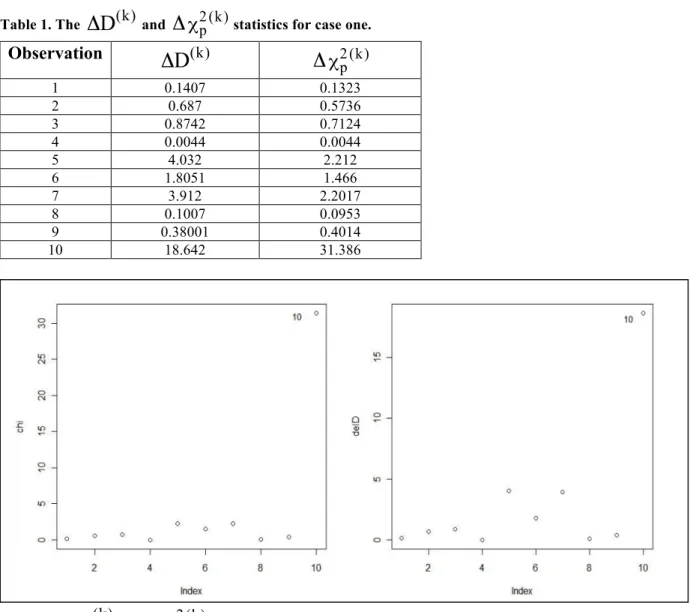
(k) indicates that the kth observation is an outlier.A simulation study was conducted to investigate the behavior of the deviance and chi-square Pearson diagnostic statistics under various modeling scenarios. We considered data simulated
from a PR with sample size n and p explanatory variables for the cases (n,p)=(10,1),(25,2) and
(50,2). The first case represents a simple PR with X following uniform [0,1] distribution and
β=(0,1). The second and third case represent a multiple PR with
x
1and
x
2 have uniform [0,1]distribution and β=(0,1). The percentage of contamination was set to be 10%, 4% and 4%
respectively in order to make one or two observations from the response variable sever from
shift-mean outlier (the 10th observation from the first case, the 25th observation from the second
case, and observations 29 and 48 from the third case). For brevity, the
Δ
D
(k) andΔ
χ2p(k) arepresented only in summary in table 1 for the first case, while the rest case results are shown in figure 2 and figure 3.
Table 1. The
Δ
D
(k) andΔ
χ2p(k) statistics for case one. ObservationD
(k)Δ
Δ
χ2p(k) 1 0.1407 0.1323 2 0.687 0.5736 3 0.8742 0.7124 4 0.0044 0.0044 5 4.032 2.212 6 1.8051 1.466 7 3.912 2.2017 8 0.1007 0.0953 9 0.38001 0.4014 10 18.642 31.386Figure 1.
Δ
D
(k) andΔ
χ2p(k) for the first case.The deviance for the full model was (25.37). The 10th observation will be outlier since it has
642
.
18
D
(k)=
Δ
andΔ
χ2p(k)=
31
.
386
. Figure 1 shows theΔ
D
(k) andΔ
χ2p(k) for this case.
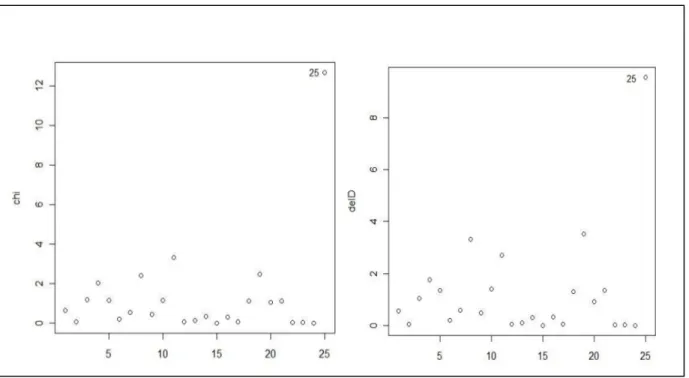
Figure 2.
Δ
D
(k) andΔ
χ2p(k) for the second case.From figure (2) we can conclude that the observation 25 will be outlier since its deletion will
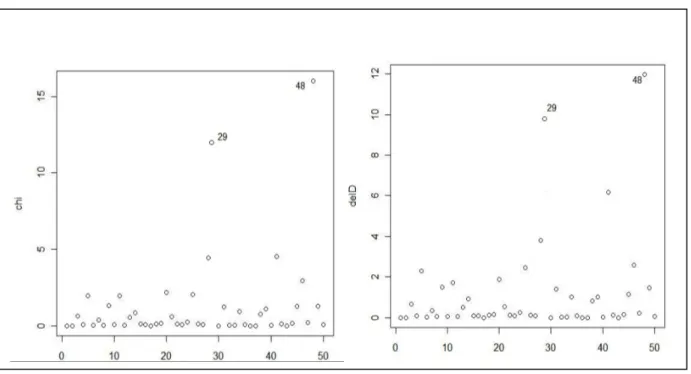
decrease the deviance and Pearson χ2 by (10.3) and (13.4). Again from figure (3), we can
considered observations 29 and 48 are outliers since they have large
Δ
D
andΔ
χ2p among theFigure 3.
Δ
D
(k) andΔ
χ2p(k) for the third case.5.
Numerical Results
The performance of the delta deviance and delta Pearson χ2 diagnostic statistics was studied in a
real data example. Andersen (2008) [1] described data for Canadian Equality, Security, and
Community Survey of 2000. He used only Quebec respondents in the analysis where (n=949).
The response variable is the number of voluntary associations to which respondents belonged. The explanatory variables are gender (with women as the reference category), Canadian born (the reference category is "not born in Canada"), and language spoken in the home (divided into English, French, and other, with French coded as the reference category). He used Cook's distance which indicates that there are two observations (31 and 786) may be particularly
problematic. Also, he pointed that the analysis of the
DFBETA
indicates that the influence ofthese two observations is largely with respect to the effect of Canadian born variable. To assess
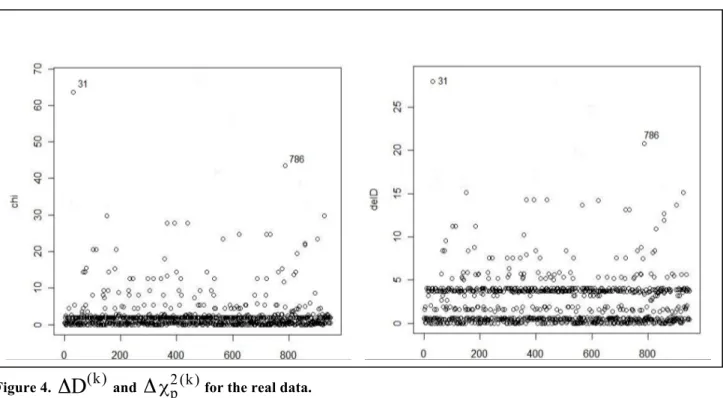
our diagnostic statistics performance, we used this example. Table (2) shows the
Δ
D
(k) andχ
Δ
2p(k) only for the two observations (31 and 949), where the full model deviance is 2427.632.Figure 4 shows the overall look about our analysis.
Table 2. The
Δ
D
(k) andΔ
χ2p(k) for the real data. ObservationD
(k)Δ
Δ
χ2p(k)31 28.00042 63.5904
786 20.813 43.595
Figure 4.
Δ
D
(k) andΔ
χ2p(k) for the real data.
6.
Conclusion
All of the diagnostic statistics described in this paper use one-step approximations to measure the effect of single case deletion on the Poisson regression model parameters. As we can see from figure 1 that the observation 10 considered outlier by our diagnostics statistics and this corresponds the fact that case 10 has already sever from shifting in mean comparing with the rest observations. The same with observation 25 from figure 2 and observations 29 and 48 from figure 3.
As mentioned in section 5 and from figure 4, the observations 31 and 786 considered outliers
using delta deviance and delta Pearson χ2 diagnostic statistics, this is the same decision that made
by Andersen (2008) using
DFBETA
. It should be noted here that the DFFIT pointed out thatthe observation 31 has the value 0.0114 which is less than the traditional cut-off value 0.129 and that the observation 786 has the value 0.312 which is greater than the traditional cut-off value. Here we could conclude that our diagnostic statistics well done in identifying outliers.
References
[1]. Andersen, R. (2008). Modern methods for robust regression. New York: SAGE
Publication.
[2]. Cook, R. D. and Weisberg, S. (1982). Residuals and influence in regression. New York:
Chapman & Hall.
[3]. Guria, S. and Roy, S. S. (2008). Diagnostics in logistic regression models. Journal of the
Korean Statistical Society, 37, 89-94.
[4]. Jong, P. and Heller, G. Z. (2009). Generalized linear models for insurance data. London: Cambridge University Press.
[5]. Long, J. S. (1997). Regression models for categorical and limited dependent variables.
New York: SAGE Publication.
[6]. McCullagh, P. and Nelder, J.A. (1989). Generalized linear models. 2nd ed. London:
Chapman & Hall.
[7]. Pregibon, D. (1981). Logistic regression diagnostics. The Annals of Statistics, 9, 4,
705-724.
[8]. Rousseeuw, P. J. and Leroy, A. M. (1987). Robust regression and outliers detection. New
York: John Wiley.
[9]. Seber, G. A. F. and Lee, A. J. (2003). Linear regression analysis. 2nd ed. New Jersey:
John Wiley.
[10]. Winkelmann, R. (2008). Econometric analysis of count data. 5th ed. Leipzing: Springer.
[11]. Yan, X. and Su, X. G. (2009). Linear regression analysis, theory and computing.