8.0
PUBLIC SERVICES AND FACILITIES ELEMENT
The Public Services and Facilities Element is concerned with the provision of public services, community facilities, and utility systems, which promote and enhance the daily activities of all Loma Linda citizens. Many of these systems, including wastewater treatment, and the provision of water, natural gas, electricity, and telecommunications, act as catalysts for urban growth and development. These facilities must be in place for growth to occur in an area. Other facilities are also necessary to serve both existing and new development. These facilities include solid waste disposal, parks, libraries, educational facilities and service, and the delivery and availability of police, fire, and health/medical services. In addition, this element focuses on City’s current service levels of the existing facilities and services.
The purpose of the Public Services and Facilities Element is to identify and plan for the public services necessary to serve the functional needs of Loma Linda as it grows in area and population. The focus of this Element is on the capital facilities and public services needed to support build out of the land uses identified in the Land Use Element while maintaining a full range of high-quality public and private services. This Element sets forth standards desired by the community for its fire and police services, library services, public schools, private institutions, public utilities, and solid waste management.
In accord with the provisions of California Government Code Sections 66000 et seq., all development projects as defined therein shall be required to pay development fees to cover 100 percent of their pro rata share of the cost of any public infrastructure, facilities, or services, including without limitation roads, sewer, utility, police, and fire services, necessitated as a result of the approval of such development. The City Council shall set and determine development fees sufficient to cover 110 percent of their pro rata share of the estimated cost of such public infrastructure, facilities, and services based on appropriate cost-benefit analyses, as required by the provisions of California Law.
8.1 FIRE
PROTECTION
The Fire and Rescue Division of the Department of Public Safety provide fire protection. Fire Station 251, located at 11325 Loma Linda Drive, services the City of Loma Linda. The Fire Station houses the equipment listed in Table 8.A.
Table 8.A: Loma Linda Fire and Rescue Division Equipment as of February 2004
Equipment Capacity/Function
Two triple-combination engines 1,500 gallons per minute; structure fires, etc. One aerial multi-purpose ladder truck 2,000 gallons per minute, 102-foot aerial.
One brush engine 750 gallons per minute; wildland fires
One water tender 750 gallons per minute; 1,500-gallon tank.
One paramedic fire/rescue squad Medical aid and rescue One portable lighting/rehab trailer Lighting and rehab support One rescue/backup paramedic squad Rescue and Haz Mat equipment
The Department of Public Safety’s Fire and Rescue Division currently consists of two Chief Officers, six Captains, six Engineers, and six Firefighter/Paramedics. Additionally, the Division has 10 part-time Firefighters participating in the Paid Call
Program. The average 24-hour shift consists of two Captains, two Engineers, two Firefighter/Paramedic, and two part-time Firefighters. This set of personnel normally staffs an Engine Company the Paramedic Rescue Squad and either an additional engine or the truck. The Fire and Rescue Division handles structural, wildland, vehicle, and refuse fire suppression, fire investigation, heavy rescue, technical rescue, confined-space rescue, hazardous materials response, vehicle extrication, emergency medical procedures, building collapse, train derailment, CPR/First-aid training, and fire hydrant testing.
The Department of Public Safety’s Community Safety Division consists of one Fire Prevention Inspector, two Code Enforcement Officers, contract animal control services, and one Parking Control Officer. This Division handles fire plan checks, fire prevention inspections, weed abatement, public fire safety and fire extinguisher training, traffic control, fire public education, disaster preparedness, municipal code enforcement, animal control services, and parking enforcement.
Response time varies within the City and is difficult to measure due to the daily influx of traffic from the University and the related medical center. The Fire and Rescue Division is currently experiencing an approximately 11 percent increase in call volume (2003 over 2000) at this time. Additionally, the Department is experiencing a number of simultaneous calls (approximately 25% of all calls). To ensure adequate fire protection services in an emergency, the City of Loma Linda maintains a joint response/automatic aid agreement with the fire departments in neighboring cities including Colton, Redlands, and San Bernardino. The Department also participates in the California Master Mutual Aid Agreement.
8.1.1 Identified Fire Protection Issues
The southern portion of the City, including the Hillside Initiative and adjacent hillside areas, has been identified by the Public Safety Department as an area that may need a second station for several reasons. First, these hills lie within the City’s identified Hazardous Fire Area. Second, there is an extended drive time into the southern hill area from the headquarters station. Third, future
budgetary process due to a rapidly increasing rate of calls for service. Along with a new station, the City will need the equipment and personnel to service the area.
8.1.2 Guiding
Policy
Provide an adequate number of fire stations, along with fire fighting personnel and equipment to protect the residents and businesses of Loma Linda.
8.1.2.1 Implementing Policies
a. Assess the short-term and long-term needs of the Department of Public Safety to ascertain how the Fire and Rescue Division should grow to serve Loma Linda adequately.
b. All discretionary development projects shall be reviewed by the Department of Public Safety to ensure that a five-minute response time (including three-minute running time) can be maintained for 80 percent of emergency fire, medical, and hazardous materials calls on a Citywide response area basis.
c. Conduct an annual assessment of the adequacy of facilities and services serving Loma Linda, personnel and staffing needs, and capital needs, based on anticipated growth and the level of service standard set forth in Implementing Policy b, above. This assessment should be undertaken as part of the annual review of proposed capital projects required by the California Government Code Sections 65103(c) and 65410.
d. Require implementation of fire protection measures, such as a buffer area of fire-resistant plants and non-combustible roofing in areas of high fire hazard as identified on Figure 10.3 and in Section 10.4.
e. Continue to collaborate with other jurisdictions in the provision of back-up fire services in emergency situations.
f. Continue and expand Fire Education and Safety Programs.
8.1.3 Fire Protection Facilities
8.1.3.1 Performance Objective
Maintain competent and efficient fire prevention and emergency fire, medical, and hazardous materials response services with first responder capability in order to minimize risks to life and property.
8.1.3.2 Performance Standard
Prior to approval of discretionary development projects, require written verification from the Fire Department that a five-minute response time (including three-minute running time) can be maintained for 80 percent of emergency fire, medical, and hazardous materials calls on a citywide
8.2
POLICE PROTECTION SERVICES
Police protection for the City is provided by and contracted through the San Bernardino Sheriff‘s Department, located at 655 East Third Street in San Bernardino, at Sheriff’s Headquarters, Central Station. The City has recently provided a workstation at City Hall, which provides deputies and a sheriff’s service specialist with an area for completing reports, conducting interviews, and crime prevention activities. The City shares the cost of law enforcement personnel and equipment with the City of Grand Terrace. Loma Linda University maintains its own security force with the City providing services on an as-needed basis.
The sheriff personnel currently serving the City of Loma Linda includes 12 sworn officers and 5 non-sworn (civilian) employees. The present ratio of sheriff officers to population in the City of Loma Linda is 1 deputy per 2,478 residents. The volunteer staff includes 11 citizens on patrol and 13 Explorer Scouts. Sheriff vehicles include 5.5 marked units, 2 unmarked units, and 1 citizen patrol unit.
The Sheriff Department divides the City into 16 reporting districts, and has an average emergency response time within the City of 3.25 minutes. The present ratio of sheriff deputy to population is 1 deputy per 2,478 residents. Table 8.B details the City of Loma Linda’s Crime Statistics from 1995 through 2000.
Table 8.B: City of Loma Linda Crime Statistics
Offense 1995 1996 1997 1998 1999 2000 Criminal Homicide 0 0 1 2 0 3 Forcible Rape 6 6 7 4 2 8 Robbery 22 26 21 15 14 12 Assault 113 74 100 86 72 83 Burglary 239 203 223 171 93 157 Larceny – Theft 407 471 506 407 374 321
Grand Theft Auto 325 291 251 160 106 105
Grand Total 1,112 1,071 1,109 845 661 689
8.2.1 Identified Police Protection Issues
A number of factors are considered in assessing the law enforcement needs for the community in the future. First, the level of calls for police services has been steadily increasing during the past several years and is now reaching the range of 55 to 60 per day. This trend is expected to continue. Second, while the resident City population is listed at 19,418, this number increases to an estimated 50,000 during the day due to activities related to the LLU and related Medical Centers. The daytime population is expected to increase in the future. Third, community arterial roadways, including Barton Road, Redlands Boulevard, Anderson Street, and Mountain View Avenue, routinely handle over 25,000 cars daily, which significantly impacts law enforcement transportation issues. Travel on these roadways is expected to increase in the future. Lastly, with several large housing and business developments in the final stages of planning, the population of Loma Linda could easily expand by a projected 25 percent during the next several years, which would increase the need for law enforcement services. These issues could significantly tax the available resources and impact the ability of the Sheriff’s Department deputies to respond to calls for service in the appropriate time frame.
8.2.2 Guiding
Policy
Provide for the protection of Loma Linda citizens and businesses from crime through maintenance of an adequate force of police officers, appropriate physical planning of new development, and a high level of public involvement in crime prevention.
8.2.2.1 Implementing Policies
a. Strive to provide an adequate police force to respond to emergency calls within an average of 3.25 minutes from time of dispatch.
b. Provide sufficient facilities and staff to ensure that the dispatch staff can collect emergency information and immediately forward requests for service to patrol units.
c. Annually assess crime prevention and law enforcement programs to evaluate the adequacy of Loma Linda’s services, facilities, and personnel needs based on short and long-term growth. d. Continue collaboration with other jurisdictions in providing back-up police services and where
necessary, equipment and personnel.
e. Continue working with Loma Linda University Security in providing as needed police services to the University community.
f. Promote the establishment and operation of neighborhood watch programs.
g. Expand community outreach programs and promote community involvement in crime prevention. h. Require design features in new development to reduce potential for crime.
x Provide well-lighted and visible streets and street names, building entrances and addresses, recreation areas, and parking areas.
x Limit access into and between buildings to reduce escape routes and to make undetected entry difficult.
x Landscape development sites to permit surveillance of open areas and entryways, and avoid creating places for concealment.
x Within multifamily and non-residential developments, provide emergency vehicle access around buildings to the extent feasible.
x Within multifamily and non-residential developments, eliminate the potential for access to roofs by pallets, flag poles, etc.
8.2.3 Police Service Facilities
8.2.3.1 Performance ObjectiveMaintain an active police force, while developing programs and police facilities that are designed to enhance public safety and protect the citizens of Loma Linda by providing an average response time to emergency calls of between seven and eight minutes from the time the call is received to the time an officer arrives.
8.2.3.2 Performance Standard
Maintain a force level, including sworn and community service officers assigned to community policing and prisoner custody details that is capable of responding to emergency calls within an average of 3.25 minutes from time of dispatch.
8.3 EDUCATIONAL
FACILITIES
The City of Loma Linda’s roots are tied to education beginning with the “College of Medical Evangelists,” which opened in 1909 and later became Loma Linda University (LLU) in 1961. From the first nursing school to the seven schools comprising LLU today, the university has been a dominant force in the growth and development of the community. LLU is a Seventh-day Adventist educational health-sciences institution with 3,000 students. Seven schools and the Faculty of Religion comprise the University organization. The schools of Allied Health Professions, Dentistry, Medicine, Nursing, Pharmacy, Public Health, and the Graduate School offer more than 55 programs. Curricula offered range from certificates of completion and associate in science degrees to doctor of philosophy and professional doctoral degrees. Students from more than 80 countries and virtually every state in the nation are represented in LLU’s student body. Postgraduate medical and dental education programs are also conducted with the LLU. In addition, the Medical Center is affiliated with 27 other educational institutions and provides training for a variety of allied health specialists. An active research program at the Medical Center supports 184 research projects in all major areas of medicine and surgery, particularly mineral metabolism, neurobiology, cardiovascular, and AIDS research. Within a short drive of Loma Linda are three junior colleges: San Bernardino Valley College, Crafton Hills College, and Riverside Community College. The University of California at Riverside, Cal State University San Bernardino, the University of Redlands, the California Baptist College, and the Claremont Colleges are available for upper division and graduate courses.
Public education in the City of Loma Linda is provided by Redlands Unified School District (RUSD) except for the western portion of the City, which is served by Colton Joint Unified School District (CJUSD). In addition to these school districts, one community day school, overseen by San Bernardino County Superintendent of Schools Office, is located in the City of Loma Linda. Loma Linda Academy, a private Seventh-day Adventist school, also provides schooling for kindergarten through high school grades.
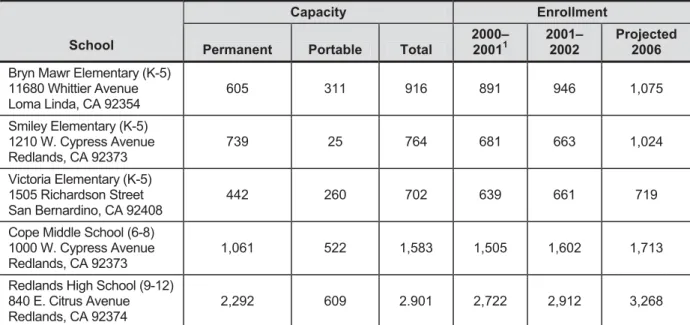
All the RUSD schools serving the City of Loma Linda have exceeded their original capacities (Table 8.C). To accommodate student enrollment, the three elementary schools are on a year-round schedule, which increases the seats available for students by approximately 25 percent. RUSD converted these schools to year-round schedules because funding was not available to construct new schools to meet enrollment demands. The recent implementation of 20:1 student/teacher ratio significantly impacted the District’s elementary and middle schools. Portable classrooms have been and will continue to be placed on all campuses from year-to-year to meet student enrollment needs.
Table 8.C: Redlands Unified School District Enrollment
Capacity Enrollment
School Permanent Portable Total 2000–20011 2001–
2002
Projected 2006
Bryn Mawr Elementary (K-5) 11680 Whittier Avenue Loma Linda, CA 92354 605 311 916 891 946 1,075 Smiley Elementary (K-5) 1210 W. Cypress Avenue Redlands, CA 92373 739 25 764 681 663 1,024 Victoria Elementary (K-5) 1505 Richardson Street San Bernardino, CA 92408 442 260 702 639 661 719
Cope Middle School (6-8) 1000 W. Cypress Avenue Redlands, CA 92373
1,061 522 1,583 1,505 1,602 1,713
Redlands High School (9-12) 840 E. Citrus Avenue Redlands, CA 92374
2,292 609 2.901 2,722 2,912 3,268
1
CBEDS: California Basic Education Date System. The state designates a day in October for reporting enrollment, which is used on year-to-year basis for comparison and reporting purposes. Special education students are not included.
The western portion of the City of Loma Linda is within the boundaries of CJUSD. Currently, Reche Canyon Elementary School, Terrace Hills Middle School, and Colton High School serve this portion of the City. Individual school capacities along with current and projected enrollment at schools serving the City of Loma Linda within CJUSD are presented in Table 8.D.
Table 8.D: Colton Joint Unified School District Enrollment
School Capacities 2000–20011
Projected 2001–20022
Reche Canyon Elementary (K-6)
3101 Canyon Vista Drive, Colton CA 92324 750 702 723
Terrace Hills Middle School (7-8)
22579 De Berry Street, Grand Terrace CA 92313 1050 951 979
Colton High School (9-12)
777 W. Valley Boulevard, Colton CA 92324 2900 2,720 2,801
1
CBEDS: California Basic Education Date System. The Designates a day in October for reporting enrollment, which is used on year-to-year basis for comparison and reporting purposes. Special education students are not included.
2
Projections are based on a District-wide annual growth of approximately 3% per year.
Loma Linda Academy, a private educational institution associated with the Seventh-day Adventist Church, has three campuses on 45 acres located on Anderson Street, south of I-10. The academy has a current capacity of 1,550 students. However, through creative arrangements, the school is able to accommodate a current enrollment of 1,648 students. The school’s projected enrollment is shown in Table 8.E.
Table 8.E: Loma Linda Academy Enrollment
Grade Level 2000–2001 Projected 2001–2002 Projected 2002–2003 Projected 2003–2004
K-5 628 647 666 686
6-8 411 423 435 448
9-12 609 627 646 665
Total 1,648 1,697 1,747 1,799
Projected enrollment is based on a 3% annual growth. Enrollment has grown at 3% annually over the past 15 years.
The San Bernardino County Superintendent of Schools oversees a County-operated day school in the northeast portion of the Planning Area. Known as the Mission Community School (MSC), this school offers an educational opportunity for students who have been expelled or are no longer permitted to attend schools in their appropriate school districts. The MCS accepts grades 7 through 12 from surrounding school districts. As of January 22, 2002, enrollment ranged between 50 and 60 students with maximum capacity ranging between 100 and 120 students. In January 2002, this educational facility had an unutilized classroom. Due to this surplus, it is expected to be able to accommodate future growth and educational needs.
8.3.1 Identified Educational Issues
The City of Loma Linda places a high priority on quality educational facilities. The high priority placed on schools by area residents is reflective of the family-oriented nature of the community. The City also takes pride in being the home of an internationally known university that plays a key role in the community’s economic well being.
Although the construction of school is the responsibility of local school districts and not the City, municipal development policies, along with the ups and downs of the housing market, significantly affect the rate at which new schools must be built. As a result, close cooperation between the City and local school districts is essential both for the districts and the City to address the impact of new development on the all ready overcrowded educational facilities.
School districts are exempt from local regulations and cannot be required to adhere to City General Plan policies. However, cooperation between the City and the School Districts is essential in order to provide high quality educational facilities. Present laws regulating school facility financing place responsibility on the State and local school districts. State law also caps development fees for schools, and limits the ability of cities to require new development to provide new school facilities. In general, payment of development fees established by local school districts is considered to be “mitigation in full” for the impacts of such development on schools, whether or not the maximum fees allowable under the law are adequate to construct new facilities.
Additionally, there is presently only one public school located in the City of Loma Linda. Neighborhood schools are an asset to a community and more local public schools would enhance the livability of Loma Linda.
8.3.2 Guiding
Policy
Facilitate the acquisition of sites for public and private educational institutions such that all school-age children have access to school facilities that are not overcrowded and that can provide superior educational opportunities.
8.3.2.1 Implementing Policies
a. Maintain clear, ongoing communications with area school districts on all matters related to the need for and provision of school sites and other administrative, educational, and recreational facilities. On a regular basis, exchange information with the County Superintendent of Schools on the Mission Community School. On a regular basis, exchange information with the Redlands and Colton Unified School Districts on:
x The status of development review and construction; x The capacity of schools serving Loma Linda residents; x The status of site acquisitions by the districts; and
x Applicable student-generation factors by type of development.
b. Assist the various school districts in developing school sites and facilities to serve all neighborhoods in the City.
c. As more schools are built within the City, maximize the joint use of facilities by the City and the local school districts (including joint school/park sites and, where feasible, joint use of athletic fields, community meeting facilities, and provision of child and senior care facilities) by developing joint funding for such facilities through a combination of school district and City sources, provided that City contributions to joint facilities are consistent with the availability of such joint facilities to meet non-school recreational and other community needs.
d. Require new development to pay all legally established fees, provide capital facilities, and/or participate in land-based financing districts established by local school districts for the acquisition and development of school sites with adequate, permanent classroom space, as required by the local school districts and State law.
e. Maintain land use regulations permitting the development of public and private educational facilities at appropriate locations within the Planning Area.
x Within lands planned for residential or mixed-use development, permit public and private schools along arterial and collector roads at the periphery of neighborhoods where traffic impacts created by the school on the local neighborhood can be minimized.
x Provide adequate buffer areas along common property lines with residential uses.
f. Work with Loma Linda University to provide public transportation services, circulation system, affordable housing, and other public services that contribute to the maintenance and long-term success of this institution.
g. Cooperate and support joint public/private endeavors, such as a performing arts center, with Loma Linda Academy.
h. Work with trade schools to locate new facilities in Loma Linda.
8.3.3 School
Facilities
Recognizing that provision of school facilities is the responsibility of the school district, as set forth in State law (SB 50). The intent of the General Plan in setting forth objectives and a performance standard for school facilities is to require the maximum mitigation allowable by law.
8.3.3.1 Performance Objective
Provision of schools in locations that are readily accessible to student populations, along with sufficient facilities to provide educational services without overcrowding.
Loma Linda Branch Library
8.3.3.2 Performance Standard
Require new development to provide necessary funding and/or capital improvements to mitigate projected impacts on school facilities, as determined by the Redlands Unified School District.
8.4 LIBRARY
SERVICES
The Loma Linda library facility is a branch of the San Bernardino County Library system. This library is located in a City-owned facility operated under the jurisdiction of the San Bernardino County Library and is funded by the State of California and
San Bernardino County property taxes.
The library has a collection of 46,267 items, including periodicals, and is staffed by 2 full-time and 8 part-full-time employees. The Loma Linda Branch Library currently provides the following resources and services: videos, compact discs, books on tape, foreign language materials, an African-American collection, four computers with Internet access and Microsoft Office, free literary services, interlibrary loan services, an online public access catalog, and a Countywide reference center. The Loma Linda Branch Library serves an estimated population base of 20,900.
8.4.1 Key Library Service Issues
The Loma Linda Branch Library current facilities and services are only a quarter to half of what is needed to accommodate the current population of the City. The average ratio for public library facilities is 0.46 square feet per capita according to the 2000 Public Library Data Service Statistical Report, an annual publication of the Public Library Association.
The County of San Bernardino released a facilities study in November 2001 that analyzed future needs of library facilities in San Bernardino County, including the City of Loma Linda, through the year 2021. According to this facilities study, the City of Loma Linda Branch Library will need to expand and renovate the existing facility to accommodate future growth. This study proposed a building size of 14,974 square feet, requiring 75 public and staff parking spaces. It was estimated that the expanded facility would increase the square footage per capita from the present 0.33 to 0.39 by the year 2021.
Future library facility funding will be the responsibility of the City with assistance from the County for operation of the facilities. There are currently no capital improvement dollars at the County for improvement or expansion of library facilities.
8.4.2 Guiding
Policy
Loma Linda University Medical Center
8.4.2.1 Implementing Policies
a. As the library facility is City-owned, continue to work with the San Bernardino County Library System to maintain the facility and secure library titles consistent with the standards of the American Library Association.
b. Seek opportunities to expand and renovate the existing library facility by securing State and Federal funds for facilities and services.
c. Continue and explore new ways in which the City can support the goal of expanded facilities and services such as book sales, corporate sponsorships, and volunteer programs.
d. Continue to seek State funding for library facilities which will service the residents of the City.
8.5
MEDICAL INSTITUTIONS AND SOCIAL SERVICES
Private businesses and non-profit institutions provide many services that are beneficial to the citizens of the City of Loma Linda. The City benefits from private business and non-profit institutions offering childcare, youth programs and senior services. With the aging population, single-parent families, two-worker households, and the increasing problem of drug abuse, the community is dependent upon social services and programs offered by these agencies, businesses, and non-profits organizations. Some of these services, such as Shopping 4 Seniors and the Ronald McDonald House, are located in the City of Loma Linda. Other services, such as Inland Harvest, Big Brother, Big Sister of
the Inland Empire, and Easter Seals of Southern California, are located in nearby communities. The City does not control the provisions of these services; however, City policies and actions can affect the availability of these services.
Of particular importance to the City are the regionally and internationally known medical facilities, which provide the latest in health care services. The combination of Loma Linda University Community Medical Center, Loma Linda University Behavioral Medicine Center, Loma Linda University Proton Treatment Center, and the Loma Linda University Children’s Hospital, offers nearly 900 beds for patient care. Loma Linda University Medical Center (LLUMC) operates some of the largest clinical programs in the United States in areas such as neonatal care, and is recognized as the international leader in infant heart transplantation and proton treatments for cancer. As the only referral (tertiary care) center for specialties hospital in the area, LLUMC is the only level-one regional trauma center, which means it meets a complex set of criteria and provides the highest level of complete care around the clock for Inyo, Mono, Riverside, and San Bernardino Counties.
In addition, a Veterans Medical Center located in the City of Loma Linda provides care for area veterans under the teaching auspices of LLU School of Medicine. The Jerry L. Pettis Memorial VA Medical Center is part of the Desert Pacific Healthcare Network, providing services to veterans in Southern California and Southern Nevada. Opened in 1977, this modern facility fulfills the agency’s threefold mission of patient care, research and teaching. The Medical Center provides a wide variety of services through inpatient; outpatient and home care programs. The major services provided are in the areas of general medicine, surgery, psychiatry, and neurology.
8.5.1 Identified Medical and Social Services Issues
The General Plan does not control the provision of private businesses, non-profit organizations, or public agencies offering services to the community of Loma Linda. It does, however, establish policies to facilitate the availability of services in the City.
8.5.2 Guiding
Policy
Encourage the continuance and the development of private and public medical facilities and human and social services in Loma Linda.
8.5.2.1 Implementing Policies
a. Provide for and encourage the development of facilities offering childcare and elder care by providing a reasonable range of sites where such facilities could be located.
b. Collaborate with schools, businesses, non-profit agencies, religious organizations, law enforce-ment, and others to prioritize needs and establish programs and services for children and youth. c. Encourage the development of a variety of housing and recreational options for senior citizens in
areas close to services and transportation.
d. Actively work with public, private, and non-profit service providers to create and expand opportunities for elder care facilities, programs, and services in Loma Linda.
e. Provide for religious facilities and preschool facilities on arterial or collector streets.
f. Promote development of multi-use buildings/community centers that can be utilized for youth and teen activities and childcare.
g. Encourage and support private businesses and public facilities and services that contribute to the maintenance and long-term success of the medical facilities in the City.
h. Encourage and support businesses that would benefit from close association to the medical facilities to locate on sites designated for mixed-use development.
8.6
PARKS AND SCHOOL GROUNDS
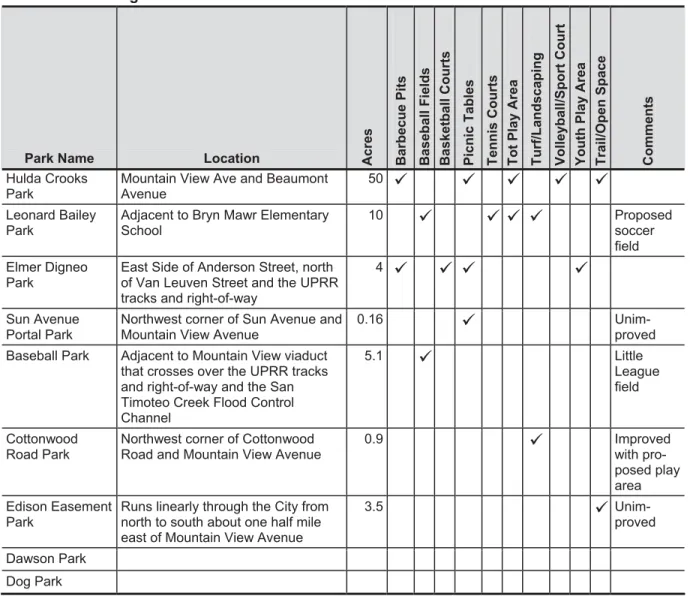
The City owns and administers nine parks, varying in size and amenities from the ¼-acre Sun Avenue Portal Park to the 50-acre Hulda Crooks Park. Over 73 acres of parks and open space areas are located within the City, over 64 acres of which are developed. The remaining 10 acres consist of acreage awaiting development. Table 8.F gives a detailed list of all existing parks, their locations, and the amenities they provide, also included are future park facilities planned for the City.Table 8.F: Existing Parks
Park Name Location Acr
es
Barbecue Pits Baseball Field
s
Basketball Courts Picnic Tables Tennis Courts Tot Play Area Turf/Landscaping Volleyball/Sport Court Youth Play Area Trail/Open Space Comments Hulda Crooks
Park
Mountain View Ave and Beaumont Avenue
50
9
9
9
9
9
Leonard Bailey Park
Adjacent to Bryn Mawr Elementary School 10
9
9 9 9
Proposed soccer field Elmer Digneo ParkEast Side of Anderson Street, north of Van Leuven Street and the UPRR tracks and right-of-way
4
9
9 9
9
Sun Avenue Portal Park
Northwest corner of Sun Avenue and Mountain View Avenue
0.16
9
Unim-proved Baseball Park Adjacent to Mountain View viaduct
that crosses over the UPRR tracks and right-of-way and the San Timoteo Creek Flood Control Channel 5.1
9
Little League field Cottonwood Road ParkNorthwest corner of Cottonwood Road and Mountain View Avenue
0.9
9
Improved with pro-posed play area Edison Easement ParkRuns linearly through the City from north to south about one half mile east of Mountain View Avenue
3.5
9
Unim-proved Dawson Park
Dog Park
8.6.1 Future Park Facilities
San Timoteo West Park Site, Cottonwood Road Park Site, and the Edison Easement are City planned parks that have not yet been developed. San Timoteo West Park Site is located east and adjacent to the Mountain View viaduct that crosses over the UPRR tracks and right-of-way and the San Timoteo Creek Flood Control Channel. Due to limited access to the site and related issues, the City has not decided if it will pursue acquisition of this site. The Cottonwood Road Park Site is located at the northwest corner of Cottonwood Road and Mountain View Avenue. The site has physical constraints in that it is about 360 feet long and 110 feet deep, extending west from the corner. Funds were included in the Fiscal Year 2001/2002 budget for landscaping, irrigation, fencing, walls, and outdoor seating at this park. A tot lot may also be included if there is enough funding. The Edison Easement runs linearly through the City from north to south about one-half mile east of Mountain View. A portion of the easement has been improved with a trail system, orange groves, and minimal, natural landscaping. It has always been the intent of the City to improve the entire length of the easement with the previously mentioned improvements. Currently, there are fund raising efforts
8.6.2 Recreation
Programs
The City has no formal recreation programs. Organizations and members of the public are able to obtain no-fee Park Use Permits for special events (e.g., family reunions, large picnics, weddings, and showers). Long-term use is granted to organizations for league use at Baseball Park.
8.6.3 Parks Standards, Acquisition, and Maintenance
The City has adopted a population to parkland acreage ratio of 5 acres per 1,000 population. With a population of 19,418 persons in January 2001 and 64.16 acres of parkland, the City currently has a park ratio of 3.30 acres. With the addition of the proposed parks, the park ratio would be 3.8 acres. The Community Development Department provides the public with information on park usage and is responsible for park facility planning. The Parks, Recreation and Beautification Committee oversees all park planning and construction efforts. The City’s Public Works Department provides maintenance of the parks (but only portions of the Edison Easement).
The City imposes a Parks Facilities Development Impact Fee on all new residential development. In recent years, the City Council has provided some monies from the General Fund for park facilities. City staff is also utilizing grant funding from the California Department of Parks and Recreation and is in the process of identifying other sources of grant funding. The City’s Capital Improvements Plan (CIP) includes some of the park facilities and improvements that have been identified in the Parks Master Plans for Leonard Bailey and Hulda Crooks Parks.
8.6.4 Identified Park Issues
The previous Parks and Recreation Element, adopted in 1992, has not been implemented due to lack of funding and staff time. A current Citywide Parks Master Plan does not exist and the City does not sponsor an ongoing recreational program. The few park and recreation services that do exist, such as special events and processing of park permits are funded from a combination of funding sources, which include Development Impact Fees, various State grant programs, and the City’s General Fund. As noted earlier, the City currently falls short of the park ratio of 5 acres per 1,000 population. While the City can require new development to provide new parks at a rate of 5.0 acres of developed park land per 1,000 new residents, new development can not be required to make for the City’s existing shortfall in park land. It is, however, the desire of the City of Loma Linda to make up its existing park land deficit and achieve a ratio of 5.0 acres of park land per 1,000 at General Plan buildout. In addition to the number and size of parks, key factors in determining the effectiveness of a local park network include the type of facilities offered, the level of maintenance and the distribution of parks throughout the community. The City’s two community parks are both located in the southeastern portion of the City and are partially completed. Of the existing Neighborhood Parks, one is a temporary park, one is developed as a Little League baseball field, and one is soon to be relocated and developed only with outdoor picnic areas.
Local public school sites can act as neighborhood park and recreation facilities when not in use. While school facilities are primarily utilized during daytime hours, joint use of athletic fields, ball courts, or play areas can substantially increase the amount of available usable open space, especially in urbanized areas of the City. The City has one public school site, Bryn Mawr Elementary School that is not under control of the City.
8.6.5 Guiding Policy for Parkland Acquisition
provision of a range of recreational facilities, to serve the needs of Loma Linda residents of all ages and attain a population-to-parkland acreage ratio of 5 acres per 1,000 population.
8.6.5.1 Implementing Policies
a. Provide a range of public parklands for use by the community including the following:
x Neighborhood Park. A park or playground generally 5 to 10 acres in size primarily developed to meet the recreational needs of citizens living within 0.5 to 1 mile.
x Joint School/Park. A neighborhood park development, improved, and maintained on or adjacent to school grounds by the City. Joint school/park facilities are utilized jointly by students and residents from the surrounding neighborhoods. Since school facilities are only available for use by the general public when school in not in session, only half of the total acreage is to be applied to the City’s park standard.
x Community Park. A larger park facility developed to meet the park and recreational needs of those living or working within a 3- to 5-mile radius. Community parks generally range in size from 10 to 60 acres.
x Sports Park. A park development designed to serve the needs of organized sports activities including youth and adult leagues. Generally ranges in size from 5 to 30 acres.
x Specialized Recreational Area. These include linear parks (trails), community centers, and preservation areas or structures. These facilities vary in size depending on use.
b. Complete and maintain an up to date Parks and Recreation Master Plan setting forth a program to meet the recreational needs of citizens of all ages and achieve 5.0 acres of developed park land per 1,000 population distributed throughout the community.
c. Utilize the resources of national, regional and local conservation organizations, corporations, and non-profit associations and to identify and acquire environmentally sensitive land or preservation areas particularly in the hill areas in the southern section of the City.
d. Encourage the preservation of significant natural features and development of landscaped parkways and trail systems in new development in addition to the required park development. (See Conservation and Open Space Section 9.2.6.3 and Land Use Section 2.2.6.3 regarding existing trail plan and development of utility easement trail.)
e. Actively pursue the acquisition of land for neighborhood parks in areas currently under served. f. Use existing City-owned properties to the extent feasible for development of a 20-30 acre sports
park within Special Planning Area D and as a means eliminating the City’s existing park land deficit by buildout.
g. Cooperate with the public school districts and private educational institutions serving the City to promote joint development and use of school sites and facilities located within the City and its Sphere of Influence.
h. Continue to seek funding resources for the acquisition, design and construction of public parks, trails, and recreation facilities. Participate in federal and state bonds and grants programs to ensure that the City is taking full advantage of all appropriate local and non-local sources of financial assistance.
i. Provide incentives for private individuals to donate land and funds for park development to the City by establishing a means to accept tax-deductible donations, which may also include donation of equipment and facilities.
j. Require the provision of private play space for children in attached residential developments. k. To the extent feasible, acquire and develop open space linkages between existing and future
park facilities.
8.6.6 Guiding Policy for Park Improvement
Provide for the orderly and comprehensive planning of parklands and resources through specific planning and Master Plan procedures.
8.6.6.1 Implementing Policies
a. Continue to implement improvements at existing park sites through yearly capital improvements. b. Encourage and support development of “grass roots” community-based programs for park
improvements such as donations from organized sports like Little League Baseball.
c. Ensure that neighborhood and community parks are developed with facilities appropriate to all ages and interests including athletic fields; active play areas, passive open space, tot lots, and picnic areas.
d. Park design shall conform to standards developed by the National Recreation and Parks Association for access, safety, health and protection of humans and domestic animal species. e. Provide for the needs of special populations including the physically and mentally challenged in
park facility and program design.
f. Seek partnership opportunities with the private sector and with other public agencies to enhance park facilities and provide leisure time activities through mechanisms such as zoning, donation, purchase of easement, management strategies, or establishment of resource conservation and recreation authorities with coordinated taxing and management roles.
8.6.7 Guiding Policy for Recreation Programs and Services
Provide recreation programs that are responsive to the needs of the community and offered throughout the City.
8.6.7.1 Implementing Policies
a. Promote community events, family programs and activities and other programs that serve special populations of the community in terms of population, age groups and interests.
b. Conduct citizen participation and preference surveys every 3-5 years to determine and/or adjust recreation needs data.
c. Fund City staff positions dedicated to parks and recreation services and programs. d. Use neighborhood residents as volunteer recreation leaders and aides, where feasible.
e. Develop joint programs and participate in joint recreation services with other community groups and associations, as well as surrounding communities within the local or sub-regional area to enhance the programs available to the community.
f. Encourage ongoing community input into the management of park facilities and programs through the Parks, Recreation and Beautification Committee.
g. Promote historical and cultural education through special programs, the operation of museums, preservation of historical sites, and promotion of special events.
8.6.8 Guiding Policy for Park Maintenance
Maintain parkland and facilities in a manner that promotes community pride, exhibits cleanliness and security and reduces public liability.
8.6.8.1 Implementing Policies
a. Develop and maintain a maintenance/management schedule that identifies preventive maintenance, remedial maintenance and deferred maintenance programs for parkland and facilities including all structures, site improvements and equipment resources.
b. Establish maintenance service programs that protect public property and preserve its value, intended use, life expectancy, safety, security and appearance.
8.7 WATER
UTILITIES
The City of Loma Linda’s Department of Public Works, Water Division, provides the production and distribution of water within the City. The City’s water service area consists of approximately 10.6 square miles, which includes the City and Sphere of Influence areas.
The City currently, and for the planned future, obtains all of its water from groundwater wells in the Bunker Hill Basin, a vast aquifer underlying the eastern San Bernardino Valley. Groundwater in the Bunker Hill Basin is replenished from rainfall and snowmelt from the San Bernardino Mountains. The basin is considered to be a reliable source of water.
In addition to the groundwater wells, the City has two emergency connections with the City of San Bernardino. No contract is in effect that guarantees a specified amount of water from the City of San Bernardino. Therefore, only limited quantities of water from outside sources may be available during emergency events.
Loma Linda University and Loma Linda University Medical Center are located within the limits of the City, but have their own water production and distribution system. With the exception of fire flow, the City does not provide water service to the University on a normal basis. The City of Loma Linda maintains an emergency connection to the City of Redlands water system.
The City has six existing operational storage reservoirs located in the south-central and southwest portions of the City. These reservoirs provide storage to the City’s five pressure zones. With the exception of a future Zone 4, storage capacity within the City is adequate. The City’s existing water distribution system consists of over 71 miles of pipeline ranging from 1.5 to 24 inches in diameter. The overall condition of the system is good. The existing pipelines are sufficient to convey water for existing demand conditions.
8.7.1 Identified Water Opportunities and Issues
The City’s current water resources should be sufficient to meet build out demand based on existing resources and anticipated increases from new development. However, new development will require the installation of additional transmission and distribution lines and possibly new wells. If the City chooses to purchase water from the San Bernardino Valley Municipal Water District, rather than drill and equip additional groundwater wells, an evaluation of the size and location of pipelines would be necessary.
New development in the hillside areas will also require booster stations and additional storage reservoirs. To allow for future growth and full capacity at the Richardson wells, a 16-inch diameter pipeline, paralleling the existing 18-inch line along Richardson Street is required. Funding of these improvements may require the joint involvement of several developers and the City; however, the cost of providing infrastructure and any incremental costs of providing services to the area is to be internalized within the south hills area.
8.7.2 Guiding
Policy
Provide a water system that supplies high quality water to serve existing and future needs of the City during peak use conditions, with sufficient water in storage reservoirs for emergency and fire protection.
Water quality and availability are critical to the current and future residents of the City of Loma Linda, its planning area, and its sphere of influence. No new development shall be approved that endangers the quality or quantity of water delivered to households within the City.
8.7.2.1 Implementing Policies
a. Ensure that adequate water supply capacity and infrastructure is in place prior to occupancy of new development.
b. Maintain existing levels of water service by preserving and improving infrastructure, replacing water mains as necessary, and improving water transmission facilities.
c. Update the City’s Water Master Plan as needed, with a review occurring at least every five years. d. As a part of the design of water systems, ensure adequate pumping and storage capacity for both
drought and emergency conditions as well as the ability to provide City required fire flows.
e. To ensure long-term good quality water, complete water quality assessments and implement appropriate mitigation activities.
f. Encourage water conservation as a means of preserving water resources. Require new development to be equipped with water conservation devices.
g. Maintain existing levels of water service by protecting and improving infrastructure, replacing water mains and pumping facilities as necessary, and improving the efficiency of water transmission facilities.
h. Use of alternative infrastructure (e.g., septic systems or water systems) may be permitted in areas where municipal systems feasibly cannot be extended in an economically feasible manner. The cost of either alternative infrastructure or the extension of municipal systems shall be the responsibility of the developer.
i. No development project shall be approved which would cause the quality of water delivered to Loma Linda households to fail to meet State and/or Federal water quality standards, or which would cause an increase in residential rates, or which would result in a restriction of water usage, except for those projects exempt under State and/or Federal law.
8.7.3 Water Storage and Distribution Facilities
1 8.7.3.1 Performance ObjectiveMaintain a water system that is capable of meeting the daily and peak demands of Loma Linda residents and businesses, including the provision of adequate fire flows and storage for drought and emergency conditions.
8.7.3.2 Performance Standard
Adequate fire flow as established by the Fire Department, along with sufficient storage for emergency and drought situations and to maintain adequate service pressures.
8.8 WASTEWATER
MANAGEMENT
Wastewater (sewer) facilities within the City of Loma Linda are operated and maintained by the City’s Department of Public Works, Utilities Division. The City’s sewer service area consists of approximately 10.6 square miles, which includes the City and Sphere of Influence areas. Sewer line maintenance programs within the City are administered by the City while wastewater treatment services are provided under provisions outlined in a Joint Powers Agreement (JPA) with the City of San Bernardino. The City currently provides sewer service to one “island” of County of San Bernardino land located in the east central portion of the City. Expansion of the sewer system to accommodate new development is paid for exclusively by development fees levied on new construction. The operation and maintenance of existing sewer facilities is funded through monthly user fees levied on residential, commercial, and institutional users.
The San Bernardino Municipal Water Department wastewater facility (primary and secondary wastewater treatment) is located in the City of San Bernardino. This facility has the capacity to process up to 33 million gallons per day (mgd) of effluent, and currently processes 28 mgd. The City of Loma Linda utilizes less than half of its assigned 7 mgd allotment. The average wastewater flow generated by the City during ultimate build out conditions is projected to be 6.27 mgd. The Rapid Infiltration/Extraction (RIX) (tertiary treatment) facility, located in the City of Colton, has a maximum daily capacity of 40 mgd and currently process 32 mgd. No new facilities are planned, nor is expansion of existing facilities.
8.8.1 Identified Wastewater Management Issues and Opportunities
Several small areas of the City, not connected to the City’s sanitary sewer system, rely on private septic systems. These areas include the southwestern portion of the City, the Peterson Tract (an unincorporated County “island”), and the eastern Sphere of Influence (both north and south of Barton Road. These septic systems have the potential of leaking into the groundwater.
A number of areas in the existing sewer system have been observed to be deficient because they are undersized or structurally compromised. A number of sewer system rehabilitation and relief repairs have been designed but have not yet been constructed as of 2002.
8.8.2 Guiding
Policy
Ensure a wastewater collection, treatment, and disposal system is available to serve existing and future residences, businesses, institutions, and other uses within the City of Loma Linda.
1
The performance objectives and standards for water storage and distribution relate to the provision of capital facilities. Policies related to water conservation and the use of reclaimed wastewater are contained in the
8.8.2.1 Implementing Policies
a. Maintain existing levels of wastewater service by preserving and improving infrastructure, including repairing areas known to be deficient because they are undersized or structurally compromised (“hot spots”) and replacing mains as necessary.
b. At a minimum, review and update the Master Plan of Sewer Facilities every three years. As part of the design of sewer systems, provide adequate capacity for average and peak conditions. c. Encourage water conservation as a means of reducing sewage generation.
d. Investigate the use of reclaimed wastewater. Where reclaimed wastewater can be economically delivered, require the installation of dual water system supplies for irrigation purposes and industrial purposes.
e. To avoid the possibility of leakage to the groundwater, existing septic systems should be encouraged where feasible, to connect to the sewer system. New septic systems should only be used where sewer connection is infeasible and for low-intensity uses where they will not have a negative impact on the environment.
f. Use of alternative infrastructure (e.g., septic systems or water systems) may be permitted in areas where municipal systems feasibly cannot be extended in an economically feasible manner. The cost of either alternative infrastructure or the extension of municipal systems shall be the responsibility of the developer.
8.8.3 Sanitary Sewer Collection and Treatment Facilities
2 8.8.3.1 Performance ObjectiveA wastewater collection, treatment, and disposal system that is capable of meeting the daily and peak demands of Loma Linda residents and businesses.
8.8.3.2 Performance Standards
a. Sanitary sewers (except for force mains) will exhibit unrestricted flow in normal and peak flows. b. Prior to approval of discretionary development projects, require written verification that the
proposed project will not cause the rated capacity of treatment facilities to be exceeded during normal or peak flows.
8.9
SOLID WASTE MANAGEMENT
The collection of solid waste within the City is contracted to Waste Management of the Inland Empire. Loma Linda University, Loma Linda University Medical Center and the Veterans Hospital maintain their own separate solid waste collection contracts. The City maintains a curbside residential recycling program, which allows residential customers to separate “green waste” and recyclable materials from other solid waste. Medical waste generated by medical facilities affiliated with Loma Linda University and the Veterans Administration Hospital is collected and disposed of apart from the remainder of the City’s municipal waste stream.
Upon collection, “green waste” is transported to Inland Empire Composting in Riverside. This facility processes “green waste” (via grinding, chipping or other means) and sells the end product as ground cover, mulch, or soil additives.
2
Recyclable materials collected in the City are transported to a transfer station in Moreno Valley, where they are consolidated with loads from surrounding municipalities. Upon consolidation, recyclable material is transported to segregation facilities operated by Quality Paper in either Pico Rivera or Carson. These facilities separate aluminum, paper, cardboard, glass, plastics and other materials from the incoming consolidated loads.
Solid waste not diverted to recycling or composting facilities is transported to San Timoteo Solid Waste Disposal Site in Redlands. The County of San Bernardino Solid Waste Management Division operates this facility. The San Timoteo landfill site encompasses 366 acres of which 114 acres are actively utilized for solid waste disposal. The County of San Bernardino Solid Waste Division has stated that based on current permitted disposal rates and capacity, this landfill will reach capacity by May 2016. Adequate room at the San Timoteo landfill is available for further expansion.
8.9.1 Identified Solid Waste Management Issues and Opportunities
Assembly Bill 939 (Integrated Waste Management Act) requires every California city and county to divert 50 percent of its waste from landfills by the year 2000. Jurisdictions select and implement the combination of waste prevention, reuse, recycling, and composting that best meets the needs of their residents while achieving the diversion requirements of the Act. While major commercial, governmental, and institutional entities have contributed significantly to a reduction in the amount of solid waste generated in the City, (according to the State) Loma Linda has not yet met the 50 percent diversion mandate.
8.9.2 Guiding
Policy
Reduce the amount of solid waste requiring disposal at landfills, enhancing the potential for recycling of the City’s solid wastes.
8.9.2.1 Implementing Policies
a. Continue contracting for solid waste collections and recycling.
b. Encourage yard waste collection services for businesses and residents.
c. Work with San Bernardino County Solid Waste Division to ensure capacity at the San Timoteo landfill or alternative site after May 2016.
d. Require provision of attractive, convenient recycling bins and trash enclosures in new multifamily residential and non-residential development.
e. Continue and expand public education programs involving waste reduction, recycling, composting, waste to energy, zero-waste programs, and household hazardous waste.
f. Require builders to incorporate interior and exterior storage areas for recyclables into new commercial, industrial, and public buildings.
g. Continue to follow State regulations by implementing City goals, policies and programs which include source reduction, reuse, recycling, and composting in order to achieve and maintain a 50 percent reduction in solid waste disposal.
h. Continue to participate in the waste-to-energy program.
i. Plan for the transformation or elimination of waste materials that cannot be reduced, recycled, or composted in order to eliminate the need for additional landfill space, save energy, reduce greenhouse gas emissions, reduce air and water pollution, and conserve forests.
j. Foster and support use of discarded products and waste materials to stimulate and drive local economic and workforce development.
8.10 UTILITIES, TELECOMMUNICATIONS, AND CABLE TELEVISION
Utilities and communication systems are necessary to maintain a safe and healthy living environment. Although largely not under the control of the City, desired standards for these services are set forth in this section.
8.10.1 Electricity
The Southern California Edison Company (SCE) provides electrical service in the Planning Area. SCE owns, operates, and maintains both above- and below ground facilities in the Planning Area. Most of SCE’s facilities are located in the street right-of-way. An energy sub-station is located near the intersection of Redlands Boulevard and Mountain View Avenue. In addition, there is a utility easement located in the eastern portion of the Planning Area extending from north to south. This utility easement containing energy transmission lines also provides a public trail in some portions. Energy transmission lines extend south from this utility easement into the South Hills and join other lines that run east to west.
8.10.2 Gas
The Southern California Gas Company (SGC) provides natural gas service in the Planning Area. SGC owns, operates and maintains underground gas lines in most of the public streets located throughout the Planning Area. Aside from these high-pressure distribution gas lines, SCG maintains a network of distribution gas lines that extend from these high-pressure lines.
8.10.3 Telecommunications
Verizon provides telephone service in the Planning Area and is a utility regulated by the California Public Utility Commission (PUC). In addition to providing standard phone service to the City of Loma Linda, Verizon offers additional telecommunication services upon consumer request. Verizon is able to provide Digital Subscriber Line (DSL) to the majority of the City. DSL is a service that allows the consumer to have a high-speed computer connection via an additional phone line.
The Loma Linda Connected Community Project (LLCCP) is designed to promote the use of advanced telecommunications in the City. The program will provide Loma Linda businesses and residents with opportunities for voice, data, video, multimedia, home automation systems, environmental control, security, audio, television, sensors, alarms, and intercom. LLCCP is intended to provide a highly evolved system of fiber optic-based network components offering the fastest common denominator of communications infrastructure currently available throughout the City.
The City uses this fiber optic the infrastructure as its communications link for public safety and municipal services. The same infrastructure serves as the pathway for residential and commercial broadband services, developed to be provided on a wholesale basis to various service providers and in a private public partnership run as a utility, by the City.
8.10.5 Cable Television
Cable Television is not legally classified as a “utility” and is not regulated by the California PUC. Regulation of all aspects of cable television is the responsibility of the Federal Communication Commission (FCC). Cable Television service is provided to the City of Loma Linda by Adelphia
Division equipment for emergency broadcasts. Cable service subscribers in the City of Loma Linda can be provided with standard cable service (analog) or digital cable service. Channel 3 is locally recognized as the community-access channel for the City of Loma Linda.
8.10.6 Identified Utility Issues and Opportunities
High capacity electrical transmission lines through Loma Linda are a defining feature of the community and the land under the lines can become an asset if cooperatively utilized. Currently the transmission lines occupy wide easements throughout the City. Some of these easements are developed with public trails. Completion and continued maintenance of these trails would enhance their recreational use and provide more useable open space for the residents of Loma Linda.
Wireless communication requires the siting of a network of wireless facilities, such as panel antennas and satellite dishes. Potential impacts associated with this equipment include land use compatibility and aesthetics. Many opportunities are available to lessen the impact of these facilities including camouflaging the antennae as trees or incorporating the equipment in existing structures such as the rooftops of three-story buildings.
8.10.7 Guiding Policy
Ensure the provision of adequate communication and utility systems for existing and future residents and the business community.
8.10.7.1 Implementing Policies
a. Work with Southern California Edison to improve transmission line corridors with attractive, community-serving uses such as ornamental planting and recreational uses, including trails and playing fields.
b. Require all new development projects and building additions exceeding 50 percent (50%) of the original structure that are within a fiber-optic master plan area to participate in the Loma Linda Connected Communities Program.
c. Require new development to underground all utility lines needed to serve future buildings and their occupants, and work with Southern California Edison to underground utilities in existing neighborhoods.
d. Underground existing overhead utility lines throughout the City with available funding.
e. Continue to monitor cable services and encourage competition to ensure the highest quality service consistent with Federal Communications Commission guidelines.
f. Encourage all new development to provide the technology to support multiple telecommunications facilities and providers such as multi-media products, wireless technologies, and satellite communications.
g. Develop appropriate siting regulations for the installation of utilities and telecommunication facilities to minimize potential impacts to the community.