COMPARISON OF TWO DIFFERENT SURFACES FOR 3D MODEL ABSTRACTION
IN SUPPORT OF REMOTE SENSING SIMULATIONS
Paul Pope, Ph.D. Doug Ranken
Los Alamos National Laboratory Los Alamos, New Mexico 87545
[email protected] [email protected]
ABSTRACT
A method for abstracting a 3D model by shrinking a triangular mesh, defined upon a best fitting ellipsoid surrounding the model, onto the model's surface has been previously described. This "shrinkwrap" process enables a semi-regular mesh to be defined upon an object's surface. This creates a useful data structure for conducting remote sensing simulations and image processing. However, using a best fitting ellipsoid having a graticule-based tessellation to seed the shrinkwrap process suffers from a mesh which is too dense at the poles. To achieve a more regular mesh, the use of a best fitting, subdivided icosahedron was tested. By subdividing each of the twenty facets of the icosahedron into regular triangles of a predetermined size, arbitrarily dense, highly-regular starting meshes can be created. Comparisons of the meshes resulting from these two seed surfaces are described. Use of a best fitting icosahedron-based mesh as the seed surface in the shrinkwrap process is preferable to using a best fitting ellipsoid. The impacts to remote sensing simulations, specifically generation of synthetic imagery, is illustrated.
BACKGROUND
Remote sensing simulations often require the use of 3D models (e.g. buildings, vehicles, etc.), for which there are a multitude available from various commercial sources. There are image processing, computational, database storage, and data access advantages to having a regularized, encapsulating, triangular mesh representing the surface of a 3D object model. However, this is usually not how these models are stored. They can exhibit too much detail in some areas, and not enough detail in others. They can have a mix of planar geometric primitives (triangles, quadrilaterals, n-sided polygons) representing not only the surface of the model, but also interior features. And the exterior mesh is usually not regularized nor encapsulating. A method called ShrinkWrap (and an associated GUI software called SHRINKWRAP), which can be used to process 3D object models to achieve output models having the aforementioned desirable traits, has been described previously (Pope, 2009). The method works by collapsing an encapsulating, regularized triangular mesh onto the surface of the model.
The original version of ShrinkWrap used a best-fitting ellipsoid as the encapsulating surface. However, use of a best-fitting ellipsoid incurs the undesirable effect of having too many triangles near each of its two poles. This characteristic is antithetical to one of ShrinkWrap's objectives, specifically to generate an approximately even distribution of triangles over the surface of a 3D model.
Instead of using a best-fitting ellipsoid, use of an icosahedron as the encapsulating surface was investigated. An icosahedron is a geometric solid, specifically a regular polyhedron, with twenty sides of the exact same shape, each of which is an equilateral triangle. Because of the triangular shape of each face, it is a straight-forward matter to create a triangular mesh upon each face. An icosahedron can be viewed as a rough approximation of a sphere, and so it seemed particularly well suited for abstracting a 3D model by projecting a triangular mesh onto the model's surface.
METHODOLOGY
The objective of this work is to render and then qualitatively compare the triangular mesh as produced using a best-fitting ellipsoid to the triangular mesh as produced using an icosahedron. The ability to create a triangular mesh upon a best-fitting ellipsoid has already been enabled within the SHRINKWRAP software. The ability to create a triangular mesh upon a best-fitting icosahedron is a new ability, recently implemented within SHRINKWRAP. It was inspired by brain activity mapping research conducted at Los Alamos National Laboratory (Heller, et al., 1995). One restriction to using an icosahedron is that if there are a particular number of total triangles which are desired, then this number must be an integer multiple of twenty.
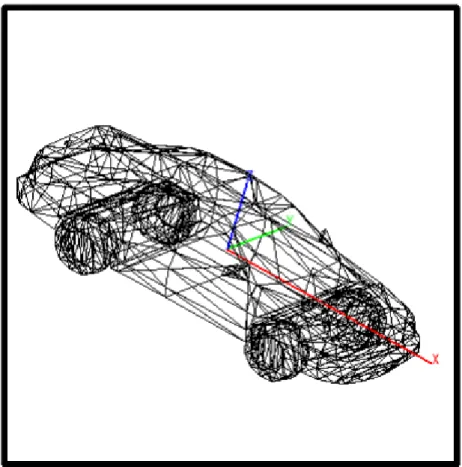
A 3D model of a car was used to conduct the comparison (Fig. 1). There were 1,000 triangles in this unabstracted model. The original triangles were not distributed evenly over the surface of the object.
Figure 1. The original mesh of the 3D car model.
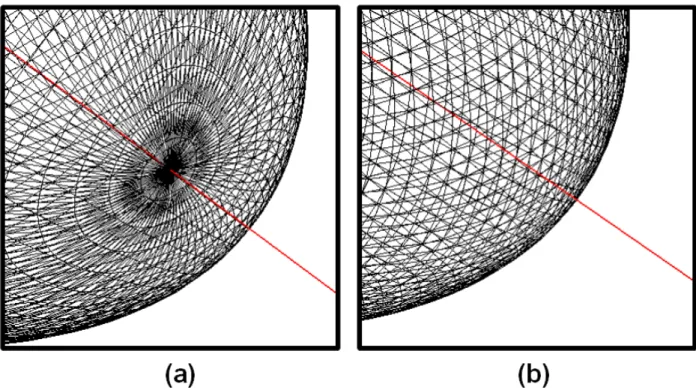
Next, a best-fitting ellipsoid was constructed for the car model. A triangular mesh, consisting of 40,000 triangles was constructed upon the ellipsoid's surface (Fig. 2(a)). A triangular mesh, consisting of 40,000 triangles was also constructed upon an icosahedron's surface, converted to a unit spheriod surface, and then its axes were scaled to match the size of the best-fitting ellipsoid (Fig. 2(b)). The ellipsoid-based mesh and the icosahedron-based mesh were each projected (“shrinkwrapped”) onto the surface of the 3D car model (Fig. 3).
Figure 2. A best-fitting ellipsoid for the 3D car model of Fig. 1 with the ellipsoid-based triangular mesh (a) and the icosahedron-based triangular mesh (b), each consisting of 40,000 triangles. Detail around the positive x-axis pole is shown. Note the clustering of triangles around the pole of the ellipsoid-based mesh on the left, and the lack of this dense grouping at the pole (and more evenly spaced mesh) of the icosahedron-based mesh on the right.
A qualitative analysis was conducted by visually comparing these two meshes. This comparison was facilitated by displaying the two meshes in 3D and then inspecting them by changing viewpoints (e.g. Fig. 3). Two characteristics were clear from this comparison. First, by using an icosahedron-based mesh, the high density of triangles near the poles of the ellipsoid (associated with the front and rear of the car) were eliminated. Second, the triangular facets of the icosahedron-based mesh were much more evenly distributed over the surface of the model.
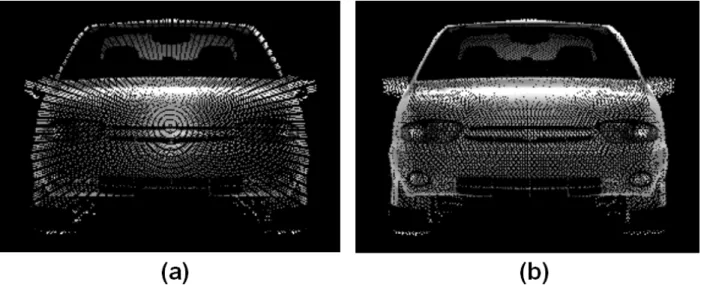
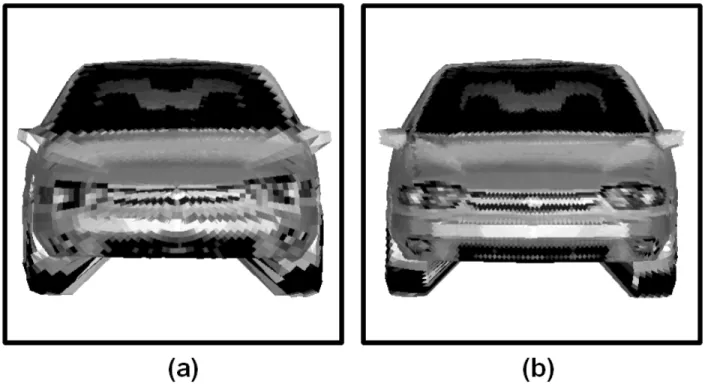
Use of the ellipsoid-based mesh and the icosahedron-based mesh for remote sensing simulations (e.g. Pope, 2008) was tested by projecting an actual image of a car onto each of these surfaces. The actual implementation of this process consisted of backprojecting the vertices of the triangular mesh onto the positive focal plane of a pinhole camera model. Each vertex was tagged with the greyscale value resulting from intersecting line-of-sight rays originating from the 3D mesh with the positive focal plane of the pinhole camera model (Fig. 4). Once each vertex was tagged, the greyscale information could be interpolated across the triangular facets of the mesh (Fig. 5).
Figure 4. Backprojection of a frontal view image of an actual car, associated with the 3D car model of Fig. 1, onto the ellipsoid-based triangular mesh of Fig. 2(a) (see (a)), and the icosahedron-based triangular mesh of Fig. 2(b) (see (b)). Note the concentration of image information around the positive x-axis pole incurred by the ellipsoid-based mesh on the left and the more even distribution of image information using the icosahedron-based mesh on the right.
Figure 5. Interpolation of the greyscale values for each vertex across the triangular facets of the ellipsoid-based (a) and icosahedron-based meshes (b) of Fig 4.
CONCLUSIONS AND FUTURE WORK
Use of an icosahedron-based triangular mesh has been found to be superior to the use of an ellipsoid-based triangular mesh, because the former avoids the high concentration of triangles near the poles which is characteristic of the latter. This mesh generation capability provides a data structure which exhibits useful mesh characteristics (e.g. approximately evenly spaced vertices, an encapsulating surface, abstraction of model features to a particular spatial scale, etc.) Use of this data structure for surface-based image processing (e.g. cross correlation) will be the topic of future work.
REFERENCES
Heller L., Schlitt H.A., Ranken D.M., Best E.D., 1995. Comparison of a Realistic Head Model with Spherical Approximations for MEG: Forward Problem, Human Brain Mapping, Supplement 1, Wiley-Liss, New York, p. 97.
Pope, P., 2008. Synthetic Image Chip Generation through Photogrammetric and Computer Graphic Techinques.
Proc. of the 2008 ASPRS Annual Meeting, Portland, Oregon, April 28 - May 2 , unpaginated CDROM. Pope, P., 2009. ShrinkWrap: 3D Model Abstraction for Remote Sensing Simulations. Proc. of the 2009 ASPRS