A
Resource
Guide
for
Transplant
Surveyors
Prepared for:
Survey and Certification Group
Center for Medicaid, CHIP and Survey & Certification Centers for Medicare & Medicaid Services
Prepared by: Catapult Consultants, LLC 2300 Clarendon Blvd., Suite 1005 Arlington, VA 22201 Phone: 703-849-0960 Fax: 703-852-2843 [email protected] www.catapultconsultants.com September 8, 2010
Quality
Assessment
and
Performance
Improvement
Quality Assessment and Performance Improvement (QAPI) Programs
A
Resource
Guide
for
Transplant
Surveyors
T
ABLE
OF
C
ONTENTS
Introduction ... 1
Use of the QAPI Worksheet ... 1
A. Components of a QAPI Program in Transplantation ... 2
The Structure of a Transplant QAPI Program ... 2
QAPI Methods ... 3
QAPI Tools/ Instruments ... 4
Quality Assessment ... 6
Definition ... 6
Objective Measures ... 6
Quality Assessment Activities ... 8
Performance Improvement... 10
Definition ... 10
Performance Improvement Activities ... 10
Adverse Events ... 11
B. Completing the QAPI Worksheet ... 15
QAPI Worksheet General Program Information ... 15
QAPI Worksheet Part 1: Policies and Procedures for QAPI Program ... 15
Policies and Procedures ... 16
QAPI Meetings ... 16
Peer-protected Information ... 17
A Comprehensive QAPI Program ... 18
Linking with the Hospital’s QAPI Program ... 18
QAPI Worksheet Part 2: Evaluation and Monitoring the Transplant Program by the QAPI ... 19
QAPI Worksheet Part 3: Review of Objective Measures ... 22
Review of Objective Measures – Transplant Recipients ... 22
Review of Objective Measures – Living Donors ... 24
QAPI Worksheet Part 4: Performance Improvement Actions/ Activities and Prior Non-Compliance, Complaints and Adverse Events ... 26
Program Actions/ Activities ... 28
Resolution of Prior Non-Compliance, Complaints and Adverse Events ... 29
QAPI Worksheet Part 5: Transplant Program’s Adverse Event Policies/ Procedures and Analysis ... 30
Adverse Event Policies/ Procedures ... 30
Adverse Event Analysis ... 30
C. Surveying Techniques ... 32
Entrance Conference/ Written Materials ... 32
Observations ... 32
Interviews ... 33
Interviewing QAPI Personnel ... 33
Interviewing Non-QAPI Personnel ... 33
Interviewing Patients/ Living Donors ... 34
Conclusion/ Exit Conference ... 34
Bibliography ... 35
I
NTRODUCTION
Two additional tools have been developed to assist transplant surveyors in conducting transplant program surveys. Transplant surveyors already have an Organ Transplant Surveyor Workbook and a computer – based resource. The two new tools, Quality Assessment and Performance Improvement (QAPI) Programs, A
Resource Guide for Transplant Surveyors and the “Surveyor Worksheet- Organ Transplant Program, Quality Assessment and Performance Improvement,” will be incorporated into both the Organ Transplant Surveyor Workbook and computer-based resource online in the near future.
The Quality Assessment and Performance Improvement (QAPI) Programs, A Resource Guide for Transplant Surveyors was developed for the Centers for Medicare & Medicaid Services (CMS) to assist transplant surveyors with the completion of the “Surveyor Worksheet- Organ Transplant Program, Quality Assessment and Performance Improvement,” also known as the QAPI Worksheet. The QAPI Worksheet is used by transplant surveyors to determine transplant programs’ compliance with the Quality Assessment and Performance Improvement (QAPI) regulations.. The QAPI Worksheet was developed for three primary reasons:
1. The national need to ensure transplant surveyors understand the QAPI regulations and survey guidelines;
2. Further describe CMS expectations for a comprehensive transplant QAPI program; and
3. Provide surveyors with a tool that provides/promotes a consistent application of the QAPI regulation.
Use of the QAPI Worksheet
It is important that all surveyors complete the QAPI Worksheet. The information entered on the QAPI Worksheet will be used to further refine and develop not only the QAPI Worksheet and Resource Guide, but any other materials that might prove useful for transplant surveyors. CMS will also track the information so that at the end of September 2011 CMS will know in which areas the programs excel and which areas may need additional work.
It is CMS’s expectation that all transplant surveyors applying the QAPI regulations will completely fill out and use the QAPI Worksheet. For the year October 2010 through September 2011, once the transplant surveyors have completed the 2567 for the transplant survey in ASPEN, the transplant surveyors will need to send the completed QAPI Worksheet to:
Catapult Consultants, LLC
2300 Clarendon Blvd., Suite 1005 Arlington, VA 22201,
A.
C
OMPONENTS OF A
QAPI
P
ROGRAM IN
T
RANSPLANTATION
It is important for surveyors to have a basic understanding and conceptualization of a provider’s purpose and practices. This is particularly true for transplant surveyors especially in the areas of Quality Assessment and Performance Improvement. This Resource Guide is organized to familiarize the transplant surveyor with basic concepts of QAPI and then walk through the transplant QAPI worksheet which will review and explain in more detail the specific regulatory expectations of a Transplant QAPI.
The Structure of a Transplant QAPI Program
Transplant QAPI programs oversee the overall quality management of the transplant program, which is typically comprised of two main components:
1. Quality Assessment 2. Performance Improvement
The structure of a transplant QAPI program is generally described in detail in the program’s QAPI/ Quality Plan, which may also be known as the program description document or the policies and procedures. The QAPI Plan should be reviewed by transplant program QAPI personnel or the QAPI Committee/ Council on a regular basis. Topics commonly found in a QAPI Plan include:
• General QAPI program description and overview,
• Organization structure to include an Organization Chart and reporting lines, • Goals, objectives and purpose of the QAPI program,
• QAPI Committee/ Council description and structure, • Roles and responsibilities of the QAPI personnel, • Reporting mechanisms,
• Process for activities relating to adverse events,
• List of indicators for monitoring Quality Assessment and Performance Improvement activities, and • Methods for Quality Assessment and Performance Improvement activities and for monitoring
compliance with regulations/ standards.
A transplant QAPI program usually contains a QAPI committee/ council. The transplant QAPI policies and procedures or the QAPI Plan should describe the QAPI committee/ council’s:
• Regular members/ meeting attendees, • Responsibilities,
• Quality Assessment and Performance Improvement procedures (including how improvements are tracked),
• Decision process concerning data collection and tracking,
• Decision process regarding indicators for monitoring Quality Assessment and Performance Improvement activities, and
• Frequency of the transplant QAPI meetings.
QAPI for transplant programs includes two processes, Quality Assessment and Performance Improvement; which incorporate the development of objective measures relating to transplant processes and patient outcomes; identifying acceptable benchmarks to measure quality; identifying gaps in performance with needed
Transplantation includes three phases of transplantation (pre-transplant, such as evaluation, patient selection and waiting list management; transplant, such as surgical protocols, immunosuppression, cold ischemic times; and post-transplant, such as medication effectiveness, support services and health maintenance) and can include all three phases for both the transplant recipient and the living donor. This Resource Guide provides the transplant surveyor with different element of Quality Assessment and Performance Improvement as well as how they relate to the three phases of transplantation.
QAPI
Methods
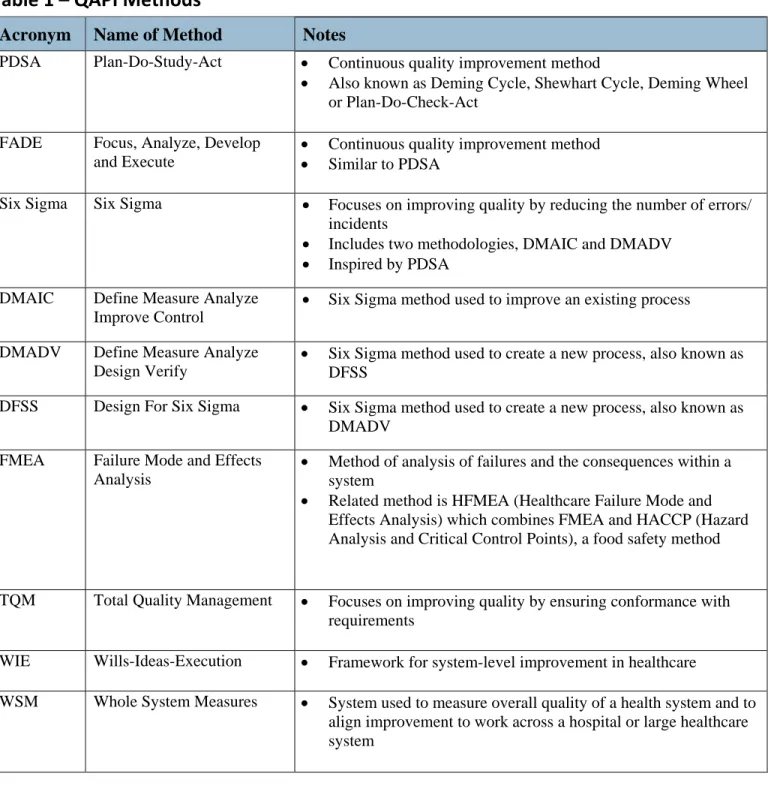
Quality Assessment and Performance Improvement methods include the identification and selection of data for analysis with the intent to create new processes or improve existing processes in order to improve the overall quality of the program procedures. The QAPI method used by the transplant program is often documented in the program’s QAPI Plan, policies or procedures and may influence how the program performs its Quality Assessment and Performance Improvement activities. Many different QAPI methods are utilized by transplant QAPI programs.
Surveyors need to be aware that:
• Transplant QAPI programs may have adapted and re-named a more well-known method for their own use,
• There are often “hybrid” methods developed and tailored to fit transplant QAPI programs, and • Often transplant QAPI programs confuse “Quality Assessment” and “Performance Improvement”
methods and tools.
Examples of some QAPI methods are included in the table below so that surveyors will understand the possible QAPI methods that may be used. The inclusion of a method in this Resource Guide does not constitute a recommendation or endorsement that a program is expected to use a particular method. A transplant program may use any method that fulfills the requirements of the regulation. The QAPI regulations do not specify which particular method is to be used by a transplant program, but rather expects whatever method is chosen meets the needs of the transplant program and the intent of the QAPI regulations. Regardless of the method chosen, follow-up monitoring needs to also be documented to ensure that the process is operating as intended.
Some commonalities that exist among the more frequently used QAPI methods are usually seen in the method’s discussion and/ or use of:
• Goals/ criteria, standards/measures, • Data analysis/evaluation,
• Repetition of continuous cycle, and • Roles/ responsibilities/interactions.
The following table includes some of the more frequently used QAPI methods. Note that the table does not include all available QAPI methods, but does include some of the more frequently used QAPI methods.
Table
1
–
QAPI
Methods
Acronym Name of Method Notes
PDSA Plan-Do-Study-Act • Continuous quality improvement method
• Also known as Deming Cycle, Shewhart Cycle, Deming Wheel or Plan-Do-Check-Act
FADE Focus, Analyze, Develop and Execute
• Continuous quality improvement method
• Similar to PDSA
Six Sigma Six Sigma • Focuses on improving quality by reducing the number of errors/ incidents
• Includes two methodologies, DMAIC and DMADV
• Inspired by PDSA DMAIC Define Measure Analyze
Improve Control
• Six Sigma method used to improve an existing process DMADV Define Measure Analyze
Design Verify
• Six Sigma method used to create a new process, also known as DFSS
DFSS Design For Six Sigma • Six Sigma method used to create a new process, also known as DMADV
FMEA Failure Mode and Effects Analysis
• Method of analysis of failures and the consequences within a system
• Related method is HFMEA (Healthcare Failure Mode and Effects Analysis) which combines FMEA and HACCP (Hazard Analysis and Critical Control Points), a food safety method
TQM Total Quality Management • Focuses on improving quality by ensuring conformance with requirements
WIE Wills-Ideas-Execution • Framework for system-level improvement in healthcare
WSM Whole System Measures • System used to measure overall quality of a health system and to align improvement to work across a hospital or large healthcare system
QAPI
Tools/
Instruments
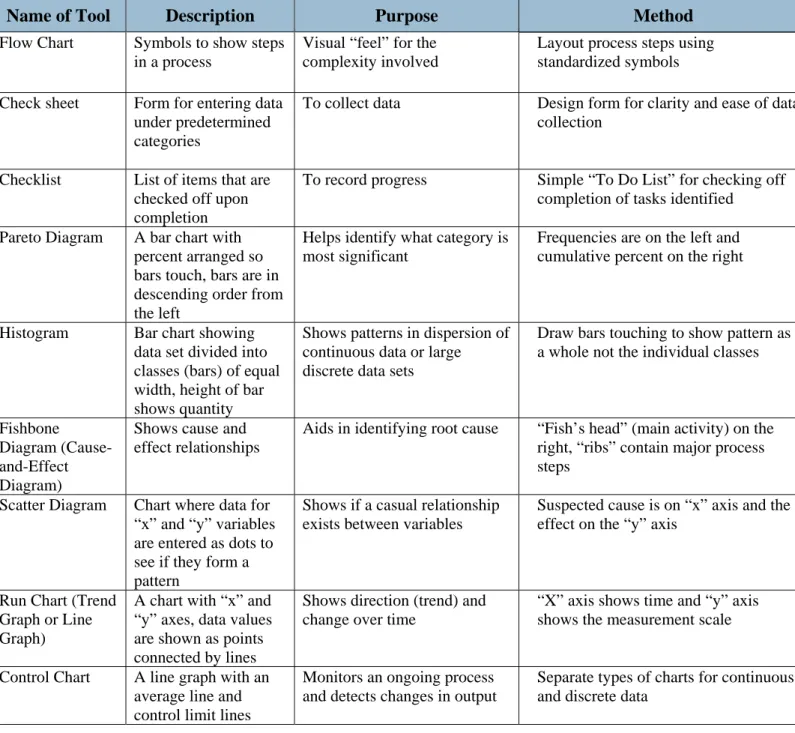
To assist with data collection and analysis, some examples of QAPI tools are included in the table below. While this document describes tools used for capturing and documenting data, the examples presented do not replace or represent official QAPI regulations. The inclusion of a tool/ instrument in this Resource Guide does not constitute a recommendation or endorsement that a program is expected to use a particular tool/ instrument. A transplant program may use any tools/ instruments it wishes. . The QAPI regulations do not specify which particular tools/ instruments that a transplant program must use, but rather expects whatever tool/ instrument is
chosen meets the needs of the transplant program and the intent of the QAPI regulations. The following table does not include all available QAPI tools/ instruments, but does include some of the more frequently used tools/ instruments.
Table
2
‐
QAPI
Tools
/
Instruments
1
Name of Tool Description Purpose Method
Flow Chart Symbols to show steps in a process
Visual “feel” for the complexity involved
Layout process steps using standardized symbols
Check sheet Form for entering data under predetermined categories
To collect data Design form for clarity and ease of data collection
Checklist List of items that are checked off upon completion
To record progress Simple “To Do List” for checking off completion of tasks identified
Pareto Diagram A bar chart with percent arranged so bars touch, bars are in descending order from the left
Helps identify what category is most significant
Frequencies are on the left and cumulative percent on the right
Histogram Bar chart showing data set divided into classes (bars) of equal width, height of bar shows quantity
Shows patterns in dispersion of continuous data or large discrete data sets
Draw bars touching to show pattern as a whole not the individual classes
Fishbone Diagram (Cause-and-Effect Diagram)
Shows cause and effect relationships
Aids in identifying root cause “Fish’s head” (main activity) on the right, “ribs” contain major process steps
Scatter Diagram Chart where data for “x” and “y” variables are entered as dots to see if they form a pattern
Shows if a casual relationship exists between variables
Suspected cause is on “x” axis and the effect on the “y” axis
Run Chart (Trend Graph or Line Graph)
A chart with “x” and “y” axes, data values are shown as points connected by lines
Shows direction (trend) and change over time
“X” axis shows time and “y” axis shows the measurement scale
Control Chart A line graph with an average line and control limit lines
Monitors an ongoing process and detects changes in output
Separate types of charts for continuous and discrete data
1
Quality Assessment
Definition
Quality Assessment is one of the two main components of the overall quality management of the transplant program. Quality Assessment and Performance Improvement are separate processes that have activities which are related to and influence the activities of the other process.
Quality Assessment is defined as a “process for ensuring compliance with specifications, requirements or standards and identifying indicators for performance monitoring and compliance with standards.”2
Objective
Measures
Integral to Quality Assessment are the development and use of objective measures. Objective measures are specific attributes that are the basis for assessing quality in a particular area, have to be measureable/ observable and constrained by a timeframe. Both Quality Assessment and Performance Improvement need objective measures. A transplant QAPI program must use objective measures to evaluate the transplant center’s activities and outcomes.
In building an understanding of a successful QAPI, the surveyor needs to take note of the difference between a “transplant activity/ process” and a “patient outcome” as distinguishing these two elements is essential when evaluating the scope of the program’s objective measures. There are numerous transplant processes and patient outcomes within each of the three phases of transplantation (pre-transplant, transplant and post-transplant) for both the recipient and the donor when surveying a Transplant QAPI Program.
• Transplant Activity/ Process – Defined as a series of actions (e.g.. informed consent by transplant patient) or functions (e.g. cold ischemic time of organ) during the delivery of patient care within the program’s system that result in an organ transplant.
• Patient Outcome – Defined as either a measurement (e.g. serum creatinine) or an event (e.g. death or need for dialysis) that is the result of the transplant process and directly affects the length or quality of a person’s life. An outcome is potentially modifiable by a defined intervention
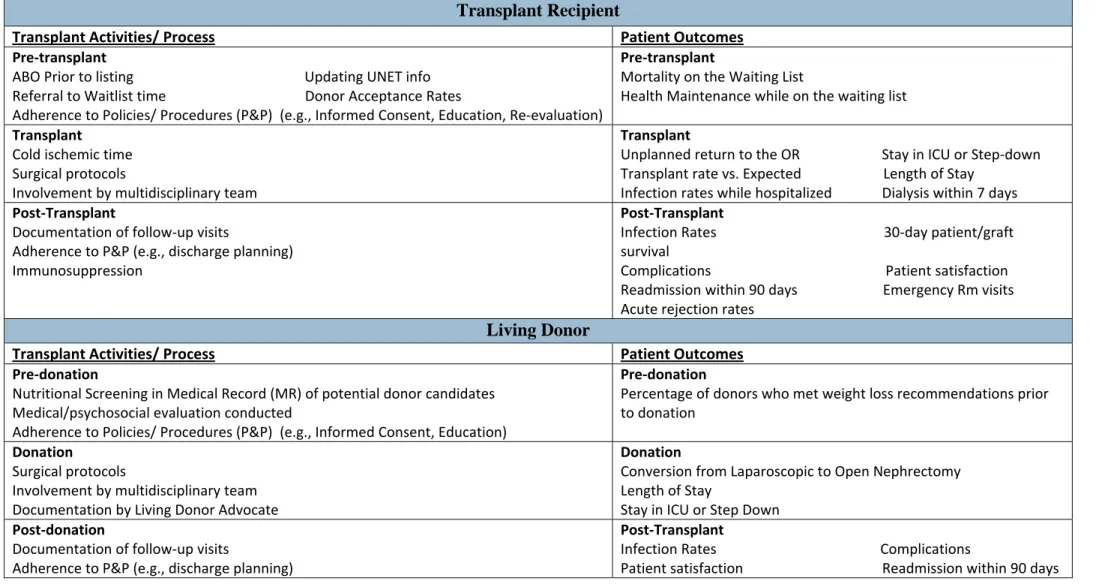
The regulation requires that the QAPI program be comprehensive. The transplant program must have objective measures for transplant processes/activities and outcomes for each phase of transplantation (pre-transplant, transplant and post-transplant) relating to transplant recipients and also for living donors. Table 3 in this QAPI Resource Guide contains several examples for relating objective measures to transplant processes and patient outcomes for each of the three phases of transplantation (pre-transplant, transplant and post-transplant) for both the recipient and the donor.
2
Elizabeth R. Ransom, et al., The Healthcare Quality Book Vision, Strategy, and Tools Second Edition (Chicago, IL: Health Administration Press and Washington, DC: AUPHA Press, 2008) 331.
Table 3 ‐ Examples of Objective Measures in Each Phase of Transplantation for Recipient and Living Donors
Note: To assist the surveyor in organizing all the Transplant QAPI program materials and information, the QAPI Worksheet contains charts and checklists. Table 3 is to be used to document the Quality Assessment measures being used for both the transplant recipient and living donor in the three phases of transplantation: pre-transplant, transplant, and post-transplant. In this Resource Guide, examples of what the surveyor may find are given, but under no circumstances is it the expectation that these are the only possibilities. The transplant program does not need to have all the measures listed – these are just examples of measures for each category.
Transplant Recipient
Transplant Activities/ Process Patient Outcomes
Pre‐transplant
ABO Prior to listing Updating UNET info
Referral to Waitlist time Donor Acceptance Rates
Adherence to Policies/ Procedures (P&P) (e.g., Informed Consent, Education, Re‐evaluation)
Pre‐transplant
Mortality on the Waiting List
Health Maintenance while on the waiting list
Transplant
Cold ischemic time
Surgical protocols
Involvement by multidisciplinary team
Transplant
Unplanned return to the OR Stay in ICU or Step‐down
Transplant rate vs. Expected Length of Stay
Infection rates while hospitalized Dialysis within 7 days
Post‐Transplant
Documentation of follow‐up visits
Adherence to P&P (e.g., discharge planning)
Immunosuppression
Post‐Transplant
Infection Rates 30‐day patient/graft
survival
Complications Patient satisfaction
Readmission within 90 days Emergency Rm visits
Acute rejection rates
Living Donor
Transplant Activities/ Process Patient Outcomes
Pre‐donation
Nutritional Screening in Medical Record (MR) of potential donor candidates
Medical/psychosocial evaluation conducted
Adherence to Policies/ Procedures (P&P) (e.g., Informed Consent, Education)
Pre‐donation
Percentage of donors who met weight loss recommendations prior
to donation
Donation
Surgical protocols
Involvement by multidisciplinary team
Documentation by Living Donor Advocate
Donation
Conversion from Laparoscopic to Open Nephrectomy
Length of Stay
Stay in ICU or Step Down
Post‐donation
Documentation of follow‐up visits
Adherence to P&P (e.g., discharge planning)
Post‐Transplant
Infection Rates Complications
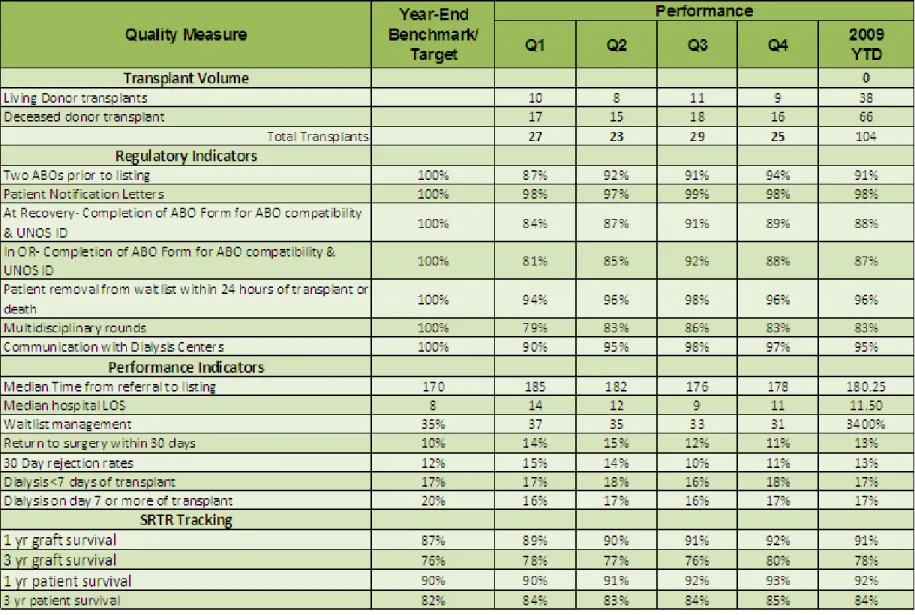
The transplant program is expected to clearly define the objectives for both transplant process and patient outcome measures tracked and monitored during the QAPI process. Clear and precise definitions help ensure consistency in the way the transplant program collects the data to evaluate the measure, as well as consistency in the analysis over time. The transplant program’s measures are typically included on the program’s
Dashboard, the QAPI Plan and/ or in the transplant QAPI policies and procedures. While all measures need clear and precise definitions, examples of measures that are broad and could have different interpretations if clear and precise definitions are not provided include:
• Adherence to Policies and Procedures (which policies and procedures are included), • Complication Rates (what types of complications are included),
• Environmental Factors, • Infection Rates, and
• National Patient Safety Goals.
Quality
Assessment
Activities
A transplant program’s Quality Assessment program includes all activities that ensure compliance with regulations and requirements, such as identifying outcomes, establishing benchmarks and the monitoring performance. Quality Assessment often involves the coordinated efforts of staff with multiple skills and from different specialties/ disciplines working together to improve transplant quality of care. Personnel involved in Quality Assessment may identify the processes and outcomes integral to the program, develop objectives, select indicators and benchmarks for the processes and outcomes, and analyze the program results on a regular basis. Quality Assessment activities may include both regularly scheduled analyses of established outcomes and data collection and completion of specific projects.
Quality Assessment, and the related methods and tools, may also be referred to as: • Performance Measurement/ Assessment/ Assurance,
• Program Measurement/ Assessment/ Assurance, or • Quality Measurement/ Assurance.
Monitoring of the transplant program’s performance is important for the transplant program to ensure successful outcomes for their patients. Without a coordinated effort by all transplant staff, this goal may fall short. Well thought out Quality Assessment activities combined with careful selection of performance improvement activities will lead to improved transplant services.
Surveyors, through observations and interviews, are expected to ensure that different levels of staff are involved with the Transplant QAPI program; that the QAPI Program had adequate dedicated staff to do the job well and accurately, and that communication of QAPI objectives, benchmarks and discoveries are shared with Transplant staff.
Benchmarks
Benchmarks are quantitative points of reference by which a program’s objective measures can be assessed, monitored and compared. Benchmarks may also be known as standards or targets. Each objective measure must have an associated benchmark for determining acceptability of performance. Programs need to regularly assess the benchmark or level of acceptable performance on each objective measure.
Possible benchmark sources the transplant QAPI program may use to review, compare, monitor and evaluate the program activities include:
• Best practices of different disciplines/ professions, which may include practice guidelines, protocols, care maps, appropriations criteria, credentialing requirements and checklists;
• Research;
• Compliance with regulations;
• National benchmarks/ industry standards;
• The program’s own findings, data and/ or independent discovery; • Various decision aids, such as checklists, reminders, alerts and prompts; • Outcomes of the analysis of adverse events/ sentinel events/ accident reports; • Clinical variances from standards of care;
• Funding sources;
• Response to complaints;
• Results of complaint investigations; and
• Participation in national transplant registries/databases.
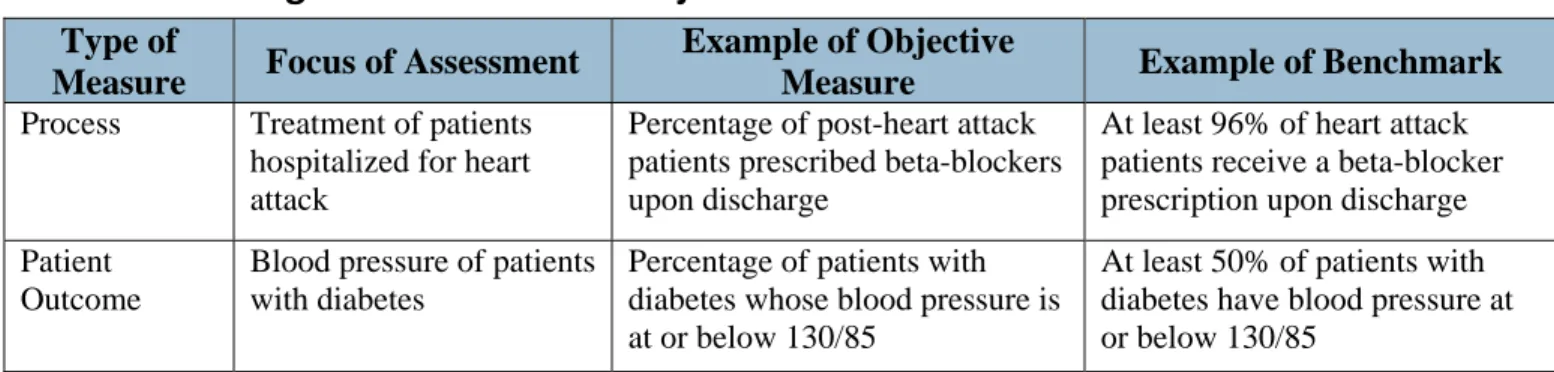
Table 4 gives an example of benchmarks related to Quality Assessment objectives for both process and outcome.
Table
4
‐
Relating
Benchmarks
with
Objective
Measures
Type of
Measure Focus of Assessment
Example of Objective
Measure Example of Benchmark
Process Treatment of patients hospitalized for heart attack
Percentage of post-heart attack patients prescribed beta-blockers upon discharge
At least 96% of heart attack patients receive a beta-blocker prescription upon discharge Patient
Outcome
Blood pressure of patients with diabetes
Percentage of patients with diabetes whose blood pressure is at or below 130/85
At least 50% of patients with diabetes have blood pressure at or below 130/85
System for Collection/ Analysis
For benchmarks to be useful, a documented data-driven method to collect the results of the program’s
designated measures is required. The transplant surveyor must identify data collection processes, record review (manual or computer), observations, staff reporting, protocol adherence, incident analysis, and random spot checks and any other techniques that may be used by a QAPI program. As with data collection, the surveyor would expect to find a description of how the collected data will be analyzed, compared to previous data, aggregated, averaged or graphed, and who will analyze the data. After the data has been collected and analyzed it needs to be reviewed and discussed by the QAPI committee/ council who should decide if the results of the analyses, as well as any identified trends are significant and warrant further assessment and/ or the development of performance improvement activities. The transplant program’s system for collection and analysis for
Ensuring Measures are Valid
As a final note, the transplant program must ensure that the actual monitoring and data collection activities are accurate and timely. Some examples of evaluation and monitoring activities include sampling, parallel
collection, spot checks (e.g. reviewing one record and checking if results are repeated), and data queries.
Performance Improvement
Definition
Performance Improvement is the second component of the overall quality management of the transplant program. Quality Assessment and Performance Improvement are separate processes that may have unique activities.
Performance Improvement is defined broadly as “an organized, structured process used to identify parts of the transplant program that need addressing due to failure to meet Quality Assessment expectations and/ or results of adverse events. Often, transplant program staff may identify processes, policies, protocols that need changes or refinement analyzing, or at the very least further study”.
Performance
Improvement
Activities
Performance Improvement activities includes all activities related to the achievement of improvement within the transplant program. Performance Improvement projects that have been implemented within the transplant program need to be effective and sustainable.
Performance Improvement, and the related methods and tools, may be also be referred to as: • Quality Improvement,
• Process Improvement, or • Program Improvement.
Performance Improvement activities include:
1. A review transplant performance compared to established benchmarks (identified during Quality Assessment activities) to determine areas where changes may be needed to improve operations or services, and
2. Identification and prioritization of special activities/ studies that will lead to changes to improve services.
The transplant program is expected to address in their policies and procedures how the QAPI committee/ council/ staff determine the topics/ areas of concern for performance improvement. Some of the most common techniques used by QAPI programs to determine the topics/ areas of concern for performance improvement are:
• Prioritizing results from the program’s Quality Assessment activities; • Brainstorming;,
• Responding to complaints;
• Use of nationally established priorities; and • Leveraging the resources available.
The policies and procedures for Performance Improvement need to also detail: • The process used to analyze the selected issue;
• How possible solutions are generated;
• How recommendations for changes are determined; and
• How the impact of the changes will be monitored for durability.
The CMS transplant regulations do not dictate how the four above-mentioned activities will be accomplished, but rather expect the program to develop a method that best works for themselves.
Consider the following questions when conducting a review of a transplant QAPI program’s Performance Improvement activities:
1. How does the QAPI program assure that once a change is implemented that the program maintains its effectiveness of the change?
2. Does the QAPI program have a way to double check the accuracy of the data/ information collected as part of their PI activities/ projects?
3. If staff training is the designated corrective action or is necessary for performance improvement, how does the QAPI program assure that the training is effective?
4. How is staff throughout the transplant program notified of changes/ modifications?
A well-established framework for ensuring compliance will not, in itself, guarantee success. A QAPI program’s success will also depend on strong execution.
Adverse
Events
The transplant program must have a clear description of what constitutes an adverse event during any of the three phases of transplantation (pre-transplant, transplant and post-transplant), and must have a process to identify, report, analyze and prevent adverse events.
The transplant regulations define an adverse event as: “an untoward, undesirable, and usually unanticipated event that causes death or serious injury, or the risk thereof. As applied to transplant centers, examples of adverse events include (but are not limited to) serious medical complications or death caused by living donation; unintentional transplantation of organs of mismatched blood types; transplantation of organs to unintended recipients; and unintended transmission of infectious disease to a recipient.”3
The transplant program may share or have the same definition of adverse event as the hospital. Regardless, it must be at least as stringent as CMS’s definition, which defines an adverse event as “an untoward, undesirable, and usually unanticipated event that causes death or serious injury, or the risk thereof. As applied to transplant centers, examples of adverse events include (but are not limited to) serious medical complications or death caused by living donation; unintentional transplantation of organs of mismatched blood types; transplantation of organs to unintended recipients; and unintended transmission of infectious disease to a recipient.” It is
acceptable for a transplant program to use the same adverse event processes as the hospital as long as the surveyor is able to verify that all adverse events related to transplant services follow these processes QAPI
3
policies and procedures must establish and manage through consistent standards of documentation and reporting, a mechanism to react to remediation requirements and provide a communication channel for the transplant staff. Additionally, the QAPI policies and procedures must include a description of how adverse events related to transplant services are communicated to the transplant QAPI staff.
Root Cause Analysis
A Root Cause Analysis (RCA) is one of the most universally used set of steps during the investigation of an adverse event and is often used to identify performance issues, related causes and needed improvements. RCA’s strength is that when done correctly, it leads to the identification of the primary cause of the problem and related secondary causes.
The CMS regulation states that a transplant center must establish and implement written policies to address and document adverse events that occur during any phase of an organ transplantation case. The policies must address at a minimum, the process for the identification, reporting, analysis and prevention of adverse events. (X102)
The transplant program may be part of the hospital’s adverse event analysis team/ committee/ council, but it is expected that any adverse event impacting transplant services is also reviewed and becomes part of the
transplant QAPI program. The below chart is provided as a summary of the purpose of a RCA and as a reference point for transplant program surveyors.
Table
5
‐
Purpose
of
a
Root
Cause
Analysis
Questions Actions
What happened? • Description of events/ activities/ actions that caused the adverse event Why did it happen? • Identify contributing factors to the adverse event
What follow-up and/or performance improvement projects need to done?
• Develop a plan to prevent repeat incidences or after the analysis determine that no opportunities for improvement exist
A Root Cause Analysis may be performed by:
• Transplant QAPI personnel that report directly to hospital QAPI staff, • The hospital’s QAPI personnel,
• The hospital and transplant’s QAPI personnel working together,
• The hospital’s or transplant program’s Human Resources (HR) personnel, or • Other personnel specifically designated to handle investigation of adverse events.
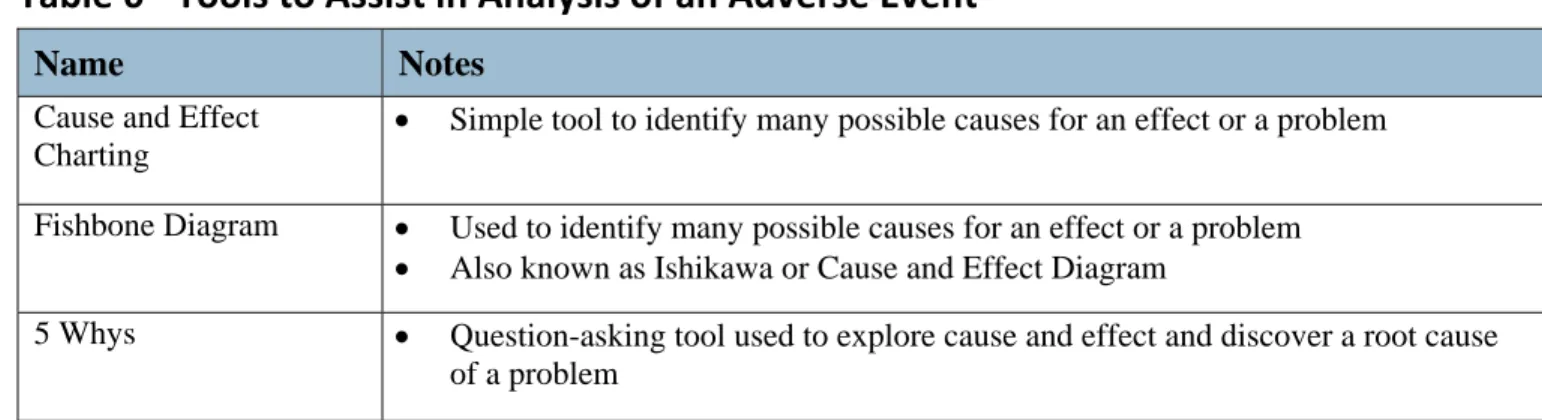
A RCA performed by Transplant QAPI personnel that report to the transplant program could constitute a potential conflict of interest as the personnel cannot be considered an independent party. Different techniques can be used for analyzing adverse events and for tracking and incorporating changes in the program’s policies and procedures dealing with transplant adverse events. Examples of tools to assist in the analysis of an adverse event are displayed in the table below. This table does not include all available tools used in the analysis of an adverse event, but does list some of the more commonly used tools. It is important to note that CMS does not subscribe or advocate for a particular type of tool, provided that there is a thorough analysis.
Table
6
‐
Tools
to
Assist
in
Analysis
of
an
Adverse
Event
Name Notes
Cause and Effect Charting
• Simple tool to identify many possible causes for an effect or a problem Fishbone Diagram • Used to identify many possible causes for an effect or a problem
• Also known as Ishikawa or Cause and Effect Diagram
5 Whys • Question-asking tool used to explore cause and effect and discover a root cause of a problem
Example 1 -Fishbone Diagram4
Use the fishbone diagram to systematically sort all of the contributing causes for problems being analyzed. Typical cause categories include: people, equipment, methods/process, materials, policies, environment & measurement.
Step 1. Define the problem in a brief statement at the ‘head’ of the fish.
Step 2. It is often useful to organize the possible causes into major cause categories and write at the end of each 'large
bone' of the fish. A commonly used format it to categorize causes as equipment, process, people, materials, environment or management causes.
Step 3. Brainstorm all possible causes within the major cause categories on each ‘small bone’ of the fish.
Step 4. Once all the causes have been identified brainstorm solutions for each of possible causes. If there are a significant
number of causes identified, prioritize the causes then brainstorm solutions.
4
Example 2 - Root cause analysis utilizing ‘5 Whys’ Tool5
The ‘5 Whys’ tool lends itself to a more narrative version when examining adverse events. One of the benefits derived from using this tool is the ability to drill down to the problem’s root cause by peeling away peripheral data and focusing the reasons the adverse event occurred. However, once defined the steps leading to the adverse event can be scrutinized.
How to Complete the ‘5 Whys’
1. Write down the specific problem. Writing the issue helps you formalize the problem and describe it completely.
2. Ask Why the problem happens and write the answer down below the problem.
3. If the answer you just provided doesn’t identify the root cause of the problem that you wrote down in step 1, ask Why again and write that answer down.
4. Look back to step 3 until the team is in agreement that the problem’s root cause is identified. Again, this may take fewer or more times than five Whys.
Assuring Effectiveness of Changes
The Root Cause Analysis (or any other form of analysis) generally results in specific recommendations/ action steps to correct or prevent repeat occurrences of the adverse event. If there are no specific recommendations/ action steps a sound rationale for not making any changes to the transplant program policies, procedures, and protocols, must be documented. A surveyor may find that specific recommendations/ action steps are recorded by the transplant program in any of the following:
• Adverse Events Log,
• Performance Improvement Log,
• Completed Root Cause Analysis Form (or any other type of analysis form), • Quality/ Safety/ QAPI Meeting Minutes, or
• Dashboard.
Identifying needed changes does not assure that changes have been made and are effective. The transplant program must have procedures in place to assure that change is implemented and communicated to all applicable staff. Once changes are implemented, they need to be measured in terms of its continued effectiveness. Quality Assessment and Performance Improvement is a continuous process. Once QAPI
personnel know that change has been implemented they also need to assess whether the change has resulted in a performance improvement. The transplant program needs to continuously monitor changes and additional improvements should be considered as needed.
B.
C
OMPLETING THE
QAPI
W
ORKSHEET
The “Surveyor Worksheet- Organ Transplant Program, Quality Assessment and Performance Improvement,” also known as the QAPI Worksheet, has been developed to assist transplant surveyors when performing a review of transplant QAPI programs. The QAPI Worksheet is used by transplant surveyors to determine transplant programs’ compliance to the QAPI regulations, tags and survey guidelines.
QAPI Worksheet General Program Information
The surveyor needs to ensure that the completed QAPI Worksheet includes:• The full names of the hospital and transplant center being surveyed, and • All of the transplant programs covered by the QAPI program.
If there are more than one transplant QAPI program at the transplant program a QAPI Worksheet must be completed for each distinct transplant QAPI program. A distinct transplant QAPI program will have separate QAPI policies, procedures and plan.
During the entrance conference, surveyors must request a copy of the transplant QAPI policies, procedures and plan including those describing:
• The structure of transplant QAPI program, • How the transplant QAPI program operates, • The handling of adverse events, and
• The process for using objective measures and performance improvement activities, • Log of adverse events.
QAPI Worksheet Part 1: Policies and Procedures for QAPI Program
Regulation: Transplant centers must develop, implement, and maintain a written, comprehensive, data‐driven QAPI
program designed to monitor and evaluate performance of all transplantation services, including services provided
under contract or arrangement. (X099)
The surveyor may utilize a variety of collection techniques in order to determine whether the transplant center has a written, comprehensive, data-driven QAPI program that has been implemented and maintained. To make this determination the surveyor must request documentation and ask questions during the entrance conference, review the program’s policies and procedures, review documented evidence of QAPI meetings, interview staff and patients/ living donors and observe operations at the transplant program.
Policies
and
Procedures
When reviewing transplant QAPI policies and procedures surveyors must determine if, as a whole, they describe the big picture as well as day-to-day operations as the surveyor has observed or learned. The
transplant QAPI policies and procedures are expected to lay out for the program’s transplant personnel exactly how the transplant QAPI program works.
During the QAPI record review the surveyor must confirm that:
1. The various points contained in the QAPI Worksheet are reflected in the transplant program’s QAPI policies and procedures, and
2. The policies and procedures match what the surveyor has learned first-hand through observations and interviews.
While comparing the various points in the QAPI Worksheet to the transplant program’s QAPI policies and procedures, the surveyor may find:
1. The members of the transplant QAPI committee/ council, 2. The expectations of the transplant QAPI committee/ council, 3. Support personnel that are designated as QAPI personnel, 4. The responsibilities of the transplant QAPI personnel,
5. Whether the transplant program’s QAPI meets the different components detailed in Part 4 of the Worksheet for performance improvement activities, and
6. Whether there are definitions for different parts of the QAPI program defined to be at least as stringent as CMS’s definitions.
When confirming that the transplant program’s policies and procedures match what the surveyor has learned first-hand through observations and interviews, the surveyor needs to confirm that:
• Patients are aware of the informed consent process, that they know exactly what they have signed and for what they gave permission. Patients have been provided with the program’s most recent transplant outcomes’ data, expressed patient needs are being addressed by the program and patients know who and how to contact help when needed.
• Standard level deficiencies cited in the last survey have been researched and discussed by the transplant program’s QAPI personnel and necessary changes have been made to the policies, procedures,
protocols, other written materials and staff and/ or patient behavior.
QAPI
Meetings
Seek evidence of:
• Meeting agendas, minutes and summaries from transplant QAPI meetings which specifically reflect the points discussed, results of the discussion, next steps with possible due dates and responsible person identified, or
• Reports and/ or presentations created by transplant QAPI staff, which may summarize data/ statistics and show compliance with pre-set benchmarks/ targets/ goals.
Peer
protected
Information
Certain QAPI documentation may be designated as peer-protected information, and as such is kept confidential from entities outside the hospital and/ or transplant program. These peer protections do not apply to surveys of the provider’s compliance or the Conditions of Participation
Examples of peer-protected information may include the discussions about and work products associated with: • Root Cause Analyses,
• Peer reviews, and
• Adverse event investigations
A
Comprehensive
QAPI
Program
CMS has defined a “comprehensive” transplant QAPI program to mean the inclusion of the three phases of transplantation (pre-transplant, such as evaluation, patient selection and waiting list management; transplant, such as surgical protocols, immunosuppression, cold ischemic times; and post-transplant, such as medication effectiveness, support services and health maintenance) for both the recipient and the donor. It is expected that the transplant QAPI program will have objective measures (see page 8 for a discussion of objective measures) to evaluate performance with respect to transplant activities/ processes and outcomes for each phase of
transplantation for both the recipient and the donor.
When using the QAPI Worksheet, the surveyor will review thoroughly the transplant QAPI program’s objective measures for transplant activities/processes and outcomes for each phase of transplantation (pre-transplant, transplant and post-transplant) relating to transplant recipients and also for living donors. For each organ
transplant program that is surveyed the surveyor needs to document at least six objective measures, for
transplant recipients (one transplant activity/ process measure and one outcome measure for each phase of transplantation, pre-transplant, transplant and post-transplant) and six objective measures for living donors (one transplant activity/ process measure and one outcome measure for each phase of transplantation, pre-transplant, transplant and post-transplant).
Take note of the difference between a “transplant process” and a “patient outcome” when documenting the program’s objective measures. There are several transplant processes and patient outcomes within each of the three phases of transplantation (pre-transplant, transplant and post-transplant) for both the recipient and the donor.
• Transplant Process – Defined as a series of actions or functions during the delivery of patient care within the program’s system that result in an organ transplant.
• Patient Outcome – Defined as either a measurement (i.e. serum creatinine) or an event (i.e. death or need for dialysis) that is the result of the transplant process and directly affects the length or quality of a person’s life. An outcome is potentially modifiable by a defined intervention. Outcome measures capture whether or not a benchmark/ target was achieved.
Linking
with
the
Hospital’s
QAPI
Program
As part of the transplant QAPI program structure there must be a clear, documented link between the hospital’s QAPI program and the transplant QAPI program which may be documented in the transplant program’s policies and procedures, organization chart or QAPI Plan. To confirm this link, review the evidence that describes:
• How information flows to and from the hospital and transplant QAPI programs, • How often the hospital and transplant QAPI programs communicate,
• What the reporting line is from the transplant QAPI program to the hospital QAPI program, and • Whether a member of the hospital QAPI program with the authority/ power to make/ dictate change is
part of the transplant QAPI committee/ council.
QAPI Worksheet Part 2: Evaluation and Monitoring the Transplant
Program by the QAPI
Regulation: The transplant center’s QAPI program must use objective measures to evaluate the center’s performance
with regard to transplantation activities and outcomes. (X100)
The program’s measures used to evaluate performance must: 1. Be objective,
2. Address activities/ processes and outcomes throughout the three phases of transplant relating to the
recipient (pre-transplant, transplant and post-transplant), and
3. Address activities/ processes and outcomes for all three phases of the donation process relating to the
living donor (pre-donation, donation and post-donation).
** As stated previously in this Resource Guide, for each organ transplant program that is surveyed the surveyor needs to document six objective measures, for transplant recipients (one transplant activity/ process measure and one outcome measure for each phase of transplantation, pre-transplant, transplant and post-transplant) and six objective measures for living donors (one transplant activity/ process measure and one outcome measure for each phase of transplantation, pre-transplant, transplant and post-transplant).
The transplant program must have a documented data-driven method to collect the results of the program’s designated measures. A data-driven methodology includes:
1. Which specific data will be collected, 2. How often the data will be collected,
3. Where the data will come from (records, observations, etc.), 4. Who is responsible for the data collections,
5. How the data will be analyzed (tallied and compared, charted for trends, tracked over identified time periods),
6. How often updates to the QAPI Committee/ Council (or others) is expected.
The results of the measures must be monitored and evaluated on a regular basis, and be a part of the program’s data-driven description. The results of the program’s data-driven measures are often tracked and monitored on the program’s Dashboard. Dashboards may monitor the program’s measures monthly, quarterly or any other designated time frame. A Dashboard may also be known as:
• Transplant Quality Assessment Dashboard, • Performance Measurement Report,
• Performance Assessment, • Quality Measurement Report or • Quality Assessment.
The surveyors will seek evidence that the transplant QAPI staff and committee/ council members are reviewing and discussing the results of the objective measures through written documentation like:
• QAPI committee/ council meeting agendas, • QAPI committee/ council meeting minutes, • QAPI presentations, and/or
• QAPI progress notes.
If a transplant program is having difficulties in a given area, review the objective measures to ensure that the issue is being tracked. For example, if the program does not meet the 1-year post transplant outcomes, confirm that this issue is one of the tracked measures.
QAPI
Worksheet
Part
3:
Review
of
Objective
Measures
Review of Objective Measures – Transplant Recipients
The transplant program’s measures must address transplant activities/ process and outcomes throughout the three phases of transplantation (pre-transplant, (pre-transplant, and post-transplant). Below are samples of completed charts from Part 3 of the “Surveyor Worksheet- Organ Transplant Program, Quality Assessment and Performance Improvement.” This chart represents a transplant center with two organ transplant programs for Adult Kidney Only (AKO) and Adult Liver (AL).
Table 8 ‐ Transplant Activities/ Process
Review Objective Measures. For each box, identify the program type and an example of at least one measure for each of the 3 categories. Examples: Pre‐transplant: AKO‐Completion of psychosocial evaluation; Transplant: ALO – ABO Verification
Note: Can combine adult/pediatric program types if they’re using the same measures. Pre‐
Transplant
AKO-ABO Prior to listing ALI-Referral to wait list time
AKO-Updating UNET info ALI-ABO prior to listing
Transplant AKO-Cold ischemic time ALI-Surgical protocols
ALI-Cold ischemic time
Post‐ Transplant
AKO-Graft survival ALI-Documentation of follow-up visits
AKO-Patient survival ALI-Pharmacy discharge planning
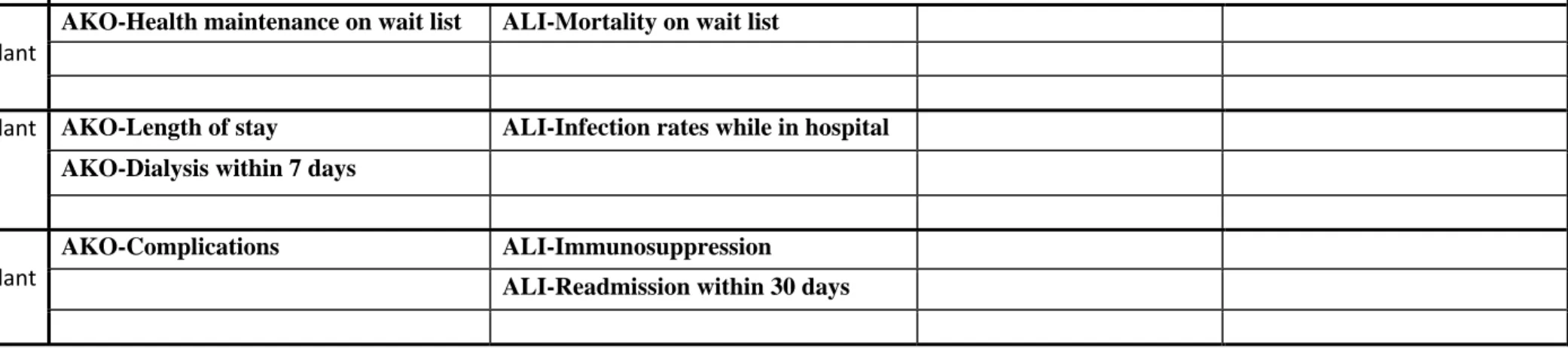
Table 9 ‐ Patient Outcomes
Review Objective Measures. For each box, identify the program type and an example of at least one measure for each of the 3 categories.
Examples for Pre‐transplant: AKO‐ Mortality while on Waiting List; Post‐Transplant: ALO – Acute Rejection
Note: Can combine adult/pediatric program types if they’re using the same measures. Pre‐
Transplant
AKO-Health maintenance on wait list ALI-Mortality on wait list
Transplant AKO-Length of stay ALI-Infection rates while in hospital
AKO-Dialysis within 7 days
Post‐ Transplant
AKO-Complications ALI-Immunosuppression
ALI-Readmission within 30 days
The below chart has both “Yes” and “No” sample answers.
Table 10 ‐ Summary in Reviewing Measures for Transplant Recipients
SUMMARY ‐ IN REVIEWING MEASURES FOR TRANSPLANT RECIPIENTS:
1. Are there benchmarks? If no, how does the program evaluate performance? Yes, the benchmarks are on the program’s dashboard. / No, the program
evaluates data quarterly at QAPI meetings.
2. Is data missing from any indicators? If yes, why? Yes, program doesn’t have a transplant-specific QAPI program. The only data reported is in the
hospital quality meeting minutes and this data is incomplete. / No data is missing.
3. Are any instances where other survey information (e.g., interview, records) show something different than what the program is reporting in the indicators (i.e., indicators
aren’t valid)? Yes, the program’s Data Manager reported during an interview that she collects data / No differences.
4. Is there agreement/ consistency between the measures how they are being measured and the analysis? (i.e. The program is measuring what it says it will be measuring and
the list of indicators is consistent throughout the QAPI process.) Yes, there is consistency. / No. The list of indicators is different on the Dashboard
Review of Objective Measures – Living Donors
The program’s measures must address transplant activities/ process and outcomes throughout the three phases of the donation process (pre-donation, donation, and post-donation). Below are samples of completed charts from Part 3 of the “Surveyor Worksheet- Organ Transplant Program, Quality Assessment and Performance Improvement.” This chart represents a transplant center with two organ transplant programs for Adult Kidney Only (AKO) and Adult Liver (AL).
Table 11 ‐ Transplant Program Activities/ Process
Review Objective Measures: Specify program type and example of measure for each category.
Note: Can combine adult/pediatric program types if they’re using the same measures. Example for pre‐donation: AKO‐ Completion of
psychosocial evaluation
Pre‐Donation AKO-Nutritional screening in MR ALI-Selection Committee Forms
ALI-Informed Consent
Donation AKO-Documentation by Living Donor
Advocate
ALI-ABO verification in OR
Post‐Donation AKO-Documentation of follow-up visits ALI-Multi-disciplinary team
documentation
ALI- OPTN follow-up forms completed
Table 12 ‐ Living Donor Outcomes
Review Objective Measures: Specify program type and example of measure for each category.
Note: Can combine adult/pediatric program types if they’re using the same measures.
Example for Donation: AKO‐ Conversion from laparoscopic to open nephrectomy
Pre‐Donation AKO-% of donors who met weight loss
recommendations prior to donation
ALI-Pharmacological assessment to include over-the-counter medications/products
Donation AKO-Conversion from laparoscopic to
open nephrectomy
ALI-Length of stay
Post‐Donation AKO-Complications ALI- Infection
ALI-Death of Donor
Table 13 ‐ Summary in Reviewing the Measures for Living Donors
The below chart has both “Yes” and “No” sample answers.
SUMMARY ‐ IN REVIEWING THE MEASURES FOR LIVING DONORS:
1. Are there benchmarks for each measure? If no, how does the program evaluate performance? Yes. / No, the program reviews data twice a year and looks
at whether or not numbers are increasing or decreasing.
2. Is data missing from any measures? If yes, why? Yes. The QAPI Plan states that the program’s Dashboard will track 12 measures, but the
Dashboard only shows tracking of 10 measures. / For the measures being tracked, none of the data is missing.
3. Are any measures that are inaccurate based on other information? Yes. The transplant program defines “multidisciplinary” as involvement of
surgical personnel and only one other discipline. / No.
4. Is there consistency in the specific measures that the program identifies are being tracked? (i.e. What the written policy says the program is tracking and the listing of
indicators is the same.) Yes, they are consistent. / No, the QAPI personnel stated during the interview that a different set of measures are
QAPI
Worksheet
Part
4:
Performance
Improvement
Actions/
Activities
and
Prior
Non
Compliance,
Complaints
and
Adverse
Events
Regulation: The transplant center must take actions that result in performance improvements and track performance to ensure that improvements are sustained.
(X101)
Part 4 of the QAPI Worksheet is related to the surveyor’s review of the transplant QAPI program’s Performance Improvement actions/ activities and non-compliance, complaints and adverse events identified during a prior survey. Surveyors will confirm that standard level deficiencies cited in the last survey have been researched and discussed by the transplant program’s QAPI personnel to determine exactly what is needed to correct the issue and maintain the correction. If QAPI personnel determine that a Performance Improvement project is necessary, the specific item to be improved needs to be described, as well as how the program expects the change will happen. The applicable Performance Improvement project needs to be monitored on a Performance Improvement log, the Dashboard or in the QAPI meeting minutes. There needs to be evidence with a description of the Performance Improvement project, the actions taken and the effect of the actions taken.
Below is an explanation of the columns on the charts entitled “Program Actions/ Activities” and “Resolution of Prior Enforcement Identified Problems” located on the “Surveyor Worksheet- Organ Transplant Program, Quality Assessment and Performance Improvement.”
Table 14 ‐ Examples of Documentation Needed
Chart Column Heading
Explanation/ Example of Documentation Needed
Program Type Three letter abbreviation, such as “AKO” for an Adult Kidney-only program.
Program Actions/ Activities chart only -
Issue/ need for change identified? (How? When?) QAPI meeting agenda, minutes, progress notes, presentation or report
Resolution of Prior Enforcement Identified Problems chart only -
SRTR Data/ 2567 Issues/ Complaint Issues
For follow-up survey visits, confirmation that all issues/ problems identified during prior survey(s) have been resolved/ addressed by the transplant program
Tracked as part of objective measures? Dashboard, QAPI Plan and/or policies and procedures
Was issue analyzed? (Yes/ No) Root Cause Analysis form or other type of analysis form
Chart Column Heading
Explanation/ Example of Documentation Needed
progress notes
Corrective action implemented? (Yes/ No) Corrective Action form, Adverse Events Log, Performance Improvement Log, QAPI meeting
minutes, agenda or progress notes, training logs
Negative outcomes from delays? (If yes, describe) Dashboard, Adverse Events Log, Performance Improvement Log, QAPI meeting minutes,
agenda or progress notes
Forms are changed? (Eff. Date) Copies of forms/ templates used, Adverse Events log, Performance Improvement Log, QAPI
Plan, policies and procedures, QAPI meeting minutes, agenda or progress notes
Staff trained? (When?) QAPI meeting minutes, agenda or progress notes, training logs, sign in sheets, computerized
list of users
Policies and procedures revised? (Eff. Date) Copies of policies and procedures and QAPI meeting minutes
Improvements tracked? (How?) Dashboard, Adverse Events log, Performance Improvement Log, QAPI meeting minutes,
agenda or progress notes
Evidence improvement not sustained? Dashboard, Adverse Events log, Performance Improvement Log, QAPI meeting minutes,
Program Actions/ Activities
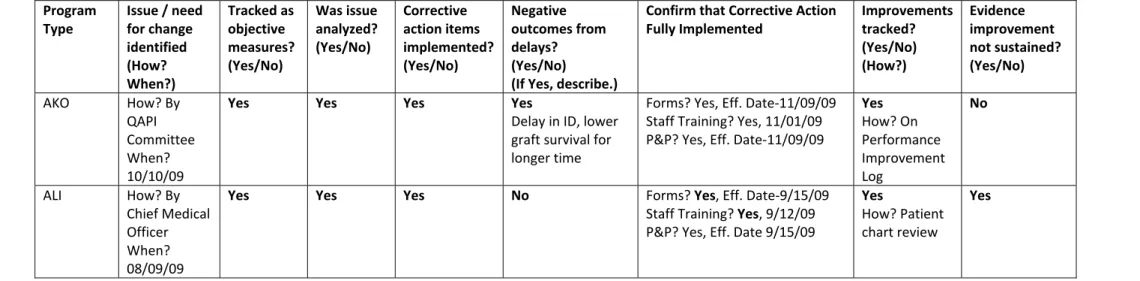
Below is an example of a completed Program Actions/ Activities chart located in Part 4 of the “Surveyor Worksheet- Organ Transplant Program, Quality Assessment and Performance Improvement.” This chart represents a transplant center with two organ transplant programs for Adult Kidney Only (AKO) and Adult Liver (ALI). One organ program is recorded in each row of the chart.
Table 15 – Example of a Completed Program Actions/ Activities Chart
Program Type Issue / need for change identified (How? When?) Tracked as objective measures? (Yes/No) Was issue analyzed? (Yes/No) Corrective action items implemented? (Yes/No) Negative outcomes from delays? (Yes/No)(If Yes, describe.)
Confirm that Corrective Action
Fully Implemented Improvements tracked? (Yes/No) (How?) Evidence improvement not sustained? (Yes/No) AKO How? By QAPI Committee When? 10/10/09
Yes Yes Yes Yes
Delay in ID, lower
graft survival for
longer time
Forms? Yes, Eff. Date‐11/09/09
Staff Training? Yes, 11/01/09
P&P? Yes, Eff. Date‐11/09/09
Yes How? On Performance Improvement Log No ALI How? By Chief Medical Officer When? 08/09/09
Yes Yes Yes No Forms? Yes, Eff. Date‐9/15/09
Staff Training? Yes, 9/12/09
P&P? Yes, Eff. Date 9/15/09
Yes
How? Patient
chart review
Yes
Resolution of Prior NonCompliance, Complaints and Adverse Events
Below is a sample Resolution of Prior Identified Problems chart located in Part 4 of the “Surveyor Worksheet- Organ Transplant Program, Quality Assessment and Performance Improvement.” This chart is used by transplant surveyors to track previous non-compliance issues, investigations and adverse events. The purpose is to ensure that the transplant program incorporated improvements into their QAPI program that are associated with the prior identified problems. This chart represents a transplant program with two organ transplant programs for Adult Kidney Only (AKO) and Adult Liver (ALI). One organ program is recorded in each row of the chart.
Table 16 – Sample of Resolution of Non‐Compliance, Complaints and Adverse Events Chart
Program Type SRTR Data/ Patient Care/ Complaint Issues Tracked as objective measures? (Yes/No) Was issue analyzed? (Yes/No) Corrective action items implemented? (Yes/No) Negative outcomes from delays? (Yes/No)(If Yes, describe.)
Confirm that Corrective Action
Fully Implemented Improvements tracked? (Yes/No) (How?) Evidence improvement not sustained? (Yes/No) SRTR Data Forms? Staff Training? P&P? How? Notes‐ Forms? Staff Training? P&P? How? Notes‐ Quality of Care Forms? Staff Training? P&P? How? Notes‐ Forms? Staff Training? P&P? How? Notes‐ Substantiated Complaints Forms? Staff Training? P&P? How? Notes‐
Adverse Event (see
Part 5) Forms? Staff Training? P&P? How? Notes‐
QAPI Worksheet Part 5: Transplant Program’s Adverse Event Policies/
Procedures and Analysis
Adverse
Event
Policies/
Procedures
Regulation: A transplant center must establish and implement written policies to address and document adverse events
that occur during any phase of an organ transplantation case. The policies must address at a minimum, the process for
the identification, reporting, analysis and prevention of adverse events. (X102) The transplant regulations define an
adverse event as: “an untoward, undesirable, and usually unanticipated event that causes death or serious injury, or the
risk thereof. As applied to transplant centers, examples of adverse events include (but are not limited to) serious medical
complications or death caused by living donation; unintentional transplantation of organs of mismatched blood types;
transplantation of organs to unintended recipients; and unintended transmission of infectious disease to a recipient.”
The transplant program’s Adverse Events Policy will most likely be found as part of the program’s QAPI Plan or Policies and Procedures or in the hospital’s Adverse Events Policies and Procedures, if not the surveyor needs to ask for a copy of the Adverse Events Policy.
The transplant program’s definition of an adverse event must be specific to transplant and describe in detail what constitutes an adverse event during any of the three phases of transplantation (pre-transplant, transplant and post-transplant).
If the transplant program does not use the term “adverse event,” the surveyor will need to ask what term the program uses that is equivalent to the CMS definition. The transplant program may also refer to an adverse event as: • An incident, • A critical incident, • A safety incident, • A safety event, • A critical event, or • A sentinel event**.
** Please Note: The Joint Commission has a different definition for “Sentinel Event” than for “Adverse Event,” however the surveyor may find that the transplant program uses the terms synonymously.
Adverse
Event
Analysis
The transplant center must conduct a thorough analysis of and document any adverse event. (X103) The transplant
center must utilize the analysis to effect changes in the Transplant Center’s policies and practices to prevent repeat
incidents. (X104)