SUMMARY
S.0 Summary
This Tier 1 Final Environmental Impact Statement (Final EIS) addresses the proposal by the Illinois Department of Transportation (IDOT) to improve high‐speed rail (HSR) passenger service between Chicago, Illinois and St. Louis, Missouri (a distance of approximately 284 miles), including the rail lines through Springfield, Illinois (Exhibit S.0‐1). This Tier 1 Final EIS (Volume I) for the Chicago to St. Louis High‐Speed Rail (HSR) Corridor Program has been prepared by IDOT and the Federal Railroad Administration (FRA), in cooperation with the Federal Highway Administration (FHWA), U.S. Army Corps of Engineers, U.S. Fish and Wildlife Service, and the U.S. Environmental Protection Agency, to satisfy the requirements of the National
Environmental Policy Act (NEPA) of 1969 (42 U.S.C. 4321 et seq.), and the Council on Environmental Quality (CEQ) NEPA regulations (40 CFR 1500‐1508).
For this program, IDOT and FRA are using a tiered environmental process, a phased environmental review used in the development of complex projects. Under this process, the Tier 1 EIS (Volume I of this document) addresses broad, corridor‐level issues and alternatives. Tier 2 environmental documents (Volume II of this document is one such Tier 2 document) address individual component projects of the Selected Alternative carried forward from the Tier 1 study at site‐specific detail. Concurrently with this Tier 1 study, IDOT and FRA are conducting a Tier 2 analysis for the Springfield Rail
Improvements Project. The Tier 2 Environmental Evaluation for the Springfield Rail Improvements Project has been incorporated into this Tier 1 Final EIS as Volume II.
S.1
Background
For more than two decades, IDOT has pursued improvements to passenger rail service between Chicago and St. Louis. The Chicago to St. Louis HSR Corridor is part of the Midwest Regional Rail Initiative program’s intent to develop and implement a 21st‐
century regional passenger rail system.
In January 2003, IDOT, FRA, and FHWA completed an EIS for the Chicago to St. Louis HSR Corridor. The Selected Alternative from the EIS included improvements along the existing Chicago to St. Louis Amtrak route, with 110‐mile per hour high‐speed rail service south of Dwight, Illinois. Selected improvements included 12 miles of double track, 22 miles of freight sidings, station enhancements, one grade‐separated crossing, and enhanced warning devices at 174 crossings. No action was selected between Chicago and Dwight. FHWA and FRA issued a Record of Decision (ROD) in January 2004, allowing improvements in the Dwight to St. Louis portion of the corridor to be advanced. Section 2.1.3 discusses the projects that have advanced based on the 2004 ROD.
In 2011, an Environmental Assessment (EA) was completed and FRA issued a Finding of No Significant Impact (FONSI) for track improvements from Joliet to Dwight. These improvements include upgrading approximately 36 miles of existing track and associated crossings to accommodate 110 mph high‐speed rail passenger trains, the addition of six miles of double track, approximately two miles of new side track, and about 12 new turnouts.
S.2
Purpose and Need
The purpose of the proposed Chicago to St. Louis HSR Corridor Program is to enhance the passenger transportation network in the Chicago to St. Louis HSR Corridor by improving high speed passenger rail service, resulting in a more balanced use of different corridor travel options by diverting trips made by automobile and air to rail. The existing transportation network consists of highway (automobile and bus), air, and passenger rail travel. Currently, nearly all trips made annually within the Chicago to St. Louis HSR Corridor are accomplished through automobile and air travel, with only one percent by passenger rail. Enhancements to passenger rail service would include reduced travel times, improved service reliability, increased frequency of trips, and increased capacity. Increased use of passenger rail would result in an overall
improvement in traveler safety in the corridor, as well as a reduction in air pollutant emissions and energy consumption.
In addition to the Tier 1 level corridor‐wide needs from Chicago to St. Louis, the large number of grade crossings in Springfield results in issues specific to that portion of the study area, including safety, vehicle, and pedestrian delays. These needs are detailed in Volume II, Tier 2 Environmental Evaluation of the Springfield Rail Improvements Project.
S.3
Alternatives Considered
An extensive alternatives screening process was conducted that led to the selection of five alternatives that were evaluated: a No‐Build Alternative and four HSR Build Alternatives (A, B, C, and D).
S.3.1 No-Build
Alternative
The No‐Build Alternative includes the 2004 ROD HSR improvements from Dwight to St. Louis and the 2011 EA/FONSI HSR improvements from Joliet to Dwight. The limited HSR service resulting from these improvements will include passenger trains at speeds up to 110 mph between Joliet and Alton, with the remaining portions of the corridor allowing speeds of up to 79 mph.
S.3.2 Build
Alternatives
The four Build Alternatives that were evaluated would utilize different routes in three areas: between Chicago and Joliet, through Springfield, and between Alton and St. Louis. The proposed Build Alternative routes would utilize combinations of the existing
passenger rail (Amtrak) route and other proposed intercity passenger routes that
primarily follow other existing rail lines. In general, the proposed improvements would include double tracking along the entire length of the corridor in addition to
improvements to railroad crossings (including rail to rail grade separations and pedestrian grade separations at the train stations), signals, and stations. The potential locations of highway to rail grade separations has also been identified that will be studied in greater detail during the Tier 2 studies. In developing these four Build
Alternatives, the corridor was divided into the following seven sections (Exhibit S.3‐1): Section 1 – Existing Amtrak Route from Chicago to Joliet
Section 2 – Proposed Other Existing Route (i.e., Rock Island Route) from Chicago to Joliet
Section 3 – Existing Amtrak Route from Joliet to Springfield Section 4 – Existing Amtrak Route through Springfield
Section 5 – Proposed Other Existing Route through Springfield Section 6 – Existing Amtrak Route from Springfield to Alton Section 7 – Existing Amtrak Route from Alton to St. Louis
The four Build Alternatives were then comprised of various combinations of these sections as follows:
Alternative A (Sections 1, 3, 4, 6, 7) Alternative B (Sections 1, 3, 5, 6, 7) Alternative C (Sections 2, 3, 4, 6, 7) Alternative D (Sections 2, 3, 5, 6, 7)
All of these Build Alternatives would include eight daily round trips allowing for 110 mph intercity passenger service for the entire route between Chicago and St. Louis. The overall travel times for these Build Alternatives between Chicago and St. Louis would range from three hours and 51 minutes to four hours and 10 minutes, which would result in a maximum decrease in travel time of one hour and 47 minutes over existing conditions.
S.3.3 Tier 1 Preferred Alternative
Tier 1 Alternatives C (Sections 2, 3, 4, 6, and 7) and D (Sections 2, 3, 5, 6, and 7), both of which include Section 2, have been identified as the Preferred Alternatives based on the following comparison of Section 1 (i.e., Canadian National (CN) railroad) and Section 2 (i.e., Rock Island District (RID) railroad). Because all of the Alternatives A, B, C, and D include Sections 3, 6, and 7, the impacts and performance measures within these sections are the same for all of the alternatives. Therefore, there were no differentiating factors that could be used in selecting one alternative over another based on these sections.
§
¨
¦
§
¨
¦
§
¨
¦
§
¨
¦
§
¨
¦
§
¨
¦
§
¨
¦
§
¨
¦
§
¨
¦
¡
s
§
¨
¦
¡
s
¡
s
§
¨
¦
§
¨
¦
¡
s
§
¨
¦
¡
s
¡
s
§
¨
¦
¡
s
¡
s
¡
s
¡
s
§
¨
¦
§
¨
¦
"
)
§
¨
¦
§
¨
¦
§
¨
¦
¡
s
§
¨
¦
"
)
§
¨
¦
§
¨
¦
§
¨
¦
§
¨
¦
¡
s
¡
s
ST. CHARLES ST. LOUIS ST. LOUIS CITY JEFFERSON Arlington Heights Elgin Chicago Naperville Aurora Joliet Moline Morris Peru Wilmington Kankakee Dwight Galesburg Pontiac Peoria Bloomington Normal Lincoln Champaign Decatur Springfield Taylorville Mattoon Carlinville Litchfield Effingham Vandalia Alton Centralia OGLE WILL LASALLE BUREAU HENRY GRUNDY MERCER PUTNAM MCLEAN TAZEWELL FULTON CHAMPAIGN LOGAN PIATT STARK KNOX MARSHALL LIVINGSTONWARREN PEORIA WOODFORD IROQUOIS
CARROLL KANE DEKALB COOK ROCK ISLAND KENDALL KANKAKEE FORD MENARD MASON DEWITT SCHUYLER BROWN DOUGLAS CASS CUMBERLAND CALHOUN CLAY JERSEY EFFINGHAM GREENE CLINTON WABASH EDWARDS WASHINGTON RICHLAND DUPAGE WHITESIDE LEE MCDONOUGH VERMILION MACON SANGAMON EDGAR MORGAN CHRISTIAN MOULTRIE SCOTT COLES SHELBY MONTGOMERY MACOUPIN CLARK CRAW JASPER BOND MADISON FAYETTE ST. CLAIR WAYNE MONROE JEFFERSON LAWRENCE MARION 108 267 45 30 52 51 24 45 51 136 58 36 50 52 34 290 294 88 94 57 80 55 80 355 55 39 74 57 72 55 55 70 270 64 70 57 88 80 Legend Section 1 Section 2 Major Road County Boundary Municipality Section 3 Section 4 Section 5 Section 6 Section 7 Springfield Springfield Leland Grove Jerome Grandview Southern View
As a result, the Tier 1 selection of the Preferred Alternative was limited to comparing the differences in impacts and performance measures between the alternatives that include Section 1 (i.e., Alternatives A and B) and the alternatives that include Section 2 (i.e., Alternatives C and D). Because the Tier 1 study did not result in a selection between Sections 4 and 5 that travel through Springfield, two Tier 1 Preferred Alternatives were advanced, including both Section 4 and Section 5, for further consideration in the Tier 2 studies1.
S.3.3.1 Hine’s Emerald Dragonfly
Section 1 would impact 3.7 acres of Critical Habitat for the federally and state
endangered Hine’s emerald dragonfly. Because the Critical Habitat is on both sides of the existing railroad alignment and immediately adjacent to the right‐of‐way, these impacts would be difficult to avoid and mitigate. In addition, the USFWS has expressed concern regarding the project’s impacts to the Critical Habitat and the potential increase in train‐dragonfly collisions. Section 2, however, would not result in any impacts to the Hine’s emerald dragonfly.
S.3.3.2 Operational
Operational performance of the Preferred Alternatives to achieve acceptable on‐time performance standards was of high importance when selecting an alternative.
Currently, Amtrak is pursuing relief from the Surface Transportation Board for failure of the CN railroad (Section 1) to properly dispatch Amtrak trains to avoid delays. The RID railroad (Section 2) is dispatched by Metra, which more clearly understands the needs for on‐time performance on a passenger rail line. While Section 2 has considerably more traffic than Section 1, the Metra trains are on a fixed timetable with a 95% on‐time
performance record. Section 1 has unpredictable freight traffic including shipper servicing which makes on‐time performance more difficult to achieve. Incremental infrastructure improvements to Section 2 can be made to preserve or enhance on‐time performance in a shorter time frame at a lower cost. Section 1 requires that four costly and time consuming flyovers be constructed to preserve or enhance on‐time
performance. In comparison, the Section 2 requires only one flyover at the EJ&E Railroad.
S.3.3.3 Cost
Section 2 costs $200 to $500 million less than Section 1 primarily due to the need for the four flyovers.
S.3.3.4 Public Policy
If Amtrak service is no longer on Section 1, two Chicago Region Environmental and Transportation Efficiency (CREATE) Project flyovers on that route may not be needed. The ability to reprioritize limited CREATE resources for more urgent projects would be of significant public benefit as well as reduce the total cost of the CREATE program.
Additional infrastructure investment along Section 2 would not only benefit the High‐ Speed Rail Program but also would place that investment in a publicly owned corridor.
S.3.3.5 Summary
Alternatives C and D, both of which include Section 2, have been identified as the Preferred Alternatives based on the following reasons:
Avoids Critical Habitat of the federally and state endangered Hine’s emerald dragonfly.
More passenger friendly dispatching.
Fewer unpredictable train events to affect on‐time performance.
On‐time performance can be preserved or enhanced with smaller incremental improvements in a shorter time frame at lower cost.
Total cost is less.
Allows potential CREATE program reprioritization or program cost savings. Invests public funds in a publically owned transportation corridor.
It should be noted for the Preferred Alternatives that while the MacArthur Bridge is recognized as the preferred route for the Chicago – St. Louis High‐Speed Rail Program, it is recognized that the Merchants Bridge also plays an important role in serving as an alternate route during maintenance or unexpected disruptions, and also as a key part of the St. Louis area rail network providing potential benefits to both freight and passenger traffic.
It should also be noted that during the Tier 2 studies for Section 2, alternative connections that would provide access to Union Station could be considered if that connection would be deemed better than the connection at 40th Street.
S.4
Summary of Impacts
Table S.4‐1. Summary of Impacts and Costs
Resources Alternative A Alternative B Preferred
Alternative C Preferred Alternative D No-Build Buildings Displaced 183 238 262 317 0 Community Facilities 0 0 0 0 0 Environmental Justice >50% Minority Census Blocks 38 44 83 89 0 Environmental Justice >50% Poverty Census Tracts 3 3 10 10 0
New Right‐of‐Way 642‐658 ac 678‐679 ac 700‐716 ac 736‐737 ac 0
Prime Farmland Soils 1,807 ac 1,804 ac 1,903 ac 1,900 ac 0
Historic Sites 7 6 6 5 0
Archaeological Sites 0 0 0 0 0
Forest 237.8 ac 236.1 ac 254.3 ac 248.1 ac 0
Prairie Remnants 233.1 ac 233.1 ac 233.1 ac 233.1 ac 0
Protected Natural Areas 17.44 ac 17.44 ac 17.74 ac 17.74 ac 0
Critical Habitat – Hine’s
Emerald Dragonfly 3.7 ac 3.7 ac 0 0 0
Noise Sensitive Receptors
215 682 339 806 Not Applicable Vibration Sensitive Receptors 269 302 249 282 Not Applicable Surface Water 203 203 191 191 0
Special Status Streams:
Biologically Sensitive
Streams #/ft 5/805 5/805 5/805 5/805 0
Illinois Natural Areas
Inventory Streams #/ft 6/1,004 6/1,004 6/1,004 6/1,004 0
Nationwide Rivers
Inventory Streams #/ft 3/554 3/554 3/554 3/554 0
Navigable Waterways
#/ft 6/829 6/829 7/883 7/883 0
Wellhead Protection Areas 2 2 2 2 0
Floodplains #/acres 37/80.0 37/80.0 44/85.2 44/85.2 0
Wetlands #/acres 58/49.9 58/50.3 71/55.0 71/54.9 0
Special Waste Sites 179 195 260 276 0
Section 4(f) Properties 10 10 14 14 0
S.4.1 Land Use/Socioeconomic Impacts
Table S.4‐2 shows the number of displacements and the acreage of right‐of‐way that would be needed for each alternative. Alternative A would result in the fewest
displacements (183) and acres of new right‐of‐way (642‐658) while Preferred Alternative D would result in the most displacements (317) and acres of new right‐of‐way (736‐737). Potential impacts by each alternative to low‐income and minority populations (i.e., environmental justice populations) were also evaluated. As indicated in Table S.4‐2,
Preferred Alternatives C and D would potentially result in greater impacts to low‐ income and minority populations than Alternatives A and B. The No‐Build Alternative would result in no displacements or impacts to environmental justice populations.
Table S.4‐2. Comparison of Land Use and Environmental Justice Impacts between
Build Alternatives Build Alternative Number of Buildings Potentially Displaced Proposed New Right-of-Way (Acres) Census Tracts with Populations Below Poverty Line (>50%) Census Block Groups with Minority Populations (>50%) Alternative A 183 642‐658 3 38 Alternative B 238 678‐679 3 44 Preferred Alternative C 262 700‐716 10 83 Preferred Alternative D 317 736‐737 10 89 No‐Build 0 0 0 0
S.4.2 Energy
Table S.4‐3 presents the annual energy consumption by mode and alternative.
Table S.4‐3. Annual Energy Consumption (billions of BTUs)
Alternative Rail Automobile Bus Air Total
Existing (2010) 199 22,754 69 411 23,433
No‐Build (2030) 354 27,558 93 692 28,697
A, B, C (Preferred), or
D (Preferred) 572 27,143 83 628 28,426
The results in Table S.4‐3 show that the total energy consumption from intercity passenger travel under the No‐Build Alternative would be higher than the Build
Alternatives. Although the Build Alternatives would result in an increase in energy consumption compared to the No‐Build Alternative with regard to rail transportation, all of the other three modes would experience a decrease, thereby, resulting in an overall net decrease in energy consumption. This overall net decrease could be attributed to a shift in ridership from the other three less energy efficient modes to rail.
S.4.3 Agriculture
Table S.4‐4 presents the impacts to prime farmland soils for the No‐Build Alternative and each Build Alternative. As indicated in the table, the total acres of impacts between all the Build Alternatives varies by 99 acres with Alternative B resulting in the fewest impacts with 1,804 acres and Preferred Alternative C resulting in the greatest impacts with 1,903 acres. Because all of the Build Alternatives would follow the existing railroad tracks, no farms would be bisected by any of the alternatives. The increase in train traffic along the corridor could result in increased delays at railroad crossings, as farm vehicles would be required to stop more frequently for trains crossing roadways. The No‐Build Alternative would not impact any farmlands or prime farmland soils.
Table S.4‐4. Prime Farmland Soil Impacts by Alternative
Alternative Existing ROW
Acres Impacted
Proposed New ROW Acres Impacted Total Acres Impacted A 1,358 449 1,807 B 1,343 461 1804 C (Preferred) 1,405 498 1,903 D (Preferred) 1,390 510 1,900 No‐Build 0 0 0
S.4.4 Cultural
Resources
In accordance with Section 106 of the National Historic Preservation Act, each alternative was evaluated for potential impacts to historic architectural and
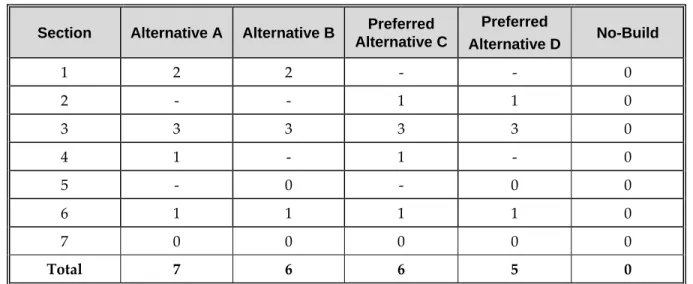
archaeological resources. A file search was conducted to identify any properties within the study corridor that are listed or eligible for listing on the National Register of Historic Places (NRHP). Table S.4‐5 shows the number of NRHP listed/eligible
architectural resources that would be potentially impacted by the program alternatives. Alternative A would impact the most historic architectural resources (7) while Preferred Alternative D would impact the least (5). The No‐Build Alternative would not impact any historic architectural or archaeological resources. More detailed field surveys for potentially eligible properties that are not currently listed on the NRHP and the determination of effects will be conducted during Tier 2 studies.
Table S.4‐5. Summary of Potentially Impacted Historic Architectural Resources
Section Alternative A Alternative B Preferred
Alternative C Preferred Alternative D No-Build 1 2 2 ‐ ‐ 0 2 ‐ ‐ 1 1 0 3 3 3 3 3 0 4 1 ‐ 1 ‐ 0 5 ‐ 0 ‐ 0 0 6 1 1 1 1 0 7 0 0 0 0 0 Total 7 6 6 5 0
With regard to known archaeological resources, potential impacts were considered where proposed improvements (construction activity) would physically impact the property on which the resource lies or would be immediately adjacent to the
construction activity such that temporary impacts could result. Because the resources lay belowground, noise, vibration, and visual impacts were not considered.
One site, 11MP4, located adjacent to Section 6 in Macoupin County is adjacent to an area were construction activities would occur. As a result, all four Build Alternatives would potentially impact this one archaeological resource. Further evaluation will be required during Tier 2 studies to determine if the construction would have an adverse effect on the resource. In addition, Tier 2 studies will include a survey of potential archaeological resources in all areas to be disturbed.
S.4.5 Natural
Resources
S.4.5.1 Forests, Prairie Remnants, and Illinois Natural Areas
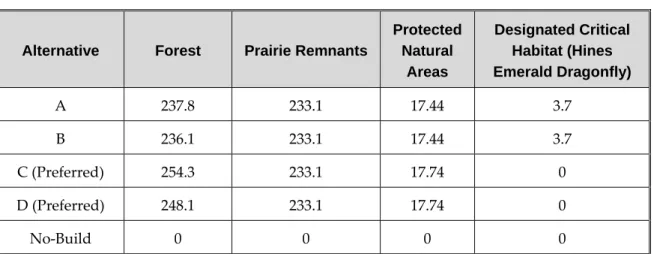
Each alternative was evaluated for potential impacts to natural resources such as forest, prairie remnants, and protected natural areas. Table S.4‐6 shows the impacts to these resources for each alternative. With regard to impacts to forest, Alternative B would result in the fewest impacts (236.1 acres) while Preferred Alternative C would result in the greatest impacts (254.3 acres). All of the Build Alternatives would impact 233.1 acres of prairie remnants. They would also result in nearly the same impacts to protected natural areas (17.44 to 17.74 acres). There are six natural areas located within the construction limits of the Build Alternatives: Hickory Creek Barrens Nature Preserve (0.3 acre), Funks Grove Nature Preserve (0.9 acre), Thaddeus Stubblefield Grove Nature Preserve (6.9 acres), Hitts Siding Prairie Nature Preserve (0.6 acres), Funks Grove Land and Water Reserve (7.9 acres), and Denby Prairie Nature Preserve (1.14 acres). As indicated in Table S.4‐6, Alternatives A and B would impact 17.44 acres of these natural areas while Preferred Alternatives C and D would impact 17.74 acres. The No‐Build Alternative would not impact any forests, prairie remnants, or protected natural areas.
Table S.4‐6. Acreage of Impact to Natural Resources by Alternative
S.4.5.2 Threatened and Endangered Species
As indicated in Table S.4‐6, Alternatives A and B would impact approximately 3.7 acres of USFWS designated Critical Habitat for the federally and state endangered Hine’s emerald dragonfly. Preferred Alternatives C and D would not impact any Critical Habitat. Analysis of the impacts to this habitat will be addressed in more detail in the Tier 2 environmental documentation. In addition to the potential direct loss of Critical Habitat for the Hine’s emerald dragonfly, the only other notable impact to the species could be the potential increase in train‐dragonfly collisions due to the increase in the number of round trips associated with several of the alternatives.
Based on the IDNR EcoCat database and coordination with USFWS and IDNR, there are no Critical Habitats of other federally listed species located within the study corridor that could be impacted by any of the program alternatives. Based on Natural Heritage Data Base records of occurrences, the federally and state endangered leafy prairie clover and the federally threatened and state endangered Meadʹs milkweed occur within the existing and proposed ROW. However, this Tier 1 level of documentation did not include detailed fieldwork to identify potential habitats and/or populations of threatened and endangered species. Therefore, conclusions about impacts to listed species or their habitat cannot be made at this time. Further coordination with USFWS and IDNR will continue during the Tier 2 studies.
Species listed as threatened or endangered by the state, which have recorded
occurrences within the existing or proposed right‐of‐way based on the Natural Heritage Data Base, are included in Chapter 5, Table 5.6‐3 and Exhibits 5.6‐1 through 5.6‐3. Most of the records for state listed species occur in Sections 3 and 6. Since these sections are included in all the Build Alternatives, there is little difference in the species records for each alternative. All of the species listed in Table 5.6‐3 are present in the right‐of‐way of Alternatives A and B, with the exception of Mead’s milkweed, which is only known for Section 2. All species listed in Table 5.6‐3 are also present in the right‐of‐way of
Preferred Alternatives C and D, with the exception of the leafy prairie clover, which is only known for Section 1.
Alternative Forest Prairie Remnants
Protected Natural Areas Designated Critical Habitat (Hines Emerald Dragonfly) A 237.8 233.1 17.44 3.7 B 236.1 233.1 17.44 3.7 C (Preferred) 254.3 233.1 17.74 0 D (Preferred) 248.1 233.1 17.74 0 No‐Build 0 0 0 0
The No‐Build Alternative would not impact any federal and state threatened and endangered species.
S.4.6 Air
Quality
The proposed improvement would impact the counties of Cook, Will, and Grundy in the northeastern Illinois nonattainment area, and the counties of Jersey, Madison, St. Clair, and St. Louis in the St. Louis nonattainment area. While the proposed program would increase diesel locomotive emissions, these increases would be offset by decreases in regional mobile source auto vehicle miles traveled (VMT). The program‐generated net increases in predicted annual pollutant emissions, from high‐speed rail passenger service, in nonattainment areas would all be below general conformity de minimis threshold values. Pursuant to the General Conformity Rule, EPA considers project‐ generated emissions below these de minimis values to be minimal. Such projects do not require formal conformity determinations. With regard to greenhouse gas (GHG) emissions, the Build Alternatives would reduce CO2 emissions by 22,200 tons/year
versus the No‐Build Alternative. As a result, the program is not anticipated to result in significant adverse impacts to public health related to air pollutants and air toxics or contributions to GHG emissions.
S.4.7 Noise and Vibration
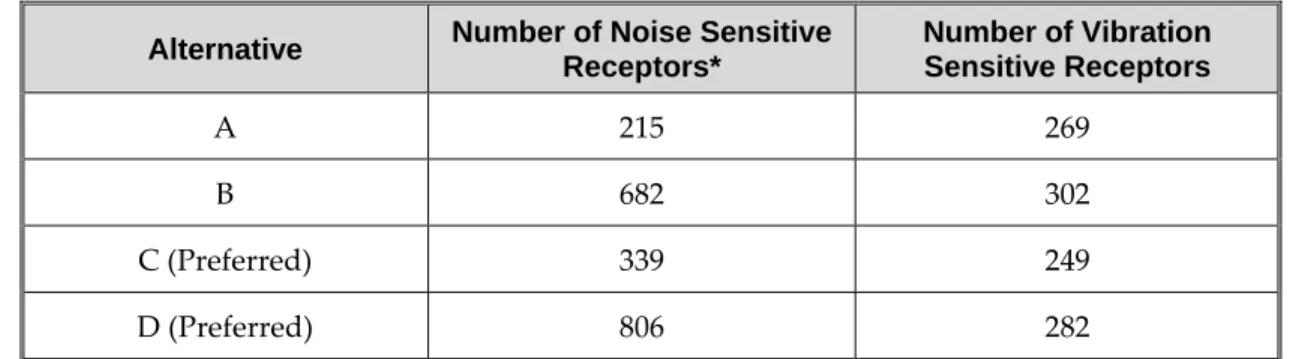
As indicated in Table S.4‐7, Alternative A would impact the fewest noise sensitive receptors (215) while Preferred Alternative D would impact the most (806). With regard to vibration, Preferred Alternative C would impact the fewest sensitive receptors (249) while Alternative B would impact the most (302).
Table S.4‐7 Noise and Vibration Impacts (Number of Sensitive Receptors)
Alternative Number of Noise Sensitive
Receptors* Number of Vibration Sensitive Receptors A 215 269 B 682 302 C (Preferred) 339 249 D (Preferred) 806 282
*Train noise impacts were evaluated based on projected noise level increases relative to
baseline (No‐Build Alternative) conditions at noise‐sensitive receptors. Therefore, no impacts
are identified for the No‐Build Alternative.
S.4.8 Water
Quality
S.4.8.1 Surface Water
Preferred Alternatives C and D would result in the fewest surface water crossings (191) while Alternatives A and B would result in the most crossings (203) (Table S.4‐1). The No‐Build Alternative would not impact surface waters.
S.4.8.2 Special Status Streams
All of the Build Alternatives would result in the same impacts to Biologically Sensitive Streams (five crossings/805 feet), Illinois Natural Areas Inventory Streams (six
crossings/1,004 feet), and Nationwide Rivers Inventory Streams (three crossings/554 feet). With regard to Navigable Waterways, Alternatives A and B would cross six waterways (829 feet) while Preferred Alternatives C and D would cross seven waterways (883 feet) (Table S.4‐1). The No‐Build Alternative would not impact any special status streams.
S.4.8.3 Wells Crossings
All of the Build Alternatives would cross the same number of Wellhead Protection Areas (2) and Non‐Community Water Supply Well Setbacks (5) (Table S.4‐1). The No‐Build Alternative would not impact wells.
S.4.8.4 Floodplains
Table S.4‐8 shows that Alternatives A and B would have the least impacts to floodplains (37 crossings and 80.0 acres) while Preferred Alternatives C and D would have the greatest impacts (44 crossing and 85.2 acres). The number of perpendicular crossings are similar between all of the Build Alternatives (29 and 30). The No‐Build Alternative would not impact floodplains.
Table S.4‐8. 100‐Year Floodplain Impact by Alternative
Alternative Number of Floodplains Crossed Number of Perpendicular Crossings Total Floodplain Impact (Acres) A 37 30 80.0 B 37 30 80.0 C (Preferred) 44 29 85.2 D (Preferred) 44 29 85.2 No‐Build 0 0 0
S.4.9 Wetlands
For this Tier 1 level of analysis, National Wetland Inventory (NWI) mapping was used to determine potential wetland impacts. Field investigations were not conducted to verify this information. Therefore, wetland delineations will need to be conducted during the Tier 2 environmental documentation. The wetland communities that would be impacted by the program alternatives are palustrine (i.e., freshwater) emergent (PEM), palustrine forested/scrub‐shrub (PFO/PSS), palustrine unconsolidated bottom (PUB) (i.e., ponds), and riverine (i.e., rivers). Table S.4‐1 shows that Alternatives A and
B would have the least total impacts to wetlands (58 wetlands totaling approximately 50 acres) while Preferred Alternatives C and D would have the greatest impacts (71 wetlands totaling approximately 55 acres). Out of all the NWI wetland communities impacted, PFO/PSS wetland communities would have the greatest impacts. The No‐ Build Alternative would not impact any wetlands.
S.4.10 Utilities
The Build Alternatives would require the relocation of utilities in the corridor. The estimated cost to relocate these utilities has been included in the program cost estimates.
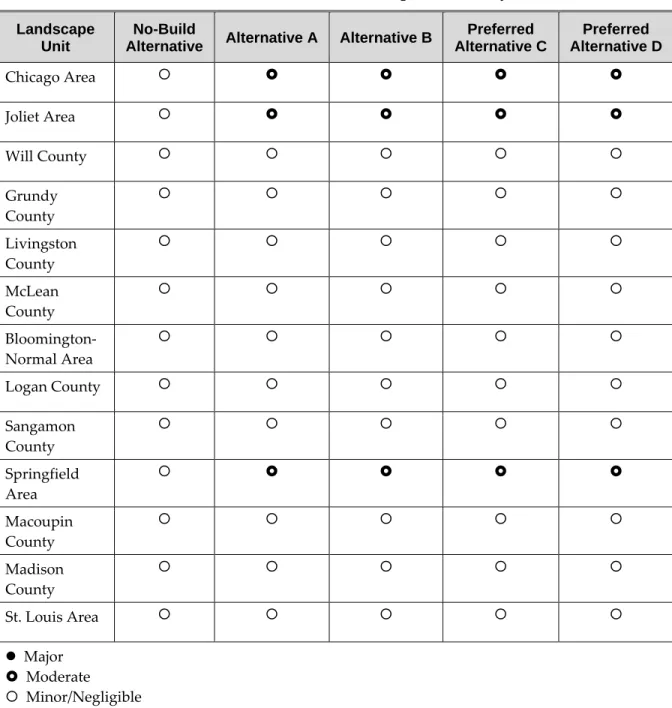
S.4.11 Visual and Aesthetic Quality Impacts
Table S.4‐10 on the following page shows the relative visual impacts to each of the landscape units along the Build Alternatives. Most of the landscape units would have minor/negligible impacts from all of the Build Alternative except for the Chicago, Joliet, and Springfield areas, which would have moderate impacts. The No‐Build Alternative would not result in visual impacts.
S.4.12 Special Waste
A database search was conducted to identify special waste sites that may be impacted by the program. Table S.4‐11 shows that Alternative A would potentially impact the fewest number of sites (179) while Preferred Alternative D would impact the most sites (276). The No‐Build Alternative would not impact special waste sites.
Table S.4‐11. Special Waste Sites by Alternative
Alternative Number of Special Waste Sites
A 179
B 195
C (Preferred) 260
D (Preferred) 276
S.4.13 Section 4(f)/6(f) and Parklands
This section identifies the potential for program activities to impact resources protected by Section 4(f) of the Department of Transportation Act of 1966 and Section 6(f) of the Land and Water Conservation Fund (LWCF) Act of 1965 such as public parks, recreation areas, wildlife and waterfowl refuges, and historic properties.
Table S.4‐10. Visual Resource Impact Summary
Landscape Unit
No-Build
Alternative Alternative A Alternative B
Preferred Alternative C Preferred Alternative D Chicago Area Joliet Area Will County Grundy County Livingston County McLean County Bloomington‐ Normal Area Logan County Sangamon County Springfield Area Macoupin County Madison County St. Louis Area Major Moderate Minor/Negligible
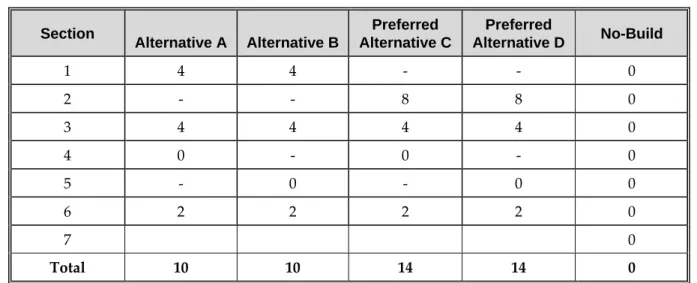
For the Tier 1 analysis, potential impacts were considered when any portion of a Section 4(f) resource was to be acquired by the program or would physically abut the existing or proposed right‐of‐way limit. These impacts do not represent an official determination of Section 4(f) “use”. Historic resources were not included as potential Section 4(f)
properties for this analysis because a determination of adverse effect would need to be conducted, which will not occur until the Tier 2 stage, along with official determination of Section 4(f) “use”. Table S.4‐12 shows that Alternatives A and B would result in the least impacts to Section 4(f) properties (10) while Preferred Alternatives C and D would impact the most (14). The No‐Build Alternative would not impact Section 4(f)/6(f) resources.
Table S.4‐12. Potential Number of Section 4(f) Resources Impacted Section Alternative A Alternative B Preferred Alternative C Preferred Alternative D No-Build 1 4 4 ‐ ‐ 0 2 ‐ ‐ 8 8 0 3 4 4 4 4 0 4 0 ‐ 0 ‐ 0 5 ‐ 0 ‐ 0 0 6 2 2 2 2 0 7 0 Total 10 10 14 14 0
Only one Section 6(f) property, the I&M Canal Trail, may be impacted by Alternative A or B (Section 1). Coordination with IDNR and NPS will be required during the Tier 2 study to determine whether these impacts constitute a conversion of protected uses under Section 6(f) of the LWCF.
S.4.14 Indirect and Cumulative Impacts
It is anticipated that the program would result in negligible indirect impacts for the following reasons:
The program would utilize existing rail corridors and train stations and, therefore, would not result in the development of new access or train stations in areas that previously did not have any passenger rail service.
It is anticipated that the increased ridership would have a minimal effect on
inducing development around the existing train stations, which are already located in developed/urbanized areas. Any induced growth that may occur would be limited to the built‐up areas in the immediate vicinity of the train stations and would likely include small restaurants and/or retail shops that would be attracted by the increase in transit passengers and potential customers. Any potential growth that may occur would be controlled by the local, state, and federal agencies that would be responsible for approving such development and permitting the impacts to any regulated resources that may be impacted.
With regard to natural, cultural, agricultural, and socioeconomic resources, it is anticipated that the program would result in negligible cumulative impacts for the following reasons:
Because the Chicago‐St. Louis High‐Speed Rail Program would involve primarily the addition of a second track that would parallel the existing track, the majority of the impacts would be within the existing right‐of‐way and in previously disturbed areas.
Any new impacts outside of the existing track’s footprint and right‐of‐way would be relatively narrow, linear, and distributed over a long distance (i.e., 284 miles). As a result, the impacts to any given resource (e.g., natural, cultural, agricultural, or socioeconomic) within any given area (e.g., ecosystem, watershed, community) is expected to be relatively small and would have a negligible cumulative effect when added to any other project impacts in those areas.
The vast majority of the study corridor has been, currently is, and will continue to be farmland. The remaining study corridor is mostly comprised of highly developed urban areas that would not contribute to cumulative impacts. The only areas that may be experiencing land use changes that could contribute to cumulative impacts would be the suburban areas associated with the major metropolitan areas such as Chicago, Springfield, and St. Louis. The potential for this program to generate land use changes in and around the project study corridor from farmland/undeveloped land to suburban or urban land is minimal due to the fact that the rail corridor already exists and the program would help to reduce growth pressures on non urban land by focusing on already built out areas and reducing traffic on the regions roadways and highway infrastructure.
The most notable known projects that would result in cumulative impacts along the study corridor when added to this program are the high‐speed rail improvements from Dwight to St. Louis associated with the 2004 ROD and the high‐speed rail improvements from Joliet to Dwight associated with the 2011 EA/FONSI. Although minimal, the cumulative negative impacts associated with these projects would primarily be limited to prime farmland, vegetation/habitat, wetlands, and streams that are located along the existing railroad corridor. With regard to air quality, these projects are expected to provide an overall cumulative benefit. The high‐speed rail facility is expected to
provide service to motorists who would otherwise travel between Chicago and St. Louis by automobile. This shift in travel mode is expected to reduce overall vehicle emissions. These projects would also result in a cumulative benefit of removing automobiles from congested roadways and improving safety by shifting automobile travelers to a safer mode of transportation.
S.4.15 Travel Benefits
S.4.15.1 No‐Build Alternative
Travel Time, Frequency, and Reliability
Existing passenger rail travel time between Chicago and St. Louis ranges from five hours and 20 minutes to five hours and 57 minutes. Under the No‐Build Alternative,
passenger rail travel time is expected to range from four hours and 30 minutes and four hours and 45 minutes.
Rail communication and signal systems would continue to be upgraded under the No‐ Build Alternative, which would improve some of the reliability and on‐time
the corridor) would continue to affect reliability and on‐time performance and limit the ability to add additional trains through the corridor.
With limits on travel time, passenger rail capacity, and reliability that remain with the No‐Build Alternative. Ridership in 2030 is forecast to be approximately 1.1 million passengers with the No‐Build Alternative, an increase of over 400,000 passengers compared to existing conditions.
Safety
Overall passenger safety in the corridor would increase in that the passenger miles traveled by rail in the corridor is expected to rise to 203 million passenger miles from the existing 114 million passenger miles. To the extent that this increase represents a
diversion from automobile travel, the safety risk to travelers would decrease in that rail travel is safer than automobile travel.
However, fewer travelers are expected to divert from automobile to rail under the No‐ Build Alternative compared to the Build Alternatives. As a result, the No‐Build
Alternative would have a lesser impact on increasing safety than the Build Alternatives.
S.4.15.2 Build Alternatives (Alternatives A and B and Preferred Alternatives C and D)
Travel Time, Frequency, Reliability
Rail passenger travel time between Chicago and St. Louis would decrease from a range of four hours and 30 minutes to four hours and 45 minutes, to three hours and 51 minutes to four hours and 10 minutes. The Build Alternatives could therefore result in an additional 35‐ to 39‐minute travel time savings compared to the No‐Build Alternative.
With the Build Alternatives, three additional passenger round trips would be operated daily.
The Build alternatives would include the addition of a second track through most of the corridor (Dwight to St. Louis), rail‐to‐rail grade separations, and added capacity north of Joliet, as well as associated signal improvements. These features would address the reliability‐related issues due to train interference that are not addressed by the No‐Build Alternative.
Safety
Overall passenger safety in the corridor would increase in that the annual passenger miles traveled by rail in the corridor is expected to rise to 328 million passenger miles (Year 2030) from the existing 114 million passenger miles. This is 125 million passenger miles greater than with the No‐Build Alternative. To the extent that this increase represents a diversion from automobile travel, the safety risk to travelers would decrease in that rail travel is safer than automobile travel. Annual passenger miles by automobile are projected to decrease by 118 million passenger miles compared to the No‐Build Alternative.
With additional trains operating in the corridor, the possibility of train collisions is increased. However, the installation of a positive train control signal system, increasing the advanced warning time, and construction of grade separations would mitigate this risk.
Additional Travel Benefits
Improvements to passenger rail service improve its competitiveness with other modes of travel. When compared to the other transportation modes, the Build Alternatives would provide more access to intermediate markets along the corridor except for automobile travel, which currently provides access along the entire corridor via the interstate interchanges. Between Chicago and St. Louis, the Build Alternatives would provide improved access to nine intermediate markets via the train stations while air and bus travel currently provides access to only two markets (Bloomington/Normal and
Springfield). With regard to trip service, the Build Alternatives would provide for safe use of cell phones and internet access for diverted automobile drivers. As for air travel, although cell phone and internet access is available at airports, there are more
restrictions/limitations regarding their use during flight. With regard to cost and
service, Build Alternatives would provide higher quality service than bus travel and rail service under the No‐Build Alternative at a lower cost than air travel.
S.4.16 Transportation Impacts
S.4.16.1 Freight Rail Service Impacts
The No‐Build Alternative includes conditions as exist in 2012, plus the completion of construction of track upgrades, capacity improvements, and signal improvements between Joliet and St. Louis per the 2004 ROD improvements and 2011 Dwight to Joliet EA. IDOT and UP have coordinated extensively on these changes so that the projected freight, as well as the No‐Build Alternative’s intercity passenger service, can operate with current or improved reliability relative to existing conditions.
Implementation of the Build Alternatives is not expected to result in a change in the number of freight trains operating in the Chicago ‐ St. Louis corridor. Freight traffic is more dependent on markets and demand than capacity. Some freight train scheduling modifications to prevent conflicts with passenger rail service proposed for the Build Alternatives. The increased frequency of passenger trains will further restrict freight movements, so capacity and other improvements will be required to accommodate both freight and passenger service.
S.4.16.2 Commuter Rail Service Impacts
Commuter rail service in the Chicago area currently operates on Sections 1 (Metra Heritage Corridor) and 2 (Metra Rock Island District). No other commuter rail service operates in the corridor. Metra has no plans for changing or expanding the existing service along Metra’s Rock Island District, used by Alternatives C and D. There is also no intercity passenger service currently operated via the Metra Rock Island District. For Alternatives A and B (using Metra Heritage Corridor north of Joliet), Amtrak service in the No‐Build Alternative would remain largely similar to the current service, with the
operation of five Amtrak round trips. Metra does have plans to expand service along the Metra Heritage Corridor, possibly adding six trains per day. In addition, Metra intends to add a new station between Lemont and Lockport. The assumed capacity improvements for the high speed service will be developed further in the Tier 2 process to provide appropriate additional capacity, but not for the additional commuter service. Further improvements (crossovers, segments of new trackage, etc) could be developed and analyzed to support the future additional commuter rail service.
Implementation of the Build Alternatives would not result in changes in the number of commuter trains operating daily. The Build Alternatives could result in additional intercity passenger trains operating, potentially affecting commuter rail service.
S.4.16.3 Impacts to Rail Service during Construction
Under the No‐Build Alternative, construction would be limited to regular maintenance activities, and improvements as planned by the 2004 ROD improvements. Therefore, impacts to railroad operations would be minimal.
In general, construction activities for the Build Alternatives would affect rail traffic by reducing operating train speeds through the construction zones, adding to rail travel time and, in turn, cost. This would occur when adding new siding tracks, double‐tracks, and connection tracks. The other impact would be schedule adjustments for existing operations to create windows of opportunity for temporary shutdown of rail operations on selected track sections, such as when the new turnouts are being placed for the passing sections and new sidings, or when there is a potential safety risk, such as during the construction of a flyover. During construction, there may be track outages that would interrupt intercity passenger rail service. As necessary, bus service would be provided along the corridor to replace intercity passenger rail service lost during construction.
S.4.16.4 Highway‐Rail Grade Crossings Impacts
Based on the 2004 ROD and 2011 EA, at‐grade highway‐rail crossings through most of Sections 3 through 7 (Joliet to East St. Louis) will be upgraded to provide four‐quadrant gates and roadway configuration/approach improvements based on crossing
diagnostics. Under the No‐Build Alternative, no further modification to grade crossing warning devices in the study corridor would be made.
Under the Build Alternatives, most crossings in the corridor would require some type of improvement to accommodate the upgraded service. For example, where additional tracks are to be added, crossing surfaces, gates, and other equipment must be modified. The Build Alternatives would increase vehicular delay at highway‐rail grade crossings for the following reasons:
Additional intercity passenger rail service: Gate down time would increase
because the number of passenger trains operating in the corridor would increase from 10 per day to 18 per day.
Increase in advance warning time: All crossings will be equipped with constant warning time. Currently, crossing gates are activated approximately 20 to 30 seconds prior to a train reaching the grade crossing. For high‐speed passenger trains, crossing gates would be activated sooner, possibly up to 90 seconds before a train reaches the crossing. This increase in time would cause additional vehicular delay for motorists using the highway‐rail grade crossing. As part of
implementation of the 2004 ROD improvements, coordination with the Illinois Commerce Commission is underway to determine the length of time required for the gates to be activated before a train reaches a crossing.
The combination of additional trains and longer gate down times would increase the amount of time that a crossing is blocked by approximately 20 minutes per day. Every highway‐rail crossing in the study corridor was evaluated for its suitability for grade separation to alleviate the potential for vehicle delays at crossings. Potential grade separation locations were identified based on setting (urban or rural) and their predicted exposure factor, a function of train and vehicular volumes. At the conclusion of this evaluation, 101 crossings were identified in the study corridor for potential grade separation, which would be evaluated further during Tier 2 analysis.
S.4.16.5 Impacts to Vehicular Crossings during Construction
Vehicular traffic would be temporarily affected at locations where grade crossings would be separated, modified, or improved. While the exact construction zones are not known at this time, temporary lane closures or roadway closures would be required to construct some of the proposed improvements. The grade crossing improvements would, at a minimum, require traffic to slow down as it passes through the construction zone while new warning devices and other improvements are installed. In some cases, temporary diversion of traffic to adjacent crossings could be required. Construction of grade separations would be staged to minimize street closures.
Where impacts to vehicular traffic exists, emergency services, schools, businesses, and other activities requiring vehicular access would be affected by potential delays or detours. However, construction related impacts on vehicular traffic would be temporary. Traffic maintenance planning would be coordinated with schools and emergency service providers.
S.4.16.6 Station Access and Parking Impacts
The Build Alternatives could potentially involve proposed parking expansions and station improvements to accommodate the increase in ridership. It is anticipated, however, that there would be no access or traffic congestion problems associated with the Build Alternatives.
Potential new stations will be evaluated in suburban Chicago (between Chicago and Joliet) and St. Louis (between St. Louis and Alton). If this program moves forward, the potential location for these stations would be evaluated in Tier 2 studies. It is assumed
that the location of new stations would be easily accessible from the highway and arterial system. Provision of suburban stations adjacent to the highway system would increase the attractiveness of intercity passenger rail service because it will enhance passenger accessibility to HSR service, allowing potential travelers an additional option of not travelling to downtown to board a train. Between Chicago and Joliet, use of an existing Metra station also would be considered..
S.5
Summary of Potential Mitigation Measures
Table S.5‐1. Potential Mitigation Measures
Impact Mitigation
Land Use Long Term ‐ IDOT will implement the provisions of the State of
Illinois Relocation Assistance Plan in accordance with the Uniform
Relocation Act as mitigation measures where ROW acquisitions
and land use changes occur.
Cultural Mitigation measures will be determined based on the more
detailed impact determinations from Tier 2 studies.
Natural Resources
Short Term ‐ Avoidance, minimization, and best management
practices implementation will reduce adverse impacts.
Long Term – Coordination will continue through the Tier 2 level
with the Illinois Nature Preserves Commission regarding the
avoidance, minimization, and mitigation of any impacts to prairies.
Coordination will continue through the Tier 2 level with the
USFWS and INDR regarding the avoidance, minimization, and
mitigation of any impacts to state and federal threatened and
endangered species in the study corridor. Upland forests will be
replaced on a 1:1 ratio in accordance with IDOT policy ʺD&E‐18
Table S.5‐1. Potential Mitigation Measures (continued)
Impact Mitigation
Construction Air Quality:
Short Term ‐ State and local regulations regarding dust control and
other air quality emission reduction controls will be followed
during construction.
Noise and Vibration:
Short Term:
Perform all construction in a manner to minimize noise and
vibration;
Use newer equipment with improved noise muffling, and
periodic inspection;
Perform independent noise and vibration monitoring to
demonstrate compliance with the noise limits, and
modify/reschedule activities if maximum limits are exceeded at
residential land uses;
Avoid hauling and unloading operations through residential
neighborhoods to the greatest extent possible;
Construction lay‐down or staging areas should be selected in
industrially zoned districts;
Turn off idling equipment;
Minimize construction activities during evening, nighttime,
weekend, and holiday periods;
Comply with all local noise and vibration ordinances and
obtain all necessary permits and variances;
When possible, limit the use of construction equipment that
creates high vibration levels, such as vibratory rollers and
hammers, operating within 130 feet of building structures;
Require vibration monitoring during vibration‐intensive
activities;
Restrict the hours of vibration‐intensive equipment or activities
such as vibratory rollers so that impacts to residents are
minimal.
Water Quality/Erosion Control:
Short Term ‐ BMPs will be utilized to protect water quality. Runoff
from construction sites must be diverted from directly entering
streams during and after construction. Any impervious areas
resulting in a small reduction in recharge area will be mitigated
using stormwater retention/detention basins.
Floodplains Mitigation measures will be determined based on the more
Table S.5‐1. Potential Mitigation Measures (continued)
Impact Mitigation
Wetlands Long Term ‐ A conceptual wetland mitigation plan will be
developed to compensate for unavoidable impacts. Coordination
with the USACE, the USFWS, and the IDNR will be required to
determine specific mitigation requirements to adequately
compensate for wetland losses pending final design to quantify
actual wetland impacts.
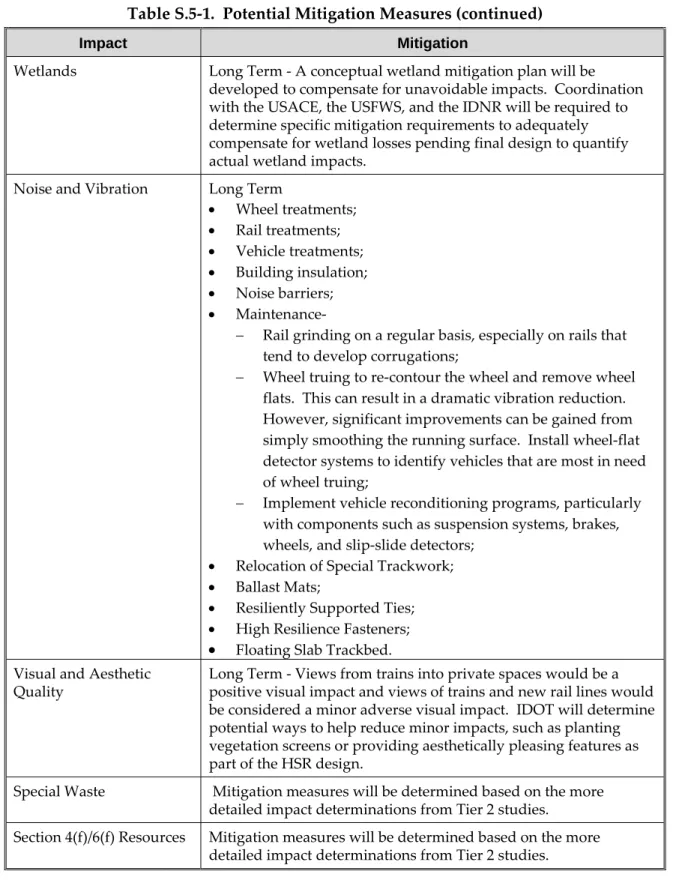
Noise and Vibration Long Term
Wheel treatments; Rail treatments; Vehicle treatments; Building insulation; Noise barriers; Maintenance‐
Rail grinding on a regular basis, especially on rails that
tend to develop corrugations;
Wheel truing to re‐contour the wheel and remove wheel
flats. This can result in a dramatic vibration reduction.
However, significant improvements can be gained from
simply smoothing the running surface. Install wheel‐flat
detector systems to identify vehicles that are most in need
of wheel truing;
Implement vehicle reconditioning programs, particularly
with components such as suspension systems, brakes,
wheels, and slip‐slide detectors;
Relocation of Special Trackwork;
Ballast Mats;
Resiliently Supported Ties;
High Resilience Fasteners;
Floating Slab Trackbed.
Visual and Aesthetic
Quality
Long Term ‐ Views from trains into private spaces would be a
positive visual impact and views of trains and new rail lines would
be considered a minor adverse visual impact. IDOT will determine
potential ways to help reduce minor impacts, such as planting
vegetation screens or providing aesthetically pleasing features as
part of the HSR design.
Special Waste Mitigation measures will be determined based on the more
detailed impact determinations from Tier 2 studies.
Section 4(f)/6(f) Resources Mitigation measures will be determined based on the more
S.6
Implementation Plan
The Tier 1 Final EIS presents several improvements along the Chicago to St. Louis corridor to meet the purpose and need of the program. A corridor program of this size and scope is rarely implemented at once, and, instead, typically requires incremental steps to logically advance the program. As such, the State of Illinois has developed an implementation plan to help guide the identification and selection of staged
improvements within the corridor that can be advanced as part of the corridor wide development plan. Ahead of any future projects, should federal funding be utilized, Tier 2 environmental documents must be completed to assess the individual component projects of the Selected Alternative carried forward from the Tier 1 EIS. Within these Tier 2 environmental documents, design alternatives will be evaluated, potential environment impacts will be identified, and measures to avoid, minimize, and mitigate those identified impacts will be documented.
The following is a list of anticipated Tier 2 environmental studies. The list is organized from north to south. Logical termini for the projects are based on the extent of major infrastructure improvements and station locations. Tier 2 project limits will be
identified using train operation modeling where additional improvements are necessary to support service level increases (Exhibit S.6‐1). The sequence of construction will be based on the results of train traffic modeling. The scope of each Tier 2 environmental document may change depending on future funding and implementation decisions and additional design. Upon initiation of each Tier 2 project, IDOT, in coordination with FRA, will determine the environmental class of action: Categorical Exclusion (CE), Environmental Assessment (EA), or Environmental Impact Statement (EIS).
Chicago to Joliet – This Tier 2 environmental document (EIS) will include additional track, sidings, culvert and bridge improvements, signal improvements, commuter rail station improvements, HSR station improvements, rail flyovers, rail connections and a parallel structure across the Chicago River at 21st Street to improve capacity
and reliability for identified incremental service additions.
Joliet to Springfield ‐ This Tier 2 environmental document (EIS) will include additional track, sidings, culvert and bridge improvements and roadway grade separations to improve capacity and reliability for identified incremental service additions. It is possible that this approximately 140‐mile section would be divided into smaller sections in advance of initiating Tier 2 studies through this area. These smaller sections could potentially be advanced as CEs or EAs.
Springfield ‐ This Tier 2 environmental document is part of the overall Chicago to St. Louis Tier 1 Final EIS (included as Volume II).
Springfield Flyover ‐ This Tier 2 environmental document (EA) will include new track alignment and a railway flyover structure to separate the UPRR and NSRR at‐ grade crossover to improve capacity and reliability along the corridor.
Springfield Flyover to St. Louis Area ‐ This Tier 2 environmental document (EIS) will include additional track, sidings, culvert and bridge improvements and roadway grade separations to improve capacity and reliability for identified incremental service additions. It is possible that this approximately 100‐mile section could be divided into smaller sections in advance of initiating Tier 2 studies through this area. These smaller sections could potentially be advanced as CEs or EAs.
St. Louis Area ‐ This Tier 2 environmental document (EIS) will include new doubletrack approaches to an increased capacity Mississippi River crossing to improve capacity and reliability for identified incremental service additions. The Tier 2 environmental document will evaluate alternatives for an increased capacity Mississippi River crossing. A new double track connection to the Merchants bridge will also be include to provide redundant access in the system for the Mississippi River crossing and to provide construction staging and future maintenance routes. Station Improvements – Tier 2 environmental documents (EAs) will be prepared for
proposed improvements at the HSR stations in Joliet, Dwight, Pontiac, Normal, Lincoln, Carlinville and Alton. Each station would be a separate project. Proposed station improvements include pedestrian grade separation structures to provide access to both platforms and to avoid pedestrians crossing tracks at‐grade,
additional parking requirements and additional station capacity requirements for identified incremental service additions.
S.7
Comments and Coordination
The environmental process for the Chicago to St. Louis High‐Speed Rail Corridor
Program Tier 1 EIS began in February 2011. A scoping coordination letter describing the program and requesting comments and attendance to upcoming scoping meetings, held on March 1st and 3rd, 2011, was forwarded to the state and federal resource agencies in
February 2011. The agency scoping letter responses and cooperating agency responses are located in Appendix F. The Tier 1 Chicago to St. Louis High Speed Rail
Environmental Impact Statement Notice of Intent (NOI) was published in the Federal Register on February 14, 2011, and a copy is located in Appendix G. In March 2011, an initial round of public meetings was held within the corridor to introduce the study to the public, to explain the EIS process and timeline, and to get input. After these
meetings, the study team spent the next several months developing alternatives. In late October and early November 2011, a second round of public meetings was held in the cities of Joliet; Bloomington; Springfield; Carlinville; and Alton.
Sectio