AC 2009-2337: QUALIFICATION AND ASSESSMENT REQUIREMENTS FOR
SIMULATION BASED ELECTRICAL ENGINEERING EDUCATION
Hamid Vakilzadian, University of Nebraska, Lincoln
HAMID VAKILZADIAN is an Associate Professor of Electrical Engineering at the University of
Nebraska-Lincoln. He is a Region 4 PACE Chair of IEEE. His current research interests include
computational modelling and simulation, microcomputers, logic design and analysis, and
embedded systems.
Dietmar Moeller, University of Hamburg
DIETMAR P. F. MÖLLER is a Full and Tenured Professor of Computer Engineering at the
University of Hamburg, Germany. He is Director of the McLeod Institute of Simulation Sciences
at UHH and Chair of Computer Engineering. His current research interests include computational
modelling and simulation, e-Learning, transportation, air-transport systems, aeronautical
engineering, robotics, and embedded systems.
© American Society for Engineering Education, 2009
P
Qualification and Assessment Requirements for
Simulation-Based Electrical Engineering Education
AbstractModeling and Simulation (M&S) is a discipline for developing an understanding of the interaction of the parts or of a whole system. The level of understanding developed using M&S is rarely achievable using other disciplines. However, except for handful institutions that offer a Master of Science program in M&S, no other educational program is currently available at the undergraduate level, especially for electrical engineers. This demands the development of a curriculum and requirements for its assessment, which is the topic of this presentation. The development is part of a National Science Foundation (NSF) grant for a
course, curriculum, and laboratory improvement project called Undergraduate STEM
Education Initiative in Creative Educational (USE-ICE) innovation for electrical
engineering students at the College of Engineering, the University of Nebraska-Lincoln (UNL).
1. Introduction
Globalization and international research and development have changed the way the United
States must approach educating and training students. As our engineers prepare for the 21st
century global market economy, they will face significant international competitors who are building on the technologies the U.S. pioneered in the 20th century. Although the United States has led the world in advances in technology, competitors are harvesting the technological and economic advantages. Simulation-Based Engineering Science (SBES) is a major area with current and future potential. In order to stay on the cutting edge, we must meet the challenges presented by other countries, such as those in Western Europe and Asia, whose governments are investing heavily in modeling and simulation and computational engineering and science, threatening U.S. leadership in basic research.
Currently, M&S programs offered in the U.S. include graduate level programs at a number of universities, such as Old Dominium, Arizona State, Florida, California State Chico, and Alabama at Huntsville [1,2]. Arizona State and Old Dominium universities have embarked on establishing such a program at the undergraduate level. However, at present there is no established M&S program in the U.S. at the undergraduate level in electrical engineering. Thus, to stimulate educational innovations through M&S, to develop M&S-based programs, and to provide plans for embedding M&S in the electrical engineering curriculum, we need to address the qualification criteria for the graduates, the responsibilities they will hold, and the assessment and evaluation of the program by an accrediting body.
Currently, there are no required or agreed upon set of skills for the M&S graduates, no list of accepted qualifications, and no established M&S program is available in the U.S. at the undergraduate level in electrical engineering. In an effort to address some of the above issues, we propose a set of criteria for critique and feedback from our colleagues who may be
interested in developing such a program in their institution.
P
Defining a curriculum for undergraduate M&S-based electrical engineering is difficult, partly because M&S is usually regarded as a fragmented subject with components in a range of disciplines and partly because of the wide range of M&S applications. Any engineering, mathematics, or science department can provide one or multiple courses in M&S. This results in a situation in which courses related to an M&S degree program are scattered throughout various departments of a university, with no central responsibility for M&S as a discipline.
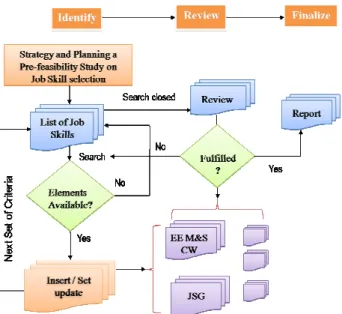
One way of dealing with the various individual views on M&S is to identify the required skills/qualifications that the graduates of an M&S program in electrical engineering should possess. This can be determined by surveying the needs of the public and private sectors and by meeting an accreditation body’s, such as ABET’s, academic assessment requirements [3]. The determination of skill/qualification criteria requires the specification of the elements of the criteria and the elements of the courseware to provide them. The methodology used to identify, review, and evaluate (finalize) the job skills required is introduced as a process workflow in Fig. 1.
Using this workflow process, it is possible to develop criteria, qualifications, responsibilities, and educational requirements for the development of an M&S curriculum in electrical engineering. The curriculum will be based on a number of credit hours of M&S, electrical engineering, mathematics, and science. The student selects the remaining courses with no restrictions as to the department or discipline as long as they meet the student’s academic goals and receive the faculty advisor’s approval.
Fig. 1: Job Skills Criteria Identification and Review Process Workflow.
Abbreviations: EE M&S CW = electrical engineering M&S coursework; JSG = job skill goals
M&S-supported education also requires research consisting of the construction of models, simulation scenarios, and piloting realistic schemes.
Fifty-nine industries were polled to determine the requirements for an M&S-based electrical engineer. An analysis of the survey shows that the graduates are expected to meet the following ten requirements:
P
1. General engineering
2. General electrical engineering
3. General education
4. General M&S
5. Area specific electrical engineering
6. Information technology and computer science
7. Field specific tools and application
8. Upper level math
9. Verbal and oral communication
10.Others
Requirement No. 1 refers to math, physics, and science. Requirement No. 2 refers to basic passive and active circuit analysis, including electromagnetics. Requirement No. 3 is about concepts and methodologies in continuous and discrete systems simulation. Requirement No. 4, general education (GenEd), is an important component of the students' education at any institution. It describes the core courses all students must take to become familiar with some of the many rapidly changing disciplines. Requirement No. 5 is about upper level courses in a students area of specialization, such as communication, control, digital, power, etc. Requirement No. 6 describes the knowledge of a graduate in basic information technology, such as programming, data structure, and databases. Requirement No. 7 refers to knowledge and use of specific tools in a student’s area of specialization. This requirement should be integrated within projects that a student takes in his/her specialized area. The upper level math requirement in No. 8 is to give the student a strong background in probability, statistics, and random processes as well as operation research, including linear and stochastic systems. Verbal and written communication as well as a good knowledge of information technology is needed for preparing students to write reports and explain them in team meetings. These soft skills are important to provide students with adequate knowledge in using and displaying an efficient and informed use of information technology. Others, part of the requirements for No. 10, are intended for the professional skills of the student. These are necessary but are not limited to project management, ethics, and leadership skills for engineers.
2. Program Evaluation and Assessment
A solid assessment and evaluation should be included as part of any program. Currently, engineering programs are being assessed every six years by ABET. Criterion No. 3, which is specific for engineering programs [3], is intended for the institutions to demonstrate that the graduates are qualified. This evaluation body, either jointly with other societies, such as the Society for Modeling and Simulation International, or individually, may address the assessment process for an M&S degree in electrical engineering.
Engineering programs must demonstrate that their students attain the following:
a) An ability to apply mathematics, science, engineering, and computing principles.
b) An ability to design and conduct experiments, and to analyze and interpret data.
c) An ability to design a system, component, or process model to meet needs within realistic constraints, such as economic, environmental, social, political, ethical, health and safety, manufacturability, and sustainability.
d) An ability to function on disciplinary teams and/or to lead multidisciplinary teams.
e) An ability to identify, formulate, and solve engineering problems by selecting and applying appropriate M&S tools and techniques.
P
f) An understanding of professional and ethical responsibilities.
g) An ability to communicate effectively.
h) The broad education necessary to understand the impact of M&S-based engineering solutions in a global, economical, environmental, and societal context.
i) A recognition of the need for and an ability to engage in life-long learning.
j) A knowledge of contemporary issues.
k) An ability to use the techniques, skills, and modern engineering and M&S tools necessary for engineering practice.
l) Ability to consider the entire system in project solutions.
m) Awareness of contemporary tools and techniques of M&S throughout the M&S and system life cycle.
n) Awareness of issues of architecture, scale, complexity, and utility in the design and maintenance of models and simulations.
o) An ability to exert the effort necessary for job success.
These outcomes are similar to Criterion No. 3 but tailored for M&S. Thus, it is important in today’s global market that an electrical and computer engineering program provides the skills and knowledge which will enable its graduates to consider the full, rather than partial, nature of a design and/or a solution. This requires the graduates to be able to work with designs and solutions with high degrees of complexity by using the advanced techniques that M&S offers. Henceforth, UNL will require use of enhanced ABET Criterion No. 3 (items L through O in addition to A-K) as a starting point for the program [3] as well as a direct measure of the quality of the program and its graduates. Hence, UNL Electrical Engineering Department faculty, in cooperation with alumni, current students, and industry partners, plans to develop guidelines to transform the above 15 criteria into operational goals, objectives, and requirements for implementing this program into its electrical engineering degree program. The educational objectives follow.
3. Educational Goals
The overall goal of the M&S-based undergraduate program in electrical engineering is to provide skilled, M&S practicing electrical engineers. The program needs to provide students with:
≠ The technical knowledge and skills to enable them to have a successful career in the profession.
≠ A general education to enable them to appreciate the social, ethical, economic, and
environmental dimensions of problems.
≠ The communication skills and social skills that are necessary to work effectively with others.
≠ The ability to solve problems by learning what is already known and then applying logic
and creativity to find a solution.
≠ The intellectual skills necessary to continue learning and to stay current with the
profession as it changes.
≠ The knowledge and skills to enable students to create a system, component, or process
model taking into account the full nature of the designs/solutions to meet the needs within realistic constraints, such as economic, environmental, social, political, ethical, health and safety, manufacturability, and sustainability, by using the techniques of mathematics,
The program graduates should be contributing members of multidisciplinary teams and be able to lead/manage the projects, take advantage of their knowledge of contemporary issues in providing solutions, and exert the effort necessary for the success of the job.
4. The Program Components
The ABET accredited bachelor programs in electrical engineering [3] require the program to provide depth and breadth across the range of electrical engineering and M&S topics. Graduates must demonstrate that they have the necessary knowledge of probability and statistics, including applications appropriate to electrical engineering; mathematics, including differential and integral calculus; the basic sciences; computer science; and engineering sciences to analyze and design complex electrical and electronic devices, software, and systems containing hardware and software components. The program must also demonstrate that graduates have knowledge of advanced mathematics, such as differential equations, linear algebra, and complex variables.
In addition to the above, M&S-based electrical engineering graduates must also have knowledge of numerical analysis, computer programming, databases, and data structure. The average total number of credit hours in an engineering program is 128. In principal, an accredited M&S-based electrical engineering program should follow a similar structure, number of credit hours, and requirements in addition to the M&S requirements.
4.1 Basic Math
An average of 17 credit hours of basic math, including analytical geometry, calculus, and differential equations, needs to be included in the program. This will include Calculus I, II, III, and differential equations, that usually are packed into four-to-five courses.
4.2 Basic Science
About 15 to 18 credit hours of fundamental science (physics and chemistry) will be necessary in the program. The breakdown is usually about 12 credit hours of general physics and 4 to 6 credit hours of general chemistry. This number of credit hours may be packaged into three to four physics courses and one or two chemistry courses.
4.3 Basic Computer Science
Designing a model for a project, simulating and analyzing the results successfully, and planning adequately for its execution requires a basic knowledge of programming, data representation, and analysis. The skills and experience gained in courses such as Programming, Numerical Analysis, and Data Structure, and database management will be very helpful. These courses will amount to about 15 credit hours that will include 2 programming courses, 1 data structure course, 1 numerical analysis course, and 1 database course.
4.4 Upper Level Math
M&S-based engineering requires strong math and computer knowledge in addition to field-specific knowledge. A set of three courses may be required by the student program advisor
to meet this requirement. The courses are: Probability Theory, Linear System Analysis and
P
Design, Applied Linear Algebra, Statistical Methods for Electrical Engineers, Stochastic and Random Processes, and Operation Research. Since some of the concepts covered in these courses will overlap, it is recommended that the redundancy in the topics in these courses be removed in order to pack them into three courses.
4.5 Fundamentals of Computational M&S
Students specializing in M&S-based electrical engineering and computational modeling are recommended to take at least two courses in M&S and its application to electrical engineering. These courses are Continuous Time System Simulation, Discrete Time System Simulation, and Advanced Topics in M&S. The continuous and discrete M&S topics may be
combined into a single course. The fundamentals should cover areas such as methodology,
tools and techniques, and a seminar of at least three credit hours on an M&S topic in electrical engineering.
4.6 General Education
The General Education requirements describe the core courses all students must take to meet graduation requirements. They are an important component of students' education at UNL. Besides specializing in a major and training for a career, students should become familiar with some of the many rapidly changing disciplines. About 15 to 18 credit hours, equivalent to 4 to 5 courses, should be taken from arts, humanities, social science, natural science and technology, social and behavior sciences, and advanced composition to satisfy the requirement.
4.7 Professional Skills
It is very important that the graduates of the program be able to assume a leadership position and present their scientific results in a clear and comprehensive manner, both orally and in writing, using modern information technology. This requires:
≠ Good writing skills appropriate to the purpose, e.g., progress reports, published
documents, and capstone design thesis.
≠ Good presentation (verbal) skills to defend research outcomes, to promote the public
understanding of one's research field, and to support the learning of others when involved in teaching, mentoring, or demonstrating activities.
≠ Good project management skills in order to plan, implement, and evaluate each
project. These skills allow the graduates to learn about project organization, planning, scheduling, budgeting, accounting, quality assurance, etc.
≠ Good leadership skills are imperative in M&S-based electrical engineering projects. This will permit the graduates to assume the leadership role in implementing and managing the projects.
≠ Engineering Economy for Electrical Engineers is very important, especially for M&S-based electrical engineers. This will allow the graduates to become familiar with methods and concepts of economic comparisons of electrical engineering alternatives. These are concepts and techniques of analysis that are useful in evaluating the worth of a design, a system, etc., in relation to their costs. The issues such as :
- Which projects are worthwhile?
- Which projects should have a higher priority?
P
- How should the project be designed?
≠ Professional ethics are very important in any profession, especially in M&S-based electrical engineering. Modeling and simulation is used extensively in research and development; hence, the principles of responsible conduct must be followed to avoid fabrication, falsification, and plagiarism (data, text, and ideas) and other misconduct. Twelve credit hours of courses on the above topics will meet this requirement. The break down will be six credit hours of communication skills, three credit hours of electrical engineering economy, and one credit hour in the remaining topics.
4.8 Team-Based Capstone Design Project
The idea behind this component is to engage students in a semester long electrical engineering project that depends heavily on M&S and involves students working in teams of two members. Such a project will provide team experience in addition to R&D. This will be three credit hours of virtual experimentation followed by a physical implementation which will put to use the fundamentals the students have learned for producing a useful and semicomplex project.
5. Instructional Methodology
Creating an educational methodology to challenge and stimulate students while providing the key instructional concepts in a flexible and efficient form is of critical importance. Modules within a course or the entire course may be offered in face-to-face (F2F) form or in blended learning (BL) form.
The BL approach comes in the form of a combination of different modes, models, and styles of delivery and learning and can also make use of laboratory work, as part of an embedded collaborative virtual lab, [4,5] as well as modeling and simulation [6, 7].
The BL approach raises several questions:
a) What is the blended approach?
b) What does one get blended with what?
The answer can only be given tessellated:
≠ BL is a net-based learning arrangement accompanied, or enriched, by F2F learning
arrangements.
≠ BL uses online technology rather than using pure F2F learning.
≠ BL uses different didactic approaches for presenting the instructional content online.
≠ BL uses different approaches to support the collaboration of students.
≠ BL uses different approaches to support communication between tutors and learners
and among learners.
≠ BL has many possibilities to achieve a blend of learning arrangements.
≠ The BL content delivery system is a blend of different technologies.
The following topics provide a brief description of the issues one needs to consider when proposing a course for offering as F2F or BL.
P
5.1 Topic No. 1
On deciding how much of an M&S course should be offered via traditional learning (F2F) and how much via e-Learning, one needs to consider the didactic strategies and the technologies that are used for the e-Learning and F2F learning modules. That is:
≠ Implementing communication facilities—news groups, chat, video, F2F—not always
necessary to combine e-Learning with F2F learning.
≠ Assessing the demand an instructional method poses on the learners.
≠ Meeting these demands in specific communication settings might necessitate
implementing F2F phases within the BL process, or it might be sufficient to combine various e-Learning facilities.
5.2 Topic No. 2
Issues to be considered for arranging a course for blended learning consist of more than combining online and F2F options. Approximately 65% of online learning should be self-paced learning, group collaboration, and mentoring and tutoring (teaching on the web). The remaining 35% should be F2F, including laboratories, seminars, and exams.
5.3 Topic 3
One important consideration for designing a course for a BL offering is the collaboration of students. Various benefits can be ascribed to group collaboration. The students working as a group usually achieve better results than those working individually, because group discussion helps reinforce concepts qualitatively and/or quantitatively. In addition, since group members coordinate their activities, they achieve better results and acquire a wider knowledge than those working individually. Multiple perspectives allow:
≠ Less knowledgeable group members to learn from more knowledgeable ones.
≠ More emphasis on the individual member activities, such as communication about
instructional material, e.g. explaining it to others.
≠ Support of restructuring and elaboration of learning contents.
Furthermore, it permits development of social skills, because team success relies on the successful learning and commitment of the individual team members. The focus will be on:
≠ Helping each other
≠ Explaining concepts to each other
≠ Encouraging each other to achieve
≠ Working and supporting each other.
≠ Exchanging of experiences
As a group, students will be highly motivated because they will be faced with challenging and interesting tasks. The process of group work itself is highly rewarding and will lead to:
≠ Motivation of individual members
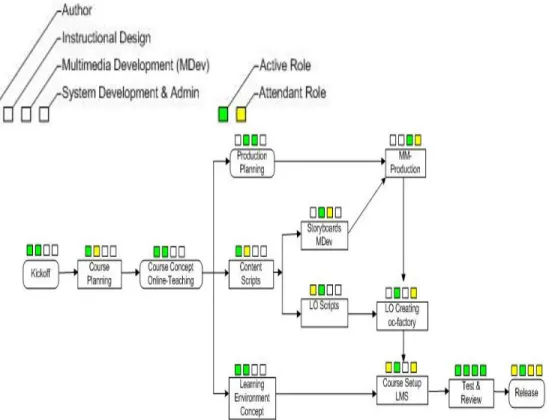
Blended learning arrangements embedding modeling and simulation in electrical engineering consist of more than just combining online and F2F facilities. Henceforth, a specific production process has been established in this project, as shown in Figure 3.
It doesn’t matter what the basis is for an M&S program in electrical engineering as the program can be established by a set of generally agreed upon guidelines, such as those in ABET criteria for accrediting electrical and computer engineering programs [3]. Hence, it will be important to specify course contents in the form of subareas rather than complete courses. This modularization approach will allow mixing and matching of different SAs to produce individual courses that best fit the needs and resources of a particular M&S program in electrical engineering.
Students entering this program will need to have adequate background (prerequisites) in basic topics in mathematics, science, computer programming, and their primary electrical engineering discipline.
Fig. 3: Workflow of blended learning production process
At UNL, these topics include 17 credit hours of calculus I, II, III, and differential equations (Math 106, 107, 208, and 221); 13 credit hours of science (9 credit hours of physics (Phys 211, 212, and 222); 4 credit hours of science elected from biology, chemistry, or physics (BIOS 101 and 101L, Chem 109 or 111 or 113or Phys 213), 12 credit hours of passive, active, and digital circuits (Elec 215, 216, 316, and 370) and the corresponding 4 credit hour lab (Elec 213, 214, 307), embedded systems (Elec 222) followed by signals and systems (Elec 304), probability and introduction to random processes (Elec 305), 5 credit hours of electromagnetics and its laboratory (Elec 306 and Elec 317), Electrical Engineering Senior Design (Elec 494) and Electrical Engineering Design (Elec 495). The curriculum also
P
includes 12 credit hours of general education (humanity) and 21 hours of technical electives, and 3 credit hours of programming.
6. Quality Assurance
The mission of university education is to contribute to society through the pursuit of education, learning, and research at the highest international levels of excellence [8]. In order to ensure that the quality and excellencies of learning and teaching maintained, the M&S program in electrical engineering needs to embed a quality assurance procedure which allows examination and reflection and enhances teaching activities. Hence, quality assurance process has to review the teaching, learning, and assessment activities, including curriculum content and design, at appropriate regular intervals. Normally this would be at least annually, as part of a review of the quality statement or in response to reports of examiners or responses to student questionnaires, the student feedback on teaching and courses, which is considered essential to good practice. For this reason, criteria have to be established to enable the M&S study program in EE to assess its program and courses offered. This is based on the two goals and learning outcomes and how they relate to the course delivery and assessment. The learning outcomes generally focus on knowledge and skills and have been reflected in relation to the ABET requirements in chapter 2 and its accompanying measures, the two goals, with their respective professional alignment. Henceforth the quality assurance criteria are given in relation to the ABET requirements.
Quality assessment practices and procedure are based on
≠ Standards for individual essays, questions and other related work in accordance to the
ABET criteria listed
≠ Class standing criteria for determining the standing of the candidates based on their overall performance in the examinations in accordance to the ABET criteria
7. Conclusion
A first version of a model curriculum for a new undergraduate degree in M&S in electrical engineering is outlined. We hope this outline can be used as a basis for a wide range of discussions and feedback from colleagues and interested professionals.
8. References
[1] Crosbie, R. E., “A Model Curriculum in Modeling and Simulation: Do We Need It? Can We Do It?,” Proceedings of the 2000 Winter Simulation Conference, Piscataway, New Jersey: Institute of Electrical and Electronics Engineers, 2000.
[2] H. Vakilzadian, “A Graduate Program in Modeling and Simulation,” Proceedings of International Conference on Simulation and Multimedia in Engineering Education, pp. 49-53, January 2003.
[3] Criteria for accrediting engineering programs- Effective for evaluations during the 2009-20010 accreditati-on cycle; incorporates all changes approved by the ABET Board of Directors as of November 1, 2008. Published by Engineering Accreditation Commission ABET, Inc. 111 Market Place, Suite 1050 Baltimore, MD 21202
[4] Moeller, D. P. F., “Virtual Reality: Simulation Synergy in Laboratories and Outer Space Domain,” Simulation - Past, Present and Future, Vol. II, pp 64-67, Proceedings of ESM 98, Manchester, Eds.: R. Zobel, D. P. F. Möller, SCSI Publ., Delft, NL, 1998
P
[5] Christou, I. T., Efremidis, S., Tiropanis, T. Kanis: A., “Grid-Based Virtual Laboratory Experiments for a Graduate Course on Sensor Networks,” IEEE Transactions on Education, Vol. 50, No. 1, pp. 17-26, 2007 [6] Wittmann, J., Moeller, D. P. F. ,”Demands for Flexibility in Authoring and e-Learning Platforms under the
Aspect of Integrating Simulation Models,” Proceedings of eChallenges Internat. Confer. Pp. 1599-1566, Eds.: P. Cunningham, M. Fateling, IOS Press Amsterdam, 2003.
[7] Moeller, D. P. F., Crosbie, R.E., “United States – Europe e-Learning Network (USE_ eNET) in Education,” Proceedings of 2006 Spring Simulation Conference, Huntsville, Alabama, pp. 41-46, Eds. J. A. Hamilton, R. Mc Donald, SCS Publ., San Diego.
[8] The Guide to Quality Assurance and Enhancement of Learning, Teaching and Assessment; A Guide for Faculties, Departments and other University institutions associated with learning and teaching provision, Version 5, September 2007, University of Cambridge
http://www.admin.cam.ac.uk/offices/education/quality/guide.pdf
9. Acknowledgment
This work is supported in part by the National Science Foundation, Directorate for Education and Human Resources (EHR), Division of Undergraduate Education (DUE) under Grant Number CCLI-0737530. Any opinions, findings, and conclusions or recommendations expressed in this paper are those of the authors and do not necessarily reflect the views of the National Science Foundation.