Research Report H200301
Barriers to Entry
Differences in barriers to entry for SMEs and
large enterprises
Jasper Blees
Ron Kemp
Jeroen Maas
Marco Mosselman
Zoetermeer, May 2003
SCALES
ISBN: 90-371-0893-8 Order number: H200301 Price: € 50.-
This report is published under the SCALES-initiative (Scientific AnaLyses of Entrepreneurship SMEs), as part of the SMEs and Entrepreneurship' programme financed by the Netherlands' Ministry of Economic Affairs.
Most recent EIM reports and much more on SMEs and Entrepreneurship can be found at: www.eim.nl/smes-and-entrepreneurship.
The responsibility for the contents of this report lies with EIM. Quoting numbers or text in papers, essays and books is permitted only when the source is clearly mentioned. No part of this publication may be copied and/or published in any form or by any means, or stored in a retrieval system, without the prior written permission of EIM.
3
Contents
Summary 5
1
Introduction 7
2
Literatu re on barriers to en try
9
2.1 Indus tri al organis ati on o n ba rri ers to ent ry 9
2.2 Strate gi c -ma nagem ent l i te rature 17
2.3 Concl usi on 24
3
Barriers to entry: descrip tions
27
3.1 Abs ol ute c ost adva ntages 28
3.2 Ac ce ss to di s tri buti on c hannel s 31
3.3 Adv erti si ng 34
3.4 Ass et s peci fi ci ty 38
3.5 Av ai l abi li ty of s kil l e d l a bour 40
3.6 Brand na me 42
3.7 Ca pi tal requi rem ents 44
3.8 Ca usal ambi gui ty 47
3.9 Control ov er s trategi c res ources 51
3.10 (Tra nsacti on) C osts of op erati ng i n forei gn ma rket s 54
3.11 Cul tural di s tanc e 56
3.12 Cus tom er l oyal ty 58
3.13 Cus tom er-s wi tc hi ng cos ts 60
3.14 Di vi si onal i s ati on 64
3.15 Dy namic l i mi t-pri ci ng 68
3.16 Ec onomi es of s cal e 71
3.17 Ex ces s c apaci ty 76
3.18 Ex perie nce adva ntages 79
3.19 Gaps a nd asym m etry of i nforma ti on 82
3.20 Gov ernm ent l ic ences 86
3.21 Gov ernm ent pol ici es 88
3.22 Hi gh wage s for em pl oy ees a nd managers 92
3.23 Inv es tm ent ri sk 96
3.24 Know-ho w 99
3.25 Le vel of te chnol ogy 102
3.26 Loc ati on 104
3.27 Pac ki ng the produc t s pac e 107
3.28 Pate nts (product or p roce ss ) 109
3.29 Produc t di ffe renti a ti on 111
3.30 Res earc h and devel opment i ntensi ty 115
3.31 (Ex pec ted) Re tali ati on by inc umbe nts 117
3.32 Sel l e r conc entrati on 121
3.33 Sel li ng ex pens es 124
3.34 Speci al ri s k and uncertai nti es of entry 126
3.35 Sunk cos t 128
3.36 Tec hnol ogi cal c hange 131
4
Syn th esis 135
4.1 I mporta nce of barri ers for SM Es 135
4.2 I nfl uenc abi li ty of barri e rs 137
4.3 Concl usi on 140
4.4 Suggesti ons for future researc h 141
Literatu re 143
Ann ex
5
Summary
Entry of firms into a market is an important mechanism in the economy. Entrants have an equilibrating function. Firms will enter the market if the profit level is above the run competitive level. As a result of entry, the profit level will decrease to the long-run competitive level. Entrants are also important agents of change. Firms with new ideas or production processes will enter the market. Thus these two effects of entry contribute to allocative as well as to dynamic efficiency in the market. However, several mechanisms can prevent firms from entering the market. In other words, there can be barriers to entry that harm the allocative and dynamic efficiency and are therefore det-rimental for industry dynamics and economic welfare. From this perspective, it is clear that lowering barriers to entry or preventing that these barriers are created is an impor-tant issue in competition policy.
In this report, we identify different barriers to entry and discuss the mechanisms behind these barriers. The central research question is:
Which barriers to entry exist, how do they work and to what extent is the mechanism influenced by the size of the (potential) entrant?
The report is based on two different literature traditions, industrial organisation and strategic management.
Barriers to entry in the industrial-organisation literature go back to Bain (1956). He fo-cused on the consequences of the barriers to entry, i.e. a higher price than the price hypothetically attributed to long-run equilibrium in pure competition. If the most effi-cient entrant of all potential entrants cannot enter the market then there is said to be a barrier to entry. The barriers are based on structural aspects of the market and behav-iour of the incumbents to influence the conditions of entry. The structural conditions permit incumbents to raise the price above the minimum average cost of potential en-trants.
A slightly different perspective in the industrial-organisation literature (Chicago school) is to look at the costs that must be borne by an entrant to a market that need not to be borne by an incumbent already operating in the market (asymmetry of costs). This im-plies that the incumbents and entrants are not equally efficient after the costs of enter-ing are taken into account (i.e., the conditions for entering for the incumbents were less difficult than for later entrants).
In strategic-management literature, one tries to explain (and prescribe) the behaviour of individual companies that pursue maximal profit and other organisational goals. In pur-suing these goals, companies interact with their environment (competitors, stake-holders, government, etc). This interaction influences the final profit of the individual company and industry as a whole. There are different strategies and tactics that com-panies can use to sustain their position. Examples of these strategies and tactics are raising structural barriers (e.g., blocking access to distribution channels) and increasing expectations about retaliation (signal commitment to defend). An important author in this line of thinking is Porter (1980, 1985).
Based on the two literature traditions, we identified 37 distinct barriers to entry. For each barrier, we give a short description in which the mechanism how the barrier works is discussed. There is a discussion on the possible size effect related to the barrier, the sustainability of the barrier (what can the incumbent do to sustain the barrier and the
entrant to avoid the barrier). Finally, we discuss for each barrier if they are related to other barriers and how they are measured in empirical studies.
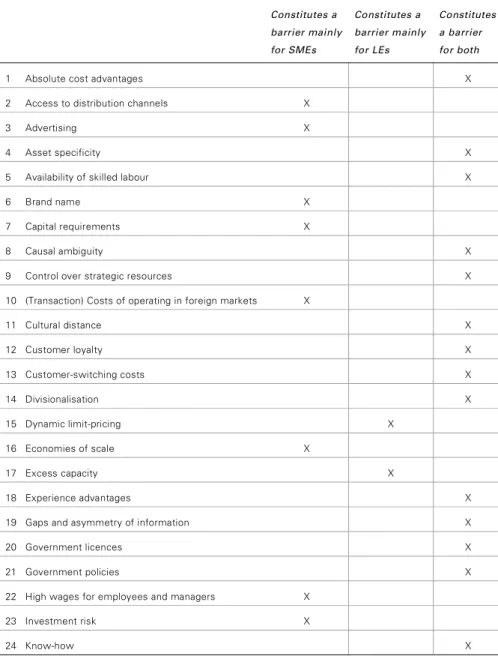
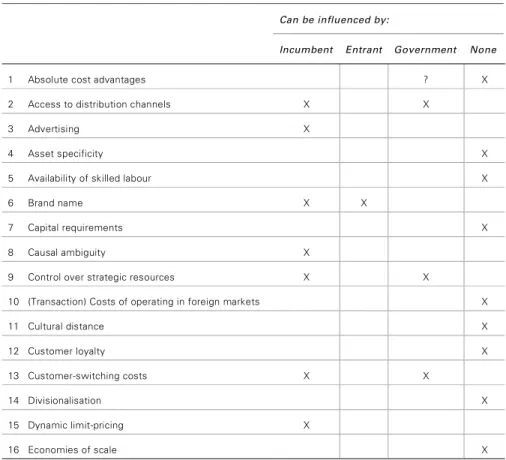
The report is ended with a synthesis in which the barriers are evaluated on the impact of size on the barrier and to what extent the barriers can be influenced by SMEs, large enterprises or the government. It proves that especially incumbents and the government can influence a lot of barriers to entry. SMEs are to a larger extent than large firms in-fluenced by the existence of barriers to entry.
7
1 Introduction
According to the traditional view in industrial organisation (IO), a level of profitability in excess of equilibrium induces entry into an industry. First, new entrants provide an equilibrating function in the market; the levels of profitability and prices are restored to their long-run competitive levels. Second, entrants are viewed as agents of change (Audretsch, 2001). The threat of entry forces existing companies to introduce new products and processes. In this perspective, small firms are not founded to be smaller clones of big firms but they serve as agents of change through innovative activities. As a result, entrants are important because of their disequilibrating influence as well (Audretsch and Mata, 1995). Hence, they play an important role in the dynamics of markets and competition.
Given both arguments, entry is viewed as important for the dynamics of an industry. If barriers to entry exist, this is detrimental for industry dynamics and economic welfare. Therefore, lowering barriers to entry or preventing that these barriers are created is an important issue in competition policy. A reduction in barriers to entry is currently per-ceived as one of the main objectives (rather than as a means) of competition policy (Burke and To, 2001).
Entry can take different forms, a green-field firm (start-ups), an existing company that enters a new industry (a new plant), an existing company that buys an existing plant, an existing company that adjust its existing product mix and a foreign company that enters the market with one of the previous four forms (Geroski, 1991). From a competition perspective, the British competition authority (Office of Fair Trading, OFT) has defined new entry as ‘a situation in which both a new undertaking is established in the industry and that new productive capacity is set up in that industry’ (OFT, 1999), narrowing the perspective of Geroski on entry forms. One may expect that barriers to entry differ for the various forms of entry. For instance, it will be easier for an existing big company to finance the required investments to enter a new market than it is for a new start-up. One may also expect that firms of different sizes will face different barriers to entry. Big companies can overcome certain barriers to entry much easier (e.g., economies of scale) and they may be able to influence the competitive positions in an industry to a greater extent than smaller companies can. Small companies are often the first and most di-rectly affected by the harm caused by price fixers and market allocators or anti-competitive behaviour of incumbents1
(Golodner, 2001).
The size of the entry (in terms of new production capacity) influences the consequences for the incumbent. Incumbents might allow small entrants or fringe companies in the market in order to keep bigger competitors out of the market. If an entrant enters with a large production capacity, it poses a serious threat to the incumbents. In such circum-stances, incumbents are more likely to react aggressively to the entrant, for example by lowering their prices. Therefore, the size of the (potential) entrant is expected to influ-ence the reaction of the incumbents.
Barriers to entry have an effect on the entry decision of potential entrants as well. If the barriers to entry are too high, small firms or start-ups might decide not to enter the market. This might have a negative effect on competition and on the dynamics of the market, and might result in high prices and/or low quality and innovation. The purpose 1
of this study is to identify and describe all possible barriers to entry and their potential effects on competition. We shall study the topic of barriers to entry with a special focus on the difference between SMEs and large firms and the effects on the dynamics of the market. One might expect that certain market characteristics pose higher barriers to en-try for small entrants, while large entrants are less affected (Bais, 1998; Kleiweg and Van der Zeijden, 1997). Furthermore, incumbents may react differently to small-scale entrants compared to large-scale entrants.
This leads to the following research questions: 1 What is a barrier to entry?
2 Which barriers to entry exist?
3 How do barriers to entry work (economic processes/mechanisms behind the barriers to entry)?
4 What differences exist between SMEs and large firms concerning barriers to entry? 5 Which contextual variables influence the existence of barriers to entry (technology,
MES, stage industry)?
6 How are the barriers to entry measured in empirical studies?
This study provides a kind of reference book on the topic of barriers to entry. The study can be used by policy makers or competition authorities to evaluate competition in mar-kets or competition cases. The study provides a comprehensive overview of barriers to entry, the rationale and mechanisms behind these barriers to entry and indicators how these barriers to entry may be measured in an empirical setting. There will be a special focus on the relation between barriers to entry and potential size effects. In chapter 2, the literature on barriers to entry is discussed. Two streams of literature are reviewed: industrial organisation and strategic management. Based on both streams of literature, several barriers to entry are identified. These barriers to entry are described and discussed in chapter 3. Chapter 4 ends this report with conclusions and some remarks.
9
2
Literature on barriers to entry
The entry into markets - and thus the barriers to entry that exist within those markets - can both be viewed from the perspective of the entering firm and from the perspective of incumbent firms. Entering firms will assess their opportunities and threats by analys-ing the market structure and potential reactions of the incumbent firms. This is neces-sary because the target market could be very unattractive for new companies to enter. For example, an overcapacity of production facilities could exist, or the target market could face a declining number of customers. In economic literature, the scientific study-ing of market structures is mostly referred to as the industrial organisation of markets (structure-conduct-performance paradigm). A review of the barriers to entry from the perspective of the industrial-organisation literature is one of the approaches of this study.
On the other hand, the incumbents might try to prevent other firms from entering their markets and consuming their profits, by using a diverse scope of mechanisms. The unit of analysis in this perspective is the individual company and what the company can do to maintain or enhance its profitability. For example, the company could raise barriers to entry by developing unique resources that are hard to imitate. If other incumbents or new entrants cannot make the same offer to the customers (because they do not have that unique resource), the company can ask a higher price and earn an above-normal return. The (long-term) strategic plans and actions of firms that are trying to shape their own competitive environment is known as strategic management. By using various stra-tegic-management tools, companies can make it unattractive or even impossible for other firms to enter their market, thus creating barriers to entry. The second approach that we shall use to analyse the barriers to entry is to study the strategic-management literature1
(see also Yip, 1982). Also the industrial-organisation literature deals with stra-tegic behaviour of incumbents and entry deterrence.
As both fields of literature sometimes use or are based on the same sources, they may partly overlap. Because both literature streams have a different perspective and devel-oped differently, it is interesting to review both streams in this exploratory study.
2.1
Industrial organisation on barriers to entry
Industrial organisation is very influential in the field of regulation and competition pol-icy. Within this literature stream, the concept of barriers to entry attracts an increasing interest, both among policy makers and in the academic world. In competition cases, the analysis of barriers to entry seems to replace or supplement the strict focus on mar-ket shares. Barriers to entry have to become a central concept in studying the marmar-ket definition and market power in competition cases (CPB, 2000).
Contes tabi li ty of the m ar k et as a benc hma rk
The theory on contestable markets (Baumol et al., 1982) is often used as a benchmark in studies on the effect of barriers to entry on market performance. A perfectly contest-able market can be seen as one of the extremes on a continuum of all possible markets. 1
The choice for industrial-organisation and strategic-management literature as sources of independ-ent independ-entry variables was made earlier by Harrigan (1983).
Baumol et al. (1982, as cited in Geroski et al., 1990: 3/4) define a ‘perfectly contestable market’ as ‘a market in which a necessary condition for an equilibrium outcome is that no firm can enter taking prices as given and earn strictly positive profits using the same technology as existing firms’. In a perfectly competitive market, entrants can and will enter to take advantages of even transient profit opportunities at current prices. This behaviour is most reasonable when the costs of entry are completely reversible so that there are no capital losses in the event of exit. If these conditions are satisfied, a per-fectly contestable market mirrors a competitive environment in which entry and exit are frictionless and barriers to entry and exit are non-existent. This will result in a situation in which prices are set to marginal costs. In the case of a natural monopoly, potential competition ensures that the behaviour of the monopolists is restricted so that total revenues are not more than total costs.
There are, however, some critiques on the assumptions underlying the theory of perfect contestability (e.g., capital mobility). Especially the assumption that entry is perfectly reversible is questioned.
At the other extreme of the continuum is the assumption that even if sunk costs are very small, the hit-and-run entry assumption of the contestable market theory does not work perfectly anymore and monopoly behaviour and pricing above competitive levels are possible. This is especially relevant if incumbents react rapidly and aggressively on entrants.
In between are different views on the effects of barriers to entry and the effect on in-dustry performance. Two important perspectives are the structuralist perspective (Bain, 1956) and the Chicago school (Stigler, 1968). The structuralist school argues that the efficacy of potential competition depends on determinants of the conditions of entry such as economies of scale, technological advantages, absolute cost advantages, etc. The barriers to entry have basically a structural basis, although the conditions of entry can often also be influenced by behaviour of the incumbents. The Chicago school ar-gues that market concentration reflects the differential efficiencies of established firms and that barriers to entry mostly arise from restrictions in market conduct imposed by government.
Barrie rs to entry i n a s tru cturali st pers pecti ve
Bain (1956) introduced the concept of ‘barriers to new competition’ as a collective noun for the structural characteristics in a given industry that may pose conditions adverse to market entry for potential competitors. The efficacy of potential competition depends on determinants of the conditions of entry such as economies of scale, technological advantages, absolute cost advantages, etc. Moreover, incumbents can actively influence the conditions of entry. The key implication of this work is that the construction of such entry-deterrent mechanisms can aid existing companies in limiting the number of com-petitors and the intensity of competition in their respective industries. Barriers to new competition, or barriers to entry, therefore enable them to become the exclusive bene-ficiaries to supernormal long-term industry profits (Han, Kim and Kim, 2001).
Bain (1956: 3) defined barriers to entry as: ‘the advantage of established sellers in an industry over potential entrant sellers, their advantages being reflected in the extent to which established sellers can persistently raise their prices above a competitive level without attracting new firms to enter the industry’. In his definition, Bain focused on the consequences of barriers to entry, i.e. a higher price than the price hypothetically attributed to long-run equilibrium in pure competition. As a consequence, the general thought is that industries with high barriers to entry will have a higher return than in-dustries with low barriers to entry. This way of thinking about barriers to entry is rooted in limit-price models of oligopoly.
11 The height of the barriers to entry is measured by the difference in profits between the incumbent firms and the entrant. It is argued that a barrier to entry exists if an entrant cannot achieve the profit levels post-entry that the incumbents enjoyed prior to its arri-val. In a more formal way, this idea can be formulated as follows:
Let Πi (x1 *
, ... xn *
) be incumbent i’s profit when incumbent firms i = 1, ..., n operate at the pre-entry output xi
*, and let Π e (x1 **, ... x n **, x e
** ) be the profit of an entrant at the
post-entry output xi ** and x
e
**. Then entry is deterred if Π
e <0. The height of the barriers
to entry for the industry is Πi - max [Πe,0], the level of profits that can be sustained
against entry in perpetuity (Geroski et al., 1990: 7).
To study the effects and the height of the barriers to entry, one focuses on the most advantaged potential entrant instead of actual entrants. Implicitly, there is the assump-tion that there is a pool of potential entrants who will enter and that the most efficient or favoured entrant will enter first. If one finds that such an entrant cannot do as well as the incumbent was doing, then a barrier is said to exist.
Ba rriers to entry i n the C hi c ago Sc hool
Others have defined barriers to entry slightly differently focussing on the extra costs an entrant has over the incumbents. Stigler (1968: 67) defined barriers to entry as: ‘a cost of producing (at some or every rate of output) which must be borne by a firm which seeks to enter an industry but is not borne by firms already in the industry’. OFT (1999: 10) defines barriers to entry as ‘the cost that must be borne by an undertaking entering a market that does not need to be borne by an incumbent undertaking already operat-ing in the market’. The emphasis in both definitions is on the asymmetry of costs be-tween incumbents and potential entrants.
In this perspective, the height of the barrier to entry is calculated as Ce (x) - Ci (x). The
difference with the structuralist school of Bain is that the Chicago school focuses on the post-entry difference between the entrant and the incumbent. According to the Chi-cago School, there is a barrier to entry if the conditions of entry for the incumbents were less difficult than for the new entrants. The incumbents and the new entrants are not equally efficient after the costs of entering are taken into account. For instance, the entrant has to overcome more consumer resistance than did the incumbent (e.g., switching costs or brand loyalty). The structuralist school compares the pre-entry situa-tion with the post-entry situasitua-tion and focuses on structural condisitua-tions that permit in-cumbents to raise the price above the minimum average cost of potential entrants. The practical distinction between the two definitions lies in the way economies of scales are treated as a barrier to entry. In Bain’s definition, economies of scale are a barrier to entry because entry will lead to a price reduction and the post-entry profits are likely to be lower than the incumbents’ pre-entry profits. In the Stigler definition, scale econo-mies do not represent a barrier to entry if they imply penalties from sub-optimal levels of production that are the same for the incumbents and the entrant. If the entrant pro-duces at a lower output level, this might be the consequence of demand conditions (in-adequate demand) and not a result of barriers to entry. If entrants have access to the same cost curve, economies of scale do not constitute a barrier to entry.
S houl d we worry about b arri ers to e ntry? A norm a ti ve pers pecti ve on ba rriers to entry
The previous sections don’t explain whether barriers to entry are good or bad. It is more or less commonly held that a reduction in barriers to entry and exit to an industry can-not retard market performance. A reduction in barriers to entry is either expected to cause a fall in market price or at the very least have no effect. Therefore, there is a
ten-dency in government policy to lower barriers to entry. However, it is not necessary that barriers to entry are detrimental to economic welfare1
.
Von Weizsacker (1980) included a normative perspective in the definition of Stigler. He defined barriers to entry as ‘a cost of producing (at some or every rate of output) which must be borne by firms which seek to enter an industry but is not borne by firms al-ready in the industry, and which implies a distortion in the use of economic resources from a social point of view’ (Geroski et al., 1990: 10). The fact that entrants bear costs that incumbents don’t bear is not relevant. This only becomes relevant if a cost asym-metry is attended with the distortion in the allocation of resources. This implies that from a social point of view, some barriers to entry might be desirable (especially if an activity creates positive externalities). If an activity creates positive externalities and can-not be sufficiently protected (e.g., innovation) there might be too few resources attrib-uted to that activity. In that case, entry has to be deterred to such an extent that prod-uct prices and rate of technological innovations result in an optimal combination. In this perspective, a trade-off between static and dynamic efficiency has to be made. Demsetz (1982) extended this view by stating that what is called a barrier to entry is an endoge-nous response to consumers’ preferences (role externalities, information and transaction cost should be taken into account). For example, the number of brands may be re-stricted by the consumers’ ability to evaluate alternatives. Therefore, studying barriers to entry should not focus on financial consequences (cost positions) only, but should also take real-world frictions into account (e.g., information is not free and with the evalua-tion of alternatives costs are involved). This implies that informaevalua-tion asymmetry, access to distribution channels and reputation can also be barriers to entry.
Because evaluating the welfare effect of barriers to entry is very complicated, a two-step approach is suggested (Geroski et al., 1990). First, identify barriers to entry and measure their heights and then evaluate their consequences for welfare. This analysis should be complemented by analysing the strategic behaviour of incumbents.
Prac ti cal argum ent fo r ‘ d esi rabl e’ barri e rs to entry
A practical argument for a ‘desirable’ barrier to entry is given by Harrigan (1983). She states that ‘high barriers to entry are a necessary but not sufficient condition for long-term industry profitability. High barriers to entry are necessary because without them plant expansions (a strategic investment which is difficult to reverse) could rapidly out-pace demand. The pressures created by under-utilised plant capacities could precipitate price wars which may drive out some firms (...) but will ruin profit margins for all’ (Har-rigan, 1983).
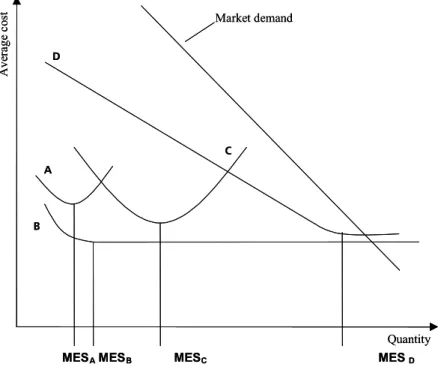
In some cases, it is socially optimal if small firms do not enter a market (Geroski, 1991), especially if there are scale economies or economies of scope. For instance, the market can only sustain one firm if minimum scale efficiency is bigger than market demand. In this case, the existence of a barrier to entry might be desirable and entry, from a wel-fare perspective, might even be forbidden by law unless there is an argument to allow ‘destructive competition’.
Burke and To (2001) argue that lowering barriers to entry can also have negative effects on market performance (i.e., less firm rivalry or a higher market price). This is especially the case if the only entry threat is from the incumbent’s employees. In such a situation, a reduction in barriers to entry may result in increased salaries rather than an increase in actual entry. That is, the incentive to leave the company and start a new firm (expected
1
A good example is patents. Patents are created to stimulate innovation (dynamic efficiency) but can also act as a barrier to entry.
13 profit earned in an own company) should be higher as a result of the higher salary. This raises the barrier to start a company. Over a longer time period, reductions in barriers to entry may cause firms to limit their number of employees, knowing that the subsequent threat of entry will translate into increased salaries. In this case, reductions in barriers to entry cause lower output and higher prices. The potential entrants (employees) are of-fered a part of the monopoly profit as an incentive not to enter the market. Conversely, firms may create barriers to entry to create monopolistic power (usual argument), but also to reduce labour costs (lower salaries/share monopoly profit because entry is not attractive because of the barriers to entry).
T he rel ati ve i m portanc e of ba rri ers to entry vers us barri ers to gro w Barriers to grow may be more important for market performance than barriers to entry per se. Geroski (1995) argues that structural characteristics apparently do not pose a great barrier to entry; they may, in fact, have a greater impact on the likelihood of sur-vival. The post-entry performance of entrants may have more effect on the process of industry evolution than entry itself. The importance of post-entry performance is con-firmed by Baldwin and Rafiquzzaman (1995). They found that new start-ups have la-bour costs relative to incumbent firms that exceed their relative productivity by far. Therefore, surviving firms have to grow over time, their productivity has to grow at a faster rate than wages increase. This results in an increase in profitability over time. Thus new firms tend to be confronted with a cost disadvantage that can only be over-come by growing and achieving a greater rate of productivity. Therefore, for under-standing industry dynamics and competition, it is important to look at the possibilities to grow as well. However, in this study we shall only focus on the barriers to entry and not the barriers to grow.
How bar ri ers to e nt ry wo rk
To discuss the mechanism of barriers to entry, one needs to distinguish two types of entry: small-scale and large-scale entry. In case of small-scale entry, the output the en-trant brings to the market is relatively small and does not influence market price. For small-scale entry, cost advantages of the incumbent are important. The incumbents’ cost advantage can be based on various aspects like better resources, economies of scope, etc. These aspects will be discussed in more detail in chapter 3. Because the costs of the entrant are higher, also the average costs of the entrant will be higher. As a result, the incumbent can raise its price by reducing output. The price can be raised till it equals the most efficient (with the lowest average costs) potential entrant. If the in-cumbent increases the price above the average costs of the entrant, the entrant will en-ter the market. In case of actual entry, the incumbents are assumed to calculate their residual demand, given the entrants’ supply curves, and then act as to maximise their own profit (Dixit, 1979). The incumbents act as Stackelberg leaders.
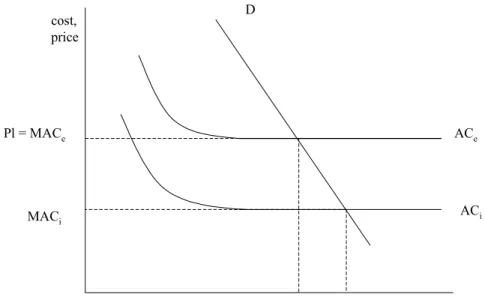
To prevent entry, incumbents can decide to set the price at or just below the limit price or above the limit price. This decision is influenced by the speed of entry. If the reaction time of the entrant is short, the price should be set at the average costs of the entrant (limit price). If the reaction time is sufficiently long, the incumbent faces a trade-off. The incumbent can set the price above the limit price and earns larger profit in the short run. Long-term profits will fall because of entry. The optimal price setting depends on the speed of entry and discount rate. If the discount rate is higher, the more likely it is that the incumbent sets it price above the limit price (current profits are valued higher than future profits). The barriers to entry are presented in figure 1.
figure 1 The working of barriers to entry (absolute cost advantage)
Where P = price, D = demand, AC = average costs, MAC = minimum average costs, I = incumbent, and e = entrant. Pl is the limit price that results in above-normal profits.
Source: Van Witteloostuijn, 1986.
The mechanism works slightly different if there is large-scale entry. In this case, the po-tential entrants acknowledge that large-scale entry reduces market price (significant ex-tra output). In their decision, the enex-trants look at the entry market price. The post-entry price is expected to be lower than the pre-post-entry price because the market has to absorb the extra capacity and this is only possible if the price is reduced. As a result, even though the entrant’s cost may be just as low as the incumbent’s, and even though the pre-entry price exceeds the entrant’s full expected unit costs, the post-entry price may fall below that cost, and entry will prove to be unprofitable. The fact that entry re-duces price, enables incumbents to set prices above minimum average costs, even if they do not have an absolute cost advantage.
The amount to which price falls depends on the post-entry and pre-entry output. And this is dependent on the reaction of the incumbent. Incumbents can reduce their own output and accommodate entry. On the other hand, they can also hold their output constant or even increase it to make entry as difficult as possible. Therefore, to study the effect of entry, assumptions about the reactions of the incumbents have to be made. In these situations, game-theoretic tools are often used. An important assump-tion is the Sylos postulate. This postulate implies that: ‘potential entrants behave as though they expected existing firms to adopt the policy most unfavourable to them, namely, the policy of maintaining output while reducing the price (or accepting reduc-tions) to the extent required to enforce such an output policy’ (Modigliani, 1958: 217). This implies that entrants a priori assume that incumbents set their limit prices such that entry is precluded (or at least the rate of entry is retarded; Kamien and Schwartz, 1971). The Sylos postulate assumes a certain degree of collusion between the incumbents (necessary for the setting of limit prices by all incumbents) and ignores strategic interac-tions between the entrant and incumbents.
quantity cost, price Pl = MACe MACi D ACi ACe
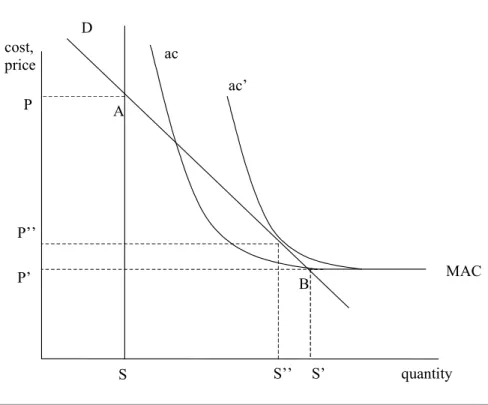
15 To clarify the working of limit-pricing in case of large-scale entry, see figure 2. Suppose that the incumbents produce S. If the entrant enters at the minimum optimal scale (MOS), market output equals S’, Price falls from P to P’, the minimum average cost level (MAC). Entrants can also enter on a lower scale than the MOS. Since the incumbents produce S, the entrant’s demand curve can be considered as AB. If the entrants average cost curve is ac, than entry is profitable. When the cost curve (ac’) is no longer below the demand curve, entry is deterred. P’’ is the entry deterring price level for entrants with cost curve ac’, and S’’ is the entry deterrence output.
figure 2 Limit-pricing in case of large-scale entry
The degree to which the limit price approaches marginal and average costs depends on elasticity of demand, market size and economies of scale. The limit price falls when elasticity of demand and market size increase. The limit price rises when economies of scale become more important.
There can be three situations of impeded entry. If the optimal output of incumbents (without regard to the threat of entrants) is sufficient to make entry unprofitable, one speaks of blockaded entry (the incumbents optimal output exceeds the limit output). Impeded entry is effective when the incumbent earns higher profit by choosing an out-put at which entry is prevented. In other situations, impeded entry is ineffective. Whether the entry deterrence is effective or not, depends on the credibility of the threats and commitments of the incumbent. The effectiveness of entry deterrence can be studied by game theory. Threats and commitments take the same form: If you take action X, I shall take action Y, which will make you regret X. A threat is characterised by the fact that the incumbent has no incentive to carry out action Y either before of after action X. The distinguishing fact for a commitment is that once action X has occurred, it is in the actor’s self-interest to take action Y (Eaton and Lipsey, 1980). In a multi-period game, a threat may become a commitment if the incumbent can build a reputation of retaliation (potential entrants base their expectations upon past behaviour).
quantity
cost,
price
P’’
D
MAC
S
P’
P
S’’
S’
ac’
ac
A
B
The small-scale barriers to entry are more or less based on structural barriers to entry that provide the incumbents a cost advantage. In the large-scale barriers to entry, en-dogenous barriers become more important, i.e. barriers to entry created due to pur-poseful action of the incumbents. Especially these barriers can be problematic as they are created to deter entry. As a result of the behaviour of the incumbents, they can raise their prices above the competitive level. Bain recognises that the extent to which prices are set above a competitive level without attracting new firms, also depends on: 1 The time lag between the decision of entry and actual entry
2 Elasticity of demand
3 Degree of collusion among incumbent firms
4 Conjectures of incumbent firms and potential entrants with respect to post-entry behaviour (price and quantity reaction).
To illustrate the first point: normally, one expects that the post-entry price is lower than the pre-entry price. However, a pre-entry price may also increase on the short run with a lowering of the barriers to entry when the incumbents realise that there is a positive time lag between a rival’s decision to enter and his appearance as an effective competi-tor (De Bondt, 1978). In this time period, the incumbents can earn extra revenue.
The s trate gi c us e of ba rri ers to entry by i ncum bents a nd the e ffect on economi c we l fare
An incumbent may create barriers to entry in various ways (Van Witteloostuijn, 1986)1 . The incumbent may succeed in raising the (minimum average) cost of potential en-trants, the incumbent may reduce its own (minimum average) costs, or may increase the costs of the entrant as well as their own costs, but the increase in the entrant’s cost is bigger than the increase in its own costs. This leads to nine possibilities of creating (rais-ing), destroying (lowering) or maintaining (the height of) the barriers to entry (see table 1).
table 1 The relationship between incumbents' and entrants' cost
Raising potential entrants’ costs Lower potential entrants’ cost Do not influence potential entrants’ costs
Raise incumbents’ costs 1 2 3
Lower incumbents’ costs 4 5 6
Do not influence incumbents’ costs 7 8 9
Source: Van Witteloostuijn, 1986: 15.
In situations 4, 6 and 7, barriers to entry are created or raised, in situations 2, 3, and 8, barriers to entry are destroyed or lowered. In case of situations 1 and 5, the height of the barriers to entry may be lowered, raised or maintained dependent on the effect of the activities on the relative cost positions of the incumbent and potential entrant. In situation 9, the barriers to entry are maintained at the same level.
To give an example of situation 7, an incumbent may create barriers to entry for the po-tential entrant by closing exclusive dealings with retailers. The costs of the entrant are
1
The focus here is on the financial consequences of the strategic behaviour of the incumbent for the entrants. The strategic behaviour can also have non-financial aspects.
17 increased by this activity, whereas the costs of the incumbent are hardly influenced (perhaps somewhat higher because of extra negotiations or compensations). In situation 6, the incumbent can reduce its own (minimum average) costs without influencing the costs of the entrant, e.g. by means of introducing new (more efficient) production tech-niques. In situation 1, an incumbent raises the costs of itself as well as the costs of the potential entrant. It is only interesting for the incumbent to do this if the costs of the potential entrant rise more than the own costs. For example, a national advertising campaign is cheaper for the incumbent than the entrant (the incumbent has a bigger market share). From a welfare-theoretical perspective, raising the level of costs repre-sents a decline in welfare.
Concl usi on
In this section, we have discussed some issues on barriers to entry from an industrial-organisation perspective. There appear to be two different perspectives, one focussing on the (cost) advantages of the incumbents over the entrant that is reflected in prices that are persistently above the competitive level without attracting entrants (Bain, limit-pricing). The other perspective (Stigler) focuses on the costs of producing which must be borne by entrants but are not borne by firms already in the market. Both perspec-tives are rooted in the industrial-organisation literature. In this literature stream, the fo-cus is on structural aspects of the industry and possible reactions of incumbents to it. The possible result is an above-normal profit.
There is also another literature stream, i.e. strategic-management literature. This stream of literature starts from a management perspective, what can a company do to create an above-normal profit. This stream of literature focuses more on the purposeful ac-tions of companies and will be discussed in the next section.
2.2 Strategic-management
literature
In this section, we shall approach the subject of barriers to entry from the point of view of strategic management. First, we shall give a short overview of the field of strategic management, then we shall treat the subject of strategic responses to entry. This chap-ter will be concluded with an overview of barriers to entry from the
strategic-management literature.
2.2.1 Introduction into the aims and issues of strategic management
Building on industrial-organisation literature, strategic-management literature and lit-erature on entrepreneurship suggest that barriers to entry are key aspects that impact the business performance (Robinson et al., 2001). While the industrial-organisation (IO) approach focuses on the (mainly financial) disadvantages that potential entrants face compared to established companies, strategic management (SM) is the field of science that tries to explain (and prescribe) the behaviour of individual companies that pursue maximal profit or other organisational goals. The unit of analysis is the individual com-pany.
These individual companies do not function in a vacuum, however, and in trying to reach their goals companies need a clear focus on the increasingly dynamic environ-ment. The relationship between a company and its environment is a two-way interac-tion: the environment functions as a framework within which the company acts, but the environment is also affected by the company’s acting.
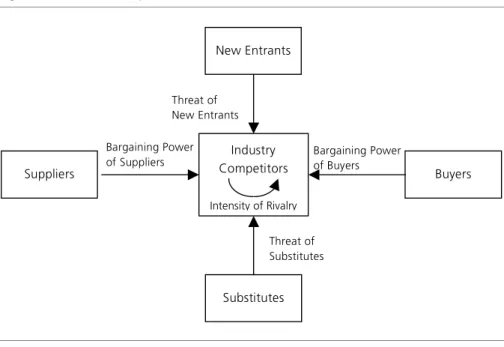
Bargaining Power of Suppliers New Entrants Industry Competitors Intensity of Rivalry Substitutes Buyers Suppliers Bargaining Power of Buyers Threat of New Entrants Threat of Substitutes
At the macro level, social, economic, political and technological developments play an important role. Changes in the social, economic, political (= legal) or technological envi-ronment implicate a change in the competitive position of a company.
At the meso level (= industry level), the relevant external environment of a company consists of five ‘forces’ that shape the competitive arena in which a firm operates (Por-ter, 1980, 1985). These forces make up the legal and social framework within which competition takes place (see figure 3). These five forces are:
1 Intensity of the rivalry within the industry 2 Bargaining power of suppliers
3 Bargaining power of buyers 4 Threat of substitutes 5 Threat of new entrants.
According to Porter (1985, p. 7), ‘Firms, through their strategies, can influence the five forces. If a firm can shape structure, it can fundamentally change an industry’s attrac-tiveness for better or for worse.’ In other words: through their strategies, firms can in-fluence the intensity of rivalry within the industry, they can inin-fluence the bargaining power of buyers and suppliers, and they can influence the threat of substitutes and new entrants. This implies that companies, by creating and implementing competitive strate-gies, could deter enter into their industry.
figure 3 The five competitive forces (external threats)
Source: Porter, 1980.
Strategi c ma nagement a n d barri ers to ent ry
Michael Porter (1980) starts his famous book Competitive Strategy with the following sentence: ‘The essence of formulating competitive strategy is relating a company to its environment’. Strategic management is the process of creating and implementing such a competitive strategy, in order to gain sustained competitive advantage. Since the threat of new competitors entering the industry is one of the environmental forces that shape the competitive position of a company, managers should formulate competitive strategies to avoid or minimise the negative impact of such developments.
19 In order to survive in its competitive environment, a firm has to outstand its competitors through superior performance. Superior performance involves implementing a value-creating strategy that none of the competitors is implementing at the same time. While customers call this value for money, strategists call it competitive advantage. A firm is said to have sustained competitive advantage, when none of its (potential) competitors is able to duplicate this strategy. Like Barney (1991), we argue that ‘firms obtain sus-tained competitive advantages by implementing strategies that exploit their internal strengths, though responding to environmental opportunities, while neutralizing exter-nal threats and avoiding interexter-nal weaknesses.’ The basis of the sustainable competitive advantage is that the firm should seek to possess and exploit a unique combination of critical resources. These resources can be either material or immaterial. These internal resources should be linked to the developments in its external environment.
2.2.2 Strategic barriers to entry
(Future) entry into an industry is likely to trigger competitive responses from incum-bents. These responses will vary according to the market conditions, the importance of the market to the incumbent, the perceived threat, the potential of the new entrant, the ability of the firm to react and other circumstances. One of the possible strategies is to influence (raise) the industry’s barriers to entry, but incumbents could also explicitly choose to let the new entrants be.
Although firms may design strategies that are aimed to reduce the threat of new en-trants, it is not always clear whether or not these strategies reach the desired goals. Ac-cording to MacMillan et al. (1985), most service businesses are characterised by low protection from rapid competitive imitation of new products, due to the absence of patent protection, production-capacity requirements or high investments required. Yip (1982) argues that strategies, aimed at building structural barriers to entry, are ineffec-tive. Han et al. (2001) show that barriers to entry might in the long run discourage existing companies to innovate, leading them to their demise. Although this may be true, in this section we focus on the different barriers to entry that exist and how they work from the strategic-management perspective.
T he res ource-bas ed a pproach
An important approach within strategic management is the resource-based view. The resource-based view of the firm presents a company as a set of productive resources that are needed to produce its products and services. Examples of the resources are la-bour, knowledge, capabilities, brand names, company infrastructure, management sys-tems and (access to) financial capital. According to the resource-based approach, valu-able, rare, imperfectly imitvalu-able, competitively superior and unique resources form the basis of a sustainable competitive strategy (Barney, 1991). These internal resources and capabilities also provide the basic direction for a firm’s strategy (Grant, 1991). In order to compete effectively, a company must utilise its resources strategically. Companies that want to reach sustainable competitive advantage should create a configuration of resources that is attuned to their environment in such a way that their company goals are achieved.
Valuable, rare, imperfectly imitable, competitively superior and unique company re-sources provide the basis for incumbents’ possibilities to create barriers to entry for en-trants and start-ups, and barriers to grow for other incumbents. According to Grant (1991), ‘barriers to entry are based upon scale economies, patent, experience advan-tages, brand reputation, or some other resource which incumbent firms possess but which entrants can acquire only slowly or at disproportional expense’. This approach
clearly derives from the resource-based view and lies very close to the definition of sus-tainable competitive advantages. It also corresponds with the Chicago School approach that barriers to entry raise entrants’ cost above the incumbents’ cost level.
Type s of res ource s
Various authors have presented classifications of resources that contribute to the firm’s strategy from a resource-based view (e.g., Grant, 1991; Barney, 1991, Matthysens et al., 1998). Grant (1995) distinguishes between physical, non-physical and human re-sources and organisational capabilities (as cited in Matthysens et al., 1998). According to Grant, resources as such are not productive. The organisational capabilities of the firm make the resources productive.
Although Grant’s point is clearly valid, Barney integrates the organisational capabilities and the resources under the label ‘capital’. Barney (1991) suggests the following classi-fication, which seems fit for the analysis of possible barriers to entry from a resource-based point of view:
1 Financial capital; access to various kinds of financing, e.g. through the stock
mar-ket, banks or suppliers
2 Physical capital; e.g., machines, production facilities, geographical locations,
ac-cess to raw materials and customer markets
3 Human capital; e.g., labour, knowledge, skills and experience
4 Organisational capital; e.g., organisational processes, structures and systems that
enable firms to produce the required products and services.
Gaining power over critical resources could be a very effective way of preventing new competitors to enter the market. For example: until recently, only one firm (De Beers) dominated the global diamond-mining industry because it controlled most of the dia-mond mines (physical capital) and organised the diadia-mond trade worldwide (organisa-tional capital). Because of this situation, it was very difficult for new firms to enter the market. Other ways of preventing competitors to enter the market, from a resource-based point of view, would be controlling financial, physical, human or organisational resources.
Stretc h and l ev erage
In most lines of business, control over one or more resources is not a very realistic op-tion. Most of the resources are freely available in the market. Thus, from a resource-based view, companies will use the available resources in the most effective way and are likely to set very high standards that new entrants cannot easily meet. According to Hamel and Prahalad (1993), ‘creating stretch, a misfit between resources and aspira-tions, is the single most important task senior management faces’. Stretch, they argue, results in the need for leveraging the company’s resource productivity. These resources can be either financial, physical, human or organisational. Hamel and Prahalad (1993) identify five basic ways to leverage resources:
1 Concentrating resources more effectively (than competitors) on key strategic goals 2 Accumulating resources more efficiently (than competitors)
3 Complementing various types of resources to create higher value (than competitors can)
4 Conserving resources when possible
5 Recovering resources from the market place in the shortest possible time. In their later work, Hamel and Prahalad (1994) argue that it is the firm’s core compe-tencies (= immaterial resources) that should be leveraged.
21 P re-em pti v e s trate gi es a n d tac ti cs
According to Harrigan (1981), firms can influence the nature and height of many barri-ers to entry, but not of those relating to demand, technological scale and other exoge-nous factors. Other authors disagree with this statement, pointing out, for example, that firms can tie up customers by introducing switching cost, by which they do influ-ence the demand structure.
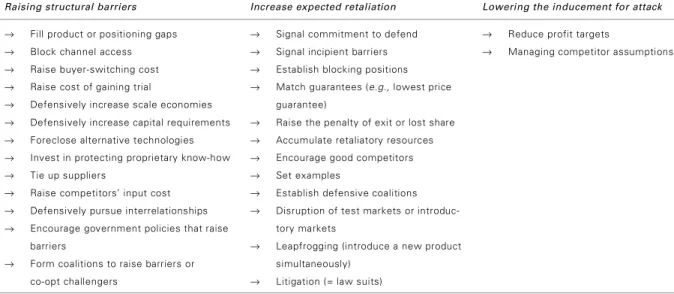
In some industries, barriers to entry are high already, due to the natural characteristics of the industry (for example, some oligopolies that face high levels of spending on promotion (e.g., the cigarette industry), or high technological barriers due to patents (e.g., the pharmaceutical industry)). Porter distinguishes the following strategies compa-nies can use to raise barriers (see table 2):
table 2 Defensive strategies and tactics
Raising structural barriers Increase expected retaliation Lowering the inducement for attack
→ Fill product or positioning gaps
→ Block channel access
→ Raise buyer-switching cost
→ Raise cost of gaining trial
→ Defensively increase scale economies
→ Defensively increase capital requirements
→ Foreclose alternative technologies
→ Invest in protecting proprietary know-how
→ Tie up suppliers
→ Raise competitors’ input cost
→ Defensively pursue interrelationships
→ Encourage government policies that raise barriers
→ Form coalitions to raise barriers or co-opt challengers
→ Signal commitment to defend
→ Signal incipient barriers
→ Establish blocking positions
→ Match guarantees (e.g., lowest price guarantee)
→ Raise the penalty of exit or lost share
→ Accumulate retaliatory resources
→ Encourage good competitors
→ Set examples
→ Establish defensive coalitions
→ Disruption of test markets or introduc-tory markets
→ Leapfrogging (introduce a new product simultaneously)
→ Litigation (= law suits)
→ Reduce profit targets
→ Managing competitor assumptions
Source: Porter, 1985.
According to Harrigan (1983), firms can use barriers to entry to sustain their position. She suggests some strategies firms can undertake to use the barriers to entry. For ex-ample, firms might aggressively shift their capital-to-labour rations in favour of more efficient, technologically innovative assets. They should not let their products become commodity-like by continuing expenditures for advertising and R&D. Also, Harrigan (1983) suggests that ‘potential entrants appear to be less likely to attempt an entry where they expect little chance for success. If a market is already suffering excess capacity, this analysis suggests, firms may be discouraged from entering. This finding suggests that defending firms may adopt a policy (…) of keeping some level of capacity idle by always building first and the most appropriate locations to pre-empt would-be competitors’. Last but not least, she notes that recent entry of a competitor diminishes the risk of new entry by yet another company.
Karakaya and Stahl (1989) analysed the relative importance of six barriers to entry. They found that all six play an important role in marketing executives’ decisions of market entry, but that some barriers are more important than others. In order of importance, cost advantages of incumbents are the most important barrier of the six, followed by capital requirements, customer-switching cost, product differentiation of incumbents, access to distribution channels, and government policy. The relative weights of the
bar-riers show that the cost-advantages barrier is perceived as more important for entry in industrial-goods markets than in consumer-goods markets. Also, the authors discovered differences in the relative importance of the barriers for early and late entry.
Schoemaker and Amit (1997) point out that strategy formulation, including the creation of mechanisms that discourage potential competitors to enter the industry, should be focussed on in the future. They claim that the resource-based approach has been look-ing too much at the past, instead of anticipatlook-ing future developments. Schoemaker and Amit (1997) suggest that strategy makers should use scenario planning to anticipate the rapid changes in their environment, including the changes in opportunities for potential new entrants. From these scenarios, strategy makers can deduct which competences and resources are necessary for the firm in order to remain its competitive advantage. To conclude, the strategic-management literature suggests that incumbents can and indeed do prevent companies from entering their market. There are several strategies that they can select. In some situations, these strategies may be effective, in other situa-tions they may not.
Retal i ati on agai ns t new e ntrants
Although barriers to entry might be high, successful incumbents in profitable markets can expect to face entry of a new competitor at a certain point in time. When faced by such a situation, incumbents may consider retaliating. According to Robertson and Ga-tignon (1991), retaliatory actions taken by the ‘pioneer’ (incumbent) are usually success-ful, especially when the scale of entry is low and the entrant’s access to resources is low or medium. A retaliation strategy should be based on three principles (Robertson and Gatignon, 1991):
1 The incumbent should have a significant competitive advantage over the entrant 2 The scale of entry should be limited
3 The entrant should have low to medium access to the necessary resources. If these criteria are not met, the incumbent may consider attacking the entrant in an-other market. Gatignon and Reibstein (1997: 239) developed a decision model for de-termining the appropriate response to new entry (see figure 4).
23 figure 4 Decision model for determining response to a new entrant
Source: Gatignon and Reibstein, 1997.
As various authors (Harrigan, 1983; Robertson and Gatignon, 1991; Gatignon and Reib-stein, 1997) have suggested, the model proposes four possible strategies for incumbent firms: No Ignore the new entrant Yes Is a response appropriate? How aggressive should the
re-sponse be? What should be the magnitude of the response? Accommodate the new entrant Abandon the market Retaliate against
the new entrant
Outdo attacker Match attacker
Delayed
How fast should the response be?
What should be the domain of the
response? Immediate Respond in a different product/market Respond in the same product/market
What marketing initiatives should be taken?
- Pricing? - Communication?
1 Abandon the market; abandonment could be considered if the new entrant has a sustainable competitive advantage over the incumbent in the target market, or if the firm’s resources can be applied more profitably in other markets.
2 Accommodate the new entrant; new entrants can also be considered as ‘agents
of change’. Existing firms within the industry might profit from this change. For ex-ample, in the telecommunications business, incumbents have little to fear from some of the new, highly innovative small companies that are being set up. They sometimes stimulate these companies to innovate, and the most successful compa-nies end up being bought by the former monopolists. This way, the incumbent pro-fits from the new ideas of the entrant1
.
3 Ignore the new entrant; letting small new entrants enter the market could be a
proper strategy in some cases. The idea is that firms should ‘manage’ entry and should consider allowing harmless new entrants in niche markets. These niche play-ers fill the ‘gaps’ in the market and by doing so, they block the way for more ag-gressive, potentially harmful new entrants. The danger of this approach, however, is that the new competitor may use the niche as a wedge, to enter the incumbent’s main market in a later stadium.
4 Retaliate against the new entrant; retaliation is an appropriate strategy if the
new entrant threatens the incumbent’s position in the market. ‘Retaliation corre-sponds to a declaration of war, wherein the firm wants to signal to the attacker and to other competitors its intention to fight back’ (Gatignon and Reibstein, 1997).
Concl usi on
Strategic-management literature looks at barriers to entry from the perspective of indi-vidual companies (mainly incumbents). The main focus is on the creation of a sustain-able competitive advantage based on resources and distinct capabilities. Based on this perspective, companies can actively influence the nature and height of many barriers to entry. The actions can try to raise the (structural) barriers (preventing entry) or increase the retaliation expectations as a response to actual entry.
2.3 Conclusion
In this chapter, we discussed literature on barriers to entry. There are two different, sometimes overlapping streams of literature: industrial organisation and strategic man-agement. In the industrial-organisation literature, there is a distinction between struc-tural barriers and strategic barriers. The strucstruc-tural barriers to entry are based on charac-teristics of the industry. They include, amongst others, technology, advertising intensity and economies of scale (in relation to total market demand). These barriers are exoge-nous to players in the market. Strategic barriers to entry are endogeexoge-nous, i.e. they can be influenced by actions of market players. Econometric models and game theory are used to study the effects of these barriers on the competitive outcome of the market. The industrial-organisation literature especially shed light on the effects of barriers to entry on the market outcome.
Strategic-management literature takes the perspective of individual companies and de-scribes what they can do to enhance their performance. Central in this perspective are resources and capabilities. With these resources and capabilities, companies will try to
1
Based on arguments of the industrial-organisation literature, incumbents may lower their output after entry, acting as Stackelberg quantity leaders (Martin, 2002: 232).
25 create a sustainable competitive advantage. This will result in above-normal returns. To remain profitable and earn above-normal returns, incumbents can actively influence the conditions under which other companies can enter the market and potentially harm in-cumbents’ position. The strategic-management literature contributes to the understand-ing of the rationale behind the strategic actions of companies to create barriers to en-try.
27
3
Barriers to entry: descriptions
Through an extensive literature search, 36 barriers to entry have been identified. In this chapter, we shall describe the different barriers to entry in more detail. Some of the barriers are closely related, are part of a ‘higher’ barrier or contribute to another barrier. This will be discussed in the description. For a description of this process, see annex I. The next 37 paragraphs give an overview of the following barriers:
1 Absolute cost advantages 2 Access to distribution channels 3 Advertising
4 Asset specificity
5 Availability of skilled labour 6 Brand name
7 Capital requirements 8 Causal ambiguity
9 Control over strategic resources
10 (Transaction) Costs of operating in foreign markets 11 Cultural distance 12 Customer loyalty 13 Customer-switching costs 14 Divisionalisation 15 Dynamic limit-pricing 16 Economies of scale 17 Excess capacity 18 Experience advantages
19 Gaps and asymmetries of information 20 Government licences
21 Government policies
22 High wages for employees and managers 23 Investment risk
24 Know-how 25 Level of technology 26 Location
27 Packing the product space 28 Patents (product or process) 29 Product differentiation
30 Research and development intensity 31 (Expected) Retaliation by incumbents 32 Seller concentration
33 Selling expenses
34 Special risk and uncertainties of entry 35 Sunk cost
36 Technological change 37 Vertical integration.
For each barrier, we describe the mechanisms behind the barrier, i.e. how the barrier influences or restrains competition and entry. Also the relationship between the barrier and the size of the entrant will be discussed. Furthermore, we describe how sustainable the barrier is from the perspective of the incumbent and what potential entrants can do to avoid the barrier. Finally, measurement issues of the barriers will be described.
3.1 Absolute
cost
advantages
Desc ri pti on of the bar ri e r
Besides economies of scale and product differentiation, Bain (1956) describes absolute cost advantages as a third barrier to entry. An absolute cost advantage exists when, at any common scale, the prospective unit costs of production are higher for entrants than for incumbents (Bain, 1956). Potential entrants who know they will face higher unit costs will think twice before entering the industry, and so absolute cost advantages can pose a barrier to entry.
The principal potential sources of absolute cost advantages are (1) control over superior production techniques (exercised through patents, secrecy or both), (2) lower prices for productive factors coming from imperfections in the market, (3) strategic factor sup-plies, especially concerning natural resources, resulting in exclusive use of resources or the use of the resources for a lower price and (4) lower interest costs than potential en-trants (Bain, 1956). Absolute cost advantages can also arise from differential wage rates, superior talent, random luck, and historical accidents (Shepherd, 1997: 211). Absolute cost advantages originate from access to scarce resources which new entrants cannot develop as inexpensively as earlier entrants did, if at all. Access to distribution channels and ownership of a uranium mine are good examples. To match the access to scarce raw materials or vertical relationships, firms would have to invest heavily. Even then, some experience-curve advantages cannot be replicated through accelerated spending programmes by late entrants (Harrigan, 1983; 76).
Besides the more exogenous barriers, strategic behaviour of the incumbents can also result in cost asymmetries. Salop and Scheffman (1983) argued that behaviour intended to increase industry costs could benefit established firms (despite increasing their own costs) because it causes rival firms to reduce their output (perhaps to zero). Examples are efforts to increase union wages and strategic behaviour to acquire natural resources and deny access to them by rivals. This strategic behaviour must be based on some ex-ogenous differences between incumbents and entrants (e.g., first-mover advantage, long-term contract with customers, etc.).
It is important to emphasise that the disadvantage of the potential entrant must be un-avoidable, even after he has tried to make some adaptations on other dimensions, like integrating in the environment. When after these adaptations the cost advantages are less, one could have mixed up another barrier to entry with absolute cost advantages (partly) (Bain, 1956). In this case, it is important to look at the role of opportunity costs. Demsetz (1982) uses the example of taxi medallions that are issued by a municipality and traded at market-determined prices. The medallion requirement impedes the entry of taxi services on this market. The value of the medallion is an opportunity cost of op-erating for existing as well as potential service providers. The true barrier to entry in this market is at the level of the municipality and not at the costs of the medallion. If prop-erly measured and valued, the medallion requirement would not be a source of supra-normal profit for existing taxis.
Siz e e ffects
Considering absolute cost advantages, time is an important element, while incumbents’ advantages mainly come from early-mover advantages. The size of the incumbents in relation to the (sub-)markets (of productive factors) is important for entrants. The space left in the industry compared to the minimum-efficient scale, can tell the potential en-trant whether or not he has to compete for what amount of market share with incum-bents with absolute cost advantages. It also tells something about the likely reaction of
29 the incumbents. When adaptations or alternatives are not possible and cost advantages prove to be absolute, the barrier to entry will be very severe.
S usta i nabi li ty of the ba rri er
The sustainability of the barrier to entry can decline when superior production tech-niques prove to be not superior anymore or when these techtech-niques can be exercised by entrants all of a sudden (once patents or secrecy comes to an end).
Absolute cost advantages coming from market imperfections of productive factors can-not be sustained when these imperfections can be tackled.
The sustainability of advantages coming from strategic factor supplies declines when, for example, the market for natural resources becomes more open as new supplies are found or players in the market decide to change direction, or when the factor supplies become less relevant while an alternative resource has proved useable, for instance. The absolute cost advantage coming from lower interest costs for incumbents is not sustainable when the capital market imperfections are removed or alternative capital supply (with lower interest costs) for potential entrants, e.g. from a large partner com-pany, becomes an option.
Rel ati on wi th others barr i ers to e ntry
Various barriers can be more or less sources for absolute cost advantages. The next bar-riers to entry result in a situation in which the entrant has higher cost than the incum-bent.
Capital requirements: When capital requirements are high, imperfections in the
mar-ket become more severe and result in higher barriers to entry.
Control over strategic resources: If access can be denied, control over strategic
re-sources can result in a cost advantage for the incumbent.
Availability of skilled labour: Incumbents will have the first choice for selecting the
most skilled employees.
Location(limited): Incumbents will have the first choice for selecting the most
attrac-tive or producattrac-tive location.
Access to distribution channels: Incumbents will have the first choice for selecting
the most attractive distribution channel. Especially if the incumbents can conclude long-term exclusive contracts with these distribution channels, it will be hard for entrants to enter the market.
As noted earlier in the description of the barrier, it is important to distinguish between cost disadvantages for potential entrants that can be avoided by making some adapta-tions on other dimensions, as Bain (1956) suggested. Absolute cost advantages can eas-ily get mixed up with e.g. economies of scale, experience curve, vertical integration, technological change and access to resources. It is important to look at possible oppor-tunity costs in these situations.
P ossi bil i ti es for av oi di ng the barri e r
To obtain the absolute cost advantages of early entrants, later entrants can acquire ex-isting firms (Harrigan, 1983; 76).
M eas urem ent of the ba rri er
Karakaya and Stahl (1989) use a questionnaire in an experimental design in which deci-sion makers were asked to make a market decideci-sion. Absolute cost advantage is one of the barriers that is used in the entry-decision profiles.