Action Localization in Video using a Graph-based Feature Representation
Iveel Jargalsaikhan, Suzanne Little and Noel E O’Connor
Insight Centre for Data Analytics,
Dublin City University, Ireland
Abstract
We propose a new framework for human action localiza-tion in video sequences. The oplocaliza-tion to not only detect but also localize actions in surveillance video is crucial to im-proving system’s ability to manage high volumes of CCTV. In the approach, the action localization task is formulated the maximum-path finding problem in the directed spatio-temporal video-graph. The graph is constructed on the top of frame and temporal-based low-level features. To local-ize actions in the video-graph, we apply a maximum-path algorithm to find the path in the graph that is considered to be the localized action in the video. The proposed ap-proach achieves competitive performance with the J-HMDB and the UCF-Sports dataset.
1. Introduction
Understanding of human action in video sequences is useful for a variety of applications such as detecting rele-vant activities, summarizing and indexing video sequences, organizing a digital video library according to the relevant actions, etc. In security applications, CCTV footage can be analysed in order to index actions of interest and enable queries relating to actions such as anti-social or criminal behaviour or to monitor crowd volume or aggression. How-ever it remains a challenging problem for computer vision to robustly recognize action due to cluttered backgrounds, camera motion, occlusion, view point changes and the geo-metric and photogeo-metric variances of objects.
Recent methods [13, 25, 7] for action recognition mostly focus on action classification rather than action localisation. Mostly the top-performing classification approaches in the action modelling process [25, 16, 22] explicitly or implic-itly use the background information, i.e., the region where the action is not performed. This significantly contributes to the classification performance [19, 5] but prevents the identification of the region where the action is taking place. However, the action localisation task requires the classified action to be localised both spatially and temporally. The
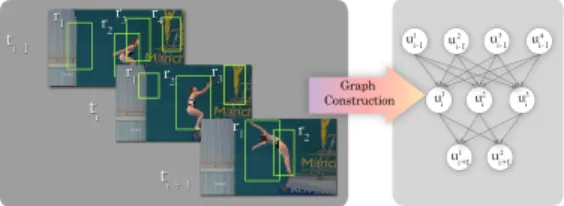
Figure 1. A directed video graph construction process
temporal localisation can be efficiently [18] detected us-ing the typical classification method coupled with the slid-ing window technique. However, the spatial localisation is complicated for the classification-based methods due to the above mentioned use of the background. This paper aims to address the localisation problem emphasising the spatial lo-calisation of the action. In particular, we propose an action localisation framework based on a directed video-graph and present two major contributions as follows,
First, we propose a new directed video graph suited for the localisation task. In the graph, the node describes a can-didate action region and its connectivity (edge) describes the similarity with the adjacent region regarding cues such as region colour, motion and region geometry. The discrim-inative score of each node is calculated using a late fusion technique based on the corresponding local and regional features. The late fusion provides a means to integrate a variety of features of different type and dimensions (local, global and regional). Also, it makes the video graph repre-sentation sufficiently flexible to combine a richer set of fea-tures that has a potential to increase the performance. Sec-ondly, this paper presents the application of the maximum-path finding algorithm to identify the localised action. This method has been successfully adopted in an object tracking problem [4] where it showed its effectiveness. We propose that action localisation can be understood as semantic con-cept tracking over time. Therefore we investigate whether this approach can be extended to the challenge of action localisation. The proposed approach is evaluated using two benchmark action datasets, namely J-HMDB and UCF-Sports. In the literature [20, 12, 27], these datasets have
been extensively used for action localization. The remain-der of this paper is organized as follows: Section 3 presents a overview of the proposed framework followed the video graph construction (Section 3.1) and the maximum-path (MPF) formulation on the video graph (Section 4) and the experimental result (Section 5).
2. Related Work
Action localisation is becoming crucial for effective analysis of therealisticvideo capture scenario that consists of videos captured in complex settings that have significant background clutter or contain multiple actors or actions. The earlier works [20] propose to directly use a classifier on the action localisation task using 3D sliding window or similar technique. The main advantage is that the mid-level representation may not be necessary. However, the sliding window approach substantially increases the computational complexity when an input video has a long duration or high-resolution.
In other approaches, the localisation is primarily based on the action proposal [8] inspired by the success of the region proposal methods for the object localisation task in 2D images. For instance, theobjectness technique [1] for object localization is extended to video by [4] and selec-tive search[21] is modified into spatio-temporal tubelets in [27]. This class of method overcomes the short-coming of classifier-based approach by investigating the selected part or region of the video rather than the entire video. The re-gion proposal approach is computationally efficient and ob-tains good results for action localisation in comparison to the other methods. We adopt this strategy in the develop-ment of the video graph.
Recently the approaches based on features from convo-lutional neural networks [11] [14] have achieved significant progress in the object detection and image classification task. In particular, the approaches based on regional convo-lutional neural networks (RCNN) [17] are the state-of-the-art that have produced best results with a high-margin of difference compared to competing approaches for the ob-ject localisation task. Gkioxari et al [8] first applied the region-based convolutional feature (R-CNN) in the action localisation task and achieved promising results. However, the action detection is frame-based and can not take into ac-count the temporal dynamics of the action which is an im-portant cue in any action recognition system. More recently, Weinzaepfela et al. [27] introduced a method to overcome this weakness by fusing the region-based feature (R-CNN) with a track descriptor, that is similar to the trajectory fea-ture used in our approach, and achieved further improve-ment. This shows that combining the frame-level descrip-tor, such as R-CNN, with local temporal features (motion trajectories) that are complementary to each other and im-proves the performance. Our framework embeds both the
region-based convolutional features (R-CNN) and the local trajectory features to obtain the discriminative graph model. In an approach similar to our work, [24] introduces an action localisation framework based on action proposals from dense trajectories features. However our proposed framework differs in several key aspects: first, we de-velop the effective graph structure that is capable of inte-grating the different feature types i.e., local trajectory and RCNN features. Furthermore, the additional cues such as local, motion and region geometry are captured as the graph edges. Finally, the localisation is performed by maximising the path score in a video graph.
3. Proposed Framework
In the localisation framework, given a video, we first ap-ply a region proposal technique at the frame level. This step produces the candidate action regions that form the basis for constructing the video graph. In the video graph, the node represents the region along with its corresponding features and the edge describes the similarity with its adjacent re-gion. To assign the discriminative node score, support vec-tor machines (SVMs) classifier is built with training videos for each type of feature (local and regional) and integrated using a late fusion method (details in Section 3.1.3). Fi-nally, the maximum-path finding algorithm is used to find the maximum scoring path in the video graph of a test video. The regions associated with the maximum path is consid-ered as the localised action. Next, we describe construction of the video graph.
3.1. Video Graph Construction
Given a video sequenceV ={I1, I2, .., In}, whereIkis
a static frame at the time instancek, we construct the corre-sponding video graphG(V, E). As shown in Figure 1, the nodeujk describes the action candidate region regions de-fined by a rectangular regionrjk = (xjk, yjk, hjk, wjk)in the static frameIk. There are various ways to acquire
candi-date regions such as dense sampling [6] that subdivides the frame into fixed grids at different scales. However, it has an implication to substantially increase the number of can-didate regions whereby the computational complexity in-creases. Consequently, the alternative strategy is to use the region proposal method that efficiently identifies the likely object regions using only texture and edge information. Al-though any object proposal can be used in our framework, the selective-search method [21] is used in the experiment due to the availability of its implementation1. The region proposal is applied on the video frames to generate approx-imately2000candidate action regions per frame. Further-more, we filter the candidate regions where there is no sig-nificant motion according to the method [8]. This
Figure 2. The regional feature calculation process
cantly reduces the number of a region by 85% with a loss of only 4% (action positive regions).
Once the node region is determined, the next important step is feature extraction process. The recently [27, 8] suc-cessfully used region-based neural network (RCNN) fea-tures for action localisation, are adopted for describing the node region. The RCCN is shown to be highly discrimi-native as well as able to describe the region with arbitrary size. However, it does not capture the temporal dynamics of the action beyond two consecutive frames. Thus, the local dense trajectory feature is extracted from the node region to complement the RCCN feature. Next, we discuss how the features are extracted in detail.
3.1.1 Regional feature
Gkioxari et al [8] introduced RCNN features that operate separately on the image and optical flow. We use the same set of RCNN features i.e., rgb-RCNN and f low-RCNN. Given a region re-scaled to the dimension of227×227, the rgb-RCNN operates on a three-channel of the colour im-age. It captures the static appearance of the actor/scene. For f low-CNN feature extraction, the flow image is first formed by transforming the dense optical flow into a 3-channel im-age (the flow x & y component and its amplitude) followed by the re-scaling and convolutional process. The f low-RCNN captures the motion pattern of the action. In the experiment, the pre-trained RCNN network2is used to com-pute thergb-RCNN and thef low-RCNN features from the video frame region associated with the graph nodes as show in Figure 2. We use the concatenation of thef c7−layer (4096dimension) features ofrgb-RCNN andf low-RCNN network. We refer to the concatenated vector (9192 dimen-sion) asvfi for the nodeui with the corresponding region
ri.
3.1.2 Local feature
Although the proposed approach is not constrained by the type of local features, we adopt the feature/descriptor de-scribed in the work [25]. In particular, we use the dense trajectory [25] that extracts the motion trajectories. In the
2https://github.com/gkioxari/ActionTubes
Figure 3. The procedure of calculating the node score of the action graph. We use two different feature types:localandregion-based. Each feature is aggregated into final node score using late-fusion method.
experiment, the trajectory length is set shortL= 15frames to avoid the drifting trajectory problem. We apply the fea-ture extraction for the entire video. Then the video graph nodeui is associated with the local features located in its
regionrk. For each feature, four descriptors (TRAJ, HOG,
HOF, MBH) are calculated and concatenated to form a sin-gle vector.
3.1.3 Classifier training and node discriminative score
Since we use two sets of features, two separate classifiers (regional and local) are trained. For the regional feature, we train SVM classifiers for each action classc ∈ C, where ground truth regions are considered as positive examples and regions that overlap by factor of less than 0.3 times the area with the ground truth as negative. During training, the hard-negative mining technique is used. This strategy has shown significant improvement compared to traditional training [17] in the object localisation task.
For training a classifier for local features, we use the Bag-of-Features (BoF) model with the re-formulated scor-ing function introduced in the work [6] . In the experiment, the one-against-rest strategy is used to produce a binary classifier for each action classc. Once the SVM classifier is learned, the discriminative score for nodeuiis calculated
as follows:
Regional Classifier: Given a regionri of nodeuiwith
the extracted regional feature vectorvfi and the trained clas-sifiers for action class. Each nodeuiin the video graph is
assigned with a discriminative score for action classc: scorefc(ui) =βc+w0c·v
f
i (1)
where the discriminative score is the estimate of a likeli-hood that actioncis performed within the regionriof the
nodeuiandwc,βc are learned bias and support vector of
the trained regional SVM classifier for actionc.
Local classifier: As we formulated the localisation as the maximum path, the discriminative score should be able to be combined additively to give the cumulative score for traversing the path in the video graph. The additivity
requirement on the classifier property is applicable here. Therefore, we use the linear (additive) SVM classifier for training. In particular, for each training video, we com-pute the BoF encoding with K visual words. A training video with N local features is described by the set S = {(xi, vi)}Ni=1 , where xi = (xi, yi, ti)refers to the local
feature position in space and time, andviis the associated
local descriptor. Leth(S)be function maps feature setS into K-dimensional BoF coded vector.
The one-against-rest strategy is to learn a linear SVM for each action classc ∈ C. The resulting score function can be re-formulated as a sum over the contribution from each feature and this formulation is used calculate the discrimi-native score for nodeui,
scoretc(ui) =βc+ K X j=1 wjch j (S(r)) =βc+ X i∈ri wci c (2)
where hj(S)denotes the j-th bin count for histogram h(S). The j-th word is associated with a weight wj =
P
iαh j(S
i)andwc,βc are learned bias and support
vec-tor of the learned SVM classifier for actionc.
Late-Fusion:To calculate the final discriminative score for a given nodeui, we use the fusion technique to combine
the respective scores as follows:
scorec(ui) =α·scorerc(ui) + (1−α)·scorelc(ui) (3)
whereαis a scalar. In the experiment, we use this param-eter to investigate the respective feature type contribution to localisation performance.
3.2. Edge weight
The edge e(ui, uj) represents the similarity between
given nodesui,uj. In the proposed video graph, the edge is
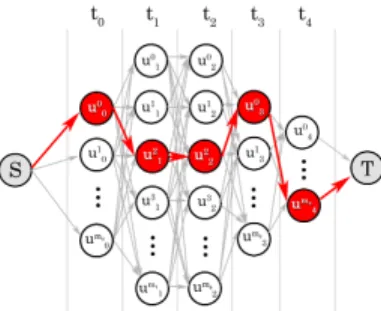
formed between temporally adjacent nodes as shown in Fig-ure 4 and the edge direction is used to enforce the path to flow in time. The action localisation can be understood as semantic concept tracking over time. In tracking methods [2][3], the authors use the color, motion cues for successful object tracking. A rich set of cues is crucial for the accurate registration of the object over different frames. Therefore we propose to combine multiple cues (colour, descriptor and geometric) to determine the edge weight:
e(ui, uj) =
(
fc(ri, rj) +fg(ri, rj) +fd(ri, rj), if adj(ri,rj)
0, otherwise
(4) whereri,rjare the corresponding region for the nodeui
anduj, respectively andadj(ri,rj)implies the temporally
adjacent nodes and the termfc,fg andfd are defined as
follows:
Figure 4. The maximum path in the graph considered to be the lo-calized action. In the experiment, we use the Boykov-Kolmogorov method to calculate the maximum flow between nodeS,T .
• Color Similarity Term(fc): Many colour descriptors
have been proposed in the literature. In the experiment, we use the region-based color descriptor proposed by Van et al.[23] due the availability of its implementa-tion3. The color descriptor (108 dimension) is ex-tracted from the regionrkfor each color hannel (RGB)
and concatenated to create the combined descriptorck.
Then color similarity termfc(ri, rj)is defined as a
co-sine measure betweencosine(ci, cj)whereck is
con-catenated color descriptor extracted from a region rk
of the nodeuk. The cosine similarity is selected due
to it has positive space, where the outcome is neatly bounded in a range of[0,1].
• Descriptor Similarity Term(fd): This term is based
on the assumption that the features extracted from the same actor/action should resemble similarity. In the experiment, we use the regional feature to determine the descriptor similarity term as follows: fc(ri, rj) =
cosine(vi, vj)wherevj viis the regional features
ex-tracted at the regionriandrjrespectively.
• Geometric Similarity Term(fg): This term
encour-ages the spatial coherence between the node regions. In other words, the term scores high if the spatial extent significantly overlaps. The geometric similar-ity is defined as intersection of over union measure, fg(ri, rj) =IOU(ri, rj)i.e the full overlap between
the regions gives a score of 1.
4. Action localization in the video-graph
Assuming a video sequence is mapped into directed video-graphV(G, E)as discussed in Section 3.1. We now describe how to localize action in the graph. Given a path p, the scoreMc(p)is defined as:Mc(p) = X i∈p scorec(ui) +λ X (i,j)∈p e(ui, uj) (5) 3http://lear.inrialpes.fr/people/vandeweijer/color descriptors.html
wherecis the action class and λis a scalar. The edge weighte(ui, uj)scores high if the corresponding node
re-gionsri,rjoverlap and agree in terms of color and regional
feature. To localize the action, the problem becomes to find the optimal pathp∗with highest accumulated score:
(p∗, c∗) = arg max
c∈C argp∈maxpath(G)
Mc(p) (6)
wherep∗ = [u1, u2, ..., ut]is the trajectory that
maxi-mizes the video graph with action classc∗. Finally the cor-responding regions[r1, r2, ..., rt]will be considered as the
localised action in the video sequence. The Maximum path problem is efficiently solved using dynamic programming. In the experiment, we have used Boykov-Kolmogorov al-gorithm to find the maximum flow in the graph by adding zero-weighted sourceS and terminal T node as shown in Figure 4.
5. Evaluation
5.1. Datasets
We evaluate our approach on two widely used datasets, namely UCF Sports [15] and J-HMDB [10]. On UCF sports we compare against other techniques and show substantial improvement from state-of-the-art approaches. We present an ablation study of our CNN-based approach and show results on action classification using our action tubes on JHMDB, which is a substantially larger dataset than UCF Sports. The UCF Sports dataset consists of 150 videos with 10 different actions. There are on average 10.3 videos per action for training, and 4.7 for testing 1 . J-HMDB contains about 900 videos of 21 different actions. The videos are extracted from the larger HMDB dataset [24], consisting of 51 actions.To date, UCF Sports has been widely used by scientists for evaluation purposes.
5.2. Experimental Protocol
To quantify our results, we report AUC curves for the UCF-Sports dataset, a metric commonly used by other ap-proaches. A number of recent methods have used AP metrics, and we have compared our method performance against these reported methods for both the J-HMDB and UCF-Sports dataset.
5.3. Results
5.3.1 UCF SportsIn Figure 5 we plot the average AUC (Area Under Curve) for different values of σ (IOU parameter). The curve is created by plotting the true positive rate (TPR) against the false positive rate (FPR) at various threshold setting. We plot the curves as produced by the recent state-of-the-art ap-proaches, Jain et al. [9] , Wang et al. [26], Tian et al. [20],
Figure 5. AUC for varying IoU thresholds for UCF-Sports Dataset action class local region combined
brush hair 79.1% 59.8% 84.9% catch 27.8% 11.6% 33.6% clap 57.3% 20.1% 60.3% climb stairs 21.8% 23.0% 63.9% golf 92.3% 29.7% 95.7% jump 14.4% 9.0% 14.5% kick ball 14.5% 3.7% 15.5% pick 42.4% 14.4% 53.9% pour 92.3% 70.3% 97.1% pullup 89.8% 52.1% 96.2% push 63.3% 31.6% 55.8% run 37.9% 13.7% 42.9% shoot ball 23.0% 19.9% 26.5% shoot bow 79.1% 31.0% 79.6% shoot gun 25.7% 19.6% 48.5% sit 40.0% 30.5% 50.2% stand 39.1% 32.3% 42.6% swing baseball 79.5% 9.6% 81.3% throw 25.9% 11.1% 28.5% walk 70.7% 33.7% 77.8% wave 37.0% 23.9% 50.0% MAP 26.2% 50.1% 57.1%
Table 1. The performance by action class for J-HMDB dataset (Split 1)
Lan et al. [12], Action Tube [8] and SMTH [27]. Our ap-proach outperforms most of these techniques, showing the most improvement for high values of overlap. In particular, the proposed method achieves the competitive performance with the recent state-of-the-art work [27] only falling short by a slight margin. For comparison with the state-of-the-art methods, as shown in column 2 at Table 2, our method achieves competitive performance of MAP = 88.7 % with IOU parameterσ= 0.5.
5.3.2 J-HMDB dataset
First, we report the performance of the 21 actions of the J-HMDB dataset. Table 1 presents the result by the
differ-J-HMDB (σ= 0.5) UCF-Sports (σ= 0.5) Action Tube[8] 53.3 % Action Tube [8] 75.8 % STMH [27] 60.7 % STMH [27] 90.5 %
Our method 56.3 % Our method 88.7 %
Table 2. Comparison of the method with the state-of-the-art meth-ods
ent combination of features used: local (TRAJ, HOG, HOF, MBH), regional (flow RCNN + RGB RCNN) and fused (lo-cal + regional). It is apparent that the fused approach con-sistently outperforms the individual features. The regional feature performs significantly better for almost all actions in comparison with the local counterpart. It proves the highly discriminative nature of the convolutional feature. Regard-ing MAP, feature fusRegard-ing (57.1%) shows the improvement of 7%, 31 % in comparison to using regional (50.1%) and local feature (26.2%) alone.
For comparison with the-state-of-art methods, recently two methods have evaluated their system MAP performance averaged over all three splits with IOU parameterσ= 0.5. As shown at column 1 of Table 2, our method achieves com-petitive MAP performance of 56.30 %.
6. Conclusion
We propose a novel video graph-based framework for human action localisation from video sequences. The abil-ity to not only detect but also localize actions in surveillance video is crucial to improving surveillance system’s capacity to manage high volumes of CCTV. The proposed approach can effectively accommodate different types of feature us-ing the late fusion method. Also, the additional cues such as colour, motion and the geometrical information are cap-tured within the graph representation. We perform the ac-tion localisaac-tion by maximising the score associated with the node and the edge in the video graph. The proposed approach achieves competitive performance with J-HMDB and UCF-Sports dataset.
Acknowledgement
This publication has emanated from research conducted with the financial support of Science Foundation Ireland (SFI) under grant number SFI/12/RC/2289 and the techni-cal support from NVIDIA corporation.
References
[1] B. Alexe, T. Deselaers, and V. Ferrari. Measuring the objectness of image windows.PAMI, 34(11):2189–2202, 2012.
[2] J. G. Allen, R. Y. Xu, and J. S. Jin. Object tracking using camshift al-gorithm and multiple quantized feature spaces. InVisual information processing, 2004.
[3] B. Babenko, M.-H. Yang, and S. Belongie. Robust object track-ing with online multiple instance learntrack-ing.PAMI, 33(8):1619–1632, 2011.
[4] J. Berclaz, F. Fleuret, E. T¨uretken, and P. Fua. Multiple object track-ing ustrack-ing k-shortest paths optimization. PAMI, IEEE Transactions on, 33(9):1806–1819, 2011.
[5] L. Cao, Z. Liu, and T. S. Huang. Cross-dataset action detection. In CVPR (CVPR), 2010 IEEE conference on, pages 1998–2005. IEEE, 2010.
[6] C.-Y. Chen and K. Grauman. Efficient activity detection with max-subgraph search. InCVPR 2012.
[7] P. Doll´ar, V. Rabaud, G. Cottrell, and S. Belongie. Behavior recog-nition via sparse spatio-temporal features. InVisual Surveillance and Performance Evaluation of Tracking and Surveillance, 2005. 2nd Joint IEEE International Workshop on, pages 65–72. IEEE, 2005. [8] G. Gkioxari and J. Malik. Finding action tubes. InCVPR, pages
759–768, 2015.
[9] M. Jain, J. Gemert, H. J´egou, P. Bouthemy, and C. Snoek. Action localization with tubelets from motion. InConference on CVPR, pages 740–747, 2014.
[10] H. Jhuang, J. Gall, S. Zuffi, C. Schmid, and M. Black. Towards understanding action recognition. InICCV, pages 3192–3199, 2013. [11] A. Krizhevsky, I. Sutskever, and G. E. Hinton. Imagenet classifica-tion with deep convoluclassifica-tional neural networks. InNIPS, pages 1097– 1105, 2012.
[12] T. Lan, Y. Wang, and G. Mori. Discriminative figure-centric models for joint action localization and recognition. InICCV 2011. [13] I. Laptev. On space-time interest points. International Journal of
Computer Vision, 64(2):107–123, 2005.
[14] S. Lawrence, C. L. Giles, A. C. Tsoi, and A. D. Back. Face recog-nition: A convolutional neural-network approach. neural networks, 8(1):98–113, 1997.
[15] J. Liu, J. Luo, and M. Shah. Recognizing realistic actions from videos in the wild. InIEEE CVPR 2009.
[16] K. Rapantzikos, Y. Avrithis, and S. Kollias. Dense saliency-based spatiotemporal feature points for action recognition. InCVPR, 2009. CVPR 2009. IEEE Conference on, pages 1454–1461. IEEE, 2009. [17] S. Ren, K. He, R. Girshick, and J. Sun. Faster r-cnn: Towards
real-time object detection with region proposal networks. InNIPS, pages 91–99, 2015.
[18] K. Soomro, H. Idrees, and M. Shah. Action Localization in Videos Through Context Walk.ICCV, pages 3280–3288, 2015.
[19] W. Sultani and I. Saleemi. Human action recognition across datasets by foreground-weighted histogram decomposition. InConference on CVPR, pages 764–771, 2014.
[20] Y. Tian, R. Sukthankar, and M. Shah. Spatiotemporal deformable part models for action detection. InConference on CVPR, pages 2642–2649, 2013.
[21] J. R. Uijlings, K. E. van de Sande, T. Gevers, and A. W. Smeulders. Selective search for object recognition.International journal of com-puter vision, 104(2):154–171, 2013.
[22] M. Ullah, S. Parizi, and I. Laptev. Improving bag-of-features action recognition with non-local cues. InBMVC, volume 10, pages 95–1, 2010.
[23] J. Van De Weijer and C. Schmid. Coloring local feature extraction. InComputer Vision–ECCV 2006, pages 334–348. Springer, 2006. [24] J. van Gemert, M. Jain, E. Gati, and C. Snoek. Apt: Action
localiza-tion proposals from dense trajectories. InBMVC, volume 2, page 4, 2015.
[25] H. Wang, A. Klaser, C. Schmid, and C. Liu. Action recognition by dense trajectories. InIEEE CVPR, pages 3169–3176, 2011. [26] H. Wang, C. Yuan, W. Hu, and C. Sun. Supervised class-specific
dictionary learning for sparse modeling in action recognition.Pattern Recognition, 2012.
[27] P. Weinzaepfel, Z. Harchaoui, and C. Schmid. Learning to track for spatio-temporal action localization. InICCV, pages 3164–3172, 2015.