The estimated cost of this report for the Department of Defense is approximately $3,297,000 for the 2013 Fiscal Year. This includes $1,120,000 in expenses and $2,177,000 in DOD labor.
Generated on 2013Jul25 RefID: E-A446BB3
T
ABLE OF
C
ONTENTS
Executive Summary Introduction i 1 I. Set Direction 11II. Analyze the Workforce 15
III. Implement Strategy 43
IV. Monitor Progress 55
Conclusion and Path Ahead 73
Reference Section: Supporting Documentation
Under Secretary of Defense (Personnel and Readiness) Memorandum, October 27, 2011, Framework for Department of Defense (DOD) Civilian Strategic Workforce Planning and Enterprise Competency Management
1
Deputy Assistant Secretary of Defense, Civilian Personnel Policy (Personnel and Readiness) Memorandum, November 23, 2011, Enterprise Civilian Competency Management Framework Implementation
2
Defense Human Resource Board Charter, December 8, 2011 3
Department of Defense Strategic Human Capital Management Governance Structure 4 Assistant Secretary of Defense (Readiness and Force Management) Memorandum, July 3, 2012, Development of the Fiscal Year 2012-2018 Department of Defense Strategic Workforce Plan
5
2012 Mission Critical Occupation Reporting Template Instructions 6
Overall Facilitation Steps for Assessment Sessions 7
Fiscal Year 2010 – 2018 Component Strategy Update Template 8
Current and Pending Human Capital Legislation 9
Appendix: Functional Community Plans
USD (Acquisition, Technology and Logistics)
Acquisition (Separate Submission – Not yet submitted) 1
Facilities Engineering and Management 2
Engineering (Non-Construction) 3
Environmental Management 4
Logistics 5
Safety and Public Safety 6
Science and Technology 7
USD (Personnel and Readiness)
Education 8 Human Resources 9 Law Enforcement 10 Manpower 11 Medical 12 Social Science 13
Senior Executive Service 14
USD (Intelligence)
Intelligence 15
Security 16
DOD Chief Information Officer (CIO)
Information Technology 17
USD Comptroller
Financial Management 18
DOD (Office of the General Counsel)
Legal 19
USD (Policy)
Foreign Affairs 20
ASD (Public Affairs)
Public Affairs 21
OSD (Director of Administration and Management)
Administrative Support 22
NOTE: The Department's ability to implement the gap closure strategies identified by the functional communities is subject to the effects of various environmental factors including: budget constraints, e.g., continuing resolution authorities, budget sequestration and reductions, employee furloughs, and hiring and pay freezes; unforeseen retirements; and evolving missions, etc. DOD will continue to monitor gap closure results and work with Functional Communities to achieve favorable results nonetheless.
Fiscal Year 2013-2018 i
DOD
FY
2013-2018
S
TRATEGIC
W
ORKFORCE
P
LANNING
:
E
XECUTIVE
S
UMMARY
T
ABLE OF
C
ONTENTS
Introduction ………. ii
Overview ……… ii
Accomplishments ………. iii
Functional Community Management
……….
iv
Competency Management
……….
viii
Path Ahead ………... ix
Conclusion ……… x
NOTE: The Department's ability to implement the gap closure strategies identified by the functional communities is subject to the effects of various environmental factors including: budget constraints, e.g., continuing resolution authorities, budget sequestration and reductions, employee furloughs, and hiring and pay freezes; unforeseen retirements; and evolving missions, etc. DOD will continue to monitor gap closure results and work with Functional Communities to achieve favorable results nonetheless.
ii Fiscal Year 2013-2018
I
NTRODUCTION
For Fiscal Year (FY) 2012, the Department of Defense (DOD) continues its journey on multiple paths to develop a more systematic approach and complementary enterprise tools for strategic workforce planning. The DOD FY 2013–2018 Strategic Workforce Plan details the ongoing accomplishments and strategy implementation for shaping a ready civilian employee
workforce. This plan continues to focus on improving engagement of the Military Departments and Defense Agencies through ongoing outreach meetings, standardizing reporting templates and developing baseline results-oriented performance measures.
The plan incorporates the requirements of section 115b of title 10, United States Code (U.S.C.) and builds on lessons learned from previous efforts, which provide a unified process for workforce planning across the Department.The workforce planning process is guided by DOD Instruction (DODI) 1400.25, Volume 250, DOD Civilian Personnel Management System: Volume 250, Civilian Strategic Human Capital Planning, November18, 2008. This DODI establishes DOD policy to create a structured, competency-based human capital planning approach to the civilian workforce’s readiness.
O
VERVIEW
The plan reflects progress made toward institutionalizing the workforce planning process in DOD by providing industry standard processes, tools and training to stakeholders. The plan also reflects the progress toward identifying and assessing critical skills/staffing gaps as well as meeting statutory requirements.
The DOD FY 2013–2018 Strategic Workforce Plan is organized into six sections, with four of the sections illustrating the key milestones of the DOD Rolling Wave Maturity Model. This model is anchored in the tenets of workforce planning. These tenets include setting the direction of the plan and the efforts of the stakeholders; analyzing the workforce through data and gap analysis; developing and implementing strategies to close skill/staffing gaps; and monitoring the
Fiscal Year 2013-2018 iii
One caveat to this plan should be noted from the outset: DOD is currently experiencing significant budget cuts from the previously submitted workforce plan; therefore, while workforce gap closure strategies are being implemented, any forecast data and supporting strategies provided in the plan should be viewed as a point in time and subject to change.
A
CCOMPLISHMENTS
Because the nearly 750,000+ DOD civilian employees in over 600 occupations must rapidly adapt to evolving missions, the DOD workforce planning process continues to evolve, mature and respond to meet environmental challenges. To better manage the Department’s strategic workforce planning direction, process and outcomes, a three-tier governance structure was established consisting of the Defense Human Resource Board (DHRB), the Strategic Human Capital Management Executive Steering Committee (SHCM ESC), and the Functional
Community Advisory Group (FCAG).
The Department’s overall workforce planning approach focuses on identifying mission critical occupations (MCOs) which are managed by Component Functional Community Managers (CFCMs) and monitored by the Office of the Secretary of Defense Functional Community Managers (OFCMs). OFCMs are supported by CFCMs and Component Integrators (CIs) in the Military Departments and Defense Agencies. OFCMs and CFCMs lead the assessment of the overall health of the workforce via occupational series that are aligned to their communities. These stakeholders have oversight for their community’s implementation of the strategic
Section Content
Introduction Background and planning framework
Set Direction Workforce planning roles and responsibilities
Analyze the Workforce Environmental scan, workforce data and forecast analysis, gap assessment, and identification of strategies to close gaps
Implement Strategies Actions taken to implement strategies for gap closure and the identification of future strategies.
Monitor Progress Baseline performance measures and progress assessment
iv Fiscal Year 2013-2018
workforce planning process, review and analyze workforce data, and develop gap closure strategies in coordination with CIs and monitor the progress of those strategies.
Functional Community Management
Framework
In FY 2010, the DOD Functional Communities were organized into 12 functional communities covering approximately 40% of the DOD civilian workforce and with 24 MCOs. In FY 2012, the Department grew the functional community construct to 22 functional communities covering nearly 93% of the DOD civilian workforce and identified 32 MCOs. The expansion of functional communities include the alignment of additional occupational series to new communities and thereby cover a larger percentage of the workforce population which allows OFCMs, CFCMs and CIs to engage in increased analysis and discussion of the needs of the Department’s workforce.
Table 1. DOD FY 2012 Functional Community Overview
Functional Community Summary
Acquisition Receipt of Acquisition Functional Community Assessment pending
7% of workforce
Legacy community from FY 2010
MCOs: Contracting Series, 1102 *; Quality Assurance Series, 1910
Administrative Support
Community consists of clerical and administrative support positions that provide direct support to mission.
5% of workforce
Emerging community in FY 2012
No MCOs Education Community is comprised of personnel in
early childhood education (birth to age 12); childhood education (pre-K thru Grade 12) and adult education and professional development (civilian and military)
including the technicians that support these programs. 5% of workforce Emerging community in FY 2012 No MCOs Engineering (Non- Construction)
A portion of the community originates from the FY 2010 Civil Engineering legacy community which was redistributed
10% of workforce
10% of workforce
Emerging community in FY 2012
Fiscal Year 2013-2018 v Series, 0840; Computer Engineering Series, 0854; Electronics Engineering Series, 0855 Environmental Management
This community represents a small number of practitioners in DOD who provide very specialized knowledge, skill and ability focusing on maintaining compliance with environmental requirements. 1% of workforce Emerging community in FY 2012 No MCOs Facility Engineering and Management
This functional community manages and executes the planning, design, construction, maintenance, operation, and disposal of over 500,000 facilities on military installations worldwide.
5% of workforce
Emerging community in FY 2012
No MCOs
Financial Management This community ensures the Department’s budget and financial expenditures support the national security objectives of the United States by providing high-quality information and analysis support to decision makers
5% of workforce
Legacy community from FY 2010 MCOs: Financial Administration Series, 0501; Accounting Series, 0510; Auditing Series, 0511; Budget Analysis Series, 0560
Foreign Affairs The Foreign Affairs functional community addresses the economic, political and technical aspects of international relations, program management, and logistics management.
0.1% of workforce
Emerging community in FY 2012
MCO: Foreign Affairs Series, 0130
Human Resources This community provides traditional human resources (HR) services in the areas of recruitment and placement, classification, employee benefits, human resources development, employee relations, labor relations and HR information systems to both the civilian and military workforce.
3% of workforce
Legacy community from FY 2010
MCO: Human Resource Management Series, 0201
Information Technology
There are three key issues impacting the Information Technology Management workforce: General turnover in the occupational series population;
6% of workforce
Legacy community from FY 2010
vi Fiscal Year 2013-2018 Competition with the private sector; and
the ability of the educational institutions to keep up with emerging workforce
requirements.
Technology Management, Series 2210
Intelligence Due to the sensitive nature of the Department’s intelligence efforts, a good portion of the Defense Intelligence community’s authorized targets and strategic workforce plans are classified and were not provided in this report.
1% of workforce
Legacy community from FY 2010
MCO: Intelligence Series, 0132
Law Enforcement This functional community resides in a diversified organizational structure consisting of the 4 Military Services and 5 major Defense Agencies. Within the Department, criminal investigators are a part of an integrated military/civilian force employed for law enforcement purposes.
2% of workforce
Legacy community from FY 2010
MCO: Criminal
Investigating Series, 1811
Legal This community provides legal support to the various clients across DOD.
1% of workforce
Emerging community in FY 2012
No MCOs Logistics This community provides globally
responsive, operationally precise and cost-effective joint logistics support for the projection and sustainment of America’s war fighter
20% of workforce
Legacy community from FY 2010 MCOs: Logistics Management Series, 0346; Inventory Management Series, 2010; Traffic Management Series, 2130; Supply Program Management Series, 2003 Equipment Services Series, 1670; Transportation Operations Series, 2150; General Supply Series, 2001; Transportation Specialist Series, 2101 Manpower Individuals performing manpower functions
span a variety of occupational series.
4% of workforce
Emerging community in FY 2012
Fiscal Year 2013-2018 vii Medical Individuals engage in direct patient care of
wounded and injured members of the active duty military.
6% of workforce
Legacy community from FY 2010
MCOs: Psychology Series, 0180; Social Work Series, 0185; Medical Officer Series, 0602; Nurse Series, 0610*
Pharmacist Series 0660 Miscellaneous Program
Management
This community exists because program management is an essential function needed to continue to meet mission requirements and direct the diverse programs within the Department.
5% of workforce
Emerging community for FY 2012
No MCOs
Public Affairs The Public Affairs Functional Community research, plans, executes and assesses the Department’s communication efforts.
0.3% of workforce
Emerging community in FY 2012
No MCOs Safety and Public
Safety
This cadre of Explosives Safety, Safety and Occupational Health (SOH), Fire Protection and Prevention, and Installation Emergency Management professional is concerned that hiring qualified safety professionals becomes challenging as increased mission support-requirements place more
demands on workforce numbers and on the professional competency of each SOH professional.
2% of workforce
Legacy community in FY 2012
MCOs: Explosive Safety Series, 0017; Safety and Public Safety Series, 0018; Fire Protection and Prevention Series, 0081*
Science and Technology This community supports a cadre of experts with interdisciplinary skills in emerging technology areas such as cyber research, quantum computing, and cognitive modeling.
3% of workforce
Legacy community in FY 2012
MCO: Computer Science Series, 1550
Security The Security professionals work daily with the Department’s joint and coalition partners as well as multi-agency mission partners in the intelligence community.
1% of workforce
Legacy community from FY 2010
MCO: Security
Administration Series, 0080 Social Science This is a community of social science
practitioners which includes historians,
1% of workforce
viii Fiscal Year 2013-2018 recreation specialists, recreational aids and
assistants, economists, and geographers.
2012
No MCOs
Cross Cutting Community Summary Senior Executive
Service
This community identifies teambuilding, influencing and negotiating, technology management and influencing others as critical competencies with the largest gaps.
0.2% of workforce
Legacy cross-cutting community from FY 2010
*denotes DOD high risk MCO Strategic Communication and Process Improvements
As a means of building partnerships and alliances with other strategic workforce planning stakeholders, the Department co-chaired with the Office of Personnel Management (OPM) a government-wide MCO and Mission Critical Competency (MCC) determination process which included the participation of 23 member agencies of the Federal Chief Human Capital Officer (CHCO) agencies. This partnership resulted in a government-wide MCO determination process and government-wide MCOs and MCCs. All government agencies must report to OPM its gap closure of the government-wide and agency –specific mission critical occupations and those occupations that are DOD high risk MCOs.
Through a series of facilitated meetings, the Strategic Human Capital Planning Division
(hereafter known as the Program Office), engaged in a collaborative communication approach with OFCMs, CFCMs and CIs and began institutionalizing the workforce planning process throughout the Department. The approach began with a three-day training summit that inculcated workforce planning practices at the functional community level and continues with the Program Office providing quarterly recruitment and retention data to the functional communities for data analysis, skills/staffing gap determination and strategy development. These process improvements enable functional community managers to engage more robustly in the workforce planning process with the overall result being an improved understanding of DOD workforce planning requirements.
The Program Office implemented new processes and tools that improve the output and analysis of workforce requirements. The Department applied a defined government-wide MCO
determination process and identified 32 DOD MCOs. In addition, the Department identified three high risk MCOs using regression analysis to quantitatively determine risk levels to the
Fiscal Year 2013-2018 ix
mission based on specific recruitment and retention data indicators. To support the workforce forecasting process, the Program Office developed and applied a forecasting model to project future skills/staffing gaps and assist functional communities with skills/staffing gap analysis and strategy development.
The Program Office provided OFCMs and CFCMs with measurable performance criteria to assess their successful completion of milestones in the DOD Rolling Wave Maturity Model. Also, the Department established a methodology for strategy development and applied the methodology across all functional communities to streamline and standardize the strategy development process and implementation.
Competency Management
Framework
The Department embarked on a rigorous plan for shaping the 21st-century workforce that includes a comprehensive and integrated enterprise competency management framework supporting strategic workforce planning and employee lifecycle management. The
Department’s efficiencies and shifting missions underscore the need for a consistent, flexible approach to shape and develop a mission-ready workforce. Implementation of an enterprise competency management framework is critical to ensure a mission-ready civilian workforce. In accordance with Department of Defense Instruction (DODI) 1400.25, Volume 250, this
framework features:
Provides a common enterprise competency definition and taxonomy
Defines the technical and non-technical competencies that employees need to develop in a career field, from entry level through mid and senior levels
Includes standard proficiency-level definitions for assessing employee competencies and how the proficiency was acquired (e.g., training, education, experience)
Provides the capability to identify emerging competencies that extend beyond traditional career groups (e.g., cyber, acquisition) for current and future mission-readiness needs
Reinforces the use of competencies throughout the employee life cycle, including recruitment and hiring (e.g., competency-based selection assessments, job analysis, and job announcements) and employee development and retention
Informs the development of career roadmaps that outline education, training and experiential opportunities for career progression
x Fiscal Year 2013-2018
Strategic Communication and Process Improvements
In FY 2012 the Department focused on developing enterprise competencies for major civilian occupations, including MCOs. This phased, collaborative process involved input from functional community and Component subject-matter experts (SMEs). The development and assessment of competencies and identification of competency gaps for the majority workforce will require several workforce planning cycles to fully implement and to fully meet the intent of section 115b of title 10, U.S.C. requirements. This phased approach to implementation yielded competency models for 21 of the 32 DOD FY 2012 MCOs. The Program Office also developed competency models for an additional 26% of the non-MCO civilian workforce.
An important part of meeting section 115b of title 10, U.S.C. requirements includes a revision of DODI 1400.25 Vol. 250 on strategic human capital management and competency management policy to include the competency management framework (e.g., standard competency
taxonomy, competency development process, career roadmap structure, business rules, governance and responsibilities). As a part of this revision, in FY 2012 the Department
established a Competency Management Advisory Group (CMAG) to develop business rules and facilitate the implementation of enterprise competency management practices.
Another important aspect of meeting the requirements of section 115b of title 10, U.S.C. requirements includes the development of the enterprise-wide Defense Competency
Assessment Tool (DCAT) for validating and maintaining enterprise competencies and assessing competency gaps. DCAT will include an assessment of an employee’s competency proficiencies by both the employee and the supervisor. A data repository captures the competency
assessment data from employees and supervisors so that they can identify and understand those gaps.
Given the progress in enterprise-wide MCO and non-MCO competency development (covering 45% of the civilian workforce within the functional community structure), and the design, development, and planned deployment of the DCAT, the Department is on target to fully meet section 115b of title 10, U.S.C. requirements by FY 2015.
P
ATH
A
HEAD
The Department continues to build on its progress toward institutionalizing the strategic workforce planning process and proactively addresses several potential challenges in the next reporting cycle. With the improved use of data, the methodical development of strategies and the focus on continuous process improvement, the Department positioned itself to fully meet
Fiscal Year 2013-2018 xi
statutory requirements. The Department will also continue to support linking the strategic workforce planning process with all Defense planning guidance to improve mission readiness of the civilian workforce. In addition, with the implementation of DCAT, the Department will ensure the deployment cycle can support new MCOs and other status changes. By providing data, processes and tools to the functional communities, the Department can make better workforce decisions in the face of a fiscally constrained and ever-changing environment.
C
ONCLUSION
Functional community management of the DOD workforce entails addressing a number of challenges: the enormous size and scope of the workforce; the need to respond to rapidly changing mission priorities and work requirements; the reality of shrinking budgets; and the effects of other dynamic external environmental factors. Despite all of these challenges, the Department accomplished several actions to improve its strategic workforce planning
capabilities. The functional community management framework continues to mature, resulting in better collaboration in the workforce planning process between DOD functional community managers and the Program Office, Manpower and Component stakeholders. Continuous process improvements allow the Department to effectively recruit and retain talented personnel in an ever-changing environment. Most importantly, the Department continues to move forward with an aggressive action plan to meet all statutory civilian workforce planning requirements with the desired end result being a workforce that is ready to meet current and future missions.
xii Fiscal Year 2013-2018
I
NTRODUCTION
The Department of Defense (DOD) Strategic Workforce Plan incorporates the requirements of section 115b of title 10, United States Code (U.S.C.) and built on lessons learned from previous efforts, which provided a unified process for workforce planning across the Department. This plan focuses on the engagement of the Military Departments and Defense Agencies in the workforce planning requirement through the implementation of a standardized process, which includes facilitated discussions with key stakeholders; analysis and application of enterprise-wide data for decision-making; and established baseline results-oriented performance measures. One caveat to this plan is noted from the outset: DOD is currently experiencing significant budget cuts from the previously submitted workforce plan; therefore, while workforce gap closure strategies are being implemented, the forecasts in this plan should be viewed as a point in time and subject to change.
The DOD FY 2013–2018 Strategic Workforce Plan is organized into six sections, each with key milestones and based on the DOD Rolling Wave Maturity Model. This model is anchored in the tenets of workforce planning. These tenets include setting the direction of the plan and the efforts of the stakeholders; analyzing the workforce through data and gap analysis; developing and implementing strategies to close skill/staffing gaps; and monitoring the progress of those strategies for gap closure. This introductory section provides the plan’s background and framework.
Section Content
Introduction Background and planning framework
Set Direction Workforce planning roles and responsibilities
Analyze the Workforce Environmental scan, workforce data and forecast analysis, gap assessment, and identification of strategies to close gaps Implement Strategies Actions taken to implement strategies for gap closure Monitor Progress Baseline performance measures and progress assessment Conclusion and Path Ahead Summary of results and next steps
The workforce planning process is guided by DOD Instruction (DODI) 1400.25, Volume 250, DOD Civilian Personnel Management System: Volume 250, Civilian Strategic Human Capital
Planning, November 18, 2008. This DODI establishes DOD policy to institute a structured, competency-based human capital planning approach to the civilian workforce’s readiness.
Planning Framework
Overall Workforce. The Department’s overall workforce planning team approach to support all DOD General Schedule (GS) 1 through GS15 and equivalent pay plans as well as the Federal Wage Grade pay plans for employees is organized as follows:
• Office of the Secretary of Defense Functional Community Managers (OFCMs): OFCMs managed the functional community
• Component Functional Community Managers (CFCMs): Supported the OFCMs in the Military Departments and Defense Agencies
• Component Integrators (CIs): Supported the CFCMs in the Military Departments and Defense Agencies
• Mission Critical Occupations (MCOs): Those occupations in FY 2012 which are critical to the success of meeting the DOD mission in functional communities
This framework provides a holistic approach to workforce planning that supports the management and analysis of MCOs.
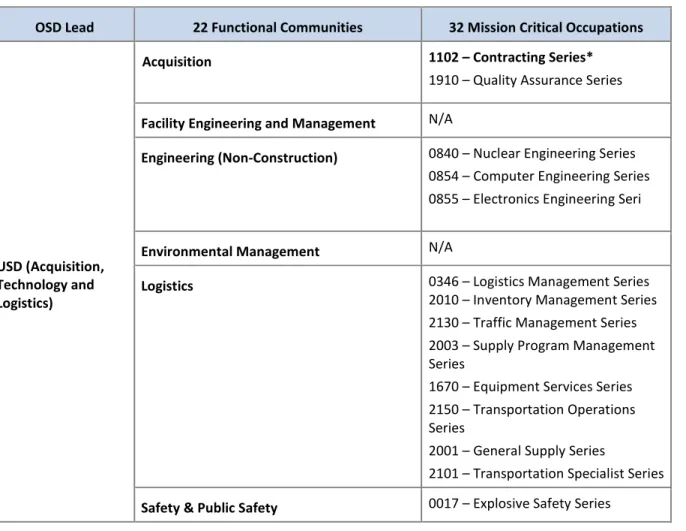
MCOs and Functional Communities. In FY 2012, the Department grew from 12 functional communities to 22 and identified 32 MCOs. Functional communities and MCOs are shown in Table 1. Each functional community has a separate plan in the Appendix. Exception: The
Acquisition workforce information is not included in this plan due to that community’s separate reporting requirements.
DOD MCO Criteria. The DOD MCOs are selected based on criteria and processes established by the Chief Human Capital Officer (CHCO) agencies as a part of a government-wide initiative to develop government-wide and agency-specific MCO definitions:
• Government-wide MCO: A strategic program or goal with government-wide impact (across multiple CHCO agencies) that is at risk of failure related to human capital deficiencies.
• Agency-specific MCO: A strategic program or goal with an agency-specific impact that is at risk of failure related to human capital deficiencies.
• Process: In FY 2012 23 CHCO agencies conducted environmental scans, analyzed workforce data and forecasts, conducted a gap assessment, developed strategies to close gaps, and provided an initial report to the Office of Personnel Management (OPM) in September 2012 as part of a process to report both government-wide and agency-specific MCOs to meet the Cross Agency Priority (CAP) skill gap closure goal. For more information, refer to the Analyze Workforce section of this plan.
Table 1: FY 2012 Functional Communities and MCOs
OSD Lead 22 Functional Communities 32 Mission Critical Occupations
USD (Acquisition, Technology and Logistics)
Acquisition 1102 – Contracting Series*
1910 – Quality Assurance Series
Facility Engineering and Management N/A
Engineering (Non-Construction) 0840 – Nuclear Engineering Series
0854 – Computer Engineering Series 0855 – Electronics Engineering Seri
Environmental Management N/A
Logistics 0346 – Logistics Management Series
2010 – Inventory Management Series 2130 – Traffic Management Series
2003 – Supply Program Management Series
1670 – Equipment Services Series 2150 – Transportation Operations Series
2001 – General Supply Series
2101 – Transportation Specialist Series
OSD Lead 22 Functional Communities 32 Mission Critical Occupations
0018 – Safety and Public Safety Series
0081 – Fire Protection and Prevention Series*
Science & Technology 1550 – Computer Science Series
USD (P&R)
Administrative Support N/A
Education N/A
Human Resources 0201 – Human Resources Management
Series
Law Enforcement 1811 – Criminal Investigating Series
Manpower N/A
Medical 0180 – Psychology series
0185 – Social Work Series 0602 – Medical Officer Series
0610 – Nurse Series*
0660 – Pharmacist Series
Social Science N/A
USD Comptroller
Financial Management 0501 – Financial Administration Series
0510 – Accounting Series 0511 – Auditing Series 0560 – Budget Analysis Series
USD (P) Foreign Affairs 0130 – Foreign Affairs Series
DOD (CIO) Information Technology 2210 – Information Technology Management Series
USD (I) Intelligence
0132 – Intelligence Series
Security 0080 – Security Administration Series
DOD GC Legal N/A
ASD (PA) Public Affairs N/A
Federal-wide Mission Critical Occupations
2210 – Information Technology Management Series(Cybersecurity focus) - High Risk
0110 – Economist Series
0511 – Auditing Series STEM – Science, Technology, Engineering, Mathematics Functional Group (MCOs determined within each federal agency)
Critical Skills and Competencies. The Department’s workforce planning approach— identifying
and assessing MCOs —aligns with section 115b of title 10, U.S.C. requirement to identify and assess critical skills. Further, the Department’s competency management framework includes identification and assessment of competencies within the MCOs. A DOD competency is defined as (observable) measurable patterns of knowledge, abilities, skills and other characteristics that individuals need in order to successfully perform their work.1
The MCO construct and competency management framework are designed to meet the intent of the section 115b of title 10, U.S.C. requirement to identify and assess the existing and future critical skills and competencies of the civilian employee workforce. This approach is
recommended to the staff supporting the House Armed Services Committee (HASC) and the Senate Armed Services Committee (SASC) and is accepted as meeting the legislative intent.
In addition, DOD began developing competency models for all MCOs and additional major occupational series. These models will undergo validation by functional community experts and feed into the enterprise-wide competency assessment tool currently in development for a first quarter FY 2014 target launch date. The Defense Competency Assessment Tool (DCAT) will enable employees to assess the importance of required competencies to the position and assess their proficiency level in the respective competencies, after which the supervisor can review the employee’s self assessment. Employees and supervisors could subsequently begin to discuss any gap that may exist between their respective competency importance and employee proficiency assessments and develop a plan to enhance the employee’s skills.
DOD Rolling Wave Maturity Model
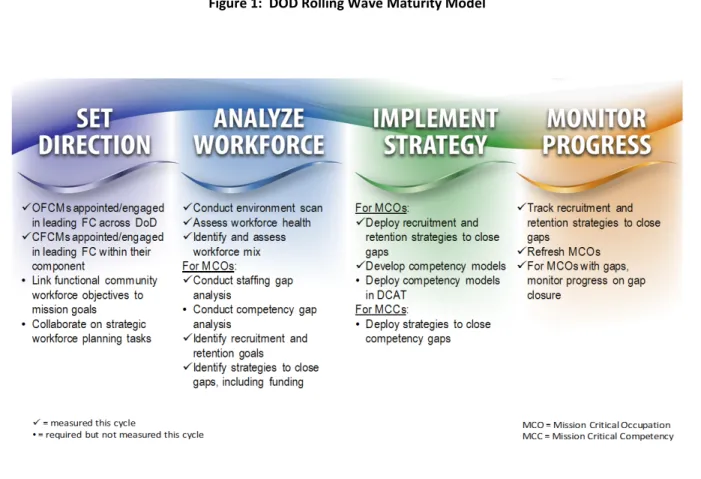
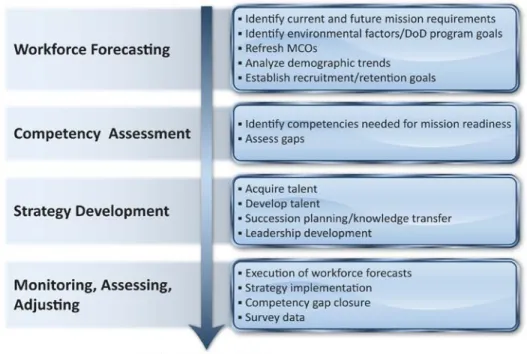
The DOD Rolling Wave Maturity Model provides a framework for functional communities to implement the tenets of strategic workforce planning. This model includes the workforce planning milestones for Functional Communities and Components to monitor and improve planning efforts. By meeting the model milestones, functional communities engage in workforce planning. The DOD Rolling Wave Maturity Model has been the planning guide for
1DODI 1400.25, Vol 250, Civilian Personnel Manual, DOD CPMS: Civilian SHCP, November 18, 2008 * Indicates the three DOD High Risk MCOs
functional communities and Components for the past four years. While some functional communities began the workforce planning journey several years ago, other emerging
functional communities just began the process in FY 2012; therefore, there are various levels of progress and maturity in the workforce planning process.
Figure 1: DOD Rolling Wave Maturity Model
Set Direction. This process of the DOD Rolling Wave and plan sectionincludes information regarding those who led the workforce planning process in the functional communities. Analyze Workforce. This process of the DOD Rolling Wave and plan section provides qualitative and quantitative data for analysis of the DOD organization.
Implement Strategy. This process of the DOD Rolling Wave and plan section includes strategy development for skill gap closure of MCOs.
Monitor Progress. This process of the DOD Rolling Wave and plan section assesses progress by OFCMs and Components in the key model milestones (checked items in the figure above)
within each step of the DOD Rolling Wave. The definitions for the key milestones in the rolling wave are located in the Monitor Progress section of this plan.
Roles
Strategic Human Capital Planning Program Office (SHCPD)2
Ongoing FCM and Integrator Meetings. The Program Office engages the OFCMs and CIs via bi-monthly and quarterly meetings to discuss workforce planning issues and requirements. In FY 2012, meeting topics included annual reporting requirements, timelines, data analysis, MCO determination using a facilitated process and sharing best practices and new initiatives.
. The Deputy Assistant Secretary of Defense for Civilian Personnel Policy (DASD (CPP)) expanded the SHCPD (referred to as the Program Office throughout this plan) to include the broader talent mix and skill sets needed to lead a strategic program portfolio. This expansion includes human capital policy development, workforce forecasting and data analysis, competency development and
assessment, and advisory support to the functional communities. The Program Office provides workforce planning activity oversight; supports 750,000+ DOD employees; and drives the strategic human capital planning process sharing best practices enterprise-wide. The Program Office reports workforce planning outcomes to Congress and other stakeholders, as well as keeps them abreast of legislative requirements that drive workforce planning outcomes. The Program Office continues to monitor the workforce planning process by providing a timeline for deliverables, training and communication plans, and expert consultation through its SHCPD Advisors. Communication efforts include:
Training efforts included:
A three-day summit for OFCMs, CIs and Action Officers (AOs) that provided
interactive training for environmental scans, data analyses, root cause analyses, and strategy development. Presentation subject matter included Total Force
Management, DOD Budget and DOD Performance Goals. Expert panel participants included OFCMS and CIs.
Individual and group training sessions for new OFCMs, CFCMs and CIs. Functional Community Manager Toolkits.
Half-day data analysis training sessions.
2 SHCPD is the workforce planning strategic policy division within the Human ResourcesStrategic Programs and
Advisory Services (HRSPAS) Directorate. Both entities are housed in the Civilian Personnel Policy/Defense Civilian Personnel Advisory Service (CPP/DCPAS) which serves as the enterprise leader in the development and delivery of civilian personnel policies and HR solutions.
Functional Community Managers (FCMs). FCM responsibilities are summarized in Figure 2. OFCMs assess and monitor the workforce health in their communities to ensure the workforce has the necessary competencies, size, and composition to meet mission and program
objectives. They ensure that realistic workforce forecasts and strategies are in place to recruit, hire, shape, develop, and retain a mission-ready workforce. CFCMs perform the same
responsibilities at the Component level. Both seek to align the model process with DOD’s Planning, Programming, Budgeting Execution (PPBE) System in support of more efficient and effective resource allocations to meet mission requirements.
Component Integrators. (CIs) were designated in FY 2010 to provide strategic review and feedback regarding functional community strategies and Component implementation plans for MCO gap closure.
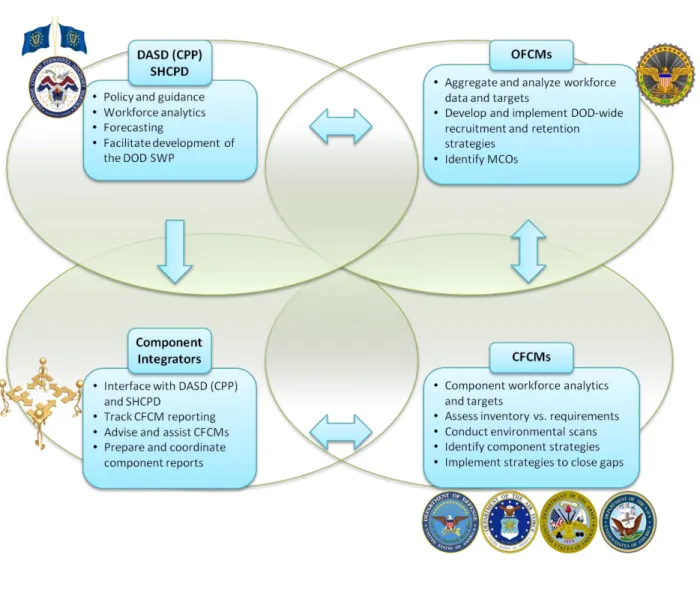
Pulling it All Together. The DOD model and planning process with shared responsibilities for preparation of functional community and Component reports is depicted below:
Figure 3: Workforce Plan Reporting Process
Senior Executive Workforce. The civilian Senior Executive workforce supports DOD’s mission by providing much needed superior leadership to the military forces to deter war and protect the national security of the United States. This workforce of high caliber Senior Executives are a critical and valued resource who apply their extraordinary knowledge, skills and abilities to executing DOD’s increasingly complex missions. This is a diverse, cross-functional workforce consisting of approximately 1,500 Senior Executives, Senior Leaders and Senior Technical professionals that face several recruitment and retention issues; for example, since civilian employees at this level often have the most years of experience in DOD, they are closer to retirement eligibility. Component efforts, however, continued to ensure a representative Senior Executive workforce that is well positioned to meet impending fiscal and mission challenges. For further information, refer to the Senior Executive Service Appendix 14.
I.
S
ET
D
IRECTION
Key Planning Milestone:
• Appoint/Engage OFCMs and CFCMs
Appoint/Engage OFCMs and CFCMs
The Department’s workforce planning approach is based on a collaborative system that crosses organizational lines, including OSD and Component functional communities, human resources (HR), manpower, and budget stakeholders. Institutionalizing the OFCM and CFCM construct continues to be a challenging culture shift, but it is essential to effective workforce planning in DOD.
The primary role of the OFCM and CFCM is to align and shape workforce requirements and capacity to achieve DOD program goals and objectives. As leaders for specific missions and functions, OFCMs and CFCMs understand:
• The skills and competencies needed to achieve current and emerging workload requirements;
• The skills and competencies that grew as well as declined; and
• The balance of skills and competencies needed to meet the Department’s mission. OFCM and CFCM engagement is critical to ensuring that recruitment, retention, and
development strategies are appropriate for addressing specific workforce gaps. It is also needed to drive the implementation of gap closure strategies across communities.
The FY 2012 DOD Rolling Wave Model workforce planning process began with a revalidation of OFCMs and CFCMs, some of whom continued their work from the FY 2010 cycle. As DOD functional communities expanded to cover a majority of the workforce, a key challenge for this planning cycle is to ensure the right leaders are appointed as OFCMs and CFCMs. Strong, effective leadership at the senior executive level is critical to the success of this process.
Key Drivers and Enablers
The key drivers and enabling guidance that set the direction for this plan are described below: Section 115b of Title 10, United States Code (U.S.C.). The Program Office is responsible for 14 of 20 statutory planning requirements for the overall civilian workforce, initially outlined in section 115b of title 10, U.S.C. during the last reporting cycle. For this reporting cycle, this Program Office is again responsible for 14 of 20 statutory planning requirements along with other environmental factors and enabling policy and strategy guidance that shape this plan’s direction. Section 935 of the NDAA FY 2012 amended section 115b of title 10, U.S.C. as follows:
• Biennial Plan Required: The Secretary of Defense shall submit to the congressional defense committees in every even-numbered year a strategic workforce plan to shape and improve the civilian employee workforce of the Department of Defense; and
• An assessment of the critical skills and competencies of the existing civilian employee workforce of the Department and projected trends for five years out (vice seven years) in that workforce based on expected losses due to retirement and other attrition. The Department’s goal is to develop and deploy the Defense Competency Assessment Tool (DCAT) in FY 2014 to assess the critical skills and competencies for current and future needs. As the Department progresses, competencies will be more fully addressed and reported in the comprehensive report due to Congress in FY 2016. The 14 requirements listed in section 115b of title 10, U.S.C. pertain to the overall civilian workforce and are addressed in this plan,
including an assessment of progress in the Monitor Progress section. The remaining four of the six requirements are addressed as appropriate in the Science and Technology Functional
Community Appendix 7, the Senior Executive Service Appendix 14, or the Financial Management Functional Community Appendix 18.
DOD Strategy and Policy Guidance. Three primary sources are listed in the table below to support the overarching goal:
Table 2. Strategic Goals Alignment
Each DOD plan supports various mission areas for the Department. Within each plan, the following key objectives or goals specifically address mission readiness of the workforce:
Plan Type Plan Objective or Goal
Quadrennial Defense Review
Report, February 2010 • Priority Objective 4(Includes enhancing the civilian workforce): Preserve and Enhance the All-Volunteer Force.
DOD Implementation Goals -
Strategic Mgt Plan, FY 12-13 • Business Goal 1mix (military, civilian, and contracted support) : Strengthen and right-size the DoD Total Workforce
DOD FY 10 Budget Overview
- Performance • Strategic Objective 4. 4-2Tthe right competencies : Train the total Defense Workforce with Additional Department sources include:
a. DODI 1400.25, Volume 250, Civilian Personnel Manual, DOD CPMS: Civilian SHCP: November 18, 2008
b. Section 115b of title 10, U.S.C. as amended
c. FY 2010-2018 Strategic Plan, Office of the Under Secretary of Defense for Personnel and Readiness (OUSD [P&R]): February 2011
d. USD (P&R) Memorandum Framework for DoD Strategic Workforce Planning and Enterprise Competency Management: October 27, 2011
e. USD (P&R) Memorandum Enterprise Civilian Competency Management Framework Implementation: November 23, 2011
1 Source: DODI 1400.25 Vol. 250 Civilian Personnel Manual, DOD CPMS: Civilian SHCP, November 18 2008
DOD Strategic Workforce Planning Goal FY13:
Additional external sources include:
a. Society for Human Resource Management Future Insights, Alexandria, VA: February 2011 b. US Department of Labor, Bureau of Labor Statistics Employment Projections 2010-2020 Washington, DC: February 2012
c. Society for Human Resource Management, Workforce Projections, Alexandria, VA: February 2011
As a part of the environmental scanning process, the functional communities used these sources as a foundation for developing their workforce assessments. Additional sources were analyzed and the information applied toward building a DOD-wide environmental scan which is outlined in the Analyze Workforce section of this plan.
II
.
A
NALYZE THE
W
ORKFORCE
Key Planning Milestones:
• Conduct environmental scan
• Assess Workforce health
• Identify and assess workforce mix
• For Mission Critical Occupations:
Conduct staffing gap analysis
Identify recruitment and retention goals
Identify strategies to close gaps, including funding
Environmental Scan
To support meaningful workforce planning, DOD evaluates a variety of environmental
information, workforce data and trends within and across industries, functional communities and Mission Critical Occupations (MCOs). Impacts and implications are considered along with the environmental factors identified by the functional communities that affect DOD. Effective workforce analysis depends on the ability to accurately forecast staffing and competency requirements (demand) and assess the sufficiency of the current and projected workforce against these requirements (supply).
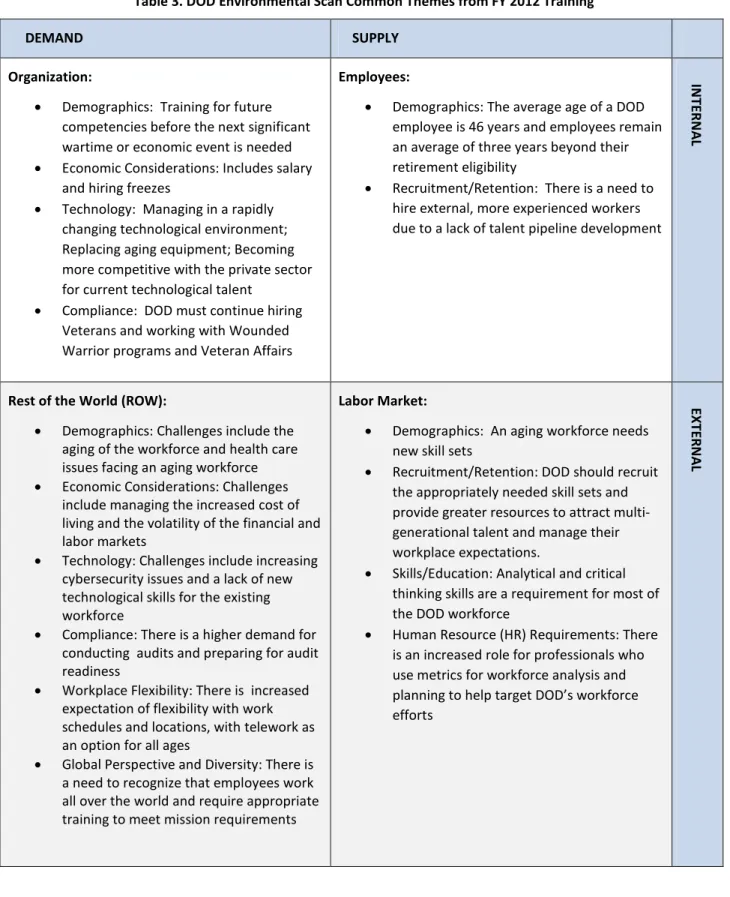
In May 2012, the functional communities engaged in a three-day training process to improve their workforce planning skills and to begin institutionalizing the DOD Rolling Wave Maturity Model workforce planning process. As a part of this training, the OSD Functional Community Managers (OFCMs) conducted a DOD-wide environmental scan. The environmental scan process represents a disciplined and continuous process of information gathering, profiling and analyzing an organization’s internal and external environment. A scan includes qualitative and quantitative views of the organization and provides critical input into future DOD
Table 3. DOD Environmental Scan Common Themes from FY 2012 Training
DEMAND SUPPLY
Organization:
• Demographics: Training for future competencies before the next significant wartime or economic event is needed
• Economic Considerations: Includes salary and hiring freezes
• Technology: Managing in a rapidly changing technological environment; Replacing aging equipment; Becoming more competitive with the private sector for current technological talent
• Compliance: DOD must continue hiring Veterans and working with Wounded Warrior programs and Veteran Affairs
Employees:
• Demographics: The average age of a DOD employee is 46 years and employees remain an average of three years beyond their retirement eligibility
• Recruitment/Retention: There is a need to hire external, more experienced workers due to a lack of talent pipeline development
IN
TE
RN
AL
Rest of the World (ROW):
• Demographics: Challenges include the aging of the workforce and health care issues facing an aging workforce
• Economic Considerations: Challenges include managing the increased cost of living and the volatility of the financial and labor markets
• Technology: Challenges include increasing cybersecurity issues and a lack of new technological skills for the existing workforce
• Compliance: There is a higher demand for conducting audits and preparing for audit readiness
• Workplace Flexibility: There is increased expectation of flexibility with work schedules and locations, with telework as an option for all ages
• Global Perspective and Diversity: There is a need to recognize that employees work all over the world and require appropriate training to meet mission requirements
Labor Market:
• Demographics: An aging workforce needs new skill sets
• Recruitment/Retention: DOD should recruit the appropriately needed skill sets and provide greater resources to attract multi-generational talent and manage their workplace expectations.
• Skills/Education: Analytical and critical thinking skills are a requirement for most of the DOD workforce
• Human Resource (HR) Requirements: There is an increased role for professionals who use metrics for workforce analysis and planning to help target DOD’s workforce efforts EX TER N AL
The three-day training initiative in May 2012 provided an opportunity for OFCMs to view DOD from the enterprise level and begin to determine how some of these challenges could
potentially impact their functional communities. For additional information regarding environmental scans by functional community, refer to the Appendix.
Workforce Health
DOD implemented new processes and tools that improve the output and analysis of workforce requirements. For this reporting cycle, all data is provided from the Defense Civilian Personnel Data System (DCPDS), a live system that serves as the primary source for employment,
assignment, and transactional data covering all Appropriated Fund DOD civilian employees and feeds into the Corporate Management Information System (CMIS). In addition, the Program Office developed an Excel-based forecast tool using RAND’s initial forecast tool as a prototype to forecast future workforce efforts based on OFCM-submitted workforce targets which are approved by the Components and Defense Agencies.
DOD-wide Demographics*
Note that this report provides data from September 2007 through September 2012. All data for this report was generated in January 2013 from DCPDS.
Strength as of 30 September 2012
This section provides an overview of workforce demographics and trends across the primary civilian functional
communities. With a civilian workforce of 750,000+ personnel across nearly 600 occupations, the Department prioritizes MCOs and functional communities for Department-wide analysis and reporting.
Table 4. DOD Civilian Demographics for FY 2012
Figure 4. DOD Civilian End Strength FY 2007-2011
Source: DCPDS Date: January 2013, Excludes SES and Air Force Military Technicians
Key Related Data Points:
• DOD experienced growth from FY 2009-2011, with a reduction in civilian personnel end strength beginning in FY 2012 due to hiring freezes and budget restrictions
• The workforce was projected to continue to decrease relative to FY 2009-2011 based on future workforce determinations or budget constraints
DOD Appointments (New Hires) and Separations
An analysis of workforce appointments and separations provides critical insights to inform hiring and retention strategies. For the purpose of this report, appointments include the
overall volume of hiring activity and other data related to recruiting. Separations are defined as
2007 2008 2009 2010 2011 Strength 669,081 693,292 738,137 773,629 781,163 600,000 620,000 640,000 660,000 680,000 700,000 720,000 740,000 760,000 780,000 800,000
Key Related Data Points:
• FY 2012 MCOs represent 32% of the DOD workforce
• Employees in MCOs typically have a post-secondary degree
separations from DOD employment. For more detailed definitions, refer to the Glossary of Terms in the Reference section.
Figure5. DOD Appointments and Separations for FY 2008-2012
Source: DCPDS Date: January 2013 Key Related Data Point:
• Appointments and separations could continue their downward trend as a result of changes in requirements and budget constraints
Recent hiring trends within the functional communities from FY 2008-2012 indicates that external Government hires account for more than 60% of overall appointments. Retirements account for nearly 40% of all separations from DOD. Civilian employee turnover, including voluntary separations from the DOD, followed a predictable pattern until FY 2011 wherein DOD experienced fewer separations and retirements than usual for voluntary separations. Several functional community representatives expressed concern that the increased workload due to the current budget environment and wage freezes may result in increased losses over the next several years.
DOD Retirement Eligibility and Phasing
Effective knowledge management and knowledge transfer for DOD begins with an analysis of the retirement eligible population to determine the likelihood of retirements within an MCO or
2008 2009 2010 2011 2012 Appointments 113,329 125,440 119,057 103,018 74,869 Separations 88,745 80,925 84,445 97,856 87,619 0 20,000 40,000 60,000 80,000 100,000 120,000 140,000
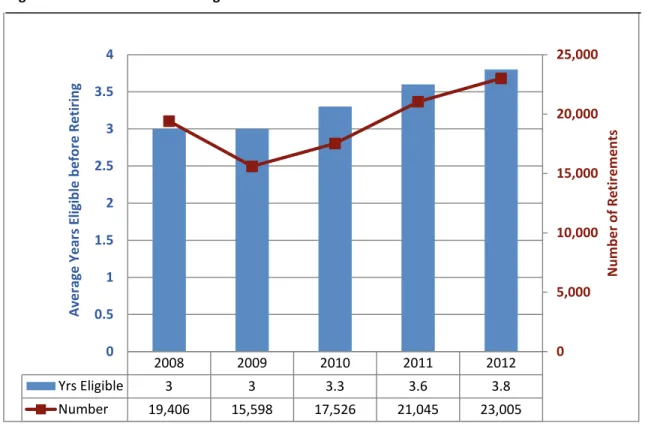
functional community. Retirement phasing depicts how long employees remain beyond their initial optional voluntary retirement eligibility date. Approximately 12% of DOD employees are retirement eligible in any given year. Approximately 25% of those eligible to retire actually retire each year.
Figure 6. DOD Actual Retirement and Retirement Eligibility FY 2008-2012
Source: DCPDS Date: January 2013
Key Related Data Points:
• The retirement eligible population remained somewhat flat across FY 2009-2011, with an uptick beginning in FY 2012
• In FY 2010 the Department experienced an increase in the number of retirements due to Base Realignment and Closure (BRAC) as opposed to other voluntary retirement options
2008 2009 2010 2011 2012 % Retirement Eligible 11.8% 12.2% 12.2% 12.5% 12.6% % Retirements from Eligible Population 25% 19% 20% 22% 24% 0.0% 5.0% 10.0% 15.0% 20.0% 25.0% 30.0%
Figure 7. DOD Retirement Phasing FY 2008-2012
Source: DCPDS Date: January 2013 Key Related Data Points:
• DOD employees remain an average of three years beyond their retirement eligibility
• More retirement eligible employees remain beyond three years beginning in FY 2010
Given the demographic profile, budgetary constraints, and the projected increase in workload, DOD closely monitors the current retirement eligible workforce to ensure that the necessary skills and abilities are adequately transferred to continue to meet the mission.
DOD Recruitment, Retention and Relocation Incentives and Student Loan Repayment
Recruitment, retention and relocation incentives (the 3Rs) are compensation flexibilities available to help Federal agencies recruit and retain a world-class workforce. The Federal Student Loan Repayment Program permits agencies to repay Federally insured student loans as a recruitment or retention incentive for candidates or current employees of the agency to attract or retain highly qualified employees.
2008 2009 2010 2011 2012 Yrs Eligible 3 3 3.3 3.6 3.8 Number 19,406 15,598 17,526 21,045 23,005 0 5,000 10,000 15,000 20,000 25,000 0 0.5 1 1.5 2 2.5 3 3.5 4 N um ber o f Ret irem en ts Av er ag e Y ea rs E lig ib le bef or e Ret iri ng
Figure 8. DOD Recruitment, Retention, Relocation Incentives and Student Loan Repayment FY 2008-2012
Source: DCPDS Date: January 2013
Key Related Data Points:
• DOD embraced the student loan repayment program in FY 2010 by increasing its financial investment in the program
• DOD increased its use of relocation incentives due to the continuing BRAC initiative which ended in FY 2012
• DOD decreased its use of recruitment incentives dramatically due to a soft hiring freeze
These incentives and programs are especially useful for DOD in recruiting new employees, relocating current employees, or retaining employees with unusually high or unique
qualifications or who fulfill a special need. For example, these incentives and programs are useful when an employee is likely to leave his or her current position for a different position in the Federal service. Staffing personnel should ensure efficient, effective, budget-conscious use of the incentives to support mission requirements, to meet future staffing requirements, or to assist in geographic and organizational moves to help organizations cross-level skills and talent.
2008 2009 2010 2011 2012
Recruitment Incentive 5,364 6,939 6,582 4,173 2,347
Retention Incentive 4,995 4,278 3,754 4,209 3,040
Relocation Incentive 1,925 2,885 3,015 3,799 2,327
Student Loan Repayment 1,166 1,894 3,131 3,401 2,726
0 1,000 2,000 3,000 4,000 5,000 6,000 7,000 8,000
Functional Community Development
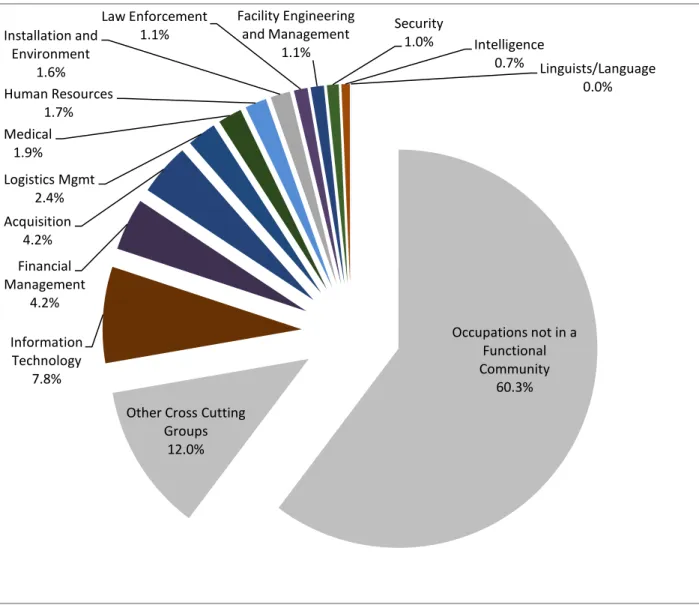
DOD functional communities are aligned using related occupational series. In FY 2010, DOD had 24 MCOs and 12 functional communities covering nearly 40% of the DOD workforce. A significant number of occupational series were not included as a part of the sustainment and maintenance of the DOD population. The FY 2010 community composition is illustrated below:
Figure 9. DOD Functional Communities in FY 2010
Source: DCPDS Date: January 2013
Occupations not in a Functional Community
60.3% Other Cross Cutting
Groups 12.0% Information Technology 7.8% Financial Management 4.2% Acquisition 4.2% Logistics Mgmt 2.4% Medical 1.9% Human Resources 1.7% Installation and Environment 1.6% Law Enforcement
1.1% Facility Engineering and Management 1.1%
Security
1.0% Intelligence
0.7% Linguists/Language 0.0%
Key Related Data Points:
• 40% DOD population included in 12 Functional Communities in Fiscal Year 2010
• Twelve percent of the cross-cutting population included Senior Executive Service (SES), Civilian
Expeditionary Workforce (CEW), National Security Professionals, and Science and Technology Reinvention Labs (STRL)
• Skills/staffing gaps were assessed and strategies to address gaps are developed for many MCOs
The functional communities grew since the FY 2010 reporting process to accommodate more occupational series and the DOD population. OFCMs and CIs were involved in several
facilitated workforce planning sessions in FY 2011 to develop a new functional community management structure that aligned approximately 93% of the DOD population (over 270 occupational series) within 22 functional communities:
Figure 10. DOD Functional Communities in FY 2012
Source: DCPDS Date: January 2013
Key Related Functional Community Data Points:
• Thirty-two MCOs are identified by FCMs through the application of Government-wide and agency-specific MCO criteria
• One cross-cutting functional community remains from FY 2010: Senior Executive Service
• Skills/Staffing gaps assessed and strategies to address gaps are developed for all 32 MCOs
The expansion of functional communities includes the addition of more occupational series and DOD population which allows OFCMs, CFCMs and CIs to engage in deeper analysis and
Foreign Affairs 0.09% Public Affairs
0.30% Social Science 0.71% 0.83% Legal
Environmental Management 0.88% Intelligence 0.89% Security 1.25%
Safety & Public Safety 1.69% Law Enforcement
2.19% Science & Technology 2.61% Human Resources 3.04% Manpower 3.79% Education 4.67% Facility Engineering and Management 4.87% Administrative Support 5.09% Misc Programs 5.55% Financial Management 5.75% Information Technology 5.98% Medical 6.13% Acquisition 6.84% Engineering - NonConstruction 9.91% Logistics 20.01% Occupations not in a Functional Community 6.93%
discussion of the needs of the majority of the DOD workforce. Some adjustments that occurred during this phase include:
1. The movement of Computer Science Series, 1550 from the Information Technology
Management Functional Community to the Science and Technology Functional Community; 2. The movement of Computer Engineering Series, 0854 and Electronics Engineering Series,
0855 from the Information Technology Management Functional Community to the Engineering (Non-Construction [NC]) Functional Community;
3. The absorption of the occupational series in the Airfield Operations Functional Community into the Logistics Functional Community; and
4. The elimination of the Language Functional Community due to its small population. Future adjustments may be needed for functional community shaping and growth as OFCMs and Components continue to work on the sustainment, maintenance and general oversight of the majority of the DOD population.
Identify and Assess Workforce Mix
The DOD mission requires a well maintained, properly sized and highly capable civilian
workforce that aligns to mission and workload requirements to ensure its success. The civilian workforce complements and delivers support to ensure the military workforce maintains training and readiness levels to support the well-being of the All-Volunteer Force and their families. This is necessary to guard against an erosion of our corporate technical base, skills and knowledge, or against an overreliance on contract services. The DOD continues to develop a systematic and iterative approach to meeting the requirements of section 115b of title 10, Untied States Code (U.S.C.) by incorporating a Total Force Mix (TFM) capabilities assessment approach in alignment with the DOD Rolling Wave Maturity Model. This approach seeks to leverage existing statutorily required data sets and tools, such as the Inventory of Contracts for Services and the data compiled in support of the Federal Activities Inventory Reform Act.
In FY 2012, as part of an iterative approach to meet section 115b of title 10, U.S.C.
requirements, the Department initiated a pilot study of the process to assess capabilities being delivered by the Federal government career civilian workforce, military personnel and contract support. The three workforce components (civilian, military and contractors) have different staffing and competency data elements, data management systems and separate data access authentication controls. In addition, each workforce data system belongs to different offices; e.g. the civilian workforce data system is housed in The Defense Civilian Personnel Advisory Services (DCPAS) and the military workforce data system is housed in the Defense Manpower Data Center (DMDC). Currently these two detached data systems do not interface with each other. The TFM task first requires joining the three currently disconnected data systems to be able to evaluate TFM options. The initial pilot study was limited to the three high risk MCOs: Nurse Series, 0610, Fire Protection and Prevention Series, 0081, and Contracting Series, 1102.
These high risk MCOs are identified through a Government-wide process – the Human Capital Management High Risk Initiative (SHCM HRI) outlined later in this section.
The pilot study identifies initial desired workforce capabilities, and tests assessment methods. The initial desired workforce capabilities assessment approach is conducted against the
direction of the SHCM. The Department’s goal is to assess a broad range of MCO capabilities by FY 2016. In testing the process, the Department is to be able to make progress toward
developing a viable assessment approach to reach that goal.
The sourcing of functions and work among civilian personnel, military (active and reserve), and contracted services should maintain consistency with workload requirements, funding
availability, readiness and management needs, as well as applicable laws. The FY 2012 assessment approach is based on desired capabilities, and in no way serves to remove the ultimate authority over determination of adequacy and appropriateness of the workforce mix in accordance with applicable section 115b title 10, U.S.C statutes and Federal policies.
The intent of this assessment approach process is not to provide a permanent determination of a long-lasting nature of the workforce make up but to provide a snapshot to identify a point in time review of the resources available and whether their mix supports the mission of DOD. DOD will continue to enhance its TFM assessment approach through more leadership
engagement as it plans to further test this methodology to include additional MCOs in FY 2014.
For MCOS: Conduct Staffing Gap Analysis
Forecasting
For the DOD FY 2010 Strategic Workforce Plan, DOD used OPM’s Civilian Forecasting System (CIVFORS) to develop MCO forecasts with targets provided by the OFCMs. For more
information regarding the progress of the 24 FY 2010 MCOs, please refer to Section IVMonitor Progress. Because OPM no longer maintains that system, DOD sought the assistance of RAND to develop an Excel-based forecasting tool, similar to the tool provided to DOD’s Acquisition Functional Community. RAND relies on data from the Defense Manpower Data Center (DMDC), a DOD data warehouse provider that is fed via Component reporting and updated on a
quarterly basis. RAND provided DOD with a data-intensive tool requiring Statistical Analysis System (SAS) programming to obtain values needed to run the model. To forecast future loss, historical loss rates are computed using retirement eligibility data from two overarching retirement programs: the Civil Service Retirement System (CSRS) and the Federal Employees Retirement System (FERS), respectively.
The forecasted loss rates ultimately determine the direction of workforce planning required in meeting the targets of necessary workforce size to achieve DOD missions. RAND provided an excellent prototype for DOD to develop a more user-friendly, Excel-based forecasting tool using