Science and Technology Options Assessment
Potential and
Impacts of Cloud
Computing
Services and
Social Network
Websites
Science and Technology Options Assessment
European Parliamentary Research Service
Potential and Impacts of Cloud Computing Services
and Social Network Websites
Study
IP/A/STOA/FWC/2008-096/Lot4/C1/SC8
January 2014
The STOA project 'Potential and Impacts of Cloud Computing Services and Social Network Websites' was carried out by the Fraunhofer Institute for Systems and Innovation Research (ISI), Karlsruhe (project co-ordinator); together with the Institute of Technology Assessment (ITA), Vienna; the Institute for Technology Assessment and Systems Analysis (ITAS), Karlsruhe; and the Danish Board of Technology (DBT), Copenhagen, as members of ETAG.
PROJECT LEADER
Timo Leimbach, Fraunhofer ISI
AUTHORS
Timo Leimbach, Dara Hallinan, Daniel Bachlechner (Fraunhofer ISI) Arnd Weber, Maggie Jaglo, Leonhard Hennen (ITAS)
Rasmus Øjvind Nielsen (DBT)
Michael Nentwich, Stefan Strauß (ITA) Theo Lynn, Graham Hunt (DCU/IC4)
RESPONSIBLE ADMINISTRATOR
Peter Ide-KosticScience and Technology Options Assessment (STOA)
Directorate for Impact Assessment and European Added Value Directorate-General for Parliamentary Research Services
European Parliament, Rue Wiertz 60 - RMD 00J016, B-1047 Brussels E-mail: [email protected]
LINGUISTIC VERSION
Original: ENABOUT THE PUBLISHER
To contact STOA or to subscribe to its newsletter please write to: [email protected]
This document is available on the Internet at: http://www.ep.europa.eu/stoa/
DISCLAIMER
The opinions expressed in this document are the sole responsibility of the authors and do not necessarily represent the official position of the European Parliament.
Reproduction and translation for non-commercial purposes are authorised, provided the source is acknowledged and the publisher is given prior notice and sent a copy.
Manuscript completed in January 2014. Brussels, © European Union, 2014.
PE 513.546
ISBN 978-92-823-5271-7 DOI 10.2861/48873 CAT QA-01-14-011-EN-C
Abstract
Cloud Computing and Social Network Sites (SNS) are among the most controversially discussed developments in recent years. The opportunities of using powerful computing resources on demand via the web are considered as a possible driver for the growth of the European economy. However, there are also critics arguing that economic, social and technical risks prevail or even dismiss the potentials of Cloud Computing and SNS. This project sheds light on these aspects and analysed more specifically, the latest technological and economic developments, driving factors and barriers in Europe, the main actors and their respective interests, the impacts on citizens, business and public administrations and, a broad range of technical, economic, cultural, legal, regulatory issues and their impacts. It showed that at the moment, there is a chance to achieve multiple Cloud Computing and SNS related goals simultaneously. There are no contradictions between assuring European citizens, secure, privacy aware, legally certain and fair use of Cloud Computing and SNS and in increasing the competitiveness of European ICT industries. Moreover it is possible to exploit the potential of Cloud Computing and SNS to the benefit of both the European economy and society at large. Based on this a set of options for European policy makers grouped into four themes with in total 16 options was derived.
Make security a commodity
1. Support the development of open and secure software and hardware and encryption methods. 2. Encourage the use of checklists and security certifications.
3. Assess the economic viability of large hardware security modules.
4. Initiate a dialogue on the structure and governance of the Future Internet. Establish privacy as a location advantage
5. Proceed with the modernization of data protection. 6. Establish the principles of security and privacy by design. 7. Support the creation of a European Data Protection Board.
8. Ensure the extraterritorial application of European data protection law. Build a trustworthy environment for digital business and living
9. Stipulate the setting of minimum requirements for contracts.
10. Support the standardization of Acceptable Use Policies and Service Level Agreements. 11. Eliminate jurisdictional uncertainty.
12. Support the development of Cloud specific certifications. Create an inspiring ecosystem for ICT industries
13. Encourage the creation of European market players. 14. Support standardization and interoperability. 15. Empower people across all strata of society. 16. Reconsider current broadband strategies
CONTENTS
Executive Summary 1
1. Introduction 15
1.1. Impacts and challenges of Cloud Computing and Social Network Sites 15
1.2. Scope and aims of the report 16
2. Foundations of Cloud Computing 17
2.1. Defining Cloud Computing 17
2.1.1. Definition according to NIST 17
2.1.2. Other definitions 18
2.2. Classification of Cloud Computing services 19
2.2.1. Service models 20
2.2.2. Delivery models 21
2.2.3. Revenue models 21
2.2.4. Type of actors 22
2.3. Technical foundations of Cloud Computing 23
2.3.1. Origins and evolution of Cloud Computing 23
2.3.2. Cloud Computing technology 25
2.4. Use cases for Cloud Computing 27
3. Adoption and impacts of Cloud Computing 29
3.1. Overview on the current market situation 29
3.1.1. Overview on existing market studies and forecasts 29
3.1.2. Cloud Computing services and providers 32
3.2. Adoption and usage patterns of Cloud Computing 36
3.2.1. Adoption and usage by business users 36
3.2.2. Adoption and usage by consumers 38
3.2.3. Adoption and usage by governments 41
3.3. Identification and assessment of barriers and drivers 44
3.4. Impacts of Cloud Computing services 49
3.4.1. Impacts on businesses and public administrations 49
3.4.2. Impacts on consumers 52
3.4.3. Impacts on the ICT industry 54
3.4.4. Impacts for the society and economy as a whole 57
4. Challenges of Cloud Computing 60
4.1.1. Interoperability and standards 60
4.1.2. Data management and scalability 61
4.1.3. Conclusions 62
4.2. Challenges in data security 62
4.2.1. Main challenges 62
4.2.2. Consequences 65
4.2.3. Conclusions 67
4.3. Cloud computing, privacy and the EU data protection regime 68
4.3.1. Challenges of the Cloud to the Current Data Protection Framework 68
4.3.2. Data Protection Reform and the Data Protection Regulation 70
4.3.3. Data Protection Reform and Cloud Computing 70
4.3.4. Recent developments and conclusions 72
4.4. Challenges in ICT governance 73
4.4.1. Overview: A sea change in ICT governance 73
4.4.2. 3rd party data access and retention 75
4.4.3. The Safe Harbour agreement 78
4.4.4. International harmonization? 79
4.4.5. Conclusions 79
4.5. Contractual issues and customer rights 80
4.5.1. The contract 80
4.5.2. Common main features and issues in Cloud Computing Contracts 81
4.5.3. Contractual issues related to security 85
4.5.4. IP issues 86
4.5.5. Conclusions 88
4.6. Competitiveness of the market 90
4.6.1. Vendor lock-in 90
4.6.2. Market fragmentation 91
4.6.3. Lack of innovative, fast-growing companies 92
4.6.4. Broadband coverage 93
4.6.5. Lack of skilled workforce 94
4.6.6. Conclusions 94
5. Social Network Sites 97
5.1. State-of-the-art 97
5.2. Structure and functionality 99
5.2.2. Network relations and the social graph 102
5.2.3. Embedded services and the role of social plugins 102
5.3. Societal impacts 103
5.3.1. SNS between the public and the private sphere 104
5.3.2. Capability for political participation 105
5.3.3. SNS-linked knowledge production 106
5.4. Privacy Implications 107
5.4.1. User perceptions on information disclosure and privacy 108
5.4.2. Complexity of privacy settings and user preferences 108
5.4.3. Personal vs. non-personal data and identifiable information 110
5.4.4. Privacy types and SNS usage 111
5.4.5. Privacy-by-design 112
6. Conclusions and policy options 116
6.1. Main findings and concluding remarks 116
6.2. Suggestions for policy options 121
Annex A: List of Respondents and Events visited 125
Annex B: Summary of the workshop 126
EXECUTIVE SUMMARY
Cloud Computing and Social Network Sites (SNS) are among the most controversially discussed developments in recent years. They are both part of the same societal transformation referring to a paradigm shift stating that “the network is the computer”. The opportunities of using powerful computing resources on demand via the web are considered as a possible driver for the growth of the European economy. Especially cost savings as well as increased productivity and mobility are seen as key elements by many experts. However, there are also critics arguing that economic, social and technical risks prevail or even dismiss the potentials of Cloud Computing and SNS. This project sheds light on these aspects and analyses the potentials and impacts of these developments. This includes a review of the technological and economic developments Cloud Computing is based on, an identification of driving factors and barriers for Cloud Computing in Europe as well as of main actors and their interests; and an analysis of impacts on citizens, business (including the IT industry itself) and public administration including a broad range of technical, economic, cultural, legal, regulatory issues and the impacts on society and economy as a whole. Cloud Computing not least includes a variety of technical concepts that alter computing infrastructures. SNS represent a prominent phenomenon grounding on Cloud Computing with a wide array of services and applications mainly focussed on end-users. Particular interrelations are given in terms of privacy and security challenges which are main issues addressed by the analysis of SNS related impacts.
Foundations of Cloud Computing
Cloud Computing is still an evolving concept and technology. This is underlined by the fact that many different types of definition and characteristics exist. The analysis of different definitions shows that there is a core set of functionalities and characteristics including on-demand services, network access, resource sharing and measured services but also that the exact definitions of these aspects and the focus setting vary depending on the viewpoint of the authors. There is no universally accepted definition, but the definition of NIST has prevailed in practice. It defines Cloud Computing as “a model for enabling convenient, on-demand network access to a shared pool of configurable computing resources (e.g., networks, servers, storage, applications, and services) that can be rapidly provisioned and released with minimal management effort or service provider interaction.” Similar to the plethora of definitions, there is also a growing number of service, delivery and revenue models. In particular the service and delivery models have become an object of marketing. Beside the three classical service models Infrastructure as a Service (IaaS), Platform as a Service (PaaS) and Software as Service (SaaS), which are reflected in the NIST definition, there is growing number of brandings for new service models. These are used to differentiate specific segments or services, but make it hard to keep an overview because the borders to other technologies or services are not always well defined. The same situation can be found in case of the delivery models, where besides the typical delivery models of public, private or hybrid clouds many new terms emerged. Within this project, we focus on the main types of delivery and service models to avoid the resulting definition-related problems. In case of the revenue models, there are no stable definitions yet. Typically, different models are based on subscription or usage (pay-as-you-go) and advertisements. The hybrid model of freemium services is currently the main revenue model for consumer-oriented offers. Apart from that there are new approaches like dynamic pricing. Given this blurry situation, the project focuses on service and delivery models to classify and analyse cloud services and providers. Finally it should be noted that the overall focus for the analysis of challenges and opportunities lies on public and hybrid cloud services.
A more detailed review of the evolution of the Cloud Computing concept reveals that it is not a disruptive or totally new concept. It can be traced back to ideas from the 1960s and there are predecessors and related concepts like Application Service Provision, Utility Computing and Grid Computing that appeared in the last decades. Many basic ideas of Cloud Computing like location
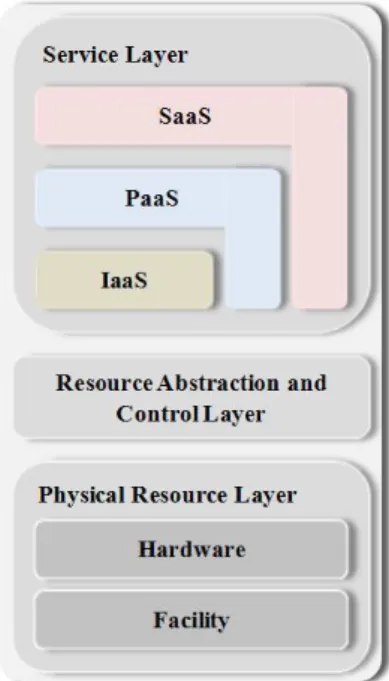
independence or pay-per-use have already been introduced above, though some of these concepts failed to succeed on the market. Basically, the underlying technology of Cloud Computing is based on two concepts: multi-tenancy and service orientation. Typically, these concepts are implemented in form of virtualisation systems and web services. This is also reflected in the three-layered basic architecture. In addition, Cloud Computing demands several requirements such as the availability of sufficient network capacity ensuring access to data, reliable and fault tolerant service offers and a well-functioning technical infrastructure for proper functioning. Although the basic concepts seem to be clear, the concept and technology still bears potential for further advances in areas like scalability and flexibility. Beyond that it is necessary to address several technical challenges like interoperability to facilitate compelling reasons to use Cloud Computing.
Market development of Cloud Computing
A review of the different market research reports shows that Cloud Computing services are one of the fastest growing segments within the market for software and IT services. Only Mobile Computing or Big Data seem to have comparable growth rates but their segments are smaller. Moreover, they are also drivers for the cloud market because they often build upon cloud technologies. At the moment the market for public Cloud offers grew by nearly 20% per year. For example IDC states that the market grew from 40 bn. $ in 2012 to 47.7 bn. $ in 2013. Also other market segments like Cloud-related IT services or markets for private Clouds show a strong growth. Therefore Cloud Computing will become an essential part of the overall market. This will lead to an overall growth of the software and IT services as well as the IT hardware market, but it will also lead to a decrease of existing market segments, in particular, the segment of software products based on licenses and maintenance contracts as well as IT service segments like outsourcing. However, it is presumed that cloud-related services like integration consulting (e.g. in case of hybrid cloud solutions) will grow and maybe compensate for the loss in the IT service market.
The common view is that in respect of the different services models the market for the SaaS model (including BPaaS) will stay the biggest one in the future. Nevertheless, it is presumed that IaaS, which is with a clear margin the second biggest market, will grow at an even higher rate. Moreover, some experts believe that PaaS will also gain in importance. Though this will lead to an increasing share of both models within the Cloud Computing market, SaaS will remain in absolute value the main market in the future. One reason for this is the difference in the adoption and usage patterns. This relates to consumers using cloud services for private purposes as well as for their work life, but also the growing number of SMEs adopting cloud services are more used to standardised product offers. Finally, there is a clear trend towards more diversity on the cloud market, i.e. more and more complex services and revenue models.
Regarding the regional development the US is the biggest market for Cloud Computing at the moment. According to all forecasts, it will show in terms of absolute value the greatest growth. However in terms of growth rate emerging markets like China or India are growing in importance. At the moment, Europe is the second biggest market behind the US and followed by Japan, but it is characterized by smaller growth rates than many other regions. As reasons for this researchers name two issues: Firstly, the lower adoption rate in general caused by a greater reluctance against Cloud Computing that is also reflected in the adoption patterns, and secondly, the economic crisis of the Euro zone. The strongest players in the market are well known. On the one hand there are early movers like Amazon and Google with a strong background in Internet-based services as well as for example Salesforce, which was an early proponent of SaaS and its predecessors. On the other hand, there are the IT service providers like IBM, HP or Deutsche Telekom (T-Systems) and others who capitalize on their technology and customer base. Another group is formed of specialist like VMWare or Terremark, which were engaged in virtualisation and data center operation. There is also the group of more product-oriented companies like Microsoft, Oracle or SAP, which all started at a later stage but rely on their experience, strong profile as well as their existing market position. Finally, there is the group of “cloud born” companies like Dropbox or
Evernote, which build their offers on cloud services of others and address consumers and SMEs in the first place. However, the question will be which of these companies are able to turn their revenues into profit while growing further. It is probable that one or a few of them will become global players and many of them will not survive in the long run. The growing number of acquisitions of promising start-ups and medium-sized companies is a first sign of market consolidation.
Adoption and usage patterns of Cloud
Although there is little information available, it seems obvious that European companies are generally less engaged in using cloud services as compared to their US counterparts. The difference is most obvious in the SME segment, where US companies are more likely to adopt cloud services. Most European companies only started to adopt cloud services in the last two years, which might be an explanation for the differences in the adoption patterns. With regard to the different types of usage, it is not possible to determine bigger differences between the US and Europe. Most often, simple applications are the first ones in both regions, while with more experience the complexity of the services used increases. There are also uncertainties to which extent European companies tend to use private Cloud instead of public Cloud offers. Given this and taking the positive development in recent years into account, it might be that the lagging behind of Europe is not as big as some predictions state or discussants fear.
In case of the consumers’ adoption and usage patterns the situation is more complicated due to the different definitions of consumer cloud services. Therefore comparisons between the different studies and analyses are only possible to a very limited extent. Overall, the results show that the adoption of cloud services by consumers varies between the different European countries. Characteristics such as geographical location or size do not seem to affect the adoption of cloud services significantly, but it seems likely that different national approaches towards privacy and trust, which were addressed by some studies, form a good indication. In regard to what kind of services are used two trends are recognizable. Firstly, most consumers prefer to use free services over paid ones. Secondly, the studies show that services with less involvement of personal data are more frequently used than others. Based on the information available on the situation in the US, it seems clear that US consumers also clearly prefer free service offers. As for the second point, the relation between personal information/data and adoption, it is not possible to find relevant information. In total, the adoption level in the US is likely higher than the one in Europe.
At a first glance the adoption level of Cloud services by governments and public services does not seem to differ much between the US and Europe. However, there are some differences with respect to the overall attitude and the resulting course of action. The US federal government already started in 2009 to implement projects and meanwhile adopted a federal Cloud strategy foreseeing a Cloud First policy, which often leads to the use of existing public cloud services. In contrast, many European states just started to develop plans for national cloud platforms with varying coverage, which will take time to develop and implement. Often, part of these plans is to support the national IT industry. Until these platforms work, many smaller efforts were made that led to the introduction of private clouds within the existing structures. However, there are also European countries following different approaches. At the moment it is obvious that more pragmatically approaches gain more attention.
The growing maturity of Cloud Computing will lead to a transformation in usage and offers. While the last years were shaped by the fact that most services where transferred from existing offers into the Cloud, the future development will enable more services building upon other services. The question is if and when this “Cloud innovation” will occur and how it will impact, i.e. it will be a revolution or more an evolution or even something in between. Nevertheless some trends for the next years are already observable. The first one is that, in particular for innovative Cloud offers, consumer will play an important role (“Consumerization of IT”). In the market for business oriented Cloud services the trend of more and more complex services is recognizable, which will lead to a growing hybridization of the
existing IT landscape in companies. This requires high levels of integration, but it also governance strategies to comply to existing regulations and to assure the security of own data and applications, in particular if critical processes are involved.
Identification and assessment of drivers and barriers
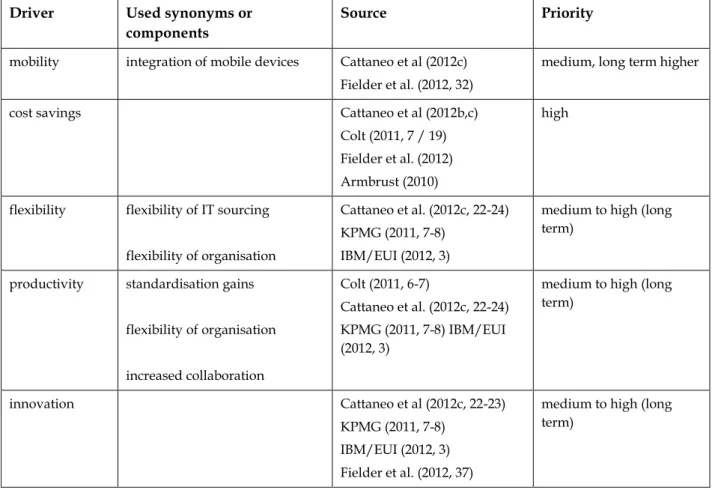
In order to determine the challenges for Cloud Computing in Europe that needs to be addressed, the first step was an initial identification of barriers and drivers. It served two purposes: Firstly, it supported the identification of impacts, positive as well as negative ones; secondly, it helped to determine the importance of them. Together with the results of the impact analysis this was a major input for the selection of challenges. It showed that there is currently a strong research focus on the barriers for adoption and use in Europe that strongly focus on the barriers and drivers for demand side, in particular on the business usage and less on the consumer usage. This is also reflected by the fact that the number of barriers outnumbers the one of drivers. The analysis underpins that cost savings and resulting competitive advantages are seen as the major drivers for the business adoption, but that in a long-term other drivers like flexibility and innovation will gain of importance. Concerning the barriers five group of barriers can be identified: 1. technical barriers, e.g. technical security, network availability and reliability, interoperability/standards; 2. business and operational barriers, e.g. compliance, regulation, vendor lock-in, lack of skilled developers and users, service reliability/access to data; 3. regulatory-legal barriers, e.g. privacy/data protection, contractual arrangements, legal jurisdiction, service levels, consumer rights; 4. governance barriers, e.g. third party access/data retention, data location; and, 5. socio-cultural barriers like loss of control, lack of trust/ lack of transparency. All of them are strongly interrelated and need to be reflected in the analysis of impacts. Regarding the situation off Cloud service providers the review shows that the spectrum of identified barriers covers a broad spectrum, of which many are not specific for Cloud Computing. However, some of them still have a high importance for the take up of the Cloud providers in Europe. Finally, it should be noted that there are interrelations between the barriers and drivers for the demand side as well as the supply side.
Impacts of Cloud Computing services
The review and analysis of the existing literature on socio-economic impacts reveals a fundamental challenge. Most of the literature is based on assumptions and estimations, in particular the one on impacts on the economy as a whole. Even on the micro-level of companies there is only little literature based on real cases, which makes it difficult to evaluate the estimations made. Therefore, the results of the different studies have to be interpreted with caution.
Direct impacts on businesses, public administrations and consumers are widely discussed. In particular for businesses and public administrations cost savings of IT services are seen as the main impact. The span of estimated cost savings reaches from 10 to 30%, but as already mentioned there is only little literature that deals with real cases. Some examples suggest that cost savings can only be realized if certain conditions are given. Additionally, the question of the total cost of ownership (TCO), which also includes costs for migration and termination, has not yet been answered. In case of consumers, cost savings are seen as less important. Most often the convenience of using services is seen as the main positive impact. This also counts for employees using Cloud services for work purposes (IT consumerization, Buy/bring your own device (BYOD)) or for small companies. Beyond that other positive impacts are growing mobility and flexibility. In the medium to long term, productivity gains are seen as positive impacts, in particular for businesses and public administrations. Apart from that, another often controversially discussed impact is the professionalization of security management (back up, security, etc.) which comes along with cloud offers and could be a benefit for consumers and SMEs. The review also revealed several direct negative impacts and concerns. They mostly relate to security and control. There is the risk to lose control over data or that the confidentiality of data is breached as well as the risk that the data is not available when needed. These risks concern all user types from
businesses via public administrations through to consumers. For consumers in particular, there is the risk of sacrificing privacy because many advertisement-based or freemium services like web-based mail services rely on the analysis and reuse of user data. Moreover, the mobile use bears further risks like the cost of mobile connections and in particular roaming fees for usage outside of the provider’s network. Further risks can arise if a transfer of data is problematic either because data cannot be deleted or technical problems make it difficult. The problem of data portability and beyond that of migration or usage of different providers is even a bigger challenge for businesses and public administrations, because in the worst case vendor lock-in can eventually lead to higher instead of lower costs. Additionally, many large corporations already used outsourcing and/or virtualisation in the last years, which is quite close to private clouds. Therefore, it is an open question to what extent they can reap additional benefits. It can be stated that there is a widespread fear that Cloud Computing providers and foreign government’s abuse data, providers go out of business or suffer from severe outages. The effects of the US Patriot Act, the Foreign Intelligence Surveillance Act, and the National Security Letters have been widely discussed in the media. If problems with confidentiality, availability and migration of data can be overcome, Cloud Computing is expected to have a bright future.
Regarding the impacts on the IT markets and the IT industry itself, it can be stated that Cloud Computing represents a fast growing segment and will gain in importance in the future. According to different market researchers, it can be stated that the share of Cloud Computing in the overall market for software and IT services will grew from 3 to 5% at the moment to a range of 10 to 20% in the next 5 to 10 years. Though it might be that in some years Cloud Computing as a segment will merge into new or other market segments, the underlying technology and models will remain as a part of the future IT landscape. While markets will change, the structure of the industry will not change significantly as it seems today, i.e. the dominance of US-based providers will continue. Nevertheless, the current challenges may provide an opportunity that European providers with a strong focus on reliability and confidentiality gain in importance, in particular if they are supported by the European policy.
Based on the positive direct impacts, several studies conclude that Cloud Computing enables significant productivity growth that will impact overall growth and employment positively. Another argument, which is often brought up in discussions on the impact of Cloud Computing on the society and the economy as a whole, is that Cloud Computing, due to the flexibility and low costs, supports the creation of innovation and in particular that new businesses can easily enter the market and scale their operations. However, only a very limited number of the analyses tried to determine the size of these effects for Europe or at least for some of the EU member states. In these cases, all studies forecast a significant positive impact on employment and the creation of new business opportunities, which goes along with an overall economic growth. But for two reasons these results have to be interpreted with caution beside the normal challenges of all types of forecasts. Firstly, the underlying calculations are based on estimated cost savings. This is fair due to the lack of empirical values, but normally such estimations tend to be quite optimistic, particularly in early stages of a technology. Secondly, the analyses partly neglect input-output relations and effects, i.e. the fact that job creation in one sector may lead to job destruction in another. The relevance of these points is underlined by some recent literature on the impact of IT in general on employment and growth. This research shows that even realised productivity gains do not automatically lead to the creation of highly-skilled employment. In the worst case, it could even have the opposite effect.
This review is not aimed at dismissing the positive expectations and potentials associated with Cloud Computing as a whole, but it is aimed at raising awareness for the fact that these potentials are not exploited automatically. Exploiting them requires that all obstacles are removed as well as that the estimated cost savings can be realized to a certain extent. Moreover, the analysis also showed that beyond addressing obstacles and challenges specific framework conditions like education or infrastructure are required to turn productivity gains into growth of employment. Additionally, the aim
of changing the structure of the industry poses some further challenges. Based on this consideration, the main barriers and challenges that need to be addressed are analysed in the following sections.
Technological challenges
Though there are only a few technological challenges named in the analysis of barriers and impacts, there are reasons two have a more detailed look for two reasons. The first one is that related to technological capabilities like flexibility which demands efficient and highly scalable infrastructures. The second reason is that some challenges are reinforced by technological issues. The most prominent example is the vendor lock-in, which can be reinforced by a lack of standards. Consequently these challenges will be shortly analysed in the following. Finally it should be noted that information security is also a technological challenge, but due to its importance and its non-technical aspect it is treated separately. The analysis shows that standards and interoperability are important for two reasons. Firstly, because only interoperable cloud services enable users to fully exploit potentials of cloud computing such as dynamic usage and flexible payment. Secondly, standards and interoperability prevents vendor lock-in, which is a concern representing a major barrier for cloud adoption. However, the IT industry is shaped by market driven de facto standards either set market leaders or driven by industrial bodies. In both cases the European influence is small. Therefore this challenge needs to be addressed. Considerations with respect to scalable data management are important in the context of cloud computing as the amount of data being processed is growing constantly and as the majority of Web applications are designed to be driven by traditional database software and porting them to utilize alternative data stores is often not feasible. In particular other emerging technologies such as Big Data are relying on Cloud Computing and require addressing this to unfold their potentials.
Data security
The most important security issue is confidentiality. After the Snowden revelations it has become known that the NSA is attempting to “(i)nsert vulnerabilities into commercial encryption systems, IT systems, networks, and endpoint communications devices used by targets.” (Guardian 2013c) This not only means that it can Internet traffic and data stored on Cloud servers, it has also access to online company computers. The US government even has access to encrypted information, e.g. through manipulated random number generators and even “encryption chips” (Guardian 2013d). It turned out that the concerns of businesses to put confidential data to Cloud servers, widely reported in surveys, were rather justified.
As identified in the STOA project on eGovernment security, Europe would benefit from having a reliable, highly secure or even proven computing base, without any scope for zero-day exploits or Trojan horses. This is the only way in which a solid base for future computing can be achieved. Such a secure computing base would have to comprise both hard- and software. It is also an aim of the US DARPA Crash program. Based on this, high quality applications could be used, and attacks on servers be reduced, either because of less vulnerabilities, or because of using isolation.
While Cloud services can be used to backup encrypted data, with or without a secure base, the challenge to process confidential data remotely without any insiders having access remains. Homomorphic encryption is an approach to solve this, but it is unclear if it will ever be economic. An alternative would be to explore the costs of using large, mass-manufactured devices using tamper-detecting membranes. Regarding confidentiality, “privacy by design” would help consumers in particular, e.g. by the use of pseudonyms or attribute-based credentials (which reveal only, e.g., the age, but not the identity).
As to availability, there is the general risk that Cloud servers might be down, that a denial-of-service attack is taking place, that no network is available or that a provider goes out of business. While aspects of this can be addressed with various means, in general Cloud users will need to consider a backup solution such as local storage and processing.
Cloud computing, privacy and the EU data protection regime
Data protection law is applicable currently elaborated by Directive 95/46. This Directive is designed to protect fundamental rights which might be harmed by data processing and is applicable to all cloud computing in which personal data is processed.
There are four core problems created by the specificities of Cloud Computing for data protection law.
1. The problem of jurisdiction and applicability: One of the core features of Cloud Computing is that the physical location of the data or service is irrelevant. Data protection law, however, employs criteria in defining its applicability which are inextricably linked with concepts of location. When data processing is difficult to relate to geographical location, these criteria can be very difficult to apply and the applicability of the Directive can be difficult to establish.
2. The problem of defining roles and responsibilities: The data protection framework relies on categorizing entities involved in data processing as specific sorts of actor. Each form of actor then has roles and responsibilities in ensuring that the requirements of the directive are fulfilled. The complexity of processing in cloud environments and the unique arrangements between cloud provider and cloud client, call into question the delineation of roles and responsibilities imagined in the Directive.
3. The problem of worldwide and continuous data transfer: Cloud Computing service provision can utilize service providers, and be called up by service users, located outside the EU. In order to ensure that EU citizens’ data is protected regardless of where they are processed, the Directive puts certain restrictions on the transfer and processing of data outside the EU. Whilst there are exceptions to these restrictions, the Cloud Computing scenarios in which these exceptions can be applied are limited. This can needlessly prevent the provision of cloud services without further protecting individuals’ rights.
4. The lack of a binding European interpretation mechanism: The above issues remained problematic, as the Directive provided no mechanisms to adapt to them.
In 2012, the Commission released a draft Data Protection Regulation aimed at replacing Directive 95/46. There may be changes to the text before the Regulation becomes law – a revised text was voted on in the European Parliament in October – however, the general framework outlined in the Regulation looks likely to remain.
There are several changes with varying significance made by the Regulation to address the problems identified in relation to the Directive.
1. The Regulation offers a clarification and expansion of scope: This is aimed at ensuring that the application of data protection law is clear and that EU citizens’ data is protected regardless by whom, or where, it is processed.
2. The Regulation offers a clarification of the distribution of roles and responsibilities: The Regulation moves away from strict definitions of roles toward a scheme which ensures that the actor best placed to fulfill a controller’s obligation is the party obliged to fulfill that obligation.
3. The Regulation envisages a revamp of the rules allowing international transfers of data: These are aimed at removing the legal obstructions to trans-border data flows, whilst maintaining a high level of protection when personal data leaves the EU.
4. The Regulation institutes a number of novel interpretation mechanisms which will allow the Regulation to be bindingly interpreted at European level: These will provide, in advance, mechanisms aimed at allowing the law to be adapted to meet the challenges posed by any further new developments in data processing.
There are also several novel features introduced by the Regulation which may affect the provision of cloud services. Of particular importance are; 1. The right to be forgotten; 2. The right to data portability;
3. Data protection by design and default. It remains to be seen, however, precisely what the effect of these innovations will be.
Governance issues related to data retention and enforcement outside the EU
The difficulty of governing Cloud Computing, which arises from the plurality of jurisdictions involved, is well-known. But over the past year the world has gained insight into trans-legal (if not illegal) practices of third-party access to data for the purposes of data mining by both private actors and government agencies. This has shown that cloud governance is not only about legal frameworks, but also about their enforceability.
With the proposed European data protection regulation, the European Commission has taken one step towards a more unilateral approach to upholding European standards of data security and privacy in a globalized economy. The proposed regulation seeks to provide means for the enforcement of European privacy policy in international markets. Currently, it seems that this approach has support in the European Parliament.
This approach has both benefits and drawbacks. On the one hand, more active means of enforcement become available to Europe while providers under the proposed regulation will be forced to provide greater transparency. As such, the proposed legislation relies less on trust in individual actors than previous frameworks such as Safe Harbour. The benefits of greater enforceability are obvious. European citizens, SME cloud users and government agencies are all at a disadvantage in negotiating terms of service and security practices with major cloud providers. Strong European leadership may alleviate this disadvantage. Such leadership may additionally help further home-grown European providers of primary cloud services. It might, however, also stifle the growth of secondary providers of cloud services. On the other hand, with this approach Europe moves one step closer to the strong-arm style of diplomacy, which have otherwise been associated with other major world powers. Maintaining this course may well lead to ripples in the EU-US relationship. And while “Europeanisation” of cloud governance may be preferable to other tendencies of Member State actions, which point towards nationalisation, there are real risks of a global polarization that may spill from matters of ICT governance into areas of economic, strategic and perhaps even military collaboration.
One pathway forward, which may meaningfully supplement the proposed strengthening of Europe’s position, may be a true internationalisation of governance structures underlying the functioning of the Internet. So far, the world has relied on an Internet governance regime largely founded on U.S. hegemony. But now, we see calls for the severance of historical ties between core Internet infrastructure and the U.S. military-industrial complex. If Europe is ready to answer this call, it may contribute to a sea change in ICT governance and a global step forward towards the realization of the liberating potentials of a neutral, open Internet.
Contractual issues
While the discussion of data protection and data retention attracts much attention, there are other contractual issues that also impact the adoption of Cloud Computing, in particular in business contexts. Typically, the contractual relationship between service providers and their clients is laid out in one or more documents typically comprising commonly the following one: Terms of Service (TOS); Service Level Agreement (SLA); Acceptable Use Policy (AUP), and Privacy Policy. Each of them serves specific purposes and clarifies different issues. The analysis tried to cover the main features including the choice of law, data location (including transfers outside of the EU), policies for data integrity, availability and security, liability, acceptable user requirements, monitoring and service levels, backup, termination and a couple of other aspects. Besides a description of these contractual features also their consequences are discussed. Similar to the overall situation of Cloud Computing this analysis shows that the related legal framework for the provision of cloud services is complex, fragmented and at an early stage of conceptualization due to the multi-tenant nature, the underlying chain of service provision (and the
consecutive nexus of contracts) and the reliance on the Internet. This requires that interventions, if possible at all, needs to be made with care. In the current situation, the framework mostly favors the cloud service provider, which is shown in many of the following points.
First of all, the choice of law and thereby the applicability of EU law is one important concern because it provides a greater legal certainty. It is of relevance in particular in the relations to non-EU providers, which often stipulate US law into cloud service contracts disproportionately impacting exclusions and limitations on liability and indemnifications. This is reinforced by issue of the location of data in storage, transit and processing, which was identified as one major concern. Though many of these issues for consumers are addressed by the current draft regulation on data protection, the situation in business differs and needs to be addressed in many ways. This goes along with the usage of a language that may not be feasible for clients to meet in the AUPs and TOS. Especially the end users are often affected by this, which needs to be addressed by standardizations and simplifications. In particular the formulation of the AUP also refers to another broad set of contractual issues, which all can result in a lack of trust in Cloud services. This could form one further barrier for the adoption of Cloud Computing. One major reason is the lack of transparency regarding security of data, performance levels and metrics, audit rights, use of metadata, the identity of data processors and subcontractors along the chain of service provision and indeed the location of data in storage, in transit and while being processed.
Other major aspects for a possible use of Cloud Computing by consumers and businesses are the perceived redundancy and resilience provided by cloud offers. Consequently, the uncertainty regarding backup policy and the security arrangements, which are often not disclosed, creates further intransparency. In this regard consumers and businesses can only rely on third party certification of security and IT governance policies used by Cloud providers. The currently most used information system assurance and related trust marks, however, are criticized because of many reasons, including for example limited scope, passive, periodic and retrospective character, or lack of warranties. Consequently, there is the need for new trust marks in the Cloud Computing context, which could have, as research suggests, positive impacts on the perceived trustworthiness, including influencing respondents’ beliefs about security and privacy, general beliefs about firm trustworthiness, and willingness to provide personal information.
Finally, the analysis of IP issues showed that there is degree of incompatibility between the current IP frameworks, which are based on geographic location, and the locally independent Cloud Computing. It refers to many cases such as the user’s development of applications utilizing tools of the Cloud provider or the question of ownership in customization and bug fixes. This may refer to a general set of issues in the current IP scheme and raises the questions if and how these issues should be addressed.
Competitiveness of the markets
The competitiveness of markets is a crucial point for the further development of Cloud Computing in Europe for both users and providers. Given the fact that Cloud Computing is a two-sided market shaped by network effects, the current development bears some risks for the competitiveness. The reason is that there is the tendency that only a few players will establish strong platforms, which create their own closed ecosystems consisting of a strong user base and a broad numbers of solutions and applications. In this context, the first challenge to competiveness is that a platform owner could create barriers that make it hard to migrate to offers of other providers (vendor lock in). This includes legal aspects like the issue of contract termination, data portability, etc. as well as technical aspects like standards and interoperability. Possibilities to reduce the risks of such behavior are the clarification of rights related to data portability as well as the support for further measures ensuring better standardization and interoperability of platforms. Due to the fact that many of the currently leading providers are not of European origin, there exists the possibility of creating a vivid and competitive market by supporting a competitive landscape of European providers. They are underrepresented in the worldwide IT industry, which contradicts Europe's position as the second largest market, is subject of research for a long time.
Regarding Cloud Computing there are two major points. The first one is the fragmentation of the market. It refers to a broad set of issues all dealing with challenges to cross-border activities in Europe. There are still issues that need to be addressed to enforce the creation of a single market for digital services. The second point related to a vivid landscape of European providers is the lack of fast growing European enterprises becoming global player. As shown by many analyses over the last decade, there is a set of issues that hinder the creation of such companies. In recent time the lack of entrepreneurial activities and culture as well as the role of the state in this process became the focus of the discussion. The latter point relates in particular to the role of the state as procurer as well as to the level of public R&D funding. Apart from specific challenges in all these areas, the lack of coordinated strategies combining funding and procurement is an issue that needs to be addressed. While there are many activities to increase the level of venture capital or stipulate founding activities there is also some point in the question why it did not succeed until now. Some research argues that this is caused by the fact that European investments were often directed to local invention, instead of exploiting the potentials of the open internet. Some analysis indicates that similar to the lack of a coordinated approach to R&D funding and procurement, there is also a lack of stimulation for a true venture culture. This is an issue that should be explored and, if possible, addressed. Finally, there are two issues, the provisioning of infrastructure and the creation of human capital, which might not directly impact competitiveness. Nevertheless, in a long term perspective both will have a strong impact on competitiveness due to their character as framework conditions for it. Skilled personnel is fundamental for both providers of cloud services as well as their users. Especially the ability of users to exploit the potentials of Cloud Computing and related other emerging technologies like Big Data is fundamental to realize the positive societal and economic benefits of it. Based on the existing lack of skilled workforce, the further development of the human capital base will strongly impact the competitiveness of Europe in Cloud Computing. The availability of network infrastructure and mobile as well as fixed connections will play a similar role in the future development. The reason is that Cloud Computing will enable more and more digital business, which will lead to a strong increase in the demand for a suitable network infrastructure. Consequently, it is necessary to develop network infrastructures in a way that enables the realization of the potentials of Cloud Computing. Questions arising from it concern the differences in the development between the different regions in Europe, the further need for more advanced network infrastructures and how these should be financed in a appropriate balance for all relevant stakeholders, including customers, service providers (incumbents as well as emerging players) and content provider.
SNS and major privacy challenges
The history of contemporary SNS is relatively short but turbulent. In practically no time, the variety of applications available and accordingly the user rates increased enormously: big players such as Facebook today count almost one billion users. In their very beginnings, SNS started as niche applications, already in the late 1980s and early 1990s with a first impetus from early web communities and interest groups. The first messaging services appearing during the 1990s created options to connect with other Web users and create contact lists. Few years later, sixdegrees.com, the first profile-based SNS combined different features for self-presentation, managing contacts, and messaging. The user profile today is standard in contemporary SNS and part of their core architecture as profiles are the main entry points to access all functionalities of SNS. The profile-based SNS expedited further developments and facilitated the occurrence of different community-focussed SNS. With increasing usage rates, business-related SNS and SNS devoted to particular interest groups appeared (e.g. the music-focussed MySpace was the most popular site during the early 2000s). After Facebook entered the global stage (in 2003), a broad spectrum of social media services (such as YouTube, Twitter, etc.) became available and SNS became part of the mainstream. Entailed is an on-going trend towards the integration of services and applications, transforming SNS into platforms for a broad spectrum of different features expanding also to the outside Web. Major drivers in this regard are social plugins and social graphs that link SNS and other web environments. This can affect the shape of the World Wide Web in general. Thus, the societal impacts of SNS are considerable, which not least reflects in the wide diffusion of SNS and the manifold
different user groups. For most users, the main motivation is to continuously maintain and establish relations with friends, contacts, etc. The networking structure of SNS provides a variety of new modes of interactions to support this. The basic functionality of SNS to some extent grounds on classical theories in the field of network analysis: for instance Milgram’s (1967) “small world problem”, addressing the “six degrees of separation”, i.e. that every person globally can be related over six degrees to any other, and Granovetter’s (1973) hypothesis of the “strength of weak ties”, claiming that loose connections have a strong impact on network expansion as they function as bridges across different network nodes. The growth of SNS environments is coined by these concepts and the variety of types of content available across SNS environments. Users’ interactions are often related to dealing with content (e.g. consuming, sharing, creating, etc.). By enabling and stimulating one-to-many and many-to-many interactions among personal as well as non-personal entities (i.e. content) these new modalities contribute to the self-amplifying dynamic of SNS. A core aspect in this regard is the instant distribution of information among extensive numbers of users, groups or communities on local and global scale. This entails a broad spectrum of positive effects, such as social learning; new options for participation; strengthening community building; developing social capital; and enhancing political empowerment. A democratic potential of SNS has been highlighted for instance by the Arab Spring Revolutions, although in an ambivalent manner. While social media channels were supportive and catalysing means for activists and democratic movements to transform the governing regimes towards democratic systems, the same channels have been used by authoritarian regimes for control and repression. Hence, social media can make a democratic difference, but only if people use it in that sense. The participatory capacity of social media is fed by the many different interactive features, which also stimulate the production of new knowledge. The variety of new possibilities for information exchange, mutual learning and collaboration is particularly relevant in scientific contexts. The increasing relevance of user-generated content also provides valuable source for various kinds of business models.
Privacy is among the most controversial issues in SNS environments as relations, content and interactions are both explicitly and implicitly linkable to individual users. While a complex privacy “puzzle” stresses contemporary societies in general, SNS represent a significant part entailing many privacy challenges. A major problem is the lacking distinction between user information, interactions, and content. The combination of these issues enables SNS to gain deep and far-reaching insights into user behaviour and identity. Recent innovations such as the social graph aim at systematically mapping the variety of different relations and interactions and thus aggravate these problematic aspects. This results in multiplying the existing barriers for users to exercise their right to informational self-determination. Insufficient or lacking privacy protection mechanisms in SNS architecture reinforce this problem. This underlines the demand for privacy-by-design concepts as integral parts of SNS environments. Respective strategies need to deal with at least two core problems of contemporary privacy protection: a disclosure-by-default paradigm exemplified by SNS, i.e. the widespread availability of personal information as standard mode; and the related increase in personal identifiable information reinforced by a convergence of personal and non-personal data as one result of the multiple interactions, not least between personal and non-personal entities. Contemporary SNS affect several different types of privacy (such as communication, data and image, behaviour and action, location). Considering emerging trends related to SNS, privacy impacts might increase further with social plugins and graphs, biometrics and face recognition technologies, as well as mobile SNS usage and location-based services as fast growing markets.
In general, measures to address the major privacy challenges identified should not least trigger a shift of the prevailing disclosure-by-default paradigm towards a setting where by-design and privacy-by-default are the leading principles. More precisely, this shift might be stimulated by the following measures: Enforce content encryption as standard; foster anonymity and pseudonymity; strengthen freedom of information and transparency; raise awareness for privacy and transparency; stimulate innovation for privacy by design; strengthen the role of Data Protection Authorities to improve checks and balances. These measures are particularly salient in the face of the recent scandals revealing
large-scale surveillance of individuals on a global level. While the collateral damage caused by these scandals is yet unpredictable, they highlight urgency for a revitalization of privacy – a concept that is strongly connected to the need to recover the individuals’ trust in the system.
Conclusions
Overall these results underline that action is necessary to ensure that the positive potentials can be realized by all and for the society and economy at large. In particular the recent developments such as NSA disclosures or cyber-criminal activities have potential to undermine the trust of consumers and business and make them concerned about security and privacy. Normally, a situation like this is then often coined by the contradiction of interests, but also the IT and internet industry started to realize that trustworthiness is in the long run a critical factor for their business. This situation offers new opportunities for Europe and creates some reasons to take action in Europe now. The first one is the need for a holistic approach. The analysis shows that neither more technological solutions nor more regulations nor new governance structures will solve the problems alone. Only a combination of strong security, modern and appropriate privacy regime, fair legal environment and improved governance structures will assure that potentials for misuse can be minimized. The second reason to take action is that this would allow Europe to use the chance to gain more importance in the global discussion on digital society and economy. Finally, it also offers a chance to boost the European ICT and Internet industry.
Suggestions for policy options
The overall conclusions show that at the moment, there is a unique chance to achieve multiple Cloud Computing and SNS related goals simultaneously. There are no contradictions in assuring European citizens secure, privacy aware, legally certain and fair use of Cloud Computing and SNS and in increasing the competitiveness of European ICT industries. Moreover it is possible to exploit the potential of Cloud Computing and SNS to the benefit of both the European economy and society at large. Consequently the aim of the last step of the project was to prioritize the identified policy measures. For this we evaluated the options, analysed interrelations and complementarities, and, finally, derived a coherent and consistent set of options for European policy makers, which is grouped into four thematic blocks. The blocks and options are listed below. For a detailed description of each option please see section 6.2.
Make security a commodity
At the moment IT security is sometimes difficult. Solutions can be hacked, even if, e.g. a powerful crypto system is used, or sometimes they are inconvenient to use for normal users. Therefore it is necessary to support the development of highly secure IT solutions, which are easy to use and which can be adopted by all businesses, both big and small, as well as by all citizens.
17. Support the development of open and secure software and hardware and encryption methods. 18. Encourage the use of checklists and security certifications.
19. Assess the economic viability of large hardware security modules.
20. Initiate a dialogue on the structure and governance of the Future Internet. Establish privacy as a location advantage
For a long time, European data protection standards were seen as a disadvantage for digital business. Recent developments, as well as changing requirements for emerging technologies and a growing digitalization of all spheres, underpin the necessity of modern privacy rules. By modernizing the data protection regime Europe could not only ensure a better protection of citizens, but also serve as a model for emerging markets, which could be attracted to increase their exchange with Europe. Moreover
Europe could underpin this function as an example for modern and appropriate privacy regime by addressing a fair and secure governance and proposing a structure of an open Internet at a global level.
21. Proceed with the modernization of data protection. 22. Establish the principles of security and privacy by design. 23. Support the creation of a European Data Protection Board.
24. Ensure the extraterritorial application of European data protection law. Build a trustworthy environment for digital business and living
Digital life of citizens and business needs legal certainty to ensure new ideas are taken up. Since many emerging ICT create both new chances and new challenges, there is a need to continually review existing legislation and to adjust it if necessary. Only if people have trust in legal certainty, they will adopt and use new technologies and exploit their potential for the economy and society as a whole.
25. Stipulate the setting of minimum requirements for contracts.
26. Support the standardization of Acceptable Use Policies and Service Level Agreements. 27. Eliminate jurisdictional uncertainty.
28. Support the development of Cloud specific certifications. Create an inspiring ecosystem for ICT industries
A crucial precondition for a competitive ICT industry is an inspiring ecosystem. This is illustrated by examples in other regions (Silicon Valley, Israel) or other industries (cars, machine equipment). Such ecosystems contain many components. Of particular importance is support for innovative and fast growing companies as well as the provision of sufficient framework conditions.
29. Encourage the creation of European market players. 30. Support standardization and interoperability. 31. Empower people across all strata of society. 32. Reconsider current broadband strategies.
1.
INTRODUCTION
1.1.
Impacts and challenges of Cloud Computing and Social Network Sites
In recent years, Cloud Computing and Social Network Sites have become major trends not only in business but also in various other fields of society. Although the introduction of more and more information and communication technology into all spheres of life has always raised discussions, there were only a few as controversial as the on-going discussions on these both technologies. These technologies are associated with high expectations and opportunities but also with a number of concerns and risks. Both, advocates and opponents, use many arguments, such as:
“With Cloud Computing, no one knows where the data is located.”
“Social Networks enable the easy connection of people.”
“Cloud Computing will change the way we use information.”
“Social Networks pose threats to children and young adults.”
“Cloud Computing is always less expensive than on–premises computing.”
“Social Networks increase the efficiency of collaboration.”
“Cloud Computing is only one more new hype in the IT industry.”
“Social Networks are the end of privacy.”
“Cloud Computing will help to create new employment and innovation.”
“Social Networks will disrupt offline social relations.”
This list of arguments is only a random sample and can be easily extended and varied. However it already shows that the perception and the way on how Cloud Computing and Social Network Sites are perceived and discussed is characterized by a strong antagonism of arguments. On the one side there is a tendency to celebrate euphemistically the potentials and benefits for individuals, businesses and the society and economy as a whole, while on the other side there is strong perception of these technologies as threats.
This antagonism is very obvious in the case of Cloud Computing. There is the expectation that Cloud Computing offers significant opportunities for customers as it reduces the total cost of ownership of information systems and consequently lowers the barrier to acquisition respectively usage of IT systems for (especially smaller) enterprises. It is also expected that these new forms of usage and the underlying new business models will also impact the current European IT market structure, resulting in important value transfers and price reductions and impacting all segments. Beside the impact on the IT industry itself, the development of both is also seen as pivotal for the overall competitiveness of the European economy and society as a whole. It is considered as a chance to increase the low adoption of ICT technologies, in particular in SME, which is seen as one reason for the European productivity gap
However, Cloud Computing also pose a number of challenges for enterprises as well as for private citizens. There could be increasing virtualisation of the processing of personal and other sensitive data that is transmitted and stored by commercial providers on servers situated in a location unknown to the costumer. Therefore, data protection and security are crucial issues, since it has always been a limiting factor for the trust that businesses and consumers have in cloud services (and its predecessors). Often it is not clear which of the different arguments are realities and which are myths. It also reveals that there is no clear understanding what Cloud Computing is and how it works. One reason for that is the practice of many providers to label all kind of internet-based services as Cloud Computing. At the same time different actors have different understandings of the terms, depending on their specific perspective and the technologies themselves, keep changing. Moreover, it also underlines that there is only little knowledge on how it is used, by whom it is used and which factors influence the further development. Therefore, the current picture we have of cloud computing and its impact is somewhat blurred.