I
MPLICIT COMPETITIVE REGULARIZATION IN
GAN
S
Florian Sch¨afer
Caltech
Hongkai Zheng
Shanghai Jiao Tong University∗
Anima Anandkumar
Caltech
ABSTRACT
Generative adversarial networks (GANs) are capable of producing high quality samples, but they suffer from numerous issues such as instability and mode col-lapse during training. To combat this, we propose to model the generator and dis-criminator as agents acting under local information, uncertainty, and awareness of their opponent. By doing so we achieve stable convergence, even when the under-lying game has no Nash equilibria. We call this mechanismimplicit competitive regularization(ICR) and show that it is present in the recently proposed compet-itive gradient descent(CGD). When comparing CGD to Adam using a variety of loss functions and regularizers on CIFAR10, CGD shows a much more consis-tent performance, which we attribute to ICR. In our experiments, we achieve the highest inception score when using the WGAN loss (without gradient penalty or weight clipping) together with CGD. This can be interpreted as minimizing a form of integral probability metric based on ICR.
1
INTRODUCTION
Generative adversarial networks (GANs): (Goodfellow et al., 2014) are a class of generative
models based on a competitive game between ageneratorthat tries to generate realistic new data, and adiscriminator, that tries to distinguish generated from real data. In the original formulation, the two players are playing a zero-sum game with the loss function of the generator given by the binary cross entropy,
min G maxD 1 2Ex∼Pdata[logD(x)] + 1 2Ex∼G[log (1− D(x))]. (1) Here,Gis the probability distribution generated by the generator,Dis the classifier provided by the discriminator, andPdatais the target measure, for example the empirical distribution of the training
data. In practice, both players are parameterized by neural networks that are trained simultaneously by a variant of stochastic gradient descent (SGD).
Instability and mode collapse:GANs constitute the state of the art (SOTA) on many problems, but
suffer from a variety of issues such as instability andmode collapse, i.e. a drastic loss of sample diversity, during training.
Beginning with (Goodfellow et al., 2014), GANs have often been interpreted as the generator per-forming approximate minimization of a function defined implicitly by maximization over the dis-criminator. From this perspective, instability and mode collapse have been explained with the fact that for finite amounts of data and any continuous distributionGproduced by the generator, a suf-ficiently powerful discriminator will be able to fully maximize the two summands in Equation 1 independently of each other, instead of searching for a trade-off. This is because it can first maxi-mize the second summand and then modify its value in-neighborhoods of the true data to maximize the first summand. In the limit of small, these modifications don’t influence the second objective, leading to the discriminator maximizing both objectives. While one could hope that this problem vanishes for large data sets, real data will often be concentrated around low-dimensional structure, which can be exploited by the discriminator in a similar fashion. Thus, for any fixed generator we expect the weights of the discriminator to diverge as it fully performs the above trick, causing instability and preventing the generator from receiving useful gradient information.
∗
This work was produced while HZ was a visiting undergraduate researcher at Caltech.
Gradient penalties need to choose a metric on sample space: The above observation has mo-tivated restriction of the size of the gradients ofD(as a function on sample space) (Arjovsky & Bottou, 2017; Arjovsky et al., 2017; Gulrajani et al., 2017; Roth et al., 2017; Kodali et al., 2017; Miyato et al., 2018). Measuring the size of the gradient ofD requires a metric on the space of samples, typically chosen to be`2. For complex samples like images, this will be a crude measure
of similarity. In images of human faces for instance, skin– and hair color will likely dominate over other subtle features like facial expression in terms of the`2-norm. In contrast, the original GAN
has the intriguing property of not requiring any explicit choice of distance on sample space.
The game behind GANs: For convex-concave games, Nash equilbria provide a natural solution
concept. We merely need to choose which algorithm to use when computing them. For non-convex-concave games like GANs however, Nash equilibria need not be the right solution concept (see Be-rard et al. (2019) and Figure 2), which spurred a search for new solution concepts (Jin et al., 2019; Fiez et al., 2019).
Both the choice of a loss function and of a notion of solution is a modeling problem. We argue that rather than deriving an algorithm based on these choices, it might be preferable to directly model iterative games between the two players. Just like ”the goal is to capture the other player’s king” does not fully specify the rules of chess, Equation 1 does not fully specify a game between the two players. Rather, we need to specify what information the players have access to, which ”moves” are allowed, and in what order are they are to be made. Even with the rules completely specified, the behavior of the players will crucially depend on the heuristics that they use to anticipate each other’s behavior and choose their own strategy, possibly in the face of uncertainty. Finally, a chess player might prefer a certain draw over an uncertain victory depending on the format of the tourna-ment. Similarly, players aiming to minimize an averaged loss might play differently from players that greedily minimize the loss after every move.
Even for the same loss function, different such assumptions lead to different dynamics in GANs. Rather than trying to define a suitable solution concept based on, for instance, the spectrum of the Hessian, it might be more fruitful to directly model the behavior of the two players.
Our contributions:In this work we show that modeling the generator and discriminator as agents
making decisions under uncertainty and in awareness of each others’ goals can lead to stable be-havior. Surprisingly, this holds even in the absence of Nash equilibria and for games that are mean-ingless in the minimax sense. We show empirically that even generators that produce good samples can incur large losses under a discriminator optimized for this particular generator, but such dis-criminators are highly vulnerable to changes of the generator’s strategy (see Figure 2). Therefore, a discriminator aware of the competitive nature of the game will try to find a trade-off between achieving a low loss and being robust to the actions of the generator, and vice versa. Based on this observation, we propose to mitigate the lack of stability in GAN training by choosing more realis-tic models of the agents’ behavior.One realization of this idea is the recently proposed competitive gradient descent (CGD) algorithm (Sch¨afer & Anandkumar, 2019), where players update their pa-rameters using the Nash equilibrium of local approximations of the loss functions that takes into account actions of the other player. We show that it imposes animplicit competitive regularization
(ICR) on the updates, leading to moves that are locally robust to the other player’s response. We conclude with an extensive suite of experiments using Adam and CGD on the original GAN loss from Equation 1 and the bilinear WGAN loss (Arjovsky & Bottou, 2017; Arjovsky et al., 2017), and a variety of different regularizers. We observe that the performance of CGD is much more consis-tent than that of Adam and that the highest inception score is achieved by combining the WGAN loss (without gradient penalty or weight clipping) with CGD. Recall that when combined with a Lipschitz constraint, WGAN minimizes the Wasserstein distance between generator and target dis-tribution. By analogy, the combination of WGAN loss with CGD can be interpreted as minimizing an integral probability metric (Sriperumbudur et al., 2009) based on ICR. Thus, its superior per-formance supports the claim that ICR is the appropriate form of regularization for GANs. We emphasize that in our experiments we did not perform any architecture or hyperparameter tuning, and instead use a model intended to be used with WGAN gradient penalty (Gulrajani et al., 2017).
2
THE NASHLESS GAME
What is the solution, if there is no solution?We believe that rather than viewing the loss function
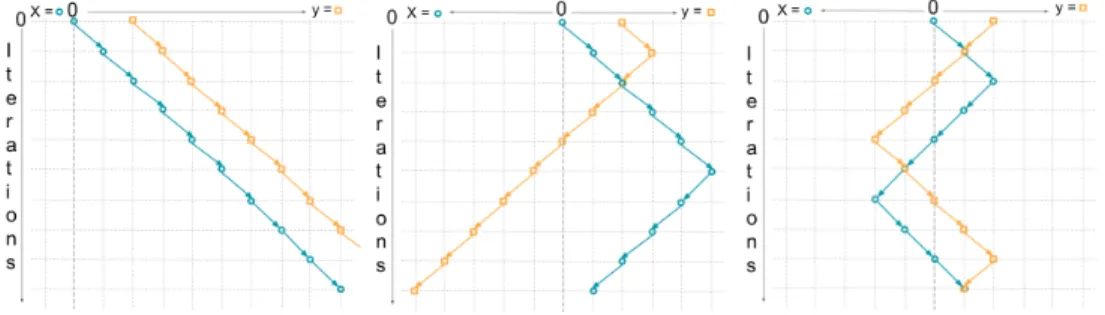
Figure 1:Implicit competitive regularization in the nashless game:Under full information, each player moves towards infinity as quickly as possible (first panel). Under limited information, but without accounting each other’s actions, the players oscillate and eventually diverge (second panel). Under both limited information and awareness of the opponent, the trajectories become stable (third panel).
Nash equilibrium using one of the many methods proposed in the literature, the choice of the algo-rithm should part of the modeling problem. In order to make this more concrete, we consider the zero-sum game given by
min
x∈R
max
y∈R
−exp(x2)−αxy+ exp(y2), (2) which we will refer to asthe nashless game. Here,α 1 is a large but fixed parameter. This game does not have a global Nash equilibrium, since each player can always achieve an exponen-tially increasing reward by moving towards infinity. It furthermore does not have any local Nash equilibria, since the curvature of the objective function is always negative inxand positive iny. One approach would be to interpret it as a Stackelberg game where playerygets to make their move after playerx. However, since playerycan always achieve arbitrarily large rewards by diverging to infinity this does still not result in a notion of solution. (Jin et al., 2019, Definition 14) introduced a notion oflocal minmax point(x∗, y∗)that amounts to restricting the movement of the follower to within a small distance ofy∗. However they also require the objective to be a local minimum with respect toy, which prevents it from being adequate for the game. (Fiez et al., 2019, Definition 4) propose a notion of differential Stackelberg equilibrium. However, since it is only based on first or-der information it will implicitly use theworststrategy of the follower. Thus, the leader can always locally improve by moving further towards infinity, preventing the game from having a differential Stackelberg equilibrium in the sense of (Fiez et al., 2019, Defininition 4.). While it is possible to define other notions of equilibrium, and hence solutions, for problems like in Equation 2, the above discussion illustrates that it is much harder than in the convex-concave setting.
An alternative way of turning equation 2 into an algorithm is to turn it into an iterative game between the two players, and obtain the algorithm from a suitable notion of rational behavior.
Three games for one loss function: To illustrate the different dynamics that can arise, we now
equip the loss function of Equation 2 with three different sets of rules for iterative play.
1. The global game: The two players move simultaneously, a distance of at most 1. They have access to the entire optimization landscape and aim to minimize their average loss in the asymptotic limit of infinite time.
2. The myopic game: The two players move simultaneously at a distance of at most1. At thek-th step, the playerx(y) only has access to objective function on[xk−1, xk+ 1]× {y}({x} ×[yk−
1, yk+ 1]) and tries to minimize the loss at stepk+ 1.
3. The predictive game: The two players move simultaneously at a distance of at most1. At the k-th step, both players have access to the objective function on[xk−1, xk+ 1]×[yk−1, yk+ 1])
and try to minimize their loss at stepk+ 1. The players are furthermore aware of each other’s goals. In the global game, playerycan win the game with a loss of−∞by diverging to infinity as quickly as possible. This is similar in spirit to the maximization overDin the original GAN where the global optimization overDresults in unstable behavior of the underlying game (see Figure1)
Since the global optimization of nonconvex problems is computationally infeasible, the first set of rules is not a suitable model for GAN training. In myopic game, we model the use of local
0 10000 20000 30000 40000 Iteration 102 101 100 Discriminator loss 11 epochs-checkpoint 21 epochs-checkpoint 11 epochs-scratch 21 epochs-scratch 0 1000 2000 3000 4000 5000 6000 Iteration 1 2 3 4 5 6 7 8
L2 norm of generator gradient
11 epochs-checkpoint 21 epochs-checkpoint 11 epochs-scratch 21 epochs-scratch 0 200 400 600 800 Iteration 102 101 100 101 Discriminator loss 11 epochs over-trained 21 epochs over-trained 11 epochs-checkpoint 21 epochs-checkpoint
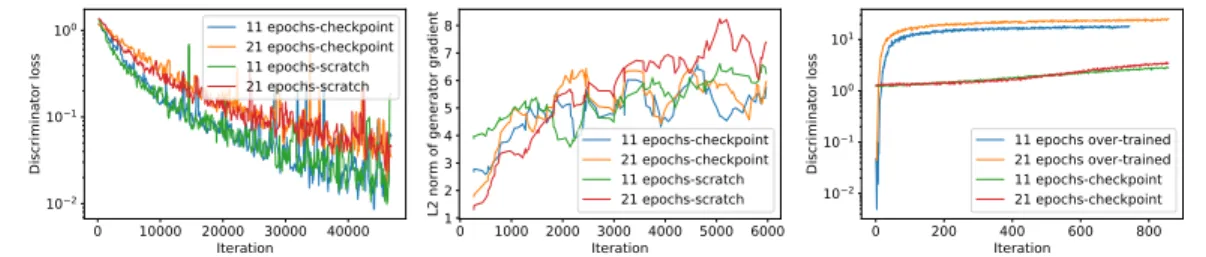
Figure 2:Overtraining Discriminators:We begin by training a GAN on MNIST using Adam for 21 (11) epochs, saving the resulting generator and discriminator as a ”checkpoint”. We then over-trainthe discriminator while keeping the checkpoint generator fixed, achieving low discriminator loss (second panel). As indicated by the increasing gradient norm of the generator during training (third panel), the resulting discriminator is brittle and incurs large losses as we start training the gen-erator again (fourth panel). Values computed from minibatches and averaged over smallx-windows.
algorithms by only giving the players access to the loss function in a local neighborhood of their present position. Initially of the exponentially increasing reward at infinity they try to improve their reward locally, entering the cycling dynamics also known from simultaneous gradient descent (see Figure 1). While the cycling behavior slows down the divergence, the players will eventually diverge far enough for the exponential term to overpower the bilinear term, from where on both players will diverge to infinity, without further cycling behavior.
In predictive game, the two players have access not only to their own, but also to the other player’s loss function as well as the effect that the other player’s moves will have on their own loss. Therefore, they don’t blindly aim to increase their own loss function but also try to estimate the actions of the other player and adapt choose their own actions accordingly. In the initial positionx= 0,y = 2, a playerythat is unaware of the presence ofxwill choose to move to3, in order to minimize its loss. Ifyis aware of the goals ofxhowever, it will know that whatever movey makes, the best move forxwill be to move to1. Thus, playery should make its move based on the assumption thatx will move to1and hence (sinceα1) moves to1instead. For the given starting conditions there always exist unique optimal strategies forxandy resulting in the periodic behavior illustrated in Figure 1.
The above example shows that even in the absence of suitable equilibria we can obtain meaningful and stable dynamics by modeling the players as agents acting with limited information and aware-ness of their opponents. Before providing a possible framework for this type of modeling, we will provide evidence that key features of the nashless game might indeed be present in GANs.
3
WHY A COMPETITION-AWARE
GAN
MIGHT BE STABLEGAN discriminators are not optimal: The key feature of the nashless of the last section is that
even though either player is incentivized to diverge to infinity, in doing so it enables the other player to ”counter-attack” by means of the strong bilinear term. In order to verify these properties in GANs, we first train a GAN on MNIST using21iterations of Adam, obtaining a good generative model. For future reference, we will refer to this generator and discriminator as thecheckpoint generator and discriminator. We thenovertraina new discriminator from scratch against thefixedcheckpoint generator. Similar to Arjovsky & Bottou (2017), we observe that the overtrained discriminator can achieve orders of magnitude lower discriminator loss than the checkpoint discriminator. There-fore, the checkpoint discriminator is far from being globally optimal. It seems conceivable that the checkpoint discriminator might instead be locally optimal. In order to verify this claim, we continue training the checkpoint discriminator while keeping the checkpoint generator fixed. As shown in Figure 2, we observe almost the same behavior as when overtraining the discriminator from scratch. Thus, the checkpoint discriminator was not at a local minimum (that is deep enough to affect stochas-tic gradient descent). Recent results by Berard et al. (2019) indicate that many good (in terms of image quality) generators are not local minima, but rather critical points of their loss function. This casts further doubt on the idea that local Nash equilibria are the right notion of solution for GANs.
Optimal discriminators in GANs are brittle: Given that the discriminator could so drastically improve over the checkpoint generator we have to ask ourselves why it doesn’t do so during GAN trainin. What, if anything, makes the checkpoint discriminator the better choice over the overtrained one? In the nashless game, players were partly discouraged from decreasing their losses since in doing so they became would become more vulnerable to counter play by the other player. To inves-tigate this question we now perform a second experiment were we fix the overtrained discriminators from the first experiment and start training the checkpoint generator again. As shown in Figure 2, the discriminator loss increases by two orders of magnitude within just40iterations, significantly beyond the loss at the checkpoint. In contrast, training the generator against the fixed checkpoint discriminator the discriminator loss does not show a significant increase over the first100iterations. This behavior is already foreshadowed by the increase in norm of the generator’s gradient in the initial stage of the overtraining procedure (see Figure 2). Thus, while the overtrained discriminator can achieve a greatly reduced loss, it is much more vulnerable to changes of the generator. A dis-criminator that is aware of the goals of the generator might therefore choose not to minimize its loss myopically but rather aim for a trade-off between achieving a low loss and being robust to actions of the generator.
4
MODELING THE PLAYERS’
ACTIONSBelief, uncertainty, and anticipation:In the previous section we observed that GANs, just like the
nashless game, might not be described well by the solution concept of a (local) Nash equilibrium. However, our experiments suggested that a suitable notion of rational play of the two players might indeed lead to stable GAN formulations. As described in the introduction and further illustrated on the nashless game, there are numerous ways to turn a given loss function for the two players into an iterative game. In the following, we will present one possible framework towards this goal. We will restrict our framework towards the case of both players movingsimultaneously,forgettingthe history of the game andgreedily aiming to minimize their loss after each move. Our framework models the players as choosing optimal actions based on the following three ingredients.
1. Thebelief that the agents have about the loss associated with different actions. 2. The way they incorporate theiruncertaintyinto their decisions.
3. Theiranticipationof the action of the adversary when making a decision.
In the myopic version of the nashless game, both players’ model consisted of the knowledge of the loss function in a1-neighborhood of their own position. The agents handled their uncertainty conservatively, by refusing to step outside the region where they are aware of the loss function. The agents did not have enough information to make use of an anticipation of the other agent’s strategy, thus we can take them to assume that the other player stays fixed. The next iterate(xk+1, yk+1)can
therefore be obtained as solution to the optimization problem min
x f(x, yk) +φ{x:|x−xk|≤1}(x)
max
y f(xk, y)−φ{y:|y−yk|≤1}(y),
(3) wheref is the loss function andφA(x) =∞forx /∈Aand zero everywhere else.
In the predictive version of the nashless game, both players’ model consists of the true loss func-tion in a1-neighborhood of the present position of either player. As before, the players treat the uncertainty conservatively by refusing to step outside the region where they have knowledge of the objective function. Differently from the myopic game, they are aware of the objectives of the other player and the way in which the other player’s actions affect their own loss. Therefore, their update is obtained as the Nash equilibrium of
min
x f(x, y) +φ{x:|x−xk|≤1}(x)
max
y f(x, y)−φ{y:|y−yk|≤1}(y).
(4) In the particular case considered in the nashless game the above local game always had a pure equilibrium. For general problems, the optimal solution of the local problem might correspond to a randomized strategy, resulting in a randomized algorithm for the ”solution” of the two-player game.
Computationally feasible instances: In practice, we usually don’t have access to the exact loss function in a local neighborhood, but rather to a local approximation that we expect to less reliable as we move away from the present iterate. A natural and computationally feasible way of modelling agent behavior in this setting is to let the agents use a Taylor approximation of the loss function, together with a regularizer that penalizes moving too far away from the last iterate, and thus into regions where the Taylor approximation is unreliable. The popular simultanous gradient descent falls into this framework, with players playing optimal with respect to a linear approximation of the loss and a quadratic penalty modeling their uncertainty, obtaining the game
min x f(xk, yk) + (x−xk) >∇ xf(xk, yk) + 1 2ηkx−xkk 2 max y f(xk, yk) + (y−yk) >∇ yf(xk, yk)− 1 2ηky−ykk 2.
By choosing different models for the player’s uncertainty, we could obtain other instances of simul-taneous mirror descent. This game is very similar similar to the one in equation 3 and simulsimul-taneous gradient descent can be seen as a computationally feasible version of the myopic game and as such features a similar oscillatory behavior.
In order to mitigate this problem, we can allow the players to anticipate each others actions, for instance by assuming that the other player will perform a gradient descent update. For the players to be able to use this information we have to introduce a bilinear approximation, obtainingLearning with opponent-learning awareness(LOLA) (Foerster et al., 2018) as solution to the local game
min x f(xk, yk) + (x−xk) >∇ xf(xk, yk) + (x−xk)>Dxy2 f(xk, yk)η∇yf(xk, yk) + 1 2ηkx−xkk 2 max y f(xk, yk) + (y−yk) >∇ yf(xk, yk)−(y−yk)>Dxy2 f(xk, yk)η∇xf(xk, yk)− 1 2ηky−ykk 2.
Optimistic mirror descent (Daskalakis et al., 2017) and the extragradient method (Korpelevich, 1977) can similarly be interpreted as based on ”optimistic” predictions of the two players actions.
Competitive gradient descent:In LOLA, both players make their decision based on the
assump-tion that the other player will play gradient descent. In contrast, the predictive variant of the nashless game lets the players choose the Nash equilibrium of the local problem, thus accounting the uncer-tainty on the other player’s plans. A computationally feasible analogue of this idea is given by
competitive gradient descent(CGD) (Sch¨afer & Anandkumar, 2019), which lets the players choose the Nash equilibrium of a bilinear approximation of the loss function, regularized with a quadratic penalty. The resulting game is given by
min x f+ (x−xk) >∇ xf+ (x−xk)>D2xyf(y−yk) + (y−yk)>∇yf + 1 2ηkx−xkk 2 max y f+ (x−xk) >∇ xf+ (x−xk)>D2xyf(y−yk) + (y−yk)>∇yf − 1 2ηky−ykk 2 , where all derivatives and function values offin the above expression are evaluated in the last iterate, (xk, yk). Sch¨afer & Anandkumar (2019) observe that this game has a pure unique Nash equilibrium
resulting in the update rule
xk+1=xk−η Id +η2Dxy2 f D 2 yxf −1 ∇xf+ηDxy2 f∇yf yk+1=yk+η Id +η2D2yxf D 2 xyf −1 ∇yf−ηD2yxf∇xf.
Implicit competitive regularization in CGD: While Sch¨afer & Anandkumar (2019) introduced
CGD as a method for finding Nash equilibria, we believe that by modeling the behavior of the two players it also provides a useful notion of implicit regularization. Indeed, while the gradient term ∇xf models the goal of xto minimize f. The additional term ηD2xyf∇yf is a gradient
step for the penalty term ηk∇yfk2, similar to LOLA or symplectic gradient adjustment (SGA)
(Gemp & Mahadevan, 2018; Balduzzi et al., 2018; Letcher et al., 2019) which can be interpreted as attempting to decrease the effect of the other player’s action. The term Id +η2D2xyf Dyx2 f
−1
corresponds to choosing updates that are robust to the actions of the other player. If some of the singular values of Dxyf are very large, this amounts to approximately restricting the update to
0 1000 2000 3000 4000 5000 6000 7000 Iteration 0 2 4 6 8
L2 norm of generator gradient
11 epochs-checkpoint 21 epochs-checkpoint 11 epochs-scratch 21 epochs-scratch 11 epochs-CGD 21 epochs-CGD 0 200 400 600 800 1000 Iteration 102 101 100 101 Discriminator loss 11 epochs-CGD 21 epochs-CGD 11 epochs-Adam 21 epochs-Adam 11 epochs-checkpoint 21 epochs-checkpoint
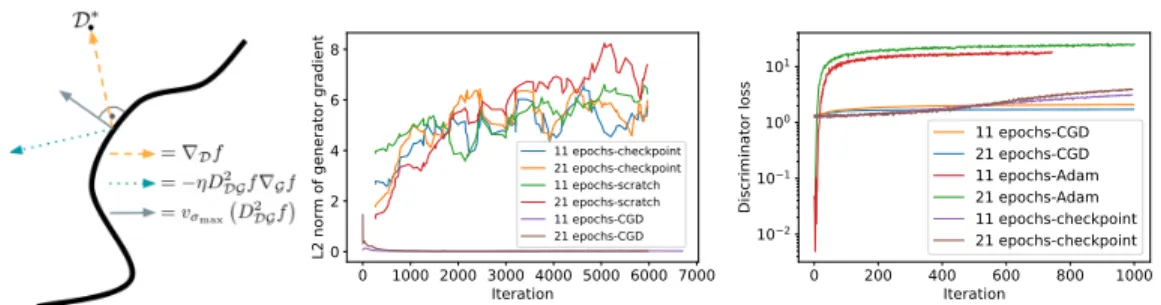
Figure 3: Implicit competitive regularization: First panel: While simple gradient ascent would lead towards the overtrained discriminatorD∗(first arrow), CGD tries to also reduce the other play-ers gradient (second arrow) and for large mixed HessianD2
DGf, projects the update on the orthogo-nal complement of the leading singular vector, thus preventing overtraining. The thick black curve illustrates the ”manifold of robust play”. Second and third panel: When attempting to overtrain the discriminator using CGD, it actually becomesmorerobust (compare to Figure 2).
the orthogonal complement of the corresponding singular vectors. For smoothly varying singular vectors, this can be though of as approximately constraining the trajectories to a manifold of robust play (see Figure 3 for an illustration). Contrary to the explicit regularization using gradient penalties, thisimplicit competitive regularizationdoes not require choosing a metric on the space of samples but is instead informed by the inductive biases of the generator’s and discriminator’s architecture. We will now investigate how the use of CGD affects the overtraining in on MNIST presented in Figure 2. To this end, we try to overtrain the discriminator from the checkpoint, this time using CGD instead of Adam. As shown in Figure 3, no significant overtraining takes place even after 21 epochs. In fact, the generator gradients aresmallerand the discriminator ismore robustthan at the checkpoint.
5
EMPIRICAL STUDY ON
CIFAR10
Experimental setup:One of the key claims in this work is that the implicit competitive
regulariza-tion due to CGD is enough to allow stable GAN training. To substantiate this claim, we compare Adam and CGD on a wide range of regularizers and loss functions. While it is still unclear what is the best way of combining CGD with learning rate heuristics, we opt for a naive combination of CGD with RMSprop (referred to as ACGD) to make for a more fair comparison to Adam. As loss functions, we use the original GAN loss (OGAN) of equation 1 and the Wasserstein GAN loss function (WGAN) given by
min
G maxD Ex∼Pdata[D(x)]−Ex∼PG[D(x)].
When using Adam on OGAN, we stick to the common practice of replacing the generator loss by
Ex∼G[−log (D(x)]], as this has been found to improve training stability (Goodfellow et al., 2014; 2016). In order to be generous to existing methods, we use an existing architecture 1 intended
for the use with WGAN gradient penalty (Gulrajani et al., 2017). As regularizers, we consider no regularization (NOREG),`2penalty on the discriminator with different weights (L2), Dropout (p=
0.5) on the discriminator after each convolutional layer (Dropout), or1-centered gradient penalty on the discriminator, following Gulrajani et al. (2017) (GP). Following the advice in (Goodfellow et al., 2016) we train generator and discriminator simultaneously, with the exception of WGAN-GP and Adam, for which we follow (Gulrajani et al., 2017) in making five discriminator updates per generator update. We use the inception score (Salimans et al., 2016) to quantitatively compare the quality of the different generators.
Experimental results:We will now summarize our main experimental findings.(1:)When
restrict-ing our attention to the top performrestrict-ing models, we observe that the combination of ACGD with the WGAN loss and without any regularization achieves higher inception score than all other combina-tions tested (see Figure 4).(2:)Many of the other high-performing models are obtained via ACGD
0 100 200 300 400 Thousand generator iters(10^3) 2.5 3.0 3.5 4.0 4.5 5.0 5.5 Inception score OGAN-Dropout+Adam WGAN-GP+Adam OGAN-Dropout+ACGD WGAN-NOREG+ACGD WGAN-GP+ACGD 0 1 2 3 4 5 6
Million gradient calls(10^6) 2.5 3.0 3.5 4.0 4.5 5.0 5.5 Inception score OGAN-Dropout+Adam WGAN-GP+Adam OGAN-Dropout+ACGD WGAN-NOREG+ACGD WGAN-GP+ACGD
Figure 4: We plot the inception score against the number of iterations (first panel) and gradient or Hessian-vector product computation (second panel). The third panel shows final samples of WGAN trained with ACGD and without regularization.
0 100 200 300 400 Thousand generator iters(10^3) 1.0 1.5 2.0 2.5 3.0 3.5 4.0 4.5 5.0 Inception score OGAN-Dropout+Adam OGAN-Dropout+ACGD 0 100 200 300 400 500 Thousand generator iters(10^3) 1 0 1 2 3 Inception score 0 100 200 300 400 Thousand generator iters(10^3) 1.0 1.5 2.0 2.5 3.0 3.5 4.0 4.5 5.0
Inception score OGAN-NOREG+ACGDOGAN-NOREG+Adam OGAN-0.0001L2+Adam OGAN-0.0001L2+ACGD
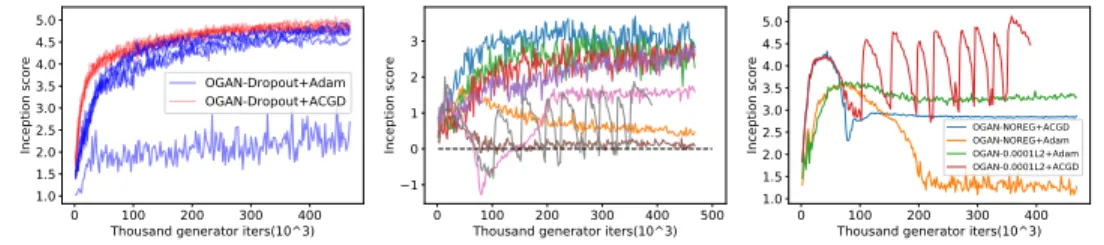
Figure 5: First panel: We compare the variance over seven runs of the same model with ACGD and Adam. Second panel: We plot the difference between inception scores between ACGD and Adam (positive values correspond to a larger score for ACGD) over all iterations and models. Third panel: The only cases where we observe nonconvergence of ACGD are OGAN without regularization or with weight decay of weight0.0001. The inception score is however still higher than for the same model trained with Adam.
(see Figure 4).(3:)When comparing the number of gradient computations and Hessian-vector prod-ucts, ACGD is significantly slower than OGAN combined with ADAM and dropout, because of the iterative solution of the matrix inverse in ACGD’s update rule (see Figure 4).(4:)The only instance where we observe erratic behavior with ACGD is when using OGAN without regularization, or with a small`2penalty. However, ACGD still outperforms Adam on those cases (see Figure 5). We note
that we observed nan values in one case of OGAN-L2 and ACGD, presumably because of underflow in the CG solve as discriminator weights approach zero. (5:) When plotting seven runs of OGAN with dropout using both ACGD and Adam, the results of ACGD are consistent while Adam shows a large variance (see Figure 5).(6:)When plotting the difference between the inception score obtained by ACGD and Adam for the same model over the number of iterations, for all models, we observe that ACGD often performs significantly better, and hardly ever significantly worse (see Figure 5).
6
CONCLUSION AND OUTLOOK
In this work we have argued that difficulties in GAN training might better be addressed by modeling the behavior of generator and discriminator than by just modifying the loss function or devising new local solution concepts, like generalizations of Nash or Stackelberg equilibria. We have proposed a framework for doing so and illustrated how it relates to different algorithms in the literature. For one instance of our framework, competitive gradient descent, we explore in more detail the implicit competitive regularization that it induces. Extensive numerical experiments show that the perfor-mance of competitive gradient descent is significantly more consistent than that of Adam across different loss functions and regularizers. In particular, the highest performing model is the bilinear WGAN loss together with competitive gradient descentand no explicit regularization. Analogous to the Wasserstein distance being theintegral probability metric(IPM) (Sriperumbudur et al., 2009) associated to a Lipschitz constraint, the WGAN loss optimized with CGD can be intuitively inter-preted as a form of IPM associated to implicit competitive regularization.
GANs allow us to employ neural networks for generative modeling without having to prescribe a notion of similarity between images explicitly, by taking full advantages of their ”inductive biases”. The present works suggests that their training might be best stabilized by sticking to this approach
and relying on implicit competitive regularization rather than using penalties that make an explicit choice of distance function on sample space. We believe that once reliable methods for their training have been established, adversarial methods will greatly increase the scope of applications of deep neural networks.
ACKNOWLEDGMENTS
A. Anandkumar is supported in part by Bren endowed chair, DARPA PAIHR00111890035, Raytheon, and Microsoft, Google and Adobe faculty fellowships. F. Sch¨afer gratefully acknowl-edges support by the Air Force Office of Scientific Research under award number FA9550-18-1-0271 (Games for Computation and Learning). H. Zheng is supported by Zhiyuan College, Shanghai Jiao Tong University.
REFERENCES
Mart´ın Arjovsky and L´eon Bottou. Towards principled methods for training generative adversarial networks. In5th International Conference on Learning Representations, ICLR 2017, Toulon, France, April 24-26, 2017, Conference Track Proceedings. OpenReview.net, 2017. URLhttps:
//openreview.net/forum?id=Hk4_qw5xe.
Martin Arjovsky, Soumith Chintala, and L´eon Bottou. Wasserstein generative adversarial networks. InInternational conference on machine learning, pp. 214–223, 2017.
David Balduzzi, Sebastien Racaniere, James Martens, Jakob Foerster, Karl Tuyls, and Thore Grae-pel. The mechanics of n-player differentiable games.arXiv preprint arXiv:1802.05642, 2018. Hugo Berard, Gauthier Gidel, Amjad Almahairi, Pascal Vincent, and Simon Lacoste-Julien. A
closer look at the optimization landscapes of generative adversarial networks. arXiv preprint arXiv:1906.04848, 2019.
Constantinos Daskalakis, Andrew Ilyas, Vasilis Syrgkanis, and Haoyang Zeng. Training gans with optimism. arXiv preprint arXiv:1711.00141, 2017.
Tanner Fiez, Benjamin Chasnov, and Lillian J Ratliff. Convergence of learning dynamics in stack-elberg games.arXiv preprint arXiv:1906.01217, 2019.
Jakob Foerster, Richard Y Chen, Maruan Al-Shedivat, Shimon Whiteson, Pieter Abbeel, and Igor Mordatch. Learning with opponent-learning awareness. InProceedings of the 17th International Conference on Autonomous Agents and MultiAgent Systems, pp. 122–130. International Founda-tion for Autonomous Agents and Multiagent Systems, 2018.
Ian Gemp and Sridhar Mahadevan. Global convergence to the equilibrium of gans using variational inequalities.arXiv preprint arXiv:1808.01531, 2018.
Ian Goodfellow, Jean Pouget-Abadie, Mehdi Mirza, Bing Xu, David Warde-Farley, Sherjil Ozair, Aaron Courville, and Yoshua Bengio. Generative adversarial nets. InAdvances in neural infor-mation processing systems, pp. 2672–2680, 2014.
Ian Goodfellow, Yoshua Bengio, Aaron Courville, and Yoshua Bengio. Deep learning, volume 1. MIT Press, 2016.
Ishaan Gulrajani, Faruk Ahmed, Martin Arjovsky, Vincent Dumoulin, and Aaron C Courville. Im-proved training of wasserstein gans. InAdvances in neural information processing systems, pp. 5767–5777, 2017.
Chi Jin, Praneeth Netrapalli, and Michael I Jordan. Minmax optimization: Stable limit points of gradient descent ascent are locally optimal.arXiv preprint arXiv:1902.00618, 2019.
Naveen Kodali, Jacob Abernethy, James Hays, and Zsolt Kira. On convergence and stability of gans.
arXiv preprint arXiv:1705.07215, 2017.
GM Korpelevich. Extragradient method for finding saddle points and other problems.Matekon, 13 (4):35–49, 1977.
Alistair Letcher, David Balduzzi, S´ebastien Racani`ere, James Martens, Jakob Foerster, Karl Tuyls, and Thore Graepel. Differentiable game mechanics. Journal of Machine Learning Research, 20 (84):1–40, 2019. URLhttp://jmlr.org/papers/v20/19-008.html.
Takeru Miyato, Toshiki Kataoka, Masanori Koyama, and Yuichi Yoshida. Spectral normalization for generative adversarial networks.arXiv preprint arXiv:1802.05957, 2018.
Kevin Roth, Aurelien Lucchi, Sebastian Nowozin, and Thomas Hofmann. Stabilizing training of generative adversarial networks through regularization. InAdvances in neural information pro-cessing systems, pp. 2018–2028, 2017.
Tim Salimans, Ian Goodfellow, Wojciech Zaremba, Vicki Cheung, Alec Radford, and Xi Chen. Improved techniques for training gans. InAdvances in neural information processing systems, pp. 2234–2242, 2016.
Florian Sch¨afer and Anima Anandkumar. Competitive gradient descent. arXiv preprint arXiv:1905.12103, 2019.
Bharath K Sriperumbudur, Kenji Fukumizu, Arthur Gretton, Bernhard Sch¨olkopf, and Gert RG Lanckriet. On integral probability metrics,\phi-divergences and binary classification. arXiv preprint arXiv:0901.2698, 2009.