The Politics of External Approval: Explaining the IMF’s
Evaluation of Austerity Programs
This is the accepted version of
Hinterleitner, M., Sager, F. and E. Thomann. 2016. The Politics of External Approval: Explaining the IMF’s Evaluation of Austerity Programs. European Journal of Political Research 55(3): 549–567.
Abstract
During the European debt crisis, numerous states launched austerity programs. The
International Monetary Fund (IMF) evaluates and forecasts the likelihood of member states’
success in implementing these programs. Although IMF evaluations influence country risk
perceptions on capital markets, little is known about their reasoning. This paper uses fuzzy-set
Qualitative Comparative Analysis to explore on what grounds the IMF evaluated the success
prospects of austerity programs during the European debt crisis. Results reveal that IMF
evaluations are heavily influenced by the program’s implementation credibility. They require a tractable policy problem, a country’s institutional capacity to structure implementation, and
favor expenditure reduction over revenue measures. By acting as a strict guide on the road to
fiscal adjustment, the IMF indirectly influences member states’ scope of policymaking through
its surveillance activities. Extensive austerity programs that need to be implemented swiftly are
evaluated negatively if the country is not involved in an IMF program.
Keywords:
International Monetary Fund (IMF), Austerity, European Debt Crisis, fuzzy-set Qualitative
Introduction
This paper analyzes on what grounds the IMF evaluated the success prospects of austerity
programs during the European debt crisis. The level of debt in developed European countries
has risen sharply in recent years. To avoid spiraling debt and refinance existing debts on the
capital markets under acceptable conditions, numerous states have adopted austerity programs.
Austerity programs aim to balance the fiscal budget by reducing expenditure and increasing
revenue, hence constituting one way to achieve fiscal consolidation (Blyth 2013; IMF 1995).
The International Monetary Fund (IMF), often described as one of the most powerful IOs in
history (Bird 2007; Nelson 2014; Stone 2002), “accompanies” countries on the road to fiscal
consolidation. Throughout this process, it influences domestic fiscal policy in important ways
(Ban 2015; Barnett & Finnemore 2004; Fang & Stone 2012; Woods 2006). Besides providing policy advice to member countries, the IMF also evaluates the countries’ likely performance in
implementing austerity policies, and communicates the results (Dreher, Marchesi & Vreeland
2008; IMF 2015a, b, c; Lombardi & Woods 2008). The IMF’s evaluations of countries’
austerity programs – a key element in the IMF’s bilateral surveillance activities – are influential
signals to capital markets on how risky certain sovereigns are in terms of investment (Ban &
Gallagher 2015; Dreher et al. 2008; IMF 2015c). If the IMF does not consider a country’s road
to fiscal adjustment credible, this results in an increased risk perception on capital markets
(Fratzscher & Reynaud 2011).
Despite the huge relevance of IMF austerity program evaluations, little is known about their
reasoning. The main thrust of research on IMF-decision-making has focused on the Fund’s
lending activities, but paid little attention to surveillance activities (Barnett & Finnemore 2004;
Dreher & Gassebner 2012; Pop-Eleches 2008; Steinwand & Stone 2008; Stone 2004). However, as the IMF’s new raison d'être is surveillance (Dreher et al. 2008), the question of how the IMF exerts power on its member states – not only by direct means such as formal
enforcement mechanisms, but also indirectly through the narrowing of policy advice and
options – has taken on a new dimension (Broome & Seabrooke 2012).
As arguably the first study that examines the IMF’s recent stance towards austerity in the
context of its surveillance activities in the Eurozone, this paper asks: how did the IMF assess
austerity programs during the European debt crisis? We adopt a public policy perspective and assume that Sabatier and Mazmanian’s (1980) seminal framework of the implementation
process helps us understand IMF evaluations (e.g., Exadaktylos & Zahariadis 2014). Employing
fuzzy-set Qualitative Comparative Analysis (fsQCA) (Ragin 2008), we assess how different
constellations of the interplay of problem tractability, the ability of the austerity program to
structure implementation, and non-statutory variables affected the IMF’s evaluation of 20
austerity programs implemented in 14 countries of the Eurozone or the European Union (EU)
during the recent debt crisis.
This paper contributes to the debate on IMF evaluations in three ways. First, it analyzes
developed European countries. Earlier work has focused on low- and middle-income transition
and developing countries and emphasized the IMF’s responsiveness to geopolitical and
transnational business interest (Aldenhoff 2007; Dreher et. al. 2008; Fratzscher & Reynaud
2011; Pop-Eleches 2009; Thacker 1990). This perspective has largely neglected the “domestic variables that influence whether or not a government adopts an IO’s policy preferences”
(Broome & Seabrooke 2012: 2). Indeed, findings on the IMF’s loan negotiations and lending
decisions (Broome 2010; Chwieroth 2013; Stone 2002; Woods 2006) suggest that particularly
in the institutionally and politically more stable context of the Eurozone, domestic variables
should affect how the IMF evaluates austerity programs (Heller 2002). Second, contrary to
these previous studies, we focus on IMF evaluations within the context of formal assessments
of austerity programs which provide information signals about sovereign risk to capital markets.
to reconsider its understanding of a “sound fiscal policy” and its stance towards austerity and
stimulus measures. It increasingly recommended a more gradual implementation of austerity
measures for countries with sufficient confidence on financial markets (Blanchard & Leigh
2013) and a more balanced mix of expenditure reduction and revenue increases (Ban 2015).
Given this altered stance towards austerity, the assumption that the IMF acts as a fierce and
undifferentiated agent of austerity made in much work on the European debt crisis may prove
to be too narrow. Clearly, a more differentiated stance towards austerity by the IMF asks for an
in-depth examination of the factors that influence that stance.
In fact, our results show that the IMF is not an undifferentiated agent of austerity, but considers
domestic conditions. IMF evaluations prove to be heavily influenced by implementation
credibility. First, for rather uncompetitive countries with lower institutional capacity and
ambitious austerity programs, it is almost impossible to take the road to fiscal adjustment
without being involved in an IMF rescue program. Second, the IMF negatively evaluates
economically stronger countries whose adjustment policies do not conform to the IMF’s
preference of expenditure reduction over revenue measures. These findings suggest that the
IMF acts as a strict guide on the road to fiscal adjustment, indirectly influencing member states’
scope of policymaking through its surveillance activities.
Next, we discuss the IMF’s evaluations of austerity programs and outline our explanatory
model. We then proceed to the research design and methods employed. After presenting the
results, we go on to discuss the main findings and their implications.
The Politics of External Approval
The IMF has recently begun to gradually shift its primary focus from lending to surveillance
activities. Accordingly, scholars seek to understand how surveillance works and what
fiscal and macroeconomic variables of member countries which are published on a regular
basis.
Although IMF forecasts are known to be based on a strong scientific culture (Ban & Gallagher
2015), the IMF publishes only vague information on these procedures and schematically
describes the preceding consultation processes (Asdorian 2015; IMF 2015b, c): “the initial
projections are based on an econometric model. Subsequently, however, there is much leeway for […] discretionary adjustments” (Dreher et al. 2008: 146). IMF evaluations contain a
substantive qualitative element resulting from the considerable subjectivity of the respective
country teams (IMF 2015b, c). While earlier research scrutinized the accuracy of forecasts
(Pons 2000; Timmermann 2007), few scholars have recently analyzed their determinants
(Aldenhoff 2007; Dreher et. al. 2008; Fratzscher & Reynaud 2011). These studies have found
a low explanatory power of political strategies and macroeconomic variables, while quite
unambiguously suggesting that the IMF both legitimizes its lending activities with overly
optimistic forecasts, and favors countries that are political allies of the United States of America
(US) (Aldenhoff 2007; Dreher et al. 2008). In emerging market economies, the countries’
political power has also proven relevant (Fratzscher & Reynaud 2011).
We argue that in the context of the contemporary Eurozone, domestic variables that influence a country’s implementation credibility matter for IMF austerity program evaluations. While the
geopolitical and strategic interests of the IMF’s principals set the broader boundaries for
IMF-decision-making (Stone 2002; Thacker 1990), within these boundaries, the IMF has acquired
considerable maneuvering space (Chwieroth 2013; Pop-Eleches 2009; Woods 2006). Whereas
IMF evaluations may be commercially more sensitive towards systemic economic entities like
the Eurozone than to low- and middle-income transition and developing economies, this factor
alone cannot explain the considerable variation in IMF austerity program evaluations within the Eurozone. Geopolitical arguments also cannot be the main difference-maker in the European
context: the IMF has negatively rated the austerity programs of powerful US-friendly countries
like Germany and the United Kingdom. Finally, the IMF has expressed its intention to
strengthen the traction of surveillance by ensuring its quality, candor, and evenhandedness (IMF
2011: 19; 2014), which should also enhance the relevance of domestic variables.
When a country announces an austerity program, this can be interpreted as a signal of its
willingness for fiscal adjustment. IMF publications clearly indicate that the IMF does not take
these signals at face value, but subjects them to a “reality-check” to verify them for their
implementation credibility (Heller 2002). Our aim is to evaluate the IMF’s response to the
announcement of an austerity program, specifically, whether the IMF deems the program
capable of meeting its objective. The IMF regularly publishes forecasts for estimated budget
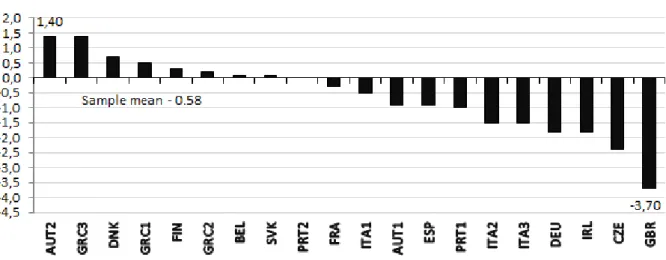
balances in its Fiscal Monitor(FM) (Ban & Gallagher 2015; IMF 2015a, b). The outcome we seek to explain is the IMF’s evaluation of an austerity program’s likely success in balancing the
budget as intended, hereinafter referred to as “positive evaluation” (POS). To capture this, we
compare the fiscal balance targeted by the austerity program, on the one hand, with the fiscal
balance (general government structural balance) projection after the announcement of an
austerity program, on the other.1
-- insert Figure 1 here –
1 To ensure that announced austerity programs were actually incorporated in the projections, we chose a time span
of approximately 4-6 weeks between announcement and data publication by the IMF. In case of doubt, we opted for the later Fiscal Monitor update.
As Figure 1 illustrates, the IMF’s forecasts of changes in the countries’ fiscal balance after
implementation vary considerably between different austerity programs. If the IMF forecasts
that the program is likely to miss the target, then the evaluation is more negative than positive.
For instance, by the end of 2010, Ireland announced its intention to meet the EU deficit criteria
of -3% of GDP until 2014. However, considering the planned austerity measures, the IMF
projected the deficit to be at -4.8%. Hence, the IMF expected Ireland to miss its target by 1.8
percentage points. If the IMF projects that the program will not miss its intended target (score
of 0 or more), then the program is more positively than negatively evaluated. The Slovak
Republic, for instance, announced an austerity program in May 2012, with the aim of bringing
its budget deficit down to 3% by 2013. In response, the IMF expected the program to exceed
its goal by +0.1 percentage points and projected the deficit to be 2.9% after implementation.
The observed evaluations range from +1,4 to -3.7. It is these differences that we now scrutinize.
On what grounds can the IMF reasonably assess?
When announcing austerity programs, countries must, as a minimum, define the total amount
of savings, the expected duration, and cost saving efforts in order to obtain funds and reasonable
credit terms. However, most austerity programs under scrutiny outlined these parameters too
vaguely to ensure their successful implementation. The IMF was therefore well-advised to treat
these indications as a mere declaration of intent, whose implementation credibility required
verification. Sabatier and Mazmanian’s (1980) framework captures the way austerity measures
as centrally designed top-level policy decisions, often imposed under external pressure, are
implemented particularly well (e.g., Exadaktylos & Zahariadis 2014). We adapt that framework
to the specific research context by integrating explanatory factors mentioned more or less
explicitly by the IMF. Sabatier and Mazmanian (1980) understand the implementation of public
of the problem at hand is captured here as program ambitiousness and the presence of an IMF
rescue program. Second, the ability of the statute to structure implementation is influenced by
the number of veto players and the effectiveness of the national administration. Third, we
consider the presence of a strong Centre-Right government and a country’s economic
competitiveness as non-statutory variables affecting implementation.
Sabatier and Mazmanian’s (1980: 554) model should be understood as a “minimum list of
crucial conditions”, rather than as individual factors which work in isolation. We want to
discover case-specific configurations that explain how the IMF evaluates austerity programs. Surprising results then provide opportunities for further explorations to refine theory (Rihoux
& Ragin 2009). While adopting an explorative focus, we seek to identify theoretically plausible
counterfactual arguments when dealing with limited diversity (that not all logically possible
combinations of relevant causal conditions exist in the real world). To this end, we formulate
directional expectations on the effects of single variables. These expectations serve as
counterfactual arguments and are not testable hypotheses (Schneider & Wagemann 2012:
295ff).
Problem tractability
First, the greater the amount of behavioral change required, the more problematic a program’s
successful implementation becomes (Sabatier & Mazmanian, 1980: 544). The ambitiousness of the adopted program (AMB) sets the size of the envisaged deficit reduction in relation to the time countries had at their disposal to achieve the deficit reduction. Programs are ambitious if
the country envisaged a large budget reduction within a brief period of time. This might indicate
low implementation credibility to the IMF: ambitious programs could be mere “paper tigers”
that promise an unrealistically severe and swift fiscal change. Conversely, the IMF might also
its austerity plans seriously. Since program ambitiousness could indicate both high and low
success prospects, no directional expectation is formulated.
Second, two reasons make us assume that the IMF rates austerity programs more positively in
countries where it is engaged with a rescue program (PRG) (IMF 2015b). First, there is strong evidence that the IMF engages in “defensive forecasting”: a negative evaluation would weaken
the credibility of the IMF program. Positive evaluations can also increase the probability that
those loans are repaid (Aldenhoff 2007; Dreher et al. 2008). Second, the presence of an IMF
program signals a country's willingness and ability to undertake substantive reform (Fratzscher
& Reynaud 2011: 407). Countries with IMF arrangements in place have already undergone a ‘screening’ process that allows the IMF to better estimate the country’s ability to fulfill its
policy commitments (Chwieroth 2013). Less uncertainty could positively affect IMF
evaluations. Moreover, loan disbursements during an IMF program are conditional on
demonstrable policy actions, which provides the IMF with opportunities to directly influence,
monitor and enforce policy design and compliance (Armingeon & Guthmann, 2014; Broome,
2015; IMF 2015d).
Ability of the statute to structure implementation
Third, implementation success is determined by the number of veto/clearance points involved
in the attainment of statutory objectives (Sabatier & Mazmanian, 1980: 546). Austerity
programs can entail severe and abrupt cuts affecting a wide range of players and giving rise to opposition. Central governments must make sure that “budgetary discipline is imposed on all
fiscal entities” (Heller 2002: 18). A decentralized political system features a larger number of
sub-national veto players whose opposition to painful austerity measures could potentially undermine the “flexible and responsive execution of the budget” (Huber, Ragin & Stephens
should negatively affect the IMF’s evaluation of implementation credibility.
Fourth, sufficient financial and personnel administrative resources are “necessary to hire the
staff and to conduct the technical analyses involved in the development of regulations, the
administration of permit programs, and the monitoring of compliance” (Sabatier & Mazmanian
1980: 545). Established administrative capacities, e.g., a strong treasury, improve the efficient,
thorough and successful implementation of austerity programs (Heller 2002: 17; IMF 1995).
The existence of an effective administration (EFF) should thus positively affect the IMF’s evaluation of the austerity program.
Non-statutory variables
Fifth, Sabatier and Mazmanian (1980: 574) highlight that “[a]ny new program requires
implementors who are not merely neutral but sufficiently persistent to develop new regulations
and standard operating procedures, and to enforce them in the face of resistance from target groups”. IMF evaluations entail a continuous “policy dialogue” between fund staff and national
authorities (Lombardi & Woods 2008). Much of the existing literature has focused on the
commitment of individual ‘sympathetic interlocutors’, i.e. “national policymakers who are
sympathetic to advice from the IMF” (Broome & Seabrooke 2015: 6; Chwieroth 2015). We
measure the political commitment of the whole government through partisan affiliation for three
reasons. First, in developed countries, the IMF pays more attention to broader political support
than to the presence of individual interlocutors (Woods 2006). Second, in situations like the
European debt crisis marked by a very contentious economic problem and alternative
ideology-based interpretations and solutions, partisanship influences the IMF’s decision-making
(Pop-Eleches 2009). Third, in a European context key actors are not only socialized by the
universities they attend, but also by their political parties. Due to their political commitment to
support and implement austerity measures to a stronger degree than Centre-Left and
Christian-Democratic governments (Hibbs 1977). The former usually face less blame when cutting social
policy (Giger & Nelson 2010). Accordingly, the presence of a strong Centre-Right government
(CR) should positively affect the IMF’s evaluation of implementation credibility.2
Sixth, as Bird (2007: 683) points out, “in order to understand the IMF’s operations, economics has to be combined with politics”. A relevant socio-economic condition is the competitiveness
of the economy. Economic competitiveness describes the basic conditions for growth,
innovation, and efficiency that determine how productively a country uses its available
resources to provide future economic prosperity. Economically competitive states are more
likely able to escape the debt spiral by generating economic growth and reducing both their
debt burden and future pressure for savings. This, in turn, creates budgetary scope and increases
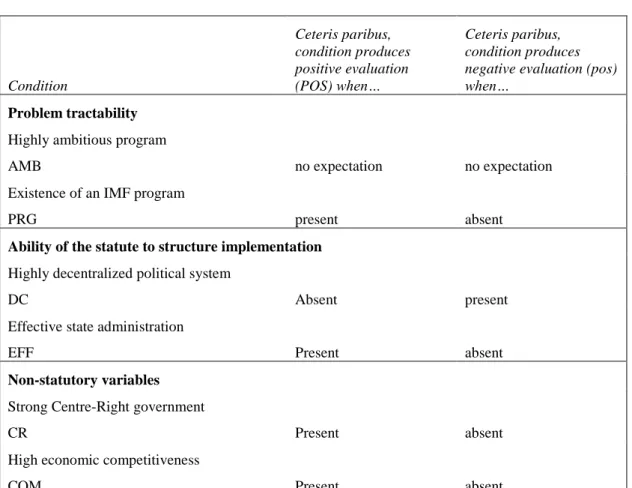
the likelihood that budgetary targets are met (IMF 2015a). Thus, the countries’ high economic competitiveness (COM) should positively influence the IMF’s evaluation of success likelihood. Table 1 summarizes the six conditions and the directional expectations used for counterfactual
arguments. Adopting QCA notation, the presence of a factor is indicated with uppercase letters,
and its absence with lowercase letters.
-- insert Table 1 here --
2 We account for the “policy dialogue” influencing the IMF’s assessment of political commitment during our case
Data and methods
We assess 20 austerity programs introduced in 14 countries within the Eurozone or the EU since
the crisis began between January 2009 and May 2012.3 This design holds important economic
contextual factors constant: the countries share an internal market and have been undergoing a
process of fiscal-political harmonization since the crisis began. Since they have the same
currency, or their national currency is tied with the Euro, they cannot avoid consolidation
measures by devaluing their currency without restriction.4 This enhances the importance of
austerity programs.
We employ Fuzzy Set Qualitative Comparative Analysis (fsQCA) (Ragin 2008; Rihoux &
Ragin 2009; Schneider & Wagemann 2012) to identify necessary and/or sufficient conditions
for a positive or negative evaluation by the IMF (software: QCA R package). The underlying
assumption of causal complexity has three elements. Equifinality means that various scenarios can induce the same IMF evaluation. Conjunctural causation indicates that case-specific factors affect IMF evaluation in combination rather than in isolation (Sabatier and Mazmanian 1980).
Lastly, asymmetrical causation means that different causal factors may matter for a positive IMF evaluation than for a negative IMF evaluation. Case knowledge enables us to identify
potential measurement errors (Schneider & Wagemann 2012: 89, 295-305, 307-312).
fsQCA conceives of variables as sets in which cases have membership or not. The attribution
of cases to sets is called calibration. Qualitative anchors determine the stage at which the
3 In the absence of any official document listing austerity programs passed in the EU, cases were identified using
Internet-based research. National and international news services were consulted to verify that the announced austerity program had actually been adopted.
condition is deemed fully present (fuzzy value ≥ 0.95), fully absent (fuzzy value ≤ 0.05) and an
indifference point at 0.5. The latter establishes the difference in kind: for example, fuzzy
membership values in POS above 0.5 means that IMF evaluation was rather or fully positive
(POS), while values below 0.5 indicate that the evaluation was rather or fully negative (pos).
fsQCA uses the logical operators OR (+) and AND (*). The latter depicts combinations of
conditions, referred to hereinafter as configurations or paths. A “truth table” shows all possible combinations of conditions. If all or enough cases’ fuzzy set membership in a truth table row is
smaller than or equal to its membership in the outcome, then the row is identified as a sufficient
path for the outcome. The logical minimization process identifies the shortest expression for
those factors that imply () the outcome – the solution term.
fsQCA results are evaluated using two main parameters of fit that range from 0-1. The
appropriate levels for these parameters are research-specific but are better the closer they are to
1 (Schneider & Wagemann 2012: 128). Consistency indicates the extent to which the results are in line with the statements of necessity or sufficiency, which is weakened by “deviant cases
consistency in kind” with qualitatively different membership in the explanation and the
outcome (Schneider & Rohlfing 2013). The proportional reduction in inconsistency (PRI)
indicates the degree to which a configuration is not simultaneously sufficient for both outcomes.
Consistency should not be below 0.75 for sufficient conditions, and 0.9 for necessary conditions
(Ragin 2008: 46). The presence of “gaps” and deviant cases consistency in kind helped us
determine raw consistency thresholds for single truth table rows. Coverage then states how well the available empirical information is explained by the condition(s). For sufficient conditions,
raw coverage indicates how much a single path covers, while unique coverage indicates how
much it uniquely covers. For necessary conditions, coverage expresses their relevance in terms
of not being much larger than the outcome, and the Relevance of Necessity (RoN), in terms of
Applying the Enhanced Standard Analysis (ESA) procedure, we make theoretically informed
directional expectations about empirically unobserved configurations (Table 1) and ensure that
the coding of the outcome in the truth table does not contradict prior findings of necessity or
sufficiency (Schneider & Wagemann, 2012: 198-211). The datasets, descriptive statistics, the
truth tables, directional expectations, conservative and parsimonious solution terms,
simplifying assumptions and r codes for replication are all indicated in the online appendix.
Operationalization and calibration
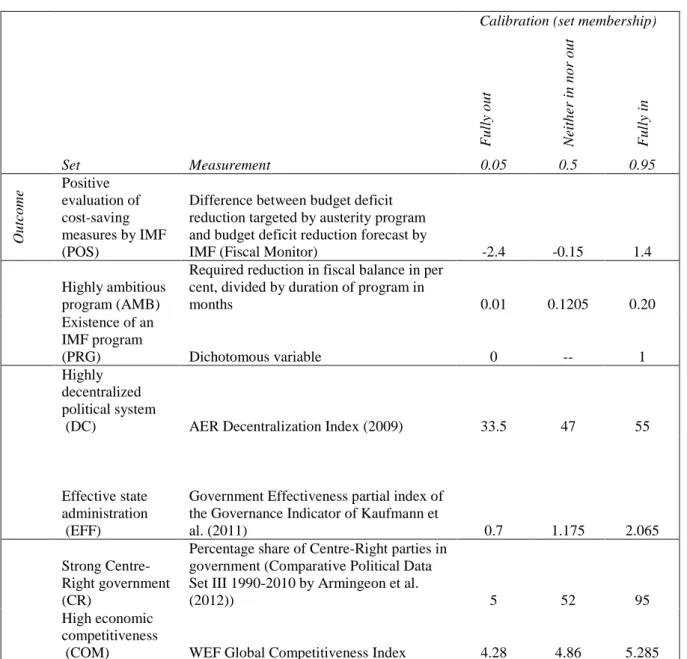
We now turn to the measurement and calibration of the condition and outcome sets, using the
current values at the time of the announcement of the austerity program (Table 2). The
calibration decisions are outlined in detail together with extensive robustness tests in online
appendix B (Skaaning 2011).
Highly ambitious program (AMB). Austerity programs are ambitious if they need to achieve a large deficit reduction within too little time to be realistically implemented. To measure
ambitiousness, we divide the planned deficit reduction in per cent of GDP by the duration of
the austerity program in months. For instance, while Portugal’s first austerity program sought
to bring the deficit down from -7.3% to -4.6% of GDP almost within a year, the Czech program
aimed at reducing the deficit from -3.5% to 0% within four years. The resulting scale has a
sample range from 0.6 (very high ambitiousness) to 0.01 (very low ambitiousness).
Existence of an IMF program (PRG). Austerity programs in countries with an IMF program in place at the time of the announcement are coded with 1, all others, with 0 (dichotomous set).
Strongly decentralized political system (DC). In decentralized political systems, sub-national jurisdictions have significant decision-making power concerning policy design and
implementation and can make significant changes (e.g., in the timetable and broad parameters).
and implementation of austerity measures, which results only in minor to austerity policies
adjustments (e.g., local delays). The aggregated decentralization index developed by the
Assembly of European Regions views decentralization as the sum of decision-making power
and competencies of sub-national jurisdictions in various areas (scale from 0 to 100) (AER
2009).
Effective state administration (EFF). An effective state administration possesses the means and expertise to implement austerity measures thoroughly, on time and successfully. This is not the
case if it lacks important resources and expertise necessary to translate austerity requirements
into concrete policies and enforce their implementation. The Governance Indicator developed
by Kaufmann, Kraay and Mastruzzi (2011) combines the quality of the public service, the
political independence of the administration, the quality of policy formulation and
implementation and other administration-related aspects into an index for government
effectiveness that ranges from -2.5 to +2.5. Higher values correspond to greater government
effectiveness.
Strong Centre-Right government (CR). If the share of government-posts held by Centre-Right candidates is sufficiently large, Centre-Right candidates’ can exert a dominant influence on
policymaking and implementation. We use the percentage share of (ministerial) posts held by
Centre-Right parties in the government from the Comparative Political Data Set III 1990-2010
of Armingeon et al. (2012) for operationalization.
High economic competitiveness (COM). A high degree of competitiveness facilitates sound future growth and economic prosperity, as increased tax revenue creates budgetary leeway and
alleviates the need for austerity in subsequent years. Conversely, low economic competitiveness
heralds poor growth prospects and significantly limits the future budgetary scope. The Global
Competitiveness Index of the World Economic Forum aggregates data on basic conditions for
can range from 2.7 to 5.8.
-- insert Table 2 here --
Results
Results reveal two necessary conditions for a positive evaluation by the IMF (for full results
see Table A4 and Figure A1 online appendix). First, the IMF requires a country to possess the
institutional capacity to structure the implementation of austerity measures in order to consider
the latter feasible: whenever the IMF gave an austerity program a positive evaluation, either the
political system tended to be centralized, or the state administration was effective (dc + EFF).
A second prerequisite for the IMF to evaluate an austerity program positively is a tractable
problem: either the austerity program has to be non-ambitious, or an ongoing IMF program is
in place (amb + PRG). The existence of an IMF program might actually influence the program’s
perceived ambitiousness: it reduces information asymmetries and enables the IMF to enforce
maximum compliance instead of having to rely on persuasion (Fang & Stone 2012; IMF
2015b).
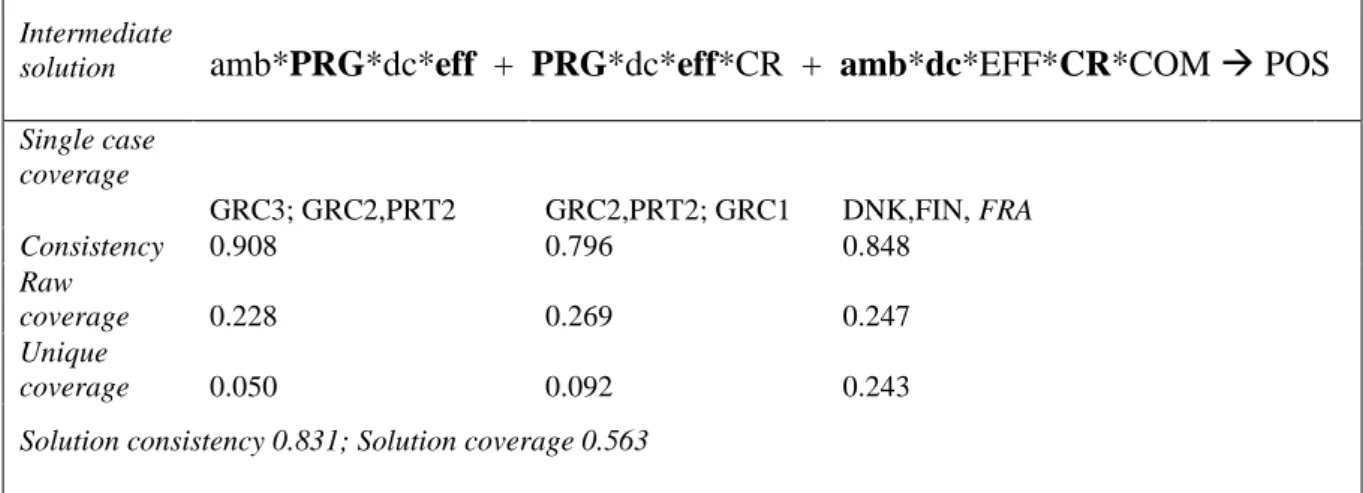
Table 3 presents the three paths that imply that the IMF grades austerity programs well. The
single cases that are explained by this solution, the consistency and coverage indicators for the
single paths and the overall solution are listed below. Cases can display several paths. We
discuss typical cases for each path below.
insert Table 3 here
a positive evaluation. Paths 1 and 2 describe the “struggling, but manageable students”:
austerity programs passed in countries with ineffective state administrations (eff), but which
are comparatively centralized (dc) and with a direct involvement of the IMF (PRG). In the first
path, this combined with low program ambitiousness (amb), and in path 2, with a strong
Centre-Right government (CR). In line with the “defensive forecasting” assertion, these cases are
Greece and Portugal, where the IMF provided financial support and was directly involved in
the implementation of agreed austerity measures. The IMF seems to be confident that its
engagement in a country can bolster a weak state administration under favorable conditions
marked by fewer veto points, reasonable consolidation targets, or a Centre-Right government
that supports the austerity program. Whether this is due to the IMF’s closer grip on
implementation, the improved availability of information, or a combination of these, could be
addressed in future research by interviewing IMF officials about their motives.
Another group of positively evaluated austerity programs entailed “model pupils” with
comparatively unambitious programs (amb) adopted in economically competitive (COM),
centralized countries (dc) with a strong Centre-Right government (CR) and an effective
administration (EFF). These ideal conditions for the successful implementation of austerity
measures were present in Denmark and Finland. For instance, Finland devised a program which
was aimed merely at “keeping the balance”. Since there was never any need to reestablish Finland’s standing on capital markets, the existence of an IMF program was irrelevant for the
IMF’s evaluation.
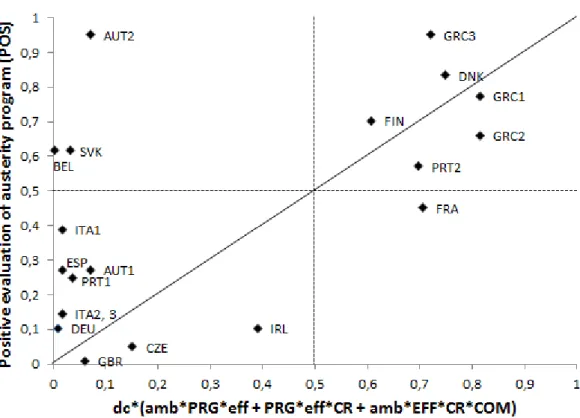
Figure 2 illustrates how the cases score on this solution. Despite the low coverage, we are able
to explain six out of nine cases of positive evaluation. France is a deviant case, as we will
discuss below.
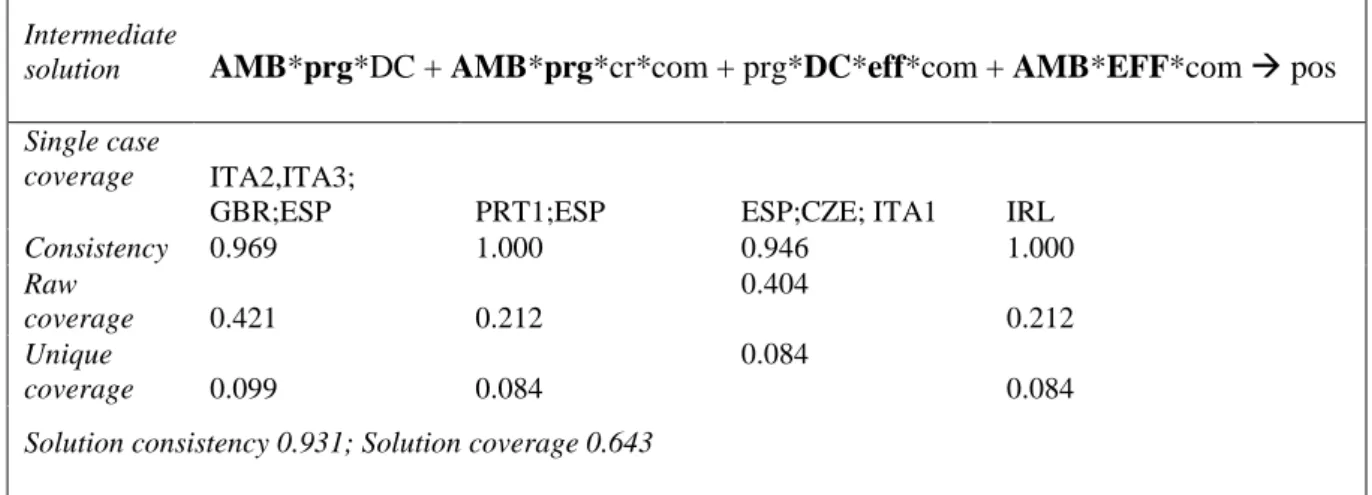
Another four paths imply that the IMF evaluated austerity programs negatively (Table 4). Three
factors have a particular salience when the IMF rates austerity programs negatively: first, the
programs should not be overly ambitious; second, low economic competitiveness is often a
hurdle; and third, the IMF is obviously skeptical when it is not engaged in a country.
-- insert Table 4 here --
Both paths 1 and 2 suggest that in the absence of direct IMF involvement, the IMF considers
ambitious programs to be “likely deceivers”. Examples for path 1 are the two austerity programs
passed in quick succession in Italy under the Berlusconi government and under the Monti
government, which entailed severe cuts to be implemented swiftly (AMB), but facing
significant veto power in a decentralized country (DC) without IMF involvement (prg). Low problem tractability, Italy’s low ability to structure implementation, and the IMF’s low control
over the latter lent little credibility to these austerity programs. As an instance for path 2, in
May 2010, Spain announced that it wanted to reduce its deficit by 3.3 percentage points in no
more than 19 months (AMB). The highly ambitious program did not convince the IMF: the
IMF had no direct control or information (prg), political support by the Leftist government
under Zapatero was weak (cr), and Spain was comparatively uncompetitive economically
(com).
The third pathway to a negative evaluation of implementation credibility entails “hopeless cases” like the Czech Republic’s 2012 austerity program with a particularly unfavorable
configuration of conditions, namely: strong decentralization (DC), low effectiveness of state
administration (eff), low economic competitiveness (com), and no IMF involvement (prg).
irrespective of how ambitious they are.
The fourth path covers the Irish austerity program as a special, “overly ambitious” case: it
envisaged a deficit reduction of no less than 28.9 percentage points in 48 months. The IMF
projected that the program would miss its target by “only” -1.8 points. The presence of a rather
effective state administration (EFF) combined with low economic competitiveness (com), but
the program’s exceptionally high ambitiousness was probably decisive for the IMF. Indeed, the
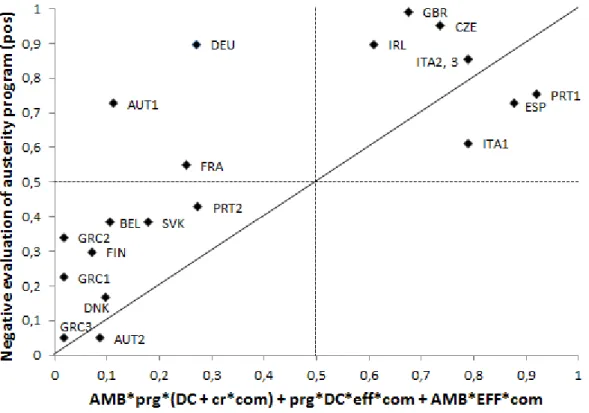
evaluation could be seen as rather positive. The solution has a high explanatory power, covering
8 out of 11 negative evaluations (Figure 3).
-- insert Figure 3 here --
Our proposed framework had a limited capacity to explain the evaluation of austerity programs
in Western European countries like Austria, Belgium, France and Germany, but also Slovakia.
Figure 1 has already revealed that, given the wide range of IMF evaluations, regional
provenience cannot itself be the missing explanation. Based on the IMF country reports, we
now discuss such “outlier” cases (Rihoux & Ragin 2009; Schneider & Rohlfing 2013) (see
Table A9 online appendix).
Austria’s two austerity programs represent the “least explained cases” for negative and positive
evaluation. As they display an identical country context and the same configuration of
explanatory factors, we can identify the decisive additional factor through a controlled
comparison. Austria announced its first austerity program, which aimed at reducing the deficit
by 2 % within 47 months, in January 2010. The IMF criticized Austria for over-emphasizing
revenue measures in its plan for fiscal consolidation, and projected that it would miss the target
IMF projected that this program would exceed its target by 1.4 %: Austria had proven responsive to the IMF’s calls to shift the focus of fiscal policy to the reduction of expenditures,
now striking an appropriate balance between fiscal discipline and the cyclical needs of the
economy.
This comparison suggests that the IMF evaluates countries more positively if they emphasize
expenditure reduction for achieving fiscal balance, especially during the initial stages of
adjustment (Broome 2015; IMF 1995: 26). Indeed, the IMF also reacted to the other
unexplained negatively rated programs with calls for more expenditure containment (France
2012, Germany 2010). Conversely, the other positively rated deviant cases (Belgium 2012,
Slovak Republic 2012) were explicitly lauded by the IMF for their focus on expenditure
containment.
The French austerity program, announced in August 2011, was rated negatively, despite the
fact that France is a “model pupil”. The IMF predicted a slight miss of -0.3 per cent (targeted
reduction: 1.4 per cent in 16 months). The Danish 2010 program and the Finnish 2012 program
belonged to the same group of “model pupils” and received a positive evaluation. Here, the
crux of the matter was tax policy. The IMF staff pointed out that the very high French tax burden would keep increasing relative to France’s peers. Conversely, the IMF welcomed the
tax freeze implemented in Denmark and lauded the Finish taxation measures as steps in the
right direction.
These comparisons suggest that, particularly in the context of Western European countries, the
IMF considers not only implementation credibility, but also the austerity programs’ content –
specifically, their relative emphasis on revenue measures or expenditure reduction. As austerity
programs often outline this content in broad terms only, the IMF appears also to take past
Conclusions
This paper investigated the grounds on which the IMF assessed the prospects for success of
austerity programs during the European debt crisis. The methodological approach we adopted
differs from the conventional toolbox of IMF studies, as it focuses on interrelated and
substitutable, rather than isolated net effects on IMF surveillance. This in turn paves the way
for an analysis of the causal mechanisms through which IOs influence their member states.
Simultaneously, our less-than-intermediate-N fuzzy set analysis entails relatively high amounts
of limited diversity and precludes highly generalizable results, or statements about the size of
the causal effects. Extensive robustness tests and case knowledge helped us control for
measurement error (Skaaning 2011).
Despite these limitations, using Sabatier and Mazmanian’s (1980) seminal framework, our
study is the first to show that the austerity programs’ domestic implementation credibility
heavily influences IMF surveillance (Broome & Seabrooke 2012). First, the IMF requires a
minimum of institutional capacity to structure implementation to give an austerity program a positive evaluation. Second, the problem has to have a minimum level of tractability, either because the program is not very ambitious, or because an IMF rescue program is in place.
Indeed, third, the IMF’s engagement in a country appears to be crucial. The IMF took a more skeptical stance when it was not directly involved, particularly if austerity programs were overly
ambitious and/or the unfavorable implementation context made failure likely. Finally, the IMF
favored expenditure reduction over revenue measures. These findings cohere with the relevance of domestic conditions for IMF-decision-making within the context on conditionality (Broome
2010; Chwieroth 2013; Stone 2002; Woods 2006).
This paper has departed from much research on IMF-decision-making by examining the
specific context of IMF surveillance in developed European countries. One of our main
transferable to another. We focused on comparable cases which share an internal market, where
the absence of the option of devaluating the currency enhances the importance of austerity
programs. In many developing countries, where economic policy is more centralized and less
transparent than in the European context, the IMF usually gets a closer grip on key actors and
agencies responsible for implementation (Woods 2006: 82). Accordingly, individual ‘sympathetic interlocutors’ should be given more attention by the IMF when dealing with
developing countries (Broome & Seabrooke 2015; Chwieroth 2015; Woods 2006). Moreover,
considering complementarities between budget policy and institutional configurations in
different varieties of capitalism may be a promising avenue for future research (Amable & Azizi
2014; Hall & Soskice 2001).
Within the scope of our sample, our results suggest that the IMF is a strict guide on the road to
fiscal adjustment. Particularly in cases where austerity requirements are substantial and must
be implemented swiftly, the IMF tends not to give positive evaluations if the country is not
involved in an IMF program. While these patterns are compatible with the “defensive forecasting” argument (Aldenhoff 2007; Dreher et al. 2008; Fratscher & Reynaud 2011), our
overall results suggest that this is as much about implementation credibility and, ultimately,
about exerting influence as it is about legitimizing lending activities. First, when the IMF’s
policy advice is backed up with financial incentives for domestic compliance through loan programs, it is harder for national authorities to reject the IMF’s reform recommendations
(Broome 2015: 149). Second, the IMF possesses more information on and control over whether
a government is serious about enacting “IMF friendly” policy reforms (Broome & Seabrooke
2012: 2).
To date, the literature has examined IMF influence predominantly within the context of lending
activities (Bird 2007; Barnett & Finnemore 2004; Dreher & Gassebner 2012; Steinwand &
obvious way for the IMF to effectively exert indirect influence on member states via its
surveillance activities. First, for rather uncompetitive countries with lower institutional
capacity, it is almost impossible to take the road to fiscal adjustment without the IMF. By
tendency, countries that need to restore their standing on international capital markets can do
so only under the IMF’s direct supervision. If countries reject this help, they pay for their
independence from the IMF with higher country-risk perceptions on capital markets. A higher
risk perception on capital markets heralds rising refinancing costs, which, in turn, implies
diminished scope for independent policymaking (Ban & Gallagher 2015). Hence, weak
countries in need of fiscal consolidation pay the price in terms of sovereignty not only after
they receive funding from the IMF, but already through the IMF’s evaluation of their fiscal
position. Second, regardless of any existing IMF program, the IMF also uses its evaluations to
impose its preferred policy options upon economically less vulnerable countries. This calls for
further research examining the realm of indirect influence that exists between the IMF and its
member countries.
References
Aldenhoff, F.O. (2007). Are economic forecasts of the International Monetary Fund politically biased? A public choice analysis. Review of International Organizations,2(3), 239-260. Amable, B. & Azizi, K. (2014). Counter-cyclical budget policy across varieties of capitalism.
Structural Change and Economic Dynamics, 30, 1-9.
Armingeon, K. & Guthmann, K. (2014). Democracy in crisis? The declining support for national democracy in European countries, 2007–2011. European Journal of Political Research53, 423-442.
Armingeon, K., Careja, R., Weisstanner, D., Engler, S., Potolidis, P. & Gerber, M. (2012).
Comparative Political Data Set III 1990-2010. Institute of Political Science, University of Bern 2012.
Asdorian, G. (2015). International Monetary Fund World Economic Outlook Data Forum. Retrieved from http://forums.imf.org/showthread.php?162248-Information-on-Staff-Estimates
Assembly of European Regions (AER) (2009). From subsidiarity to success: The Impact of Decentralisation on Economic Growth. Retrieved from http://www.aer.eu/publications/aer-study.html
Ban, C. (2015). Austerity versus Stimulus? Understanding Fiscal Policy Change at the International Monetary Fund Since the Great Recession. Governance,28(2), 167-183. Ban, C. & Gallagher, K. (2015). Recalibrating Policy Orthodoxy: The IMF Since the Great
Recession. Governance, 28(2), 131-146.
Barnett, M. & Finnemore, M. (2004). Rules for the World – International Organizations in Global Politics. Ithaca: Cornell University Press.
Bird, G. (2007). The IMF: A bird’s eye view of its role and operations. Journal of Economic Surveys, 21(4), 683-745.
Blanchard, O. & Leigh, D. (2013). Growth Forecast Errors and Fiscal Multipliers. IMF Working Paper, 13(1), 1-42.
Blyth, M. (2013). Austerity: The History of a Dangerous Idea. Oxford: Oxford University Press. Broome, A. (2010). The Currency of Power: The IMF and Monetary Reform in Central Asia.
New York: Palgrave Macmillan.
Broome, A. (2015). Back to Basics: The Great Recession and the Narrowing of IMF Policy Advice. Governance, 28(2), 147-165.
Broome, A. & Seabrooke, L. (2012). Seeing Like an International Organisation. New Political Economy, 17(1), 1-16.
Broome, A. & Seabrooke, L. (2015). Shaping Policy Curves: Cognitive Authority in Transnational Capacity Building. Public Administration, early view.
Chwieroth, J.M. (2013). “The silent revolution”: How the staff exercise informal governance over IMF lending. Review of International Organizations, 8(2), 265-290.
Chwieroth, J.M. (2015). Professional ties that bind: how normative orientations shape IMF conditionality. Review of International Political Economy, 22(4), 757-787.
Public Choice, 137, 145-171.
Dreher, A. & Gassebner, M. (2012). Do IMF and World Bank Programs Induce Government Crises? An Empirical Analysis. International Organization, 66(2), 329-358.
Exadaktylos, T. & Zahariadis, N. (2014). Quid pro Quo: Political Trust and Policy Implementation in Greece during the Age of Austerity. Politics & Policy, 42(1), 160-183.
Fang, S. & Stone, R.W. (2012). International organizations as policy advisors. International Organization, 66(4), 537-569.
Fratzscher, M. & Reynaud, J. (2011). IMF surveillance and financial markets - A political economy analysis. European Journal of Political Economy, 27, 405-422.
Giger, N. & Nelson, M. (2010). The electoral consequences of welfare state retrenchment: Blame avoidance or credit claiming in the era of permanent austerity? European Journal of Political Research, 50(1), 1-23.
Hall, P.A. & Soskice, D. (2001). Varieties of Capitalism. The Institutional Foundations of Comparative Advantage. Oxford. Oxford University Press.
Heller, P.S. (2002). Considering the IMF’s Perspective on a ‘Sound Fiscal Policy’. IMF Policy Discussion Paper,02/08, 1-27.
Hibbs, D.A. Jr., (1977). Political Parties and Macroeconomic Policy. The American Political Science Review,71(4), 1467-1487.
Huber, E., Ragin, C.C. & Stephens, J.D. (1993). Social Democracy, Christian Democracy, Constitutional Structure, and the Welfare State. American Journal of Sociology,99(3),
711-749.
International Monetary Fund (IMF) (1995). Guidelines for Fiscal Adjustment. Pamphlet Series No. 49. Retrieved from https://www.imf.org/external/pubs/cat/longres.aspx?sk=620.0 International Monetary Fund (IMF) (2011). 2011 Triennial Surveillance Review – Overview
Paper. Retrieved from http://www.imf.org/external/np/pp/eng/2011/082911.pdf. International Monetary Fund (IMF) (2014). 2014 Triennial Surveillance Review – Overview
Paper. Retrieved from http://www.imf.org/external/np/pp/eng/2014/073014.pdf. International Monetary Fund (IMF) (2015a). Technical assistance and Training. International
Monetary Fund Factsheet. Retrieved from
http://www.imf.org/external/np/exr/facts/tech.htm
International Monetary Fund (IMF) (2015b). The IMF and Europe. International Monetary Fund Factsheet. Retrieved from http://www.imf.org/external/np/exr/facts/europe.htm International Monetary Fund (IMF) (2015c). IMF Surveillance. International Monetary Fund
Factsheet. Retrieved from http://www.imf.org/external/np/exr/facts/surv.htm International Monetary Fund (IMF) (2015d). IMF Conditionality. International Monetary
Fund Factsheet. Retrieved from
https://www.imf.org/external/np/exr/facts/conditio.htm International Monetary Fund (IMF). Country reports. Retrieved from
http://www.imf.org/external/country/
Kaufmann, D., Kraay, A. & Mastruzzi, M. (2011). The Worldwide Governance Indicators: Methodology and Analytical Issues. Hague Journal on the Rule of Law, 3, 220-246.
Review of International Political Economy, 15(5), 711-739.
Nelson, S.C. (2014). The International Monetary Fund’s evolving role in global economic governance. In M. Moschella & C. Weaver (eds), Handbook of Global Economic Governance: Players, Power and Paradigms. New York: Routledge.
Organisation for Economic Co-operation and Development (OECD) (2013). Country statistical profile: Czech Republic. Country statistical profiles: Key tables from OECD. Retrieved from http://www.oecd-ilibrary.org/economics/country-statistical-profile-czech-republic-2013_csp-cze-table-2013-1-en;jsessionid=18y5bf37xvut7.x-oecd-live-02 Pons, J. (2000). The Accuracy of IMF and OECD Forecasts for G7 Countries. Journal of
Forecasting, 19(1), 53-63.
Pop-Eleches, G. (2008). Crisis in the Eye of the Beholder: Economic Crisis and Partisan Politics in Latin American and East European International Monetary Fund Programs.
Comparative Political Studies, 41(9), 1179-1211.
Pop-Eleches, G. (2009). From Economic Crisis to Reform: IMF Programs in Latin America and Eastern Europe. Princeton, NJ: Princeton University Press.
Ragin, C.C. (2008). Redesigning Social Inquiry - Fuzzy Sets and Beyond. Chicago: University of Chicago Press.
Rihoux, B. & Ragin, C.C. (2009). Configurational comparative methods. Qualitative Comparative Analysis (QCA) and related techniques. Thousand Oaks and London: Sage Publications.
Sabatier, P. & Mazmanian, D. (1980). The Implementation of Public Policy: A Framework of Analysis. Policy Studies Journal, 8(4), 538-560.
Schneider, C.Q. & Rohlfing, I. (2013). Combining QCA and Process Tracing in Set-Theoretic Multi-Method Research. Sociological Methods & Research, 42(4), 559-597.
Schneider, C.Q. & Wagemann, C. (2012). Set-Theoretic Methods for the Social Sciences. A Guide to Qualitative Comparative Analysis. New York: Cambridge University Press. Skaaning, S. (2011). Assessing the robustness of crisp-set and fuzzy-set QCA results.
Sociological Methods & Research, 40(2), 391-408.
Steinwand, M.C. & Stone, R.W. (2008). The International Monetary Fund: A review of the recent evidence. Review of International Organizations,3, 123-149.
Stone, R.W. (2002). Lending Credibility: The International Monetary Fund and the Post-Communist Transition. Princeton, NJ: Princeton University Press.
Stone, R.W. (2004). The political economy of IMF lending in Africa. American Political Science Review, 98(4), 577-592.
Thacker, S.C. (1990). The High Politics of IMF Lending. World Politics, 52(1), 38-75.
Timmermann, A. (2007). An evaluation of the world economic outlook forecasts. IMF Staff Papers,54(1), 1-33.
Tsebelis, G. (1995). Decision Making in Political Systems: Veto Players in Presidentialism, Parlamentarism, Multicameralism and Multipartism. British Journal of Political Science, 25(3), 289-325.
Woods, N. (2006). The globalizers: the IMF, the World Bank, and their borrowers. Cornell University Press.
2010-2011, 2011-2012. Retrieved from http://www.weforum.org/reports/global-competitiveness-report-2011-2012
Tables and Figures
Table 1: Conditions and directional expectations
Condition Ceteris paribus, condition produces positive evaluation (POS) when… Ceteris paribus, condition produces negative evaluation (pos) when…
Problem tractability
Highly ambitious program
AMB no expectation no expectation
Existence of an IMF program
PRG present absent
Ability of the statute to structure implementation Highly decentralized political system
DC Absent present
Effective state administration
EFF Present absent
Non-statutory variables
Strong Centre-Right government
CR Present absent
High economic competitiveness
COM Present absent
Note: directional expectations denote counterfactual arguments rather than empirically testable hypotheses (Schneider & Wagemann 2012: 168-177)
Table 2: Measurement and calibration
Set Measurement
Calibration (set membership)
F u lly o u t N eith er in n o r out F u lly in 0.05 0.5 0.95 Ou tco me Positive evaluation of cost-saving measures by IMF (POS)
Difference between budget deficit reduction targeted by austerity program and budget deficit reduction forecast by
IMF (Fiscal Monitor) -2.4 -0.15 1.4
Highly ambitious program (AMB)
Required reduction in fiscal balance in per cent, divided by duration of program in
months 0.01 0.1205 0.20 Existence of an IMF program (PRG) Dichotomous variable 0 -- 1 Highly decentralized political system
(DC) AER Decentralization Index (2009) 33.5 47 55
Effective state administration (EFF)
Government Effectiveness partial index of the Governance Indicator of Kaufmann et
al. (2011) 0.7 1.175 2.065
Strong Centre-Right government (CR)
Percentage share of Centre-Right parties in government (Comparative Political Data Set III 1990-2010 by Armingeon et al.
(2012)) 5 52 95
High economic competitiveness
Table 3: Sufficient conditions for positive evaluation
Intermediate
solution amb*PRG*dc*eff + PRG*dc*eff*CR + amb*dc*EFF*CR*COM POS Single case coverage GRC3; GRC2,PRT2 GRC2,PRT2; GRC1 DNK,FIN, FRA Consistency 0.908 0.796 0.848 Raw coverage 0.228 0.269 0.247 Unique coverage 0.050 0.092 0.243
Solution consistency 0.831; Solution coverage 0.563
Table 4: Sufficient conditions for negative evaluation
Intermediate
solution AMB*prg*DC + AMB*prg*cr*com + prg*DC*eff*com + AMB*EFF*com pos Single case
coverage ITA2,ITA3;
GBR;ESP PRT1;ESP ESP;CZE; ITA1 IRL Consistency 0.969 1.000 0.946 1.000 Raw coverage 0.421 0.212 0.404 0.212 Unique coverage 0.099 0.084 0.084 0.084
Solution consistency 0.931; Solution coverage 0.643
Figure 2: Intermediate solution for positive evaluation
Cases situated above the diagonal are consistent. In the upper left quadrant are deviant cases for coverage, in the lower right quadrant are deviant cases consistency in kind. The lower left quadrant is irrelevant (Schneider & Rohlfing 2013).
Figure 3: Intermediate solution for negative evaluation
Cases situated above the diagonal are consistent. In the upper left quadrant are deviant cases for coverage, in the lower right quadrant are deviant cases consistency in kind. The lower left quadrant is irrelevant (Schneider & Rohlfing 2013).
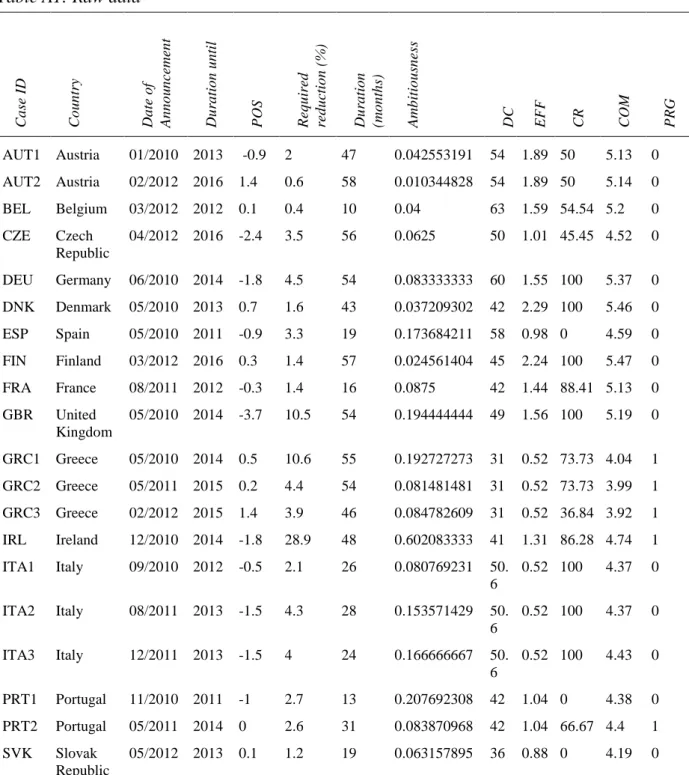
Online Appendix A: Supplementary tables and figures
Table A1: Raw data
C a se ID C o u n tr y Da te o f A n n o u n ce men t Du ra tio n un til P OS R eq u ir ed red u ctio n ( %) Du ra tio n (mo n th s) A mb itio u sn ess DC EFF CR COM PRG AUT1 Austria 01/2010 2013 -0.9 2 47 0.042553191 54 1.89 50 5.13 0 AUT2 Austria 02/2012 2016 1.4 0.6 58 0.010344828 54 1.89 50 5.14 0 BEL Belgium 03/2012 2012 0.1 0.4 10 0.04 63 1.59 54.54 5.2 0 CZE Czech Republic 04/2012 2016 -2.4 3.5 56 0.0625 50 1.01 45.45 4.52 0 DEU Germany 06/2010 2014 -1.8 4.5 54 0.083333333 60 1.55 100 5.37 0 DNK Denmark 05/2010 2013 0.7 1.6 43 0.037209302 42 2.29 100 5.46 0 ESP Spain 05/2010 2011 -0.9 3.3 19 0.173684211 58 0.98 0 4.59 0 FIN Finland 03/2012 2016 0.3 1.4 57 0.024561404 45 2.24 100 5.47 0 FRA France 08/2011 2012 -0.3 1.4 16 0.0875 42 1.44 88.41 5.13 0 GBR United Kingdom 05/2010 2014 -3.7 10.5 54 0.194444444 49 1.56 100 5.19 0 GRC1 Greece 05/2010 2014 0.5 10.6 55 0.192727273 31 0.52 73.73 4.04 1 GRC2 Greece 05/2011 2015 0.2 4.4 54 0.081481481 31 0.52 73.73 3.99 1 GRC3 Greece 02/2012 2015 1.4 3.9 46 0.084782609 31 0.52 36.84 3.92 1 IRL Ireland 12/2010 2014 -1.8 28.9 48 0.602083333 41 1.31 86.28 4.74 1 ITA1 Italy 09/2010 2012 -0.5 2.1 26 0.080769231 50. 6 0.52 100 4.37 0 ITA2 Italy 08/2011 2013 -1.5 4.3 28 0.153571429 50. 6 0.52 100 4.37 0 ITA3 Italy 12/2011 2013 -1.5 4 24 0.166666667 50. 6 0.52 100 4.43 0 PRT1 Portugal 11/2010 2011 -1 2.7 13 0.207692308 42 1.04 0 4.38 0 PRT2 Portugal 05/2011 2014 0 2.6 31 0.083870968 42 1.04 66.67 4.4 1 SVK Slovak Republic 05/2012 2013 0.1 1.2 19 0.063157895 36 0.88 0 4.19 0
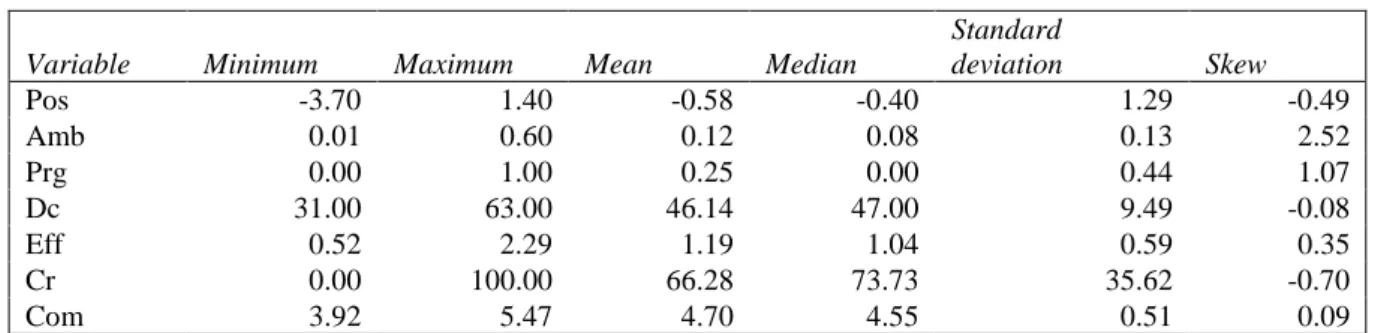
Table A2: Descriptive statistics of raw variables
Variable Minimum Maximum Mean Median
Standard deviation Skew Pos -3.70 1.40 -0.58 -0.40 1.29 -0.49 Amb 0.01 0.60 0.12 0.08 0.13 2.52 Prg 0.00 1.00 0.25 0.00 0.44 1.07 Dc 31.00 63.00 46.14 47.00 9.49 -0.08 Eff 0.52 2.29 1.19 1.04 0.59 0.35 Cr 0.00 100.00 66.28 73.73 35.62 -0.70 Com 3.92 5.47 4.70 4.55 0.51 0.09 N = 20.
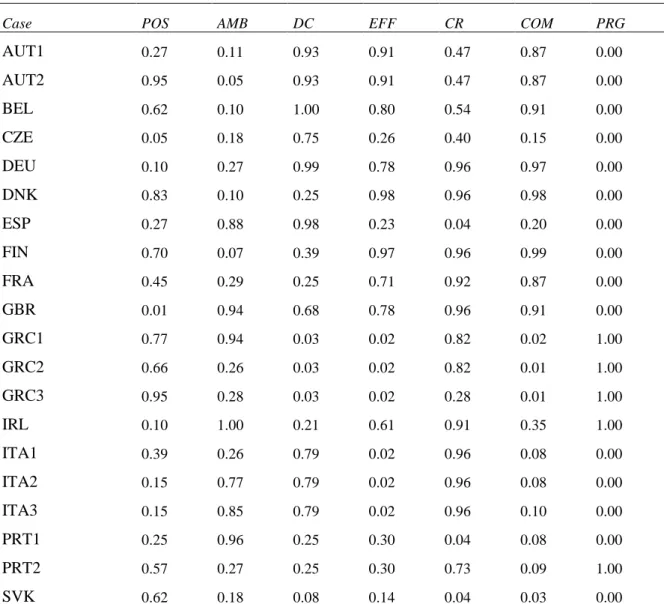
Table A3: Fuzzy data
Case POS AMB DC EFF CR COM PRG
AUT1 0.27 0.11 0.93 0.91 0.47 0.87 0.00 AUT2 0.95 0.05 0.93 0.91 0.47 0.87 0.00 BEL 0.62 0.10 1.00 0.80 0.54 0.91 0.00 CZE 0.05 0.18 0.75 0.26 0.40 0.15 0.00 DEU 0.10 0.27 0.99 0.78 0.96 0.97 0.00 DNK 0.83 0.10 0.25 0.98 0.96 0.98 0.00 ESP 0.27 0.88 0.98 0.23 0.04 0.20 0.00 FIN 0.70 0.07 0.39 0.97 0.96 0.99 0.00 FRA 0.45 0.29 0.25 0.71 0.92 0.87 0.00 GBR 0.01 0.94 0.68 0.78 0.96 0.91 0.00 GRC1 0.77 0.94 0.03 0.02 0.82 0.02 1.00 GRC2 0.66 0.26 0.03 0.02 0.82 0.01 1.00 GRC3 0.95 0.28 0.03 0.02 0.28 0.01 1.00 IRL 0.10 1.00 0.21 0.61 0.91 0.35 1.00 ITA1 0.39 0.26 0.79 0.02 0.96 0.08 0.00 ITA2 0.15 0.77 0.79 0.02 0.96 0.08 0.00 ITA3 0.15 0.85 0.79 0.02 0.96 0.10 0.00 PRT1 0.25 0.96 0.25 0.30 0.04 0.08 0.00 PRT2 0.57 0.27 0.25 0.30 0.73 0.09 1.00 SVK 0.62 0.18 0.08 0.14 0.04 0.03 0.00
Table A4:Analysis of necessity
Positive evaluation (POS) Negative evaluation (pos) Condition Consistency Coverage RoN Consistency Coverage RoN
AMB 0.432 0.437 0.695 0.661 0.840 0.889 DC 0.519 0.442 0.623 0.719 0.769 0.800 EFF 0.573 0.578 0.751 0.510 0.647 0.783 CR 0.746 0.500 0.505 0.768 0.647 0.592 COM 0.531 0.550 0.748 0.465 0.604 0.771 PRG 0.345 0.612 0.885 0.174 0.388 0.831 amb 0.842 0.664 0.699 0.558 0.552 0.635 Dc 0.729 0.674 0.769 0.478 0.556 0.710 eff 0.650 0.514 0.617 0.667 0.662 0.699 Cr 0.473 0.618 0.836 0.407 0.668 0.854 com 0.617 0.479 0.590 0.654 0.637 0.673 prg 0.655 0.387 0.352 0.826 0.613 0.463 dc + EFF 0.971 0.610 0.517 - - - amb + PRG 0.959 0.608 0.523 - - - cr + amb1 0.906 0.601 0.555 - - - AMB + DC1 - - - 0.909 0.735 0.63
Bold: Condition passes consistency threshold of 0.9.
1No necessary condition: at least one deviant case consistency in kind.
A consistent necessary condition is deemed trivial if coverage is below 0.6 and the RoN value is below 0.5. We tested for all possible supersets of POS and pos. Only complex necessary conditions meeting the consistency and triviality criteria are listed in the table.
Table A5: Truth table for outcome “POS”
AMB DC EFF CR COM PRG POS Consistency PRI Cases
0 0 0 0 0 1 1 1.000 1.000 GRC3 0 0 0 1 0 1 1 0.885 0.771 GRC2,PRT2 0 0 1 1 1 0 1 0.841 0.691 DNK,FIN,FRA 1 0 0 1 0 1 1 0.838 0.704 GRC1 0 1 1 0 1 0 0 0.819 0.589 AUT1,AUT2 0 1 1 1 1 0 0 0.720 0.438 BEL,DEU 0 0 0 0 0 0 0 0.718 0.371 SVK 1 1 0 0 0 0 0 0.633 0.001 ESP 0 1 0 1 0 0 0 0.607 0.041 ITA1 1 0 0 0 0 0 0 0.585 0.001 PRT1 0 1 0 0 0 0 0 0.582 0.058 CZE 1 1 1 1 1 0 0 0.519 0.000 GBR 1 0 1 1 0 1 0 0.458 0.000 IRL 1 1 0 1 0 0 0 0.434 0.000 ITA2,ITA3
Raw consistency threshold: 0.837 (next highest 0.819; AUT1 is a deviant case consistency in kind).
Complex solution: amb*dc*eff*com*PRG + dc* CR*eff*com*PRG + amb*dc* CR*EFF*COM*prg POS (solution consistency 0.831, solution coverage 0.563).
Parsimonious solution (without exclusion of untenable assumptions): eff*PRG + amb*dc*CR POS (solution consistency 0.782, solution coverage 0.640).
Untenable assumptions: dc*EFF + AMB*prg POS (contradicts statement of necessity).
Enhanced parsimonious solution (under exclusion of untenable assumptions): amb*dc* CR + dc*eff*PRG POS (solution consistency 0.786, solution coverage 0.640).
Limited diversity: 50 out of 64 configurations are logical remainders (78.2%). Directional expectations see Table 1.
Table A6: Simplifying assumptions for analysis of POS
AMB DC EFF CR COM PRG
Easy counterfactual (used for intermediate solution? 0 0 0 0 1 1 X 0 1 0 0 0 1 - 0 1 0 0 1 1 - 1 0 0 0 0 1 - 1 0 0 0 1 1 - 1 1 0 0 0 1 - 1 1 0 0 1 1 - 0 0 0 1 0 0 - 0 0 0 1 1 0 - 0 0 0 1 1 1 X 0 0 1 1 0 0 - 0 0 1 1 0 1 - 0 0 1 1 1 1 X 0 1 0 1 0 1 - 0 1 0 1 1 1 - 1 0 0 1 1 1 X 1 1 0 1 0 1 - 1 1 0 1 1 1 -
Table A7: Truth table for outcome “pos”
AMB DC EFF CR COM PRG pos Consistency PRI Cases
1 0 1 1 0 1 1 1.000 1.000 IRL 1 1 0 1 0 0 1 1.000 1.000 ITA2,ITA3 1 1 1 1 1 0 1 1.000 1.000 GBR 1 0 0 0 0 0 1 1.000 0.999 PRT1 1 1 0 0 0 0 1 0.976 0.934 ESP 0 1 0 0 0 0 1 0.974 0.942 CZE 0 1 0 1 0 0 1 0.923 0.811 ITA1 0 1 1 1 1 0 0 0.782 0.562 BEL,DEU 0 1 1 0 1 0 0 0.740 0.411 AUT1,AUT2 0 0 0 0 0 0 0 0.700 0.329 SVK 1 0 0 1 0 1 0 0.594 0.259 GRC1 0 0 1 1 1 0 0 0.583 0.190 DNK,FIN,FRA 0 0 0 1 0 1 0 0.496 0.000 GRC2,PRT2 0 0 0 0 0 1 0 0.458 0.000 GRC3
Raw consistency threshold: 0.0.922 (next highest 0.782; BEL is a deviant case consistency in kind).
Complex solution: DC*eff*com*prg + AMB*eff*cr*com*prg + AMB*dc*EFF*CR*com*PRG + AMB*DC*EFF* CR*COM*prg pos (solution consistency 0.965, solution coverage 0.638).
Parsimonious solution (without exclusion of untenable assumptions):
The present data display tied logically redundant prime implicants and hence, a certain degree of ambiguity. Both models are reported below (Schneider & Wagemann, 2012, pp. 108ff). The two solutions are identical, except for the role of com and eff, respectively in the last path. We opt for M2 because of its higher consistency and coverage. The intermediate solution is identical for both models.
M1: AMB*EFF + AMB*prg + DC*com pos (solution consistency 0.925, solution coverage 0.682). M2: AMB*EFF + AMB*prg + DC*eff pos (solution consistency 0.930, solution coverage 0.687).
Untenable assumptions: amb*dc* CR + dc*eff*PRG pos (contradicts statement of sufficiency for POS, enhanced parsimonious solution).
Enhanced parsimonious solution (under exclusion of untenable assumptions): amb*dc* CR + dc*eff*PRG POS (solution consistency 0.786, solution coverage 0.640).
M1: AMB*EFF + AMB*prg + DC*com pos (solution consistency 0.925, solution coverage 0.682). M2: AMB*EFF + AMB*prg + DC*eff pos (solution consistency 0.930, solution coverage 0.687).
Limited diversity: 50 out of 64 configurations are logical remainders (78.2%). Directional expectations see Table 1.