Marquette University Marquette University
e-Publications@Marquette
e-Publications@Marquette
Management Faculty Research andPublications Management, Department of
2018
Trust and Experience in Online Auctions
Trust and Experience in Online Auctions
Terence T. OwBrian I. Spaid Charles A. Wood Sulin Ba
Follow this and additional works at: https://epublications.marquette.edu/mgmt_fac
Marquette University
e-Publications@Marquette
Management Faculty Research and Publications/College of Business
Administration
This paper is NOT THE PUBLISHED VERSION;
but the author’s final, peer-reviewed manuscript. The
published version may be accessed by following the link in the citation below.
Journal of Organizational Computing and Electronic Commerce
, Vol. 28, No. 4 (2018) : 294-314.
DOI
.
This article is © Taylor & Francis and permission has been granted for this version to appear in
e-Publications@Marquette
. Taylor & Francis does not grant permission for this article to be further
copied/distributed or hosted elsewhere without the express permission from Taylor & Francis.
Trust and Experience in Online Auctions
Terence T. Ow
Department of Management, College of Business Administration, Marquette University, Milwaukee, WI
Brian I. Spaid
Department of Marketing, College of Business Administration, Marquette University, Milwaukee, WI
Charles A. Wood:
ShiftSecure, Philadelphia, PA
Sulin Ba
Department of Operations and Information Management, School of Business, University of Connecticut, Storrs, CT
Abstract:
This paper aims to shed light on the complexities and difficulties in predicting the effects of trust and the experience of online auction participants on bid levels in online auctions. To provide some insights into learning by bidders, a field study was conducted first to examine auction and bidder characteristics from eBay auctions of rare coins. We proposed that such learning is partly because of institutional-based trust. Data were then
gathered from 453 participants in an online experiment and survey, and a structural equation model was used to analyze the results. This paper reveals that experience has a nonmonotonic effect on the levels of online auction bids. Contrary to previous research on traditional auctions, as online auction bidders gain more experience, their level of institutional-based trust increases and leads to higher bid levels. Data also show that both a bidder’s selling and bidding experiences increase bid levels, with the selling experience having a
somewhat stronger effect. This paper offers an in-depth study that examines the effects of experience and learning and bid levels in online auctions. We postulate this learning is because of institutional-based trust. Although personal trust in sellers has received a significant amount of research attention, this paper addresses an important gap in the literature by focusing on institutional-based trust.
Keywords:
online auction, electronic markets, trust behavior, selling and bidding experience, learningIntroduction
Information technologies, especially the Internet, have significantly changed the way people exchange information and participate in business transactions. They have enabled electronic commerce (EC) business models whose reach and scope were unattainable in traditional markets. Online auctions especially represent a robust and profitable retail business model. eBay, the premier online auction retailer, boasted 167 million global active buyers in 2016 and $84 billion in gross merchandise volume (GMV) (eBay, 2017). This reflects a year over year increase of both active buyers and GMV and underscores the revenue generating power of online auctions. Just as the rate of participation and volume of online auctions have increased, so have the incidents of fraud in these transactions. In the fourth quarter of 2015, 27 fraud attacks occurred for every 1000 e-commerce
transactions, a 215% increase from the first quarter of the same year (Meola, 2016). According to a report by the U.S. Federal Bureau of Investigation (FBI) Internet Crime Complaint Center (IC3) (2016), 288,012 individual complaints of Internet-based crime occurred in 2015, a number estimated to be only 15% of the actual instances of fraud perpetrated. Of those complaints that included a monetary loss (127,145), the average was $8,421. Online fraud has had a significant impact on U.S. online retailers; estimates show a loss of 1.3% of all revenues in 2015 (Meola, 2016). Auction-based fraud is a significant portion of this Internet-based fraud, ranking fourth in prevalence after nonpayment/nondelivery scams, 419/overpayment scams, and identity theft.
Institutions that host online auctions have undertaken various protective measures to address these problems. For example, eBay offers escrow services that withhold a buyer’s payment to the seller until the buyer has received the merchandise and reported his or her satisfaction with the transaction. Similarly, payment services such as PayPal protect buyers by securely storing a buyer’s payment information so that a buyer does not need to share any financial information with a seller.
Research has shown that these mechanisms help build institutional trust—the comfort and sense of protection a consumer has with a specific business (Hu, Lin, Whinston, & Zhang, 2004; Pavlou, 2002; Pavlou & Gefen, 2004). Trust is an important consideration for traditional retailers because trustworthy sellers can charge more as buyers experience satisfactory transactions over time (C. Shapiro, 1982). Similarly, online retail transactions have been shown to increase trust as shoppers gain more experience with online retailers (Gefen, Karahanna, & Straub, 2003).
This exposes an important conflict in the literature between traditional transactions and online auctions with respect to experience. Lambert (1972) argues that inexperienced buyers in traditional transactions are unwilling to pay as much as highly experienced buyers because highly experienced buyers are more confident of increased quality. However, auction research suggests that inexperienced bidders have a higher willingness to pay
(overbid), paying more than the expected value for items (Kagel & Richard, 2001) - a phenomenon known as the Winner’s Curse. In our research, we investigated the complex relationships between bidder experience, learning behavior, and institutional-based trust.
We first conducted a field study by observing data from winning bids in 24,579 rare coin auctions to examine how experience affected a buyer’s final bid. We then undertook to understand this learning effect by conducting
an online survey of 453 subjects who also participated in an experiment in which each respondent entered 25 bids in different online auctions.
This paper offers an in-depth examination of the effects of buyer experience and learning behavior on the bid levels of buyers in online auctions. We empirically demonstrated how institutional-based trust and its effect on bid levels could explain learning behavior. In addition, we found that in online auctions inexperienced bidders discount their bid levels because they lack this institutional-based trust and that the skills and abilities to find items at lower prices exist only at much higher levels of bidder experience.
Theoretical Foundations
In this section, we examine the literature on the role of experience in auctions and how bidder experience relates to institutional-based trust in online markets.
Experience and Auction Bid Levels
Several studies have examined how experience relates to bid levels. If all bidders derive a common valuation of an item from a distribution, only the highest valuation will win the auction. Moreover, this highest valuation, often from inexperienced bidders, will typically exceed the expected common value of most auction
participants, Kagel and Richard (2001) found that in traditional auctions inexperienced bidders bid higher than experienced bidders. However, Easley, Wood, and Barkataki (2010) found that experienced bidders in online auctions tend to gravitate toward bidding patterns that reduce their bid levels. These findings suggest a conclusion that experienced bidders in both traditional and online auctions change their bidding patterns and behavior to identify and win auctions with lower bids. Thus, we should see a decrease in the bid levels for items as a buyer’s experience increases because experienced buyers are better able to judge the value of items sold in online auctions.
Experience, Learning, and Institutional-Based Trust
Information asymmetry occurs when one party in a transaction has more information than the other party. Information asymmetry, and its effect on electronic market transactions, is of special interest to electronic market researchers because the Internet changes the way a seller’s information flows to the buyer. Ba, Whinston and Zhang (2003) described how information asymmetry can exist in electronic markets in the areas of product characteristics, seller identity, and seller characteristics. Existing research also recognizes trust as a necessary facilitator in online transactions (Bhattacherjee, 2002; Lowry, Vance, Moody, Beckman, & Read, 2008). Anonymous Internet sellers can mask their identities as well as the quality of the products they sell, thus increasing various forms of information asymmetry with a reduced risk of detection and punishment. Ba and Pavlou (2002) emphasize that because of the increase in information asymmetry in these areas, a buyer’s trust in a seller is more critical for successful transactions in electronic markets, like online auctions, than in
traditional markets.
Learning — or specifically bidder learning — happens when bidding strategy changes over time because of accumulated experience (Srinivasan and Wang 2010) without regard to whether a bidder wins. Wang and Hu (2009) infer bidding learning directly from prior experiences and this bidder learning “transcends categories” rather than limited to certain product (Srinivasan and Wang 2010). Wang and Hu (2009) tracked new bidders and observed their bidding behavior over time. They showed that novice bidders learned from their experience and followed the conventions of the learning literature (Darr et al. 1995); they defined experience in their study as the actual number of auctions in which a bidder participated. We would expect that with more experience, a bidder learns to adopt a strategy that will result in a winning bid.
Beyond trust in an individual seller, Zucker (1986) identified institutional-based trust as one of the major types of trust formed on the basis of an institution’s guarantees, safety nets, or other structures that help individuals transact business. McKnight, Choudhury, and Kacmar (2002) discussed the two aspects of institutional-based trust: situational normality and structural assurances. Situational normality deals with understanding the social norms that exist within an institution or, in this research, a marketplace.
Structural assurance, on the other hand, is defined as guarantees and constructs an institution provides that deter opportunistic behavior and thus facilitate more successful transactions (McKnight, Cummings, & Chervany, 1998). Pennington, Wilcox, and Grover (2003) examined structural assurances that lead to trust in an underlying transactional technology platform. They showed that guarantees can lead to increased system trust and
increased perceived vendor trust, which in turn lead to an increase in the purchase intent of a buyer. For
example, eBay can remove a badly behaving seller or even identify such a seller to permit the instigation of legal proceedings. Shapiro (1982) discussed structural safeguards such as regulations, guarantees, and legal recourse and found that all of them have a positive effect on institutional-based trust. For example, eBay’s feedback mechanism can not only potentially punish an untrustworthy seller but also enable a trustworthy seller to receive a price premium. Shapiro (1982) pointed out that reputation can be considered a structural safeguard, in that vendors who act opportunistically will face a customer backlash that will result in reduced bid levels
because consumers will refuse to pay as much for an opportunistic seller’s goods. As a result, eBay’s feedback mechanism acts as a structural safeguard in that sellers will avoid acting opportunistically so as to ensure their ability to derive the highest possible bid prices for their products.
Research has shown that customers’ trust is shaped through their experiences (Gefen et al., 2003). Even if their initial trust of another party is low, experience with this other party brings familiarity, which significantly
influences their intended behavior. In an online auction setting, once a buyer understands the social norms of an institution or has enough successful transactions with different sellers in a marketplace, we posit that he or she will develop institutional-based trust that will lead to trust in the sellers in a marketplace because a buyer will generalize about the behavior of the rest of the sellers based on his or her dealings with a few sellers. Such a buyer believes that the social norms of the sellers preclude opportunistic behavior. For example, if an eBay bidder has made several purchases and has received the items as promised, that bidder will begin to believe that opportunistic behavior is the exception, not the norm, in the online auction environment.
Based upon the findings of these researchers, we should expect to see an increase in the bid levels from highly experienced bidders because institutional-based trust increases with experience, and experienced buyers would not feel a need to discount their bid levels because of feelings of distrust.
Research Model and Hypotheses
Thus far we have examined what we categorize as two bodies of research. One body of research predicts, and empirically shows, that bid levels decrease as experience increases, but the other body of research, based on an examination of institutional-based trust, predicts that bid levels increase with experience. In this section, we will undertake to reconcile these two viewpoints by using a conceptual model that illustrates the effects of
experience on price.
Experience is a multifaceted variable that demonstrates a subject’s level of understanding of price levels and best bidding practices for items bought in online auctions. Experience can be gained in several ways: length of time that a person has participated in online auctions, the amount of online auction activity that the subject has engaged in, and the number of auctions the person has won. Like Kagel and Richard (2001) and others, we contend that as bidders gain experience, they are better able to determine good deals from bad ones and thus decrease their bid levels over time. Therefore, in general,
H1a: Bidders with more bidding experience in online auctions have lower bid levels. H1b: Bidders with more selling experience in online auctions have lower bid levels.
We posit here that part of a bidder’s learning is to better understand who he or she is dealing with. This understanding also safeguards the bidder in submitting a successful bid without fear of being cheated. Institutional-based trust is trust affected by the safeguards that an institution has in place and by a subject’s sense of being secure when dealing with that institution. One debatable subject is how different forms of trust develop. McKnight, Choudhury and Kacmar (2002) and Robert, Denis, and Hung (2009) pointed out the
existence of two divergent viewpoints on trust development, one from cognitive-based trust research and the other from knowledge-based trust research. The cognitive-based trust literature embodies the concept of “swift trust”; in this approach, trusting beliefs form relatively quickly and before an individual has meaningful
information about the object in question. This rapid formation of trust is because of social categorization, reputation, illusions (e.g., irrational thinking), disposition, institutional roles and structures, or the need to immediately cooperate on a task (McKnight et al., 1998; Meyerson, Weick, & Kramer, 1996; Xu, Feng, Wu, & Zhao, 2007). In contrast, the knowledge-based trust literature derived from management and economic
research posits that trust develops gradually and must be built through experiential social exchange (Blau, 1964; Greiner & Wang, 2007; Lewicki, 1995; Luhmann, 1979; Pavlou & Gefen, 2004; Ring & van de Ven, 1994; D. L. Shapiro, Sheppard, & Cheraskin, 1992).
When examining institutional-based trust, an argument can then be made that if trust is gained immediately (or nearly so), then one would expect no relationship between experience and institutional-based trust. Conversely, if trust develops through experience, we should see an increase in institutional-based trust as experience increases. We hypothesize that experience is necessary to develop institutional-based trust:
H2: Increased bidder experience with online auctions leads to higher institutional-based trust.
Moreover, previous research suggests that trustworthy sellers receive price premiums for their products (Ba & Pavlou, 2002; Dellarocas & Wood, 2008; C. Shapiro, 1982). Because institutional-based trust increases with experience, it is reasonable to expect that highly experienced bidders are willing to bid at higher levels because of a relatively higher level of such trust.
H3: Institutional-based trust is associated with higher bid levels in online auctions.
Control Variables
We used two control variables, supported by the literature, for how they affect experience and institutional-based trust. These variables are propensity to search and propensity for innovation.
Propensity to search describes how likely a subject is to search for related information from others before deciding to bid. This includes searches from previous transactions as well as an examination of current transactions involving similar or identical items. Many researchers have noted that consumers build both a higher level of experience as well as a higher level of trust after searching for information online. For instance, Lim et al. (2006) described how recommendations from similar individuals tend to increase trust among first-time purchasers. This is especially relevant in the online auction environment with its thousands of sellers present at any given time as well as a likelihood that any given transaction will be made by a bidder who has not dealt with a particular seller before. Menon et al. (2003) discussed how patients have more trust in prescription drug information after searching, and Ray, Ow, and Kim (2011) discussed how online search activity can lead to trust in the same way that experience does. Luan et al. (2016) discussed consumers’ online review search behavior on the various types of products reviewed. Much research from the information systems and economics bodies of literature puts forth the premise that the reputation reported by others is vital to
establishing a higher willingness to pay for an item (Dellarocas & Wood, 2008; C. Shapiro, 1982). However, more recent research describes how, with higher priced items, consumers form trust based on argument content rather than on heuristic cues such as the source being an independent party’s opinion (D. Kim & Benbasat, 2009). Hence, the effect of online comments, and the effect of searching through online comments, is still an important topic for research.
Propensity for innovationdescribes how likely a person is to adopt new technology that may be interesting or profitable. This construct gauges the likelihood of adoption of new and different technologies or of new areas that use familiar technology. Previous research has illustrated a positive relationship between innovation and trust. For example, Wang, Yeung, and Zhang (2011) surveyed Chinese managers and found that managers’ innovation and trust share a positive relationship in supply chain transactions. Agag and Masry (Agag & El-Masry, 2016) discussed the relationship between innovation and trust and its effects on online travel purchases. Rese and Baier (2011) showed how trust and innovation are related in successful research and development within a firm. In keeping with these findings, we included as a control variable that an individual’s readiness to accept innovation will lead to increased trust.
The relationships between experience and trust to bidders’ winning bid levels was then studied in the following hypothesized model (Figure 1).
Figure 1 – Research Model
Methodology
To test our hypotheses, we conducted a field study on the relationships between various levels of experience and the final winning bid price. Following the field study, we conducted an online survey and experiment. In our experiment, we used respondents obtained from an online survey service. We contacted the respondents and paid them to participate in our experiment and directed them to our online site. To add to the respondents’ motivation to bid, we offered a free popular mobile device to a randomly selected bidder whose response was used in our study.
Field Study
To gather insights into auction behavior, we collected eBay auction data to investigate the winning bids paid in auctions and the characteristics of the winning bidders. Several auction researchers (Bapna, Goes, & Gupta, 2001; Kauffman & Wood, 2006; Lucking Reiley, Bryan, Prasad, & Reeves, 2007) have examined bidder behavior and identified factors that may affect the willingness of a bidder to pay more or less for an item on eBay. These factors include the number of bids, the existence of a picture, the level of the starting bid in relation to the item’s value, and the magnitude of the average selling price. Therefore, our field study includes these variables in addition to the focal variables.
In this field study, we examined 24,579 rare coin auctions on eBay over a nine-month period. These auctions included items from 3,938 sellers and 9,724 buyers. Each rare coin in these auctions was identified by mint year
(e.g., 1888, 1796, etc.), denomination (e.g., nickel, half cent, etc.), condition (a number between 3 and 70, e.g., 8 for VG8, 50 for AU50, etc.), and mintmarks (Doubled Die, CC for Carson City Mint, FBL for Full Bell Lines, etc.). To determine the average price paid for these coins, we considered only auctions that received at least one bid and only coins bid upon in at least five different auctions. Any coins with a secret reserve price or that used the “buy it now” feature were excluded. Our data set includes auction information (e.g., ending time, selling price, etc.), as well as seller and bidder information (e.g., number of comments for items bought and sold, etc.).
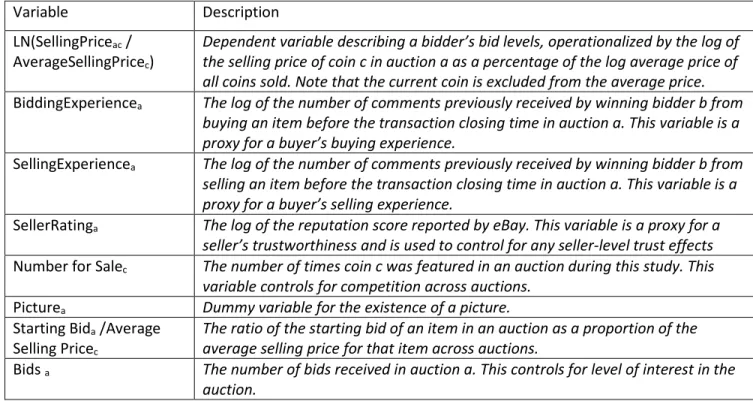
Our field study examined how the selling and buying experiences affected bid levels and controlled for the factors identified as affecting the final bid price. We also investigated the effect of bidding experience (H1a) and selling experience (H1b) on bid levels. Equation (1) and Table 6 describe the empirical model and variables used in this study.
LN (SellingPrice
ac/ AverageSellingPrice
c) =
β
0+
β
1BiddingExperience
a+
β
2SellingExperience
a+
β
3SellerRating
a+
β
4Number for Sale
c+
β
5Picture
a+
β
6LN(Starting Bid
a/ Average Selling Price
c) +
β
7Bids
a+
ε
(1)
Table 1 – Variables Used in the Empirical Models Variable Description
LN(SellingPriceac /
AverageSellingPricec)
Dependent variable describing a bidder’s bid levels, operationalized by the log of the selling price of coin c in auction a as a percentage of the log average price of all coins sold. Note that the current coin is excluded from the average price.
BiddingExperiencea The log of the number of comments previously received by winning bidder b from
buying an item before the transaction closing time in auction a. This variable is a proxy for a buyer’s buying experience.
SellingExperiencea The log of the number of comments previously received by winning bidder b from
selling an item before the transaction closing time in auction a. This variable is a proxy for a buyer’s selling experience.
SellerRatinga The log of the reputation score reported by eBay. This variable is a proxy for a
seller’s trustworthiness and is used to control for any seller-level trust effects
Number for Salec The number of times coin c was featured in an auction during this study. This
variable controls for competition across auctions.
Picturea Dummy variable for the existence of a picture.
Starting Bida /Average
Selling Pricec
The ratio of the starting bid of an item in an auction as a proportion of the average selling price for that item across auctions.
Bids a The number of bids received in auction a. This controls for level of interest in the
auction.
Field Study Results
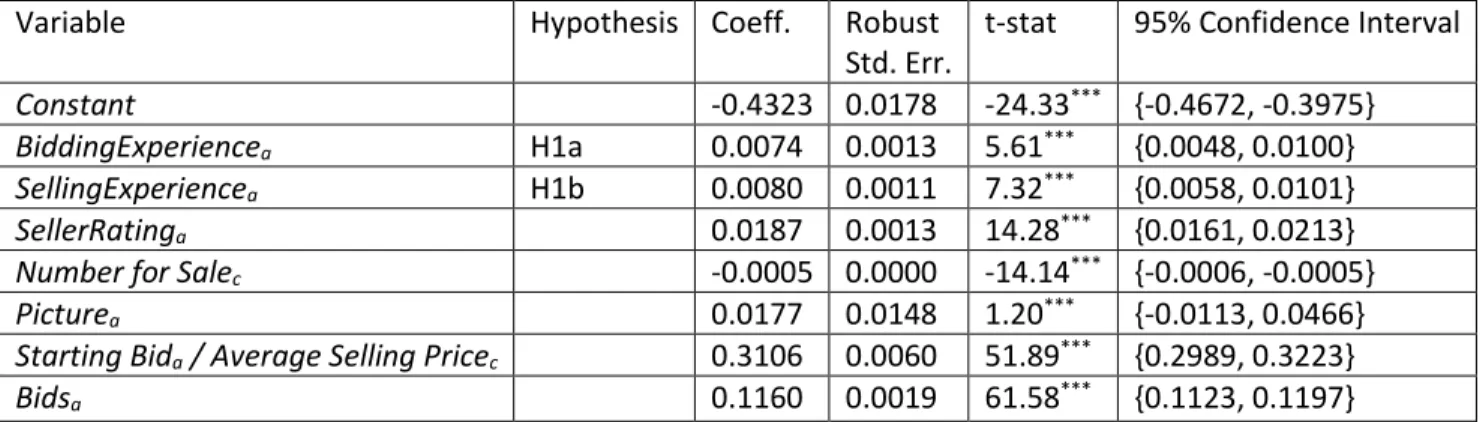
Table 2 shows the results of our empirical model. Overall, both the bidding and selling experiences relate positively to winning bid levels when bidders at all experience levels are considered together. Therefore, it makes sense to examine our data further at different experience levels. Because of the challenge of understanding individual bid behavior as the bidders gained experience, we decided to do a cross-sectional analysis. We relied on feedback ratings posted on eBay as proxy. Srinivasan and Wang (2010) indicated that if the rating is a random subset of total experience, it is not as problematic to use it as proxy.
Variable Hypothesis Coeff. Robust
Std. Err. t-stat 95% Confidence Interval
Constant -0.4323 0.0178 -24.33*** {-0.4672, -0.3975}
BiddingExperiencea H1a 0.0074 0.0013 5.61*** {0.0048, 0.0100} SellingExperiencea H1b 0.0080 0.0011 7.32*** {0.0058, 0.0101} SellerRatinga 0.0187 0.0013 14.28*** {0.0161, 0.0213} Number for Salec -0.0005 0.0000 -14.14*** {-0.0006, -0.0005}
Picturea 0.0177 0.0148 1.20*** {-0.0113, 0.0466}
Starting Bida / Average Selling Pricec 0.3106 0.0060 51.89*** {0.2989, 0.3223} Bidsa 0.1160 0.0019 61.58*** {0.1123, 0.1197}
***p-value < .001; Sample Size = 24,579; R2 =35.5%;
Dependent variable: LN (Selling Price ac / AverageSellingPrice c)
We used K-means cluster analysis to force three levels of factors that use a bidder’s selling experience, buying experience, and bid levels. This was done to examine the low, medium, and high bid levels. Table 3 shows the effects of the bidding and selling experiences across the three clusters. For a bidder’s bidding experience, we detected a significant relationship in the first cluster, no relationship in the second, and a negative relationship in the third. For a bidder’s selling experience, we showed a strong positive relationship in the first cluster, a relatively weaker relationship in the second, and no relationship in the third.
The results in Table 3 are consistent with our theoretical model that at lower levels of experience, new bidders initially discount their bids, but bidders with moderately more experience learn from their experience and bid at higher levels. In our data set, only bidders with relatively high levels of experience appear to have the ability to find the best deals and enter bids that win auctions at lower bid levels.
Table 3 – Cluster Robust Regression Results Based Upon Bidder Experience1
Variable Cluster 1 Winning Bidder Score From 0 to 46 Cluster 2 Winning Bidder Score From 47 to 152 Cluster 3 Winning Bidder Score From 153 to 349
Coeff Std Err t-stat Coeff Std Err t-stat Coeff Std Err t-stat
Constant -0.400 0.027 -14.98*** -0.441 0.063 -7.04*** 0.328 0.237 1.38*** BiddingE xperienc ea 0.006 0.002 3.67*** 0.003 0.014 0.20*** -0.126 0.046 -2.74*** SellingEx periencea 0.012 0.002 5.78*** 0.005 0.002 3.45*** 0.001 0.004 0.14*** SellerRati nga 0.020 0.002 11.16*** 0.017 0.002 8.36*** 0.013 0.005 2.55***
1 These results were duplicated with second bidder analysis as well with similar results. As a check for robustness, similar
results were obtained with no natural log transformation of dependent or independent variables, although the result was not as strong.
Number for Salec 0.000 0.000 -9.89*** -0.001 0.000 -9.89*** 0.000 0.000 -2.95*** Picturea 0.014 0.020 0.67*** 0.037 0.023 1.61*** -0.119 0.065 -1.85*** Starting Bida / Average Selling Pricec 0.315 0.008 39.20*** 0.302 0.010 31.54*** 0.330 0.024 13.83*** Bidsa 0.115 0.003 45.21*** 0.117 0.003 40.11*** 0.122 0.008 15.42*** Sample Size = 13,694; R2 =36.0% Sample Size=9,72 8; R2 =34.5% Sample Size = 1,157; R2 =38.4%
Note: Dependent variable: Bid Level, operationalized by LN(SellingPriceac/AverageSellingPricec), *p<.05; **p<.01; ***p<.001
Table 3 and Figure 2 show that bidders with moderate levels of experience in both selling and bidding (proxied by the bidder comments received for selling activity and buying activity, respectively) are willing to pay more than bidders with lesser levels of experience. We posit that trust is in play because it is one of few constructs that we proposed that will increase winning bid levels as proposed in H3. We assert that through the learning process of auctions, the moderate bidder develops trust and hence pays a premium over the novice bidder. The belief in the interplay of trust and experience yielded the results shown in Table 3 and Figure 2. We proceeded with the next study to further understand if the manifestation of trust can explain this result.
Figure 2 – Bidder Experience as It Relates to Price Paid for Winning Bidders
2Online Survey and Experiment
Because we are unable to observe any variable in eBay auctions that allows us to understand the trust level of bidders, we conducted a survey to examine if trust increases with experience and, if so, how it affects the winning bid level. We conducted an online experiment and survey and then a field study to examine the effect of experience and institutional-based trust on the final bid price. In our experiment, we used subjects obtained through an online survey service that contacted and paid respondents to participate in our experiment and 2 Note that experiences levels are discrete integers. Although we tried to divide the bidders in Figure 2 into equal bins,
18,850 of the 24,579 bidders in our study had no selling experience. Hence, the first bar in Figure 2 contains the majority of bidders, and the remaining bars divide the remaining bidders more or less equally.
directed them to our online site. To add to the respondents’ motivation to bid, we offered a free popular portable audio/video player to a randomly selected bidder whose response was used in our study.
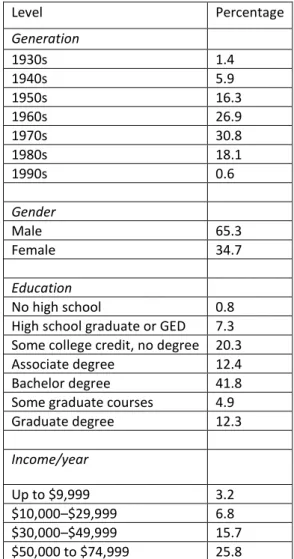
The survey service contacted 2000 people, 467 of whom completed our experiment and survey. Incomplete experiments and surveys were discarded. As suggested by Ray, Ow, and Kim (2011), we removed subjects who had extremely low experiment times (e.g., subjects who finished 38 questions and 25 bid scenarios in less than two minutes). In addition, as suggested by Neter et al. (1996), we removed outlying subjects whose bid levels were three standard deviations away from the mean for an item. These two measures resulted in the removal of 14 subjects, and our final data set contained 453 subjects who each entered 25 bids and completed the online survey. Thus, we can analyze a total of 11,325 bids. Table 4 shows the demographic data of our respondents. The goal of our empirical methodology was to measure actual bid levels through an experiment and then use a survey to estimate values for the latent variables in our model, comparing them to the actual bids in the
experiment. Researchers point out that self-reporting bias can corrupt results and lead to common method bias, so asking about bid levels in a survey would not be as effective as observing bids within an experimental setting. When the subjects came to our experiment website, they first encountered an instruction page that explained the rules of the experiment. Each respondent then bid 25 times in situations/scenarios in which we varied the parameters of the experiment (different levels of seller reputation LOW vs. MODERATE vs. HIGH, different auction hosts, different institutional factors such as escrow, credit cards, pay services like PayPal, etc.).
Table 4 – Demographic Data from Survey Respondents
Level Percentage Generation 1930s 1.4 1940s 5.9 1950s 16.3 1960s 26.9 1970s 30.8 1980s 18.1 1990s 0.6 Gender Male 65.3 Female 34.7 Education No high school 0.8
High school graduate or GED 7.3 Some college credit, no degree 20.3
Associate degree 12.4
Bachelor degree 41.8
Some graduate courses 4.9
Graduate degree 12.3 Income/year Up to $9,999 3.2 $10,000–$29,999 6.8 $30,000–$49,999 15.7 $50,000 to $74,999 25.8
$75,000 to $99,999 27.7
$100,000 to $499,999 19.5
$500,000 or more 1.3
In our experiment, we allowed (but did not force) the respondents to search through similar auctions at any time during the experiment. Then respondents had the goal of entering appropriate bids on a popular portable audio/video player in 25 auctions. The make and model of the product never changed. We varied the auctions by the hosting institution (between a well-known online auction site, eBay, and a mock auction site that we created for this experiment, CrazyAuctions). We also varied the payment processing credit card handler between a well-known payment processing service, PayPal, and a payment processor that we created,
ChargeBuddy. The goal of creating these new entities was to compare unknown vendors with vendors who have a proven track record.
The product descriptions used in the various auctions in the experiment were designed to be generic, yet explanatory, and were taken from actual eBay auctions. We varied the display photo, using either a stock photo or a seller-provided photo (also taken from an eBay auction). In addition, we manipulated the number of bidders, the seller comments received, and the percentage of positive and negative comments. We also varied an escrow option so that some auctions indicated that the money was kept by a third party until the buyer received the merchandise.
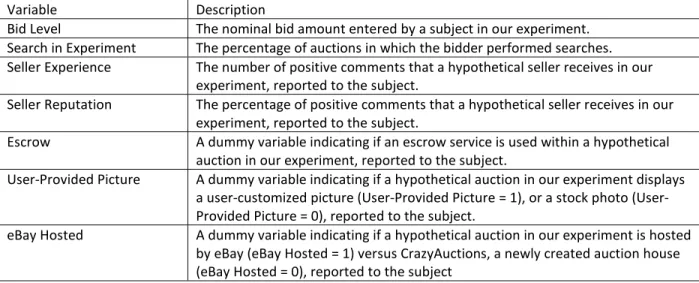
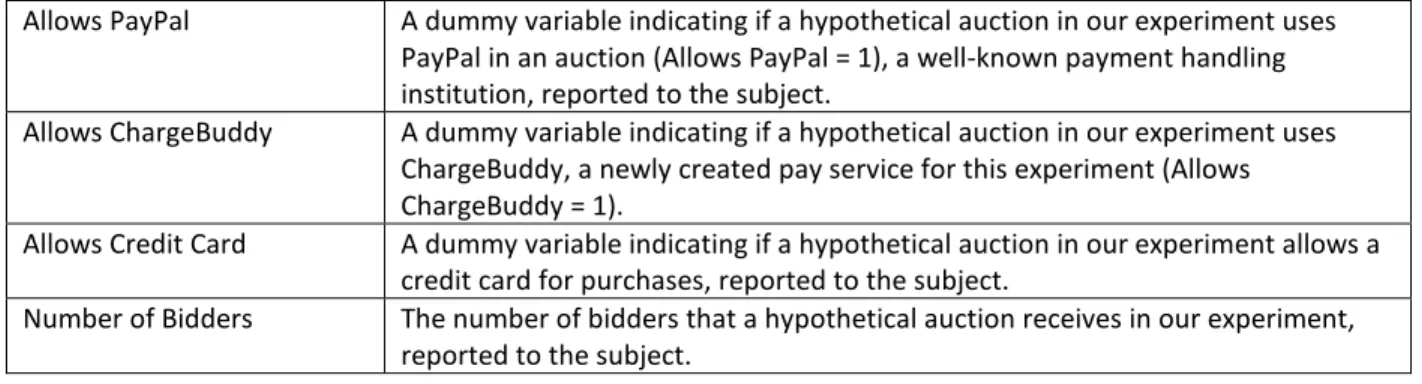
Finally, we gave the subject an opportunity to search for similar items at any time during the experiment. The variables examined in our bid experiment are shown in Table 2. Research has shown that simulated policy-capturing results are able to replicate real-world experiments (Olson, Dell'Omo, & Jarley, 1987). Webster and Trevino (1995) advocated the use of the method as a valuable adjunct to a survey method. The external validity of the method has been verified previously by Levin et al. (1983).
Immediately after the auctions, the subjects were directed to a survey page that contained 11 questions. These questions (see Appendix) were designed to permit examination of four latent variables—institutional-based trust, experience, propensity for innovation, and propensity for search—not directly observable. It was emphasized to the subjects that to qualify to win the product, they must answer all the questions. Established instruments were used to examine the latent variables. See the Appendix for the survey instrument.
Table 5 – Variables Examined in the Auction Experiment
Variable Description
Bid Level The nominal bid amount entered by a subject in our experiment.
Search in Experiment The percentage of auctions in which the bidder performed searches. Seller Experience The number of positive comments that a hypothetical seller receives in our
experiment, reported to the subject.
Seller Reputation The percentage of positive comments that a hypothetical seller receives in our experiment, reported to the subject.
Escrow A dummy variable indicating if an escrow service is used within a hypothetical auction in our experiment, reported to the subject.
User-Provided Picture A dummy variable indicating if a hypothetical auction in our experiment displays a user-customized picture Provided Picture = 1), or a stock photo (User-Provided Picture = 0), reported to the subject.
eBay Hosted A dummy variable indicating if a hypothetical auction in our experiment is hosted by eBay (eBay Hosted = 1) versus CrazyAuctions, a newly created auction house (eBay Hosted = 0), reported to the subject
Allows PayPal A dummy variable indicating if a hypothetical auction in our experiment uses PayPal in an auction (Allows PayPal = 1), a well-known payment handling institution, reported to the subject.
Allows ChargeBuddy A dummy variable indicating if a hypothetical auction in our experiment uses ChargeBuddy, a newly created pay service for this experiment (Allows ChargeBuddy = 1).
Allows Credit Card A dummy variable indicating if a hypothetical auction in our experiment allows a credit card for purchases, reported to the subject.
Number of Bidders The number of bidders that a hypothetical auction receives in our experiment, reported to the subject.
Survey Data Analysis
Structural Equation Modeling (SEM) has become widely used over the last three decades to analyze data in the behavioral or social sciences (Bollen, 1983; Galletta, Henry, McCoy, & Polak, 2006; Jöreskog, 1971; Ryu, 2011). Ryu (2011) argued that SEM is excellent for assessing the goodness of fit of a theoretical model as well as for estimating parameters in a hypothesized model, especially in the presence of unobservable latent constructs difficult or impossible to observe directly.Using the standard SEM methodology, we first evaluated our
measurement model for convergent and discriminant validity; then the structural model was assessed for model fit (Anderson & Gerbing, 1988; Gefen et al., 2003).
Our survey instruments were rooted deeply in previous research. Table 6 shows the results of our factor analysis. A Varimax rotation with Kaiser Normalization was used, and results converged in five iterations. A confirmatory factor analysis (CFA) was conducted to examine the fit of the measurement model. The CFA showed 2 of 104.54 (p < .001). Internal consistency was relatively strong, with a minimum Cronbach’s alpha of
.83, and the standardized factor loadings for the empirical model were all significant (p < .001), which supports the convergent validity of the indicators (Anderson & Gerbing, 1988; Ba & Johansson, 2008).
Table 6 – Factor Loadings from Factor Analysis
Institutional-Based
Trust Experience Propensity for Innovation Propensity for Search
Trust3 0.887 0.061 -0.210 0.016 Trust1 0.835 -0.081 0.034 -0.151 Trust2 0.786 0.025 -0.065 0.000 TimePart -0.002 1.000 0.006 0.002 TimeWon -0.035 0.996 0.016 -0.015 HowLong 0.131 0.806 0.015 0.068 Innov3 -0.067 -0.023 0.899 0.018 Innov1 -0.041 0.097 0.849 -0.148 Innov2 -0.006 -0.051 0.731 0.119 SrchPrev -0.067 -0.043 -0.076 0.917 SrchCurr 0.040 0.116 -0.044 0.710
Fornell and Larker (1981) proposed a conservative test for discriminant validity called Average Variance
Extracted (AVE). It is based on the premise that estimates of convergent latent variables should have more than 50% of their variability explained by the factors that load upon them. Using Fornell and Larker’s measurements, all the AVEs of our latent constructs save one exceed their 50% threshold. The exception is propensity for
innovation, which has an AVE of 48.3%, very near the 50% cutoff. However, O’Rourke and Hatcher (2013) suggested that the AVE test is conservative and may cause rejection of valid loadings (i.e., false negatives are possible or even likely). They suggested a pairwise discriminant validity check that uses a
χ
2difference test tofurther assess discriminant validity. Our
χ
2difference test for propensity for innovation returned aχ
2of 45.9with 21 degrees of freedom for a p-value < .01, providing evidence of discriminant validity.
Figure 3 shows the structural model we used to examine the observed bid levels entered by the subjects in our experiment. This model was created by combining the stimuli from our experiment (darkly shaded), the subject responses in our experiment (orange), and the subject responses in our survey (not shaded).
Figure 3 – Structural Equation Model
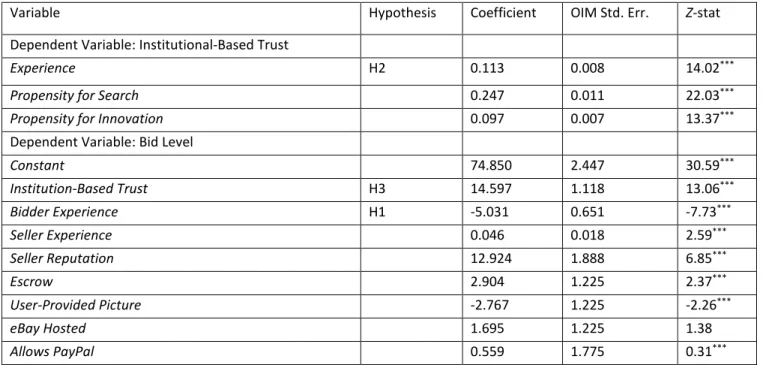
In the model, control variables set by the experiment are shaded. Stata 12.0 was used for SEM analysis and for Figure 3. The bidder reacts to different stimuli within the experiment, shown in each darkly shaded box. The values for these variables were predetermined for the bidder for the online experiment. The two choices made by the bidder in our experiment, bid level and search in experiment, are shaded in orange. These two choices are actions taken by the bidder during the auction experiment. Search in Experiment loaded well with self-reported variables from the survey. We used the bid levelas a dependent variable. Survey variables are unshaded. Rectangular text boxes indicate observed variables, and ovals indicate latent variables. Note that testing institutional-based trust, propensity for innovation, or experience within the experiment would vastly complicate the experiment; therefore, we relegated the estimation of these constructs to self-reported answers from the survey.
Table 7 – Structural Equation Model Results
Variable Hypothesis Coefficient OIM Std. Err. Z-stat
Dependent Variable: Institutional-Based Trust
Experience H2 0.113 0.008 14.02***
Propensity for Search 0.247 0.011 22.03***
Propensity for Innovation 0.097 0.007 13.37***
Dependent Variable: Bid Level
Constant 74.850 2.447 30.59*** Institution-Based Trust H3 14.597 1.118 13.06*** Bidder Experience H1 -5.031 0.651 -7.73*** Seller Experience 0.046 0.018 2.59*** Seller Reputation 12.924 1.888 6.85*** Escrow 2.904 1.225 2.37*** User-Provided Picture -2.767 1.225 -2.26*** eBay Hosted 1.695 1.225 1.38 Allows PayPal 0.559 1.775 0.31***
Allows ChargeBuddy -1.287 1.775 -0.73***
Allows Credit Card -2.207 1.342 -1.64***
Number of Bidders 0.087 0.085 1.02***
Table 7 shows that that experience is associated with reduced bid levels as hypothesized in H1 and supports H2 in that experience leads to an increase in a subject’s institutional-based trust. H3 is also supported, showing institutional-based trust having a positive effect on bid levels. As expected, we also show support for the control variables (i.e., that a bidder’s propensity for search has a positive effect on both experience and on institutional-based trust, and a bidder’s propensity for innovation has a positive effect on a bidder’s institutional-institutional-based trust). Our results show a bidder’s experience has a direct negative effect on bid level, but institutional-based trust has a positive mediating effect on this relationship. Furthermore, the seller’s experience has a positive effect. The structural model shows that each of the factors load on our final model with strong significance. The RMSEA of the model is 0.033, well below the 0.08 cutoff suggested by Jarvenpaa et al. (1998), indicating strong model fit. In addition, the correlation matrix between latent constructs shown in Table 8 shows no significant
correlation between the latent constructs. Table 8 – Correlation Matrix for Latent Variables
Experience Propensity for
Innovation Institutional-Based Trust Propensity for Search
Experience 1.00
Propensity for Innovation 0.24 1.00
Institution-Based Trust 0.30 0.28 1.00
Propensity for Search 0.36 0.18 0.28 1.00
Although previous research into traditional auctions suggests that bidders reduce their bid levels as they gain experience (Kagel & Richard, 2001), insights from our experiment imply that experience can have a positive effect on bid levels as trust increases. Presumably this occurs because of the increased importance of trust in online environments in which a bidder is forced to rely on institutional structures to guarantee an anonymous seller’s claims about product quality, delivery, and service. Hence a seller’s experience and reported reputation showed an increase in the bid level. A bidder puts a premium on a seller’s experience and strong reputation as well as on the structure in place to protect the bidder and uses these factors as an indication that it is worth paying a premium to get the winning bid.
We found a propensity to innovate leads to an increased level of institutional-based trust because those who consider themselves innovative are more likely to trust online institutions. We also found that searching (both self-reported and observed in our experiment) leads to higher levels of institutional-based trust and experience. In addition, although other research contends that established institutions, like eBay and PayPal, should
command higher bid levels (Brynjolfsson & Smith, 2000; Kauffman & Wood, 2007), our findings are consistent with the results of Stewart (2003) and Kim (2008). They found that the institutional-based trust which certain individuals develop for one online institution can be transferrable to similar institutions. We show that
experienced bidders exhibit higher levels of institutional-based trust. However, we found little or no evidence to support the contention that the institutions themselves seem to generate larger bid levels because we found no significant difference in our subjects’ bid levels between eBay auctions and our fictional CrazyAuctions. Similarly, no significant difference was found in bid levels when a bidder was restricted to using only our ChargeBuddy
which experience in any auction can translate to higher institutional-based trust in all auction house institutions. However, more research is needed in this area before such statements can be made conclusively. We urge future research to more closely examine the effect that brand name marketplaces have on prices and bid levels by using similar experiments to simulate real-world auctions rather than self-reporting of the importance of brand name. Note, however, that escrow is significant, thus indicating that although trust in standard institutional practices may be transferred to similar institutions, explicitly providing additional institutional-based services, like escrow, may lead to higher bid levels.
From the two studies, we have posited that bidding learning is initially very low and that the proposed trusting behavior is low in online environments but will increase with experience. Nevertheless, it stands to reason that eventually trust will be developed to a point beyond which further experience will have little impact on the trust level and its effect on a bidder’s bid levels. It also stands to reason that experience will continue to increase bidders’ skills as more participants enter an auction. Thus, the levels of bidding skills will continue to increase even after institutional-based trust levels off. Hence, bidders with a relatively high level of experience appear to establish a sufficient level of institutional-based trust and thus appear to be able to win auctions at lower bid levels. This is consistent with research findings by Easley, Wood, and Barkataki (2010) that bidders gravitate toward more profitable bidding strategies as their experience increases.
Overall Analysis
The results shown in Table 3 and Figure 2 demonstrate a nonmonotonic relationship between experience and bid levels. As new customers enter an electronic market, the prices they are willing to pay are reduced, which is consistent with the low level of initial trust predicted by trust theory (McKnight et al., 2002). As such, on average, electronic market retailers will not be able to charge as much as traditional retailers, despite more convenience and better price information, until the lack of trust is overcome. Then, as buyers become used to online environments and gain experience with successfully completed transactions, we theorize that buyers place more trust in the online auction market structure. This familiarization and subsequent trust then result in higher bid levels for an item, but this situation is short-lived because these sane buyers soon start to demand lower prices as they become experienced in searching out bargains.
Because we incorporated theories of trust and experience, our results differ from those in traditional auctions as reported by Kagel and Richard (2001). We believe this difference is explained by an intrinsic difference in
information flow between traditional (offline) auctions and online auctions. In traditional auctions, trust may not be as important to bidders. Often, the item is viewable and can be inspected before the bidding begins.
Conversely, in online auctions, a bidder must rely on a seller’s word about the quality of the item, delivery times, etc. From previous discussion on the degree of information asymmetry, if a seller is not forthcoming with certain information or does not deliver the item as promised, the buyer must rely on structural guarantees provided by the institution (penalties, reputational repercussions, information for lawsuits, etc.) for restitution. Thus, although traditional auction research shows that experience has a negative effect on bid levels, Figure 2 shows this effect is not nearly as clear-cut in online auctions and at lower levels of bidder experience additional experience leads to a willingness to pay more for an item.
These findings have design implications. The results emphasize the importance for sellers to seek out institutions with an established user base; it is equally important that institutions convey to bidders the institutional-based structures that inspire bidders to trust the institution. In addition, although sellers typically pay the commissions on transactions to an auction house, auction houses can increase their profitability by designing auctions with incentives for repeat experienced buyers. Our results also indicate that auction houses can engender more trust from buyers by encouraging buyers to also sell items in online auctions.
Conclusion
This paper examines the interplay of institutional-based trust and its effects on auction bid levels. It also
examines the separate effects on bid levels of selling and bidding experiences. To perform our research, we used actual auction data to analyze the winning bids in our field study data. We staged an experiment in which subjects entered bids for the same auction item and conducted a survey to gather information about the subjects. Multiple research methods allowed us to make many contributions. Our results show a direct negative effect between winning bid levels and experience, indicating — as has been shown in traditional offline auctions — that bidders become better at bidding as their experience increases. However, we also show that in online auctions institutional-based trust mediates the relationship between experience and bid level, making untrusting bidders deeply discount their bids until they develop sufficient institutional-based trust. Taken together, these results demonstrate a conflicting effect of experience on bid levels: The effect of experience on bids is significantly positive at low levels of experience and nondescript at middle ranges of experience;
presumably the lack of significant effect at the middle ranges reflects a period during which the trust is being developed that eventually increases willingness to pay. However, as a bidder’s experience continues to increase, the heightened skills at finding the best bargains decreases that bidder’s willingness to pay. Consequently, experience becomes negatively significant at high levels of experience.
We found that inexperienced bidders tend to greatly discount their bid amounts. However, as they gain more experience, their level of institutional-based trust increases and leads to higher bid levels. This is contrary to what research has shown in traditional auctions (e.g. see Ball, Bazerman, & Carroll, 1991; Dyer & Kagel, 1996; Kagel & Richard, 2001). We also found that both personal experience and viewing other successful transactions appear to have a strong effect on building institutional-based trust. Nevertheless, the existence of a brand-name institution appears to have little or no effect on institutional-based trust. Although we suspect bidders may be attracted to brand names, exploration of that suspicion is beyond the scope of this study. However, whatever the answer may be about initial attraction, our results show that once bidders arrive at an auction site, their bid levels apparently are unaffected by the existence of a brand name.
Our findings support a contention that bidders develop institutional-based trust at moderate levels of bidder experience, but the ability to win auctions with the lowest bids comes at relatively high levels of experience. Previous research shows that in traditional offline auctions inexperienced bidders tend to overbid (Ball et al., 1991; Dyer & Kagel, 1996; Kagel & Richard, 2001). Our results show that in an online environment trust becomes a more salient factor than in traditional offline environments. The absence of trust online provokes the opposite reaction, in which inexperienced bidders tend to bid less than those with more experience and thus avoid transactions that more experienced bidders would find profitable. We posit that this result is because of the large degree of information asymmetry in online environments and that this asymmetry is less pronounced in the traditional offline marketplace. The online information imbalance can permit a seller to mask personal or product characteristics that buyers in “bricks-and-mortar” environments would be likelier to discover in viewing products and talking to sellers. This information asymmetry has been discussed in previous research in
electronic markets (Ba & Pavlou, 2002; Dellarocas & Wood, 2008), but we believe our results distinctly and sharply delineate this difference between online and traditional environments.
Limitations and Future Research
This research has limitations that call for further investigation. First, our research only applies to public valuation auctions in which bidders tend to share some sort of criteria for valuation and should not be applied to private value auctions in which users develop their own valuation. We used rare coins in our field study because coin collectors and dealers either purchase for resale (making the auction, by definition, a public valuation auction) or have access to external information sources that describe what a specific rare coin should be worth. Although
we used a technological device for our experiment that generates similar results, we encourage future researchers to examine institutional-based trust in other online domains. Further, because we studied
transactions that are exclusively online, our results are more generalizable to the online community than to the general population.
One limitation of our study is that we only observed winning bid levels on eBay auctions. We were unable to observe losing bids and discern how much a bidder learns through making both winning and losing bids. Another limitation of our field study is that comments were not left for every transaction. Moreover, it is possible that bidders can establish different identities, thereby masking their experience levels. Based on a Monte Carlo simulation conducted outside of this research, such behavior will lead to understated significance levels at the upper end; thus, although we did find significance, the results of experience in decreasing bid levels may be even stronger than we have indicated.
We assumed in our field study that bidders who distrust an online auction will cease to bid there. We also assumed that online survey participants with more experience in auctions gained that experience because of positive reinforcement. Although this is not necessarily true, our results bear out that those with more experience tend to bid higher, giving support to this contention.
For our latent constructs, we relied on self-reporting by the respondents. Researchers point out that reliance solely on survey responses can result in common method bias (CMB) in which, in our case, a respondent can misreport propensity to innovate, experience, or trust. Researchers lack consensus on the importance of CMB. Some argue its effect is trivial or insignificant (Crampton & Wagner, 1994; Meade, Watson, & Kroustalis, 2007; Spector & Trantenberg, 2011). Others contend CMB can significantly affect results (Burton-Jones & Straub, 2004; P. M. Podsakoff, MacKenzie, Lee, & Podsakoff, 2003). To alleviate some of the potential CMB, we incorporated an experiment with our survey that permitted us to observe respondents’ bid levels instead of using their self-reported bid levels, and we also used observed search patterns in conjunction with self-reported search habits. However, the nature of our experiment required some simplicity, and test fatigue was a concern. Thus, the remaining constructs were determined solely by using survey responses.
We used cross-sectional data for this research. Within that cross-sectional data, respondents (in the survey) and auction participants (in the field study) have experience levels. As such, we cannot state definitively that an individual develops trust as he or she gains experience, but only that individuals with more experience tend to have more trust, which is a weaker statement. Consequently, our results are not quite as powerful as could be achieved with longitudinal data. But our results are indicative and suggestive that future research could show that as a single individual develops experience, that individual develops trust. We call for future research using longitudinal data within a field study to examine changes in bid levels as an individual bidder gains experience. Although we did not examine electronic markets other than online auctions, our results may extend to other forms of electronic commerce. We call for more examination of nonauction environments in which institutional-based trust can affect a buyer’s willingness to pay. Our study has implications for managers as well; it may be profitable for them to take steps to quickly establish trust and then cater to customers who have recently developed trust.
In addition, we recognize that the theories we rely upon are based on valuations that are affiliated with other bidders, so that one bidder’s valuation of a coin is often similar to another bidder’s valuation of the same coin (this is often referred to as a “common valuation,” and does not indicate identical valuation, but rather
correlated valuation based on outside factors, such as market valuation). Previous empirical research shows that bidders do indeed have affiliated values in rare coin online auctions (Bajari & Hortacsu, 2003; Easley et al., 2010), probably because of several factors, including the potential for resale (which is always considered a
common valuation) and the existence of numerous pricing guides available at coin shops, drugstores, groceries, and newsstands. In addition, we designed our experiment to elicit common valuation by suggesting that there is a “right bid” for the bidders to bid rather than the bidders trying to add the product to their own collections. However, although we agree with previous empirical research on this topic, we recognize that wildly differing personal valuations of the same rare coin would reduce the generalizability of our findings, and so we limited our research to specific coins (denomination, year, place of mint, mint marks, and condition) that were sold at least five times during the period of this study. This allows bidders to at least review past auction and auction bid levels.
In summary, our research makes several important contributions to the online trust and auction literature. First, we demonstrate how online and traditional offline auctions are intrinsically different. Research shows that inexperienced bidders in traditional (offline) auctions tend to overbid, whereas our research shows that inexperienced bidders in online auctions tend to underbid. Second, our results show that the effect of
experience is nonmonotonic—inexperienced bidders under bid and moderately experienced bidders tend to bid higher, but bidders with the highest levels of experience bid lower than moderately experienced bidders. Third, our research identifies the lack of institutional-based trust as a possible explanation for this conflicting effect of experience. On the one hand, the lack of trust in the online auction market structure underlies inexperienced bidders’ low bids. On the other hand, bidders with more experience appear to develop more institutional-based trust over time, which leads to a willingness to bid higher. However, once institutional-based trust is fully developed and its impact levels off, experienced bidders seem to acquire additional skills that allow them to find better deals. Thus, these highly experienced bidders bid at lower levels than moderately experienced bidders.
References
Agag, G. M., & El-Masry, A. A. (2016). Why do consumers trust online travel websites? Drivers and outcomes of consumer trust toward online travel websites. Journal of Travel Research,
https://doi.org/10.1177/0047287516643185.
Agarwal, R., & Prasad, J. (1998). A Conceptual and Operational Definition of Personal Innovativeness in the Domain of Information Technology. Information Systems Research, 9(2), 204–215.
http://doi.org/10.1287/isre.9.2.204
Anderson, J. C., & Gerbing, D. W. (1988). Structural equation modeling in practice: A review and recommended two-step approach. Psychological Bulletin, 103(3), 411.
Ba, S., & Johansson, W. C. (2008). An exploratory study of the impact of e-service process on online customer satisfaction. Production and Operations Management, 17(1), 107–119.
Ba, S., & Pavlou, P. A. (2002). Evidence of the effect of trust building technology in electronic markets: Price premiums and buyer behavior. MIS Quarterly, 243–268.
Ba, S., Whinston, A. B., & Zhang, H. (2003). Building trust in online auction markets through an economic incentive mechanism. Decision Support Systems, 35(3), 273–286.
Bajari, P., & Hortacsu, A. (2003). The winner's curse, reserve prices, and endogenous entry: Empirical insights from eBay auctions. RAND Journal of Economics, 329–355.
Ball, S. B., Bazerman, M. H., & Carroll, J. S. (1991). An evaluation of learning in the bilateral winner's curse. Organizational Behavior and Human Decision Processes, 48(1), 1–22.
Bapna, R., Goes, P. B., & Gupta, A. (2001). Insights and analyses of online auctions. Commun. ACM, 44(11), 42– 50.
Bhattacherjee, A. (2002). Individual trust in online firms: Scale development and initial test. Journal of Management Information Systems, 19(1), 211–241.
Blau, P. M. (1964). Exchange and power in social life. Transaction Publishers.
Bollen, K. (1983). A.(1989). Structural equations with latent variables. New York: John Wiley, 19891, 612–21. Brynjolfsson, E., & Smith, M. D. (2000). Frictionless commerce? A comparison of Internet and conventional
Burton-Jones, A., & Straub, D. W. (2004). Minimizing method variance in measures of system usage. Proceedings of the Southern Association for Information Systems (SAIS), 336–342.
Crampton, S. M., & Wagner, J. A. (1994). Percept-percept inflation in microorganizational research: An investigation of prevalence and effect.
Darr, E. D., Argote, L., Epple, D. (1995). The acquisition, transfer, and depreciation of knowledge in service organizations: Productivity in franchises. Management Science 41(11), 1750-1762.
Dellarocas, C., & Wood, C. A. (2008). The sound of silence in online feedback: Estimating trading risks in the presence of reporting bias. Management Science, 54(3), 460–476.
Dyer, D., & Kagel, J. H. (1996). Bidding in common value auctions: How the commercial construction industry corrects for the winner's curse. Management Science, 42(10), 1463–1475.
Easley, R. F., Wood, C. A., & Barkataki, S. (2010). Bidding patterns, experience, and avoiding the winner's curse in online auctions. Journal of Management Information Systems, 27(3), 241–268.
eBay. (2017, January 24). eBay Inc. Reports Fourth Quarter and Full Year 2016 Results - eBay Inc. Retrieved March 17, 2017, from https://investors.ebayinc.com/releasedetail.cfm?ReleaseID=1009166 Fornell, C., & Larcker, D. F. (1981). Evaluating structural equation models with unobservable variables and
measurement error. Journal of Marketing Research, 18(1).
Galletta, D. F., Henry, R. M., McCoy, S., & Polak, P. (2006). When the wait isn’t so bad: The interacting effects of website delay, familiarity, and breadth. Information Systems Research, 17(1), 20–37.
Gefen, D., Karahanna, E., & Straub, D. W. (2003). Trust and TAM in Online Shopping: An Integrated Model. MIS Quarterly, 27(1), 51–90.
Greiner, M., & Wang, H. (2007). Building consumer-to-consumer trust in e-finance marketplaces. AMCIS 2007 Proceedings, 211.
Hu, X., Lin, Z., Whinston, A. B., & Zhang, H. (2004). Hope or hype: On the viability of escrow services as trusted third parties in online auction environments. Information Systems Research, 15(3), 236–249.
Internet Crime Complaint Center. (2016). 2015 Internet Crime Report, 1–236.
Jarvenpaa, S. L., Knoll, K., & Leidner, D. E. (1998). Is anybody out there? Antecedents of trust in global virtual teams. Journal of Management Information Systems, 14(4), 29–64.
Jöreskog, K. G. (1971). Statistical analysis of sets of congeneric tests. Psychometrika, 36(2), 109–133.
Kagel, J. H., & Richard, J.-F. (2001). Super-experienced bidders in first-price common-value auctions: Rules of thumb, Nash equilibrium bidding, and the winner's curse. Review of Economics and Statistics, 83(3), 408–419.
Kauffman, R. J., & Wood, C. A. (2006). Doing their bidding: An empirical examination of factors that affect a buyer’s utility in Internet auctions. Information Technology and Management, 7(3), 171–190. Kauffman, R. J., & Wood, C. A. (2007). Follow the leader: Price change timing in Internet-based selling.
Managerial and Decision Economics, 679–700.
Kim, D. J. (2008). Self-perception-based versus transference-based trust determinants in computer-mediated transactions: A cross-cultural comparison study. Journal of Management Information Systems, 24(4), 13–45.
Kim, D., & Benbasat, I. (2009). Trust-assuring arguments in B2C e-commerce: impact of content, source, and price on trust. Journal of Management Information Systems, 26(3), 175–206.
Lambert, Z. V. (1972). Price and choice behavior. Journal of Marketing Research, 35–40.
Levin, I. P., Louviere, J. J., Schepanski, A. A., & Norman, K. L. (1983). External validity tests of laboratory studies of information integration. Organizational Behavior and Human Performance, 31(2), 173–193.
Lewicki, R. J. (1995). Trust in relationships: A model of trust development and decline, Ed Bunker and Rubin, Conflict and Justice. San Francisco.
Lim, K. H., Sia, C. L., Lee, M. K., & Benbasat, I. (2006). Do I trust you online, and if so, will I buy? An empirical study of two trust-building strategies. Journal of Management Information Systems, 23(2), 233–266. Lowry, P. B., Vance, A., Moody, G., Beckman, B., & Read, A. (2008). Explaining and predicting the impact of
branding alliances and web site quality on initial consumer trust of e-commerce web sites. Journal of Management Information Systems, 24(4), 199–224.
Luan, J., Yao, Z., Zhao, F., & Liu, H. (2016). Search product and experience product online reviews: An eye-tracking study on consumers' review search behavior. Computers in Human Behavior, 65, 420–430. Lucking Reiley, D., Bryan, D., Prasad, N., & Reeves, D. (2007). Pennies from eBay: The determinants of price in
online auctions. The Journal of Industrial Economics, 55(2), 223–233. Luhmann, N. (1979). Trust and power. New York: John Wiley & Sons.
McKnight, D. H., Choudhury, V., & Kacmar, C. (2002). Developing and validating trust measures for e-commerce: An integrative typology. Information Systems Research, 13(3), 334–359.
McKnight, D. H., Cummings, L. L., & Chervany, N. L. (1998). Initial trust formation in new organizational relationships. Academy of Management Review, 23(3), 473–490.
Meade, A. W., Watson, A. M., & Kroustalis, C. M. (2007). Assessing common methods bias in organizational research (pp. 1–10). Presented at the 22nd annual meeting of the Society for Industrial and
Organizational Psychology, New York.
Menon, A. M., Deshpande, A. D., Perri, M., III, & Zinkhan, G. M. (2003). Trust in online prescription drug
information among Internet users: The impact on information search behavior after exposure to direct-to-consumer advertising. Health Marketing Quarterly, 20(1), 17–35.
Meola, A. (2016). Online fraud attacks in the U.S. are growing at an alarming rate. Business Insider.
Meyerson, D., Weick, K. E., & Kramer, R. M. (1996). Swift trust and temporary groups. Trust in Organizations: Frontiers of Theory and Research, 166, 195.
Neter, J., Kutner, M. H., Nachtsheim, C. J., & Wasserman, W. (1996). Applied linear statistical models (Vol. 4). Irwin Chicago.
O'Rourke, N., & Hatcher, L. (2013). A step-by-step approach to using SAS for factor analysis and structural equation modeling. SAS Institute.
Olson, C. A., Dell'Omo, G. C., & Jarley, P. (1987). A comparison of arbitrator decision-making in experimental and field settings. Presented at the meeting of the Econometric Society, Chicago.
Pavlou, P. A. (2002). Institution-based trust in interorganizational exchange relationships: The role of online B2B marketplaces on trust formation. The Journal of Strategic Information Systems, 11(3), 215–243.
Pavlou, P. A., & Gefen, D. (2004). Building effective online marketplaces with institution-based trust. Information Systems Research, 15(1), 37–59.
Pennington, R., Wilcox, H. D., & Grover, V. (2003). The role of system trust in business-to-consumer transactions. Journal of Management Information Systems, 20(3), 197–226.
Podsakoff, P. M., MacKenzie, S. B., Lee, J.-Y., & Podsakoff, N. P. (2003). Common method biases in behavioral research: A critical review of the literature and recommended remedies. Journal of Applied Psychology, 88(5), 879.
Ray, S., Ow, T., & Kim, S. S. (2011). Security assurance: How online service providers can influence security control perceptions and gain trust. Decision Sciences, 42(2), 391–412.
Rese, A., & Baier, D. (2011). Success factors for innovation management in networks of small and medium enterprises. R&D Management, 41(2), 138–155.
Ring, P. S., & van de Ven, A. H. (1994). Developmental processes of cooperative interorganizational relationships. Academy of Management Review, 19(1), 90–118.
Robert, L. P., Denis, A. R., & Hung, Y.-T. C. (2009). Individual swift trust and knowledge-based trust in face-to-face and virtual team members. Journal of Management Information Systems, 26(2), 241–279. Ryu, E. (2011). Effects of skewness and kurtosis on normal-theory based maximum likelihood test statistic in
multilevel structural equation modeling. Behavior Research Methods, 43(4), 1066–1074.
Shapiro, C. (1982). Consumer information, product quality, and seller reputation. The Bell Journal of Economics, 20–35.
Shapiro, D. L., Sheppard, B. H., & Cheraskin, L. (1992). Business on a handshake. Negotiation Journal, 8(4), 365– 377.
Spector, M., & Trantenberg, J. A. (2011, July 19). Borders Forced to Liquidate, Close All Stores. Retrieved January 1, 2014, from
Srinivasan, K., & Wang, X. (2010). Commentary: Bidder's experience and learning in online auctions: Issues and implications. Marketing Science, 29(6), 988-993.
Stewart, K. J. (2003). Trust transfer on the World Wide Web. Organization Science, 14(1), 5–17.
Wang, X., & Hu, Y. (2009). The effect of experience on Internet auction bidding dynamics. Marketing Letters, 20(3), 245-261.
Wang, L., Yeung, J. H. Y., & Zhang, M. (2011). The impact of trust and contract on innovation performance: The moderating role of environmental uncertainty. International Journal of Production Economics, 134(1), 114–122.
Webster, J., & Trevino, L. K. (1995). Rational and social theories as complementary explanations of
communication media choices: Two policy-capturing st