Environmental improvement initiatives in the coal mining
industry: maximisation of the triple bottom line
Article (Accepted Version)
http://sro.sussex.ac.uk
Laing, Timothy, Upadhyay, Arvind, Mohan, Sushil and Subramanian, Nachiappan (2019) Environmental improvement initiatives in the coal mining industry: maximisation of the triple bottom line. Production Planning and Control, 30 (5-6). pp. 426-436. ISSN 0953-7287
This version is available from Sussex Research Online: http://sro.sussex.ac.uk/id/eprint/72939/ This document is made available in accordance with publisher policies and may differ from the published version or from the version of record. If you wish to cite this item you are advised to consult the publisher’s version. Please see the URL above for details on accessing the published version.
Copyright and reuse:
Sussex Research Online is a digital repository of the research output of the University.
Copyright and all moral rights to the version of the paper presented here belong to the individual author(s) and/or other copyright owners. To the extent reasonable and practicable, the material made available in SRO has been checked for eligibility before being made available.
Copies of full text items generally can be reproduced, displayed or performed and given to third parties in any format or medium for personal research or study, educational, or not-for-profit purposes without prior permission or charge, provided that the authors, title and full bibliographic details are credited, a hyperlink and/or URL is given for the original metadata page and the content is not changed in any way.
1
Environmental improvement initiatives in the coal mining industry:
Maximisation of the triple bottom line
Dr Timothy Laing1 Lecturer in Economics
Brighton Business School, University of Brighton, UK
Dr Arvind Upadhyay
Senior Lecturer in Operations and Supply Chain Management Brighton Business School, University of Brighton, UK
Dr Sushil Mohan Economics Subject Leader
Brighton Business School, University of Brighton, UK
Dr Nachi Subramanian
Reader in Operations, Logistics and Supply Chain University of Sussex, UK
2
Abstract
Mining is an economically important industry which faces several environmental and social challenges. Other than operational improvement activities, mining companies are increasingly paying attention to reduce greenhouse gas emissions (GHGs) and maximise social welfare to satisfy multiple stakeholders and the rise of corporate social responsible initiatives. Based on a case study analysis of coal mining companies we develop a triple bottom line (TBL) initiatives framework that provides a starting point for mining companies to develop a strategic approach to environmental improvement initiatives that can positively impact all elements of the TBL. We highlight that four types of process and offset-based initiatives are available to mining companies to reduce their GHGs, each having differential effects on elements of the TBL. Our findings suggest the importance of company-wide strategies of looking at initiatives through all rather than individual elements of the TBL. Such a strategy would provide an appropriate estimate of the costs and benefits of the initiatives and result in a balanced approach that takes care of operational improvement, reduces GHGs and improves the social welfare of people engaged in mining operations and wider society.
Keywords: Coal mining, Greenhouse gas emissions, Operational improvement, Social welfare, Triple bottom line
3
1. Introduction
The mining industry is an important economic sector globally and it is a predominant income generating source for several countries, such as Australia, South Africa, Zambia and Mongolia. At the same time mining activities has been criticised for environmental damage and pollutants. The mining industry also, however, produces a huge range of the material necessary to facilitate any future transition to a low-carbon economy. For example, it supplies the base and rare earth metals required for renewable energy production and a variety of minerals required for batteries and electronic components used in electric cars, electric motors and smart houses. Given the importance of the mining industry in the world economy and in addressing the global problem of climate change, the challenge therefore is to facilitate its continued operation and growth whilst reducing its greenhouse gas emissions (GHGs).
Previous studies report the negative consequences of mining towards environmental damage in terms of pollution of water sources (Tiwary, 2001), dust and air pollution (Ghose & Majee, 2001), deforestation (Joshki et al., 2006), damage to biodiversity (Pond et al., 2008), GHGs from the energy it consumes to extract, process, refine and transport minerals and additionally fugitive emissions that occur as part of many mining activities (Burnham, et al., 2011). Mining companies are being subjected to critical scanning and have come under increasing pressure, internally from shareholders and externally from non-governmental organisations and community groups, to reduce their environmental footprint (Mutti et al., 2012). In addition, there are conflict minerals whose systematic exploitation and trade involves human violations in the country of extraction and surrounding areas (Hofmann et al., 2015). This has led to mining companies to explore wider improved operational practices that could reduce environmental impact and improve social welfare activities. Industry organisations such as the International Council of Mining and Metals (ICMM), (a grouping of twenty-three of the largest multinational mining firms and thirty-four regional and commodities association) have helped to promote operational improvements in the industry through requiring their members to commit to a number of environmentally-related principles such as: improve supply chain due diligence, integrate sustainable development in corporate strategy and decision-making processes, pursue continual operational improvement practices that takes care of water stewardship, energy use and other climate change issues, contribute to the conservation of biodiversity and integrated approaches to land-use planning (ICMM, 2015). A priority therefore for the mining sector is seeking for operational practices that would result in reduced overall GHGs from mining and greater social welfare activities.
In addition to these operational improvements, many mining companies have also invested in different types of offset-based environmental improvement initiatives in order to reduce their overall GHGs. The theory of offsetting arose from the concept of ‘No Net Loss’ – whereby any environmental damage can be made up for by restoration or reclamation elsewhere (Gibbons & Lindenmayer, 2007; Gardner, et al., 2013). Offsetting has occurred with a range of environmental media including biodiversity (McKenney & Kiesecker, 2010), GHGs (Grubb, Laing, Counsell, & Willan, 2011) and wetlands (Robertson, 2000). It is a controversial activity, with authors raising questions of additionality and remarking that it does not necessarily achieve overall reductions in pollutants (Maron, et al., 2012; Wara, 2007) but has formed a key part of the environmental strategy of many firms in the mining sector and otherwise (Nazari &
4
Proebstel, 2009).2 Mining is susceptible to human right violations and social problems; the United Nations is engaged in developing a legal and policy framework to reduce human abuses in the mining sector (Hofmann et al., 2015). A common perception is that large multi-national companies are green washing and projecting their communal developing activities in order to cover up potentially negative social and environmental effects of their activities. Despite these concerns the concept of a ‘social licence to operate’ (Bice, 2014; Prno, 2013), whereby firms are required to invest in wider environmental protection and social development, has become essential and pre-requisite for major mining companies to meet their shareholders, industry and government expectations. Mining companies are thus under severe scrutiny and seeking ways to improve their welfare of workers and local communities surrounding the mining activities as well as wider society through adoption of advanced operational and fairer practices. In addition, technological advancement and competition forces mining companies to dig deeper into their internal processes and operations to improve operational efficiency. The booming commodity prices during mid-2000s led to big increase in miners’ productive capacity – but overall the productivity suffered as a result of rise in capital expenditures and operating costs. According to estimates compiled by McKinsey in 2015 using a new index, the productivity overall in the mining industry fell by 28 percent compared to the previous decade (Lala et al., 2015). Raising productivity is now a key focus for the mining industry in order to improve efficiency and boost faltering profits.
Mining companies are subjected to three distinct pressures i.e. financial (operational), environmental and social pressures. This could be well related to the famous triple bottom line of companies coined by John Elkington (Elkington, 1997). Accounting for this triple bottom line (TBL) has become increasingly mainstream for many mining companies through the development of Key Performance Indicators and the development of frameworks by organisations such as the Global Reporting Initiative (Global Reporting Initative, 2011). However, the open question for mining companies is how best to implement initiatives that can help achieve these three, sometimes complementary but often competing TBL objectives.3 Mining companies often implement corporate social responsibility (CSR) projects in an ad-hoc manner based on short-term budgetary pressures. Environmental initiatives are often treated as separate from other elements of CSR programmes and operational improvement initiatives (Laing, Taschini, & Palmer, 2016). Understanding how integration of these elements together into a holistic strategy for achieving the TBL could help mining firms achieve all elements whilst improving profitability.
In this paper we conduct a case study analysis of three major coal mining companies and a small-scale survey of mining companies and experts in the mining industry to examine whether environmental improvement initiatives of mining companies have different effects on the TBL. We divide these initiatives into process and offset-based initiatives and develop a framework that categorises them into four types based on their impact on the TBL. The framework can help mining companies plan a strategy of environmental improvements that can potentially improve all elements of the TBL. The paper provides theoretical and empirical contributions
2 The topic of additionality is one of the most fundamental in the discussion of offsets. It is essentially the question
of whether the project would have happened anyway if it wasn’t funded as an offset. If the question is yes then the project isn’t additional.
3 For example, operational improvements may allow for greater levels of production, putting greater strain on
5
to an emerging literature of TBL performance from the perspective of mining sector, and provides a tool that mining companies can use to help strategically plan a suite of environmental improvement initiatives that can help to improve all elements of the TBL. Our framework highlights that those companies that implement a complementary suite of investments – especially those targeting business processes directly achieve strongest improvements in the elements of the TBL per unit of cost.
The rest of the paper is organised as follows. Section 2 reviews the literature relating to operational, environmental and social welfare improvement initiatives in the coal mining sector and their impact on elements of the TBL.4 Section 3 outlines our methodological approach. Section 4 reviews the current operational, environmental and social welfare improvement initiatives made by three large companies in the coal mining sector and evaluates their impact on elements of the TBL. A TBL framework is developed in Section 5 which presents the outcomes of the study. Section 6 concludes.
2. Literature
Coal Industry Advisory Board (CIAB, 2006) documented several cases relating to sustainable development in the coal industry. Typically the issues reported are acceptance and integration of sustainable development principles, balancing TBL objectives, role of technology, differing regional views, collaboration along the value chain and implementation of government policies and regulations. Specifically the report shared the insights from fifty case studies that exposed several challenges surrounding people, value chain, environmental impacts, resource stewardship, communities and management processes and systems in the coal mining industry. From the CIAB report it is evident that awareness of sustainable development is picking up and there is growing awareness of reducing GHGs in the coal industry across the globe. Another issue that has been debated in the CIAB report is on trade-off among balancing TBL objectives with substantial consideration given to economical and financial aspects. The trade-off worked well for larger firms compared to smaller firms. In terms of technology, multiple cases revealed improvement of efficiency, health and safety and environmental performance. A study by Lederwasch & Mukheibir (2013) provided a perspective on trade-off among TBL objectives in the coal industry based on a case study in Australia. The study suggested to avoid assigning equal importance to all TBL objectives as well as finding interdependent relationship among TBL objectives; instead the study suggested to find potential impact on all elements of the TBL. In line with the views of Lederwasch & Mukheibir (2013), we review the impact of operational, environmental and social improvement initiatives on elements of the TBL. Overall, the impact assessment of operational improvement practices in the mining industry is scant. Typically the studies measuring efficiency and productivity of coal mines have been exploratory in nature and do not follow standardised practices and procedures. A few studies employed data environmental analysis (DEA) to analyse the performance of both opencast and underground coal mines (Kulshreshtha & Parikh, 2002). The studies show that efficiency of opencast mines has improved due to the technological advancement in opencast mining compared to underground mining. In addition, coal firms all over the world are exploring best practices to improve their performance and their overall efficiency. Comparative research using a DEA approach shows that coal firms in China have low efficiency compared to the coal firms
6
in the USA (Fang, Wu, & Zeng, 2009). Assessing production planning and control such as workload control to accomplish operational improvement and eco-efficiency has been discussed by de Oliveira Neto & Lucato (2016). Moreover, a study explored the usage of lean thinking to reduce inefficiencies and distribution distance by 32 percent in road transportation with respect to coal firms in Mexico (Villareal, Garza-Reyes, & Kumar, 2016).
A related, but slightly different concept of customising Eco-Efficiency (EE) framework for the mining sector in Australia was introduced by Van Berkel (2007). The framework relates five preventive practices: process design; input substitution; plant improvement; good housekeeping; and reuse, recycling and recovery. The study identified the feasibility of the framework as per technical and operational aspects. A study by Prashar (2016) integrated different statistical tools such as design-of-experiments, Taguchi methods and Shainin methods to achieve process improvement in complex industries. Hilson & Nayee (2002) discussed the contribution of cleaner production to wider technical and economic benefits to the company. It is evident that these studies focus on operational improvement practices and do not explicitly consider impact on environmental performance or social welfare.
However, a few studies do review the impact on environmental performance of the mining industry. For example, cleaner production and its impact on the environmental performance has been studied by Basu & van Zyl (2006). The authors focused on minimising environmental impact such as waste minimisation, greater recycling, pollution control and waste disposal. The study is similar to that by Hilson & Nayee (2002), but with an added focus on environmental performance. Goodland (2012) proposed responsible mining by discussing how it can help to achieve both environmental sustainability and improved profits by encouraging the use of best practice that can reduce waste, inefficiency and conflicts. Most of the other studies on environmental performance improvements are in terms of offset activities to compensate for the damaging environmental impacts from the mining activities by funding projects external to their mining operations (Virah-Sawmy et al., 2014). Some studies talk of broader sustainability practices. For example, Ranangen & Lindman (2017) develop general sustainability practices guidelines for Nordic mining industry. The guidelines focus on corporate governance, fair operation practices, economic aspects, human rights, labour practices, society and the environment.
Some studies focus on the social welfare aspects of the coal mining industry. For example, Narula et al. (2017) document social challenges in the coal mining sector from the Indian context and suggest a framework to uplift the livelihood of local communities through capacity building activities. A study by Tiainen (2016) analysed social component of sustainability and emphasised that the importance towards social welfare aspects is low. There is a need to be proactive in establishing an internationally ambitious governance framework for social sustainability in mining with the encouragement of local community to participate. The review of the literature reveals a gap in existing studies in terms of impact of operational, environmental and social improvement initiatives in the coal mining sector on the elements of the TBL – an objective of the paper is to address this gap.
3. Methodology
We adopt a two-stage methodological approach to develop a framework that helps us to understand how the choice between process and offset-based environmental improvements in
7
coal mining may affect TBL performance. Although the focus is on coal-mining activities but group-wide investments that could affect coal mining activities are also included. The first stage examines three case studies of large multinational coal mining firms to understand the types of environmental improvement initiatives they have been undertaking, the balance between process and offset-based improvement initiatives and the potential impacts of these initiatives upon the TBL.
We conduct content analysis of Annual Reports, Sustainability Development Reports (SDRs) and CDP (formerly the Carbon Disclosure Project) reports for three major mining companies: Anglo-American, BHP Billiton and Rio Tinto. All data and information in the following sections is sourced from these reports for the period 2011-2016. The three companies were chosen as they represent three of the most significant players in the global mining industry, representing over US$120 billion in revenue with mining activities across 114 different sites. The three companies together account for almost 20 percent of the revenue of the Top 40 largest global mining companies (PwC, 2016); they also emitted over 100MT CO2 in 2014.5
In the second stage, the relevant results from the content analysis were used to develop a small-scale survey which was undertaken with representatives of large mining firms and experts in the mining industry. The main aim of the survey was to test the validity of the dichotomous split between types of environmental improvement initiatives, obtain further detail on the types of process and offset-based environmental improvement initiative that mining companies have been implementing, and the potential and perceived impact on the TBL. The survey consisted of six open-ended questions and took place in April and May of 2017. Invitations were sent to representatives of large mining firms involved in environmental management and corporate social responsibility, individuals at mining associations and academic experts working in the field of mining. Initial invitations were sent to individuals at mining companies and mining associations known to the corresponding author, and continued via snowball sampling. Responses were received from eight representatives of large-scale multinational mining firms, two representatives of mining associations and four academic experts. The responses were from individuals based in the UK, North America and South America, though responses from individuals of multinational firms represented operations across a broad spectrum of countries. Although this is a small sample, but it is not a limitation as the aim was to collect indicative information rather than statistically significant data. Additional interviews were conducted with two participants to clarify information provided. As information collected was confidential for commercial reasons, the broad results of the survey, rather than any individual responses, were used along with information from the three case studies to develop an over-arching framework for the impact of different types of environmental improvement initiatives on the TBL.
4. Case studies
4.1 Case Study 1: Anglo-American
Anglo-American (AA) is a multinational company, headquartered in the UK and South Africa. It has operations across all continents, and is the world’s largest producer of platinum. It also produces copper, diamonds, coal, iron ore and nickel. It has over 100,000 employees. It
8
currently has 46 active operations with the majority in Southern Africa. It had total revenue of over US$23 billion in 2016 and made a profit before tax of over US$2.5 billion.
4.1.1 Operational improvement initiatives
AA has undertaken a number of initiatives specifically targeting improvements in operational efficiency, especially as it relates to the extraction and use of coal power plants that also bring environmental benefit. The company has invested in vast capacity, which will remain in service until 2050. The company is also investing in coal technology for the zero-emission coal-fired power plant. They are using high-efficiency, low emission coal combustion technologies, simultaneously reducing emissions and improving efficiency. Future technology development program at AA focuses on equipment automation projects in opencast and underground mining and safety of people proximity intervention system. AA link their operational performance to different factors, e.g. safety, environment, production and cost.
4.1.2 Environmental initiatives
AA have reduced their GHGs from 20 MT CO2e to 18MTCO2e between 2010 and 2015. The
company set a GHGs reduction target for 2015 of a 19 percent reduction from the base year of 2011. This has been extended to a 22 percent reduction for 2020 from the 2015 base. Both targets are based on a projected consumption pattern (CDP Report 2016). In order to achieve this target Anglo-American have adopted a four-step approach to reducing their GHGs:
- ‘reduce our carbon footprint as part of our voluntary commitment to mitigate our impacts and reduce our exposure to emerging climate change regulation’
- ‘manage our climate risks and opportunities associated with our products and investments’
- ‘improve our ability to influence the development of effective climate policy’
- ‘drive greater resilience to the physical effects of climate change within our business and host communities’.
Examining this approach highlights that mitigation of GHGs in fact forms only a small part of AA’s overall climate change strategy. Climate change is the responsibility of a Sustainability Committee chaired by a non-executive director. Incentives are provided for the achievement of targets relating to climate change to the corporate executive team and energy and environment/sustainability managers.
The key overarching initiative to reduce GHGs is AA’s ECO2MAN energy efficiency programme. Launched in 2011 this operational energy and carbon-management programme works to analyse the activities of the company and identify opportunities to reduce energy consumption and therefore GHGs. The programme works to integrate energy and emissions management into business processes. The model includes a number of different elements such as ‘analyse and improve’ and ‘service strategy’. ECO2MAN is AA’s key overall framework for controlling GHGs and is a clear example of a process-based production-based investment. Such process-based initiatives has helped AA identify and operationalise a large number of GHG reduction opportunities, and we would propose that such a programme could bring large operational efficiency benefits to the company.
In addition to such process-based initiatives, AA has also embarked on a number of end-of-pipe production-based initiatives. For example, at its New Denmark Colliery in South Africa
9
the company have introduced mobile methane flaring units to reduce intermittent methane that is drained from boreholes drilled into underground workings. The project has been estimated to have reduced methane emissions at the colliery by 15 percent.6 This end-of-pipe technology has only small operational efficiency benefits, although, as it is funded through the United Nations Framework Convention on Climate Change (UNFCCC) Clean Development Mechanism, it is anticipated that the company will recover all costs of its implementation. The project could potentially have spin-off benefits as it could encourage AA to introduce mobile methane flaring units at its coal mining operations at other sites around the world.
AA has also made offset-based initiatives, both internally and externally, in order to reduce its overall GHGs. Internally, it has installed solar panels at a number of its Thermal Coal operations in South Africa, including 90KWp at its colliery at Greenside, 553KWp at its colliery at Goedehoop and 240KWp at is Kriel colliery. The latter is also connected to South Africa’s grid thus potentially providing capacity to South Africa as a whole. The 2013 SDR of AA highlights that these investments are as much to do with long-term potential for cost-savings as for reduction of GHG emissions:
‘Thermal Coal carefully manages its energy use and CO2 emissions, not only because of their
contribution to climate change, but as a results of the need to address energy security and the rising cost of electricity’ (Anglo American , 2013).
There may also be social benefits, especially from the grid-connected systems, but given the small scale of the current scope of initiatives in solar PV (AA’s Thermal Coal’s total PV capacity was only around 1MW in 2013) this is likely to be small.
Larger social benefits are likely to come through AA’s external based offset-initiatives through its Zimele Green Fund. The Fund, established in 2011 forms part of AA’s wider Zimele Enterprise fund that was established in 1989 to serve as a catalyst to emerging black businesses in South Africa. The Green component was set-up to support businesses that mitigate GHGs, reduce energy and water consumption and improve waste and emissions management. Projects can receive up to SAR10 million under the Fund via a blend of debt and equity or a pure loan. The wider Zimele programme has spawned spin-off programmes in other countries that AA operate such as Chile and Botswana. Such a green fund is designed to have a strong social development component but also works to reduce GHGs overall in the world, if not directly reducing AA’s own footprint. Although it is unlikely to have much impact on operational efficiency of the business, the learning-by-doing benefits of such schemes for improving the overall social impact of the mining business can be seen by AA’s roll-out of similar programmes in other jurisdictions.
4.1.3 Social initiatives
Reporting on social development is the least consistent of the three TBL elements. AA’s key reported metrics include those related to expenditure on Corporate Social Initiatives (CSI) and jobs created/sustained through their enterprise development initiatives. The former is the only
6 Although the flaring of methane creates a large amount of carbon dioxide, and in some instances can be a source
of significant GHGs that may not otherwise have been created, for no material gain (for example gas flaring in the oil fields of Nigeria (Anomohanran, 2012), the flaring of fugitive methane that would otherwise have escaped due to industrial activity can actually reduce GHGs due to the lower global warming potential of carbon dioxide as compared to methane (Karacan, Ruiz, Cote, & Phipps, 2011).
10
common metric between the three case study companies so we concentrate on this metric – even though it represents an input into the social development process rather than an outcome. Key to AA’s social development initiatives is its Zimele Fund in South Africa and related initiatives in other countries. AA’s expenditure on CSI peaked in absolute terms in 2012 at US$145.7 million and declined to US$124.1 million in 2015. The decrease in 2015 is explained by fall in profits rather than a lack of AA’s commitment to CSI. This is evident from the fact that when expressed as a share of pre-tax profit it actually peaked in 2015 as CSI expenditure levels declined marginally whilst profits declined substantially in line with fall in commodity prices (Anglo American, 2015).7 In terms of job creation 2015 actually represented a fall from previous years with less than 14,000 created compared to over 20,000 in the previous year.
4.2 Case Study 2: Rio Tinto
Rio Tinto is a British-Australian company with headquarters in London and Melbourne. It is one of the world’s major producers of aluminium, iron ore, copper, uranium, coal and diamonds. It is also involved in refining of bauxite and iron ore. It has over 50 operations worldwide with over 50,000 employees in 2016. It has revenue of over US$30 billion in 2016 with profits of almost US$5 billion.
4.2.1 Operational improvement initiatives
Rio Tinto has adopted a different approach to improving operational efficiency than AA, with potentially different results on emissions. It is focused more on rationalising its portfolio and focusing on few operations with suitable (economically efficient) scale. Rio Tinto is divesting selected operations and has recently sold a major stake from their Australian and South African holdings as a long-term strategy to focus on cost control, productivity gains and cash generation. Rio Tinto is also investing in technologies to increase coal production and tailor better product for its customers. Rio Tinto has launched a new phase of its ‘Mine of the Future’ technology and innovation program, which is driving value by optimising the performance of key international coal operations. This latter component may bring with it environmental management improvements as a by-product, but its overall focus is on efficiency improvements.
4.2.2 Environmental initiatives
Rio Tinto has larger GHGs than AA. It emitted 31.3 MT CO2ein 2015, a substantial decline
compared to 2011 when it emitted 43 MT CO2e. Rio Tinto is aiming for the substantial
decarbonisation if its business by 2050. It has a short-term target to reduce the GHGs intensity of its production by 24 percent from a 2008 baseline by 2020. The progress towards achieving this target is reported to the company’s Executive and Sustainability Committees.
Rio Tinto does not identify a business wide process-based production-based investment such as AA’s ECO2MAN programme. It does however report some smaller process-based initiatives that have improved small components of the businesses emissions performance. For example, an engine replacement programme is being rolled out in Australia for the company’s haul trucks via the Dhanna Yurubaya project. Through software engineering changes
7 For example gold prices fell from a high of almost US$1900 in September 2011, before falling to under US$1100
in December 2015 (Kitco, 2017). Coal prices fell from approximately US$70 per short ton in 2012 to just over US$40 per short ton in July 2015 (Kitco, 2017).
11
efficiencies of 5-7 percent have been achieved in reducing energy consumption and GHGs. At Richards Bay Minerals, a titanium mine in Australia, an Energy Leadership Programme has been initiated leading to an identification of 24 projects that reduce energy consumption and therefore GHGs, predominantly through shifting electricity load around in the day to reduce energy waste. Further projects have been implemented to improve energy efficiency in shipping and minimising electrical losses at aluminium facilities.
Rio Tinto has also implemented a number of internal offset-based initiatives. For example, at its Diavik Diamond Mine in North-Western Canada Rio Tinto has installed a 9.2MW wind farm, integrated into the mine’s main diesel-powered system. This has saved the company US$5-6 million a year in fuel costs, paying back the initial US$33 million cost in only a few years, and reducing the mine’s GHGs by around 6 percent. With the mine planned for closure in 2023 the company is investigating whether the wind turbines can be donated to the local community.8 This highlights the potential for these offset-based initiatives, even internal ones, to have social development benefits as well as improving operational efficiency.
4.2.3 Social initiatives
Rio Tinto, in a similar manner to AA, also report on total community contributions. Like AA its absolute level of contributions have declined from a peak of US$332 million in 2013 to US$184 million in 2015. Contributions have followed commodity prices (profitability), showing substantial increases from US$119 million in 2009 until 2013 and then decreasing until 2015. Given Rio Tinto’s larger profits than AA, these figures represent a relatively smaller overall contribution. Unlike AA’s Zimele Fund, Rio Tinto have no reported uniform fund for community development. However, in 2015 they supported over 1,800 different socio-economic programmes. A note of caution may be in order; it may be wrong to conclude that Rio Tinto’s community contributions is lower than that of AA as some of its dispersed activities may not be recorded in its reports.
4.3 Case Study 3: BHP Billiton
BHP Billiton is a British-Australian company headquartered in Melbourne. It is the world’s largest mining company, and at times has been Australia’s largest by revenue. It is a major producer of coal, copper, iron ore, petroleum and potash. It has 18 major operating sites producing minerals worldwide. It has revenues of over US$30 billion in 2015 with a workforce of approximately 65,000. It made an underlying attributable profit of US$6.5 billion in 2015.
4.3.1. Operational improvement initiatives
BHP Billiton has made strides towards improving operational improvement by focusing on reducing cycle time through having the right technology, right data and right process. By reducing cycle time, BHP Billiton has focused more on improving integration of technical work, enhancing strategic planning and value creation. They have increased the truck utilisation across all mines which helps them to offset the adverse weather conditions. Technology is playing a vital role in improving their operational efficiency. They have invested in predictive maintenance software to predict machinery faults and investing in mobile technology and designed a mobile application to allow real-time access to relevant information
12
to employees. In a similar vein to the investments at Rio Tinto these operational efficiency improvements are only likely to affect GHGs in a small manner.
4.3.2 Environmental initiatives
BHP Billiton experienced an overall increase in GHGs between 2011 and 2014, rising from 40.8 MTCO2e to 45 MTCO2e.9 BHP Billiton have adopted an integrated approach to climate
change with four major areas of activity: mitigation, adaptation, low-emissions technology and portfolio evaluation. Specifically the company will:
- ‘Continue to take actions to reduce our emissions
- Build the resilience of our operations, investments, communities and ecosystems to the impacts of climate change
- Recognising their role as policymakers, seek to enhance the global response by engaging with governments
- Work in partnership with resource sector peers to improve sectoral performance and increase industry’s influence in policy development to deliver effective long-term regulatory responses
- Contribute to the reduction of greenhouse gas emissions from the use of fossil fuels through material investments in low-emission technologies’ (BHP CDP Report 2016)
BHP Billiton has set a target of keeping their absolute level of emissions for 2017 below that of the base year of 2006. A process has been established across the business to identify, evaluate and implement suitable projects to achieve this target. GHGs has become a Key Performance Indicator (KPI) for the company and in 2015 reductions of 676,000 tCO2e was directly
attributed to projects identified through this process.
BHP Billiton has introduced a strong set of internal incentives to incentivise this process. Monetary rewards are given to the CEO, the corporate executive team, business unit managers, environment and sustainability managers and all employees via a short-term incentive pool that is based on a number of target measures including GHGs reduction projects.
This structure is a good example of the type of process-based production-based investments that we propose could achieve environmental improvements and operational efficiency gains. BHP Billiton has also implemented end-of-pipe production-based initiatives. At its North American shale gas operations the company has worked to reduce fugitive emissions by capturing and selling natural gas that otherwise would have been vented or flared and produced substantial GHGs. Such actions could potentially improve operational aspects of the business as a whole by reducing, and in fact monetising, an otherwise waste product.
Along with these production-based initiatives BHP Billiton has undertaken a series of other offset-based initiatives, predominantly internal. For example, in 2011 it constructed a new Combined Cycle Gas Turbine (CCGT) power station for its Western Australian Iron Ore mining operations. The station included heat recovery steam generators which capture waste heat and generates additional power, reducing GHGs and minimising gas usage. This sort of investment has the potential to reduce GHGs (though not as much as renewable generation)
9 We only examine BHP Billiton up until 2014 due to the demerger of South32 from BHP Billiton in 2015 that
removed a substantial share of GHG emissions from the company. BHP’s emissions in 2016 consequently fell to 18 MTCO2e.
13
and also improve operating efficiency by reducing waste. Such initiatives however offer little wider social development gains.
There are no clearly identified external climate-related offset-based initiatives. They have however engaged in partnerships in other environmental related areas. For example in 2015 BHP Billiton entered into a US$7 million partnership with the Great Barrier Reef Foundation to support critical marine research and rehabilitation works on the reef. Such investments bring clear social development benefits, but are unlikely to affect BHP Billiton’s operations in any substantial manner.
4.3.3 Social initiatives
BHP Billiton have an annual target to invest 1 percent of pre-tax profits in community programmes, calculated on the average of the previous three years’ profits. This is a lower level than either AA or Rio Tinto but the target has ensured that its contributions have been relatively more stable. For example, contributions in 2012 were US$214 million, but had actually risen by 2015 to US$225 million, unlike either AA or Rio Tinto. A large share of BHP’s social development occurs through two corporate charities: BHP Billiton Sustainable Communities (based in the UK) and the BHP Billiton Foundation (based in the US). Both of these organisations provide grants to organisations to create social projects that create sustainable outcomes across all operations of the group.
4.4. Comparison
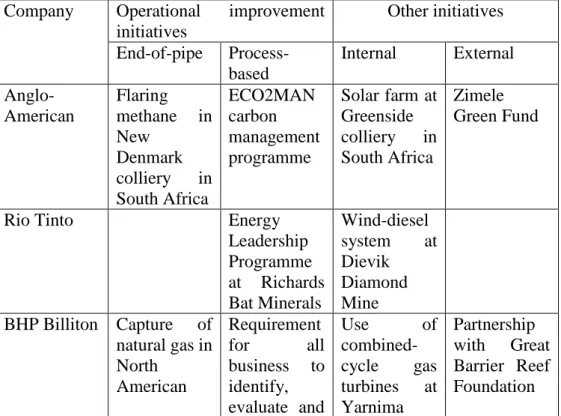
We compare the performance of the three companies and examine whether there is any evidence that implementation of different types of environmental improvement initiatives has led to different effect on the TBL. We summarise examples of the different types of environmental improvement initiatives in Table 1.
Table 1: Summary of Initiatives at AA, Rio Tinto and BHP Billiton Company Operational improvement
initiatives Other initiatives End-of-pipe Process-based Internal External Anglo-American Flaring methane in New Denmark colliery in South Africa ECO2MAN carbon management programme Solar farm at Greenside colliery in South Africa Zimele Green Fund
Rio Tinto Energy
Leadership Programme at Richards Bat Minerals Wind-diesel system at Dievik Diamond Mine BHP Billiton Capture of natural gas in North American Requirement for all business to identify, evaluate and Use of combined-cycle gas turbines at Yarnima Partnership with Great Barrier Reef Foundation
14 shale operations implement GHG reduction projects Power Station in Australia BHP Billiton Sustainable Communities
Examining the trend in overall GHGs for the three companies (Figure 1), we can see that there are contrasting patterns. AA has experienced a small decline, before a small rise. Rio Tinto however has experienced a sharp decline, whilst BHP experienced a substantial rise, before a small fall. It is hard however to draw strong comparisons because over the time-period all three firms undertook a number of major initiatives and divestments that changed the overall scope of their business and thus their GHGs.
Figure 1: GHG emissions at AA, BHP Billiton and Rio Tinto (Source: Company Sustainable Development Reports 2011-2016)
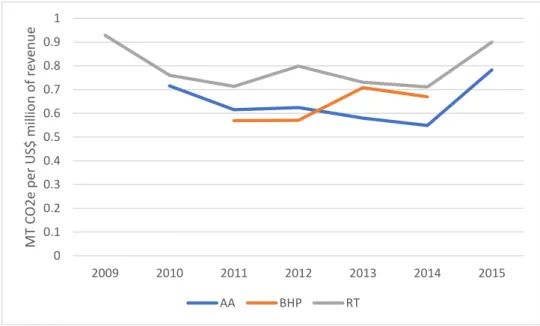
We now examine potentially more comparable metrics that could inform us about both operational improvement initiatives and environmental management initiatives. Figure 2 shows the GHGs per unit of revenue for each of the three firms. Rio Tinto were the most GHGs intensive of the three firms, with AA generating the least GHGs for each unit of revenue. AA and Rio Tinto show a general downward trend until 2014 before spiking sharply to levels comparable or even higher than five years previously. The metric follows closely movements in commodity prices, falling when the price of minerals has reduced indicating little evidence of strong improvements in operational processes. Instead the fall in commodity prices would have impacted revenue, but left environmental performance largely unchanged.10
10 The scale of the impact of falling commodity prices in the industry is discussed by amongst others by Colgan,
(2015) and The Telegraph, (2015). 0 5 10 15 20 25 30 35 40 45 50 2009 2010 2011 2012 2013 2014 2015 G HG e m is sion s p er y ear (M T C O2 e) AA BHP RT
15
Figure 2: GHGs per unit of revenue
(Source: Company annual reports and Sustainable Development Reports 2011-2016)
Table 2: Summary of key TBL indicators
(Source: Company annual reports and Sustainable Development Reports 2011-2016; data for AA and Rio Tinto is for 2015 and BHP is for 2014)
Parameters/company AA Rio Tinto BHP
Revenue US$23 billion US$34.8 billion US$67 billion Pre-tax profits US$2.5 billion US$5 billion US$6.5 billion GHGs 18 MT CO2e 31.3 MT CO2e 45 MT CO2e
GHGs (MT CO2e)
per US$ million revenue
0.783 0.899 0.670
Community contributions
US$124.1 million US$184 million US$225 million Community
contributions per US$ million revenue
US$5.39 US$5.29 US$3.35
5. TBL initiatives framework 0 0.1 0.2 0.3 0.4 0.5 0.6 0.7 0.8 0.9 1 2009 2010 2011 2012 2013 2014 2015 MT C O2 e p er U S$ m illi on o f re ve n u e AA BHP RT
16
As discussed in the introduction section we develop a framework that categorises the environmental improvement initiatives into two different types. The first type we refer to as ‘production-based initiatives’. These are initiatives into projects or programmes that change the nature of the coal mining process or key production techniques within the process. The second type we refer to as ‘offset-based initiatives’. These are initiatives that either offset the emissions involved in the coal mining process, for example replacing fossil fuel energy generation with renewable generation or involve reducing the emissions of actors outside the mining process (for example, funding projects that avoid emissions in local communities or the surrounding area). We examine the potential impacts on operational improvement of these two different types of initiatives.
5.1 Production-based initiatives
Coal mining companies have undertaken initiatives that have made substantive changes to their operational processes in order to reduce their GHGs. For example, improving ventilation systems to reduce energy consumption, flaring waste gases (such as methane) that are potent greenhouse gases and implementing environmental management systems that allows for GHGs to be managed and reduced. We divide production-based initiatives into two categories: end-of-pipe initiatives and process-driven initiatives. End-end-of-pipe initiatives are those that reduce GHGs at the point of their release, for example flaring of methane gas that is emitted during coal mining substantially reduces the GHGs by reducing the global warming potential of the emitted gas. Process-driven initiatives are those that change fundamentally the mining process in a way that reduces GHGs. For example, improving the efficiency of mine ventilation systems large energy savings can be made, which in turn can reduce the GHGs of the coal mining operations.
We propose that these two different types of production-based initiatives have different effects on operational improvements. We propose that end-of-pipe initiatives have only minimal effects on operational improvement – this is because they do not change the overall operational environment of the mining operations – but they could improve revenue streams through offering potential to earn revenue from monetising waste products. These initiatives have only a minimal impact on social welfare as they do not offer any direct benefit to the local communities other than by potentially reducing local air pollutants.
In contrast we propose that process-driven technologies have the potential to have strong positive impacts on operational improvement. These technologies try to identify and improve the efficiency of various processes in mining operations in order to reduce GHGs through actions such as reducing energy consumption. In doing so these actions should lead to improved production efficiency and cost reductions. To the extent the process reduces local pollutants it can potentially improve social development outcomes.
5.2 Offset-based initiatives
Coal mining companies also reduce the GHGs by taking up offset-based initiatives such as substituting fossil-fuel generation for renewable energy and by funding projects external to their mining operations, in local communities. Although these projects help reduce the GHGs, but they have no clear impacts on operational improvements. They may however have stronger impacts on social development outcomes.
17
We divide these initiatives into two categories: internal and external. Internal refers to initiatives that produce the same end-product, i.e. energy, but uses alternative technologies that reduce overall GHGs. The most common of these are the adoption of renewable technologies for energy generation. These technologies have the potential to make large reductions in the GHGs of the coal mining industry. Their role in promoting operational improvement is however limited. We propose that there may be minimal or even negative effects on operational improvement due to the potential difficulties in the integration of different technologies into the operational processes. These technologies however may have medium-scale benefits for social development as these technologies potentially offer electricity to local communities while reducing local air pollutants that may arise from traditional fossil-fuel generation. External offset initiatives include those in which coal mining firms compensate for environmental damage caused by their operations by funding projects external to their mining operations. These projects have potential to achieve substantial social development benefits, and are often directly targeted to benefit local communities along with providing environmental benefits (such as funding renewable energy generation in local communities or funding forestry development or waste recycling). These projects offer limited opportunities to improve operational efficiency as they mostly operate outside the day-to-day operations of the mining companies.
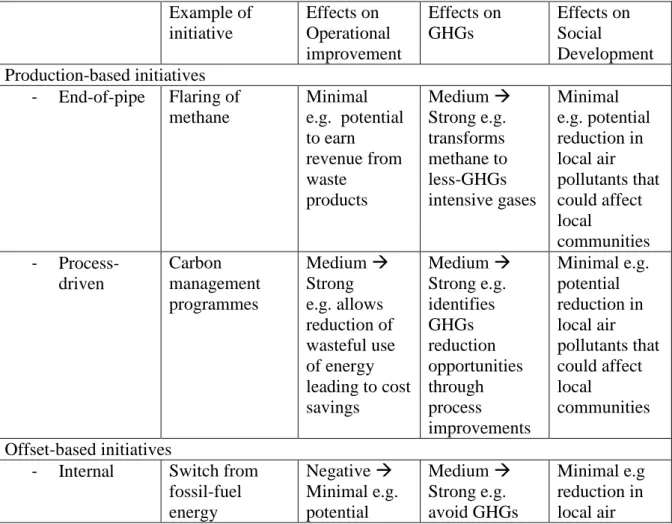
Table 3 summarises the TBL framework. It should be noted that some initiatives may cross-cut these categories.
Table 3: Summary of TBL framework Example of initiative Effects on Operational improvement Effects on GHGs Effects on Social Development Production-based initiatives - End-of-pipe Flaring of methane Minimal e.g. potential to earn revenue from waste products Medium Strong e.g. transforms methane to less-GHGs intensive gases Minimal e.g. potential reduction in local air pollutants that could affect local communities - Process-driven Carbon management programmes Medium Strong e.g. allows reduction of wasteful use of energy leading to cost savings Medium Strong e.g. identifies GHGs reduction opportunities through process improvements Minimal e.g. potential reduction in local air pollutants that could affect local communities Offset-based initiatives
- Internal Switch from fossil-fuel energy Negative Minimal e.g. potential Medium Strong e.g. avoid GHGs Minimal e.g reduction in local air
18 generation to renewables downsides in short-term from integration of new technologies from burning of fossil fuels pollutants that could affect local communities
- External Funding offset initiatives in local communities Minimal e.g. unless able to integrate an element of initiative to operations linked to mining Medium Strong e.g. various forms of GHGs reduction Strong e.g. direct community support through jobs and output from initiatives 6. Concluding remarks
In this paper we develop a framework that provides a starting point for mining companies to develop a strategic approach to environmental improvement initiatives that can positively impact all elements of the TBL. We highlight that a typology of different abatement options are available to mining companies to reduce their GHGs and we create four distinct categories of initiatives. Each of these categories have differential effects on the elements of the TBL. Offset-based initiatives predominantly will affect the environment but may have spin-off benefits for social development, with external offset-based initiatives having more potential in this area. End-of-pipe initiatives offer clear environmental improvements but little in the area of operational efficiency. Process-driven initiatives offer both operational and environmental improvements. Hence in order to have an environmental improvements programme that also offers benefits to the other elements of the TBL, mining companies need initiatives in each of the four different types, and those companies with a diverse range of initiatives should have the strongest gains in each of the TBL elements.
In Section 3 we noted that the three coal mining companies implement a suite of environmental improvement initiatives, however with different range of focus. All three companies emphasise process-driven initiatives, with AA focusing mainly on their ECO2MAN programme that operates across the group. In their SDR’s both AA and BHP highlight end-of-pipe initiatives they have implemented. Stronger focus on internal and external offset initiatives are made by AA through their investments in renewable energy and the Zimele Fund. The initiatives reported by Rio Tinto and BHP in this area are limited, although BHP’s social development pledge is met through two charitable arms that provides for external offset-based initiatives. AA as a company seems to have invested in a package of measures that best spans the four types of initiatives identified in the framework. The company had the strongest operational improvements until 2015 and had also made relatively the highest contribution to environmental and social development.
19
Our findings are of importance to mining companies in developing strategies and plans to reduce GHGs. They point to the importance of company-wide strategies that can implement projects across all parts of the typology. This would create advantages over approaches that allow individual divisions to decide their own projects. Although the latter allows the flexibility for middle managers to identify the most cost-effective opportunities within their own specialism, it risks the wider operational improvements and social development advantages that planning a suite of initiatives across the company can achieve. The TBL framework emphasises the need for overarching process-driven initiatives that can change operational processes resulting in operational efficiency and GHGs reduction, rather than just achieve environmental objectives such as those that can be achieved through end-of-pipe initiatives. The framework highlights the importance of looking at environmental improvement initiatives through all three lenses of the TBL; assessing these initiatives on one, or even two of the elements of TBL could under-estimate the benefits and over-estimate the costs. For example, if internal offset-based initiatives were analysed using only operational-efficiency and environmental metrics, their social development benefits could be missed out. On the other hand, if just environmental and social metrics were used, the potential operational costs reduction benefits could be missed. This highlights the need for the TBL metrics in assessing initiatives that have the potential to impact all the elements of the TBL.
The development of the framework was limited by the differential data (especially with regard to social development) that is reported by these companies through Annual Reports and SDRs – but we find evidence that those companies that have implemented a complementary suite of initiatives – especially those targeting operational processes directly, have achieved strongest environmental performance and also improvements in the other elements of the TBL. Extending this framework by analysing in the context of a wider suite of initiatives from the mining industry more generally offers a fruitful path for future research.
References
Anglo American . (2013). Sustainable Development Report. Anglo American. (2015). Anglo American Interim Results 2015.
Anomohanran, O. (2012). Determination of greenhouse gas emission resulting from gas flaring activities in Nigeria. Energy Policy, 45, 666-670.
Auty, R., & Mikesell, R. F. (1998). Sustainable Development in Mineral Economics. Oxford: Clarendon Press.
Basu, A. J., & van Zyl, D. J. (2006). Industrial ecology framework for achieving cleaner production in the mining and minerals sector. Journal of Cleaner Production, 14(3), 299-304.
Bice, S. (2014). What gives you a social licence? An exploration of the social licence to operate in the Australian mining industry. Resources, 3(1), 62-80.
Booz & Company. (2012). Profits in a slowdown: How Australian mining companies can cut costs and grow stronger. PwC.
Brown, D. S. (1993). Minerals and environment in the 21st century. Nonrenewable Resources, 2(3), 181-186.
20 Burnham, A., Han, J., Clark, C. E., Wang, M., Dunn, J. B., & Palou-Rivera, I. (2011). Life-cycle
greenhouse gas emissions of shale gas, natural gas, coal and petroleum. Environmental Science and Technology, 46(2), 619-627.
CIAB. (2006). Case studies in sustainable development in the coal industry: Coal industry advisory board report. Retrieved October 29, 2017, from
https://www.iea.org/ciab/papers/CIAB_Case_Studies_2006.pdf
Colgan, P. (2015). The commodity crash just lost the world's biggest mining company 86.2% of its profits. Business Insider Australia.
de Oliveira Neto, G. C., & Lucato, W. C. (2016). Production planning and control as a tool for eco-efficiency improvement and environmental impact reduction. Production Planning & Control, 27(3), 148-156.
Elkington, J. (1997). Cannibals with Forks: the Triple Bottom Line of 21st Century Business. Capstone. Eurostat. (2016). Greenhouse gas emissions by industries and households.
Fang, H., Wu, J., & Zeng, C. (2009). Comparative study on efficiency performance of listed coal mining companies in China and the US. Energy Policy, 37(12), 5140-5148.
Gardner, T. A., Hase, A., Brownlie, S., Ekstrom, J. M., Pilgrim, J. D., Savy, C. E., . . . ten Kate, K. (2013). Biodiversity offsets and the challenge of achieving no net loss. Conservation Biology, 27(6), 1254-1264.
Ghose, M. K., & Majee, S. R. (2001). Air pollution caused by opencast mining and its abatement measures in India. Journal of Environmental Management, 63(2), 193-202.
Gibbons, P., & Lindenmayer, D. B. (2007). Offsets for land clearing: No net loss or the tail wagging the dog. Ecological Management and Restoration, 8(1), 26-31.
Gibbons, P., & Lindenmayer, D. B. (2007). Offsets for land clearing: no net loss or the tail wagging the dog? Ecological Management & Restoration, 8(1), 26-31.
Global Reporting Initiative. (2011). Sustainability Reporting Guidelines & Mining and Metals Sector Supplement.
Goodland, R. (2012). Responsible mining: the key to profitable resource development. Sustainability, 4(9), 2099-2126.
Grubb, M., Laing, T., Counsell, T., & Willan, C. (2011). Global carbon mechanisms: lessons and implications. Climatic Change, 104(3), 539-573.
Hamann, R., & Kapelus, P. (2004). Corporate social responsibility in mining in Southern Africa: Fair accountability or just greenwash? Development, 47(3), 85-92.
Hammam, R. (2003). "Mining companies" role in sustainable development: the 'why' and 'how' of corporate social responsibility from a business perspective. Development Southern Africa, 20(2), 237-254.
Hilson, G., & Murck, B. (2000). Sustainable development in the mining industry: clarifying the corporate perspective. Resources Policy, 26(4), 227-238.
21 Hilson, G., & Nayee, V. (2002). Environmental management system implementation in the mining
industry: a key to achieving cleaner production. International journal of mineral processing, 64(1), 19-41.
ICMM. (2015). ICMM 10 Principles. Retrieved December 9, 2017, from https://www.icmm.com/en-gb/about-us/member-commitments/icmm-10-principles
Jenkins, H. (2004). Corporate social responsibility and the mining industry: conflicts and constructs. Corporate Social Responsibility and Environmental Management, 11(1), 23-34.
Jenkins, H., & Yakovleva, N. (2006). Corporate social responsibility in the mining industry: Exploring trends in social and environmental disclosure. Journal of cleaner production, 14(3), 271-284. Joshki, P. K., Kumar, M., Midha, N., Yanand, V., & Wal, A. P. (2006). Assessing areas deforested by
coal mining activities through satellite remote sensing images and GIS in parts of Korba. Journal of the Indian Society of Remote Sensing, 34(4), 415-421.
Kapelus, P. (2002). Mining, corporate social responsibility and the" community": The case of Rio Tinto, Richards Bay Minerals and the Mbonambi. Journal of Business Ethics, 39(3), 275-296. Karacan, C. O., Ruiz, F. A., Cote, M., & Phipps, S. (2011). Coal mine methane: a review of capture and
utilization practices with benefits to mining safety and to greenhouse gas reduction. International Journal of Coal Geology, 86(2), 121-156.
Kitco. (2017). Historic Gold Prices. Retrieved December 9, 2017, from Kitco.com: http://www.kitco.com/charts/historicalgold.html
Kulshreshtha, M., & Parikh, J. K. (2002). Study of efficiency and productivity growth in opencast and underground coal mining in India: a DEA analysis. Energy Economics, 24(5), 439-453. Laing, T., Taschini, L., & Palmer, C. (2016). Understanding the demand for REDD+ credits.
Environmental Conservation, 43(4), 389-396.
Lala, A., Moyo, M., Rehbach, S., & Sellschop, R. (2015). Productivity in mining operations: Reversing the downward trend. McKinsey & Company.
Lederwasch, A., & Mukheibir, P. (2013). The triple bottom line and progress toward ecological sustainable development: Australia’s coal mining industry as a case study. Resources, 2, 26-38.
Maron, M., Hobbs, R. J., Moilanen, A., Matthews, J. W., Christie, K., Gardner, T. A., . . . McAlpine, C. A. (2012). Faustian bargains? Restoration realities in the context of biodiversity offset policies. Biological Conservation, 155, 141-148.
McKenney, B. A., & Kiesecker, J. M. (2010). Policy development for biodiversity offsets: a review of offset frameworks. Environmental management, 45(1), 165-176.
Mutti, D., Yakovleva, N., Vazquez-Brust, D., & Di Marco, M. H. (2012). Corporate social responsibility in the mining industry: Perspectives from stakeholder groups in Argentina. Resources Policy, 37(2), 212-222.
Narula, S. A., Magray, M. A., & Desore, A. (2017). A sustainable livelihood framework to implement CSR project in coal mining sector. Journal of Sustainable Mining. Retrieved from
22 Nazari, M., & Proebstel, D. (2009). Biodiversity Offset in Mining. Mining. com Magazine.
Pond, G. J., Passmore, M. E., Borsuk, F. A., Reynolds, L., & Rose, C. J. (2008). Downstream effects of mountaintop coal mining comparing biological conditions using family-and genus-level macroinvertibrate bioassessment tools. Journal of the North American Benthological Society, 27(3), 717-737.
Prashar, A. (2016). Using Shainin DOE for six sigma: an Indian case study. Production Planning & Control, 27(2), 83-101.
Prno, J. (2013). An analysis of factors leading to the establishment of a social licence to operate in the mining industry. Resources Policy, 38(4), 577-590.
PwC. (2016). Mine 2016: Slower, lower, weaker ... but not defeated.
Ranangen, H., & Lindman, A. (2017). A path towards sustainability for the Nordic mining industry. Journal of Cleaner Production, 151, 43-52.
Robertson, M. M. (2000). No net loss: wetland restoration and the incomplete capitalization of nature. Antipode, 32(4), 463-493.
Sen, S., & Bhattacharya, C. B. (2001). Does doing good always lead to doing better? Consumer reactions to corporate social responsibility. Journal of Marketing Research, 38(2), 225-243. The Telegraph. (2015). Five reasons mining companies are in a hole.
Tianen, H. (2016). Contemplating governance for social sustainability in mining in Greenland. Resources Policy, 49, 282-289.
Tiwary, R. K. (2001). Environmental impact of coal mining on water regimes and its management. Water, Air and Soil Pollution, 132(1-2), 185-199.
Tsoutsoura, M. (2004). Corporate social responsibility and financial performance. Center for responsible business.
van Berkel, R. (2007). Eco-efficiency in the Australian minerals processing sector. Journal of cleaner production, 15(8), 772-781.
Villareal, B., Garza-Reyes, J. A., & Kumar, V. (2016). Lean road transportation–a systematic method for the improvement of road transport operations. Production Planning & Control, 27(11), 865-877.
Virah-Sawmy, M., Ebeling, J., & Tapling, R. (2014). Mining and biodiversity offsets: A transparent and science-based approach to measure "no-net-loss". Journal of environmental management, 143, 61-70.
Wara, M. (2007). Is the global carbon market working? Nature, 445(7128), 595-596.
Warhurst, A., & Bridge, G. (1996). Improving environmental performance through innovation: recent trends in the mining industry. Minerals Engineering, 9(9), 907-921.