Understand children’s
Understand children’s
Understand children’s
early years education and
early years education and
early years education and
development
development
development
development
development
development
development
development
development
Unit 1
Unit 1
As you work with young children and get to know them, you will notice that
all children develop in different ways and at different rates. It is important
that you have a good knowledge and understanding of different aspects of
children’s development from birth up to the age of 8 years so that you can
meet their individual needs. In this way you can move quickly to support
them if there are any concerns.
Learning outcomes
By the end of this unit you will:
1.
understand patterns of children’s development from birth up to 8 years2.
understand evidence-based approaches to child development3.
understand the significance of attachment to children’s development4.
understand how to support children’s speech, language and communication5.
understand howtransitions and significant events affect children’s lives.
Before you start
Think about the abilities of different children with whom you work. What do you notice about the development of babies and toddlers? How do 5 and 7 year olds vary in their skills and abilities? Do you think this is due to their stage of development?
1 Understand patterns of children’s
development from birth up to 8 years
All children develop differently, but the stages they pass through are broadly the same. If you work with children of the same age, you will start to recognise similarities in their levels of development. This will help you to identify those children who are working at a significantly higher or lower level than others in the group. The pattern of children’s development falls into different areas, although many of these are interlinked.
From birth to 5 years
Cognitive, neurological and brain development
Cognitive and neurological development refer to the development of the mind. Between birth and the age of 5 years, babies’ and children’s brains will undergo the most rapid changes.
Birth to 6 months
Babies will develop rapidly as they use their senses and start to become aware of what is happening around them. They will be aware of physical sensations such as hunger and will start to recognise their carers,
responding to physical stimuli such as smiles. From an early stage, babies will start to make simple associations, for example starting to recognise the soothing voice of a parent or the routines when feeding and sleeping. 6 to 12 months
Babies will be starting to understand tone of voice and some key words such as ‘mama’ or ‘dada’. They will also be able to recognise some objects
Unit 1
Figure 1.1:How can you stimulate babies’ engagement with the world around them?
1 to 2 years
Children will continue to explore different objects to find out what they do. They will start to use objects appropriately: for example, trying to use a hairbrush or cup. Their language will be developing rapidly and they will be able to use around 40 words, as well as understanding more than this.
2 to 3 years
Children’s vocabulary will be expanding rapidly and they will start to understand more abstract thoughts. They will have more awareness of others and will be able to understand consequences of their own actions. They will also be starting to learn nursery rhymes and familiar songs.
3 to 4 years
Children’s understanding of the abstract will continue to develop. They will continue their fascination with why things happen. They will be starting to understand the passing of time – what has happened in the past or will happen in the future.
4 to 5 years
Children will be able to give reasons for their actions and solve problems. Their memory skills will be increasing. They will be able to remember events such as Christmas or what happened in the summer break. Children will be able to sort and categorise objects by criteria such as colour and size. They may also be able to state their name and address.
Speech, language and communication
development
This refers to the way in which children start to understand and process language so that they can communicate with others. The first five years of life are crucial as children start to make sense of the world and their place in it.
Birth to 6 months
Babies will start to interact with adults by looking and listening, and by starting to vocalise through gurgling or cooing at people they recognise. Young babies may respond to their name when they are as young as a few weeks old, but this is more likely to be because they recognise the voice of their parent or carer. They may respond to speech by smiling, or cry when they have a need.
6 to 12 months
Babies will be starting to recognise key voices, understand simple language and recognise their own name. They will be starting to experiment with speech by making sounds, babbling or talking to themselves. 1 to 2 years
Babies will be starting to understand simple instructions (‘have a drink’) when accompanied by
Jargon buster
Cognitive – to do with acquiring knowledge. Neurological – to do with nerves and the nervous system.
Unit 1
identify a few objects and be starting to increase their spoken vocabulary. They may also be echoing what others say to them, known as echolalia.
2 to 3 years
Children will know and speak over 200 words and will begin to put them together. They will often talk to themselves as they do things, and will name different objects when they recognise them.
3 to 4 years
Children will become more aware of their own thoughts. They will starting to be able to count by rote, recognise and say nursery rhymes, and have basic conversations.
4 to 5 years
Children will be able to reason about different things, solve problems and talk with fluency. They will now have a large vocabulary and be able to use tenses, although they may sometimes be unaware of more irregular ways of speaking.
Literacy and numeracy development
As soon as young children learn to speak andunderstand language, they are starting to develop their literacy and numeracy skills. This area of development is closely linked to both speech and language
development.
Speech and language are linked to numeracy because so many of children’s earliest numerical experiences will depend on their ability to use language and be able to put their experiences into words. For example, if children do not recognise and understand the words ‘more’ and ‘less’, they will find it difficult to recognise and understand the concept.
Similarly, the development of language is closely related to the development of literacy skills. At the age of 2 years, children will be starting to understand and use language themselves. 2 to 3 years
It is important for young children to put words together and start using sentences. They will understand the significance of different objects, and so be able to recognise similarities and categorise items later when working on mathematical activities.
3 to 4 years
As children start to remember and repeat songs and rhymes, they will be exploring patterns in language and will enjoy hearing similar sounding and nonsense words.
4 to 5 years
Children of this age will have an increasing enjoyment of books and sharing them with adults. They will be starting to learn their sounds and recognise some simple words.
Physical
Physical development covers sensory as well as fine and gross motor skills. Children will develop at their own rate so many of these key points such as learning to crawl and walk, and in particular potty or toilet training, will depend on the child’s readiness.
Jargon buster
By rote – by memorising and repeating, often without really understanding.
Echolalia – echoing what others say over and over.
Fine motor skills – skills that involve small muscle movements, such as using a pencil. Gross motor skills – skills that involve large movements of the arms, legs, feet or entire body, such as running.
Sensory development – growth of awareness through the senses (sight and sound, touch and texture, smell and taste and also body position sense).
Unit 1
Birth to 6 months
A newborn baby’s physical development will progress quickly. From basic reflexes, they will soon be able to make jerky movements with their arms and legs, keep their head up and move it deliberately to look around them. 6 to 12 months
Babies will be able to push themselves up if lying on their front, using their arms. They will also be able to roll over and kick their legs. They will continue to develop their strength, and may be able to bear much of their weight when supported and sit unsupported for brief periods. They may be starting to find ways of moving. They will also be able to pick things up.
1 to 2 years
Babies will be able to bring themselves to a sitting position. From pulling themselves up using furniture, they will gradually learn to walk steadily as their
balance develops. Their coordination will be developing and they will be able to pick up small objects, turn the pages of a book, and begin to feed themselves using a spoon. They may be starting to use a potty.
2 to 3 years
At 2 years, children will be able to run, climb and throw a ball. They may be using a tricycle; by 3 years they will also be able to use pedals. They will be able to drink from a cup and use a spoon more confidently, and may have a preferred hand for feeding and drawing.
Figure 1.2: What activities will help children to develop their strength and coordination?
Emotional and social development
Birth to 12 monthsBabies will be forming emotional attachments to their primary carers. They are likely to be easily distressed if their primary carer leaves and to be wary of unfamiliar people. Babies of this age will enjoy cuddles and attention.
1 to 2 years
Babies will still be shy with unfamiliar adults but will be starting to develop their independence. They will become frustrated if they cannot express themselves. Babies will enjoy socialising and playing alongside others.
Theory in action
Consider why early years workers need to take the developmental needs of children into account when planning the learning environment. How is the environment relevant to different areas of children’s development?
3 to 4 years
Children will have a greater spatial awareness and ability to move around objects. They will be able to use stairs, jump off a low step and kick a ball. They will be developing their ability to use a pencil and draw simple representations of people.
4 to 5 years
Children’s physical skills will be well developed. They will be starting to use a knife and fork, thread beads and hold a pen or pencil correctly. They will have a good sense of balance and be confident when walking and running.
Unit 1
2 to 3 years
Children will be learning to say how they are feeling, although at times they will find it difficult to control their feelings and may have tantrums. They will still depend on adults emotionally. They may start to share with other children, while still enjoying solitary play. 3 to 4 years
Children will be starting to express likes and dislikes. They will be developing their own personal identity and developing in confidence and independence. They will be starting to make friends and enjoy playing with others.
Figure 1.3: At what age do children begin to enjoy playing together?
4 to 5 years
Children’s confidence will continue to increase and they will enjoy the company of other children. They will enjoy their independence and will enjoy helping adults. They will be more likely to share with others and take turns although they may still exert their own wishes and desires.
From 5 to 8 years
Development between these ages will be less rapid, but children will still be developing in different areas and will need support from adults. This age group includes up to the child’s eighth birthday.
Cognitive, neurological and
brain development
At this stage, children will be starting to think in a more abstract way due to the development of their language skills. Consequently they will be able to understand topics such as rules and discuss points of view. They will be able to concentrate for increasing periods and be starting to categorise and sort objects according to multiple features. For example, children may sort a pile of toy animals by colour, type of animal, how they move, or other features.
Speech, language and
communication development
Children of this age are likely to be fluent speakers who are easily understood and can follow instructions. Their language will be grammatically correct and they will have a good grasp of tenses, being able to use language in different ways. They will be starting to talk about abstract words and will enjoy listening to stories, often acting them out later and being able to distinguish between fantasy and reality. Their thinking skills will be developing as they are more able to organise their language, and they will understand time concepts such as ‘tomorrow’ and ‘yesterday’. They will be starting to read,
recognise and write their own name, and know their left and right.
Literacy and numeracy development
Children will be developing their literacy and numeracy skills rapidly during this period. They will be able to read and write on their own and structure well formed sentences. Their counting skills will be developed and they will be able to count money and tell the time.Physical development
Between the ages of 5 and 8 years, children will grow rapidly and have increasing agility and muscle coordination (for example, starting to ride a bicycle). They will also develop their fine motor skills, being able to use a knife and fork, have good control over pens
Unit 1
and pencils, and copy complex shapes and pictures. Milk teeth will start to fall out and permanent teeth will appear.
Emotional and social development
Children of this age will be developing in confidence and independence, and have a greater perception of their own personal identity and self–concept. They will be aware of their own feelings and start to show sympathy and concern for others who are hurt or upset. They will be able to play cooperatively with each other and form close friendships, as well as demonstrating a competitive spirit. Their attention span will continue to grow and they will be forming a sense of humour.language development – the Early Years Foundation Stage document refers to them as the three prime areas, (‘speech and language’ is communication and language’ in the EYFS framework document). If children are slower to develop in these areas, further development in other areas such as literacy and numeracy will take longer to achieve.
Speech, language and communication
This aspect of development is important for children’s holistic development. Through the development of speech and language, children will learn to socialise and express their preferences and their needs, and be able to make sense of the world. In turn the ability to communicate will support the development of their confidence and self-esteem. It is important that young children have as much opportunity as possible not only to listen to others but also to put their own language skills to use. Adults should make sure that young children are given praise when they achieve as well as frequent feedback.Children who have limited speech and language skills will have corresponding difficulties in expressing themselves, which in turn may lead to frustration, poor understanding, inability to express themselves and limited social skills.
Personal, social and emotional
development
This aspect of children’s development is related to their confidence and self-esteem. Babies and children need to have positive interactions and form firm attachments from the earliest stages, and feel reassured emotionally by the adults around them. Children who are given praise, encouragement and guidance as they grow will develop a greater sense of self-worth. Children will in turn be able to form positive relationships and friendships with their peers through their interactions. (For more information about attachments and attachment theories, see learning outcome 2 in this unit.)
The importance of different aspects
of development
Different aspects of children’s development are interlinked and co-dependent, so they will each be important to the child’s holistic development. Children’s overall development and educational needs will be affected by the way in which they develop in key areas. As children grow and pass different milestones or key points, they will gradually become more independent and less reliant on those around them in preparation for the future.
The three key areas of children’s development are personal, social and emotional, physical, and speech and
Jargon buster
Self concept – the way in which you see and think about yourself.
Holistic development – overall development.
Peer – someone who is equal in terms of age, status or ability to another specified person.
Unit 1
Physical development
As well as physical growth, this aspect involves children’s health, physical strength, mobility and sensory abilities. They will need to have opportunities to exercise and develop both fine and gross motor skills so that they can gain full control over their muscles. The more opportunities children have to develop muscular strength and physical skills, the greater their stamina. Some children may be limited by a physical condition or disability, or have a sensory impairment which hinders their progress. (For information on the effects of atypical development, see later on in this learning outcome under ‘The impact of atypical development’.)
How different factors can affect
children’s learning and development
Children’s learning and development may be affected by a wide range of factors. Their background, their health and the environment in which they are growing up will all have an impact, as each will affect all areas of development. You should know how children may be affected so that you can encourage them to develop and reach their potential.
Personal factors
The personal factors that affect children’s learning and development are based around their environment and their relationships with primary carers. Some of the causes and effects are outlined below.
Encouragement
Children need to be encouraged and given positive praise by primary carers as they learn and develop in different areas, to build confidence and self-esteem.
Jargon buster
Atypical – not typical; unusual; not following the expected pattern.
Unit 1
This is true of all areas of development. If they form poor attachments with little encouragement from adults, it is likely that they will develop anxieties and insecurities about their own abilities and have a need for reassurance. They may lack motivation or adopt attention-seeking behaviour. They may also suffer from separation anxiety – a fear of being apart from their primary carer – due to their own poor self-confidence and self-concept.
Limited resources
Children who are from backgrounds where there are limited resources may have less time with their primary carers, or have limited life experiences. This may be as simple as having trips to different areas to broaden their knowledge, or having access to different experiences. Role models
Children may have ineffective role models in different areas of their development. Those who look to
adults with poor social and communication skills may have difficulty in developing their own, as
the adults do not form positive relationships with others. Children who have limited opportunities to develop their own communication skills may also demonstrate poor behaviour or a poor attention span if they become frustrated due to an inability to communicate.
Expectations
Expectations of children can vary depending on the past experiences of adults in their family. Some children may have parents or carers who have had poor experiences in the education system and in turn may have low expectations for their own children.
External factors
External factors affecting children’s learning and development are likely to be concerned with more limited access to services and support where it is needed. Parents or carers may not be aware of the different services available or may not be able to find out about them.
Access to resources and services
Some children may have reduced access to healthcare or social services, and so have less support if they have a slower rate of development.
Ill health
Children who suffer from regular ill health on a regular basis may have slowed development. On its own, or alongside other factors such as limited support, this may cause longer-term issues such as failure to grow or thrive.
Case study 1.1
Minal is in your school’s nursery and has a large extended family. She seems very busy and regularly attends different clubs and activities after school with her brothers and sisters. She is usually collected by her mother or her aunt, who both support the school PTA. She is very confident and talkative.
Michael is from a small family and has to travel some distance to the nursery. You do not know much about his home circumstances except that his mother is bedridden and he is cared for by his father. He is regularly late and his father seems very shy and not keen to communicate.
• How might the learning and development of these two children be affected by some of the factors above?
Unit 1
Opportunities and choice
Children who are from more disadvantaged
backgrounds and who have limited support may be offered fewer external opportunities from others, or have fewer support systems in place.
Influence of others
The smaller the social circle and the fewer
opportunities to develop social skills, the more likely children are to be dependent on parents and carers. This may also lead to poor communication skills and low self-image or lack of confidence.
Consistency in education
If children move around to different schools and areas, the lack of consistency and routine may have an adverse effect on their development, particularly if issues are not picked up or acted on due to changes of address. Monitoring of development
Where children’s development is not monitored
effectively, any failure to grow, thrive or develop will not be picked up, so the intervention available will be limited.
The impact of atypical development
If young children are developing differently from their peers in one or more areas, this is likely to have an impact on other aspects of their progress. Two key areas where this may happen are physical and communication development, although it may also impact on their social and emotional development.
Physical development
Atypical physical development may mean that a child has a slower or faster rate of development than other children, or has a physical impairment. However, if a child is growing at a much faster or slower rate than their peers, they may feel different to other children, which may affect their social and emotional development. Adults will need to ensure that this kind of issue is discussed with parents so that the child’s health status can be checked and services accessed.
Children who have a physical impairment may be affected in different ways. Physical impairments are usually related to mobility or coordination, but may also be sensory – related to vision or hearing.
Problems with, for example, mobility may also have an impact on a child’s social and emotional development as they develop feelings about themselves and other people. The effects may be negative if the child starts to have low self-esteem or confidence, and adults will need to provide positive support.
Figure 1.5: How can you ensure that children with physical disabilities feel included?
Case study 1.2
Amara has a condition that means she is much taller than all the other children in her year. She does not seem to be unduly concerned, but as her childminder you have heard other children in the school passing comments on her size as you leave the playground.
• Should you do anything in this situation if Amara is not concerned?
• What might be the effects of Amara’s condition as she goes through the school?
Unit 1
Communication development
Children whose communication development is atypical may have a variety of needs. Communication development may be affected by a sensory
impairment such as poor vision or hearing, but c an also be due to speech and language issues such as a language disorder, or a cleft palate – or
simply a slower rate of development. Communication and language are vital aspects of children’s
learning, so it is important that a slower rate of communication development is addressed as soon as possible.
In the early stages of communication development other aspects may be unaffected, but as children grow older their rate of communication development may lead to delayed cognitive development, anxiety, poor behaviour and possible social exclusion by their peers.
In all of these cases, you should discuss any effects of atypical development with parents so that can get the support they need, in order to benefit the child.
disrupted, may also be affected, as their feeling of personal identity and security will not be so developed. (For more information on attachment see learning outcome 3 in this unit.)
How interventions can promote
positive development
As children grow and develop, they will undergo checks at different times. For example, the progress check at age 2, which takes place between the ages of 24 and 36 months gives a breakdown of children’s development in the three prime areas – personal, social and emotional, physical, and communication and language. These checks are designed to give parents and healthcare professionals a clear picture of the child’s development so that they can identify any areas in which they are developing slower or faster than is expected.
Following observations and assessment judgements, a child may be referred to a specialist to assess and support their further development. The specialist will then advise teaching and support staff. Parents will be told about the kind of service provision and opportunities available to support their child. In this way, targeted intervention can promote positive development, and appropriate support can be put in place. If children are not making expected progress or achieving milestones, intervention should happen as early as possible.
With the right intervention, children are likely to be more motivated and have a greater self-concept, which will enhance their overall development. Their progress will then continue to be monitored by setting
Reflect
Consider the needs of children with whom you have worked in your setting. How has their development been affected by different factors?
The effect of stage of development
Children’s learning and development will be affected by the stage of development they have reached. They will need to pass the milestones in sequence, although not necessarily at exactly the same age. For example, learning to walk may occur at around the age of one year, but some children walk at ten months, and others not until sixteen months.
If a child completes a stage in one area sooner than their peers, they are likely to continue to progress more quickly and this may impact on other areas of development. For example, a child of 18 months who has spent time in the company of adults or older children may have learned some action songs and nursery rhymes. These will promote their communication and conversation skills, and so their confidence and self-concept is likely to be greater. A child who has not formed an attachment or bonded
Unit 1
2 Understand evidence-based
approaches to child development
How babies and children learn and
develop
The way in which babies and young children learn and develop is a continuous process involving a number of factors, many of which are linked and incorporate different aspects of development. The pattern of development starts with more simple actions and goes on to more complex ones as the child becomes older.
Child development Communication
Modelling Exploration Resources Activities Play Relationships Socialisation Support Guidance Attachment Observation Use of senses Continuous interaction Use of senses and exploration
As soon as they are born babies begin to use their senses to explore their new world. They will be taking in a huge amount of information and are alert, looking and listening when they are awake. As they grow and develop, use of their senses will continue to be an important aspect of their development.
Continuous interaction and communication
The communication development of babies and young children will need to be stimulated by continuous interaction and communication with others. In this way they will learn the norms of interaction: for example, taking turns to speak, giving eye contact and using facial expressions.
Resources
Access to resources will support children’s
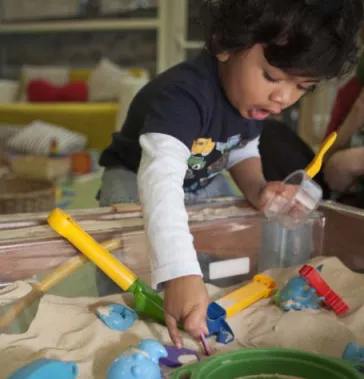
development as they explore and begin to talk about different materials and their properties. They will need to have access to sensory materials such as sand, water and dough, items that support their physical development such as tricycles, balls and pencils, and items they can explore and play with as they become more independent. This will also support their communication and language development as they talk to others about what they are finding out.
Case study 1.3
Following her progress check at age 2, Ramola has been referred to a speech and language therapist as her communication skills are very poor. Her mother is not keen to take her because she does not want her to be ‘labelled’ and has spoken to you about it.
• What would you say to Ramola’s mother? • Why is it important that Ramola attends
the appointment?
Unit 1
social and emotional development. This is because they will need to feel secure and protected as they begin to explore their world, as they will always have a reassuring presence to return to. (For more information on
attachment theory, see learning outcome 3 in this unit.) Modelling and observation
Babies and young children will learn by observing adults and others modelling different aspects of behaviour. For example, they will pick up language by listening to others and copying the way in which they speak, or recognise the correct way to behave by observing adults.
Figure 1.7: What resources can you use to stimulate children’s development?
Play and activities
Play and different activities will support all areas of development. Young children will need to socialise with others and explore their environment through play and a variety of different activities.
Relationships and socialisation
As children grow and develop, they will form relationships with others, socialising with adults and their peers. They will learn about their place in the world and the way in which we treat other people. This will support both their social and moral development. Guidance and support
Babies and young children will need guidance and support from adults as they grow and develop. This may take different forms, such as praise and encouragement or through demonstration, such as showing them how to catch a ball. Young children will continuously ask questions as they start to find out about the world. Attachment
Babies and young children will need to have a positive
Jargon buster
Modelling – a technique by which adults show children what is expected by doing it themselves.
Innate – inborn, natural; an innate ability is something you are born able to do.
Theories and models of child
development
Various theories of development will influence the way we approach our work with children. Psychologists have different ideas about how children learn and develop. Some feel that a child’s ability is innate, while others think it depends on the opportunities that they are given. This is often called the ‘nature versus nurture’ debate.
Sigmund Freud
Freud stated that our personalities are made up of three parts – the id, the ego and the superego. Each of these will develop with the child and will be subconsciously driven by childhood events and experiences. Freud focused on the relationship between the id (the instinctive part of our personality) and the superego (the conscience), which develops later in childhood.
Unit 1
Erik Erikson
Erikson was greatly influenced by Freud. He stated that we pass through eight psychosocial stages throughout our entire lives. At each stage, our psychological needs will conflict with those of society.
John Bowlby
Bowlby stated that early attachments are crucial to a child’s development and are a key part of the way in which we build relationships later. (For more information on attachment theory, see learning outcome 3 in this unit.)
Jean Piaget
Piaget thought that children think differently to adults. He believed that the way children think and learn is governed by their age and stage of cognitive development, because learning is based on experiences they build on as they become older. As children’s experiences change, they adapt their beliefs. For example, a child who only ever sees green apples will believe that all apples are green. Children need to extend their experiences in order to extend their learning. They will eventually take ownership of this themselves so that they can think about experiences that they have not yet developed.
Albert Bandura
Bandura’s ‘social learning’ or ‘modelling’ theory stated that learning takes place through observing others rather than being taught. Children will often simply copy adults and their peers without being told to do so, meaning that their learning is spontaneous.
Lev Vygotsky
Vygotsky believed that culture and social factors both play a crucial role in a child’s development, and that cognitive functions will be affected by the beliefs and values of the society in which children grow up. He also believed that children learn actively, through hands-on experience.
B. F. Skinner
Skinner believed that children learn through experience or conditioning. He promoted the theory that our learning is based on a consequence following a particular behaviour. We will repeat experiences that are enjoyable and avoid those that are not. This applies to learning too. For example, a child who is praised for working well at a particular task will want to work at the task again. Skinner called this positive reinforcement.
Theory in action
Consider the ways in which positive reinforcement is used in your setting.
• How do adults use it to encourage children’s work and behaviour? • How successful do you think this is?
Figure 1.8: How might you incorporate Skinner’s theories in your work with children?
Unit 1
Ivan Pavlov
Pavlov put forward the idea of classical conditioning, which he discovered by accident when carrying out research using dogs. The dogs would salivate when one of Pavlov’s assistants entered the room, even if they did not feed them, as the dogs expected it to happen. He then started to ring a bell whenever the dogs were fed; eventually ringing a bell produced the same response. Because this response was learned, it was called a conditioned response. Classical conditioning is often used today to treat phobias and anxiety problems, by helping people form new associations. In the same way, children can be taught to associate positive experiences with learned behaviour.
Urie Bronfenbrenner
Bronfenbrenner developed a theory known as ecological systems theory. This emphasises the importance of different environmental factors on a child’s development, from people in the child’s immediate environment to the influence of national forces such as cultural changes.
Howard Gardner
Gardner introduced the theory that all individuals learn in different ways based on their own aptitudes, and not by a single general ability of intelligence. He stated that different ‘intelligences’ do not all progress at the same time, so children may be at a different stage in their understanding of number to their ability with language, for example. Gardner originally outlined eight intelligences, although he subsequently added two more.
Information-processing theory
Information-processing theory was developed during the 1950s and 1960s, influenced by the concept of the computer. It states that individuals process information in much the same way as a computer
Jargon buster
Psychosocial – to do with how social factors and individual behaviour interact.
Classical – in this context, to do with an unlearned reflex such as salivating. Progressive – in this context, to do with an unlearned reflex such as salivating [note to editor: this definition is incorrect; a new definition is needed].
does, by coding, storing and using information. This is a model used by cognitive psychologists.
Reggio Emilia
This approach, developed in the 1940s, is based around the child being the initiator in their own early learning. When it was first introduced, it was a progressive model of early years care as it had never been done before. Children will follow their own interests, which will be fostered and developed with support from parents, teachers and the wider community. It speaks of ‘the hundred languages of children’ – children use many different ways to explore their world and express their thoughts, all of which should be nurtured.
How to apply theories and
models to support children’s
development
You will need to be able to consider how different theories support the development of young children. In your workplace it is likely that you will be able to see evidence of different ways in which they influence your practice.
Unit 1
Table 1.1: Links between childcare practice and theories of child development.
Aspect of practice Links to How it is applied
Observation and assessment
All All theories of child development are based on observation and the way in which children react in different situations. You will need to observe children so that you can assess their progress and plan for their future needs.
Planning and evaluation
Piaget Piaget emphasised the importance of extending children’s experiences, so that they are able to see things in different ways and challenge their ideas. This theory may influence the way in which you plan and evaluate work with children.
Effective communication
Bowlby Bowlby’s attachment theory affects the way in which our confidence develops and we are able to relate to others. This may be seen in the way in which young children can develop relationships and communicate with others.
Behaviour analysis Skinner Pavlov
Behaviour analysis is based on the way in which the child’s behaviour is affected by the environment and how we respond to their behaviour. Both Skinner and Pavlov’s theories show that we can influence behaviour in different ways.
Planning or structure of educational programme
Gardner Both Gardner’s and Bronfenbrenner’s influence affects the way in which we present activities to children and shows the importance of doing this in different ways to appeal to different learning styles and environmental stimuli.
Consultation and intervention
Pavlov Pavlov’s influence can be seen in the use of intervention as it shows that some aspects of behaviour and development can be taught or modified.
Environment and resources
Reggio Emilia Bronfenbrenner
Reggio Emilia’s influence can be seen particularly in the EYFS framework, which emphasises the importance of children’s own interests being followed.
Bronfenbrenner’s influence can be seen in the development of the learning environment, particularly the outside classroom.
Partnership working and referral
All Where children are a cause for concern and all agencies work together to support them, there is potential for all theories to influence practice, depending on the needs of the child.
Theory in action
Look at each of the aspects in the table and think about how they affect your own practice. Can you think of any other ways in which the theories of development relate to the aspects of practice on the left?
How evidence-based approaches can
inform your practice
It is important that you keep up to date with current research and practice so that you are aware of any new findings around children’s development. As far
as possible you should read around the subject and regularly attend courses so that you can review any areas you need to update. Within your setting or network you should have opportunities to discuss and review your practice, to ensure consistency and effectiveness in different areas.
Planning, the curriculum and evaluation
of practice
Evidence-based approaches and research findings will affect your day-to-day practice through changes to the curriculum or framework you follow in your setting. You will need to be aware of any changes well in advance so that you can anticipate how this will affect your planning. Regularly review and evaluate your practice to ensure that it is up to date.
Unit 1
Use and effectiveness of interventions
and strategies
Research findings may affect the way in which you target interventions in your setting. There may be new research into how children respond to interventions, or more support may be available.
Safety of practice and risk assessment
Issues around safety – safeguarding and childprotection as well as general health and safety – are key in informing your practice. Make sure you have procedures in place so that you can keep up to date with regular training.
Reflect
• How do you ensure that you stay up to date with current practice?
• What is available to you within your setting and the wider area? How do you find out about it?
Table 1.1: Links between childcare practice and theories of child development. (cont.)
3 Understand the significance
of attachment to children’s
development
Theories of attachment
There are a number of different theories of attachment that you should be aware of when considering
children’s overall development. Attachment theory is important as it affects a child’s social and emotional development long term.
John Bowlby’s theory of attachment
John Bowlby was a psychoanalyst like Freud. He recognised and devised one of the most important theories, which is that of attachment. He stated that a child is influenced the most by their relationship with their primary carer (in most cases, their mother). Here are the main aspects of his theory.• Babies have an innate need to attach to one main person. This is called a monotropic attachment, and will need to be established during the first 6 months of life.
• A child will need to have continual care from this person for around the first two years of life; this is a critical period. Any kind of disruption during this period will have long-lasting effects on the child’s overall development such as depression, increased aggression or affectionless psychopathy (showing no guilt for antisocial behaviour).
• Secure attachment is more likely to be provided through the child’s family than anywhere else.
Jargon buster
Monotropic – in one direction; towards one person.
Mary Ainsworth’s studies of
attachment behaviour
Following John Bowlby, other theories have emerged around attachment. Mary Ainsworth, a student of Bowlby, was a psychologist who devised an experiment that focused on the different forms of attachment shown between mothers and infants. In this experiment, called ‘The strange situation’, the behaviour of a child aged 12-18 months was observed in a series of seven different situations.
1. Parent and infant alone.
2. Stranger joins parent and infant. 3. Parent leaves infant and stranger alone. 4. Parent returns and stranger leaves. 5. Parent leaves; infant left completely alone. 6. Stranger returns.
Unit 1
• Anxious-avoidant – The baby largely ignores the parent, and continues to play when the parent leaves, showing little distress. The baby ignores or avoids the parent when they return. The baby doesn’t like being alone but can be comforted by a stranger.
• Securely attached – The baby plays while the parent is present, but plays less when the parent leaves, showing some distress. When the parent returns, the baby is comforted easily and carries on playing. The baby cries when alone but can be comforted to some extent by a stranger. The baby’s reactions towards parents and strangers are noticeably different.
• Anxious-resistant – The baby is wary and explores less than other types. The baby is very distressed when the parent leaves and actively resists the stranger’s attempts to comfort. When the parent returns, the baby wants immediate contact but is ambivalent, showing frustration and anger alongside clinginess; for example, wanting to be held but the immediately struggling to get down. Ainsworth thought that the child’s behaviour was determined by their early attachment with their mother. For example, where parents could predict their baby’s needs and frustrations, the baby showed securely attached behaviour, happy to explore a strange environment, knowing that their parent was a safe ‘base’ for them to return to. Ainsworth found that a high percentage of children (70%) formed a secure attachment like this. However, when upset by the departure of their parent, they will only be comforted by the parent’s return.
situations. They drew the conclusion that romantic relationships and infant-carer relationships are based on the same system, although in adult partnerships the attachment and caregiving roles are often exchanged.
Main and Solomon’s attachment style
Main and Solomon (1986) wrote about the characteristics of disorganised-insecure attachment. They describe this as children’s behaviour that is mixed in response to caregivers. This is caused by inconsistent behaviour by parents: for example, carers who both frighten and comfort the child. Subsequent research has stated that this may occur in situations of abuse or neglect.Forming a positive attachment is important for children for a number of reasons. It supports children’s development as it is through a secure attachment that children gain a feeling of security and have a reassuring presence from which to explore the world. This will gradually enable them to develop the confidence to start exploring things for themselves and gain their own sense of competence. When children have the security and stability of a secure attachment, they will be more able to develop a positive and non-threatening view of the world. This will in turn lead to the development of an individual who is more likely to have good self-esteem and self-concept, as well as the ability to self-regulate (self-control).
Theory in action
Deliver a training session to other staff in your setting explaining different theories of attachment. Make sure that you cover strategies for promoting positive attachments and why a positive attachment is so important for children.
Include handouts analysing the impact on children of not forming positive attachments.
Hazan and Shaver: the applicability of
attachment theory to adult
relationships
Hazan and Shaver (1987) investigated the influence that attachment has on adult relationships. They put forward the idea that there are the same kinds of interaction between adult romantic partners as there are between primary carers and infants. Their research with different couples looked at the way they responded to one another and in particular to different
Unit 1
Why positive attachment is important
Figure 1.9: Positive attachment is important for several reasons. Security
Confidence
Self-concept High self-esteem
Positive view of the world
Sense of competence Supports development
Needs are met Secure attachment
Self-regulation
Benefits of positive attachment
If we look at Maslow’s hierarchy of needs, we will see that our basic human needs are those of shelter, safety, belonging and self-esteem from others. Children in particular will be unable to reach their potential without these needs being met.
Self-actualisation (Achieving individual potential)
Esteem (Self-esteem and esteem from others)
Belonging
(Love, affection, being a part of groups) Safety
(Shelter, removal from danger) Physiological (Health, food, sleep)
Figure 1.10: Maslow’s hierarchy of needs.
The impact on children of not
forming positive attachments
Not forming positive attachments with adults can be very damaging for children and their social and emotional development. If their primary carer has not been a reliable attachment who reassures and gives them a sense of security, they may well develop negative traits. These are likely to include:
• lack of trust and wariness of strangers • low self-esteem and lack of self-affirmation • anxiety
• developmental delay
• a negative view of the world.
These kinds of issues will impact on their future development and the opportunities available to them, as children need to have a secure base from which to develop relationships and grow feelings of trust.
Unit 1
Theory in action
Johnnie is 3 years old and has been in care for most of his life. He has recently started at your nursery and is collected by different adults at different times. You can see that Johnnie lacks confidence and is usually quite ‘clingy’, particularly when he first comes into the nursery.
• How could you support Johnnie’s social and emotional development as his key person? • Why is it important that you make this a
priority?
Strategies for promoting positive
attachments
Children’s social and emotional development depends on positive attachments being formed in the early years. However, even without this they will benefit from the nurturing and consistency available to them through your setting. One of the benefits of the key person system is that children have reliable contact with an adult who will get to know them and develop a relationship with them and their families. A key person will be able to provide continuity and reliability for the child; in turn they will learn to build trust with others. Here are some key ways in which positive attachments can be built.
• Effective communication and openness – Adults should ensure that they communicate with all children on a regular basis, but in particular with those who have limited experience of positive attachments. This will support the child in building regular socialisation and developing relationships with others.
• Observing and being responsive to children’s needs – All adults should as far as possible be responsive to the needs of children through observing and getting to know them so that they develop confidence in seeking help or approval.
• Understanding individuality – As adults get to know children, they will start to recognise their own individual preferences and traits. This will help them to develop positive attachments and relationships with them.
• Being consistent – Children respond to routines and consistency as they benefit from knowing what will happen next. They need to have clear expectations from adults. This also leads to a sense of security.
4 Understand how to support
children’s speech, language and
communication
The communication development
needs of children
In order to develop their speech, language and communication skills effectively, babies and young children will need to have supportive carers around them who interact with them and each other and encourage them to do the same through speaking and responding.
Birth to 2 years
From the earliest stages, adults should try to
communicate with babies even though they are not yet able to understand what they are saying. This is because babies need to be stimulated and have an interest shown so that they will learn to interact with others. They should have opportunities to listen and respond to normal language as well as different forms of communication such as soothing voices, songs and rhymes, hand gestures and simple board and cloth books. If babies are neglected and do not spend time interacting with adults at this time, they will find it difficult to learn the skills of effective communication later.
2 to 5 years
Children of this age should continue to have many opportunities to communicate and interact in different ways, through a variety of experiences as their circle widens. As they grow and develop they will ask many
Unit 1
questions as they seek to find out about their world, and adults will need to support them by answering and showing an interest. As well as opportunities to speak and listen to others and develop their social skills, children should continue to look at books with adults and be starting to learn to read and write. Adults should encourage them in all areas and give them positive praise and feedback as they name different objects and start to use a pencil to draw and write.
5 to 8 years
Children of this age will continue to look to adults to model correct use of language and give them feedback as they become more mature and develop their skills in socialisation. They will continue to enjoy sharing books and reading as well as playing games, which will also develop their ability to take turns and wait for one another, as in conversation. Adults will need to actively listen, give guidance, respond and question children sensitively so that they continue to develop their communication skills.
Figure 1.11: How can you interact with a baby who is not able to talk?
Early intervention criteria
Early intervention will be based on the criteria shown in Figure 1.12.
How the child is passing through the different stages of language development
Observations of the child both in the setting and at home
Assessment of the child’s level of language development
Diagnosis and reference-based analysis of any speech and language or communication needs
Standards to support the development of early communication skills
Guidance, collaboration and specialist intervention
Figure 1.12: There are various criteria that may highlight a need for early intervention.
As children develop through different stages, it may become apparent through observation and interaction with them that they need specialist intervention. Specialists will then assess their communication skills so that they can give a diagnosis and a basis for intervention.
The earlier the diagnosis of speech and language or communication needs, the easier it will be for professionals and others to target the child’s language so that they can give support – and the more beneficial for the child, as the early years are a time of rapid learning and development. Specialists will be able to • Understanding individuality – As adults get to
know children, they will start to recognise their own individual preferences and traits. This will help them to develop positive attachments and relationships with them.
• Being consistent – Children respond to routines and consistency as they benefit from knowing what will happen next. They need to have clear expectations from adults. This also leads to a sense of security.
4 Understand how to support
children’s speech, language and
communication
The communication development
needs of children
In order to develop their speech, language and communication skills effectively, babies and young children will need to have supportive carers around them who interact with them and each other and encourage them to do the same through speaking and responding.
Birth to 2 years
From the earliest stages, adults should try to
communicate with babies even though they are not yet able to understand what they are saying. This is because babies need to be stimulated and have an interest shown so that they will learn to interact with others. They should have opportunities to listen and respond to normal language as well as different forms of communication such as soothing voices, songs and rhymes, hand gestures and simple board and cloth books. If babies are neglected and do not spend time interacting with adults at this time, they will find it difficult to learn the skills of effective communication later.
2 to 5 years
Children of this age should continue to have many opportunities to communicate and interact in different ways, through a variety of experiences as their circle
Unit 1
work with early years teams and collaborate to support the child. You will then need to ensure that you have opportunities to meet with them regularly in order to discuss the child’s progress.
It is important to act quickly to support children who have speech and language or communication needs, as language is crucial to learning and enables us to store our thoughts in an organised way. Pupils with language delay may also find it harder to form relationships with others; as a result they may become frustrated, leading to possible behaviour problems. Very young children in particular will not have the experience to recognise the reason for their feelings. If you are working with a child who has a diagnosis of communication delay or disorder, you should be sent on specific training or be given guidance so that you have support strategies to help you in your work with them.
share expertise and resourcing, to see how the child’s needs can best be met and to monitor their progress. In this way, early years professionals will gain ideas and support to help them assess and plan for children with communication and language needs. They may also come and observe the child in the setting, feeding back to one another about how the child is managing and looking at the support being given. They will then meet again after a set period to look at outcomes and review the child’s progress.
Case study 1.4
Mike is working in a reception class and often works with a group of children who need to develop their confidence in speaking and listening. Sasha is working well in this group and seems to have a good level of understanding, but she seems to find it difficult to express her ideas, even in a small group. Mike has noticed that Sasha is increasingly reticent about speaking to others.
• What should Mike do?
• Can you think of any other ways in which Mike can support Sasha?
How multi-agency teams work
together
If you are working with a child who has speech, language and communication needs, you may come into contact with a number of other professionals. They may come together as a team to discuss and
Jargon buster
Multi-agency – involving different services, agencies and teams of professionals working together.
Phoneme – a distinct unit of sound, such as the ‘p’ in ‘pad’.
Decipher – decode, work out the meaning of.
Who is involved will depend on the specific needs of the child, but may include speech and language therapists, educational psychologists, sensory support teachers and local authority representatives. They will always include parents or carers, teachers or key people and support assistants, and children themselves where appropriate. Teams will share information and give advice to education staff and parents about how best to support the child and their needs while encouraging their communication skills. (For more information on partnership working, see Unit 9.)
The systematic synthetic phonics
approach to reading
Synthetic phonics is a method of teaching reading that focuses on the link between letters and sounds. This approach is based on breaking down and blending letters so that children learn to link sounds with individual letters and phonemes. The sound system is more complex and inconsistent in English than in other languages. There
Unit 1
are more than 40 different phonemes in spoken English, and there can be a number of different phonemes to represent the same sound (for example, ‘f’ and ‘ph’). Phonics helps us to look at the different letter patterns together, along with their sounds.
Synthetic phonics puts the teaching of letters and sounds into an orderly framework. It requires the reader to learn simpler individual sounds first, then start to put them together to form words, and finally progress to the most complex combinations. The sounds are taught in a particular way, not to sound like the letters – for example, the sound for ‘t’ would be taught as this short sound and not as ‘tee’ or ‘tuh’. The simpler and most commonly used sounds will be the first to be taught, as these are also straightforward (s, a, t, I, p and n). These can then be put together to form many simple three-letter words, which can be sounded out by children from a relatively early stage (for example, ‘p-i-n’ or ‘c-u-p’). Children’s confidence usually develops quickly
Theory in action
Write a report for parents about the way in which your setting teaches phonics to children. Does it follow a specific scheme?
Strategies for developing early
literacy and mathematics
Learning to read and write is a complex process, incorporating speaking and listening to others, phonemic awareness and deciphering text. Mathematics is also a broad subject area covering many aspects of learning, including measuring, using money and telling the time. You will need to think about different areas in order to develop early literacy and mathematics skills.
Planning and preparation
Thorough planning and preparation is important when considering how you will carry out literacy and mathematics activities with children. You will need to develop long-term plans to ensure coverage over a period, and think about how you can link different areas of learning together. For example, if your topic is based around stories you will be able to incorporate all other areas of learning including mathematics.
<Insert v972440_aw_005>
Figure 1.13: What are the benefits of careful planning of literacy and mathematics activities?
and they can sound out different words quite easily as they start to blend combinations of sounds together – an important stage of this process. As children become more skilled at blending, they will also start to develop word recognition skills until they gradually become more fluent readers.
Unit 1
Speaking and listening
From Figure 1.13 you will be able to see many different opportunities for speaking and listening. Children should be encouraged to talk about what they have done or are doing with adults, or to report back to their peers afterwards. This reinforces their learning and develops their confidence. Speaking and listening are just as important for developing mathematical skills as children will need to work on and talk about mathematical concepts and develop their vocabulary before going on to more abstract activities.
Reading and writing
It is important to expose young children as much as possible to books and language to encourage their natural curiosity and promote their literacy development. Both fiction and non-fiction books should be available to children, as they should be exposed to as much variety as possible. You will probably have a reading and writing area in your setting, and print used in displays and texts
at children’s level. Word banks and labelling activities are good ways to encourage children to look at print in their environment. It is important that adults point out these kinds of area and use them as much as possible so that children are able to develop their literacy skills.
You should provide children with a range of resources and activities so that they have different opportunities to develop their literacy skills. Although they are often doing this through play, children are very imaginative and will use these skills to develop further. Engaging the imagination of children is an excellent way to encourage children to learn.
Here are some resources and activities you might use. • Story sacks – Children will enjoy using story sacks
that contain different elements of a familiar story. For example, a ‘Little Red Riding Hood’ story sack might include a red cloak, a small stuffed wolf, a basket of fruit, a granny’s hat, and so on. Story sacks encourage discussion and develop children’s vocabularies as they talk about the text.
Unit 1
• Storytelling – Young children love stories and they should start to be able to retell their favourite stories in their own words. This will help them to sequence their ideas.
• Role play – All early years settings should have a role-play area which changes regularly. This will give children opportunities to develop their speaking and listening skills in different contexts as well as their confidence and imagination.
• Story and music CDs – Early years settings usually have a listening corner where children can sit quietly and listen to stories, rhymes and music. They should also regularly sing songs with other children and have opportunities for dance and drama. • Small-world play – When children play with
small-world toys, such as building blocks, toy towns and other small figures, they are encouraged to use spoken language and their imagination as they ‘act’ stories out.
You need to be able to use different strategies and resources in order to develop mathematical skills in young children. You can do this through focused activities as well as using the learning environment to stimulate children’s learning.
The kinds of resources you use for developing mathematical skills depend on what is being learned. For example, when working on measuring, weighing or capacity you will need to use specific equipment. When working on numbers and counting, resources can range from playing cards and board games to using counting songs.
Counting
As well as counting with young children as much as possible so they are used to hearing numbers in order, numbers should be displayed indoors and outdoors so that children see them being used. They should also be part of children’s play activities or included in class routines. For example, create a ‘car park’ in the outside play area with numbered spaces and ask children to park toys or bicycles in the correctly numbered space.
Games
Games are another important part of developing children’s mathematical skills as they help them to identify numbers and shapes as well as consolidating their learning. Board games and more physical games such as hopscotch will help them recognise and use their knowledge of number.
Reviewing and evaluating
You should always review plans and activities you have carried out in any area of the educational programme, rather than repeat them in a cycle without considering their effectiveness. This is particularly important with mathematical activities, as children may have found the approach difficult to understand or follow up.
How play and activities support
speech, language and communication
development
Play experiences can enhance all areas of learning and development. It can be directed specifically to address individual areas such as speaking and listening, or can be used more generally to support all areas as they are interlinked. Play is an ideal way to engage children to communicate with others, as they can interact in a non-pressured environment. You can plan for, monitor and assess different areas of learning using play. As they grow older, children will still need to be given the chance to enjoy activities and equipment that support their play, creativity and learning across the programme of teaching and learning. It is important that they are given opportunities to use their own initiative, work with others and develop in all areas. These can often be used to best effect when children are introduced to new ideas in practical, imaginative and stimulating ways. Giving children a project or getting them to decide in a group how they are going to solve a problem can be very beneficial. For example, you could ask them to come up with a design for a house for a fictional character that they all know. They would then need to justify what features it might need and why, and present this to a group.
Unit 1
Much of our communication with others is expressed non-verbally. It is important for children that they can recognise and respond to non-verbal signals from others. Children who are autistic, for example, may well have difficulty in recognising and interpreting non-verbal signs. If you are working with a child who has communication and interaction needs, you will probably be using different non-verbal strategies to support them, giving them an additional aid to understanding.
The kinds of strategy you could use include:
• gestures – this could be something as simple as a ‘thumbs up’ or beckoning the child to come over • pointing to objects – you can help children to
understand by giving concrete examples of what you are discussing, and encouraging children to point to different objects in a similar way
Figure 1.15: How can you use puppets to encourage children’s communication development?
• facial expressions – a smile or nod can show approval, while you can also indicate excitement, disapproval, happiness and other emotions
• body language – you can show that you are giving the child your attention through the way in which you sit or stand.
You may also need to be specific and ask children what particular gestures or signals from others might mean if they are unable to interpret them.
A number of visual and auditory approaches can also be used to enhance communication and will give additional support to young children.
• Puppets are always popular with young children. They can be used to model language and will often hold a child’s attention. Children may be invited to interact with the puppet and their responses will often be more relaxed than when speaking directly
Unit 1
Case study 1.5
Cassie in reception has been in school for two terms but does not speak at all to adults. She interacts verbally with her peers, and both you and the class teacher will speak