57
H
Principle 7: There is feedback to, among
and from all stakeholders in the partnership,
with the goal of continuously improving the
partnership and its outcomes
Juliann G. Sebastian, Judith Skelton and Karen P. West
ealth care has become so complex and is changing so rapidly and profoundly that new strategies are needed to develop care delivery systems capable of producing extraordinary outcomes. With national attention in the United States focused on reducing disparities between underserved segments of the population and the country as a whole (Hamburg, 1998), community-based organizations and academia increasingly are turning toward partnerships to help manage this complex issue (Sebastian, 1998). While collaborating with another organization possessing complementary capacities is an appealing idea, it is not simple to develop and sustain a partnership. Partnerships create interdependencies between organizations that can be challenging to manage (Thompson, 1967). Successful partnerships rest in part on building and sustaining communication mechanisms, while using feedback to continuously improve partnership functioning.
This article will describe approaches to encouraging and initiating feedback between community partners and for using feedback as part of continuous improvement. Examples will be provided from the Health Professions Schools in Service to the Nation (HPSISN) Program at the University of Kentucky Medical Center (Seifer, 1998). HPSISN aligned health professions faculty and students with community partners in service-learning networks from 1995-98. Much was learned through the evaluation of this program about the factors that contribute to productive academic and community partnerships (Gelmon, 1999).
Feedback as Communication Strategy for Building Strong Partnerships
Partnerships are complex approaches to organizing work, because they involve blending different missions, cultures, work styles, deadlines and time pressures, financial concerns, and expertise (Provan, 1983). Figure 1
illustrates that the overlap and blending across partners varies by
organization. In some cases, such as the relationships between organizations A & B, the area of overlap is minimal, while in others, such as between B & D, it is substantial. Organization D conducts a significant portion of its work with B, C, & E, and would need sophisticated communication systems to manage information flow and coordination with its partners. Complexity increases at the individual organizational level and at the system level, based on the number of partners.
Sebastian
Skelton
With the complexity of these types of interorganizational relationships, strategic and effective communication becomes important. Feedback is a form of communication that provides information as well as a strategy for building trust and strengthening relationships. The problem of seeking and using feedback is essentially one of managing information flow in order to work effectively and, probably even more importantly, to build relationships that can lead to vision and leadership in improving the health of the
community. Information may flow in one direction only, or back and forth between organizations. Effective partnerships build mechanisms both for mutual information sharing and for ensuring that feedback is used to improve program effectiveness.
Content of Feedback
Content of feedback at, for example, the level of clinical services might include the nature of program design and functioning, the development of shared policies and procedures, the nature of clinical outcomes and ways to improve these outcomes, and changes in clinical service delivery.
The Impact of Different Feedback Styles
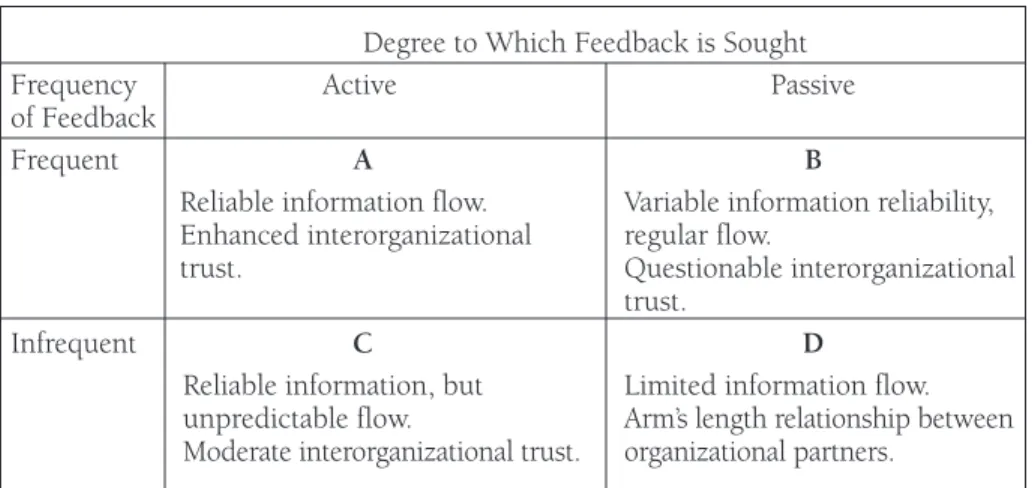
Giving and receiving feedback is time consuming and, therefore, costly. Members of partner organizations may consciously choose to use feedback as a strategic asset or may resist feedback believing that its costs outweigh the benefits. Feedback may be actively sought or it may be passively accepted. Both the frequency and regularity of feedback have the potential to influence the relationship between the partners, with more regular and frequent feedback leading to more reliable information flow and enhanced
59
interorganizational trust. The matrix in Figure 2 delineates the potential impact of feedback style on information flow and partner relationships.
Figure 2. Impact of Feedback Style on Information Flow and Partner Relations
Degree to Which Feedback is Sought
Frequency Active Passive
of Feedback
Frequent A B
Reliable information flow. Variable information reliability, Enhanced interorganizational regular flow.
trust. Questionable interorganizational
trust.
Infrequent C D
Reliable information, but Limited information flow. unpredictable flow. Arm’s length relationship between Moderate interorganizational trust. organizational partners.
In Cell A, organizational partners actively seek feedback on a frequent basis, leading to more reliable information flow and enhanced organizational trust. Trust in this situation is built on the dependability of feedback and the extent to which feedback is used to make real-time improvements. Cell B, on the other hand, illustrates the case in which feedback is accepted, but not sought. This type of situation may be related to less confidence in the partnership, based on uncertainty about the extent to which one partner is concerned about the other’s perceptions. In Cell C, organizational partners actively seek feedback, but on an infrequent basis. The unpredictability and potential lack of timeliness of the information interfere with the partners’ ability to use feedback to make program improvements. Finally, in Cell D, passively accepted feedback provided on an infrequent basis is likely to have the most negative impact on partner relationships, keeping organizational partners at arm’s length.
HPSISN asked participants to evaluate the extent to which community partners thought they were actively involved in program decisions. These evaluations were conducted at least annually, although some groups solicited input more frequently. Participants indicated a high level of satisfaction with both types of evaluation mechanisms, thus reinforcing the premise that active involvement is essential to the success of community partnerships (Gelmon, 1999).
Approaches to Incorporating Feedback
Numerous approaches are available for partners interested in stimulating helpful and growth-producing feedback, including:
• Advisory committee meetings;
• Participation in community-wide consortia or coordinating committees;
• Inclusion of consumers on advisory committees or consortia; • Sharing information related to referrals;
• Development of shared protocols and guidelines;
• Informal information exchange between individuals within partnering organizations;
• Communication media such as shared newsletters, Web pages, and electronic discussion groups; and,
• Shared programs, such as clinical programs or grant funding for demonstration programs.
Advisory committees and consortia provide formal mechanisms for seeking feedback on a regular and frequent basis. Sharing leadership of such groups and developing shared meeting agendas give participants equal opportunities for input. Well-organized advisory committee meetings that occur on a regular basis provide a mechanism for strengthening relationships between partners, fostering reliable information flow about community needs and assets, and making ongoing improvements in meeting community health needs. The University of Kentucky HPSISN Program relied heavily on an Advisory Committee that included a broad range of community partners and interested stakeholders. Because this program focused on service-learning activities related to the health of underserved women and children, the Advisory Committee was constructed to include both community agency representatives of these groups and consumers. The committee met on average twice per year and provided direct input into interdisciplinary health professions student teams’ work and feedback on the impact of student projects. Student teams consulted with committee members about the goals and implementation strategies for their projects and provided final reports.
Annual evaluations of committee members’ satisfaction with their level of participation in decision making were positive.
Developing clinical guidelines or protocols for serving particular client groups and then monitoring their effectiveness is a more formal mechanism for clinical communication. The development and distribution of communication tools, such as newsletters, Web pages, listservs, or electronic discussion groups, is yet another strategy for fostering ongoing dialogue between partners.
Strategies for Using Feedback for Program Improvement
To use feedback effectively for continuous program improvement,
organizational capacities must be developed for responding to feedback in “real time” and solving process problems interfering with feedback. In order to achieve “real time” responsiveness, feedback mechanisms must be well
Advisory committees and
consortia provide formal
mechanisms for seeking
feedback on a regular and
frequent basis.
61
established and known to all. Communication opportunities should be reliable and predictable. Key players must diligently attend to maintaining avenues of communication.
One effective strategy is to incorporate an on-going development program for program participants. Community partners in the University of Kentucky HPSISN Program indicated at the end of the program’s first year that they would like to have an
orientation to service-learning and ongoing development in this area. The first Advisory Committee meeting of each program year after that included just such an orientation. Additionally, the director of the Office of Experiential Education provided training in team development for interdisciplinary faculty members. Including multiple opportunities for development and periodic “refreshers” from the beginning of a relationship reduces the likelihood of unrecognized conflict or frustration that can escalate to dysfunctional communication.
Essential Ingredients for Effective Feedback
Trust. Participants need a strong sense of trust so they are free to explore ideas and feelings. Trust develops through consistent and full disclosure of relevant information, as well as through demonstrations of support and respect involved in the feedback process. Qualities of helpful feedback include candor, a focus on issues and problem solving rather than on personalities, and respect for differing points of view. Conflict and differences must be managed so they become positive features of the communication feedback loop. If disagreements lead to antagonism or suspicions, they can quickly derail the feedback process, as well as the partnership itself.
An additional key to developing trust among organizational partners is providing clear evidence that the strengths of each partner are valued and incorporated into the work of the partnership. One of the lessons of the HPSISN Program was that community partners valued their roles as teachers and wanted the opportunity to function in this capacity (Gelmon, 1999). They wanted university faculty to respect their expertise and to call upon them to share that expertise with health professions students.
Shared understanding of mission, goals, & policies. Continuous
improvement focuses heavily on streamlining processes. Interorganizational feedback itself can have process problems related to communication. Participants must understand all policies, procedures, and performance expectations. Failure to include and value input from all partners interferes with the development and maintenance of trust. Mutual involvement in long range planning, shared agendas, and timely distribution of minutes facilitate communication and feedback. Program leaders should be vigilant in recognizing and responding quickly to issues.
Including multiple
opportunities for
development and periodic
“refreshers” from the
beginning of a
relationship reduces the
likelihood of
unrecognized conflict or
frustration that can
escalate to dysfunctional
communication.
Involved leadership. Another critical element of the organization’s capacity for continuous improvement of feedback rests with leadership. Leaders who are too far removed from daily program operations may not be able to fully understand issues when first identified. Response time may be delayed, causing increased tensions and perhaps a decrease in morale and motivation. Re-establishing positive productive communication is more difficult than maintaining it; thus, prevention of problems is easier than correction.
Evaluation of Feedback Efficacy. Because of the quality and quantity of resources that must be dedicated to the feedback process, evaluating its effectiveness and correcting deficiencies are critical to the development of efficient partnerships. Evaluation procedures should include mechanisms for strengthening and improving feedback if the process is not meeting the desired goals. Feedback is a key component of continuous quality
improvement; program leaders should use this strategy to maximize the benefits of quality improvement information from multiple perspectives.
Challenges Related to Feedback
Using feedback reduces organizational decision-making autonomy (Provan, 1984) and creates challenges, because organizations pressed for resources may not immediately see the benefits. Lack of resources, including adequate finances and staffing, is the primary challenge many organizations identify in the development of a proactive and interactive feedback process. Together, partners should determine the goals of feedback and devise cost-effective methods of assessing whether the goals have been met.
Recommendations
Regular feedback that is actively sought is an important strategy for
optimizing partnerships. Collaborating organizations should aim to include all stakeholders in the feedback process, including consumers, policy makers, and their own organizational members. Multiple and diverse approaches to seeking and using feedback should be developed, and the effectiveness of these approaches should be assessed and improved upon on a regular basis. All partners should seek to understand and implement policies and procedural expectations. If modifications are needed,
participants should be flexible and consider overall outcomes. In evaluating the effectiveness of feedback, partners might ask whether their input is actively sought on a frequent basis; if input is used to make program improvements; and whether the ongoing benefits of engaging in joint decision making outweigh the costs. Program leadership must remain dedicated to the process, providing the framework and continuous support necessary for successful feedback.
63
Juliann G. Sebastian is Associate Professor and Assistant Dean for Advanced Practice Nursing at the University of Kentucky College of Nursing. Juliann is certified as a Community Health Clinical Nurse Specialist by the American Nurses Credentialing Center and is a Fellow in the American Academy of Nursing. She received her Ph.D. in business administration from the University of Kentucky
College of Business and Economics, and her MSN from the University of Kentucky College of Nursing. She is the Project Director for the University of Kentucky Medical Center Service-Learning Program. Her clinical expertise is in home care and nursing case management. Juliann’s research interests include understanding the structure and behavior of organizational systems in health care, and in
particular, issues related to interorganizational cooperation, partnerships, and care coordination across agencies.
Judith Skelton is an Assistant Professor in the Office of Academic Affairs at the University of Kentucky College of Dentistry. Judy received a Bachelor of Science degree in Dental Hygiene from the University of Louisville, a Master of Education degree in Adult and Technical Education and a Doctoral degree in Postsecondary Education in Curriculum and Instruction from the University of Florida. Her career includes professional contributions in the areas of service-learning, community-based and school-based dental education, faculty development, educational assessment, gender-bias in professional curricula, and periodontology. Karen West is the Assistant Dean for Academic Affairs at the University of Kentucky College of Dentistry. She received her Doctor of Dental Medicine degree from the University of Louisville in 1982 and a Master’s in Public Health from the University of South Carolina in 1992. Karen also completed a General Practice Residency at the Medical College of Georgia in 1983. She has been involved in academic dentistry for the past 15 years as faculty at the Medical College of Georgia and the University of Kentucky. Karen has worked in community
dentistry and in patient management, directed the student externship program and served as a clinical team leader for dental students. Her research interests include gender issues in dentistry and service-learning.
Conflict and differences must be
managed so they become positive
features of the communication
feedback loop.
References
Connors, K., Seifer, S., Sebastian, J., Cora-Bramble, D., & Hart, R. (1996). Interdisciplinary collaboration in service-learning: Lessons from the health professions. Michigan Journal of Community Service-Learning, 3.
Gelmon, S., & Holland, B. (1999). Final report of the Health Professions Schools in Service to the Nation Program. San Francisco: UCSF Center for the Health Professions.
Hamburg, M. (1998). Eliminating racial and ethnic disparities in health: Response to the Presidential Initiative on Race. Public Health Reports, 113,
372-375.
Provan, K.G. (1983). The federation as an interorganizational linkage network. Academy of Management Review, 8(1), 79-89.
Provan, K.G. (1984). Interorganizational cooperation and decision making autonomy in a consortium multihospital system. Academy of Management Review, 9(3), 494-504.
Sebastian, J.G., Davis, R.R., & Chappell, H. (1998). Academia as partner in organizational change. Nursing Administration Quarterly, 23(1), 62-71. Sebastian, J.G. (1999). Population-based and community-focused
approaches to vulnerability and disadvantage: Partnership models. In J.G. Sebastian & A. Bushy (Eds.), Special populations in the community: Advances in reducing health disparities. Gaithersburg, MD: Aspen.
Seifer, S. (1998). Service-learning: Community-campus partnerships for health professions education. Academic Medicine, 87(3), 273-277.
Shortell, S.M., Gillies, R.R., Anderson, D.A., Erickson, K.M., & Mitchell, J.B. (1996). Remaking health care in America: Building organized delivery systems.
San Francisco: Jossey-Bass.
Sullivan E.J., Decker P.J. (1997). Effective leadership and management in nursing (4th ed.). Menlo Park, CA: Addison-Wesley.
Thompson, J.D. (1967). Organizations in action. New York: McGraw Hill.
This work was made possible in part by a grant from the Health Professions Schools in Service to the Nation Program, sponsored by the Pew Charitable Trusts Health Professions Commission, the Corporation for National Service, the National Fund for Medical Education, and the Bureau for Health Professions. The authors gratefully acknowledge the contributions of the interdisciplinary faculty team, students, and the many community partners who exemplify the kind of productive relationships that are highlighted in this paper.
89
C
About Community-Campus
Partnerships for Health
ommunity-Campus Partnerships for Health (CCPH) is a non-profit
organization based at the Center for the Health Professions at the University of California-San Francisco. Founded in 1996, our mission is to
Foster partnerships between communities and educational institutions that build on each other’s strengths and develop their role as change agents for improving health professions education, civic responsibility, and the overall health of communities
CCPH has a focus and characteristics that are unique in that:
• We work collaboratively across sectors of higher education, communities and disciplines to achieve successful community-campus partnerships nationwide.
• We identify community members, students, administrators, faculty and staff as equal constituencies, and our board of directors reflects those diverse constituencies.
• We serve as a welcoming bridge between the many government and foundation-sponsored initiatives in community-oriented health professions education and community health improvement.
• We define health broadly to encompass emotional, physical and spiritual well-being within the context of self, family and community.
In order to achieve our mission, CCPH works collaboratively to:
• Create and expand opportunities for individuals and organizations to collaborate and exchange resources and information relevant to community-campus partnerships.
• Promote awareness about the benefits of community-campus partnerships. • Advocate for policies needed in the public and private sectors that facilitate
and support community-campus partnerships.
• Promote service-learning as a core component of health professions education.
CCPH’s major programs include:
• The CCPH Mentor Network - our training and technical assistance network, is comprised of individuals from higher education, health professions, and community-based organizations who have experience, expertise and proven records of success in important areas related to community-campus partnerships. CCPH Mentors conduct training workshops, provide consultation, and coach partnerships to fully realize their potential.
90
• Partners in Caring and Community: Service-Learning in Nursing
Education - sponsored by the Helene Fuld Health Trust, HSBC Bank USA, Trustee, this national initiative is working with nine teams of nursing faculty, nursing students, and community partners to develop models of service-learning in nursing education.
• Service-Learning Institutes - training institutes for campus-based and community-based health professions faculty and program staff who wish to integrate service-learning into their courses. Applications are now available on our website for our up to date introductory and advanced level institutes.
• Annual National Conference - our annual conference is the premier training and networking event for community and campus leaders who are pursuing or involved in community-campus partnerships.
• Healthy People 2010 Curriculum Project - this project is developing tools for integrating the Healthy People 2010 objectives into the curriculum of health professional schools across the country
• Community Scholarship Project - this project seeks to elevate the recognition and rewards for faculty who are engaged in community-based scholarship
• National Health Service Corps Educational Partnership Agreement - funded by the National Health Service Corps, this project is assisting dental school participants in the development of service-learning and other partnership opportunities in underserved communities.
As a member of CCPH, you join a movement of leaders committed to building healthier communities. You also receive a wide range of benefits and services:
By joining CCPH, you will increase your knowledge about issues impacting and contributing to successful community-campus partnerships. We believe our programs and products will provide you with rich resources to learn from and to share with your peers from across the country, and around the world. Be a leader - join CCPH - and you will receive: *
• a free copy of our resource guide to Developing Community-Responsive Models in Health Professions Education and a free subscription to Partnership Perspectives magazine
• a membership packet, including a membership directory designed to facilitate networking and information sharing among CCPH members • discounts on registration fees for our conferences and training institutes • discounts on consulting and technical assistance services tailored to your
specific strengths and needs
• access to the CCPH electronic discussion group • access to friendly and responsive staff
Please contact CCPH to receive a membership brochure or to learn more about our programs and products.
91
The CCPH Mentor Network
A training network committed to successful community-campus partnerships
“I really enjoyed your commitment to the participants by providing materials, soliciting feedback, sending follow-up information and offering to serve as a resource. It was not just you giving information; I felt like you were fostering a relationship with each participant.”
~ A training participant, 1999
The CCPH Mentor Network is a multidisciplinary network of individuals from higher education, health professions and community-based
organizations who have experience, expertise and proven records of success in important areas related to community-campus partnerships. The Network is designed to assist you, your organization, your community or your program in developing and sustaining successful community-campus partnerships. The Network works with schools, colleges, universities,
community-based organizations, student organizations, government agencies and others to strengthen health-promoting community-campus partnerships. Our mentors are skilled and actively engaged in community-campus
partnership building, leadership development, faculty development, program evaluation, strategic planning and fundraising and other areas that underlie successful community-campus partnerships. They are available to give presentations, design and lead training workshops, conduct external evaluations and provide telephone or on-site technical assistance. The mentors are trained in incorporating a blend of didactic and interactive experiential learning techniques into various consultative arrangements.
The Goals of the Mentor Network
The goals of the CCPH Mentor Network are to foster partnerships between communities and educational institutions through high-quality and effective training and consultation services. These services are intended to:
• Foster the development and sustainability of health-promoting community-campus partnerships
• Strengthen the ability of these partnerships to improve health professions education, civic responsibility and the overall health of communities • Provide CCPH with a continuous source of information about
contemporary issues facing community-campus partnerships, enabling us to be more responsive to new and emerging trends
Types of Training and Consultation
Training and consultation provided by the CCPH Mentor Network takes many forms. For training, these include but are not limited to:
• Workshops and presentations during conferences and training institutes that are sponsored or cosponsored by CCPH
92
• Workshops and presentations during conferences and training institutes that are sponsored by organizations other than CCPH
• Workshops and presentations held at the Mentee location.
Training Scenarios
The following scenarios provide a sample of training options. All training experiences are complemented by tested training tools, handouts and other resource materials. The following training options can be provided in 1-2 days.
• Community-responsive curriculum development. How can your curriculum be more student and community-responsive? This training would address the “process” and implications for designing a
curriculum that meets both the institutions objectives for academic learning, the student’s learning and professional growth objectives, and the “service” objectives of community clinician and agency partners. Trainers can assist the faculty and their team members in designing an action plan in follow-up to the training.
• Faculty development and leadership. How can faculty leadership in community-based education be fostered? What are the faculty
competencies for working in community-based settings? Trainers can assist faculty in discovering their leadership abilities and develop strategies for effectively “channeling” these abilities in community settings.
• Community leaders involved in community-campus partnerships.
Would you like to learn more about working in partnership with a health professions school in your area? This training provides community clinicians and agency staff with the skills and
competencies to effectively build partnerships with campus faculty and staff, and to “navigate” through the academic system. In addition, participants learn important strategies for developing a partnership agreement with other stakeholders and the “nuts and bolts” of working with students in community-based settings.
• Student leadership and development. How can we foster student leadership skills and abilities? This training is modeled from tested student leadership institutes held by CCPH. Student learners engage in interactive hands-on sessions focused on developing their
leadership skills in the area of communication, community organizing and advocacy, partnership building, and working with the media. Students work with trainers to design an action plan for
implementation following the training.
• Service-learning in the health professions. This training focuses on service-learning as an effective educational methodology for improving student education and community health. Trainers work with faculty and program staff to understand the theory of service-learning, effective “reflection” strategies for classroom and community-based settings, partnership building strategies, service-learning assessment,
93
Members of the Mentor Network can design a training or consultation that reflects your desires, and builds upon your knowledge and skill base. Prior to any training or consultation, members of the Mentor Network will work with you to assess your most pressing issues based on your completion of the Network Skills and Needs Inventory Tool. Your completion of the inventory tool will also reveal the learning method(s) desired by your and/or your organization.
In addition to customized trainings, Community-Campus Partnerships for Health also sponsors regularly scheduled introductory and advanced service-learning institutes for community and campus faculty and staff. Institute information and application materials can be obtained by completing the enclosed index card, downloading the application from our website
(www.futurehealth.ucsf.edu/ccph.html), or by contacting our fax on demand service by calling 1-888-267-9183 and selecting documenting # 206.
CCPH Mentor Network Fees
CCPH Mentor Network services are usually provided on a fee-for-service basis according to a fee schedule, plus reimbursement of travel expenses where applicable. Discounts are provided to CCPH members and to programs paying for services with federal funds. As an organizational member of CCPH, you will receive a free one hour consultation on the topic of your choice.
Our Mentors
Our mentors include:
Barbara Aranda-Naranjo, University of Texas Health Sciences Center Patricia Bailey, University of Scranton-Department of Nursing
J. Herman Blake, Iowa State University-Department of African American Studies
Diane Calleson
Kate Cauley, Wright State University-Center for Healthy Communities Kara Connors, Community-Campus Partnerships for Health
Hilda Heady, West Virginia Rural Health Education Partnerships Kris Hermanns, Brown University-Swearer Center for Public Service Sherril Gelmon, Portland State University
Barbara Holland, Northern Kentucky University
Mick Huppert, University of Massachusetts Medical Center, Office of Community Programs
Cheryl Maurana, The Medical College of Wisconsin-Center for Healthy Communities
Nan Ottenritter, American Association of Community Colleges Tom O’Toole, Johns Hopkins University Department of Family and
Community Medicine
Letitia Paez, Institute for Community Health Education
Monte Roulier, Roulier Associates
Julie Sebastian, University of Kentucky College of Nursing
Sarena Seifer, Community-Campus Partnerships for Health and the University of Washington School of Public Health
Ira SenGupta, Cross Cultural Health Care Program
More information about our mentors can be obtained by contacting CCPH.
Examples of Recent Mentor Network Activities include:
• Engaging Colleges and Universities in the Healthy Communities Movement. Coalition of Healthier Cities and Communities national meeting (workshop).
• Building Partnerships Between Communities and Higher Educational Institutions. East San Gabriel Valley Community Health Council meeting (facilitated meeting).
• Assessing the Impact of Service-Learning. Rutgers University School of Nursing Center for Families and Communities (presentation).
• Joining Forces with Health Professional Schools to Close the Access Gap. Robert Wood Johnson Foundation Reach Out Initiative annual meeting (presentation).
• Leadership for the Engaged Campus: Dental Schools and Their
Surrounding Communities. Council of Deans annual meeting, American Association of Dental Schools (presentation).
• Service-learning in Nursing Education. Minnesota Campus Compact (presentation and training institute).
• Service-learning Institute in the Health Professions. Congress of Health Professions Educators, Association of Academic Health Centers
(training institute).
• Building a Strong Interdisciplinary Team. WK Kellogg Interdisciplinary Community Health Fellowship Program, American Medical Student Association (training workshop).
• Developing a Community-based Nursing Education Curriculum. Colby-Sawyer College (strategic planning meeting).
• Achieving Healthy People Objectives through Service-learning, Association of Teachers of Preventive Medicine (presentation).
We’re ready to assist you
Please complete and submit the enclosed insert card and we will follow-up with you to discuss how the CCPH Mentor Network can help you realize your community-campus partnership goals. Or, you may contact us by phone: 415/476-7081; email: [email protected]; or fax: 415/476-4113. We look forward to working with you.