Pacific Earthquake Engineering
Research Center
Framing Earthquake Retrofitting Decisions:
The Case of Hillside Homes in Los Angeles
Detlof von Winterfeldt
University of Southern California
Nels Roselund
The Roselund Engineering Company
South San Gabriel, California
Alicia Kitsuse
Framing Earthquake Retrofitting Decisions:
The Case of Hillside Homes in Los Angeles
Detlof von Winterfeldt
School of Policy, Planning, and Development University of Southern California
Los Angeles, California Nels Roselund
The Roselund Engineering Company South San Gabriel, California
Alicia Kitsuse
School of Policy, Planning, and Development University of Southern California
Los Angeles, California
A report on research conducted under
award no. SA2236JB from the National Science Foundation
PEER Report 2000/03
Pacific Earthquake Engineering Research Center College of Engineering
University of California, Berkeley March 2000
ABSTRACT
The Northridge earthquake of 1994 created a surprising amount of damage to homes located on the hillsides of Los Angeles. Of approximately 10,000 hillside homes, 374 were damaged, some severely. This report examines three different representations, or “decision frames,” of the decision to improve the earthquake safety of hillside homes. The first decision frame is that of a safety engineer in a regulatory agency concerned with developing a city ordinance to reduce the future earthquake damage to hillside homes. The second decision frame is that of an individual homeowner, contemplating the decision to spend money on retrofitting his or her home to reduce the risk of earthquake damage. The third decision frame is that of an economist concerned with setting regulations that produce the largest net social benefits. Based on a review of the engineering and economic issues, and interviews with engineers and homeowners, three formal decision models were developed that represented these decision frames. Each of the models resulted in different recommendations. The regulatory model suggested the most stringent and costly retrofitting measures. The individual homeowner model suggested no retrofits. The economic model suggested minor retrofits. The report concludes that resistance to implementation of earthquake ordinances by individual homeowners may not be irrational, but merely due to a decision frame that is different from those of an economist or engineer. Understanding the decision frames of people who eventually have to pay the cost of the regulations, and providing appropriate incentives for implementation should therefore be an important part of both regulatory and economic analysis.
iv
ACKNOWLEDGMENTS
This work was supported in part by the Pacific Earthquake Engineering Research Center through the Earthquake Engineering Research Centers Program of the National Science Foundation under Award number SA2236JB.
CONTENTS
ABSTRACT ... iii
ACKNOWLEDGMENTS...iv
TABLE OF CONTENTS ...v
LIST OF FIGURES... vii
LIST OF TABLES ...ix
1 INTRODUCTION...1
2 EARTHQUAKE RISKS OF HILLSIDE HOMES ...3
2.1 Classification of Hillside Homes ...3
2.2 Classification of Down-Slope Structural Systems ...6
2.3 Earthquake Engineering Basics for Hillside Houses ...7
2.4 Typical Damaging Earthquake Response of a Braced-Wall System in a Down-Slope Hillside House ...8
2.5 Typical Damaging Earthquake Response of a Braced-Frame System in a Down-Slope Hillside House ...10
2.6 Retrofit Strategy ...12
2.7 Costs and Benefits...14
3 INTERVIEWS...17
3.1 City Engineer ...17
3.2 First Focus Group Meeting ...18
3.3 Second Focus Group ...20
3.4 Comparison of Focus Groups...22
4 FORMAL REPRESENTATIONS OF THREE DECISION FRAMES FOR RETROFITTING HILLSIDE HOMES ...23
4.1 Regulatory Frame...23
4.2 The Homeowner’s Frame ...25
4.3 Social Cost-Benefit Frame ...31
5 IMPLICATIONS FOR EARTHQUAKE POLICY...35
vii
LIST OF FIGURES
Fig. 2.1 Distribution of damaged hillside homes, Northridge earthquake 1994 ...4
Fig. 2.2 Up-slope home—Ordinary seismic hazards ...5
Fig. 2.3 Down-slope homes—Hillside seismic hazards...6
2.3a Braced-frame...6
2.3b Braced-wall ...6
Fig. 2.4 Braced-wall system—Down-slope shaking ...9
Fig. 2.5 Braced-wall system—Cross-slope shaking...10
Fig. 2.6 Braced-frame system—Down-slope shaking...11
Fig. 2.7 Braced-frame system—Cross-slope shaking ...12
Fig. 2.8 Retrofit anchored-bracing system for braced-wall house ...13
Fig. 2.9 Retrofit anchored bracing system for braced-frame house ...13
Fig. 2.10 Primary anchor ...14
Fig. 2.11 Retrofit secondary anchors...15
Fig. 4.1 Decision tree for hillside home retrofitting problems ...28
Fig. 4.2 Rolled back decision tree for the individual homeowner’s analysis...30
LIST OF TABLES
Table 4.1 Conditional Probabilities of Damage States Given Shaking Levels ...27 Table 4.2 Expected Costs of the Retrofitting Decision Broken Down into
Cost Components. ...32 4.2a Homeowner’s Frame ...32
1 Introduction
After a serious earthquake city planners and engineers typically study the causes of damage, develop strategies for avoiding or reducing damage in similar earthquakes, and design regulatory actions to implement these strategies. More often than not, they are subsequently faced with substantial resistance by individuals and organizations who have the responsibility for implementing the regulation.
After the devastating Northridge (Los Angeles) earthquakeon January 17, 1994, several committees were created and ordinances passed that followed this pattern of investigation, mitigation recommendation, and resistance to implementation. One case described and analyzed in this report concerns hillside homes, which experienced unexpected damage during the Northridge earthquake. While the foundations of hillside homes held up very well, some 374 sustained significant damage, primarily due to the separation of structure from foundation. This was both an unexpected and significant event (about 3.7% of hillside homes in Los Angeles were affected).
The Hillside Buildings Subcommittee of the Los Angeles Department of Building and Safety (1996) investigated the causes of the damage to the hillside homes and made recommendations to improve their earthquake safety. The recommended retrofits are not cheap. For new homes, they amount to an increase of 1% or more of their construction cost; for existing homes, between $5,000 and $25,000. The recommendations were adopted as a mandatory ordinance for new homes, but were left to be voluntary for existing homes. So far, the response from owners of existing hillside homes has not been enthusiastic. Many homeowners don’t know about the ordinance, and some of those who do question its cost-effectiveness.
Reasonable people can disagree on the best course of action when considering earthquake mitigation measures, because they can have very different representations of the decision problem. For example, an engineer may seek solutions that provide certainty in risk reduction,
even if it comes at a high cost. An economist may look for solutions that maximize expected net social benefits, which may suggest modest and only partially effective retrofitting options. An individual homeowner who expects to live in a house for only a few years may not want to spend large amounts of money on retrofits that may never be recovered in a sale.
Tversky and Kahneman (1981) use the term “decision frames” to describe these different perspectives for the same decision problem, and demonstrate that different decision frames can have a powerful effect on a decision-maker’s preference. This report examines alternative decision frames in the context of the decision to retrofit 10,000 hillside homes in Los Angeles.
The research for this report consisted of three approaches: First, we collected data and reviewed the available written material on earthquake safety of hillside homes; second, we interviewed a city engineer and homeowners to better understand their views of the problem; and third, we developed three formal decision models representing a regulatory decision frame, an economic decision frame, and an individual homeowner’s decision frame.
The surprising result is that the three decision frames lead to quite different conclusions about the best retrofitting policy. Yet all three frames are rational and defensible. In the last chapter, we argue that for policy to be effective and implementable, stakeholders have to develop a common decision frame, or at least understand each other’s frames better.
3
2
Earthquake Risks of Hillside Homes
In the Northridge earthquake, which measured 6.7 on the Richter scale, 374 of about 10,000 Los Angeles hillside homes were damaged, some severely. Figure 2.1 adapted from the report by the Hillside Buildings Subcommittee of the City of Los Angeles Department of Building and Safety (1996) shows the distribution of damage. This raised concerns about the safety of hillside homes. Following is a summary of the engineering issues related to the earthquake safety of hillside homes.
2.1 CLASSIFICATION OF HILLSIDE HOMES
Hillside homes may be divided into two classes: up-slope and down-slope. Up-slope homes (Figure 2.2) are built on ground that rises above their street; their design incorporates features intended to minimize access and construction problems posed by the land rising above the street. Thus, often the garage and secondary portions of the living space are built in excavations cut into the slope at or near street level. The main living level is built at a level above the street, as low and as near to the street as practical on foundations embedded in leveled pads. The result is that the main level of up-slope homes is generally built directly on or relatively close to its foundations.
On the other hand, down-slope homes (Figure 2.3) are built on ground that drops below their street; their design incorporates features intended to minimize access and construction problems posed by the land dropping away from the street. Thus, usually, the main level of the house is at or near street level with supports that rise from foundations that are embedded in the ground that slopes down and away from the main level. The further from the street a portion of the foundation is, the higher the structure bearing on it must reach to support the main level of the house. The result is that the main level of down-slope homes is generally separated from its foundation by a tall supporting structure.
Fig. 2.1 Distribution of damaged hillside homes, Northridge earthquake 1994
0
20
40
60
80 100 120 140 160
90-100%
80-89%
70-79%
60-69%
50-59%
40-49%
30-39%
20-29%
0-19%
Percent Damage
Number of Buildings
5
Fig. 2.2 Up-slope home—Ordinary seismic hazards
The earthquake-resisting characteristics of the two types of hillside homes are very different. Up-slope homes usually pose only ordinary seismic hazards. They generally respond to earthquake shaking much like a home on flat land: the main levels of both flat-land homes and up-slope homes are usually built directly on the foundations, so there is little difference in seismic damage. Down-slope homes, on the other hand, tend to have characteristically poor responses to earthquake shaking because the underfloor structure between the foundation and the main level of the house, as commonly built in the past, typically provides a poor interconnection of the house to its foundation. It is down-slope homes that generally display the kinds of seismic damage typically associated with hillside homes.
a. Braced-frame b. Braced-wall Fig. 2.3 Down-slope homes—Hillside seismic hazards
2.2 CLASSIFICATION OF DOWN-SLOPE STRUCTURAL SYSTEMS
A down-slope house is connected to its foundation by its underfloor bracing system, which is commonly either the braced-frame or the braced-wall type. Braced-frame underfloor structures (Figure 2.3a) are built with frames of steel beams and columns supported on the tops of footing pads at discrete locations on the hillside below the main level floor. These houses are often described as stilt houses because of their tall slender supporting columns. Diagonal steel rods interconnecting opposite corners of the steel frames provide the bracing against displacement of the main level floor during an earthquake. The forces produced by the Northridge earthquake caused the steel bracing rods of many braced-frame houses to stretch and become permanently elongated so that they could no longer provide rigid bracing for the main level of the house.
Braced-wall underfloor structures (Figure 2.3b) are built with wood-stud framed walls supported on the tops of stepped or sloped foundations. The wall framing is typically sheathed with plywood, or stucco, and sometimes with gypsum board sheathing (on the interior surfaces). The sheathing provides the bracing against lateral displacement of the main level floor during earthquake shaking. Walls built on footings embedded in a downward sloping hillside are generally not rectangular but triangular or trapezoidal. The 1994 Northridge earthquake damaged many non-rectangular bracing walls.
7
A third and potentially very effective type of underfloor structural bracing system is not common: the anchored-bracing system. An anchored-bracing system makes use of connections of the house that are anchored directly to the upper parts of the foundation. Anchored connections are present in all houses with braced-wall and with braced-frame systems. However, most anchored connections before the Northridge earthquake were generally not specifically designed as part of an anchored-bracing system in which these primary structural elements connect the house to its foundation. To be effective, anchored connections must be so designed. Although the designed anchored-bracing system was developed before the Northridge earthquake, its effectiveness was not widely recognized and it was rarely used until after the seismic response of down-slope houses was studied following the earthquake.
2.3 EARTHQUAKE ENGINEERING BASICS FOR HILLSIDE HOUSES
It is important that the underfloor bracing system of a house be strong enough to remain undamaged by earthquake shaking. If damage occurs to the underfloor bracing system, it can lead to further structural damage in other parts of the house. In the case of a hillside house, in which the living space may be high above the ground, structural damage has the potential of being extremely hazardous, and may even result in partial collapse of the house.
The underfloor bracing system needs to have two important characteristics: adequate strength and adequate rigidity. An element of the underfloor bracing system must have strength
to resist the forces expected from earthquake shaking, and rigidity to assure that while the element is resisting seismic forces, it does not displace enough to cause separation of other parts of the house that cannot tolerate excessive displacement.
In a modern flat-land or up-slope house, the commonly used underfloor bracing connections of the house to the foundation are the result of years of good performance on flat-land buildings. They are both strong and rigid. In addition, they are usually numerous and redundant so that loss of one effective bracing connection will, at worst, add slightly to the load that adjacent connections must resist. In a down-slope hillside house, the bracing connections to the foundation are not all equally effective because the connections of different types of bracing systems have differing rigidities. As a general rule, the greater the distance from the main level of the house to the foundation, the less rigidity the connection has.
The potentially most rigid connections of the house to its foundation are anchored connections directly connecting the house to its foundation where the main level meets the
foundation, which is generally at the highest level of the foundation. However, unless the direct connections of the house to its foundation are carefully designed for strength as anchored-bracing, even though they are direct and rigid, they may not be strong enough to be effective.
Braced-wall or braced-frame systems in an underfloor bracing system are much less rigid than anchored-bracing because they are indirect. In addition they have what have been found to be unexpected weaknesses. If an underfloor bracing system incorporates anchored connections not designed as an anchored bracing system with either a braced-wall or braced-frame bracing system, it is vulnerable to damage. Damage occurs when the less rigid bracing system allows the house to displace enough to break the rigid direct connections that were not designed with adequate strength.
2.4 TYPICAL DAMAGING EARTHQUAKE RESPONSE OF A BRACED-WALL SYSTEM IN A DOWN-SLOPE HILLSIDE HOUSE
A braced-wall system, when loaded by an earthquake force, displaces in the direction of the force. We can study the effect on a house of a braced-wall’s displacement by considering the effects of forces in two horizontal directions, each direction perpendicular to the other: in a down-slope direction and in a cross-slope direction.
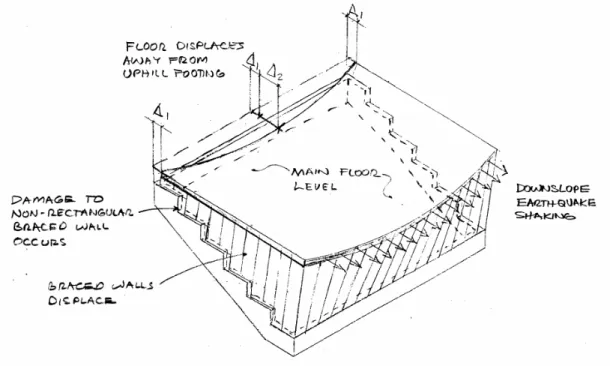
1. Shaking in a down-slope direction (Figure 2.4). When loaded to its capacity with a horizontal earthquake force, a braced-wall may displace as much as an inch or more without damage to the braced-wall. However, if the main level of the house moves with the braced wall, an inch of deflection will probably damage the anchored connections of the house to the uphill footing. The braced walls that resist down-slope forces are typically trapezoidal or triangular in shape. Because of the characteristic damage that tends to occur to a non-rectangular braced wall under a strong earthquake force, the displacement of the main level of a house may be considerably more than the expected one inch. The result of such a large displacement is typically that the rigid anchored connections of the house to the uphill footing are broken. In such cases, the house becomes disconnected from its foundation, and vulnerable to further serious damage.
9
Fig. 2.4 Braced-wall system—Down-slope shaking
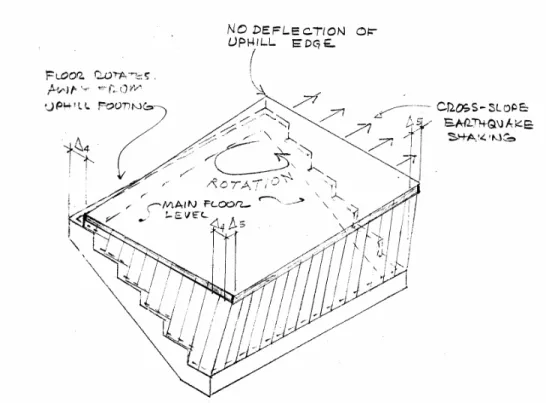
2. Shaking in a cross-slope direction (Figure 2.5). When the direction of the earthquake forces on a house are oriented across-slope, displacement of the main level floor will be greatest at the edge over the tallest braced wall and least at the edge closest to the foundation. The result of this difference in displacement is rotation of the main level floor. As the floor rotates, one corner tends to separate from the uphill footing. If the rigid anchored connections near that corner do not have the strength to prevent that separation, they may be damaged. If broken, the house may then become disconnected from its foundation at that corner and become vulnerable to serious damage. Because earthquake forces are cyclic, reversing direction, this kind of damage may occur at both uphill corners of the main level floor.
Fig. 2.5 Braced-wall system—Cross-slope shaking
2.5 TYPICAL DAMAGING EARTHQUAKE RESPONSE OF A BRACED-FRAME SYSTEM IN A DOWN-SLOPE HILLSIDE HOUSE
A braced-frame system, like a braced-wall system, also displaces under earthquake loading. We can study the effect on a house of a braced-frame’s displacement by considering the effects of forces in two horizontal directions, each direction perpendicular to the other: in a down-slope direction and in a cross-slope direction.
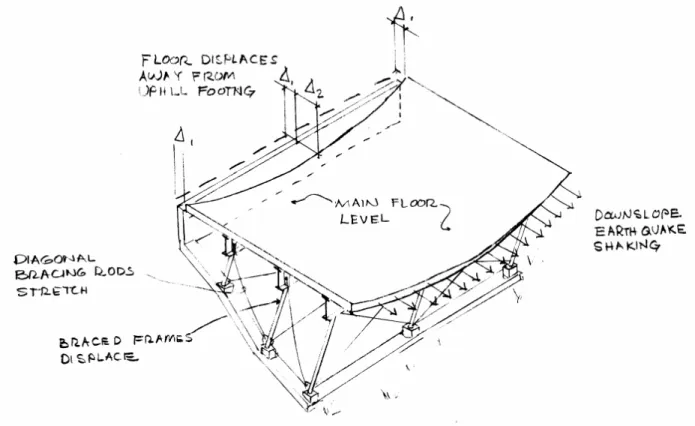
1. Shaking in a down-slope direction (Figure 2.6). When loaded to its capacity with a horizontal earthquake force, the amount of displacement in the braced frame is also in the range of one inch; its displacement is due to elongation of the diagonal steel rod. However, if the diagonal steel rod becomes permanently elongated, the displacement may be even greater than the expected one inch. The result of such a large displacement is typically that the rigid anchored connections of the house to the uphill footing are broken. If such connections are broken, the house becomes disconnected from its foundation, and vulnerable to further serious damage.
11
Fig. 2.6 Braced-frame system—Down-slope shaking
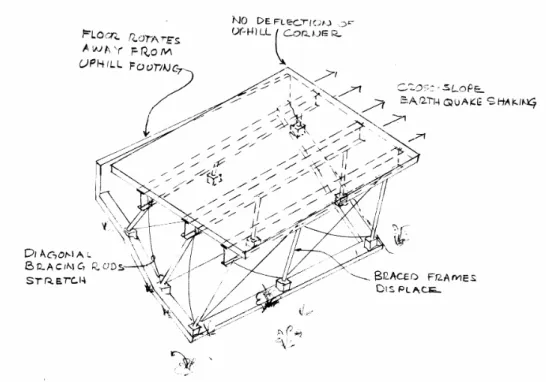
2. Shaking in a cross-slope direction (Figure 2.7). When direction of the earthquake forces on a house are oriented across the slope, displacement of the main level floor will be greatest at the edge over the tallest braced-frame, and least at the edge closest to the foundation. The result of this difference in displacement is rotation of the main level floor. As the floor rotates, one corner tends to separate from the uphill footing. If the rigid anchored connections near that corner do not have the strength to prevent that separation, they may be damaged. If these connections are broken, the house may become disconnected from its foundation at that corner and become vulnerable to serious damage. Because earthquake forces are cyclic, reversing direction, this kind of damage may occur at both uphill corners of the main level floor.
Fig. 2.7 Braced-frame system Cross-slope shaking
2.6 RETROFIT STRATEGY
Mitigation of the potential earthquake damage that may be caused to a down-slope house requires a system that will prevent separation of the house from the uphill footing during earthquake shaking. The approach must be to make the connection of the main level of the house to the uphill footing strong enough to prevent separation. Because houses with anchored-bracing systems were not damaged by separation of the house from the uphill footing during the Northridge earthquake, installation of a retrofit anchored-bracing system has been determined to be the best retrofit strategy for a down-slope house with either a braced-wall or a braced-frame underfloor bracing system.
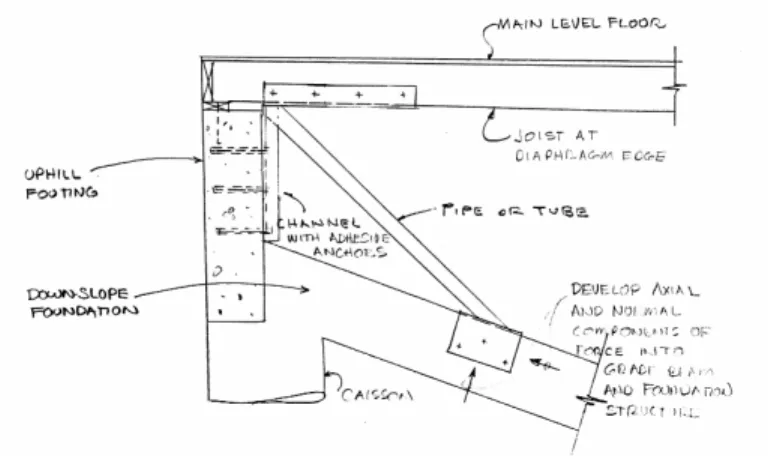
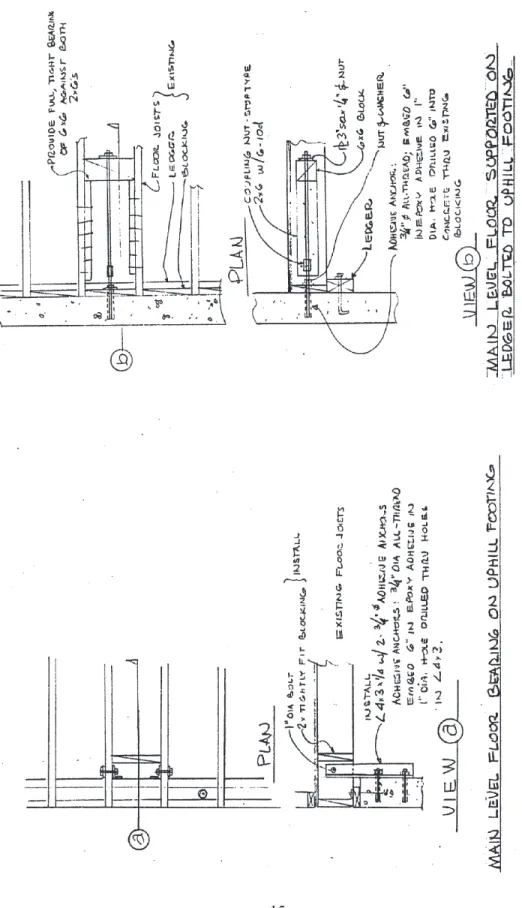
Division 94 of the City of Los Angeles Building Code, Voluntary Earthquake Hazard in Existing Hillside Buildings (1996), is a city ordinance that provides rules for seismic strengthening of down-slope hillside houses. Though the ordinance is voluntary, it mandates rules that are intended to assure that if a building owner decides to strengthen a house for earthquake hazard reduction, an effective strategy is applied. The strategy required by Division 94 of the City of Los Angeles Building Code is installation of a retrofit anchored-bracing system to brace a hillside house to its foundation. Two types of anchored connections are required by the ordinance, primary anchors and secondary anchors. Figure 2.8 shows a retrofit scheme for a
13
house built with a braced-wall system. Figure 2.9 shows a retrofit scheme for a house built with a braced-frame system.
Fig. 2.8 Retrofit anchored-bracing system for braced-wall house
The retrofit anchored-bracing devices are steel hardware connected to the wood framing of the main level floor and to the upper portions of the foundation of the house.
1. Primary anchors (Figure 2.10) that anchor the main level floor to the down-slope foundations are intended to replace the function of braced-walls or braced-frames that originally were constructed on the down-slope foundations.
Fig. 2.10 Primary anchor
2. Secondary anchors (Figure 2.11) that secure the uphill edge of the main level floor to the uphill foundation are intended to protect the weak anchor bolt connections to the uphill footing along the edge of the main level floor. The anchor bolt connections are easily damaged by small displacements of the floor away from the uphill footing—secondary anchors provide restraint against such displacements.
2.7 COSTS AND BENEFITS
The expected cost of a typical retrofit project on a hillside house was estimated in 1995 to be in the range of approximately $14,000. This is about three times the cost of a typical seismic hazard reduction retrofit project on a flat-land house. However, the investment in a hillside house that would be protected by a seismic retrofit project is likely to be considerably greater than that in a flat-land house. In any case, the cost of a retrofit project based on the Los Angeles city ordinance has a high probability of being several times less than the cost of repairs required to a hillside house that is not retrofit and is damaged by earthquake shaking.
15 Fi g. 2 .1 1 R et rofit secondar y anchors
3 Interviews
To better understand the views of various parties about the earthquake risks of hillside homes, interviews with a city engineer and homeowners were conducted. The engineer worked for the Los Angeles Department of Building and Safety. The homeowner interviews were conducted in two focus groups. The first group was a homeowners’ association called the “Hillsiders” in Culver City, California. In spite of its name, the homes of this group are actually on fairly flat terrain, and as a result these homeowners had few concerns regarding the hillside safety of their homes. The second focus group comprised people who live in the Studio City and Sherman Oaks area of Los Angeles, which has fairly steep terrain and had seen substantial damage in the Northridge earthquake. This group was much more concerned with earthquake safety related to hillside issues.
3.1 CITY ENGINEER
We reviewed the process that led up to the city ordinance on hillside buildings and the rationale for making the ordinance mandatory for new buildings but voluntary for existing ones. Much of the material that we covered in the interview is described in the report by the Hillside Buildings Subcommittee (1996), so will not be repeated here. Instead we will discuss some general insights about the decision frame as we understand from the interview materials, the committee report, and from one author's participation as a committee member (Nels Roselund).
It was clear that the damage to hillside buildings represented a new concern with earthquake safety. The response by the Committee and the Department was something like this: Let’s try to figure out engineering solutions that provide a high degree of assurance that a home that is retrofit with these solutions would not be damaged during a Northridge-type earthquake.
18
Another line of reasoning was that the cost of retrofitting should be significantly below the cost of rebuilding a damaged home.
The sixteen recommendations by the committee originally were considered for both new and existing homes. For new homes the cost of implementing these recommendations would be modest (about 1% of construction cost—or $2,000 to $5,000), but for existing homes it could be substantial—up to $25,000, depending on the difficulty in accessing the areas under the house that needed improved anchoring to the foundation.
Recognizing the high cost of retrofitting existing homes, the city decided to create a mandatory ordinance for new construction only and to keep the ordinance voluntary for existing homes. This conclusion was apparently based on the commonsense observation that it would be hard to convince homeowners of the benefits of spending $5,000 to $25,000 on earthquake safety.
There was little discussion of the probabilities of damage and of the economic benefits of retrofitting. To the extent that probabilities were mentioned, they were expressed in the form of scenarios like “in a Northridge-like earthquake.” The economic benefits were mentioned primarily to provide benchmarks for the cost of retrofitting.
Overall, the representation of the decision problem can be described as follows: We identified a new set of problems with the earthquake safety of hillside homes; we know how to fix these problems, at least for moderate to strong earthquakes like the Northridge earthquake; as long as the costs of the fixes are significantly below the damage that is likely to occur in a Northridge-like earthquake, and as long as these fixes provide a higher degree of assurance that there won’t be any damage, they are probably reasonable.
3.2 FIRST FOCUS GROUP MEETING
Twelve homeowners participated in the first focus group session, which took place on September 29, 1999. The session lasted two hours. During the first half hour, the participating author (Nels Roselund) made a presentation about the earthquake hazards of hillside homes. This was followed by a short review of earthquake risk statistics from the Northridge earthquake. After the presentation, focus group members were asked a number of questions regarding their assessment of earthquake risks and their willingness to invest in retrofitting measures.
Because participants were members of a local Community Emergency Response Team (CERT), they were especially sensitized to safety concerns. The CERT team meets monthly to
discuss emergency safety issues. However, the group had never before discussed seismic retrofitting. As one group member put it, “We haven’t given thought to preventing earthquake destruction. Mostly we think about cleaning up afterward.”
The fact that most participants’ homes had survived the Northridge earthquake with little or no damage appeared to reduce their perceptions of future risks. Of the group, only one homeowner had sustained substantial damage to his home during that event.
In a show of hands, all participants indicated concern about the earthquake safety of their home. The group agreed that their primary concern about earthquakes was personal safety rather than damage to property. However, when asked to compare earthquake risk to other types of risk, many indicated more concern with other issues. Several participants ranked auto safety, fire protection, and protection from crime as greater concerns than earthquakes. One participant said that given a budget of $10,000 to make any safety improvement to her home, she would first opt to install a home alarm system and would use the remainder of the money to fix something that an earthquake inspection revealed needed to be done to her home.
Other respondents said they would spend their budget on smoke alarms and sprinkler systems, earthquake-readiness supplies, and basic precautions such as strapping down valuable items in their home. One respondent said he would spend $5,000 on bolting and $5,000 on reinforcing his chimney. Another said he would put his money into reinforcing floor joists.
Seven out of the 12 participants held an earthquake insurance policy on their home. Some of the insured had been prompted to purchase insurance by a new state policy that lowered earthquake insurance deductibles, raised upper limits of coverage, and provided greater allowance for living expenses in case of residential destruction. One person who did not have insurance said that he had done seismic reinforcements in his home and felt that this measure would offer sufficient protection.
In general, participants in this group did not seem willing to pay much for earthquake retrofitting measures. A number of participants expressed a fatalistic attitude toward earthquakes. As one group member put it, “An earthquake is the thing you can do least about. It’s going to happen arbitrarily—there’s no escaping it.” Another participant noted that there appeared to be a periodicity of about 20 years to major earthquake events; as a homeowner, he would factor in the likelihood that a large earthquake would hit during the period in which he owned his home before investing in safety improvements.
20
One participant indicated that he would require substantial cost-benefit information before investing in earthquake retrofitting for his home. This respondent indicated that he would like to know how much more vulnerable hillside homes were than others, what distinguished one damaged home from the one next door, and the magnitude at which earthquake retrofitting would prove effective. This participant also indicated that this information would have to be sanctioned by an unbiased, official body. He would not deem trustworthy agents who might profit from retrofitting, such as engineers or contractors.
Other participants echoed this concern, noting that at higher levels of investment they would require assurance that retrofitting would in fact work, and assurances about the earthquake magnitude at which retrofitting would protect their home. In the absence of this information, they felt they would be “putting money in against unknowns.”
Participants also expressed interest in better understanding the tradeoffs available to them, e.g., the tradeoff between paying a large deductible in case of damage to their home versus the cost of taking preventative action. One participant suggested the need for a computer program that would take account of various variables and advise homeowners of tradeoffs.
Participants said they would be more likely to invest in retrofitting if there were a program in place to help finance such improvements. One participant who had fixed a cripple wall in his home after the Northridge earthquake said that he had been motivated to do so by a FEMA program that offered an easy-to-follow program for getting such expenses reimbursed.
Some respondents suggested that they might be more likely to put money into retrofitting their home if disclosure of earthquake hazards upon sale of their home were mandated. Respondents said that they would also view insurance discounts as an incentive to retrofitting their home.
3.3 SECOND FOCUS GROUP
Nine people were present at the second focus group meeting, which took place on December 1, 1999 and lasted an hour and forty-five minutes. The group comprised homeowners living in hillside areas of the Sherman Oaks and Studio City sections of Los Angeles, where property damage from the Northridge earthquake was significant. Indeed, many of the guidelines contained in the voluntary city ordinance on retrofitting hillside homes were based on the study of property damage that occurred in these areas. Five of the nine participants in the group
resided in these areas at the time of the Northridge earthquake, and most participants’ current residences had sustained at least moderate damage. A number of participants had implemented retrofitting measures in their homes subsequent to the quake. However, none was familiar with the guidelines established in the voluntary ordinance.
On the whole, members of this group expressed a high level of interest in obtaining information on earthquake safety and were receptive to the idea of investing in retrofitting their homes. They posed many questions during the initial presentation on the earthquake risks of hillside homes. A number of these questions concerned the creation of the voluntary ordinance and its provisions: how the ordinance had been decided, whether the guidelines had been tested on models, and how much additional protection the retrofits offered. Participants also wanted to know how to obtain a copy of the voluntary hillside ordinance. Other questions had to do with how well certain types of homes had fared during the Northridge earthquake (stilt homes, two-story homes, etc.) and how to find a qualified engineer to assess the earthquake safety of their home. A few participants asked for clarification on the technical aspects of particular types of retrofits.
All respondents indicated that they were at least somewhat concerned about earthquake safety, and about half of the group expressed serious concern. Notably, when asked what concerned them most about earthquakes, most respondents indicated greater concern with property damage than personal safety. This concern arose from the high deductibles associated with earthquake insurance policies, which frequently range from $30,000 to $50,000. After the Northridge earthquake, a number of participants found that their deductible was too high to cover the damage to their home. As one respondent noted, “I know it seems very cold to be concerned about monetary issues, but I find it quite an outrage that you have that high a deductible.”
Respondents consistently indicated that they were more concerned about earthquakes than other types of risks to their homes. For example, group members unanimously indicated greater concern about earthquakes than either landslides or crime. Only two of the nine participants expressed greater concern about fires than earthquakes.
Despite complaints about high deductibles, six of the nine participants currently held earthquake insurance policies, which they regarded as a necessary evil. As one respondent put it, “If you went through the last quake, you have to have it.” Nevertheless, “demand” for earthquake insurance was fairly elastic at different hypothetical premiums. Group members unanimously agreed they would be willing to pay $1,000 a year in premiums for a $10,000
22
deductible. However, none of the group members was willing to pay a $5,000 annual premium for a $10,000 deductible, and only half were willing to pay a $2,000 premium.
Participants displayed a greater willingness to invest directly in earthquake retrofitting measures. Presented with a four-tiered continuum of measures ranging from amelioration of life-threatening conditions to mitigations that would prevent only minor damage, participants were unanimously willing to pay $5,000 in order to ameliorate life-threatening earthquake hazards in their homes. Participants also unanimously agreed that they would consider paying $20,000 for a high-end solution that would correct all the earthquake hazards in their home. Given a budget of $10,000 to spend on any type of home safety improvements, most respondents said they would put the money toward improving the structural integrity of their house against earthquakes.
3.4 COMPARISON OF FOCUS GROUPS
The two focus groups differed in several ways:
1. Members of the first focus group lived further away from the epicenter of the Northridge earthquake and had suffered less damage. Also, their homes were built on fairly gentle slopes, and several owned homes that were actually on flat terrain. While concerned with earthquake hazards, they did not seem very interested in major structural earthquake retrofits. 2. Whereas the first group was more concerned with personal safety than with property damage,
the reverse was true of the second group. This was surprising, given that some of the San Fernando Valley participants lived on a street where a person had died during the Northridge earthquake.
3. While the first group viewed the problem in terms of costs and benefits of retrofitting, the second group seemed to view the problem more like an engineer would. In particular, they wondered whether their homes conformed to the standards established in the retrofitting ordinance. Differences in income level may have been a factor here, but it appears that the experience of actually sustaining damage to one’s home minimizes resistance to investing in retrofitting, particularly since earthquake insurance coverage is generally poor.
4
Formal Representations of Three Decision
Frames for Retrofitting Hillside Homes
4.1 REGULATORY FRAME
From a regulatory and engineering perspective the key questions are what caused the damage to hillside homes in past earthquakes (especially the Northridge earthquake) and what can be done to avoid similar damage in future earthquakes. Cost-benefit and probabilistic considerations seemed secondary in this frame.
However, it was clear from the interviews and the report by the Hillside Building Subcommittee that retrofits should not be required at all cost. The high cost of retrofitting existing homes led to the wise decision to make the hillside home ordinance voluntary for these homes. In general, the rule appeared to be to spend no more money for retrofitting than what could be saved by avoiding damages in a major earthquake. As a decision rule this can be expressed as follows:
Retrofit if C(R) < C(D|E), (4.1)
where C(R) is the cost of the retrofit and C(D|E) is the cost of the damage D given a major earthquake E.
Note, however, that this rule is vague about what constitutes a major earthquake and about the probability of the damage. If one defined E as an earthquake of magnitude 8 with an epicenter in the vicinity of the homes under consideration, almost all retrofits would be acceptable. However, an earthquake of magnitude 8 is extremely unlikely. Recognizing this problem, most regulators would likely qualify this rule by specifying scenarios for E, for example, the Northridge earthquake.
24
There are still two potential problems with this scenario-based decision rule. First, the likelihood of a Northridge-like earthquake is fairly low (about 1.2% per year).
Second, even in a Northridge-like earthquake, only 3.7% of the hillside homes were damaged. Thus, on an annual basis, the risk is only about 0.04% per year of sustaining damage. Of course, this probability increases with the number of years that are considered. Most analyses consider a 30-year life of a home. In this case, the probability of damage from Northridge-like earthquakes increases to about 1%.
A decision rule that incorporates these probabilistic considerations seems therefore more appropriate than the strict scenario-based rule. One version of this rule is as follows:
Retrofit if C(R) < p(E)*p(D|E)*C(D), (4.2)
where p(E) is the probability of a Northridge-like earthquake and p(D|E) is the probability of damage in a Northridge-like earthquake. Further generalizations of this rule would consider all possible earthquakes and sum over them to determine the limit of spending on retrofits.
It is clear that this rule will lead to much lower acceptable costs for retrofitting. When only considering a Northridge-like earthquake, the acceptable retrofitting costs would be about one percent of the average damage that hillside homes sustained in that earthquake, and certainly below the $5,000 or $25,000 that some of these retrofits may cost. When considering a wider range of earthquakes, the acceptable costs for retrofitting will increase but are unlikely to be as high as the high end of the retrofitting costs. This is because the extension to other earthquakes would include many of the frequent earthquakes of smaller magnitude and damage, but only a few of the less frequent earthquakes of higher magnitude and damage.
In summary, it appears that a deterministic framing as represented by equation (4.1) leads to the highest acceptable retrofitting costs. Even when this frame is made more specific by using a reference earthquake like the Northridge earthquake, the acceptable retrofitting costs are still high. In contrast, the acceptable retrofitting costs will be dramatically lower when using a probabilistic frame. Since most regulators and many engineers seem to use deterministic or scenario-based frames when evaluating the acceptability of retrofits, it is not surprising that the results are typically recommendations of high-end retrofits.
4.2 THE HOMEOWNER’S FRAME
The two focus groups differed in their views of the value of retrofitting. Most members of the first focus group raised issues of cost and benefit of retrofitting and some raised the issue of the low probability of large earthquakes and large damage. As a result, they challenged the recommendations by the subcommittee to retrofit. Members of the second focus group seemed to be much more willing to accept these recommendations.
For the purpose of formalizing the individual homeowner’s decision frame, we will attempt to capture the probabilistic and cost-benefit issues in a formal decision analysis. For illustration, we consider a single-family down-slope home located in the hillsides of Los Angeles. If an earthquake causes total damage to such a home, the cost of reconstruction could be $250,000 or higher. Contemplating the voluntary retrofitting ordinance for hillside homes, the homeowner considers the following options:
1. No retrofit
2. A minor retrofit for about $5,000 3. A major retrofit for about $25,000
Considerations in the evaluation of these options are 1. How long the homeowner plans to live in the house
2. The likelihood that the home will experience moderate to high ground shaking that could damage the house
3. The likelihood that the house would be damaged given different levels of ground shaking 4. The costs of different levels of damage.
Regarding consideration (1) we know from census data that the average length of owning a home is about ten years, and so will use this as the default assumption. To determine (2), we developed a methodology that combined data from the hazard mapping project by the U.S. Geological Services (www.usgs.gov 2000) and data from the Working Group on California Earthquake Probabilities (1995) to estimate a probability distribution over peak ground acceleration (PGA), measured in %g for any zip code location in California. This methodology is described elsewhere (von Winterfeldt 2000, in preparation). Using this probability
26
distribution, we consider three possible events that could occur within the time horizon contemplated by the homeowner (ten years as a default assumption):
1. Low shaking (smaller than 0.2g)
2. Moderate shaking (between 0.2g and 0.5g) 3. Strong shaking (larger than 0.5g)
Assuming a ten-year time horizon, the respective probabilities for zip codes in the area of the Los Angeles hillside homes are
P(Strong Shaking) = p = 0.03 P(Moderate Shaking) = q = 0.08
P(Low Shaking) = 1-p-q =1-0.03-0.08 = 0.89
The methodology further contemplates three damage states: 1. No damage
2. Moderate damage (defined as 50% damage) 3. Total damage (defined as 100% damage)
The probabilities of damage states depend on the level of shaking. To obtain these probabilities, we combined the data from the Northridge earthquake (see Figure 2.1) with engineering judgment. The results are shown in Table 4.1.
Table 4.1 Conditional Probabilities of Damage States Given Shaking Levels NO RETROFIT No Damage Moderate Damage Total Damage
Low Shaking 1.00 0.00 0.00
Moderate Shaking 0.90 0.08 0.03
Strong 0.55 0.30 0.15
MINOR RETROFIT No Damage Moderate Damage Total Damage
Low Shaking 1.00 0.00 0.00
Moderate Shaking 0.95 0.04 0.01
Strong 0.78 0.15 0.08
MAJOR RETROFIT No Damage Moderate Damage Total Damage
Low Shaking 1.00 0.00 0.00
Moderate Shaking 0.98 0.02 0.00
Strong 0.95 0.05 0.00
Notes:
Low shaking is defined as less than .2g
Moderate shaking is defined as between .2g and .5g Strong shaking is defined as above .5g
Moderate damage is defined as 50% damage Total damage is defined as 100% damage
Figure 4.1 shows a decision tree representing this problem (see Clemen 1991; and von Winterfeldt and Edwards 1986, for a description of the decision tree methodology). In this tree decision nodes are shown as squares, chance nodes are shown as circles. The tree begins with the choice among the three retrofitting options (none, minor retrofit, major retrofit), followed by the shaking events over 10 years, followed by the damage states. The probabilities for the shaking events depend on the time horizon and are therefore parameterized. The probabilities for damage states are taken from Table 4.1.
At the end of the tree are the consequences, labeled x, that accrue to the homeowner for a specific sequence of decisions and events. For example, if the homeowner decides not to retrofit and there is only low shaking and no damage, the consequence is x=0. On the other hand, if the
28
Fig. 4.1 Decision tree for hillside home retrofitting problems*
*This figure is a direct output of the program Decision Analysis by Treeage (DATA). It shows the expected values calculated with the usual decision analysis procedures as boxes to the right of each node. The part of the decision tree that is covered up by these expected values is not material for the purpose of understanding the results.
homeowner decides not to retrofit and there is strong shaking and total damage, the consequences are the cost of replacing the home.
To evaluate these consequences, we need to know the cost of repairing or replacing a home with moderate damage (50%) and with total damage (100%). For simplicity, we assume that the replacement value of the home is V=$250,000 and that the repair cost for a 50% damaged home is half of that, or $125,000. Knowing the retrofitting cost R ($5,000 for a minor retrofit and $25,000 for a major retrofit) we can now assign dollar costs to each end node in the decision tree:
X = R + V*D, (4.3)
where D is the percent damage.
Having defined probabilities and consequences, it is now trivial to “roll back” the tree and to calculate the expected values for the three decisions. The result is shown in Figure 4.2. It clearly indicates that the best decision is not to retrofit. This result is determined primarily by the low probabilities of moderate and strong shaking and by the low conditional probabilities of the damage states.
Table 2a shows the expected costs of the three decision alternatives broken down by retrofitting cost and expected damage cost. Clearly, as retrofitting costs increase, the expected damage costs decrease. However, the reduction of expected damage cost is not sufficient to make up the retrofitting costs.
We conducted several sensitivity analyses and concluded that under three conditions, a minor retrofit becomes the preferred option:
1. If the time horizon is increased to about 30 years
2. If the replacement value V is increased to about $750,000 3. If the homeowner is very risk averse
30
Fig. 4.2 Rolled back decision tree for the individual homeowner’s analysis*
*This figure is a direct output of the program Decision Analysis by Treeage (DATA). It shows the expected values calculated with the usual
decision analysis procedures as boxes to the right of each node. The part of the decision tree that is covered up by these expected values is not material for the purpose of understanding the results.
4.3 SOCIAL COST-BENEFIT FRAME
Not all regulators work within the frame described in section 4.2. An alternative frame is a cost-benefit analysis. In this frame all the social costs and cost-benefits are counted that result from a regulatory action and the action with the highest net social benefits should be taken.
When cost-benefit analysis incorporates uncertainties, it is very similar to a decision analysis. We therefore use the decision tree in Figure 4.1 to represent the cost-benefit frame as well. However, there are three important changes:
1. We now need to consider all 10,000 homes in the Los Angeles hillsides, not just a single home. Therefore all costs (retrofitting and replacement costs) will need to be multiplied by 10,000.
2. The replacement value of the house V can no longer be tailored to a specific home. Rather, the average replacement value of the 10,000 hillside homes in Los Angeles should be used. As a default, we will use V=$250,000, as in the individual home example.
3. The time horizon should be the useful life of the home, not the homeowners’ time horizon for living in it. From a societal perspective, it does not matter who lives in the home—it will always be occupied during its useful life. As a default, we will use 30 years of useful life.
When making these three adjustments to the decision tree we obtain the results shown in Figure 4.3. Interestingly, the best alternative now is to implement a policy that requires a minor retrofit for all hillside homes. The primary reason for this switch is the longer time horizon. With a longer time horizon the probabilities of moderate and strong ground shaking increase (approximately, but not precisely, by a factor of three), and the probability of low shaking decreases. As a result, retrofitting alternatives will become more attractive.
Table 4.2b shows the expected costs of the three decision alternatives broken down by retrofitting cost and expected damage cost. In this case, the reduction of the expected damage cost by moving from no retrofit to a minor retrofit is just larger than the increase in retrofitting costs.
32
Table 4.2 Expected Costs of the Retrofitting Decision Broken Down into Cost Components 4.2a Homeowner’s Frame
No Retrofit Minor Retrofit Major Retrofit
Cost of Retrofit $0 $5,000 $25,000
Expected Cost of Damage $3,500 $1,750 $387
Total Expected Cost $3,500 $6750 $25,387
4.2b Cost-Benefit Frame (in Million Dollars)
No Retrofit Minor Retrofit Major Retrofit
Cost of Retrofit $0 $50m $250m
Expected Cost of Damage $106m $53m $11m
Fig. 4.3 Rolled back decision tree for societal cost-benefit analysis*
*This figure is a direct output of the program Decision Analysis by Treeage (DATA). It shows the expected values calculated with the usual
decision analysis procedures as boxes to the right of each node. The part of the decision tree that is covered up by these expected values is not material for the purpose of understanding the results.
35
5
Implications for Earthquake Policy
This report examined a specific earthquake retrofitting decision problem: whether or not to retrofit existing hillside homes in Los Angeles to improve their earthquake safety. After the Northridge earthquake, the City of Los Angeles passed an ordinance that required improved bracing and anchoring for new hillside homes. The ordinance also recommends retrofits of this kind for existing hillside homes. Realizing the high cost (from $5,000 to $25,000) these retrofits are voluntary. Since the ordinance was passed in 1996, very few homeowners have retrofitted their homes by following these voluntary guidelines.
Based on interviews and focus groups meetings, we developed three decision frames that characterize different views of this problem: a regulatory frame, an individual homeowner’s frame, and a societal cost-benefit analysis frame. Each frame suggests a different “rational” solution to the decision problem. In its deterministic version, the regulatory/engineering frame suggests a major retrofit as the preferred decision. The individual homeowners’ frame suggests not retrofitting at all. The societal cost-benefit frame suggests implementing a minor retrofit for all hillside homes in Los Angeles.
Each of these frames can be considered rational yet lead to radically different solutions. As a result, ordinances based on one frame will not be accepted by those working within a different frame. This may explain why many ordinances and regulations based on either a regulatory/engineering frame or on a societal cost-benefit frame encounter such stiff resistance.
How can earthquake policy be developed, given these differences in frames and the resulting disagreements? First, policy makers should make an attempt to better understand the different decision frames, e.g., by conducting focus group meetings and interviews with relevant stakeholders prior to defining rules and regulations. Second, developing decision models that are
based on different decision frames can be useful, since they can highlight the reasons for opposing conclusions. Ultimately, the policy makers have to choose. They have a societal responsibility and are likely to choose a regulatory frame (perhaps modified by probabilistic considerations) or a societal cost-benefit frame. To the extent that the results of these frames are in disagreement with the decision frames of those affected by the regulations, policy makers have to be concerned with the implementation issues and provide appropriate incentives that make implementation more likely.
37
REFERENCES
Clemen, R. 1991. Making hard Decisions. Boston: PWS-Kent.
Department of Building and Safety. Division 94 of the City of Los Angeles Building Code. 1996.
Voluntary earthquake hazard in existing hillside buildings. Los Angeles: Department of Building and Safety.
Hillside Buildings Subcommittee. 1996. Findings and recommendations. Los Angeles: Hillside Buildings Subcommittee of the City of Los Angeles Department of Building and Safety and Structural Engineers Association of Southern California.
Tversky, A., and D. Kahneman. 1981. The framing of decisions and the psychology of choice.
Science 211: 453–58.
U.S. Geological Services. 2000. National Seismic Hazard Mapping Project. www.usgs.gov.
Von Winterfeldt, Detlof. In preparation. A methodology for estimating probability distributions over peak ground acceleration from earthquakes.
Von Winterfeldt, Detlof, and W. Edwards. 1986. Decision analysis and behavioral research. New York: Cambridge University Press.
Working Group on California Earthquake Probabilities. 1995. Seismic hazards in Southern California: probable earthquakes. 1994 to 2024. Bulletin of the Seismological Society of America.
PEER REPORTS
PEER reports are available from the National Information Service for Earthquake Engineering (NISEE). To order PEER reports, please contact the Pacific Earthquake Engineering Research Center, 1301 South 46th
Street, Richmond, California 94804-4698. Tel.: (510) 231-9468; Fax: (510) 231-9461.
PEER 2000/03 Framing Earthquake Retrofitting Decisions: The Case of Hillside Homes in
Los Angeles. Detlof von Winterfeldt, Nels Roselund, and Alicia Kitsuse.
March 2000. $13.00
PEER 2000/01 Further Studies on Seismic Interaction in Interconnected Electrical Substation
Equipment. Armen Der Kiureghian, Kee-Jeung Hong, and Jerome L.
Sackman. November 1999. $20.00
PEER 1999/14 Seismic Evaluation and Retrofit of 230-kV Porcelain Transformer Bushings. Amir S. Gilani, Andrew S. Whittaker, Gregory L. Fenves, and Eric Fujisaki. December 1999. $26.00
PEER 1999/12 Rehabilitation of Nonductile RC Frame Building Using Encasement Plates
and Energy-Dissipating Devices. Mehrdad Sasani, Vitelmo V. Bertero, James
C. Anderson. December 1999. $26.00
PEER 1999/11 Performance Evaluation Database for Concrete Bridge Components and
Systems under Simulated Seismic Loads. Yael D. Hose and Frieder Seible.
November 1999. $20.00
PEER 1999/09 Performance Improvement of Long Period Building Structures Subjected to
Severe Pulse-Type Ground Motions. James C. Anderson, Vitelmo V. Bertero,
and Raul Bertero. October 1999. $26.00
PEER 1999/08 Envelopes for Seismic Response Vectors. Charles Menun and Armen Der Kiureghian. July 1999. $26.00
PEER 1999/07 Documentation of Strengths and Weaknesses of Current Computer Analysis
Methods for Seismic Performance of Reinforced Concrete Members. William
F. Cofer. November 1999. $15.00
PEER 1999/06 Rocking Response and Overturning of Anchored Equipment under Seismic
Excitations. Nicos Makris and Jian Zhang. November 1999. $15.00
PEER 1999/05 Seismic Evaluation of 550 kV Porcelain Transformer Bushings. Amir S. Gilani, Andrew S. Whittaker, Gregory L. Fenves, and Eric Fujisaki. October 1999. $15.00
PEER 1999/04 Adoption and Enforcement of Earthquake Risk-Reduction Measures. Peter J. May, Raymond J. Burby, T. Jens Feeley, and Robert Wood. $15.00
PEER 1999/03 Task 3 Characterization of Site Response General Site Categories. Adrian Rodriguez-Marek, Jonathan D. Bray, and Norman Abrahamson. February 1999. $20.00
PEER 1999/02 Capacity-Demand-Diagram Methods for Estimating Seismic Deformation of
Inelastic Structures: SDF Systems. Anil K. Chopra and Rakesh Goel. April
1999. $15.00
PEER 1999/01 Interaction in Interconnected Electrical Substation Equipment Subjected to
Earthquake Ground Motions. Armen Der Kiureghian, Jerome L. Sackman,
and Kee-Jeung Hong. February 1999. $20.00
PEER 1998/08 Behavior and Failure Analysis of a Multiple-Frame Highway Bridge in the
1994 Northridge Earthquake. Gregory L. Fenves and Michael Ellery.
December 1998. $20.00
PEER 1998/07 Empirical Evaluation of Inertial Soil-Structure Interaction Effects. Jonathan P. Stewart, Raymond B. Seed, and Gregory L. Fenves. November 1998. $26.00 PEER 1998/06 Effect of Damping Mechanisms on the Response of Seismic Isolated
Structures. Nicos Makris and Shih-Po Chang. November 1998. $15.00
PEER 1998/05 Rocking Response and Overturning of Equipment under Horizontal
Pulse-Type Motions. Nicos Makris and Yiannis Roussos. October 1998. $15.00
PEER 1998/04 Pacific Earthquake Engineering Research Invitational Workshop Proceedings, May 14–15, 1998: Defining the Links between Planning, Policy
Analysis, Economics and Earthquake Engineering. Mary Comerio and Peter
Gordon. September 1998. $15.00
PEER 1998/03 Repair/Upgrade Procedures for Welded Beam to Column Connections.
James C. Anderson and Xiaojing Duan. May 1998. $33.00
PEER 1998/02 Seismic Evaluation of 196 kV Porcelain Transformer Bushings. Amir S. Gilani, Juan W. Chavez, Gregory L. Fenves, and Andrew S. Whittaker. May 1998. $20.00