University of Wollongong
Economics Working Paper Series
2005
http://www.uow.edu.au/commerce/econ/wpapers.html
Stock Market Integration in the MENA Region: An
Application of the ARDL Bounds Testing Approach
Hazem Marashdeh
WP 05-27
Bounds Testing Approach
by
Hazem Marashdeh
School of Economics and Information System Faculty of Commerce University of Wollongong Wollongong, NSW Australia. 2522 Email: [email protected] Abstract
This study examines financial integration among four emerging stock markets in the Middle East and North African (MENA) region. The study also examines the integration between these markets and developed markets represented by the US, UK and Germany. The study utilizes the newly proposed autoregressive distributed lag (ARDL) approach to cointegration. The results show evidence of the existence of integration among stock markets in the MENA region, but not between the MENA markets and developed markets. This provides opportunities for international investors to obtain long-run gains through portfolio diversification in the MENA region, while for regional investors, these opportunities are limited in the long run.
I.
INTRODUCTION
Over recent years there has been a significant amount of research on the issue of stock market integration and how to measure this integration. The term “stock market integration” refers to an area of research in financial economics that covers many aspects of the interrelationships across stock markets. Various measures have been developed for measuring stock market integration. Some have used the correlation of the local market return with the world return as a measure of integration; others have concentrated on the investment restriction as indicators of integration. Also asset pricing models and recent econometrics techniques have been used for measuring stock market integration.
The common factor for most of these schools is the law of one price (LOOP). That is, when
transaction costs and taxes are not taken into account, identical securities should carry the same price across all stock markets where such securities are traded. In other words, if two or more stock markets are integrated then the identical securities should be priced identically within both markets Oxelheim, (2001). Stock market integration implies that stocks in all markets are exposed to the same risk factors and the risk premia on each factor are the same in all markets.
A few empirical studies have concentrated on emerging stock markets in the MENA region. These studies have been conducted over short periods of time and a small number of markets. One of the earliest studies to focus on integration in the MENA stock markets is by Darrat et al. (2000). In their study, they explore the pattern and extent to which the three emerging stock markets in the MENA region (namely, Egypt, Morocco and Jordan) are linked among themselves and with international stock markets. The study uses the Johansen-Juselius (1990) cointegration approach over the period October 1996 to August 1999. The results show that the MENA markets are segmented globally and integrated regionally.
Neaime (2002) uses the Engle-Granger (1987) cointegration approach, during the nineties, with more stock markets from the MENA region and from developed markets. The results indicate a weak integration among the MENA markets (Morocco, Egypt, Jordan and Turkey) and strong integration between these markets and developed markets (the US, UK and France).
Maghyereh (2003) discusses integration among four emerging markets in the MENA region, namely Jordan, Morocco, Egypt and Turkey, over the period November 1997 to December 2002. The findings of the study show weak linkages among the four markets.
The motivation behind the present study is to examine the linkages among four emerging stock markets in the MENA region, namely, Egypt, Turkey, Jordan and Morocco, and with developed markets represented by the US, UK and Germany. This paper is organized as follows.
Section 2 describes the data. Section 3 deals with the estimation procedure in terms of the ARDL approach to cointegration. The interpretation of the results and policy implications are reported in sections 4 and 5 respectively, and the final section summarizes the major findings.
II. DATA
This study employs monthly stock market indices for four major emerging stock markets in the MENA region, namely Egypt, Turkey, Jordan, and Morocco. As representative developed markets, the study uses monthly data for the US, UK, and Germany. The US and UK stock markets are included here because they are among the largest stock markets in the world and play a vital role in their economies. Moreover, the US is the largest economy in the world and all countries from the MENA region (which are used in this study) have a strong economic relationship with the US. Germany is also included because it is the largest economy in Europe and has a very strong economic relationship with all countries in the MENA region, especially Turkey. The data is
obtained from Morgan Stanley Capital International (MSCI) (www.msci.com) and covers 115
monthly observations for the period from December 1994 to June 2004. The stock price indices are expressed in local currencies. Some previous studies have argued that denominating the stock prices in local currency incorporates hedging activities of investors against the foreign exchange rate (see Darrat and Benkato, 2003). This study uses stock prices indices on a monthly basis to avoid distortions common in weekly and daily data arising from non-trading and non-synchronous trading, and a clearer picture of movements of the indices away from short-term fluctuations (see Hung and Cheung, 1995; and Piesse and Hearn, 2002).
III. THE AUGMENTED DISTRIBUTED LAG (ARDL) APPROACH TO
COINTEGRATION
This study utilizes the newly-proposed autoregressive distributed lag (ARDL) approach (Pesaran and Shin, 1995, 1998; Pesaran et al., 1996; Pesaran et al. 2001). More recent studies have indicated that the ARDL approach to cointegration is preferable to other conventional cointegration approaches such as Engle and Granger (1987), Johansen (1988), Johansen and Juselius (1990) and Gregory and Hansen (1996). One of the reasons for preferring the ARDL is that it is applicable
irrespective of whether the underlying regressors are purely , purely or mutually
cointegrated. The statistic underlying this procedure is the familiar Wald or F-statistic in a generalized Dickey-Fuller type regression, which is used to test the significance of lagged levels of the variables under consideration in a conditional unrestricted equilibrium error correction model
) 0 (
(ECM) (Pesaran, et al. 2001, pp. 289-290). Another reason for using the ARDL approach is that it is more robust and performs better for small sample sizes (such as in this study) than other cointegration techniques.
The ARDL approach involves estimating the conditional error correction version of the
ARDL model for variables under estimation. The augmented ARDL ( is given by
the following equation (Pesaran and Pesaran, 1997; Pesaran and Shin, 2001):
) ,..., , ,q1 q2 qk p
∑
= + ′ + + = k i t t it i i t a L q x w y p L 1 0 ( , ) ) , (β
λ
ε
α
(1) n t=1,..., ∀ where p pL L L p L α α α α( , )=1− − 2 −...− 2 1 i i q iq i i i i i Lq β β L β L β L β( , )= + + 2+...+ 2 1 0 ∀i =1,2,...,k ty is the dependent variable, a0 is the constant term, L is the lag operator such that Lyt = yt −1,
is vector of deterministic variables such as intercept term, time trends, or exogenous
variables with fixed lags.
t
w s×1
The long-run elasticities are estimated by:
p q i i i i i i p q ˆ 2 1 ˆ 1 0 ˆ ... ˆ ˆ 1 ˆ ... ˆ ˆ ) ˆ , 1 ( ) ˆ , 1 ( ˆ α α α β β β α β φ − − − + + + = = ∀i=1,2,...,k (2)
where and pˆ qˆi,i=1,2,...,kare the selected (estimated) values of and pˆ qˆi,i=1,2,...,k. The long-run coefficients are estimated by:
p k q q q p ˆ 2 1 2 1 ˆ ... ˆ ˆ 1 ) ˆ ,..., ˆ , ˆ , ˆ ( ˆ α α α λ π − − − − = (3)
where λˆ(pˆ,qˆ1,qˆ2,...,qˆk)denotes the OLS estimates of λin equation (1) for the selected ARDL
model.
The error correction model (ECM) related to the ARDL can be obtained by
writing equation (1) in terms of lagged levels and the first difference of and :
) ˆ ,..., ˆ , ˆ , ˆ (p q1 q2 qk kt t t t x x x y , 1, 2 ,..., wt
∑
∑ ∑
∑
− = − = = − ∗ = − − + Δ − Δ − Δ ′ + Δ + − Δ = Δ ˆ 1 1 1 ˆ 1 , 1 1 0 1 0 1 ) ˆ , 1 ( p j k i q j t j t i ij t k i t it i t t i x y j w x EC p a y α β λ α β ε (4)where ECM is the error correction model and it is defined as follows:
∑
− ′ − − = t i it t t y a x w ECM ˆ βˆ λ (5) tx is the - dimensional forcing variables which are not cointegrated among themselves. k
t
ε is a vector of stochastic error terms, with zero means and constant variance-covariance.
The existence of an error-correction term among a number of cointegrated variables implies that changes in the dependent variable are a function of both the level of disequilibrium in the cointegration relationship (represented by the ECM) and the changes in other explanatory variables. This tells us that any deviation from the long-run equilibrium will feed back on the changes in the dependent variable in order to force the movement towards the long-run equilibrium (see Masih and Masih, 2002, p. 69).
The ARDL approach involves two steps for estimating the long-run relationship (Pesaran et
al., 2001). The first step is to examine the existence of long–run relationship among all variables in the equations under estimation. The second step is to estimate the long-run and the short-run coefficients of the same equation. We run the second step only if we find a long-run relationship in the first step (Narayan, et al. 2004).
This study uses a more general formula of ECM with unrestricted intercept and unrestricted trends (Pesaran et al., 2001, p. 296):
∑
− = − − − + + Ψ ′Δ + ′Δ + + + = Δ 1 1 1 1 . 1 1 0 p i t t t i t x yx t yy t c c t y x z w X u y π π (6)where and . The Wald test (F-statistics) tests for the null
hypotheses , 0 , and alternative hypotheses ,
. Hence the joint null hypothesis of interest in the above equation is given
by: , and the alternative hypothesis is correspondingly stated as:
. 0 0 ≠ c c1 ≠0 0 : 0 yy = yy Hπ π 0 . : . = ′ x yx x yx Hπ π 1yy : yy ≠0 Hπ π 0 : . 1 . ≠ ′ x yx x yx Hπ π x yx yy H H H . 0 0 0 π π ∩ = x yx yy H H H . 1 1 0 π π ∩ =
The asymptotic distributions of the F-statistics are non-standard under the null hypothesis of no cointegration relationship between the examined variables, irrespective of whether the variables
are purely or , or mutually cointegrated. Two sets of asymptotic critical values are
provided by Pesaran and Pesaran (1997). The first set assumes that all variables are while the
second set assumes that all variables are . If the computed F-statistics is greater than the upper
bound critical value, then we reject the null hypothesis of no cointegration and conclude that there exists steady state equilibrium between the variables. If the computed F-statistics is less than the lower bound critical value, then we can not reject the null of no cointegration. If the computed F-statistics falls within the lower and upper bound critical values, then the result is inconclusive; in this case, following Kremers, et al. (1992) and Bannerjee et al. (1998), the error correction term will be a useful way of establishing cointegration. The second step is to estimate the long-run coefficient of the same equation and the associated ARDL error coercion models.
) 0 ( I I(1) ) 0 ( I ) 1 ( I
V.
INTERPRETATION OF THE RESULTS
The ARDL model requires a priori knowledge or estimation of the orders of the extended ARDL. This appropriate modification of the orders of the ARDL model is sufficient to simultaneously correct for residual serial correlation and the problem of endogenous regressors (Pesaran and Shin, 1998, p. 386). The order of the distributed lag on the dependent variable and the regressors is selected using either the Akaike Information Criterion (AIC) or the Schwartz Bayesian Criterion (SBC). However, depending on Monte Carlo evidence, Pesaran and Smith (1998) find that SBC is preferable to AIC, as it is a parsimonious model that selects the smallest possible lag length, while AIC selects the maximum relevant lag length. This study will use SBC as a lag selection criterion.
Based on the previous discussion, a significant F-statistic for testing the joint level significance of the lagged level indicates the existence of long-run relationship. The results of the bounds tests for cointegration are reported in Table 1. They indicate that the null hypothesis of no cointegration cannot be accepted for two stock markets, namely Turkey and Jordan. The F-statistic for these markets exceeds the upper bound critical values. However, in the case of Egypt and Morocco, we have an inconclusive outcome because the calculated F-statistics is less than the upper-bound critical value but greater than the lower-upper-bound. In this case, following Kremers, et al. (1992), the error correction term will be a useful way of establishing cointegration. Hence, we continue with the ARDL procedure.
Table 1 F-statistics for testing the existence of a long-run relationship among variables
Equation The calculated F-statistics
) , , , , , / (E T J M US UK G F 3.2493 ) , , , , , / (T E J M US UK G F 3.9203* ) , , , , , / (J E T M US UK G F 5.3635** ) , , , , , / (M T J J US UK G F 2.6116
Note: The relevant critical value bounds are obtained from Pesaran and Shin (2001).
For Turkey and Jordan we use Table CI(v) Case V (with unrestricted intercept and unrestricted trend), where the critical values in the case of 6 regressors are 2.53 - 3.59 at 90% significance level and 2.87 - 4.00 at 95% significance level.
* denotes that the F-statistic falls above the 90% upper bound. ** denotes that the F-statistic falls above the 95% upper bound
Following the establishment of the existence of cointegration, we move to the second stage, where we retain the lagged level of variables and estimate equation 6 based on the ARDL model
selected by Schwarz Bayesian Criterion (SBC)1. Starting with Egypt as a dependent variable, the
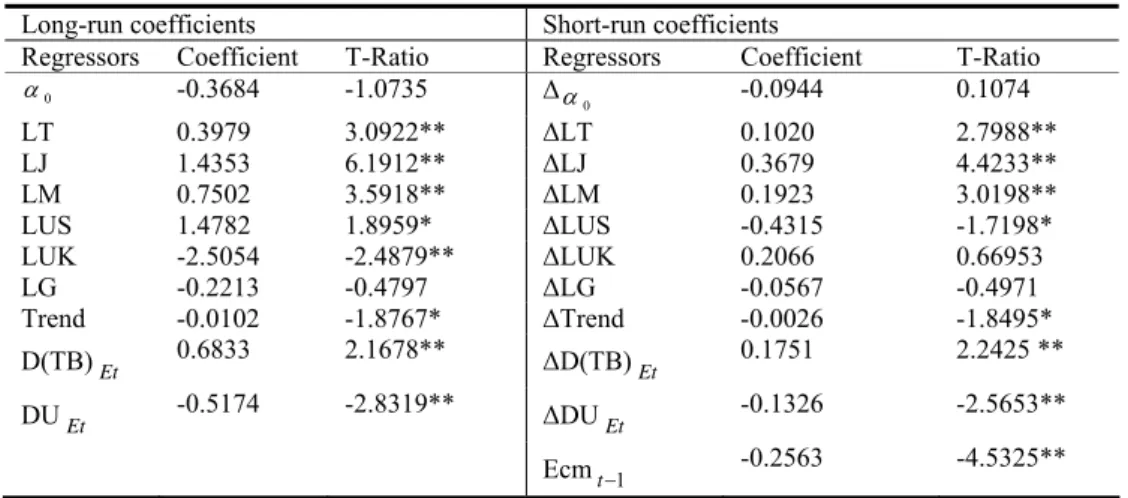
results reported in Table 2 indicate the existence of long-run relationship among MENA stock markets. Regarding the developed stock markets, the results show that both stock price indices in the US and UK have long-run impact on the stock price index of Egypt. Moreover, the coefficient of the error correction model (ECM) of the selected ARDL (1,0,0,0,1,1,0) is negative and highly significant at 1% level. This confirms the existence of a stable long-run relationship and points to a long-run cointegration relationship between variables. The ECM represents the speed of adjustment to restore equilibrium in the dynamic model following a disturbance. The coefficient of the ECM is -0.26, this implies that a deviation from the long-run equilibrium following a short-run shock is corrected by about 26 per cent after one month.
1 The test for the unit root hypothesis in the presence of structural change has been conducted using Perron (1997) Innovational Outlier Model (IO). In each case we reject the unit root null hypothesis at 5 % level and all variables show evidence of a non-stationarity. Moreover, results show that the time of the break for each variable is coinciding with observed real event. These times of the break are used as dummy variables when conducting the ARDL approach. However, the results of the Perron (1997) model are available from the author on request.
Table 2. Estimated long-run coefficients using the ARDL (1,0,0,0,1,1,0) model selected based on SBC
Dependent variable: LE
Long-run coefficients Short-run coefficients
Regressors Coefficient T-Ratio Regressors Coefficient T-Ratio
0 α -0.3684 -1.0735 Δ 0 α -0.0944 0.1074 LT 0.3979 3.0922** ΔLT 0.1020 2.7988** LJ 1.4353 6.1912** ΔLJ 0.3679 4.4233** LM 0.7502 3.5918** ΔLM 0.1923 3.0198** LUS 1.4782 1.8959* ΔLUS -0.4315 -1.7198* LUK -2.5054 -2.4879** ΔLUK 0.2066 0.66953 LG -0.2213 -0.4797 ΔLG -0.0567 -0.4971 Trend -0.0102 -1.8767* ΔTrend -0.0026 -1.8495* D(TB)Et 0.6833 2.1678** ΔD(TB)Et 0.1751 2.2425 ** DUEt -0.5174 -2.8319** ΔDUEt -0.1326 -2.5653** Ecmt−1 -0.2563 -4.5325** Note: * significant at 10% level, ** significant at 5% level
When Turkey is the dependent variable, the results reported in Table 3 indicate the existence of a long-run impact of Egypt and Morocco on Turkey. The error correction model (ECM) of the selected ARDL (1,0,0,0,0,0,1), as shown in Table3, is significant at the 1% level with the expected negative sign. It points to a long-run cointegration relationship between variables. It also suggests that 30 per cent of the adjustment back to long-run equilibrium is corrected after one month.
Table 3. Estimated long-run coefficients using the ARDL (1,0,0,0,0,0,1) model selected based on SBC
Dependent variable: LT
Long-run coefficients Short-run coefficients
Regressors Coefficient T-Ratio Regressors Coefficient T-Ratio
0 α 4.4820 0.7625 Δ 0 α 1.3614 0.7172 LE 0.8808 3.0085** ΔLE 0.2675 2.5734** LJ 0.4741 0.7919 ΔLJ 0.1440 0.8390 LM -1.5724 -3.0429** ΔLM -0.4777 -3.2789** LUS -1.0361 -0.8241 ΔLUS -0.3147 -0.8074 LUK 0.9347 1.1516 ΔLUK 0.2839 0.6090 LG 0.7832 1.1516 ΔLG 1.0875 0.7172** Trend 0.0798 4.0459** ΔTrend 0.0242 3.5439** DUTt -0.0767 -2.5733** ΔDUTt -0.0233 -2.7052** Ecmt−1 -0.3037 -4.0991** Note: * significant at 10% level, ** significant at 5% level
When Jordan is the dependent variable, as shown in Table 4, only Egypt and Turkey have long-run impacts, and no impacts either from Morocco or the developed countries. The error correction model of the selected ARDL (1,0,1,0,0,2,0) is significant at 1% level, with the expected sign. The coefficient of the ECM is -0.14, this implies that a deviation from the long-run equilibrium following a short-run shock is corrected by about 14 per cent after one month.
Table 4. Estimated long-run coefficients using the ARDL (1,0,1,0,0,2,0) model selected based on SBC
Dependent variable: LJ
Long-run coefficients Short-run coefficients
Regressors Coefficient T-Ratio Regressors Coefficient T-Ratio
0 α 10.094 2.9018** Δ 0 α 1.4029 2.9837** LE 0.4244 3.1298** ΔLE 0.0589 2.2204** LT -0.5270 -2.9639** ΔLT -0.0057 -0.2232 LM -0.0526 -0.2250 ΔLM -0.0073 -0.2222 LUS -0.7309 -1.2334 ΔLUS -0.1016 -1.2413 LUK -0.1884 -0.1953 ΔLUK 0.0767 0.5284 LG 0.6469 1.3073 ΔLUK(-1) 0.3735 4.0315** Trend 0.0232 2.9174** ΔLG 0.0899 1.4749 DU Jt -0.0464 -0.2786 ΔTrend 0.0032 4.4219** ΔDU Jt -0.0064 -0.2898 Ecmt−1 -0.1389 -3.2711**
Note: ** significant at 10% level, ** significant at 5% level
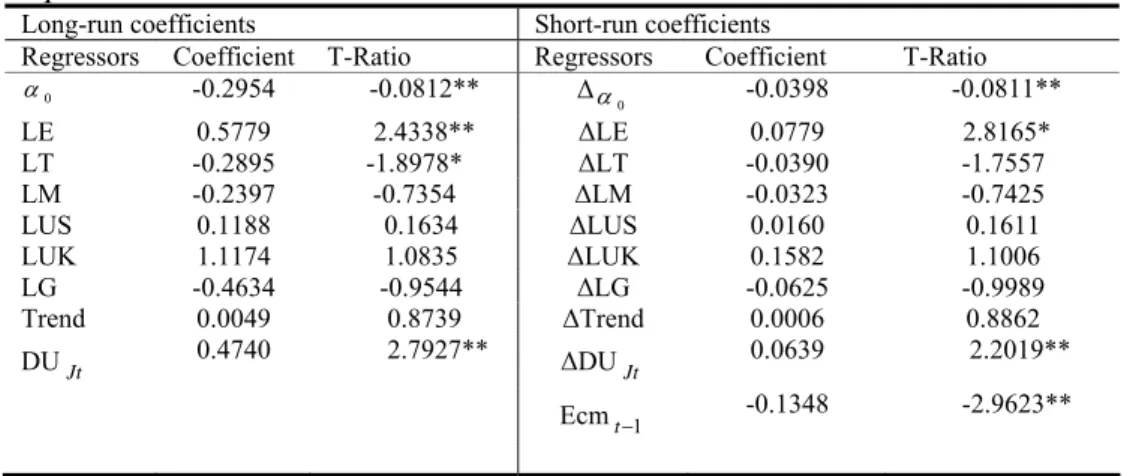
Finally, in the case of Morocco, the results reported in Table 5 show that both Egypt and Turkey have long-run impacts on Morocco, but there is no long-run impact from other markets. However, it is found that the stock market in Turkey affects the stock market in Morocco negatively. This means that a fall in the price index of Turkey will have a positive effect on the price index in Morocco. Regarding the error correction term, it is found to be significant at 1% level and the coefficient of the ECM is -0.14 which implies that a deviation from the long-run equilibrium following a short-run shock is corrected by about 14 per cent after one month.
Table 5. Estimated long-run coefficients using the ARDL (1,0,0,0,0,0,0) model selected based on SBC
Dependent variable: LM
Long-run coefficients Short-run coefficients
Regressors Coefficient T-Ratio Regressors Coefficient T-Ratio
0 α -0.2954 -0.0812** Δ 0 α -0.0398 -0.0811** LE 0.5779 2.4338** ΔLE 0.0779 2.8165* LT -0.2895 -1.8978* ΔLT -0.0390 -1.7557 LM -0.2397 -0.7354 ΔLM -0.0323 -0.7425 LUS 0.1188 0.1634 ΔLUS 0.0160 0.1611 LUK 1.1174 1.0835 ΔLUK 0.1582 1.1006 LG -0.4634 -0.9544 ΔLG -0.0625 -0.9989 Trend 0.0049 0.8739 ΔTrend 0.0006 0.8862 DU Jt 0.4740 2.7927** ΔDU Jt 0.0639 2.2019** Ecmt−1 -0.1348 -2.9623** Note: ** significant at 10% level, ** significant at 5% level
VI.
POLICY IMPLICATIONS
Based on the results reported in the previous section, the study found that all stock markets in the MENA region are integrated with each other and segmented from the international markets. Only Egypt is found to be integrated with international markets. These findings will be analysed on two levels, the regional level and the international level.
First, on the regional level, the results show that stock markets in the MENA region are
cointegrated. This implies the operation of the law of one price (LOOP). As a result, the potential of
regional investors for obtaining abnormal profits through portfolio diversification is limited in the long-run. The reason for this is that as the MENA stock markets are cointegrated, abnormal profits will be arbitraged away in the long-run. Moreover, in the absence of barriers or potential barriers generating country risk and exchange rate premium, financial assets of similar risk and liquidity are expected to achieve similar yields, irrespective of nationality or location (Von Furstenberg and Jeon, 1989; Narayan et al., 2004).
However, despite the lack of arbitrage opportunities in the long run, investors can still achieve arbitrage profits through portfolio diversification in the MENA stock markets in the short run. This depends on the speed of adjustment which is represented by the error correction model (ECM). The coefficients of ECM’s for the MENA stock markets are as follows: Egypt, -0.26; Turkey, -0.30; Jordan, -0.14; and Morocco, -0.14. These coefficients indicate that the speed of adjustment is slow which means the short-term can last for a longer period, and there is a high possibility of achieving arbitrage profits as the LOOP may not hold.
Second, on the international level, the results show that Turkey, Jordan and Morocco are not cointegrated with the developed markets. This means that there is no long-run impact from developed stock markets towards these markets. However, a long-run relationship is found between Egypt and both the US and UK when Egypt is a dependent variable. Based on these results, there are opportunities for international investors to obtain long-run gains through international portfolio diversification in the Turkey, Jordan and Morocco stock markets. Also, at the same time, investors from these two countries have the opportunities to obtain long-run gains through investing in developed markets. The existence of long-run relationships between Egypt and both US and UK implies that the potential for investors from Egypt stock market to obtain abnormal profit through portfolio diversification in US and UK is limited in the long-run, the reason for that is because the abnormal profit will be arbitraged away in the long-run. However, there are opportunities for achieving abnormal profit by investing in Germany as it is not cointegrated with the MENA markets. Moreover, with the short-run error correction model (ECM), arbitrage opportunities and
possible profits may also be achieved from diversification as the LOOP may not hold in the short run.
VII. CONCLUSION
This paper examines the stock market integration among four emerging stock markets, namely Egypt, Turkey, Jordan and Morocco. The study also examines the integration between these markets and the developed markets represented by the US, UK and Germany. The study employs the ARDL approach to cointegration. The results indicate that all stock markets in the MENA region are integrated with each other, but not with developed markets, except for Egypt.
The implications of these results are analysed on two levels: the regional level and the international level. On the regional level, the potential of regional investors for obtaining abnormal profits through portfolio diversification is limited in the long-run as abnormal profits will be arbitraged away. However, investors can still achieve arbitrage profits through portfolio diversification in the MENA stock markets in the short run. This depends on the speed of adjustment which is represented by the error correction model (ECM). On the international level, there are opportunities for international investors to obtain long-run gains through international portfolio diversification in the MENA stock markets.
Also at the same time, investors from the MENA countries have opportunities to obtain long-run gains through investing in developed markets. However, for future studies, two points are to be mentioned. First, future studies could examine the integration among more stock markets in the MENA region, such as including the stock markets of the Gulf Countries (Saudi Arabia, United Arab Emirates, Qatar, Kuwait, Bahrain and Oman). These countries are growing very fast and have an important economic role on the international level. Also, for future studies, the period of the study could be extended to more than ten years.
REFERENCES
Bannerjee, A. Dolado and R. Mestre. (1998) Error-correction mechanism tests for cointegration in
single equation framework, Journal of Time Series Analysis, 19, 267-283.
Creane Susan, Rishi Goyal, A. Mushfiq Mobarak, and Randa Sab. (2003) Financial development
and growth in the Middle East and North Africa, IMF Working Paper, Washington, DC.
Darrat, Ali F., Elkhal Khaled and Hakim Sam R. (2000) On the integration of emerging stock
markets in the Middle East, Journal of Economic Development, 25, 119-129.
Darrat, Ali F. and Omar M. Benkato. (2003) Interdependence and volatility spillovers under market
liberalization: the case of Istanbul Stock Exchange, Journal of Business Finance and
Accounting, 30(7) and (8), 1089-1114.
El-Erian Mohamed A. and Manmohan S. Kumar, (1994) Emerging equity markets in Middle
Eastern countries, IMF Working Paper, WP/94/103, International Monetary Fund.
Engle, F. and C. W. J. Granger, (1987) Co-integration and error correction representation,
estimation, and testing, Econometrica, 55, 251-276.
Gregory, A. W. and B. E. Hansen. (1996) Tests for cointegration in models with regime and trend
shifts, Oxford bulletin of Economics and Statistics, 58, 555-560.
International Financial Corporation. (2002) Emerging Stock Markets Factbook. USA.
Johansen, Soren, (1988) Statistical analysis of cointegration vectors, Journal of Economic Dynamic
and Control, 12, 231-254.
Johansen, Soren, and Katarina Juselius. (1990) Maximum likelihood estimation and inference on
cointegration-with application to the demand for money, Oxford Bulletin of Economics and
Statistics”, 52, 169-210.
Hung, B. and Cheung Y. (1995) Interdependence of Asian Emerging Equity Markets, Journal of
Business Finance and accounting”, 22, 281-288.
Kremers, J. J. M., Neil R. Ericsson and Juan J. Dolado, 1992, “The power of Cointegration tests”,
Oxford Bulletin of Economics and Statistics, 54, pp. 325-343.
Maghyereh, Aktham (2003) Equity markets integration in the Middle East region, unpublished
paper, Hashemite University, Jordan.
Masih, A. Mansur M. and Rumi Masih. (2002) Propagative causal price transmission among
international stock markets: evidence from the pre- and post globalization period, Global
Finance Journal, 13, 63-91.
Narayan, Paresh and Seema Narayan. (2003) Saving behavior in Fiji: An empirical assessment
using the ARDL approach to cointegration, Discussion Papers, No. 02/03, Monash University.
Narayan, Paresh, Russell Smyth and Mohan Nandha. (2004) Interdependence and dynamic linkages
Neaime, Simon. (2002) Liberalization and financial integration of MENA stock markets, a paper
prepared at the ERF’s 9th annual conference on “Finance and Banking”, United Arab
Emirates.
Oxelhein, Lars. (2001) Routes to equity market integration- the interplay between politician,
investors and managers, Journal of multinational financial management, 11, 183-211.
Pesaran, H. M. (1997) The role of economic theory in modeling the long-run, Economic Journal,
107, 178-191.
Pesaran, H. M. and Y. Shin. (1995) Autoregressive distributed lag modeling approach to
cointegration analysis, DAE Working Paper Series, No. 9514, Department of Economics,
University of Cambridge.
Pesaran, H. M. and Y. Shin. (1998) An Autoregressive distributed lag modeling approach to
cointegration analysis, in: S. Storm, ed., Econometrics and Economic Theory in the 20th
Century: The Ragnar Frisch Centennial Symposium, Cambridge University Press.
Pesaran, M. H., Y. Shin and R. Smith. (1996) Testing for the existence of a long-run relationship,
DAE Working Papers 9622, Department of Applied Economics, university of Cambridge.
Pesaran, M. H., Y. Shin and R. Smith. (2001) Bounds testing approaches to the analysis of level
relationships, Journal of Applied Econometrics, 16, 289-326.
Piesse Jenifer and Bruce Hearn. (2002) Equity market integration versus segmentation in three dominant markets of the Southern Africa Customs Union: cointegration and causality tests,