Jet Engine
Prof. Dr. Mustafa Cavcar
Anadolu University, School of Civil Aviation Eskisehir, Turkey
Figure 1 Jet engine The thrust for a turbojet engine can be derived from Newton’s second law which implies that the force equals to the time rate of change of momentum:
dt mV d F = ( )
where mV is the momentum.
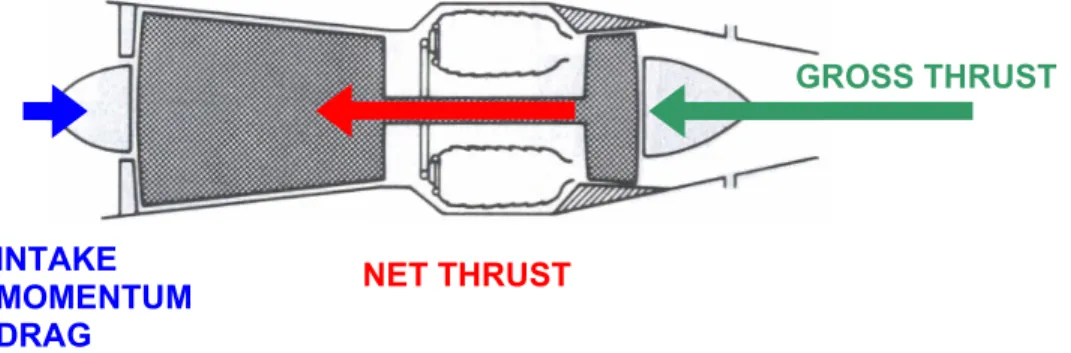
The net thrust of a jet engine is the difference between the outgoing exhaust gas momentum flow and incoming air momentum flow. Outgoing exhaust gas momentum is usually referred the gross thrust, and incoming air momentum flow is called momentum drag or ram drag. Since m& =dm/dt is the mass flow rate of the air passing through the engine, then the gross thrust
) ( j am j j g mV A p p T = & + − where = j
V exhaust gas velocity,
=
j
A area of jet nozzle,
=
j
p static pressure at the jet nozzle discharge, and
=
am
p atmospheric pressure.
The incoming air momentum flow (momentum drag)
GROSS THRUST
INTAKE MOMENTUM DRAG
where Vi is the incoming air velocity. Therefore, the net thrust drag Momentum thrust Gross Net thrust=
[
]
) ( ) ( ) ( am j j i j i am j j j p p A V V m V m p p A V m T − + − = − − + = & & &Factors Affecting Jet Thrust Air Velocity
Incoming air velocity affects the thrust in two different and opposite ways. When the aircraft is static, as when an engine is being run up prior to take-off at the end of a runway, momentum drag is equal to zero, because Vi =0. However, as the aircraft commences to move, the velocity of the air entering the engine also begins to increase because of the speed of the aircraft. Therefore, the difference between Vj and Vi will become less as airspeed,
or Vi, increases. On the other hand, as the aircraft gains speed down a runway, the movement of the aircraft relative to the outside air causes air to be rammed into the engine inlet duct. This compression of air in an inlet duct arising from forward motion is called ram pressure or ram effect. The ram effect both increases the air mass flow to the engine and the intake pressure, and consequently, increases the thrust. Figure 2 shows how the thrust varies with airspeed considering both velocity difference variation and ram effects.
However, ram pressure rise is not significant at lower speeds, thus it cannot offset the effect of (Vj−Vi) difference and the thrust decreases as the aircraft speeds up during take-off. Thrust decrease due to airspeed increase during take-off is more significant for the turbofan engines as shown in Figure 3. Because the pure jet and
the lower by-pass ratio engines have less airflow per unit of thrust, they suffer less momentum drag as speed increases.
Figure 3 Take-off thrust variation for various engines [2].
Air Temperature
The thrust generated by a jet engine is inversely proportional with the ambient air temperature, thus the thrust decreases as the air temperature increases. However, this also means an increase of thrust when the temperature decreases, so that an engine may generate higher thrust than its design rating at lower ambient air temperatures. Higher thrust above the design rating can harm the engine. For this reason, engines are restricted to a maximum thrust. This thrust restriction is called
“flat rating,” and engines with restricted maximum take-off thrust are called “flat rated.” At a given pressure altitude, temperature has no influence on engine takeoff thrust, below the so-called reference temperature (Tref) or flat rating Figure 4 Thrust versus air temperature for a flat rated engine.
temperature. Above this reference temperature, engine thrust is limited by the Exhaust Gas Temperature (EGT). The consequence is that the available thrust decreases as the temperature increases [3]. Thrust versus temperature for a flat rated engine is shown in Figure 4.
Altitude
The effect of altitude on thrust is a function of density. As the altitude increases, the pressure and density decreases so does the thrust, but as the temperature decreases, the thrust increases. However, the pressure and density of the outside air decreases faster than the temperature, so an engine actually produces less thrust as the altitude is increased [1]. Because temperature stays constant in the
stratosphere while pressure and density are decreasing as the altitude increases, thrust will drop off more rapidly in the stratosphere as shown in Figure 5.
Combined Effects of Velocity and Altitude
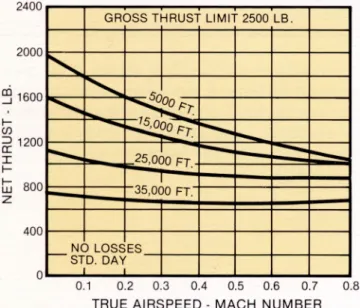
Figure 6 Thrust versus Mach number for P&WC JT15D-4C Turbofan engine [4]. Figure 6 shows the maximum cruise thrust variation of JT15D-4C turbofan engine
with the Mach number at a given pressure altitude, then these variations will be similar for thrust versus airspeed case. As shown in the figure, thrust decrease to the velocity increase is more significant at lower altitudes. As the altitude increases, the thrust variation due to airspeed flattens, and even a slight increase occurs at higher airspeeds.
References
[1] United Technologies Pratt & Whitney, The Aircraft Gas Turbine Engine and Its Operation, P&W Oper. Instr. 200, 1988.
[2] R.S. Shevell, Fundamentals of Flight, Prentice Hall, Englewood Cliffs, 1989.
[3] Airbus Industrie, Getting to Grips with Aircraft Performance, Blagnac, 2002.
[4] United Technologies Pratt & Whitney Canada, JT15D-4C Fact Sheet, Longueuil, 1987.
![Figure 2 Jet engine thrust versus airspeed [1].](https://thumb-us.123doks.com/thumbv2/123dok_us/9694146.2458417/2.918.428.780.422.722/figure-jet-engine-thrust-versus-airspeed.webp)
![Figure 3 Take-off thrust variation for various engines [2].](https://thumb-us.123doks.com/thumbv2/123dok_us/9694146.2458417/3.918.252.781.170.492/figure-thrust-variation-various-engines.webp)