ISSN 1837-7750
Industry-Academic Partnership in Finance Programmes.
Case of CFA-Partnered Programmes
Alexandr Akimov, Robert Bianchi and Michael Drew
No. 2013-08
Series Editor: Dr Alexandr Akimov
Copyright © 2013 by the author(s). No part of this paper may be reproduced in any form, or stored in a retrieval ISSN 1836-8123
Industry-Academic Partnership in Finance
Programmes. Case of CFA-Partnered
Programmes.
Alexandr Akimov*, Robert J. Bianchi and Michael E. Drew**
Department of Accounting, Finance and Economics
Griffith Business School
Griffith University
Abstract
This paper examines the developing trend of Finance programmes around the world being awarded partnership status as an undergraduate and postgraduate Chartered Financial Analyst (CFA) University Program Partner by the CFA Institute. The CFA Institute has partnerships with select universities around the world that have embedded into their degree programs a significant percentage (more than 70%) of the CFA® Program Candidate Body of Knowledge. This paper explores both general motivations for academic/professional partnerships and specific motivations for university-CFA Institute partner arrangements. These include issues of curriculum development, product and brand enhancement, and the pathways that the program provides to students endeavoring to attain an esteemed industry qualification. Evidence is presented on the requirements, geographical distribution, and ranking of CFA University Program Partners around the world. Moreover, the approach of universities towards the CFA Institution partnership and programme design is examined.
JEL: I23; A22; A23
Key Words: Accreditation; Chartered Financial Analyst; Higher Education
* Corresponding author: Email: [email protected]; Telephone: + 61 (0) 7 555 28579; Mail: Department of Accounting, Finance and Economics, Gold Coast Campus, Griffith University, QLD 4222, Australia.
Industry-Academic Partnership in Finance
Programmes. Case of CFA-Partnered
Programmes
1. Introduction
Tertiary education plays an important role in ensuring the evolution and progress of human society. It is important that university graduates are adequately equipped with the knowledge and skills to face current and future challenges in their respective disciplines. In applied disciplines such as finance, graduates generally enter the workforce with the set of basic knowledge and skills, which allow rapid adaptation to the professional environment and provides a foundation for further personal and professional development.
Many educators and practitioners in applied disciplines realize the importance of cooperation between academics and industry for finance graduates to meet the demands and expectations of employers and the general public. Moreover, research input provided by academia contributes to innovation and development of new or better services offered by practitioners. Such cooperation is common in a range of practical disciplines such as medical sciences, engineering, and is also observed in commerce based disciplines including accounting and finance. The motivation of individual participants and forms of cooperation vary but they can be broadly categorized into three groups: education and training, research and innovation, and advancement of the profession. These goals can be achieved in many ways; one of them is through the establishment of formal partnerships or receiving professional accreditation from a peak industry body.
The focus of this paper is on the discipline of finance. In particular, we analyse educational cooperation through formal partnerships between the CFA Institute and universities in the delivery of graduate Finance programmes, including motivation, forms, and perceived benefits. The CFA-Institute, headquartered in Charlottesville, USA, manages and administers the CFA designation, is perhaps the most globally recognised professional designation in Finance with over 100,000 CFA charter holders located in more than 130 countries. The CFA charter is awarded to those individuals who pass three levels of comprehensive 6-hour exams covering ten topic
areas from the CFA Candidate Body of Knowledge (CBOK) and meet professional experience requirements (CFA Institute 2012).
This paper is organized into three major sections. Section 2 discusses the motivation for academic/industry cooperation as well as the forms of cooperation as it relates to the discipline of finance. Section 3 reviews the motivations, perceived benefits and problems associated with the establishment of formal accreditations/partnerships with a professional organization. Section 4 analyzes postgraduate partnerships between the CFA Institute and universities. In particular, we review the geographical distribution and ranking of the CFA partner programmes. We then examine the strategies universities have taken towards partnerships and their approach towards program design. Finally, we provide concluding remarks in Section 5.
2. Academic/practitioner cooperation. Motivation and forms.
Practitioners and academics share a common goal of attracting high-calibre students into their respective disciplines, and this also includes finance. For academics, the benefit is that better students can absorb the course material easier, provide opportunities for more challenging/interesting material delivery, more thoughtful discussions, better learning outcomes, and therefore, better job satisfaction. Moreover, high performance students present a pool for potential research students. For employees, more capable students together with appropriate training provide professional and efficient human resources. Even though the high quality training of the prospective work force for the profession is the primary motivation, which academics and practitioners collectively share, it is not the only one. A second motivation for academic/industry cooperation is the development of innovative products and services, where joint academic/practitioner research may play an important role. The final motivation for cooperation is the advancement of professional needs, political lobbying and the promotion of the finance profession.
Education and training is no doubt the primary reason for established partnerships between universities and professional industry bodies. There are a number of areas of mutual interest including student recruitment (both student recruitment by universities, and graduate recruitment by employers), curriculum development, teaching, professional examinations and resources. Industry practitioners engage in these established partnerships in a number of ways. For example, they occasionally
address students, partially or fully deliver course curriculum, organise professional experiences for faculty members, sponsor internships and field experiences, work-integrated learning, provide scholarships and provide feedback on the educational needs of finance professionals through curriculum development (Anonymous 1995; Bailey 1995; Novin 2001; Orell 2004; Donovan 2005; Escott 2009). The issue of curriculum development is at the heart of academic governance (Mortier and Sathre, 2010). For many Universities, industry plays a vital role in guiding curriculum, offering both students and Faculty practical insights into the theoretical concepts taught (Harvey et. al., 1997).
The CFA Institute promotes the incorporation of the CFA Candidate Body of Knowledge curriculum through various cooperative arrangements with Universities. Topic areas cover ethical and professional standards in investments, economics and quantitative methods, financial reporting and analysis, corporate finance, equity investments, fixed income investments, alternative assets, derivatives and portfolio management, and wealth planning. Particular emphasis is focused on ethics and professional standards. This is hardly surprising given the various issues, controversies and problems associated with individual and corporate behaviour during the 2008 Global Financial Crisis, which undermined the trust in the finance profession.
Cooperation in research efforts may occur in various forms. Outcomes may come in the form of joint research, contracted research, joint forums and interchanges to advance innovation in research. It is important that this collaborative process aligns the needs of the profession and research efforts of the academics. To advance professional needs, industry professionals may participate in institutional development of educational institutions through advisory roles, fund raising, and applying leverage to influence resource allocation within university systems. Finally, universities and practitioners may serve together in professional associations, develop and administer professional examinations, provide accreditation or establish formal partnerships between the University and the profession. The latter two are the primary focus of this study. Through professional accreditation, or formal partnerships, educators and practitioners often achieve numerous goals at once.
3. Accreditations and partnerships. Motivation, benefits and
problems.
Accreditations become increasingly important for academic institutions and all its stakeholders, whether they are the accreditation of educational institutions as a whole, academic units or degree programs. Accreditations of whole institutions are normally conducted by government agencies, whereas programs are often accredited by independent professional organizations. Examples of accreditation of academic units would be AACSB and ACBSP accreditation of Business schools, whereas there are many examples of program accreditation in the accounting discipline, for example, by CPA Australia and the ICAA1.
For prospective students, validation through accreditation, recognition or partnership helps to identify reputable institutions, and provides the assurance that the institution will maintain and upgrade their resources and enhance students’ future employment opportunities, as well as provide pathways to a professional qualification. For a prospective employer, accreditation may provide an indicator of the school/programme quality, which trains knowledgeable and skilled graduates, capable of making a positive contribution to a company. For the accrediting body, accreditations provide opportunities to promote the organizational goals and maintain their own privileged position as a controlling body. For educational institutions, accreditation goals include the recognition of superior institutions, accountability for program improvement, marketing advantages and brand enhancement, opportunities to share techniques, successes, and challenges with peer institutions, faculty recruitment advantages, and bargaining leverage for university resources. For academics, it is an important recognition of the quality of the institutions, that faculty members would like to be associated with, as well as potential bargaining leverage for faculty compensation (Roller, Andrew et al. 2003; Harvey 2004; Trapnell 2007; Lowrie 2008; Lightbody 2010; Kourik, Maher et al. 2011).
There are also commentators who have highlighted the problems associated with the accreditation/partnerships. These issues include the power struggle between
1
AACSB refers to the Association to Advance Collegiate Schools of Business, ACBSP denotes the Association of Collegiate of Business Schools and Programs, CPA refers to Certified Practicing Accountant, and ICAA denotes the Institute of Chartered Accountants in Australia.
academics and accrediting bodies, constraints on innovation in delivering programs, as well as the diminishing value of brand enhancement when more and more institutions take on these forms of recognition (Harvey 2004; Lowrie 2008; Lightbody 2010; Poullaos 2010; Pan and Perera 2012).
Many of the above benefits can be attributed to using recognition and partnership arrangements between the CFA Institute and universities around the globe. The CFA-Institute sees its mission ‘to lead the investment profession globally by promoting the highest standards of ethics, education, and professional excellence for the ultimate benefit of society’, which they attempt to achieve through five pillars, namely, (i) ethical championing; (ii) creating a global community of investment professionals; (iii) building a respected source of industry knowledge; (iv) professional excellence; and (v) serving the interests of investors and society (CFA Institute 2012). The CFA Institute has been able to establish a strong reputation due to its commitment to ethics and the rigour in administering its professional designation. Therefore, the issue of product and brand enhancement is of particular interest regarding the decision for a university to seek cooperation with the CFA Institute. It is our conjecture that this partnership provides a strategic tool for positioning. As noted by Iglesias et. al., (2011) brands are facing key changes and challenges that need to be addressed. Importantly, the CFA Institute gives universities the right to use their logo in university promotion and marketing materials. Moreover, the CFA Institute provides other benefits such as access to various learning resources, sample exams and scholarships. It also strongly encourages cooperation between educational institutions and members of local CFA societies.
The curriculum covered by the CFA designation has attracted recognition as comprehensive and professionally relevant; therefore, the adoption of CBOK topics in university programs provides a ‘seal of approval’ of the quality of the program and the relevance of curriculum being delivered. The CFA Institute requires undergraduate partner programs to adopt at least 70% of their Level 1 examination, and graduate partner programs to cover 70% of the curriculum of all three levels of the CFA examination, as well as commitment to cover the CFA Institute Ethical and Professional Standards in all of the partner programs. As a result, the graduates of partner programs are better prepared to take professional examinations leading to the
CFA professional designation upon completion of relevant programs in partner institutions.
The CFA Institute has been highly successful in establishing partner relationships around the world. To effectively address the rapid growth in educational cooperation, it has recently launched lower levels of cooperation with universities, a so called ‘recognition program’.
4. CFA Institute and its postgraduate partner programmes
As of September 2012, there were 145 universities from 38 countries with ‘partner status’ with the CFA Institute. The USA represents the largest number of universities with 36 institutions accredited with CFA partner status. However, not all Universities hold partner status for both undergraduate and graduate programs. Since the requirements to obtain partner status for graduate programs are more stringent, only 97 Universities out of 145 partners qualified to offer graduate programs. However, some Universities were able to obtain partner status for more than one graduate program and this brought the total number of graduate programs to 129 in 30 countries around the world. Graduate programs are the primary focus of this study.
The CFA Institute has divided all partners into three regional groups – (i) Asia Pacific, (ii) Europe, Middle East and Africa (EMEA), and (iii) The Americas. Since there are no graduate partner programs outside Europe, this group will be referred to as ‘Europe’ in this study. As evident in Figure 1, Europe has the largest number of partners both in terms of university partners and partner programs, as well as the number of different countries they represent. The gap between Europe and other regions is particularly notable in terms of participating programs, since the practice of multiple partner programs within the same university seems more popular in European universities.
Figure 1. Geographical composition of CFA partners in 2012 in terms of the number of graduate programs, as well as universities and countries they represent.
4.1 Graduate partner programs in the Asia Pacific
The Asia Pacific region is somewhat underrepresented in the global list of partners with 25 programs offered by 21 universities (refer to Table 1). The largest number of graduate programs (6) is offered by five Australian universities, closely followed by China with five programs in five universities. Japan, Korea, Hong Kong, Singapore, Thailand, Philippines and Pakistan represent the remaining 7 countries.
The programs are delivered almost exclusively in English with the exception of some Chinese and Japanese programs where there are some courses delivered in Mandarin or Japanese languages. When we take into account that the CFA curriculum is prepared exclusively in English, this might be a reason which constrains the ability of some Asian universities to satisfy the requirements of the CFA Institute.
Table 1 shows that programs in Japan, Philippines and Pakistan are offered exclusively in a Finance MBA format. In contrast, all Australian, Hong Kong and Singaporean programs are offered as some variation of a Master of Finance (MFin) programme. The Masters of Finance format is also popular in China with four out of five programs in the MFin format. Other countries have a mixture of two formats. In total, nine of 25 programs are offered as a Finance MBA, whereas the rest are a variation of the Masters of Finance. Typically, Finance MBAs have more stringent work experience requirements, and some programs are delivered in an Executive MBA format. Moreover, Finance MBAs are usually longer and more expensive than their MFin counterparts.
37 39 7 21 25 9 39 65 15 0 10 20 30 40 50 60 70
Universities Programmes Countries
Americas Asia Pacific Europe
Table 1. CFA partner programs in the Asia Pacific by country and type
Universities Partner Programs
Finance
MBAs Masters in Finance
Australia 5 6 0 6 China 5 5 1 4 Hong Kong 1 2 0 2 Japan 3 3 3 0 Korea 2 3 2 1 Pakistan 1 1 1 0 Philippines 1 1 1 0 Singapore 1 2 0 2 Thailand 2 2 1 1 Total 21 25 9 16
4.2 Graduate partner programs in Europe
The country and university representation of the European region in the CFA Institute partner list has been growing rapidly in recent years. It is now the largest of the geographical regions with 65 programs in 39 universities representing 14 countries in and outside of the European Union. The UK and France are the countries where the CFA institute has the largest number of partner universities and programs with more than half of all universities and programs in Europe. There are two peculiar features in the partnerships between European universities and the CFA Institute. First, it is a fact that almost all programs are offered in a Masters of Finance format (61 out 65). Second, a distinct feature of many European universities is that they deliver more than one postgraduate program with partnership status.
Table 2. CFA partner programs in Europe by country and type
Universities Partner Programs
Finance
MBAs Masters in Finance
Belgium 1 2 0 2 France 7 16 2 14 Germany 1 1 0 1 Greece 1 1 0 1 Ireland 2 2 0 2 Italy 1 1 0 1 Netherlands 3 3 0 3 Poland 1 1 0 1 Portugal 1 1 0 1 Russia 1 1 1 0 Spain 2 2 0 2 Switzerland 2 3 0 3 Turkey 2 3 1 2 UK 14 28 0 28 Total 39 65 4 61
4.3 Graduate partner programs in the Americas
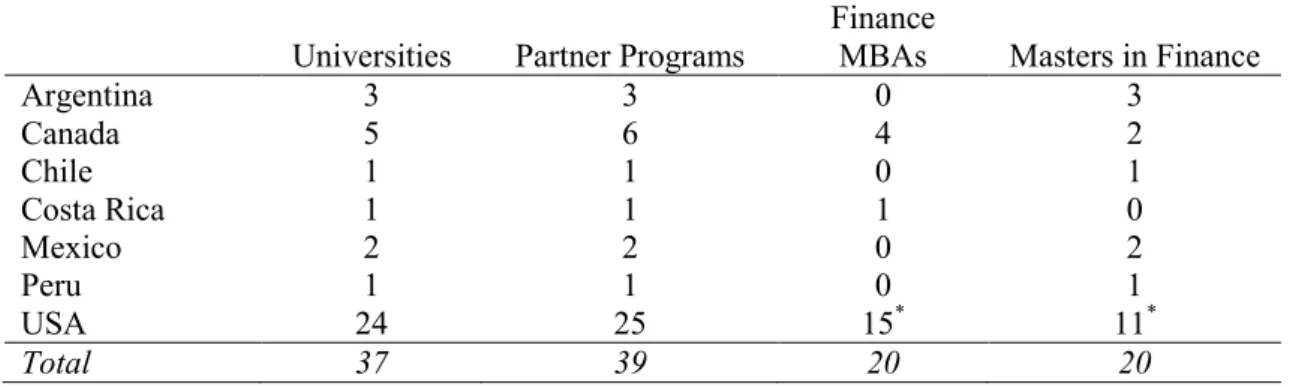
The Americas region has historically been a traditional market for the CFA Institute since the USA is where the organization has originated. Therefore, it does not come as a surprise that the USA has the largest number of partner universities in the world – 24, although in terms of partner programs, the UK has recently overtaken the USA (refer to Table 3). A number of partners are located in Canada, which also does not come as a surprise as the CFA Institute partnered program is required to be delivered in English. Despite the language barrier, there are programs offered in countries like Argentina, Mexico, Chile, Coast Rica and Peru. There is a mixture in terms of format that the programs are delivered in the Americas with20 being delivered as MBAs, 20 as Masters of Finance and one as a dual track.
Table 3. CFA partner programs in the Americas by country and type
Universities Partner Programs
Finance
MBAs Masters in Finance
Argentina 3 3 0 3 Canada 5 6 4 2 Chile 1 1 0 1 Costa Rica 1 1 1 0 Mexico 2 2 0 2 Peru 1 1 0 1 USA 24 25 15* 11* Total 37 39 20 20
*Note: there is one dual track MBA/MFin programme
4.4 Ranking of academic institutions
To assess the quality (or perceived quality) of academic institutions that enter into the partnership arrangements, we examined the ranking of their programs. Three rankings were taken into account, where two are specific to Finance programs, and one is a more general MBA ranking. The QS Global 200 Business Schools Report 2012 TopMBA ranking for Finance specialisation (50 schools ranked) and the Financial Times 2012 ranking of Masters of Finance, Pre and Post Experience (39 schools in total) were selected for our analysis of the MBA and Masters of Finance programs. The Economist’s MBA ranking (100 schools) is also employed as a general guide for the quality of Business Schools.
Table 4. Number of ranked programs Ranking Business Schools Programs MBA in Finance (TopMBA) MBA (Economist) Masters in Finance (FT) Americas 37 39 1 7 1 Asia Pacific 21 25 3 1 4 Europe 39 65 7 15 12
Table 4 reveals that the difference between regions is clearly visible. There are a substantial number of highly ranked institutions in Europe that have entered into partnership arrangements. For example, most of the top ten FT Masters in Finance programs are from Europe and have a partner status with the CFA Institute. On the contrary, the CFA Institute postgraduate partners in the Americas tend to be outside of the top Business School rankings. This might be due to historical reasons, whereby US universities outside the top rankings approached the CFA Institute partnership as a brand enhancement strategy for promoting their programs.
Even though the Asia Pacific region has a much smaller proportion of schools with similar rankings as Europe, this does not necessary mean that the CFA Institute does not attract high quality partnerships in this region. The reason for this is most likely due to the fact that the Asia Pacific region is relatively underrepresented in the global rankings. In terms of regional stance, these universities in the Asia Pacific region are good quality institutions.
4.5 Universities strategies towards partnership status
A careful examination of the postgraduate Finance offerings of partner institutions has revealed the way universities have engaged in formal cooperation with the CFA Institute. They can be broadly classified into three groups. The first group are usually large institutions with well-established postgraduate Finance programs with a large number of courses on offer. They acquired partnership status for one of their programs, possibly for the one which was the closest to the CFA Institute requirements. Only minor curriculum adjustment would have been required for these programs. The second group of institutions, similar to Group 1, represents universities with well-established programs that offer a large variety of Finance courses. In contrast to group 1, these institutions have acquired the partnership status for more than one program. This type of arrangement is more commonly observed in Europe.
Finally, group 3 are the institutions, which specifically designed Masters programs which are in line with the CFA Institute curriculum and promote this education as their ‘flagship’ finance program. The choice of elective courses is often limited in these programs. This is a broad group where there can be institutions with only one Finance Masters on offer either because of the size of the university or small demand for these postgraduate programs. Moreover, there are also institutions that deliver most of their programs in their local language and another program which is delivered in the English language. This arrangement is most common in the Asia Pacific region.
4.6 Program design
The common factor of all CFA Institute partnered programs is the coverage of curriculum as specified in the CBOK, as well as the commitment to teach ethical and professional standards. Besides this, these programs vary dramatically in terms of their entry requirements, fees, program structures and modes of delivery. As part of the academic entry requirements, practically all programs require an undergraduate degree, some with the restriction in specific subject areas, and proof of English proficiency. However, there is a large variation of additional requirements to enter these programs. We find that most MBA style and some Masters in Finance programmes require practical experience in the industry, additional tests such as GMAT and GRE, or other evidence of numerical skills.
In terms of program lengths, they vary from approximately 10 months in intensive mode to three years. Shorter programs (12 months) are common in the UK; most American and Australian programs are delivered over 1.5 to 2 years, whereas programs beyond two years are delivered in the Asia Pacific region only. We observe that mode delivery differs whereby some courses are delivered in a normal semester cycle; others offer intensive short course modes, while others provide a combination of both. The choice of core courses and electives vary substantially from program to program. Some universities deliver the program in a core course format only. Conversely, there are programs with small number of core courses but dozens of available elective courses. Some universities (predominately in the UK) include a dissertation (research) component in the program.
5. Conclusion
This paper has analysed the growing trend of the CFA Institute partnered programs around the world. Firstly, we observed that the primary motivation of such cooperation is in the provision of high quality educational programs in finance, as well as advancement of the goals for a more ethical finance and investment profession. At present, there is little evidence that suggests that these partnered programs deliver significant benefits in the area of research. Educational institutions are keen to engage these partnership arrangements in an effort to gain industry body approval of a globally recognised professional designation with the expected marketing benefits from this type of accreditation. Curriculum development seems the most prominent form of cooperation between universities and the CFA Institute whereby educational institutions are adopting a substantial part of the CFA Candidate Body of Knowledge. Partner Institutions also receive access to in-house knowledge, educational resources, and receive a right to award scholarships for their students who wish to pursue the CFA designation.
We noticed a great diversity of partner institutions around the globe, their rankings and their approach to cooperation with the CFA Institute. Smaller or less recognised institutions tend to value the benefits from cooperation higher, and therefore, they tend to provide a stronger emphasis on their CFA Institute partnership.
With the exception of CFA topics covered, the flexibility of the CFA Institute in relation to entry requirements, program design and modes of delivery allow those partnerships to avoid some of the drawbacks of other accreditations such as limitations on educational innovation and the power struggle between academics and the accrediting body. These findings may explain the growing popularity of this form of cooperation between universities and the CFA Institute.
References
Anonymous (1995). "Accounting faculty/practitioners partnership to address mutual education concerns." Issues in Accounting Education 10(1): 197-206.
Bailey, J. (1995). "Forming professional/educational partnerships." Management Accounting 76(11): 24-26.
CFA Institute (2012). "CFA Program Course of Study." Retrieved 27 Sep, 2012, from http://www.cfainstitute.org/cfaprogram/courseofstudy/Pages/index.aspx.
CFA Institute (2012). "Vision and Values." Retrieved 27 Sep, 2012, from http://www.cfainstitute.org/about/vision/Pages/index.aspx.
Donovan, C. (2005). "The benefits of academic/practitioner collaboration." Accounting Education: An International Journal 14(4): 445-452.
Escott, S. (2009). "Higher education and accounting." Charter 80(6): 52.
Harvey, L. (2004). "The power of accreditation:views of academics." Journal of Higher Education Policy and Management 26(2): 207-223.
Iglesias, O., J. Singh, et al. (2011). "Key changes and challenges for brands in an uncertain environment." Journal of Product and Brand Management 20(6): 436-439.
Kourik, J., P. Maher, et al. (2011). "Managing the demands of accreditation: the impact on global business schools." Research in Higher Education Journal
14(December): 38-44.
Lightbody, M. (2010). The impact of accreditation on accounting education in 2010. Accounting Education at a Crossroad in 2010. E. Evans, R. Burritt and J. Guthrie. Adelaide, The Instituite of Chartered Accountants in Australia.
Lowrie, A. (2008). "The relevance of aggression and the aggression of relevance. The rise of the accreditation marketing machine " International Journal of Educational Management 22(4): 352-364.
Mortier, K. and C.O. Sathre (2010). The Art and Politics of Academic Governance. Relationships between Board, Presidents, and Faculty. Rowman and Littlefield Publsihers, Plymouth.
Novin, A. (2001). "Partnership between practitioners and accounting faculty: Opportunities and obstacles." The National Public Accountant 46(2): 17-19.
Orell, J. (2004). Work-integrated Learning Programmes: Management and Educational Quality. Australian Universities Quality Forum.
Pan, P. and H. Perera (2012). "Market relevance of university accounting programs: Evidence from Australia." Accounting Forum 36(2): 91-108.
Poullaos, C. (2010). The profession/academy relationship and entry to professional programs. Accounting Education at a Crossroad in 2010. E. Evans, R. Burritt and J. Guthrie. Adelaide, The Instituite of Chartered Accountants in Australia.
Roller, R., B. Andrew, et al. (2003). "Specialised accreditation of business schools: a comparison of alternative costs, benefits, and motivations." Journal of Education for Business 78(4): 197-204.
Trapnell, J. (2007). "AACSB international accreditation. The value proposition and a look to the future." Journal of Management Development 26(1): 67-72.