IT Process Architectures for Enterprises
Development: A Survey from a Maturity Model
Perspective
Roberto Santana Tapia
1Department of Computer Science
University of Twente
E-mail:
[email protected]
January, 2006
1Supported by the Netherlands Organization for Scientific Research (NWO) under
Abstract
During the last years much has been published about IT governance. Close to the success of many governance efforts are the business frameworks, qual-ity models, and technology standards that help enterprises improve processes, customer service, quality of products, and control. In this paper we (i) survey existing frameworks, namely ITIL, ASL and BiSL, (ii) find relations with the IT Governance framework CobiT to determine if the maturity model of CobiT can be used by ITIL, ASL and BiSL, and (iii) provide an integrated vista of IT processes viewed from a maturity model perspective. This perspective can help us understand the importance of maturity models for increasing the efficiency of IT processes for enterprises development and business-IT alignment.
Contents
Acknowledgments 3
1 Introduction 4
2 The Maturity Model Perspective 7
3 Frameworks Studied 9 3.1 ITIL . . . 10 3.2 ASL . . . 13 3.3 BiSL . . . 17 3.4 CobiT . . . 20 4 Mapping of frameworks 24 4.1 Mapping of ASL . . . 25 4.2 Mapping of BiSL . . . 29 5 Discussion 32 6 Conclusion 34 Bibliography 35
Appendix 1. Specific mapping of CobiT and ASL 37
List of Figures
1.1 Position of ITIL, ASL and BiSL (source: [16]). . . 5
3.1 ITIL framework (source: [18]). . . 11
3.2 ASL framework (source: [15]).. . . 14
3.3 BiSL framework (source: [16]). . . 18
3.4 The CobiT framework (source: [09]). . . 21
4.1 The mapping process. . . 25
4.2 The process “Define a Strategic IT Plan”, taken from [10].. . . . 27
4.3 Mapping between CobiT and ASL. . . 30
4.4 Technical, Application and Functional Management. . . 31
Acknowledgments
This survey could not have been written without the many valuable discussions with Pascal van Eck and Maya Daneva. A thanks goes out to them for their patience in seeing this project through to the end.
Chapter 1
Introduction
Over the last years organizations have recognized that the degree of dependence on IT to reach their business goals is increasing. Evolved from this dependence, comes the need for IT services which correspond to the business goals and satisfy the requirements and expectations of customers with a high level of quality.
As a result, emphasis on the developments of IT applications to manage IT services is also increasing. At this point the exploitation of IT applications is a crucial factor for organizations.
Through the life cycle of IT products, beside the development, the exploitation phase take 70-80% of both time and money resources assigned to the IT projects. Effectiveness and efficiency of IT man-agement are decisive for the success of the IT applications. This applies to each type of organization, large or small, in the public or
private sector. (Translation from [18], p.31)
Information System Management (ISM) is a key component of successful im-plementation and utilization of information and communication technology in an organization [12]. ISM refers to all activities and organizational structures needed to establish and maintain the information infrastructure of an orga-nization at the operational, tactical and strategic level. With ‘orgaorga-nizational structures’ we mean the relationships among business units, and those involved, within organizations; and the term ‘information infrastructure’ concerns an in-frastructure which represents the functionality of the information systems.
In this survey, we approach ISM from two perspectives: governance control and ISM frameworks. On the one hand, controlling helps to efficiently deliver IT
service. We think of controls as mechanisms that hold ICT1in check in terms
1ICT is an abbreviation for Information and Communications Technology, and we consider
this term as IT and related technology. The term ICT is used extensively in the ASL and BiSL literature.
of bringing value and managing risk. To put it another way, we can say that controls are safeties that permit to have a better preservation of value through the management of risks. As Stephen Katz, former chief information security officer for Citibank, once said, “Controls don’t slow the business down; like brakes on a car, controls allow you to go faster” [02]. The brakes on a car not only serve to stop the car and keep it under control, they enable the driver to actually go faster and still remain safe. Actually a number of formal IT control frameworks have been developed, and CobiT is one of these frameworks.
The aim of CobiT is to support management and process owners by means of IT Governance. CobiT helps with bridging the differ-ences between business risks, the resulting need, from that, for the control of the business processes, and supporting IT services and IT
infrastructure. (Translation from [20], p.01)
On the other hand, we have ISM frameworks. The trio ITIL, ASL and BiSL helps in that area and they form an answer to the well-known management model of Looijen [12]: technical management, applications management and functional management. These three management forms are now available to be implemented in organizations: ITIL for technical management, ASL for ap-plications and BiSL for functionality. They do not stand apart from each other. Between the functional management domain and the other two management domains exist some links, but of course every domain knows its own specific
points of interest, activities and responsibilities. In Figure1.1, taken from [16],
we can observe this:
Functional management has been positioned as a component of the user organization. Functional management is, on behalf of the user organization and management, responsible for the total provision of information in the organization. In this context, functional management acts as a client for the ICT-Service organization.
ICT-Service organization provides all services in the field of technical management and applications management which are necessary to provide information to the user organization. The activities of applications management and technical management come together in the service team. This service team operates as integrator of the provided service. The service team forms with that an univocal point for the functional management in the name of the ICT-Service organization. (Translation from [Pols, 2005], pp. 21-22)
The paper is structured as follows. Section 2 explains the Maturity Model perspective we took to write this paper. In section 3 we give a description of the four frameworks mentioned. Section 4 gives an overview, and shows results, of the comparison of the frameworks and describes the way we did that; and section 5 concludes the paper and gives possible future research directions. ---
2 The Maturity Model Perspective
The experience with the improvement of the quality of the IT service has meanwhile learned that it can rarely be enough with systematizing and fixing the already IT applications. The causes by which the service not satisfies the requirements of the clients are frequently carry back from the way the organization is controlled and managed. The permanent improvement of quality demands a certain maturity of the organization [Itsmf, 2002]. In this point we can talk about Maturity approaches because maturity approaches have their roots in the field of quality management.
“Maturity Models have been around for some time. The basic idea of a maturity model is to assess work process practices (development, management, design, manufacturing, customer service, any repetitive process) against a “norm” and identify areas of possible improvement. These improvements must connect to a business benefit.” [Alleman, 2005]
Functional management Application management Technical management ASL ITIL BiSL Service team
Service Level Agreements Mangmnt
Suppliers Users
User organization ICT-Service organization
Figure 1.1: Position of ITIL, ASL and BiSL (source: [16]).
Functional management has been positioned as a component of the user organization. Functional management is, on behalf of the user organization and management, responsible for the total provision of
information in the organization. In this context, functional manage-ment acts as a client for the ICT-Service organization.
ICT-Service organization provides all services in the field of techni-cal management and applications management which are necessary to provide information to the user organization. The activities of ap-plications management and technical management come together in the service team. This service team operates as integrator of the pro-vided service. The service team forms with that an univocal contact point for the functional management in the name of the ICT-Service
organization. (Translation from [16], pp. 21-22)
When surveying and mapping the processes of CobiT and the three man-agement models, a fundamental structure can be obtain to control and assess enterprises’ IT processes in order to determine lacks of governance having on mind the establishing of improvement strategies. We selected CobiT because CobiT is the standard framework for IT Governance and IT Governance is an
important topic for the VITAL2 project where we are working. In addition,
CobiT, as we will explain in Chapter 3, is a control framework which establishes best practices for the IT management, term related with ITIL, ASL and BiSL. ITIL is a well-known standard for IT management; it guides organizations through some best practices to get to have a high quality technical manage-ment. Both ASL and BiSL were originally developed by PinkRoccade, The Netherlands. ASL is often used to improve applications management and is becoming an international framework in this area, and BiSL is one of the newly introduced frameworks covering the links between business, infrastructure and applications, working in the information management area.
With such survey, we can (i) observe the relation between CobiT and ITIL, ASL and BiSL (this relation helps providing a view of what extensive CobiT is covered by the three management models), (ii) determine if the Maturity Model of CobiT can be used by ITIL, ASL and BiSL, (iii) provide an integrated vista of IT processes viewed from a maturity model perspective. This perspective can help understand the importance of maturity models to increase IT processes’ efficiency for enterprises’ development and business-IT alignment.
The paper is structured as follows. Chapter 2 explains the Maturity Model perspective we took to write this survey. In Chapter 3 we give a description of the four frameworks mentioned. Chapter 4 gives an overview, and shows results, of the comparison of the frameworks and describes the way we did such comparison; and Chapter 5 discusses some relevant points related to our results. Finally, Chapter 6 concludes the paper and gives possible future research direc-tions.
Chapter 2
The Maturity Model
Perspective
Experience with improving the quality of IT services has taught us that it can rarely be enough systematize and fix the available IT applications. The causes by which services do not satisfy the requirements of the users are frequently tracked back to the way the organization is controlled and managed. The per-manent improvement of quality demands a certain maturity of the organization [18]. At this point, we can talk about maturity approaches because maturity approaches have their roots in the field of quality management.
“Maturity Models have been around for some time. The basic idea of a maturity model is to assess work process practices (development, management, manufacturing, customer service, any repetitive pro-cess) against a ‘norm’ and identify areas of possible improvement.
These improvements must connect to a business benefit.”( [01], p.01)
Glen Alleman, in his article “Some Thoughts on Project Management Orga-nizational Maturity Models” [01], says that over the years, the idea of maturity assessment has become the means of identifying risks, focusing management on improvement and identifying areas of business retributions. So, we can say that the establishment of an organization’s maturity can induce the development of an improvement strategy. This strategy can be converted into a concrete plan which can help to get paybacks. So, an organization can establish goals for process improvement and identify opportunities for business optimization. By this assessment and by the planning of improvements an organization begins its processes evolving from an ad-hoc state to an efficient and effective state: the development of its maturity.
A maturity model will also:
• allow an organization to benchmark itself with other internal or external
organizations. With a benchmarking process, an organization can measure
its operations against similar operations of other entities for the purpose of improving its own processes, which is an intention of the maturity model.
Architecture Maturity Model (AMM) subproject of VITAL - Description of Proposed Research
3
With these concepts we can also say that with a maturity model organizations can evolve processes and practices from an ad hoc state to an efficient and effective state. A maturity model will also:
• allow an organization to benchmark themselves with other internal or
external organizations. With a benchmarking process, an organization can measure its operations against similar operations of other entities for the purpose of improving its own processes, which is an intention of the maturity model.
This processes improvement is one area that has caught the attention of most of the organizations. They try to develop and execute a process management improvement strategy, and those that have succeeded in this area are gaining real economic value. Unfortunately, there is often significant resistance in some organizations to a formalized process. Indeed, some organizations are so preoccupied with market and daily demands that a serious process improvement initiative is not only a fantasy, but positively laughable [05].
Seeking formal improvement can be time consuming and expensive, but the rewards in the quality of the processes is very real.
• offer an improvement path to the firm so that it can set priorities for
process improvement actions. These improvement actions will permit an organization to achieve higher level of the maturity model increasing its possibility of predicting. It means, if an organization’s maturity increases, then the definition of results becomes more accurate. In other words, the planned results resemble more the real results [04].
• allow a possible interested party to have certainty on the potential of the
organization. Depending on the level of maturity that an organization has, an external party (another organization, a stakeholder, a client, or a supplier) can have a clear idea about how an organization’s business-IT architecture alignment is, in order to decide to have economic dealings
with such organization (importance of a maturity model from a value
viewpoint).
Research framework.
(to be determined)
MM allow BENCHMARKING PROCESSES to make
allow to improve
This processes improvement is one area that has caught the attention of most of the organizations. They try to develop and execute a process management improvement strategy, and those that have succeeded in this area are gaining real economic value. Unfortunately, as Gainer notes [05], there is often significant resistance in some organizations to a formalized process. Some organizations are certainly truly preoccupied with market and daily demands that a serious process improvement initiative is almost just a fantasy.
Seeking formal improvement can be time consuming and expensive, but the rewards in the quality of the processes can be significant.
• offer an improvement path to the firm so that it can set priorities for
process improvement actions. These improvement actions will permit an organization to achieve a higher level of maturity increasing its possibility of predicting. It means, if an organization’s maturity increases, then the definition of results becomes more accurate. In other words, the planned results resemble more the real results [06].
• allow a possible interested party to have certainty on the potential of the
organization. Depending on the level of maturity that an organization has, an external party (another organization, a stakeholder, a client, or a supplier) can have a clear idea about the organization’s capabilities, in order to decide to have economic dealings with such organization (impor-tance of a maturity model from a value viewpoint).
With a maturity model the organizations can determine their maturity, and they are going to be able to evolve toward a culture of process improvement excellence.
The Maturity Model (MM) perspective we are going to take in this survey came from the question “How can we know what level of maturity our organi-zation has after the use of the ITIL, ASL and/or BiSL frameworks?”. As we know, ITIL, ASL and BiSL are management frameworks and they do not have a MM to establish what level of maturity organizations have to make improve-ments. A solution to this situation is to find a way to use a MM as a base for this particular case. Among the existing MMs, the MM of CobiT could help us because CobiT is a control framework which establishes best practices for IT management. This will be defined in Chapter 3.
Chapter 3
Frameworks Studied
In this chapter, we give a description of the four frameworks studied. Each description will treat both concepts and process architectures. In Chapter 4, we will map the ITIL, ASL and BiSL management frameworks taking as basis the CobiT control framework.
The first three frameworks are related to the three fold model of IT ser-vice management introduced by Looijen [12]. The model identifies the following three areas of IT management:
Technical management is responsible for maintenance and management of
the technical IT infrastructure. This infrastructure consists of all the used au-tomation resources to store, process and provide data and information. Techni-cal management consists of the techniTechni-cal components of the automated informa-tion systems, the equipment, the basic programs and communicainforma-tion systems, including related procedures and documentation. A management framework for this area is ITIL. ITIL provides businesses with a customizable framework of best practices to achieve quality service and to overcome difficulties associated with the growth of IT systems.
Application management works in the maintenance of the application
pro-grams and databases. Application management corresponds to the function of a software house: producing, maintaining and adapting application designs and programs. This is the working area of ASL. ASL is intended to simplify the process of application management by providing tools best-practices to do it.
Functional management is on behalf of the user organization responsible for
maintaining and controlling information of the organization. From the perspec-tive of the user organization and the business process, this management area has as goal to support the organization and the business process by means of the management of the information. BiSL is a framework for functional man-agement and information manman-agement. This framework provides guidelines for
processes and activities that are necessary for a proper information provisioning structure within organizations.
3.1
ITIL
ITIL (Information Technology Infrastructure Library) is a set of best practices for IT service management. ITIL was created in the 1980’s by the UK govern-ment’s CCTA (Central Computer and Telecommunications Agency) in response to the growing dependence on IT to meet business needs and goals. ITIL pro-vides businesses with a customizable framework of best practices to achieve quality of service and to overcome difficulties associated with the growth of IT systems [11].
The specific goals of ITIL are to develop and maintain IT services that (i) meet the existing IT requirements of the business, (ii) are easily developed and enhanced to meet future business needs, within appropriate time scales and costs, and (iii) make effective and efficient use of all IT resources to contribute to the improvement of the overall quality of IT service.
Starting from the Frank Niessink’s definition of ‘service’ [13]: a service is
an essentially intangible set of benefits or activities that are sold by one party
to another, we think of ‘IT Services’ as IT functions done for a customer that
provide value. Within the context of this survey, we do not make any distinction between the terms ‘users’ and ‘customers’. For us, users, or customers, are peo-ple who use information systems in their work; therefore, they are consumers of information and they could make a large number of demands. Users can be internal of external to the organization. So, from a customer perspective, an IT service is what exactly the customer receives from the IT Service provider. It is a set of related components (hardware, software, and communication facili-ties) that support the activities of an organization holding up business processes. The Office of Government Commerce of the United Kingdom [14] asserts that some benefits realized by many IT organizations through implementing ITIL are:
• Continuous improvement in the delivery of quality IT services.
• Reduced long term costs through improved Return on Investment (ROI)
or reduced Total Cost of Ownership (TCO ) through process improvement.
• Reduced risk of not meeting business objectives, through the delivery of
rapidly recoverable, consistent services.
• The ability to absorb a higher rate of change with an improved, measurable
The overall structure of ITIL consists of five parts [11]: The business perspective Supporting IT Services Delivering IT Services Managing Applications Managing Infrastructure
There are a considerable number of books where we can read about these five ITIL components but the core of the ITIL processes is found in two of them: the Service Delivery set (tactical level) and the Service Support set (operational
level). These processes are shown in the Figure3.1. From [18] and [11] we have
deduced a brief description of the ITIL processes:
3.2 ASL
ASL (Application Service Library), in accordance with the ASL foundation (www.aslfoundation.org), is a framework for application management that is based on the best practices of professionals with years of experience. The model has been developed in such a way that it guarantees optimum ICT support for business processes, thus allowing you to focus on your core business. ASL limits itself to providing guidelines for structuring processes and leaves the structure of the management organization entirely open. As a result of this, the framework is generally applicable within the ICT service sector, regardless of the size of the organization.
The quality of the primary business processes of an organization is directly related to the quality of its IT support. An application does not just support a business process; it is an integral part of it. As a result of this, ICT has become a production factor, thus creating the need for a higher degree of professionalism. Organizations demand responsibility for results and guarantees in the field of their application management. ASL's goal is the professional development of application management.
A professional application management:
Financial Mangmnt for IT Services Availability Management Service level Management IT Serv Continuity Management Capacity Management Service Delivery Set Release Management Problem Management Incident Management Configuration Management Change Management Service Support Set Service Desk
Figure 3.1: ITIL framework (source: [18]).
Service Support Set Change
Management
Processes to ensure that standardized meth-ods and procedures are used for efficient and prompt handling of all changes, in order to minimize the impact of any related incidents upon service maintaining the proper balance between the need for change and the potential detrimental impact of them.
Configuration Management
Processes to provide a logical model of the IT infrastructure by identifying, controlling, maintaining and verifying the version of all configuration items (CI’s) in existence. Release
Management
Processes to take a holistic view of a change to an IT service and ensure that all aspects of a release, both technical and non technical, are considered together. Release Management should be used for large or critical hardware roll-outs, major software roll-outs and batch-ing related sets of changes.
Incident Management
Processes to restore normal service operation as quickly as possible with minimum disrup-tion to the business, ensuring that the best achievable levels of availability and service are maintained.
Problem Management
Processes to resolve problems quickly and ef-fectively, to ensure resources are prioritized to resolve problems in the most appropriate or-der based on business needs, to improve the productivity of support staff, and to provide relevant management information.
Service Delivery Set
Service Level
Management
Processes to maintain, and gradually to im-prove, business aligned IT service quality, through a constant cycle of agreeing, mon-itoring, reporting and reviewing IT service achievements and through instigating actions to eradicate unacceptable levels of service. Capacity
Management
Processes to understand the future business requirements (the required service delivery), the organization’s operation (the current ser-vice delivery), the IT infrastructure (the means of service delivery), and ensure that all current and future capacity and performance aspects of the business requirements are pro-vided in a cost-effective way.
Financial Management for IT Services
Processes to provide cost effective steward-ship of the IT assets and the financial re-sources used in providing IT services. An ef-fective financial management system will as-sist in the management and reduction of over-all long term costs, and provide accurate and vital financial information to assist the deci-sion making process.
Availability Management
Processes to optimize the capability of the IT infrastructure and supporting organization to deliver a cost effective and sustained level of availability that enables the business to satisfy its objectives.
IT Service Con-tinuity Manage-ment
Processes to support the overall business con-tinuity management process by ensuring that the required IT technical and services facilities can be recovered within required and agreed business time-scales.
Service Desk
Service Desk
Operations
Processes to act as the central point of contact between the user and IT Service Management to handle incidents and requests, and provide an interface for other service management ac-tivities.
3.2
ASL
ASL (Application Service Library), according to the ASL foundation 1, is a
framework for application management that is based on best practices of pro-fessionals with years of experience. The model has been developed in such a way that it guarantees optimum IT support for business processes allowing or-ganizations to focus on their core business.
ASL rests on the assumption that the quality of the primary business pro-cesses of an organization is directly related to the quality of its IT support. An application does not just support a business process; it is an integral part of it. As a result of this, ICT has become a production factor, thus creating the need for a higher degree of professionalism. ASL’s goal is the professional development of application management.
Professional application management reflects the fact that applications may have a long life cycle, that today’s applications could still affect a company’s competitive position in five years’ time. Application management is
future-focused. A professional application management permits that not only the
organization itself has a role to play. Process chain automation also makes organizations dependent on others. The uniformity of application management among organizations is therefore an important success factor when it comes to mutually coordinating applications and application service providers [07].
1See www.aslfoundation.org
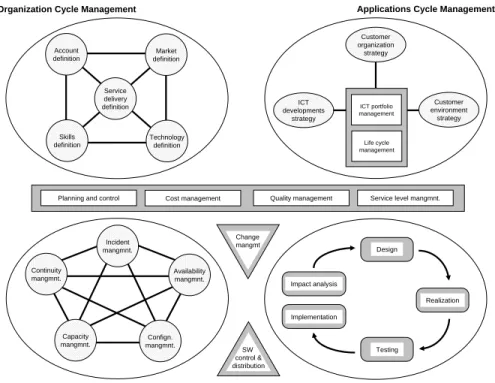
Figure3.2illustrates the ASL framework. The big ovals and the rectangle in the middle each represent a cluster of processes. Three levels are distinguished: operational, tactical and strategic. In [07] we can find the next explanations.
Organization Cycle Management
Account definition Market definition Skills definition Technology definition Service delivery definition Customer organization strategy ICT developments strategy Customer environment strategy ICT portfolio management Life cycle management
Applications Cycle Management
Incident mangmnt. Continuity mangmnt. Availability mangmnt. Capacity mangmnt. Confign. mangmnt.
Maintenance processes Enhancement/renovation
Cost management
Planning and control Quality management Service level mangmnt.
Design Impact analysis Implementation Testing Realization Change mangmt SW control & distribution
Figure 3.2: ASL framework (source: [15]). The operational level recognizes two clusters of processes:
1 maintenance of applications: processes that ensure the optimum availability of the applications currently being used to support the business process with a minimum of resources and disruption in the operation.
2 enhancement/renovation of applications: processes that adapt applications to new needs and requirements in response to changes to the organization and its environment. The necessary adjustments are made to the software, the data model and the documentation.
The tactical level consists of the overall management processes. These pro-cesses provide for the guidance of the operational propro-cesses for ‘services’ and ‘applications’. Both the strategic and the operational level supply the manage-ment processes.
The clusters of processes at the strategic level are:
1 Organization Cycle Management (OCM): processes that are aimed at devel-oping a future vision of the ICT service organization and translating that vision into a policy for its renewal.
2 Applications Cycle Management (ACM): processes that serve to shape a long-term strategy for the various applications that fit within the entirety of an organization’s information provisioning in relation to the organization’s long-term policy.
The next table shows a brief description of the ASL processes which have been deduced from [15] and [07]:
Maintenance Processes
Incident Management Processes to deal with questions and
wishes concerning the existing applica-tions, and to take care of the incidents.
Configuration Management Processes to register and store
infor-mation about Inforinfor-mation Systems (IS) and applications versions.
Availability Management Processes to provide, monitor and
guar-antee the availability of services and ICT components.
Capacity Management Processes to take care of the optimal
deployment of resources, i.e. right time, right place, right quantity, and at a re-alistic price.
Continuity Management Processes to deal with the continuity
of the realizations and the support of the information provisioning by means of the IS.
Enhancement/renovation Processes
Impact Analysis Processes to condition and chart the
implications of a change proposal.
Design Processes to set up the specifications of
the users of the IS or general changes, i.e. further information analysis and de-sign.
Realisation Processes to set up the design’s results
into concrete and correct changes in au-tomated systems.
Test Processes to test the changed objects
with the following end results: com-pleted products for acceptance, accep-tance tests,etc.
Implementation Processes to introduce the changed ob-jects focusing on conversion, training, instruction and migration.
Connecting Processes
Change management Processes to make an inventory, to set
priorities, to make an evaluation and to support the desired changes on applica-tions.
SW control and distribution Processes to manage and distribute SW
objects as versions, releases, documen-tations, data definitions.
Management processes
Planning and control Processes to manage time and capacity
relating to all activities that are involve in maintenance, enhancement, and ren-ovation of applications.
Cost management Processes to manage and charge ICT
costs.
Quality management Processes to manage the quality of the
application management processes, the products, the service and the organiza-tion.
Service level management Processes to specify in more detail the
desired services, and to specify and monitor the desired service level to make it transparent.
Application Cycle Management Processes
ICT developments strategy Processes to examine which ICT
devel-opments could be of interest to the cus-tomer’s organization and its informa-tion provisioning.
Customer environment strategy Processes to provide an image of
pro-cess chain developments and resulting requirements and opportunities for the applications and information provision-ing of the customer’s organization.
Customer organization strategy Processes to chart the developments
within the customer’s organization as well as the obstacles, the impact on the applications and the ways of responding to them.
Life cycle management Processes to match the existing options of and the future requirements for one or more applications that support a business process.
ICT portfolio management Processes to chart the significance and
performance of the various existing applications for the organizations, to translate the company policy into the various objects, and to set out a strat-egy for the future of the objects in the ICT portfolio.
Organization Cycle management Processes
Market definition Processes to determine the market
seg-ments on which the services will be pro-vided in the future on the basis of an analysis of the market, supply chain and client developments..
Account definition Processes to determine the image,
strategy, organizational form for the re-alization of the approach to the desired markets.
Skills definition Processes to determine skills,
knowl-edge and expertise called for by the fu-ture service of the organization.
Technology definition Processes to determine the
(develop-ment) tools, technology and methods that the firm wants to use to realize the future service.
Service delivery definition Processes to chart the service that the
market wants and that the ICT service provider can supply using his skills, and to translate it into policy and strategy.
3.3
BiSL
BiSL (Business Information Service Library) is, like ITIL and ASL, a set of recommendations for organizations to work more efficiently. The framework de-scribes the planning of the operational functional management and information management, on the basis of best practices. This process model underlines the importance of the role of information management and functional management in organizations for the connection between ICT and business processes.
Caroline van Dolder [19] establishes that functional management is the voice
of the user organization; it is the responsible for the supervision of ICT vendors and for the support to users.
This framework offers a number of general advantages, including the follow-ing:
• better visibility of the added value of an organization’s information
pro-visioning.
• better functionality of information systems.
• potential of ICT suppliers is exploited entirely.
• justified ICT investments
• satisfaction of (the user) organization
• more effective applications management and technical management
BiSL covers (see Figure3.3) seven clusters of processes [16]:
Determine the information provisioning organization strategy Determine the information strategy
Usage Management Functionality Management
Cost management
Planning and control Demand management Contract management
Management User organization Relation Vendors Management Information provisioning function Strategy Planning Chain-partners Management Establish the Chain Developments Establish the Technology Developments Life cycle Information Management Information Portfolio Management Establish the Business process Developments General Users Support Business Information Management Operational IT Control Informa tion C oordina ti on Specification Assessment and Testing Transition Preparation Design of non-automated Inf. provisioning Change mangmt Transition
Usage Management
These processes help to assure a continuous and optimal user support service, which is essential to users in their daily use of information to execute their ac-tivities within the company processes. The main question in these processes is: “Is the operational information well used and aimed?”
Functionality Management
This cluster of processes addresses the route along which changes in information provisioning are formed and carried out. These processes care for the realiza-tion of the desired modificarealiza-tions on automated and non-automated informarealiza-tion provisioning.
Connecting Processes
The clusters Usage Management and Functionality Management can not be seen in separation. The Connecting Processes decide (i) what changes must be carried out in the information provisioning area, and (ii) the actual execution in the user organization of a change to the information provisioning.
Management Processes
These processes take care of the integral control of the process clusters. This con-cerns the supervision of the management activities, the enhancement/renovation processes and the connecting processes. The Management Processes control the activities in terms of costs and profits, demands, contract and service levels, and planning. The central question of this process cluster is: “How do we guide the information provisioning?”
Determine the information strategy
It is very important to the organizations that the information suits the require-ments which are going to be established in the future. That calls for a strategy for the information provisioning for the future years. In this cluster, the deci-sions about the contents of the information are made.
Determine the information provisioning organization strategy
In the information provisioning area, more parts act in management,
decision-making and influencing roles. Management, structuring and working
meth-ods must thereby be coordinated. This applies also to the relations to the
management parties beyond the functional management domain, as vendors,
chain-partners and the users organization. The processes in this cluster are (i) the vendors management, (ii) the management user organization relation, (iii) the chain-partners management, and (iv) the information provisioning function strategy planning.
Connecting processes at the guiding level
The link between the two previous clusters needs also a process where the deci-sions on several areas are coordinated. This process, Information Coordination, forms the connecting cluster in the functional level of BiSL.
3.4
CobiT
“CobiT (Control Objectives for Information and related Technology) has been developed as a generally applicable and accepted standard for good Information Technology (IT) security and control practices that provides a reference framework for management, users, and IS
audit, control and security practitioners.” ( [08], p.01)
CobiT enables an enterprise to implement effective governance over the IT that is pervasive and intrinsic throughout the enterprise. In particular, CobiT contains a framework responding to management’s need for control and measur-ability of IT offering tools to assess and measure the enterprise’s IT capmeasur-ability
for the 34 CobiT IT processes (see Figure3.4) [08].
For each of the 34 IT processes, CobiT has a number of management instru-ments, such as:
• Control objectives, which are in fact the management objectives per IT
process. The 34 processes together consist of 318 detailed control objec-tives.
• Critical Success Factors (CSF’s), that define the most important issues or
actions for management to enable achieving control over and within its IT processes.
• Key Goal Indicators (KGI’s) that, representing the process goal, are
mea-surable indicators of “what” has to be accomplished in a process.
• Key Performance Indicators (KPI’s), which define measures to determine
“how well” the IT process is performing in enabling the goal to be reached.
• Maturity levels on a scale of 0 up to and including 5, where 0 stands for
DELIVERY & SUPPORT ACQUISITION & IMPLEMENTATION PLANNING & ORGANIZATION MONITORING IT RESOURCES INFORMATION IT GOVERNANCE BUSINESS OBJECTIVES effectiveness efficiency confidentiality integrity availability compliance reliability people application systems technology facilities data M1 monitor the processes
M2 assess internal control adequacy M3 obtain independent assurance M4 provide for independent audit
PO1 define a strategic IT plan PO2 define the information architecture PO3 determine the technological direction PO4 define the IT organization and relationships PO5 manage the IT investment
PO6 communicate management aims and direction PO7 manage human resources
PO8 ensure compliance with external requirements PO9 assess risks
PO10 manage projects PO11 manage quality
DS1 define and manage service levels DS2 manage third-party services DS3 manage performance and capacity DS4 ensure continuous service DS5 ensure systems security DS6 identify and allocate costs DS7 educate and train users DS8 assist and advise customers DS9 manage the configuration DS10 manage problems and incidents DS11 manage data DS12 manage facilities DS13 manage operations
AI1 identify automated solutions AI2 acquire and maintain application software AI3 acquire and maintain technology infrastructure AI4 develop and maintain procedures AI5 install and accredit systems AI6 manage changes
Figure 3.4: The CobiT framework (source: [09]).
• Audit guidelines; directives for interview, information and tests which can
be carried out to provide management assurance and/or advice for im-provement.
CobiT has been based on the idea that IT resources must be managed and controlled on the basis of processes grouped in a natural manner. The aim of CobiT is to support the management and the process owners by means of infor-mation technology governance. The process owner should be able to determine the level of adherence to the control objectives either as a quick self-assessment or as a reference in conjunction with an independent review. Managers may wish to place any of these assessments in context by comparison to the indus-try and the environment they are in, or by comparison to where international standards and regulations are evolving (i.e., emerging future expectations).
“The approach to Maturity Models for control over IT processes con-sists of developing a method of scoring so that an organization can grade itself from non-existent to optimized (from 0 to 5). This ap-proach is based on the Maturity Model that the Software Engineering Institute defined for the maturity of the software development capa-bility. Whatever the model, the scales should not be too granular, as that would render the system difficult to use and suggest a precision
that is not justifiable.” ( [10], p.10)
The MM of CobiT helps management to map:
• the current status of the organization - where the organization is today
• the current status of (best-in-class in) the industry - the comparison
• the current status of international standard guidelines - additional
com-parison
• the organization’s strategy for improvement - where the organization wants
to be
For each of the 34 IT processes, there is an incremental assessment based on ratings of “0” through “5”. This is associated with some generic qualitative maturity model descriptions ranging from “Non Existent” to “Optimized” as follows [10]:
Generic Maturity Model
M
ANAGEMENT
G
UIDELINES
11
I T GO V E R N A N C E IN S T I T U T E
In contrast, one should concentrate on maturity levels based on a set of conditions that can be unambiguously met. Against levels developed for each of COBIT’s 34 IT processes, management can map:
• The current status of the organisation — where the organisation is today • The current status of (best-in-class in) the industry — the comparison • The current status of international standard guidelines — additional comparison • The organisation’s strategy for improvement — where the organisation wants to be
For each of the 34 IT processes, there is an incremental measurement scale, based on a rating of “0” through “5.” The scale is associated with generic qualitative maturity model descriptions ranging from “Non Existent” to “Optimised” as follows:
0 Non-Existent. Complete lack of any recognisable processes. The organisation has not even recognised that there is an
issue to be addressed.
1 Initial. There is evidence that the organisation has recognised that the issues exist and need to be addressed. There are
however no standardised processes but instead there are ad hoc approaches that tend to be applied on an individual or case by case basis. The overall approach to management is disorganised.
2 Repeatable. Processes have developed to the stage where similar procedures are followed by different people undertaking
the same task. There is no formal training or communication of standard procedures and responsibility is left to the individual. There is a high degree of reliance on the knowledge of individuals and therefore errors are likely.
3 Defined. Procedures have been standardised and documented, and communicated through training. It is however left to
the individual to follow these processes, and it is unlikely that deviations will be detected. The procedures themselves are not sophisticated but are the formalisation of existing practices.
4 Managed. It is possible to monitor and measure compliance with procedures and to take action where processes appear
not to be working effectively. Processes are under constant improvement and provide good practice. Automation and tools are used in a limited or fragmented way.
5 Optimised. Processes have been refined to a level of best practice, based on the results of continuous improvement and
maturity modelling with other organisations. IT is used in an integrated way to automate the workflow, providing tools to improve quality and effectiveness, making the enterprise quick to adapt.
LEGEND FOR SYMBOLS USED LEGEND FOR RANKINGS USED Non-Existent 0 Initial 1 Repeatable 2 Defined 3 Managed 4 Optimised 5
0 Non-Existent — Management processes are not applied at all 1 Initial — Processes are ad hoc and disorganised 2 Repeatable — Processes follow a regular pattern 3 Defined — Processes are documented and communicated 4 Managed — Processes are monitored and measured 5 Optimised — Best practices are followed and automated
Summarizing, CobiT helps to meet the multiple needs of management by bridging the gaps between business risks, control needs and technical issues. This framework provides good practices across processes and presents activities in a manageable and logical structure together with a MM which helps IT pro-fessionals explain to managers where IT management shortcomings exist, and sets targets for where they need to be by comparing their organization’s control practices to the best practices [09] [10].
Chapter 4
Mapping of frameworks
As has already been mentioned, ITIL, ASL and BiSL do not have a MM to find what level of maturity the organizations have to make improvements. CobiT has a MM and we assume that the CobiT MM can be used by ITIL, ASL and BiSL.
In order to confirm that assumption, we have conducted a mapping between the CobiT framework and ASL. Mappings between CobiT and ITIL have al-ready been investigated, among others, by Andy Cameron from PinkRoccade (UK) [03] and Martin Dion from Above Security (Canada) [04]. They have found different results in their mappings. A closer look into their reports in-dicates that they took different ways to do the mapping. The differences are
in the level of detail and the point of view taken. Their results suggest that
Above Security took a technical point of view to do the mapping using the 318 recommended detailed control objectives from CobiT and the specific activities from the ITIL processes; while PinkRoccade made a general comparison of the CobiT/ITIL processes from a management point of view. Both mappings can be found in [03] and [04] respectively.
From both mappings, we can conclude that CobiT and ITIL are comple-mentary. They show that even if the organizations have a fully compliant ITIL process suite, CobiT stills provides significant scope to further improve the man-agement of IT processes. CobiT provides an over-arching framework covering all IT activities; ITIL is focused mostly on service management (CobiT’s Delivery & Support domain) and the most noticeable opportunities for ITIL are in the domains “Planning and Organization” and “Monitor” from CobiT.
4.1
Mapping of ASL
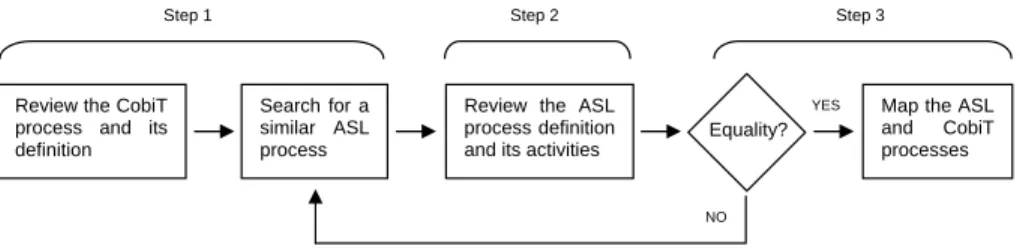
Figure 4.1 describes the mapping process we used to conduct the CobiT-ASL
mapping.
[19] Pols, Remco van der, Ralph Donatz, and Frank van Outvorst. BiSL, Een Framework voor Functioneel Beheer en Informatiemanagement. Van Haren Publishing. 2005. In Dutch.
[20] Sprague, Ralph H. Jr., and Bargara C. McNurlin. Information Systems Management in Practice, Prentice Hall International, Inc. 1993.
Review the CobiT process and its definition
Search for a similar ASL process
Review the ASL process definition and its activities
Equality?
Map the ASL and CobiT processes
YES
NO
Step 1 Step 2 Step 3
Figure 4.1: The mapping process.
For the mapping, we only used the 34 generic CobiT processes and the 26 ASL processes grouped on 6 clusters because this degree of analysis was suffi-ciently specific to find relations between the two frameworks. Nevertheless, we did not limit our study to those processes in case we needed more detail.
After reviewing the CobiT literature, we began to read each CobiT process definition while searching for a similar ASL process. If we found some equality in the definition of that process, we considered the processes equal. Each ASL process could be placed in one or more CobiT process (e.g. an ASL process could completely satisfy a CobiT process, but in other case the same ASL pro-cess could overlap one of more of the specific objectives of other generic CobiT process so, we also mapped those processes). Subsequently, we determined in what grade the processes could be mapped.
If we did not find some equality or similarity between the processes, we contin-ued looking for another possible similar ASL process (if it existed).
For a better understanding of this process, we show an example. Step 1. Review of the CobiT process.
For this example, we take the process “Define a Strategic IT Plan” from CobiT. It is the first CobiT process of the domain “Planning & Organization” from CobiT.
The business goal, as stated in the CobiT Management Guidelines [10], of this
process is“striking an optimum balance of information technology opportunities
and IT business requirements as well as ensuring its further accomplishment by
the IT strategic planning definition”. The principal activities in this process are
the“definition of IT in long- and short- term”, and the“assessment of existing
systems”.
The management instruments that CobiT uses to describe its processes are related in the following way: Control over the process “Define a Strategic IT Plan” ensures to bring information to the organization that “addresses the
re-quiredInformation Criteria and is measured by Key Goal Indicators. It
also considersCritical Success Factorsthat leverage specificIT Resources
and is measured byKey Performance Indicators.” [10]
This process is enabled by a strategic planning process done at regular in-tervals giving rise to long-term plans that need to be translated into operational plans establishing clear and specific short-term goals. This process “Define a Strategic IT Plan” from CobiT takes into consideration the:
• enterprise business strategy
• existing systems assessments
• definition of how IT supports the business objectives
• inventory of technological solutions and current infrastructure
• monitoring the technology markets
• timely feasibility studies and reality checks
• enterprise position on risk, time-to-market, quality
• need for senior management buy-in, support and critical review
In Figure4.2, taken from [10], we can find the specific CSF’s, KGI’s, KPI’s,
the information criteria and IT resources of this process in particular. Setp 2. Review of the ASL process.
It is evident that the process “Define a Strategic IT Plan” from CobiT com-pletely overlaps with the process “ICT developments strategy” from ASL. This ASL process examines which ICT developments could be interesting for the or-ganization to establish an IT strategy having as objective: to specify the impact of IT over the applications and business processes.
The process “ICT developments strategy” tries to identify the trends for application developments because IT developments have a strong influence on the future of applications in the long term. The principal activities of this process are (translated from [15]):
1 To identify relevant technological developments for the business processes. 2 To determine what are the possible opportunities of that IT within the
Figure 4.2: The process “Define a Strategic IT Plan”, taken from [10].
3 To realize costs-, risks-, investments-, possible growth studies.
4 To indicate the desired direction to the IT (IT strategy establishment). 5 To make an inventory of the existing applications and their impact in the
company.
Step 3. Map the processes.
Between the process “Define a Strategic IT Plan” from CobiT and the pro-cess “ICT developments strategy” from ASL can be found more than one re-lation if we take into account their complete definitions. So, we mapped the
activity “definition of IT in long- and short- term” from the CobiT process
(one of the two principal activities identified in step 1 above) with the
activ-ity “indication of the desired direction to the IT” from the ASL process (item
4 identified in setp 2 above). For the other activities of the process “Define a Strategic IT Plan” from CobiT, we could identify similar mappings. The results of this are presented in the figure below.
definition of IT in long- and short- term
CobiT ASL
indication of the desired direction to the IT monitoring the technology markets identification of relevant technological developments assessment of the existing systems
definition of how IT supports the business objectives
finding of the possible opportunities of IT within the organization
realization of feasibility studies and reality checks definition of enterprise position on risk, time-to-market, quality
realization of costs-, risks-, investments-, possible growth studies
making an inventory of technological solutions and current infrastructure
making an inventory of the existing applications
These results show how the process “Define a Strategic IT Plan” from CobiT and the process “ICT developments strategy” from ASL are related. There are, however, more ASL processes that overlap with the process “Define a Strategic IT Plan” from CobiT. The next table presents the process “Define a Strategic IT Plan” from CobiT together with de ASL processes which overlap with this one.
COBIT
PLANNING & ORGANISATION CLUSTER PROCESS
Define a Strategic Information Technology Plan Application Cycle Management ICT developments strategy
" Life cycle management
" ICT portfolio management
Organization Cycle Management Technology definition
" Service delivery definition
Define the Information Architecture Application Cycle Management ICT developments strategy " Customer environment strategy Determine the Technology Direction Organization Cycle Management Market definition
Account definition Technology definition Define the IT Organisation and Relationships Application Cycle Management Customer organization strategy Manage the Investment in Information Technology Management Cost Management
Communicate Management Aims and Direction Organization Cycle Management Service delivery definition (policies)
Manage Human Resources X
Ensure Compliance with External Requirements X
Assess Risks Maintenance Continuity Management
Manage Projects Connecting Processes Change Management
" SW control and distribution Enhancement/renovation Design
Organization Cycle Management Service delivery definition
Manage Quality Management Quality Management
Enhancement/renovation Test ACQUISITION & IMPLEMENTATION
Identify Solutions Organization Cycle Management Technology definition Enhancement/renovation Design
Acquire and Maintain Application Software Application Cycle Management ICT developments strategy Management Planning and control Maintenance Availability Management
" Continuity Management
" Capacity Management
" Configuration Management
Acquire and Maintain Technology Architecture X
Develop and Maintain Information Technology Organization Cycle Management Technology definition Enhancement/renovation Realization
Install and Accredit Systems " Implementation
" Test
Connecting Processes SW control and distribution
Managing Changes Connecting Processes Change Management
Enhancement/renovation Impact analysis DELIVERY & SUPPORT
Define Service Levels Management Service level Management
Manage Third-Party Services " Cost Management (accountability) Service level Management Maintenance Continuity Management (risks) Manage Performance and Capacity " Availability Management
" Capacity Management
Ensure Continuous Service " Continuity Management
Ensure Systems Security X
Identify and Allocate Costs Management Cost Management
Educate and Train Users Maintenance Incident Management
Enhancement/renovation Implementation Organization Cycle Management Skills definition Assisting and Advising Information Technology Maintenance Incident Management
Manage the Configuration " Configuration Management
Manage Problems and Incidents " Incident Management
Manage Data Connecting Processes SW control and distribution Maintenance Continuity Management (back-up)
Manage Facilities X
Manage Operations X
MONITORING
Monitor the Process Management Planning and control
Asess Internal Control Adequacy " Quality Management (audits)
Obtain Independent Assurance X
Provide for Independent Audit Management Quality Management (audits)
ASL
The process “ICT developments strategy” from ASL overlaps completely with the process “Define a Strategic IT Plan” from CobiT. But it is not the
unique one. Each ASL process has also its own activities. The ASL processes with activities related to the process “Define a Strategic IT Plan” from CobiT are presented in the next table:
CLUSTER PROCESS ACTIVITY
Application Cycle Management ICT development strategy To define the ICT strategy and to indicate de impact of the existing applications. " Life cycle management To establish possible scenarios for the IT strategy
" ICT portfolio management To establish the strategy & activities to reach the desired ICT portfolio situation. Organization cycle management Technology definition To establish the strategy to acquire IT and knowledge
" Service delivery definition To define the strategy and path to follow for the ICT service provider.
In addition to the process “ICT developments strategy” from ASL, the other ASL processes partially overlap with the CobiT process and they also converge with other CobiT processes. For instance, the process “Service delivery defini-tion” from ASL partially overlaps with the process “Communicate Management Aims and Direction” from CobiT in the definition of IT policies, and with the process “Manage Project” from CobiT in the definition of the necessary means for IT Services.
The specific mapping of the CobiT/ASL processes can be found in
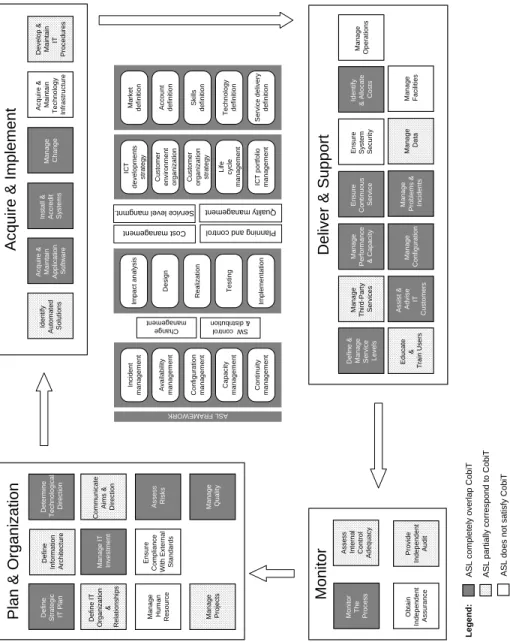
Ap-pendix 1. Figure 4.3, which is structured in a similar way as the diagram
utilized in the CobiT - ITIL mapping of PinkRoccade (UK) [03], shows the re-lation found between ASL and CobiT. The components of ASL are depicted in the centre of the figure. The grey boxes in the surrounding framework indicate where ASL completely overlap the requirements of CobiT. The dotted boxes indicate the CobiT processes are only partially satisfied by ASL and the white boxes indicate the CobiT processes are not satisfied by ASL.
We can see in the figure that CobiT and ASL are related to each other. They have relations in some processes. Organizations which use ASL can ex-tend their IT management with the utilization of CobiT and so, they can also use the MM of CobiT. We found that the CobiT MM can easily be used to determine the maturity levels of the ASL processes that completely map to the CobiT processes. For the ASL processes that only partially overlap with the CobiT processes, the organizations will need to make some adjustments in the CobiT MM, but these adjustments are not so considerable because partially the ASL/CobiT processes are equal. To describe how the CobiT MM can exactly be used by ASL is not the purpose of this survey, as we only intend to determine if the maturity model of CobiT can be used by the management frameworks.
4.2
Mapping of BiSL
BiSL has some activities that can be related to best practices of CobiT, namely Financial Management, Change Management, and Planning and Control.
Acquire & Implement Iden ti fy Au to ma ted So lu ti on s A c qu ir e & Maintain A p plication So ft w a re A c qu ir e & Maintain T e chno logy In frastruct u re Dev e lo p & Maintain IT P ro c edu re s
Install & Accr
edit Sy s te m s M a nage C hange
Deliver & Support Ma
nage P e rf orm a nce & Capa city En s u re C o n tinuou s Se rv ic e En s u re Sy s te m Se c u ri ty Iden ti fy & Allocat e Costs M a nage Thi rd-P a rt y Se rv ic e s Defi n e & M anage Se rv ic e Le ve ls E d uca te & Train Users Assist & A d vise IT Cust omers M a nage Co nfi g ura tio n M a nage Pro b le ms & In ciden ts M a nage Data M a nage Fa cil it ie s M a nage Op er ati o ns Monitor Monit o r T he Proc ess Assess Inte rn a l C ont ro l Adequa cy Obtain Independen t Assurance Provid e Independent Aud it
Plan & Organization Defi
n e Strat e gic IT Pla n Defi n e IT O rgan iza tion & Rela tio n shi p s M a nage IT In ve st m ent Det e rmin e Te chno log ica l Directio n Commu nicat e
Aims & Direction
M a nage Hum a n Res o urce En s u re Compliance Wit h E x te rna l S tanda rd s Assess Risks M a nage Pr ojects M a nage Quality Defi n e In fo rm at ion Arc h itect u re Desig n Tes ti n g Im pa ct ana ly sis Implem e n ta tio n Realization SW contro l & distributio n Change ma nagemen t Costmanag
ement nd control Planning a
Quality mana ge ment Service leve lm angmnt. Availabil ity m a nage men t C apa city m a nage men t In cid ent m a nage men t Co nti n uit y m a nage men t Co nfi g ura tio n m a nage men t Cust omer en vir o n m ent or g a n izatio n Lif e cy cle m a nage men t ICT de ve lop m ent s st ra tegy IC T po rtfo lio m a nage men t Cust omer or g a n izatio n st ra tegy A ccoun t definition T e chno logy definition Market definition S e rv ice delivery definition S k ills definition ASL FRAMEWORK Leg e nd: AS L com p le te ly ov erl a p Co bi T ASL pa rt ia lly co rr e s pon d to C ob iT ASL does not sa tisfy C ob iT
ever, BiSL can not be directly mapped with CobiT because BiSL works more
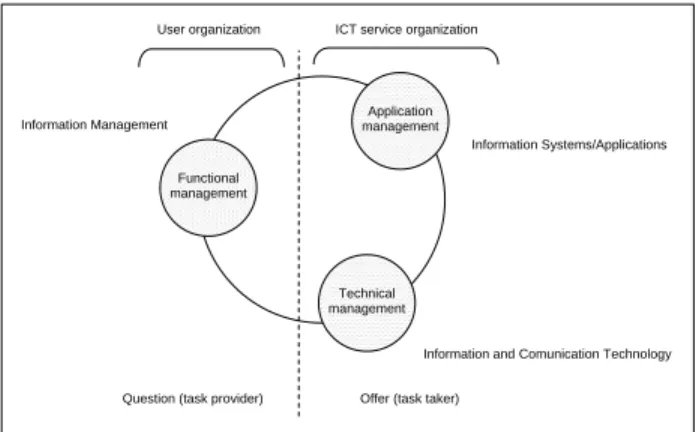
in the area of information provisioning (functional management). In Figure4.4
we can see that. The BiSL area (functional management) is a complementary part of ITIL (technical management) and ASL (application management). This last two frameworks can be easily mapped to CobiT because CobiT works also in those management areas.
complementary part of ITIL (technical management) and ASL (application management). This last two frameworks can be easily mapped to CobiT because CobiT works also in the ICT management area.
5 Conclusions
In this section, we will make a number of observations that are relevant for future research directions and for users of ITIL, ASL, BiSL (management frameworks) and/or CobiT (control framework). As we saw, the CobiT MM can be used in some processes of the management frameworks. The problem is what to do with the rest of the processes. The question “How will we know what level of maturity our organization has after the use of the ITIL, ASL en/of BiSL frameworks?” remains still with a not complete answer because we establish that BiSL can not be mapped with CobiT. We still need to see maturing to get to a point that we decide: level one, level two, level three, etc. in order to make improvements in the supply of information area. CMM could be a solution but it is necessary to do a study about that.
ITIL, ASL and BiSL are frameworks in which are described which activities and processes take place in ISM and how these processes coincide. But they are just frameworks, models, just simplified reproductions of reality and organizations can use them to structure and manage their processes. Functional management Application management Technical management User organization ICT service organization
Information Management
Information Systems/Applications
Information and Comunication Technology Question (task provider) Offer (task taker)
Figure 4.4: Technical, Application and Functional Management.
Chapter 5
Discussion
As we have seen, the CobiT MM can be used in some processes of the manage-ment frameworks. The problem is what to do with the rest of the processes (i.e. processes which do not overlap with CobiT processes). The question stated in Chapter 2 about “How can we know what level of maturity our organization has after the use of the ITIL, ASL and/or BiSL frameworks?” remains still with an incomplete answer because we have established that BiSL can not be mapped with CobiT. They are two separated areas and therefore, it would not make sense to establish mappings between them. We still need to see maturity to get to a point that we can make improvements in the functional management area in general, or the BiSL framework in particular.
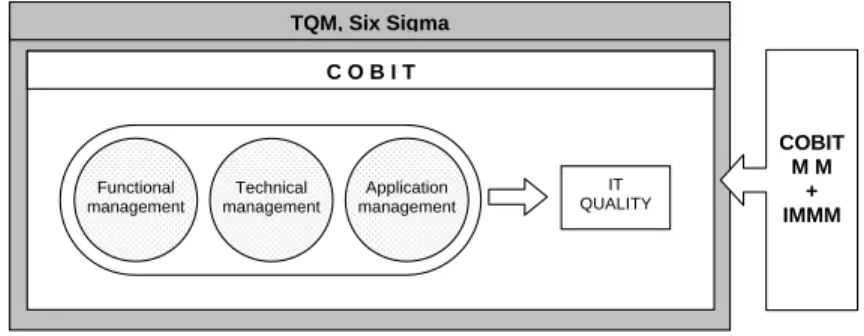
The Information Management Maturity Model (IMMM) developed by Bear-ingPoint (formerly KPMG Consulting LP) for the Canadian Government could be a good candidate solution because its elements are related with the manage-ment of information which is an important task in the BiSL framework, but it is necessary to do a study about how it fits to BiSL. The study needs to focus not only on the usability of this capacity checking tool in this context, but also on the benefits that can be obtained.
ITIL, ASL and BiSL are frameworks which describe which activities and processes take place in ISM and how these processes coincide. But they are merely frameworks, models: simplified representations of reality. Organizations can use them to structure and manage their processes. A process model assumes the idea that an organization operates as a physical process with predictable and controllable actions. However, not everything is predictable and entirely manageable. ITIL, ASL and BiSL are checklists that say which processes need to be established in an organization. These frameworks offer all the freedom to let work then within the organizations. They are not mandatory frameworks. They are there as means to improve quality in the ISM area in the organiza-tions. We could say that ITIL, ASL and BiSL run the “day-to-day” operations of IT in the organizations, and CobiT is the control framework where these
![Figure 1.1: Position of ITIL, ASL and BiSL (source: [16]).](https://thumb-us.123doks.com/thumbv2/123dok_us/9704800.2459915/7.918.318.601.659.865/figure-position-itil-asl-bisl-source.webp)
![Figure 3.1: ITIL framework (source: [18]).](https://thumb-us.123doks.com/thumbv2/123dok_us/9704800.2459915/13.918.254.669.421.783/figure-itil-framework-source.webp)
![Figure 3.3: BiSL framework (source: [16]).](https://thumb-us.123doks.com/thumbv2/123dok_us/9704800.2459915/20.918.223.697.564.925/figure-bisl-framework-source.webp)
![Figure 3.4: The CobiT framework (source: [09]).](https://thumb-us.123doks.com/thumbv2/123dok_us/9704800.2459915/23.918.219.700.196.687/figure-the-cobit-framework-source.webp)
![Figure 4.2: The process “Define a Strategic IT Plan”, taken from [10].](https://thumb-us.123doks.com/thumbv2/123dok_us/9704800.2459915/29.918.194.720.252.916/figure-process-define-strategic-plan-taken.webp)