CIFE
CENTER FOR INTEGRATED FACILITY ENGINEERING
Potential Benefits of
Internet-Based Project Control Systems –
A Study On Monthly Progress Billings Processing
By
Alex Barrón, Martin Fischer
CIFE Technical Report #127
March, 2001
Copyright © 2001 by
Center for Integrated Facility Engineering
If you would like to contact the authors, please write to: c/o CIFE, Civil and Environmental Engineering Dept.,
Stanford University Terman Engineering Center
Mail Code: 4020 Stanford, CA 94305-4020
The authors would like to acknowledge the contributions of the following people to this research: N.L. Barnes Construction Co.
Tom Neidecker Jim Youd Karthi Mowdhgalya
SUMMARY
CIFE TECHNICAL REPORT #127
Title:
Potential Benefits of Internetbased Project Control Systems
-A Study on Monthly Progress Billings Processing
Authors:
Alex Barrón, Ph.D. Student, Department of Civil & Environmental
Engineering, Stanford University
Martin Fischer, Associate Professor of Civil & Environmental
Engineering, Stanford University
Publication Date:
March 6, 2001
Funding Sources:
National Science Foundation Graduate Fellowship
CIFE - 4D-Based Time and Cost Control and Financial Management
1. Abstract:
AEC companies lack a consistent way to assess to what degree their processes are inefficient
and thus do not know where investments in automation and integration tools could benefit them
most. This report presents a detailed study of project management processes in the areas of cost
control, contract management and financial management based on examples from the Stanford
SEQ construction project. It discusses a framework for developing and analyzing business
process models. This report focuses on monthly progress billings processing. The report studies
the effects internet-based systems could have on the organization, duration, and effort required
for construction management processes. It presents the potential qualitative and quantitative
benefits of an internet-based project control system over the current paper-based systems.
2. Subject:
This report studies the potential benefits of internet-based project control systems by
modeling and analyzing a business process model of the monthly progress billings process. The
key idea investigated was how to model business processes to make them explicit and simpler to
understand. A key observation is that most of the information used in project documents is not
new, but is created in previous processes. The essential message is that by modeling the
information flow and using internet-technologies to integrate the information, most of the
activities to re-enter this information could be automated or eliminated, thus significantly
reducing processing effort, which in turn translates into shorter process duration and cost
savings.
3. Objectives/Benefits:
CIFE funded this research to extend the product and process modeling efforts to
document management and cost control. CIFE members can now understand what type of
benefits can be expected from integration using internet-based tools. Internet-based tools are
increasingly being used to manage projects. The vision is that internet-based systems would
automate many business functions and integrate heterogeneous systems using workflow
technologies and business-to-business integration standards such that information will flow
seamlessly across companies throughout the life cycle of a project, where each item of data is
entered only once. The research attempted to explore how these technologies could be used to
manage project costs and contract changes.
4. Methodology:
The research utilized data and case studies from the Stanford SEQ project as well as
Excel and Visio computer models to build the business process models.
5. Results:
The major finding of this investigation is that, with an internet-based system:
•
monthly progress billings could be processed with one or two actors per organization instead
of the three or four used today.
•
the total effort to process progress billings can be reduced by nearly 84%.
•
over 99% of the information used for all the progress billing processing activities can be
taken from previous processes.
•
the activities requiring clerical and technical skills drop from 64% to 11% shifting the focus
to managerial activities.
•
the majority (80%) of the effort will now be centered on authorizing applications for payment
rather than preparing documents, processing them, locating them or updating the accounting
database.
This offers tremendous opportunities for the AEC community to reduce the project duration and
costs. The results are given in this report as a set of charts.
6. Research Status:
This research for the monthly progress billings process is complete. The next logical step
is to repeat the methodology and analysis to other processes including payments. These results
could be applied to create an internet-based financial management system to be used in the field
office of construction projects and begin to enjoy the benefits of integration with the internet.
TABLE OF CONTENTS
Executive Summary...
1. POTENTIAL BENEFITS OF INTERNET BASED PROJECT
CONTROL SYSTEMS - A STUDY ON MONTHLY PROGRESS
BILLINGS PROCESSING...
1.1. Introduction...
1.2. Internet-Based Systems...
1.3. Overview of Research...
1.4. Practical Motivation...
1.5 Case Study Example...
1.6 Problem Statement...
1.6.1. Business Processes are Implicit... 1.6.2. Business Processes are Complex... 1.6.3. Business Processes Need Visibility...1.7. Purpose of Research...
1.8. Scope of Research...
1.9. Research Contributions...
1.10. Practical Benefits...
1.11. Future Directions for Research...
1.12. Overview of Report ...
2. CASE STUDY DESCRIPTION...
2.1. Cubbies Problem Description and Request for Information...
2.2. Delay of Construction due to Lack of Responsibility for Design-Construction
Conflict and Costs...
2.3. Sub Change Order Requests...
2.4. Time Cards and Revised Sub Change Order Request...
2.5. Owner Change Order Request...
2.6. Change Orders...
2.7. Owner and Subcontractor Billings...
2.8. Owner and Subcontractor Payments...
2.9. Observations Related to Case Study...
1
3
3
3
4
4
6
7
7 8 88
9
9
9
10
10
11
11
12
12
13
13
14
14
15
15
3. MONTHLY PROGRESS BILLINGS INFORMATION AND
PROCESS
3.1. Discussion of Progress Billing Documents...
3.1.1. Purpose of Progress Billing Documents... 3.1.2. Purpose of Payment Requests... 3.1.3. Information in Progress Billing Documents... 3.1.3.1 Monthly Schedule of Values Information... 3.1.3.2. Application for Payment... 3.1.3.3. Invoice... 3.1.4. Payment Request Information... 3.1.4.1. Owner Payment Request... 3.1.4.2. Sub Payment Request... 3.1.5. Observations Related to Progress Billing Documents...3.2. Overview of Progress Billings Process...
3.2.1. Monthly Progress Billing Process Description... 3.2.1.1. Prepare Progress Billing... 3.2.1.2. Certify Application for Payment... 3.2.1.3. Issue Payment Request... 3.2.2. Paper-based System... 3.2.3. Internet-based System... 3.2.4. Benefits of Using an Internet-based System...4. BUSINESS PROCESS MODELING...
4.1. Objectives of Business Process Model...
4.2. Product and Process Modeling in AEC...
4.2.1. Object Oriented Modeling Concepts... 4.2.2. Standards Efforts... 4.2.3. Document Management Research... 4.2.4. Product & Process Modeling Concepts...4.3. Business Process Modeling Framework...
4.3.1. Analytical Model...4.3.1.1 Levels of Detail in Process Model... 4.3.1.2. Attributes Associated with Information Elements... 4.3.1.3. Attributes Associated With Process Activities... 4.3.2. Graphical Model... 4.3.2.1. Structure and Decomposition... 4.3.2.2. Source and Effect on Activity... 4.3.2.3. Document Transfer and Information Flow...
5. PROGRESS BILLINGS ANALYSIS AND RESULTS...
5.1. Analysis Methodology...
5.1.1. Dimensions Measured in Analysis ...17
17
17 17 18 18 18 19 19 19 19 1919
20 20 20 20 20 21 2123
23
24
24 25 26 2627
27 28 29 30 32 32 32 3335
35
355.2. Single Parameter Analysis Highlights...
5.3. Multi-Parameter Analysis Highlights...
6. CONTRIBUTIONS AND BENEFITS OF RESEARCH
6.1. Contributions of Research...
6.1.1. Extending Previous AEC Research for Modeling Business Processes... 6.1.2. Levels of Detail in Business Process Modeling Framework...6.2. Key Benefits of Internet-Based Systems...
6.2.1. Qualitative Benefits... 6.2.2. Quantitative Benefits...6.3. Conclusion...
APPENDIX A. ANALYTICAL PROGRESS BILLINGS PROCESS
MODEL...
APPENDIX B. GRAPHICAL PROGRESS BILLINGS PROCESS
MODEL...
APPENDIX C. PROGRESS BILLINGS ANALYSIS AND RESULTS...
C.1. Results of Monthly Billings Process Analysis - Single Parameter...
C.1.1. Overall Process Analysis Results... C.1.1.1. Total Number of Activities... C.1.1.2. Total Process Effort... C.1.1.3. Total Calendar Time... C.1.2. Analysis Results per Transaction...C.1.2.1. Transactions per Organization and Position... C.1.2.2. Number of Activities and Process Effort per Transaction... C.1.3. Analysis Results per Position...
C.1.3.1. Total Number of Activities per Position... C.1.3.2. Processing Effort per Position... C.1.4. Analysis Results per Activity Skill... C.1.4.1. Total Number of Activities per Activity Skill... C.1.4.2. Processing Effort per Activity Skill... C.1.5. Analysis Results per Effect of Integration on Activity... C.1.5.1. Total Number of Activities per Effect on Activity... C.1.5.2. Processing Effort per Effect on Activity... C.1.6. Analysis Results per Activity Classification...
C.1.6.1. Total Number of Activities per Activity Classification... C.1.6.2. Processing Effort per Activity Classification... C.1.7. Analysis Results per Activity Level...
C.1.7.1. Total Number of Activities per Activity Level... C.1.7.2. Total Processing Effort per Activity Level... C.1.8. Analysis Results per Source of Information Elements...
C.1.8.1. Number of Activities per Source of Information Elements...
36
39
41
41
41 4141
42 4243
45
47
49
49
49 49 50 51 53 53 58 86 86 87 89 89 90 92 92 93 94 94 95 97 97 98 99 99C.1.8.2. Processing Effort per Source of Information Elements... C.1.9. Analysis Results per Data Type of Information Elements... C.1.9.1. Number of Activities per Data Type of Information Elements... C.1.9.2. Processing Effort per Data Type of Information Elements...
C.2. Results of Progress Billings Analysis - Two Parameters...
C.2.1. Distribution per Position... C.2.1.1. Distribution by Activity Skill per Position... C.2.1.1.1. Number of Activities Distribution of Activity Skill per Position... C.2.1.1.2. Distribution of Processing Effort by Activity Skill per Position... C.2.1.2. Distribution by Effect on Activity per Position... C.2.1.2.1. Number of Activities Distribution of Effect per Position... C.2.1.2.2. Distribution of Processing Effort by Effect per Position... C.2.1.3. Distribution by Activity Classification per Position...
C.2.1.3.1. Number of Activities Distribution of Activity Classification per Position... C.2.1.3.2. Distribution of Processing Effort by Activity Classification per Position... C.2.2. Distribution per Activity Skill...
C.2.2.1. Distribution by Position per Activity Skill... C.2.2.1.1. Distribution of Activities by Position per Activity Skill... C.2.2.1.2. Distribution of Processing Effort by Effect on Activity per Activity Skill... C.2.2.2. Distribution by Effect on Activity per Activity Skill... C.2.2.2.1. Distribution of Activities by Effect on Activity per Activity Skill... C.2.2.2.2. Distribution of Processing Effort by Effect on Activity per Activity Skill... C.2.2.3. Distribution by Activity Classification per Activity Skill... C.2.2.3.1. Distribution of Activities by Activity Classification per Activity Skill... C.2.2.3.2. Distribution of Processing Effort by Activity Classification per Activity Skill... C.2.3. Distribution per Effect of Integration on Activity... C.2.3.1. Distribution by Position per Effect on Activity... C.2.3.1.1. Distribution of Activities by Position per Effect on Activity... C.2.3.1.2. Distribution of Processing Effort by Position per Effect on Activity... C.2.3.2. Distribution by Activity Skill per Effect on Activity... C.2.3.2.1. Distribution of Activities by Activity Skill per Effect on Activity... C.2.3.2.2. Distribution of Processing Effort by Activity Skill per Effect on Activity... C.2.3.3. Distribution by Activity Classification per Effect on Activity... C.2.3.3.1. Distribution of Activities by Activity Classification per Effect on Activity... C.2.3.3.2. Distribution of Processing Effort by Activity Classification per Effect on Activity C.2.4. Distribution per Activity Classification...
C.2.4.1. Distribution by Position per Activity Classification... C.2.4.1.1. Distribution of Activities by Position per Activity Classification... C.2.4.1.2. Distribution of Processing Effort by Position per Activity Classification... C.2.4.2. Distribution by Activity Skill per Activity Classification...
C.2.4.2.1. Distribution of Activities by Activity Skill per Activity Classification... C.2.4.2.2. Distribution of Processing Effort by Activity Skill per Activity Classification... C.2.4.3. Distribution by Effect on Activity per Activity Classification...
102 105 105 107
109
109 109 109 111 113 113 115 117 117 120 123 123 123 125 127 127 128 129 129 131 133 133 133 135 137 137 139 141 141 143 145 145 145 147 150 150 152 155POTENTIAL BENEFITS OF INTERNET-BASED PROJECT CONTROL
SYSTEMS - A STUDY ON MONTHLY PROGRESS BILLINGS
PROCESSING
Alex Barrón
Ph.D. Student, Department of Civil & Environmental Engineering Stanford University, Stanford, CA 94305
Martin Fischer
Associate Professor, Department of Civil & Environmental Engineering Stanford University, Stanford, CA 94305
Executive Summary
In today's fast-paced economy, Architecture/Engineering/Construction (AEC) companies are seeking new ways to streamline their business processes to reduce project duration and costs. The reasons are simple: Owners need to minimize the time to market of their products and thus need to reduce the delivery time for the facilities used to manufacture these products. Similarly, contractors, faced with intense competition, tight labor markets, and slim profit margins, need to optimize their allocation of human resources and minimize their working capital needs.
Given the inter-dependency of a project's physical and management activities, it is essential for AEC companies to manage and integrate information effectively and efficiently. Yet today, most project stakeholders in the US still manage and integrate information manually using paper documents or electronic files created by "best-of-breed" applications such as CAD, estimating, scheduling, document control and accounting systems as well as spreadsheets, word processing software and company paper forms. The business processes used to manage these documents are often ad-hoc, proprietary, and not explicit. People simply "know what to do" or, at best, are given a "list of steps" to follow. As a result, several process inefficiencies exist in the field and home offices such as paper-based activities, multiple document hand-offs, redundant activities, data re-entry, and distributed data storage, all of which can result in extensive delays, additional work, excessive costs, and potential data inconsistencies or error. Project managers are burdened with excessive clerical-level work in addition to their other duties on the project. Internet-based project management and coordination tools promise to help reduce these inefficiencies. However, AEC companies lack a consistent way to assess to what degree their processes are inefficient and thus do not know where investments in automation and integration tools could benefit them most.
This report presents a detailed study of current, paper-based project management processes based on examples from a construction project. It shows how project management processes can be analyzed with respect to position, activity skill, effect of integration on activities, activity classification, transactions, and source of information. The dimensions we modeled were activities, organizations, actors, information, processing effort, and calendar time. One key aspect of our model is that it shows the source of every information element, thus establishing the relationships necessary for automated information flow. Based on the detailed documentation and analysis of today’s processes, the report studies the effects internet-based systems could have on the organization, duration, and effort required for management processes.
It demonstrates that, with an internet-based system:
• monthly progress billings could be processed with one or two actors per organization instead of the three or four used today.
• the total effort to process billings can be reduced by nearly 84%.
• over 99% of the information used for all the progress billing processing activities can be taken from previous processes.
• the activities requiring clerical and technical skills drop from 64% to 11% shifting the focus to managerial activities.
• the calendar time (process duration) is reduced from 3 weeks to 1 week ? a significant reduction of 67%! This makes the true value of integration evident as management processes make use of information already in the system. The report concludes with a summary of our contributions and the potential benefits of integrating information with internet-based systems to manage construction projects.
We hope that this report provides the starting point and tools for a dialog between the many participants in project management processes and between software vendors and practitioners to enable professionals to use their expertise, time and attention in the best possible way.
1. POTENTIAL BENEFITS OF INTERNET-BASED PROJECT CONTROL
SYSTEMS - A STUDY ON MONTHLY PROGRESS BILLING
PROCESSING
1.1. Introduction
In today's fast-paced economy, Architecture/Engineering/Construction (AEC) companies are seeking new ways to streamline their business processes to reduce project duration and costs. The reasons are simple: Owners need to minimize the time to market of their products and thus need to reduce the delivery time for the facilities used to manufacture these products. Similarly, contractors, faced with intense competition, tight labor markets, and slim profit margins, need to optimize their allocation of human resources and minimize their working capital needs. In this type of environment, it is becoming more common to "fast-track" projects where construction begins before the design documents are fully complete. Consequently, many Requests for Information (RFIs) arise due to conflicts or omissions in the contract documents and give way to extra work not included in the original contract scope. This can result in additional costs and project delays. Contractors are then faced with the problem of tracking this extra work, submitting change order requests, waiting until they are issued a change order before they can bill for this work, and finally financing this additional working capital for months until they are compensated for the work they performed months before in order to meet the project schedule.
Given the inter-dependency of a project's physical and management activities, it is essential for AEC companies to manage and integrate information effectively and efficiently. Yet today, most project stakeholders in the US still manage and integrate information manually using paper documents or electronic files created by "best-of-breed" applications such as CAD, estimating, scheduling, document control and accounting systems as well as spreadsheets, word processing software and company paper forms. The business processes used to manage these documents are often ad-hoc, proprietary, and not explicit. People simply "know what to do" or, at best, are given a "list of steps" to follow. As a result, several process inefficiencies exist in the field and home offices such as paper-based activities, multiple document hand-offs, redundant activities, data re-entry, and distributed data storage, all of which can result in extensive delays, additional work, excessive costs, and potential data inconsistencies or error. Project managers are burdened with excessive clerical-level work in addition to their other duties on the project. Internet-based project management and coordination tools promise to help reduce these inefficiencies.
Yet today, AEC companies lack a consistent way to assess to what degree their processes are inefficient and thus do not know where investments in automation and integration tools could benefit them most. This report presents a detailed study of current, paper-based project management processes based on examples from a construction project. It also presents a framework we developed for modeling these processes at various levels of detail. This enables a better understanding of what processes are likely to benefit most from integration using internet-based systems and an estimate of the extent that these processes will be affected in terms of the organization, processing effort and process duration.
1.2. Internet-Based Systems
Over the last few years, over 200 startups with internet-based project management systems focused on the AEC industry have appeared and have promised to streamline business processes and thus add value to AEC companies. Their primary focus is in design collaboration (sharing CAD files and RFIs) and e-commerce (bidding & procurement) and to a lesser extent on project control (cost control, contract management & accounting). It is estimated that over $1Billion of venture capital has been invested in these startups in an effort to capture the "$3.2Trillion global AEC market"1. The sudden attention surrounding internet-based systems and standards efforts like aecXML has caused strong interest and confusion among project stakeholders regarding the level of impact internet-based systems will have on the industry and on projects in terms of reduced delivery cycles, cost savings, integration of information and quality of communication. Some research analysts estimate that web-based tools can save between 5-10% of a project's total installed cost, implying potential savings of up to $400 Billion annually by 20042. Although these numbers are encouraging, it is not exactly clear how these estimates were derived nor do
quantitative and qualitative benefits an internet-based system would offer over traditional paper-based systems and to identify the processes that would benefit most. The vision here is that internet-based systems would automate many business functions and integrate heterogeneous systems using workflow technologies and business-to-business integration standards such that information will flow seamlessly across companies throughout the life cycle of a project, where each item of data is entered only once. The process model compiled for this study shows how far from this vision practice is today.
In conclusion, both AEC companies and startups need a way to model and analyze the current and improved business processes in detail to describe and compare what information is managed, who does what, what will change, who will benefit, what skills will be required, and how much time and money internet-based systems can be expected to save.
1.3. Overview of Research
In this research, we developed business process models based on observations of current practice. Our focus is on the cost control and financial management processes in the construction phase of a building project used to compensate contractors. The goal was to evaluate the potential quantitative and qualitative benefits an integrated internet-based system would offer over current paper-based systems. This report discusses how we developed these models as well as the analysis we performed based on the process models. The results of this research will be presented in a series of reports covering each process category (RFIs, Time Cards, Change Orders, Progress Billings, and Payments) in detail and a summary report discussing the results from a global perspective. The current report focuses on monthly progress billing process modeling and automation.
To motivate this discussion, this chapter first presents a case study of a project that clearly demonstrates some of the limitations of current paper-based systems and is the basis for the business process models we developed in this research. We then discuss some of the challenges facing the AEC industry in the area of integration and internet-based tools. Next, we present the purpose and scope of our research. A summary of the contributions this research makes to the AEC industry follows. Finally, we conclude this chapter with an overview of the rest of the report.
1.4. Practical Motivation
The construction project that motivated this research is the new Science and Engineering Quad (SEQ) at Stanford University. While unique in its design, this project is typical of many fast-track projects today that have tight schedules and budget constraints, but are late and over budget due to an incomplete design and the lack of integrated information systems between the participating companies.
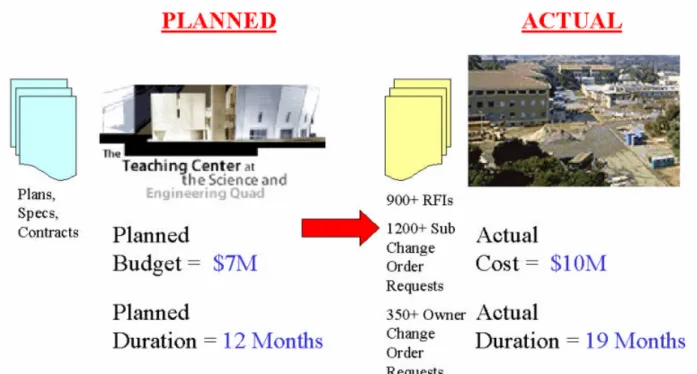
The first phase of this project, which included the Teaching Center on which the case study in this report is based, eventually led to over 900 Requests for Information (RFIs), over 1200 Sub Change Order Requests (SCORs) and over 350 Owner Change Order Requests (OCORs) which affected the duration and cost of the project significantly. Given the paper-based systems available to manage the project documents, and the organizational structure of the project, it was not possible for the project participants to process the Change Order Requests and corresponding Progress Billings in a timely manner. The first phase of the project was completed 7 months behind schedule at a cost close to 50% over the contract (Figure 1-1). The change order paperwork to compensate the General Contractor and all his Subcontractors was completed almost a year later.
Figure 1-1. Practical motivation inspired by difference between planned and actual results in SEQ project.
The inefficiencies experienced on this project associated with managing paperwork inspired us to examine how things could have been different had there been an internet-based system to control the project. We prepared a case study from this project to illustrate how a typical issue required multiple manual re-entries of information for various project documents (see Chapter 2). We developed a business process model of the various management functions required to process the issue and used it to track the flow of information from the time the issue was raised to the time it was paid for (see Chapter 4). As this case illustrates, although the work to install the particular building components was performed in less than 100 man-hours, it took 8 companies and over 25 individuals over 20 work-hours and over 6 months to process the associated paperwork required to pay for this work. This process was typical of most issues in the SEQ project. Each process to resolve an issue took approximately the same time regardless of the actual cost of the issue. This project clearly illustrates that a project's duration and cost are determined not just by its physical activities, but by the sum total of the physical and management activities associated with it. Thus, it is critical to a project's success to consider not only physical activities, but also to understand and model the management activities and the relationships between the two.
Figure 1-2. The duration and cost of a project are a function of the physical activities plus the surrounding upstream and downstream management activities.
1.5. Case Study Example
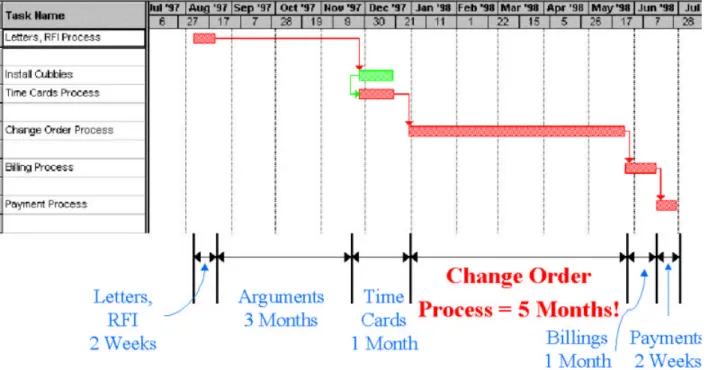
This case study focuses on the wood cubbies in the 2nd floor lobby of the Teaching Center (Figure 1-3). The paperwork to compensate the contractors for this issue included letters, an RFI, time cards, change order requests, change orders, applications for payment, payment requests, and eventually payment. The contractors received payment almost 11 months after the RFI was issued and over 6 months after the work was complete (Figure 1-4).
Figure 1-4. Process duration view of the cubbies issue. It took 11 months from the time the RFI was sent to the time this issue was paid for. This was very typical of most issues on this project.
1.6. Problem Statement
The case study illustrates that business processes are critical to the success of a project, yet with today's paper-based systems, they are lengthy and very inefficient. The main problems are threefold:
1.) Explicit business process models are virtually non-existent, thus the impact of management activities and decisions on physical activities is not understood and cannot be controlled or predicted.
2.) Business processes are complex and therefore require logical grouping and decomposition to make it easier to understand them.
3.) Business processes lack visibility into where inefficiencies exist. Therefore it is difficult to identify areas where processes would benefit from automation and integration.
We now discuss each of these points in more detail.
1.6.1. Business Processes are Implicit
Traditionally, most construction projects have been modeled only in terms of the physical components (CAD drawings) and physical activities (project schedule) required to construct the building, such as "Install Cubbies" and "Patch Wall". However, business processes are often the drivers of duration and overhead costs. Business processes, which consist of management activities dealing with documents such as RFIs, submittals, change orders, change orders and billings, are performed in support of physical activities. However, most of these business processes are implicit - project stakeholders simply "know what to do". Although these processes directly affect physical activities, their impact on the project schedule and cost is not well understood and cannot be controlled or predicted. Therefore, we see there is a need to model business processes explicitly to have a better understanding of their impact on project duration and cost. These models will then enable project stakeholders to prioritize their time and effort by providing them visibility into the impact their management activities will have on physical activities.
1.6.2. Business Processes are Complex
Given that business process models are necessary for project control and efficiency, the issue then becomes what to model and how to structure the model. Business processes can be described at various levels of detail from the project phase to a specific transaction at the document level to an activity at the information level. The challenge in modeling business processes is that the more detailed the process model becomes, the more complex and difficult it becomes to understand what matters. Therefore, it is useful to structure the process into various levels of detail in a logical way to keep things simple and associate related concepts. In decomposing the process using a top-down approach or grouping related activities in a bottom-up approach, it is essential to maintain consistency and clarity of purpose at each level of detail so that the resulting process models are aligned and can be compared across process categories on an equal basis.
1.6.3. Business Processes Need Visibility
The case study illustrates that business processes to compensate contractors are lengthy and inefficient. However, at the level of detail shown in Figure 1-4, it is virtually impossible to answer the following practical questions:
• Where are the process inefficiencies?
• How large are these inefficiencies?
• Why do process inefficiencies exist?
• To what extent could an internet-based system help reduce or eliminate process inefficiencies?
• Who is involved in these processes?
• What information do they manage?
• How does the information flow between documents?
To answer these questions, a detailed process model and analysis of these information management activities is needed. The analysis can then be used to determine where automation and integration could help make the process more efficient, and to estimate to what extent each process would benefit from automation and integration. This new level of visibility will help prioritize standardization and implementation efforts and also help AEC companies understand how to achieve the most return on their investment.
1.7. Purpose of Research
The purpose of this research project is to explore how and to what extent an internet-based system could streamline the management processes used during the construction phase of a project in the areas of cost control, contractual management and financial management. To achieve this purpose, we set the following objectives:
• Develop a framework to create AEC business process models that clearly describe the content, structure, relationships, logic, actions and sequence of business processes using multiple yet consistent and logical levels of detail. These models will help to describe, visualize, and compare business processes using different technologies across different categories.
• Model the following set of business processes in great detail using documents from a real project: RFI, Change order, Change Order, Monthly Progress Billings, and Payments processes. These models will help identify what information can be integrated and automated by specifying the source of each information element. At the lowest level of detail, it is also easier to estimate how much processing effort each activity takes.
• Estimate the quantitative and qualitative impact an integrated internet-based system would have over current paper-based systems by performing a detailed analysis of the management activities in these processes and measuring the number of activities, effort required, calendar time, and staffing, due to integration and automation.
system would be predicted to add the most value. Hence the research results identify the potential areas where automation and integration can make the processes more efficient. Thus they can guide implementation and standardization efforts in a strategic way and help firms leverage the return on investment in integration and automation tools.
1.8. Scope of Research
We have divided the scope of this research effort into eight major categories:
1.) Manage Project Setup (Project Information, Company Information, People Information, and Contract Information).
2.) Manage Scope (Cost Codes and Schedule of Values) 3.) Manage Project Documents (e.g., RFI, Letters, etc.)
4.) Manage Field Resources (e.g., Change orders, Material Data Sheets, etc.) 5.) Manage Contract Changes (e.g., Change Order Requests, Change Orders, etc.) 6.) Manage Billings (e.g., Monthly Schedule of Values, Application of Payment, etc.) 7.) Manage Payments (e.g., Employee Payment, Subcontractor Payment, etc.)
8.) Manage Reports (e.g., Cost Report, Manpower Distribution Report, Cash Flow Analysis, etc.)
We will present the results of this research in a series of detailed reports and a summary report discussing the results from a global perspective.
1.9. Research Contributions
Our research makes two contributions to knowledge in AEC:
• First, it extends the product and process modeling concepts developed in AEC research to model engineering and construction activities to include project documents and management activities.
• Second, it provides a framework consisting of several structured levels of detail to describe AEC business processes in a consistent and logical way. This is useful to describe and compare different business processes across companies, system types, project phases and categories.
1.10. Practical Benefits
Our research yields many practical benefits to the AEC building industry:
• First, it provides business process models of many common management activities in the areas of cost control, contract management and financial management. These models are useful to describe, visualize and understand what processes consist of and look like.
• Second, the process models identify where business processes could benefit from integration and automation by making the source of each information element explicit.
• Third, the process models help benchmark the time and effort processes take today using paper-based systems and help estimate the potential amount of processing effort that could be saved by enabling the integration and automation of AEC business processes using internet technologies.
• Finally, the analysis helps to understand what project phases and business functions are likely to benefit most and to what extent they will benefit. It also shows what information needs to be standardized. This will help guide the standardization and implementation efforts necessary to reap the rewards of integration.
The main reason for this long duration is that each document needs to pass through a number of hands in many firms. To reduce overall process time we must focus on reducing the time of each transaction and on redesigning overall processes across organizational boundaries to reduce redundant activities as much as possible. This redesign of the overall process can only be based on explicit business process models.
We hope that this report provides the starting point and tools for a dialog between the many participants in project management processes and between software vendors and practitioners to enable professionals to use their expertise, time and attention in the best possible way.
1.11. Future Directions for Research
Our long-term goals for this research are:• To understand how to use the framework and models to achieve integrated financial management and cost control of a construction project based on standardized transactions and internet technologies, such as Java and XML.
• To demonstrate the generality and power of the framework described by applying it to other project phases such as estimating, bidding, and procurement.
1.12. Overview of Report
The current report focuses on change order process modeling and automation. The report is structured as follows:
• Chapter 1 introduces the research motivation, problem statement and the purpose of the research.
• Chapter 2 discusses the case study used to develop a business process model and the accompanying analysis.
• Chapter 3 describes the information in the change orders used in the case study. It also describes the change order process, the limitations of a paper-based system and the potential benefits of an internet-based process.
• Chapter 4 presents the methodology we used to model business processes. We also describe the analytical and graphical monthly progress billings process model used in the analysis in Appendices A and B.
• Chapter 5 presents an overview of the detailed analysis comparing today's paper-based processes to those envisioned using an internet-based system and discusses the impact of the internet-based system qualitatively and quantitatively in terms of number of activities, processing effort, calendar time, people involved, and information attributes. Appendix C presents the details of this analysis.
• Chapter 6 concludes the report with a discussion of the insights and benefits drawn from this analysis.
CHAPTER 1 - REFERENCES
1. Cohan, Peter S. - "Deconstructing Buzzsaw.com." The Standard website.
http://www.thestandard.com/article/display/0,1151,14952,00.html. May 15, 2000.
2. Daratech, Inc. - "Engineering/Construction/Operations Industry in Technology Transition. Technology-Enabled Savings to Approach $400 Billion Annually by 2004." Daratech News Release. May 8, 2000.
2. CASE STUDY DESCRIPTION
This chapter describes the case study we used to develop the analytical and graphical business process model discussed in Chapter 4. The purpose of this case study is to illustrate typical problems found with today's paper-based systems and to provide a basis for the different business processes we modeled and analyzed in this research. The case study discusses the background and development of the project issue in question from the RFI to the final payment. The process described in this section was very typical of most issues generated on the SEQ project. It shows the interplay between organizations, individuals, documents, time, money and information.
2.1. Cubbies Problem Description and Request for Information
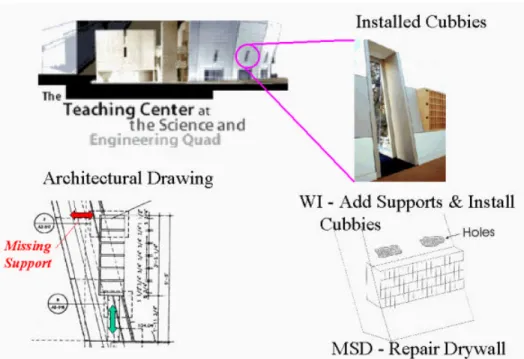
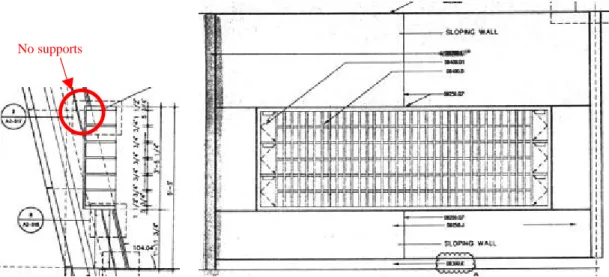
The issue was initiated by Request for Information (RFI) # 644 which requests the design of a support system for the wooden cubbies in the second floor of the Teaching Center lobby. In the architectural drawings A2-509 and A2-517, the Architect shows a set of wood cubbies and a sketch of the metal stud framing necessary to support them vertically. However, the details for the horizontal support and attachment of the cubbies to the diagonally slanted vertical wall are not shown. The Specifications in Section 6400 call for "concealed fasteners". The Wood Supplier (WS) subcontractor asked in a letter dated Aug. 6, 1997 that the General Contractor (GC) request a design from the Architect. The GC issued RFI# 644 on Aug. 13, 1997 to the Architect asking him to provide a design for these fasteners.
Figure 2-1. Architectural drawings of cubbies. Side view (left) and front view (right).
The Architect's RFI Response dated Aug. 19, 1997 included a sketch and a set of vendor specifications for a special type of fastener. The Wood Installer (WI) subcontractor notified the GC that this type of fastener would not work since the metal stud walls did not provide any support for these fasteners. The WI suggested to the GC that the metal stud walls would have to be modified to add the appropriate support for the fasteners. An additional problem was that the drywall around the cubbies had already been installed on the metal stud walls. This implied that in order to modify the metal stud framing, holes would have to be cut into the drywall above and below the cubbies.
Figure 2-2. Sketch of holes cut in drywall above the cubbies.
2.2. Delay of Construction due to Lack of Responsibility for Design-Construction Conflict
and Costs
On the cubbies issue, the Architect and Construction Manager (CM) at first said that this was a coordination issue that the GC should have anticipated and resolved, and that the Owner would not be responsible for the costs to open the walls, make the adjustments, and then patch them again. The resulting argument over who was responsible to pay for this extra work led to a delay of approximately 3 months from August to November 1997. Eventually, in the interest of finishing the project without further delay, the GC directed the WI to cut the holes in the drywall, make the required modifications to the metal stud framing, and add the horizontal supports for the cubbies. The GC figured the costs would be resolved at a later date with the Owner.
Figure 2-3. Pictures of installed cubbies in Teaching Center lobby.
2.3. Sub Change Order Requests
When subcontractors are asked to perform extra work, they typically submit a Cost Estimate. Once the work is complete the Sub submits a Change Order Request specifying the amount they agreed on with the GC. When the
costs are difficult to estimate or there is no time to do the estimate, the Subs are asked to do the work on a Time & Materials (T&M) basis. This means the Subcontractor has to keep track of the labor hours and materials spent on the extra work, submit documents to verify the amounts billed (e.g. change orders) to be reimbursed through a Sub Change Order.
The Wood Installer (WI) subcontractor estimated it would take approximately 100 man-hrs at a cost of $60/man-hr to modify the walls to provide support for the fasteners. The WI performed the work between November 23, 1997 and December 15, 1997. On January 7, 1998, the WI issued a Change Order Request (COR) for $6,000.
The Metal Stud & Drywall (MSD) subcontractor repaired the drywall that was damaged to modify the walls in mid December 1997. On December 30, 1997 the MSD subcontractor issued a Change Order Request for $2,842 for this extra work.
2.4. Time Cards and Revised Sub Change Order Request
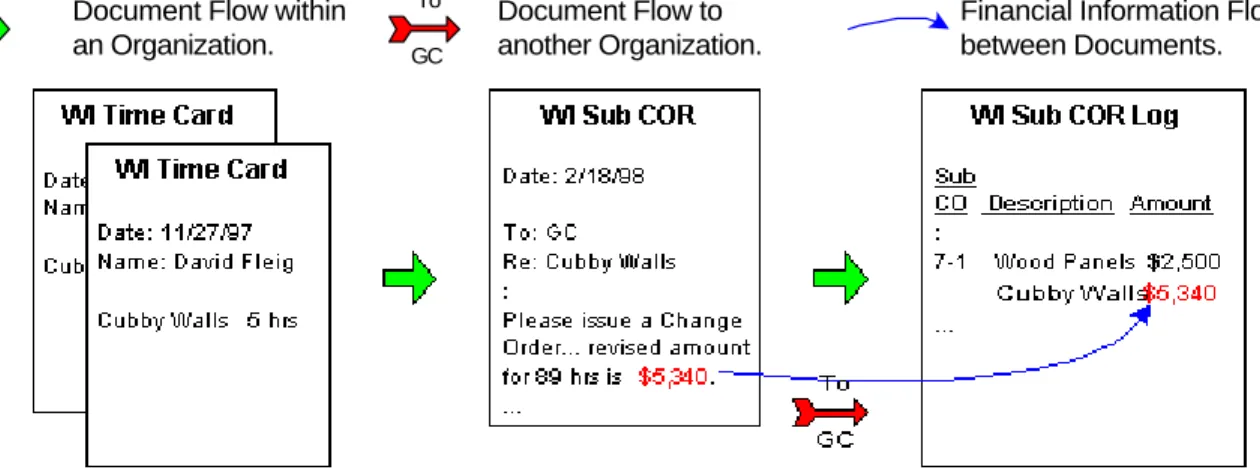
Because the WI did not provide any backup for the COR, and the work was T&M, the GC requested that the WI provide time cards as backup for the 100 hours charged. The WI retrieved the relevant time cards from his files and submitted these as backup with a revised Sub COR. Since the hours only added up to 89 hours, the WI revised its Change Order Request amount to $5,340. The WI re-issued the revised Sub COR on February 18, 1998. The WI project manager did not provide a cost breakdown of how he calculated the $5,340. Both the WI and the GC recorded the COR amount in a Sub COR Log to keep track of what issues had been processed.
To GC
Legend
Document Flow within an Organization.
Document Flow to another Organization.
Financial Information Flow between Documents.
Figure 2-4. The work hours on the 9 time cards totaled 89 hours. These hours times the $60/hr billing rate gives
the $5,340 amount requested by the WI Sub COR. Both the WI sub and the GC re-enter this total in their respective Sub COR Log.
2.5. Owner Change Order Request
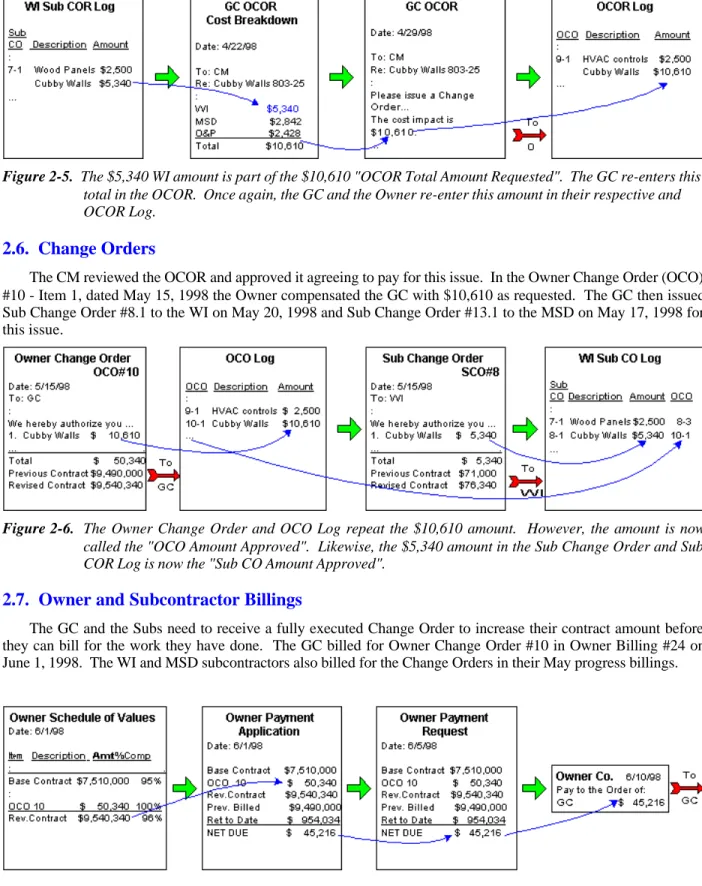
Due to the backlog of paperwork, the GC did not process this issue until April 22, 1998 when it created the Owner Change Order Request (OCOR) Cost Breakdown. The total amount requested was $10,610. This amount consisted of $5340 for WI, $2842 for MSD, and $2,428 for Overhead and Profit (O&P). The GC issued the OCOR to the Owner's Construction Manager (CM) on April 29, 1998.
Figure 2-5. The $5,340 WI amount is part of the $10,610 "OCOR Total Amount Requested". The GC re-enters this total in the OCOR. Once again, the GC and the Owner re-enter this amount in their respective and OCOR Log.
2.6. Change Orders
The CM reviewed the OCOR and approved it agreeing to pay for this issue. In the Owner Change Order (OCO) #10 - Item 1, dated May 15, 1998 the Owner compensated the GC with $10,610 as requested. The GC then issued Sub Change Order #8.1 to the WI on May 20, 1998 and Sub Change Order #13.1 to the MSD on May 17, 1998 for this issue.
Figure 2-6. The Owner Change Order and OCO Log repeat the $10,610 amount. However, the amount is now
called the "OCO Amount Approved". Likewise, the $5,340 amount in the Sub Change Order and Sub COR Log is now the "Sub CO Amount Approved".
2.7. Owner and Subcontractor Billings
The GC and the Subs need to receive a fully executed Change Order to increase their contract amount before they can bill for the work they have done. The GC billed for Owner Change Order #10 in Owner Billing #24 on June 1, 1998. The WI and MSD subcontractors also billed for the Change Orders in their May progress billings.
Figure 2-7. The Owner Payment Application billed for the $10,610 "OCO Amount Approved" is included in the
$50,340 "OCO Total Amount Billed". After subtraction of the retention, the GC received an "Owner Payment Total" of $45,216.
2.8. Owner and Subcontractor Payments
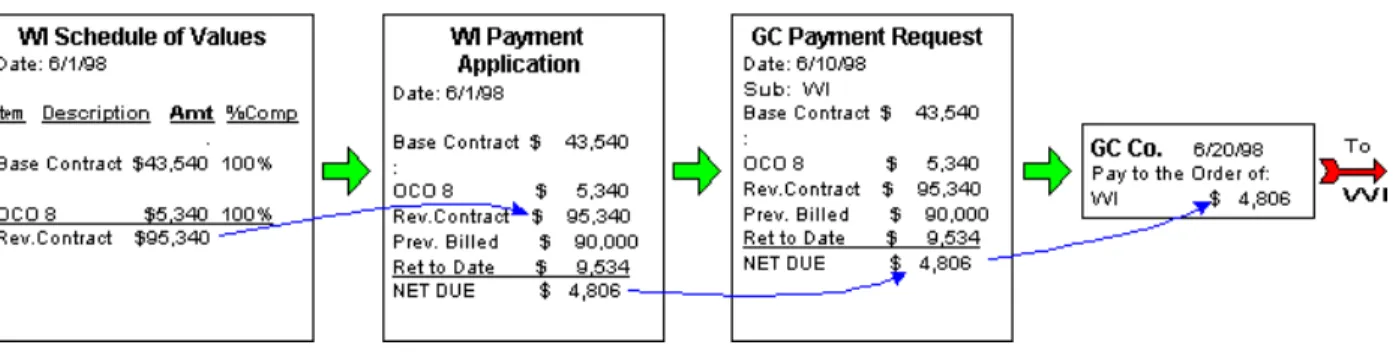
The Owner Billing was paid on June 10, 1998. Since it is typical for the GC to pay their Subs within 10 days after receiving Owner Payment, the GC then paid the subcontractors on June 20, 1998, about 6 months after the work was performed.
Figure 2-8. The WI Sub Payment Application billed for the $5,340 "Sub CO Total Amount Billed" of WI SubCO No. 8. Minus retention, the WI sub received a "GC Payment Total" of $4,806 ? over 6 months after the work was complete.
2.9. Observations Related to Case Study
From the case study, we can make several observations regarding today's paper-based process.
• Any physical activity (scope of work) can have several documents associated with it (e.g., RFI, Change orders, Billings, etc.).
• Many organizations and individuals are involved in processing the documents.
• The information content of each document consists mostly of information obtained from other documents or results that are computed from a few other values.
• There is a lot of data duplication and re-entry across multiple systems, documents and companies.
• The same information value can be associated with multiple names depending on the context of the document.
• The overall process can take a long time, not because each individual document takes long to process, but because there is much inefficiency in the overall process.
These observations will be analyzed in more detail in Chapter 3 in the context of monthly progress billings processing.
3. MONTHLY PROGRESS BILLINGS INFORMATION AND PROCESS
This chapter focuses on the details relevant to the study and the automation of progress billing documents. Section 3.1 discusses the purpose of monthly progress billings and payment requests and the information contained in these documents. Section 3.2 presents an overview of the monthly progress billings process with a paper-based system vs. an internet-based system.
3.1. Discussion of Progress Billing Documents
This section focuses on the monthly progress billing documents used by the project participants for the work to install the cubbies. We begin by presenting the purpose of these documents followed by a discussion of the actual information recorded.
3.1.1. Purpose of Progress Billing Documents
Contractors use progress billings to apply for payment for work completed on a construction project since the last billing period. This is typically done on a monthly basis.
The typical monthly progress billing consists of the following documents and associate purposes:
• Monthly Schedule of Values - to state in detail the amount complete this period in $ terms and % for each account in the scope of work, organized in various levels of detail.
• Application for Payment - a summary of the monthly schedule of values stating the $ amount the contractor is applying for. The Owner's representative, typically the field architect certifies this document if he approves it.
• Company Invoice - a formal statement of billing for the amount specified in the application of payment with the contractor's letterhead.
These documents have the following purposes:
1.) To present the documents that summarize the areas where work was performed. 2.) To calculate the % complete and cost for each area since the last period billed.
3.) To request certification from the Owner's representative that this work is complete as described and satisfactory. 4.) To request payment in the total amount specified under the contract specifications.
If the Owner's representative does not approve the amount the contractor is applying for, he must allow the contractor time to substantiate the merits of his billing or else modify it and resubmit to reflect the negotiated amount.
The lack of understanding of these related purposes can lead to incomplete information in the progress billings. If the systems used to process these documents and manage costs are not integrated, multiple data re-entry occurs and inconsistencies may result.
3.1.2. Purpose of Payment Requests
Owners and General Contractors use payment requests to request payment in the amount approved by the Owner's representative and agreed to by the contractor.
The information recorded has two main purposes:
1.) To state the approved financial compensation for the billing period.
2.) To request the internal accounting department prepare a payment for the specified amount and hold it in the aging report until it is approved to be released.
3.1.3. Information in Progress Billing Documents 3.1.3.1. Monthly Schedule of Values Information
The typical information recorded on a monthly schedule of values was derived from the AIA G703 form and includes the following:
• Building Name: To identify which building on the project this schedule of values pertains to.
• Line Item No.: To identify the major activity or cost account.
• Description: To describe the activity or cost account.
• Item Value: To identify the total value or budgeted amount assigned to this activity.
• Previous Item $ Amount Complete: To state the $ amount complete through the last billing period.
• Item $ Amount Complete This Period: To calculate the $ amount complete this period.
• Item $ Value Materials Presently Stored: To quantify the value of materials stored on site this period, but not installed.
• Building Item % Complete: To describe total % complete to date. This is defined as the ratio between the $ Total $ Amount Complete to Date and the Item Value.
• Item $ Amount Complete to Date: To calculate the total amount complete to date on this line item in $ terms.
• Item $ Balance to Finish: To calculate the difference between the Item Value and the $ Amount Complete to Date.
• Item $ Retained to Date: To calculate the amount retained on this item per the contract requirements.
These line item amounts are calculated and summarized for both the base contract and the change order work. They are summarized according to various levels of detail as follows:
• Per cost code.
• Per scope type.
• Per organization.
• Per building.
• Per project.
3.1.3.2. Application for Payment
The typical information recorded on an application for payment includes the following:
• Date of document: To record the date the application for payment was created.
• Billing Period: To specify the period being billed for.
• Base Contract Value: To state the total $ value of the base contract.
• Total CO Value: To state the total $ value of the approved change orders.
• Revised Total Contract $ Value: To quantify the total value of the base contract plus the change order work.
• Total Revised Contract $ Amount Complete to Date: To quantify the total $ amount complete through this billing period.
• Total Revised Contract $ Retained to Date: To quantify the payment withheld from the contractor to date until his contract work is complete.
• Total Revised Contract $ Earned Less Retainage: To calculate the net total $ amount the contractor is owed through this period.
• Total $ Amount for Previous Certificates of Payment: To quantify the total $ amount the contractor has received to date for previous work.
• Revised Contract Net $ Amount Payment Due: To quantify the total $ amount due for this billing period.
• Revised Contract Balance Remaining Incl. Retainage: To quantify the total $ amount owed to the contractor on the contract pending successful completion of his contract work.
• Contractor's Signature: This certifies that the contractor is requesting the amount due this period given the best of his knowledge that the work has been satisfactorily completed per contract.
• Architect's Signature: Once the Owner's representative, the architect approves the application for payment amount, he restates this amount and signs it to certify the amount has been approved and the work is satisfactory.
3.1.3.3. Invoice
The typical information recorded on an invoice is essentially the same as on the Application for Payment. The main difference is that it is submitted on company overhead and also includes:
• Invoice ID: To identify the invoice uniquely within the contractor's accounting database. 3.1.4. Payment Request Information
3.1.4.1. Owner Payment Request
The typical information recorded on an owner payment request is the same as that on the owner schedule of values. The main difference is that only the total for the buildings are included rather than the entire breakdown. The change order work is listed separately per each cost code account.
3.1.4.2. Sub Payment Request
The typical information recorded on a sub payment request is the same as that on the sub schedule of values. The main difference is that only the total for the buildings are included rather than the entire breakdown. Also the change order work is listed separately per each cost code account.
3.1.5. Observations Related to Progress Billing Documents
We now discuss some general observations related to the progress billing documents:
• Progress billing documents build on information contained in other documents such as time cards and change orders.
• Paper-based billing documents require multiple data re-entry for the financial management and accounting system.
3.2. Overview of Progress Billings Process
We now present a comparison of the process to manage progress billings using a paper-based system vs. a hypothetical internet-based system. We then discuss the problems with the current system and summarize the expected benefits of an internet-based system.
description of the work they completed that month. Typically, this is done using the schedule of values prepared at the beginning of the project where each major work package or cost account was assigned a $ value. The work complete at the end of the month is estimated as a % of the total contract work specified. This percentage is then multiplied by the $ value of the cost account to calculate the $ amount complete to date. This process tends to be very subjective and often leads to disagreement between the contractor and the architect as to what the "true % complete" ought to be. This is why we suggest a more objective method that includes earned value measurements be adopted from the onset of the project. In this manner, there would be less room for adjustment and disagreement. The progress billing process can be subdivided into three main stages: Prepare progress billing, certify progress billing and issue payment request.
3.2.1.1. Prepare Progress Billing
In the first stage, the project manager or cost engineer must assess the amount of work complete for each cost account in terms of "% complete" and "$ value". These costs include labor, materials, equipment, subcontractors, and other indirect costs. These values are used to prepare the proposed monthly schedule of values. Each subcontractor submits this to the general contractor who in turn assembles the proposed Owner schedule of values for the current period. This is submitted to the field architect for review and approval. If the architect disagrees with any of the amounts proposed by the subcontractors, the subcontractor is notified and given an opportunity to substantiate, clarify, or modify the amount billed. Once this is done, the billing is revised and submitted for certification. The general contractor will then prepare the monthly progress billing. Typically, each line item in the owner schedule of values is for each subcontractor to make it simpler to create. Once the total amounts are calculated, the cost engineering will create an Application for Payment and a company Invoice stating a summary of the amounts completed and being billed for the month. The project manager will then review and approve the request with his signature to certify that to the best of his knowledge it is accurate per the contract requirements. A clerk will then copy the progress billing before it is sent to the Owner and finally mail it.
3.2.1.2. Certify Application for Payment
In the second stage, the Owner's representative, typically the field architect will review the application for payment and approve it since it has been previously negotiated. He certifies the amount to be paid with his signature and sends a copy of the certified payment application to the general contractor.
3.2.1.3. Issue Payment Request
Once the application for payment is approved and certified, the Owner will issue a payment request to the Owner's accounting department. This payment request specifies the net amounts approved to be paid to the contractor as well as the amounts to be retained. The general contractor in turn submits a payment request for each of the subcontractors.
The accounting department in the home office will then proceed to enter the certified amount into the accounting system, so that payments may be released upon receipt of payment from the owner.
The process just described is basically the same for the paper-based system as with an internet-based system at the level of detail presented. In the next two sections, we compare and contrast in more detail the activities within each system.
3.2.2. Paper Based System:
With a paper-based system, multiple project management tools are used to prepare and process each document such as spreadsheets, word processors, PC-based document management systems, mainframe accounting reports and paper documents stored in file folders. This creates many problems and inefficiencies, such as:
• The process to create and process progress billing documents is not explicit. People just "know what to do".
• Information is re-entered in the field and in the home office.
• The process usually requires at least two people per company per office handling the same information.
• The relationship between the information in different documents like the cost report and the monthly schedule of values is not explicit.
• Totals are calculated manually.
• The time to prepare and process an owner schedule of values is delayed by the need to figure out what subcontractor billings have been submitted and the need to resolve any amounts not approved by the architect.
• Access to this information is only available by either manually searching for the documents from the file cabinet or by waiting for the home office or other companies to create the necessary documents or summary reports.
• To create documents like the schedule of values requires re-entry of the same information into a separate application like a spreadsheet because the information is not structured in a standard electronic format in the subcontractors' billings.
• The more people involved in the process, the greater the chance for erroneous or incomplete information and the longer the process takes.
• The level of detail expressed by each subcontractor's billing is drastically different given their area of expertise or how they divided the work.
• The % complete for each type of work is often not easy to quantify in an objective manner. 3.2.3. Internet-based System
Using an internet-based system, the project managers or accountants could directly access the project model database using a browser from the field office. The process would be standardized yet be flexible enough to accommodate any special type of change to the contract. Standardized forms would enforce project participants to enter complete and valid information. The system would search for all related documents and make the process of finding and retrieving related supporting information and documents a simple matter of point and click. Once the project manager selects a document to be created, the system would automatically enter any information available from other related documents and all the basic information like the project name. Potential errors would be virtually eliminated since he would enter either only new information or select information from a limited set of pre-selected choices. The system would automatically calculate all totals. Because the system uses standardized documents, there is no need to interpret and re-enter information for each company's documents. Once completed, he would submit the information directly into the project extranet database, which would then transmit it to the home office accounting databases for each affected company. The reason for having the data in two different places is due to the need for cost control from the project perspective and the need for financial management from the home office perspective.
3.2.4. Benefits of Using an Internet-based System
The benefits of using an integrated internet-based system to manage the monthly progress billings process are many. Below, we describe some of the benefits we envision along with additional benefits that will be possible by integrating the documents with a 4D-production model of the facility.
Benefits of Internet-based system:
• The process to create and process a progress billing or payment request is explicit.
• Information is entered only once in the field, not in the home office.
• The process requires only one or maximum two persons per company.
• The relationship between the information in different documents like the cost report and the schedule of values is explicit.
• Totals are calculated automatically.
• The time to post the information to the accounting database is reduced to zero since this work is automated.
• Access to this information is immediate at anytime. The information is searchable.
• Creating other types of analysis like earned value analysis and trends for predicting cost overruns is automatic since the information is already in the system.
Benefits of Integrating Progress Billing Documents with 4D Production Model:
In the future, when 4D production models1 are used as part of internet-based systems, we could associate the information in progress billing documents directly with the 4D production model. By doing so, we could obtain even more benefits.
• Since the work breakdown is part of the 4D Production Model, it would be easy for the project manager to determine where and how much work was complete each month and visualize costs over time.
• If a project manager wanted to know how the change order costs compare to the base contract for any subcontractor or area of the building, instead of having to wait for the monthly cost report he could easily see that comparison by clicking on the subcontractor name or building area.
• The schedule would be automatically updated every day to reflect actual work progress based on quantity-based earned value calculations2. If any person wanted to know what work was done on any given day or time period, this would be readily available since the time card dates and change order cost codes would be automatically linked to the schedule. This assumes the use of integrated control cells where cost codes and schedule activities are one and the same3.
• The 4D model would also enable the user to visualize what work in what areas has been billed and what is yet left to complete as well as indicate areas where costs have a strong indication of running over budget by using various color coding schemes.
Now that we have introduced the monthly progress billing and payment request information recorded and the process to manage this information, we now develop the business process model for the progress billing documents in the case study in Chapter 4.
CHAPTER 3 - REFERENCES
1. Aalami, Florian B., Martin Fischer and John C. Kunz - "AEC 4D Production Model: Definition and Automated Generation". Stanford University Center for Integrated Facilities Engineering - Working Paper 052. September 1998. http://www.stanford.edu/group/CIFE/Publications/index.html
2. Fleming, Quentin W. and Joel Koppelman M. - "Earned Value Project Management". Project Management Institute Publications; ISBN: 1880410389. June 1996.
3. Rasdorf, William J. and Osama Y. Abudayyeh - "Cost and Schedule-Control Integration: Issues and Needs". Journal of Construction Engineering and Management, American Society of Civil Engineers, Volume 117, Number 3, pp. 486-502. September 1991.