A Diplomat’s Guide to the
UN Small Arms Process
2014 Update
A Diplomat’
s Guide to the UN Small
Arms Process
Handbook
Copyright
Published in Switzerland by the Small Arms Survey
© Small Arms Survey, Graduate Institute of Internation al and Development Studies, Geneva 2014
First edition published in August 2012, second edition published June 2014
All rights reserved. No part of this publication may be reproduced, stored in a retrieval system, or transmitted, in any form or by any means, without the prior permission in writing of the Small Arms Survey, or as expressly permit-ted by law, or under terms agreed with the appropriate reprographics rights organization. Enquiries concerning reproduction outside the scope of the above should be sent to the Publications Manager, Small Arms Survey, at the address below.
Small Arms Survey
Graduate Institute of International and Development Studies
47 Avenue Blanc 1202 Geneva Switzerland
Copy-edited by Tania Inowlocki Proofread by Stephanie Huitson
Typeset in Optima by HotHouse South Africa Illustrations by Daly Design
Printed by nbmedia in Geneva ISBN 978-2-940548-00-2
3
About the Small
Arms Surv
ey
About the Small Arms Survey
The Small Arms Survey is an independent research project located at the Gradu-ate Institute of International and Development Studies in Geneva, Switzerland. Established in 1999, the project is supported by the Swiss Federal Department of Foreign Affairs and current or recent contributions from the Governments of Australia, Belgium, Denmark, Finland, Germany, the Netherlands, New Zeal-an d, Norway, the United Kingdom, Zeal-and the United States, as well as from the European Union. The Survey is grateful for past support received from the Gov-ernments of Canada, France, Spain, and Sweden. The Survey also wishes to acknowled ge the financial assistance it has received over the years from found-ations and many bodies within the UN system.
The objectives of the Small Arms Survey are: to be the principal source of public information on all aspects of small arms and armed violence; to serve as a resource centre for governments, policy-makers, researchers, and activists; to monitor national and international initiatives (governmental and non-govern-mental) on small arms; to support efforts to address the effects of small arms proliferation and misuse; and to act as a clearinghouse for the sharing of inform-ation and the dissemininform-ation of best practices. The Survey also sponsors field research and information-gathering efforts, especially in affected states and region s. The project has an international staff with expertise in security studies, political science, law, economics, development studies, sociology, and crimino-logy, and collaborates with a network of researchers, partner institutions, non-governmental organizations, and governments in more than 50 countries. Small Arms Survey
Graduate Institute of International and Development Studies 47 Avenue Blanc, 1202 Geneva, Switzerland
p +41 22 908 5777
f +41 22 732 2738
e [email protected] w www.smallarmssurvey.org
A Diplomat’
s Guide to the UN Small
Arms Process
Handbook
About the Authors
Sarah Parker is a senior researcher with the Small Arms Survey. She has been engaged in small arms research since 2005 and has authored and co-authored several publications on different aspects of Programme of Action implementa-tio n, including A Decade of Implementing the United Naimplementa-tions Programme of Acimplementa-tion and The Programme of Action Implementation Monitor (Phase 1): Assessing Reported Progress, published by the UN Institute for Disarmament Research and the Small Arms Survey, respectively. She served on the Australian delegation at the Second Review Conference of the UN Programme of Action in 2012 and at the Arms Trade Treaty (ATT) negotiations in 2012 and 2013. She also served as the consult-ant to the chair of the Open-ended Working Group towards an ATT in 2009. Marcus Wilson is programme manager at the Centre for Armed Violence Reduc-tio n in London and a research consultant at the Small Arms Survey. He has been engaged in small arms policy since 2008, when he worked as research director at GunPolicy.org. Marcus has conducted research on firearm legislation, gun violen ce prevention, arms transfers, armed violence reduction, and the inter-natio nal small arms process for the Small Arms Survey, the Geneva Declaratio n, the International Action Network on Small Arms, Surviving Gun Violence, and Transparency International. Marcus has also published work on national fire-arms legislatio n, armed violence reduction, and military history.
5
Table of Contents
Table of Contents
List of Boxes, Figures, and Tables ... 8
Frequently Used Acronyms ... 9
Acknowledgements ... 11
Introduction ... 12
Part 1. Definitions and Terminology ... 13
Small arms, light weapons, and firearms 14
What are small arms and light weapons? 14 What are firearms? 15 What is the difference between a small arm and a firearm? 15 What is the difference between ‘military’ and ‘civilian’ arms? 15 Main elements of selected small arms 16 Selected light weapons 18 Life cycle of a firearm: selected intervention points 20 Ammunition 21
Resources 24 Part 2. International Instruments ... 25
2.1 The Firearms Protocol 27 Background 27 History 27
Basis for the negotiations 28 Technical hurdles 29 A precedent is born 30 Purpose 32 Themes 32 Main commitments 32 Scope 35
A Diplomat’
s Guide to the UN Small
Arms Process
Handbook
The Firearms Protocol process 36
Conference of the Parties 36
Secretariat 36
Working group on firearms 37
Relationship to the PoA 37
Resources 38
2.2 The Programme of Action 39
Background 39
History 39
The emergence of small arms on the international disarmament agenda 39
Anticipating the UN small arms conference 41
The UN small arms conference unfolds 42
Relevant factors 44
Purpose 46
Themes 46
Main commitments 46
The PoA process 50
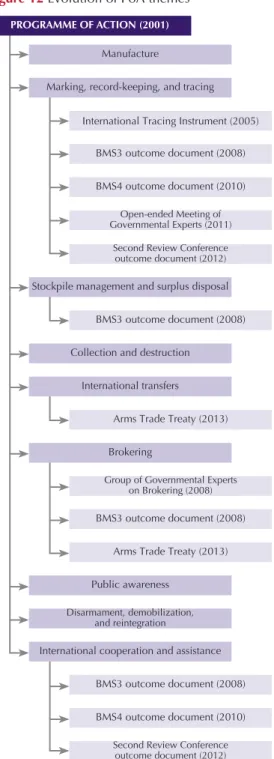
Evolution of the PoA and its relationship to other instruments 50
Resources 52
2.3 The International Tracing Instrument 52
Background 52
History 52
Attention to the tracing issue 52
Contentious hurdles 53
Purpose 55
Themes 55
Main commitments 56
The ITI process 56
Evolution of the ITI and its relationship to other instruments 58
Resources 59
2.4 The Geneva Declaration 59
Background 59
Purpose 61
Main commitments 62
Relationship to other instruments 62
7
Table of Contents
2.5 The Arms Trade Treaty 63
Background 63 History 63 Purpose 66 Themes 67 Scope 67 Main commitments 68
The ATT process 70
Relationship to other instruments 71
Resources 72
Part 3. Other UN Processes ... 73
Security Council engagement 74
General Assembly resolutions 74
The Secretary-General’s reports 75
The Advisory Board on Disarmament Matters 75
The UN Register of Conventional Arms 76
The Conference on Disarmament 77
The Disarmament Commission 77
International Ammunition Technical Guidelines 78
International Small Arms Control Standards 79
Resources 79
Part 4. Multilateral and Regional Instruments, Tools,
and Organizations ... 81
The Wassenaar Arrangement 82
Regional instruments and organizations 83
Relationships among organizations 87
Resources 87
Glossary ... 89
A Diplomat’
s Guide to the UN Small
Arms Process
Handbook
List of Boxes, Figures, and Tables
Box 1 UN Panel definitions 14
Box 2 Components of a small-calibre cartridge 23
Box 3 Firearms Protocol timeline 31
Box 4 PoA timeline 42
Box 5 Schedule of PoA meetings, 2012–18 50
Box 6 ITI timeline 55
Box 7 Definitions in the ITI 56
Box 8 ATT timeline 65
Figure 1 Parts of a handgun: revolver 16
Figure 2 Parts of a handgun: semi-automatic pistol (Sig Sauer) 17
Figure 3 Parts of a long gun: pump-action shotgun 17
Figure 4 Parts of a long gun: bolt-action rifle (Mauser) 17
Figure 5 Parts of a long gun: assault rifle (AK-47) 18
Figure 6 Heavy machine gun: Browning M2 18
Figure 7 MANPADS: SA-7 19
Figure 8 Anti-tank guided weapon: Spike 19
Figure 9 Light mortar: 60 mm 20
Figure 10 Life cycle of a firearm: selected intervention points 22
Figure 11 Components of a small-calibre cartridge 23
Figure 12 Evolution of PoA themes 51
Table 1 Firearms Protocol provisions 33
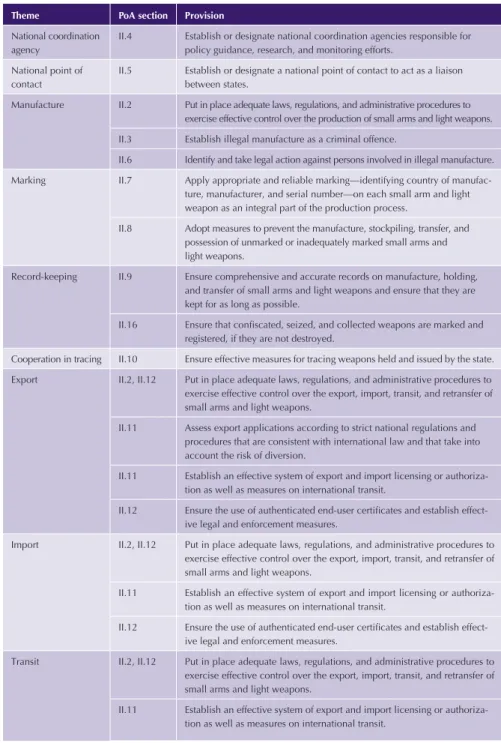
Table 2 PoA provisions 47
Table 3 ITI provisions 57
Table 4 The three pillars of the Geneva Declaration 61
Table 5 ATT provisions 68
Table 6 Selected regional instruments and organizations 83
9
Frequently
Used Acron
yms
Frequently Used Acronyms
ASEAN Association of Southeast Asian Nations
ATF United States Bureau of Alcohol, Tobacco, Firearms
and Explosives
ATGW Anti-tank guided weapon
ATT Arms Trade Treaty
AU African Union
BMS Biennial meeting of states
CARICOM Caribbean Community and Common Market
CASA Coordinating Action on Small Arms
CD Conference on Disarmament
CIFTA Inter-American Convention against the Illicit Manufacturing
of and Trafficking in Firearms, Ammunition, Explosives, and Other Related Materials
CTBT Comprehensive Nuclear Test-Ban Treaty
DDR Disarmament, demobilization, and reintegration
DVC Delivery verification certificate
EAPCCO Eastern Africa Police Chiefs Cooperation Organisation
ECCAS Economic Community of Central African States
ECOSOC United Nations Economic and Social Council
ECOWAS Economic Community of West African States
EU European Union
EUC End-use(r) certificate
GGE Group of Governmental Experts
IANSA International Action Network on Small Arms
IATG International Ammunition Technical Guidelines
IIC International import certificate
INTERPOL International Criminal Police Organization
A Diplomat’
s Guide to the UN Small
Arms Process
Handbook
ITI International Instrument to Enable States to Identify and
Trace, in a Timely and Reliable Manner, Illicit Small Arms and Light Weapons (‘International Tracing Instrument’)
LAS League of Arab States
MANPADS Man-portable air defence system(s)
NGO Non-governmental organization
NSA Non-state actor
OAS Organization of American States
OAU Organization of African Unity
OCO Oceania Customs Organisation
OEWG Open-ended working group
OSCE Organization for Security and Co-operation in Europe
PICP Pacific Islands Chiefs of Police
PIF Pacific Islands Forum
PoA United Nations Programme of Action to Prevent, Combat and
Eradicate the Illicit Trade in Small Arms and Light Weapons in All Its Aspects (‘Programme of Action’ or ‘PoA’)
PoA–ISS Programme of Action Implementation Support System
PrepCom Preparatory Committee
RECSA Regional Centre on Small Arms in the Great Lakes Region, the
Horn of Africa and Bordering States
RPG Rocket-propelled grenade (launcher)
SADC South African Development Community
SARPCCO Southern African Police Chiefs Cooperation Organisation
SEESAC South Eastern and Eastern Europe Clearinghouse for the
Control of Small Arms and Light Weapons
SICA Central American Integration System
UNGA United Nations General Assembly
UNIDIR United Nations Institute for Disarmament Research
UNODA United Nations Office for Disarmament Affairs
UNODC United Nations Office on Drugs and Crime
UNTOC United Nations Convention against Transnational
11
Ac
kno
wledgements
Acknowledgements
The authors extend thanks to David Atwood, who authored the section on the history of the UN Programme of Action and provided valuable insight on the Geneva Declaration; Pierre Gobinet, who provided guidance on technical issues covered in the sections on small arms and light weapons and ammunition, as well as on the ‘life cycle of a firearm’; Bill Kullman, who contributed to the sec-tion on the history of the Firearms Protocol negotiasec-tions; and Luigi De Martino for his guidance on the section about the Geneva Declaration. Thanks also go out to Glenn McDonald, who reviewed the report and provided helpful suggestions; to Simonetta Grassi, who provided valuable comments on the Firearms Protocol section; and to Martin Field for his patient assistance in the preparation of the handbook.
A Diplomat’
s Guide to the UN Small
Arms Process
Handbook
Introduction
A Diplomat’s Guide to the UN Small Arms Process is designed to assist and inform policy-makers who are new to the issue of small arms on the international agenda. While it is not meant to serve as a policy tool or as an exhaustive revie w of the small arms process, this concise manual includes:
definitions and terminology;
summaries of key issues, instruments, and measures; and an overview of the roles of various institutions.
The Guide will be regularly updated to reflect progress and changes in this area. Readers are invited to submit their comments and suggestions for the Guide to the Small Arms Survey at: [email protected].
For more information on each of the issues highlighted, please visit the Small Arms Survey website at www.smallarmssurvey.org.
PART 1
A Diplomat’
s Guide to the UN Small
Arms Process
Handbook Box 1
UN Panel definitions
Small arms: revolvers and self-loading pistols, rifles and carbines, assault rifles,1 sub-machine guns, and light machine guns. Light weapons: heavy machine guns, hand-held under-barrel and mounted grenade launchers, portable tank and anti-aircraft guns, recoilless rifles, portable launchers of anti-tank missile and rocket systems and anti-aircraft missile systems, and mortars of less than 100 mm calibre. Source: UNGA (1997a, para. 26)
Small arms, light weapons, and firearms
What are small arms and light weapons?
There is no universally accepted definition of a ‘small arm’ or of a ‘light weapon’. The Small Arms Survey uses the term ‘small arms and light weapons’ to cover both military-style small arms and light weapons as well as commercial firearms (handguns and long guns). The term ‘small arms’ is often used to refer to both types of weapons, including in this Guide.
One of the most widely accepted definitions comes from the 1997 report of the United Nations Panel of Governmental Experts on Small Arms. In general terms, ‘small arms’ are designed for personal use and may be carried by one person; ‘light weapons’ are used by several persons or a crew and may be trans-ported by two or more people, a pack animal, or a light vehicle (UNGA, 1997a, paras. 25, 27(a); see Box 1).
The International Tracing Instrument (see Part 2.3) provides the following definition of small arms and light weapons:
any man-portable lethal weapon that expels or launches, is designed to expel or launch, or may be readily converted to expel or launch a shot, bullet or projectile by the action of an explosive, excluding antique small arms and light weapons or their replicas (UNGA, 2005b, para. 4; see Box 7).
It then goes on to note that, broadly speaking, small arms are ‘weapons designed for individual use’ and light weapons are ‘weapons designed for use by two or three persons serving as a crew, al-thoug h some may be carried and used by a single person’ (UNGA, 2005b, para. 4). It subsequently re-peats the list of examples provided in the 1997 UN Panel report.
1 As noted in the Small Arms Survey 2007: ‘There is no clear distinction between rifles and assault rifles. All assault rifles have the capacity of fully automatic fire, but so do some rifles. In general, assault rifles tend to be shorter, lighter, and fire smalle r ammunition, and are therefore more portable’ (Gimelli Sulashvili, 2007, p. 33, n. 1).
15
Definitions and
Terminology
What are firearms?
A legally binding definition of ‘firearm’ is contained in the Firearms Protocol (see Part 2.1), which provides:
‘Firearm’ shall mean any portable barrelled weapon that expels, is designed to expel or may be readily converted to expel a shot, bullet or projectile by the action of an explosive, excluding antique firearms or their replicas. Antique firearms and their replicas shall be defined in accordance with domestic law. In no case, however, shall antique firearms include firearms manufactured after 1899 (UNGA, 2001c, art. 3(a)).
What is the difference between a small arm and a firearm?
The terms ‘small arm’ and ‘firearm’ are often used interchangeably. Gener-ally speaking, the term ‘firearm’ is used in domestic settings and national laws governin g the manufacture and transfer of such weapons, as well as civilian acces s to them; the term ‘small arm’ is more commonly used to refer to the weapon an individual may use and carry in a military context. In this Guide, the terms ‘small arm’ and ‘firearm’ are used interchangeably unless the context indica tes otherwise.
While the definition of ‘firearm’ adopted by the Firearms Protocol covers all ‘small arms’, its coverage of ‘light weapons’ is limited in two ways. First, the weapon must have a barrel since the definition covers ‘portable barrelled weapons’ (emphasis added). This excludes light weapons that employ a tube or rail as opposed to a barrel, such as man-portable air defence systems (MAN-PADS). Second, the weapon must ‘expel’ the projectile—in contrast to the defin-ition of ‘small arms and light weapons’ in the International Tracing Instrument, which covers any weapon that ‘expels or launches’ the projectile (emphasis adde d). This excludes those light weapons that use self-propelled projectiles, such as rockets or missiles. In these cases, the weapon does not ‘expel’ (drive out) the projectile as required by the definition. In essence, only light weapons that use cartridge-based ammunition qualify as ‘firearms’ under the Firearms Protocol definition (McDonald, 2005, p. 124).
What is the difference between ‘military’ and ‘civilian’ arms?
Military small arms and light weapons are used by armed forces, including intern al security forces, in self-protection or self-defence, in close or short-range
A Diplomat’
s Guide to the UN Small
Arms Process
Handbook
Ejector rod
combat, in direct or indirect fire, and against tanks or aircraft at relatively short distances. Military small arms such as automatic rifles and carbines, sub-machin e guns, and combat shotguns are designed to military specifications. Military light weapons include grenade launchers, rocket launchers, and heavy machine guns. Civilian possession of these types of weapon is generally prohibited, depending on the jurisdiction.
Domestic legislation stipulates which arms are permitted for civilian posses-sion and the conditions under which the weapons may be used in individual states. Civilian small arms (often referred to in domestic law as ‘firearms’) fall under specific legal definitions of each jurisdiction and may be used for a range of legi ti mate purposes, such as hunting, sports and target shooting, personal protec-tion, collecprotec-tion, pest control, and occupational uses such as personal security or veterinary work. Each state applies its own legal definition of small arms.
Main elements of selected small arms
Figures 1–5 identify the main elements of handguns (revolvers and pistols) and long guns (pump-action shotguns, bolt-action rifles, and assault rifles).
17
Figure 2 Parts of a handgun: semi-automatic pistol (Sig Sauer)
Figure 4 Parts of a long gun: bolt-action rifle (Mauser)
Figure 3 Parts of a long gun: pump-action shotgun
Note: These diagrams are indicative in nature only. For example, many semi-automatic pistols are striker-fired, rather than hammer-fired.
Definitions and
A Diplomat’
s Guide to the UN Small
Arms Process
Handbook
Figure 5 Parts of a long gun: assault rifle (AK-47)
Selected light weapons
Heavy machine guns are capable of firing calibres ranging from 12.7 mm up to but not including 20 mm, the size of the smallest cannon munitions. They are man-portable but are typically mounted on vehicles or ground mounts as anti-personnel and anti-aircraft weapons. They are effective against personnel, light armoured vehicles, low- and slow-flying aircraft, and small boats (Berman and Leff, 2008, p. 21; see Figure 6).
Figure 6 Heavy machine gun: Browning M2
Man-portable air defence systems, or MANPADS, are short-range surface-to-air missile systems intended for attacking and defending against low-flying aircraft. Some are crew-served (sometimes known as CREWPADS), but most are easily handled by a single individual and are shoulder-launched (Berman and Leff, 2008, p. 16; see Figure 7).
19
Definitions and
Terminology
Figure 7 MANPADS: SA-7
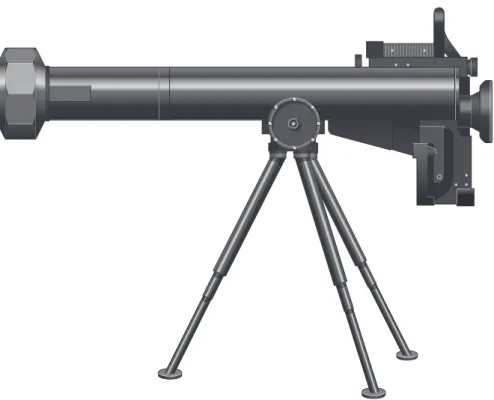
Anti-tank guided weapons (ATGWs) are small missile-launching systems. They differ from unguided rocket launchers, such as the RPG-7, in that their missiles are steered, or ‘guided’, to a target after launch (that is, during flight). ATGWs are traditionally designed to disable armoured vehicles, but over the last decade producers have been developing variants intended for use against other targets, such as hardened bunkers and buildings (Berman and Leff, 2012, p. 1; see Figure 8).
A Diplomat’
s Guide to the UN Small
Arms Process
Handbook
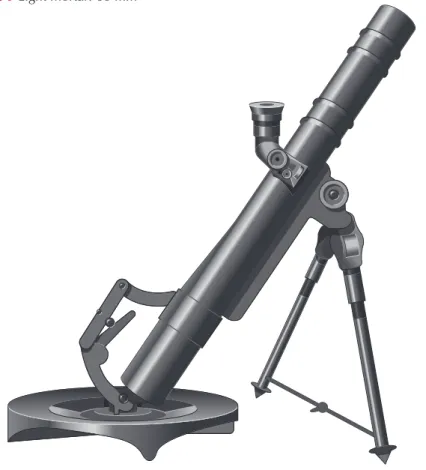
Mortars are generally smooth-bored, indirect-fire support weapons that enabl e users to engage targets outside their line of sight, such as behind hills, while minimizing their exposure to direct enemy fire. The Small Arms Survey recognizes three types of mortars in the light weapons category: ‘light’ (up to and including 60 mm), ‘medium’ (61 mm to 82 mm), and ‘heavy’ (83 mm to 120 mm). With traditional ammunition, mortars can engage targets at distances rangin g from less than 100 m from the firer’s position to more than 7 km away (Berman and Leff, 2008, p. 26; see Figure 9).
Figure 9 Light mortar: 60 mm
Life cycle of a firearm: selected intervention points
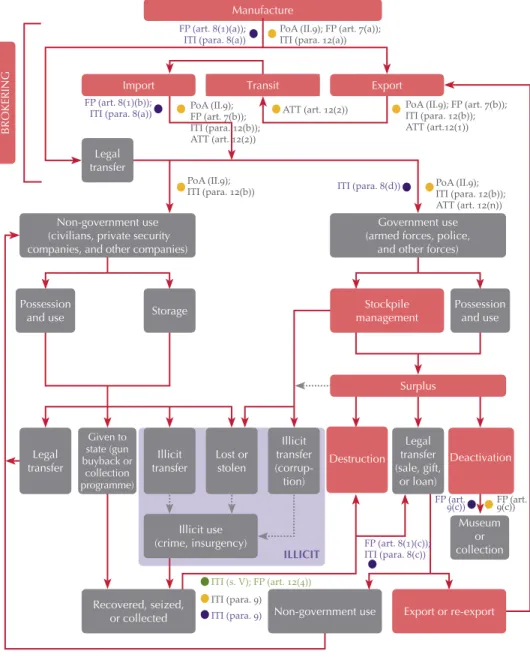
Figure 10 provides a general overview of the life cycle of a firearm from the point of manufacture through to deactivation or destruction. The diagram highlights a
21
Definitions and
Terminology
small arm’s main life stages and opportunities for regulation, as well as key act-ors who hold and use small arms.
At the international level, states have committed themselves to regulating and controlling various stages in the life cycle of small arms through the adop-tion of measures relating to their manufacture, transfer, storage, use, and dis-posal (see Parts 2–4). Figure 10 indicates at which stages relevant international commitments exist (see the red boxes). The diagram points to commitments re-garding the marking, record-keeping, and tracing of small arms and identifies the relevant provisions of international instruments.
Firearms can enter or be diverted into the illicit market at multiple points in the life cycle. See the purple shaded area of Figure 10 for examples of points at which firearms enter the illicit market.
Ammunition
According to a 1999 report of the Group of Experts on the problem of ammuni-tion and explosives, in the context of small arms:
Ammunition refers to the complete round/cartridge or its components, including bullets or projectiles, cartridge cases, primers/caps and propellants that are used in any small arm or light weapon (UNGA, 1999b, para. 14; see Box 2).2
2 The Firearms Protocol provides an adapted version of this definition: ‘“Ammunition” shall mean the complete round or its components, including cartridge cases, primers, propellant powder, bullets or projectiles, that are used in a firearm, provided that those components are themselves subject to authorization in the respective State Party’ (UNGA, 2001c, art. 3(c)).
What is calibre?
Ammunition is defined in terms of calibre. The calibre measures the diameter of the gun’s bore and is expressed in hundredths or thousandths of an inch (for instance, .22 or .357) or in millimetres (for example, 9 mm). Thus, the metric equivalent of a ‘.38’ cartridge is a ‘9 mm’ projectile. Cartridges with the same calibre can differ according to the length of the case (such as 7.62 x 39 mm, 7.62 x 51 mm, or 7.62 x 63 mm). One explanation for the large number of cartridge types currently in existence is that many countries used to set their own standards for their military weapons, such as the 7.5 mm French and .303 British round (Pézard, 2005, p. 11). Most weapons of .50 (12.7 mm) or greater calibre are designed explicitly for military use, with some exceptions, such as .50-calibre pistols and rifles (Pézard and Anders, 2006, p. 23).
A Diplomat’
s Guide to the UN Small
Arms Process
Handbook
Figure 10 Life cycle of a firearm: selected intervention points
Marking provisions Record-keeping provisions Tracing provisions Illegal or illicit movement ATT Arms Trade Treaty (see Part 2.5)
FP Firearms Protocol (see Part 2.1)
ITI International Tracing Instrument (see Part 2.3) PoA Programme of Action (see Part 2.2)
Stages at which relevant international commitments exist (ATT, FP, ITI, and PoA)
Manufacture
ILLICIT Import
Non-government use (civilians, private security companies, and other companies)
Government use (armed forces, police,
and other forces) Legal transfer Possession and use Storage Illicit use (crime, insurgency) Recovered, seized,
or collected Non-government use Export or re-export Museum or collection Possession and use Legal transfer Given to state (gun buyback or collection programme) Illicit
transfer Lost or stolen
Illicit transfer (corrup-tion) Destruction Legal transfer (sale, gift, or loan) Deactivation Stockpile management Transit Export Surplus FP (art. 8(1)(a)); ITI (para. 8(a))
FP (art. 8(1)(b)); ITI (para. 8(a))
FP (art. 9(c)) FP (art. 8(1)(c)); ITI (para. 8(c)) ITI (para. 9) ITI (para. 9) ITI (s. V); FP (art. 12(4)) PoA (II.9); FP (art. 7(b)); ITI (para. 12(b)); ATT (art. 12(2)) PoA (II.9); ITI (para. 12(b)); ATT (art. 12(n)) FP (art. 9(c)) PoA (II.9); ITI (para. 12(b))
PoA (II.9); FP (art. 7(b)); ITI (para. 12(b)); ATT (art.12(1)) PoA (II.9); FP (art. 7(a));
ITI (para. 12(a))
BROKERING
ATT (art. 12(2))
23
Definitions and
Terminology
Box 2 Components of a small-calibre cartridge
A cartridge is a complete round of ammunition, consisting of a projectile (bullet) and cartridge case (see Figure 11). The cartridge case contains the propellant and the primer (including the primer cap). Headstamps are applied to the base of most small-calibre cartridge cases; their text or symbols may identify the manufacturer, calibre, date, or a combination of any of these. Figure 11 Components of a small-calibre cartridge
Source: Bevan (2008, p. 3) Bullet Cartridge mouth Cartridge case Circular groove (extractor) Primer annulus Primer cap Primer Powder Headstamp Cartridge base Overall length of round
Ammunition is a consumable, rather than a durable, good. While small arms and light weapons may remain in circulation for decades, ammunition has a relatively short shelf life and users require stockpiles to be replenished frequently.
A Diplomat’
s Guide to the UN Small
Arms Process
Handbook
Resources
Berman, Eric G. and Jonah Leff. 2008. ‘Light Weapons: Products, Producers, and Proliferation.’ In Small Arms Survey. Small Arms Survey 2008: Risk and Resilience. Cambridge: Cambridge University Press, pp. 6–41.
—. 2012. ‘Anti-tank Guided Weapons.’ Research Note No. 16. Geneva: Small Arms Survey.
Herron, Patrick, et al. 2010. ‘Emerging from Obscurity: The Global Ammunition Trade.’ In Small Arms Survey. Small Arms Survey 2010: Gangs, Groups, and Guns. Cambridge: Cambridge University Press, pp. 6–39.
Pézard, Stéphanie and Holger Anders, eds. 2006. Targeting Ammunition: A Primer. Geneva: Small Arms Survey.
PART 2
A Diplomat’
s Guide to the UN Small
Arms Process
Handbook
International small arms control efforts have focused on parallel major issues, including the negative effects of arms proliferation and misuse, and transna-tional organized crime as major threats to stability and security. These efforts have generated several instruments and processes that have mutually influ-enced each other:
Central among these is the UN Programme of Action to Prevent, Combat and Eradicate the Illicit Trade in Small Arms and Light Weapons in All Its Aspect s—known as the Programme of Action or PoA—adopted by UN member states in 2001.
Four years later, UN member states adopted a spin-off of the PoA, the Inter-national Instrument to Enable States to Identify and Trace, in a Timely and Reliable Manner, Illicit Small Arms and Light Weapons—known as the Inter-national Tracing Instrument, or ITI.
Another important instrument is the UN Protocol against the Illicit Manufac-turing of and Trafficking in Firearms, Their Parts and Components and Ammunitio n—known as the Firearms Protocol. Adopted by UN member states in 2001, the Firearms Protocol formed part of a separate process focus-ing on transnational law enforcement challenges.
The final component in the suite of principal global instruments governing small arms control is the Arms Trade Treaty (ATT), adopted by UN member states in April 2013.
The PoA and ITI emerged and were negotiated in the context of arms control, an issue that falls within the mandate of the First Committee of the General Assem-bly, which deals with disarmament and international security. The processes asso-ciated with the PoA and ITI—meetings of states and the collection of reports—is overseen by the UN Office for Disarmament Affairs (UNODA). The chief of UNOD A’s Conventional Arms Branch served as the secretary-general of the con-ference to negotiate the ATT, which also emerged through the First Committee.
The Firearms Protocol, on the other hand, is one of three protocols to the UN Convention against Transnational Organized Crime (UNTOC) and forms part of a separate process focusing on transnational law enforcement challenges. Its elaboration took place in the context of efforts to address transnational organized crime under the auspices of the Economic and Social Council (ECOSOC) of the United Nations and its Commission on Crime Prevention and Criminal Justice;
27
The F
irearms Protocol
the process associated with its implementation is overseen by the UN Office on Drugs and Crime (UNODC).
This part of the handbook provides an overview of these and other instru-ments that establish the framework for small arms control at the international level. It includes a summary of the history, purpose, themes, and main commit-ments of each instrument as well as a brief commentary on their relationships to each other. The instruments are discussed in chronological order.
2.1 The Firearms Protocol
Background
UN member states adopted the UN Convention against Transnational Organized Crime in November 2000.3 UNTOC was supplemented by three protocols that
address trafficking in persons, the smuggling of migrants, and the illicit manufac-ture of and trafficking in firearms. The third of these—the UN Protocol against the Illicit Manufacturing of and Trafficking in Firearms, Their Parts and Compo nent s and Ammunition, known as the Firearms Protocol—was adopted on 31 May 2001 by General Assembly Resolution 55/255 and entered into force on 3 July 2005 (UNGA, 2001c). For states that have ratified or otherwise formally expressed their consent to be bound by it, the Firearms Protocol is legally binding.
History
In the mid-1990s, the international community was simultaneously deliberating on the establishment of an international instrument on transnational organized crime and considering the issues of illicit firearms trafficking and the impact of firearms on crime. The 1995 report of the Ninth UN Congress on the Prevention of Crime and the Treatment of Offenders (‘the Ninth Congress’), for one, included a resolution calling upon states to promote adequate regulation of 3 UNTOC was adopted by General Assembly Resolution 55/25 in November 2000 (UNGA, 2000a);
A Diplomat’
s Guide to the UN Small
Arms Process
Handbook
firearms (to protect public health and safety and diminish violent crime) and to take effective action against illicit trafficking in firearms; it also charged UN bodie s and agencies with taking up the issue of firearms regulation more seriousl y (UNGA, 1995c, res. 9, paras. 7, 8, 11).
Furthermore, in 1995, ECOSOC asked the Secretary-General to initiate a study on firearms regulation to inform the consideration of measures to regulate firearms in order to prevent transnational illicit trafficking and suppress the use of firearms in criminal activities (ECOSOC, 1995, s. IV(A), paras. 7–8). The find-ings of the study were published in March 1997 (ECOSOC, 1997).
The decision to develop an international instrument on firearms within the context of a convention on transnational organized crime arose out of these ini-tiatives. In its Resolution 1998/18, ECOSOC recommended that states elaborate an international instrument to combat the illicit manufacturing of and trafficking in firearms and decided that the dedicated Ad Hoc Committee considering the development of a convention on transnational organized crime should hold dis-cussions on such an instrument (ECOSOC, 1998, paras. 4, 7).
Accordingly, negotiations on the Firearms Protocol began in Vienna in January 1999 at the first meeting of the Ad Hoc Committee, with Canada submit-ting a draft protocol against the illicit manufacturing of and trafficking in fire-arms, ammunition, and other related materials as one of three protocols attached to the draft convention under consideration (UNGA, 1998c).
Basis for the negotiations
The Firearms Protocol was agreed just a few years after the Organization of American States had adopted the world’s first regional instrument to combat the illicit trafficking in firearms and other commodities: the Inter-American Conven-tion against the Illicit Manufacturing of and Trafficking in Firearms, Ammuni-tion, Explosives, and Other Related Materials—known as CIFTA (OAS, 1997). It was agreed at the outset of the negotiations on the Firearms Protocol that CIFTA should serve as the basic template for a new global treaty to combat firearms trafficking. Indeed, the General Assembly specifically recommended that the Ad Hoc Committee take CIFTA into account during negotiations ‘when appropriate and pertinent’, along with other (unspecified) international instruments and ongoing initiatives (UNGA, 1999d, para. 2).
29
The F
irearms Protocol
The use of CIFTA as a starting point for the Firearms Protocol was not without its difficulties. While CIFTA includes explosives in its scope, states were divided on whether to do so in the Protocol, with Mexico, Spain, and Turkey calling for their inclusion, and the United States and much of the European Union against the proposal. Ultimately, the chair of the meeting distributed an opinion drafted by the UN Office of the Legal Counsel, which concluded that the mandate did not permit explosives in the text, partly because of an independent study of explosiv es mandated by UN General Assembly Resolution 54/127.4 Despite
objectio ns that the resolution was not a sufficient substitute for including explos-ives in the Protocol, and calls to expand the Ad Hoc Committee’s mandate, ref-erences to explosives were deleted from the text.
Nevertheless, much of CIFTA proved extremely useful for the Firearms Pro-tocol negotiations and improvements were made with respect to clarity and spe-cificity. For example, the provision on maintaining records in CIFTA requires records to be maintained ‘for a reasonable time’ (OAS, 1997, art. XI), while the Protocol requires a time period of ‘not less than ten years’ (UNGA, 2001c, art. 7).
Technical hurdles
The negotiations struggled with many of the technical issues inherent in impos-ing legally bindimpos-ing obligations on commodities that are not considered contra-band, in comparison to the ‘pure’ criminal activities addressed by UNTOC’s two other protocols (smuggling of migrants and trafficking in persons). For example, during the final sessions, debate grew over how to address marking systems that were embedded with characters, symbols, and languages that were not legible to all investigators (such as Chinese symbols) and thus prevented successful tra-cing of these weapons. As a compromise, the negotiators drafted a provision that allowed the continued use of such markings, provided that states that use them also use ‘a numeric and/or alphanumeric code, permitting ready identification by all States of the country of manufacture’ (UNGA, 2001c, art. 8.1(a)). As a result, states that use symbols or non-Western alphabets in their unique markings can 4 In Resolution 54/127, the General Assembly requested that the Secretary-General convene an expert group of no more than 20 members, with equitable geographical representation, to prepare a study on the illicit manufacturing of and trafficking in explosives by criminals and their use for criminal purposes (UNGA, 1999d, para. 5).
A Diplomat’
s Guide to the UN Small
Arms Process
Handbook
‘maintain’ such a system, but they are not supposed to introduce such a marking system. In any case, they are to ensure that the country of manufacture is marked using a numeric or alphanumeric code.
The issue of how to mark firearms nearly derailed the Protocol negotiations, and deliberations over the marking provisions partly caused the delay in adopt-ing the Firearms Protocol as compared to the other protocols.5 Indeed, when it
adopted UNTOC and the two protocols in November 2000, the UN General As-sembly made note of the fact that the Ad Hoc Committee had not yet completed its work on the draft Firearms Protocol and requested that it finalize such work ‘as soon as possible’ (UNGA, 2000a, paras. 4–5).
A precedent is born
During the 12th session of the Ad Hoc Committee in February 2001, the draft protocol on firearms was completed and, at its 239th meeting on 2 March 2001, the Committee approved the final text. The Protocol was adopted by General Assembly Resolution 55/255 on 31 May 2001 (UNGA, 2001c, para. 2).
Over a decade after the negotiations were completed, the Firearms Protocol continues to lag behind in terms of ratifications when compared to its sister pro-tocols and UNTOC.6 Nevertheless, the Protocol was a significant achievement in
that it established illicit manufacturing of and trafficking in firearms as criminal offences. It further identifies tracing and law enforcement cooperation as the primary tools to assist investigators and prosecutors in combating these crimes. Moreover, it was the first legally binding global instrument on small arms.
5 The draft protocols on trafficking in persons and smuggling of migrants were adopted by the Ad Hoc Committee in October 2000, while the Firearms Protocol was adopted in March 2001 (see Box 3).
6 As of April 2014, there were 179 states parties to UNTOC; 159 states parties to the Protocol on Trafficking in Persons; 138 states parties to the Protocol on Smuggling of Migrants; and 109 states parties to the Firearms Protocol. For current information, see UNODC (n.d.a).
The Firearms Protocol was the first legally binding global instrument on small arms.
31
The F
irearms Protocol
Box 3 Firearms Protocol timeline
21–23 November 1994 World Ministerial Conference on Organized Transnational Crime: the possibility of an international instrument on transnational organized crime is considered (UNGA, 1994).
29 April–8 May 1995 The Ninth Congress is held in Cairo, Egypt, resulting in a push for a convention against organized transnational crime and consideration of firearms regulation (UNGA, 1995c).
24 July 1995 ECOSOC asks the Secretary-General to initiate a study on firearms regulation (ECOSOC, 1995, s. IV(A), paras. 7–8).
7 March 1997 The UN international study on firearm regulation is published (ECOSOC, 1997).
28 July 1998 In Resolution 1998/18, ECOSOC recommends the elaboration of an internation al instrument to combat the illicit manufacturing of and trafficking in firearms, their parts and components, and ammunition within the context of a UN convention against transnational organized crime (ECOSO C, 1998, paras. 4, 7).
January 1999–July 2000 The Ad Hoc Committee7 holds ten sessions to draft a UN convention against transnational organized crime.
28 July 2000 The Ad Hoc Committee approves the draft United Nations Convention against Transnational Organized Crime at its tenth session (UNGA, 2000b, para. 15).
29 October 2000 The Ad Hoc Committee approves the draft protocols on trafficking in persons and smuggling of migrants at its 11th session (UNGA, 2001d, paras. 16, 27).
15 November 2000 In Resolution 55/25, the General Assembly approves the texts of UNTOC and two draft protocols (UNGA, 2000a, para. 2). 12–15 December 2000 UNTOC and the two draft protocols are opened for signature. 2 March 2001 The Ad Hoc Committee approves the draft Firearms Protocol at its 12th
session (UNGA, 2001e, para. 32).
31 May 2001 In Resolution 55/255, the General Assembly adopts the Firearms Protocol and opens it for signature (UNGA, 2001c).
29 September 2003 UNTOC enters into force.
3 July 2005 The Firearms Protocol enters into force.
7 The Ad Hoc Committee on the Elaboration of a Convention against Transnational Organized Crime was established by the General Assembly in 1999, mainly to draft a comprehensive inter-national convention against transinter-national organized crime (UNGA, 1998b, para. 10). The Ad Hoc Committee held 12 sessions, meeting for a total of 239 times.
A Diplomat’
s Guide to the UN Small
Arms Process
Handbook
Purpose
The purpose of the Firearms Protocol is to:
promote, facilitate and strengthen cooperation among States Parties in order to prevent, combat and eradicate the illicit manufacturing of and trafficking in fire-arms, their parts and components and ammunition (UNGA, 2001c, art. 2). The purpose of the Firearms Protocol must be understood and read in conjunc-tion with the purpose of UNTOC, which is ‘to promote cooperaconjunc-tion to prevent and combat transnational organized crime more effectively’ (UNGA, 2000a, art. 1).
Themes
At the heart of the Firearms Protocol is the need to prevent and control illicit activities commonly involving firearms that are associated with organized crime groups. The Protocol provides a framework for states parties to control and reg-ulate legal arms and arms flows, prevent their diversion into the illicit market, and facilitate the investigation and prosecution of related offences. The instru-ment provides for a comprehensive system to control the manufacture, import, export, and transit of firearms, their parts and components, and ammunition. The central premise holds that strong controls allow increased transparency and enhance the ability of states to target illicit transactions.
Main commitments
UNTOC provides a framework for law enforcement and judicial cooperation and includes mechanisms to support criminal investigations, such as mutual legal assistance and extradition. While UNTOC provides for basic measures to prevent and combat transnational organized crime, its protocols provide for measures to deal with specific crimes, and UNTOC must be read and applied in conjunction with its protocols. Parties to the Firearms Protocol undertake to adop t and implement the strongest possible legislation, consistent with their national legal systems, to prevent, investigate, and prosecute the offences stemming from the illicit manufacture of and trafficking in firearms.
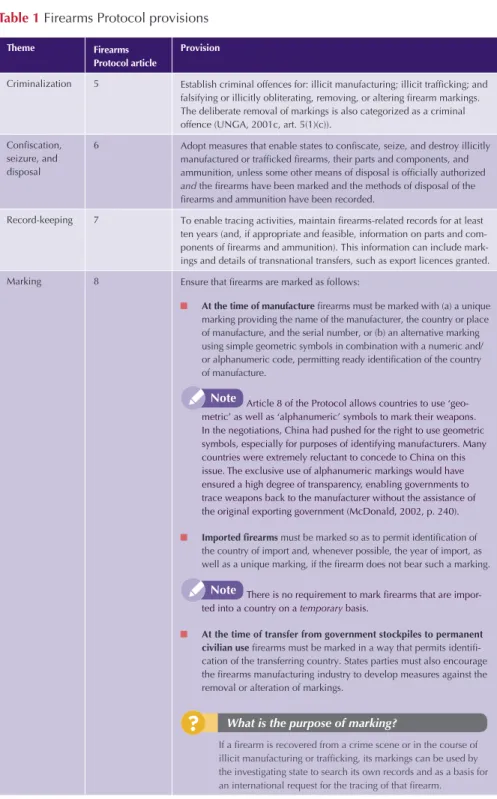
Table 1 lists central commitments of the Firearms Protocol that states parties must fulfil.
33
The F
irearms Protocol
Table 1 Firearms Protocol provisions
Theme Firearms
Protocol article
Provision
Criminalization 5 Establish criminal offences for: illicit manufacturing; illicit trafficking; and falsifying or illicitly obliterating, removing, or altering firearm markings. The deliberate removal of markings is also categorized as a criminal offence (UNGA, 2001c, art. 5(1)(c)).
Confiscation, seizure, and disposal
6 Adopt measures that enable states to confiscate, seize, and destroy illicitly manufactured or trafficked firearms, their parts and components, and ammunition, unless some other means of disposal is officially authorized
and the firearms have been marked and the methods of disposal of the
firearms and ammunition have been recorded.
Record-keeping 7 To enable tracing activities, maintain firearms-related records for at least ten years (and, if appropriate and feasible, information on parts and com-ponents of firearms and ammunition). This information can include mark-ings and details of transnational transfers, such as export licences granted. Marking 8 Ensure that firearms are marked as follows:
At the time of manufacture firearms must be marked with (a) a unique
marking providing the name of the manufacturer, the country or place of manufacture, and the serial number, or (b) an alternative marking using simple geometric symbols in combination with a numeric and/ or alphanumeric code, permitting ready identification of the country of manufacture.
Article 8 of the Protocol allows countries to use ‘geo-metric’ as well as ‘alphanumeric’ symbols to mark their weapons. In the negotiations, China had pushed for the right to use geometric symbols, especially for purposes of identifying manufacturers. Many countries were extremely reluctant to concede to China on this issue. The exclusive use of alphanumeric markings would have ensure d a high degree of transparency, enabling governments to trace weapons back to the manufacturer without the assistance of the original exporting government (McDonald, 2002, p. 240).
Imported firearms must be marked so as to permit identification of
the country of import and, whenever possible, the year of import, as well as a unique marking, if the firearm does not bear such a marking.
There is no requirement to mark firearms that are impor-ted into a country on a temporary basis.
At the time of transfer from government stockpiles to permanent civilian use firearms must be marked in a way that permits
identifi-cation of the transferring country. States parties must also encourage the firearms manufacturing industry to develop measures against the removal or alteration of markings.
If a firearm is recovered from a crime scene or in the course of illicit manufacturing or trafficking, its markings can be used by the investigating state to search its own records and as a basis for an international request for the tracing of that firearm.
What is the purpose of marking?
Note
A Diplomat’
s Guide to the UN Small
Arms Process
Handbook
Deactivation of firearms
9 If national law does not recognize a deactivated firearm as a ‘firearm’, take measures to prevent the illicit reactivation of firearms, including by: establish-ing relevant criminal offences (such as illicit reactivation or inadequate deactivatio n); ensuring that deactivation involves rendering all essential parts permanently inoperable and incapable of reactivation; and officially verifying that the firearm has been deactivated and that the firearm is marked in a way that confirms it has been deactivated.
In their national laws regulating firearms, most states include a definition of a ‘firearm’. In some countries, the definition is drafted in such a way that it includes only functioning firearms—that is, those capable of expelling a projectile. This means, for example, that antique firearms or deactivated firearms that form part of a museu m collection may not be covered by the legislation; con-sequently, there is no requirement to hold a licence for such firearms or to store them in a secure way. However, it may be possible to alter—or reactivate—such firearms so that they are capable of expellin g a projectile.
Export 10(1) Establish or maintain an effective system of export licensing or authorization for the transfer of firearms, their parts and components, and ammunition.
10(2) Before issuing export licences or authorizations, verify that importing states have issued import licences or authorizations and transit states have given notice in writing that they have no objection to the transit. 10(3) Ensure that the export licence or authorization and accompanying
docu-mentation contain information on: place and the date of issuance, the date of expiration, the country of export, the country of import, the final recipient, a description and the quantity of the firearms, their parts and components, and ammunition, and, if applicable, the countries of transit. The information contained in the import licence must be provided to the transit states in advance.
10(5) Ensure that licensing or authorization procedures are secure and that the authenticity of relevant documents can be verified or validated. Import 10(1) Establish or maintain a system of import licensing or authorization for the
transfer of firearms, their parts and components, and ammunition. 10(3) Ensure that the import licence or authorization and accompanying
docu-mentation contain information on: place and the date of issuance, the date of expiration, the country of export, the country of import, the final recipient, a description and the quantity of the firearms, their parts and components, and ammunition, and, if applicable, the countries of transit. The information contained in the import licence must be provided to the transit states in advance.
10(4) Upon request, inform the exporting state of the receipt of the dispatched shipment.
Transit 10(1) Establish or maintain measures on international transit for the transfer of firearms, their parts and components, and ammunition.
Note
Theme Firearm Protocol
article
35
The F
irearms Protocol
Information exchange
12 Exchange relevant case-specific information and cooperate in tracing with other states parties, in line with their domestic legal and administrat-ive systems; shared information can cover aspects such as known traffick-ing routes or organized criminal groups involved in trafficktraffick-ing. Cooperation 13 Cooperate at the bilateral, regional, and international levels to prevent,
combat, and eradicate the illicit manufacturing of and trafficking in fire-arms, their parts and components, and ammunition.
Brokering 15 Consider establishing a system for regulating brokers that could include one or more of the following measures: registration of brokers operating within their territory; licensing or authorization of brokering; and disclos-ure of the names and locations of brokers involved in import and export licences or accompanying documents.
Brokering provisions are recommended rather than mandatory.
Note
Scope
State-to-state transfers. The Protocol does not apply to state-to-state transactions (UNGA, 2001c, art. 4(2)). During the negotiations, states favouring the inclusion of such transfers argued that they were just as susceptible to diversion to the il-licit market and should thus be subject to the same restrictions as commercial sales. States opposing their inclusion argued that it would broaden the scope of the Protocol too far and risk taking the negotiations into sensitive territory linked to national security concerns. The latter view prevailed (McDonald, 2002, p. 239).
What is a state-to-state transfer?
State-to-state (or government-to-government) transfers involve the sale of small arms by the government of an exporting state to the government of an importing state for use by its defence or security forces. These arms may be procured from the surplus stockpiles of the exporting government; they may be produced by a state-owned company; or the exporting government may procure them on behalf of the importing government from a private arms-manufacturing com-pany operating in the exporting state.
Private manufacturers in an exporting state engage in commercial sales when they sell their small arms to an entity in a foreign country. That entity could be a government or a firearms dealer in the importing state (Parker, 2009, p. 64). If a government transfers small arms to a private individual or company, it is carrying out a state-to-private-end-user transfer.
What transfers are not state-to-state?
Theme Firearm Protocol
article
A Diplomat’
s Guide to the UN Small
Arms Process
Handbook
Transfers to non-state actors. The Protocol does not apply to ‘state transfers in cases where the application of the Protocol would prejudice the right of a State Party to take action in the interest of national security consistent with the Charter of the United Nations’ (UNGA, 2001c, art. 4(2)). Negotiating states diverged sharply in their views on whether to apply the Protocol to transfers of firearms from states to non-state actors. They eventually agreed on compromise language in Article 4.2 that allows states parties to decide for themselves whether a spe-cific transfer from the state to a non-state actor is covered by the Protocol (McDonald, 2002, pp. 239–40).
The Firearms Protocol process
Conference of the Parties
A Conference of the Parties to the Convention, established pursuant to Article 32 of UNTOC, promotes and reviews the implementation of the Convention and its protocols, including the Firearms Protocol. To date, the Conference has held six regular sessions in Vienna—in 2004, 2005, 2006, 2008, 2010, and 2012; the next Conference is scheduled to take place in the second half of 2014.8
Secretariat
The United Nations Office on Drugs and Crime is the Secretariat of the Confer-ence of the Parties to UNTOC and its protocols. Pursuant to Article 33 of UNTO C, the Secretariat’s roles are to:
assist the Conference of the Parties in carrying out its activities and support Conference sessions;
upon request, assist states parties in providing information on their imple-mentation;9 and
ensure the necessary coordination with the secretariats of relevant inter-national and regional organizations.
8 Session reports are available at UNODC (n.d.c).
9 A self-assessment software tool has been created to assist states parties in submitting information; see UNODC (n.d.d).
37
The F
irearms Protocol
Working group on firearms
10The Conference of the Parties to UNTOC established an open-ended intergov-ernmental working group on firearms in 2010 to advise and assist the Confer-ence in the implementation of its mandate with regard to the Firearms Protocol (UN CTOC, 2010, res. 5/4, para. 8). The first two meetings of the working group on firearms took place in Vienna, the first from 21 to 22 May 2012 and the second from 26 to 28 May 2014.
Relationship to the PoA
The process of developing the Firearms Protocol ran parallel to the work leading to the UN small arms conference in July 2001. Indeed, the UN small arms confer-ence opened a few weeks after the Protocol was adopted.
The drafters of the Firearms Protocol were determined to keep the instru-ment focused on crime prevention and law enforceinstru-ment.11 Many supporters
wanted to steer the negotiations clear of issues that they considered arms control rather than crime control measures. They feared that a comprehensive agree-ment would be weaker and less enforceable. Towards the end of the negoti-ations, many countries looked to the upcoming UN small arms conference as a more suitable forum for discussion of the more sensitive issues. As a result, the Firearms Protocol is limited in scope and content.
In laying the groundwork for the UN small arms conference (see Part 2.2), the Group of Governmental Experts (GGE) appointed to develop the framework for the conference noted that the illicit trade in small arms and light weapons was closely linked to the excessive and destabilizing accumulation and transfer of such arms. The group argued that:
the scope of the Conference should therefore not be limited to criminal breaches of existing arms legislation and export/import controls but consideration should be given to all relevant factors leading to the excessive and destabilizing accumula-tion of small arms and light weapons in the context of the illicit arms trade (UNGA, 1999a, para. 132).
10 For a full list of working groups established by the Conference on other issues, see UNODC (n.d.e).
11 This was consistent with the Firearms Protocol drafters’ use of CIFTA as their model (OAS, 1997; see ‘History’, above).
A Diplomat’
s Guide to the UN Small
Arms Process
Handbook
Since the Protocol already focused on combating and preventing illicit traf-ficking in small arms, calls for the UN small arms conference to do the same were significantly weakened.
Nevertheless, effective implementation and further development of the PoA and the Firearms Protocol have been closely linked. They feature many of the same measures, including ones that call on states to share information to facili-tate identification of groups involved in trafficking and illicit manufacture, ensure arms are adequately marked and records kept, and establish effective licensin g systems and transfer controls. At a more general level, there are intrinsic links between the issues of crime prevention, security, and disarma-ment that underpin both instrudisarma-ments (Greene, 2001).
Resources
UNODC (United Nations Office on Drugs and Crime). 2004a. Legislative Guides for the Implementation
of the United Nations Convention against Transnational Organized Crime and the Protocols Thereto.
<http://www.un.org/disarmament/convarms/ATTPrepCom/Background%20documents/ Legislative%20guide%20-%20E.pdf>
—. 2011. ‘Model Law against the Illicit Manufacturing of and Trafficking in Firearms, Their Parts and Components and Ammunition.’ <http://www.unodc.org/documents/legal-tools/Model_Law_ Firearms_Final.pdf>
Quick reference
The text of UNTOC and its three protocols is available here: <http://www.unodc.org/unodc/en/treaties/CTOC/> The text of the Firearms Protocol is available here:
<http://www.unodc.org/pdf/crime/a_res_55/255e.pdf>
UNODC maintains a website providing information on the Firearms Protocol and firearms-related activities:
<https://www.unodc.org/unodc/en/firearms-protocol/introduction.html>
The United Nations treaty collection maintains an updated list of states that have signed, ratified, accepted, approved, acceded to, and succeeded to the Firearms Protocol:
<http://treaties.un.org/Pages/ViewDetails.aspx?src=TREATY&mtdsg_no=XVIII-12-c&chapter =18&lang=en>
39
The Progr
amme of
Action
2.2 The Programme of Action
Background
The Programme of Action to Prevent, Combat and Eradicate the Illicit Trade in Small Arms and Light Weapons in All Its Aspects—known as the Programme of Action, or PoA—establishes a normative framework for small arms control and covers a broad spectrum of issue areas and activities.
Agreed to by all participants of a UN small arms conference held in July 2001, the PoA is a politically binding set of global commitments that provides UN member states with a mandate to develop and implement practical measures to curb the illicit trade in small arms and light weapons at the global, regional, and national levels.
History
The emergence of small arms on the international disarmament agenda
The emergence of the problem of small arms and light weapons onto the inter-national agenda must be seen in the context of the interinter-national environment of the early 1990s. Following the end of the cold war, the international community began to focus its attention on internal rather than inter-state conflicts, particu-larly through UN activities around the world.One result was a growing awareness of the pervasiveness and role of small arms and light weapons in conflict. This shift is evidenced in the UN Secretary- General’s 1995 Supplement to an Agenda for Peace, in which he explicitly draws attention to the need for ‘micro-disarmament’ efforts, meaning:
practical disarmament in the context of the conflicts the United Nations is actuall y dealing with and of the weapons, most of them light weapons, that are actually killing people in the hundreds of thousands (UNGA, 1995a, para. 60). The initial task of defining the problems associated with small arms and light weapons fell to the UN Panel of Governmental Experts on Small Arms.
A Diplomat’
s Guide to the UN Small
Arms Process
Handbook
The Panel addressed the following issues:
the types of small arms and light weapons used in conflicts being dealt with by the United Nations;
the nature and causes of the excessive and destabilizing accumulation and transfer of small arms and light weapons; and
the ways and means to prevent and reduce the excessive and destabilizing accu mulation and transfer of small arms and light weapons (UNGA, 1995b, para. 1).
Among its recommendations, the Panel called for an ‘international confer-ence on the illicit arms trade in all its aspects, based on the issues identified in the present repor t’ (UNGA, 1997a, para. 80(k)). In response, the UN General Assem-bly called for an examinati on of member states’ views on the Panel’s proposal and for a GGE to develop the framework of such a conference (UNGA, 1997b) and in 1998 announced its decision ‘to convene an international conference on the illicit trade in all its aspects’ (UNGA, 1998a, para. 1). The GGE met from May 1998 to August 1999, partly to develop the recommendations of the Panel and to make further recommendations in its 1999 report (UNGA, 1999a).
Several developments served to buttress efforts to convene an international conference. First, the successful conclusion of the Anti-personnel Mine Ban Conventio n in late 1997 gave rise to a new sense of what was possible in relation to multilateral action on conventional weapons. Second, regional organizations were increasingly active on small arms issues, with several having adopted regional instruments on the issue prior to the UN conference.12 Third, new
Comprising representatives of European Union states, the United States, China, and key members of the Non-Aligned Movement, the GGE largely reflected the composition of the UN itself. Its debates in 1998–99 thus provided an accurate preview of the difficulties that would dominate the UN small arms conference two years later.
Note
12 Regional organizations produced a number of agreements, including the Southern Africa Regional Action Programme on Light Arms and Illicit Arms Trafficking (1998), the Organization for Securit y and Co-operation in Europe’s Document on Small Arms and Light Weapons (2000), the Organization of African Unity’s Bamako Declaration (2000), and the European Union’s Plan of Action to Prevent, Combat and Eradicate the Illicit Trade in Small Arms and Light Weapons in All Its Aspects (2000), building on its earlier Code of Conduct on Arms Exports (1998) and Joint Action on Small Arms (1998).
41
initiative s were emerging largely out of concern about the relationship between illicit firearms and criminality.13 Fourth, civil society organizations had begun to
play a crucial role in getting the issue of small arms and light weapons on the international agenda; they were spearheading efforts to understand the small arms problem from the human rights, development, and humanitarian perspect-ives. With the formation of the International Action Network on Small Arms (IANSA) in the late 1990s, the emerging UN process gained a dedicated civil so-ciety interlocutor. Other civil soso-ciety groups, including the World Forum on the Future of Sport Shooting Activities, also weighed in with their views, especially with respect to firearms marking.
Anticipating the UN small arms conference
The idea of an international small arms conference was by no means uncontro-versial. A fear that the outcome might somehow limit the ability to import weapons was of particular concern to some developing countries that lacked the capacity to manufacture arms; the United States was wary with respect to do-mestic issues, such as the question of civilia n possession. Meanwhile, Canada and European Union members saw the conference as a chance to develop inter-national norms in an area where few existed. In contrast, Australia, New Zeal-and, and South Africa held that the issue was not ripe for positive international action, arguing that the conference might distract from or even undermine pos-itive steps that were already being taken at the national and regional levels.
This range of perspectives echoed the broad differences that had run through the deliberations of the Panel of Experts and the GGE with respect to the scope of any proposed action in relation to the ‘illicit trade’, including the degree to which the legal trade itself must be considered in the process. The GGE, for in-stance, had argued:
The scope of the Conference should […] not be limited to criminal breaches of existing arms legislation and export/import controls but consideration should be given to all relevant factors leading to the excessive and destabilizing accumu-lation of small arms and light weapons in the context of the illicit arms trade (UNGA, 1999a, para. 132; emphasis added).
13 These initiatives resulted in the 1997 CIFTA agreement and in the legally binding Firearms Pro-tocol of 2001. See Part 2.1 for more details.
The Progr
amme of