1
Advanced
Multiphase
Modeling
of
Solidification
with OpenFOAM®
A. Vakhrushev1, A. Ludwig2, M. Wu1, Y. Tang3, G. Hackl3, G. Nitzl4
1
Christian Doppler Laboratory for Advanced Process Simulation of Solidification and Melting, University of Leoben, 8700 Leoben, Austria
2
Simulation and Modeling of Metallurgical Processes, Department of Metallurgy, University of Leoben, 8700 Leoben, Austria
3
RHI AG, Technology Center, Magnesitstrasse 2, 8700 Leoben, Austria
4
RHI AG, 1100 Vienna, Wienerbergstrasse 9, Austria Abstract
Accumulated results of using OpenFOAM® as a tool to simulate various phenomena accompanying casting processes are presented in this paper. The designed solidification model incorporates mass and heat transfer along with the description of the multiphase solid / liquid region being formed as a porous media [1]. Turbulent flow interaction with the so called “mushy zone” is taken into account and its influence on the solid shell formation is examined extending results of reference [2,3]. Motion of the different non-metallic inclusions is modeled within the Lagrangian frame of reference [4] and verified with the experimental data. A new approach of modeling elastic deformations of the solid shell during the withdraw process in the funnel-shaped mold types is proposed as a supplement to improve the algorithm with local numerical mesh refinement presented in [5].
Keywords
Solidification, discrete phase, turbulence, deformations. 1. INTRODUCTION
Multiphase flow phenomenon is of the great interest for the modern CFD field investigations, taking into account phase transition process as well as the momentum and energy exchange between the phases. These tasks can be solved in the most complex case by incorporating the full set of the Navier-Stokes equations for each of the single phases being under the consideration. This is so called Eulerian approach, where the description of the velocity, density, temperature, solid fraction and other simulated fields focuses on the specific locations in the space through which the multiphase flow advances with the course of time.
Presented studies incorporate modeling results for the around-casting processes, such as dendritic solidification, motion of the non-metallic inclusions and gas bubbles within the melt. The newest investigations here concern stress-and-strain analysis in the solidified shell.
An enthalpy-based mixture solidification model with consideration of turbulent flow [6-9] was introduced by the current authors to model conventional continuous casting [4,10]. According to Voller et al., the treatment of the motion of the solid phase has a dramatic influence on the convection of the latent heat, hence on the shape of the evolving mushy zone [11-14]. New continuous casting technologies, e.g. the thin slab casting (TSC), for their advantages of integration of the casting-rolling production chain, energy saving, high productivity and near net shape, is likely to replace the conventional slab casting for
2
producing flat/strip products [15,16]. However, the frequently reported problems like the sensibility to breakout and edge/surface cracks have challenged the metallurgists to consider modeling tools to optimize and control the TSC parameters [17-19]. The key issue for the modelling is to consider the evolution of the solid shell, which interacts strongly with the turbulent flow and in the meantime is subject to continuous deformation due to the funnel shape (curvature) of the mould. Model formulation and the analysis of the simulation results are presented here.
During modeling of the turbulent flows and solidification in the continuous casting process to tackle particles and gas bubbles motion, Lagrangian method gives a huge advantage if it is exploited for the simulation of the additional phases with the relatively small volume fraction (<10%). Thereby, diverse nonmetallic inclusions and small gas bubbles can be described within Lagrangian frame of the reference. In the presented work the results of studies, obtained using commercial CFD software FLUENT, are compared with the comprehensive experimental measurements and with the simulations using OpenFOAM® solver, designed by the authors, incorporating the Discrete Phase Model (DPM) and Discrete Random Walk (DRW) models [4,20,21].
Momentum exchange between continuous and discrete phase, which is rather important for the transient simulation of the nonmetallic inclusions and gas bubbles motion during continuous casting, is taken into account by means of two-way coupling technique.
The advantage of the presented models consists of open-source implementation using OpenFOAM® CFD software package, which permits to combine different multiphase sub-models and to apply for the multiphase simulations.
2. SOLIDIFICATION MODEL
An enthalpy-based mixture solidification model [11-13] is applied. This mixture combines liquid -phase and solid s-phase, which are quantified by their volume fractions, f and fs.
The morphology of the solid phase is usually dendritic, but here we consider the dendritic solid phase as a part of the mixture continuum. The mixture continuum changes continuously from a pure liquid region, through the mushy zone (two phase region), to the complete solid region. The evolution of the solid phase is determined by the temperature according to a
T
fs relation (e.g. Gulliver-Scheil),
1 1 0 1 1 liquidus f f kp s T T T T f . Eutectic Eutectic liquidus liquidus T T T T T T T (1)Only one set of Navier-Stokes equation, which is applied to the domain of the bulk melt and mushy zone, is solved in the Eulerian frame of reference.
0 u , (2)
u u t u p(effu)Smon, (3)3 where s s s u u f u f u u region. solid zone mushy region melt bulk (4) Here us
, the solid velocity, is estimated by solving volume conservation and Laplace’s equations (see below). The momentum sink due to the drag of the solid dendrites in the mushy zone is modeled by the Blake-Kozeny law:
)
( s
mon u u
K
S (5)
The permeability, K, is modeled as function of the primary dendrite arm spacing1 [22]:
2 1 4 2 s 3 10 6 f f K . (6)
The energy equation applies to the entire domain,
uh eff T Se t h . (7)Here h is the sensible enthalpy of the solid hs href c dT
T T
ref p. At a given temperature the liquid phase is assumed to have an enthalpy of h hs L. Release of latent heat by
solidification, L, is treated in the source term of the energy equation,
t f L
Se s L
fsus
. (8)3. TURBULENT FLOW MODEL FOR SOLIDIFICATION
A low Reynolds number k- model was introduced by Prescott and Incropera [6-9] to handle the turbulence during solidification. In current studies a realizable k- model was employed providing improved performance for flows involving boundary layers under strong pressure gradients and strong streamline curvature. The governing equations for the turbulence are
k K G k k u t k k t, t Pr , (9)
k C S C u t 2 2 1 t, t Pr , (10)The turbulent Prandtl numbers for k : Prt,k=1.0, and for : Prt,=1.2; G is the shear
production of turbulence kinetic energy; S 2SijSij , Sij 0.5
uj xi ui xj
; Sk/. A simple approach is used to modify the turbulence kinetic energy in the mushy zone. It is assumed that within a coherent mushy zone turbulence is dampened by shear which is linearly
4
correlated with the reduction of the mush permeability. The influence of turbulence on the momentum and energy transports are considered by the effective viscosity, eff t, and
the effective thermal conductivity, eff t, where
2 μ
t C k , t ftcp, Prt,h, Cμ
is a function of velocity gradient and ensures positivity of normal stresses; Prt,h is the turbulent Prandtl number for energy equation (0.85).
4. VELOCITIES IN THE DEFORMING SHELL
A linear elasticity model [23] is further simplified to estimate the solid velocity. If we assume that in the solid domain the elastostatics condition applies and the body force is ignorable, the governing equation obtained is called Navier-Cauchy equation or elastostatic equation:
0, (11)where is the displacement vector. So called Lamé parameters , are
1 2 , 2 1 1 E E , (12)where E represents Young's modulus and is Poisson’s ratio. If the solid shell is incompressible and its deformation is at small strains ( 0.5), then a volume conservation condition is fulfilled:
0
, (13)
and the first term of Eq. (11) is forced to zero as well: 0
. (14)
Transforming Eq.(13) and (14) from Lagragian frame into Eulerian frame by considering
t
us , we obtain volume-conserved Laplace’s equations:
. 0 , 0 s s u u (15) In 2D case, these volume-conserved Laplace’s equations can be solved with a method (Method I) [24]. A stream function and a curl of the solid velocity us
are defined by: y u x u x u y u sx y s y s x s , , , (16) with T u u u ( , y) s x s s
5 . 0 , 2 2 2 2 2 2 2 2 y x y x (17)
This method provides accurate solution, but it applies only to the 2D case. An alternative and approximation method (Method II), applicable to both 2D and 3D, is to solve the one-phase Navier-Stokes equation with an ‘infinite solid viscosity’. In the current work the approximation method is to be justified by comparison with the method on the 2D base.
5. MODELING DISCRETE PHASE
The inclusions and bubbles motion along with a highly turbulent flow are under consideration in the presented numerical model. To specify the continuous phase motion, a fixed finite volume mesh is used with a so-called collocated or non-staggered variable arrangement (Rhie and Chow [25], Perić [26]), where all physical values share the same control volumes (CV), and all flux variables reside on the CV faces. The generalized form of the divergence theorem is used throughout the discretization procedure to represent mass and momentum conservation laws in integral form over the control volume. Nonmetallic inclusions and gas bubbles hereinafter referred to as “Lagrangian particles” and representing the discrete phase are tracked within Lagrangian framework.
The Navier-Stokes equations with an assumption of the liquid incompressibility are used to simulate the liquid melt motion. The equation system consisting of the continuity and momentum equations is 0 u , (18)
u u t u p(effu)SP, (19)The presence of the discrete phase is defined by the source term Sp, which represents the
momentum exchange between Lagrangian particles and the liquid flow. The estimation of its quantitative evaluation is described later. In the presented study, a RANS turbulence approach is used based on k model.
To employ the DPM theory, a definition of the Lagrangian particle should be introduced. Hereinafter we consider a spherical particle with the diameter DP and the density P. Thereby
the mass of the particle with the volume VP is estimated as 3 P P P P P 6 1 D V m . (20)
Next, it is required to track the antecedent particles’ trajectories through the simulation domain. Thereto each Lagrangian object is provided with its own position vector xP in the Cartesian system of coordinates. To determine the particle’s velocity uP and the
6
corresponding acceleration aP, it is sufficient to compute the time derivatives of the trajectory vector xP of the corresponding order:
P P
P u x
a . (21)
The defining equation of the motion in the Lagrangian frame is based on the Newton’s Second Law. It binds the acceleration of the particle with the resulting forces, acting on it:
FP u
mP , (22)
where a sum of the external forces
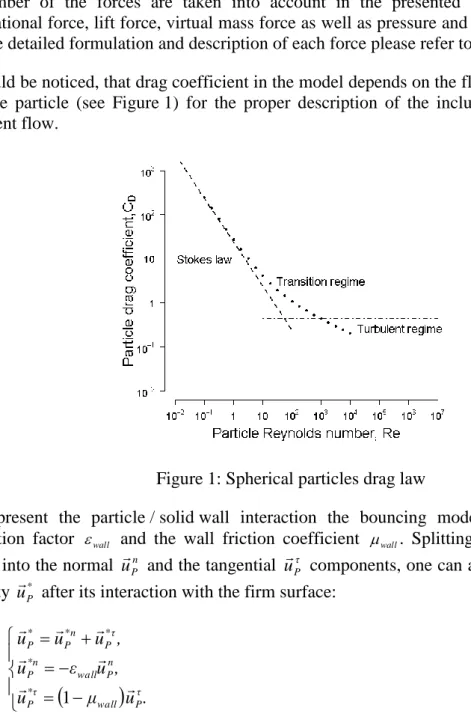
FP originate in the influence from other Lagrangian particles as well as in the impact from the surrounding continuous media motion.A number of the forces are taken into account in the presented work: particles drag, gravitational force, lift force, virtual mass force as well as pressure and stress gradient forces. For the detailed formulation and description of each force please refer to publication [4]. It should be noticed, that drag coefficient in the model depends on the flow regime around the discrete particle (see Figure 1) for the proper description of the inclusions behavior in the turbulent flow.
Figure 1: Spherical particles drag law
To represent the particle / solid wall interaction the bouncing model is defined by the restitution factor wall and the wall friction coefficient wall. Splitting the particle velocity
vector into the normal uPn and the tangential uPτ components, one can achieve a new particle velocity uP*
after its interaction with the firm surface:
. u μ u , u ε u , u u u τ P wall τ P n P wall n P τ P n P P 1 * * * * * (23)7
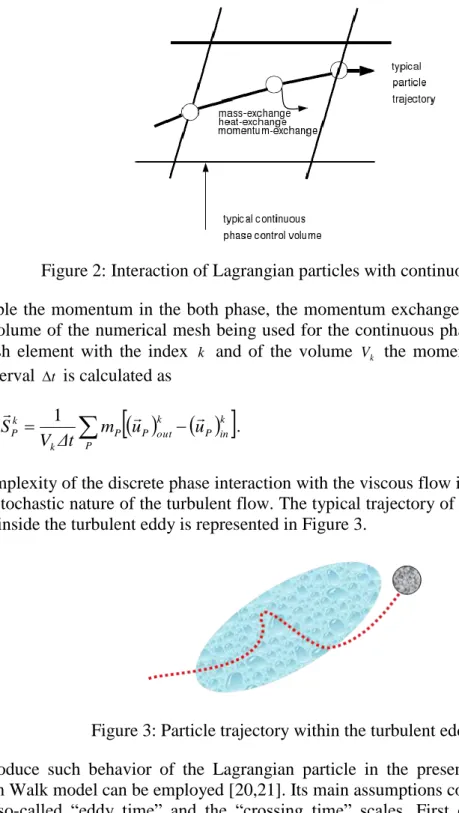
Figure 2: Interaction of Lagrangian particles with continuous phase
To couple the momentum in the both phase, the momentum exchange is determined in each finite volume of the numerical mesh being used for the continuous phase (see Figure 2). For the mesh element with the index k and of the volume Vk the momentum exchange during
time interval t is calculated as
P k in P k out P P k k P m u u Δt V S 1 . (24)The complexity of the discrete phase interaction with the viscous flow in the reality is defined by the stochastic nature of the turbulent flow. The typical trajectory of the small particle / gas bubble inside the turbulent eddy is represented in Figure 3.
Figure 3: Particle trajectory within the turbulent eddy
To introduce such behavior of the Lagrangian particle in the presented model a Discrete Random Walk model can be employed [20,21]. Its main assumptions concern the introduction of the so-called “eddy time” and the “crossing time” scales. First of them describes the characteristic time, within which the eddy can exist until it is dissipated. Second one defines the time interval sufficient for the discrete phase object to cross the eddy. Both parameters are based on the local turbulence parameters. The instant velocity becomes a sum of the mean and pulsating components in the local point, and its fluctuation amplitude depends on the kinetic energy (see [4] for details).
Next we will proceed to the simulation results and consider their application for the modelling of the real around-casting processes. Here some new studies being of the great importance for the simulation of the solidification are discussed, and it was an advantage of using
8
OpenFOAM and the transparency of its source code to be able, for example, to couple fluid flow and stress-and-strain analysis in the single CFD software, which is rather hard or some times impossible using commercial software.
6. LATENT HEAT AND FLOW REGIME INLUENCE
In this section an importance of the latent heat advection due to the motion of the dendritic structures along with the turbulent/laminar flow regime influence is studied. A 2D benchmark to analyze mention phenomena is defined, as shown in Figure 4. The melt with nominal composition of Fe-0.34wt.%C fills continuously through the inlet into the domain with constant temperature (1850 K). The casting section is gradually reduced to mimic the solidification and shell deformation in TSC. Other material properties being used refer to [1]. Solid velocity is calculated with the configuration of Figure 4(a). The whole domain is filled with the solid which is extruded downwards with the constant speed upull
=0.07 m/s, being set at the outlet. Free slip condition is applied at the walls and non-rotational condition (us 0
) is used at the inlet. Right boundary represents symmetry plane. Flow-solidification simulation is configured in Figure 4(b). A mass balance between the inlet and the outlet is fulfilled: uinAin supullAout, where Ain and Aout are the inlet and outlet surface areas. At the
walls free-slip condition is assumed.
(a) (b)
Figure 4. Configuration of a 2D benchmark (a) for solid velocity calculation and (b) for the solidification– flow calculation. The geometry in vertical direction is scaled by 1/8 (the same hereafter).
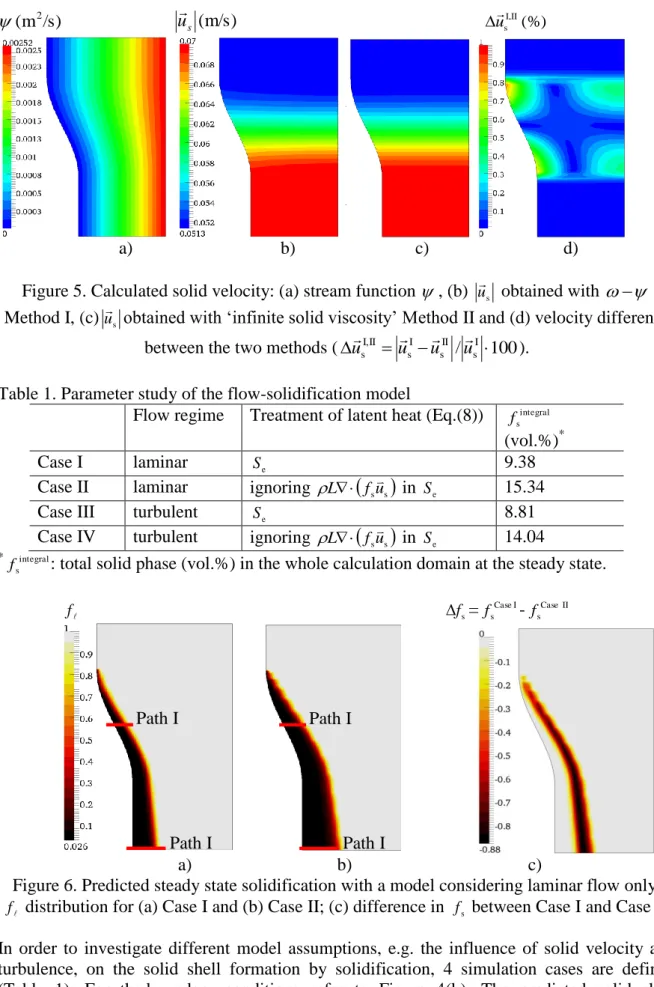
In the presented studies solid velocities calculation is decoupled from the simulation of the melt flow. They are initially estimated by solving (15) with an assumption that the whole domain is filled with the solid and are used later on for the solidification modeling in the mush region only. Thereby liquid core in the center can accelerate or retard for balancing the total mass flow rate. The calculated solid velocity, us
, is shown in Figure 5 (a)-(b). Solid phase enters the domain in parallel to the straight wall. In the section-reduction region the solid is extruded and its velocity is gradually increased. The surface profile is forced to move along the curved wall. Comparison of the calculation results by two different methods (I and II) is made in Figure 5(b)-(d). The maximum error caused by method II, solving a simplified Navier-Stokes equation with an ‘infinite solid viscosity’, is 0.8%, falling in the engineering tolerance. This solid velocity will only be used by the flow-solidification model, Eq.(5) and (8), in the region where solid phase exists.
9 ) /s m ( 2 us (m/s) (%) II I, s u a) b) c) d)
Figure 5. Calculated solid velocity: (a) stream function , (b) us
obtained with Method I, (c)us obtained with ‘infinite solid viscosity’ Method II and (d) velocity difference
between the two methods ( / I 100
s II s I s II I, s u u u u ). Table 1. Parameter study of the flow-solidification model
Flow regime Treatment of latent heat (Eq.(8)) integral s f
(vol.%)*
Case I laminar Se 9.38
Case II laminar ignoring L
fsus
in Se 15.34Case III turbulent Se 8.81
Case IV turbulent ignoring L
fsus
in Se 14.04* integral s
f : total solid phase (vol.%) in the whole calculation domain at the steady state. f fs= I Case s f - Case II s f a) b) c)
Figure 6. Predicted steady state solidification with a model considering laminar flow only:
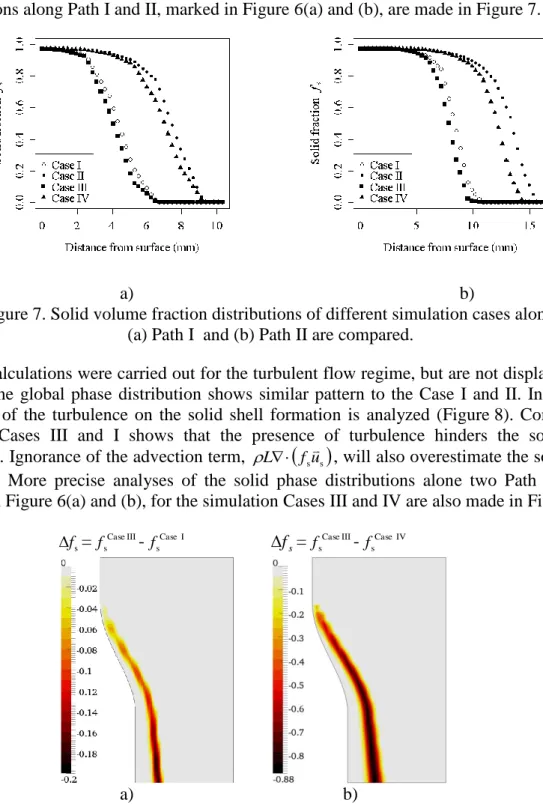
f distribution for (a) Case I and (b) Case II; (c) difference in fs between Case I and Case II. In order to investigate different model assumptions, e.g. the influence of solid velocity and turbulence, on the solid shell formation by solidification, 4 simulation cases are defined (Table 1). For the boundary conditions refer to Figure 4(b). The predicted solid shell formation for the Case I and II (only laminar flow is considered) at the steady state is shown
Path I Path I I Path I Path I I
10
in Figure 6. Obviously the treatment of the advection of latent in the energy equation is extremely important. Ignorance of the advection term, L
fsus
, in Case II will to a great extent overestimate the solid shell thickness. More precise analyses of the solid phase distributions along Path I and II, marked in Figure 6(a) and (b), are made in Figure 7.
a) b)
Figure 7. Solid volume fraction distributions of different simulation cases along (a) Path I and (b) Path II are compared.
Similar calculations were carried out for the turbulent flow regime, but are not displayed here because the global phase distribution shows similar pattern to the Case I and II. Instead the influence of the turbulence on the solid shell formation is analyzed (Figure 8). Comparison between Cases III and I shows that the presence of turbulence hinders the solid shell formation. Ignorance of the advection term, L
fsus
, will also overestimate the solid shell thickness. More precise analyses of the solid phase distributions alone two Path I and II, marked in Figure 6(a) and (b), for the simulation Cases III and IV are also made in Figure 7.
s f = CaseIII s f - Case I s f fs= III Case s f - Case IV s f a) b)
Figure 8. Influence of turbulence on the solid shell formation, i.e. the difference in fs
distribution (a) between Cases III and I, (b) between Cases III and IV.
Additionally a mesh and time step dependency of the numerical solution was examined. A low latent heat relaxation factor (0.05) [1] along with a relatively large number of iterations (50 per time-step) allowed using a relatively large time steps without problem of divergence. It was shown that the increase in time step did not influence the final steady state solution. To
11
improve the accuracy a necessity to use separate refinement regions for the temperature and solid fraction fields was approved previously by authors [5]. Thereby based on the error analysis of the energy equation and the resolution criterion of the Gulliver-Scheil correlation (Eq.(1)), consecutive mesh refinements were made (Figure 9). Eventually mesh independent results were obtained.
Figure 9. Mesh refinement to track the temperature boundary layer and solidification front
c)
Figure 10. Quasi steady state simulation result of an engineering TSC. a) 3D distribution of the velocity vector field and evolution of the solid shell (dark region in the 5 cross sections); b) zoomed velocity field in the central plane near the narrow face; c) detailed velocity (uy component) profile and solid volume fraction along two paths cross the mushy zone.
Based on the aforementioned model a simulation of the real engineering TSC (width 1726 mm and thickness 72 mm) was performed, and the calculation result is shown in Figure 10. The calculation domain includes the submerge entry nozzle and entire mold region and part of water cooled strand (till 2000 mm from meniscus). To ensure the calculation accuracy numerical techniques like parallel computing and mesh adaptation are necessarily applied. More than 1 million computational cells are used to resolve the interdendritic flow in the
u (m/s) a) b) temperature boundary layer mushy zone boundary layer Mol d wa ll B ulk l iqui d
12
mushy zone (Figure 10(c)). In [2,3] Laplace’s equation was solved for solid velocities with a constant vertical component assumption restricting longitudinal deformations. The new approach doesn’t have such a limitation and helps to mimic the mush better.
7. MODELING DISCRETE PHASE
Based on the implementation of the DPM solver in the OpenFOAM CFD software package, a number of simulations were made.
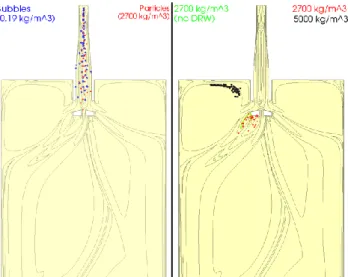
First of all, comparison of the nonmetallic inclusion and gas bubbles behavior in the turbulent flow was made (Figure 11). Particles of two types (with densities of 2700 and 5000 kg/m3 accordingly) and argon bubbles (density 0.19 kg/m3) were injected from different points of the 2D continuous casting mold geometry with the steady state fluid flow been established. It is marked on the figures by the gray-colored stream lines.
Figure 11: Initial injection of the particles and gas bubbles
Bubbles (blue circles) and particles (red dots), presented at the left draw, were ejected through SEN with the same initial velocities. On the right picture, black-dotted particles are injected at the region of the large top vortex at the slag region, other (red and green) at the SEN ports. The only difference in the simulation setup for green-marked particles is that turbulence / particle interaction is not taken into account (in other word, DRW model is switched off for that type of objects). Hereby it is possible to estimate the significance of the eddy influence on the particle trajectories.
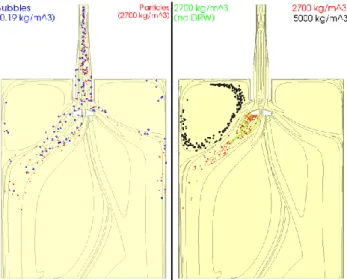
Further one can see (Figure 12) how the distribution of the gas bubbles and particles dramatically changes after they are involved by the flow. Bubbles, as it was emphasized here before, are strongly influenced by the buoyancy force counteracting the main flow drag: even at the initial stages of the simulation some of the gas bubbles are already captured by the slag. Smaller particles mostly follow the melt motion. Additionally, they are spread out over the simulation domain due to the interaction with the turbulent flow.
13
Figure 12: Gas bubbles and solid particles distribution after injection is complete
Figure 13: Developed distribution of the gas bubbles and solid particles during numerical simulation
a) b) c)
Figure 14: Gas bubbles and solid particles distribution in 3D mold geometry in (a) 1 second (b) 2 seconds (c) 3 seconds after injection
14
Finally, after the motion of the particles and bubbles is developing in the course of time (Figure 13), following conclusions can be made: gas bubbles mostly tend to rise to the slag surface; however some of them are still brought with the melt flow downwards and leave the simulation domain through the outlet; thereby they can be entrapped into the final product and facilitate the porosity formation; particle inclusions are strongly influenced by the melt flow; turbulence dramatically enhances their distribution (e.g. green colored particles strictly follow the stream lines as opposed to other types with the DRW model taken into account). Dispersion effect is even more amplified in 3D real geometries (Figure 14).
Obtained results emphasize the importance of the flow pattern in the continuous casting mold, which can either enhance or reduce the porosity formation and nonmetallic inclusions entrapment into final product.
Presented analysis of the results, obtained with the developed solver for the simulation of the nonmetallic inclusions and the gas bubbles in the continuous casting mold, sustains the efficiency of the numerical experiment concept for the continuous casting especially when it is rather difficult to receive measurement’s and experimental data. Open-source CFD package OpenFOAM proved to be an excellent design tool for the implementation and further development of the DPM approach for the multiphase flows simulation.
8. VERIFICATION OF THE DPM MODEL
As an extension of the presented work a verification of the DPM solver was carried out based on the obtained results of the water modeling experiment regarding the particle flow.
Particle flow experiment included tundish water flow with the particle been injected through the nozzle above the trial device. Particles being lighter than water tended to reach the water / air surface due to the buoyancy force, which competed with the strong flow, dragging the particles towards the reservoir’s outflow. Transparent walls of the tundish permitted to capture the particles motion during the trials with the speed camera, giving an impression regarding the turbulent flow behavior.
Fig. 15. Wooden frames at the tundish and the particles, being captured at the surface (voestalpine Stahl laboratory, Linz, Austria)
Figure 15 show the final stage of the water modeling experiment with the particles been captured within emerged wooden frames on the top of the tundish. Figure 16(a), showing
15
instantaneous picture of the turbulent flow stream lines (OpenFOAM® simulation) stresses the complexity of the convectional mechanisms influencing particle motion.
a) b)
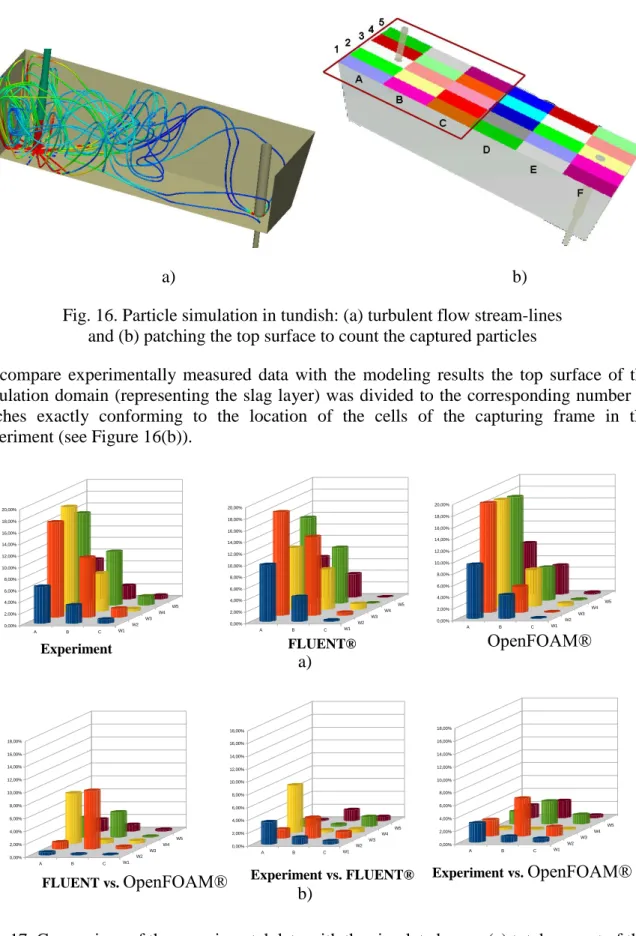
Fig. 16. Particle simulation in tundish: (a) turbulent flow stream-lines and (b) patching the top surface to count the captured particles
To compare experimentally measured data with the modeling results the top surface of the simulation domain (representing the slag layer) was divided to the corresponding number of patches exactly conforming to the location of the cells of the capturing frame in the experiment (see Figure 16(b)).
Fig. 17. Comparison of the experimental data with the simulated ones: (a) total amount of the particles being captured; (b) difference between acquired data sets
0,00% 2,00% 4,00% 6,00% 8,00% 10,00% 12,00% 14,00% 16,00% 18,00% A B C W1 W2 W3 W4 W5 0,00% 2,00% 4,00% 6,00% 8,00% 10,00% 12,00% 14,00% 16,00% 18,00% A B C W1 W2 W3 W4 W5 0,00% 2,00% 4,00% 6,00% 8,00% 10,00% 12,00% 14,00% 16,00% 18,00% 20,00% A B C W1 W2 W3 W4 W5 0,00% 2,00% 4,00% 6,00% 8,00% 10,00% 12,00% 14,00% 16,00% 18,00% 20,00% A B C W1 W2 W3 W4 W5 0,00% 2,00% 4,00% 6,00% 8,00% 10,00% 12,00% 14,00% 16,00% 18,00% 20,00% A B C W1 W2 W3 W4 W5 a) b) 0,00% 2,00% 4,00% 6,00% 8,00% 10,00% 12,00% 14,00% 16,00% 18,00% A B C W1 W2 W3 W4 W5
Experiment FLUENT® OpenFOAM®
16
Figure 17 represents quantitative comparison between measured and simulated results. One can see that FLUENT® simulation as well as one done with OpenFOAM® showed good agreement with the experiment along the tundish walls. FLUENT® solver underestimated the amount of the captured particles in the central part of the tundish, whereas in OpenFOAM® simulation we got a perfect agreement. On the contrary, the mean part between walls and center plain was much better treated by the FLUENT® DPM, than OpenFOAM®’s one. The fundamentals of the simulation results deviation from the experimental observation consist of the particle forces treatment in the different model formulations and should be studied in the future.
9. SUMMARY
A long term experience with CFD software development has shown that the OpenFOAM® package can be extensively used for the combination of flow-solidification calculation of the conventional casting as well as for the thin slab casting applications where the deforming solid shell is observed. Modelling results of a 3D thin slab casting are presented to demonstrate the functionality of the numerical model. For particles and bubbles motion and extended DPM model was developed and the first verifications with the water modelling are carried out. Further model development for the around-casting processes simulation with OpenFOAM® (e.g. free surface simulation along with the solidification) and verifications against experiments are desired.
10.ACKNOWLEDGMENT
The financial support by RHI AG, the Austrian Federal Ministry of Economy, Family and Youth and the National Foundation for Research, Technology and Development is gratefully acknowledged.
17 REFERENCES
[1] M. Wu, A. Vakhrushev, G. Nummer, C. Pfeiler, A. Kharicha and A. Ludwig, Importance of Melt Flow in Solidifying Mushy Zone. Open Transport Phenomena J. – Bentham Open. 2, pp. 16-23 (2010)
[2] A. Vakhrushev, A. Ludwig, M. Wu, Y. Tang, G. Nitzl and G. Hackl, Modeling of Turbulent Melt Flow and Solidification Processes in Steel Continuous Caster with the Open Source Software Package OpenFOAM®. Proc. OSCIC’10, Munich, Nov. 4-5, pp. 1-17 (2010) [3] A. Vakhrushev, A. Ludwig, M. Wu, Y. Tang, G. Nitzl and G. Hackl, Modeling of Heat Transfer and Solidification Processes in Thin Slab Caster. Proc. ECCC 2011, Düsseldorf,
June 27 – July 01, S18, pp. 1-10 (2011)
[4] A. Vakhrushev, A. Ludwig, M. Wu, Y. Tang, G. Nitzl and G. Hackl, Modeling of nonmetallic inclusions and gas bubbles motion in continuous caster. Proc. STEELSIM 2011, Düsseldorf, June 27 – July 01, S17, pp. 1-8 (2011)
[5] A. Vakhrushev, A. Ludwig, M. Wu, Y. Tang, G. Nitzl and G. Hackl, Coupling the turbulent flow with the solidification processes in OpenFOAM®. Proc. OSCIC’11, Paris
Chantilly, Nov. 3-4, pp. 1-21 (2011)
[6] Prescott PJ and Incropera FP 1994 Transp. Phen. in Mater. Proc. & Manuf.-ASME HTD
280 59.
[7] Prescott PJ and Incropera FP 1994 J. Heat Transfer 116 735.
[8] Prescott PJ, Incropera FP and Gaskell DR 1994 Trans. ASME 116 742. [9] Prescott PJ and Incropera FP 1995 Trans. ASME 117 716.
[10] Pfeiler C, Thomas BG, Wu M, Ludwig A and Kharicha A 2008 Steel Res. Int. 79 599. [11] Voller VR and Prakash C 1987 Int. J. Heat Mass Transfer 30 1709.
[12] Voller VR, Brent AD and Prakash C 1989 Int. J. Heat Mass Transfer 32 1719. [13] Voller VR, Brent AD and Prakash C 1990 Appl. Math. Modeling 14 320.
[14] Chakraborty PR and Dutta P 2011 Metall. Mater. Trans. 42B in press (DOI: 10.1007/s11663-011-9585-3).
[15] Yin RY 2009 J. Iron & Steel Res. 16 (Supplement 1) 1.
[16] Birat JP and Bobadilla M 2006 Proc. McWASP XI (Eds: Gandin CA and Bellet M, TMS Publications) 33.
[17] Tang Y, Krobath M, Nitzl G, Eglsaeer C and Morales R 2009 J. Iron & Steel Res. 16 (Supplement 1) 173.
18
[18] Thomas BG 2001 Brimacombe Lecture, 59th Electric Furnace Conf. (Iron & Steel Soc.) 3.
[19] Tian X, Zou F, Li B and He J 2010 Metall. Mater. Trans. 41B 112
[20] Graham, D. I.; James, P. W.: Turbulent dispersion of particles using eddy interaction models; Int. J. Multiphase Flow, 1996, vol. 22, Issue 1, P. 157-175
[21] Graham, D. I.: On the inertia effect in eddy interaction models; Int. J. Multiphase Flow, 1996, vol. 22, Issue 1, P. 177-184
[22] Gu JP and Beckermann C 1999 Metall. Mater. Trans. 33A 1357.
[23] Slaughter WS 2002 The Linearized Theory of Elasticity (Boston: Birkhäuser).
[24]Roache PJ 1998 Fundamentals of Computational Fluid Dynamics (New Mexico: Hermosa Publishers)
[25] Rhie, C. M.; Chow, W. L.: A numerical study of the turbulent flow past an isolated airfoil with trailing edge separation; 3rd Joint Thermophysics, Fluids, Plasma and Heat Transfer Conference, St. Louis, Missouri, 1982
[26] Perić, M.: A Finite Volume method for the prediction of three-dimensional fluid flow in complex ducts; PhD thesis, Imperial College, University of London, 1985