The Relationship between Innovative Behavior and Sustainable
Development
Panteha Khodakarami, Zukarnain Zakaria
International business school, Universiti Teknologi Malaysia (UTM), Jalan Semarak, 54100 Kuala Lumpur, Malaysia
Abstract
This paper aims to review the previous studies in order to collect the effects of innovative behavior on sustainable development. However, there is just a limited research between innovative behavior and sustainable development. This paper provides a collection of prior studies which have been done regarding the relationship among innovative behavior, innovation, and sustainable development. The importance of this paper refers to sustainable development that is usually focused by companies, which are involved in economic, environmental, and social perspectives. Sustainable development and innovative behavior constitute engines of development today. Innovative behavior is related to the human behavior which can be related to problem recognition, idea generation, supporting idea and idea implementation. This research attempts to review past studies for the purpose of justifying the relation between innovative behavior and sustainable development. Therefore, this paper calls to pay attention to such question as how the attributes of innovative behavior can effect sustainable development.
Keywords: Sustainable development, Innovative behavior 1. Introduction
Many claim that sustainable development challenges the increased integration of the world in a capitalist economy (Middleton et al, 1993; Christie and Warburton, 2001). Sustainable development is defined as a rate of growth that can be kept without making other economic issues, particularly regarding next generations. Clearly there is a trade-off between quick economic growth at the present and in the future. The rapid development of today may exhaust resources and make environmental problems in future such as, lower oil and global warming. In sense of sustainability, it may be said that the growth of short-term debt, rather than long-term productivity is unstable. For an economy to keep growing in the future, it requires to enhance its capacity for growth. In fact, the increase of the productive potential can be expressed by an outward change in production possibility frontier (PPF) of the economy.
According to Janssen (2000) a correlation exists between sustainable development and innovation, particularly the employees’ response to innovation. Response to innovation is a salient feature impacting the accomplishment and continuity of an organization (Janssen, 2000). Innovation for sustainable development needs design processes; in this case, it leads toward change and the development of individual and collective human work (Duarte, F. et al 2015). Innovative behavior – a type of action - focuses on accomplishing a deliberate line of action and the realization of alternate ways of working (Janssen, 2003). Going by his definition creativity or creative actions and innovative behavior are synonymous qualities that impact discussion on new products, services and procedures (Amabile, 1998). The perception exists that innovative behavior is at variance with creative behavior, since innovative behavior impacts the execution of an idea (De Jong & Dan Hartog, 2010). Pieterse et al (2010) propounded that creativity is a salient component of innovative behavior at the commencement of the innovative undertaking (Jong & Hartog, 2010). In actuality innovative behavior comprises two aspects, that is, creating ideas and putting into effect.
Moreover innovative behavior is essentially an Ad hoc activity and on the part of the individual and therefore the organization usually does not recognize it (Ramamoorthy, Flood, Slattery and Sardessai, 2005). However, individuals who are active in this kind of behavior could provide effectively to the organization’s creative objectives (Ramamoorthy et al, 2005). With reference to this innovative behavior there are parallels between innovative behavior and organizational citizenship behavior (OCB) (Jafri, 2010). The important difference being that innovative behavior is meant as a solution to issues for individuals to manage situations or transform routines practiced in the organization (Janssen 2000). However, the commitment of helping others moves beyond OCB exclusively of normal expectations in service work (Robbins & Judge, 2003). Therefore innovative behavior is designed to help individuals improve their work capabilities and in executing their ideas (Janssen 2000).
To remain viable and competitive an organization has to be innovative (Kanter, 1986, Peters & Waterman, 1982). For an organization to be viable it should address competition worldwide, changing population profiles, new generation of evolving technologies; these are some challenges organizations must face. When such challenges surface and increase, the organization should be thoroughly prepared to stay viable. Amabile (1997) announced
that it might not be possible for an organization to be viable if it continues to offer the same standard of products and services continuously in a changing environment. Porter (1990) supposed that a country’s ability to be competitive could depend on the value of its products. It is quite obvious that the knowledge gained about different matters in companies could serve as useful tools for other managers in their quest for viability in the long run.
One more subject for investigation concerning innovation deals with the quality of analysis by individuals. A large amount of earlier investigative work on innovation and organizational levels were skewed with misinterpretation of the functions of certain workers dealing with innovation (King & West, 1987). Individual research capabilities vary vastly between public and private sectors. For example, the conventional rewards for innovation in the private sector is more encouraging than in the public sector. In modern economies innovation in research and development play a significant role to maintain viability and competitiveness of the firm.
Due to the weight given to R&D due to innovation it is important that the company concerned offered the proper investment to drive the R&D effort; this aspect is very much discussed by experts in many fields. Earlier studies have highlighted the fact that innovation contributes a great advantage to future economic growth (Keister, L.A & Hodson R, 2009). Therefore this paper attempts to demonstrate the effect innovative behavior has on sustainable development.
2. Literature Review 2.1 Innovation
To define innovation is not simple and there is not an acceptable definition of it anywhere in the world. Though this subject is discussed widely in most organizations related to real changes. The definition of innovation is extremely vague (Amabile, 1983) (Brazeal & Herbert, 1999) (Oldham & Cummings, 1997) (Patterson, 2000) (Woodman, Sawyer, & Griffin, 1993). Essentially, three definitions have been highlighted and characterized. Zaltman et al divided innovation into three categories: The first refers to invention; the second refers to process and the third refers to product. From existing literature the above three are further extended as creation, development and marketing. Innovation means change and change produces something new. This new thing can be translated into a product or a kind of operation. This innovation can be defined as a summary of two ideas and concepts (Gronhaug & Kaufmann, 1988) being newness and an advantage or a positive change.
There is ample literature and publications that highlight innovation in areas of study such Patterson as economics, strategic management, entrepreneurship, and human resources among others. These areas are discussed in this study via behavior in organizations. For a company to survive in a competitive environment innovation is of paramount importance (Jung, Chow & Wu 2003). Organizational innovation pertains to the creation and enhancement of new and current products and services and to succeed in propelling these into the marketplace (Gumusluoğlu & Ilsev, 2009). Thus, as a requirement organizational innovation is a critical tool for improving organizational performance (García-Morales, Lloréns-Montes, & Verdú-Jover, 2008).
Some research has been conducted at team level innovation as a result variable (Gebert, Boerner, & Kearney, 2010). According to Eisenbeiss, van Knippenberg, & Boerner (2008), team innovation works on creation and execution of numbers and the quality of critiques among teams. Team process plays a critical part in highlighting team innovation and ensures that the members contribute to obtaining the goals of the team (Hülsheger, Anderson, & Salgado, 2009).
To conceive and implement any innovative project successfully all individuals should work as a team; this is to all1ow ideas and methods to flow freely between members (Heunks, 1998). (Scott & Bruce, 1994) said that to motivate individuals innovative behavior is essential and this was reinforced by information obtained from the company’s R&D situated in the United States. The atmosphere that is conducive for innovative discussion improves the behavior among workers.
To innovate is to create new ideas and to apply them in an appropriate approach. New ideas can contain to a technological innovation, a process innovation, or an administrative (Markicˇ, 2004). In the 20th century during the industrial revolution, two types of innovation were developed technological and administrative.
2.2 Technological innovation
Damanpour (1987) theorized that Technological Innovation includes changes to technology that in turn creates changes in the organization. Changes in technological innovation include products, processes and technologies (Gopalakrishnan & Bierly, 2001). It is perceived that organizational innovation drives product innovation; productivity is driven by technological innovation. To achieve technological innovation it is considered to use new generation instruments and techniques. R&D plays a strategic part in the implementation of techniques and instruments. Damanpour (1987) states that from the above methodologies technological innovation is realized. The environment in which the company is situated motivates it to produce innovative goods (Utterback & Suarez, 1993). To maintain this conducive environment companies should institute five paradigms. They are:
1.Technology driven model, 2.Market sensitive model, 3.Coupling model, 4.Parallel model, 5.Networking model (Rothwell, 1992).
The technology driven model dictates the performance of the product/service in the market. The market sensitive model drives innovation following customer satisfaction. The coupling model relates to the mix of science, technology and the market. Parallel model refers to the vertical and horizontal growth of a firm, with reference to other companies (Rothwell, 1992).
Gallouj and Weinstein, (1997) studied that technological innovation is central to any manufacturing organization. The above is dependent on two models: the first model builds on and improves on the central innovation process and the second model on the entrepreneurial action (Sundbo, 1997).
2.3 Administrative innovation
This type of innovation happens when emerging procedures, policies and organizational forms are taken into account (Ravichandran, 2000). Administrative innovation also includes opportunity of resources and tasks (Evans, 1989). Innovation is an exceptional form of transformation which inputs new changes (Coopey et al 1998). This new input can take the form of a product or policy or accommodation. Hence, innovation could be defined as an appliance, process or product which is emerging to the organization that adopted it. (Damanpour, 1991). This research will focus on the logical conclusion for administrative innovations since it is part of the premise of this study.
The management of an organization usually involves administrative innovation since major policies are handed down from management (Gopalakrishnan & Bierly, 2001). One can find major differences between administrative and technological innovation, as the premises are different. Also the two innovations have different guiding principles.
Moreover, Ravichandran (2000) states that the results of technological adoption need to be specific when compared to administrative topics. Damanpour et al (1987) expressed regret that organizational innovation has not probed into various types of innovations. It is suggested that enhanced emphasis on this subject would lead to increased emphasis on technological innovation than administrative innovation. The outcome demonstrates that administrative innovation influences the espousal of technological innovation (Damanpour, Szabat & Evans, 1989). When considering the important difference between technological and administrative innovation it is obvious that differences exist between technology and social structure; also decision-making methods tend to vary (Damanpour, 1991). Progressive organizations tend to favour technological innovation whereas more conventional companies favour administrative innovation (Daft, 1978). This theory is supported by many researchers (Damanpour, 1988, Kimberly & Evanisko, 1981).
The process of organizational structure involves the administrative innovation and also demands the structure of the organization management (Damanpour, 1988). This outlook directly influences the strategic management environment of the firms. This in turn contributes to management innovation. Innovation of personnel involves changing workers’ position and enhancing of personnel by utilizing various techniques (Knight, 1967).
When compared to other innovations the study conducted in relation to administrative innovation is ongoing. The reason for this ongoing process of administrative innovation is due to the fact that innovation should involve skilled managers to implement. There is also a paucity of chances to integrate administrative and technological innovations. Technological innovation is also massive enough to assimilate administrative innovation. Many are of the opinion that these two should not be isolated from each other (Van de Ven, Angle & Poole, 2000).
The influence of economics has assisted in creating administrative innovation (Teece, 1980). The benefit of implementing administrative innovation is similar to the improvement in productivity due to implementing technological innovation.
Cooper et al (1986) and Clark et al (1995) think that innovation is a process of various phases. It is on top of this theory that a model was designed which impacts the degrees of innovation and assists in innovative behavior. This model proposes that behavior is an individual’s participation at every stage of innovation. This model also underlines various areas of innovation such as (a) the basic idea and putting into operation (b) transforming the idea into a concept (c) transforming concept into actuality (d) bringing the model / product to the marketplace. Moreover this study also accentuates administrative innovation as a multiphase process and it is synonymous with employees’ innovative actions.
The perception of multiphase process gives essential clarification about individual innovative behavior. The multiphase process also highlights certain aspects on organizational innovation as individual activities. However P G Scott & Falcone (1998) are assured that individual actions are not confined to this first phase.
2.4 Innovative behavior
Innovative behavior plays a vital part for the proper functioning and longevity of the firm (Amabile, 1988; Ancona, D. G., & Caldwell, D. F. 1992). The definition if innovative behavior of an individual’s actions is his ability to work towards gaining the purposeful generation and achievement of newer and more beneficial ideas
relevant to various processes, products or procedure on an individual basis or in a team environ (Farr & Ford, 1990). This definition highlights the fact that innovative behavior is akin to creative behavior (Amabile 1988). In addition innovative behavior is largely a discretionary behavior (i.e. optional role behavior) and is rarely identified with current reward protocols of companies (Ramamoorthy et al 2005). However, employees participating in such types of behavior could eventually reinforce their company to accomplish innovative goals (Ramamurthy et al 2005). By this reasoning innovative behavior could be rated as similar to organizational citizenship behavior (OCB) (Jafri 2010). The salient difference between both of these is that innovative behavior seems to solve problems for employees (Janssen, 2000) while OCB just about helps people to move further in their jobs (Robbins & judge, 2003).
A great number of studies have been implemented to investigate the effect of personal characteristics and features on innovation- centered results (Anderson, de Dreu & Nijstad, 2004). Consequently, a large quantity of individual characteristic such as tolerance, self-confidence, openness of experience, creative personality
(Medjar, Oldham & Pratt, 2002), and personal initiative were found in individuals at different levels of creativity or innovation (Woodman et al., 1993).
To-date, no research has completely paid attention to the relationships between opposition to change and innovative performance. It has been shown that in only one instance has a negative situation been highlighted due to opposition to change (Oreg, 2003, Study 6) because of this characteristic generated poor innovation-adoption behavior.
2.4.1 Multi-Stage of process of innovative behavior
Innovative behavior consists of four steps. Identification of the problem would be the first step. The second step is to produce ideas. Gathering support for ideas is the third stage, and lastly to implement the ideas (Scott & Bruce 1994). The progression from producing ideas to execution will have significant effect on products, processes and also on the whole organization (Janssen 2003).
In earlier discussions it was highlighted that individual innovative behavior commences with the identification of the issues at hand which could result in newer and improved ideas (Drucker, 2002). At this stage employees will be on the lookout for other business ventures and should be able to critique current products and services (de Jong & Den Hartog, 2010). Once they have identified the issue they would be in a position to spawn new ideas and thus innovation is born. Creating new ideas at this stage is a success for employees (Pieterse et al 2010). It is then up to the individual to identify a third person who can be anyone who can drive this idea to reality (Janssen, 2000). Upon execution of the idea to reality the last part of the project becomes manufacturing the product or its mock-up which has the potential for profit for the individual, team or company (Janssen, 2000). Hence, innovative behavior could be taken as a series of actions with various programs and individual behavior at each stage.
According to de Jong & Den Hartog (2010) exploration, generation, championing and executing of ideas are four actions for evaluating innovative behavior. To appraise theoretical relationship of innovative working behavior (IWB) confirmatory factor analyses and hierarchical multi-level regression are employed. Also the evaluation of participative leadership, outside work associates and innovative output, confirmed adequate reliability and standard validity.
Disagreements with colleagues and employee turnover have a positive relationship with IWB (Shih & Susanto, 2011). Assessments have demonstrated that being fair, balances the association between IWB and disagreements with associates. Zenko et al (2011) researched that innovative behavior demonstrates that innovation mode attracted more publicity.
Much study has been conducted on innovative behavior. Scott & Bruce (1994) expound innovative behavior as an individual’s unique action to meet company’s goals. According to Scott & Bruce (1994), Bruce’s exploration in the direction of new methodologies, sciences, processes, evolving ideas, delivering concepts to others, investigations are synonymous with employee innovative behavior.
2.5 Sustainable development (SD)
Nidumolu et al (2009) postulated that SD has become a global phenomenon and apparently has no equal. SD has firmed itself significantly among economists and politicians.
Initially SD was considered to be an obstacle to economic development; SD was not considered to be a complement to innovation, but innovation was looked upon as a criti1cal component in employee creativity behavior and development plans. In 1911, Schumpter put forward the Walrasian static framework to enumerate the dynamics of economics and the innovative entrepreneur (Shumpter, 1911). However, SD was unpopular due to costs and ecological restriction.
Organizations have integrated SD into their long-term plans at the minutest levels to reap the benefits of achieving social responsibility. Consequently, organizations achieve environmental management (ISO 14000 – standard), quality management (ISO 9000), and sustainable logistics (Wu & Dunn, 1995).
Pesqueux & Biefnot (2000) postulate that in current times entrepreneurs tend to focus on SD and social responsibility (CSR) espoused about 10 years ago at every strata of the organization. The connection between innovation and SD is vague. Schumpter argues that innovation by itself propels growth, while SD is considered central to economic growth. There are some concerns: 1) what is the reason for innovation to be associated with development? 2) Can it be assimilated into SD? 3) Can innovation and SD be resigned? 4) Consequently, there are two perceptions SD could encourage innovation or could be the product of a series of innovations.
2.5.1 The Sustainable Development Concept as a New Context
As enumerated earlier SD’s concept is “development that meets the needs of the present without compromising the ability of future generations to meet their own needs”. Specifically, its primary objective is directing development in the following manner: a) Economics (especially arranging interchanging between nations and upgrading backward areas) b) Social Aspect (ensuring that healthcare and educational facilities are available and safeguarding acceptable working environments) c) Environmental (combatting pollution and illegal exploitation of natural resources and ensuring the continuity of bio-diversity).
From the perspective of the company the SD protocol necessitates policies of corporate social responsibility (CSR) that is “the voluntary integration by social and ecological concerns of companies in their commercial activities and in their relationships to their partners” (Commission of the European Communities, 2001). With respect to this the position of stakeholder is paramount: the organization must bear in mind their responsibilities to involved parties. The part played by the company in carrying out its social responsibility is connected to the stakeholder theory that may propose a conceptual form for amalgamating SD within companies (Bouglet, J., Joffre, O., & Simon, E. (2012) or (Reynaud and Dontenwill, 2006). This theory presumes that ‘company’ is a collection of incoming and outgoing interests (Donaldson & Preston, 1995). This ensures that many stakeholders have a say in the management of the company.
2.6 Sustainable development as a basis of innovation
Organizations regard SD as a modern concept to their goals. Bouglet et al (2012) postulate that SD despite its constraints also has opportunities. Innovation and SD is made up of development processes stakeholders’ which are interconnected and can thrive on each other. Porter & Kramer (2011) claim that SD’s strategies are capable of making a firm basis for competitive advantage.
Ethical and environmental sensitivity have no disagreements with one another- “Good ethics is Good Business” (Blanchard & Peale, 1988). It is the general consensus that the interests of SD are best served by companies to attain their goals (Clarkson 1995). However, the involved stakeholders’ expectations/ objectives concerning SD should drive managers to obtain the necessary information to make appropriate decisions.
Despite the fact that companies practice SD to a limited extent this methodology suggests that SD can contribute to an organization’s growth potential via organizational and strategic goals. Therefore, based on the previous discussion on employees’ innovative behavior, sustainable development and the relationship between them, the first hypothesis of this study is as below:
3. Proposed Framework
The framework of this study is driven from the theories regarding sustainable development and innovation. In this regard, below a summary of previous studies has been provided especially to highlight their variables and findings for the purpose of supporting the framework of this study, as shown in Table 1.
Table 5. Summary of studies regarding innovation and sustainable development
Author(s) Variable Findings Methodology
(Johannessen & Olsen, 2009) Sustainable competitive advantages as the dependent variable. Innovation as a process of percolation and Systemic knowledge process focusing on innovation as the independent variables.
It is through these processes that organizations can develop innovations, which ultimately will lead to sustainable competitive advantages.
The research question in this paper was how can systemic knowledge processes create innovation and promote competitive advantages? Through a conceptual model it is argued that a prerequisite for the acquisition,
development, integration and application of knowledge, is the existence of systemic knowledge processes, percolation processes and networking. (Bouglet, Joffre, & Simon, 2012) Sustainable development and innovation approach. Sustainable development
constitutes a new data of the macro-environmental context, likely to modify the competing industries and systems in which companies evolve. In return,
they represent many opportunities that companies can seize to model their strategies. Within the framework of such an approach, innovation and sustainable development constitute engines of development which can get connected and virtuously feed themselves. Conceptual paper (Kardos, 2012) Entrepreneurship, innovation and Sustainable Development
The research results point out that sustainable entrepreneurship, seen through the perspective of innovative SMEs, as considered in the research, is part of the support system for sustainable
development, as entrepreneurial enterprises are increasingly recognized as a driving force for innovation and competitiveness, as one of the keys to achieving sustainable development.
The methodology is based on methods of analysis and synthesis, of interpretation and relevant comparisons.
(Natarajan & Wyrick, 2011)
Sustainable practices The paper introduces a preliminary framework for implementing sustainable practices among SMEs in the United States.
Conceptual research
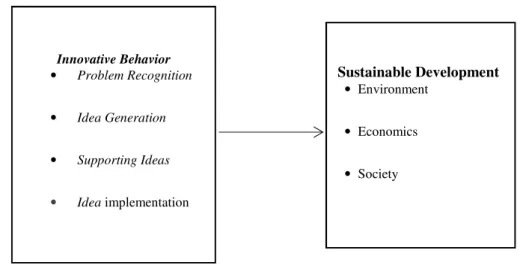
Thus, literature reports that several studies have been carried out with a focus on the relationship between sustainable development and innovation (e.g. Johannessen & Olsen, 2009; Natarajan & 1Wyrick, 2011; Bouglet, Joffre, & Simon, 2012; Kardos, 2012), as shown in Table 1. However, the relationship between innovative behavior and sustainable development can be supported by previous studies. Hence, the following framework can be proposed:
Figure 5. Proposed Framework
4. Discussion
This paper encompasses three major parts namely innovation, employee’s innovative behavior and sustainable development. The study reviews previous studies for the defined relationship between innovation and sustainable development. However, innovation is viewed as innovative behavior in this study. Accordingly, several past works were studied and it was found out that innovation is considered very vital for every domain and everybody is involved in innovation. The role of management is defined in creativeness for the support of collaborators’ creativeness. The administrative innovation is so a part in the innovative business system. To innovate is to create new ideas and to apply them in an appropriate approach. New ideas can contain to a technological innovation (new technical inventions, new machinery or products), a process innovation (new services, programs, or production procedures), or an administrative innovation (new on policies, structures or systems) (Markicˇ, 2004).
Sustainable development needs notable effort and innovation for fully seen the demands of three purposes: social equity, environmental sustainability and economic development. Sustainable Development needs considerable investment in terms of innovation (Meynard et al., 2006). However, human work is not adequate in the challenge set by the innovative attempts for Sustainable development (Duarte, F. et al). This study reviews the value of having innovation through innovative behavior to increase sustainable development within the organizations involved in strategic decision. Accordingly, administrative innovation managers can create and maintain an innovative climate (Damanpour, 1988) through different ways in which employees are willing to innovate. Further research should focus on empirically testing the different ways or variables which influence on innovative behavior in order to increase SD; thus, future researchers could shape employees’ innovative behavior via various effective aspects.
5. Conclusion
This study concentrates on achieving sustainable development through employee’s innovative behavior. Nowadays sustainable development is one of the most important elements in every organization and many efforts are made in this regard. Organizations should not only focus on economic growth, but on environmental and social matters. The result of many studies indicates that technical and administrative innovations are very effective for achieving sustainable development. Innovation is related to the human behavior and in this perspective innovative behavior is related to problem recognition, idea generation, making support for ideas, and idea implementation. This study justified the relation between innovative behavior and sustainable development. Future studies could tests the conceptual framework of this study in various industries. This paper in its first parts presents a rich literature review on innovation and innovative behavior from different perspectives. The limitation of this paper is that there are still other aspects that might exist in innovative behavior that can be considered by other studies. Additionally, it is recommended to the future researchers to study other different aspects of innovative behavior in which may influence sustainable development and the effect of other related variables such as knowledge management, knowledge quality, and knowledge sharing for innovative behavior. Therefore, future scholars could examine in which extent these factors need to reinforce for maintaining innovative work behavior in order to enhance sustainable development.
Innovative Behavior • Problem Recognition • Idea Generation • Supporting Ideas • Idea implementation Sustainable Development • Environment • Economics • Society
References
Amabile, T. M. (1983). The social psychology of creativity: A componential conceptualization. Journal of personality and social psychology, 45(2), 357.
Amabile, T. M. (1988). A model of creativity and innovation in organizations. Research in organizational behavior, 10(1), 123-167.
Amabile, T. M. (1997). Entrepreneurial creativity through motivational synergy. The Journal of Creative Behavior, 31(1), 18-26.
Ancona, D. G., & Caldwell, D. F. (1992). Bridging the boundary: External activity and performance in organizational teams. Administrative science quarterly, 634-665.
Anderson, N., De Dreu, C. K., & Nijstad, B. A. (2004). The routinization of innovation research: A constructively critical review of the state-of-the-science. Journal of organizational Behavior, 25(2), 147-173. Becker, M. C., & Knudsen, T. (2002). Schumpeter 1911: Farsighted visions on economic development. American Journal of Economics and Sociology, 61(2), 387-403.
Blanchard, K., & Peale, N. V. (1988). The Power of Ethical Man Blanchard, K., & Peale, N. V. (1988). The Power of Ethical Management. New York: William Morrow and Company.agement. New York: William Morrow and Company.
Bouglet, J., Joffre, O., & Simon, E. (2012). How to reconcile business with sustainable development: an innovation approach. Society and Business Review, 7(3), 212-222.
Brazeal, D. V., & Herbert, T. T. (1999). The genesis of entrepreneurship. Entrepreneurship theory and practice, 23, 29-46.
Christie I, Warburton D. 2001. From Here to Sustainability. Earthsc an: London
Clarkson, M. E. (1995). A stakeholder framework for analyzing and evaluating corporate social performance. Academy of management review, 20(1), 92-117.
Clark, K. B., & Wheelwright, S. (1995). Leading product development: Free Press, New York. Blanchard, K., & Peale, N. V. (1988). The Power of Ethical Management. New York: William Morrow and Company.
Cooper, R. G., & Kleinschmidt, E. J. (1986). An investigation into the new product process: steps, deficiencies, and impact. Journal of product Innovation management, 3(2), 71-85.
Coopey, J. (1998). Learning to trust and trusting to learn a role for radical theatre. Management Learning, 29(3), 365-382.
Daft, R. L. (1978). A dual-core model of organizational innovation. Academy of management journal, 21(2), 193-210.
Damanpour, F. (1987). The adoption of technological, administrative, and ancillary innovations: Impact of organizational factors. Journal of management,13 (4), 675-688.
Damanpour, F. (1988). Innovation type, radicalness, and the adoption process. Communication research, 15(5), 545-567.
Damanpour, F., Szabat, K. A., & Evan, W. M. (1989). The relationship between types of innovation and organizational performance. Journal of Management Studies, 26(6), 587-602.
Damanpour, F. (1991). Organizational innovation: A meta-analysis of effects of determinants and moderators. Academy of management journal, 34(3), 555-590.
De Jong, J., & Den Hartog, D. (2010). Measuring innovative work behavior. Creativity and Innovation Management, 19(1), 23-36.
Donaldson, T., & Preston, L. E. (1995). The stakeholder theory of the corporation: Concepts, evidence, and implications. Academy of management Review, 20(1), 65-91.
Drucker, P. F. (2002). The discipline of innovation. 1985. Harvard business review, 80(8), 95-100.
Eisenbeiss, S. A., van Knippenberg, D., & Boerner, S. (2008). Transformational leadership and team innovation: integrating team climate principles. Journal of applied Psychology, 93(6), 1438.
Duarte, F., Béguin, P., Pueyo, V., & Lima, F. (2015). Work activities within sustainable development. Production, 25(2), 257-265.
Farr, J. L., & Ford, C. M. (1990). Individual innovation.
Gallouj, F., & Weinstein, O. (1997). Innovation in services. Research policy, 26(4), 537-556.
García-Morales, V. J., Lloréns-Montes, F. J., & Verdú-Jover, A. J. (2008). The Effects of Transformational Leadership on Organizational Performance through Knowledge and Innovation*. British Journal of Management, 19(4), 299-319.
Gebert, D., Boerner, S., & Kearney, E. (2010). Fostering team innovation: why is it important to combine opposing action strategies? Organization science, 21(3), 593-608.
USA.
Gopalakrishnan, S., & Bierly, P. (2001). Analyzing innovation adoption using a knowledge-based approach. Journal of Engineering and Technology management, 18(2), 107-130.
Gumusluoğlu, L., & Ilsev, A. (2009). Transformational Leadership and Organizational Innovation: The Roles of Internal and External Support for Innovation*. Journal of product Innovation management, 26(3), 264-277. Heunks, F. J. (1998). Innovation, creativity and success. Small Business Economics, 10(3), 263-272.
Hülsheger, U. R., Anderson, N., & Salgado, J. F. (2009). Team-level predictors of innovation at work: a comprehensive meta-analysis spanning three decades of research. Journal of applied Psychology, 94(5), 1128. Jafri, M. H. (2010). Organizational Commitment and Employee’s Innovative Behaviour. Journal of Management Research, 10(1), 62-68.
Janssen, E. M., Lemmens, E. E., Wolfe, T., Christen, U., von Herrath, M. G., & Schoenberger, S. P. (2003). Cd4+ t cells are required for secondary expansion and memory in cd8+ t lymphocytes. Nature, 421(6925), 852-856.
Johannessen, J.-A., & Olsen, B. (2009). Systemic knowledge processes, innovation and sustainable competitive advantages. Kybernetes, 38(3/4), 559-580.
Janssen, O. (2000). Job demands, perceptions of effort—reward fairness and innovative work behaviour. Journal of Occupational and Organizational Psychology, 73, 287- 302.
Jung, D. I., Chow, C., & Wu, A. (2003). The role of transformational leadership in enhancing organizational innovation: Hypotheses and some preliminary findings. The Leadership Quarterly, 14(4), 525-544.
Kanter, R. (1986). Supporting innovation and venture development in established companies. Journal of business venturing, 1(1), 47-60.
Kardos, M. (2012). The Relationship between Entrepreneurship, Innovation and Sustainable Development. Research on European Union Countries. Procedia Economics and Finance, 3, 1030-1035.
Keister, L. A., & Hodson, R. (2009). Ownership and innovation during economic development: corporate ownership and strategy formation in China. Research in the Sociology of Work, 19, 129-163.
Kimberly, J. R., & Evanisko, M. J. (1981). Organizational innovation: The influence of individual, organizational, and contextual factors on hospital adoption of technological and administrative innovations. Academy of management journal, 24(4), 689-713.
King, N., & West, M. A. (1987). Experiences of innovation at work. Journal of Managerial Psychology, 2(3), 6-10.
Knight, K. E. (1967). A descriptive model of the intra-firm innovation process. The journal of business, 40(4), 478-496.
Madjar, N., Oldham, G. R., & Pratt, M. G. (2002). There's no place like home? The contributions of work and nonwork creativity support to employees' creative performance. Academy of Management Journal, 45(4), 757-767.
Markič, M. 2004. Inoviranje procesov: pogoj za odličnost poslovanja. Koper: Fa- kultetaza management
Meynard J. M., Aggeri F., Coulon J. B., Habib R., & Tillon J. P. (2006). Recherches sur la conception de systèmes agricoles innovants. Paris: National Institute of Agricultural Research.
Middleton N, O‟Keefe P, Moyo S. 1993. Tears of the Crocodile: From Rio to Reality in the Developing World. Pluto Press: London
Natarajan, G. S., & Wyrick, D. A. (2011). Framework for implementing sustainable practices in SMEs in the United States. Paper presented at the Proceedings of the World Congress on Engineering.
Nidumolu, R., Prahalad, C. K., & Rangaswami, M. R. (2009). Why sustainability is now the key driver of innovation. Harvard business review, 87(9), 56-64.
Oldham, G. R., & Cummings, A. (1997). Enhancing creativity: Managing work for the high potential employee. California Management Review, 40(1), 22-38.
Oreg, S. (2003). Resistance to change: developing an individual differences measure. Journal of applied Psychology, 88(4), 680.
Patterson, F. (2000). Maximising innovation in the workplace: The development of a new model and measurement tool. TRAINING JOURNAL-ELY-, 23-25.
Pesqueux, Y., & Biefnot, Y. (2002). L'éthique des affaires: management par les valeurs et responsabilité sociale. éd. d'Organisation.
Pesqueux, Y., & Biefnot, Y. (2002). L’éthique des affaires. Editions d’organisation, 239p.
Peters, T. J., Waterman, R. H., & Jones, I. (1982). In search of excellence: Lessons from America's best-run companies.
Porter, M. E. (1990). The competitive advantage of nations. Harvard business review, 68(2), 73-93. Porter, M. E., & Kramer, M. R. (2011). Creating shared value. Harvard business review, 89(1/2), 62-77.
Ramamoorthy N., Flood P.C., Slatt ery T., & Sardessai R. (2005). eterminants of Innovative Work Behaviour: Development and Test of an Integrated Model. Creativity and Innovation management, 14, 142-150.
Ravichandran, T. (2000). Swiftness and intensity of administrative innovation adoption: an empirical study of TQM in information systems. Decision Sciences, 31(3), 691-724.
Reynaud, E. and Dontenwill, E. (2006), “Le roˆle de l’approche par les parties prenantes dans l’initiation d’une politique de de´veloppement durable: e´tude du cas d’une entreprise de transport urbain”, Gestion 2000, janvier-fe´vrier, pp. 33-59.
Robbins, S. P., & Judge, T. (2003). Essentials of organizational behavior.
Rothwell, R. (1992). Developments towards the fifth generation model of innovation. Technology Analysis & Strategic Management, 4(1), 73-75.
Schumpeter, J. A. (1911). 1934. The theory of economic development.
Scott, S. G., & Bruce, R. A. (1994). Determinants of innovative behavior: A path model of individual innovation in the workplace. Academy of management journal, 37(3), 580-607.
Scott, P. G., & Falcone, S. (1998). Comparing Public and Private Organizations An Exploratory Analysis of Three Frameworks. The American Review of Public Administration, 28(2), 126-145.
Shih, H.-A., & Susanto, E. (2011). Is innovative behavior really good for the firm?: Innovative work behavior, conflict with coworkers and turnover intention: moderating roles of perceived distributive fairness. International Journal of Conflict Management, 22(2), 111-130.
Sundbo, J. (1997). Management of innovation in services. Service Industries Journal, 17(3), 432-455. The European Commission. (2001) Palgrave.
Teece, D. J. (1980). The diffusion of an administrative innovation. Management science, 26(5), 464-470. Utterback, J. M., & Suarez, F. F. (1993). Innovation, competition, and industry structure. Research policy, 22(1), 1-21.11
Van de Ven, A. H., Angle, H. L., & Poole, M. S. (2000). Research on the management of innovation: The Minnesota studies: Oxford University Press New York.
Woodman, R. W., Sawyer, J. E., & Griffin, R. W. (1993). Toward a theory of organizational creativity. Academy of management review, 293-321.
Wu, H. J., & Dunn, S. C. (1995). Environmentally responsible logistics systems. International Journal of Physical Distribution & Logistics Management, 25(2), 20-38.
Zaltman, G., Duncan, R., & Holbek, J. (1973). Innovations and organizations (Vol. 1973). New York: Wiley. Zenko, Z., & Mulej, M. (2011). Diffusion of innovative behavior with social responsibility. Kybernetes, 40(9/10), 1258-1272.